
























Artificial
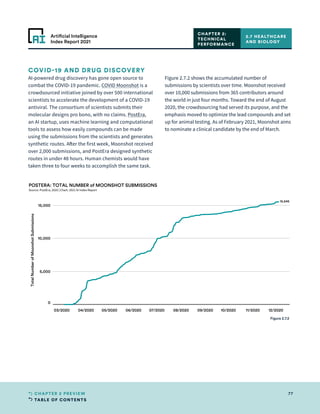
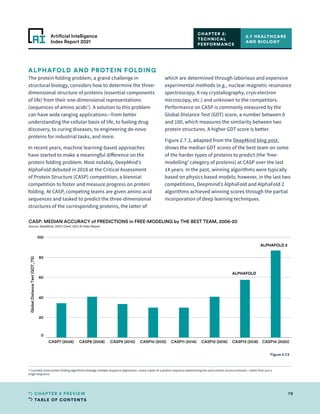
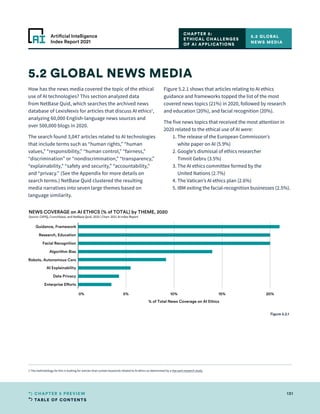
Intelligence
Index Report 2021
Artificial Intelligence
Index Report 2021
2
INTRODUCTION TO THE
2021 AI INDEX REPORT
Welcome to the fourth edition of the AI Index Report!
This year we significantly expanded the amount of data
available in the report, worked with a broader set of
external organizations to calibrate our data, and deepened
our connections with Stanford’s Institute for Human-
Centered Artificial Intelligence (HAI).
The AI Index Report tracks, collates, distills, and visualizes
data related to artificial intelligence. Its mission is to
provide unbiased, rigorously vetted, and globally sourced
data for policymakers, researchers, executives, journalists,
and the general public to develop intuitions about the
complex field of AI. The report aims to be the world’s most
credible and authoritative source for data and insights
about AI.
COVID AND AI
The 2021 report shows the effects of COVID-19 on AI
development from multiple perspectives. The Technical
Performance chapter discusses how an AI startup used
machine-learning-based techniques to accelerate COVID-
related drug discovery during the pandemic, and our
Economy chapter suggests that AI hiring and private
investment were not significantly adversely influenced
by the pandemic, as both grew during 2020. If anything,
COVID-19 may have led to a higher number of people
participating in AI research conferences, as the pandemic
forced conferences to shift to virtual formats, which in turn
led to significant spikes in attendance.
CHANGES FOR THIS EDITION
In 2020, we surveyed more than 140 readers from
government, industry, and academia about what they
found most useful about the report and what we should
change. The main suggested areas for improvement were:
	 • 
Technical performance: We significantly expanded
this chapter in 2021, carrying out more of our own
analysis.
	 • 
Diversity and ethics data: We gathered more data
for this year’s report, although our investigation
surfaced several areas where the AI community
currently lacks good information.
	 • 
Country comparisons: Readers were generally
interested in being able to use the AI Index for cross-
country comparisons. To support this, we:
		• 
gathered more data to allow for comparison
among countries, especially relating to
economics and bibliometrics; and
		• 
included a thorough summary of the various AI
strategies adopted by different countries and
how they evolved over time.
PUBLIC DATA AND TOOLS
The AI Index 2021 Report is supplemented by raw data
and an interactive tool. We invite each member of the AI
community to use the data and tool in a way most relevant
to their work and interests.
	 • 
Raw data and charts: The public data and high-
resolution images of all the charts in the report are
available on Google Drive.
	 • 
Global AI Vibrancy Tool: We revamped the Global AI
Vibrancy Tool this year, allowing for better interactive
visualization when comparing up to 26 countries
across 22 indicators. The updated tool provides
transparent evaluation of the relative position of
countries based on users’ preference; identifies
relevant national indicators to guide policy priorities
at a country level; and shows local centers of AI
excellence for not just advanced economies but also
emerging markets.
	 • 
Issues in AI measurement: In fall 2020, we
published “Measurement in AI Policy: Opportunities
and Challenges,” a report that lays out a variety of
AI measurement issues discussed at a conference
hosted by the AI Index in fall 2019.
Artificial Intelligence
Index Report 2021
3
Table of Contents
INTRODUCTION TO THE 2021 AI INDEX REPORT	 	2
TOP 9 TAKEAWAYS	 	4
AI INDEX STEERING COMMITTEE  STAFF	 	5
HOW TO CITE THE REPORT	 	6
ACKNOWLEDGMENTS	 	7
REPORT HIGHLIGHTS	 10
CHAPTER 1	 Research and Development	 14
CHAPTER 2	 Technical Performance	 41
CHAPTER 3	 The Economy	 80
CHAPTER 4	 AI Education	 107
CHAPTER 5	 Ethical Challenges of AI Applications	 125
CHAPTER 6	 Diversity in AI	 135
CHAPTER 7	 AI Policy and National Strategies	 151
APPENDIX		 177
ACCESS THE PUBLIC DATA
Artificial Intelligence
Index Report 2021
4
AI investment in drug design and discovery increased significantly: “Drugs, Cancer, Molecular,
Drug Discovery” received the greatest amount of private AI investment in 2020, with more than USD
13.8 billion, 4.5 times higher than 2019.
The industry shift continues: In 2019, 65% of graduating North American PhDs in AI went into
industry—up from 44.4% in 2010, highlighting the greater role industry has begun to play in AI
development.
Generative everything: AI systems can now compose text, audio, and images to a sufficiently high
standard that humans have a hard time telling the difference between synthetic and non-synthetic
outputs for some constrained applications of the technology.
AI has a diversity challenge: In 2019, 45% new U.S. resident AI PhD graduates were white—by
comparison, 2.4% were African American and 3.2% were Hispanic.
China overtakes the US in AI journal citations: After surpassing the United States in the total
number of journal publications several years ago, China now also leads in journal citations;
however, the United States has consistently (and significantly) more AI conference papers (which are also
more heavily cited) than China over the last decade.
The majority of the US AI PhD grads are from abroad—and they’re staying in the US:
The percentage of international students among new AI PhDs in North America continued to rise in
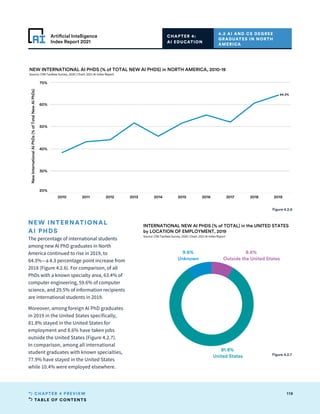
2019, to 64.3%—a 4.3% increase from 2018. Among foreign graduates, 81.8% stayed in the United States
and 8.6% have taken jobs outside the United States.
Surveillance technologies are fast, cheap, and increasingly ubiquitous: The technologies
necessary for large-scale surveillance are rapidly maturing, with techniques for image classification,
face recognition, video analysis, and voice identification all seeing significant progress in 2020.
AI ethics lacks benchmarks and consensus: Though a number of groups are producing a range
of qualitative or normative outputs in the AI ethics domain, the field generally lacks benchmarks
that can be used to measure or assess the relationship between broader societal discussions about
technology development and the development of the technology itself. Furthermore, researchers and
civil society view AI ethics as more important than industrial organizations.
AI has gained the attention of the U.S. Congress: The 116th Congress is the most AI-focused
congressional session in history with the number of mentions of AI in congressional record more
than triple that of the 115th Congress.
TOP 9 TAKEAWAYS
1
2
3
4
5
6
7
8
9
Artificial Intelligence
Index Report 2021
5
AI Index Steering Committee
AI Index Staff
Co-Directors
Members
Research Manager and Editor in Chief	
Program Manager
Jack Clark
OECD, GPAI
Daniel Zhang
Stanford University
Erik Brynjolfsson
Stanford University
John Etchemendy
Stanford University
Deep Ganguli
Stanford University
Barbara Grosz
Harvard University
Terah Lyons
Partnership on AI
James Manyika
McKinsey Global Institute
Juan Carlos Niebles
Stanford University
Michael Sellitto
Stanford University
Yoav Shoham (Founding Director)
Stanford University, AI21 Labs
Raymond Perrault
SRI International
Saurabh Mishra
Stanford University
Artificial Intelligence
Index Report 2021
6
How to Cite This Report
Daniel Zhang, Saurabh Mishra, Erik Brynjolfsson, John Etchemendy, Deep Ganguli, Barbara
Grosz, Terah Lyons, James Manyika, Juan Carlos Niebles, Michael Sellitto, Yoav Shoham,
Jack Clark, and Raymond Perrault, “The AI Index 2021 Annual Report,” AI Index Steering
Committee, Human-Centered AI Institute, Stanford University, Stanford, CA, March 2021.
The AI Index 2021 Annual Report by Stanford University is licensed under
Attribution-NoDerivatives 4.0 International. To view a copy of this license,
visit http://creativecommons.org/licenses/by-nd/4.0/.
The AI Index is an independent initiative at Stanford University’s
Human-Centered Artificial Intelligence Institute (HAI).
We thank our supporting partners
We welcome feedback and new ideas for next year.
Contact us at AI-Index-Report@stanford.edu.
The AI Index was conceived within the One Hundred Year Study on AI (AI100).
Artificial Intelligence
Index Report 2021
7
Acknowledgments
We appreciate the following organizations and individuals who provided data, analysis,
advice, and expert commentary for inclusion in the AI Index 2021 Report:
Organizations
arXiv
Jim Entwood, Paul Ginsparg,
Joe Halpern, Eleonora Presani
AI Ethics Lab
Cansu Canca, Yasemin Usta
Black in AI
Rediet Abebe, Hassan Kane
Bloomberg Government
Chris Cornillie
Burning Glass Technologies
Layla O’Kane, Bledi Taska, Zhou Zhou
Computing Research Association
Andrew Bernat, Susan Davidson
Elsevier
Clive Bastin, Jörg Hellwig,
Sarah Huggett, Mark Siebert
Intento
Grigory Sapunov, Konstantin Savenkov
International Federation of Robotics
Susanne Bieller, Jeff Burnstein
Joint Research Center, European
Commission
Giuditta De Prato, Montserrat López
Cobo, Riccardo Righi
LinkedIn
Guy Berger, Mar Carpanelli, Di Mo,
Virginia Ramsey
Liquidnet
Jeffrey Banner, Steven Nichols
McKinsey Global Institute
Brittany Presten
Microsoft Academic Graph
Iris Shen, Kuansan Wang
National Institute of Standards and
Technology
Patrick Grother
Nesta
Joel Klinger, Juan Mateos-Garcia,
Kostas Stathoulopoulos
NetBase Quid
Zen Ahmed, Scott Cohen, Julie Kim
PostEra
Aaron Morris
Queer in AI
Raphael Gontijo Lopes
State of AI Report
Nathan Benaich, Ian Hogarth
Women in Machine Learning
Sarah Tan, Jane Wang
Artificial Intelligence
Index Report 2021
8
Individuals
ActivityNet
Fabian Caba (Adobe Research); Bernard
Ghanem (King Abdullah University of
Science and Technology); Cees Snoek
(University of Amsterdam)
AI Brain Drain and Faculty Departure
Michael Gofman (University of Roches-
ter); Zhao Jin (Cheung Kong Graduate
School of Business)
Automated Theorem Proving
Geoff Sutcliffe (University of Miami);
Christian Suttner (Connion GmbH)
Boolean Satisfiability Problem
Lars Kotthoff (University of Wyoming)
Corporate Representation at
AI Research Conferences
Nuruddin Ahmed (Ivey Business School,
Western University); Muntasir Wahed
(Virginia Tech)
Conference Attendance
Maria Gini, Gita Sukthankar (AAMAS);
Carol Hamilton (AAAI); Dan Jurafsky
(ACL); Walter Scheirer, Ramin Zabih
(CVPR); Jörg Hoffmann, Erez Karpas
(ICAPS); Paul Oh (IROS); Pavlos Peppas,
Michael Thielscher (KR)
Ethics at AI Conferences
Pedro Avelar, Luis Lamb, Marcelo
Prates (Federal University of Rio
Grande do Sul)
ImageNet
Lucas Beyer, Alexey Dosovitskiy,
Neil Houlsby (Google)
MLPerf/DAWNBench
Cody Coleman (Stanford University),
Peter Mattson (Google)
Molecular Synthesis
Philippe Schwaller (IBM
Research–Europe)
Visual Question Answering
Dhruv Batra, Devi Parikh (Georgia
Tech/FAIR); Ayush Shrivastava
(Georgia Tech)
You Only Look Once
Xiang Long (Baidu)
Artificial Intelligence
Index Report 2021
9
Advice and Expert Commentary
Graduate Researchers
Report and Website
Alexey Bochkovskiy; Baidu’s PaddlePaddle Computer Vision Team; Chenggang Xu (Cheung Kong
Graduate School of Business); Mohammed AlQuraishi (Columbia University); Evan Schnidman
(EAS Innovation); Fanghzhen Lin (Hong Kong University of Science and Technology); David Kanter
(MLCommons); Sam Bowman (New York University); Maneesh Agrawala, Jeannette Bohg, Emma
Brunskill, Chelsea Finn, Aditya Grover, Tatsunori Hashimoto, Dan Jurafsky, Percy Liang, Sharon
Zhou (Stanford University); Vamsi Sistla (University of California, Berkeley); Simon King (University
of Edinburgh); Ivan Goncharov (Weights  Biases)
Ankita Banerjea, Yu-chi Tsao (Stanford University)
Michi Turner (report graphic design and cover art); Nancy King (report editor); Michael Taylor
(report data visualization); Kevin Litman-Navarro (Global AI Vibrancy Tool design and development);
Travis Taylor (AI Index website design); Digital Avenues (AI Index website development)
Artificial Intelligence
Index Report 2021
10
CHAPTER 1: RESEARCH  DEVELOPMENT
• 
The number of AI journal publications grew by 34.5% from 2019 to 2020—a much higher percentage growth
than from 2018 to 2019 (19.6%).
• 
In every major country and region, the highest proportion of peer-reviewed AI papers comes from academic
institutions. But the second most important originators are different: In the United States, corporate-
affiliated research represents 19.2% of the total publications, whereas government is the second most
important in China (15.6%) and the European Union (17.2%).
• 
In 2020, and for the first time, China surpassed the United States in the share of AI journal citations in the
world, having briefly overtaken the United States in the overall number of AI journal publications in 2004 and
then retaken the lead in 2017. However, the United States has consistently (and significantly) more cited AI
conference papers than China over the last decade.
• 
In response to COVID-19, most major AI conferences took place virtually and registered a significant increase
in attendance as a result. The number of attendees across nine conferences almost doubled in 2020.
• 
In just the last six years, the number of AI-related publications on arXiv grew by more than sixfold, from 5,478
in 2015 to 34,736 in 2020.
• 
AI publications represented 3.8% of all peer-reviewed scientific publications worldwide in 2019, up from
1.3% in 2011.
CHAPTER 2: TECHNICAL PERFORMANCE
• 
Generative everything: AI systems can now compose text, audio, and images to a sufficiently high standard
that humans have a hard time telling the difference between synthetic and non-synthetic outputs for some
constrained applications of the technology. That promises to generate a tremendous range of downstream
applications of AI for both socially useful and less useful purposes. It is also causing researchers to invest in
technologies for detecting generative models; the DeepFake Detection Challenge data indicates how well
computers can distinguish between different outputs.
• 
The industrialization of computer vision: Computer vision has seen immense progress in the past decade,
primarily due to the use of machine learning techniques (specifically deep learning). New data shows that
computer vision is industrializing: Performance is starting to flatten on some of the largest benchmarks,
suggesting that the community needs to develop and agree on harder ones that further test performance.
Meanwhile, companies are investing increasingly large amounts of computational resources to train
computer vision systems at a faster rate than ever before. Meanwhile, technologies for use in deployed
systems—like object-detection frameworks for analysis of still frames from videos—are maturing rapidly,
indicating further AI deployment.
REPORT HIGHLIGHTS
Artificial Intelligence
Index Report 2021
11
• 
Natural Language Processing (NLP) outruns its evaluation metrics: Rapid progress in NLP has yielded AI
systems with significantly improved language capabilities that have started to have a meaningful economic impact
on the world. Google and Microsoft have both deployed the BERT language model into their search engines, while
other large language models have been developed by companies ranging from Microsoft to OpenAI. Progress in
NLP has been so swift that technical advances have started to outpace the benchmarks to test for them. This can
be seen in the rapid emergence of systems that obtain human level performance on SuperGLUE, an NLP evaluation
suite developed in response to earlier NLP progress overshooting the capabilities being assessed by GLUE.
• 
New analyses on reasoning: Most measures of technical problems show for each time point the performance
of the best system at that time on a fixed benchmark. New analyses developed for the AI Index offer metrics that
allow for an evolving benchmark, and for the attribution to individual systems of credit for a share of the overall
performance of a group of systems over time. These are applied to two symbolic reasoning problems, Automated
Theorem Proving and Satisfiability of Boolean formulas.
• 
Machine learning is changing the game in healthcare and biology: The landscape of the healthcare and
biology industries has evolved substantially with the adoption of machine learning. DeepMind’s AlphaFold
applied deep learning technique to make a significant breakthrough in the decades-long biology challenge of
protein folding. Scientists use ML models to learn representations of chemical molecules for more effective
chemical synthesis planning. PostEra, an AI startup used ML-based techniques to accelerate COVID-related drug
discovery during the pandemic.
CHAPTER 3: THE ECONOMY
• 
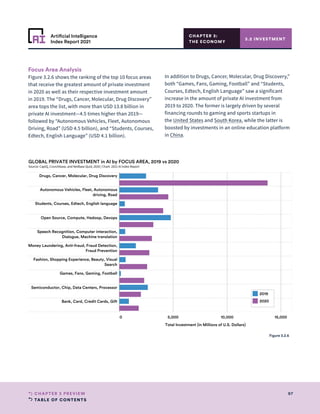
“Drugs, Cancer, Molecular, Drug Discovery” received the greatest amount of private AI investment in 2020, with
more than USD 13.8 billion, 4.5 times higher than 2019.
• 
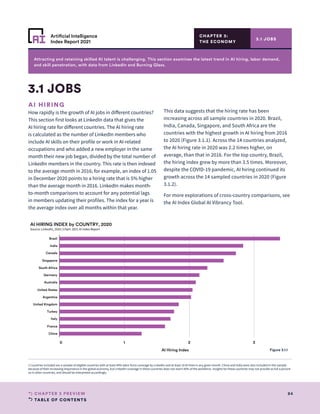
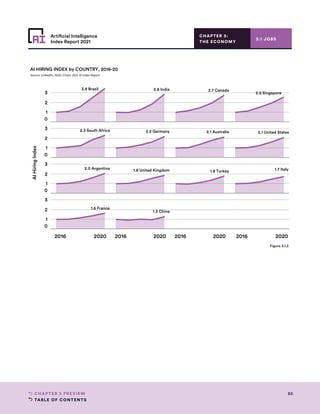
Brazil, India, Canada, Singapore, and South Africa are the countries with the highest growth in AI hiring from
2016 to 2020. Despite the COVID-19 pandemic, the AI hiring continued to grow across sample countries in 2020.
• 
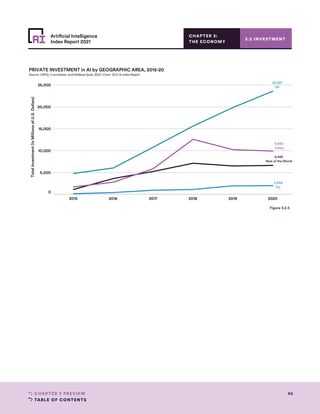
More private investment in AI is being funneled into fewer startups. Despite the pandemic, 2020 saw a 9.3%
increase in the amount of private AI investment from 2019—a higher percentage increase than from 2018 to 2019
(5.7%), though the number of newly funded companies decreased for the third year in a row.
• 
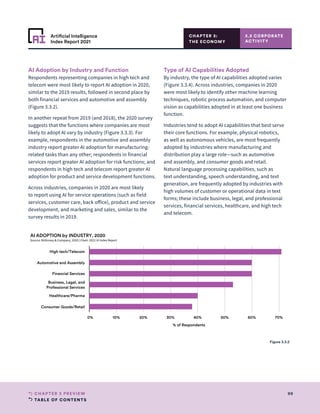
Despite growing calls to address ethical concerns associated with using AI, efforts to address these concerns
in the industry are limited, according to a McKinsey survey. For example, issues such as equity and fairness
in AI continue to receive comparatively little attention from companies. Moreover, fewer companies in 2020
view personal or individual privacy risks as relevant, compared with in 2019, and there was no change in the
percentage of respondents whose companies are taking steps to mitigate these particular risks.
• 
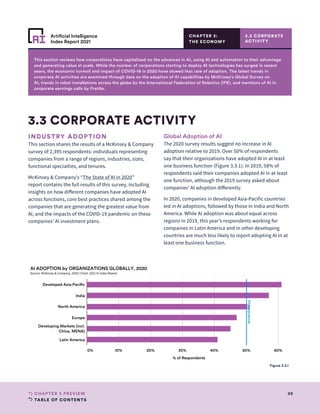
Despite the economic downturn caused by the pandemic, half the respondents in a McKinsey survey said that
the coronavirus had no effect on their investment in AI, while 27% actually reported increasing their investment.
Less than a fourth of businesses decreased their investment in AI.
• 
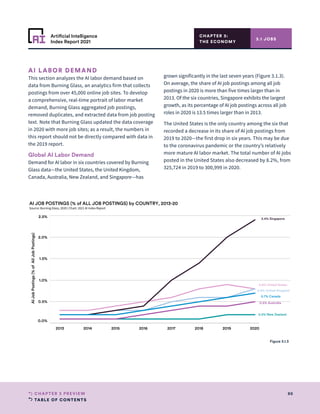
The United States recorded a decrease in its share of AI job postings from 2019 to 2020—the first drop in six years.
The total number of AI jobs posted in the United States also decreased by 8.2% from 2019 to 2020, from 325,724
in 2019 to 300,999 jobs in 2020.
Artificial Intelligence
Index Report 2021
12
CHAPTER 4: AI EDUCATION
• 
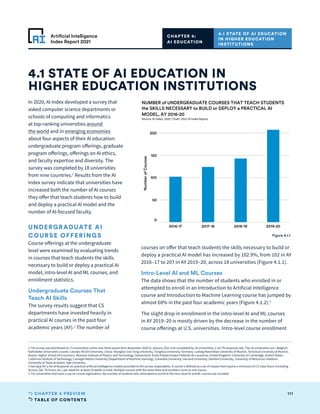
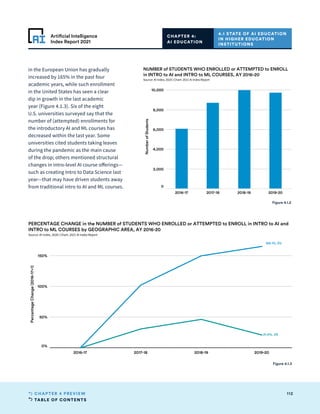
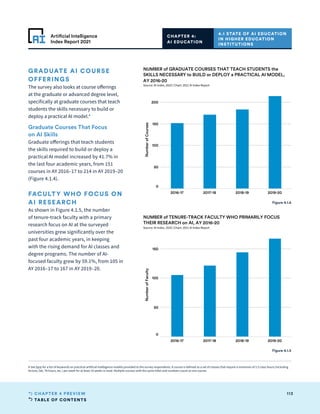
An AI Index survey conducted in 2020 suggests that the world’s top universities have increased their investment
in AI education over the past four years. The number of courses that teach students the skills necessary to build
or deploy a practical AI model on the undergraduate and graduate levels has increased by 102.9% and 41.7%,
respectively, in the last four academic years.
• 
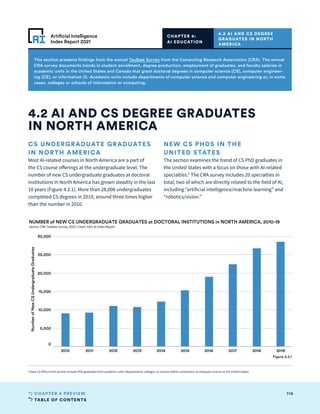
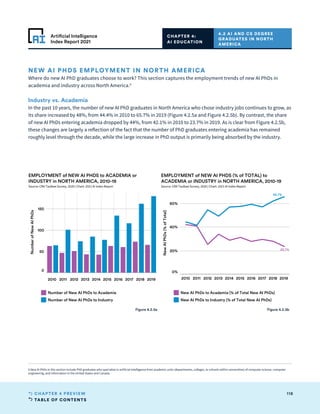
More AI PhD graduates in North America chose to work in industry in the past 10 years, while fewer opted for jobs
in academia, according to an annual survey from the Computing Research Association (CRA). The share of new
AI PhDs who chose industry jobs increased by 48% in the past decade, from 44.4% in 2010 to 65.7% in 2019. By
contrast, the share of new AI PhDs entering academia dropped by 44%, from 42.1% in 2010 to 23.7% in 2019.
• 
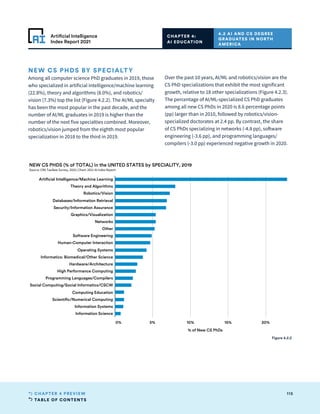
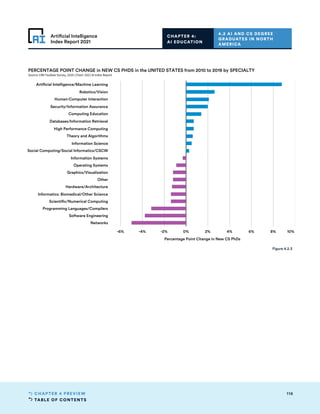
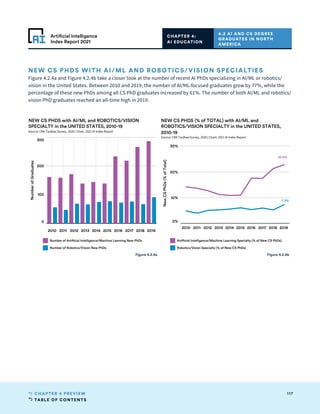
In the last 10 years, AI-related PhDs have gone from 14.2% of the total of CS PhDs granted in the United States,
to around 23% as of 2019, according to the CRA survey. At the same time, other previously popular CS PhDs have
declined in popularity, including networking, software engineering, and programming languages. Compilers all
saw a reduction in PhDs granted relative to 2010, while AI and Robotics/Vision specializations saw a substantial
increase.
• 
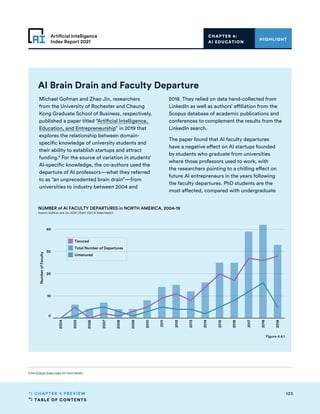
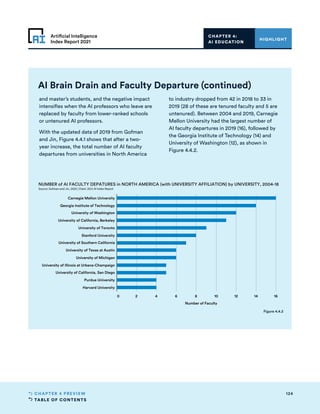
After a two-year increase, the number of AI faculty departures from universities to industry jobs in North America
dropped from 42 in 2018 to 33 in 2019 (28 of these are tenured faculty and five are untenured). Carnegie Mellon
University had the largest number of AI faculty departures between 2004 and 2019 (16), followed by the Georgia
Institute of Technology (14) and University of Washington (12).
• 
The percentage of international students among new AI PhDs in North America continued to rise in 2019, to
64.3%—a 4.3% increase from 2018. Among foreign graduates, 81.8% stayed in the United States and 8.6% have
taken jobs outside the United States.
• 
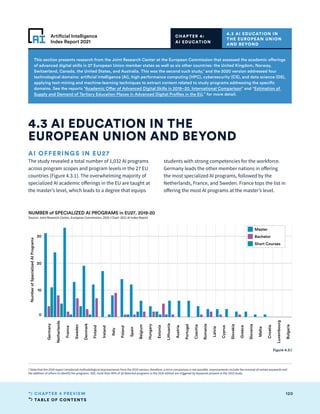
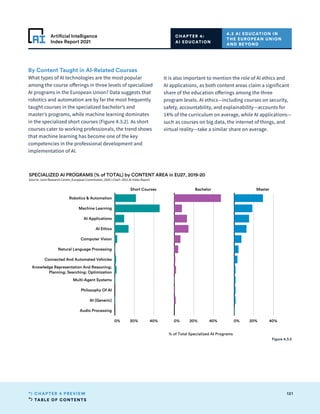
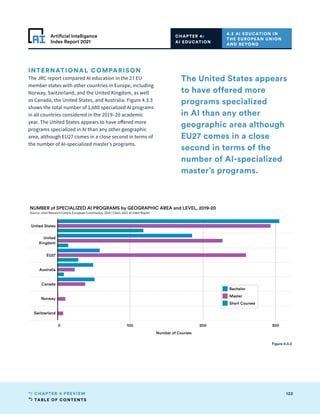
In the European Union, the vast majority of specialized AI academic offerings are taught at the master’s level;
robotics and automation is by far the most frequently taught course in the specialized bachelor’s and master’s
programs, while machine learning (ML) dominates in the specialized short courses.
CHAPTER 5: ETHICAL CHALLENGES OF AI APPLICATIONS
• 
The number of papers with ethics-related keywords in titles submitted to AI conferences has grown since 2015,
though the average number of paper titles matching ethics-related keywords at major AI conferences remains
low over the years.
• 
The five news topics that got the most attention in 2020 related to the ethical use of AI were the release of the
European Commission’s white paper on AI, Google’s dismissal of ethics researcher Timnit Gebru, the AI ethics
committee formed by the United Nations, the Vatican’s AI ethics plan, and IBM’s exiting the facial-recognition
businesses.
Artificial Intelligence
Index Report 2021
13
CHAPTER 6: DIVERSITY IN AI
• 
The percentages of female AI PhD graduates and tenure-track computer science (CS) faculty have remained low
for more than a decade. Female graduates of AI PhD programs in North America have accounted for less than
18% of all PhD graduates on average, according to an annual survey from the Computing Research Association
(CRA). An AI Index survey suggests that female faculty make up just 16% of all tenure-track CS faculty at several
universities around the world.
• 
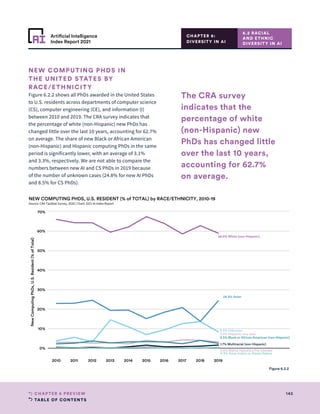
The CRA survey suggests that in 2019, among new U.S. resident AI PhD graduates, 45% were white, while 22.4%
were Asian, 3.2% were Hispanic, and 2.4% were African American.
• 
The percentage of white (non-Hispanic) new computing PhDs has changed little over the last 10 years,
accounting for 62.7% on average. The share of Black or African American (non-Hispanic) and Hispanic computing
PhDs in the same period is significantly lower, with an average of 3.1% and 3.3%, respectively.
• 
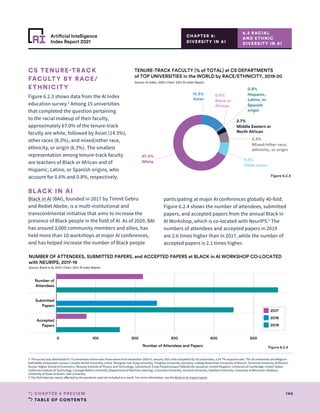
The participation in Black in AI workshops, which are co-located with the Conference on Neural Information
Processing Systems (NeurIPS), has grown significantly in recent years. The numbers of attendees and submitted
papers in 2019 are 2.6 times higher than in 2017, while the number of accepted papers is 2.1 times higher.
• 
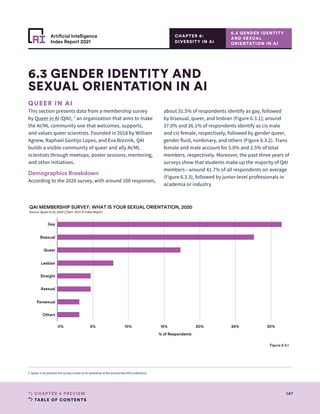
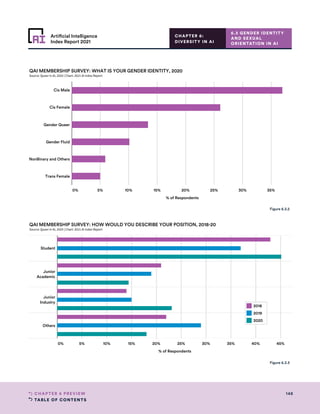
In a membership survey by Queer in AI in 2020, almost half the respondents said they view the lack of
inclusiveness in the field as an obstacle they have faced in becoming a practitioner in the AI/ML field. More than
40% of members surveyed said they have experienced discrimination or harassment at work or school.
CHAPTER 7: AI POLICY AND NATIONAL STRATEGIES
• 
Since Canada published the world’s first national AI strategy in 2017, more than 30 other countries and regions
have published similar documents as of December 2020.
• 
The launch of the Global Partnership on AI (GPAI) and Organisation for Economic Co-operation and Development
(OECD) AI Policy Observatory and Network of Experts on AI in 2020 promoted intergovernmental efforts to work
together to support the development of AI for all.
• 
In the United States, the 116th Congress was the most AI-focused congressional session in history. The number
of mentions of AI by this Congress in legislation, committee reports, and Congressional Research Service (CRS)
reports is more than triple that of the 115th Congress.
TABLE OF CONTENTS
14
CHAPTER 1 PREVIEW
Artificial Intelligence
Index Report 2021
CHAPTER 1:
Research 
Development
Artificial Intelligence
Index Report 2021
TABLE OF CONTENTS
15
CHAPTER 1 PREVIEW
Artificial Intelligence
Index Report 2021
CHAPTER 1:
RESEARCH 
DEVELOPMENT
Overview	16
Chapter Highlights	 17
1.1 PUBLICATIONS	 18
Peer-Reviewed AI Publications	 18
	Overview	 18
	 By Region	 18
	 By Geographic Area	 20
	 By Institutional Affiliation	 21
	 Academic-Corporate Collaboration	 23
AI Journal Publications	 25
	Overview	 25
	 By Region	 26
	 By Geographic Area	 27
	Citation	 27
AI Conference Publications	 28
	Overview	 28
	 By Region	 29
	 By Geographic Area	 30
	Citation	 30
AI Patents	 31
	Overview	 31
arXiv Publications	 32
	Overview	 32
	 By Region	 32
	 By Geographic Area	 33
	 By Field of Study	 34
Highlight: Deep Learning Papers on arXiv	35
1.2 CONFERENCES	 36
Conference Attendance	 36
Highlight: Corporate Representation
at AI Research Conferences	 38
1.3 AI OPEN-SOURCE SOFTWARE
LIBRARIES	39
GitHub Stars	 39
Chapter Preview
CHAPTER 1:
ACCESS THE PUBLIC DATA
TABLE OF CONTENTS
16
CHAPTER 1 PREVIEW
Artificial Intelligence
Index Report 2021
Overview
OVERVIEW
The report opens with an overview of the research and development (RD)
efforts in artificial intelligence (AI) because RD is fundamental to AI
progress. Since the technology first captured the imagination of computer
scientists and mathematicians in the 1950s, AI has grown into a major
research discipline with significant commercial applications. The number
of AI publications has increased dramatically in the past 20 years. The rise
of AI conferences and preprint archives has expanded the dissemination of
research and scholarly communications. Major powers, including China, the
European Union, and the United States, are racing to invest in AI research.
The RD chapter aims to capture the progress in this increasingly complex
and competitive field.
This chapter begins by examining AI publications—from peer-reviewed
journal articles to conference papers and patents, including the citation
impact of each, using data from the Elsevier/Scopus and Microsoft
Academic Graph (MAG) databases, as well as data from the arXiv paper
preprint repository and Nesta. It examines contributions to AI RD
from major AI entities and geographic regions and considers how those
contributions are shaping the field. The second and third sections discuss
RD activities at major AI conferences and on GitHub.
CHAPTER 1:
RESEARCH 
DEVELOPMENT
TABLE OF CONTENTS
17
CHAPTER 1 PREVIEW
Artificial Intelligence
Index Report 2021
CHAPTER HIGHLIGHTS
• 
The number of AI journal publications grew by 34.5% from 2019 to 2020—a much higher
percentage growth than from 2018 to 2019 (19.6%).
• 
In every major country and region, the highest proportion of peer-reviewed AI papers
comes from academic institutions. But the second most important originators are
different: In the United States, corporate-affiliated research represents 19.2% of the total
publications, whereas government is the second most important in China (15.6%) and the
European Union (17.2%).
• 
In 2020, and for the first time, China surpassed the United States in the share of AI
journal citations in the world, having briefly overtaken the United States in the overall
number of AI journal publications in 2004 and then retaken the lead in 2017. However,
the United States has consistently (and significantly) more cited AI conference papers
than China over the last decade.
• 
In response to COVID-19, most major AI conferences took place virtually and registered
a significant increase in attendance as a result. The number of attendees across nine
conferences almost doubled in 2020.
• 
In just the last six years, the number of AI-related publications on arXiv grew by more
than sixfold, from 5,478 in 2015 to 34,736 in 2020.
• 
AI publications represented 3.8% of all peer-reviewed scientific publications worldwide
in 2019, up from 1.3% in 2011.
CHAPTER
HIGHLIGHTS
CHAPTER 1:
RESEARCH 
DEVELOPMENT
TABLE OF CONTENTS
18
CHAPTER 1 PREVIEW
Artificial Intelligence
Index Report 2021
2000
2001
2002
2003
2004
2005
2006
2007
2008
2009
2010
2011
2012
2013
2014
2015
2016
2017
2018
2019
0
20
40
60
80
100
120
Number
of
Peer-Reviewed
AI
Publications
(in
Thousands)
NUMBER of PEER-REVIEWED AI PUBLICATIONS, 2000-19
Source: Elsevier/Scopus, 2020 | Chart: 2021 AI Index Report
AI publications include peer-reviewed publications, journal articles, conference papers, and patents. To track trends among these
publications and to assess the state of AI RD activities around the world, the following datasets were used: the Elsevier/Scopus
database for peer-reviewed publications; the Microsoft Academic Graph (MAG) database for all journals, conference papers, and
patent publications; and arXiv and Nesta data for electronic preprints.
PEER-REVIEWED AI PUBLICATIONS
This section presents data from the Scopus database by
Elsevier. Scopus contains 70 million peer-reviewed research
items curated from more than 5,000 international publishers.
The 2019 version of the data shown below is derived from
an entirely new set of publications, so figures of all peer-
reviewed AI publications differ from those in previous years’
AI Index reports. Due to changes in the methodology for
indexing publications, the accuracy of the dataset increased
from 80% to 84% (see the Appendix for more details).
Overview
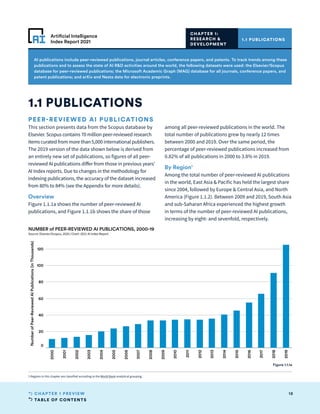
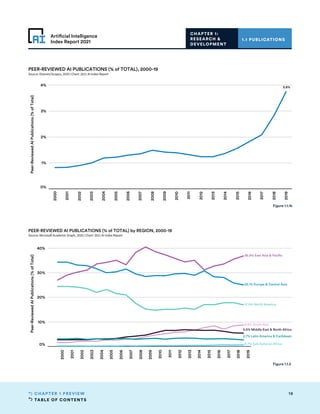
Figure 1.1.1a shows the number of peer-reviewed AI
publications, and Figure 1.1.1b shows the share of those
1.1 PUBLICATIONS
among all peer-reviewed publications in the world. The
total number of publications grew by nearly 12 times
between 2000 and 2019. Over the same period, the
percentage of peer-reviewed publications increased from
0.82% of all publications in 2000 to 3.8% in 2019.
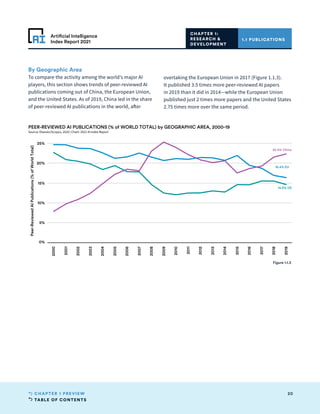
By Region1
Among the total number of peer-reviewed AI publications
in the world, East Asia  Pacific has held the largest share
since 2004, followed by Europe  Central Asia, and North
America (Figure 1.1.2). Between 2009 and 2019, South Asia
and sub-Saharan Africa experienced the highest growth
in terms of the number of peer-reviewed AI publications,
increasing by eight- and sevenfold, respectively.
1.1 PUBLICATIONS
CHAPTER 1:
RESEARCH 
DEVELOPMENT
Figure 1.1.1a
1 Regions in this chapter are classified according to the World Bank analytical grouping.
TABLE OF CONTENTS
19
CHAPTER 1 PREVIEW
Artificial Intelligence
Index Report 2021
2000
2001
2002
2003
2004
2005
2006
2007
2008
2009
2010
2011
2012
2013
2014
2015
2016
2017
2018
2019
0%
1%
2%
3%
4%
Peer-Reviewed
AI
Publications
(%
of
Total)
3.8%
PEER-REVIEWED AI PUBLICATIONS (% of TOTAL), 2000-19
Source: Elsevier/Scopus, 2020 | Chart: 2021 AI Index Report
1.1 PUBLICATIONS
CHAPTER 1:
RESEARCH 
DEVELOPMENT
Figure 1.1.1b
1999
2000
2001
2002
2003
2004
2005
2006
2007
2008
2009
2010
2011
2012
2013
2014
2015
2016
2017
2018
2019
2020
2021
2022
2023
0%
10%
20%
30%
40%
Peer-Reviewed
AI
Publications
(%
of
Total)
5.5% Middle East  North Africa
2.7% Latin America  Caribbean
0.7% Sub-Saharan Africa
8.8% South Asia
17.0% North America
25.1% Europe  Central Asia
36.9% East Asia  Pacific
PEER-REVIEWED AI PUBLICATIONS (% of TOTAL) by REGION, 2000-19
Source: Microsoft Academic Graph, 2020 | Chart: 2021 AI Index Report
Figure 1.1.2
TABLE OF CONTENTS
20
CHAPTER 1 PREVIEW
Artificial Intelligence
Index Report 2021
2000
2001
2002
2003
2004
2005
2006
2007
2008
2009
2010
2011
2012
2013
2014
2015
2016
2017
2018
2019
0%
5%
10%
15%
20%
25%
Peer-Reviewed
AI
Publications
(%
of
World
Total)
16.4% EU
14.6% US
22.4% China
PEER-REVIEWED AI PUBLICATIONS (% of WORLD TOTAL) by GEOGRAPHIC AREA, 2000-19
Source: Elsevier/Scopus, 2020 | Chart: 2021 AI Index Report
By Geographic Area
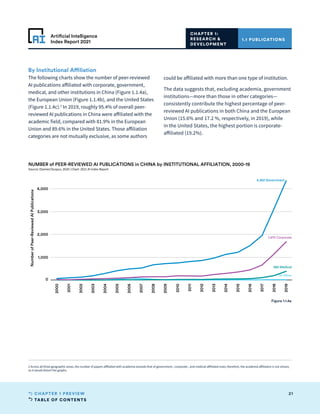
To compare the activity among the world’s major AI
players, this section shows trends of peer-reviewed AI
publications coming out of China, the European Union,
and the United States. As of 2019, China led in the share
of peer-reviewed AI publications in the world, after
overtaking the European Union in 2017 (Figure 1.1.3).
It published 3.5 times more peer-reviewed AI papers
in 2019 than it did in 2014—while the European Union
published just 2 times more papers and the United States
2.75 times more over the same period.
1.1 PUBLICATIONS
CHAPTER 1:
RESEARCH 
DEVELOPMENT
Figure 1.1.3
TABLE OF CONTENTS
21
CHAPTER 1 PREVIEW
Artificial Intelligence
Index Report 2021
2000
2001
2002
2003
2004
2005
2006
2007
2008
2009
2010
2011
2012
2013
2014
2015
2016
2017
2018
2019
0
1,000
2,000
3,000
4,000
Number
of
Peer-Reviewed
AI
Publications
14 Other
382 Medical
4,352 Government
1,675 Corporate
NUMBER of PEER-REVIEWED AI PUBLICATIONS in CHINA by INSTITUTIONAL AFFILIATION, 2000-19
Source: Elsevier/Scopus, 2020 | Chart: 2021 AI Index Report
1.1 PUBLICATIONS
CHAPTER 1:
RESEARCH 
DEVELOPMENT
Figure 1.1.4a
By Institutional Affiliation
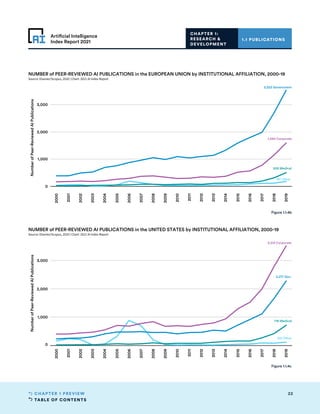
The following charts show the number of peer-reviewed
AI publications affiliated with corporate, government,
medical, and other institutions in China (Figure 1.1.4a),
the European Union (Figure 1.1.4b), and the United States
(Figure 1.1.4c).2
In 2019, roughly 95.4% of overall peer-
reviewed AI publications in China were affiliated with the
academic field, compared with 81.9% in the European
Union and 89.6% in the United States. Those affiliation
categories are not mutually exclusive, as some authors
could be affiliated with more than one type of institution.
The data suggests that, excluding academia, government
institutions—more than those in other categories—
consistently contribute the highest percentage of peer-
reviewed AI publications in both China and the European
Union (15.6% and 17.2 %, respectively, in 2019), while
in the United States, the highest portion is corporate-
affiliated (19.2%).
2 Across all three geographic areas, the number of papers affiliated with academia exceeds that of government-, corporate-, and medical-affiliated ones; therefore, the academia affiliation is not shown,
as it would distort the graphs.
TABLE OF CONTENTS
22
CHAPTER 1 PREVIEW
Artificial Intelligence
Index Report 2021
2000
2001
2002
2003
2004
2005
2006
2007
2008
2009
2010
2011
2012
2013
2014
2015
2016
2017
2018
2019
0
1,000
2,000
3,000
Number
of
Peer-Reviewed
AI
Publications
120 Other
718 Medical
2,277 Gov.
3,513 Corporate
NUMBER of PEER-REVIEWED AI PUBLICATIONS in the UNITED STATES by INSTITUTIONAL AFFILIATION, 2000-19
Source: Elsevier/Scopus, 2020 | Chart: 2021 AI Index Report
1.1 PUBLICATIONS
CHAPTER 1:
RESEARCH 
DEVELOPMENT
Figure 1.1.4c
2000
2001
2002
2003
2004
2005
2006
2007
2008
2009
2010
2011
2012
2013
2014
2015
2016
2017
2018
2019
0
1,000
2,000
3,000
Number
of
Peer-Reviewed
AI
Publications
187 Other
508 Medical
3,523 Government
1,594 Corporate
NUMBER of PEER-REVIEWED AI PUBLICATIONS in the EUROPEAN UNION by INSTITUTIONAL AFFILIATION, 2000-19
Source: Elsevier/Scopus, 2020 | Chart: 2021 AI Index Report
Figure 1.1.4b
TABLE OF CONTENTS
23
CHAPTER 1 PREVIEW
Artificial Intelligence
Index Report 2021
0 1,000 2,000 3,000 4,000 5,000 6,000 7,000 8,000
Number of Peer-Reviewed AI Publications
United States
European Union
China
United Kingdom
Germany
Japan
France
Canada
South Korea
Netherlands
Switzerland
India
Hong Kong
Spain
Italy
NUMBER of ACADEMIC-CORPORATE PEER-REVIEWED AI PUBLICATIONS by GEOGRAPHIC AREA, 2015-19 (SUM)
Source: Elsevier/Scopus, 2020 | Chart: 2021 AI Index Report
1.1 PUBLICATIONS
CHAPTER 1:
RESEARCH 
DEVELOPMENT
Figure 1.1.5
Academic-Corporate Collaboration
Since the 1980s, the RD collaboration between
academia and industry in the United States has grown
in importance and popularity, made visible by the
proliferation of industry-university research centers as
well as corporate contributions to university research.
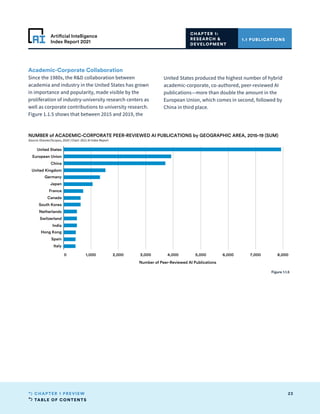
Figure 1.1.5 shows that between 2015 and 2019, the
United States produced the highest number of hybrid
academic-corporate, co-authored, peer-reviewed AI
publications—more than double the amount in the
European Union, which comes in second, followed by
China in third place.
TABLE OF CONTENTS
24
CHAPTER 1 PREVIEW
Artificial Intelligence
Index Report 2021
5 10 20 50 100 200 500 1,000 2,000
Number of Academic-Corporate Peer-Reviewed AI Publications (Log Scale)
0
1
2
3
Peer-Reviewed
AI
Publications'
Field-Weighted
Citation
Impact
(FWCI)
Germany
Australia
Brazil
Canada
China
European Union
France
Hong Kong
India
Indonesia
Iran
Italy
Japan
Malaysia
Netherlands
Russia
Singapore
South Korea
Spain
Switzerland
Taiwan
Turkey
United Kingdom United States
PEER-REVIEWED AI PUBLICATIONS' FIELD-WEIGHTED CITATION IMPACT and NUMBER of ACADEMIC-CORPORATE
PEER-REVIEWED AI PUBLICATIONS, 2019
Source: Elsevier/Scopus, 2020 | Chart: 2021 AI Index Report
1.1 PUBLICATIONS
CHAPTER 1:
RESEARCH 
DEVELOPMENT
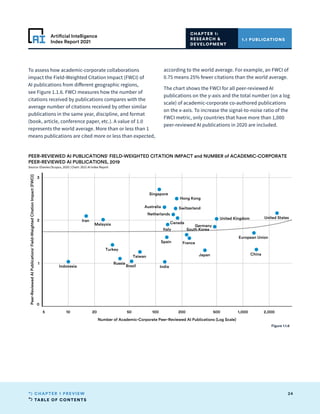
To assess how academic-corporate collaborations
impact the Field-Weighted Citation Impact (FWCI) of
AI publications from different geographic regions,
see Figure 1.1.6. FWCI measures how the number of
citations received by publications compares with the
average number of citations received by other similar
publications in the same year, discipline, and format
(book, article, conference paper, etc.). A value of 1.0
represents the world average. More than or less than 1
means publications are cited more or less than expected,
according to the world average. For example, an FWCI of
0.75 means 25% fewer citations than the world average.
The chart shows the FWCI for all peer-reviewed AI
publications on the y-axis and the total number (on a log
scale) of academic-corporate co-authored publications
on the x-axis. To increase the signal-to-noise ratio of the
FWCI metric, only countries that have more than 1,000
peer-reviewed AI publications in 2020 are included.
Figure 1.1.6
TABLE OF CONTENTS
25
CHAPTER 1 PREVIEW
Artificial Intelligence
Index Report 2021
2000
2001
2002
2003
2004
2005
2006
2007
2008
2009
2010
2011
2012
2013
2014
2015
2016
2017
2018
2019
2020
0
20
40
60
80
Number
of
AI
Journal
Publications
(in
Thousands)
NUMBER of AI JOURNAL PUBLICATIONS, 2000-20
Source: Microsoft Academic Graph, 2020 | Chart: 2021 AI Index Report
2000
2001
2002
2003
2004
2005
2006
2007
2008
2009
2010
2011
2012
2013
2014
2015
2016
2017
2018
2019
2020
0%
1%
2%
3%
AI
Journal
Publications
(%
of
All
Publications)
2.2%
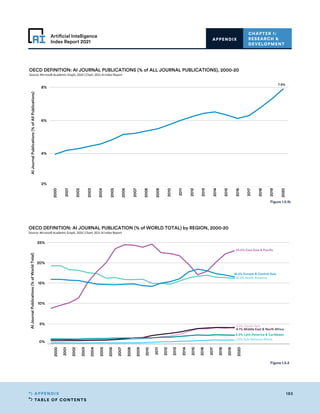
AI JOURNAL PUBLICATIONS (% of ALL JOURNAL PUBLICATIONS), 2000-20
Source: Microso Academic Graph, 2020 | Chart: 2021 AI Index Report
1.1 PUBLICATIONS
CHAPTER 1:
RESEARCH 
DEVELOPMENT
Figure 1.1.7a
AI JOURNAL PUBLICATIONS
The next three sections chart the trends in the publication
of AI journals, conference publications, and patents, as
well as their respective citations that provide a signal
for RD impact, based on data from Microsoft Academic
Graph. MAG3
is a knowledge graph consisting of more than
225 million publications (at the end of November 2019).
Overview
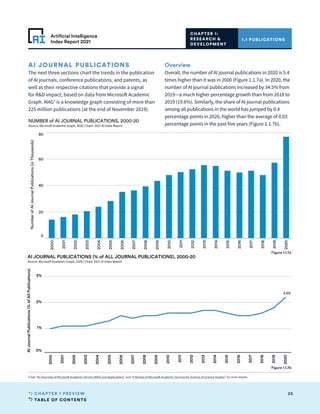
Overall, the number of AI journal publications in 2020 is 5.4
times higher than it was in 2000 (Figure 1.1.7a). In 2020, the
number of AI journal publications increased by 34.5% from
2019—a much higher percentage growth than from 2018 to
2019 (19.6%). Similarly, the share of AI journal publications
among all publications in the world has jumped by 0.4
percentage points in 2020, higher than the average of 0.03
percentage points in the past five years (Figure 1.1.7b).
Figure 1.1.7b
3 See “An Overview of Microsoft Academic Service (MAS) and Applications” and “A Review of Microsoft Academic Services for Science of Science Studies” for more details.
TABLE OF CONTENTS
26
CHAPTER 1 PREVIEW
Artificial Intelligence
Index Report 2021
2000
2001
2002
2003
2004
2005
2006
2007
2008
2009
2010
2011
2012
2013
2014
2015
2016
2017
2018
2019
2020
2021
2022
2023
2024
0%
10%
20%
30%
40%
AI
Journal
Publications
(%
of
World
Total)
0.3%, Sub-Saharan Africa
4.9%, South Asia
14.0%, North America
3.1%, Middle East  North Africa
1.3%, Latin America  Caribbean
13.3%, Europe  Central Asia
26.7%, East Asia  Pacific
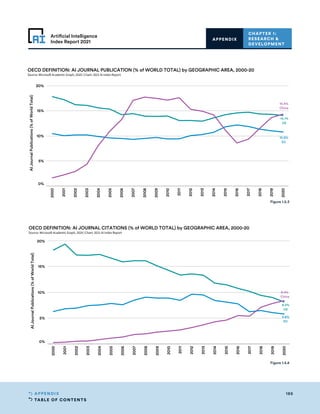
AI JOURNAL PUBLICATIONS (% of WORLD TOTAL) by REGION, 2000-20
Source: Microsoft Academic Graph, 2020 | Chart: 2021 AI Index Report
By Region
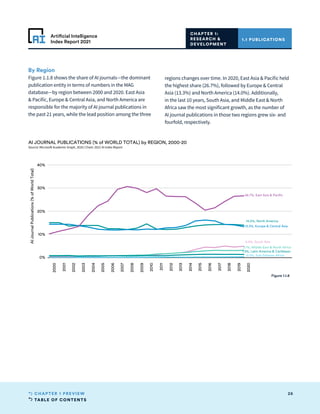
Figure 1.1.8 shows the share of AI journals—the dominant
publication entity in terms of numbers in the MAG
database—by region between 2000 and 2020. East Asia
 Pacific, Europe  Central Asia, and North America are
responsible for the majority of AI journal publications in
the past 21 years, while the lead position among the three
regions changes over time. In 2020, East Asia  Pacific held
the highest share (26.7%), followed by Europe  Central
Asia (13.3%) and North America (14.0%). Additionally,
in the last 10 years, South Asia, and Middle East  North
Africa saw the most significant growth, as the number of
AI journal publications in those two regions grew six- and
fourfold, respectively.
1.1 PUBLICATIONS
CHAPTER 1:
RESEARCH 
DEVELOPMENT
Figure 1.1.8
TABLE OF CONTENTS
27
CHAPTER 1 PREVIEW
Artificial Intelligence
Index Report 2021
2000
2001
2002
2003
2004
2005
2006
2007
2008
2009
2010
2011
2012
2013
2014
2015
2016
2017
2018
2019
2020
0%
5%
10%
15%
20%
25%
AI
Journal
Publications
(%
of
World
Total)
12.3%, US
8.6%, EU
18.0%, China
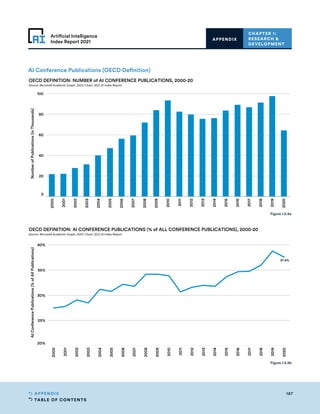
AI JOURNAL PUBLICATIONS (% of WORLD TOTAL) by GEOGRAPHIC AREA, 2000-20
Source: Microso Academic Graph, 2020 | Chart: 2021 AI Index Report
By Geographic Area
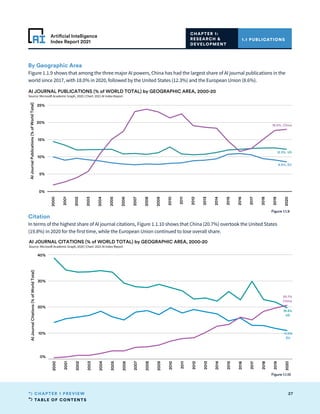
Figure 1.1.9 shows that among the three major AI powers, China has had the largest share of AI journal publications in the
world since 2017, with 18.0% in 2020, followed by the United States (12.3%) and the European Union (8.6%).
1.1 PUBLICATIONS
CHAPTER 1:
RESEARCH 
DEVELOPMENT
Figure 1.1.9
2000
2001
2002
2003
2004
2005
2006
2007
2008
2009
2010
2011
2012
2013
2014
2015
2016
2017
2018
2019
2020
0%
10%
20%
30%
40%
AI
Journal
Citations
(%
of
World
Total)
19.8%
US
11.0%
EU
20.7%
China
AI JOURNAL CITATIONS (% of WORLD TOTAL) by GEOGRAPHIC AREA, 2000-20
Source: Microsoft Academic Graph, 2020 | Chart: 2021 AI Index Report
Citation
In terms of the highest share of AI journal citations, Figure 1.1.10 shows that China (20.7%) overtook the United States
(19.8%) in 2020 for the first time, while the European Union continued to lose overall share.
Figure 1.1.10
TABLE OF CONTENTS
28
CHAPTER 1 PREVIEW
Artificial Intelligence
Index Report 2021
2000
2001
2002
2003
2004
2005
2006
2007
2008
2009
2010
2011
2012
2013
2014
2015
2016
2017
2018
2019
2020
0%
5%
10%
15%
20%
25%
AI
Conference
Publications
(%
of
All
Publications)
20.2%
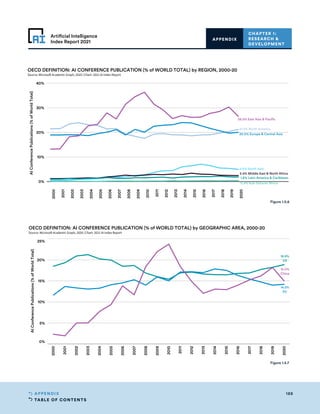
AI CONFERENCE PUBLICATIONS (% of ALL CONFERENCE PUBLICATIONS), 2000-20
Source: Microso Academic Graph, 2020 | Chart: 2021 AI Index Report
2000
2001
2002
2003
2004
2005
2006
2007
2008
2009
2010
2011
2012
2013
2014
2015
2016
2017
2018
2019
2020
0
10
20
30
40
50
Number
of
Publications
(in
Thousands)
NUMBER of AI CONFERENCE PUBLICATIONS, 2000-20
Source: Microsoft Academic Graph, 2020 | Chart: 2021 AI Index Report
1.1 PUBLICATIONS
CHAPTER 1:
RESEARCH 
DEVELOPMENT
Figure 1.1.11a
Figure 1.1.11b
AI CONFERENCE PUBLICATIONS
Overview
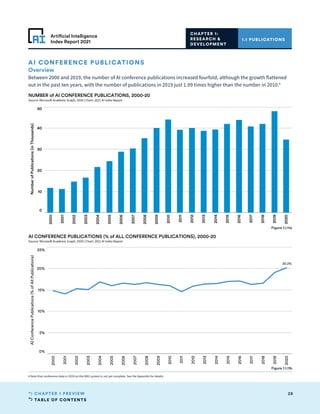
Between 2000 and 2019, the number of AI conference publications increased fourfold, although the growth flattened
out in the past ten years, with the number of publications in 2019 just 1.09 times higher than the number in 2010.4
4 Note that conference data in 2020 on the MAG system is not yet complete. See the Appendix for details.
TABLE OF CONTENTS
29
CHAPTER 1 PREVIEW
Artificial Intelligence
Index Report 2021
1999
2000
2001
2002
2003
2004
2005
2006
2007
2008
2009
2010
2011
2012
2013
2014
2015
2016
2017
2018
2019
2020
2021
2022
2023
2024
2025
2026
0%
10%
20%
30%
40%
AI
Conference
Publications
(%
of
World
Total)
0.3%, Sub-Saharan Africa
21.7%, North America
2.2%, Middle East  North Africa
1.7%, Latin America  Caribbean
5.1%, South Asia
18.6%, Europe  Central Asia
27.3%, East Asia  Pacific
AI CONFERENCE PUBLICATIONS (% of WORLD TOTAL) by REGION, 2000-20
Source: Microsoft Academic Graph, 2020 | Chart: 2021 AI Index Report
By Region
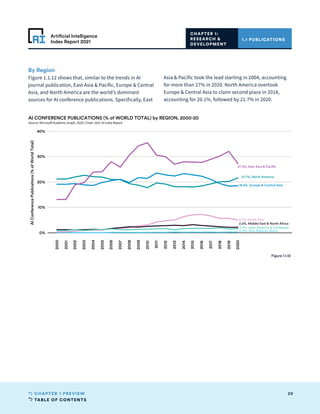
Figure 1.1.12 shows that, similar to the trends in AI
journal publication, East Asia  Pacific, Europe  Central
Asia, and North America are the world’s dominant
sources for AI conference publications. Specifically, East
Asia  Pacific took the lead starting in 2004, accounting
for more than 27% in 2020. North America overtook
Europe  Central Asia to claim second place in 2018,
accounting for 20.1%, followed by 21.7% in 2020.
1.1 PUBLICATIONS
CHAPTER 1:
RESEARCH 
DEVELOPMENT
Figure 1.1.12
TABLE OF CONTENTS
30
CHAPTER 1 PREVIEW
Artificial Intelligence
Index Report 2021
2000
2001
2002
2003
2004
2005
2006
2007
2008
2009
2010
2011
2012
2013
2014
2015
2016
2017
2018
2019
2020
0%
10%
20%
30%
40%
AI
Conference
Citations
(%
of
World
Total)
11.8% China
40.1% US
10.9% EU
AI CONFERENCE CITATIONS (% of WORLD TOTAL) by GEOGRAPHIC AREA, 2000-20
Source: Microso Academic Graph, 2020 | Chart: 2021 AI Index Report
2000
2001
2002
2003
2004
2005
2006
2007
2008
2009
2010
2011
2012
2013
2014
2015
2016
2017
2018
2019
2020
0%
5%
10%
15%
20%
25%
AI
Conference
Publications
(%
of
World
Total)
12.8% EU
15.2% China
19.4% US
AI CONFERENCE PUBLICATIONS (% of WORLD TOTAL) by GEOGRAPHIC AREA, 2000-20
Source: Microso Academic Graph, 2020 | Chart: 2021 AI Index Report
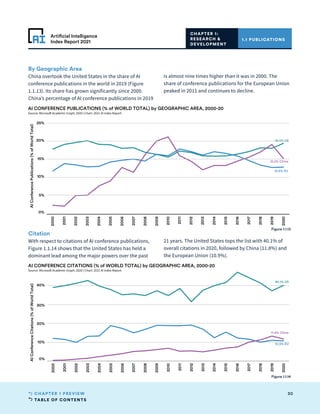
By Geographic Area
China overtook the United States in the share of AI
conference publications in the world in 2019 (Figure
1.1.13). Its share has grown significantly since 2000.
China’s percentage of AI conference publications in 2019
is almost nine times higher than it was in 2000. The
share of conference publications for the European Union
peaked in 2011 and continues to decline.
1.1 PUBLICATIONS
CHAPTER 1:
RESEARCH 
DEVELOPMENT
Figure 1.1.13
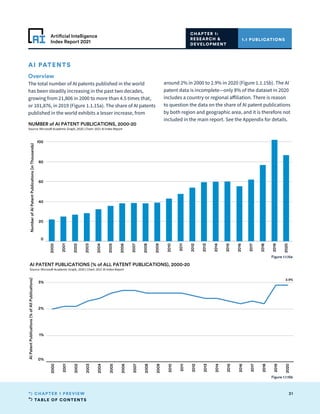
Citation
With respect to citations of AI conference publications,
Figure 1.1.14 shows that the United States has held a
dominant lead among the major powers over the past
21 years. The United States tops the list with 40.1% of
overall citations in 2020, followed by China (11.8%) and
the European Union (10.9%).
Figure 1.1.14
TABLE OF CONTENTS
31
CHAPTER 1 PREVIEW
Artificial Intelligence
Index Report 2021
2000
2001
2002
2003
2004
2005
2006
2007
2008
2009
2010
2011
2012
2013
2014
2015
2016
2017
2018
2019
2020
0
20
40
60
80
100
Number
of
AI
Patent
Publications
(in
Thousands)
NUMBER of AI PATENT PUBLICATIONS, 2000-20
Source: Microsoft Academic Graph, 2020 | Chart: 2021 AI Index Report
1.1 PUBLICATIONS
CHAPTER 1:
RESEARCH 
DEVELOPMENT
Figure 1.1.15a
AI PATENTS
Overview
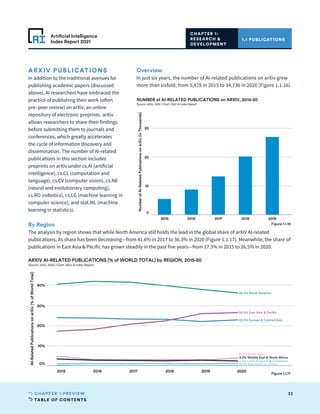
The total number of AI patents published in the world
has been steadily increasing in the past two decades,
growing from 21,806 in 2000 to more than 4.5 times that,
or 101,876, in 2019 (Figure 1.1.15a). The share of AI patents
published in the world exhibits a lesser increase, from
around 2% in 2000 to 2.9% in 2020 (Figure 1.1.15b). The AI
patent data is incomplete—only 8% of the dataset in 2020
includes a country or regional affiliation. There is reason
to question the data on the share of AI patent publications
by both region and geographic area, and it is therefore not
included in the main report. See the Appendix for details.
2000
2001
2002
2003
2004
2005
2006
2007
2008
2009
2010
2011
2012
2013
2014
2015
2016
2017
2018
2019
2020
0%
1%
2%
3%
AI
Patent
Publications
(%
of
All
Publications)
2.9%
AI PATENT PUBLICATIONS (% of ALL PATENT PUBLICATIONS), 2000-20
Source: Microso Academic Graph, 2020 | Chart: 2021 AI Index Report
Figure 1.1.15b
TABLE OF CONTENTS
32
CHAPTER 1 PREVIEW
Artificial Intelligence
Index Report 2021
2015 2016 2017 2018 2019 2020
0
10
20
30
Number
of
AI-Related
Publications
on
arXiv
(in
Thousands)
NUMBER of AI-RELATED PUBLICATIONS on ARXIV, 2015-20
Source: arXiv, 2020 | Chart: 2021 AI Index Report
1.1 PUBLICATIONS
CHAPTER 1:
RESEARCH 
DEVELOPMENT
Figure 1.1.16
ARXIV PUBLICATIONS
In addition to the traditional avenues for
publishing academic papers (discussed
above), AI researchers have embraced the
practice of publishing their work (often
pre–peer review) on arXiv, an online
repository of electronic preprints. arXiv
allows researchers to share their findings
before submitting them to journals and
conferences, which greatly accelerates
the cycle of information discovery and
dissemination. The number of AI-related
publications in this section includes
preprints on arXiv under cs.AI (artificial
intelligence), cs.CL (computation and
language), cs.CV (computer vision), cs.NE
(neural and evolutionary computing),
cs.RO (robotics), cs.LG (machine learning in
computer science), and stat.ML (machine
learning in statistics).
Overview
In just six years, the number of AI-related publications on arXiv grew
more than sixfold, from 5,478 in 2015 to 34,736 in 2020 (Figure 1.1.16).
2015 2016 2017 2018 2019 2020 2021
0%
10%
20%
30%
40%
AI-Related
Publications
on
arXiv
(%
of
World
Total)
4.0% South Asia
2.5% Middle East  North Africa
1.3% Latin America  Caribbean
0.3% Sub-Saharan Africa
36.3% North America
22.9% Europe  Central Asia
26.5% East Asia  Paci c
ARXIV AI-RELATED PUBLICATIONS (% of WORLD TOTAL) by REGION, 2015-20
Source: arXiv, 2020 | Chart: 2021 AI Index Report
By Region
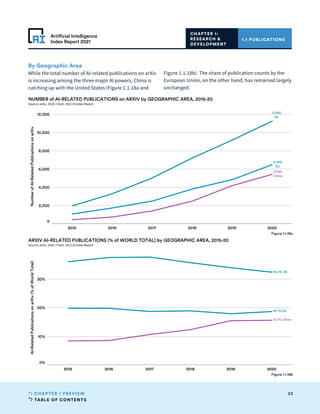
The analysis by region shows that while North America still holds the lead in the global share of arXiV AI-related
publications, its share has been decreasing—from 41.6% in 2017 to 36.3% in 2020 (Figure 1.1.17). Meanwhile, the share of
publications in East Asia  Pacific has grown steadily in the past five years—from 17.3% in 2015 to 26.5% in 2020.
Figure 1.1.17
TABLE OF CONTENTS
33
CHAPTER 1 PREVIEW
Artificial Intelligence
Index Report 2021
2015 2016 2017 2018 2019 2020
0
2,000
4,000
6,000
8,000
10,000
12,000
Number
of
AI-Related
Publications
on
arXiv
11,280
US
6,505
EU
5,440
China
NUMBER of AI-RELATED PUBLICATIONS on ARXIV by GEOGRAPHIC AREA, 2015-20
Source: arXiv, 2020 | Chart: 2021 AI Index Report
2015 2016 2017 2018 2019 2020
0%
10%
20%
30%
AI-Related
Publications
on
arXiv
(%
of
World
Total)
32.5% US
18.7% EU
15.7% China
ARXIV AI-RELATED PUBLICATIONS (% of WORLD TOTAL) by GEOGRAPHIC AREA, 2015-20
Source: arXiv, 2020 | Chart: 2021 AI Index Report
By Geographic Area
While the total number of AI-related publications on arXiv
is increasing among the three major AI powers, China is
catching up with the United States (Figure 1.1.18a and
Figure 1.1.18b). The share of publication counts by the
European Union, on the other hand, has remained largely
unchanged.
1.1 PUBLICATIONS
CHAPTER 1:
RESEARCH 
DEVELOPMENT
Figure 1.1.18a
Figure 1.1.18b
TABLE OF CONTENTS
34
CHAPTER 1 PREVIEW
Artificial Intelligence
Index Report 2021
2015 2016 2017 2018 2019 2020
0
2,000
4,000
6,000
8,000
10,000
Number
of
AI-Related
Publications
on
arXiv
11,098 cs.LG
11,001 cs.CV
1,818 stat.ML
2,571 cs.RO
743 cs.NE
5,573 cs.CL
1,923 cs.AI
NUMBER of AI-RELATED PUBLICATIONS on ARXIV by FIELD of STUDY 2015-20
Source: arXiv, 2020 | Chart: 2021 AI Index Report
By Field of Study
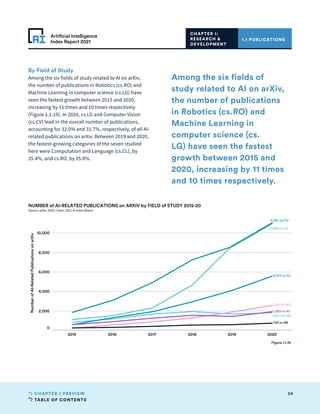
Among the six fields of study related to AI on arXiv,
the number of publications in Robotics (cs.RO) and
Machine Learning in computer science (cs.LG) have
seen the fastest growth between 2015 and 2020,
increasing by 11 times and 10 times respectively
(Figure 1.1.19). In 2020, cs.LG and Computer Vision
(cs.CV) lead in the overall number of publications,
accounting for 32.0% and 31.7%, respectively, of all AI-
related publications on arXiv. Between 2019 and 2020,
the fastest-growing categories of the seven studied
here were Computation and Language (cs.CL), by
35.4%, and cs.RO, by 35.8%.
1.1 PUBLICATIONS
CHAPTER 1:
RESEARCH 
DEVELOPMENT
Figure 1.1.19
Among the six fields of
study related to AI on arXiv,
the number of publications
in Robotics (cs.RO) and
Machine Learning in
computer science (cs.
LG) have seen the fastest
growth between 2015 and
2020, increasing by 11 times
and 10 times respectively.
TABLE OF CONTENTS
35
CHAPTER 1 PREVIEW
Artificial Intelligence
Index Report 2021
Deep Learning Papers on arXiv
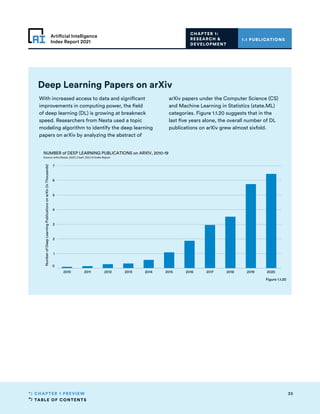
With increased access to data and significant
improvements in computing power, the field
of deep learning (DL) is growing at breakneck
speed. Researchers from Nesta used a topic
modeling algorithm to identify the deep learning
papers on arXiv by analyzing the abstract of
arXiv papers under the Computer Science (CS)
and Machine Learning in Statistics (state.ML)
categories. Figure 1.1.20 suggests that in the
last five years alone, the overall number of DL
publications on arXiv grew almost sixfold.
2010 2011 2012 2013 2014 2015 2016 2017 2018 2019 2020
0
1
2
3
4
5
6
7
Number
of
Deep
Learning
Publications
on
arXiv
(in
Thousands)
NUMBER of DEEP LEARNING PUBLICATIONS on ARXIV, 2010-19
Source: arXiv/Nesta, 2020 | Chart: 2021 AI Index Report
Figure 1.1.20
1.1 PUBLICATIONS
CHAPTER 1:
RESEARCH 
DEVELOPMENT
TABLE OF CONTENTS
36
CHAPTER 1 PREVIEW
Artificial Intelligence
Index Report 2021
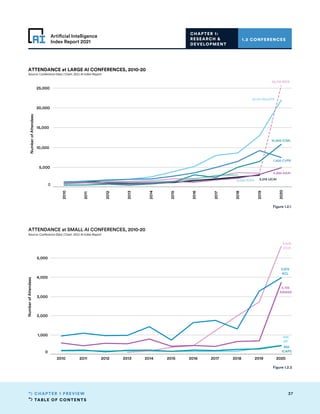
Conference attendance is an indication of broader industrial and academic interest in a scientific field. In the past 20 years,
AI conferences have grown not only in size but also in number and prestige. This section presents data on the trends in
attendance at and submissions to major AI conferences.
CONFERENCE ATTENDANCE
Last year saw a significant increase in participation levels
at AI conferences, as most were offered through a virtual
format. Only the 34th Association for the Advancement
of Artificial Intelligence (AAAI) Conference on Artificial
Intelligence was held in person in February 2020.
Conference organizers report that a virtual format allows
for higher attendance of researchers from all over the
world, though exact attendance numbers are difficult to
measure.
Due to the atypical nature of 2020 conference attendance
data, the 11 major AI conferences in 2019 have been
split into two categories based on 2019 attendance data:
large AI conferences with over 3,000 attendees and small
AI conferences with fewer than 3,000 attendees. Figure
1.2.1 shows that in 2020, the total number of attendees
across nine conferences almost doubled.5
In particular,
the International Conference on Intelligent Robots
and Systems (IROS) extended the virtual conference
to allow users to watch events for up to three months,
which explains the high attendance count. Because the
International Joint Conference on Artificial Intelligence
(IJCAI) was held in 2019 and January 2021—but not in
2020—it does not appear on the charts.
1.2 CONFERENCES
1.2 CONFERENCES
CHAPTER 1:
RESEARCH 
DEVELOPMENT
Conference organizers
report that a virtual
format allows for higher
attendance of researchers
from all over the world,
though exact attendance
numbers are difficult to
measure.
5 For the AAMAS conference, the attendance in 2020 is based on the number of users on site reported by the platform that recorded the talks and managed the online conference; For the KR conference,
the attendance in 2020 is based on the number of registrations; For the ICPAS conference, the attendance of 450 in 2020 is an estimate as some participants may have used anonymous Zoom accounts.
TABLE OF CONTENTS
37
CHAPTER 1 PREVIEW
Artificial Intelligence
Index Report 2021
2010 2011 2012 2013 2014 2015 2016 2017 2018 2019 2020
0
1,000
2,000
3,000
4,000
5,000
Number
of
Attendees
469
KR
450
ICAPS
3,726
AAMAS
5,600
ICLR
3,972
ACL
ATTENDANCE at SMALL AI CONFERENCES, 2010-20
Source: Conference Data | Chart: 2021 AI Index Report
1.2 CONFERENCES
CHAPTER 1:
RESEARCH 
DEVELOPMENT
Figure 1.2.2
2010
2011
2012
2013
2014
2015
2016
2017
2018
2019
2020
0
5,000
10,000
15,000
20,000
25,000
Number
of
Attendees
22,011 NeurIPS
25,719 IROS
3,015 IJCAI
3,050 ICRA
4,884 AAAI
10,800 ICML
7,500 CVPR
ATTENDANCE at LARGE AI CONFERENCES, 2010-20
Source: Conference Data | Chart: 2021 AI Index Report
Figure 1.2.1
TABLE OF CONTENTS
38
CHAPTER 1 PREVIEW
Artificial Intelligence
Index Report 2021
Corporate Representation at AI Research Conferences
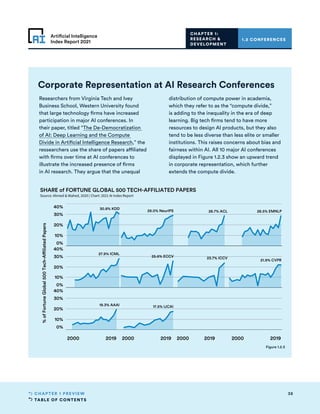
Researchers from Virginia Tech and Ivey
Business School, Western University found
that large technology firms have increased
participation in major AI conferences. In
their paper, titled “The De-Democratization
of AI: Deep Learning and the Compute
Divide in Artificial Intelligence Research,” the
ressearchers use the share of papers affiliated
with firms over time at AI conferences to
illustrate the increased presence of firms
in AI research. They argue that the unequal
distribution of compute power in academia,
which they refer to as the “compute divide,”
is adding to the inequality in the era of deep
learning. Big tech firms tend to have more
resources to design AI products, but they also
tend to be less diverse than less elite or smaller
institutions. This raises concerns about bias and
fairness within AI. All 10 major AI conferences
displayed in Figure 1.2.3 show an upward trend
in corporate representation, which further
extends the compute divide.
0%
10%
20%
30%
40%
0%
10%
20%
30%
40%
0%
10%
20%
30%
40%
30.8% KDD
29.0% NeurIPS 28.7% ACL 28.5% EMNLP
27.9% ICML
25.6% ECCV 23.7% ICCV
21.9% CVPR
19.3% AAAI 17.5% IJCAI
SHARE of FORTUNE GLOBAL 500 TECH-AFFILIATED PAPERS
Source: Ahmed  Wahed, 2020 | Chart: 2021 AI Index Report
%
of
Fortune
Global
500
Tech-Affiliated
Papers
2000 2019 2000 2019 2000 2019 2000 2019
Figure 1.2.3
1.2 CONFERENCES
CHAPTER 1:
RESEARCH 
DEVELOPMENT
TABLE OF CONTENTS
39
CHAPTER 1 PREVIEW
Artificial Intelligence
Index Report 2021
A software library is a collection of computer code that is used to create applications and products. Popular AI-specific software
libraries—such as TensorFlow and PyTorch—help developers create their AI solutions quickly and efficiently. This section analyzes
the popularity of software libraries through GitHub data.
GITHUB STARS
GitHub is a code hosting platform that AI researchers and
developers frequently use to upload, comment on, and
download software. GitHub users can “star” a project
to save it in their list, thereby expressing their interests
and likes—similar to the “like’’ function on Twitter and
other social media platforms. As AI researchers upload
packages on GitHub that mention the use of an open-
source library, the “star” function on GitHub can be used
to measure the popularity of various AI programming
open-source libraries.
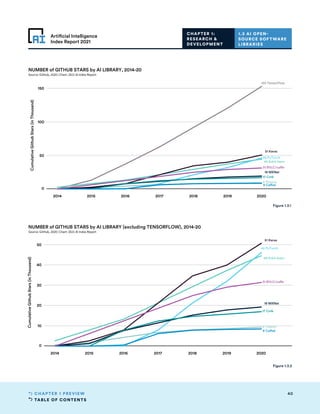
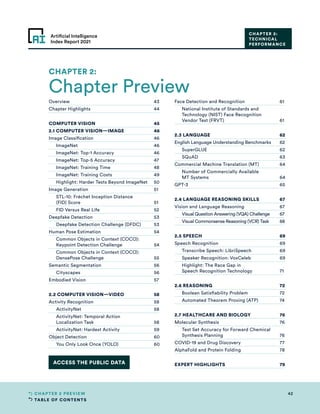
Figure 1.3.1 suggests that TensorFlow (developed by
Google and publicly released in 2017) is the most popular
AI software library. The second most popular library in
2020 is Keras (also developed by Google and built on top
of TensorFlow 2.0). Excluding TensorFlow, Figure 1.3.2
shows that PyTorch (created by Facebook) is another
library that is becoming increasingly popular.
1.3 AI OPEN-SOURCE
SOFTWARE LIBRARIES
1.3 AI OPEN-
SOURCE SOFTWARE
LIBRARIES
CHAPTER 1:
RESEARCH 
DEVELOPMENT
TensorFlow (developed
by Google and publicly
released in 2017) is the
most popular AI software
library. The second most
popular library in 2020 is
Keras (also developed by
Google and built on top
of TensorFlow 2.0).
TABLE OF CONTENTS
40
CHAPTER 1 PREVIEW
Artificial Intelligence
Index Report 2021
2014 2015 2016 2017 2018 2019 2020
0
10
20
30
40
50
Cumulative
Github
Stars
(in
Thousand)
45 Sckit-learn
19 MXNet
51 Keras
8 Caffe2
9 Theano
46 PyTorch
17 Cntk
31 BVLC/caffe
NUMBER of GITHUB STARS by AI LIBRARY (excluding TENSORFLOW), 2014-20
Source: GitHub, 2020 | Chart: 2021 AI Index Report
1.3 AI OPEN-
SOURCE SOFTWARE
LIBRARIES
CHAPTER 1:
RESEARCH 
DEVELOPMENT
Figure 1.3.2
2014 2015 2016 2017 2018 2019 2020
0
50
100
150
Cumulative
Github
Stars
(in
Thousand)
45 Sckit-learn
19 MXNet
51 Keras
8 Caffe2
9 Theano
153 TensorFlow
46 PyTorch
17 Cntk
31 BVLC/caffe
NUMBER of GITHUB STARS by AI LIBRARY, 2014-20
Source: GitHub, 2020 | Chart: 2021 AI Index Report
Figure 1.3.1
TABLE OF CONTENTS
41
CHAPTER 2 PREVIEW
Artificial Intelligence
Index Report 2021
CHAPTER 2:
Technical
Performance
Artificial Intelligence
Index Report 2021
TABLE OF CONTENTS
42
CHAPTER 2 PREVIEW
Artificial Intelligence
Index Report 2021
CHAPTER 2:
TECHNICAL
PERFORMANCE
Overview	43
Chapter Highlights	 44
COMPUTER VISION	 45
2.1 COMPUTER VISION—IMAGE	 46
Image Classification	46
	 ImageNet	46
	 ImageNet: Top-1 Accuracy	46
	 ImageNet: Top-5 Accuracy	47
	 ImageNet: Training Time	48
	 ImageNet: Training Costs	49
	 Highlight: Harder Tests Beyond ImageNet	 50
Image Generation	51
	 STL-10: Fréchet Inception Distance
	 (FID) Score	 51
	 FID Versus Real Life	52
Deepfake Detection	53
	 Deepfake Detection Challenge (DFDC)	 53
Human Pose Estimation	54
	 Common Objects in Context (COCO):
	 Keypoint Detection Challenge	 54
	 Common Objects in Context (COCO):
	 DensePose Challenge	 55
Semantic Segmentation	56
	Cityscapes	 56
Embodied Vision	57
2.2 COMPUTER VISION—VIDEO	 58
Activity Recognition	58
	 ActivityNet	58
	 ActivityNet: Temporal Action
	 Localization Task	58
	 ActivityNet: Hardest Activity	 59
Object Detection	60
	 You Only Look Once (YOLO)	60
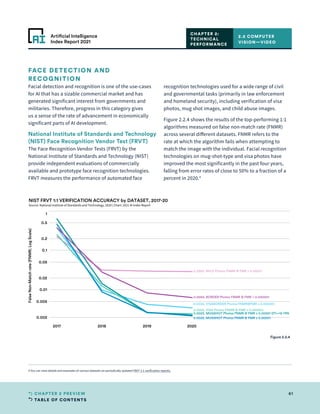
Face Detection and Recognition	61
	 National Institute of Standards and
	 Technology (NIST) Face Recognition
	 Vendor Test (FRVT)	61
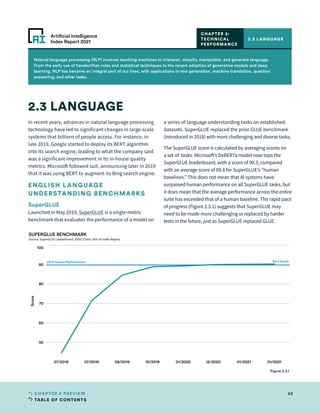
2.3 LANGUAGE	 62
English Language Understanding Benchmarks	 62
	 SuperGLUE	62
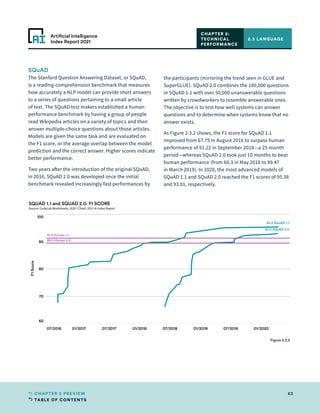
	SQuAD	 63
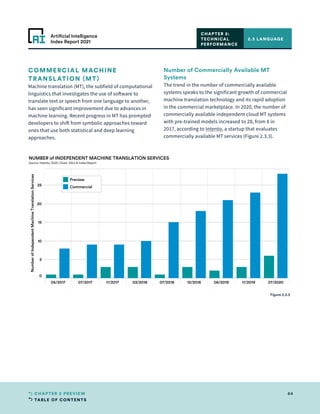
Commercial Machine Translation (MT)	 64
	 Number of Commercially Available
	 MT Systems	64
GPT-3	65
2.4 LANGUAGE REASONING SKILLS	 67
Vision and Language Reasoning	 67
	 Visual Question Answering (VQA) Challenge	 67
	 Visual Commonsense Reasoning (VCR) Task	 68
2.5 SPEECH	 69
Speech Recognition	 69
	 Transcribe Speech: LibriSpeech	 69
	 Speaker Recognition: VoxCeleb	 69
	 Highlight: The Race Gap in
	 Speech Recognition Technology	 71
2.6 REASONING	72
	 Boolean Satisfiability Problem	 72
	 Automated Theorem Proving (ATP)	 74
2.7 HEALTHCARE AND BIOLOGY	 76
Molecular Synthesis	 76
	 Test Set Accuracy for Forward Chemical
	 Synthesis Planning	 76
COVID-19 and Drug Discovery	77
AlphaFold and Protein Folding	 78
EXPERT HIGHLIGHTS	 79
Chapter Preview
CHAPTER 2:
ACCESS THE PUBLIC DATA
TABLE OF CONTENTS
43
CHAPTER 2 PREVIEW
Artificial Intelligence
Index Report 2021
Overview
OVERVIEW
This chapter highlights the technical progress in various subfields of
AI, including computer vision, language, speech, concept learning, and
theorem proving. It uses a combination of quantitative measurements,
such as common benchmarks and prize challenges, and qualitative
insights from academic papers to showcase the developments in state-of-
the-art AI technologies.
While technological advances allow AI systems to be deployed more
widely and easily than ever, concerns about the use of AI are also growing,
particularly when it comes to issues such as algorithmic bias. The
emergence of new AI capabilities such as being able to synthesize images
and videos also poses ethical challenges.
CHAPTER 2:
TECHNICAL
PERFORMANCE
TABLE OF CONTENTS
44
CHAPTER 2 PREVIEW
Artificial Intelligence
Index Report 2021
CHAPTER HIGHLIGHTS
• 
Generative everything: AI systems can now compose text, audio, and images to a sufficiently high
standard that humans have a hard time telling the difference between synthetic and non-synthetic
outputs for some constrained applications of the technology. That promises to generate a tremendous
range of downstream applications of AI for both socially useful and less useful purposes. It is
also causing researchers to invest in technologies for detecting generative models; the DeepFake
Detection Challenge data indicates how well computers can distinguish between different outputs.
• 
The industrialization of computer vision: Computer vision has seen immense progress in the past
decade, primarily due to the use of machine learning techniques (specifically deep learning). New
data shows that computer vision is industrializing: Performance is starting to flatten on some of the
largest benchmarks, suggesting that the community needs to develop and agree on harder ones
that further test performance. Meanwhile, companies are investing increasingly large amounts
of computational resources to train computer vision systems at a faster rate than ever before.
Meanwhile, technologies for use in deployed systems—like object-detection frameworks for
analysis of still frames from videos—are maturing rapidly, indicating further AI deployment.
• 
Natural Language Processing (NLP) outruns its evaluation metrics: Rapid progress in NLP has
yielded AI systems with significantly improved language capabilities that have started to have a
meaningful economic impact on the world. Google and Microsoft have both deployed the BERT
language model into their search engines, while other large language models have been developed
by companies ranging from Microsoft to OpenAI. Progress in NLP has been so swift that technical
advances have started to outpace the benchmarks to test for them. This can be seen in the rapid
emergence of systems that obtain human level performance on SuperGLUE, an NLP evaluation suite
developed in response to earlier NLP progress overshooting the capabilities being assessed by GLUE.
• 
New analyses on reasoning: Most measures of technical problems show for each time point the
performance of the best system at that time on a fixed benchmark. New analyses developed for
the AI Index offer metrics that allow for an evolving benchmark, and for the attribution to individual
systems of credit for a share of the overall performance of a group of systems over time. These
are applied to two symbolic reasoning problems, Automated Theorem Proving and Satisfiability of
Boolean formulas.
• 
Machine learning is changing the game in healthcare and biology: The landscape of the healthcare
and biology industries has evolved substantially with the adoption of machine learning. DeepMind’s
AlphaFold applied deep learning technique to make a significant breakthrough in the decades-long
biology challenge of protein folding. Scientists use ML models to learn representations of chemical
molecules for more effective chemical synthesis planning. PostEra, an AI startup used ML-based
techniques to accelerate COVID-related drug discovery during the pandemic.
CHAPTER
HIGHLIGHTS
CHAPTER 2:
TECHNICAL
PERFORMANCE
TABLE OF CONTENTS
45
CHAPTER 2 PREVIEW
Artificial Intelligence
Index Report 2021
Introduced in the 1960s, the field of computer vision has seen significant
progress and in recent years has started to reach human levels of
performance on some restricted visual tasks. Common computer
vision tasks include object recognition, pose estimation, and semantic
segmentation. The maturation of computer vision technology has unlocked
a range of applications: self-driving cars, medical image analysis, consumer
applications (e.g., Google Photos), security applications (e.g., surveillance,
satellite imagery analysis), industrial applications (e.g., detecting defective
parts in manufacturing and assembly), and others.
COMPUTER
VISION
CHAPTER 2:
TECHNICAL
PERFORMANCE
Computer Vision
TABLE OF CONTENTS
46
CHAPTER 2 PREVIEW
Artificial Intelligence
Index Report 2021
IMAGE CLASSIFICATION
In the 2010s, the field of image recognition and
classification began to switch from classical AI techniques
to ones based on machine learning and, specifically,
deep learning. Since then, image recognition has shifted
from being an expensive, domain-specific technology to
being one that is more affordable and applicable to more
areas—primarily due to advancements in the underlying
technology (algorithms, compute hardware, and the
utilization of larger datasets).
ImageNet
Created by computer scientists from Stanford University
and Princeton University in 2009, ImageNet is a dataset
of over 14 million images across 200 classes that expands
and improves the data available for researchers to train
AI algorithms. In 2012, researchers from the University of
Toronto used techniques based on deep learning to set
a new state of the art in the ImageNet Large Scale Visual
Recognition Challenge.
Since then, deep learning techniques have ruled
the competition leaderboards—several widely used
techniques have debuted in ImageNet competition
entries. In 2015, a team from Microsoft Research said it
had surpassed human-level performance on the image
classification task1
via the use of “residual networks”—an
innovation that subsequently proliferated into other AI
systems. Even after the end of the competition in 2017,
researchers continue to use the ImageNet dataset to test
and develop computer vision applications.
The image classification task of the ImageNet Challenge
asks machines to assign a class label to an image based
on the main object in the image. The following graphs
explore the evolution of the top-performing ImageNet
systems over time, as well as how algorithmic and
infrastructure advances have allowed researchers to
increase the efficiency of training image recognition
systems and reduce the absolute time it takes to train
high-performing ones.
ImageNet: Top-1 Accuracy
Top-1 accuracy tests for how well an AI system can
assign the correct label to an image, specifically whether
its single most highly probable prediction (out of all
possible labels) is the same as the target label. In recent
years, researchers have started to focus on improving
performance on ImageNet by pre-training their systems
on extra training data, for instance photos from
Instagram or other social media sources. By pre-training
on these datasets, they’re able to more effectively use
ImageNet data, which further improves performance.
Figure 2.1.1 shows that recent systems with extra training
data make 1 error out of every 10 tries on top-1 accuracy,
versus 4 errors out of every 10 tries in December 2012.
The model from the Google Brain team achieved 90.2%
on top-1 accuracy in January 2021.
2.1 COMPUTER VISION—IMAGE
2.1 COMPUTER
VISION—IMAGE
CHAPTER 2:
TECHNICAL
PERFORMANCE
1 Though it is worth noting that the human baseline for this metric comes from a single Stanford graduate student who took roughly the same test as the AI systems took.
Image recognition has
shifted from being an
expensive, domain-specific
technology to being one
that is more affordable
and applicable to more
areas—primarily due
to advancements in the
underlying technology.
TABLE OF CONTENTS
47
CHAPTER 2 PREVIEW
Artificial Intelligence
Index Report 2021
75%
80%
85%
90%
95%
100%
Top-5
Accuracy
98.8%, With Extra Training Data
97.9%, Without Extra Training Data
94.9% Human Performance
IMAGENET CHALLENGE: TOP-5 ACCURACY
Source: Papers with Code, 2020; AI Index, 2021 | Chart: 2021 AI Index Report
01/2013 01/2014 01/2015 01/2016 01/2017 01/2018 01/2019 01/2020 01/2021
90..
.
Human Performance
ImageNet: Top-5 Accuracy
Top-5 accuracy asks whether the correct label is in at least the classifier’s top five predictions. Figure 2.1.2 shows that
the error rate has improved from around 85% in 2013 to almost 99% in 2020.2
2.1 COMPUTER
VISION—IMAGE
CHAPTER 2:
TECHNICAL
PERFORMANCE
2 Note: For data on human error, a human was shown 500 images and then was asked to annotate 1,500 test images; their error rate was 5.1% for Top-5 classification. This is a very rough baseline, but it
gives us a sense of human performance on this task.
60%
70%
80%
90%
100%
Top-1
Accuracy
90.2%, With extra training data
86.5%, Without extra training data
IMAGENET CHALLENGE: TOP-1 ACCURACY
Source: Papers with Code, 2020; AI Index, 2021 | Chart: 2021 AI Index Report
01/2013 01/2014 01/2015 01/2016 01/2017 01/2018 01/2019 01/2020 01/2021
80..
.
Figure 2.1.1
Figure 2.1.2
TABLE OF CONTENTS
48
CHAPTER 2 PREVIEW
Artificial Intelligence
Index Report 2021
ImageNet: Training Time
Along with measuring the raw improvement in accuracy
over time, it is useful to evaluate how long it takes
to train image classifiers on ImageNet to a standard
performance level as it sheds light on advances in the
underlying computational infrastructure for large-scale
AI training. This is important to measure because the
faster you can train a system, the more quickly you
can evaluate it and update it with new data. Therefore,
the faster ImageNet systems can be trained, the more
productive organizations can become at developing and
deploying AI systems. Imagine the difference between
waiting a few seconds for a system to train versus waiting
a few hours, and what that difference means for the type
and volume of ideas researchers explore and how risky
they might be.
What follows are the results from MLPerf, a competition
run by the MLCommons organization that challenges
entrants to train an ImageNet network using a common
(residual network) architecture, and then ranks systems
according to the absolute “wall clock” time it takes them
to train a system.3
As shown in Figure 2.1.3, the training time on ImageNet
has fallen from 6.2 minutes (December 2018) to 47
seconds (July 2020). At the same time, the amount of
hardware used to achieve these results has increased
dramatically; frontier systems have been dominated by
the use of “accelerator” chips, starting with GPUs in the
2018 results, and transitioning to Google’s TPUs for the
best-in-class results from 2019 and 2020.
Distribution of Training Time: MLPerf does not just
show the state of the art for each competition period;
it also makes available all the data behind each
entry in each competition cycle. This, in turn, reveals
the distribution of training times for each period
(Figure 2.1.3). (Note that in each MLPerf competition,
competitors typically submit multiple entries that use
different permutations of hardware.)
Figure 2.1.4 shows that in the past couple of years,
training times have shortened, as has the variance
between MLPerf entries. At the same time, competitors
have started to use larger and larger numbers of
accelerator chips to speed training times. This is in line
with broader trends in AI development, as large-scale
training becomes better understood, with a higher
degree of shared best practices and infrastructure.
2.1 COMPUTER
VISION—IMAGE
CHAPTER 2:
TECHNICAL
PERFORMANCE
3 The next MLPerf update is planned for June 2021.
Imagine the difference
between waiting a few
seconds for a system to
train versus waiting a
few hours, and what that
difference means for the
type and volume of ideas
researchers explore and
how risky they might be.
TABLE OF CONTENTS
49
CHAPTER 2 PREVIEW
Artificial Intelligence
Index Report 2021
12/2017 06/2018 12/2018 06/2019 12/2019
1
2
5
10
20
50
100
200
500
1,000
2,000
Cost
(U.S.
Dollars;
Log
Scale)
$7.43
IMAGENET: TRAINING COST (to 93% ACCURACY)
Source: DAWNBench, 2020 | Chart: 2021 AI Index Report
ImageNet: Training Costs
How much does it cost to train a contemporary image-
recognition system? The answer, according to tests run by
the Stanford DAWNBench team, is a few dollars in 2020,
down by around 150 times from costs in 2017 (Figure
2.1.5). To put this in perspective, what cost one entrant
around USD 1,100 to do in October 2017 now costs about
USD 7.43. This represents progress in algorithm design as
well as a drop in the costs of cloud-computing resources.
2.1 COMPUTER
VISION—IMAGE
CHAPTER 2:
TECHNICAL
PERFORMANCE
Figure 2.1.5
12/2018 06/2019 07/2020
0
1,000
2,000
3,000
4,000
Number
of
Accelerators
0
1
2
3
4
5
6
Training
Time
4,096
1,024
640
6.2 Min
1.3 Min
47 Sec
IMAGENET: TRAINING TIME and HARDWARE of the BEST
SYSTEM
Source: MLPerf, 2020 | Chart: 2021 AI Index Report
Number of Accelerators Training Time
2018 2019 2020
1
10
100
1,000
10,000
Training
Time
(mins)
IMAGENET: DISTRIBUTION of TRAINING TIME
Source: MLPerf, 2020 | Chart: 2021 AI Index Report
Figure 2.1.3 Figure 2.1.4
TABLE OF CONTENTS
50
CHAPTER 2 PREVIEW
Artificial Intelligence
Index Report 2021
Harder Tests Beyond ImageNet
In spite of the progress in performance on ImageNet, current computer vision systems are still not
perfect. To better study their limitations, researchers have in recent years started to develop more
challenging image classification benchmarks. But since ImageNet is already a large dataset, which
requires a nontrivial amount of resources to use, it does not intuitively make sense to simply expand the
resolution of the images in ImageNet or the absolute size of the dataset—as either action would further
increase the cost to researchers when training systems on ImageNet. Instead, people have tried to figure
out new ways to test the robustness of image classifiers by creating custom datasets, many of which are
compatible with ImageNet (and are typically smaller). These include
IMAGENET ADVERSARIAL:
This is a dataset of images
similar to those found in
ImageNet but incorporating
natural confounders (e.g., a
butterfly sitting on a carpet with
a similar texture to the butterfly),
and images that are persistently
misclassified by contemporary
systems. These images “cause
consistent classification
mistakes due to scene
complications encountered
in the long tail of scene
configurations and by exploiting
classifier blind spots,” according
to the researchers. Therefore,
making progress on ImageNet
Adversarial could improve the
ability of models to generalize.
IMAGENET-C:
This is a dataset of common
ImageNet images with 75 visual
corruptions applied to them
(e.g., changes in brightness,
contrast, pixelations, fog
effects, etc.). By testing systems
against this, researchers can
provide even more information
about the generalization
capabilities of these models.
IMAGENET-RENDITION:
This tests generalization by
seeing how well ImageNet-
trained models can categorize
30,000 illustrations of 200
ImageNet classes. Since
ImageNet is designed to be built
out of photos, generalization
here indicates that systems
have learned something more
subtle about what they’re trying
to classify, because they’re able
to “understand” the relationship
between illustrations and the
photographed images they’ve
been trained on.
What is the Time Table for Tracking This Data? As these benchmarks are relatively new, the plan is to
wait a couple of years for the community to test a range of systems against them, which will generate
the temporal information necessary to make graphs tracking progress overtime.
2.1 COMPUTER
VISION—IMAGE
CHAPTER 2:
TECHNICAL
PERFORMANCE
TABLE OF CONTENTS
51
CHAPTER 2 PREVIEW
Artificial Intelligence
Index Report 2021
IMAGE GENERATION
Image generation is the task of generating images
that look indistinguishable from “real” images. Image
generation systems have a variety of uses, ranging from
augmenting search capabilities (it is easier to search for
a specific image if you can generate other images like
it) to serving as an aid for other generative uses (e.g.,
editing images, creating content for specific purposes,
generating multiple variations of a single image to help
designers brainstorm, and so on).
In recent years, image generation progress has
accelerated as a consequence of the continued
improvement in deep learning–based algorithms, as well
as the use of increased computation and larger datasets.
STL-10: Fréchet Inception Distance (FID) Score
One way to measure progress in image generation is via a
technique called Fréchet Inception Distance (FID), which
roughly correlates to the difference between how a given
AI system “thinks” about a synthetic image versus a real
image, where a real image has a score of 0 and synthetic
images that look similar have scores that approach 0.
Figure 2.1.6 shows the progress of generative models
over the past two years at generating convincing
synthetic images in the STL-10 dataset, which is designed
to test how effective systems are at generating images
and gleaning other information about them.
2.1 COMPUTER
VISION—IMAGE
CHAPTER 2:
TECHNICAL
PERFORMANCE
01/2018 04/2018 07/2018 10/2018 01/2019 04/2019 07/2019 10/2019 01/2020 04/2020 07/2020
20
25
30
35
40
45
Fréchet
Inception
Distance
(FID)
Score
25.4
STL-10: FRÉCHET INCEPTION DISTANCE (FID) SCORE
Source: Papers with Code, 2020 | Chart: 2021 AI Index Report
Figure 2.1.6
TABLE OF CONTENTS
52
CHAPTER 2 PREVIEW
Artificial Intelligence
Index Report 2021
2.1 COMPUTER
VISION—IMAGE
CHAPTER 2:
TECHNICAL
PERFORMANCE
FID Versus Real Life
FID has drawbacks as an evaluation technique—
specifically, it assesses progress on image generation
via quantitative metrics that use data from the model
itself, rather than other evaluation techniques. Another
approach is using teams of humans to evaluate the
outputs of these models; for instance, the Human eYe
Perceptual Evaluation (HYPE) method tries to judge image
quality by showing synthetically generated images to
humans and using their qualitative ratings to drive the
evaluation methodology. This approach is more expensive
and slower to run than typical evaluations, but it may
become more important as generative models get better.
Qualitative Examples: To get a sense of progress, you
can look at the evolution in the quality of synthetically
generated images over time. In Figure 2.1.7, you can
see the best-in-class examples of synthetic images of
human faces, ordered over time. By 2018, performance of
this task had become sufficiently good that it is difficult
for humans to easily model further progress (though it
is possible to train machine learning systems to spot
fakes, it is becoming more challenging). This provides a
visceral example of recent progress in this domain and
underscores the need for new evaluation methods to
gauge future progress. In addition, in recent years people
have turned to doing generative modeling on a broader
range of categories than just images of people’s faces,
which is another way to test for generalization.
Figure 2.1.7
GAN PROGRESS ON FACE GENERATION
2014 2015 2016
2017
2018
2020
Source: Goodfellow et al., 2014; Radford et al., 2016; Liu  Tuzel, 2016; Karras et al., 2018; Karras et al., 2019; Goodfellow, 2019; Karras et al., 2020; AI Index, 2021
TABLE OF CONTENTS
53
CHAPTER 2 PREVIEW
Artificial Intelligence
Index Report 2021
DEEPFAKE DETECTION
Advances in image synthesis have created new
opportunities as well as threats. For instance, in recent
years, researchers have harnessed breakthroughs
in synthetic imagery to create AI systems that can
generate synthetic images of human faces, then
superimpose those faces onto the faces of other people
in photographs or movies. People call this application
of generative technology a “deepfake.” Malicious uses
of deepfakes include misinformation and the creation
of (predominantly misogynistic) pornography. To try
to combat this, researchers are developing deepfake-
detection technologies.
Deepfake Detection Challenge (DFDC)
Created in September 2019 by Facebook, the Deepfake
Detection Challenge (DFDC) measures progress on
deepfake-detection technology. A two-part challenge,
DFDC asks participants to train and test their models from
a public dataset of around 100,000 clips. The submissions
are scored on log loss, a classification metric based on
probabilities. A smaller log loss means a more accurate
prediction of deepfake videos. According to Figure
2.1.8, log loss dropped by around 0.5 as the challenge
progressed between December 2019 and March 2020.
2.1 COMPUTER
VISION—IMAGE
CHAPTER 2:
TECHNICAL
PERFORMANCE
1/6/2020 1/16/2020 1/26/2020 2/5/2020 2/15/2020 2/25/2020 3/6/2020 3/16/2020 3/26/2020
0.0
0.1
0.2
0.3
0.4
0.5
0.6
0.7
Log
Loss
0.19
DEEPFAKE DETECTION CHALLENGE: LOG LOSS
Source: Kaggle, 2020 | Chart: 2021 AI Index Report
Figure 2.1.8
TABLE OF CONTENTS
54
CHAPTER 2 PREVIEW
Artificial Intelligence
Index Report 2021
HUMAN POSE ESTIMATION
Human pose estimation is the problem of estimating the
positions of human body parts or joints (wrists, elbows,
etc.) from a single image. Human pose estimation is a
classic “omni-use” AI capability. Systems that are good at
this task can be used for a range of applications, such as
creating augmented reality applications for the fashion
industry, analyzing behaviors gleaned from physical
body analysis in crowds, surveilling people for specific
behaviors, aiding with analysis of live sporting and
athletic events, mapping the movements of a person to a
virtual avatar, and so on.
Common Objects in Context (COCO):
Keypoint Detection Challenge
Common Objects in Context (COCO) is a large-scale
dataset for object detection, segmentation, and
captioning with 330,000 images and 1.5 million object
instances. Its Keypoint Detection Challenge requires
machines to simultaneously detect an object or a person
and localize their body keypoints—points in the image
that stand out, such as a person’s elbows, knees, and
other joints. The task evaluates algorithms based on
average precision (AP), a metric that can be used to
measure the accuracy of object detectors. Figure 2.1.9
shows that the accuracy of algorithms in this task has
improved by roughly 33% in the past four years, with the
latest machine scoring 80.8% on average precision.
2.1 COMPUTER
VISION—IMAGE
CHAPTER 2:
TECHNICAL
PERFORMANCE
07/2016 01/2017 07/2017 01/2018 07/2018 01/2019 07/2019 01/2020 07/2020
50%
60%
70%
80%
90%
Average
Precision
(AP)
80.8%
COCO KEYPOINT CHALLENGE: AVERAGE PRECISION
Source: COCO Leaderboard, 2020 | Chart: 2021 AI Index Report
Figure 2.1.9
TABLE OF CONTENTS
55
CHAPTER 2 PREVIEW
Artificial Intelligence
Index Report 2021
Common Objects in Context (COCO):
DensePose Challenge
DensePose, or dense human pose estimation, is the task
of extracting a 3D mesh model of a human body from a
2D image. After open-sourcing a system called DensePose
in 2018, Facebook built DensePose-COCO, a large-scale
dataset of image-to-surface correspondences annotated
on 50,000 COCO images. Since then, DensePose has
become a canonical benchmark dataset.
The COCO DensePose Challenge involves tasks of
simultaneously detecting people, segmenting their
bodies, and estimating the correspondences between
image pixels that belong to a human body and a
template 3D model. The average precision is calculated
based on the geodesic point similarity (GPS) metric,
a correspondence matching score that measures the
geodesic distances between the estimated points and
the true location of the body points on the image. The
accuracy has grown from 56% in 2018 to 72% in 2019
(Figure 2.1.10).
2.1 COMPUTER
VISION—IMAGE
CHAPTER 2:
TECHNICAL
PERFORMANCE
03/2018 05/2018 07/2018 09/2018 11/2018 01/2019 03/2019 05/2019 07/2019 09/2019
50%
55%
60%
65%
70%
75%
Average
Precision
(AP)
72%
COCO DENSEPOSE CHALLENGE: AVERAGE PRECISION
Source: arXiv  CodaLab, 2020 | Chart: 2021 AI Index Report
Figure 2.1.10
TABLE OF CONTENTS
56
CHAPTER 2 PREVIEW
Artificial Intelligence
Index Report 2021
SEMANTIC SEGMENTATION
Semantic segmentation is the task of classifying each
pixel in an image to a particular label, such as person,
cat, etc. Where image classification tries to assign a
label to the entire image, semantic segmentation tries to
isolate the distinct entities and objects in a given image,
allowing for more fine-grained identification. Semantic
segmentation is a basic input technology for self-driving
cars (identifying and isolating objects on roads), image
analysis, medical applications, and more.
Cityscapes
Cityscapes is a large-scale dataset of diverse urban street
scenes across 50 different cities recorded during the
daytime over several months (during spring, summer, and
fall) of the year. The dataset contains 5,000 images with
high-quality, pixel-level annotations and 20,000 weekly
labeled ones. Semantic scene understanding, especially
in the urban space, is crucial to the environmental
perception of autonomous vehicles. Cityscapes is useful
for training deep neural networks to understand the urban
environment.
One Cityscapes task that focuses on semantic
segmentation is the pixel-level semantic labeling task.
This task requires an algorithm to predict the per-pixel
semantic labeling of the image, partitioning an image
into different categories, like cars, buses, people, trees,
and roads. Participants are evaluated based on the
intersection-over-union (IoU) metric. A higher IoU score
means a better segmentation accuracy. Between 2014 and
2020, the mean IoU increased by 35% (Figure 2.1.11). There
was a significant boost to progress in 2016 and 2017 when
people started using residual networks in these systems.
2.1 COMPUTER
VISION—IMAGE
CHAPTER 2:
TECHNICAL
PERFORMANCE
01/2015 01/2016 01/2017 01/2018 01/2019 01/2020
60%
65%
70%
75%
80%
85%
90%
Mean
Intersection-Over-Union
(mIoU)
85.1% With Extra Training Data
82.3% Without Extra Training Data
CITYSCAPES CHALLENGE: PIXEL-LEVEL SEMANTIC LABELING TASK
Source: Papers with Code, 2020 | Chart: 2021 AI Index Report
Figure 2.1.11
TABLE OF CONTENTS
57
CHAPTER 2 PREVIEW
Artificial Intelligence
Index Report 2021
EMBODIED VISION
The performance data so far shows that computer vision
systems have advanced tremendously in recent years.
Object recognition, semantic segmentation, and human
pose estimation, among others, have now achieved
significant levels of performance. Note that these visual
tasks are somewhat passive or disembodied. That
is, they can operate on images or videos taken from
camera systems that are not physically able to interact
with the surrounding environment. As a consequence
of the continuous improvement in those passive tasks,
researchers have now started to develop more advanced
AI systems that can be interactive or embodied—that
is, systems that can physically interact with and modify
the surrounding environment in which they operate: for
example, a robot that can visually survey a new building
and autonomously navigate it, or a robot that can learn
to assemble pieces by watching visual demonstrations
instead of being manually programmed for this.
Progress in this area is currently driven by the
development of sophisticated simulation environments,
where researchers can deploy robots in virtual spaces,
simulate what their cameras would see and capture, and
develop AI algorithms for navigation, object search, and
object grasping, among other interactive tasks. Because
of the relatively early nature of this field, there are few
standardized metrics to measure progress. Instead, here
are brief highlights of some of the available simulators,
their year of release, and any other significant feature.
• 
Thor (AI2, 2017) focuses on sequential abstract
reasoning with predefined “magic” actions that are
applicable to objects.
• Gibson (Stanford, 2018) focuses on visual navigation
in photorealistic environments obtained with 3D
scanners.
• iGibson (Stanford, 2019) focuses on full interactivity
in large realistic scenes mapped from real houses and
made actable: navigation + manipulation (known in
robotics as “mobile manipulation”).
• 
AI Habitat (Facebook, 2019) focuses on visual
navigation with an emphasis on much faster
execution, enabling more computationally expensive
approaches.
• 
ThreeDWorld (MIT and Stanford, 2020) focuses on
photorealistic environments through game engines,
as well as adds simulation of flexible materials, fluids,
and sounds.
• 
SEAN-EP (Yale, 2020) is a human-robot interaction
environment with simulated virtual humans that
enables the collection of remote demonstrations from
humans via a web browser.
• 
Robosuite (Stanford and UT Austin, 2020) is a modular
simulation framework and benchmark for robot
learning.
2.1 COMPUTER
VISION—IMAGE
CHAPTER 2:
TECHNICAL
PERFORMANCE
TABLE OF CONTENTS
58
CHAPTER 2 PREVIEW
Artificial Intelligence
Index Report 2021
2016 2017 2018 2019 2020
0%
10%
20%
30%
40%
50%
Mean
Average
Precision
(mAP)
42.8%
ACTIVITYNET: TEMPORAL ACTION LOCALIZATION TASK
Source: ActivityNet, 2020 | Chart: 2021 AI Index Report
Video analysis is the task of making inferences over sequential image frames, sometimes with the inclusion of an audio feed.
Though many AI tasks rely on single-image inferences, a growing body of applications require computer vision machines to reason
about videos. For instance, identifying a specific dance move benefits from seeing a variety of frames connected in a temporal
sequence; the same is true of making inferences about an individual seen moving through a crowd, or a machine carrying out a
sequence of movements over time.
ACTIVITY RECOGNITION
The task of activity recognition is to identify various
activities from video clips. It has many important
everyday applications, including surveillance by video
cameras and autonomous navigation of robots. Research
on video understanding is still focused on short events,
such as videos that are a few seconds long. Longer-term
video understanding is slowly gaining traction.
ActivityNet
Introduced in 2015, ActivityNet is a large-scale video
benchmark for human-activity understanding. The
benchmark tests how well algorithms can label and
categorize human behaviors in videos. By improving
performance on tasks like ActivityNet, AI researchers are
developing systems that can categorize more complex
behaviors than those that can be contained in a single
image, like characterizing the behavior of pedestrians on
a self-driving car’s video feed or providing better labeling
of specific movements in sporting events.
ActivityNet: Temporal Action Localization Task
The temporal action localization task in the ActivityNet
challenge asks machines to detect time segments in a
600-hour, untrimmed video sequence that contains several
activities. Evaluation on this task focuses on (1) localization:
how well can the system localize the interval with the precise
start time and end time; and (2) recognition: how well can
the system recognize the activity and classify it into the
correct category (such as throwing, climbing, walking the
dog, etc.). Figure 2.2.1 shows that the highest mean average
precision of the temporal action localization task among
submissions has grown by 140% in the last five years.
2.2 COMPUTER VISION—VIDEO
2.2 COMPUTER
VISION—VIDEO
CHAPTER 2:
TECHNICAL
PERFORMANCE
Figure 2.2.1
TABLE OF CONTENTS
59
CHAPTER 2 PREVIEW
Artificial Intelligence
Index Report 2021
0% 2% 4% 6% 8% 10% 12% 14%
Mean Average Precision (mAP)
Drinking coffee
High jump
Polishing furniture
Putting in contact
lenses
Removing curlers
Rock-paper-scissors
Running a marathon
Shot put
Smoking a cigarette
Throwing darts
ACTIVITYNET: HARDEST ACTIVITIES, 2019-20
Source: ActivityNet, 2020 | Chart: 2021 AI Index Report
2019
2020
ActivityNet: Hardest Activity
Figure 2.2.2 shows the hardest activities of the temporal
action location task in 2020 and how their mean average
precision compares with the 2019 result. Drinking coffee
remained the hardest activity in 2020. Rock-paper-
scissors, though still the 10th hardest activity, saw the
greatest improvement among all activities, increasing by
129.2%—from 6.6% in 2019 to 15.22% in 2020.
2.2 COMPUTER
VISION—VIDEO
CHAPTER 2:
TECHNICAL
PERFORMANCE
Figure 2.2.2
TABLE OF CONTENTS
60
CHAPTER 2 PREVIEW
Artificial Intelligence
Index Report 2021
12/2016 04/2018 04/2020 11/2020
20
30
40
50
60
70
80
Mean
Average
Precision
(mAP50)
65.2
YOLOv2
(Resolution: Unclear)
YOLOv3
(Resolution: 608)
YOLOv4
(Resolution: 608)
PP-YOLO
(Resolution: 608)
YOU ONLY LOOK ONCE (YOLO): MEAN AVERAGE PRECISION
Source: Redmon  Farhadi (2016  2018), Bochkovskiy et al. (2020), Long et al. (2020) | Chart: 2021 AI Index Report
OBJECT DETECTION
Object detection is the task of identifying a given object
in an image. Frequently, image classification and image
detection are coupled together in deployed systems.
One way to get a proxy measure for the improvement
in deployed object recognition systems is to study the
advancement of widely used object detection systems.
You Only Look Once (YOLO)
You Only Look Once (YOLO) is a widely used open source
system for object detection, so its progress has been
included on a standard task on YOLO variants to give a
sense of how research percolates into widely used open
source tools. YOLO has gone through multiple iterations
since it was first published in 2015. Over time, YOLO has
been optimized along two constraints: performance and
inference latency, as shown in Figure 2.2.3. What this
means, specifically, is that by measuring YOLO, one can
measure the advancement of systems that might not
have the best absolute performance but are designed
around real-world needs, like low-latency inference
over video streams. Therefore, YOLO systems might
not always contain the absolute best performance as
defined in the research literature, but they will represent
good performance when faced with trade-offs such as
inference time.
2.2 COMPUTER
VISION—VIDEO
CHAPTER 2:
TECHNICAL
PERFORMANCE
Figure 2.2.3
TABLE OF CONTENTS
61
CHAPTER 2 PREVIEW
Artificial Intelligence
Index Report 2021
2017 2018 2019 2020 2021 2022
0.002
0.005
0.01
0.02
0.05
0.1
0.2
0.5
1
False
Non-Match
rate
(FNMR;
Log
Scale)
0.0035, VISABORDER Photos FNMR@FMR ≤ 0.000001
0.0025, VISA Photos FNMR @ FMR ≤ 0.000001
0.0023, MUGSHOT Photos FNMR @ FMR ≤ 0.00001 DT=12 YRS
0.0022, MUGSHOT Photos FNMR @ FMR ≤ 0.00001
0.0293, WILD Photos FNMR @ FMR ≤ 0.00001
0.0064, BORDER Photos FNMR @ FMR = 0.000001
NIST FRVT 1:1 VERIFICATION ACCURACY by DATASET, 2017-20
Source: National Institute of Standards and Technology, 2020 | Chart: 2021 AI Index Report
FACE DETECTION AND
RECOGNITION
Facial detection and recognition is one of the use-cases
for AI that has a sizable commercial market and has
generated significant interest from governments and
militaries. Therefore, progress in this category gives
us a sense of the rate of advancement in economically
significant parts of AI development.
National Institute of Standards and Technology
(NIST) Face Recognition Vendor Test (FRVT)
The Face Recognition Vendor Tests (FRVT) by the
National Institute of Standards and Technology (NIST)
provide independent evaluations of commercially
available and prototype face recognition technologies.
FRVT measures the performance of automated face
recognition technologies used for a wide range of civil
and governmental tasks (primarily in law enforcement
and homeland security), including verification of visa
photos, mug shot images, and child abuse images.
Figure 2.2.4 shows the results of the top-performing 1:1
algorithms measured on false non-match rate (FNMR)
across several different datasets. FNMR refers to the
rate at which the algorithm fails when attempting to
match the image with the individual. Facial recognition
technologies on mug-shot-type and visa photos have
improved the most significantly in the past four years,
falling from error rates of close to 50% to a fraction of a
percent in 2020.4
2.2 COMPUTER
VISION—VIDEO
CHAPTER 2:
TECHNICAL
PERFORMANCE
Figure 2.2.4
4 You can view details and examples of various datasets on periodically updated FRVT 1:1 verification reports.
TABLE OF CONTENTS
62
CHAPTER 2 PREVIEW
Artificial Intelligence
Index Report 2021
07/2019 07/2019 08/2019 10/2019 01/2020 12/2020 01/2021 01/2021
50
60
70
80
90
100
Score
90.3 Score
89.8 Human Performance
SUPERGLUE BENCHMARK
Source: SuperGLUE Leaderboard, 2020 | Chart: 2021 AI Index Report
Natural language processing (NLP) involves teaching machines to interpret, classify, manipulate, and generate language.
From the early use of handwritten rules and statistical techniques to the recent adoption of generative models and deep
learning, NLP has become an integral part of our lives, with applications in text generation, machine translation, question
answering, and other tasks.
In recent years, advances in natural language processing
technology have led to significant changes in large-scale
systems that billions of people access. For instance, in
late 2019, Google started to deploy its BERT algorithm
into its search engine, leading to what the company said
was a significant improvement in its in-house quality
metrics. Microsoft followed suit, announcing later in 2019
that it was using BERT to augment its Bing search engine.
ENGLISH LANGUAGE
UNDERSTANDING BENCHMARKS
SuperGLUE
Launched in May 2019, SuperGLUE is a single-metric
benchmark that evaluates the performance of a model on
a series of language understanding tasks on established
datasets. SuperGLUE replaced the prior GLUE benchmark
(introduced in 2018) with more challenging and diverse tasks.
The SuperGLUE score is calculated by averaging scores on
a set of tasks. Microsoft’s DeBERTa model now tops the
SuperGLUE leaderboard, with a score of 90.3, compared
with an average score of 89.8 for SuperGLUE’s “human
baselines.” This does not mean that AI systems have
surpassed human performance on all SuperGLUE tasks, but
it does mean that the average performance across the entire
suite has exceeded that of a human baseline. The rapid pace
of progress (Figure 2.3.1) suggests that SuperGLUE may
need to be made more challenging or replaced by harder
tests in the future, just as SuperGLUE replaced GLUE.
2.3 LANGUAGE
2.3 LANGUAGE
CHAPTER 2:
TECHNICAL
PERFORMANCE
Figure 2.3.1
TABLE OF CONTENTS
63
CHAPTER 2 PREVIEW
Artificial Intelligence
Index Report 2021
07/2016 01/2017 07/2017 01/2018 07/2018 01/2019 07/2019 01/2020
60
70
80
90
100
F1
Score
95.4 SQuAD 1.1
93.0 SQuAD 2.0
91.2 Human 1.1
89.5 Human 2.0
SQUAD 1.1 and SQUAD 2.0: F1 SCORE
Source: CodaLab Worksheets, 2020 | Chart: 2021 AI Index Report
SQuAD
The Stanford Question Answering Dataset, or SQuAD,
is a reading-comprehension benchmark that measures
how accurately a NLP model can provide short answers
to a series of questions pertaining to a small article
of text. The SQuAD test makers established a human
performance benchmark by having a group of people
read Wikipedia articles on a variety of topics and then
answer multiple-choice questions about those articles.
Models are given the same task and are evaluated on
the F1 score, or the average overlap between the model
prediction and the correct answer. Higher scores indicate
better performance.
Two years after the introduction of the original SQuAD,
in 2016, SQuAD 2.0 was developed once the initial
benchmark revealed increasingly fast performances by
the participants (mirroring the trend seen in GLUE and
SuperGLUE). SQuAD 2.0 combines the 100,000 questions
in SQuAD 1.1 with over 50,000 unanswerable questions
written by crowdworkers to resemble answerable ones.
The objective is to test how well systems can answer
questions and to determine when systems know that no
answer exists.
As Figure 2.3.2 shows, the F1 score for SQuAD 1.1
improved from 67.75 in August 2016 to surpass human
performance of 91.22 in September 2018—a 25-month
period—whereas SQuAD 2.0 took just 10 months to beat
human performance (from 66.3 in May 2018 to 89.47
in March 2019). In 2020, the most advanced models of
SQuAD 1.1 and SQuAD 2.0 reached the F1 scores of 95.38
and 93.01, respectively.
2.3 LANGUAGE
CHAPTER 2:
TECHNICAL
PERFORMANCE
Figure 2.3.2
TABLE OF CONTENTS
64
CHAPTER 2 PREVIEW
Artificial Intelligence
Index Report 2021
0
5
10
15
20
25
Number
of
Independent
Machine
Translation
Services
NUMBER of INDEPENDENT MACHINE TRANSLATION SERVICES
Source: Intento, 2020 | Chart: 2021 AI Index Report
05/2017 07/2017 11/2017 03/2018 07/2018 12/2018 06/2019 11/2019 07/2020
0
Preview
Commercial
COMMERCIAL MACHINE
TRANSLATION (MT)
Machine translation (MT), the subfield of computational
linguistics that investigates the use of software to
translate text or speech from one language to another,
has seen significant improvement due to advances in
machine learning. Recent progress in MT has prompted
developers to shift from symbolic approaches toward
ones that use both statistical and deep learning
approaches.
Number of Commercially Available MT
Systems
The trend in the number of commercially available
systems speaks to the significant growth of commercial
machine translation technology and its rapid adoption
in the commercial marketplace. In 2020, the number of
commercially available independent cloud MT systems
with pre-trained models increased to 28, from 8 in
2017, according to Intento, a startup that evaluates
commercially available MT services (Figure 2.3.3).
2.3 LANGUAGE
CHAPTER 2:
TECHNICAL
PERFORMANCE
Figure 2.3.3
TABLE OF CONTENTS
65
CHAPTER 2 PREVIEW
Artificial Intelligence
Index Report 2021
0%
10%
20%
30%
40%
50%
60%
Accuracy
42.6%
Zero-Shot
51.0%
One-Shot
57.4%
Few-Shot
GPT-3: AVERAGE PERFORMANCE across 42 BENCHMARKS
Source: OpenAI (Brown et al.), 2020 | Chart: 2021 AI Index Report
1 10 100
Number of Parameters (Billions)
GPT-3
In July 2020, OpenAI unveiled GPT-3, the largest known
dense language model. GPT-3 has 175 billion parameters
and was trained on 570 gigabytes of text. For comparison,
its predecessor, GPT-2, was over 100 times smaller, at
1.5 billion parameters. This increase in scale leads to
surprising behavior: GPT-3 is able to perform tasks it
was not explicitly trained on with zero to few training
examples (referred to as zero-shot and few-shot learning,
respectively). This behavior was mostly absent in the
much smaller GPT-2. Furthermore, for some tasks (but
not all; e.g., SuperGLUE and SQuAD2), GPT-3 outperforms
state-of-the-art models that were explicitly trained to
solve those tasks with far more training examples.
Figure 2.3.4, adapted from the GPT-3 paper,
demonstrates the impact of scale (in terms of model
parameters) on task accuracy (higher is better) in zero-,
one-, and few-shot learning regimes. Each point on the
curve corresponds to an average performance accuracy,
aggregated across 42 accuracy-oriented benchmarks. As
model size increases, average accuracy in all task regimes
increases accordingly. Few-shot learning accuracy
increases more rapidly with scale, compared with zero-
shot learning, which suggests that large models can
perform surprisingly well given minimal context.
2.3 LANGUAGE
CHAPTER 2:
TECHNICAL
PERFORMANCE
Figure 2.3.4
TABLE OF CONTENTS
66
CHAPTER 2 PREVIEW
Artificial Intelligence
Index Report 2021
That a single model can achieve state-of-the-art or close
to state-of-the-art performance in limited-training-data
regimes is impressive. Most models until now have been
designed for a single task, and thus can be evaluated
effectively by a single metric. In light of GPT-3, we
anticipate novel benchmarks that are explicitly designed
to evaluate zero- to few-shot learning performance
for language models. This will not be straightforward.
Developers are increasingly finding model novel
capabilities (e.g., the ability to generate a website from a
text description) that will be difficult to define, let alone
measure performance on. Nevertheless, the AI Index is
committed to tracking performance in this new context
as it evolves.
Despite its impressive capabilities, GPT-3 has several
shortcomings, many of which are outlined in the original
paper. For example, it can generate racist, sexist, and
otherwise biased text. Furthermore, GPT-3 (and other
language models) can generate unpredictable and
factually inaccurate text. Techniques for controlling
and “steering” such outputs to better align with human
values are nascent but promising. GPT-3 is also expensive
to train, which means that only a limited number of
organizations with abundant resources can currently
afford to develop and deploy such models. Finally, GPT-3
has an unusually large number of uses, from chatbots
to computer code generation to search. Future users are
likely to discover more applications, both good and bad,
making it difficult to identify the range of possible uses
and forecast their impact on society.
Nevertheless, research to address harmful outputs and
uses is ongoing at several universities and industrial
research labs, including OpenAI. For more details, refer
to work by Bender and Gebru et al. and the proceedings
from a recent Stanford Institute for Human-Centered
Artificial Intelligence (HAI) workshop (which included
researchers from OpenAI), “Understanding the
Capabilities, Limitations, and Societal Impact of Large
Language Models.”
2.3 LANGUAGE
CHAPTER 2:
TECHNICAL
PERFORMANCE
That a single model can
achieve state-of-the-
art or close to state-of-
the-art performance in
limited-training-data
regimes is impressive.
Most models until now
have been designed for a
single task, and thus can
be evaluated effectively
by a single metric.
TABLE OF CONTENTS
67
CHAPTER 2 PREVIEW
Artificial Intelligence
Index Report 2021
10/2015 04/2016 10/2016 04/2017 10/2017 04/2018 10/2018 04/2019 10/2019 04/2020
55%
60%
65%
70%
75%
80%
Accuracy
76.4% Accuracy
80.8% Human Baseline
VISUAL QUESTION ANSWERING (VQA) CHALLENGE: ACCURACY
Source: VQA Challenge, 2020 | Chart: 2021 AI Index Report
VISION AND LANGUAGE
REASONING
Vision and language reasoning is a research area that
addresses how well machines jointly reason about visual
and text data.
Visual Question Answering (VQA) Challenge
The VQA challenge, introduced in 2015, requires
machines to provide an accurate natural language
answer, given an image and a natural language question
about the image based on a public dataset. Figure 2.4.1
shows that the accuracy has grown by almost 40% since
its first installment at the International Conference on
Computer Vision (ICCV) in 2015. The highest accuracy of
the 2020 challenge is 76.4%. This achievement is closer to
the human baseline of 80.8% accuracy and represents a
1.1% absolute increase in performance from the top 2019
algorithm.
2.4 LANGUAGE REASONING SKILLS
2.4 LANGUAGE
REASONING
SKILLS
CHAPTER 2:
TECHNICAL
PERFORMANCE
Figure 2.4.1
TABLE OF CONTENTS
68
CHAPTER 2 PREVIEW
Artificial Intelligence
Index Report 2021
11/2018 01/2019 03/2019 05/2019 07/2019 09/2019 11/2019 01/2020 03/2020 05/2020 07/2020
20
40
60
80
100
Q-AR
Score
70.5
85 Human Performance
VISUAL COMMONSENSE REASONING (VCR) TASK: Q-AR Score
Source: VCR Leaderboard, 2020 | Chart: 2021 AI Index Report
Visual Commonsense Reasoning (VCR) Task
The Visual Commonsense Reasoning (VCR) task,
first introduced in 2018, asks machines to answer a
challenging question about a given image and justify
that answer with reasoning (whereas VQA just requests
an answer). The VCR dataset contains 290,000 pairs of
multiple-choice questions, answers, and rationales, as
well as over 110,000 images from movie scenes.
The main evaluation mode for the VCR task is the Q-AR
score, requiring machines to first choose the right answer
(A) to a question (Q) among four answer choices (Q-A)
and then select the correct rationale (R) among four
rationale choices based on the answer. A higher score is
better, and human performance on this task is measured
by a QA-R score of 85. The best-performing machine has
improved on the Q-AR score from 44 in 2018 to 70.5 in
2020 (Figure 2.4.2), which represents a 60.2% increase in
performance from the top competitor in 2019.
2.4 LANGUAGE
REASONING
SKILLS
CHAPTER 2:
TECHNICAL
PERFORMANCE
Figure 2.4.2
TABLE OF CONTENTS
69
CHAPTER 2 PREVIEW
Artificial Intelligence
Index Report 2021
A major aspect of AI research is the analysis and synthesis of human speech conveyed via audio data. In recent years,
machine learning approaches have drastically improved performance across a range of tasks.
SPEECH RECOGNITION
Speech recognition, or automatic speech recognition (ASR),
is the process that enables machines to recognize spoken
words and convert them to text. Since IBM introduced its
first speech recognition technology in 1962, the technology
has evolved with voice-driven applications such as
Amazon Alexa, Google Home, and Apple Siri becoming
increasingly prevalent. The flexibility and predictive power
of deep neural networks, in particular, has allowed speech
recognition to become more accessible.
Transcribe Speech: LibriSpeech
LibriSpeech is a dataset, first introduced in 2015, made up
of 1,000 hours of speech from audiobooks. It has become
widely used for the development and testing of speech
recognition technologies. In recent years, neural-network-
based AI systems have started to dramatically improve
performance on LibriSpeech, lowering the word error rate
(WER; 0% is optimal performance) to around 2% (Figure
2.5.1a and Figure 2.5.1b).
Developers can test out their systems on LibriSpeech in
two ways:
	 • 
Test Clean determines how well their systems can
transcribe speech from a higher-quality subset of the
LibriSpeech dataset. This test gives clues about how
well AI systems might perform in more controlled
environments.
	 • 
Test Other determines how systems can deal with
lower-quality parts of the LibriSpeech dataset. This
test suggests how well AI systems might perform in
noisier (and perhaps more realistic) environments.
There has been substantial progress recently on both
datasets, with an important trend emerging in the past two
years: The gap between performance on Test Clean and Test
Other has started to close significantly for frontier systems,
shifting from an absolute performance difference of more
than seven points in late 2015 to a difference of less than
one point in 2020. This reveals dramatic improvements in
the robustness of ASR systems over time and suggests that
we might be saturating performance on LibriSpeech—in
other words, harder tests may be needed.
2.5 SPEECH
2.5 SPEECH
CHAPTER 2:
TECHNICAL
PERFORMANCE
Speaker Recognition: VoxCeleb
Speaker identification tests how well machine learning
systems can attribute speech to a particular person. The
VoxCeleb dataset, first introduced in 2017, contains over
a million utterances from 6,000 distinct speakers, and its
associated speaker-identification task tests the error rate
for systems that try to attribute a particular utterance to
a particular speaker. A better (lower) score in VoxCeleb
provides a proxy for how well a machine can distinguish
one voice among 6,000. Evaluation method for VoxCeleb is
Equal Error Rate (EER), a commonly used metric for identity
verification systems. EER provides a measure for both the
false positive rate (assigning a label incorrectly) and the
false negative rate (failing to assign a correct label).
In recent years, progress on this task has come from
hybrid systems—systems that fuse contemporary deep
learning approaches with more structured algorithms,
developed by the broader speech-processing community.
As of 2020, error rates have dropped such that computers
have a very high (99.4%) ability to attribute utterances to
a given speaker (Figure 2.5.2)
Still, obstacles remain: These systems face challenges
processing speakers with different accents and in
differentiating among speakers when confronted with a
large dataset (it is harder to identify one person in a set
of a billion people than to pick out one person across the
VoxCeleb training set of 6,000).
TABLE OF CONTENTS
70
CHAPTER 2 PREVIEW
Artificial Intelligence
Index Report 2021
2017 2018 2019 2020
0%
2%
4%
6%
8%
Equal
Error
Rate
(EER)
0.6%
VOXCELEB: EQUAL ERROR RATE
Source: VoxCeleb, 2020 | Chart: 2021 AI Index Report
01/2016 01/2017 01/2018 01/2019 01/2020
0
1
2
3
4
5
6
Word
Error
Rate
(WER)
1.4
LIBRISPEECH: WORD ERROR RATE, TEST CLEAN
Source: Papers with Code, 2020 | Chart: 2021 AI Index Report
01/2016 01/2017 01/2018 01/2019 01/2020
0
2
4
6
8
10
12
14
Word
Error
Rate
(WER)
2.6
LIBRISPEECH: WORD ERROR RATE, TEST OTHER
Source: Papers with Code, 2020 | Chart: 2021 AI Index Report
Figure 2.5.1b
Figure 2.5.2
Figure 2.5.1a
2.5 SPEECH
CHAPTER 2:
TECHNICAL
PERFORMANCE
TABLE OF CONTENTS
71
CHAPTER 2 PREVIEW
Artificial Intelligence
Index Report 2021
The Race Gap in
Speech Recognition
Technology
Researchers from Stanford University
found that state-of-the-art ASR
systems exhibited significant
racial and gender disparity—they
misunderstand Black speakers
twice as often as white speakers.
In the paper, titled “Racial
Disparities in Automated Speech
Recognition,” authors ran thousands
of audio snippets of white and
Black speakers, transcribed from
interviews conducted with 42 white
speakers and 73 Black speakers,
through leading speech-to-text
services by Amazon, Apple, Google,
IBM, and Microsoft.
The results suggest that, on average,
systems made 19 errors every
hundred words for white speakers
and 35 errors for Black speakers—
nearly twice as many. Moreover,
the systems performed particularly
poorly for Black men, with more than
40 errors for every hundred words
(Figure 2.5.3). The breakdown by
ASR systems shows that gaps are
similar across companies (Figure
2.5.4). This research emphasizes
the importance of addressing the
bias of AI technologies and ensuring
equity as they become mature and
deployed.
2.5 SPEECH
CHAPTER 2:
TECHNICAL
PERFORMANCE
Black Men Black Women White Men White Women
0%
10%
20%
30%
40%
Average
Word
Error
Rate
(WER)
TESTINGS on LEADING SPEECH-to-TEXT SERVICES:
WORD ERROR RATE by RACE and GENDER, 2019
Source: Koenecke et al., 2020 | Chart: 2021 AI Index Report
0%
5%
10%
15%
20%
25%
Average
Word
Error
Rate
(WER)
TESTINGS on LEADIN
WORD ERROR RATE b
Source: Koenecke et al., 2020 | Char
Apple
100%
Av..
Black Men Black Women White Men White Women
0%
10%
20%
30%
40%
Average
Word
Error
Rate
(WER)
TESTINGS on LEADING SPEECH-to-TEXT SERVICES:
WORD ERROR RATE by RACE and GENDER, 2019
Source: Koenecke et al., 2020 | Chart: 2021 AI Index Report
0%
5%
10%
15%
20%
25%
Average
Word
Error
Rate
(WER)
TESTINGS on LEADING SPEECH-to-TEXT SERVICES:
WORD ERROR RATE by SERVICE and RACE, 2019
Source: Koenecke et al., 2020 | Chart: 2021 AI Index Report
Apple IBM Google Amazon Microsoft
100%
Av..
Black Speakers
White Speakers
Figure 2.5.3
Figure 2.5.4
TABLE OF CONTENTS
72
CHAPTER 2 PREVIEW
Artificial Intelligence
Index Report 2021
This section measures progress on symbolic (or logical) reasoning in AI, which is the process of drawing conclusions from
sets of assumptions. We consider two major reasoning problems, Boolean Satisfiability (SAT) and Automated Theorem
Proving (ATP). Each has real-world applications (e.g., circuit design, scheduling, software verification, etc.) and poses
significant measurement challenges. The SAT analysis shows how to assign credit for the overall improvement in the field to
individual systems over time. The ATP analysis shows how to measure performance given an evolving test set.
All analyses below are original to this report. Lars Kotthoff wrote the text and performed the analysis for the SAT section.
Geoff Sutcliffe, Christian Suttner, and Raymond Perrault wrote the text and performed the analysis for the ATP section. This
work had not been published at the time of writing; consequently, a more academically rigorous version of this section (with
references, more precise details, and further context) is included in the Appendix.
BOOLEAN SATISFIABILITY PROBLEM
Analysis and text by Lars Kotthoff
The SAT problem considers whether there is an
assignment of values to a set of Boolean variables, joined
by logical connectives, that makes the logical formula it
represents true. Many real-world problems, such as circuit
design, automated theorem proving, and scheduling, can
be represented and solved efficiently as SAT problems.
The performance of the top-, median-, and bottom-ranked
SAT solvers was examined from each of the last five years
(2016–2020) of the SAT Competition, which has been
running for almost 20 years, to measure a snapshot of
state-of-the-art performance. In particular, all 15 solvers
were run on all 400 SAT instances from the main track of
the 2020 competition and the time (in CPU seconds) it took
to solve all instances was measured.5
Critically, each solver
was run on the same hardware, such that comparisons
across years would not be confounded by improvements
in hardware efficiency over time.
While performance of the best solvers from 2016 to
2018 did not change significantly, large improvements
are evident in 2019 and 2020 (Figure 2.6.1). These
improvements affect not only the best solvers but also
their competitors. The performance of the median-ranked
solver in 2019 is better than that of the top-ranked solvers
in all previous years, and the performance of the median-
ranked solver in 2020 is almost on par with the top-ranked
solver in 2019.
Performance improvements in SAT—and more generally,
hard computational AI problems—come primarily
from two areas of algorithmic improvements: novel
techniques and more efficient implementations of existing
techniques. Typically, performance improvements arise
primarily from novel techniques. However, more efficient
implementations (which can arise with performance
improvements in hardware over time) can also increase
performance. Therefore, it is difficult to assess whether
performance improvements arise primarily from novel
techniques or more efficient implementations. To address
this problem, the temporal Shapley value, which is the
contribution of an individual system to state-of-the-art
performance over time, was measured (see the Appendix
for more details).
Figure 2.6.2 shows the temporal Shapley value
contributions of each solver for the different competition
years. Note that the contributions of the solvers in 2016
are highest because there is no previous state-of-the-art
to compare them with in our evaluation and that their
contribution is not discounted.
2.6 REASONING
2.6 REASONING
CHAPTER 2:
TECHNICAL
PERFORMANCE
5 Acknowledgments: The Advanced Research Computing Center at the University of Wyoming provided resources for gathering the computational data. Austin Stephen performed the computational
experiments.
TABLE OF CONTENTS
73
CHAPTER 2 PREVIEW
Artificial Intelligence
Index Report 2021
2016 2017 2018 2019 2020
7.00e+05
8.00e+05
1.00e+06
1.20e+06
1.50e+06
1.75e+06
2.00e+06
Total
Time
(CPUs)
smallsat
glu_vc
YalSAT 03r YalSAT PauSat
MapleLCMDistChronoBT
MapleLCMDiscChronoBT-DL-v3
MapleCOMSPS_DRUP
Maple_mix
Maple_LCM_Dist
Kissat-sc2020-sat
glue_alt
expMC_VSIDS_LRB_Switch_2500
CCAnrSim
Candy
TOTAL TIME to SOLVE ALL 400 INSTANCES for EACH SOLVER and YEAR (LOWER IS BETTER), 2016-20
Source: Kotthoff, 2020 | Chart: 2021 AI Index Report
2016 2017 2018 2019 2020
1.00e+02
1.00e+03
1.00e+04
1.00e+05
1.00e+06
Temporal
Shapley
Value
glu_vc
expMC_VSIDS_LRB_Switch_2500
YalSAT 03r
YalSAT
smallsat
PauSat
MapleLCMDistChronoBT
MapleLCMDiscChronoBT-DL-v3
MapleCOMSPS_DRUP
Maple_mix
Maple_LCM_Dist
Kissat-sc2020-sat
glue_alt
CCAnrSim
Candy
TEMPORAL SHAPLEY VALUE CONTRIBUTIONS of INDIVIDUAL SOLVERS to the STATE of the ART OVER TIME (HIGHER
IS BETTER), 2016-20
Source: Kotthoff, 2020 | Chart: 2021 AI Index Report
Figure 2.6.1
Figure 2.6.2
2.6 REASONING
CHAPTER 2:
TECHNICAL
PERFORMANCE
TABLE OF CONTENTS
74
CHAPTER 2 PREVIEW
Artificial Intelligence
Index Report 2021
According to the temporal Shapley value, in 2020 the best
solver contributes significantly more than the median-
and bottom-ranked solvers do. The 2020 winner, Kissat,
has the highest temporal Shapley value of any solvers
excluding the first year. The changes it incorporates,
compared with those of previous solvers, are almost
exclusively more efficient data structures and algorithms;
Kissat thus impressively demonstrates the impact of
good engineering on the state-of-the-art performance.
By contrast, smallsat, the solver with the largest
temporal Shapley value (but not the winner) in 2019,
focuses on improved heuristics instead of a more efficient
implementation. The same is true of Candy, the solver
with the largest temporal Shapley value in 2017, whose
main novelty is to analyze the structure of a SAT instance
and apply heuristics based on this analysis. Interestingly,
neither solver ranked first in their respective years; both
were outperformed by versions of the Maple solver,
which nevertheless contributes less to the state of the
art. This indicates that incremental improvements,
while not necessarily exciting, are important for good
performance in practice.
Based on our limited analysis of the field, novel
techniques and more efficient implementations have
made equally important contributions to the state
of the art in SAT solving. Incremental improvements
of established solvers are as likely to result in top
performance as more substantial improvements of
solvers without a long track record.
AUTOMATED THEOREM PROVING
(ATP)
Analysis and text by Christian Suttner, Geoff Sutcliffe, and
Raymond Perrault
Automated Theorem Proving (ATP) concerns the
development and use of systems that automate sound
reasoning, or the derivation of conclusions that follow
inevitably from facts. ATP systems are at the heart
of many computational tasks, including software
verification. The TPTP problem library was used to
evaluate the performance of ATP algorithms from 1997 to
2020 and to measure the fraction of problems solved by
any system over time (see the Appendix for more details).
The analysis extends to the whole TPTP (over 23,000
problems) in addition to four salient subsets (each
ranging between 500 and 5,500 problems)—clause
normal form (CNF), first-order form (FOF), monomorphic
typed first-order form (TF0) with arithmetic, and
monomorphic typed higher-order form (TH0) theorems—
all including the use of the equality operator.
Figure 2.6.3 shows that the fraction of problems solved
climbs consistently, indicating progress in the field. The
noticeable progress from 2008 to 2013 included strong
progress in the FOF, TF0, and TH0 subsets. In FOF, which
has been used in many domains (e.g., mathematics,
real-world knowledge, software verification), there were
significant improvements in the Vampire, E, and iProver
systems. In TF0 (primarily used for solving problems in
mathematics and computer science) and TH0 (useful in
subtle and complex topics such as philosophy and logic),
there was rapid initial progress as systems developed
techniques that solved “low-hanging fruit” problems. In
2014–2015, there was another burst of progress in TF0,
as the Vampire system became capable of processing
TF0 problems. It is noteworthy that, since 2015, progress
has continued but slowed, with no indication of rapid
advances or breakthroughs in the last few years.
2.6 REASONING
CHAPTER 2:
TECHNICAL
PERFORMANCE
TABLE OF CONTENTS
75
CHAPTER 2 PREVIEW
Artificial Intelligence
Index Report 2021
While this analysis demonstrates progress in ATP, there
is obviously room for much more. Two keys to solve
ATP problems are axiom selection (given a large set of
axioms, only some of which are needed for a proof of
the conjecture, how to select an adequate subset of
the axioms); and search choice (at each stage of an ATP
system’s search for a solution, which logical formula(e)
should be selected for attention). The latter issue has
been at the forefront of ATP research since its inception
in the 1960s, while the former has become increasingly
important as large bodies of knowledge are encoded
for ATP. In the last decade, there has been growing use
of machine learning approaches to addressing these
two key challenges (e.g., in the MaLARea and Enigma
ATP systems). Recent results from the CADE ATP System
Competition (CASC) have shown that the emergence of
machine learning is a potential game-changer for ATP.
2.6 REASONING
CHAPTER 2:
TECHNICAL
PERFORMANCE
1997
1998
1999
2000
2001
2002
2003
2004
2005
2006
2007
2008
2009
2010
2011
2012
2013
2014
2015
2016
2017
2018
2019
2020
2021
2022
2023
2024
0%
20%
40%
60%
80%
%
of
Problems
Solved
64.0% Th0 Thm Equ Nar
71.4% Tf0 Thm Equ Ari
61.1% Fof Thm Rfo Seq
57.8% Cnf Uns Rfo Seq Nhn
49.2% All
PERCENTAGE of PROBLEMS SOLVED, 1997-2020
Source: Sutcliffe, Suttner  Perrault, 2020 | Chart: 2021 AI Index Report
Figure 2.6.3
TABLE OF CONTENTS
76
CHAPTER 2 PREVIEW
Artificial Intelligence
Index Report 2021
2.7 HEALTHCARE AND BIOLOGY
Standard 500k Benchmark
Human Prediction Benchmark
0%
25%
50%
75%
100%
Top-1
Accuracy
76.5% Best Human
76.5% Best Human
76.5% Best Human
76.5% Best Human
76.5% Best Human
GNN-based | Graph Edits
Seq2seq with attn |
SMILES
Transformer | SMILES
CHEMICAL SYNTHESIS PLANS BENCHMARK: TOP-1 TEST ACCURACY
Source: Schwaller, 2020 | Chart: 2021 AI Index Report
12/2017 06/2018 11/2018 08/2019 11/2020
Human Prediction Benchmark Standard 500k Benchmark
In collaboration with the “State of AI Report”
MOLECULAR SYNTHESIS
Text by Nathan Benaich and Philippe Schwaller
Over the last 25 years, the pharmaceutical industry has
shifted from developing drugs from natural sources (e.g.,
plants) to conducting large-scale screens with chemically
synthesized molecules. Machine learning allows scientists
to determine what potential drugs are worth evaluating in
the lab and the most effective way of synthesizing them.
Various ML models can learn representations of chemical
molecules for the purposes of chemical synthesis planning.
A way to approach chemical synthesis planning is to
represent chemical reactions with a text notation and
cast the task as a machine translation problem. Recent
work since 2018 makes use of the transformer architecture
trained on large datasets of single-step reactions. Later
work in 2020 approached model forward prediction and
retrosynthesis as a sequence of graph edits, where the
predicted molecules were built from scratch.
Notably, these approaches offer an avenue to rapidly
sweep through a list of candidate drug-like molecules in
silico and output synthesizability scores and synthesis
plans. This enables medicinal chemists to prioritize
candidates for empirical validation and could ultimately
let the pharmaceutical industry mine the vast chemical
space to unearth novel drugs to benefit patients.
Test Set Accuracy for Forward Chemical
Synthesis Planning
Figure 2.7.1 shows the top-1 accuracy of models
benchmarked on a freely available dataset of one million
reactions in the U.S. patents.6
Top-1 accuracy means that
the product predicted by the model with the highest
likelihood corresponds to the one that was reported
in the ground truth. Data suggests that progress in
chemical synthesis planning has seen steady growth in
the last three years, as the accuracy grew by 15.6% in
2020 from 2017. The latest molecular transformer scored
92% on top-1 accuracy in November 2020.
2.7 HEALTHCARE
AND BIOLOGY
CHAPTER 2:
TECHNICAL
PERFORMANCE
Figure 2.7.1
6 Acknowledgment: Philippe Schwaller at IBM Research–Europe and the University of Bern provided instructions and resources for gathering and analyzing the data.
TABLE OF CONTENTS
77
CHAPTER 2 PREVIEW
Artificial Intelligence
Index Report 2021
2.7 HEALTHCARE
AND BIOLOGY
CHAPTER 2:
TECHNICAL
PERFORMANCE
03/2020 04/2020 05/2020 06/2020 07/2020 08/2020 09/2020 10/2020 11/2020 12/2020
0
5,000
10,000
15,000
Total
Number
of
Moonshot
Submissions
15,545
POSTERA: TOTAL NUMBER of MOONSHOT SUBMISSIONS
Source: PostEra, 2020 | Chart: 2021 AI Index Report
COVID-19 AND DRUG DISCOVERY
AI-powered drug discovery has gone open source to
combat the COVID-19 pandemic. COVID Moonshot is a
crowdsourced initiative joined by over 500 international
scientists to accelerate the development of a COVID-19
antiviral. The consortium of scientists submits their
molecular designs pro bono, with no claims. PostEra,
an AI startup, uses machine learning and computational
tools to assess how easily compounds can be made
using the submissions from the scientists and generates
synthetic routes. After the first week, Moonshot received
over 2,000 submissions, and PostEra designed synthetic
routes in under 48 hours. Human chemists would have
taken three to four weeks to accomplish the same task.
Figure 2.7.2 shows the accumulated number of
submissions by scientists over time. Moonshot received
over 10,000 submissions from 365 contributors around
the world in just four months. Toward the end of August
2020, the crowdsourcing had served its purpose, and the
emphasis moved to optimize the lead compounds and set
up for animal testing. As of February 2021, Moonshot aims
to nominate a clinical candidate by the end of March.
Figure 2.7.2
TABLE OF CONTENTS
78
CHAPTER 2 PREVIEW
Artificial Intelligence
Index Report 2021
2.7 HEALTHCARE
AND BIOLOGY
CHAPTER 2:
TECHNICAL
PERFORMANCE
CASP7 (2006) CASP8 (2008) CASP9 (2010) CASP10 (2012) CASP11 (2014) CASP12 (2016) CASP13 (2018) CASP14 (2020)
0
20
40
60
80
100
Global
Distance
Test
(GDT_TS)
ALPHAFOLD
ALPHAFOLD 2
CASP: MEDIAN ACCURACY of PREDICTIONS in FREE-MODELING by THE BEST TEAM, 2006-20
Source: DeepMind, 2020 | Chart: 2021 AI Index Report
ALPHAFOLD AND PROTEIN FOLDING
The protein folding problem, a grand challenge in
structural biology, considers how to determine the three-
dimensional structure of proteins (essential components
of life) from their one-dimensional representations
(sequences of amino acids7
). A solution to this problem
can have wide ranging applications—from better
understanding the cellular basis of life, to fueling drug
discovery, to curing diseases, to engineering de-novo
proteins for industrial tasks, and more.
In recent years, machine learning-based approaches
have started to make a meaningful difference on the
protein folding problem. Most notably, DeepMind’s
AlphaFold debuted in 2018 at the Critical Assessment
of Protein Structure (CASP) competition, a biennial
competition to foster and measure progress on protein
folding. At CASP, competing teams are given amino acid
sequences and tasked to predict the three-dimensional
structures of the corresponding proteins, the latter of
which are determined through laborious and expensive
experimental methods (e.g., nuclear magnetic resonance
spectroscopy, X-ray crystallography, cryo-electron
microscopy, etc.) and unknown to the competitors.
Performance on CASP is commonly measured by the
Global Distance Test (GDT) score, a number between 0
and 100, which measures the similarity between two
protein structures. A higher GDT score is better.
Figure 2.7.3, adapted from the DeepMind blog post,
shows the median GDT scores of the best team on some
of the harder types of proteins to predict (the ‘free-
modelling’ category of proteins) at CASP over the last
14 years. In the past, winning algorithms were typically
based on physics based models; however, in the last two
competitions, Deepmind’s AlphaFold and AlphaFold 2
algorithms achieved winning scores through the partial
incorporation of deep learning techniques.
Figure 2.7.3
7 Currently most protein folding algorithms leverage multiple sequence alignments—many copies of a protein sequence representing the same protein across evolution—rather than just a
single sequence.
TABLE OF CONTENTS
79
CHAPTER 2 PREVIEW
Artificial Intelligence
Index Report 2021
EXPERT HIGHLIGHTS
This year, the AI Index asked AI experts to share their thoughts on the most significant technical AI breakthroughs
in 2020. Here’s a summary of their responses, along with a couple of individual highlights.
What was the single most impressive AI advancement in 2020?
	 • 
The two most mentioned systems by a significant margin were AlphaFold (DeepMind), a model for molecular
assay, and GPT-3 (OpenAI), a generative text model.
What single trend will define AI in 2021?
	 • 
Experts predict that more advances will be built by using pretrained models. For instance, GPT-3 is a
large NLP model that can subsequently be fine-tuned for excellent performance on specific, narrow tasks.
Similarly, 2020 saw various computer vision advancements built on top of models pretrained on very large
image datasets.
What aspect of AI technical progress, deployment, and development are you most excited to
see in 2021?
	 • 
“It’s interesting to note the dominance of the Transformers architecture, which started for machine
translation but has become the de facto neural network architecture. More broadly, whereas NLP trailed
vision in terms of adoption of deep learning, now it seems like advances in NLP are also driving vision.” —
Percy Liang, Stanford University
	 • 
“The incredible recent advancements in language generation have had a profound effect on the fields of NLP
and machine learning, rendering formerly difficult research challenges and datasets suddenly useless while
simultaneously encouraging new research efforts into the fascinating emergent capabilities (and important
failings) of these complex new models.” —Carissa Schoenick, Allen Institute of AI Research
EXPERT
HIGHLIGHTS
CHAPTER 2:
TECHNICAL
PERFORMANCE
TABLE OF CONTENTS
80
CHAPTER 3 PREVIEW
Artificial Intelligence
Index Report 2021
CHAPTER 3:
The Economy
Artificial Intelligence
Index Report 2021
TABLE OF CONTENTS
81
CHAPTER 3 PREVIEW
Artificial Intelligence
Index Report 2021
CHAPTER 3:
THE ECONOMY
Overview	82
Chapter Highlights	 83
3.1 JOBS	84
AI Hiring	 84
AI Labor Demand	 86
	 Global AI Labor Demand	 86
	 U.S. AI Labor Demand: By Skill Cluster	 87
	 U.S. Labor Demand: By Industry	 88
	 U.S. Labor Demand: By State	 90
AI Skill Penetration	91
	 Global Comparison	 91
	 Global Comparison: By Industry	 92
3.2 INVESTMENT	93
Corporate Investment	 93
Startup Activity	 94
	 Global Trend	 94
	 Regional Comparison	 95
	 Focus Area Analysis	 97
3.3 CORPORATE ACTIVITY	 98
Industry Adoption	 98
	 Global Adoption of AI	 98
	 AI Adoption by Industry and Function	 99
	 Type of AI Capabilities Adopted	 99
	 Consideration and Mitigation of
	 Risks from Adopting AI	 101
	 The Effect of COVID-19	 103
Industrial Robot Installations	 104
	 Global Trend	 104
	 Regional Comparison	 105
Earnings Calls	 106
Chapter Preview
CHAPTER 3:
ACCESS THE PUBLIC DATA
TABLE OF CONTENTS
82
CHAPTER 3 PREVIEW
Artificial Intelligence
Index Report 2021
Overview
OVERVIEW
The rise of artificial intelligence (AI) inevitably raises the question of how much
the technologies will impact businesses, labor, and the economy more generally.
Considering the recent progress and numerous breakthroughs in AI, the field offers
substantial benefits and opportunities for businesses, from increasing productivity
gains with automation to tailoring products to consumers using algorithms,
analyzing data at scale, and more.
However, the boost in efficiency and productivity promised by AI also presents
great challenges: Companies must scramble to find and retain skilled talent to
meet their production needs while being mindful about implementing measures to
mitigate the risks of using AI. Moreover, the COVID-19 pandemic has caused chaos
and continued uncertainty for the global economy. How have private companies
relied on and scaled AI technologies to help their business navigate through this
most difficult time?
This chapter looks at the increasingly intertwined relationship between AI and the
global economy from the perspective of jobs, investment, and corporate activity.
It first analyzes the worldwide demand for AI talent using data on hiring rates
and skill penetration rates from LinkedIn as well as AI job postings from Burning
Glass Technologies. It then looks at trends in private AI investment using statistics
from SP Capital IQ (CapIQ), Crunchbase, and Quid. The third, final section
analyzes trends in the adoption of AI capabilities across companies, trends in robot
installations across countries, and mentions of AI in corporate earnings, drawing
from McKinsey’s Global Survey on AI, the International Federation of Robotics
(IFR), and Prattle, respectively.
CHAPTER 3:
THE ECONOMY
TABLE OF CONTENTS
83
CHAPTER 3 PREVIEW
Artificial Intelligence
Index Report 2021
CHAPTER
HIGHLIGHTS
CHAPTER 3:
THE ECONOMY
CHAPTER HIGHLIGHTS
• 
“Drugs, Cancer, Molecular, Drug Discovery” received the greatest amount of private AI
investment in 2020, with more than USD 13.8 billion, 4.5 times higher than 2019.
• 
Brazil, India, Canada, Singapore, and South Africa are the countries with the highest
growth in AI hiring from 2016 to 2020. Despite the COVID-19 pandemic, the AI hiring
continued to grow across sample countries in 2020.
• 
More private investment in AI is being funneled into fewer startups. Despite the pandemic,
2020 saw a 9.3% increase in the amount of private AI investment from 2019—a higher
percentage increase than in 2019 (5.7%), though the number of newly funded companies
decreased for the third year in a row.
• 
Despite growing calls to address ethical concerns associated with using AI, efforts to
address these concerns in the industry are limited, according to a McKinsey survey. For
example, issues such as equity and fairness in AI continue to receive comparatively little
attention from companies. Moreover, fewer companies in 2020 view personal or individual
privacy risks as relevant, compared with in 2019, and there was no change in the percentage
of respondents whose companies are taking steps to mitigate these particular risks.
• 
Despite the economic downturn caused by the pandemic, half the respondents in a
McKinsey survey said that the coronavirus had no effect on their investment in AI, while
27% actually reported increasing their investment. Less than a fourth of businesses
decreased their investment in AI.
• 
The United States recorded a decrease in its share of AI job postings from 2019 to 2020—
the first drop in six years. The total number of AI jobs posted in the United States also
decreased by 8.2%, from 325,724 in 2019 to 300,999 in 2020.
TABLE OF CONTENTS
84
CHAPTER 3 PREVIEW
Artificial Intelligence
Index Report 2021
0 1 2 3
AI Hiring Index
Brazil
India
Canada
Singapore
South Africa
Germany
Australia
United States
Argentina
United Kingdom
Turkey
Italy
France
China
AI HIRING INDEX by COUNTRY, 2020
Source: LinkedIn, 2020 | Chart: 2021 AI Index Report
Attracting and retaining skilled AI talent is challenging. This section examines the latest trend in AI hiring, labor demand,
and skill penetration, with data from LinkedIn and Burning Glass.
CHAPTER 3:
THE ECONOMY
AI HIRING
How rapidly is the growth of AI jobs in different countries?
This section first looks at LinkedIn data that gives the
AI hiring rate for different countries. The AI hiring rate
is calculated as the number of LinkedIn members who
include AI skills on their profile or work in AI-related
occupations and who added a new employer in the same
month their new job began, divided by the total number of
LinkedIn members in the country. This rate is then indexed
to the average month in 2016; for example, an index of 1.05
in December 2020 points to a hiring rate that is 5% higher
than the average month in 2016. LinkedIn makes month-
to-month comparisons to account for any potential lags
in members updating their profiles. The index for a year is
the average index over all months within that year.
This data suggests that the hiring rate has been
increasing across all sample countries in 2020. Brazil,
India, Canada, Singapore, and South Africa are the
countries with the highest growth in AI hiring from 2016
to 2020 (Figure 3.1.1). Across the 14 countries analyzed,
the AI hiring rate in 2020 was 2.2 times higher, on
average, than that in 2016. For the top country, Brazil,
the hiring index grew by more than 3.5 times. Moreover,
despite the COVID-19 pandemic, AI hiring continued its
growth across the 14 sampled countries in 2020 (Figure
3.1.2).
For more explorations of cross-country comparisons, see
the AI Index Global AI Vibrancy Tool.
3.1 JOBS
3.1 JOBS
Figure 3.1.1
1 Countries included are a sample of eligible countries with at least 40% labor force coverage by LinkedIn and at least 10 AI hires in any given month. China and India were also included in this sample
because of their increasing importance in the global economy, but LinkedIn coverage in these countries does not reach 40% of the workforce. Insights for these countries may not provide as full a picture
as in other countries, and should be interpreted accordingly.
TABLE OF CONTENTS
85
CHAPTER 3 PREVIEW
Artificial Intelligence
Index Report 2021
CHAPTER 3:
THE ECONOMY
3.1 JOBS
0
1
2
3
0
1
2
3
0
1
2
3
0
1
2
3
3.4 Brazil 2.8 India 2.7 Canada
2.5 Singapore
2.3 South Africa 2.2 Germany 2.1 Australia 2.1 United States
2.0 Argentina 1.8 United Kingdom 1.8 Turkey 1.7 Italy
1.6 France
1.3 China
AI
Hiring
Index
AI HIRING INDEX by COUNTRY, 2016-20
Source: LinkedIn, 2020 | Chart: 2021 AI Index Report
2016 2020 2016 2020 2016 2020 2016 2020
Figure 3.1.2
TABLE OF CONTENTS
86
CHAPTER 3 PREVIEW
Artificial Intelligence
Index Report 2021
CHAPTER 3:
THE ECONOMY
3.1 JOBS
2013 2014 2015 2016 2017 2018 2019 2020 2021
0.0%
0.5%
1.0%
1.5%
2.0%
2.5%
AI
Job
Postings
(%
of
All
Job
Postings)
0.8% United States
0.8% United Kingdom
2.4% Singapore
0.2% New Zealand
0.7% Canada
0.5% Australia
AI JOB POSTINGS (% of ALL JOB POSTINGS) by COUNTRY, 2013-20
Source: Burning Glass, 2020 | Chart: 2021 AI Index Report
Figure 3.1.3
AI LABOR DEMAND
This section analyzes the AI labor demand based on
data from Burning Glass, an analytics firm that collects
postings from over 45,000 online job sites. To develop
a comprehensive, real-time portrait of labor market
demand, Burning Glass aggregated job postings,
removed duplicates, and extracted data from job posting
text. Note that Burning Glass updated the data coverage
in 2020 with more job sites; as a result, the numbers in
this report should not be directly compared with data in
the 2019 report.
Global AI Labor Demand
Demand for AI labor in six countries covered by Burning
Glass data—the United States, the United Kingdom,
Canada, Australia, New Zealand, and Singapore—has
grown significantly in the last seven years (Figure 3.1.3).
On average, the share of AI job postings among all job
postings in 2020 is more than five times larger than in
2013. Of the six countries, Singapore exhibits the largest
growth, as its percentage of AI job postings across all job
roles in 2020 is 13.5 times larger than in 2013.
The United States is the only country among the six that
recorded a decrease in its share of AI job postings from
2019 to 2020—the first drop in six years. This may be due
to the coronavirus pandemic or the country’s relatively
more mature AI labor market. The total number of AI jobs
posted in the United States also decreased by 8.2%, from
325,724 in 2019 to 300,999 in 2020.
TABLE OF CONTENTS
87
CHAPTER 3 PREVIEW
Artificial Intelligence
Index Report 2021
CHAPTER 3:
THE ECONOMY
3.1 JOBS
2013 2014 2015 2016 2017 2018 2019 2020 2021 2022
0.0%
0.1%
0.2%
0.3%
0.4%
0.5%
AI
Job
Postings
(%
of
All
Job
Postings)
0.1% Visual Image Recognition
0.1% Robotics
0.1% Neural Networks
0.1% Natural Language Processing
0.5% Machine Learning
0.1% Autonomous Driving
0.3% Artificial Intelligence
AI JOB POSTINGS (% of ALL JOB POSTINGS) in the UNITED STATES by SKILL CLUSTER, 2013-20
Source: Burning Glass, 2020 | Chart: 2021 AI Index Report
Figure 3.1.4
U.S. AI Labor Demand: By Skill Cluster
Taking a closer look at the AI labor demand in the United
States between 2013 and 2020, Figure 3.1.4 breaks down
demand during that period year by year according to skill
cluster. Each skill cluster consists of a list of AI-related
skills; for example, the neural network skill cluster includes
skills like deep learning and convolutional neural network.
The Economy chapter appendix provides a complete list of
AI skills under each skill cluster.
Between 2013 and 2020, AI jobs related to machine
learning and artificial intelligence experienced the fastest
growth in online AI job postings in the United States,
increasing from 0.1% of total jobs to 0.5% and 0.03% to
0.3%, respectively. As noted earlier, 2020 shows a decrease
in the share of AI jobs among overall job postings across all
skill clusters.
Between 2013 and
2020, AI jobs related to
machine learning and
artificial intelligence
experienced the fastest
growth in online AI job
postings in the United
States, increasing from
0.1% of total jobs to
0.5% and 0.03% to 0.3%,
respectively.
TABLE OF CONTENTS
88
CHAPTER 3 PREVIEW
Artificial Intelligence
Index Report 2021
CHAPTER 3:
THE ECONOMY
U.S. Labor Demand: By Industry
To dive deeper into how AI job demand in the U.S. labor
market varies across industries, this section looks at the
share of AI job postings across all jobs posted in the United
States by industry in 2020 (Figure 3.1.5) as well as the
trend in the past 10 years (Figure 3.1.6).
In 2020, industries focused on information (2.8%);
professional, scientific, and technical services (2.5%); and
agriculture, forestry, fishing, and hunting (2.1%) had the
highest share of AI job postings among all job postings
in the United States. While the first two have always
dominated demand for AI jobs, the agriculture, forestry,
fishing, and hunting industry saw the biggest jump—by
almost 1 percentage point—in the share of AI jobs from
2019 to 2020.
3.1 JOBS
0.0% 0.5% 1.0% 1.5% 2.0% 2.5%
AI Job Postings (% of All Job Postings)
Information
Professional, Scientific, Tech Services
Agriculture, Forestry, Fishing, Hunting
Manufacturing
Finance and Insurance
Public Administration
Mining, Quarrying, Oil/Gas Extraction
Management of Companies/Enterprises
Educational Services
Wholesale Trade
Utilities
Real Estate and Rental and Leasing
Other Services
Retail Trade
Transportation and Warehousing
Health Care and Social Assistance
Construction
Arts, Entertainment, and Recreation
Accommodation and Food Services
AI JOB POSTINGS (% of ALL JOB POSTINGS) in the UNITED STATES by INDUSTRY, 2020
Source: Burning Glass, 2020 | Chart: 2021 AI Index Report
Figure 3.1.5
In 2020, industries
focused on information
(2.8%); professional,
scientific, and technical
services (2.5%); and
agriculture, forestry,
fishing, and hunting
(2.1%) had the highest
share of AI job postings
among all job postings in
the United States.
TABLE OF CONTENTS
89
CHAPTER 3 PREVIEW
Artificial Intelligence
Index Report 2021
AI
Job
Postings
(%
of
All
Job
Postings)
0.0%
1.0%
2.0%
3.0%
0.0%
1.0%
2.0%
3.0%
0.0%
1.0%
2.0%
3.0%
0.0%
1.0%
2.0%
3.0%
0.0%
1.0%
2.0%
3.0%
2.8%
Information
2.5%
Professional, Scientific, Tech Services
2.1%
Agriculture, Forestry, Fishing, Hunting
1.8%
Manufacturing
1.4%
Finance and Insurance 0.9%
Public Administration
0.8%
Mining, Quarrying, Oil/Gas Extraction
0.8%
Management of Companies/Enterprises
0.8%
Educational Services
0.7%
Wholesale Trade
0.6%
Utilities
0.5%
Other Services
0.5%
Real Estate and Rental and Leasing
0.4%
Retail Trade
0.2%
Arts, Entertainment, and Recreation
0.2%
Construction
0.2%
Transportation and Warehousing
0.2%
Health Care and Social Assistance
0.1%
Accommodation and Food Services
AI JOB POSTINGS (% of ALL JOB POSTINGS) in the UNITED STATES by INDUSTRY, 2013-20
Source: Burning Glass, 2020 | Chart: 2021 AI Index Report
2013 2020 2013 2020 2013 2020 2013 2020
Figure 3.1.6
CHAPTER 3:
THE ECONOMY
3.1 JOBS
TABLE OF CONTENTS
90
CHAPTER 3 PREVIEW
Artificial Intelligence
Index Report 2021
100 200 500 1,000 2,000 5,000 10,000 20,000 50,000 100,000
Number of AI Job Postings (Log Scale)
0.0%
0.5%
1.0%
1.5%
2.0%
AI
Job
Postings
(%
of
All
Job
Postings)
Alabama
Alaska
Arizona
Arkansas
California
Connecticut
Delaware
District of Columbia
Florida
Hawaii
Idaho
Illinois
Indiana
Louisiana
Maine
Maryland
Massachusetts
Michigan
Missouri
Montana
New Jersey
New Mexico
New York
North Carolina
Ohio
Oregon
Pennsylvania
South Dakota Texas
Vermont
Virginia
Washington
Wisconsin
Wyoming
AI JOB POSTINGS (TOTAL and % of ALL JOB POSTINGS) by U.S. STATE and DISTRICT, 2020
Source: Burning Glass, 2020 | Chart: 2021 AI Index Report
U.S. Labor Demand: By State
As the competition for AI talent intensifies, where are
companies seeking employees with machine learning, data
science, and other AI-related skills within the United States?
Figure 3.1.7 examines the labor demand by U.S. state in
2020, plotting the share of AI job postings across all job
postings on the y-axis and the total number of AI jobs
posted on a log scale on the x-axis. The chart shows that
the District of Columbia has the highest share of AI jobs
posted (1.88%), overtaking Washington state in 2019; and
California remains the state with the highest number of AI
job postings (63,433).
In addition to Washington, D.C., six states registered
over 1% of AI job postings among all job postings—
Washington, Virginia, Massachusetts, California, New York,
and Maryland—compared with five last year. California
also has more AI job postings than the next three states
combined, which are Texas (22,539), New York (18,580),
and Virginia (17,718).
CHAPTER 3:
THE ECONOMY
3.1 JOBS
Figure 3.1.7
TABLE OF CONTENTS
91
CHAPTER 3 PREVIEW
Artificial Intelligence
Index Report 2021
CHAPTER 3:
THE ECONOMY
3.1 JOBS
0 1 2 3
Relative AI Skill Penetration Rate
India
United States
China
Germany
Canada
South Korea
Singapore
United Kingdom
France
Australia
Brazil
Italy
South Africa
RELATIVE AI SKILL PENETRATION RATE by COUNTRY, 2015-20
Source: LinkedIn, 2020 | Chart: 2021 AI Index Report
Figure 3.1.8
AI SKILL PENETRATION
How prevalent are AI skills across occupations? The AI skill
penetration metric shows the average share of AI skills
among the top 50 skills in each occupation, using LinkedIn
data that includes skills listed on a member’s profile,
positions held, and the locations of the positions.
Global Comparison
For cross-country comparison, the relative penetration
rate of AI skills is measured as the sum of the penetration
of each AI skill across occupations in a given country,
divided by the average global penetration of AI skills
across the same occupations. For example, a relative
penetration rate of 2 means that the average penetration
of AI skills in that country is 2 times the global average
across the same set of occupations.
Among the sample countries shown in Figure 3.1.8, the
aggregated data from 2015 to 2020 shows that India (2.83
times the global average) has the highest relative AI skill
penetration rate, followed by the United States (1.99 times
the global average), China (1.40 times the global average),
Germany (1.27 times the global average), and Canada (1.13
times the global average).2
2 Countries included are a select sample of eligible countries with at least 40% labor force coverage by LinkedIn and at least 10 AI hires in any given month. China and India were included in this sample
because of their increasing importance in the global economy, but LinkedIn coverage in these countries does not reach 40% of the workforce. Insights for these countries may not provide as full a picture
as other countries, and should be interpreted accordingly.
TABLE OF CONTENTS
92
CHAPTER 3 PREVIEW
Artificial Intelligence
Index Report 2021
CHAPTER 3:
THE ECONOMY
Global Comparison: By Industry
To provide an in-depth sectoral decomposition of AI skill
penetration across industries and sample countries,
Figure 3.1.9 includes the aggregated data of the top five
industries with the highest AI skill penetration globally
in the last five years: education, finance, hardware and
networking, manufacturing, and software and IT.3
India
has the highest relative AI skill penetration across all five
industries, while the United States and China frequently
appear high up on the list. Other pockets of specialization
worth highlighting with relative skill penetration rates of
more than 1 include Germany in hardware and networking
as well as manufacturing; and Israel in manufacturing and
education.
3.1 JOBS
Relative AI Skill Penetration Rate
RELATIVE AI SKILL PENETRATION RATE by INDUSTRY, 2015-20
Source: LinkedIn, 2020 | Chart: 2021 AI Index Report
Education
0 1 2 3
India
United States
South Korea
Israel
Switzerland
Germany
China
Finance
0 1 2 3
India
United States
Canada
Germany
United Kingdom
South Africa
Netherlands
Hardware  Networking
0 1 2 3
India
United States
Germany
China
Israel
France
Singapore
Manufacturing
0 1 2 3
India
United States
Germany
Israel
United Kingdom
Spain
China
Software  IT Services
0 1 2 3
India
United States
China
South Korea
Germany
Canada
Israel
Figure 3.1.9
3 Countries included are a select sample of eligible countries with at least 40% labor force coverage by LinkedIn and at least 10 AI hires in any given month. China and India were included in this sample
because of their increasing importance in the global economy, but LinkedIn coverage in these countries does not reach 40% of the workforce. Insights for these countries may not provide as full a picture
as other countries, and should be interpreted accordingly.
TABLE OF CONTENTS
93
CHAPTER 3 PREVIEW
Artificial Intelligence
Index Report 2021
This section explores the investment activity of private companies by NetBase Quid based on data from CapIQ and
Crunchbase. Specifically, it looks at the latest trends in corporate AI investment, such as private investment, public
offerings, mergers and acquisitions (MA), and minority stakes related to AI. The section then focuses on the private
investment in AI, or how much private funding goes into AI startups and which sectors are attracting significant
investment and in which countries.
CHAPTER 3:
THE ECONOMY
CORPORATE INVESTMENT
The total global investment in AI, including private
investment, public offerings, MA, and minority stakes,
increased by 40% in 2020 relative to 2019 for a total of
USD 67.9 billion (Figure 3.2.1). Given the pandemic, many
small businesses have suffered disproportionately. As a
result, industry consolidation and increased MA activity
in 2020 are driving up the total corporate investment in
AI. MA made up the majority of the total investment
amount in 2020, increasing by 121.7% relative to 2019.
Several high-profile acquisitions related to AI took
place in 2020, including NVIDIA’s acquisition of Mellanox
Technologies and Capgemini’s of Altran Technologies.
3.2 INVESTMENT
3.2 INVESTMENT
2015 2016 2017 2018 2019 2020
0
10,000
20,000
30,000
40,000
50,000
60,000
70,000
Total
Investment
(in
Millions
of
U.S.
Dollars)
44,075
67,854
48,851
17,699
43,811
12,751
23,002
38,659
42,238
36,576
19,849
13,097 18,932
4,493
4,328
4,140
7,952
8,541
GLOBAL CORPORATE INVESTMENT in AI by INVESTMENT ACTIVITY, 2015-20
Source: CapIQ, Crunchbase, and NetBase Quid, 2020 | Chart: 2021 AI Index Report
Private Investment
Public O ering
Merger/Acquisition
Minority Stake
Figure 3.2.1
TABLE OF CONTENTS
94
CHAPTER 3 PREVIEW
Artificial Intelligence
Index Report 2021
CHAPTER 3:
THE ECONOMY
STARTUP ACTIVITY
The following section analyzed the trend of
private investment in AI startups that have
received investments of over USD 400,000 in
the last 10 years. While the amount of private
investment in AI has soared dramatically in
recent years, the rate of growth has slowed.
Global Trend
More private investment in AI is being funneled
into fewer startups. Despite the pandemic,
2020 saw a 9.3% increase in the amount of
private AI investment from 2019—a higher
percentage than the 5.7% increase in 2019
(Figure 3.2.2), though the number of companies
funded decreased for the third year in a row
(Figure 3.2.3). While there was a record high of
more than USD 40 billion in private investment
in 2020, that represents only a 9.3% increase
from 2019—compared with the largest increase
of 59.0%, observed between 2017 and 2018.
Moreover, the number of funded AI startups
continued a sharp decline from its 2017 peak.
3.2 INVESTMENT
2015
2016
2017
2018
2019
2020
0
10,000
20,000
30,000
40,000
Total
Investment
(in
Millions
of
U.S.
Dollars)
PRIVATE INVESTMENT in FUNDED AI COMPANIES, 2015-20
Source: CapIQ, Crunchbase, and NetBase Quid, 2020 | Chart: 2021 AI Index Report
Figure 3.2.2
2015 2016 2017 2018 2019 2020
0
1,000
2,000
3,000
4,000
Number
of
Companies
NUMBER OF NEWLY FUNDED AI COMPANIES in the WORLD, 2015-20
Source: CapIQ, Crunchbase, and NetBase Quid, 2020 | Chart: 2021 AI Index Report
Figure 3.2.3
TABLE OF CONTENTS
95
CHAPTER 3 PREVIEW
Artificial Intelligence
Index Report 2021
0 5,000 10,000 15,000 20,000 25,000
Total Investment (in Millions of U.S. Dollars)
United States
China
United Kingdom
Israel
Canada
Germany
France
India
Japan
Singapore
Australia
PRIVATE INVESTMENT in AI by COUNTRY, 2020
Source: CapIQ, Crunchbase, and NetBase Quid, 2020 | Chart: 2021 AI Index Report
CHAPTER 3:
THE ECONOMY
Regional Comparison
As shown in Figure 3.2.4, the United States remains the leading destination for private investment, with over USD 23.6
billion in funding in 2020, followed by China (USD 9.9 billion) and the United Kingdom (USD 1.9 billion).
A closer examination of the three contenders leading
the AI race—the United States, China, and the European
Union—further validates the United States’ dominant
position in private AI investment. While China saw an
exceptionally high amount of private AI investment in
2018, its investment level in 2020 is less than half that of
the United States (Figure 3.2.5). It is important to note,
however, that China has strong public investments in
AI. Both the central and local governments in China are
spending heavily on AI RD.4
3.2 INVESTMENT
Figure 3.2.4
4 See “A Brief Examination of Chinese Government Expenditures on Artificial Intelligence RD” (2020) by the Institute for Defense Analyses for more details.
TABLE OF CONTENTS
96
CHAPTER 3 PREVIEW
Artificial Intelligence
Index Report 2021
2015 2016 2017 2018 2019 2020
0
5,000
10,000
15,000
20,000
25,000
Total
Investment
(in
Millions
of
U.S.
Dollars)
9,933
China
23,597
US
6,662
Rest of the World
2,044
EU
PRIVATE INVESTMENT in AI by GEOGRAPHIC AREA, 2015-20
Source: CAPIQ, Crunchbase, and NetBase Quid, 2020 | Chart: 2021 AI Index Report
CHAPTER 3:
THE ECONOMY
3.2 INVESTMENT
Figure 3.2.5
TABLE OF CONTENTS
97
CHAPTER 3 PREVIEW
Artificial Intelligence
Index Report 2021
0 5,000 10,000 15,000
Total Investment (in Millions of U.S. Dollars)
Drugs, Cancer, Molecular, Drug Discovery
Autonomous Vehicles, Fleet, Autonomous
driving, Road
Students, Courses, Edtech, English language
Open Source, Compute, Hadoop, Devops
Speech Recognition, Computer interaction,
Dialogue, Machine translation
Money Laundering, Anti-fraud, Fraud Detection,
Fraud Prevention
Fashion, Shopping Experience, Beauty, Visual
Search
Games, Fans, Gaming, Football
Semiconductor, Chip, Data Centers, Processor
Bank, Card, Credit Cards, Gift
GLOBAL PRIVATE INVESTMENT in AI by FOCUS AREA, 2019 vs 2020
Source: CapIQ, Crunchbase, and NetBase Quid, 2020 | Chart: 2021 AI Index Report
2019
2020
CHAPTER 3:
THE ECONOMY
Focus Area Analysis
Figure 3.2.6 shows the ranking of the top 10 focus areas
that receive the greatest amount of private investment
in 2020 as well as their respective investment amount
in 2019. The “Drugs, Cancer, Molecular, Drug Discovery”
area tops the list, with more than USD 13.8 billion in
private AI investment—4.5 times higher than 2019—
followed by “Autonomous Vehicles, Fleet, Autonomous
Driving, Road” (USD 4.5 billion), and “Students, Courses,
Edtech, English Language” (USD 4.1 billion).
In addition to Drugs, Cancer, Molecular, Drug Discovery,”
both “Games, Fans, Gaming, Football” and “Students,
Courses, Edtech, English Language” saw a significant
increase in the amount of private AI investment from
2019 to 2020. The former is largely driven by several
financing rounds to gaming and sports startups in
the United States and South Korea, while the latter is
boosted by investments in an online education platform
in China.
3.2 INVESTMENT
Figure 3.2.6
TABLE OF CONTENTS
98
CHAPTER 3 PREVIEW
Artificial Intelligence
Index Report 2021
This section reviews how corporations have capitalized on the advances in AI, using AI and automation to their advantage
and generating value at scale. While the number of corporations starting to deploy AI technologies has surged in recent
years, the economic turmoil and impact of COVID-19 in 2020 have slowed that rate of adoption. The latest trends in
corporate AI activities are examined through data on the adoption of AI capabilities by McKinsey’s Global Survey on
AI, trends in robot installations across the globe by the International Federation of Robotics (IFR), and mentions of AI in
corporate earnings calls by Prattle.
CHAPTER 3:
THE ECONOMY
INDUSTRY ADOPTION
This section shares the results of a McKinsey  Company
survey of 2,395 respondents: individuals representing
companies from a range of regions, industries, sizes,
functional specialties, and tenures.
McKinsey  Company’s “The State of AI in 2020”
report contains the full results of this survey, including
insights on how different companies have adopted AI
across functions, core best practices shared among the
companies that are generating the greatest value from
AI, and the impacts of the COVID-19 pandemic on these
companies’ AI investment plans.
Global Adoption of AI
The 2020 survey results suggest no increase in AI
adoption relative to 2019. Over 50% of respondents
say that their organizations have adopted AI in at least
one business function (Figure 3.3.1). In 2019, 58% of
respondents said their companies adopted AI in at least
one function, although the 2019 survey asked about
companies’ AI adoption differently.
In 2020, companies in developed Asia-Pacific countries
led in AI adoptions, followed by those in India and North
America. While AI adoption was about equal across
regions in 2019, this year’s respondents working for
companies in Latin America and in other developing
countries are much less likely to report adopting AI in at
least one business function.
3.3 CORPORATE ACTIVITY
3.3 CORPORATE
ACTIVITY
0% 10% 20% 30% 40% 50% 60%
% of Respondents
Developed Asia-Pacific
India
North America
Europe
Developing Markets (incl.
China, MENA)
Latin America
All
Geographies
AI ADOPTION by ORGANIZATIONS GLOBALLY, 2020
Source: McKinsey  Company, 2020 | Chart: 2021 AI Index Report
Figure 3.3.1
TABLE OF CONTENTS
99
CHAPTER 3 PREVIEW
Artificial Intelligence
Index Report 2021
CHAPTER 3:
THE ECONOMY
AI Adoption by Industry and Function
Respondents representing companies in high tech and
telecom were most likely to report AI adoption in 2020,
similar to the 2019 results, followed in second place by
both financial services and automotive and assembly
(Figure 3.3.2).
In another repeat from 2019 (and 2018), the 2020 survey
suggests that the functions where companies are most
likely to adopt AI vary by industry (Figure 3.3.3). For
example, respondents in the automotive and assembly
industry report greater AI adoption for manufacturing-
related tasks than any other; respondents in financial
services report greater AI adoption for risk functions; and
respondents in high tech and telecom report greater AI
adoption for product and service development functions.
Across industries, companies in 2020 are most likely
to report using AI for service operations (such as field
services, customer care, back office), product and service
development, and marketing and sales, similar to the
survey results in 2019.
3.3 CORPORATE
ACTIVITY
0% 10% 20% 30% 40% 50% 60% 70%
% of Respondents
High tech/Telecom
Automotive and Assembly
Financial Services
Business, Legal, and
Professional Services
Healthcare/Pharma
Consumer Goods/Retail
AI ADOPTION by INDUSTRY, 2020
Source: McKinsey  Company, 2020 | Chart: 2021 AI Index Report
Figure 3.3.2
Type of AI Capabilities Adopted
By industry, the type of AI capabilities adopted varies
(Figure 3.3.4). Across industries, companies in 2020
were most likely to identify other machine learning
techniques, robotic process automation, and computer
vision as capabilities adopted in at least one business
function.
Industries tend to adopt AI capabilities that best serve
their core functions. For example, physical robotics,
as well as autonomous vehicles, are most frequently
adopted by industries where manufacturing and
distribution play a large role—such as automotive
and assembly, and consumer goods and retail.
Natural language processing capabilities, such as
text understanding, speech understanding, and text
generation, are frequently adopted by industries with
high volumes of customer or operational data in text
forms; these include business, legal, and professional
services, financial services, healthcare, and high tech
and telecom.
TABLE OF CONTENTS
100
CHAPTER 3 PREVIEW
Artificial Intelligence
Index Report 2021
Industry
Human
Resources
Manufacturing
Marketing And
Sales
Product and/or
Service
Development
Risk
Service
Operations
Strategy and
Corporate
Finance
Supply-Chain
Management
All Industries
Automotive and Assembly
Business, Legal, and Professional
Services
Consumer Goods/Retail
Financial Services
Healthcare/Pharma
High Tech/Telecom 12%
6%
2%
10%
9%
18%
9%
9%
2%
7%
2%
10%
8%
7%
39%
11%
34%
10%
20%
16%
21%
14%
4%
32%
3%
13%
2%
10%
37%
15%
15%
14%
21%
21%
21%
26%
16%
21%
20%
16%
10%
15%
11%
12%
5%
19%
9%
29%
12%
14%
3%
5%
1%
13%
13%
8%
AI ADOPTION by INDUSTRY  FUNCTION, 2020
Source: McKinsey  Company, 2020 | Chart: 2021 AI Index Report
% of Respondents
Figure 3.3.3
CHAPTER 3:
THE ECONOMY
3.3 CORPORATE
ACTIVITY
Industry
Autonomous
Vehicles
Computer
Vision
Conversation
al Interfaces
Deep
Learning
NL
Generation
NL Speech U
nderstanding
NL Text Unde
rstanding
Other
Machine
Learning
Techniques
Physical
Robotics
Robotic
Process
Automation
All Industries
Automotive and Assembly
Business, Legal, and Professional
Services
Consumer Goods/Retail
Financial Services
Healthcare/Pharma
High Tech/Telecom 34%
18%
37%
14%
13%
33%
22%
14%
10%
8%
23%
11%
31%
13%
37%
19%
32%
12%
25%
27%
23%
33%
15%
26%
9%
18%
19%
13%
25%
11%
19%
6%
15%
14%
12%
18%
12%
18%
6%
14%
12%
11%
30%
14%
19%
6%
19%
19%
16%
32%
10%
24%
9%
17%
16%
15%
34%
15%
18%
10%
13%
33%
18%
9%
1%
6%
13%
7%
20%
7%
AI CAPABILITIES EMBEDDED in STANDARD BUSINESS PROCESSES, 2020
Source: McKinsey  Company, 2020 | Chart: 2021 AI Index Report
% of Respondents
Figure 3.3.4
TABLE OF CONTENTS
101
CHAPTER 3 PREVIEW
Artificial Intelligence
Index Report 2021
CHAPTER 3:
THE ECONOMY
3.3 CORPORATE
ACTIVITY
Consideration and Mitigation of Risks from
Adopting AI
Only a minority of companies acknowledge the risks
associated with AI, and even fewer report taking steps
to mitigate those risks (Figure 3.3.5 and Figure 3.3.6).
Relative to 2019, the share of survey respondents
citing each risk as relevant has largely remained flat;
that is, most changes were not statistically significant.
Cybersecurity remains the only risk a majority of
respondents say their organizations consider relevant.
A number of less commonly cited risks, such as national
security and political stability, were more likely to be
seen as relevant by companies in 2020 than in 2019.
Despite growing calls to attend to ethical concerns
associated with the use of AI, efforts to address these
concerns in the industry are limited. For example,
concerns such as equity and fairness in AI use continue
to receive comparatively little attention from companies.
Moreover, fewer companies in 2020 view personal or
individual privacy as a risk from adopting AI compared
with in 2019, and there is no change in the percentage
of respondents whose companies are taking steps to
mitigate this particular risk.
Relative to 2019, the share
of survey respondents
citing each risk as
relevant has largely
remained flat; that is,
most changes were not
statistically significant.
Cybersecurity remains
the only risk a majority
of respondents say their
organizations consider
relevant.
TABLE OF CONTENTS
102
CHAPTER 3 PREVIEW
Artificial Intelligence
Index Report 2021
0% 10% 20% 30% 40% 50% 60%
% of Respondents
Cybersecurity
Regulatory
Compliance
Explainability
Personal/Individual
Privacy
Organizational
Reputation
Workforce/Labor
Displacement
Equity And Fairness
Physical Safety
National Security
Political Stability
RISKS from ADOPTING AI THAT ORGANIZATIONS CONSIDER RELEVANT, 2020
Source: McKinsey  Company, 2020 | Chart: 2021 AI Index Report
2019
2020
0% 10% 20% 30% 40% 50%
% of Respondents
Cybersecurity
Regulatory
Compliance
Personal/Individual
Privacy
Explainability
Workforce/Labor
Displacement
Organizational
Reputation
Physical Safety
Equity And Fairness
National Security
Political Stability
RISKS from ADOPTING AI THAT ORGANIZATIONS TAKE STEPS to MITGATE, 2020
Source: McKinsey  Company, 2020 | Chart: 2021 AI Index Report
2019
2020
Figure 3.3.5
Figure 3.3.6
CHAPTER 3:
THE ECONOMY
3.3 CORPORATE
ACTIVITY
TABLE OF CONTENTS
103
CHAPTER 3 PREVIEW
Artificial Intelligence
Index Report 2021
0% 10% 20% 30% 40% 50% 60% 70% 80% 90% 100%
All Industries
Automotive and Assembly
Business, Legal, and
Professional Services
Consumer Goods/Retail
Financial Services
Healthcare/Pharma
High Tech/Telecom 23%
11%
22%
23%
27%
22%
23%
52%
44%
50%
50%
48%
36%
50%
24%
44%
28%
26%
25%
42%
27%
CHANGES in AI INVESTMENTS AMID the COVID-19 PANDEMIC
Source: McKinsey  Company, 2020 | Chart: 2021 AI Index Report
Decreased No Effect Increased
Figure 3.3.7
CHAPTER 3:
THE ECONOMY
3.3 CORPORATE
ACTIVITY
The Effect of COVID-19
Despite the economic downturn caused by the pandemic,
half of respondents said the pandemic had no effect
on their investment in AI, while 27% actually reported
increasing their investment. Less than a fourth of
businesses decreased their investment in AI (Figure
3.3.7).5
By industry, respondents in healthcare and
pharma as well as automotive and assembly were the
most likely to report that their companies had increased
investment in AI.
5 Figures may not sum to 100% because of rounding.
Despite the economic
downturn caused by
the pandemic, half of
respondents said the
pandemic had no effect
on their investment in
AI, while 27% actually
reported increasing
their investment.
TABLE OF CONTENTS
104
CHAPTER 3 PREVIEW
Artificial Intelligence
Index Report 2021
CHAPTER 3:
THE ECONOMY
INDUSTRIAL ROBOT INSTALLATIONS
Right now, AI is being deployed widely onto consumer
devices like smartphones and personal vehicles
(e.g., self-driving technology). But relatively little AI
is deployed on actual robots.6
That may change as
researchers develop software to integrate AI-based
approaches with contemporary robots. For now, it is
possible to measure global sales of industrial robots
to draw conclusions about the amount of AI-ready
infrastructure being bought worldwide. While the COVID-
19-induced economic crisis will lead to a decline in robot
sales in the short term, the International Federation of
Robotics (IFR) expects the pandemic to generate global
growth opportunities for the robotics industry in the
medium term.
Global Trend
After six years of growth, the number of new industrial
robots installed worldwide decreased by 12%, from
422,271 units in 2018 to 373,240 units in 2019 (Figure
3.3.8). The decline is a product of trade tensions between
the United States and China as well as challenges faced
by the two primary customer industries: automotive and
electrical/electronics.
With the automotive industry taking the lead (28% of
total installations), followed by electrical/electronics
(24%), metal and machinery (12%), plastics and chemical
products (5%), and food and beverages (3%).7
It is
important to note that these metrics are a measurement
of installed infrastructure that is susceptible to adopting
new AI technologies and does not indicate whether every
new robot used a significant amount of AI.
3.3 CORPORATE
ACTIVITY
2012 2013 2014 2015 2016 2017 2018 2019
0
100
200
300
400
Number
of
Units
(in
Thousands)
GLOBAL INDUSTRIAL ROBOT INSTALLATIONS, 2012-19
Source: International Federation of Robotics, 2020 | Chart: 2021 AI Index Report
Figure 3.3.8
6 For more insights on the adoption of AI and robots by the industry, read the National Bureau of Economic Research working paper based on the 2018 Annual Business Survey by the U.S. Census Bureau,
“Advancing Technologies Adoption and Use by U.S. Firms: Evidence From the Annual Business Survey” (2020).
7 Note that there is no information on the customer industry for approximately 20% of robots installed.
TABLE OF CONTENTS
105
CHAPTER 3 PREVIEW
Artificial Intelligence
Index Report 2021
CHAPTER 3:
THE ECONOMY
Regional Comparison
Asia, Europe, and North America—three of the largest
industrial robot markets—all witnessed the end of a six-
year growth period in robot installations (Figure 3.3.9).
North America experienced the sharpest decline, of 16%,
in 2019, compared with 5% in Europe and 13% in Asia.
Figure 3.3.10 shows the number of installations in the
five major markets for industrial robot markets. All five—
accounting for 73% of global robot installations—saw
roughly the same decline, except for Germany, which saw
a slight bump in installations between 2018 and 2019.
Despite the downward trend in China, it is worth noting
that the country had more industrial robots in 2019 than
the other four countries combined.
3.3 CORPORATE
ACTIVITY
0 100 200 300
Number of Units (in Thousands)
Asia
Europe
North Amercia
Others
South  Central America
Africa
NEW INDUSTRIAL ROBOT INSTALLATIONS by REGION, 2017-19
Source: International Federation of Robotics, 2020 | Chart: 2021 AI Index Report
2017
2018
2019
Asia, Europe, and North
America—three of the
largest industrial robot
markets—all witnessed
the end of a six-year
growth period in robot
installations. North
America experienced the
sharpest decline, of 16%, in
2019, compared with 5% in
Europe and 13% in Asia.
Figure 3.3.9
TABLE OF CONTENTS
106
CHAPTER 3 PREVIEW
Artificial Intelligence
Index Report 2021
0 50 100 150 200
Number of Units (in Thousands)
China
Japan
United States
South Korea
Germany
Rest of the
World
NEW INDUSTRIAL ROBOT INSTALLATIONS in FIVE MAJOR MARKETS, 2017-19
Source: International Federation of Robotics, 2020 | Chart: 2021 AI Index Report
2017
2018
2019
CHAPTER 3:
THE ECONOMY
3.3 CORPORATE
ACTIVITY
2011 2012 2013 2014 2015 2016 2017 2018 2019 2020 2021
0
1,000
2,000
3,000
4,000
5,000
Number
of
AI
Mentions
1,356 Maching Learning
310 Cloud
652 Big Data
4,734 Arti cial Intelligence
MENTIONS of AI in CORPORATE EARNINGS CALLS, 2011-20
Source: Prattle  Liquidnet, 2020 | Chart: 2021 AI Index Report
EARNINGS CALLS
Mentions of AI in corporate earnings calls have increased substantially since 2013, as Figure 3.3.11 shows. In 2020, the number
of mentions of AI in earning calls was two times higher than mentions of big data, cloud, and machine learning combined,
though that figure declined by 8.5% from 2019. The mentions of big data peaked in 2017 and have since declined by 57%.
Figure 3.3.10
Figure 3.3.11
TABLE OF CONTENTS
107
CHAPTER 4 PREVIEW
Artificial Intelligence
Index Report 2021
CHAPTER 4:
AI Education
Artificial Intelligence
Index Report 2021
TABLE OF CONTENTS
108
CHAPTER 4 PREVIEW
Artificial Intelligence
Index Report 2021
CHAPTER 4:
AI EDUCATION
Overview	109
Chapter Highlights	 110
4.1 STATE OF AI EDUCATION IN HIGHER
EDUCATION INSTITUTIONS	 111
Undergraduate AI Course Offerings	 111
	 Undergraduate Courses
	 That Teach AI Skills 	 111
	 Intro-Level AI and ML Courses	 111
Graduate AI Course Offerings	 113
	 Graduate Courses That Focus
	 on AI Skills	 113
Faculty Who Focus on AI Research	 113
4.2 AI AND CS DEGREE GRADUATES
IN NORTH AMERICA	 114
CS Undergraduate Graduates
in North America	 114
New CS PhDs in the United States	 114
	 New CS PhDs by Specialty	 115
	 New CS PhDs with AI/ML and
	 Robotics/Vision Specialties	 117
New AI PhDs Employment
in North America	 118
	 Industry vs. Academia	118
New International AI PhDs	 119
4.3 AI EDUCATION IN THE
EUROPEAN UNION AND BEYOND	 120
AI Offerings in EU27	 120
	 By Content Taught in
	 AI-Related Courses	 121
International Comparison	 122
HIGHLIGHT: AI BRAIN DRAIN
AND FACULTY DEPARTURE	 123
Chapter Preview
CHAPTER 4:
ACCESS THE PUBLIC DATA
TABLE OF CONTENTS
109
CHAPTER 4 PREVIEW
Artificial Intelligence
Index Report 2021
Overview
OVERVIEW
As AI has become a more significant driver of economic activity, there has been
increased interest from people who want to understand it and gain the necessary
qualifications to work in the field. At the same time, rising AI demands from
industry are tempting more professors to leave academia for the private sector.
This chapter focuses on trends in the skills and training of AI talent through various
education platforms and institutions.
What follows is an examination of data from an AI Index survey on the state of AI
education in higher education institutions, along with a discussion on computer
science (CS) undergraduate graduates and PhD graduates who specialized in
AI-related disciplines, based on the annual Computing Research Association
(CRA) Taulbee Survey. The final section explores trends in AI education in Europe,
drawing on statistics from the Joint Research Centre (JRC) at the European
Commission.
CHAPTER 4:
AI EDUCATION
TABLE OF CONTENTS
110
CHAPTER 4 PREVIEW
Artificial Intelligence
Index Report 2021
CHAPTER HIGHLIGHTS
• 
An AI Index survey conducted in 2020 suggests that the world’s top universities have
increased their investment in AI education over the past four years. The number of courses
that teach students the skills necessary to build or deploy a practical AI model on the
undergraduate and graduate levels has increased by 102.9% and 41.7%, respectively, in the
last four academic years.
• 
More AI PhD graduates in North America chose to work in industry in the past 10 years,
while fewer opted for jobs in academia, according to an annual survey from the Computing
Research Association (CRA). The share of new AI PhDs who chose industry jobs increased by
48% in the past decade, from 44.4% in 2010 to 65.7% in 2019. By contrast, the share of new AI
PhDs entering academia dropped by 44%, from 42.1% in 2010 to 23.7% in 2019.
• 
In the last 10 years, AI-related PhDs have gone from 14.2% of the total of CS PhDs granted in
the United States, to around 23% as of 2019, according to the CRA survey. At the same time,
other previously popular CS PhDs have declined in popularity, including networking, software
engineering, and programming languages. Compilers all saw a reduction in PhDs granted
relative to 2010, while AI and Robotics/Vision specializations saw a substantial increase.
• 
After a two-year increase, the number of AI faculty departures from universities to industry
jobs in North America dropped from 42 in 2018 to 33 in 2019 (28 of these are tenured faculty
and five are untenured). Carnegie Mellon University had the largest number of AI faculty
departures between 2004 and 2019 (16), followed by the Georgia Institute of Technology (14)
and University of Washington (12).
• 
The percentage of international students among new AI PhDs in North America continued to
rise in 2019, to 64.3%—a 4.3% increase from 2018. Among foreign graduates, 81.8% stayed in
the United States and 8.6% have taken jobs outside the United States.
• 
In the European Union, the vast majority of specialized AI academic offerings are taught at
the master’s level; robotics and automation is by far the most frequently taught course in the
specialized bachelor’s and master’s programs, while machine learning (ML) dominates in the
specialized short courses.
CHAPTER
HIGHLIGHTS
CHAPTER 4:
AI EDUCATION
TABLE OF CONTENTS
111
CHAPTER 4 PREVIEW
Artificial Intelligence
Index Report 2021
CHAPTER 4:
AI EDUCATION
In 2020, AI Index developed a survey that
asked computer science departments or
schools of computing and informatics
at top-ranking universities around
the world and in emerging economies
about four aspects of their AI education:
undergraduate program offerings, graduate
program offerings, offerings on AI ethics,
and faculty expertise and diversity. The
survey was completed by 18 universities
from nine countries.1
Results from the AI
Index survey indicate that universities have
increased both the number of AI courses
they offer that teach students how to build
and deploy a practical AI model and the
number of AI-focused faculty.
UNDERGRADUATE AI
COURSE OFFERINGS
Course offerings at the undergraduate
level were examined by evaluating trends
in courses that teach students the skills
necessary to build or deploy a practical AI
model, intro-level AI and ML courses, and
enrollment statistics.
Undergraduate Courses That
Teach AI Skills
The survey results suggest that CS
departments have invested heavily in
practical AI courses in the past four
academic years (AY).2
The number of
4.1 STATE OF AI EDUCATION IN
HIGHER EDUCATION INSTITUTIONS
4.1 STATE OF AI EDUCATION
IN HIGHER EDUCATION
INSTITUTIONS
2016-17 2017-18 2018-19 2019-20
0
50
100
150
200
Number
of
Courses
NUMBER of UNDERGRADUATE COURSES THAT TEACH STUDENTS
the SKILLS NECESSARY to BUILD or DEPLOY a PRACTICAL AI
MODEL, AY 2016-20
Source: AI Index, 2020 | Chart: 2021 AI Index Report
Figure 4.1.1
courses on offer that teach students the skills necessary to build or
deploy a practical AI model has increased by 102.9%, from 102 in AY
2016–17 to 207 in AY 2019–20, across 18 universities (Figure 4.1.1).
Intro-Level AI and ML Courses
The data shows that the number of students who enrolled in or
attempted to enroll in an Introduction to Artificial Intelligence
course and Introduction to Machine Learning course has jumped by
almost 60% in the past four academic years (Figure 4.1.2).3
The slight drop in enrollment in the intro-level AI and ML courses
in AY 2019–20 is mostly driven by the decrease in the number of
course offerings at U.S. universities. Intro-level course enrollment
1 The survey was distributed to 73 universities online over three waves from November 2020 to January 2021 and completed by 18 universities, a 24.7% response rate. The 18 universities are—Belgium:
Katholieke Universiteit Leuven; Canada: McGill University; China: Shanghai Jiao Tong University, Tsinghua University; Germany: Ludwig Maximilian University of Munich, Technical University of Munich;
Russia: Higher School of Economics, Moscow Institute of Physics and Technology; Switzerland: École Polytechnique Fédérale de Lausanne; United Kingdom: University of Cambridge; United States:
California Institute of Technology, Carnegie Mellon University (Department of Machine Learning), Columbia University, Harvard University, Stanford University, University of Wisconsin–Madison,
University of Texas at Austin, Yale University.
2 See here for a list of keywords on practical artificial intelligence models provided to the survey respondents. A course is defined as a set of classes that require a minimum of 2.5 class hours (including
lecture, lab, TA hours, etc.) per week for at least 10 weeks in total. Multiple courses with the same titles and numbers count as one course.
3 For universities that have a cap on course registration, the number of students who attempted to enroll in the intro-level AI and ML courses are included.
TABLE OF CONTENTS
112
CHAPTER 4 PREVIEW
Artificial Intelligence
Index Report 2021
2016-17 2017-18 2018-19 2019-20
0%
50%
100%
150%
Percentage
Change
(2016-17=1)
165.1%, EU
21.0%, US
PERCENTAGE CHANGE in the NUMBER of STUDENTS WHO ENROLLED or ATTEMPTED to ENROLL in INTRO to AI and
INTRO to ML COURSES by GEOGRAPHIC AREA, AY 2016-20
Source: AI Index, 2020 | Chart: 2021 AI Index Report
in the European Union has gradually
increased by 165% in the past four
academic years, while such enrollment
in the United States has seen a clear
dip in growth in the last academic
year (Figure 4.1.3). Six of the eight
U.S. universities surveyed say that the
number of (attempted) enrollments for
the introductory AI and ML courses has
decreased within the last year. Some
universities cited students taking leaves
during the pandemic as the main cause
of the drop; others mentioned structural
changes in intro-level AI course offerings—
such as creating Intro to Data Science last
year—that may have driven students away
from traditional intro to AI and ML courses.
CHAPTER 4:
AI EDUCATION
4.1 STATE OF AI EDUCATION
IN HIGHER EDUCATION
INSTITUTIONS
2016-17 2017-18 2018-19 2019-20
0
2,000
4,000
6,000
8,000
10,000
Number
of
Students
NUMBER of STUDENTS WHO ENROLLED or ATTEMPTED to ENROLL
in INTRO to AI and INTRO to ML COURSES, AY 2016-20
Source: AI Index, 2020 | Chart: 2021 AI Index Report
Figure 4.1.2
Figure 4.1.3
TABLE OF CONTENTS
113
CHAPTER 4 PREVIEW
Artificial Intelligence
Index Report 2021
CHAPTER 4:
AI EDUCATION
GRADUATE AI COURSE
OFFERINGS
The survey also looks at course offerings
at the graduate or advanced degree level,
specifically at graduate courses that teach
students the skills necessary to build or
deploy a practical AI model.4
Graduate Courses That Focus
on AI Skills
Graduate offerings that teach students
the skills required to build or deploy a
practical AI model increased by 41.7% in
the last four academic years, from 151
courses in AY 2016–17 to 214 in AY 2019–20
(Figure 4.1.4).
FACULTY WHO FOCUS ON
AI RESEARCH
As shown in Figure 4.1.5, the number
of tenure-track faculty with a primary
research focus on AI at the surveyed
universities grew significantly over the
past four academic years, in keeping
with the rising demand for AI classes and
degree programs. The number of AI-
focused faculty grew by 59.1%, from 105 in
AY 2016–17 to 167 in AY 2019–20.
4.1 STATE OF AI EDUCATION
IN HIGHER EDUCATION
INSTITUTIONS
4 See here for a list of keywords on practical artificial intelligence models provided to the survey respondents. A course is defined as a set of classes that require a minimum of 2.5 class hours (including
lecture, lab, TA hours, etc.) per week for at least 10 weeks in total. Multiple courses with the same titles and numbers count as one course.
2016-17 2017-18 2018-19 2019-20
0
50
100
150
200
Number
of
Courses
NUMBER of GRADUATE COURSES THAT TEACH STUDENTS the
SKILLS NECESSARY to BUILD or DEPLOY a PRACTICAL AI MODEL,
AY 2016-20
Source: AI Index, 2020 | Chart: 2021 AI Index Report
2016-17 2017-18 2018-19 2019-20
0
50
100
150
Number
of
Faculty
NUMBER of TENURE-TRACK FACULTY WHO PRIMARILY FOCUS
THEIR RESEARCH on AI, AY 2016-20
Source: AI Index, 2020 | Chart: 2021 AI Index Report
Figure 4.1.4
Figure 4.1.5
TABLE OF CONTENTS
114
CHAPTER 4 PREVIEW
Artificial Intelligence
Index Report 2021
This section presents findings from the annual Taulbee Survey from the Computing Research Association (CRA). The annual
CRA survey documents trends in student enrollment, degree production, employment of graduates, and faculty salaries in
academic units in the United States and Canada that grant doctoral degrees in computer science (CS), computer engineer-
ing (CE), or information (I). Academic units include departments of computer science and computer engineering or, in some
cases, colleges or schools of information or computing.
CHAPTER 4:
AI EDUCATION
CS UNDERGRADUATE GRADUATES
IN NORTH AMERICA
Most AI-related courses in North America are a part of
the CS course offerings at the undergraduate level. The
number of new CS undergraduate graduates at doctoral
institutions in North America has grown steadily in the last
10 years (Figure 4.2.1). More than 28,000 undergraduates
completed CS degrees in 2019, around three times higher
than the number in 2010.
NEW CS PHDS IN THE
UNITED STATES
The section examines the trend of CS PhD graduates in
the United States with a focus on those with AI-related
specialties.5
The CRA survey includes 20 specialties in
total, two of which are directly related to the field of AI,
including “artificial intelligence/machine learning” and
“robotics/vision.”
4.2 AI AND CS DEGREE GRADUATES
IN NORTH AMERICA
4.2 AI AND CS DEGREE
GRADUATES IN NORTH
AMERICA
2010 2011 2012 2013 2014 2015 2016 2017 2018 2019
0
5,000
10,000
15,000
20,000
25,000
30,000
Number
of
New
CS
Undergraduate
Graduates
NUMBER of NEW CS UNDERGRADUATE GRADUATES at DOCTORAL INSTITUTIONS in NORTH AMERICA, 2010-19
Source: CRA Taulbee Survey, 2020 | Chart: 2021 AI Index Report
Figure 4.2.1
5 New CS PhDs in this section include PhD graduates from academic units (departments, colleges, or schools within universities) of computer science in the United States.
TABLE OF CONTENTS
115
CHAPTER 4 PREVIEW
Artificial Intelligence
Index Report 2021
NEW CS PHDS BY SPECIALTY
Among all computer science PhD graduates in 2019, those
who specialized in artificial intelligence/machine learning
(22.8%), theory and algorithms (8.0%), and robotics/
vision (7.3%) top the list (Figure 4.2.2). The AI/ML specialty
has been the most popular in the past decade, and the
number of AI/ML graduates in 2019 is higher than the
number of the next five specialties combined. Moreover,
robotics/vision jumped from the eighth most popular
specialization in 2018 to the third in 2019.
Over the past 10 years, AI/ML and robotics/vision are the
CS PhD specializations that exhibit the most significant
growth, relative to 18 other specializations (Figure 4.2.3).
The percentage of AI/ML-specialized CS PhD graduates
among all new CS PhDs in 2020 is 8.6 percentage points
(pp) larger than in 2010, followed by robotics/vision-
specialized doctorates at 2.4 pp. By contrast, the share
of CS PhDs specializing in networks (-4.8 pp), software
engineering (-3.6 pp), and programming languages/
compilers (-3.0 pp) experienced negative growth in 2020.
0% 5% 10% 15% 20%
% of New CS PhDs
Artificial Intelligence/Machine Learning
Theory and Algorithms
Robotics/Vision
Databases/Information Retrieval
Security/Information Assurance
Graphics/Visualization
Networks
Other
Software Engineering
Human-Computer Interaction
Operating Systems
Informatics: Biomedical/Other Science
Hardware/Architecture
High Performance Computing
Programming Languages/Compilers
Social Computing/Social Informatics/CSCW
Computing Education
Scientific/Numerical Computing
Information Systems
Information Science
NEW CS PHDS (% of TOTAL) in the UNITED STATES by SPECIALITY, 2019
Source: CRA Taulbee Survey, 2020 | Chart: 2021 AI Index Report
Figure 4.2.2
CHAPTER 4:
AI EDUCATION
4.2 AI AND CS DEGREE
GRADUATES IN NORTH
AMERICA
TABLE OF CONTENTS
116
CHAPTER 4 PREVIEW
Artificial Intelligence
Index Report 2021
CHAPTER 4:
AI EDUCATION
4.2 AI AND CS DEGREE
GRADUATES IN NORTH
AMERICA
Artificial Intelligence/Machine Learning
Robotics/Vision
Human-Computer Interaction
Security/Information Assurance
Computing Education
Databases/Information Retrieval
High Performance Computing
Theory and Algorithms
Information Science
Social Computing/Social Informatics/CSCW
PERCENTAGE POINT CHANGE in NEW CS PHDS in the UNITED STATES from 2010 to 2019 by SPECIALTY
Source: CRA Taulbee Survey, 2020 | Chart: 2021 AI Index Report
-6% -4% -2% 0% 2% 4% 6% 8% 10%
Percentage Point Change in New CS PhDs
Information Systems
Operating Systems
Graphics/Visualization
Other
Hardware/Architecture
Informatics: Biomedical/Other Science
Scientific/Numerical Computing
Programming Languages/Compilers
Software Engineering
Networks
Figure 4.2.3
TABLE OF CONTENTS
117
CHAPTER 4 PREVIEW
Artificial Intelligence
Index Report 2021
NEW CS PHDS WITH AI/ML AND ROBOTICS/VISION SPECIALTIES
Figure 4.2.4a and Figure 4.2.4b take a closer look at the number of recent AI PhDs specializing in AI/ML or robotics/
vision in the United States. Between 2010 and 2019, the number of AI/ML-focused graduates grew by 77%, while the
percentage of these new PhDs among all CS PhD graduates increased by 61%. The number of both AI/ML and robotics/
vision PhD graduates reached an all-time high in 2019.
CHAPTER 4:
AI EDUCATION
4.2 AI AND CS DEGREE
GRADUATES IN NORTH
AMERICA
0
100
200
300
Number
of
Graduates
NEW CS PHDS with AI/ML and ROBOTICS/VISION
SPECIALTY in the UNITED STATES, 2010-19
Source: CRA Taulbee Survey, 2020 | Chart: 2021 AI Index Report
Number of Artificial Intelligence/Machine Learning New PhDs
Number of Robotics/Vision New PhDs
2010 2011 2012 2013 2014 2015 2016 2017 2018 2019
2..
.
2010 2011 2012 2013 2014 2015 2016 2017 2018 2019
0%
10%
20%
30%
New
CS
PhDs
(%
of
Total)
22.8%
7.3%
NEW CS PHDS (% of TOTAL) with AI/ML and
ROBOTICS/VISION SPECIALTY in the UNITED STATES,
2010-19
Source: CRA Taulbee Survey, 2020 | Chart: 2021 AI Index Report
Artificial Intelligence/Machine Learning Specialty (% of New CS PhDs)
Robotics/Vision Specialty (% of New CS PhDs)
Figure 4.2.4a Figure 4.2.4b
TABLE OF CONTENTS
118
CHAPTER 4 PREVIEW
Artificial Intelligence
Index Report 2021
NEW AI PHDS EMPLOYMENT IN NORTH AMERICA
Where do new AI PhD graduates choose to work? This section captures the employment trends of new AI PhDs in
academia and industry across North America.6
CHAPTER 4:
AI EDUCATION
4.2 AI AND CS DEGREE
GRADUATES IN NORTH
AMERICA
0
50
100
150
Number
of
New
AI
PhDs
EMPLOYMENT of NEW AI PHDS to ACADEMIA or
INDUSTRY in NORTH AMERICA, 2010-19
Source: CRA Taulbee Survey, 2020 | Chart: 2021 AI Index Report
2010 2011 2012 2013 2014 2015 2016 2017 2018 2019
0%
20%
40%
60%
New
AI
PhDs
(%
of
Total)
23.7%
65.7%
EMPLOYMENT of NEW AI PHDS (% of TOTAL) to
ACADEMIA or INDUSTRY in NORTH AMERICA, 2010-19
Source: CRA Taulbee Survey, 2020 | Chart: 2021 AI Index Report
New AI PhDs to Academia (% of Total New AI PhDs)
New AI PhDs to Industry (% of Total New AI PhDs)
Number of New AI PhDs to Academia
Number of New AI PhDs to Industry
2010 2011 2012 2013 2014 2015 2016 2017 2018 2019
100
N.
Figure 4.2.5a Figure 4.2.5b
Industry vs. Academia
In the past 10 years, the number of new AI PhD graduates in North America who chose industry jobs continues to grow, as
its share increased by 48%, from 44.4% in 2010 to 65.7% in 2019 (Figure 4.2.5a and Figure 4.2.5b). By contrast, the share
of new AI PhDs entering academia dropped by 44%, from 42.1% in 2010 to 23.7% in 2019. As is clear from Figure 4.2.5b,
these changes are largely a reflection of the fact that the number of PhD graduates entering academia has remained
roughly level through the decade, while the large increase in PhD output is primarily being absorbed by the industry.
6 New AI PhDs in this section include PhD graduates who specialize in artificial intelligence from academic units (departments, colleges, or schools within universities) of computer science, computer
engineering, and information in the United States and Canada.
TABLE OF CONTENTS
119
CHAPTER 4 PREVIEW
Artificial Intelligence
Index Report 2021
2010 2011 2012 2013 2014 2015 2016 2017 2018 2019
20%
30%
40%
50%
60%
70%
New
International
AI
PhDs
(%
of
Total
New
AI
PhDs)
64.3%
NEW INTERNATIONAL AI PHDS (% of TOTAL NEW AI PHDS) in NORTH AMERICA, 2010-19
Source: CRA Taulbee Survey, 2020 | Chart: 2021 AI Index Report
Figure 4.2.6
NEW INTERNATIONAL
AI PHDS
The percentage of international students
among new AI PhD graduates in North
America continued to rise in 2019, to
64.3%—a 4.3 percentage point increase from
2018 (Figure 4.2.6). For comparison, of all
PhDs with a known specialty area, 63.4% of
computer engineering, 59.6% of computer
science, and 29.5% of information recipients
are international students in 2019.
Moreover, among foreign AI PhD graduates
in 2019 in the United States specifically,
81.8% stayed in the United States for
employment and 8.6% have taken jobs
outside the United States (Figure 4.2.7).
In comparison, among all international
student graduates with known specialties,
77.9% have stayed in the United States
while 10.4% were employed elsewhere.
CHAPTER 4:
AI EDUCATION
4.2 AI AND CS DEGREE
GRADUATES IN NORTH
AMERICA
8.6%
Outside the United States
81.8%
United States
9.6%
Unknown
INTERNATIONAL NEW AI PHDS (% of TOTAL) in the UNITED STATES
by LOCATION OF EMPLOYMENT, 2019
Source: CRA Taulbee Survey, 2020 | Chart: 2021 AI Index Report
8.6%
Outside the United States
81.8%
United States
9.6%
Unknown
INTERNATIONAL NEW AI PHDS (% of TOTAL) in the UNITED STATES
by LOCATION OF EMPLOYMENT, 2019
Source: CRA Taulbee Survey, 2020 | Chart: 2021 AI Index Report
Figure 4.2.7
TABLE OF CONTENTS
120
CHAPTER 4 PREVIEW
Artificial Intelligence
Index Report 2021
This section presents research from the Joint Research Center at the European Commission that assessed the academic offerings
of advanced digital skills in 27 European Union member states as well as six other countries: the United Kingdom, Norway,
Switzerland, Canada, the United States, and Australia. This was the second such study,7
and the 2020 version addressed four
technological domains: artificial intelligence (AI), high performance computing (HPC), cybersecurity (CS), and data science (DS),
applying text-mining and machine-learning techniques to extract content related to study programs addressing the specific
domains. See the reports “Academic Offer of Advanced Digital Skills in 2019–20. International Comparison” and “Estimation of
Supply and Demand of Tertiary Education Places in Advanced Digital Profiles in the EU,” for more detail.
CHAPTER 4:
AI EDUCATION
AI OFFERINGS IN EU27
The study revealed a total number of 1,032 AI programs
across program scopes and program levels in the 27 EU
countries (Figure 4.3.1). The overwhelming majority of
specialized AI academic offerings in the EU are taught at
the master’s level, which leads to a degree that equips
students with strong competencies for the workforce.
Germany leads the other member nations in offering
the most specialized AI programs, followed by the
Netherlands, France, and Sweden. France tops the list in
offering the most AI programs at the master’s level.
4.3 AI EDUCATION IN THE
EUROPEAN UNION AND BEYOND
4.3 AI EDUCATION IN
THE EUROPEAN UNION
AND BEYOND
0
10
20
30
Number
of
Specialized
AI
Programs
NUMBER of SPECIALIZED AI PROGRAMS in EU27, 2019-20
Source: Joint Research Centre, European Commission, 2020 | Chart: 2021 AI Index Report
Germany
Netherlands
France
Sweden
Denmark
Finland
Ireland
Italy
Poland
Spain
Belgium
Hungary
Estonia
Lithuania
Austria
Portugal
Czechia
Romania
Latvia
Cyprus
Slovakia
Greece
Slovenia
Malta
Croatia
Luxembourg
Bulgaria
Master
Bachelor
Short Courses
Figure 4.3.1
7 Note that the 2020 report introduced methodological improvements from the 2019 version; therefore, a strict comparison is not possible. Improvements include the removal of certain keywords and
the addition of others to identify the programs. Still, more than 90% of all detected programs in the 2020 edition are triggered by keywords present in the 2019 study.
TABLE OF CONTENTS
121
CHAPTER 4 PREVIEW
Artificial Intelligence
Index Report 2021
CHAPTER 4:
AI EDUCATION
4.3 AI EDUCATION IN
THE EUROPEAN UNION
AND BEYOND
Short Courses Bachelor Master
0% 20% 40% 0% 20% 40% 0% 20% 40%
Robotics  Automation
Machine Learning
AI Applications
AI Ethics
Computer Vision
Natural Language Processing
Connected And Automated Vehicles
Knowledge Representation And Reasoning;
Planning; Searching; Optimization
Multi-Agent Systems
Philosophy Of AI
AI (Generic)
Audio Processing
SPECIALIZED AI PROGRAMS (% of TOTAL) by CONTENT AREA in EU27, 2019-20
Source: Joint Research Centre, European Commission, 2020 | Chart: 2021 AI Index Report
% of Total Specialized AI Programs
Figure 4.3.2
By Content Taught in AI-Related Courses
What types of AI technologies are the most popular
among the course offerings in three levels of specialized
AI programs in the European Union? Data suggests that
robotics and automation are by far the most frequently
taught courses in the specialized bachelor’s and
master’s programs, while machine learning dominates
in the specialized short courses (Figure 4.3.2). As short
courses cater to working professionals, the trend shows
that machine learning has become one of the key
competencies in the professional development and
implementation of AI.
It is also important to mention the role of AI ethics and
AI applications, as both content areas claim a significant
share of the education offerings among the three
program levels. AI ethics—including courses on security,
safety, accountability, and explainability—accounts for
14% of the curriculum on average, while AI applications—
such as courses on big data, the internet of things, and
virtual reality—take a similar share on average.
TABLE OF CONTENTS
122
CHAPTER 4 PREVIEW
Artificial Intelligence
Index Report 2021
CHAPTER 4:
AI EDUCATION
4.3 AI EDUCATION IN
THE EUROPEAN UNION
AND BEYOND
0 100 200 300
Number of Courses
United States
United
Kingdom
EU27
Australia
Canada
Norway
Switzerland
NUMBER of SPECIALIZED AI PROGRAMS by GEOGRAPHIC AREA and LEVEL, 2019-20
Source: Joint Research Centre, European Commission, 2020 | Chart: 2021 AI Index Report
Bachelor
Master
Short Courses
Figure 4.3.3
INTERNATIONAL COMPARISON
The JRC report compared AI education in the 27 EU
member states with other countries in Europe, including
Norway, Switzerland, and the United Kingdom, as well
as Canada, the United States, and Australia. Figure 4.3.3
shows the total number of 1,680 specialized AI programs
in all countries considered in the 2019–20 academic
year. The United States appears to have offered more
programs specialized in AI than any other geographic
area, although EU27 comes in a close second in terms of
the number of AI-specialized master’s programs.
The United States appears
to have offered more
programs specialized
in AI than any other
geographic area although
EU27 comes in a close
second in terms of the
number of AI-specialized
master’s programs.
TABLE OF CONTENTS
123
CHAPTER 4 PREVIEW
Artificial Intelligence
Index Report 2021
AI Brain Drain and Faculty Departure
Michael Gofman and Zhao Jin, researchers
from the University of Rochester and Cheung
Kong Graduate School of Business, respectively,
published a paper titled “Artificial Intelligence,
Education, and Entrepreneurship” in 2019 that
explores the relationship between domain-
specific knowledge of university students and
their ability to establish startups and attract
funding.8
For the source of variation in students’
AI-specific knowledge, the co-authors used the
departure of AI professors—what they referred
to as “an unprecedented brain drain”—from
universities to industry between 2004 and
2018. They relied on data hand-collected from
LinkedIn as well as authors’ affiliation from the
Scopus database of academic publications and
conferences to complement the results from the
LinkedIn search.
The paper found that AI faculty departures
have a negative effect on AI startups founded
by students who graduate from universities
where those professors used to work, with
the researchers pointing to a chilling effect on
future AI entrepreneurs in the years following
the faculty departures. PhD students are the
most affected, compared with undergraduate
CHAPTER 4:
AI EDUCATION
HIGHLIGHT
2004
2005
2006
2007
2008
2009
2010
2011
2012
2013
2014
2015
2016
2017
2018
2019
0
10
20
30
40
Number
of
Faculty
NUMBER of AI FACULTY DEPARTURES in NORTH AMERICA, 2004-19
Source: Gofman and Jin, 2020 | Chart: 2021 AI Index Report
Tenured
Total Number of Departures
Untenured
Figure 4.4.1
8 See AI Brain Drain Index for more details.
TABLE OF CONTENTS
124
CHAPTER 4 PREVIEW
Artificial Intelligence
Index Report 2021
CHAPTER 4:
AI EDUCATION
HIGHLIGHT
AI Brain Drain and Faculty Departure (continued)
and master’s students, and the negative impact
intensifies when the AI professors who leave are
replaced by faculty from lower-ranked schools
or untenured AI professors.
With the updated data of 2019 from Gofman
and Jin, Figure 4.4.1 shows that after a two-
year increase, the total number of AI faculty
departures from universities in North America
to industry dropped from 42 in 2018 to 33 in
2019 (28 of these are tenured faculty and 5 are
untenured). Between 2004 and 2019, Carnegie
Mellon University had the largest number of
AI faculty departures in 2019 (16), followed by
the Georgia Institute of Technology (14) and
University of Washington (12), as shown in
Figure 4.4.2.
AI EDUCATION
0 2 4 6 8 10 12 14 16
Number of Faculty
Carnegie Mellon University
Georgia Institute of Technology
University of Washington
University of California, Berkeley
University of Toronto
Stanford University
University of Southern California
University of Texas at Austin
University of Michigan
University of Illinois at Urbana-Champaign
University of California, San Diego
Purdue University
Harvard University
NUMBER of AI FACULTY DEPATURES in NORTH AMERICA (with UNIVERSITY AFFILIATION) by UNIVERSITY, 2004-18
Source: Gofman and Jin, 2020 | Chart: 2021 AI Index Report
Figure 4.4.2
TABLE OF CONTENTS
125
CHAPTER 5 PREVIEW
Artificial Intelligence
Index Report 2021
CHAPTER 5:
Ethical Challenges
of AI Applications
Artificial Intelligence
Index Report 2021
TABLE OF CONTENTS
126
CHAPTER 5 PREVIEW
Artificial Intelligence
Index Report 2021
CHAPTER 5:
ETHICAL CHALLENGES
OF AI APPLICATIONS
Overview	127
Chapter Highlights	 128
5.1 AI PRINCIPLES AND FRAMEWORKS	 129
5.2 GLOBAL NEWS MEDIA	 131
5.3 ETHICS AT AI CONFERENCES	 132
5.4 ETHICS OFFERINGS AT HIGHER
EDUCATION INSTITUTIONS	 134
Chapter Preview
CHAPTER 5:
ACCESS THE PUBLIC DATA
TABLE OF CONTENTS
127
CHAPTER 5 PREVIEW
Artificial Intelligence
Index Report 2021
CHAPTER 5:
ETHICAL CHALLENGES
OF AI APPLICATIONS
Overview
OVERVIEW
As artificial intelligence–powered innovations become ever more prevalent in our
lives, the ethical challenges of AI applications are increasingly evident and subject
to scrutiny. As previous chapters have addressed, the use of various AI technologies
can lead to unintended but harmful consequences, such as privacy intrusion;
discrimination based on gender, race/ethnicity, sexual orientation, or gender
identity; and opaque decision-making, among other issues. Addressing existing
ethical challenges and building responsible, fair AI innovations before they get
deployed has never been more important.
This chapter tackles the efforts to address the ethical issues that have arisen
alongside the rise of AI applications. It first looks at the recent proliferation of
documents charting AI principles and frameworks, as well as how the media covers
AI-related ethical issues. It then follows with a review of ethics-related research
presented at AI conferences and what kind of ethics courses are being offered by
computer science (CS) departments at universities around the world.
The AI Index team was surprised to discover how little data there is on this topic.
Though a number of groups are producing a range of qualitative or normative
outputs in the AI ethics domain, the field generally lacks benchmarks that can be
used to measure or assess the relationship between broader societal discussions
about technology development and the development of the technology itself.
One datapoint, covered in the technical performance chapter, is the study by the
National Institute of Standards and Technology on facial recognition performance
with a focus on bias. Figuring out how to create more quantitative data presents
a challenge for the research community, but it is a useful one to focus on.
Policymakers are keenly aware of ethical concerns pertaining to AI, but it is easier
for them to manage what they can measure, so finding ways to translate qualitative
arguments into quantitative data is an essential step in the process.
TABLE OF CONTENTS
128
CHAPTER 5 PREVIEW
Artificial Intelligence
Index Report 2021
CHAPTER 5:
ETHICAL CHALLENGES
OF AI APPLICATIONS
CHAPTER HIGHLIGHTS
• 
The number of papers with ethics-related keywords in titles submitted to AI conferences
has grown since 2015, though the average number of paper titles matching ethics-
related keywords at major AI conferences remains low over the years.
• 
The five news topics that got the most attention in 2020 related to the ethical use of AI
were the release of the European Commission’s white paper on AI, Google’s dismissal of
ethics researcher Timnit Gebru, the AI ethics committee formed by the United Nations,
the Vatican’s AI ethics plan, and IBM’s exiting the facial-recognition businesses.
CHAPTER
HIGHLIGHTS
TABLE OF CONTENTS
129
CHAPTER 5 PREVIEW
Artificial Intelligence
Index Report 2021
Since 2015, governments, private companies,
intergovernmental organizations, and research/
professional organizations have been producing
normative documents that chart the approaches to
manage the ethical challenges of AI applications.
Those documents, which include principles, guidelines,
and more, provide frameworks for addressing the
concerns and assessing the strategies attached to
developing, deploying, and governing AI within various
organizations. Some common themes that emerge from
these AI principles and frameworks include privacy,
accountability, transparency, and explainability.
The publication of AI principles signals that organizations
are paying heed to and establishing a vision for AI
governance. Even so, the proliferation of so-called ethical
principles has met with criticism from ethics researchers
and human rights practitioners who oppose the
imprecise usage of ethics-related terms. The critics also
point out that they lack institutional frameworks and
are non-binding in most cases. The vague and abstract
nature of those principles fails to offer direction on how
to implement AI-related ethics guidelines.
Researchers from the AI Ethics Lab in Boston created a
ToolBox that tracks the growing body of AI principles.
A total of 117 documents relating to AI principles were
published between 2015 and 2020. Data shows that
research and professional organizations were among the
earliest to roll out AI principle documents, and private
companies have to date issued the largest number of
publications on AI principles among all organization types
(Figure 5.1.1). Europe and Central Asia have the highest
number of publications as of 2020 (52), followed by North
America (41), and East Asia and Pacific (14), according
to Figure 5.1.2. In terms of rolling out ethics principles,
2018 was the clear high-water mark for tech companies—
including IBM, Google, and Facebook—as well as various
U.K., EU, and Australian government agencies.
5.1 AI PRINCIPLES AND FRAMEWORKS
CHAPTER 5:
ETHICAL CHALLENGES
OF AI APPLICATIONS
5.1 AI PRINCIPLES
AND FRAMEWORKS
Europe and Central
Asia have the highest
number of publications
as of 2020 (44), followed
by North America
(30), and East Asia and
Pacific (14). In terms
of rolling out ethics
principles, 2018 was the
clear high-water mark
for tech companies—
including IBM, Google,
and Facebook—as well
as various U.K., EU, and
Australian government
agencies.
TABLE OF CONTENTS
130
CHAPTER 5 PREVIEW
Artificial Intelligence
Index Report 2021
2015 2016 2017 2018 2019 2020
0
10
20
30
40
Number
of
New
AI
Ethics
Principles
45
28
23
17
2 2
20
16
13
12
9
6
5
5
7
7
NUMBER of NEW AI ETHICS PRINCIPLES by REGION, 2015-20
Source: AI Ethics Lab, 2020 | Chart: 2021 AI Index Report
East Asia  Pacific
Europe  Central Asia
Global
Latin America  Caribbean
Middle East  North Africa
North America
South Asia
Figure 5.1.2
CHAPTER 5:
ETHICAL CHALLENGES
OF AI APPLICATIONS
5.1 AI PRINCIPLES
AND FRAMEWORKS
2015 2016 2017 2018 2019 2020
0
10
20
30
40
Number
of
New
AI
Ethics
Principles
45
28
23
17
2 2
19
13
15
11
11
4
4
9
6
8
5
3
2
2
NUMBER of NEW AI ETHICS PRINCIPLES by ORGANIZATION TYPE, 2015-20
Source: AI Ethics Lab, 2020 | Chart: 2021 AI Index Report
Research/Professional Organization
Private Company
Intergovernmental Organization/Agency
Government Agency
Figure 5.1.1
TABLE OF CONTENTS
131
CHAPTER 5 PREVIEW
Artificial Intelligence
Index Report 2021
0% 5% 10% 15% 20%
% of Total News Coverage on AI Ethics
Guidance, Framework
Research, Education
Facial Recognition
Algorithm Bias
Robots, Autonomous Cars
AI Explainability
Data Privacy
Enterprise Efforts
NEWS COVERAGE on AI ETHICS (% of TOTAL) by THEME, 2020
Source: CAPIQ, Crunchbase, and NetBase Quid, 2020 | Chart: 2021 AI Index Report
Figure 5.2.1
How has the news media covered the topic of the ethical
use of AI technologies? This section analyzed data
from NetBase Quid, which searches the archived news
database of LexisNexis for articles that discuss AI ethics1
,
analyzing 60,000 English-language news sources and
over 500,000 blogs in 2020.
The search found 3,047 articles related to AI technologies
that include terms such as “human rights,” “human
values,” “responsibility,” “human control,” “fairness,”
“discrimination” or “nondiscrimination,” “transparency,”
“explainability,” “safety and security,” “accountability,”
and “privacy.” (See the Appendix for more details on
search terms.) NetBase Quid clustered the resulting
media narratives into seven large themes based on
language similarity.
Figure 5.2.1 shows that articles relating to AI ethics
guidance and frameworks topped the list of the most
covered news topics (21%) in 2020, followed by research
and education (20%), and facial recognition (20%).
The five news topics that received the most attention in
2020 related to the ethical use of AI were:
	
1. 
The release of the European Commission’s
white paper on AI (5.9%)
	
2. 
Google’s dismissal of ethics researcher
Timnit Gebru (3.5%)
	 3. 
The AI ethics committee formed by the
United Nations (2.7%)
	 4. The Vatican’s AI ethics plan (2.6%)
	 5. IBM exiting the facial-recognition businesses (2.5%).
5.2 GLOBAL NEWS MEDIA
CHAPTER 5:
ETHICAL CHALLENGES
OF AI APPLICATIONS
5.2 GLOBAL
NEWS MEDIA
1 The methodology for this is looking for articles that contain keywords related to AI ethics as determined by a Harvard research study.
TABLE OF CONTENTS
132
CHAPTER 5 PREVIEW
Artificial Intelligence
Index Report 2021
Researchers are writing more papers that focus directly
on the ethics of AI, with submissions in this area more
than doubling from 2015 to 2020. To measure the role
of ethics in AI research, researchers from the Federal
University of Rio Grande do Sul in Porto Alegre, Brazil,
searched ethics-related terms in the titles of papers in
leading AI, machine learning, and robotics conferences.
As Figure 5.3.1 shows, there has been a significant
increase in the number of papers with ethics-related
keywords in titles submitted to AI conferences since 2015.
Further analysis in Figure 5.3.2 shows the average
number of keyword matches throughout all publications
among the six major AI conferences. Despite the growing
mentions in the previous chart, the average number of
paper titles matching ethics-related keywords at major AI
conferences remains low over the years.
Changes are coming to AI conferences, though. Starting
in 2020, the topic of ethics was more tightly integrated
into conference proceedings. For instance, the Neural
Information Processing Systems (NeurIPS) conference,
one of the biggest AI research conferences in the
world, asked researchers to submit “Broader Impacts”
statements alongside their work for the first time in 2020,
which led to a deeper integration of ethical concerns
into technical work. Additionally, there has been a
recent proliferation of conferences and workshops
that specifically focus on responsible AI, including
the new Artificial Intelligence, Ethics, and Society
Conference by the Association for the Advancement of
Artificial Intelligence and the Conference on Fairness,
Accountability, and Transparency by the Association for
Computing Machinery.
5.3 ETHICS AT AI CONFERENCES
CHAPTER 5:
ETHICAL CHALLENGES
OF AI APPLICATIONS
5.3 ETHICS AT
AI CONFERENCES
There has been a
significant increase
in the number of
papers with ethics-
related keywords in
titles submitted to
AI conferences since
2015. Further analysis
shows the average
number of keyword
matches throughout
all publications among
the six major AI
conferences.
TABLE OF CONTENTS
133
CHAPTER 5 PREVIEW
Artificial Intelligence
Index Report 2021
2000
2001
2002
2003
2004
2005
2006
2007
2008
2009
2010
2011
2012
2013
2014
2015
2016
2017
2018
2019
0.00
0.02
0.04
0.06
Average
Number
of
Keywords
Matches
AVERAGE NUMBER of PAPER TITLES MENTIONING ETHICS KEYWORDS at SELECT LARGE AI CONFERENCES,
2000-19
Source: Prates et al., 2018 | Chart: 2021 AI Index Report
AAAI
ICML
ICRA
IJCAI
IROS
NIPS/NeurIPS
Figure 5.3.2
CHAPTER 5:
ETHICAL CHALLENGES
OF AI APPLICATIONS
5.3 ETHICS AT
AI CONFERENCES
2000
2001
2002
2003
2004
2005
2006
2007
2008
2009
2010
2011
2012
2013
2014
2015
2016
2017
2018
2019
0
20
40
60
80
Number
of
Paper
Titles
70
NUMBER of PAPER TITLES MENTIONING ETHICS KEYWORDS at AI CONFERENCES, 2000-19
Source: Prates et al., 2018 | Chart: 2021 AI Index Report
Figure 5.3.1
TABLE OF CONTENTS
134
CHAPTER 5 PREVIEW
Artificial Intelligence
Index Report 2021
0 2 4 6 8 10 12
Keynote events or panel discussions on AI ethics
University-wide undergraduate general requirement
courses on broadly defined ethics
Standalone courses on AI ethics in CS or Other
Departments
Stand-alone courses on CS ethics in CS or Other
Departments
Ethics modules embedded into CS courses
AI ethics–related student groups/organizations
AI ETHICS OFFERING at CS DEPARTMENTS of TOP UNIVERSITIES around the WORLD, AY 2019-20
Source: AI Index, 2020 | Chart: 2021 AI Index Report
Figure 5.4.1
Chapter 4 introduced a survey of computer science
departments or schools at top universities around the
world in order to assess the state of AI education in
higher education institutions.2
In part, the survey asked
whether the CS department or university offers the
opportunity to learn about the ethical side of AI and CS.
Among the 16 universities that completed the survey, 13
reported some type of relevant offering.
Figure 5.4.1 shows that 11 of the 18 departments report
hosting keynote events or panel discussions on AI ethics,
while 7 of them offer stand-alone courses on AI ethics
in CS or other departments at their university. Some
universities also offer classes on ethics in the computer
science field in general, including stand-alone CS
ethics courses or ethics modules embedded in the CS
curriculum offering.3
5.4 ETHICS OFFERINGS AT
HIGHER EDUCATION INSTITUTIONS
CHAPTER 5:
ETHICAL CHALLENGES
OF AI APPLICATIONS
5.4 ETHICS OFFERINGS
AT HIGHER EDUCATION
INSTITUTIONS
2 The survey was distributed to 73 universities online over three waves from November 2020 to January 2021 and completed by 18 universities, a 24.7% response rate. The 18 universities are—Belgium:
Katholieke Universiteit Leuven; Canada: McGill University; China: Shanghai Jiao Tong University, Tsinghua University; Germany: Ludwig Maximilian University of Munich, Technical University of Munich;
Russia: Higher School of Economics, Moscow Institute of Physics and Technology; Switzerland: École Polytechnique Fédérale de Lausanne; United Kingdom: University of Cambridge; United States:
California Institute of Technology, Carnegie Mellon University (Department of Machine Learning), Columbia University, Harvard University, Stanford University, University of Wisconsin–Madison,
University of Texas at Austin, Yale University.
3 The survey did not explicitly present “Ethics modules embedded into CS courses” as an option. Selections were filled in the “Others” option. This will be included in next year’s survey.
11 of the 18 departments
report hosting keynote
events or panel discussions
on AI ethics, while 7 of
them offer stand-alone
courses on AI ethics in CS
or other departments at
their university.
TABLE OF CONTENTS
135
CHAPTER 6 PREVIEW
Artificial Intelligence
Index Report 2021
CHAPTER 6:
Diversity in AI
Artificial Intelligence
Index Report 2021
TABLE OF CONTENTS
136
CHAPTER 6 PREVIEW
Artificial Intelligence
Index Report 2021
CHAPTER 6:
DIVERSITY IN AI
Overview	137
Chapter Highlights	 138
6.1 GENDER DIVERSITY IN AI	139
Women in Academic AI Settings	 139
Women in the AI Workforce	 140
Women in Machine Learning Workshops	 141
	 Workshop Participants	 141
	 Demographics Breakdown	 142
6.2 RACIAL AND ETHNIC
DIVERSITY IN AI	 144
New AI PhDs in the United States
by Race/Ethnicity	 144
New Computing PhDs in the
United States by Race/Ethnicity	 145
CS Tenure-Track Faculty
by Race/Ethnicity	 146
Black in AI	 146
6.3 GENDER IDENTITY AND
SEXUAL ORIENTATION IN AI	 147
Queer in AI	 147
	 Demographics Breakdown	 147
	 Experience as Queer Practitioners	 149
Chapter Preview
CHAPTER 6:
ACCESS THE PUBLIC DATA
TABLE OF CONTENTS
137
CHAPTER 6 PREVIEW
Artificial Intelligence
Index Report 2021
CHAPTER 6:
DIVERSITY IN AI
Overview
OVERVIEW
While artificial intelligence (AI) systems have the potential to dramatically affect society,
the people building AI systems are not representative of the people those systems are
meant to serve. The AI workforce remains predominantly male and lacking in diversity in
both academia and the industry, despite many years highlighting the disadvantages and
risks this engenders. The lack of diversity in race and ethnicity, gender identity, and sexual
orientation not only risks creating an uneven distribution of power in the workforce, but
also, equally important, reinforces existing inequalities generated by AI systems, reduces
the scope of individuals and organizations for whom these systems work, and contributes
to unjust outcomes.
This chapter presents diversity statistics within the AI workforce and academia. It draws
on collaborations with various organizations—in particular, Women in Machine Learning
(WiML), Black in AI (BAI), and Queer in AI (QAI)— each of which aims to improve diversity
in some dimension in the field. The data is neither comprehensive nor conclusive. In
preparing this chapter, the AI Index team encountered significant challenges as a result
of the sparsity of publicly available demographic data. The lack of publicly available
demographic data limits the degree to which statistical analyses can assess the impact
of the lack of diversity in the AI workforce on society as well as broader technology
development. The diversity issue in AI is well known, and making more data available
from both academia and industry is essential to measuring the scale of the problem and
addressing it.
There are many dimensions of diversity that this chapter does not cover, including AI
professionals with disabilities; nor does it consider diversity through an intersectional
lens. Other dimensions will be addressed in future iterations of this report. Moreover,
these diversity statistics tell only part of the story. The daily challenges of minorities and
marginalized groups working in AI, as well as the structural problems within organizations
that contribute to the lack of diversity, require more extensive data collection and analysis.
1 We thank Women in Machine Learning, Black in AI, and Queer in AI for their work to increase diversity in AI, for sharing their data, and for partnering with us.
TABLE OF CONTENTS
138
CHAPTER 6 PREVIEW
Artificial Intelligence
Index Report 2021
CHAPTER HIGHLIGHTS
• 
The percentages of female AI PhD graduates and tenure-track computer science
(CS) faculty have remained low for more than a decade. Female graduates of AI PhD
programs in North America have accounted for less than 18% of all PhD graduates on
average, according to an annual survey from the Computing Research Association
(CRA). An AI Index survey suggests that female faculty make up just 16% of all tenure-
track CS faculty at several universities around the world.
• 
The CRA survey suggests that in 2019, among new U.S. resident AI PhD graduates,
45% were white, while 22.4% were Asian, 3.2% were Hispanic, and 2.4% were African
American.
• 
The percentage of white (non-Hispanic) new computing PhDs has changed little
over the last 10 years, accounting for 62.7% on average. The share of Black or
African American (non-Hispanic) and Hispanic computing PhDs in the same period is
significantly lower, with an average of 3.1% and 3.3%, respectively.
• 
The participation in Black in AI workshops, which are co-located with the Conference
on Neural Information Processing Systems (NeurIPS), has grown significantly in recent
years. The numbers of attendees and submitted papers in 2019 are 2.6 times higher than
in 2017, while the number of accepted papers is 2.1 times higher.
• 
In a membership survey by Queer in AI in 2020, almost half the respondents said they
view the lack of inclusiveness in the field as an obstacle they have faced in becoming
a queer practitioner in the AI/ML field. More than 40% of members surveyed said they
have experienced discrimination or harassment as a queer person at work or school.
CHAPTER
HIGHLIGHTS
CHAPTER 6:
DIVERSITY IN AI
TABLE OF CONTENTS
139
CHAPTER 6 PREVIEW
Artificial Intelligence
Index Report 2021
2010 2011 2012 2013 2014 2015 2016 2017 2018 2019
10%
15%
20%
25%
30%
Female
New
AI
PhDs
(%
of
All
New
AI
PhDs)
22.1% AI
20.3% CS
FEMALE NEW AI and CS PHDS (% of TOTAL NEW AI and CS PHDS) in NORTH AMERICA, 2010-19
Source: CRA Taulbee Survey, 2020 | Chart: 2021 AI Index Report
575 (83.9%)
Male
110 (16.1%)
Female
TENURE-TRACK FACULTY at CS DEPARTMENTS of
TOP UNIVERSITIES around the WORLD by GENDER,
AY 2019-20
Source: AI Index, 2020 | Chart: 2021 AI Index Report
575 (83.9%)
Male
110 (16.1%)
Female
TENURE-TRACK FACULTY at CS DEPARTMENTS of
TOP UNIVERSITIES around the WORLD by GENDER,
AY 2019-20
Source: AI Index, 2020 | Chart: 2021 AI Index Report
Figure 6.1.1
Figure 6.1.2
WOMEN IN ACADEMIC
AI SETTINGS
Chapter 4 introduced the AI Index survey that evaluates
the state of AI education in CS departments at top
universities around the world, along with the Computer
Research Association’s annual Taulbee Survey on the
enrollment, production, and employment of PhDs
in information, computer science, and computer
engineering in North America.
Data from both surveys show that the percentage of
female AI and CS PhD graduates as well as tenure-track CS
faculty remains low. Female graduates of AI PhD programs
and CS PhD programs have accounted for 18.3% of all
PhD graduates on average within the past 10 years (Figure
6.1.1). Among the 17 universities that completed the AI
Index survey of CS programs globally, female faculty make
up just 16.1% of all tenure-track faculty whose primary
research focus area is AI (Figure 6.1.2).
6.1 GENDER DIVERSITY IN AI
6.1 GENDER
DIVERSITY IN AI
CHAPTER 6:
DIVERSITY IN AI
TABLE OF CONTENTS
140
CHAPTER 6 PREVIEW
Artificial Intelligence
Index Report 2021
6.1 GENDER
DIVERSITY IN AI
CHAPTER 6:
DIVERSITY IN AI
0 1 2 3
Relative AI Skills Penetration Rate
India
United States
South Korea
Singapore
China
Canada
France
Germany
Australia
United Kingdom
South Africa
Italy
RELATIVE AI SKILLS PENETRATION RATE by GENDER, 2015-20
Source: LinkedIn, 2020 | Chart: 2021 AI Index Report
Female
Male
Figure 6.1.3
WOMEN IN THE AI WORKFORCE
Chapter 3 introduced the “global relative AI skills
penetration rate,” a measure that reflects the prevalence
of AI skills across occupations, or the intensity with which
people in certain occupations use AI skills. Figure 6.1.3
shows AI skills penetration by country for female and
male labor pools in a set of select countries.2
The data
suggest that across the majority of these countries, the
AI skills penetration rate for women is lower than that
for men. Among the 12 countries we examined, India,
South Korea, Singapore, and Australia are the closest to
reaching equity in terms of the AI skills penetration rate
of females and males.
2 Countries included are a select sample of eligible countries with at least 40% labor force coverage by LinkedIn and at least 10 AI hires in any given month. China and India were included in this sample
because of their increasing importance in the global economy, but LinkedIn coverage in these countries does not reach 40% of the workforce. Insights for these countries may not provide as full a picture
as other countries, and should be interpreted accordingly.
This data suggests that
across the majority of
select countries, the
AI skills penetration
rate for women is lower
than it is for men.
TABLE OF CONTENTS
141
CHAPTER 6 PREVIEW
Artificial Intelligence
Index Report 2021
6.1 GENDER
DIVERSITY IN AI
CHAPTER 6:
DIVERSITY IN AI
2006
2007
2008
2009
2010
2011
2012
2013
2014
2015
2016
2017
2018
2019
2020
0
200
400
600
800
1,000
Number
of
Participants
925
NUMBER of PARTICIPANTS at WIML WORKSHOP at NEURIPS, 2006-20
Source: Women in Machine Learning, 2020 | Chart: 2021 AI Index Report
Figure 6.1.4
WOMEN IN MACHINE LEARNING
WORKSHOPS
Women in Machine Learning, founded in 2006 by
Hanna Wallach, Jenn Wortman, and Lisa Wainer, is an
organization that runs events and programs to support
women in the field of machine learning (ML). This
section presents statistics from its annual technical
workshops, which are held at NeurIPS. In 2020, WiML
also hosted for the first time a full-day “Un-Workshop” at
the International Conference on Machine Learning 2020,
which drew 812 participants.
Workshop Participants
The number of participants attending WiML workshops at
NeurIPS has been steadily increasing since the workshops
were first offered in 2006. According to the organization,
the WiML workshop in 2020 was completely virtual
because of the pandemic and delivered on a new platform
(Gather.Town); these two factors may make attendance
numbers harder to compare to those of previous years.
Figure 6.1.4 shows an estimate of 925 attendees in 2020,
based on the number of individuals who accessed the
virtual platform.
In the past 10 years, WiML workshops have expanded
their programs to include mentoring roundtables, where
more senior participants offer one-on-one feedback and
professional advice, in addition to the main session that
includes keynotes and poster presentations. Similar
opportunities may have contributed to the increase in
attendance since 2014. Between 2016 and 2019, the WiML
workshop attendance is on average about 10% of the
overall NeurIPS attendance.
TABLE OF CONTENTS
142
CHAPTER 6 PREVIEW
Artificial Intelligence
Index Report 2021
Demographics Breakdown
The following geographic, professional position, and
gender breakdowns are based only on participants at
the 2020 WiML workshop at NeurIPS who consented to
having the information aggregated and who spent at
least 10 minutes on the virtual platform through which
the workshop was offered. Among the participants,
89.5% were women and/or nonbinary, 10.4% were men
(Figure 6.1.5), and a large majority were from North
America (Figure 6.1.6). Further, as shown in Figure 6.1.7,
students—including PhD, master’s, and undergraduate
students—make up more than half the participants
(54.6%). Among participants who work in the industry,
research scientist/engineer and data scientist/engineer
are the most commonly held professional positions.
6.1 GENDER
DIVERSITY IN AI
CHAPTER 6:
DIVERSITY IN AI
89.5%
Woman and/or nonbinary
10.4%
Man
PARTICIPANTS of WIML WORKSHOP at NEURIPS
(% of TOTAL) by GENDER, 2020
Source: Women in Machine Learning, 2020 | Chart: 2021 AI Index Report
89.5%
Woman and/or nonbinary
10.4%
Man
PARTICIPANTS of WIML WORKSHOP at NEURIPS
(% of TOTAL) by GENDER, 2020
Source: Women in Machine Learning, 2020 | Chart: 2021 AI Index Report
Figure 6.1.5
Among the
participants, 89.5%
were women and/
or nonbinary, 10.4%
were men, and a large
majority were from
North America. Further,
students—including
PhD, master’s, and
undergraduate
students—make up
more than half the
participants (54.6%).
TABLE OF CONTENTS
143
CHAPTER 6 PREVIEW
Artificial Intelligence
Index Report 2021
0% 5% 10% 15% 20% 25% 30% 35%
% of Participants
PhD Student
Research Scientist/Engineer
MSc Student
Data scientist/Engineer
Undergraduate Student
Postdoctoral Researcher
Software Engineer
Professor (Pre-Tenure)
Professor (Post-Tenure)
Program/Product Manager
PARTICIPANTS of WIML WORKSHOP at NEURIPS (% of TOTAL) by TOP 10 PROFESSIONAL POSITIONS, 2020
Source: Women in Machine Learning, 2020 | Chart: 2021 AI Index Report
Figure 6.1.7
6.1 GENDER
DIVERSITY IN AI
CHAPTER 6:
DIVERSITY IN AI
0% 10% 20% 30% 40% 50% 60%
% of Participants
North America
Europe
Asia
Africa
Central, South America, and the Carribean
Australia and Oceania
Middle East
PARTICIPANTS of WIML WORKSHOP at NEURIPS (% of TOTAL) by CONTINENT of RESIDENCE, 2020
Source: Women in Machine Learning, 2020 | Chart: 2021 AI Index Report
Figure 6.1.6
TABLE OF CONTENTS
144
CHAPTER 6 PREVIEW
Artificial Intelligence
Index Report 2021
22.4% Asian
45.6% White
(non-Hispanic)
24.8% Unknown
2.4% Black or African
American
(non-Hispanic)
3.2%
Hispanic
1.6% Multiracial
(non-Hispanic)
NEW U.S. RESIDENT AI PHDS (% of TOTAL) by RACE/ETHNICITY, 2019
Source: CRA Taulbee Survey, 2020 | Chart: 2021 AI Index Report
22.4% Asian
45.6% White
(non-Hispanic)
24.8% Unknown
2.4% Black or African
American
(non-Hispanic)
3.2%
Hispanic
1.6% Multiracial
(non-Hispanic)
NEW U.S. RESIDENT AI PHDS (% of TOTAL) by RACE/ETHNICITY, 2019
Source: CRA Taulbee Survey, 2020 | Chart: 2021 AI Index Report
NEW AI PHDS IN THE UNITED STATES BY RACE/ETHNICITY
According to the CRA Taulbee Survey, among the new AI PhDs in 2019 who are U.S. residents, the largest
percentage (45.6%) are white (non-Hispanic), followed by Asian (22.4%). By comparison, 2.4% were African
American (non-Hispanic) and 3.2% were Hispanic (Figure 6.2.1).
6.2 RACIAL AND ETHNIC DIVERSITY IN AI
6.2 RACIAL
AND ETHNIC
DIVERSITY IN AI
CHAPTER 6:
DIVERSITY IN AI
Figure 6.2.1
TABLE OF CONTENTS
145
CHAPTER 6 PREVIEW
Artificial Intelligence
Index Report 2021
2010 2011 2012 2013 2014 2015 2016 2017 2018 2019 2020 2021 2022
0%
10%
20%
30%
40%
50%
60%
70%
New
Computing
PhDs,
U.S.
Resident
(%
of
Total)
8.5% Unknown
0.6% Native Hawaiian/Pac Islander
1.7% Multiracial (non-Hispanic)
3.2% Hispanic, any race
2.5% Black or African American (non-Hispanic)
24.4% Asian
0.3% Amer Indian or Alaska Native
58.9% White (non-Hispanic)
NEW COMPUTING PHDS, U.S. RESIDENT (% of TOTAL) by RACE/ETHNICITY, 2010-19
Source: CRA Taulbee Survey, 2020 | Chart: 2021 AI Index Report
NEW COMPUTING PHDS IN
THE UNITED STATES BY
RACE/ETHNICITY
Figure 6.2.2 shows all PhDs awarded in the United States
to U.S. residents across departments of computer science
(CS), computer engineering (CE), and information (I)
between 2010 and 2019. The CRA survey indicates that
the percentage of white (non-Hispanic) new PhDs has
changed little over the last 10 years, accounting for 62.7%
on average. The share of new Black or African American
(non-Hispanic) and Hispanic computing PhDs in the same
period is significantly lower, with an average of 3.1%
and 3.3%, respectively. We are not able to compare the
numbers between new AI and CS PhDs in 2019 because
of the number of unknown cases (24.8% for new AI PhDs
and 8.5% for CS PhDs).
6.2 RACIAL
AND ETHNIC
DIVERSITY IN AI
CHAPTER 6:
DIVERSITY IN AI
The CRA survey
indicates that the
percentage of white
(non-Hispanic) new
PhDs has changed little
over the last 10 years,
accounting for 62.7%
on average.
Figure 6.2.2
TABLE OF CONTENTS
146
CHAPTER 6 PREVIEW
Artificial Intelligence
Index Report 2021
0 100 200 300 400 500
Number of Attendees and Papers
Number of
Attendees
Submitted
Papers
Accepted
Papers
NUMBER OF ATTENDEES, SUBMITTED PAPERS, and ACCEPTED PAPERS at BLACK in AI WORKSHOP CO-LOCATED
with NEURIPS, 2017-19
Source: Black in AI, 2020 | Chart: 2021 AI Index Report
2017
2018
2019
Figure 6.2.3 shows data from the AI Index
education survey.3
Among 15 universities
that completed the question pertaining
to the racial makeup of their faculty,
approximately 67.0% of the tenure-track
faculty are white, followed by Asian (14.3%),
other races (8.3%), and mixed/other race,
ethnicity, or origin (6.3%). The smallest
representation among tenure-track faculty
are teachers of Black or African and of
Hispanic, Latino, or Spanish origins, who
account for 0.6% and 0.8%, respectively.
BLACK IN AI
Black in AI (BAI), founded in 2017 by Timnit Gebru
and Rediet Abebe, is a multi-institutional and
transcontinental initiative that aims to increase the
presence of Black people in the field of AI. As of 2020, BAI
has around 3,000 community members and allies, has
held more than 10 workshops at major AI conferences,
and has helped increase the number of Black people
participating at major AI conferences globally 40-fold.
Figure 6.2.4 shows the number of attendees, submitted
papers, and accepted papers from the annual Black in
AI Workshop, which is co-located with NeurIPS.4
The
numbers of attendees and accepted papers in 2019
are 2.6 times higher than in 2017, while the number of
accepted papers is 2.1 times higher.
6.2 RACIAL
AND ETHNIC
DIVERSITY IN AI
CHAPTER 6:
DIVERSITY IN AI
CS TENURE-TRACK
FACULTY BY RACE/
ETHNICITY
67.0%
White
14.3%
Asian
8.3%
Other races
6.3%
Mixed/other race,
ethnicity, or origin
2.7%
Middle Eastern or
North African
0.8%
Hispanic,
Latino, or
Spanish
origin
0.6%
Black or
African
TENURE-TRACK FACULTY (% of TOTAL) at CS DEPARTMENTS
of TOP UNIVERSITIES in the WORLD by RACE/ETHNICITY, 2019-20
Source: AI Index, 2020 | Chart: 2021 AI Index Report
67.0%
White
14.3%
Asian
8.3%
Other races
6.3%
Mixed/other race,
ethnicity, or origin
2.7%
Middle Eastern or
North African
0.8%
Hispanic,
Latino, or
Spanish
origin
0.6%
Black or
African
TENURE-TRACK FACULTY (% of TOTAL) at CS DEPARTMENTS
of TOP UNIVERSITIES in the WORLD by RACE/ETHNICITY, 2019-20
Source: AI Index, 2020 | Chart: 2021 AI Index Report
Figure 6.2.3
Figure 6.2.4
3 The survey was distributed to 73 universities online over three waves from November 2020 to January 2021 and completed by 18 universities, a 24.7% response rate. The 18 universities are Belgium:
Katholieke Universiteit Leuven; Canada: McGill University; China: Shanghai Jiao Tong University, Tsinghua University; Germany: Ludwig Maximilian University of Munich, Technical University of Munich;
Russia: Higher School of Economics, Moscow Institute of Physics and Technology; Switzerland: École Polytechnique Fédérale de Lausanne; United Kingdom: University of Cambridge; United States:
California Institute of Technology, Carnegie Mellon University (Department of Machine Learning), Columbia University, Harvard University, Stanford University, University of Wisconsin–Madison,
University of Texas at Austin, Yale University.
4 The 2020 data are clearly affected by the pandemic and not included as a result. For more information, see the Black in AI impact report.
TABLE OF CONTENTS
147
CHAPTER 6 PREVIEW
Artificial Intelligence
Index Report 2021
QUEER IN AI
This section presents data from a membership survey
by Queer in AI (QAI), 5
an organization that aims to make
the AI/ML community one that welcomes, supports,
and values queer scientists. Founded in 2018 by William
Agnew, Raphael Gontijo Lopes, and Eva Breznik, QAI
builds a visible community of queer and ally AI/ML
scientists through meetups, poster sessions, mentoring,
and other initiatives.
Demographics Breakdown
According to the 2020 survey, with around 100 responses,
about 31.5% of respondents identify as gay, followed
by bisexual, queer, and lesbian (Figure 6.3.1); around
37.0% and 26.1% of respondents identify as cis male
and cis female, respectively, followed by gender queer,
gender fluid, nonbinary, and others (Figure 6.3.2). Trans
female and male account for 5.0% and 2.5% of total
members, respectively. Moreover, the past three years of
surveys show that students make up the majority of QAI
members—around 41.7% of all respondents on average
(Figure 6.3.3), followed by junior-level professionals in
academia or industry.
6.3 GENDER IDENTITY AND
SEXUAL ORIENTATION IN AI
0% 5% 10% 15% 20% 25% 30%
% of Respondents
Gay
Bisexual
Queer
Lesbian
Straight
Asexual
Pansexual
Others
QAI MEMBERSHIP SURVEY: WHAT IS YOUR SEXUAL ORIENTATION, 2020
Source: Queer in AI, 2020 | Chart: 2021 AI Index Report
Figure 6.3.1
6.3 GENDER IDENTITY
AND SEXUAL
ORIENTATION IN AI
CHAPTER 6:
DIVERSITY IN AI
5 Queer in AI presents the survey results at its workshop at the annual NeurIPS conference.
TABLE OF CONTENTS
148
CHAPTER 6 PREVIEW
Artificial Intelligence
Index Report 2021
0% 5% 10% 15% 20% 25% 30% 35%
% of Respondents
Cis Male
Cis Female
Gender Queer
Gender Fluid
NonBinary and Others
Trans Female
QAI MEMBERSHIP SURVEY: WHAT IS YOUR GENDER IDENTITY, 2020
Source: Queer in AI, 2020 | Chart: 2021 AI Index Report
0% 5% 10% 15% 20% 25% 30% 35% 40% 45%
% of Respondents
Student
Junior
Academic
Junior
Industry
Others
QAI MEMBERSHIP SURVEY: HOW WOULD YOU DESCRIBE YOUR POSITION, 2018-20
Source: Queer in AI, 2020 | Chart: 2021 AI Index Report
2018
2019
2020
Figure 6.3.2
Figure 6.3.3
6.3 GENDER IDENTITY
AND SEXUAL
ORIENTATION IN AI
CHAPTER 6:
DIVERSITY IN AI
TABLE OF CONTENTS
149
CHAPTER 6 PREVIEW
Artificial Intelligence
Index Report 2021
Experience as Queer Practitioners
QAI also surveyed its members on their experiences
as queer AI/ML practitioners. As shown in Figure
6.3.4, 81.4% regard the lack of role models as being
a major obstacle for their careers, and 70.9% think
the lack of community contributes to the same
phenomenon. Almost half the respondents also
view the lack of inclusiveness in the field as an
obstacle. Moreover, more than 40% of QAI members
have experienced discrimination or harassment
as a queer person at work or school (Figure 6.3.5).
Around 9.7% have encountered discrimination or
harassment on more than five occasions.
0% 10% 20% 30% 40% 50% 60% 70% 80%
% of Respondents
Lack of Role Models
Lack of Community
Lack of Inclusiveness
Lack of Work/School Support
Economic Hardship Now
Harrassment/Discrimination
QAI MEMBERSHIP SURVEY: WHAT ARE OBSTACLES YOU HAVE FACED in BECOMING a QUEER AI/ML
PRACTITIONER, 2020
Source: Queer in AI, 2020 | Chart: 2021 AI Index Report
Figure 6.3.4
6.3 GENDER IDENTITY
AND SEXUAL
ORIENTATION IN AI
CHAPTER 6:
DIVERSITY IN AI
Among surveyed QAI
members, 81.4% regard
the lack of role models
as being a major obstacle
for their careers, and
70.9% think the lack of
community contributes to
the same phenomenon.
TABLE OF CONTENTS
150
CHAPTER 6 PREVIEW
Artificial Intelligence
Index Report 2021
0% 5% 10% 15% 20% 25% 30% 35% 40% 45% 50% 55%
% of Respondents
0 times
1 time
2 times
5+ times
Others
QAI MEMBERSHIP SURVEY: HAVE YOU EXPERIENCED DISCRIMINATION/HARASSMENT as a QUEER PERSON at YOUR
JOB or SCHOOL, 2020
Source: Queer in AI, 2020 | Chart: 2021 AI Index Report
Figure 6.3.5
6.3 GENDER IDENTITY
AND SEXUAL
ORIENTATION IN AI
CHAPTER 6:
DIVERSITY IN AI
More than 40% of QAI members have experienced
discrimination or harassment as a queer person at work
or school. Around 9.7% have encountered discrimination
or harassment on more than five occasions.
TABLE OF CONTENTS
151
CHAPTER 7 PREVIEW
Artificial Intelligence
Index Report 2021
CHAPTER 7:
AI Policy and
National Strategies
Artificial Intelligence
Index Report 2021
TABLE OF CONTENTS
152
CHAPTER 7 PREVIEW
Artificial Intelligence
Index Report 2021
CHAPTER 7:
AI POLICY AND
NATIONAL STRATEGIES
Overview	153
Chapter Highlights	 154
7.1 
NATIONAL AND REGIONAL 	
AI STRATEGIES	 155
Published Strategies	 156
	2017	 156
	2018	 157
	2019	 159
	2020	 161
Strategies in Development 	
(as of December 2020)	 162
	 Strategies in Public Consultation	 162
Strategies Announced	 163
Highlight: National AI Strategies
and Human Rights	 164
7.2 INTERNATIONAL
COLLABORATION ON AI	 165
Intergovernmental Initiatives	 165
	 Working Group	 165
	 Summits and Meetings	 166
Bilateral Agreements	 166
7.3 U.S. PUBLIC INVESTMENT IN AI	 167
Federal Budget for Non-Defense AI RD	 167
U.S. Department of Defense
Budget Request	 168
U.S. Government Contract Spending	 169
	 Total Contract Spending	 169
	 Contract Spending by
	 Department and Agency	 169
7.4 AI AND POLICYMAKING	 171
Legislation Records on AI	 171
	 U.S. Congressional Record	 172
	 Mentions of AI and ML in
	Congressional/Parliamentary
	Proceedings	 172
Central Banks	 174
U.S. AI Policy Papers	 176
Chapter Preview
CHAPTER 7:
ACCESS THE PUBLIC DATA
TABLE OF CONTENTS
153
CHAPTER 7 PREVIEW
Artificial Intelligence
Index Report 2021
CHAPTER 7:
AI POLICY AND
NATIONAL STRATEGIES
Overview
OVERVIEW
AI is set to shape global competitiveness over the coming decades, promising
to grant early adopters a significant economic and strategic advantage. To
date, national governments and regional and intergovernmental organizations
have raced to put in place AI-targeted policies to maximize the promise of the
technology while also addressing its social and ethical implications.
This chapter navigates the landscape of AI policymaking and tracks efforts taking
place on the local, national, and international levels to help promote and govern AI
technologies. It begins with an overview of national and regional AI strategies and
then reviews activities on the intergovernmental level. The chapter then takes a
closer look at public investment in AI in the United States as well as how legislative
bodies, central banks, and nongovernmental organizations are responding to the
growing need to institute a policy framework for AI technologies.
TABLE OF CONTENTS
154
CHAPTER 7 PREVIEW
Artificial Intelligence
Index Report 2021
CHAPTER 7:
AI POLICY AND
NATIONAL STRATEGIES
CHAPTER
HIGHLIGHTS
CHAPTER HIGHLIGHTS
• 
Since Canada published the world’s first national AI strategy in 2017, more than 30 other
countries and regions have published similar documents as of December 2020.
• 
The launch of the Global Partnership on AI (GPAI) and Organisation for Economic
Co-operation and Development (OECD) AI Policy Observatory and Network of Experts
on AI in 2020 promoted intergovernmental efforts to work together to support the
development of AI for all.
• 
In the United States, the 116th Congress was the most AI-focused congressional session in
history. The number of mentions of AI by this Congress in legislation, committee reports, and
Congressional Research Service (CRS) reports is more than triple that of the 115th Congress.
TABLE OF CONTENTS
155
CHAPTER 7 PREVIEW
Artificial Intelligence
Index Report 2021
To guide and foster the development of AI, countries and regions around the world are establishing strategies and
initiatives to coordinate governmental and intergovernmental efforts. Since Canada published the world’s first national
AI strategy in 2017, more than 30 other countries and regions have published similar documents as of December 2020.
7.1 NATIONAL AND REGIONAL
AI STRATEGIES
CHAPTER 7:
AI POLICY AND
NATIONAL STRATEGIES
7.1 NATIONAL
AND REGIONAL
AI STRATEGIES
This section presents an overview of select national and regional AI strategies from around the world, including details on
the strategies for G20 countries, Estonia, and Singapore as well as links to strategy documents for many others. Sources
include websites of national or regional governments, the OECD AI Policy Observatory (OECD.AI), and news coverage. “AI
strategy” is defined as a policy document that communicates the objective of supporting the development of AI while also
maximizing the benefits of AI for society. Excluded are broader innovation or digital strategy documents which do not focus
predominantly on AI, such as Brazil’s E-Digital Strategy and Japan’s Integrated Innovation Strategy.
COUNTRIES
WITH PUBLISHED
AI STRATEGIES: 32
COUNTRIES
DEVELOPING
AI STRATEGIES: 22
TABLE OF CONTENTS
156
CHAPTER 7 PREVIEW
Artificial Intelligence
Index Report 2021
Published Strategies
2017
Canada
• 
AI Strategy: Pan Canadian AI Strategy
• 
Responsible Organization: Canadian Institute for
Advanced Research (CIFAR)
• Highlights: The Canadian strategy emphasizes
developing Canada’s future AI workforce, supporting major
AI innovation hubs and scientific research, and positioning
the country as a thought leader in the economic, ethical,
policy, and legal implications of artificial intelligence.
• 
Funding (December 2020 conversion rate): CAD 125
million (USD 97 million)
• In November 2020, CIFAR published its most recent
annual report, titled “AICAN,” which tracks progress on
implementing its national strategy, which highlighted
substantial growth in Canada’s AI ecosystem, as well
as research and activities related to healthcare and AI’s
impact on society, among other outcomes of the strategy.
China
• 
AI Strategy: A Next Generation Artificial Intelligence
Development Plan
• Responsible Organization: State Council for the People’s
Republic of China
• Highlights: China’s AI strategy is one of the most
comprehensive in the world. It encompasses areas
including RD and talent development through
education and skills acquisition, as well as ethical norms
and implications for national security. It sets specific
targets, including bringing the AI industry in line with
competitors by 2020; becoming the global leader in fields
such as unmanned aerial vehicles (UAVs), voice and
image recognition, and others by 2025; and emerging as
the primary center for AI innovation by 2030.
• Funding: N/A
• 
Recent Updates: China established a New Generation
AI Innovation and Development Zone in February 2019
and released the “Beijing AI Principles” in May 2019 with
a multi-stakeholder coalition consisting of academic
institutions and private-sector players such as Tencent
and Baidu.
Japan
• 
AI Strategy: Artificial Intelligence Technology Strategy
• 
Responsible Organization: Strategic Council for AI
Technology
• Highlights: The strategy lays out three discrete phases of
AI development. The first phase focuses on the utilization
of data and AI in related service industries, the second
on the public use of AI and the expansion of service
industries, and the third on creating an overarching
ecosystem where the various domains are merged.
• Funding: N/A
• 
Recent Updates: In 2019, the Integrated Innovation
Strategy Promotion Council launched another AI strategy,
aimed at taking the next step forward in overcoming
issues faced by Japan and making use of the country’s
strengths to open up future opportunities.
Others
Finland: Finland’s Age of Artificial Intelligence
United Arab Emirates: UAE Strategy for Artificial
Intelligence
7.1 NATIONAL
AND REGIONAL
AI STRATEGIES
CHAPTER 7:
AI POLICY AND
NATIONAL STRATEGIES
TABLE OF CONTENTS
157
CHAPTER 7 PREVIEW
Artificial Intelligence
Index Report 2021
Published Strategies
2018
European Union
• 
AI Strategy: Coordinated Plan on Artificial Intelligence
• 
Responsible Organization: European Commission
• Highlights: This strategy document outlines the
commitments and actions agreed on by EU member
states, Norway, and Switzerland to increase investment
and build their AI talent pipeline. It emphasizes the value
of public-private partnerships, creating European data
spaces, and developing ethics principles.
• 
Funding (December 2020 conversation rate): At least
EUR 1 billion (USD 1.1 billion) per year for AI research and
at least EUR 4.9 billion (USD 5.4 billion) for other aspects
of the strategy
• 
Recent updates: A first draft of the ethics guidelines was
released in June 2018, followed by an updated version in
April 2019.
France
• 
AI Strategy: AI for Humanity: French Strategy for Artificial
Intelligence
• 
Responsible Organizations: Ministry for Higher
Education, Research and Innovation; Ministry of Economy
and Finance; Directorate General for Enterprises; Public
Health Ministry; Ministry of the Armed Forces; National
Research Institute for Digital Sciences; Interministerial
Director of the Digital Technology and the Information
and Communication System
• Highlights: The main themes include developing
an aggressive data policy for big data; targeting four
strategic sectors, namely health care, environment,
transport, and defense; boosting French efforts in
research and development; planning for the impact of AI
on the workforce; and ensuring inclusivity and diversity
within the field.
• 
Funding (December 2020 conversion rate): EUR 1.5
billion (USD 1.8 billion) up to 2022
• 
Recent Updates: The French National Research Institute
for Digital Sciences (Inria) has committed to playing a
central role in coordinating the national AI strategy and
will report annually on its progress.
Germany
• 
AI Strategy: AI Made in Germany
• 
Responsible Organizations: Federal Ministry of
Education and Research; Federal Ministry for Economic
Affairs and Energy; Federal Ministry of Labour and Social
Affairs
• Highlights: The focus of the strategy is on cementing
Germany as a research powerhouse and strengthening
the value of its industries. There is also an emphasis
on the public interest and working to better the lives of
people and the environment.
• 
Funding (December 2020 conversion rate): EUR 500
million (USD 608 million) in the 2019 budget and EUR
3 billion (USD 3.6 billion) for the implementation up to
2025
• 
Recent Updates: In November 2019, the government
published an interim progress report on the Germany AI
strategy.
7.1 NATIONAL
AND REGIONAL
AI STRATEGIES
CHAPTER 7:
AI POLICY AND
NATIONAL STRATEGIES
TABLE OF CONTENTS
158
CHAPTER 7 PREVIEW
Artificial Intelligence
Index Report 2021
2018 (continued)
India
• 
AI Strategy: National Strategy on
Artificial Intelligence: #AIforAll
• 
Responsible Organization: National Institution for
Transforming India (NITI Ayog)
• Highlights: The Indian strategy focuses on both
economic growth and ways to leverage AI to increase
social inclusion, while also promoting research to
address important issues such as ethics, bias, and
privacy related to AI. The strategy emphasizes sectors
such as agriculture, health, and education, where public
investment and government initiative are necessary.
• 
Funding (December 2020 conversion rate): INR 7000
crore (USD 949 million)
• 
Recent Updates: In 2019, the Ministry of Electronics and
Information Technology released its own proposal to
set up a national AI program with an allocated INR 400
crore (USD 54 million). The Indian government formed
a committee in late 2019 to push for an organized AI
policy and establish the precise functions of government
agencies to further India’s AI mission.
Mexico
• 
AI Strategy: Artificial Intelligence Agenda MX
(2019 agenda-in-brief version)
• 
Responsible Organization: IA2030Mx, Economía
• Highlights: As Latin America’s first strategy, the Mexican
strategy focuses on developing a strong governance
framework, mapping the needs of AI in various industries,
and identifying governmental best practices with an
emphasis on developing Mexico’s AI leadership.
• Funding: N/A
• 
Recent Updates: According to the Inter-American
Development Bank’s recent fAIr LAC report, Mexico is in
the process of establishing concrete AI policies to further
implementation.
United Kingdom
• 
AI Strategy: Industrial Strategy: Artificial Intelligence
Sector Deal
• 
Responsible Organization: Office for Artificial
Intelligence (OAI)
• Highlights: The U.K. strategy emphasizes a strong
partnership between business, academia, and the
government and identifies five foundations for a
successful industrial strategy: becoming the world’s most
innovative economy, creating jobs and better earnings
potential, infrastructure upgrades, favorable business
conditions, and building prosperous communities
throughout the country.
• 
Funding (December 2020 conversion rate): GBP 950
million (USD 1.3 billion)
• 
Recent Updates: Between 2017 and 2019, the U.K.’s
Select Committee on AI released an annual report on the
country’s progress. In November 2020, the government
announced a major increase in defense spending of
GBP 16.5 billion (USD 21.8 billion) over four years, with
a major emphasis on AI technologies that promise to
revolutionize warfare.
Others
Sweden: National Approach to Artificial Intelligence
Taiwan: Taiwan AI Action Plan
7.1 NATIONAL
AND REGIONAL
AI STRATEGIES
CHAPTER 7:
AI POLICY AND
NATIONAL STRATEGIES
TABLE OF CONTENTS
159
CHAPTER 7 PREVIEW
Artificial Intelligence
Index Report 2021
Published Strategies
2019
Estonia
• 
AI Strategy: National AI Strategy 2019–2021
• 
Responsible Organization: Ministry of Economic Affairs
and Communications (MKM)
• Highlights: The strategy emphasizes actions necessary
for both the public and private sectors to take to increase
investment in AI research and development, while also
improving the legal environment for AI in Estonia. In
addition, it hammers out the framework for a steering
committee that will oversee the implementation and
monitoring of the strategy.
• 
Funding (December 2020 conversion rate): EUR 10
million (USD 12 million) up to 2021
• 
Recent Updates: The Estonian government released an
update on the AI taskforce in May 2019.
Russia
• 
AI Strategy: National Strategy for the Development of
Artificial Intelligence
• 
Responsible Organizations: Ministry of Digital
Development, Communications and Mass Media;
Government of the Russian Federation
• Highlights: The Russian AI strategy places a strong
emphasis on its national interests and lays down
guidelines for the development of an “information
society” between 2017 and 2030. These include a
national technology initiative, departmental projects
for federal executive bodies, and programs such as the
Digital Economy of the Russian Federation, designed to
implement the AI framework across sectors.
• Funding: N/A
• 
Recent Updates: In December 2020, Russian president
Vladmir Putin took part in the Artificial Intelligence
Journey Conference, where he presented four ideas for AI
policies: establishing experimental legal frameworks for
the use of AI, developing practical measures to introduce
AI algorithms, providing neural network developers with
competitive access to big data, and boosting private
investment in domestic AI industries.
Singapore
• 
AI Strategy: National Artificial Intelligence Strategy
• 
Responsible Organization: Smart Nation and Digital
Government Office (SNDGO)
• Highlights: Launched by Smart Nation Singapore, a
government agency that seeks to transform Singapore’s
economy and usher in a new digital age, the strategy
identifies five national AI projects in the following fields:
transport and logistics, smart cities and estates, health
care, education, and safety and security.
• 
Funding (December 2020 conversion rate): While the
2019 strategy does not mention funding, in 2017 the
government launched its national program, AI Singapore,
with a pledge to invest SGD 150 million (USD 113 million)
over five years.
• 
Recent Updates: In November 2020, SNDGO published
its inaugural annual update on the Singaporean
government’s data protection efforts. It describes the
measures taken to date to strengthen public sector data
security and to safeguard citizens’ private data.
7.1 NATIONAL
AND REGIONAL
AI STRATEGIES
CHAPTER 7:
AI POLICY AND
NATIONAL STRATEGIES
TABLE OF CONTENTS
160
CHAPTER 7 PREVIEW
Artificial Intelligence
Index Report 2021
2019 (continued)
United States
• 
AI Strategy: American AI Initiative
• 
Responsible Organization: The White House
• Highlights: The American AI Initiative prioritizes
the need for the federal government to invest in AI
RD, reduce barriers to federal resources, and ensure
technical standards for the safe development, testing,
and deployment of AI technologies. The White House
also emphasizes developing an AI-ready workforce and
signals a commitment to collaborating with foreign
partners while promoting U.S. leadership in AI. The
initiative, however, lacks specifics on the program’s
timeline, whether additional research will be dedicated
to AI development, and other practical considerations.
• Funding: N/A
• 
Recent Updates: The U.S. government released its
year one annual report in February 2020, followed in
November by the first guidance memorandum for federal
agencies on regulating artificial intelligence applications
in the private sector, including principles that encourage
AI innovation and growth and increase public trust and
confidence in AI technologies. The National Defense
Authorization Act (NDAA) for Fiscal Year 2021 called for a
National AI Initiative to coordinate AI research and policy
across the federal government.
South Korea
• 
AI Strategy: National Strategy for Artificial Intelligence
• 
Responsible Organization: Ministry of Science, ICT and
Future Planning (MSIP)
• Highlights: The Korean strategy calls for plans to
facilitate the use of AI by businesses and to streamline
regulations to create a more favorable environment for
the development and use of AI and other new industries.
The Korean government also plans to leverage its
dominance in the global supply of memory chips to build
the next generation of smart chips by 2030.
• 
Funding (December 2020 conversion rate):
KRW 2.2 trillion (USD 2 billion)
• 
Recent Updates: N/A
Others
Colombia: National Policy for Digital Transformation
and Artificial Intelligence
Czech Republic: National Artificial Intelligence
Strategy of the Czech Republic
Lithuania: Lithuanian Artificial Intelligence Strategy: A
Vision for the Future
Luxembourg: Artificial Intelligence: A Strategic Vision
for Luxembourg
Malta: Malta: The Ultimate AI Launchpad
Netherlands: Strategic Action Plan for Artificial
Intelligence
Portugal: AI Portugal 2030
Qatar: National Artificial Intelligence for Qatar
7.1 NATIONAL
AND REGIONAL
AI STRATEGIES
CHAPTER 7:
AI POLICY AND
NATIONAL STRATEGIES
TABLE OF CONTENTS
161
CHAPTER 7 PREVIEW
Artificial Intelligence
Index Report 2021
Published Strategies
2020
Indonesia
• 
AI Strategy: National Strategy for the Development of
Artificial Intelligence (Stranas KA)
• 
Responsible Organizations: Ministry of Research
and Technology (Menristek), National Research and
Innovation Agency (BRIN), Agency for the Assessment and
Application of Technology (BPPT)
• 
Strategy Highlights: The Indonesian strategy aims
to guide the country in developing AI between 2020
and 2045. It focuses on education and research, health
services, food security, mobility, smart cities, and public
sector reform.
• Funding: N/A
• 
Recent Updates: None
Saudi Arabia
• 
AI Strategy: National Strategy on Data and AI (NSDAI)
• 
Responsible Organization: Saudi Data and Artificial
Intelligence Authority (SDAIA)
• Highlights: As part of an effort to diversify the country’s
economy away from oil and boost the private sector, the
NSDAI aims to accelerate AI development in five critical
sectors: health care, mobility, education, government,
and energy. By 2030, Saudi Arabia intends to train 20,000
data and AI specialists, attract USD 20 billion in foreign
and local investment, and create an environment that
will attract at least 300 AI and data startups.
• Funding: N/A
• 
Recent Updates: During the summit where the
Saudi government released its strategy, the country’s
National Center for Artificial Intelligence (NCAI) signed
collaboration agreements with China’s Huawei and
Alibaba Cloud to design AI-related Arabic-language
systems.
Others
Hungary: Hungary’s Artificial Intelligence Strategy
Norway: National Strategy for Artificial Intelligence
Serbia: Strategy for the Development of Artificial
Intelligence in the Republic of Serbia for the Period
2020–2025
Spain: National Artificial Intelligence Strategy
7.1 NATIONAL
AND REGIONAL
AI STRATEGIES
CHAPTER 7:
AI POLICY AND
NATIONAL STRATEGIES
TABLE OF CONTENTS
162
CHAPTER 7 PREVIEW
Artificial Intelligence
Index Report 2021
Strategies in Development
(AS OF DECEMBER 2020)
Strategies in Public Consultation
Brazil
• 
AI Strategy Draft: Brazilian Artificial Intelligence Strategy
• 
Responsible Organization: Ministry of Science,
Technology and Innovation (MCTI)
• Highlights: Brazil’s national AI strategy was announced
in 2019 and is currently in the public consultation stage.
According to the OECD, the strategy aims to cover
relevant topics bearing on AI, including its impact on the
economy, ethics, development, education, and jobs, and
to coordinate specific public policies addressing such
issues.
• Funding: N/A
• 
Recent Updates: In October 2020, the country’s largest
research facility dedicated to AI was launched in
collaboration with IBM, the University of São Paulo, and
the São Paulo Research Foundation.
Italy
• 
AI Strategy Draft: Proposal for an Italian Strategy for
Artificial Intelligence
• 
Responsible Organization: Ministry of Economic
Development (MISE)
• Highlights: This document provides the proposed
strategy for the sustainable development of AI, aimed
at improving Italy’s competitiveness in AI. It focuses on
improving AI-based skills and competencies, fostering AI
research, establishing a regulatory and ethical framework
to ensure a sustainable ecosystem for AI, and developing
a robust data infrastructure to fuel these developments.
• 
Funding (December 2020 conversion rate): EUR 1
billion (USD 1.1 billion) through 2025 and expected
matching funds from the private sector, bringing the total
investment to EUR 2 billion.
• 
Recent Updates: None
Others
Cyprus: National Strategy for Artificial Intelligence
Ireland: National Irish Strategy on Artificial Intelligence
Poland: Artificial Intelligence Development Policy in
Poland
Uruguay: Artificial Intelligence Strategy for Digital
Government
7.1 NATIONAL
AND REGIONAL
AI STRATEGIES
CHAPTER 7:
AI POLICY AND
NATIONAL STRATEGIES
TABLE OF CONTENTS
163
CHAPTER 7 PREVIEW
Artificial Intelligence
Index Report 2021
Strategies Announced
Argentina
• 
Related Document: N/A
• 
Responsible Organization: Ministry of Science,
Technology and Productive Innovation (MINCYT)
• Status: Argentina’s AI plan is a part of the Argentine
Digital Agenda 2030 but has not yet been published. It is
intended to cover the decade between 2020 and 2030,
and reports indicate that it has the potential to reap huge
benefits for the agricultural sector.
Australia
• 
Related Documents: Artificial Intelligence Roadmap /
An AI Action Plan for all Australians
• 
Responsible Organizations: Commonwealth Scientific
and Industrial Research Organisation (CSIRO), Data 61,
and the Australian government
• Status: The Australian government published a road
map in 2019 (in collaboration with the national science
agency, CSIRO) and a discussion paper of an AI action
plan in 2020 as frameworks to develop a national
AI strategy. In its 2018–19 budget, the Australian
government earmarked AUD 29.9 million (USD 22.2
million [December 2020 conversation rate]) over four
years to strengthen the country’s capabilities in AI and
machine learning (ML). In addition, CSIRO published a
research paper on Australia’s AI Ethics Framework in 2019
and launched a public consultation, which is expected to
produce a forthcoming strategy document.
Turkey
• 
Related Document: N/A
• 
Responsible Organizations: Presidency of the Republic
of Turkey Digital Transformation Office; Ministry of
Industry and Technology; Scientific and Technological
Research Council of Turkey; Science, Technology and
Innovation Policies Council
• Status: The strategy has been announced but not yet
published. According to media sources, it will focus
on talent development, scientific research, ethics and
inclusion, and digital infrastructure.
Others
Austria: Artificial Intelligence Mission Austria
(official report)
Bulgaria: Concept for the Development of Artificial
Intelligence in Bulgaria Until 2030 (concept document)
Chile: National AI Policy (official announcement)
Israel: National AI Plan (news article)
Kenya: Blockchain and Artificial Intelligence Taskforce
(news article)
Latvia: On the Development of Artificial Intelligence
Solutions (official report)
Malaysia: National Artificial Intelligence (Al) Framework
(news article)
New Zealand: Artificial Intelligence: Shaping a Future
New Zealand (official report)
Sri Lanka: Framework for Artificial Intelligence (news
article)
Switzerland: Artificial Intelligence (official guidelines)
Tunisia: National Artificial Intelligence Strategy (task
force announced)
Ukraine: Concept of Artificial Intelligence Development
in Ukraine AI (concept document)
Vietnam: Artificial Intelligence Development Strategy
(official announcement)
7.1 NATIONAL
AND REGIONAL
AI STRATEGIES
CHAPTER 7:
AI POLICY AND
NATIONAL STRATEGIES
TABLE OF CONTENTS
164
CHAPTER 7 PREVIEW
Artificial Intelligence
Index Report 2021
Read more on AI national strategies:
• 
Tim Dutton: An Overview of National AI Strategies
• 
Organisation for Economic Co-operation and Development: OECD AI Policy Observatory
• 
Canadian Institute for Advanced Research: Building an AI World, Second Edition
• 
Inter-American Development Bank: Artificial Intelligence for Social Good in Latin America and the Caribbean:
The Regional Landscape and 12 Country Snapshots
7.1 NATIONAL
AND REGIONAL
AI STRATEGIES
CHAPTER 7:
AI POLICY AND
NATIONAL STRATEGIES
National AI Strategies and Human Rights
Table 7.1.1: Mapping human rights
referenced in national AI strategies
HUMAN RIGHTS
MENTIONED
STATES/REGIONAL
ORGANIZATIONS
The right to privacy Australia, Belgium, China,
Czech Republic, Germany,
India, Italy, Luxembourg, Malta,
Netherlands, Norway, Portugal,
Qatar, South Korea, United
States
The right
to equality/
nondiscrimination
Australia, Belgium, Czech
Republic, Denmark, Estonia, EU,
France, Germany, Italy, Malta,
Netherlands, Norway
The right to an
effective remedy
Australia (responsibility
and ability to hold humans
responsible), Denmark, Malta,
Netherlands
The rights to
freedom of thought,
expression,
and access to
information
France, Netherlands,
Russia
The right to work France, Russia
In 2020, Global Partners Digital and Stanford’s
Global Digital Policy Incubator published a
report examining governments’ national AI
strategies from a human rights perspective,
titled “National Artificial Intelligence Strategies
and Human Rights: A Review.” The report
assesses the extent to which governments
and regional organizations have incorporated
human rights considerations into their national
AI strategies and made recommendations to
policymakers looking to develop or review AI
strategies in the future.
The report found that among the 30 states and
two regional strategies (from the European
Union and the Nordic-Baltic states), a number
of strategies refer to the impact of AI on human
rights, with the right to privacy as the most
commonly mentioned, followed by equality
and nondiscrimination (Table 6.1.1). However,
very few strategy documents provide deep
analysis or concrete assessment of the impact
of AI applications on human rights. Specifics
as to how and the depth to which human
rights should be protected in the context of
AI is largely missing, in contrast to the level of
specificity on other issues such as economic
competitiveness and innovation advantage.
TABLE OF CONTENTS
165
CHAPTER 7 PREVIEW
Artificial Intelligence
Index Report 2021
Given the scale of the opportunities and the challenges
presented by AI, a number of international efforts have
recently been announced that aim to develop multilateral
AI strategies. This section provides an overview of those
international initiatives from governments committed to
working together to support the development of AI for all.
These multilateral initiatives on AI suggest that
organizations are taking a variety of approaches to
tackle the practical applications of AI and scale those
solutions for maximum global impact. Many countries
turn to international organizations for global AI norm
formulation, while others engage in partnerships or
bilateral agreements. Among the topics under discussion,
the ethics of AI—or the ethical challenges raised by current
and future applications of AI—stands out as a particular
focus area for intergovernmental efforts.
Countries such as Japan, South Korea, the United
Kingdom, the United States, and members of the European
Union are active participants of intergovernmental
efforts on AI. A major AI powerhouse, China, on the other
hand, has opted to engage in a number of science and
technology bilateral agreements that stress cooperation
on AI as part of the Digital Silk Road under the Belt
and Road (BRI) initiative framework. For example, AI is
mentioned in China’s economic cooperation under the BRI
Initiative with the United Arab Emirates.
INTERGOVERNMENTAL
INITIATIVES
Intergovernmental working groups consist of experts and
policymakers from member states who study and report
on the most urgent challenges related to developing and
deploying AI and then make recommendations based on
their findings. These groups are instrumental in identifying
and developing strategies for the most pressing issues in AI
technologies and their applications.
Working Groups
Global Partnership on AI (GPAI)
• Participants: Australia, Brazil, Canada, France, Germany,
India, Italy, Japan, Mexico, the Netherlands, New
Zealand, South Korea, Poland, Singapore, Slovenia,
Spain, the United Kingdom, the United States, and the
European Union (as of December 2020)
• 
Host of Secretariat: OECD
• 
Focus Areas: Responsible AI; data governance; the future
of work; innovation and commercialization
• 
Recent Activities: Two International Centres of
Expertise—the International Centre of Expertise in
Montreal for the Advancement of Artificial Intelligence
and the French National Institute for Research in Digital
Science and Technology (INRIA) in Paris—are supporting
the work in the four focus areas and held the Montreal
Summit 2020 in December 2020. Moreover, the data
governance working group published the beta version of
the group’s framework in November 2020.
OECD Network of Experts on AI (ONE AI)
• Participants: OECD countries
• Host: OECD
• 
Focus Areas: Classification of AI; implementing
trustworthy AI; policies for AI; AI compute
• 
Recent Activities: ONE AI convened its first meeting in
February 2020, when it also launched the OECD AI Policy
Observatory. In November 2020, the working group on
the classification of AI presented the first look at an AI
classification framework based on OECD’s definition of AI
divided into four dimensions (context, data and input, AI
model, task and output) that aims to guide policymakers
in designing adequate policies for each type of AI system.
High-Level Expert Group on Artificial Intelligence (HLEG)
• Participants: EU countries
• Host: European Commission
• 
Focus Areas: Ethics guidelines for trustworthy AI
• 
Recent Activities: Since its launch at the recommendation
7.2 INTERNATIONAL
COLLABORATION ON AI
CHAPTER 7:
AI POLICY AND
NATIONAL STRATEGIES
7.2 INTERNATIONAL
COLLABORATION
ON AI
TABLE OF CONTENTS
166
CHAPTER 7 PREVIEW
Artificial Intelligence
Index Report 2021
of the EU AI strategy in 2018, HLEG presented the EU Ethics
Guidelines for Trustworthy Artificial Intelligence and a
series of policy and investment recommendations, as
well as an assessment checklist related to the guidelines.
Ad Hoc Expert Group (AHEG) for the Recommendation
on the Ethics of Artificial Intelligence
• Participants: United Nations Educational, Scientific and
Cultural Organization (UNESCO) member states
• Host: UNESCO
• 
Focus Areas: Ethical issues raised by the development
and use of AI
• 
Recent Activities: The AHEG produced a revised first draft
Recommendation on the Ethics of Artificial Intelligence,
which was transmitted in September 2020 to Member States
of UNESCO for their comments by December 31, 2020.
Summits and Meetings
AI for Good Global Summit
• Participants: Global (with the United Nations and its
agencies)
• Hosts: International Telecommunication Union, XPRIZE
Foundation
• 
Focus Areas: Trusted, safe, and inclusive development of
AI technologies and equitable access to their benefits
AI Partnership for Defense
• Participants: Australia, Canada, Denmark, Estonia,
Finland, France, Israel, Japan, Norway, South Korea,
Sweden, the United Kingdom, and the United States
• Hosts: Joint Artificial Intelligence Center, U.S.
Department of Defense
• 
Focus Areas: AI ethical principles for defense
China-Association of Southeast Asian Nations (ASEAN)
AI Summit
• Participants: Brunei, Cambodia, China, Indonesia, Laos,
Malaysia, Myanmar, the Philippines, Singapore, Thailand,
and Vietnam
• Hosts: China Association for Science and Technology,
Guangxi Zhuang Autonomous Region, China
• 
Focus Areas: Infrastructure construction, digital
economy, and innovation-driven development
BILATERAL AGREEMENTS
Bilateral agreements focusing on AI are another form
of international collaboration that has been gaining in
popularity in recent years. AI is usually included in the
broader context of collaborating on the development of
digital economies, though India stands apart for investing
in developing multiple bilateral agreements specifically
geared toward AI.
India and United Arab Emirates
Invest India and the UAE Ministry of Artificial Intelligence
signed a memorandum of understanding in July 2018
to collaborate on fostering innovative AI ecosystems
and other policy concerns related to AI. Two countries
will convene a working committee aimed at increasing
investment in AI startups and research activities in
partnership with the private sector.
India and Germany
It was reported in October 2019 that India and Germany
likely will sign an agreement including partnerships on the
use of artificial intelligence (especially in farming).
United States and United Kingdom
The U.S. and the U.K. announced a declaration in
September 2020, through the Special Relationship
Economic Working Group, that the two countries will
enter into a bilateral dialogue on advancing AI in line with
shared democratic values and further cooperation in AI
RD efforts.
India and Japan
India and Japan were said to have finalized an agreement
in October 2020 that focuses on collaborating on digital
technologies, including 5G and AI.
French and Germany
France and Germany signed a road map for a Franco-
German Research and Innovation Network on artificial
intelligence as part of the Declaration of Toulouse
in October 2019 to advance European efforts in the
development and application of AI, taking into account
ethical guidelines.
CHAPTER 7:
AI POLICY AND
NATIONAL STRATEGIES
7.2 INTERNATIONAL
COLLABORATION
ON AI
TABLE OF CONTENTS
167
CHAPTER 7 PREVIEW
Artificial Intelligence
Index Report 2021
2020 (Request) 2020 (Enacted) 2021 (Request)
0
500
1,000
1,500
Budget
(in
Millions
of
U.S.
Dollars)
U.S. FEDERAL BUDGET for NON-DEFENSE AI RD, FY 2020-21
Source: U.S. NITRD Program, 2020 | Chart: 2021 AI Index Report
FEDERAL BUDGET FOR
NON-DEFENSE AI RD
In September 2019, the White House
National Science and Technology Council
released a report attempting to total
up all public-sector AI RD funding, the
first time such a figure was published.
This funding is to be disbursed as grants
for government laboratories or research
universities or in the form of government
contracts. These federal budget figures,
however, do not include substantial AI
RD investments by the Department of
Defense (DOD) and the intelligence sector,
as they were withheld from publication for
national security reasons.
As shown in Figure 7.3.1, federal civilian
agencies—those agencies that are not part
of the DOD or the intelligence sector—
allocated USD 973.5 million to AI RD
for FY 2020, a figure that rose to USD 1.1
billion once congressional appropriations
and transfers were factored in. For FY
2021, federal civilian agencies budgeted
USD 1.5 billion, which is almost 55%
higher than its 2020 request.
7.3 U.S. PUBLIC INVESTMENT IN AI
CHAPTER 7:
AI POLICY AND
NATIONAL STRATEGIES
7.3 U.S. PUBLIC
INVESTMENT
IN AI
This section examines public investment in AI in the United States based on data from the U.S. Networking and Information
Technology Research and Development (NITRD) program and Bloomberg Government.
Figure 7.3.1
Federal civilian agencies—those
agencies that are not part of the
DOD or the intelligence sector—
allocated USD 973.5 million to
AI RD for FY 2020, a figure
that rose to USD 1.1 billion once
congressional appropriations
and transfers were factored in.
TABLE OF CONTENTS
168
CHAPTER 7 PREVIEW
Artificial Intelligence
Index Report 2021
2018 (Enacted) 2019 (Enacted) 2020 (Enacted) 2021 (Request)
0
1,000
2,000
3,000
4,000
5,000
Budget
(in
Millions
of
U.S.
Dollars)
927 841
DOD Reported
Budget on AI RD DOD Reported
Budget on AI RD
U.S. DOD BUDGET for AI-SPECIFIC RESEARCH DEVELOPMENT, TEST, and EVALUATION (RDTE), FY 2018-20
Sources: Bloomberg Government  U.S. Department of Defense, 2020 | Chart: 2021 AI Index Report
Figure 7.3.2
U.S. DEPARTMENT OF DEFENSE AI
RD BUDGET REQUEST
While the official DOD budget is not publicly available,
Bloomberg Government has analyzed the department’s
publicly available budget request for research,
development, test, and evaluation (RDTE)— data that
sheds light on its spending on AI RD.
With 305 unclassified DOD RD programs specifying the use
of AI or ML technologies, the combined U.S. military budget
for AI RD in FY 2021 is USD 5.0 billion (Figure 7.3.2). This
figure appears consistent with the USD 5.0 billion enacted
the previous year. However, the FY 2021 figure reflects
a budget request, rather than a final enacted budget.
As noted above, once congressional appropriations are
factored in, the true level of funding available to DOD AI RD
programs in FY 2021 may rise substantially.
The top five projects set to receive the highest amount of
AI RD investment in FY 2021:
• 
Rapid Capability Development and Maturation, by the
U.S. Army (USD 284.2 million)
• 
Counter WMD Technologies and Capabilities
Development, by the DOD Threat Reduction Agency
(USD 265.2 million)
• 
Algorithmic Warfare Cross-Functional Team (Project
Maven), by the Office of the Secretary of Defense (USD
250.1 million)
• 
Joint Artificial Intelligence Center (JAIC), by the Defense
Information Systems Agency (USD 132.1 million)
• 
High Performance Computing Modernization Program,
by the U.S. Army (USD 99.6 million)
In addition, the Defense Advanced Research Projects
Agency (DARPA) alone is investing USD 568.4 million in AI
RD, an increase of USD 82 million from FY 2020.
CHAPTER 7:
AI POLICY AND
NATIONAL STRATEGIES
7.3 U.S. PUBLIC
INVESTMENT
IN AI
Important data caveat: This chart illustrates the challenge of working with contemporary government data sources
to understand spending on AI. By one measure—the requests that include AI-relevant keywords—the DOD is requesting
more than USD 5 billion for AI-specific research development in 2021 . However, DOD’s own accounting produces a
radically smaller number: USD 841 million. This relates to the issue of defining where an AI system ends and another
system begins; for instance, an initiative that uses AI for drones may also count hardware-related expenditures for the
drones within its “AI” budget request, though the AI software component will be much smaller.
TABLE OF CONTENTS
169
CHAPTER 7 PREVIEW
Artificial Intelligence
Index Report 2021
USD 1.5 billion agencies spent in FY 2019 (Figure 7.3.3).
AI spending in 2020 was more than six times higher than
what it was just five years ago—about USD 300 million in
FY 2015. However, to put this in perspective, the federal
government spent USD 682 billion on contracts in FY 2020,
so AI currently represents 0.25% of government spending.
Contract Spending by Department and Agency
Figure 7.3.4 shows that in FY 2020, the DOD spent more on
AI-related contracts than any other federal department
or agency (USD 1.4 billion). In second and third place
are NASA (USD 139.1 million) and the Department of
Homeland Security (USD 112.3 million). DOD, NASA, and
the Department of Health and Human Services top the
list for the most contract spending on AI over the past 10
years combined (Figure 7.3.5). In fact, DOD’s total contract
spending on AI from 2001 to 2020 (USD 3.9 billion) is more
than what was spent by the other 44 departments and
agencies combined (USD 2.9 billion) over the same period.
Looking ahead, DOD spending on AI contracts is only
expected to grow as the Pentagon’s Joint Artificial
Intelligence Center (JAIC), established in June 2018, is
2001
2002
2003
2004
2005
2006
2007
2008
2009
2010
2011
2012
2013
2014
2015
2016
2017
2018
2019
2020
0
500
1,000
1,500
2,000
Contract
Spending
(in
Millions
of
U.S.
Dollars)
1,837
U.S. GOVERNMENT TOTAL CONTRACT SPENDING on AI, FY 2001-20
Source: Bloomberg Government, 2020 | Chart: 2021 AI Index Report
Figure 7.3.3
CHAPTER 7:
AI POLICY AND
NATIONAL STRATEGIES
7.3 U.S. PUBLIC
INVESTMENT
IN AI
U.S. GOVERNMENT AI-RELATED
CONTRACT SPENDING
Another indicator of public investment in AI technologies is
the level of spending on government contracts across the
federal government. Contracting for products and services
supplied by private businesses typically occupies the largest
share of an agency’s budget. Bloomberg Government built
a model that captures contract spending on AI technologies
by adding up all contracting transactions that contain a
set of more than 100 AI-specific keywords in their titles or
descriptions. The data reveals that the amount the federal
government spends on contracts for AI products and
services has reached an all-time high and shows no sign of
slowing down. However, note that during the procurement
process, vendors may add a bunch of keywords into their
applications, so some of these things may have a relatively
small AI component relative to other parts of technology.
Total Contract Spending
Federal departments and agencies spent a combined
USD 1.8 billion on unclassified AI-related contracts in FY
2020. This represents a more than 25% increase from the
TABLE OF CONTENTS
170
CHAPTER 7 PREVIEW
Artificial Intelligence
Index Report 2021
0 500 1000 1500 2000 2500 3000 3500 4000
Contract Spending (in Millions of U.S. Dollars)
Department of Defense (DOD)
National Aeronautics and
Space Administration (NASA)
Department of Health and
Human Services (HHS)
Department of the Treasury
(TREAS)
Department of Homeland
Security (DHS)
Department of Veterans A airs
(VA)
Department of Commerce
(DOC)
Department of Agriculture
(USDA)
General Services
Administration (GSA)
Department of State (DOS)
TOP 10 CONTRACT SPENDING on AI by U.S. GOVERNMENT DEPARTMENT and AGENCY, 2001-20 (SUM)
Source: Bloomberg Government, 2020 | Chart: 2021 AI Index Report
0 200 400 600 800 1,000 1,200 1,400
Contract Spending (in Millions of U.S. Dollars)
Department of Defense (DOD)
National Aeronautics and Space
Administration (NASA)
Department of Homeland Security
(DHS)
Department of Health and Human
Services (HHS)
Department of Commerce (DOC)
Department of the Treasury
(TREAS)
Department of Veterans A airs
(VA)
Securities and Exchange
Commission (SEC)
Department of Agriculture (USDA)
Department of Justice (DOJ)
TOP 10 CONTRACT SPENDING on AI by U.S. GOVERNMENT DEPARTMENT and AGENCY, 2020
Source: Bloomberg Government, 2020 | Chart: 2021 AI Index Report
Figure 7.3.4
Figure 7.3.5
CHAPTER 7:
AI POLICY AND
NATIONAL STRATEGIES
7.3 U.S. PUBLIC
INVESTMENT
IN AI
still in the early stages of driving DOD’s AI spending. In
2020, JAIC awarded two massive contracts, one to Booz
Allen Hamilton for the five-year, USD 800 million Joint
Warfighter program, and another to Deloitte Consulting for
a four-year, USD 106 million enterprise cloud environment
for the JAIC, known as the Joint Common Foundation.
TABLE OF CONTENTS
171
CHAPTER 7 PREVIEW
Artificial Intelligence
Index Report 2021
107Th
(2001-2002)
108Th
(2003-2004)
109Th
(2005-2006)
110Th
(2007-2008)
111Th
(2009-2010)
112Th
(2011-2012)
113Th
(2013-2014)
114Th
(2015-2016)
115Th
(2017-2018)
116th
(2019-2020)
0
100
200
300
400
500
Number
of
Mentions
486
149
22
10 16
15
17
4 8
7
243
173
44
66
39
70
MENTIONS of AI in U.S. CONGRESSIONAL RECORD by LEGISLATIVE SESSION, 2001-20
Source: Bloomberg Government, 2020 | Chart: 2021 AI Index Report
Congressional Research Service Reports
Committee Reports
Legislation
As AI gains attention and importance, policies and
initiatives related to the technology are becoming higher
priorities for governments, private companies, technical
organizations, and civil society. This section examines
how three of these four are setting the agenda for AI
policymaking, including the legislative and monetary
authority of national governments, as well as think tanks,
civil society, and the technology and consultancy industry.
LEGISLATION RECORDS ON AI
The number of congressional and parliamentary
records on AI is an indicator of governmental interest
in developing AI capabilities—and legislating issues
pertaining to AI. In this section, we use data from
Bloomberg and McKinsey  Company to ascertain the
7.4 AI AND POLICYMAKING
CHAPTER 7:
AI POLICY AND
NATIONAL STRATEGIES
7.4 AI AND
POLICYMAKING
Figure 7.4.1
number of these records and how that number has
evolved in the last 10 years.
Bloomberg Government identified all legislation (passed
or introduced), reports published by congressional
committees, and CRS reports that referenced one or more
AI-specific keywords. McKinsey  Company searched for
the terms “artificial intelligence” and “machine learning”
on the websites of the U.S. Congressional Record, the U.K.
Parliament, and the Parliament of Canada. For the United
States, each count indicates that AI or ML was mentioned
during a particular event contained in the Congressional
Record, including the reading of a bill; for the U.K. and
Canada, each count indicates that AI or ML was mentioned
in a particular comment or remark during the proceedings.1
1 If a speaker or member mentioned artificial intelligence (AI) or machine learning (ML) multiple times within remarks, or multiple speakers mentioned AI or ML within the same event, it appears only
once as a result. Counts for AI and ML are separate, as they were conducted in separate searches. Mentions of the abbreviations “AI” or “ML” are not included.
TABLE OF CONTENTS
172
CHAPTER 7 PREVIEW
Artificial Intelligence
Index Report 2021
2011 2012 2013 2014 2015 2016 2017 2018 2019 2020
0
20
40
60
80
100
120
140
Number
of
Mentions
120
129
92
27
0
9
8
1
1 1
101
92
28
28
25
23
67
6
7
MENTIONS of AI and ML in the PROCEEDINGS of U.S. CONGRESS, 2011-20
Sources: U.S. Congressional Record website, the McKinsey Global Institute, 2020 | Chart: 2021 AI Index Report
Machine Learning
Artificial Intelligence
U.S. Congressional Record
The 116th Congress (January 1, 2019–January 3, 2021) is
the most AI-focused congressional session in history. The
number of mentions of AI by this Congress in legislation,
committee reports, and CRS reports is more than triple
that of the 115th Congress. Congressional interest in AI
has continued to accelerate in 2020. Figure 7.4.1 shows
that during this congressional session, 173 distinct
pieces of legislation either focused on or contained
language about AI technologies, their development,
use, and rules governing them. During that two-year
period, various House and Senate committees and
CHAPTER 7:
AI POLICY AND
NATIONAL STRATEGIES
7.4 AI AND
POLICYMAKING
Figure 7.4.2
subcommittees commissioned 70 reports on AI, while
the CRS, tasked as a fact-finding body for members of
Congress, published 243 about AI or referencing AI.
Mentions of AI and ML in Congressional/
Parliamentary Proceedings
As shown in Figures 7.4.2–7.4.5, the number of mentions
of artificial intelligence and machine learning in the
proceedings of the U.S. Congress and the U.K. parliament
continued to rise in 2020, while there were fewer
mentions in the parliamentary proceedings of Canada.
TABLE OF CONTENTS
173
CHAPTER 7 PREVIEW
Artificial Intelligence
Index Report 2021
2011 2012 2013 2014 2015 2016 2017 2018 2019 2020
0
50
100
150
200
250
300
Number
of
Mentions
283
192
183
138
51
0 4 5
7
1
246
158
138
179
34
42
37
MENTIONS of AI and ML in the PROCEEDINGS of U.K. PARLIAMENT, 2011-20
Sources: Parliament of U.K. website, the McKinsey Global Institute, 2020 | Chart: 2021 AI Index Report
Machine Learning
Artificial Intelligence
2011 2012 2013 2014 2015 2016 2017 2018 2019 2020
0
10
20
30
40
Number
of
Mentions
34
38
18
21
0
0 0
0
0
2
35
33
21
17
3
MENTIONS of AI and ML in the PROCEEDINGS of CANADIAN PARLIAMENT, 2011-20
Sources: Canadian Parliament website, the McKinsey Global Institute, 2020 | Chart: 2021 AI Index Report
Machine Learning
Artificial Intelligence
CHAPTER 7:
AI POLICY AND
NATIONAL STRATEGIES
7.4 AI AND
POLICYMAKING
Figure 7.4.3
Figure 7.4.4
TABLE OF CONTENTS
174
CHAPTER 7 PREVIEW
Artificial Intelligence
Index Report 2021
CHAPTER 7:
AI POLICY AND
NATIONAL STRATEGIES
7.4 AI AND
POLICYMAKING
2 See Science  Technology Review and Scientific American for more details.
2011 2012 2013 2014 2015 2016 2017 2018 2019 2020
0
200
400
600
800
1,000
Number
of
Mentions
225
MENTIONS of AI in CENTRAL BANK COMMUNICATIONS around THE WORLD, 2011-20
Source: Prattle/LiquidNet, 2020 | Chart: 2021 AI Index Report
Figure 7.4.5
CENTRAL BANKS
Central banks play a key role in conducting currency and
monetary policy in a country or a monetary union. As
with many other institutions, central banks are tasked
with integrating AI into their operations and relying on
big data analytics to assist them with forecasting, risk
management, and financial supervision.
Prattle, a leading provider of automated investment
research solutions, monitors mentions of AI in the
communications of central banks, including meeting
minutes, monetary policy papers, press releases,
speeches, and other official publications.
Figure 7.4.5 shows a significant increase in the mention
of AI across 16 central banks over the past 10 years,
with the number reaching a peak of 1,020 in 2019. The
sharp decline in 2020 can be explained by the COVID-19
pandemic as most central bank communications focused
on responses to the economic downturn. Moreover,
the Federal Reserve in the United States, Norges Bank
in Norway, and the European Central Bank top the
list for the most aggregated number of AI mentions in
communications in the past five years (Figure 7.4.6).
TABLE OF CONTENTS
175
CHAPTER 7 PREVIEW
Artificial Intelligence
Index Report 2021
0 200 400 600 800 1,000 1,200 1,400 1,600 1,800 2,000
Number of Mentions
Federal Reserve
Norges Bank
European Central Bank
Reserve Bank of India
Bank of England
Bank of Israel
Bank of Japan
Bank of Korea
Reserve Bank of Australia
Reserve bank of New Zealand
Bank of Taiwan
Bank of Canada
Sveriges Riksbank
Swedish Riksbank
Central Bank of the Republic of Turkey
Central Bank of Brazil
MENTIONS of AI in CENTRAL BANK COMMUNICATIONS around THE WORLD by BANK, 2016-20 (SUM)
Source: Prattle/LiquidNet, 2020 | Chart: 2021 AI Index Report
CHAPTER 7:
AI POLICY AND
NATIONAL STRATEGIES
7.4 AI AND
POLICYMAKING
Figure 7.4.6
TABLE OF CONTENTS
176
CHAPTER 7 PREVIEW
Artificial Intelligence
Index Report 2021
0 20 40 60 80 100 120 140 160
Number of Policy Products
Innovation  Technology
Int'l Affairs  Int'l Security
Industry  Regulation
Workforce  Labor
Government  Public Administration
Privacy, Safety  Security
Ethics
Justice  Law Enforcement
Equity  Inclusion
Education  Skills
Social  Behavioral Sciences
Health  Biological Sciences
Communications  Media
Democracy
Humanities
Energy  Environment
Physical Sciences
U.S. AI POLICY PRODUCTS by TOPIC, 2019-20 (SUM)
Source: Stanford HAI  AI Index, 2020 | Chart: 2021 AI Index Report
Secondary Topic
Primary Topic
U.S. AI POLICY PAPERS
What are the AI policy initiatives outside national and
intergovernmental governments? We monitored 42
prominent organizations that deliver policy papers on
topics related to AI and assessed the primary topic as
well as the secondary topic on policy papers published
in 2019 and 2020. (See the Appendix for a complete list
of organizations included.) Those organizations are
either U.S.-based or have a sizable presence in the United
States, and we grouped them into three categories: think
tanks, policy institutes and academia (27); civil society
organizations, associations and consortiums (9); and
industry and consultancy (6).
AI policy papers are defined as research papers, research
reports, blog posts, and briefs that focus on a specific policy
issue related to AI and provide clear recommendations
CHAPTER 7:
AI POLICY AND
NATIONAL STRATEGIES
7.4 AI AND
POLICYMAKING
Figure 7.4.7
for policymakers. Primary topics mean that such a topic is
the main focus of the policy paper, while secondary topics
mean that the policy paper either briefly touches on the
topic or the topic is a sub-focus of the paper.
Combined data for 2019 and 2020 suggests that the topics
of innovation and technology, international affairs and
international security, and industry and regulation are
the main focuses of AI policy papers in the United States
(Figure 7.4.7). Fewer documents placed a primary focus
on topics related to AI ethics—such as ethics, equity and
inclusion; privacy, safety and security; and justice and law
enforcement—which have largely been secondary topics.
Moreover, topics bearing on the physical sciences, energy
and environment, humanities, and democracy have
received the least attention in U.S. AI policy papers.
TABLE OF CONTENTS
177
APPENDIX
Artificial Intelligence
Index Report 2021
Artificial Intelligence
Index Report 2021
Appendix
TABLE OF CONTENTS
178
APPENDIX
Artificial Intelligence
Index Report 2021
Appendix
APPENDIX
CHAPTER 1	 Research and Development	 179
CHAPTER 2	 Technical Performance	 194
CHAPTER 3	 The Economy	 203
CHAPTER 4	 AI Education	 208
CHAPTER 5	 Ethical Challenges of AI Applications	 211
CHAPTER 6	 Diversity in AI	 214
CHAPTER 7	 AI Policy and National Strategies	 215
GLOBAL AI VIBRANCY	 218
TABLE OF CONTENTS
179
APPENDIX
Artificial Intelligence
Index Report 2021
ELSEVIER
Prepared by Jörg Hellwig and Thomas A. Collins
Source
Elsevier’s Scopus database of scholarly publications has
indexed more than 81 million peer-reviewed documents.
This data was compiled by Elsevier.
Methodology
Scopus tags its papers with keywords, publication dates,
country affiliations, and other bibliographic information.
The Elsevier AI Classifier leveraged the following features
extracted from the Scopus records that were returned as
a result of querying against the provided approximately
800 AI search terms. Each record fed into the feature
creation also maintained a list of each search term that
hit for that particular record:
• 
hasAbs: Boolean value whether or not the record had an
abstract text section in the record (e.g., some records
are only title and optional keywords)
• 
coreCnt: number of core-scored search terms present
for the record
• 
mediumCnt: number of medium-scored search terms
present for the record
• 
lowCnt: number of low-scored search terms present for
the record
• 
totalCnt: total number of search terms present for the
record
• 
pcntCore: coreCnt/totalCnt
• 
pcntMedium: mediumCnt/totalCnt
• 
pcntLow: lowCnt/totalCnt
• 
totalWeight = 5*coreCnt + 3*mediumCnt + 1*lowCnt
• 
normWeight = if (has Abs) { totalWeight / (title.length +
abstract.length) } else
• 
{ totalWeight/title.length}
• 
hasASJC: Boolean value: does the record have an
associated ASJC list?
• 
isAiASJC: does ASJC list contain 1702?
• 
isCompSciASJC does ASJC list contain a 17XX ASJC code
(“1700,” “1701,” “1702,” “1703,” “1704,” “1705,” “1706,”
“1707,” “1708,” “1709,” “1710,” “1711,” “1712”)
• 
isCompSubj: does the Scopus record have a
ComputerScience subject code associated with it? This
should track 1:1 to isCompSciASJC. Scopus has 27 major
subject areas of which one is Computer Science. The
feature checks, if the publication is within Computer
Science or not. This is no exclusion.pcntCompSciASJC:
percentage of ASJC codes for record that are from the
CompSci ASJC code list
Details on Elsevier’s dataset defining AI, country
affiliations, and AI subcategories can be found in the 2018
AI Index Report Appendix.
Nuance
• 
The Scopus system is retroactively updated. As a result,
the number of papers for a given query may increase
over time.
• 
Members of the Elsevier team commented that data on
papers published after 1995 would be the most reliable.
The raw data has 1996 as the starting year for Scopus data.
Nuances specific to AI publications by region
• 
Papers are counted utilizing whole counting rather
than fractional counting. Papers assigned to multiple
countries (or regions) due to collaborations are counted
toward each country (or region). This explains why top-
line numbers in a given year may not match individual
country numbers. For example, a paper assigned to
Germany, France, and the United States will appear on
each country’s count, but only once for Europe (plus
once for the U.S.) as well as being counted only at the
global level.
• 
“Other” includes all other countries that have published
one or more AI papers on Scopus.
CHAPTER 1: RESEARCH  DEVELOPMENT
CHAPTER 1:
RESEARCH 
DEVELOPMENT
APPENDIX
TABLE OF CONTENTS
180
APPENDIX
Artificial Intelligence
Index Report 2021
CHAPTER 1:
RESEARCH 
DEVELOPMENT
APPENDIX
Nuances specific to publications by topic
• 
The 2017 AI Index Report showed only AI papers within
the CS category. In the 2018 and 2019 reports, all papers
tagged as AI were included, regardless of whether they
fell into the larger CS category.
• 
Scopus has a subject category called AI, which is a
subset of CS, but this is relevant only for a subject-
category approach to defining AI papers. The
methodology used for the report includes all papers,
since increasingly not all AI papers fall under CS.
Nuances specific to methodology
• 
The entire data collection process was done by Elsevier
internally. The AI Index was not involved in the keyword
selection process or the counting of relevant papers.
• 
The boundaries of AI are difficult to establish, in part
because of the rapidly increasing applications in
many fields, such as speech recognition, computer
vision, robotics, cybersecurity, bioinformatics, and
healthcare. But limits are also difficult to define because
of AI’s methodological dependency on many areas,
such as logic, probability and statistics, optimization,
photogrammetry, neuroscience, and game theory—to
name just a few. Given the community’s interest in AI
bibliometrics, it would be valuable if groups producing
these studies strived for a level of transparency in their
methods, which would support the reproducibility
of results, particularly on different underlying
bibliographic databases.
AI Training Set
A training set of approximately 1,500 publications
defines the AI field. The set is only the EID (the Scopus
identifier of the underlying publications). Publications
can be searched and downloaded either from Scopus
directly or via the API.The training set is a set of
publications randomly selected from the initial seven
mio publications. After running the algorithm we verify
the results of the training set with the gold set (expert
hand-checked publications which are definitely AI).
TABLE OF CONTENTS
181
APPENDIX
Artificial Intelligence
Index Report 2021
CHAPTER 1:
RESEARCH 
DEVELOPMENT
APPENDIX

MICROSOFT ACADEMIC GRAPH:
METHODOLOGY
Prepared by Zhihong Shen, Boya Xie, Chiyuan Huang,
Chieh-Han Wu, and Kuansan Wang
Source
The Microsoft Academic Graph1
is a heterogeneous graph
containing scientific publication records and citation
relationships between those publications, as well as
authors, institutions, journals, conferences, and fields of
study. This graph is used to power experiences in Bing,
Cortana, Word, and Microsoft Academic. The graph is
currently being updated on a weekly basis. Learn more
about MAG here.
Methodology
MAG Data Attribution: Each paper is counted exactly
once. When a paper has multiple authors or regions,
the credit is equally distributed to the unique regions.
For example, if a paper has two authors from the
United States, one from China, and one from the United
Kingdom, then the United States, China, and the United
Kingdom each get one-third credit.
Metrics: Total number of published papers (journal
papers, conference papers, patents, repository2
); total
number of citations of published papers.
Definition: The citation and reference count
represents the number of respective metrics for AI
papers collected from all papers. For example, in
“OutAiPaperCitationCountryPairByYearConf.csv,” a row
stating “China, United States, 2016, 14955” means that
China’s conference AI papers published in 2016 received
14,955 citations from (all) U.S. papers indexed by MAG.
Curating the MAG Dataset and References: Generally
speaking, the robots sit on top of a Bing crawler to read
everything from the web and have access to the entire
web index. As a result, MAG is able to program the robots
to conduct more web searches than a typical human
can complete. This helps disambiguate entities with
the same names. For example, for authors, MAG gets to
additionally use all the CVs and institutional homepages
on the web as signals to recognize and verify claims3
.
MAG has found this approach to be superior to the results
of the best of the KDD Cup 2013 competition, which uses
only data from within all publication records and Open
Researcher and Contributor Identifiers (ORCIDs).
Notes About the MAG Data
Conference Papers: After the contents and data sources
were scrutinized, it was determined that some of the 2020
conference papers were not properly tagged with their
conference venue. Many conference papers in the MAG
system are under arXiv papers, but due to issues arising
from some data sources (including delays in DBLP and
web form changes on the ACM website), they were possibly
omitted as 2020 conference papers (ICML-PKDD, IROS, etc.).
However, the top AI conferences (selected not in terms of
publication count, but rather considering both publication
and citation count as well as community prestige) are
complete. In 2020, the top 20 conferences presented 103,000
papers, which is 13.7% of all AI conference papers, and they
received 7.15 million citations collectively, contributing
47% of all citations received for all AI conference papers.
The number of 2020 conference publications is slightly
lower than in 2019. Data is known to be missing for ICCV
and NAACL. About 100 Autonomous Agents and Multiagent
Systems (AAMAS) conference papers are erroneously
attributed to an eponymous journal.
Unknown Countries for Journals and Conferences:
For the past 20 to 30 years, 30% of journal and conference
affiliation data lacks affiliation by country or region, due
to errors in paper format, data source, and PDF parsing,
among others.
1 See “A Review of Microsoft Academic Services for Science of Science Studies” and “Microsoft Academic Graph: When Experts Are Not Enough” for more details.
2 Repository as a publication type in MAG refers to both preprints and postprints. In the AI domain, it predominantly comes from arXiv. See “Is Preprint the Future of Science? A Thirty Year Journey of
Online Preprint Services” for details.
3 See “Machine Verification for Paper and Author Claims” and “How Microsoft Academic Uses Knowledge to Address the Problem of Conflation/Disambiguation” for details.
TABLE OF CONTENTS
182
APPENDIX
Artificial Intelligence
Index Report 2021
CHAPTER 1:
RESEARCH 
DEVELOPMENT
APPENDIX
MICROSOFT ACADEMIC GRAPH:
PATENT DATA CHALLENGE
As mentioned in the report, the patent data—especially
the affiliation information—is incomplete in the MAG
database. The reason for the low coverage is twofold.
First, applications published by the patent offices often
identify the inventors by their residencies not affiliations.
While patent applications often have the information
about the “assignees” of a patent, they do not necessarily
mean the underlying inventions originate from the
assignee institutions. Therefore, detected affiliations may
be inaccurate. In case a patent discloses the scholarly
publications underlying the invention, MAG can infer
inventors’ affiliations through the scholarly publications.
Second, to maximize intellectual property protection
around the globe, institutions typically file multiple
patent applications on the same invention under various
jurisdictions. These multiple filings, while appear very
different because the titles and inventor names are often
translated into local languages, are in fact the result of a
single invention. Raw patent counts therefore inflate the
inventions in their respective domains. To remediate this
issue, MAG uses the patent family ID feature to combine all
filings with the original filing, which allows the database
to count filings all around the world of the same origin
only once.4
Conflating the multiple patent applications of
the same invention is not perfect, and over-conflations of
patents are more noticeable in MAG than scholarly articles.
These challenges raise questions about the reliability of
data on the share of AI patent publications by both region
and geographic area. Those charts are included below.
4 Read “Sharpening Insights into the Innovation Landscape with a New Approach to Patents” for more details.
2000
2001
2002
2003
2004
2005
2006
2007
2008
2009
2010
2011
2012
2013
2014
2015
2016
2017
2018
2019
2020
2021
2022
2023
0%
2%
4%
6%
8%
AI
Patent
Publications
(%
of
World
Total)
0.0%, Sub-Saharan Africa
0.1%, South Asia
0.0%, Middle East  North Africa
0.0%, Latin America  Caribbean
1.6%, Europe  Central Asia
3.2%, North America
2.6%, East Asia  Pacific
AI PATENT PUBLICATIONS (% of WORLD TOTAL) by REGION, 2000-20
Source: Microsoft Academic Graph, 2020 | Chart: 2021 AI Index Report
Figure 1.4.1
By Region
TABLE OF CONTENTS
183
APPENDIX
Artificial Intelligence
Index Report 2021
CHAPTER 1:
RESEARCH 
DEVELOPMENT
APPENDIX
2000
2001
2002
2003
2004
2005
2006
2007
2008
2009
2010
2011
2012
2013
2014
2015
2016
2017
2018
2019
2020
0%
2%
4%
6%
8%
AI
Patent
Publications
(%
of
World
Total)
1.3% EU
0.4% China
3.2% US
AI PATENT PUBLICATIONS (% of WORLD TOTAL) by GEOGRAPHIC AREA, 2000-20
Source: Microsoft Academic Graph, 2020 | Chart: 2021 AI Index Report
2000
2001
2002
2003
2004
2005
2006
2007
2008
2009
2010
2011
2012
2013
2014
2015
2016
2017
2018
2019
2020
0%
5%
10%
15%
20%
25%
AI
Patent
Citations
(%
of
World
Total)
2.1% EU
2.0% China
8.6% US
AI PATENT CITATIONS (% of WORLD TOTAL) by GEOGRAPHIC AREA, 2000-20
Source: Microsoft Academic Graph, 2020 | Chart: 2021 AI Index Report
Figure 1.4.2
Figure 1.4.3
By Geographic Area
Citation
TABLE OF CONTENTS
184
APPENDIX
Artificial Intelligence
Index Report 2021
CHAPTER 1:
RESEARCH 
DEVELOPMENT
APPENDIX
MICROSOFT ACADEMIC GRAPH:
MEASUREMENT CHALLENGES AND
ALTERNATIVE DEFINITION OF AI
As the AI Index team discussed in the paper “Measurement
in AI Policy: Opportunities and Challenges,” choosing how
to define AI and correctly capture relevant bibliometric
data remain challenging. Data in the main report is based
on a restricted definition of AI, adopted by MAG, that aligns
with what has been used in previous AI Index reports.
One consequence is that such a definition excludes many
AI publications from venues considered to be core AI
venues. For example, only 25% of conference publications
in the 2020 AAAI conference are included in the original
conference dataset.
To spur discussion on this important topic, this section
presents the MAG data with an alternative definition of AI
used by the Organisation for Economic Co-operation and
Development (OECD). OECD defines AI publications as
papers in the MAG database tagged with a field of study
that is categorized in either the “artificial intelligence”
or the “machine learning” field of study as well as their
subtopics in the MAG taxonomy.5
This is a more liberal
definition than the one used by MAG, which considers only
those publications tagged with “artificial intelligence”
as AI publications. For example, an application paper in
biology that uses ML techniques will be counted as an AI
publication under the OECD definition, but not under the
MAG definition unless the paper is specifically tagged in
the AI category.
Charts corresponding to those in the main text but using
the OECD definition are presented below. The overall
trends are very similar.
5 Read the OECD.AI Policy Observatory MAG methodological note for more details on the MAG-OECD definition of AI and “A Web-scale System for Scientific Knowledge Exploration” on the MAG Taxonomy.
2000
2001
2002
2003
2004
2005
2006
2007
2008
2009
2010
2011
2012
2013
2014
2015
2016
2017
2018
2019
2020
0
50
100
150
200
250
300
Number
of
AI
Journal
Publications
(in
Thousands)
OECD DEFINITION: NUMBER of AI JOURNAL PUBLICATIONS, 2000-20
Source: Microso Academic Graph, 2020 | Chart: 2021 AI Index Report
Figure 1.5.1a
AI Journal Publications (OECD Definition)
TABLE OF CONTENTS
185
APPENDIX
Artificial Intelligence
Index Report 2021
CHAPTER 1:
RESEARCH 
DEVELOPMENT
APPENDIX
2000
2001
2002
2003
2004
2005
2006
2007
2008
2009
2010
2011
2012
2013
2014
2015
2016
2017
2018
2019
2020
2%
4%
6%
8%
AI
Journal
Publications
(%
of
All
Publications)
7.9%
OECD DEFINITION: AI JOURNAL PUBLICATIONS (% of ALL JOURNAL PUBLICATIONS), 2000-20
Source: Microsoft Academic Graph, 2020 | Chart: 2021 AI Index Report
2000
2001
2002
2003
2004
2005
2006
2007
2008
2009
2010
2011
2012
2013
2014
2015
2016
2017
2018
2019
2020
2021
2022
2023
2024
2025
0%
5%
10%
15%
20%
25%
AI
Journal
Publications
(%
of
World
Total)
4.2% South Asia
4.1% Middle East  North Africa
16.5% Europe  Central Asia
1.0% Sub-Saharan Africa
16.2% North America
2.2% Latin America  Caribbean
23.0% East Asia  Pacific
OECD DEFINITION: AI JOURNAL PUBLICATION (% of WORLD TOTAL) by REGION, 2000-20
Source: Microsoft Academic Graph, 2020 | Chart: 2021 AI Index Report
Figure 1.5.1b
Figure 1.5.2
TABLE OF CONTENTS
186
APPENDIX
Artificial Intelligence
Index Report 2021
CHAPTER 1:
RESEARCH 
DEVELOPMENT
APPENDIX
2000
2001
2002
2003
2004
2005
2006
2007
2008
2009
2010
2011
2012
2013
2014
2015
2016
2017
2018
2019
2020
0%
5%
10%
15%
20%
AI
Journal
Publications
(%
of
World
Total)
10.8%
EU
14.4%
China
14.1%
US
OECD DEFINITION: AI JOURNAL PUBLICATION (% of WORLD TOTAL) by GEOGRAPHIC AREA, 2000-20
Source: Microsoft Academic Graph, 2020 | Chart: 2021 AI Index Report
2000
2001
2002
2003
2004
2005
2006
2007
2008
2009
2010
2011
2012
2013
2014
2015
2016
2017
2018
2019
2020
0%
5%
10%
15%
20%
AI
Journal
Publications
(%
of
World
Total)
8.2%
US
5.8%
EU
8.4%
China
OECD DEFINITION: AI JOURNAL CITATIONS (% of WORLD TOTAL) by GEOGRAPHIC AREA, 2000-20
Source: Microsoft Academic Graph, 2020 | Chart: 2021 AI Index Report
Figure 1.5.3
Figure 1.5.4
TABLE OF CONTENTS
187
APPENDIX
Artificial Intelligence
Index Report 2021
CHAPTER 1:
RESEARCH 
DEVELOPMENT
APPENDIX
2000
2001
2002
2003
2004
2005
2006
2007
2008
2009
2010
2011
2012
2013
2014
2015
2016
2017
2018
2019
2020
0
20
40
60
80
100
Number
of
Publications
(in
Thousands)
OECD DEFINITION: NUMBER of AI CONFERENCE PUBLICATIONS, 2000-20
Source: Microsoft Academic Graph, 2020 | Chart: 2021 AI Index Report
2000
2001
2002
2003
2004
2005
2006
2007
2008
2009
2010
2011
2012
2013
2014
2015
2016
2017
2018
2019
2020
20%
25%
30%
35%
40%
AI
Conference
Publications
(%
of
All
Publications)
37.6%
OECD DEFINITION: AI CONFERENCE PUBLICATIONS (% of ALL CONFERENCE PUBLICATIONS), 2000-20
Source: Microsoft Academic Graph, 2020 | Chart: 2021 AI Index Report
Figure 1.5.5a
Figure 1.5.5b
AI Conference Publications (OECD Definition)
TABLE OF CONTENTS
188
APPENDIX
Artificial Intelligence
Index Report 2021
CHAPTER 1:
RESEARCH 
DEVELOPMENT
APPENDIX
2000
2001
2002
2003
2004
2005
2006
2007
2008
2009
2010
2011
2012
2013
2014
2015
2016
2017
2018
2019
2020
2021
2022
2023
2024
2025
0%
10%
20%
30%
40%
AI
Conference
Publications
(%
of
World
Total)
0.4% Sub-Saharan Africa
2.4% Middle East  North Africa
1.8% Latin America  Caribbean
20.0% Europe  Central Asia
5.0% South Asia
21.2% North America
26.5% East Asia  Pacific
OECD DEFINITION: AI CONFERENCE PUBLICATION (% of WORLD TOTAL) by REGION, 2000-20
Source: Microsoft Academic Graph, 2020 | Chart: 2021 AI Index Report
2000
2001
2002
2003
2004
2005
2006
2007
2008
2009
2010
2011
2012
2013
2014
2015
2016
2017
2018
2019
2020
0%
5%
10%
15%
20%
25%
AI
Conference
Publications
(%
of
World
Total)
15.0%
China
18.9%
US
14.2%
EU
OECD DEFINITION: AI CONFERENCE PUBLICATION (% of WORLD TOTAL) by GEOGRAPHIC AREA, 2000-20
Source: Microsoft Academic Graph, 2020 | Chart: 2021 AI Index Report
Figure 1.5.6
Figure 1.5.7
TABLE OF CONTENTS
189
APPENDIX
Artificial Intelligence
Index Report 2021
CHAPTER 1:
RESEARCH 
DEVELOPMENT
APPENDIX
2000
2001
2002
2003
2004
2005
2006
2007
2008
2009
2010
2011
2012
2013
2014
2015
2016
2017
2018
2019
2020
0%
5%
10%
15%
AI
Conference
Citation
(%
of
World
Total)
4.2%
China
14.3%
US
4.2%
EU
OECD DEFINITION: AI CONFERENCE CITATION (% of WORLD TOTAL) by GEOGRAPHIC AREA, 2000-20
Source: Microsoft Academic Graph, 2020 | Chart: 2021 AI Index Report
2000
2001
2002
2003
2004
2005
2006
2007
2008
2009
2010
2011
2012
2013
2014
2015
2016
2017
2018
2019
2020
0
50
100
150
200
Number
of
AI
Patent
Publications
(in
Thousands)
OECD DEFINITION: NUMBER of AI PATENT PUBLICATIONS, 2000-20
Source: Microsoft Academic Graph, 2020 | Chart: 2021 AI Index Report
Figure 1.5.8
Figure 1.5.9a
AI Patent Publications (OECD Definition)
TABLE OF CONTENTS
190
APPENDIX
Artificial Intelligence
Index Report 2021
CHAPTER 1:
RESEARCH 
DEVELOPMENT
APPENDIX
2000
2001
2002
2003
2004
2005
2006
2007
2008
2009
2010
2011
2012
2013
2014
2015
2016
2017
2018
2019
2020
2%
3%
4%
5%
AI
Patent
Publications
(%
of
All
Publications)
4.6%
OECD DEFINITION: AI PATENT PUBLICATIONS (% of ALL PATENT PUBLICATIONS), 2000-20
Source: Microsoft Academic Graph, 2020 | Chart: 2021 AI Index Report
2000
2001
2002
2003
2004
2005
2006
2007
2008
2009
2010
2011
2012
2013
2014
2015
2016
2017
2018
2019
2020
2021
2022
2023
2024
0%
2%
4%
6%
8%
10%
AI
Patent
Publications
(%
of
World
Total)
0.0% Sub-Saharan Africa
0.1% South Asia
0.1% Middle East  North Africa
3.3% North America
0.0% Latin America  Caribbean
1.4% Europe  Central Asia
2.1% East Asia  Pacific
OECD DEFINITION: AI PATENT PUBLICATION (% of WORLD TOTAL) by REGION, 2000-20
Source: Microsoft Academic Graph, 2020 | Chart: 2021 AI Index Report
Figure 1.5.9b
Figure 1.5.10
TABLE OF CONTENTS
191
APPENDIX
Artificial Intelligence
Index Report 2021
CHAPTER 1:
RESEARCH 
DEVELOPMENT
APPENDIX
2000
2001
2002
2003
2004
2005
2006
2007
2008
2009
2010
2011
2012
2013
2014
2015
2016
2017
2018
2019
2020
0%
2%
4%
6%
8%
10%
AI
Patent
Publications
(%
of
World
Total)
3.2% US
1.0% EU
0.4% China
OECD DEFINITION: AI PATENT PUBLICATIONS (% of WORLD TOTAL) by GEOGRAPHIC AREA, 2000-20
Source: Microsoft Academic Graph, 2020 | Chart: 2021 AI Index Report
2000
2001
2002
2003
2004
2005
2006
2007
2008
2009
2010
2011
2012
2013
2014
2015
2016
2017
2018
2019
2020
0%
5%
10%
15%
20%
25%
AI
Patent
Citation
(%
of
World
Total)
1.2% China
5.6% US
1.1% EU
OECD DEFINITION: AI PATENT CITATION (% of WORLD TOTAL) by GEOGRAPHIC AREA, 2000-20
Source: Microsoft Academic Graph, 2020 | Chart: 2021 AI Index Report
Figure 1.5.11
Figure 1.5.12
TABLE OF CONTENTS
192
APPENDIX
Artificial Intelligence
Index Report 2021
CHAPTER 1:
RESEARCH 
DEVELOPMENT
APPENDIX
PAPERS ON ARXIV
Prepared by Jim Entwood and Eleonora Presani
Source
arXiv.org is an online archive of research articles in
the fields of physics, mathematics, computer science,
quantitative biology, quantitative finance, statistics,
electrical engineering and systems science, and
economics. arXiv is owned and operated by Cornell
University. See more information on arXiv.org.
Methodology
Raw data for our analysis was provided by
representatives at arXiv.org. The keywords we selected,
and their respective categories, are below:
Artificial intelligence (cs.AI)
Computation and language (cs.CL)
Computer vision and pattern recognition (cs.CV)
Machine learning (cs.LG)
Neural and evolutionary computing (cs.NE)
Robotics (cs.RO)
Machine learning in stats (stats.ML)
For most categories, arXiv provided data for 2015–2020.
To review other categories’ submission rates on arXiv, see
arXiv.org’s submission statistics.
The arXiv team has been expanding the publicly available
submission statistics. This is a tableau-based application
with tabs at the top for various displays of submission
stats and filters on the side bar to drill down by topic.
(Hover over the charts to view individual categories.) The
data is meant to be displayed on a monthly basis with
download options.
arXiv is actively looking at ways to improve how it can
better support AI/ML researchers as the field grows
and discovering content becomes more challenging.
For example, there may be ways to create finer grained
categories in arXiv for machine learning to help
researchers in subfields share and find work more easily.
The other rapidly expanding area is computer vision,
where there is considerable overlap for ML applications
of computer vision.
Nuance
• 
Categories are self-identified by authors—those shown
are selected as the “primary” category. Thus there is not
a single automated categorization process. Additionally,
the artificial intelligence or machine learning categories
may be categorized by other subfields or keywords.
• 
arXiv team members suggest that participation on
arXiv can breed greater participation, meaning that an
increase in a subcategory on arXiv could drive over-
indexed participation by certain communities.
TABLE OF CONTENTS
193
APPENDIX
Artificial Intelligence
Index Report 2021
CHAPTER 1:
RESEARCH 
DEVELOPMENT
APPENDIX
NESTA
Prepared by Joel Kliger and Juan Mateos-Garcia
Source
Details can be found in the following publication:
Deep Learning, Deep Change? Mapping the Development
of the Artificial Intelligence General Purpose Technology
Methodology
Deep learning papers were identified through a topic
modeling analysis of the abstracts of arXiv papers in
the CS (computer science) and stats.ML (statistics:
machine learning category) arXiv categories. The data
was enriched with institutional affiliation and geographic
information from the Microsoft Academic Graph and
the Global Research Identifier. Nesta’s arXlive tool is
available here.
Access the Code
The code for data collection and processing can be found
here; or, without the infrastructure overhead here.
GITHUB STARS
Source
GitHub: star-history (available at star history website)
was used to retrieve the data.
Methodology
The visual in the report shows the number of stars for
various GitHub repositories over time. The repositories
include the following:
apache/incubator-mxnet, BVLC/cafe, cafe2/cafe2, dmlc/
mxnet, fchollet/keras, Microsoft/CNTK, pytorch/pytorch,
scikit-learn/scikit-learn, tensorflow/tensorflow, Theano/
Theano, Torch/Torch7.
Nuance
The GitHub Archive currently does not provide a way
to count when users remove a star from a repository.
Therefore, the reported data slightly overestimates the
number of stars. A comparison with the actual number
of stars for the repositories on GitHub reveals that the
numbers are fairly close and that the trends remain
unchanged.
TABLE OF CONTENTS
194
APPENDIX
Artificial Intelligence
Index Report 2021
IMAGENET: ACCURACY
Prepared by Jörg Hellwig and Thomas A. Collins
Source
Data on ImageNet accuracy was retrieved through an arXiv
literature review. All results reported were tested on the
LSRVC 2012 validation set, as the results on the test set,
which are not significantly different, are not public. Their
ordering may differ from the results reported on the LSRVC
website, since those results were obtained on the test set.
Dates we report correspond to the day when a paper was
first published to arXiv, and top-1 accuracy corresponds
to the result reported in the most recent version of each
paper. We selected a top result at any given point in
time from 2012 to Nov. 17, 2019. Some of the results we
mention were submitted to LSRVC competitions over the
years. Image classification was part of LSRVC through
2014; in 2015, it was replaced with an object localization
task, where results for classification were still reported but
no longer a part of the competition, having instead been
replaced by more difficult tasks.
For papers published in 2014 and later, we report the best
result obtained using a single model (we did not include
ensembles) and using single-crop testing. For the three
earliest models (AlexNet, ZFNet, Five Base), we reported
the results for ensembles of models.
While we report the results as described above, due
to the diversity in models, evaluation methods, and
accuracy metrics, there are many other ways to report
ImageNet performance. Some possible choices include:
• 
Evaluation set: validation set (available publicly) or test
set (available only to LSRVC organizers)
• 
Performance metric: Top-1 accuracy (whether the
correct label was the same as the first predicted label
for each image) or top-5 accuracy (whether the correct
label was present among the top five predicted labels
for each image)
• 
Evaluation method: single-crop or multi-crop
CHAPTER 2: TECHNICAL PERFORMANCE
CHAPTER 2:
TECHNICAL
PERFORMANCE
APPENDIX
To highlight progress here in top-5 accuracy, we have taken scores from the following papers, without extra training data:
Fixing the Train-Test Resolution Discrepancy: FixEfficientNet
Adversarial Examples Improve Image Recognition
OverFeat: Integrated Recognition, Localization and Detection Using Convolutional Networks
Local Relation Networks for Image Recognition
Densely Connected Convolutional Networks
Revisiting Unreasonable Effectiveness of Data in Deep Learning Era
Squeeze-and-Excitation Networks
EfficientNet: Rethinking Model Scaling for Convolutional Neural Networks
MultiGrain: A Unified Image Embedding for Classes and Instances
EfficientNet: Rethinking Model Scaling for Convolutional Neural Networks
Billion-Scale Semi-Supervised Learning for Image Classification
GPipe: Efficient Training of Giant Neural Networks Using Pipeline Parallelism
RandAugment: Practical Data Augmentation with No Separate Search
Fixing the Train-Rest Resolution Discrepancy
TABLE OF CONTENTS
195
APPENDIX
Artificial Intelligence
Index Report 2021
To highlight progress here in top-5 accuracy, we have taken scores from the following papers, with extra training data:
Meta Pseudo Labels
Self-Training with Noisy Student Improves ImageNet Classification
Big Transfer (BiT): General Visual Representation Learning
ImageNet Classification with Deep Convolutional Neural Networks
ESPNetv2: A Light-Weight, Power Efficient, and General Purpose Convolutional Neural Network
Xception: Deep Learning with Depthwise Separable Convolutions
EfficientNet: Rethinking Model Scaling for Convolutional Neural Networks
Self-training with Noisy Student Improves ImageNet Classification
To highlight progress here in top-1 accuracy, we have taken scores from the following papers, without extra training data:
Fixing the Train-Test Resolution Discrepancy: FixEfficientNet
Adversarial Examples Improve Image Recognition
OverFeat: Integrated Recognition, Localization and Detection using Convolutional Networks
Densely Connected Convolutional Networks
Revisiting Unreasonable Effectiveness of Data in Deep Learning Era
Dual Path Networks
Res2Net: A New Multi-Scale Backbone Architecture
Billion-Scale Semi-Supervised Learning for Image Classification
Squeeze-and-Excitation Networks
EfficientNet: Rethinking Model Scaling for Convolutional Neural Networks
MultiGrain: A Unified Image Embedding for Classes and Instances
EfficientNet: Rethinking Model Scaling for Convolutional Neural Networks
Billion-Scale Semi-Supervised Learning for Image Classification
EfficientNet: Rethinking Model Scaling for Convolutional Neural Networks
RandAugment: Practical Data Augmentation with No Separate Search
Fixing the Train-Test Resolution Discrepancy
To highlight progress here in top-1 accuracy, we have taken scores from the following papers, without extra training data:
Meta Pseudo Labels
Sharpness-Aware Minimization for Efficiently Improving Generalization
An Image Is Worth 16x16 Words: Transformers for Image Recognition at Scale
Fixing the Train-Test Resolution Discrepancy: FixEfficientNet
Self-training with Noisy Student Improves ImageNet Classification
Big Transfer (BiT): General Visual Representation Learning
ImageNet Classification with Deep Convolutional Neural Networks
ESPNetv2: A Light-Weight, Power Efficient, and General Purpose Convolutional Neural Network
Xception: Deep Learning with Depthwise Separable Convolutions
EfficientNet: Rethinking Model Scaling for Convolutional Neural Networks
Self-training with Noisy Student Improves ImageNet Classification
The estimate of human-level performance is from Russakovsky et al, 2015. Learn more about the LSVRC ImageNet
competition and the ImageNet data set.
CHAPTER 2:
TECHNICAL
PERFORMANCE
APPENDIX
TABLE OF CONTENTS
196
APPENDIX
Artificial Intelligence
Index Report 2021
IMAGENET: TRAINING TIME
Trends can also be observed by studying research papers
that discuss the time it takes to train ImageNet on any
infrastructure. To gather this data, we looked at research
papers from the past few years that tried to optimize
for training ImageNet to a standard accuracy level while
competing on reducing the overall training time.
Source
The data is sourced from MLPerf. Detailed data for runs for
specific years are available:
2020: MLPerf Training v0.7 Results
2019: MLPerf Training v0.6 Results
2018: MLPerf Training v0.5 Results
Notes
Data from MLPerf is available in cloud systems for rent.
Available On Premise systems contain only components
that are available for purchase. Preview systems must be
submittable as Available In Cloud or Available on Premise
in the next submission round. Research, Development, or
Internal (RDI) contain experimental, in development, or
internal-use hardware or software. Each row in the results
table is a set of results produced by a single submitter us-
ing the same software stack and hardware platform. Each
row contains the following information:
Submitter: the organization that submitted the results
System: general system description
Processor and count: the type and number of CPUs used, if
CPUs perform the majority of ML compute
Accelerator and count: the type and number of accel-
erators used, if accelerators perform the majority of ML
compute
Software: the ML framework and primary ML hardware
library used
Benchmark results: training time to reach a specified tar-
get quality, measured in minutes
Details: link to metadata for submission
Code: link to code for submission
Notes: arbitrary notes from the submitter
IMAGENET: TRAINING COST
Source
DAWNBench is a benchmark suite for end-to-end,
deep-learning training and inference. Computation
time and cost are critical resources in building deep
models, yet many existing benchmarks focus solely on
model accuracy. DAWNBench provides a reference set
of common deep-learning workloads for quantifying
training time, training cost, inference latency, and
inference cost across different optimization strategies,
model architectures, software frameworks, clouds, and
hardware. More details available at DawnBench.
Note
The DawnBench data source has been deprecated for the
period after March 2020, and MLPerf is the most reliable
and updated source for AI compute measurements.
COCO: KEYPOINT DETECTION
The data for COCO keypoint detection data is sourced from
COCO keypoints leaderboard.
COCO: DENSEPOSE ESTIMATION
We gathered data from the CODALab 2020 challenge and
read arXiv repository papers to build comprehensive data
on technical progress in this challenge. The detailed list of
papers and sources used in our survey include:
DensePose: Dense Human Pose Estimation In the Wild
COCO-DensePose 2018 CodaLab
Parsing R-CNN for Instance-Level Human Analysis
Capture Dense: Markerless Motion Capture Meets Dense
Pose Estimation
Slim DensePose: Thrifty Learning from Sparse Annotations
and Motion Cues
COCO-DensePose 2020 CodaLab
Transferring Dense Pose to Proximal Animal Classes
Making DensePose Fast and Light
SimPose: Effectively Learning DensePose and Surface
Normals of People from Simulated Data
CHAPTER 2:
TECHNICAL
PERFORMANCE
APPENDIX
TABLE OF CONTENTS
197
APPENDIX
Artificial Intelligence
Index Report 2021
ACTIVITYNET: TEMPORAL
LOCALIZATION TASK
In the challenge, there are three separate tasks, but
they focus on the main problem of temporally localizing
where activities happen in untrimmed videos from
the ActivityNet benchmark. We have compiled several
attributes for the task of temporal localization at the
challenge over the last four rounds. Below is a link to
the overall stats and trends for this task, as well as some
detailed analysis (e.g., how has the performance for
individual activity classes improved over the years? Which
are the hardest and easiest classes now? Which classes
have the most improvement over the years?). See the
Performance Diagnosis (2020) tab for a detailed trends
update. Please see ActivityNet Statisticsin the public data
folder for more details.
YOLO (YOU ONLY LOOK ONCE)
YOLO is a neural network model mainly used for the
detection of objects in images and in real-time videos.
mAP (mean average precision) is a metric that is used
to measure the accuracy of object detectors. It is a
combination of precision and recall. mAP is the average of
the precision and recall calculated over a document. The
performance of YOLO has increased gradually with the
development of new architectures and versions in past
years. With the increase in size of model, its mean average
precision increases as well, with a corresponding decrease
in FPS of the video.
We conducted a detailed survey of arXiv papers and
GitHub repository to segment progress in YOLO across
its various versions. Below are the references for original
sources:
YOLOv1:
You Only Look Once: Unified, Real-Time Object Detection


YOLOv2: 

YOLO9000: Better, Faster, Stronger
YOLO: Real-Time Object Detection


YOLOv3: 

YOLOv3: An Incremental Improvement

Learning Spatial Fusion for Single-Shot Object Detection

GitHub: ultralytics/yolov3
YOLOv4: 

YOLOv4: Optimal Speed and Accuracy of Object Detection
GitHub: AlexeyAB/darknet
YOLOv5:
GitHub: ultralytics/yolov5
PP-YOLO:
PP-YOLO: An Effective and Efficient Implementation of
Object Detector
POLY-YOLO: 

Poly-YOLO: Higher Speed, More Precise Detection and
Instance Segmentation for YOLOV3
CHAPTER 2:
TECHNICAL
PERFORMANCE
APPENDIX
TABLE OF CONTENTS
198
APPENDIX
Artificial Intelligence
Index Report 2021
VISUAL QUESTION ANSWERING
(VQA)
VQA accuracy data was provided by the VQA team. Learn
more about VQA here. More details on VQA 2020 are
available here. 

Methodology
Given an image and a natural language question about the
image, the task is to provide an accurate natural language
answer. The challenge is hosted on the VQA Challenge
website. The challenge is hosted on EvalAI. The challenge
link is here.
The VQA v2.0 training, validation, and test sets, containing
more than 250,000 images and 1.1 million questions,
are available on the download page. All questions are
annotated with 10 concise, open-ended answers each.
Annotations on the training and validation sets are
publicly available.
VQA Challenge 2020 is the fifth edition of the VQA
Challenge. Results from previous versions of the VQA
Challenge were announced at the VQA Challenge
Workshop in CVPR 2019, CVPR 2018, CVPR 2017, and CVPR
2016. More details about past challenges can be found
here: VQA Challenge 2019, VQA Challenge 2018, VQA
Challenge 2017, VQA Challenge 2016.


VQA had 10 humans answer each question. More details
about the VQA evaluation metric and human accuracy
can be found here (see Evaluation Code section) and
in sections three (“Answers”) and four (“Inter-Human
Agreement”) of the paper.


See slide 56 for the progress graph in VQA in the 2020
Challenge. The values corresponding to the progress graph
are available in a sheet. Here is the information about the
teams that participated in the 2020 challenge and their
accuracies. For more details about the teams, please refer
to the VQA website.
PAPERS WITH CODE:
PAPER AND CODE LINKING
We used paperswithcode (PWC) for referencing technical
progress where available. Learn more about PWC here and
see the public link here.
Methodology
For papers, we follow specific ML-related categories on
arxiv (see [1] below for the full list) and the major ML
conferences (NeurIPS, ICML, ICLR, etc.). For code, we
follow GitHub repositories mentioning papers. We have
good coverage of core ML topics but are missing some
applications—for instance, applications of ML in medicine
or bioinformatics, which are usually in journals behind
paywalls. For code, the dataset is fairly unbiased (as long
as the paper is freely available).
For tasks (e.g., “image classification”), the dataset has
annotated those on 1,600 state-of-the-art papers from the
database, published in 2018 Q3.
For state-of-the-art tables (e.g., “image classification on
ImageNet”), the data has been scraped from different
sources (see the full list here), and a large number focusing
on CV and NLP were hand-annotated. A significant portion
of our data was contributed by users, and they have added
data based on their own preferences and interests. Arxiv
categories we follow:
ARXIV_CATEGORIES = “cs.CV”, “cs.AI”, “cs.LG”, “cs.CL”, “cs.
NE”, “stat.ML”,”cs.IR”}
Process of Extracting Dataset at Scale
1) 
Follow various paper sources (as described above) for
new papers.
2) 
Conduct a number of predefined searches on GitHub
(e.g., for READMEs containing links to arxiv).
3) Extract GitHub links from papers.
4) Extract paper links from GitHub.
5) 
Run validation tests to decide if links from 3) and 4) are
bona fide links or false positives.
6) 
Let the community fix any errors and/or add any missing
values.
CHAPTER 2:
TECHNICAL
PERFORMANCE
APPENDIX
TABLE OF CONTENTS
199
APPENDIX
Artificial Intelligence
Index Report 2021
NIST FRVT
Source
There are two FRVT evaluation leaderboards available here: 1:1 Verification and 1:N Identification

Nuances about FRVT evaluation metrics
Wild Photos have some identity labeling errors as the best algorithm has a low false non-match rate (FNMR), but
obtaining complete convergence is difficult. This task will be retired in the future. The data became public in 2018 and
has become easier over time. Wild is coming from public web sources. So it is possible those same images have been
scrapped from the web by developers. There is no training in the FRVT data, only test data.
The 1:1 and 1:N should be studied separately. The differences include algorithmic approaches, particularly fast search
algorithms are especially useful in 1:N whereas speed is not a factor in 1:1.
SUPERGLUE
The SuperGLUE benchmark data was pulled from the SuperGLUE leaderboard. Details about the SuperGLUE benchmark
are in the SuperGLUE paper and SuperGLUE software toolkit. The tasks and evaluation metrics for SuperGLUE are:
CHAPTER 2:
TECHNICAL
PERFORMANCE
APPENDIX
NAME IDENTIFIER METRIC
Broad Coverage Diagnostics AX-b Matthew’s Corr
CommitmentBank CB Avg. F1 / Accuracy
Choice of Plausible Alternatives COPA Accuracy
Multi-Sentence Reading Comprehension MultiRC F1a / EM
Recognizing Textual Entailment RTE Accuracy
Words in Context WiC Accuracy
The Winograd Schema Challenge WSC Accuracy
BoolQ BoolQ Accuracy
Reading Comprehension with Commonsense Reasoning ReCoRD F1 / Accuracy
Winogender Schema Diagnostics AX-g Gender Parity / Accuracy
VISUAL COMMONSENSE REASONING (VCR)
Technical progress for VCR is taken from the VCR leaderboard. VCR has two different subtasks:
• 
Question Answering (Q-A): A model is provided a question and has to pick the best answer out of four choices. Only
one of the four is correct.
• 
Answer Justification (QA-R): A model is provided a question, along with the correct answer, and it must justify it by
picking the best rationale among four choices.
The two parts with the Q-AR metrics are combined in which a model only gets a question right if it answers correctly
and picks the right rationale. Models are evaluated in terms of accuracy (%).
TABLE OF CONTENTS
200
APPENDIX
Artificial Intelligence
Index Report 2021
VOXCELEB
VoxCeleb is an audio-visual dataset consisting of short
clips of human speech, extracted from interview videos
uploaded to YouTube. VoxCeleb contains speech from
7,000-plus speakers spanning a wide range of ethnicities,
accents, professions, and ages—amounting to over a
million utterances (face-tracks are captured “in the wild,”
with background chatter, laughter, overlapping speech,
pose variation, and different lighting conditions) recorded
over a period of 2,000 hours (both audio and video). Each
segment is at least three seconds long. The data contains
an audio dataset based on celebrity voices, shorts,
films, and conversational pieces (e.g., talk shows). The
initial VoxCeleb 1 (100,000 utterances taken from 1,251
celebrities on YouTube) was expanded to VoxCeleb 2 (1
million utterances from 6,112 celebrities).
However, in earlier years of the challenge, top-1 and top-5
scores were also reported. For top-1 score, the system is
correct if the target label is the class to which it assigns
the highest probability. For top-5 score, the system is
correct if the target label is one of the five predictions
with the highest probabilities. In both cases, the top score
is computed as the number of times a predicted label
matches the target label, divided by the number of data
points evaluated.
The data is extracted from different years of the
submission challenges, including:
• 
2017: VoxCeleb: A Large-Scale Speaker Identification Dataset
• 
2018: VoxCeleb2: Deep Speaker Recognition
• 
2019: Voxceleb: Large-Scale Speaker Verification in the Wild
• 
2020: Query ExpansionSystem for the VoxCeleb Speaker
Recognition Challenge 2020
BOOLEAN SATISFIABILITY
PROBLEM
Analysis and text by Lars Kotthoff
Primary Source and Data Sets
The Boolean Satisfiability Problem (SAT) determines
whether there is an assignment of values to a set of
Boolean variables joined by logical connectives that
makes the logical formula it represents true. SAT was the
first problem to be proven NP-complete, and the first
algorithms to solve it were developed in the 1960s. Many
real-world problems, such as circuit design, automated
theorem proving, and scheduling, can be represented and
solved efficiently as SAT. The annual SAT competition is
designed to present a snapshot of the state-of-the-art and
has been running for almost 20 years.
We took the top-ranked, median-ranked, and bottom-
ranked solvers from each of the last five years (2016-2020)
of the SAT competition. We ran all 15 solvers on all 400 SAT
instances from the main track of the 2020 competition. More
information on the competition, as well as the solvers and
instances, is available at the SAT competition website.
Results
We ran each solver on each instance on the same
hardware, with a time limit of 5,000 CPU seconds per
instance, and measured the time it took a solver to solve
an instance in CPU seconds. Ranked solvers always return
correct results, hence we do not consider correctness
as a metric. Except for the 2020 competition solvers,
we evaluated the performance of the SAT solvers on a
set of instances different from the set of instances they
competed on. Further, our hardware is different from what
was used for the SAT competition. The results we report
here will therefore differ from the exact results reported for
the respective SAT competitions.
The Shapley value is a concept from cooperative game
theory that assigns a contribution to the total value that
a coalition generates to each player. It quantifies how
important each player is for the coalition and has several
desirable properties that make the distribution of the
total value to the individual players fair. For example,
CHAPTER 2:
TECHNICAL
PERFORMANCE
APPENDIX
TABLE OF CONTENTS
201
APPENDIX
Artificial Intelligence
Index Report 2021
the Shapley value is used to distribute airport costs to its
users, allocate funds to different marketing campaigns,
and in machine learning, where it helps render complex
black-box models more explainable.
In our context, it quantifies the contribution of a solver
to the state-of-the-art through the average performance
improvement it provides over a set of other solvers and over
all subsets of solvers (Fréchette et al. (2016)). For a given set
of solvers, we choose the respective best for each instance
to solve. By including another solver and being able to
choose it, overall solving performance improves, with the
difference to the original set of solvers being the marginal
contribution of the added solver. The average marginal
contribution to all sets of solvers is the Shapley value.
Quantifying the contribution of a solver through the
Shapley value compares solvers from earlier competitions
to solvers in later competitions. This is often not a fair
comparison, as later solvers are often improved versions
of earlier solvers, and the contribution of the solver to the
future state-of-the-art will always be low. The temporal
Shapley value (Kotthoff et al. (2018)) solves this problem
by considering the time a particular solver was introduced
when quantifying its contribution to the state-of-the-art.
AUTOMATED THEOREM PROVING
Analysis and text by Christian Suttner, Geoff Sutcliffe, and
Raymond Perrault
1. Motivation
Automated Theorem Proving (ATP) (also referred to
as Automated Deduction) is a subfield of automated
reasoning, concerned with the development and use of
systems that automate sound reasoning: the derivation
of conclusions that follow inevitably from facts. ATP
systems are at the heart of many computational tasks and
are used commercially, e.g., for integrated circuit design
and computer program verification. ATP problems are
typically solved by showing that a conjecture is or is not
a logical consequence of a set of axioms. ATP problems
are encoded in a chosen logic, and an ATP system for
that logic is used to (attempt to) solve the problem. A
key concern of ATP research is the development of more
powerful systems, capable of solving more difficult
problems within the same resource limits. In order to
assess the merits of new techniques, sound empirical
evaluations of ATP systems are key.
2. Analysis
For the evaluation of ATP systems, there exists a large and
growing collection of problems called the TPTP problem
library. The current release v7.4.0 (released June 10,
2020) contains 23,291 ATP problems, structured into 54
topic domains (e.g., Set Theory, Software Verification,
Philosophy, etc.). Orthogonally, the TPTP is divided into
Specialist Problem Classes (SPCs), each of which contains
problems with a specified set of logical, language, and
syntactic characteristics (e.g. first-order logic theorems
with some use of equality). The SPCs allow ATP system
developers to select problems and evaluate their
systems appropriately. Since its first release in 1993,
many researchers have used the TPTP as an appropriate
and convenient basis for ATP system evaluation. Over
the years, the TPTP has also increasingly been used as
a conduit for ATP users to contribute samples of their
problems to ATP system developers. This exposes the
problems to ATP system developers, who can then
improve their systems’ performances on the problems,
which completes a cycle to provide users with more
effective tools.
Associated with the TPTP is the TSTP solution library,
which maintains updated results from running all current
versions of ATP systems (available to the maintainer) on
all the TPTP problems. One use of the TSTP is to compute
TPTP problem difficulty ratings: Easy problems, which are
solved by all ATP systems, have a rating of 0.0; difficult
problems, which are solved by some ATP systems, have
ratings between 0.0 and 1.0; unsolved problems, which are
not solved by any ATP system, have a rating of 1.0. Note
that the rating for a problem is not strictly decreasing, as
different ATP systems and versions become available for
populating the TSTP. The history of each TPTP problem’s
CHAPTER 2:
TECHNICAL
PERFORMANCE
APPENDIX
TABLE OF CONTENTS
202
APPENDIX
Artificial Intelligence
Index Report 2021
ratings is saved with the problem, which makes it possible
to tell when the problem was first solved by any ATP
system (the point at which its rating dropped below
1.0). That information has been used here to obtain an
indication of progress in the field.
The simplest way to measure progress takes a fixed set of
problems that has been available (and unchanged) in the
TPTP from some chosen initial TPTP release, and then for
the TPTP releases from then on, counts how many of the
problems had been solved from that release. The analysis
reports the fraction of problems solved for each release.
This simple approach is unambiguous, but it does not take
into account new problems that are added to the TPTP
after the initial release.
The analysis used here extends the “Fixed Set” analysis,
taking into account new problems added after the initial
release. As it is not possible to run all previously available
ATP systems on new problems when they are added, this
approach assumes that if a problem is unsolved by current
ATP systems when it is added to the TPTP, then it would
have been unsolved by previously available ATP systems.
Under that assumption, the new problem is retrospectively
“added” to prior TPTP releases for the analysis. If a
problem is solved when it is added to the TPTP, it is
ignored because it may have been solved in prior versions
as well, and therefore should not serve as an indicator of
progress. This analysis reports the fraction of problems
solved for each release, but note that the fraction is with
respect to both the number of problems actually in the
release and also the problems retrospectively “added.”
The growing set analysis is performed on the whole TPTP
and on four SPCs. These were chosen because many ATP
problems in those forms have been contributed to the
TPTP, and correspondingly there are many ATP systems
that can attempt them; they represent the “real world”
demand for ATP capability.
The table here in the public data folder shows the
breakdown of TPTP problems by content fields, as well
as by SPCs used in the analysis. The totals are slightly
larger than those shown in the analysis, as some
problems were left out for technical reasons (no scores
available, problems revised over time, etc.).
CHAPTER 2:
TECHNICAL
PERFORMANCE
APPENDIX
TABLE OF CONTENTS
203
APPENDIX
Artificial Intelligence
Index Report 2021
LINKEDIN
Prepared by Mar Carpanelli, Ramanujam MV, and Nathan
Williams
Country Sample
Included countries represent a select sample of eligible
countries with at least 40% labor force coverage by
LinkedIn and at least 10 AI hires in any given month.
China and India were included in this sample because of
their increasing importance in the global economy, but
LinkedIn coverage in these countries does not reach 40%
of the workforce. Insights for these countries may not
provide as full a picture as other countries, and should be
interpreted accordingly.
Skills
LinkedIn members self-report their skills on their LinkedIn
profiles. Currently, more than 35,000 distinct, standardized
skills are identified by LinkedIn. These have been coded
and classified by taxonomists at LinkedIn into 249 skill
groupings, which are the skill groups represented in the
dataset. The top skills that make up the AI skill grouping
are machine learning, natural language processing, data
structures, artificial intelligence, computer vision, image
processing, deep learning, TensorFlow, Pandas (software),
and OpenCV, among others.
Skill groupings are derived by expert taxonomists through
a similarity-index methodology that measures skill
composition at the industry level. Industries are classified
according to the ISIC 4 industry classification (Zhu et al.,
2018).
AI Skills Penetration
The aim of this indicator is to measure the intensity of AI
skills in an entity (in a particular country, industry, gender,
etc.) through the following methodology:
• 
Compute frequencies for all self-added skills by LinkedIn
members in a given entity (occupation, industry, etc.) in
2015–2020.
• 
Re-weight skill frequencies using a TF-IDF model to get
the top 50 most representative skills in that entity. These
50 skills compose the “skill genome” of that entity.
• 
Compute the share of skills that belong to the AI skill
group out of the top skills in the selected entity.
Interpretation: The AI skill penetration rate signals the
prevalence of AI skills across occupations, or the intensity
with which LinkedIn members utilize AI skills in their
jobs. For example, the top 50 skills for the occupation of
engineer are calculated based on the weighted frequency
with which they appear in LinkedIn members’ profiles. If
four of the skills that engineers possess belong to the AI
skill group, this measure indicates that the penetration of
AI skills is estimated to be 8% among engineers (e.g., 4/50).
Relative AI Skills Penetration
To allow for skills penetration comparisons across
countries, the skills genomes are calculated and a relevant
benchmark is selected (e.g., global average). A ratio is then
constructed between a country’s and the benchmark’s AI
skills penetrations, controlling for occupations.
Interpretation: A country’s relative AI skills penetration
of 1.5 indicates that AI skills are 1.5 times as frequent as in
the benchmark, for an overlapping set of occupations.
Global Comparison
For cross-country comparison, we present the relative
penetration rate of AI skills, measured as the sum of the
penetration of each AI skill across occupations in a given
country, divided by the average global penetration of AI
skills across the overlapping occupations in a sample of
countries.
Interpretation: A relative penetration rate of 2 means
that the average penetration of AI skills in that country
is two times the global average across the same set of
occupations.
CHAPTER 3: ECONOMY
CHAPTER 3:
ECONOMY
APPENDIX
TABLE OF CONTENTS
204
APPENDIX
Artificial Intelligence
Index Report 2021
CHAPTER 3:
ECONOMY
APPENDIX
Global Comparison: By Industry
The relative AI skills penetration by country for industry
provides an in-depth sectoral decomposition of AI skill
penetration across industries and sample countries.
Interpretation: A country’s relative AI skill penetration
rate of 2 in the education sector means that the average
penetration of AI skills in that country is two times the
global average across the same set of occupations in that
sector.
LinkedIn AI Hiring Index
The LinkedIn AI hiring rate is calculated as the total
number of LinkedIn members who are identified as AI
talent and added a new employer in the same month the
new job began, divided by the total number of LinkedIn
members in the country. By analyzing only the timeliest
data, it is possible to make month-to-month comparisons
and account for any potential lags in members updating
their profiles.
The baseline time period is typically a year, and it is
indexed to the average month/period of interest during
that year. The AI hiring rate is indexed against the average
annual hiring in 2016; for example, an index of 3.5 for
Brazil in 2020 indicates that the AI hiring rate is 3.5 times
higher in 2020 than the average in 2016.
Interpretation: The hiring index means the rate of
hiring in the AI field, specifically how fast each country is
experiencing growth in AI hiring.
Top AI Skills
AI skills most frequently added by members during
2015–2020 period.
BURNING GLASS TECHNOLOGIES
Prepared by Bledi Taska, Layla O’Kane, and Zhou Zhou
Burning Glass Technologies delivers job market analytics
that empower employers, workers, and educators to
make data-driven decisions. The company’s artificial
intelligence technology analyzes hundreds of millions
of job postings and real-life career transitions to
provide insight into labor market patterns. This real-
time strategic intelligence offers crucial insights, such
as what jobs are most in demand, the specific skills
employers need, and the career directions that offer the
highest potential for workers. For more information, visit
burning-glass.com.
Job Posting Data
To support these analyses, Burning Glass mined its
dataset of millions of job postings collected since 2010.
Burning Glass collects postings from over 45,000 online
job sites to develop a comprehensive, real-time portrait
of labor market demand. It aggregates job postings,
removes duplicates, and extracts data from job postings
text. This includes information on job title, employer,
industry, and region, as well as required experience,
education, and skills.
Job postings are useful for understanding trends in
the labor market because they allow for a detailed,
real-time look at the skills employers seek. To assess
the representativeness of job postings data, Burning
Glass conducts a number of analyses to compare the
distribution of job postings to the distribution of official
government and other third-party sources in the United
States. The primary source of government data on U.S.
job postings is the Job Openings and Labor Turnover
Survey (JOLTS) program, conducted by the Bureau of
Labor Statistics.
To understand the share of job openings captured by
Burning Glass data, it is important to first note that
Burning Glass and JOLTS collect data on job postings
differently. Burning Glass data captures new postings:
A posting appears in the data only on the first month
TABLE OF CONTENTS
205
APPENDIX
Artificial Intelligence
Index Report 2021
CHAPTER 3:
ECONOMY
APPENDIX
it is found and is considered a duplicate and removed
in subsequent months. JOLTS data captures active
postings: A posting appears in the data for every month
that it is still actively posted, meaning the same posting
can be counted in two or more consecutive months if it
has not been filled. To allow for apples-to-apples volume
comparison in postings, the Burning Glass data needs
to be inflated to account for active postings, not only
new postings. The number of postings from Burning
Glass can be inflated using the ratio of new jobs to active
jobs in Help Wanted OnLine™ (HWOL), a method used
in Carnevale, Jayasundera and Repnikov (2014). Based
on this calculation, the share of jobs online as captured
by Burning Glass is roughly 85% of the jobs captured in
JOLTS in 2016.
The labor market demand captured by Burning Glass
data represents over 85% of the total labor demand.
Jobs not posted online are usually in small businesses
(the classic example being the “Help Wanted” sign in the
restaurant window) and union hiring halls.
Measuring Demand for AI
In order to measure the demand by employers of AI skills,
Burning Glass uses its skills taxonomy of over 17,000
skills. The list of AI skills from Burning Glass data are
shown below, with associated skill clusters. While some
skills are considered to be in the AI cluster specifically,
for the purposes of this report, all skills below were
considered AI skills. A job posting was considered an AI
job if it requested one or more of these skills.
Artificial Intelligence: Expert System, IBM Watson,
IPSoft Amelia, Ithink, Virtual Agents, Autonomous
Systems, Lidar, OpenCV, Path Planning, Remote Sensing
Natural Language Processing (NLP): ANTLR, Automatic
Speech Recognition (ASR), Chatbot, Computational
Linguistics, Distinguo, Latent Dirichlet Allocation, Latent
Semantic Analysis, Lexalytics, Lexical Acquisition,
Lexical Semantics, Machine Translation (MT), Modular
Audio Recognition Framework (MARF), MoSes, Natural
Language Processing, Natural Language Toolkit (NLTK),
Nearest Neighbor Algorithm, OpenNLP, Sentiment
Analysis/Opinion Mining, Speech Recognition, Text
Mining, Text to Speech (TTS), Tokenization, Word2Vec
Neural Networks: Caffe Deep Learning Framework,
Convolutional Neural Network (CNN), Deep Learning,
Deeplearning4j, Keras, Long Short-Term Memory (LSTM),
MXNet, Neural Networks, Pybrain, Recurrent Neural
Network (RNN), TensorFlow
Machine Learning: AdaBoost algorithm, Boosting
(Machine Learning), Chi Square Automatic Interaction
Detection (CHAID), Classification Algorithms, Clustering
Algorithms, Decision Trees, Dimensionality Reduction,
Google Cloud Machine Learning Platform, Gradient
boosting, H2O (software), Libsvm, Machine Learning,
Madlib, Mahout, Microsoft Cognitive Toolkit, MLPACK
(C++ library), Mlpy, Random Forests, Recommender
Systems, Scikit-learn, Semi-Supervised Learning,
Supervised Learning (Machine Learning), Support
Vector Machines (SVM), Semantic Driven Subtractive
Clustering Method (SDSCM), Torch (Machine Learning),
Unsupervised Learning, Vowpal, Xgboost
Robotics: Blue Prism, Electromechanical Systems,
Motion Planning, Motoman Robot Programming, Robot
Framework, Robotic Systems, Robot Operating System
(ROS), Robot Programming, Servo Drives / Motors,
Simultaneous Localization and Mapping (SLAM)
Visual Image Recognition: Computer Vision, Image
Processing, Image Recognition, Machine Vision, Object
Recognition
TABLE OF CONTENTS
206
APPENDIX
Artificial Intelligence
Index Report 2021
CHAPTER 3:
ECONOMY
APPENDIX
NETBASE QUID
Prepared by Julie Kim
NetBase Quid is a big data analytics platform that
inspires full-picture thinking by drawing connections
across massive amounts of unstructured data. The
software applies advanced natural language processing
technology, semantic analysis, and artificial intelligence
algorithms to reveal patterns in large, unstructured
datasets and to generate visualizations that allow users
to gain actionable insights. NetBase Quid uses Boolean
query to search for focus areas, topics, and keywords
within the archived news and blogs, companies, and
patents database, as well as any custom uploaded
datasets. This can filter out the search by published
date time frame, source regions, source categories,
or industry categories on the news—and by regions,
investment amount, operating status, organization type
(private/public), and founding year within the companies
database. NetBase Quid then visualizes these data points
based on the semantic similarity.
Search, Data Sources, and Scope
Here 3.6 million public and private company profiles
from multiple data sources are indexed in order to
search across company descriptions, while filtering and
including metadata ranging from investment information
to firmographic information, such as founded year, HQ
location, and more. Company information is updated
on a weekly basis. Quid algorithm reads a big amount of
text data from each document (news article, company
descriptions, etc.) to make links between different
documents based on their similar language. This process is
repeated at an immense scale, which produces a network
with different clusters identifying distinct topics or focus
areas. Trends are identified based on keywords, phrases,
people, companies, institutions that Quid identifies, and
the other metadata that is put into the software.
Data
Organization data is embedded from CapIQ and
Crunchbase. These companies include all types of
companies (private, public, operating, operating as
a subsidiary, out of business) throughout the world.
The investment data includes private investments,
MA, public offerings, minority stakes made by PE/VCs,
corporate venture arms, governments, and institutions
both within and outside the United States. Some data
is simply unreachable—for instance, when the investors
are undisclosed or the funding amounts by investors are
undisclosed. Quid also embeds firmographic information
such as founded year and HQ location.
NetBase Quid embeds CapIQ data as a default and
adds in data from Crunchbase for the ones that are not
captured in CapIQ. This yields not only comprehensive
and accurate data on all global organizations, but it also
captures early-stage startups and funding events data.
Company information is uploaded on a weekly basis.
Methodology
Boolean query is used to search for focus areas, topics,
and keywords within the archived company database,
within their business descriptions and websites. We can
filter out the search results by HQ regions, investment
amount, operating status, organization type (private/
public), and founding year. Quid then visualizes these
companies. If there are more than 7,000 companies from
the search result, Quid selects the 7,000 most relevant
companies for visualization based on the language
algorithm.
Boolean Search: “artificial intelligence” or “AI” or
“machine learning” or “deep learning”
Companies:
• 
Chart 3.2.1: Global AI  ML companies that have
been invested (private, IPO, MA) from 01/01/2011 to
12/31/2020.
• 
Chart 3.2.2–3.2.6: Global AI  ML companies that have
invested over USD 400,000 for the last 10 years (January
1, 2011 to December 31, 2020)—7,000 companies out
of 7,500 companies have been selected through Quid’s
relevance algorithm.
TABLE OF CONTENTS
207
APPENDIX
Artificial Intelligence
Index Report 2021
CHAPTER 3:
ECONOMY
APPENDIX
Target Event Definitions
• 
Private investments: A private placement is a private
sale of newly issued securities (equity or debt) by a
company to a selected investor or a selected group
of investors. The stakes that buyers take in private
placements are often minority stakes (under 50%),
although it is possible to take control of a company
through a private placement as well, in which case
the private placement would be a majority stake
investment.
• 
Minority investment: These refer to minority stake
acquisitions in Quid, which take place when the buyer
acquires less than 50% of the existing ownership stake
in entities, asset product, and business divisions.
• 
MA: This refers to a buyer acquiring more than 50% of
the existing ownership stake in entities, asset product,
and business divisions.
MCKINSEY  COMPANY
SOURCE
This survey was written, filled, and analyzed by McKinsey 
Company. You can find additional results from the Global
AI Survey here.
Methodology
The survey was conducted online and was in the field from
June 9, 2020, to June 19, 2020, and garnered responses
from 2,395 participants representing the full range of
regions, industries, company sizes, functional specialties,
and tenures. Of those respondents, 1,151 said their
organizations had adopted AI in at least one function and
were asked questions about their organizations’ AI use.
To adjust for differences in response rates, the data are
weighted by the contribution of each respondent’s nation
to global GDP. McKinsey also conducted interviews with
executives between May and August 2020 about their
companies’ use of AI. All quotations from executives were
gathered during those interviews.
Note
Survey respondents are limited by their perception of their
organization’s AI adoption.
INTERNATIONAL FEDERATION OF
ROBOTICS
Source
Data was received directly from the International
Federation of Robotics’ (IFR) 2020 World Robotics Report.
Learn more about IFR.
Methodology
The data displayed is the number of industrial robots
installed by country. Industrial robots are defined by the
ISO 8373:2012 standard. See more information on IFR’s
methodology.
Nuance
• 
It is unclear how to identify what percentage of robot
units run software that would be classified as “AI,” and it
is unclear to what extent AI development contributes to
industrial robot usage.
• 
This metric was called “robot imports” in the 2017 AI
Index Report.
PRATTLE (EARNING CALLS ONLY)
Prepared by Jeffrey Banner and Steven Nichols
Source
Liquidnet provides sentiment data that predicts
the market impact of central bank and corporate
communications. Learn more about Liquidnet here.
TABLE OF CONTENTS
208
APPENDIX
Artificial Intelligence
Index Report 2021
CRA TAULBEE SURVEY
Prepared by Betsy Bizot (CRA senior research associate)
and Stu Zweben (CRA survey chair, professor emeritus at
The Ohio State University)
Source
Computing Research Association (CRA) members
are 200-plus North American organizations active in
computing research: academic departments of computer
science and computer engineering; laboratories and
centers in industry, government, and academia; and
affiliated professional societies (AAAI, ACM, CACS/AIC,
IEEE Computer Society, SIAM USENIX). CRA’s mission
is to enhance innovation by joining with industry,
government, and academia to strengthen research and
advanced education in computing. Learn more about
CRA here.
Methodology
CRA Taulbee Survey gathers survey data during the fall
of each academic year by reaching out to over 200 PhD-
granting departments. Details about the Taulbee Survey
can be found here. Taulbee does not directly survey the
students. The department identifies each new PhD’s area
of specialization as well as their type of employment.
Data is collected from September to January of each
academic year for PhDs awarded in the previous
academic year. Results are published in May after data
collection closes. So the 2019 data points were newly
available last spring, and the numbers provided for 2020
will be available in May 2021.
The CRA Taulbee Survey is sent only to doctoral
departments of computer science, computer engineering,
and information science/systems. Historically, (a)
Taulbee covers 1/4 to 1/3 of total BS CS recipients in
the United States; (b) the percent of women earning
bachelor’s degrees is lower in the Taulbee schools than
overall; and (c) Taulbee tracks the trends in overall CS
production.
Nuances
• 
Of particular interest in PhD job market trends are
the metrics on the AI PhD area of specialization. The
categorization of specialty areas changed in 2008 and
was clarified in 2016. From 2004-2007, AI and robotics
were grouped; from 2008-present, AI is separate; 2016
clarified to respondents that AI includes ML.
• 
Notes about the trends in new tenure-track hires
(overall and particularly at AAU schools): In the 2018
Taulbee Survey, for the first time, we asked how many
new hires had come from the following sources: new
PhD, postdoc, industry, and other academic. Results
indicated that 29% of new assistant professors came
from another academic institution.
• 
Some may have been teaching or research faculty
rather than tenure-track, but there is probably some
movement between institutions, meaning the total
number hired overstates the total who are actually new.
CHAPTER 4: AI EDUCATION
CHAPTER 4:
AI EDUCATION
APPENDIX
TABLE OF CONTENTS
209
APPENDIX
Artificial Intelligence
Index Report 2021
CHAPTER 4:
AI EDUCATION
APPENDIX
AI INDEX EDUCATION SURVEY
Prepared by Daniel Zhang (Stanford Institute for Human-
Centered Artificial Intelligence)
Methodology
The survey was distributed to 73 universities online over
three waves from November 2020 to January 2021 and
completed by 18 universities, a 24.7% response rate. The
selection of universities is based on the World University
Rankings 2021 and Emerging Economies University
Rankings 2020 by The Times Higher Education.
The 18 universities are:
• Belgium: Katholieke Universiteit Leuven
• Canada: McGill University
• 
China: Shanghai Jiao Tong University, Tsinghua University
• 
Germany: Ludwig Maximilian University of Munich,
Technical University of Munich
• 
Russia: Higher School of Economics, Moscow Institute of
Physics and Technology
• Switzerland: École Polytechnique Fédérale de Lausanne
• United Kingdom: University of Cambridge
• 
United States: California Institute of Technology,
Carnegie Mellon University (Department of Machine
Learning), Columbia University, Harvard University,
Stanford University, University of Wisconsin–Madison,
University of Texas at Austin, Yale University
Key Definitions
• 
Major or a study program: a set of required and elective
courses in an area of discipline—such as AI—that leads to
a bachelor’s degree upon successful completion.
• Course: a set of classes that require a minimum of 2.5
class hours (including lecture, lab, TA hours, etc.) per
week for at least 10 weeks in total. Multiple courses with
the same titles and numbers count as one course.
• 
Practical Artificial Intelligence Models - Keywords:
Adaptive learning, AI Application, Anomaly detection,
Artificial general intelligence, Artificial intelligence,
Audio processing, Automated vehicle, Automatic
translation, Autonomous system, Autonomous vehicle,
Business intelligence, Chatbot, Computational creativity,
Computational linguistics, Computational neuroscience,
Computer vision, Control theory, Cyber physical steam,
Deep learning, Deep neural network, Expert system, Face
recognition, Human-AI interaction, Image processing,
Image recognition, Inductive programming, Intelligence
software, Intelligent agent, Intelligent control, Intelligent
software development, Intelligence system, Knowledge
representation and reasoning, Machine learning, Machine
translation, Multi-agent system, Narrow artificial
intelligence, Natural language generation, Natural
language processing, Natural language understanding,
Neural network, Pattern recognition, Predictive analysis,
Recommender system, Reinforcement learning, Robot
system, Robotics, Semantic web, Sentiment analysis,
Service robot, Social robot, Sound synthesis, Speaker
identification, Speech processing, Speech recognition,
Speech synthesis, Strong artificial intelligence,
Supervised learning, Support vector machine, Swarm
intelligence, Text mining, Transfer learning, Unsupervised
learning, Voice recognition, Weak artificial intelligence
(Adapted from: Joint Research Centre, European
Commission, p.68)
• 
AI Ethics - Keywords: Accountability, Consent,
Contestability, Ethics, Equality, Explainability, Fairness,
Non-discrimination, Privacy, Reliability, Safety, Security,
Transparency, Trustworthy ai, Uncertainty, Well-being
(Adapted from: Joint Research Centre, European
Commission, p.68)
TABLE OF CONTENTS
210
APPENDIX
Artificial Intelligence
Index Report 2021
CHAPTER 4:
AI EDUCATION
APPENDIX
EU ACADEMIC OFFERING, JOINT
RESEARCH CENTER, EUROPEAN
COMMISSION
Prepared by Giuditta De-Prato, Montserrat López Cobo,
and Riccardo Righi
Source
The Joint Research Centre (JRC) is the European
Commission’s science and knowledge service. The JRC
employs scientists to carry out research in order to provide
independent scientific advice and support to EU policy.
Learn more about JRC here.
Methodology
By means of text-mining techniques, the study identifies
AI-related education programs from the programs’
descriptions present in JRC’s database. To query the
database, a list of domain-specific keywords is obtained
through a multistep methodology involving (i) selection
of top keywords from AI-specific scientific journals;
(ii) extraction of representative terms of the industrial
dimension of the technology; (iii) topic modeling; and (iv)
validation by experts. In this edition, the list of keywords
has been enlarged to better cover certain AI subdomains
and to expand to related transversal domains, such
as philosophy and ethics in AI. Then the keywords are
grouped into categories, which are used to analyze the
content areas taught in the identified programs. The
content areas used are adapted from the JRC report
“Defining Artificial Intelligence: Towards an Operational
Definition and Taxonomy of Artificial Intelligence,”
conducted in the context of AI Watch.
The education programs are classified into specialized
and broad, according to the depth with which they
address artificial intelligence. Specialized programs
are those with a strong focus in AI, e.g., “automation
and computer vision” or “advanced computer science
(computational intelligence).” Broad programs target the
addressed domain, but in a more generic way, usually
aiming at building wider profiles or making reference to
the domain in the framework of a program specialized in
a different discipline (e.g., biomedical engineering).
Due to some methodological improvements introduced
in this edition, namely the addition of new keywords, a
strict comparison is not possible. Still, more than 90%
of all detected programs in this edition are triggered by
keywords present in the 2019 study.
The original source on which queries are performed is the
Studyportals’ database, which is made up of over 207,000
programs from 3,700 universities in over 120 countries.
Studyportals collects information from institutions’
websites, and their database is regularly updated. This
source, although offering the widest coverage among
all those identified, still suffers from some lack of
coverage, mostly because it only tracks English-language
programs. This poses a comparability issue between
English-native-speaking countries and the rest, but also
between countries with differing levels of incorporation
of English as a teaching language in higher education.
Bachelor’s-level studies are expected to be more
affected by this fact, where the offer is mostly taught in
a native language, unlike master’s, which attracts more
international audiences and faculties. As a consequence,
this study may be showing a partial picture of the level of
inclusion of advanced digital skills in bachelor’s degree
programs.
TABLE OF CONTENTS
211
APPENDIX
Artificial Intelligence
Index Report 2021
NETBASE QUID
Prepared by Julie Kim
Quid is a data analytics platform within the NetBase
Quid portfolio that applies advanced natural language
processing technology, semantic analysis, and artificial
intelligence algorithms to reveal patterns in large,
unstructured datasets and generate visualizations to allow
users to gain actionable insights. Quid uses Boolean query
to search for focus areas, topics, and keywords within
the archived news and blogs, companies, and patents
database, as well as any custom uploaded datasets. Users
can then filter their search by published date time frame,
source regions, source categories, or industry categories
on the news; and by regions, investment amount,
operating status, organization type (private/public), and
founding year within the companies’ database. Quid
then visualizes these data points based on the semantic
similarity.
Network
Searched for [AI technology keywords + Harvard ethics
principles keywords] global news from January 1, 2020, to
December 31, 2020.
Search Query: (AI OR [“artificial intelligence”](“artificial
intelligence” OR “pattern recognition” OR algorithms)
OR [“machine learning”](“machine learning” OR
“predictive analytics” OR “big data” OR “pattern
recognition” OR “deep learning”) OR [“natural language”]
(“natural language” OR “speech recognition”) OR NLP
OR “computer vision” OR [“robotics”](“robotics” OR
“factory automation”) OR “intelligent systems” OR [“facial
recognition”](“facial recognition” OR “face recognition”
OR “voice recognition” OR “iris recognition”) OR
[“image recognition”](“image recognition” OR “pattern
recognition” OR “gesture recognition” OR “augmented
reality”) OR [“semantic search”](“semantic search”
OR “data-mining” OR “full-text search” OR “predictive
coding”) OR “semantic web” OR “text analytics” OR
“virtual assistant” OR “visual search”) AND (ethics OR
“human rights” OR “human values” OR “responsibility” OR
“human control” OR “fairness” OR discrimination OR non-
discrimination OR “transparency” OR “explainability” OR
“safety and security” OR “accountability” OR “privacy” )
News Dataset Data Source
Quid indexes millions of global-source, English-language
news articles and blog posts from LexisNexis. The platform
has archived news and blogs from August 2013 to the
present, updating every 15 minutes. Sources include over
60,000 news sources and over 500,000 blogs.
Visualization in Quid Software
Quid uses Boolean query to search for topics, trends, and
keywords within the archived news database, with the
ability to filter results by the published date time frame,
source regions, source categories, or industry categories.
(In this case, we only looked at global news published from
January 1, 2020, to December 31, 2020.) Quid then selects
the 10,000 most relevant stories using its NLP algorithm
and visualizes de-duplicated unique articles.
CHAPTER 5: ETHICAL CHALLENGES
OF AI APPLICATIONS
CHAPTER 5: ETHICAL
CHALLENGES OF
AI APPLICATIONS
APPENDIX
TABLE OF CONTENTS
212
APPENDIX
Artificial Intelligence
Index Report 2021
ETHICS IN AI CONFERENCES
Prepared by Marcelo Prates, Pedro Avelar, and Luis C.
Lamb
Source
Prates, Marcelo, Pedro Avelar, Luis C. Lamb. 2018.
On Quantifying and Understanding the Role of Ethics in
AI Research: A Historical Account of Flagship Conferences
and Journals. September 21, 2018.
Methodology
The percent of keywords has a straightforward
interpretation: For each category (classical/trending/
ethics), the number of papers for which the title (or
abstract, in the case of the AAAI and NeurIPS figures)
contains at least one keyword match. The percentages do
not necessarily add up to 100% (e.g, classical/trending/
ethics are not mutually exclusive). One can have a paper
with matches on all three categories.
To achieve a measure of how much Ethics in AI is
discussed, ethics-related terms are searched for in the
titles of papers in flagship AI, machine learning, and
robotics conferences and journals.
The ethics keywords used were the following:
Accountability, Accountable, Employment, Ethic, Ethical,
Ethics, Fool, Fooled, Fooling, Humane, Humanity, Law,
Machine Bias, Moral, Morality, Privacy, Racism, Racist,
Responsibility, Rights, Secure, Security, Sentience,
Sentient, Society, Sustainability, Unemployment, and
Workforce.
The classical and trending keyword sets were compiled
from the areas in the most cited book on AI by Russell
and Norvig [2012] and from curating terms from the
keywords that appeared most frequently in paper titles
over time in the venues.
The keywords chosen for the classical keywords category
were:
Cognition, Cognitive, Constraint Satisfaction, Game
Theoretic, Game Theory, Heuristic Search, Knowledge
Representation, Learning, Logic, Logical, Multiagent,
Natural Language, Optimization, Perception, Planning,
Problem Solving, Reasoning, Robot, Robotics, Robots,
Scheduling, Uncertainty, and Vision.
The curated trending keywords were:
Autonomous, Boltzmann Machine, Convolutional
Networks, Deep Learning, Deep Networks, Long Short
Term Memory, Machine Learning, Mapping, Navigation,
Neural, Neural Network, Reinforcement Learning,
Representation Learning, Robotics, Self Driving, Self-
Driving, Sensing, Slam, Supervised/Unsupervised
Learning, and Unmanned.
The terms searched for were based on the issues exposed
and identified in papers below, and also on the topics
called for discussion in the First AAAI/ACM Conference on
AI, Ethics, and Society.
J. Bossmann. Top 9 Ethical Issues in Artificial Intelligence.
2016. World Economic Forum.
Emanuelle Burton, Judy Goldsmith, Sven Koenig,
Benjamin Kuipers, Nicholas Mattei, and Toby Walsh.
Ethical Considerations in Artificial Intelligence Courses. AI
Magazine, 38(2):22–34, 2017.
The Royal Society Working Group, P. Donnelly, R.
Browsword, Z. Gharamani, N. Griffiths, D. Hassabis, S.
Hauert, H. Hauser, N. Jennings, N. Lawrence, S. Olhede,
M. du Sautoy, Y.W. Teh, J. Thornton, C. Craig, N. McCarthy,
J. Montgomery, T. Hughes, F. Fourniol, S. Odell, W. Kay,
T. McBride, N. Green, B. Gordon, A. Berditchevskaia, A.
Dearman, C. Dyer, F. McLaughlin, M. Lynch, G. Richardson,
C. Williams, and T. Simpson. Machine Learning: The
Power and Promise of Computers That Learn by Example.
The Royal Society, 2017.
CHAPTER 5: ETHICAL
CHALLENGES OF
AI APPLICATIONS
APPENDIX
TABLE OF CONTENTS
213
APPENDIX
Artificial Intelligence
Index Report 2021
Conference and Public Venue - Sample
The AI group contains papers from the main artificial
intelligence and machine learning conferences such
as AAAI, IJCAI, ICML, and NIPS and also from both the
Artificial Intelligence Journal and the Journal of Artificial
Intelligence Research (JAIR).
The robotics group contains papers published in the IEEE
Transactions on Robotics and Automation (now known as
IEEE Transactions on Robotics), ICRA, and IROS.
The CS group contains papers published in the mainstream
computer science venues such as the Communications of
the ACM, IEEE Computer, ACM Computing Surveys, and the
ACM and IEEE Transactions.
Codebase
The code and data are hosted in this GitHub repository.
CHAPTER 5: ETHICAL
CHALLENGES OF
AI APPLICATIONS
APPENDIX
TABLE OF CONTENTS
214
APPENDIX
Artificial Intelligence
Index Report 2021
LINKEDIN
AI Skills Penetration
The aim of this indicator is to measure the intensity of
AI skills in an entity (in a particular country, industry,
gender, etc.) through the following methodology:
• 
Compute frequencies for all self-added skills by
LinkedIn members in a given entity (occupation,
industry, etc.) in 2015–2020.
• 
Re-weight skill frequencies using a TF-IDF model to get
the top 50 most representative skills in that entity. These
50 skills compose the “skill genome” of that entity.
• 
Compute the share of skills that belong to the AI skill
group out of the top skills in the selected entity.
Interpretation: The AI skill penetration rate signals the
prevalence of AI skills across occupations, or the intensity
with which LinkedIn members utilize AI skills in their
jobs. For example, the top 50 skills for the occupation of
engineer are calculated based on the weighted frequency
with which they appear in LinkedIn members’ profiles. If
four of the skills that engineers possess belong to the AI
skill group, this measure indicates that the penetration of
AI skills is estimated to be 8% among engineers (e.g., 4/50).
Relative AI Skills Penetration
To allow for skills penetration comparisons across
countries, the skills genomes are calculated and a
relevant benchmark is selected (e.g., global average).
A ratio is then constructed between a country’s and
the benchmark’s AI skills penetrations, controlling for
occupations.
Interpretation: A country’s relative AI skills penetration
of 1.5 indicates that AI skills are 1.5 times as frequent as
in the benchmark, for an overlapping set of occupations.
Global Comparison: By Gender
The relative AI skill penetration by country for gender
provides an in-depth decomposition of AI skills
penetration across female and male labor pools and
sample countries.
Interpretation: A country’s relative AI skill penetration
rate of 2 for women means that the average penetration
of AI skills among women in that country is two times
the global average across the same set of occupations
among women. If, in the same country, the relative AI
skill penetration rate for men is 1.9, this indicates that
the average penetration of AI skills among women in
that country is 5% higher than that of men (calculated by
dividing 1.9 by 2 and then subtracting 1, or 2/1.9-1) for
the same set of occupations.
CHAPTER 6: DIVERSITY IN AI
CHAPTER 6:
DIVERSITY IN AI
APPENDIX
TABLE OF CONTENTS
215
APPENDIX
Artificial Intelligence
Index Report 2021
CHAPTER 7: AI POLICY AND
NATIONAL STRATEGIES
CHAPTER 7:
AI POLICY AND
NATIONAL STRATEGIES
APPENDIX
BLOOMBERG GOVERNMENT
Bloomberg Government (BGOV) is a subscription-
based market intelligence service designed to make
U.S. government budget and contracting data more
accessible to business development and government
affairs professionals. BGOV’s proprietary tools ingest
and organize semi-structured government data sets
and documents, enabling users to track and forecast
investment in key markets.
Methodology
The BGOV data included in this section was drawn from
three original sources:
Contract Spending: BGOV’s Contracts Intelligence Tool
ingests on a twice-daily basis all contract spending data
published to the beta.SAM.gov Data Bank, and structures
the data to ensure a consistent picture of government
spending over time. For the section “U.S. Government
Contract Spending,” BGOV analysts used FPDS-NG data,
organized by the Contracts Intelligence Tool, to build a
model of government spending on artificial intelligence-
related contracts in the fiscal years 2000 through 2021.
BGOV’s model used a combination of government-
defined produce service codes and more than 100
AI-related keywords and acronyms to identify AI-related
contract spending.
Defense RDTE Budget: BGOV organized all 7,057
budget line items included in the RDTE budget request
based on data available on the DOD Comptroller website.
For the section “U.S. Department of Defense (DOD)
Budget,” BGOV used a set of more than a dozen AI-
specific keywords to identify 305 unique budget activities
related to artificial intelligence and machine learning
worth a combined USD 5.0 billion in FY 2021.
Congressional Record (available on Congressional
Record website): BGOV maintains a repository of
congressional documents, including bills, amendments,
bill summaries, Congressional Budget Office
assessments, reports published by congressional
committees, Congressional Research Service (CRS), and
others. For the section “U.S. Congressional Record,”
BGOV analysts identified all legislation (passed or
introduced), congressional committee reports, and
CRS reports that referenced one or more of a dozen AI-
specific keywords. Results are organized by a two-year
congressional session.
LIQUIDNET
Prepared by Jeffrey Banner and Steven Nichols
Source
Liquidnet provides sentiment data that predicts
the market impact of central bank and corporate
communications. Learn more about Liquidnet here.
Examples of Central Bank Mentions
Here are some examples of how AI is mentioned by
central banks: In the first case, China uses a geopolitical
environment simulation and prediction platform
that works by crunching huge amounts of data and
then providing foreign policy suggestions to Chinese
diplomats or the Bank of Japan use of AI prediction
models for foreign exchange rates. For the second
case, many central banks are leading communications
through either official documents—for example, on
July 25, 2019, the Dutch Central Bank (DNB) published
Guidelines for the use of AI in financial services and
launched its six “SAFEST” principles for regulated firms
to use AI responsibly—or a speech on June 4, 2019, by
the Bank of England’s Executive Director of U.K. Deposit
Takers Supervision James Proudman, titled “Managing
Machines: The Governance of Artificial Intelligence,”
focused on the increasingly important strategic issue of
how boards of regulated financial services should use AI.
TABLE OF CONTENTS
216
APPENDIX
Artificial Intelligence
Index Report 2021
CHAPTER 7:
AI POLICY AND
NATIONAL STRATEGIES
APPENDIX
MCKINSEY GLOBAL INSTITUTE
Source
Data collection and analysis was performed by the
McKinsey Global Institute (MGI).
Canada (House of Commons)
Data was collected using the Hansard search feature on
Parliament of Canada website. MGI searched for the terms
“Artificial Intelligence” and “Machine Learning” (quotes
included) and downloaded the results as a CSV. The date
range was set to “all debates.” Data is as of Dec. 31, 2020.
Data are available online from Aug. 31, 2002.
Each count indicates that Artificial Intelligence or Machine
Learning was mentioned in a particular comment or remark
during the proceedings of the House of Commons. This
means that within an event or conversation, if a member
mentions AI or ML multiple times within their remarks, it
will appear only once. However if, during the same event,
the speaker mentions AI or ML in separate comments (with
other speakers in between), it will appear multiple times.
Counts for Artificial Intelligence or Machine Learning are
separate, as they were conducted in separate searches.
Mentions of the abbreviations AI or ML are not included.
United Kingdom (House of Commons, House of
Lords, Westminster Hall, and Committees)
Data was collected using the Find References feature of the
Hansard website of the U.K. Parliament. MGI searched for
the terms “Artificial Intelligence” and “Machine Learning”
(quotes included) and catalogued the results. Data is as
of Dec. 31, 2020. Data are available online from January 1,
1800 onward. Contains Parliamentary information licensed
under the Open Parliament Licence v3.0.
As in Canada, each count indicates that Artificial
Intelligence or Machine Learning was mentioned in a
particular comment or remark during a proceeding.
Therefore, if a member mentions AI or ML multiple times
within their remarks, it will appear only once. However
if, during the same event, the same speaker mentions
AI or ML in separate comments (with other speakers in
between), it will appear multiple times. Counts for Artificial
Intelligence or Machine Learning are separate, as they
were conducted in separate searches. Mentions of the
abbreviations AI or ML are not included.
United States (Senate and House of
Representatives)
Data was collected using the advanced search feature
of the U.S. Congressional Record website. MGI searched
the terms “Artificial Intelligence” and “Machine Learning”
(quotes included) and downloaded the results as a
CSV. The “word variant” option was not selected, and
proceedings included Senate, House of Representatives,
and Extensions of Remarks, but did not include the Daily
Digest. Data is as of Dec. 31, 2020, and data is available
online from the 104th Congress onward (1995).
Each count indicates that Artificial Intelligence or Machine
Learning was mentioned during a particular event
contained in the Congressional Record, including the
reading of a bill. If a speaker mentioned AI or ML multiple
times within remarks, or multiple speakers mentioned AI or
ML within the same event, it would appear only once as a
result. Counts for Artificial Intelligence or Machine Learning
are separate, as they were conducted in separate searches.
Mentions of the abbreviations AI or ML are not included.
U.S. AI POLICY PAPER
Source
Data collection and analysis was performed by Stanford
InstituteofHuman-CenteredArtificialIntelligenceandAIIndex.
Organizations
To develop a more nuanced understanding of the
thought leadership that motivates AI policy, we tracked
policy papers published by 36 organizations across three
broad categories including:
Think Tanks, Policy Institutes  Academia: This includes
organizations where experts (often from academia and
the political sphere) provide information and advice
on specific policy problems. We included the following
27 organizations: AI PULSE at UCLA Law, American
Enterprise Institute, Aspen Institute, Atlantic Council,
Berkeley Center for Long-Term Cybersecurity, Brookings
TABLE OF CONTENTS
217
APPENDIX
Artificial Intelligence
Index Report 2021
CHAPTER 7:
AI POLICY AND
NATIONAL STRATEGIES
APPENDIX
Institution, Carnegie Endowment for International Peace,
Cato Institute, Center for a New American Security,
Center for Strategic and International Studies, Council
on Foreign Relations, Georgetown Center for Security
and Emerging Technology (CSET), Harvard Belfer Center,
Harvard Berkman Klein Center, Heritage Foundation,
Hudson Institute, MacroPolo, MIT Internet Policy Research
Initiative, New America Foundation, NYU AI Now Institute,
Princeton School of Public and International Affairs, RAND
Corporation, Rockefeller Foundation, Stanford Institute
for Human-Centered Artificial Intelligence (HAI), Stimson
Center, Urban Institute, Wilson Center.
Civil Society, Associations  Consortiums: Not-for profit
institutions including community-based organizations
and NGOs advocating for a range of societal issues. We
included the following nine organizations: Algorithmic
Justice League, Alliance for Artificial Intelligence in
Healthcare, Amnesty International, EFF, Future of Privacy
Forum, Human Rights Watch, IJIS, Institute for Electrical
and Electronics Engineers, Partnership on AI
Industry  Consultancy: Professional practices providing
expert advice to clients and large industry players. We
included six prominent organizations in this space: Accenture,
Bain  Co., BCG, Deloitte, Google AI, McKinsey  Company
Methodology
Each broad topic area is based on a collection of underlying
keywords that describes the content of the specific paper.
We included 17 topics that represented the majority of
discourse related to AI between 2019-2020. These topic
areas and the associated keywords are listed below.
• 
Health  Biological Sciences: medicine, healthcare
systems, drug discovery, care, biomedical research,
insurance, health behaviors, COVID-19, global health
• 
Physical Sciences: chemistry, physics, astronomy, earth
science
• 
Energy  Environment: Energy costs, climate change,
energy markets, pollution, conservation, oil  gas,
alternative energy
• 
International Affairs  International Security:
international relations, international trade, developing
countries, humanitarian assistance, warfare, regional
security, national security, autonomous weapons
• 
Justice  Law Enforcement: civil justice, criminal justice,
social justice, police, public safety, courts
• 
Communications  Media: social media, disinformation,
media markets, deepfakes
• 
Government  Public Administration: federal
government, state government, local government, public
sector efficiency, public sector effectiveness, government
services, government benefits, government programs,
public works, public transportation
• 
Democracy: elections, rights, freedoms, liberties,
personal freedoms
• 
Industry  Regulation: economy, antitrust, MA,
competition, finance, management, supply chain,
telecom, economic regulation, technical standards,
autonomous vehicle industry  regulation
• 
Innovation  Technology: advancements and
improvements in AI technology, RD, intellectual
property, patents, entrepreneurship, innovation
ecosystems, startups, computer science, engineering
• 
Education  Skills: early childhood, K-12, higher
education, STEM, schools, classrooms, reskilling
• 
Workforce  Labor: labor supply and demand, talent,
immigration, migration, personnel economics, future of
work
• 
Social  Behavioral Sciences: sociology, linguistics,
anthropology, ethnic studies, demography, geography,
psychology, cognitive science
• 
Humanities: arts, music, literature, language,
performance, theater, classics, history, philosophy,
religion, cultural studies
• 
Equity  Inclusion: biases, discrimination, gender,
race, socioeconomic inequality, disabilities, vulnerable
populations
• 
Privacy, Safety  Security: anonymity, GDPR,
consumer protection, physical safety, human control,
cybersecurity, encryption, hacking
• 
Ethics: transparency, accountability, human
values, human rights, sustainability, explainability,
interpretability, decision-making norms
TABLE OF CONTENTS
218
APPENDIX
Artificial Intelligence
Index Report 2021
OVERVIEW
The tables below show the high-level pillar, sub-pillars, and indicators covered by the Global AI Vibrancy Tool. Each
sub-pillar is composed of individual indicators reported in the Global AI Vibrancy Codebook. There are 22 metrics in
total, with 14 metrics under Research and Development (RD) pillar, 6 metrics under the Economy pillar, and 2 metrics
available under the Inclusion pillar specific to gender diversity. To aid data-driven decision-making to design national
policy strategies, the Global AI Vibrancy is available as a web tool.
GLOBAL AI VIBRANCY
GLOBAL AI
VIBRANCY
APPENDIX
RD
SUB-PILLAR VARIABLE
Conference Publications Number of AI conference papers*
Conference Publications Number of AI conference papers per capita
Conference Publications Number of AI conference citations*
Conference Publications Number of AI conference citations per capita
Journal Publications Number of AI journal papers*
Journal Publications Number of AI journal papers per capita
Journal Publications Number of AI journal citations*
Journal Publications Number of AI journal citations per capita
Innovation  Patents Number of AI patents*
Innovation  Patents Number of AI patents per capita
Innovation  Patents Number of AI patent citations*
Innovation  Patents Number of AI patent citations per capita
Journal Publications  Deep Learning Number of Deep Learning papers*
Journal Publications  Deep Learning Number of Deep Learning papers per capita
ECONOMY
SUB-PILLAR VARIABLE
Skills Relative Skill Penetration
Skills Number of unique AI occupations (job titles)
Labor AI hiring index
Investment Total AI Private Investment*
Investment AI Private Investment per capita
Investment Number of Startups Funded*
Investment Number of funded startups per capita
INCLUSION
SUB-PILLAR VARIABLE
Gender Diversity AI Skill Penetration (female)
Gender Diversity
Number of unique AI occupations
(job titles), female
TABLE OF CONTENTS
219
APPENDIX
Artificial Intelligence
Index Report 2021
The webtool allows users to adjust weights to each
metric based on their individual preference. The default
settings of the tool allow the user to select between three
weighting options:
All weights to midpoint
This button assigns equal weights to all indicators.
Only absolute metrics
This button assigns maximum weights to absolute
metrics. Per capita metrics are not considered.
Only per capita metrics
This button assigns maximum weights to per capita
metrics. Absolute metrics are not considered.
The user can adjust the weights to each metric based on
their preference. The charts automatically update when
any weight is changed.
The user can select “Global” or “National” view to
visualize the results. The “Global” view offers a cross-
country comparative view based on the weights selected
by the user. The “National” view offers a country deep
dive to assess which AI indicators a given country is
relatively better at. The country-metric specific values
are scaled (0-100), where 100 indicates that a given
country has the highest number in the global distribution
for that metric, and conversely small numbers like 0 or 1
indicates relatively low values in the global distribution
This can help identify areas for improvement and
identify national policy strategies to support a vibrant AI
ecosystem.
CONSTRUCTION OF THE GLOBAL AI
VIBRANCY: COMPOSITE MEASURE
Source
The data is collected by AI Index using diverse datasets
that are referenced in the 2020 AI Index Report chapters.
Methodology
Step 1: 
Obtain, harmonize, and integrate data on
individual attributes across countries and time.
Step 2: 
Use Min-Max Scalar to normalize each country-year
specific indicator between 0-100.
Step 3: 
Take arithmetic Mean per country-indicator for a
given year.
Step 4: 
Build modular weighted for available pillars and
individual indicators.
Aggregate Measure
The AI Vibrancy Composite Index can be expressed in the
following equation:
where c represents a country and t represents year, is
the scaled (0-100) individual indicator, is the weight
assigned to individual indicators, is weight specific
to one of the three high-level pillars and N is the number of
indicators available for a given country for a specific year.
Normalization
To adjust for differences in units of measurement and
ranges of variation, all 22 variables were normalized into
the [0, 100] range, with higher scores representing better
outcomes. A minimum-maximum normalization method
was adopted, given the minimum and maximum values of
each variable respectively. Higher values indicate better
outcomes. The normalization formula is:
Coverage and Nuances
A threshold of 73% coverage was chosen to select the final list
of countries based on an average of available data between
2015-2020. Russia and South Korea were added manually
due to their growing importance in the global AI landscape,
even though they did not pass the 73% threshold.
GLOBAL AI
VIBRANCY
APPENDIX
TABLE OF CONTENTS
220
APPENDIX
Artificial Intelligence
Index Report 2021
GLOBAL AI
VIBRANCY
APPENDIX
ID PILLAR SUB-PILLAR NAME DEFINITION SOURCE
1
Research and
Development
Conference
Publications
Number of AI
conference
papers*
Total count of published AI conference papers
attributed to institutions in the given country.
Microsoft Academic
Graph (MAG)
2
Research and
Development
Conference
Publications
Number of AI
conference
papers per capita
Total count of published AI conference papers
attributed to institutions in the given country in per
capita terms. The denominator is the population (in tens
of millions) for a given year to obtain scaled values.
Microsoft Academic
Graph (MAG)
3
Research and
Development
Conference
Publications
Number of AI
conference
citations*
Total count of AI conference citations attributed to
institutions in the given country.
Microsoft Academic
Graph (MAG)
4
Research and
Development
Conference
Publications
Number of AI
conference
citations per
capita
Total count of AI conference citations attributed to
institutions in the given country in per capita terms. The
denominator is the population (in tens of millions) for a
given year to obtain scaled values.
Microsoft Academic
Graph (MAG)
5
Research and
Development
Journal
Publications
Number of AI
journal papers*
Total count of published AI journal papers attributed to
institutions in the given country.
Microsoft Academic
Graph (MAG)
6
Research and
Development
Journal
Publications
Number of AI
journal papers
per capita
Total count of published AI journal papers attributed to
institutions in the given country in per capita terms. The
denominator is the population (in tens of millions) for a
given year to obtain scaled values.
Microsoft Academic
Graph (MAG)
7
Research and
Development
Journal
Publications
Number of AI
journal citations*
Total count of AI journal citations attributed to
institutions in the given country.
Microsoft Academic
Graph (MAG)
8
Research and
Development
Journal
Publications
Number of AI
journal citations
per capita
Total count of AI journal citations attributed to
institutions in the given country in per capita terms. The
denominator is the population (in tens of millions) for a
given year to obtain scaled values.
Microsoft Academic
Graph (MAG)
9
Research and
Development
Innovation 
Patents
Number of AI
patents*
Total count of published AI patents attributed to
institutions in the given country.
Microsoft Academic
Graph (MAG)
10
Research and
Development
Innovation 
Patents
Number of AI
patents per capita
Total count of published AI patents attributed to
institutions in the given country in per capita terms. The
denominator is the population (in tens of millions) for a
given year to obtain scaled values.
Microsoft Academic
Graph (MAG)
11
Research and
Development
Innovation 
Patents
Number of AI
patent citations*
Total count of published AI patents citations attributed
to institutions of originating patent filing.
Microsoft Academic
Graph (MAG)
12
Research and
Development
Innovation 
Patents
Number of AI
patent citations
per capita
Total count of published AI patent citations attributed
to institutions in the given country of originating patent
filing, in per capita terms. The denominator is the
population (in tens of millions) for a given year to obtain
scaled values.
Microsoft Academic
Graph (MAG)
13
Research and
Development
Journal
Publications 
Deep Learning
Number of deep
learning papers*
Total count of arXiv papers on Deep Learning attributed
to institutions in the given country.
arXiv, NESTA
14
Research and
Development
Journal
Publications 
Deep Learning
Number of deep
learning papers
per capita
Total count of arXiv papers on Deep Learning attributed
to institutions in the given country in per capita terms.
The denominator is the population (in tens of millions)
for a given year to obtain scaled values.
arXiv, NESTA
RESEARCH AND DEVELOPMENT INDICATORS
TABLE OF CONTENTS
221
APPENDIX
Artificial Intelligence
Index Report 2021
GLOBAL AI
VIBRANCY
APPENDIX
ID PILLAR SUB-PILLAR NAME DEFINITION SOURCE
15 Economy Skills
Relative skill
penetration
Relative skill penetration rate measure is based on
a method to compare how prevalent AI skills are at
the average occupation in each country against a
benchmark (e.g. the global average), controlling for the
same set of occupations.
LinkedIn Economic
Graph
16 Economy Labor AI hiring index
AI hiring rate is the percentage of LinkedIn members
who had any AI skills (see the Appendix for the AI skill
grouping) on their profile and added a new employer
to their profile in the same month the new job began,
divided by the total number of LinkedIn members in the
country. This rate is then indexed to the average month
in 2015-2016; for example, an index of 1.05 indicates a
hiring rate that is 5% higher than the average month in
2015-2016.
LinkedIn Economic
Graph
17 Economy Investment
Total Amount of
Funding*
Total amount of private investment funding received for
AI startups (nominal USD).
Crunchbase, CapIQ,
NetBase Quid
18 Economy Investment
Total per capita
funding
Total amount of private investment funding received for
AI startups in per capita terms. The denominator is the
population (in tens of millions) for a given year to obtain
appropriately scaled values.
Crunchbase, CapIQ,
NetBase Quid
19 Economy Investment
Number of
companies
funded*
Total number of AI companies founded in the given
country.
Crunchbase, CapIQ,
NetBase Quid
20 Economy Investment
Number of
companies
funded per capita
Total number of AI companies founded in the given
country in per capita terms. The denominator is the
population (in tens of millions) for a given year to obtain
appropriately scaled values.
Crunchbase, CapIQ,
NetBase Quid
ID PILLAR SUB-PILLAR NAME DEFINITION SOURCE
21 Inclusion
Gender
Diversity
AI skill
penetration
(female)
Relative skill penetration rate measure is based on
a method to compare how prevalent AI skills are at
the average occupation in each country against a
benchmark (e.g. the global average), controlling for the
same set of occupations.
LinkedIn Economic
Graph
22 Inclusion
Gender
Diversity
Number of unique
AI occupations
(job titles), female
Number of unique AI occupations (or job titles) with
high AI skill penetration for females in a given country.
LinkedIn Economic
Graph
ECONOMY INDICATORS
INCLUSION INDICATORS
Artificial
Intelligence
Index Report 2021

Artificial Intelligence Index Report, 2021

  • 1.
  • 2.
    Artificial Intelligence Index Report2021 2 INTRODUCTION TO THE 2021 AI INDEX REPORT Welcome to the fourth edition of the AI Index Report! This year we significantly expanded the amount of data available in the report, worked with a broader set of external organizations to calibrate our data, and deepened our connections with Stanford’s Institute for Human- Centered Artificial Intelligence (HAI). The AI Index Report tracks, collates, distills, and visualizes data related to artificial intelligence. Its mission is to provide unbiased, rigorously vetted, and globally sourced data for policymakers, researchers, executives, journalists, and the general public to develop intuitions about the complex field of AI. The report aims to be the world’s most credible and authoritative source for data and insights about AI. COVID AND AI The 2021 report shows the effects of COVID-19 on AI development from multiple perspectives. The Technical Performance chapter discusses how an AI startup used machine-learning-based techniques to accelerate COVID- related drug discovery during the pandemic, and our Economy chapter suggests that AI hiring and private investment were not significantly adversely influenced by the pandemic, as both grew during 2020. If anything, COVID-19 may have led to a higher number of people participating in AI research conferences, as the pandemic forced conferences to shift to virtual formats, which in turn led to significant spikes in attendance. CHANGES FOR THIS EDITION In 2020, we surveyed more than 140 readers from government, industry, and academia about what they found most useful about the report and what we should change. The main suggested areas for improvement were: • Technical performance: We significantly expanded this chapter in 2021, carrying out more of our own analysis. • Diversity and ethics data: We gathered more data for this year’s report, although our investigation surfaced several areas where the AI community currently lacks good information. • Country comparisons: Readers were generally interested in being able to use the AI Index for cross- country comparisons. To support this, we: • gathered more data to allow for comparison among countries, especially relating to economics and bibliometrics; and • included a thorough summary of the various AI strategies adopted by different countries and how they evolved over time. PUBLIC DATA AND TOOLS The AI Index 2021 Report is supplemented by raw data and an interactive tool. We invite each member of the AI community to use the data and tool in a way most relevant to their work and interests. • Raw data and charts: The public data and high- resolution images of all the charts in the report are available on Google Drive. • Global AI Vibrancy Tool: We revamped the Global AI Vibrancy Tool this year, allowing for better interactive visualization when comparing up to 26 countries across 22 indicators. The updated tool provides transparent evaluation of the relative position of countries based on users’ preference; identifies relevant national indicators to guide policy priorities at a country level; and shows local centers of AI excellence for not just advanced economies but also emerging markets. • Issues in AI measurement: In fall 2020, we published “Measurement in AI Policy: Opportunities and Challenges,” a report that lays out a variety of AI measurement issues discussed at a conference hosted by the AI Index in fall 2019.
  • 3.
    Artificial Intelligence Index Report2021 3 Table of Contents INTRODUCTION TO THE 2021 AI INDEX REPORT 2 TOP 9 TAKEAWAYS 4 AI INDEX STEERING COMMITTEE STAFF 5 HOW TO CITE THE REPORT 6 ACKNOWLEDGMENTS 7 REPORT HIGHLIGHTS 10 CHAPTER 1 Research and Development 14 CHAPTER 2 Technical Performance 41 CHAPTER 3 The Economy 80 CHAPTER 4 AI Education 107 CHAPTER 5 Ethical Challenges of AI Applications 125 CHAPTER 6 Diversity in AI 135 CHAPTER 7 AI Policy and National Strategies 151 APPENDIX 177 ACCESS THE PUBLIC DATA
  • 4.
    Artificial Intelligence Index Report2021 4 AI investment in drug design and discovery increased significantly: “Drugs, Cancer, Molecular, Drug Discovery” received the greatest amount of private AI investment in 2020, with more than USD 13.8 billion, 4.5 times higher than 2019. The industry shift continues: In 2019, 65% of graduating North American PhDs in AI went into industry—up from 44.4% in 2010, highlighting the greater role industry has begun to play in AI development. Generative everything: AI systems can now compose text, audio, and images to a sufficiently high standard that humans have a hard time telling the difference between synthetic and non-synthetic outputs for some constrained applications of the technology. AI has a diversity challenge: In 2019, 45% new U.S. resident AI PhD graduates were white—by comparison, 2.4% were African American and 3.2% were Hispanic. China overtakes the US in AI journal citations: After surpassing the United States in the total number of journal publications several years ago, China now also leads in journal citations; however, the United States has consistently (and significantly) more AI conference papers (which are also more heavily cited) than China over the last decade. The majority of the US AI PhD grads are from abroad—and they’re staying in the US: The percentage of international students among new AI PhDs in North America continued to rise in 2019, to 64.3%—a 4.3% increase from 2018. Among foreign graduates, 81.8% stayed in the United States and 8.6% have taken jobs outside the United States. Surveillance technologies are fast, cheap, and increasingly ubiquitous: The technologies necessary for large-scale surveillance are rapidly maturing, with techniques for image classification, face recognition, video analysis, and voice identification all seeing significant progress in 2020. AI ethics lacks benchmarks and consensus: Though a number of groups are producing a range of qualitative or normative outputs in the AI ethics domain, the field generally lacks benchmarks that can be used to measure or assess the relationship between broader societal discussions about technology development and the development of the technology itself. Furthermore, researchers and civil society view AI ethics as more important than industrial organizations. AI has gained the attention of the U.S. Congress: The 116th Congress is the most AI-focused congressional session in history with the number of mentions of AI in congressional record more than triple that of the 115th Congress. TOP 9 TAKEAWAYS 1 2 3 4 5 6 7 8 9
  • 5.
    Artificial Intelligence Index Report2021 5 AI Index Steering Committee AI Index Staff Co-Directors Members Research Manager and Editor in Chief Program Manager Jack Clark OECD, GPAI Daniel Zhang Stanford University Erik Brynjolfsson Stanford University John Etchemendy Stanford University Deep Ganguli Stanford University Barbara Grosz Harvard University Terah Lyons Partnership on AI James Manyika McKinsey Global Institute Juan Carlos Niebles Stanford University Michael Sellitto Stanford University Yoav Shoham (Founding Director) Stanford University, AI21 Labs Raymond Perrault SRI International Saurabh Mishra Stanford University
  • 6.
    Artificial Intelligence Index Report2021 6 How to Cite This Report Daniel Zhang, Saurabh Mishra, Erik Brynjolfsson, John Etchemendy, Deep Ganguli, Barbara Grosz, Terah Lyons, James Manyika, Juan Carlos Niebles, Michael Sellitto, Yoav Shoham, Jack Clark, and Raymond Perrault, “The AI Index 2021 Annual Report,” AI Index Steering Committee, Human-Centered AI Institute, Stanford University, Stanford, CA, March 2021. The AI Index 2021 Annual Report by Stanford University is licensed under Attribution-NoDerivatives 4.0 International. To view a copy of this license, visit http://creativecommons.org/licenses/by-nd/4.0/. The AI Index is an independent initiative at Stanford University’s Human-Centered Artificial Intelligence Institute (HAI). We thank our supporting partners We welcome feedback and new ideas for next year. Contact us at AI-Index-Report@stanford.edu. The AI Index was conceived within the One Hundred Year Study on AI (AI100).
  • 7.
    Artificial Intelligence Index Report2021 7 Acknowledgments We appreciate the following organizations and individuals who provided data, analysis, advice, and expert commentary for inclusion in the AI Index 2021 Report: Organizations arXiv Jim Entwood, Paul Ginsparg, Joe Halpern, Eleonora Presani AI Ethics Lab Cansu Canca, Yasemin Usta Black in AI Rediet Abebe, Hassan Kane Bloomberg Government Chris Cornillie Burning Glass Technologies Layla O’Kane, Bledi Taska, Zhou Zhou Computing Research Association Andrew Bernat, Susan Davidson Elsevier Clive Bastin, Jörg Hellwig, Sarah Huggett, Mark Siebert Intento Grigory Sapunov, Konstantin Savenkov International Federation of Robotics Susanne Bieller, Jeff Burnstein Joint Research Center, European Commission Giuditta De Prato, Montserrat López Cobo, Riccardo Righi LinkedIn Guy Berger, Mar Carpanelli, Di Mo, Virginia Ramsey Liquidnet Jeffrey Banner, Steven Nichols McKinsey Global Institute Brittany Presten Microsoft Academic Graph Iris Shen, Kuansan Wang National Institute of Standards and Technology Patrick Grother Nesta Joel Klinger, Juan Mateos-Garcia, Kostas Stathoulopoulos NetBase Quid Zen Ahmed, Scott Cohen, Julie Kim PostEra Aaron Morris Queer in AI Raphael Gontijo Lopes State of AI Report Nathan Benaich, Ian Hogarth Women in Machine Learning Sarah Tan, Jane Wang
  • 8.
    Artificial Intelligence Index Report2021 8 Individuals ActivityNet Fabian Caba (Adobe Research); Bernard Ghanem (King Abdullah University of Science and Technology); Cees Snoek (University of Amsterdam) AI Brain Drain and Faculty Departure Michael Gofman (University of Roches- ter); Zhao Jin (Cheung Kong Graduate School of Business) Automated Theorem Proving Geoff Sutcliffe (University of Miami); Christian Suttner (Connion GmbH) Boolean Satisfiability Problem Lars Kotthoff (University of Wyoming) Corporate Representation at AI Research Conferences Nuruddin Ahmed (Ivey Business School, Western University); Muntasir Wahed (Virginia Tech) Conference Attendance Maria Gini, Gita Sukthankar (AAMAS); Carol Hamilton (AAAI); Dan Jurafsky (ACL); Walter Scheirer, Ramin Zabih (CVPR); Jörg Hoffmann, Erez Karpas (ICAPS); Paul Oh (IROS); Pavlos Peppas, Michael Thielscher (KR) Ethics at AI Conferences Pedro Avelar, Luis Lamb, Marcelo Prates (Federal University of Rio Grande do Sul) ImageNet Lucas Beyer, Alexey Dosovitskiy, Neil Houlsby (Google) MLPerf/DAWNBench Cody Coleman (Stanford University), Peter Mattson (Google) Molecular Synthesis Philippe Schwaller (IBM Research–Europe) Visual Question Answering Dhruv Batra, Devi Parikh (Georgia Tech/FAIR); Ayush Shrivastava (Georgia Tech) You Only Look Once Xiang Long (Baidu)
  • 9.
    Artificial Intelligence Index Report2021 9 Advice and Expert Commentary Graduate Researchers Report and Website Alexey Bochkovskiy; Baidu’s PaddlePaddle Computer Vision Team; Chenggang Xu (Cheung Kong Graduate School of Business); Mohammed AlQuraishi (Columbia University); Evan Schnidman (EAS Innovation); Fanghzhen Lin (Hong Kong University of Science and Technology); David Kanter (MLCommons); Sam Bowman (New York University); Maneesh Agrawala, Jeannette Bohg, Emma Brunskill, Chelsea Finn, Aditya Grover, Tatsunori Hashimoto, Dan Jurafsky, Percy Liang, Sharon Zhou (Stanford University); Vamsi Sistla (University of California, Berkeley); Simon King (University of Edinburgh); Ivan Goncharov (Weights Biases) Ankita Banerjea, Yu-chi Tsao (Stanford University) Michi Turner (report graphic design and cover art); Nancy King (report editor); Michael Taylor (report data visualization); Kevin Litman-Navarro (Global AI Vibrancy Tool design and development); Travis Taylor (AI Index website design); Digital Avenues (AI Index website development)
  • 10.
    Artificial Intelligence Index Report2021 10 CHAPTER 1: RESEARCH DEVELOPMENT • The number of AI journal publications grew by 34.5% from 2019 to 2020—a much higher percentage growth than from 2018 to 2019 (19.6%). • In every major country and region, the highest proportion of peer-reviewed AI papers comes from academic institutions. But the second most important originators are different: In the United States, corporate- affiliated research represents 19.2% of the total publications, whereas government is the second most important in China (15.6%) and the European Union (17.2%). • In 2020, and for the first time, China surpassed the United States in the share of AI journal citations in the world, having briefly overtaken the United States in the overall number of AI journal publications in 2004 and then retaken the lead in 2017. However, the United States has consistently (and significantly) more cited AI conference papers than China over the last decade. • In response to COVID-19, most major AI conferences took place virtually and registered a significant increase in attendance as a result. The number of attendees across nine conferences almost doubled in 2020. • In just the last six years, the number of AI-related publications on arXiv grew by more than sixfold, from 5,478 in 2015 to 34,736 in 2020. • AI publications represented 3.8% of all peer-reviewed scientific publications worldwide in 2019, up from 1.3% in 2011. CHAPTER 2: TECHNICAL PERFORMANCE • Generative everything: AI systems can now compose text, audio, and images to a sufficiently high standard that humans have a hard time telling the difference between synthetic and non-synthetic outputs for some constrained applications of the technology. That promises to generate a tremendous range of downstream applications of AI for both socially useful and less useful purposes. It is also causing researchers to invest in technologies for detecting generative models; the DeepFake Detection Challenge data indicates how well computers can distinguish between different outputs. • The industrialization of computer vision: Computer vision has seen immense progress in the past decade, primarily due to the use of machine learning techniques (specifically deep learning). New data shows that computer vision is industrializing: Performance is starting to flatten on some of the largest benchmarks, suggesting that the community needs to develop and agree on harder ones that further test performance. Meanwhile, companies are investing increasingly large amounts of computational resources to train computer vision systems at a faster rate than ever before. Meanwhile, technologies for use in deployed systems—like object-detection frameworks for analysis of still frames from videos—are maturing rapidly, indicating further AI deployment. REPORT HIGHLIGHTS
  • 11.
    Artificial Intelligence Index Report2021 11 • Natural Language Processing (NLP) outruns its evaluation metrics: Rapid progress in NLP has yielded AI systems with significantly improved language capabilities that have started to have a meaningful economic impact on the world. Google and Microsoft have both deployed the BERT language model into their search engines, while other large language models have been developed by companies ranging from Microsoft to OpenAI. Progress in NLP has been so swift that technical advances have started to outpace the benchmarks to test for them. This can be seen in the rapid emergence of systems that obtain human level performance on SuperGLUE, an NLP evaluation suite developed in response to earlier NLP progress overshooting the capabilities being assessed by GLUE. • New analyses on reasoning: Most measures of technical problems show for each time point the performance of the best system at that time on a fixed benchmark. New analyses developed for the AI Index offer metrics that allow for an evolving benchmark, and for the attribution to individual systems of credit for a share of the overall performance of a group of systems over time. These are applied to two symbolic reasoning problems, Automated Theorem Proving and Satisfiability of Boolean formulas. • Machine learning is changing the game in healthcare and biology: The landscape of the healthcare and biology industries has evolved substantially with the adoption of machine learning. DeepMind’s AlphaFold applied deep learning technique to make a significant breakthrough in the decades-long biology challenge of protein folding. Scientists use ML models to learn representations of chemical molecules for more effective chemical synthesis planning. PostEra, an AI startup used ML-based techniques to accelerate COVID-related drug discovery during the pandemic. CHAPTER 3: THE ECONOMY • “Drugs, Cancer, Molecular, Drug Discovery” received the greatest amount of private AI investment in 2020, with more than USD 13.8 billion, 4.5 times higher than 2019. • Brazil, India, Canada, Singapore, and South Africa are the countries with the highest growth in AI hiring from 2016 to 2020. Despite the COVID-19 pandemic, the AI hiring continued to grow across sample countries in 2020. • More private investment in AI is being funneled into fewer startups. Despite the pandemic, 2020 saw a 9.3% increase in the amount of private AI investment from 2019—a higher percentage increase than from 2018 to 2019 (5.7%), though the number of newly funded companies decreased for the third year in a row. • Despite growing calls to address ethical concerns associated with using AI, efforts to address these concerns in the industry are limited, according to a McKinsey survey. For example, issues such as equity and fairness in AI continue to receive comparatively little attention from companies. Moreover, fewer companies in 2020 view personal or individual privacy risks as relevant, compared with in 2019, and there was no change in the percentage of respondents whose companies are taking steps to mitigate these particular risks. • Despite the economic downturn caused by the pandemic, half the respondents in a McKinsey survey said that the coronavirus had no effect on their investment in AI, while 27% actually reported increasing their investment. Less than a fourth of businesses decreased their investment in AI. • The United States recorded a decrease in its share of AI job postings from 2019 to 2020—the first drop in six years. The total number of AI jobs posted in the United States also decreased by 8.2% from 2019 to 2020, from 325,724 in 2019 to 300,999 jobs in 2020.
  • 12.
    Artificial Intelligence Index Report2021 12 CHAPTER 4: AI EDUCATION • An AI Index survey conducted in 2020 suggests that the world’s top universities have increased their investment in AI education over the past four years. The number of courses that teach students the skills necessary to build or deploy a practical AI model on the undergraduate and graduate levels has increased by 102.9% and 41.7%, respectively, in the last four academic years. • More AI PhD graduates in North America chose to work in industry in the past 10 years, while fewer opted for jobs in academia, according to an annual survey from the Computing Research Association (CRA). The share of new AI PhDs who chose industry jobs increased by 48% in the past decade, from 44.4% in 2010 to 65.7% in 2019. By contrast, the share of new AI PhDs entering academia dropped by 44%, from 42.1% in 2010 to 23.7% in 2019. • In the last 10 years, AI-related PhDs have gone from 14.2% of the total of CS PhDs granted in the United States, to around 23% as of 2019, according to the CRA survey. At the same time, other previously popular CS PhDs have declined in popularity, including networking, software engineering, and programming languages. Compilers all saw a reduction in PhDs granted relative to 2010, while AI and Robotics/Vision specializations saw a substantial increase. • After a two-year increase, the number of AI faculty departures from universities to industry jobs in North America dropped from 42 in 2018 to 33 in 2019 (28 of these are tenured faculty and five are untenured). Carnegie Mellon University had the largest number of AI faculty departures between 2004 and 2019 (16), followed by the Georgia Institute of Technology (14) and University of Washington (12). • The percentage of international students among new AI PhDs in North America continued to rise in 2019, to 64.3%—a 4.3% increase from 2018. Among foreign graduates, 81.8% stayed in the United States and 8.6% have taken jobs outside the United States. • In the European Union, the vast majority of specialized AI academic offerings are taught at the master’s level; robotics and automation is by far the most frequently taught course in the specialized bachelor’s and master’s programs, while machine learning (ML) dominates in the specialized short courses. CHAPTER 5: ETHICAL CHALLENGES OF AI APPLICATIONS • The number of papers with ethics-related keywords in titles submitted to AI conferences has grown since 2015, though the average number of paper titles matching ethics-related keywords at major AI conferences remains low over the years. • The five news topics that got the most attention in 2020 related to the ethical use of AI were the release of the European Commission’s white paper on AI, Google’s dismissal of ethics researcher Timnit Gebru, the AI ethics committee formed by the United Nations, the Vatican’s AI ethics plan, and IBM’s exiting the facial-recognition businesses.
  • 13.
    Artificial Intelligence Index Report2021 13 CHAPTER 6: DIVERSITY IN AI • The percentages of female AI PhD graduates and tenure-track computer science (CS) faculty have remained low for more than a decade. Female graduates of AI PhD programs in North America have accounted for less than 18% of all PhD graduates on average, according to an annual survey from the Computing Research Association (CRA). An AI Index survey suggests that female faculty make up just 16% of all tenure-track CS faculty at several universities around the world. • The CRA survey suggests that in 2019, among new U.S. resident AI PhD graduates, 45% were white, while 22.4% were Asian, 3.2% were Hispanic, and 2.4% were African American. • The percentage of white (non-Hispanic) new computing PhDs has changed little over the last 10 years, accounting for 62.7% on average. The share of Black or African American (non-Hispanic) and Hispanic computing PhDs in the same period is significantly lower, with an average of 3.1% and 3.3%, respectively. • The participation in Black in AI workshops, which are co-located with the Conference on Neural Information Processing Systems (NeurIPS), has grown significantly in recent years. The numbers of attendees and submitted papers in 2019 are 2.6 times higher than in 2017, while the number of accepted papers is 2.1 times higher. • In a membership survey by Queer in AI in 2020, almost half the respondents said they view the lack of inclusiveness in the field as an obstacle they have faced in becoming a practitioner in the AI/ML field. More than 40% of members surveyed said they have experienced discrimination or harassment at work or school. CHAPTER 7: AI POLICY AND NATIONAL STRATEGIES • Since Canada published the world’s first national AI strategy in 2017, more than 30 other countries and regions have published similar documents as of December 2020. • The launch of the Global Partnership on AI (GPAI) and Organisation for Economic Co-operation and Development (OECD) AI Policy Observatory and Network of Experts on AI in 2020 promoted intergovernmental efforts to work together to support the development of AI for all. • In the United States, the 116th Congress was the most AI-focused congressional session in history. The number of mentions of AI by this Congress in legislation, committee reports, and Congressional Research Service (CRS) reports is more than triple that of the 115th Congress.
  • 14.
    TABLE OF CONTENTS 14 CHAPTER1 PREVIEW Artificial Intelligence Index Report 2021 CHAPTER 1: Research Development Artificial Intelligence Index Report 2021
  • 15.
    TABLE OF CONTENTS 15 CHAPTER1 PREVIEW Artificial Intelligence Index Report 2021 CHAPTER 1: RESEARCH DEVELOPMENT Overview 16 Chapter Highlights 17 1.1 PUBLICATIONS 18 Peer-Reviewed AI Publications 18 Overview 18 By Region 18 By Geographic Area 20 By Institutional Affiliation 21 Academic-Corporate Collaboration 23 AI Journal Publications 25 Overview 25 By Region 26 By Geographic Area 27 Citation 27 AI Conference Publications 28 Overview 28 By Region 29 By Geographic Area 30 Citation 30 AI Patents 31 Overview 31 arXiv Publications 32 Overview 32 By Region 32 By Geographic Area 33 By Field of Study 34 Highlight: Deep Learning Papers on arXiv 35 1.2 CONFERENCES 36 Conference Attendance 36 Highlight: Corporate Representation at AI Research Conferences 38 1.3 AI OPEN-SOURCE SOFTWARE LIBRARIES 39 GitHub Stars 39 Chapter Preview CHAPTER 1: ACCESS THE PUBLIC DATA
  • 16.
    TABLE OF CONTENTS 16 CHAPTER1 PREVIEW Artificial Intelligence Index Report 2021 Overview OVERVIEW The report opens with an overview of the research and development (RD) efforts in artificial intelligence (AI) because RD is fundamental to AI progress. Since the technology first captured the imagination of computer scientists and mathematicians in the 1950s, AI has grown into a major research discipline with significant commercial applications. The number of AI publications has increased dramatically in the past 20 years. The rise of AI conferences and preprint archives has expanded the dissemination of research and scholarly communications. Major powers, including China, the European Union, and the United States, are racing to invest in AI research. The RD chapter aims to capture the progress in this increasingly complex and competitive field. This chapter begins by examining AI publications—from peer-reviewed journal articles to conference papers and patents, including the citation impact of each, using data from the Elsevier/Scopus and Microsoft Academic Graph (MAG) databases, as well as data from the arXiv paper preprint repository and Nesta. It examines contributions to AI RD from major AI entities and geographic regions and considers how those contributions are shaping the field. The second and third sections discuss RD activities at major AI conferences and on GitHub. CHAPTER 1: RESEARCH DEVELOPMENT
  • 17.
    TABLE OF CONTENTS 17 CHAPTER1 PREVIEW Artificial Intelligence Index Report 2021 CHAPTER HIGHLIGHTS • The number of AI journal publications grew by 34.5% from 2019 to 2020—a much higher percentage growth than from 2018 to 2019 (19.6%). • In every major country and region, the highest proportion of peer-reviewed AI papers comes from academic institutions. But the second most important originators are different: In the United States, corporate-affiliated research represents 19.2% of the total publications, whereas government is the second most important in China (15.6%) and the European Union (17.2%). • In 2020, and for the first time, China surpassed the United States in the share of AI journal citations in the world, having briefly overtaken the United States in the overall number of AI journal publications in 2004 and then retaken the lead in 2017. However, the United States has consistently (and significantly) more cited AI conference papers than China over the last decade. • In response to COVID-19, most major AI conferences took place virtually and registered a significant increase in attendance as a result. The number of attendees across nine conferences almost doubled in 2020. • In just the last six years, the number of AI-related publications on arXiv grew by more than sixfold, from 5,478 in 2015 to 34,736 in 2020. • AI publications represented 3.8% of all peer-reviewed scientific publications worldwide in 2019, up from 1.3% in 2011. CHAPTER HIGHLIGHTS CHAPTER 1: RESEARCH DEVELOPMENT
  • 18.
    TABLE OF CONTENTS 18 CHAPTER1 PREVIEW Artificial Intelligence Index Report 2021 2000 2001 2002 2003 2004 2005 2006 2007 2008 2009 2010 2011 2012 2013 2014 2015 2016 2017 2018 2019 0 20 40 60 80 100 120 Number of Peer-Reviewed AI Publications (in Thousands) NUMBER of PEER-REVIEWED AI PUBLICATIONS, 2000-19 Source: Elsevier/Scopus, 2020 | Chart: 2021 AI Index Report AI publications include peer-reviewed publications, journal articles, conference papers, and patents. To track trends among these publications and to assess the state of AI RD activities around the world, the following datasets were used: the Elsevier/Scopus database for peer-reviewed publications; the Microsoft Academic Graph (MAG) database for all journals, conference papers, and patent publications; and arXiv and Nesta data for electronic preprints. PEER-REVIEWED AI PUBLICATIONS This section presents data from the Scopus database by Elsevier. Scopus contains 70 million peer-reviewed research items curated from more than 5,000 international publishers. The 2019 version of the data shown below is derived from an entirely new set of publications, so figures of all peer- reviewed AI publications differ from those in previous years’ AI Index reports. Due to changes in the methodology for indexing publications, the accuracy of the dataset increased from 80% to 84% (see the Appendix for more details). Overview Figure 1.1.1a shows the number of peer-reviewed AI publications, and Figure 1.1.1b shows the share of those 1.1 PUBLICATIONS among all peer-reviewed publications in the world. The total number of publications grew by nearly 12 times between 2000 and 2019. Over the same period, the percentage of peer-reviewed publications increased from 0.82% of all publications in 2000 to 3.8% in 2019. By Region1 Among the total number of peer-reviewed AI publications in the world, East Asia Pacific has held the largest share since 2004, followed by Europe Central Asia, and North America (Figure 1.1.2). Between 2009 and 2019, South Asia and sub-Saharan Africa experienced the highest growth in terms of the number of peer-reviewed AI publications, increasing by eight- and sevenfold, respectively. 1.1 PUBLICATIONS CHAPTER 1: RESEARCH DEVELOPMENT Figure 1.1.1a 1 Regions in this chapter are classified according to the World Bank analytical grouping.
  • 19.
    TABLE OF CONTENTS 19 CHAPTER1 PREVIEW Artificial Intelligence Index Report 2021 2000 2001 2002 2003 2004 2005 2006 2007 2008 2009 2010 2011 2012 2013 2014 2015 2016 2017 2018 2019 0% 1% 2% 3% 4% Peer-Reviewed AI Publications (% of Total) 3.8% PEER-REVIEWED AI PUBLICATIONS (% of TOTAL), 2000-19 Source: Elsevier/Scopus, 2020 | Chart: 2021 AI Index Report 1.1 PUBLICATIONS CHAPTER 1: RESEARCH DEVELOPMENT Figure 1.1.1b 1999 2000 2001 2002 2003 2004 2005 2006 2007 2008 2009 2010 2011 2012 2013 2014 2015 2016 2017 2018 2019 2020 2021 2022 2023 0% 10% 20% 30% 40% Peer-Reviewed AI Publications (% of Total) 5.5% Middle East North Africa 2.7% Latin America Caribbean 0.7% Sub-Saharan Africa 8.8% South Asia 17.0% North America 25.1% Europe Central Asia 36.9% East Asia Pacific PEER-REVIEWED AI PUBLICATIONS (% of TOTAL) by REGION, 2000-19 Source: Microsoft Academic Graph, 2020 | Chart: 2021 AI Index Report Figure 1.1.2
  • 20.
    TABLE OF CONTENTS 20 CHAPTER1 PREVIEW Artificial Intelligence Index Report 2021 2000 2001 2002 2003 2004 2005 2006 2007 2008 2009 2010 2011 2012 2013 2014 2015 2016 2017 2018 2019 0% 5% 10% 15% 20% 25% Peer-Reviewed AI Publications (% of World Total) 16.4% EU 14.6% US 22.4% China PEER-REVIEWED AI PUBLICATIONS (% of WORLD TOTAL) by GEOGRAPHIC AREA, 2000-19 Source: Elsevier/Scopus, 2020 | Chart: 2021 AI Index Report By Geographic Area To compare the activity among the world’s major AI players, this section shows trends of peer-reviewed AI publications coming out of China, the European Union, and the United States. As of 2019, China led in the share of peer-reviewed AI publications in the world, after overtaking the European Union in 2017 (Figure 1.1.3). It published 3.5 times more peer-reviewed AI papers in 2019 than it did in 2014—while the European Union published just 2 times more papers and the United States 2.75 times more over the same period. 1.1 PUBLICATIONS CHAPTER 1: RESEARCH DEVELOPMENT Figure 1.1.3
  • 21.
    TABLE OF CONTENTS 21 CHAPTER1 PREVIEW Artificial Intelligence Index Report 2021 2000 2001 2002 2003 2004 2005 2006 2007 2008 2009 2010 2011 2012 2013 2014 2015 2016 2017 2018 2019 0 1,000 2,000 3,000 4,000 Number of Peer-Reviewed AI Publications 14 Other 382 Medical 4,352 Government 1,675 Corporate NUMBER of PEER-REVIEWED AI PUBLICATIONS in CHINA by INSTITUTIONAL AFFILIATION, 2000-19 Source: Elsevier/Scopus, 2020 | Chart: 2021 AI Index Report 1.1 PUBLICATIONS CHAPTER 1: RESEARCH DEVELOPMENT Figure 1.1.4a By Institutional Affiliation The following charts show the number of peer-reviewed AI publications affiliated with corporate, government, medical, and other institutions in China (Figure 1.1.4a), the European Union (Figure 1.1.4b), and the United States (Figure 1.1.4c).2 In 2019, roughly 95.4% of overall peer- reviewed AI publications in China were affiliated with the academic field, compared with 81.9% in the European Union and 89.6% in the United States. Those affiliation categories are not mutually exclusive, as some authors could be affiliated with more than one type of institution. The data suggests that, excluding academia, government institutions—more than those in other categories— consistently contribute the highest percentage of peer- reviewed AI publications in both China and the European Union (15.6% and 17.2 %, respectively, in 2019), while in the United States, the highest portion is corporate- affiliated (19.2%). 2 Across all three geographic areas, the number of papers affiliated with academia exceeds that of government-, corporate-, and medical-affiliated ones; therefore, the academia affiliation is not shown, as it would distort the graphs.
  • 22.
    TABLE OF CONTENTS 22 CHAPTER1 PREVIEW Artificial Intelligence Index Report 2021 2000 2001 2002 2003 2004 2005 2006 2007 2008 2009 2010 2011 2012 2013 2014 2015 2016 2017 2018 2019 0 1,000 2,000 3,000 Number of Peer-Reviewed AI Publications 120 Other 718 Medical 2,277 Gov. 3,513 Corporate NUMBER of PEER-REVIEWED AI PUBLICATIONS in the UNITED STATES by INSTITUTIONAL AFFILIATION, 2000-19 Source: Elsevier/Scopus, 2020 | Chart: 2021 AI Index Report 1.1 PUBLICATIONS CHAPTER 1: RESEARCH DEVELOPMENT Figure 1.1.4c 2000 2001 2002 2003 2004 2005 2006 2007 2008 2009 2010 2011 2012 2013 2014 2015 2016 2017 2018 2019 0 1,000 2,000 3,000 Number of Peer-Reviewed AI Publications 187 Other 508 Medical 3,523 Government 1,594 Corporate NUMBER of PEER-REVIEWED AI PUBLICATIONS in the EUROPEAN UNION by INSTITUTIONAL AFFILIATION, 2000-19 Source: Elsevier/Scopus, 2020 | Chart: 2021 AI Index Report Figure 1.1.4b
  • 23.
    TABLE OF CONTENTS 23 CHAPTER1 PREVIEW Artificial Intelligence Index Report 2021 0 1,000 2,000 3,000 4,000 5,000 6,000 7,000 8,000 Number of Peer-Reviewed AI Publications United States European Union China United Kingdom Germany Japan France Canada South Korea Netherlands Switzerland India Hong Kong Spain Italy NUMBER of ACADEMIC-CORPORATE PEER-REVIEWED AI PUBLICATIONS by GEOGRAPHIC AREA, 2015-19 (SUM) Source: Elsevier/Scopus, 2020 | Chart: 2021 AI Index Report 1.1 PUBLICATIONS CHAPTER 1: RESEARCH DEVELOPMENT Figure 1.1.5 Academic-Corporate Collaboration Since the 1980s, the RD collaboration between academia and industry in the United States has grown in importance and popularity, made visible by the proliferation of industry-university research centers as well as corporate contributions to university research. Figure 1.1.5 shows that between 2015 and 2019, the United States produced the highest number of hybrid academic-corporate, co-authored, peer-reviewed AI publications—more than double the amount in the European Union, which comes in second, followed by China in third place.
  • 24.
    TABLE OF CONTENTS 24 CHAPTER1 PREVIEW Artificial Intelligence Index Report 2021 5 10 20 50 100 200 500 1,000 2,000 Number of Academic-Corporate Peer-Reviewed AI Publications (Log Scale) 0 1 2 3 Peer-Reviewed AI Publications' Field-Weighted Citation Impact (FWCI) Germany Australia Brazil Canada China European Union France Hong Kong India Indonesia Iran Italy Japan Malaysia Netherlands Russia Singapore South Korea Spain Switzerland Taiwan Turkey United Kingdom United States PEER-REVIEWED AI PUBLICATIONS' FIELD-WEIGHTED CITATION IMPACT and NUMBER of ACADEMIC-CORPORATE PEER-REVIEWED AI PUBLICATIONS, 2019 Source: Elsevier/Scopus, 2020 | Chart: 2021 AI Index Report 1.1 PUBLICATIONS CHAPTER 1: RESEARCH DEVELOPMENT To assess how academic-corporate collaborations impact the Field-Weighted Citation Impact (FWCI) of AI publications from different geographic regions, see Figure 1.1.6. FWCI measures how the number of citations received by publications compares with the average number of citations received by other similar publications in the same year, discipline, and format (book, article, conference paper, etc.). A value of 1.0 represents the world average. More than or less than 1 means publications are cited more or less than expected, according to the world average. For example, an FWCI of 0.75 means 25% fewer citations than the world average. The chart shows the FWCI for all peer-reviewed AI publications on the y-axis and the total number (on a log scale) of academic-corporate co-authored publications on the x-axis. To increase the signal-to-noise ratio of the FWCI metric, only countries that have more than 1,000 peer-reviewed AI publications in 2020 are included. Figure 1.1.6
  • 25.
    TABLE OF CONTENTS 25 CHAPTER1 PREVIEW Artificial Intelligence Index Report 2021 2000 2001 2002 2003 2004 2005 2006 2007 2008 2009 2010 2011 2012 2013 2014 2015 2016 2017 2018 2019 2020 0 20 40 60 80 Number of AI Journal Publications (in Thousands) NUMBER of AI JOURNAL PUBLICATIONS, 2000-20 Source: Microsoft Academic Graph, 2020 | Chart: 2021 AI Index Report 2000 2001 2002 2003 2004 2005 2006 2007 2008 2009 2010 2011 2012 2013 2014 2015 2016 2017 2018 2019 2020 0% 1% 2% 3% AI Journal Publications (% of All Publications) 2.2% AI JOURNAL PUBLICATIONS (% of ALL JOURNAL PUBLICATIONS), 2000-20 Source: Microso Academic Graph, 2020 | Chart: 2021 AI Index Report 1.1 PUBLICATIONS CHAPTER 1: RESEARCH DEVELOPMENT Figure 1.1.7a AI JOURNAL PUBLICATIONS The next three sections chart the trends in the publication of AI journals, conference publications, and patents, as well as their respective citations that provide a signal for RD impact, based on data from Microsoft Academic Graph. MAG3 is a knowledge graph consisting of more than 225 million publications (at the end of November 2019). Overview Overall, the number of AI journal publications in 2020 is 5.4 times higher than it was in 2000 (Figure 1.1.7a). In 2020, the number of AI journal publications increased by 34.5% from 2019—a much higher percentage growth than from 2018 to 2019 (19.6%). Similarly, the share of AI journal publications among all publications in the world has jumped by 0.4 percentage points in 2020, higher than the average of 0.03 percentage points in the past five years (Figure 1.1.7b). Figure 1.1.7b 3 See “An Overview of Microsoft Academic Service (MAS) and Applications” and “A Review of Microsoft Academic Services for Science of Science Studies” for more details.
  • 26.
    TABLE OF CONTENTS 26 CHAPTER1 PREVIEW Artificial Intelligence Index Report 2021 2000 2001 2002 2003 2004 2005 2006 2007 2008 2009 2010 2011 2012 2013 2014 2015 2016 2017 2018 2019 2020 2021 2022 2023 2024 0% 10% 20% 30% 40% AI Journal Publications (% of World Total) 0.3%, Sub-Saharan Africa 4.9%, South Asia 14.0%, North America 3.1%, Middle East North Africa 1.3%, Latin America Caribbean 13.3%, Europe Central Asia 26.7%, East Asia Pacific AI JOURNAL PUBLICATIONS (% of WORLD TOTAL) by REGION, 2000-20 Source: Microsoft Academic Graph, 2020 | Chart: 2021 AI Index Report By Region Figure 1.1.8 shows the share of AI journals—the dominant publication entity in terms of numbers in the MAG database—by region between 2000 and 2020. East Asia Pacific, Europe Central Asia, and North America are responsible for the majority of AI journal publications in the past 21 years, while the lead position among the three regions changes over time. In 2020, East Asia Pacific held the highest share (26.7%), followed by Europe Central Asia (13.3%) and North America (14.0%). Additionally, in the last 10 years, South Asia, and Middle East North Africa saw the most significant growth, as the number of AI journal publications in those two regions grew six- and fourfold, respectively. 1.1 PUBLICATIONS CHAPTER 1: RESEARCH DEVELOPMENT Figure 1.1.8
  • 27.
    TABLE OF CONTENTS 27 CHAPTER1 PREVIEW Artificial Intelligence Index Report 2021 2000 2001 2002 2003 2004 2005 2006 2007 2008 2009 2010 2011 2012 2013 2014 2015 2016 2017 2018 2019 2020 0% 5% 10% 15% 20% 25% AI Journal Publications (% of World Total) 12.3%, US 8.6%, EU 18.0%, China AI JOURNAL PUBLICATIONS (% of WORLD TOTAL) by GEOGRAPHIC AREA, 2000-20 Source: Microso Academic Graph, 2020 | Chart: 2021 AI Index Report By Geographic Area Figure 1.1.9 shows that among the three major AI powers, China has had the largest share of AI journal publications in the world since 2017, with 18.0% in 2020, followed by the United States (12.3%) and the European Union (8.6%). 1.1 PUBLICATIONS CHAPTER 1: RESEARCH DEVELOPMENT Figure 1.1.9 2000 2001 2002 2003 2004 2005 2006 2007 2008 2009 2010 2011 2012 2013 2014 2015 2016 2017 2018 2019 2020 0% 10% 20% 30% 40% AI Journal Citations (% of World Total) 19.8% US 11.0% EU 20.7% China AI JOURNAL CITATIONS (% of WORLD TOTAL) by GEOGRAPHIC AREA, 2000-20 Source: Microsoft Academic Graph, 2020 | Chart: 2021 AI Index Report Citation In terms of the highest share of AI journal citations, Figure 1.1.10 shows that China (20.7%) overtook the United States (19.8%) in 2020 for the first time, while the European Union continued to lose overall share. Figure 1.1.10
  • 28.
    TABLE OF CONTENTS 28 CHAPTER1 PREVIEW Artificial Intelligence Index Report 2021 2000 2001 2002 2003 2004 2005 2006 2007 2008 2009 2010 2011 2012 2013 2014 2015 2016 2017 2018 2019 2020 0% 5% 10% 15% 20% 25% AI Conference Publications (% of All Publications) 20.2% AI CONFERENCE PUBLICATIONS (% of ALL CONFERENCE PUBLICATIONS), 2000-20 Source: Microso Academic Graph, 2020 | Chart: 2021 AI Index Report 2000 2001 2002 2003 2004 2005 2006 2007 2008 2009 2010 2011 2012 2013 2014 2015 2016 2017 2018 2019 2020 0 10 20 30 40 50 Number of Publications (in Thousands) NUMBER of AI CONFERENCE PUBLICATIONS, 2000-20 Source: Microsoft Academic Graph, 2020 | Chart: 2021 AI Index Report 1.1 PUBLICATIONS CHAPTER 1: RESEARCH DEVELOPMENT Figure 1.1.11a Figure 1.1.11b AI CONFERENCE PUBLICATIONS Overview Between 2000 and 2019, the number of AI conference publications increased fourfold, although the growth flattened out in the past ten years, with the number of publications in 2019 just 1.09 times higher than the number in 2010.4 4 Note that conference data in 2020 on the MAG system is not yet complete. See the Appendix for details.
  • 29.
    TABLE OF CONTENTS 29 CHAPTER1 PREVIEW Artificial Intelligence Index Report 2021 1999 2000 2001 2002 2003 2004 2005 2006 2007 2008 2009 2010 2011 2012 2013 2014 2015 2016 2017 2018 2019 2020 2021 2022 2023 2024 2025 2026 0% 10% 20% 30% 40% AI Conference Publications (% of World Total) 0.3%, Sub-Saharan Africa 21.7%, North America 2.2%, Middle East North Africa 1.7%, Latin America Caribbean 5.1%, South Asia 18.6%, Europe Central Asia 27.3%, East Asia Pacific AI CONFERENCE PUBLICATIONS (% of WORLD TOTAL) by REGION, 2000-20 Source: Microsoft Academic Graph, 2020 | Chart: 2021 AI Index Report By Region Figure 1.1.12 shows that, similar to the trends in AI journal publication, East Asia Pacific, Europe Central Asia, and North America are the world’s dominant sources for AI conference publications. Specifically, East Asia Pacific took the lead starting in 2004, accounting for more than 27% in 2020. North America overtook Europe Central Asia to claim second place in 2018, accounting for 20.1%, followed by 21.7% in 2020. 1.1 PUBLICATIONS CHAPTER 1: RESEARCH DEVELOPMENT Figure 1.1.12
  • 30.
    TABLE OF CONTENTS 30 CHAPTER1 PREVIEW Artificial Intelligence Index Report 2021 2000 2001 2002 2003 2004 2005 2006 2007 2008 2009 2010 2011 2012 2013 2014 2015 2016 2017 2018 2019 2020 0% 10% 20% 30% 40% AI Conference Citations (% of World Total) 11.8% China 40.1% US 10.9% EU AI CONFERENCE CITATIONS (% of WORLD TOTAL) by GEOGRAPHIC AREA, 2000-20 Source: Microso Academic Graph, 2020 | Chart: 2021 AI Index Report 2000 2001 2002 2003 2004 2005 2006 2007 2008 2009 2010 2011 2012 2013 2014 2015 2016 2017 2018 2019 2020 0% 5% 10% 15% 20% 25% AI Conference Publications (% of World Total) 12.8% EU 15.2% China 19.4% US AI CONFERENCE PUBLICATIONS (% of WORLD TOTAL) by GEOGRAPHIC AREA, 2000-20 Source: Microso Academic Graph, 2020 | Chart: 2021 AI Index Report By Geographic Area China overtook the United States in the share of AI conference publications in the world in 2019 (Figure 1.1.13). Its share has grown significantly since 2000. China’s percentage of AI conference publications in 2019 is almost nine times higher than it was in 2000. The share of conference publications for the European Union peaked in 2011 and continues to decline. 1.1 PUBLICATIONS CHAPTER 1: RESEARCH DEVELOPMENT Figure 1.1.13 Citation With respect to citations of AI conference publications, Figure 1.1.14 shows that the United States has held a dominant lead among the major powers over the past 21 years. The United States tops the list with 40.1% of overall citations in 2020, followed by China (11.8%) and the European Union (10.9%). Figure 1.1.14
  • 31.
    TABLE OF CONTENTS 31 CHAPTER1 PREVIEW Artificial Intelligence Index Report 2021 2000 2001 2002 2003 2004 2005 2006 2007 2008 2009 2010 2011 2012 2013 2014 2015 2016 2017 2018 2019 2020 0 20 40 60 80 100 Number of AI Patent Publications (in Thousands) NUMBER of AI PATENT PUBLICATIONS, 2000-20 Source: Microsoft Academic Graph, 2020 | Chart: 2021 AI Index Report 1.1 PUBLICATIONS CHAPTER 1: RESEARCH DEVELOPMENT Figure 1.1.15a AI PATENTS Overview The total number of AI patents published in the world has been steadily increasing in the past two decades, growing from 21,806 in 2000 to more than 4.5 times that, or 101,876, in 2019 (Figure 1.1.15a). The share of AI patents published in the world exhibits a lesser increase, from around 2% in 2000 to 2.9% in 2020 (Figure 1.1.15b). The AI patent data is incomplete—only 8% of the dataset in 2020 includes a country or regional affiliation. There is reason to question the data on the share of AI patent publications by both region and geographic area, and it is therefore not included in the main report. See the Appendix for details. 2000 2001 2002 2003 2004 2005 2006 2007 2008 2009 2010 2011 2012 2013 2014 2015 2016 2017 2018 2019 2020 0% 1% 2% 3% AI Patent Publications (% of All Publications) 2.9% AI PATENT PUBLICATIONS (% of ALL PATENT PUBLICATIONS), 2000-20 Source: Microso Academic Graph, 2020 | Chart: 2021 AI Index Report Figure 1.1.15b
  • 32.
    TABLE OF CONTENTS 32 CHAPTER1 PREVIEW Artificial Intelligence Index Report 2021 2015 2016 2017 2018 2019 2020 0 10 20 30 Number of AI-Related Publications on arXiv (in Thousands) NUMBER of AI-RELATED PUBLICATIONS on ARXIV, 2015-20 Source: arXiv, 2020 | Chart: 2021 AI Index Report 1.1 PUBLICATIONS CHAPTER 1: RESEARCH DEVELOPMENT Figure 1.1.16 ARXIV PUBLICATIONS In addition to the traditional avenues for publishing academic papers (discussed above), AI researchers have embraced the practice of publishing their work (often pre–peer review) on arXiv, an online repository of electronic preprints. arXiv allows researchers to share their findings before submitting them to journals and conferences, which greatly accelerates the cycle of information discovery and dissemination. The number of AI-related publications in this section includes preprints on arXiv under cs.AI (artificial intelligence), cs.CL (computation and language), cs.CV (computer vision), cs.NE (neural and evolutionary computing), cs.RO (robotics), cs.LG (machine learning in computer science), and stat.ML (machine learning in statistics). Overview In just six years, the number of AI-related publications on arXiv grew more than sixfold, from 5,478 in 2015 to 34,736 in 2020 (Figure 1.1.16). 2015 2016 2017 2018 2019 2020 2021 0% 10% 20% 30% 40% AI-Related Publications on arXiv (% of World Total) 4.0% South Asia 2.5% Middle East North Africa 1.3% Latin America Caribbean 0.3% Sub-Saharan Africa 36.3% North America 22.9% Europe Central Asia 26.5% East Asia Paci c ARXIV AI-RELATED PUBLICATIONS (% of WORLD TOTAL) by REGION, 2015-20 Source: arXiv, 2020 | Chart: 2021 AI Index Report By Region The analysis by region shows that while North America still holds the lead in the global share of arXiV AI-related publications, its share has been decreasing—from 41.6% in 2017 to 36.3% in 2020 (Figure 1.1.17). Meanwhile, the share of publications in East Asia Pacific has grown steadily in the past five years—from 17.3% in 2015 to 26.5% in 2020. Figure 1.1.17
  • 33.
    TABLE OF CONTENTS 33 CHAPTER1 PREVIEW Artificial Intelligence Index Report 2021 2015 2016 2017 2018 2019 2020 0 2,000 4,000 6,000 8,000 10,000 12,000 Number of AI-Related Publications on arXiv 11,280 US 6,505 EU 5,440 China NUMBER of AI-RELATED PUBLICATIONS on ARXIV by GEOGRAPHIC AREA, 2015-20 Source: arXiv, 2020 | Chart: 2021 AI Index Report 2015 2016 2017 2018 2019 2020 0% 10% 20% 30% AI-Related Publications on arXiv (% of World Total) 32.5% US 18.7% EU 15.7% China ARXIV AI-RELATED PUBLICATIONS (% of WORLD TOTAL) by GEOGRAPHIC AREA, 2015-20 Source: arXiv, 2020 | Chart: 2021 AI Index Report By Geographic Area While the total number of AI-related publications on arXiv is increasing among the three major AI powers, China is catching up with the United States (Figure 1.1.18a and Figure 1.1.18b). The share of publication counts by the European Union, on the other hand, has remained largely unchanged. 1.1 PUBLICATIONS CHAPTER 1: RESEARCH DEVELOPMENT Figure 1.1.18a Figure 1.1.18b
  • 34.
    TABLE OF CONTENTS 34 CHAPTER1 PREVIEW Artificial Intelligence Index Report 2021 2015 2016 2017 2018 2019 2020 0 2,000 4,000 6,000 8,000 10,000 Number of AI-Related Publications on arXiv 11,098 cs.LG 11,001 cs.CV 1,818 stat.ML 2,571 cs.RO 743 cs.NE 5,573 cs.CL 1,923 cs.AI NUMBER of AI-RELATED PUBLICATIONS on ARXIV by FIELD of STUDY 2015-20 Source: arXiv, 2020 | Chart: 2021 AI Index Report By Field of Study Among the six fields of study related to AI on arXiv, the number of publications in Robotics (cs.RO) and Machine Learning in computer science (cs.LG) have seen the fastest growth between 2015 and 2020, increasing by 11 times and 10 times respectively (Figure 1.1.19). In 2020, cs.LG and Computer Vision (cs.CV) lead in the overall number of publications, accounting for 32.0% and 31.7%, respectively, of all AI- related publications on arXiv. Between 2019 and 2020, the fastest-growing categories of the seven studied here were Computation and Language (cs.CL), by 35.4%, and cs.RO, by 35.8%. 1.1 PUBLICATIONS CHAPTER 1: RESEARCH DEVELOPMENT Figure 1.1.19 Among the six fields of study related to AI on arXiv, the number of publications in Robotics (cs.RO) and Machine Learning in computer science (cs. LG) have seen the fastest growth between 2015 and 2020, increasing by 11 times and 10 times respectively.
  • 35.
    TABLE OF CONTENTS 35 CHAPTER1 PREVIEW Artificial Intelligence Index Report 2021 Deep Learning Papers on arXiv With increased access to data and significant improvements in computing power, the field of deep learning (DL) is growing at breakneck speed. Researchers from Nesta used a topic modeling algorithm to identify the deep learning papers on arXiv by analyzing the abstract of arXiv papers under the Computer Science (CS) and Machine Learning in Statistics (state.ML) categories. Figure 1.1.20 suggests that in the last five years alone, the overall number of DL publications on arXiv grew almost sixfold. 2010 2011 2012 2013 2014 2015 2016 2017 2018 2019 2020 0 1 2 3 4 5 6 7 Number of Deep Learning Publications on arXiv (in Thousands) NUMBER of DEEP LEARNING PUBLICATIONS on ARXIV, 2010-19 Source: arXiv/Nesta, 2020 | Chart: 2021 AI Index Report Figure 1.1.20 1.1 PUBLICATIONS CHAPTER 1: RESEARCH DEVELOPMENT
  • 36.
    TABLE OF CONTENTS 36 CHAPTER1 PREVIEW Artificial Intelligence Index Report 2021 Conference attendance is an indication of broader industrial and academic interest in a scientific field. In the past 20 years, AI conferences have grown not only in size but also in number and prestige. This section presents data on the trends in attendance at and submissions to major AI conferences. CONFERENCE ATTENDANCE Last year saw a significant increase in participation levels at AI conferences, as most were offered through a virtual format. Only the 34th Association for the Advancement of Artificial Intelligence (AAAI) Conference on Artificial Intelligence was held in person in February 2020. Conference organizers report that a virtual format allows for higher attendance of researchers from all over the world, though exact attendance numbers are difficult to measure. Due to the atypical nature of 2020 conference attendance data, the 11 major AI conferences in 2019 have been split into two categories based on 2019 attendance data: large AI conferences with over 3,000 attendees and small AI conferences with fewer than 3,000 attendees. Figure 1.2.1 shows that in 2020, the total number of attendees across nine conferences almost doubled.5 In particular, the International Conference on Intelligent Robots and Systems (IROS) extended the virtual conference to allow users to watch events for up to three months, which explains the high attendance count. Because the International Joint Conference on Artificial Intelligence (IJCAI) was held in 2019 and January 2021—but not in 2020—it does not appear on the charts. 1.2 CONFERENCES 1.2 CONFERENCES CHAPTER 1: RESEARCH DEVELOPMENT Conference organizers report that a virtual format allows for higher attendance of researchers from all over the world, though exact attendance numbers are difficult to measure. 5 For the AAMAS conference, the attendance in 2020 is based on the number of users on site reported by the platform that recorded the talks and managed the online conference; For the KR conference, the attendance in 2020 is based on the number of registrations; For the ICPAS conference, the attendance of 450 in 2020 is an estimate as some participants may have used anonymous Zoom accounts.
  • 37.
    TABLE OF CONTENTS 37 CHAPTER1 PREVIEW Artificial Intelligence Index Report 2021 2010 2011 2012 2013 2014 2015 2016 2017 2018 2019 2020 0 1,000 2,000 3,000 4,000 5,000 Number of Attendees 469 KR 450 ICAPS 3,726 AAMAS 5,600 ICLR 3,972 ACL ATTENDANCE at SMALL AI CONFERENCES, 2010-20 Source: Conference Data | Chart: 2021 AI Index Report 1.2 CONFERENCES CHAPTER 1: RESEARCH DEVELOPMENT Figure 1.2.2 2010 2011 2012 2013 2014 2015 2016 2017 2018 2019 2020 0 5,000 10,000 15,000 20,000 25,000 Number of Attendees 22,011 NeurIPS 25,719 IROS 3,015 IJCAI 3,050 ICRA 4,884 AAAI 10,800 ICML 7,500 CVPR ATTENDANCE at LARGE AI CONFERENCES, 2010-20 Source: Conference Data | Chart: 2021 AI Index Report Figure 1.2.1
  • 38.
    TABLE OF CONTENTS 38 CHAPTER1 PREVIEW Artificial Intelligence Index Report 2021 Corporate Representation at AI Research Conferences Researchers from Virginia Tech and Ivey Business School, Western University found that large technology firms have increased participation in major AI conferences. In their paper, titled “The De-Democratization of AI: Deep Learning and the Compute Divide in Artificial Intelligence Research,” the ressearchers use the share of papers affiliated with firms over time at AI conferences to illustrate the increased presence of firms in AI research. They argue that the unequal distribution of compute power in academia, which they refer to as the “compute divide,” is adding to the inequality in the era of deep learning. Big tech firms tend to have more resources to design AI products, but they also tend to be less diverse than less elite or smaller institutions. This raises concerns about bias and fairness within AI. All 10 major AI conferences displayed in Figure 1.2.3 show an upward trend in corporate representation, which further extends the compute divide. 0% 10% 20% 30% 40% 0% 10% 20% 30% 40% 0% 10% 20% 30% 40% 30.8% KDD 29.0% NeurIPS 28.7% ACL 28.5% EMNLP 27.9% ICML 25.6% ECCV 23.7% ICCV 21.9% CVPR 19.3% AAAI 17.5% IJCAI SHARE of FORTUNE GLOBAL 500 TECH-AFFILIATED PAPERS Source: Ahmed Wahed, 2020 | Chart: 2021 AI Index Report % of Fortune Global 500 Tech-Affiliated Papers 2000 2019 2000 2019 2000 2019 2000 2019 Figure 1.2.3 1.2 CONFERENCES CHAPTER 1: RESEARCH DEVELOPMENT
  • 39.
    TABLE OF CONTENTS 39 CHAPTER1 PREVIEW Artificial Intelligence Index Report 2021 A software library is a collection of computer code that is used to create applications and products. Popular AI-specific software libraries—such as TensorFlow and PyTorch—help developers create their AI solutions quickly and efficiently. This section analyzes the popularity of software libraries through GitHub data. GITHUB STARS GitHub is a code hosting platform that AI researchers and developers frequently use to upload, comment on, and download software. GitHub users can “star” a project to save it in their list, thereby expressing their interests and likes—similar to the “like’’ function on Twitter and other social media platforms. As AI researchers upload packages on GitHub that mention the use of an open- source library, the “star” function on GitHub can be used to measure the popularity of various AI programming open-source libraries. Figure 1.3.1 suggests that TensorFlow (developed by Google and publicly released in 2017) is the most popular AI software library. The second most popular library in 2020 is Keras (also developed by Google and built on top of TensorFlow 2.0). Excluding TensorFlow, Figure 1.3.2 shows that PyTorch (created by Facebook) is another library that is becoming increasingly popular. 1.3 AI OPEN-SOURCE SOFTWARE LIBRARIES 1.3 AI OPEN- SOURCE SOFTWARE LIBRARIES CHAPTER 1: RESEARCH DEVELOPMENT TensorFlow (developed by Google and publicly released in 2017) is the most popular AI software library. The second most popular library in 2020 is Keras (also developed by Google and built on top of TensorFlow 2.0).
  • 40.
    TABLE OF CONTENTS 40 CHAPTER1 PREVIEW Artificial Intelligence Index Report 2021 2014 2015 2016 2017 2018 2019 2020 0 10 20 30 40 50 Cumulative Github Stars (in Thousand) 45 Sckit-learn 19 MXNet 51 Keras 8 Caffe2 9 Theano 46 PyTorch 17 Cntk 31 BVLC/caffe NUMBER of GITHUB STARS by AI LIBRARY (excluding TENSORFLOW), 2014-20 Source: GitHub, 2020 | Chart: 2021 AI Index Report 1.3 AI OPEN- SOURCE SOFTWARE LIBRARIES CHAPTER 1: RESEARCH DEVELOPMENT Figure 1.3.2 2014 2015 2016 2017 2018 2019 2020 0 50 100 150 Cumulative Github Stars (in Thousand) 45 Sckit-learn 19 MXNet 51 Keras 8 Caffe2 9 Theano 153 TensorFlow 46 PyTorch 17 Cntk 31 BVLC/caffe NUMBER of GITHUB STARS by AI LIBRARY, 2014-20 Source: GitHub, 2020 | Chart: 2021 AI Index Report Figure 1.3.1
  • 41.
    TABLE OF CONTENTS 41 CHAPTER2 PREVIEW Artificial Intelligence Index Report 2021 CHAPTER 2: Technical Performance Artificial Intelligence Index Report 2021
  • 42.
    TABLE OF CONTENTS 42 CHAPTER2 PREVIEW Artificial Intelligence Index Report 2021 CHAPTER 2: TECHNICAL PERFORMANCE Overview 43 Chapter Highlights 44 COMPUTER VISION 45 2.1 COMPUTER VISION—IMAGE 46 Image Classification 46 ImageNet 46 ImageNet: Top-1 Accuracy 46 ImageNet: Top-5 Accuracy 47 ImageNet: Training Time 48 ImageNet: Training Costs 49 Highlight: Harder Tests Beyond ImageNet 50 Image Generation 51 STL-10: Fréchet Inception Distance (FID) Score 51 FID Versus Real Life 52 Deepfake Detection 53 Deepfake Detection Challenge (DFDC) 53 Human Pose Estimation 54 Common Objects in Context (COCO): Keypoint Detection Challenge 54 Common Objects in Context (COCO): DensePose Challenge 55 Semantic Segmentation 56 Cityscapes 56 Embodied Vision 57 2.2 COMPUTER VISION—VIDEO 58 Activity Recognition 58 ActivityNet 58 ActivityNet: Temporal Action Localization Task 58 ActivityNet: Hardest Activity 59 Object Detection 60 You Only Look Once (YOLO) 60 Face Detection and Recognition 61 National Institute of Standards and Technology (NIST) Face Recognition Vendor Test (FRVT) 61 2.3 LANGUAGE 62 English Language Understanding Benchmarks 62 SuperGLUE 62 SQuAD 63 Commercial Machine Translation (MT) 64 Number of Commercially Available MT Systems 64 GPT-3 65 2.4 LANGUAGE REASONING SKILLS 67 Vision and Language Reasoning 67 Visual Question Answering (VQA) Challenge 67 Visual Commonsense Reasoning (VCR) Task 68 2.5 SPEECH 69 Speech Recognition 69 Transcribe Speech: LibriSpeech 69 Speaker Recognition: VoxCeleb 69 Highlight: The Race Gap in Speech Recognition Technology 71 2.6 REASONING 72 Boolean Satisfiability Problem 72 Automated Theorem Proving (ATP) 74 2.7 HEALTHCARE AND BIOLOGY 76 Molecular Synthesis 76 Test Set Accuracy for Forward Chemical Synthesis Planning 76 COVID-19 and Drug Discovery 77 AlphaFold and Protein Folding 78 EXPERT HIGHLIGHTS 79 Chapter Preview CHAPTER 2: ACCESS THE PUBLIC DATA
  • 43.
    TABLE OF CONTENTS 43 CHAPTER2 PREVIEW Artificial Intelligence Index Report 2021 Overview OVERVIEW This chapter highlights the technical progress in various subfields of AI, including computer vision, language, speech, concept learning, and theorem proving. It uses a combination of quantitative measurements, such as common benchmarks and prize challenges, and qualitative insights from academic papers to showcase the developments in state-of- the-art AI technologies. While technological advances allow AI systems to be deployed more widely and easily than ever, concerns about the use of AI are also growing, particularly when it comes to issues such as algorithmic bias. The emergence of new AI capabilities such as being able to synthesize images and videos also poses ethical challenges. CHAPTER 2: TECHNICAL PERFORMANCE
  • 44.
    TABLE OF CONTENTS 44 CHAPTER2 PREVIEW Artificial Intelligence Index Report 2021 CHAPTER HIGHLIGHTS • Generative everything: AI systems can now compose text, audio, and images to a sufficiently high standard that humans have a hard time telling the difference between synthetic and non-synthetic outputs for some constrained applications of the technology. That promises to generate a tremendous range of downstream applications of AI for both socially useful and less useful purposes. It is also causing researchers to invest in technologies for detecting generative models; the DeepFake Detection Challenge data indicates how well computers can distinguish between different outputs. • The industrialization of computer vision: Computer vision has seen immense progress in the past decade, primarily due to the use of machine learning techniques (specifically deep learning). New data shows that computer vision is industrializing: Performance is starting to flatten on some of the largest benchmarks, suggesting that the community needs to develop and agree on harder ones that further test performance. Meanwhile, companies are investing increasingly large amounts of computational resources to train computer vision systems at a faster rate than ever before. Meanwhile, technologies for use in deployed systems—like object-detection frameworks for analysis of still frames from videos—are maturing rapidly, indicating further AI deployment. • Natural Language Processing (NLP) outruns its evaluation metrics: Rapid progress in NLP has yielded AI systems with significantly improved language capabilities that have started to have a meaningful economic impact on the world. Google and Microsoft have both deployed the BERT language model into their search engines, while other large language models have been developed by companies ranging from Microsoft to OpenAI. Progress in NLP has been so swift that technical advances have started to outpace the benchmarks to test for them. This can be seen in the rapid emergence of systems that obtain human level performance on SuperGLUE, an NLP evaluation suite developed in response to earlier NLP progress overshooting the capabilities being assessed by GLUE. • New analyses on reasoning: Most measures of technical problems show for each time point the performance of the best system at that time on a fixed benchmark. New analyses developed for the AI Index offer metrics that allow for an evolving benchmark, and for the attribution to individual systems of credit for a share of the overall performance of a group of systems over time. These are applied to two symbolic reasoning problems, Automated Theorem Proving and Satisfiability of Boolean formulas. • Machine learning is changing the game in healthcare and biology: The landscape of the healthcare and biology industries has evolved substantially with the adoption of machine learning. DeepMind’s AlphaFold applied deep learning technique to make a significant breakthrough in the decades-long biology challenge of protein folding. Scientists use ML models to learn representations of chemical molecules for more effective chemical synthesis planning. PostEra, an AI startup used ML-based techniques to accelerate COVID-related drug discovery during the pandemic. CHAPTER HIGHLIGHTS CHAPTER 2: TECHNICAL PERFORMANCE
  • 45.
    TABLE OF CONTENTS 45 CHAPTER2 PREVIEW Artificial Intelligence Index Report 2021 Introduced in the 1960s, the field of computer vision has seen significant progress and in recent years has started to reach human levels of performance on some restricted visual tasks. Common computer vision tasks include object recognition, pose estimation, and semantic segmentation. The maturation of computer vision technology has unlocked a range of applications: self-driving cars, medical image analysis, consumer applications (e.g., Google Photos), security applications (e.g., surveillance, satellite imagery analysis), industrial applications (e.g., detecting defective parts in manufacturing and assembly), and others. COMPUTER VISION CHAPTER 2: TECHNICAL PERFORMANCE Computer Vision
  • 46.
    TABLE OF CONTENTS 46 CHAPTER2 PREVIEW Artificial Intelligence Index Report 2021 IMAGE CLASSIFICATION In the 2010s, the field of image recognition and classification began to switch from classical AI techniques to ones based on machine learning and, specifically, deep learning. Since then, image recognition has shifted from being an expensive, domain-specific technology to being one that is more affordable and applicable to more areas—primarily due to advancements in the underlying technology (algorithms, compute hardware, and the utilization of larger datasets). ImageNet Created by computer scientists from Stanford University and Princeton University in 2009, ImageNet is a dataset of over 14 million images across 200 classes that expands and improves the data available for researchers to train AI algorithms. In 2012, researchers from the University of Toronto used techniques based on deep learning to set a new state of the art in the ImageNet Large Scale Visual Recognition Challenge. Since then, deep learning techniques have ruled the competition leaderboards—several widely used techniques have debuted in ImageNet competition entries. In 2015, a team from Microsoft Research said it had surpassed human-level performance on the image classification task1 via the use of “residual networks”—an innovation that subsequently proliferated into other AI systems. Even after the end of the competition in 2017, researchers continue to use the ImageNet dataset to test and develop computer vision applications. The image classification task of the ImageNet Challenge asks machines to assign a class label to an image based on the main object in the image. The following graphs explore the evolution of the top-performing ImageNet systems over time, as well as how algorithmic and infrastructure advances have allowed researchers to increase the efficiency of training image recognition systems and reduce the absolute time it takes to train high-performing ones. ImageNet: Top-1 Accuracy Top-1 accuracy tests for how well an AI system can assign the correct label to an image, specifically whether its single most highly probable prediction (out of all possible labels) is the same as the target label. In recent years, researchers have started to focus on improving performance on ImageNet by pre-training their systems on extra training data, for instance photos from Instagram or other social media sources. By pre-training on these datasets, they’re able to more effectively use ImageNet data, which further improves performance. Figure 2.1.1 shows that recent systems with extra training data make 1 error out of every 10 tries on top-1 accuracy, versus 4 errors out of every 10 tries in December 2012. The model from the Google Brain team achieved 90.2% on top-1 accuracy in January 2021. 2.1 COMPUTER VISION—IMAGE 2.1 COMPUTER VISION—IMAGE CHAPTER 2: TECHNICAL PERFORMANCE 1 Though it is worth noting that the human baseline for this metric comes from a single Stanford graduate student who took roughly the same test as the AI systems took. Image recognition has shifted from being an expensive, domain-specific technology to being one that is more affordable and applicable to more areas—primarily due to advancements in the underlying technology.
  • 47.
    TABLE OF CONTENTS 47 CHAPTER2 PREVIEW Artificial Intelligence Index Report 2021 75% 80% 85% 90% 95% 100% Top-5 Accuracy 98.8%, With Extra Training Data 97.9%, Without Extra Training Data 94.9% Human Performance IMAGENET CHALLENGE: TOP-5 ACCURACY Source: Papers with Code, 2020; AI Index, 2021 | Chart: 2021 AI Index Report 01/2013 01/2014 01/2015 01/2016 01/2017 01/2018 01/2019 01/2020 01/2021 90.. . Human Performance ImageNet: Top-5 Accuracy Top-5 accuracy asks whether the correct label is in at least the classifier’s top five predictions. Figure 2.1.2 shows that the error rate has improved from around 85% in 2013 to almost 99% in 2020.2 2.1 COMPUTER VISION—IMAGE CHAPTER 2: TECHNICAL PERFORMANCE 2 Note: For data on human error, a human was shown 500 images and then was asked to annotate 1,500 test images; their error rate was 5.1% for Top-5 classification. This is a very rough baseline, but it gives us a sense of human performance on this task. 60% 70% 80% 90% 100% Top-1 Accuracy 90.2%, With extra training data 86.5%, Without extra training data IMAGENET CHALLENGE: TOP-1 ACCURACY Source: Papers with Code, 2020; AI Index, 2021 | Chart: 2021 AI Index Report 01/2013 01/2014 01/2015 01/2016 01/2017 01/2018 01/2019 01/2020 01/2021 80.. . Figure 2.1.1 Figure 2.1.2
  • 48.
    TABLE OF CONTENTS 48 CHAPTER2 PREVIEW Artificial Intelligence Index Report 2021 ImageNet: Training Time Along with measuring the raw improvement in accuracy over time, it is useful to evaluate how long it takes to train image classifiers on ImageNet to a standard performance level as it sheds light on advances in the underlying computational infrastructure for large-scale AI training. This is important to measure because the faster you can train a system, the more quickly you can evaluate it and update it with new data. Therefore, the faster ImageNet systems can be trained, the more productive organizations can become at developing and deploying AI systems. Imagine the difference between waiting a few seconds for a system to train versus waiting a few hours, and what that difference means for the type and volume of ideas researchers explore and how risky they might be. What follows are the results from MLPerf, a competition run by the MLCommons organization that challenges entrants to train an ImageNet network using a common (residual network) architecture, and then ranks systems according to the absolute “wall clock” time it takes them to train a system.3 As shown in Figure 2.1.3, the training time on ImageNet has fallen from 6.2 minutes (December 2018) to 47 seconds (July 2020). At the same time, the amount of hardware used to achieve these results has increased dramatically; frontier systems have been dominated by the use of “accelerator” chips, starting with GPUs in the 2018 results, and transitioning to Google’s TPUs for the best-in-class results from 2019 and 2020. Distribution of Training Time: MLPerf does not just show the state of the art for each competition period; it also makes available all the data behind each entry in each competition cycle. This, in turn, reveals the distribution of training times for each period (Figure 2.1.3). (Note that in each MLPerf competition, competitors typically submit multiple entries that use different permutations of hardware.) Figure 2.1.4 shows that in the past couple of years, training times have shortened, as has the variance between MLPerf entries. At the same time, competitors have started to use larger and larger numbers of accelerator chips to speed training times. This is in line with broader trends in AI development, as large-scale training becomes better understood, with a higher degree of shared best practices and infrastructure. 2.1 COMPUTER VISION—IMAGE CHAPTER 2: TECHNICAL PERFORMANCE 3 The next MLPerf update is planned for June 2021. Imagine the difference between waiting a few seconds for a system to train versus waiting a few hours, and what that difference means for the type and volume of ideas researchers explore and how risky they might be.
  • 49.
    TABLE OF CONTENTS 49 CHAPTER2 PREVIEW Artificial Intelligence Index Report 2021 12/2017 06/2018 12/2018 06/2019 12/2019 1 2 5 10 20 50 100 200 500 1,000 2,000 Cost (U.S. Dollars; Log Scale) $7.43 IMAGENET: TRAINING COST (to 93% ACCURACY) Source: DAWNBench, 2020 | Chart: 2021 AI Index Report ImageNet: Training Costs How much does it cost to train a contemporary image- recognition system? The answer, according to tests run by the Stanford DAWNBench team, is a few dollars in 2020, down by around 150 times from costs in 2017 (Figure 2.1.5). To put this in perspective, what cost one entrant around USD 1,100 to do in October 2017 now costs about USD 7.43. This represents progress in algorithm design as well as a drop in the costs of cloud-computing resources. 2.1 COMPUTER VISION—IMAGE CHAPTER 2: TECHNICAL PERFORMANCE Figure 2.1.5 12/2018 06/2019 07/2020 0 1,000 2,000 3,000 4,000 Number of Accelerators 0 1 2 3 4 5 6 Training Time 4,096 1,024 640 6.2 Min 1.3 Min 47 Sec IMAGENET: TRAINING TIME and HARDWARE of the BEST SYSTEM Source: MLPerf, 2020 | Chart: 2021 AI Index Report Number of Accelerators Training Time 2018 2019 2020 1 10 100 1,000 10,000 Training Time (mins) IMAGENET: DISTRIBUTION of TRAINING TIME Source: MLPerf, 2020 | Chart: 2021 AI Index Report Figure 2.1.3 Figure 2.1.4
  • 50.
    TABLE OF CONTENTS 50 CHAPTER2 PREVIEW Artificial Intelligence Index Report 2021 Harder Tests Beyond ImageNet In spite of the progress in performance on ImageNet, current computer vision systems are still not perfect. To better study their limitations, researchers have in recent years started to develop more challenging image classification benchmarks. But since ImageNet is already a large dataset, which requires a nontrivial amount of resources to use, it does not intuitively make sense to simply expand the resolution of the images in ImageNet or the absolute size of the dataset—as either action would further increase the cost to researchers when training systems on ImageNet. Instead, people have tried to figure out new ways to test the robustness of image classifiers by creating custom datasets, many of which are compatible with ImageNet (and are typically smaller). These include IMAGENET ADVERSARIAL: This is a dataset of images similar to those found in ImageNet but incorporating natural confounders (e.g., a butterfly sitting on a carpet with a similar texture to the butterfly), and images that are persistently misclassified by contemporary systems. These images “cause consistent classification mistakes due to scene complications encountered in the long tail of scene configurations and by exploiting classifier blind spots,” according to the researchers. Therefore, making progress on ImageNet Adversarial could improve the ability of models to generalize. IMAGENET-C: This is a dataset of common ImageNet images with 75 visual corruptions applied to them (e.g., changes in brightness, contrast, pixelations, fog effects, etc.). By testing systems against this, researchers can provide even more information about the generalization capabilities of these models. IMAGENET-RENDITION: This tests generalization by seeing how well ImageNet- trained models can categorize 30,000 illustrations of 200 ImageNet classes. Since ImageNet is designed to be built out of photos, generalization here indicates that systems have learned something more subtle about what they’re trying to classify, because they’re able to “understand” the relationship between illustrations and the photographed images they’ve been trained on. What is the Time Table for Tracking This Data? As these benchmarks are relatively new, the plan is to wait a couple of years for the community to test a range of systems against them, which will generate the temporal information necessary to make graphs tracking progress overtime. 2.1 COMPUTER VISION—IMAGE CHAPTER 2: TECHNICAL PERFORMANCE
  • 51.
    TABLE OF CONTENTS 51 CHAPTER2 PREVIEW Artificial Intelligence Index Report 2021 IMAGE GENERATION Image generation is the task of generating images that look indistinguishable from “real” images. Image generation systems have a variety of uses, ranging from augmenting search capabilities (it is easier to search for a specific image if you can generate other images like it) to serving as an aid for other generative uses (e.g., editing images, creating content for specific purposes, generating multiple variations of a single image to help designers brainstorm, and so on). In recent years, image generation progress has accelerated as a consequence of the continued improvement in deep learning–based algorithms, as well as the use of increased computation and larger datasets. STL-10: Fréchet Inception Distance (FID) Score One way to measure progress in image generation is via a technique called Fréchet Inception Distance (FID), which roughly correlates to the difference between how a given AI system “thinks” about a synthetic image versus a real image, where a real image has a score of 0 and synthetic images that look similar have scores that approach 0. Figure 2.1.6 shows the progress of generative models over the past two years at generating convincing synthetic images in the STL-10 dataset, which is designed to test how effective systems are at generating images and gleaning other information about them. 2.1 COMPUTER VISION—IMAGE CHAPTER 2: TECHNICAL PERFORMANCE 01/2018 04/2018 07/2018 10/2018 01/2019 04/2019 07/2019 10/2019 01/2020 04/2020 07/2020 20 25 30 35 40 45 Fréchet Inception Distance (FID) Score 25.4 STL-10: FRÉCHET INCEPTION DISTANCE (FID) SCORE Source: Papers with Code, 2020 | Chart: 2021 AI Index Report Figure 2.1.6
  • 52.
    TABLE OF CONTENTS 52 CHAPTER2 PREVIEW Artificial Intelligence Index Report 2021 2.1 COMPUTER VISION—IMAGE CHAPTER 2: TECHNICAL PERFORMANCE FID Versus Real Life FID has drawbacks as an evaluation technique— specifically, it assesses progress on image generation via quantitative metrics that use data from the model itself, rather than other evaluation techniques. Another approach is using teams of humans to evaluate the outputs of these models; for instance, the Human eYe Perceptual Evaluation (HYPE) method tries to judge image quality by showing synthetically generated images to humans and using their qualitative ratings to drive the evaluation methodology. This approach is more expensive and slower to run than typical evaluations, but it may become more important as generative models get better. Qualitative Examples: To get a sense of progress, you can look at the evolution in the quality of synthetically generated images over time. In Figure 2.1.7, you can see the best-in-class examples of synthetic images of human faces, ordered over time. By 2018, performance of this task had become sufficiently good that it is difficult for humans to easily model further progress (though it is possible to train machine learning systems to spot fakes, it is becoming more challenging). This provides a visceral example of recent progress in this domain and underscores the need for new evaluation methods to gauge future progress. In addition, in recent years people have turned to doing generative modeling on a broader range of categories than just images of people’s faces, which is another way to test for generalization. Figure 2.1.7 GAN PROGRESS ON FACE GENERATION 2014 2015 2016 2017 2018 2020 Source: Goodfellow et al., 2014; Radford et al., 2016; Liu Tuzel, 2016; Karras et al., 2018; Karras et al., 2019; Goodfellow, 2019; Karras et al., 2020; AI Index, 2021
  • 53.
    TABLE OF CONTENTS 53 CHAPTER2 PREVIEW Artificial Intelligence Index Report 2021 DEEPFAKE DETECTION Advances in image synthesis have created new opportunities as well as threats. For instance, in recent years, researchers have harnessed breakthroughs in synthetic imagery to create AI systems that can generate synthetic images of human faces, then superimpose those faces onto the faces of other people in photographs or movies. People call this application of generative technology a “deepfake.” Malicious uses of deepfakes include misinformation and the creation of (predominantly misogynistic) pornography. To try to combat this, researchers are developing deepfake- detection technologies. Deepfake Detection Challenge (DFDC) Created in September 2019 by Facebook, the Deepfake Detection Challenge (DFDC) measures progress on deepfake-detection technology. A two-part challenge, DFDC asks participants to train and test their models from a public dataset of around 100,000 clips. The submissions are scored on log loss, a classification metric based on probabilities. A smaller log loss means a more accurate prediction of deepfake videos. According to Figure 2.1.8, log loss dropped by around 0.5 as the challenge progressed between December 2019 and March 2020. 2.1 COMPUTER VISION—IMAGE CHAPTER 2: TECHNICAL PERFORMANCE 1/6/2020 1/16/2020 1/26/2020 2/5/2020 2/15/2020 2/25/2020 3/6/2020 3/16/2020 3/26/2020 0.0 0.1 0.2 0.3 0.4 0.5 0.6 0.7 Log Loss 0.19 DEEPFAKE DETECTION CHALLENGE: LOG LOSS Source: Kaggle, 2020 | Chart: 2021 AI Index Report Figure 2.1.8
  • 54.
    TABLE OF CONTENTS 54 CHAPTER2 PREVIEW Artificial Intelligence Index Report 2021 HUMAN POSE ESTIMATION Human pose estimation is the problem of estimating the positions of human body parts or joints (wrists, elbows, etc.) from a single image. Human pose estimation is a classic “omni-use” AI capability. Systems that are good at this task can be used for a range of applications, such as creating augmented reality applications for the fashion industry, analyzing behaviors gleaned from physical body analysis in crowds, surveilling people for specific behaviors, aiding with analysis of live sporting and athletic events, mapping the movements of a person to a virtual avatar, and so on. Common Objects in Context (COCO): Keypoint Detection Challenge Common Objects in Context (COCO) is a large-scale dataset for object detection, segmentation, and captioning with 330,000 images and 1.5 million object instances. Its Keypoint Detection Challenge requires machines to simultaneously detect an object or a person and localize their body keypoints—points in the image that stand out, such as a person’s elbows, knees, and other joints. The task evaluates algorithms based on average precision (AP), a metric that can be used to measure the accuracy of object detectors. Figure 2.1.9 shows that the accuracy of algorithms in this task has improved by roughly 33% in the past four years, with the latest machine scoring 80.8% on average precision. 2.1 COMPUTER VISION—IMAGE CHAPTER 2: TECHNICAL PERFORMANCE 07/2016 01/2017 07/2017 01/2018 07/2018 01/2019 07/2019 01/2020 07/2020 50% 60% 70% 80% 90% Average Precision (AP) 80.8% COCO KEYPOINT CHALLENGE: AVERAGE PRECISION Source: COCO Leaderboard, 2020 | Chart: 2021 AI Index Report Figure 2.1.9
  • 55.
    TABLE OF CONTENTS 55 CHAPTER2 PREVIEW Artificial Intelligence Index Report 2021 Common Objects in Context (COCO): DensePose Challenge DensePose, or dense human pose estimation, is the task of extracting a 3D mesh model of a human body from a 2D image. After open-sourcing a system called DensePose in 2018, Facebook built DensePose-COCO, a large-scale dataset of image-to-surface correspondences annotated on 50,000 COCO images. Since then, DensePose has become a canonical benchmark dataset. The COCO DensePose Challenge involves tasks of simultaneously detecting people, segmenting their bodies, and estimating the correspondences between image pixels that belong to a human body and a template 3D model. The average precision is calculated based on the geodesic point similarity (GPS) metric, a correspondence matching score that measures the geodesic distances between the estimated points and the true location of the body points on the image. The accuracy has grown from 56% in 2018 to 72% in 2019 (Figure 2.1.10). 2.1 COMPUTER VISION—IMAGE CHAPTER 2: TECHNICAL PERFORMANCE 03/2018 05/2018 07/2018 09/2018 11/2018 01/2019 03/2019 05/2019 07/2019 09/2019 50% 55% 60% 65% 70% 75% Average Precision (AP) 72% COCO DENSEPOSE CHALLENGE: AVERAGE PRECISION Source: arXiv CodaLab, 2020 | Chart: 2021 AI Index Report Figure 2.1.10
  • 56.
    TABLE OF CONTENTS 56 CHAPTER2 PREVIEW Artificial Intelligence Index Report 2021 SEMANTIC SEGMENTATION Semantic segmentation is the task of classifying each pixel in an image to a particular label, such as person, cat, etc. Where image classification tries to assign a label to the entire image, semantic segmentation tries to isolate the distinct entities and objects in a given image, allowing for more fine-grained identification. Semantic segmentation is a basic input technology for self-driving cars (identifying and isolating objects on roads), image analysis, medical applications, and more. Cityscapes Cityscapes is a large-scale dataset of diverse urban street scenes across 50 different cities recorded during the daytime over several months (during spring, summer, and fall) of the year. The dataset contains 5,000 images with high-quality, pixel-level annotations and 20,000 weekly labeled ones. Semantic scene understanding, especially in the urban space, is crucial to the environmental perception of autonomous vehicles. Cityscapes is useful for training deep neural networks to understand the urban environment. One Cityscapes task that focuses on semantic segmentation is the pixel-level semantic labeling task. This task requires an algorithm to predict the per-pixel semantic labeling of the image, partitioning an image into different categories, like cars, buses, people, trees, and roads. Participants are evaluated based on the intersection-over-union (IoU) metric. A higher IoU score means a better segmentation accuracy. Between 2014 and 2020, the mean IoU increased by 35% (Figure 2.1.11). There was a significant boost to progress in 2016 and 2017 when people started using residual networks in these systems. 2.1 COMPUTER VISION—IMAGE CHAPTER 2: TECHNICAL PERFORMANCE 01/2015 01/2016 01/2017 01/2018 01/2019 01/2020 60% 65% 70% 75% 80% 85% 90% Mean Intersection-Over-Union (mIoU) 85.1% With Extra Training Data 82.3% Without Extra Training Data CITYSCAPES CHALLENGE: PIXEL-LEVEL SEMANTIC LABELING TASK Source: Papers with Code, 2020 | Chart: 2021 AI Index Report Figure 2.1.11
  • 57.
    TABLE OF CONTENTS 57 CHAPTER2 PREVIEW Artificial Intelligence Index Report 2021 EMBODIED VISION The performance data so far shows that computer vision systems have advanced tremendously in recent years. Object recognition, semantic segmentation, and human pose estimation, among others, have now achieved significant levels of performance. Note that these visual tasks are somewhat passive or disembodied. That is, they can operate on images or videos taken from camera systems that are not physically able to interact with the surrounding environment. As a consequence of the continuous improvement in those passive tasks, researchers have now started to develop more advanced AI systems that can be interactive or embodied—that is, systems that can physically interact with and modify the surrounding environment in which they operate: for example, a robot that can visually survey a new building and autonomously navigate it, or a robot that can learn to assemble pieces by watching visual demonstrations instead of being manually programmed for this. Progress in this area is currently driven by the development of sophisticated simulation environments, where researchers can deploy robots in virtual spaces, simulate what their cameras would see and capture, and develop AI algorithms for navigation, object search, and object grasping, among other interactive tasks. Because of the relatively early nature of this field, there are few standardized metrics to measure progress. Instead, here are brief highlights of some of the available simulators, their year of release, and any other significant feature. • Thor (AI2, 2017) focuses on sequential abstract reasoning with predefined “magic” actions that are applicable to objects. • Gibson (Stanford, 2018) focuses on visual navigation in photorealistic environments obtained with 3D scanners. • iGibson (Stanford, 2019) focuses on full interactivity in large realistic scenes mapped from real houses and made actable: navigation + manipulation (known in robotics as “mobile manipulation”). • AI Habitat (Facebook, 2019) focuses on visual navigation with an emphasis on much faster execution, enabling more computationally expensive approaches. • ThreeDWorld (MIT and Stanford, 2020) focuses on photorealistic environments through game engines, as well as adds simulation of flexible materials, fluids, and sounds. • SEAN-EP (Yale, 2020) is a human-robot interaction environment with simulated virtual humans that enables the collection of remote demonstrations from humans via a web browser. • Robosuite (Stanford and UT Austin, 2020) is a modular simulation framework and benchmark for robot learning. 2.1 COMPUTER VISION—IMAGE CHAPTER 2: TECHNICAL PERFORMANCE
  • 58.
    TABLE OF CONTENTS 58 CHAPTER2 PREVIEW Artificial Intelligence Index Report 2021 2016 2017 2018 2019 2020 0% 10% 20% 30% 40% 50% Mean Average Precision (mAP) 42.8% ACTIVITYNET: TEMPORAL ACTION LOCALIZATION TASK Source: ActivityNet, 2020 | Chart: 2021 AI Index Report Video analysis is the task of making inferences over sequential image frames, sometimes with the inclusion of an audio feed. Though many AI tasks rely on single-image inferences, a growing body of applications require computer vision machines to reason about videos. For instance, identifying a specific dance move benefits from seeing a variety of frames connected in a temporal sequence; the same is true of making inferences about an individual seen moving through a crowd, or a machine carrying out a sequence of movements over time. ACTIVITY RECOGNITION The task of activity recognition is to identify various activities from video clips. It has many important everyday applications, including surveillance by video cameras and autonomous navigation of robots. Research on video understanding is still focused on short events, such as videos that are a few seconds long. Longer-term video understanding is slowly gaining traction. ActivityNet Introduced in 2015, ActivityNet is a large-scale video benchmark for human-activity understanding. The benchmark tests how well algorithms can label and categorize human behaviors in videos. By improving performance on tasks like ActivityNet, AI researchers are developing systems that can categorize more complex behaviors than those that can be contained in a single image, like characterizing the behavior of pedestrians on a self-driving car’s video feed or providing better labeling of specific movements in sporting events. ActivityNet: Temporal Action Localization Task The temporal action localization task in the ActivityNet challenge asks machines to detect time segments in a 600-hour, untrimmed video sequence that contains several activities. Evaluation on this task focuses on (1) localization: how well can the system localize the interval with the precise start time and end time; and (2) recognition: how well can the system recognize the activity and classify it into the correct category (such as throwing, climbing, walking the dog, etc.). Figure 2.2.1 shows that the highest mean average precision of the temporal action localization task among submissions has grown by 140% in the last five years. 2.2 COMPUTER VISION—VIDEO 2.2 COMPUTER VISION—VIDEO CHAPTER 2: TECHNICAL PERFORMANCE Figure 2.2.1
  • 59.
    TABLE OF CONTENTS 59 CHAPTER2 PREVIEW Artificial Intelligence Index Report 2021 0% 2% 4% 6% 8% 10% 12% 14% Mean Average Precision (mAP) Drinking coffee High jump Polishing furniture Putting in contact lenses Removing curlers Rock-paper-scissors Running a marathon Shot put Smoking a cigarette Throwing darts ACTIVITYNET: HARDEST ACTIVITIES, 2019-20 Source: ActivityNet, 2020 | Chart: 2021 AI Index Report 2019 2020 ActivityNet: Hardest Activity Figure 2.2.2 shows the hardest activities of the temporal action location task in 2020 and how their mean average precision compares with the 2019 result. Drinking coffee remained the hardest activity in 2020. Rock-paper- scissors, though still the 10th hardest activity, saw the greatest improvement among all activities, increasing by 129.2%—from 6.6% in 2019 to 15.22% in 2020. 2.2 COMPUTER VISION—VIDEO CHAPTER 2: TECHNICAL PERFORMANCE Figure 2.2.2
  • 60.
    TABLE OF CONTENTS 60 CHAPTER2 PREVIEW Artificial Intelligence Index Report 2021 12/2016 04/2018 04/2020 11/2020 20 30 40 50 60 70 80 Mean Average Precision (mAP50) 65.2 YOLOv2 (Resolution: Unclear) YOLOv3 (Resolution: 608) YOLOv4 (Resolution: 608) PP-YOLO (Resolution: 608) YOU ONLY LOOK ONCE (YOLO): MEAN AVERAGE PRECISION Source: Redmon Farhadi (2016 2018), Bochkovskiy et al. (2020), Long et al. (2020) | Chart: 2021 AI Index Report OBJECT DETECTION Object detection is the task of identifying a given object in an image. Frequently, image classification and image detection are coupled together in deployed systems. One way to get a proxy measure for the improvement in deployed object recognition systems is to study the advancement of widely used object detection systems. You Only Look Once (YOLO) You Only Look Once (YOLO) is a widely used open source system for object detection, so its progress has been included on a standard task on YOLO variants to give a sense of how research percolates into widely used open source tools. YOLO has gone through multiple iterations since it was first published in 2015. Over time, YOLO has been optimized along two constraints: performance and inference latency, as shown in Figure 2.2.3. What this means, specifically, is that by measuring YOLO, one can measure the advancement of systems that might not have the best absolute performance but are designed around real-world needs, like low-latency inference over video streams. Therefore, YOLO systems might not always contain the absolute best performance as defined in the research literature, but they will represent good performance when faced with trade-offs such as inference time. 2.2 COMPUTER VISION—VIDEO CHAPTER 2: TECHNICAL PERFORMANCE Figure 2.2.3
  • 61.
    TABLE OF CONTENTS 61 CHAPTER2 PREVIEW Artificial Intelligence Index Report 2021 2017 2018 2019 2020 2021 2022 0.002 0.005 0.01 0.02 0.05 0.1 0.2 0.5 1 False Non-Match rate (FNMR; Log Scale) 0.0035, VISABORDER Photos FNMR@FMR ≤ 0.000001 0.0025, VISA Photos FNMR @ FMR ≤ 0.000001 0.0023, MUGSHOT Photos FNMR @ FMR ≤ 0.00001 DT=12 YRS 0.0022, MUGSHOT Photos FNMR @ FMR ≤ 0.00001 0.0293, WILD Photos FNMR @ FMR ≤ 0.00001 0.0064, BORDER Photos FNMR @ FMR = 0.000001 NIST FRVT 1:1 VERIFICATION ACCURACY by DATASET, 2017-20 Source: National Institute of Standards and Technology, 2020 | Chart: 2021 AI Index Report FACE DETECTION AND RECOGNITION Facial detection and recognition is one of the use-cases for AI that has a sizable commercial market and has generated significant interest from governments and militaries. Therefore, progress in this category gives us a sense of the rate of advancement in economically significant parts of AI development. National Institute of Standards and Technology (NIST) Face Recognition Vendor Test (FRVT) The Face Recognition Vendor Tests (FRVT) by the National Institute of Standards and Technology (NIST) provide independent evaluations of commercially available and prototype face recognition technologies. FRVT measures the performance of automated face recognition technologies used for a wide range of civil and governmental tasks (primarily in law enforcement and homeland security), including verification of visa photos, mug shot images, and child abuse images. Figure 2.2.4 shows the results of the top-performing 1:1 algorithms measured on false non-match rate (FNMR) across several different datasets. FNMR refers to the rate at which the algorithm fails when attempting to match the image with the individual. Facial recognition technologies on mug-shot-type and visa photos have improved the most significantly in the past four years, falling from error rates of close to 50% to a fraction of a percent in 2020.4 2.2 COMPUTER VISION—VIDEO CHAPTER 2: TECHNICAL PERFORMANCE Figure 2.2.4 4 You can view details and examples of various datasets on periodically updated FRVT 1:1 verification reports.
  • 62.
    TABLE OF CONTENTS 62 CHAPTER2 PREVIEW Artificial Intelligence Index Report 2021 07/2019 07/2019 08/2019 10/2019 01/2020 12/2020 01/2021 01/2021 50 60 70 80 90 100 Score 90.3 Score 89.8 Human Performance SUPERGLUE BENCHMARK Source: SuperGLUE Leaderboard, 2020 | Chart: 2021 AI Index Report Natural language processing (NLP) involves teaching machines to interpret, classify, manipulate, and generate language. From the early use of handwritten rules and statistical techniques to the recent adoption of generative models and deep learning, NLP has become an integral part of our lives, with applications in text generation, machine translation, question answering, and other tasks. In recent years, advances in natural language processing technology have led to significant changes in large-scale systems that billions of people access. For instance, in late 2019, Google started to deploy its BERT algorithm into its search engine, leading to what the company said was a significant improvement in its in-house quality metrics. Microsoft followed suit, announcing later in 2019 that it was using BERT to augment its Bing search engine. ENGLISH LANGUAGE UNDERSTANDING BENCHMARKS SuperGLUE Launched in May 2019, SuperGLUE is a single-metric benchmark that evaluates the performance of a model on a series of language understanding tasks on established datasets. SuperGLUE replaced the prior GLUE benchmark (introduced in 2018) with more challenging and diverse tasks. The SuperGLUE score is calculated by averaging scores on a set of tasks. Microsoft’s DeBERTa model now tops the SuperGLUE leaderboard, with a score of 90.3, compared with an average score of 89.8 for SuperGLUE’s “human baselines.” This does not mean that AI systems have surpassed human performance on all SuperGLUE tasks, but it does mean that the average performance across the entire suite has exceeded that of a human baseline. The rapid pace of progress (Figure 2.3.1) suggests that SuperGLUE may need to be made more challenging or replaced by harder tests in the future, just as SuperGLUE replaced GLUE. 2.3 LANGUAGE 2.3 LANGUAGE CHAPTER 2: TECHNICAL PERFORMANCE Figure 2.3.1
  • 63.
    TABLE OF CONTENTS 63 CHAPTER2 PREVIEW Artificial Intelligence Index Report 2021 07/2016 01/2017 07/2017 01/2018 07/2018 01/2019 07/2019 01/2020 60 70 80 90 100 F1 Score 95.4 SQuAD 1.1 93.0 SQuAD 2.0 91.2 Human 1.1 89.5 Human 2.0 SQUAD 1.1 and SQUAD 2.0: F1 SCORE Source: CodaLab Worksheets, 2020 | Chart: 2021 AI Index Report SQuAD The Stanford Question Answering Dataset, or SQuAD, is a reading-comprehension benchmark that measures how accurately a NLP model can provide short answers to a series of questions pertaining to a small article of text. The SQuAD test makers established a human performance benchmark by having a group of people read Wikipedia articles on a variety of topics and then answer multiple-choice questions about those articles. Models are given the same task and are evaluated on the F1 score, or the average overlap between the model prediction and the correct answer. Higher scores indicate better performance. Two years after the introduction of the original SQuAD, in 2016, SQuAD 2.0 was developed once the initial benchmark revealed increasingly fast performances by the participants (mirroring the trend seen in GLUE and SuperGLUE). SQuAD 2.0 combines the 100,000 questions in SQuAD 1.1 with over 50,000 unanswerable questions written by crowdworkers to resemble answerable ones. The objective is to test how well systems can answer questions and to determine when systems know that no answer exists. As Figure 2.3.2 shows, the F1 score for SQuAD 1.1 improved from 67.75 in August 2016 to surpass human performance of 91.22 in September 2018—a 25-month period—whereas SQuAD 2.0 took just 10 months to beat human performance (from 66.3 in May 2018 to 89.47 in March 2019). In 2020, the most advanced models of SQuAD 1.1 and SQuAD 2.0 reached the F1 scores of 95.38 and 93.01, respectively. 2.3 LANGUAGE CHAPTER 2: TECHNICAL PERFORMANCE Figure 2.3.2
  • 64.
    TABLE OF CONTENTS 64 CHAPTER2 PREVIEW Artificial Intelligence Index Report 2021 0 5 10 15 20 25 Number of Independent Machine Translation Services NUMBER of INDEPENDENT MACHINE TRANSLATION SERVICES Source: Intento, 2020 | Chart: 2021 AI Index Report 05/2017 07/2017 11/2017 03/2018 07/2018 12/2018 06/2019 11/2019 07/2020 0 Preview Commercial COMMERCIAL MACHINE TRANSLATION (MT) Machine translation (MT), the subfield of computational linguistics that investigates the use of software to translate text or speech from one language to another, has seen significant improvement due to advances in machine learning. Recent progress in MT has prompted developers to shift from symbolic approaches toward ones that use both statistical and deep learning approaches. Number of Commercially Available MT Systems The trend in the number of commercially available systems speaks to the significant growth of commercial machine translation technology and its rapid adoption in the commercial marketplace. In 2020, the number of commercially available independent cloud MT systems with pre-trained models increased to 28, from 8 in 2017, according to Intento, a startup that evaluates commercially available MT services (Figure 2.3.3). 2.3 LANGUAGE CHAPTER 2: TECHNICAL PERFORMANCE Figure 2.3.3
  • 65.
    TABLE OF CONTENTS 65 CHAPTER2 PREVIEW Artificial Intelligence Index Report 2021 0% 10% 20% 30% 40% 50% 60% Accuracy 42.6% Zero-Shot 51.0% One-Shot 57.4% Few-Shot GPT-3: AVERAGE PERFORMANCE across 42 BENCHMARKS Source: OpenAI (Brown et al.), 2020 | Chart: 2021 AI Index Report 1 10 100 Number of Parameters (Billions) GPT-3 In July 2020, OpenAI unveiled GPT-3, the largest known dense language model. GPT-3 has 175 billion parameters and was trained on 570 gigabytes of text. For comparison, its predecessor, GPT-2, was over 100 times smaller, at 1.5 billion parameters. This increase in scale leads to surprising behavior: GPT-3 is able to perform tasks it was not explicitly trained on with zero to few training examples (referred to as zero-shot and few-shot learning, respectively). This behavior was mostly absent in the much smaller GPT-2. Furthermore, for some tasks (but not all; e.g., SuperGLUE and SQuAD2), GPT-3 outperforms state-of-the-art models that were explicitly trained to solve those tasks with far more training examples. Figure 2.3.4, adapted from the GPT-3 paper, demonstrates the impact of scale (in terms of model parameters) on task accuracy (higher is better) in zero-, one-, and few-shot learning regimes. Each point on the curve corresponds to an average performance accuracy, aggregated across 42 accuracy-oriented benchmarks. As model size increases, average accuracy in all task regimes increases accordingly. Few-shot learning accuracy increases more rapidly with scale, compared with zero- shot learning, which suggests that large models can perform surprisingly well given minimal context. 2.3 LANGUAGE CHAPTER 2: TECHNICAL PERFORMANCE Figure 2.3.4
  • 66.
    TABLE OF CONTENTS 66 CHAPTER2 PREVIEW Artificial Intelligence Index Report 2021 That a single model can achieve state-of-the-art or close to state-of-the-art performance in limited-training-data regimes is impressive. Most models until now have been designed for a single task, and thus can be evaluated effectively by a single metric. In light of GPT-3, we anticipate novel benchmarks that are explicitly designed to evaluate zero- to few-shot learning performance for language models. This will not be straightforward. Developers are increasingly finding model novel capabilities (e.g., the ability to generate a website from a text description) that will be difficult to define, let alone measure performance on. Nevertheless, the AI Index is committed to tracking performance in this new context as it evolves. Despite its impressive capabilities, GPT-3 has several shortcomings, many of which are outlined in the original paper. For example, it can generate racist, sexist, and otherwise biased text. Furthermore, GPT-3 (and other language models) can generate unpredictable and factually inaccurate text. Techniques for controlling and “steering” such outputs to better align with human values are nascent but promising. GPT-3 is also expensive to train, which means that only a limited number of organizations with abundant resources can currently afford to develop and deploy such models. Finally, GPT-3 has an unusually large number of uses, from chatbots to computer code generation to search. Future users are likely to discover more applications, both good and bad, making it difficult to identify the range of possible uses and forecast their impact on society. Nevertheless, research to address harmful outputs and uses is ongoing at several universities and industrial research labs, including OpenAI. For more details, refer to work by Bender and Gebru et al. and the proceedings from a recent Stanford Institute for Human-Centered Artificial Intelligence (HAI) workshop (which included researchers from OpenAI), “Understanding the Capabilities, Limitations, and Societal Impact of Large Language Models.” 2.3 LANGUAGE CHAPTER 2: TECHNICAL PERFORMANCE That a single model can achieve state-of-the- art or close to state-of- the-art performance in limited-training-data regimes is impressive. Most models until now have been designed for a single task, and thus can be evaluated effectively by a single metric.
  • 67.
    TABLE OF CONTENTS 67 CHAPTER2 PREVIEW Artificial Intelligence Index Report 2021 10/2015 04/2016 10/2016 04/2017 10/2017 04/2018 10/2018 04/2019 10/2019 04/2020 55% 60% 65% 70% 75% 80% Accuracy 76.4% Accuracy 80.8% Human Baseline VISUAL QUESTION ANSWERING (VQA) CHALLENGE: ACCURACY Source: VQA Challenge, 2020 | Chart: 2021 AI Index Report VISION AND LANGUAGE REASONING Vision and language reasoning is a research area that addresses how well machines jointly reason about visual and text data. Visual Question Answering (VQA) Challenge The VQA challenge, introduced in 2015, requires machines to provide an accurate natural language answer, given an image and a natural language question about the image based on a public dataset. Figure 2.4.1 shows that the accuracy has grown by almost 40% since its first installment at the International Conference on Computer Vision (ICCV) in 2015. The highest accuracy of the 2020 challenge is 76.4%. This achievement is closer to the human baseline of 80.8% accuracy and represents a 1.1% absolute increase in performance from the top 2019 algorithm. 2.4 LANGUAGE REASONING SKILLS 2.4 LANGUAGE REASONING SKILLS CHAPTER 2: TECHNICAL PERFORMANCE Figure 2.4.1
  • 68.
    TABLE OF CONTENTS 68 CHAPTER2 PREVIEW Artificial Intelligence Index Report 2021 11/2018 01/2019 03/2019 05/2019 07/2019 09/2019 11/2019 01/2020 03/2020 05/2020 07/2020 20 40 60 80 100 Q-AR Score 70.5 85 Human Performance VISUAL COMMONSENSE REASONING (VCR) TASK: Q-AR Score Source: VCR Leaderboard, 2020 | Chart: 2021 AI Index Report Visual Commonsense Reasoning (VCR) Task The Visual Commonsense Reasoning (VCR) task, first introduced in 2018, asks machines to answer a challenging question about a given image and justify that answer with reasoning (whereas VQA just requests an answer). The VCR dataset contains 290,000 pairs of multiple-choice questions, answers, and rationales, as well as over 110,000 images from movie scenes. The main evaluation mode for the VCR task is the Q-AR score, requiring machines to first choose the right answer (A) to a question (Q) among four answer choices (Q-A) and then select the correct rationale (R) among four rationale choices based on the answer. A higher score is better, and human performance on this task is measured by a QA-R score of 85. The best-performing machine has improved on the Q-AR score from 44 in 2018 to 70.5 in 2020 (Figure 2.4.2), which represents a 60.2% increase in performance from the top competitor in 2019. 2.4 LANGUAGE REASONING SKILLS CHAPTER 2: TECHNICAL PERFORMANCE Figure 2.4.2
  • 69.
    TABLE OF CONTENTS 69 CHAPTER2 PREVIEW Artificial Intelligence Index Report 2021 A major aspect of AI research is the analysis and synthesis of human speech conveyed via audio data. In recent years, machine learning approaches have drastically improved performance across a range of tasks. SPEECH RECOGNITION Speech recognition, or automatic speech recognition (ASR), is the process that enables machines to recognize spoken words and convert them to text. Since IBM introduced its first speech recognition technology in 1962, the technology has evolved with voice-driven applications such as Amazon Alexa, Google Home, and Apple Siri becoming increasingly prevalent. The flexibility and predictive power of deep neural networks, in particular, has allowed speech recognition to become more accessible. Transcribe Speech: LibriSpeech LibriSpeech is a dataset, first introduced in 2015, made up of 1,000 hours of speech from audiobooks. It has become widely used for the development and testing of speech recognition technologies. In recent years, neural-network- based AI systems have started to dramatically improve performance on LibriSpeech, lowering the word error rate (WER; 0% is optimal performance) to around 2% (Figure 2.5.1a and Figure 2.5.1b). Developers can test out their systems on LibriSpeech in two ways: • Test Clean determines how well their systems can transcribe speech from a higher-quality subset of the LibriSpeech dataset. This test gives clues about how well AI systems might perform in more controlled environments. • Test Other determines how systems can deal with lower-quality parts of the LibriSpeech dataset. This test suggests how well AI systems might perform in noisier (and perhaps more realistic) environments. There has been substantial progress recently on both datasets, with an important trend emerging in the past two years: The gap between performance on Test Clean and Test Other has started to close significantly for frontier systems, shifting from an absolute performance difference of more than seven points in late 2015 to a difference of less than one point in 2020. This reveals dramatic improvements in the robustness of ASR systems over time and suggests that we might be saturating performance on LibriSpeech—in other words, harder tests may be needed. 2.5 SPEECH 2.5 SPEECH CHAPTER 2: TECHNICAL PERFORMANCE Speaker Recognition: VoxCeleb Speaker identification tests how well machine learning systems can attribute speech to a particular person. The VoxCeleb dataset, first introduced in 2017, contains over a million utterances from 6,000 distinct speakers, and its associated speaker-identification task tests the error rate for systems that try to attribute a particular utterance to a particular speaker. A better (lower) score in VoxCeleb provides a proxy for how well a machine can distinguish one voice among 6,000. Evaluation method for VoxCeleb is Equal Error Rate (EER), a commonly used metric for identity verification systems. EER provides a measure for both the false positive rate (assigning a label incorrectly) and the false negative rate (failing to assign a correct label). In recent years, progress on this task has come from hybrid systems—systems that fuse contemporary deep learning approaches with more structured algorithms, developed by the broader speech-processing community. As of 2020, error rates have dropped such that computers have a very high (99.4%) ability to attribute utterances to a given speaker (Figure 2.5.2) Still, obstacles remain: These systems face challenges processing speakers with different accents and in differentiating among speakers when confronted with a large dataset (it is harder to identify one person in a set of a billion people than to pick out one person across the VoxCeleb training set of 6,000).
  • 70.
    TABLE OF CONTENTS 70 CHAPTER2 PREVIEW Artificial Intelligence Index Report 2021 2017 2018 2019 2020 0% 2% 4% 6% 8% Equal Error Rate (EER) 0.6% VOXCELEB: EQUAL ERROR RATE Source: VoxCeleb, 2020 | Chart: 2021 AI Index Report 01/2016 01/2017 01/2018 01/2019 01/2020 0 1 2 3 4 5 6 Word Error Rate (WER) 1.4 LIBRISPEECH: WORD ERROR RATE, TEST CLEAN Source: Papers with Code, 2020 | Chart: 2021 AI Index Report 01/2016 01/2017 01/2018 01/2019 01/2020 0 2 4 6 8 10 12 14 Word Error Rate (WER) 2.6 LIBRISPEECH: WORD ERROR RATE, TEST OTHER Source: Papers with Code, 2020 | Chart: 2021 AI Index Report Figure 2.5.1b Figure 2.5.2 Figure 2.5.1a 2.5 SPEECH CHAPTER 2: TECHNICAL PERFORMANCE
  • 71.
    TABLE OF CONTENTS 71 CHAPTER2 PREVIEW Artificial Intelligence Index Report 2021 The Race Gap in Speech Recognition Technology Researchers from Stanford University found that state-of-the-art ASR systems exhibited significant racial and gender disparity—they misunderstand Black speakers twice as often as white speakers. In the paper, titled “Racial Disparities in Automated Speech Recognition,” authors ran thousands of audio snippets of white and Black speakers, transcribed from interviews conducted with 42 white speakers and 73 Black speakers, through leading speech-to-text services by Amazon, Apple, Google, IBM, and Microsoft. The results suggest that, on average, systems made 19 errors every hundred words for white speakers and 35 errors for Black speakers— nearly twice as many. Moreover, the systems performed particularly poorly for Black men, with more than 40 errors for every hundred words (Figure 2.5.3). The breakdown by ASR systems shows that gaps are similar across companies (Figure 2.5.4). This research emphasizes the importance of addressing the bias of AI technologies and ensuring equity as they become mature and deployed. 2.5 SPEECH CHAPTER 2: TECHNICAL PERFORMANCE Black Men Black Women White Men White Women 0% 10% 20% 30% 40% Average Word Error Rate (WER) TESTINGS on LEADING SPEECH-to-TEXT SERVICES: WORD ERROR RATE by RACE and GENDER, 2019 Source: Koenecke et al., 2020 | Chart: 2021 AI Index Report 0% 5% 10% 15% 20% 25% Average Word Error Rate (WER) TESTINGS on LEADIN WORD ERROR RATE b Source: Koenecke et al., 2020 | Char Apple 100% Av.. Black Men Black Women White Men White Women 0% 10% 20% 30% 40% Average Word Error Rate (WER) TESTINGS on LEADING SPEECH-to-TEXT SERVICES: WORD ERROR RATE by RACE and GENDER, 2019 Source: Koenecke et al., 2020 | Chart: 2021 AI Index Report 0% 5% 10% 15% 20% 25% Average Word Error Rate (WER) TESTINGS on LEADING SPEECH-to-TEXT SERVICES: WORD ERROR RATE by SERVICE and RACE, 2019 Source: Koenecke et al., 2020 | Chart: 2021 AI Index Report Apple IBM Google Amazon Microsoft 100% Av.. Black Speakers White Speakers Figure 2.5.3 Figure 2.5.4
  • 72.
    TABLE OF CONTENTS 72 CHAPTER2 PREVIEW Artificial Intelligence Index Report 2021 This section measures progress on symbolic (or logical) reasoning in AI, which is the process of drawing conclusions from sets of assumptions. We consider two major reasoning problems, Boolean Satisfiability (SAT) and Automated Theorem Proving (ATP). Each has real-world applications (e.g., circuit design, scheduling, software verification, etc.) and poses significant measurement challenges. The SAT analysis shows how to assign credit for the overall improvement in the field to individual systems over time. The ATP analysis shows how to measure performance given an evolving test set. All analyses below are original to this report. Lars Kotthoff wrote the text and performed the analysis for the SAT section. Geoff Sutcliffe, Christian Suttner, and Raymond Perrault wrote the text and performed the analysis for the ATP section. This work had not been published at the time of writing; consequently, a more academically rigorous version of this section (with references, more precise details, and further context) is included in the Appendix. BOOLEAN SATISFIABILITY PROBLEM Analysis and text by Lars Kotthoff The SAT problem considers whether there is an assignment of values to a set of Boolean variables, joined by logical connectives, that makes the logical formula it represents true. Many real-world problems, such as circuit design, automated theorem proving, and scheduling, can be represented and solved efficiently as SAT problems. The performance of the top-, median-, and bottom-ranked SAT solvers was examined from each of the last five years (2016–2020) of the SAT Competition, which has been running for almost 20 years, to measure a snapshot of state-of-the-art performance. In particular, all 15 solvers were run on all 400 SAT instances from the main track of the 2020 competition and the time (in CPU seconds) it took to solve all instances was measured.5 Critically, each solver was run on the same hardware, such that comparisons across years would not be confounded by improvements in hardware efficiency over time. While performance of the best solvers from 2016 to 2018 did not change significantly, large improvements are evident in 2019 and 2020 (Figure 2.6.1). These improvements affect not only the best solvers but also their competitors. The performance of the median-ranked solver in 2019 is better than that of the top-ranked solvers in all previous years, and the performance of the median- ranked solver in 2020 is almost on par with the top-ranked solver in 2019. Performance improvements in SAT—and more generally, hard computational AI problems—come primarily from two areas of algorithmic improvements: novel techniques and more efficient implementations of existing techniques. Typically, performance improvements arise primarily from novel techniques. However, more efficient implementations (which can arise with performance improvements in hardware over time) can also increase performance. Therefore, it is difficult to assess whether performance improvements arise primarily from novel techniques or more efficient implementations. To address this problem, the temporal Shapley value, which is the contribution of an individual system to state-of-the-art performance over time, was measured (see the Appendix for more details). Figure 2.6.2 shows the temporal Shapley value contributions of each solver for the different competition years. Note that the contributions of the solvers in 2016 are highest because there is no previous state-of-the-art to compare them with in our evaluation and that their contribution is not discounted. 2.6 REASONING 2.6 REASONING CHAPTER 2: TECHNICAL PERFORMANCE 5 Acknowledgments: The Advanced Research Computing Center at the University of Wyoming provided resources for gathering the computational data. Austin Stephen performed the computational experiments.
  • 73.
    TABLE OF CONTENTS 73 CHAPTER2 PREVIEW Artificial Intelligence Index Report 2021 2016 2017 2018 2019 2020 7.00e+05 8.00e+05 1.00e+06 1.20e+06 1.50e+06 1.75e+06 2.00e+06 Total Time (CPUs) smallsat glu_vc YalSAT 03r YalSAT PauSat MapleLCMDistChronoBT MapleLCMDiscChronoBT-DL-v3 MapleCOMSPS_DRUP Maple_mix Maple_LCM_Dist Kissat-sc2020-sat glue_alt expMC_VSIDS_LRB_Switch_2500 CCAnrSim Candy TOTAL TIME to SOLVE ALL 400 INSTANCES for EACH SOLVER and YEAR (LOWER IS BETTER), 2016-20 Source: Kotthoff, 2020 | Chart: 2021 AI Index Report 2016 2017 2018 2019 2020 1.00e+02 1.00e+03 1.00e+04 1.00e+05 1.00e+06 Temporal Shapley Value glu_vc expMC_VSIDS_LRB_Switch_2500 YalSAT 03r YalSAT smallsat PauSat MapleLCMDistChronoBT MapleLCMDiscChronoBT-DL-v3 MapleCOMSPS_DRUP Maple_mix Maple_LCM_Dist Kissat-sc2020-sat glue_alt CCAnrSim Candy TEMPORAL SHAPLEY VALUE CONTRIBUTIONS of INDIVIDUAL SOLVERS to the STATE of the ART OVER TIME (HIGHER IS BETTER), 2016-20 Source: Kotthoff, 2020 | Chart: 2021 AI Index Report Figure 2.6.1 Figure 2.6.2 2.6 REASONING CHAPTER 2: TECHNICAL PERFORMANCE
  • 74.
    TABLE OF CONTENTS 74 CHAPTER2 PREVIEW Artificial Intelligence Index Report 2021 According to the temporal Shapley value, in 2020 the best solver contributes significantly more than the median- and bottom-ranked solvers do. The 2020 winner, Kissat, has the highest temporal Shapley value of any solvers excluding the first year. The changes it incorporates, compared with those of previous solvers, are almost exclusively more efficient data structures and algorithms; Kissat thus impressively demonstrates the impact of good engineering on the state-of-the-art performance. By contrast, smallsat, the solver with the largest temporal Shapley value (but not the winner) in 2019, focuses on improved heuristics instead of a more efficient implementation. The same is true of Candy, the solver with the largest temporal Shapley value in 2017, whose main novelty is to analyze the structure of a SAT instance and apply heuristics based on this analysis. Interestingly, neither solver ranked first in their respective years; both were outperformed by versions of the Maple solver, which nevertheless contributes less to the state of the art. This indicates that incremental improvements, while not necessarily exciting, are important for good performance in practice. Based on our limited analysis of the field, novel techniques and more efficient implementations have made equally important contributions to the state of the art in SAT solving. Incremental improvements of established solvers are as likely to result in top performance as more substantial improvements of solvers without a long track record. AUTOMATED THEOREM PROVING (ATP) Analysis and text by Christian Suttner, Geoff Sutcliffe, and Raymond Perrault Automated Theorem Proving (ATP) concerns the development and use of systems that automate sound reasoning, or the derivation of conclusions that follow inevitably from facts. ATP systems are at the heart of many computational tasks, including software verification. The TPTP problem library was used to evaluate the performance of ATP algorithms from 1997 to 2020 and to measure the fraction of problems solved by any system over time (see the Appendix for more details). The analysis extends to the whole TPTP (over 23,000 problems) in addition to four salient subsets (each ranging between 500 and 5,500 problems)—clause normal form (CNF), first-order form (FOF), monomorphic typed first-order form (TF0) with arithmetic, and monomorphic typed higher-order form (TH0) theorems— all including the use of the equality operator. Figure 2.6.3 shows that the fraction of problems solved climbs consistently, indicating progress in the field. The noticeable progress from 2008 to 2013 included strong progress in the FOF, TF0, and TH0 subsets. In FOF, which has been used in many domains (e.g., mathematics, real-world knowledge, software verification), there were significant improvements in the Vampire, E, and iProver systems. In TF0 (primarily used for solving problems in mathematics and computer science) and TH0 (useful in subtle and complex topics such as philosophy and logic), there was rapid initial progress as systems developed techniques that solved “low-hanging fruit” problems. In 2014–2015, there was another burst of progress in TF0, as the Vampire system became capable of processing TF0 problems. It is noteworthy that, since 2015, progress has continued but slowed, with no indication of rapid advances or breakthroughs in the last few years. 2.6 REASONING CHAPTER 2: TECHNICAL PERFORMANCE
  • 75.
    TABLE OF CONTENTS 75 CHAPTER2 PREVIEW Artificial Intelligence Index Report 2021 While this analysis demonstrates progress in ATP, there is obviously room for much more. Two keys to solve ATP problems are axiom selection (given a large set of axioms, only some of which are needed for a proof of the conjecture, how to select an adequate subset of the axioms); and search choice (at each stage of an ATP system’s search for a solution, which logical formula(e) should be selected for attention). The latter issue has been at the forefront of ATP research since its inception in the 1960s, while the former has become increasingly important as large bodies of knowledge are encoded for ATP. In the last decade, there has been growing use of machine learning approaches to addressing these two key challenges (e.g., in the MaLARea and Enigma ATP systems). Recent results from the CADE ATP System Competition (CASC) have shown that the emergence of machine learning is a potential game-changer for ATP. 2.6 REASONING CHAPTER 2: TECHNICAL PERFORMANCE 1997 1998 1999 2000 2001 2002 2003 2004 2005 2006 2007 2008 2009 2010 2011 2012 2013 2014 2015 2016 2017 2018 2019 2020 2021 2022 2023 2024 0% 20% 40% 60% 80% % of Problems Solved 64.0% Th0 Thm Equ Nar 71.4% Tf0 Thm Equ Ari 61.1% Fof Thm Rfo Seq 57.8% Cnf Uns Rfo Seq Nhn 49.2% All PERCENTAGE of PROBLEMS SOLVED, 1997-2020 Source: Sutcliffe, Suttner Perrault, 2020 | Chart: 2021 AI Index Report Figure 2.6.3
  • 76.
    TABLE OF CONTENTS 76 CHAPTER2 PREVIEW Artificial Intelligence Index Report 2021 2.7 HEALTHCARE AND BIOLOGY Standard 500k Benchmark Human Prediction Benchmark 0% 25% 50% 75% 100% Top-1 Accuracy 76.5% Best Human 76.5% Best Human 76.5% Best Human 76.5% Best Human 76.5% Best Human GNN-based | Graph Edits GNN-based | Graph Edits Seq2seq with attn | SMILES Transformer | SMILES Transformer | SMILES CHEMICAL SYNTHESIS PLANS BENCHMARK: TOP-1 TEST ACCURACY Source: Schwaller, 2020 | Chart: 2021 AI Index Report 12/2017 06/2018 11/2018 08/2019 11/2020 Human Prediction Benchmark Standard 500k Benchmark In collaboration with the “State of AI Report” MOLECULAR SYNTHESIS Text by Nathan Benaich and Philippe Schwaller Over the last 25 years, the pharmaceutical industry has shifted from developing drugs from natural sources (e.g., plants) to conducting large-scale screens with chemically synthesized molecules. Machine learning allows scientists to determine what potential drugs are worth evaluating in the lab and the most effective way of synthesizing them. Various ML models can learn representations of chemical molecules for the purposes of chemical synthesis planning. A way to approach chemical synthesis planning is to represent chemical reactions with a text notation and cast the task as a machine translation problem. Recent work since 2018 makes use of the transformer architecture trained on large datasets of single-step reactions. Later work in 2020 approached model forward prediction and retrosynthesis as a sequence of graph edits, where the predicted molecules were built from scratch. Notably, these approaches offer an avenue to rapidly sweep through a list of candidate drug-like molecules in silico and output synthesizability scores and synthesis plans. This enables medicinal chemists to prioritize candidates for empirical validation and could ultimately let the pharmaceutical industry mine the vast chemical space to unearth novel drugs to benefit patients. Test Set Accuracy for Forward Chemical Synthesis Planning Figure 2.7.1 shows the top-1 accuracy of models benchmarked on a freely available dataset of one million reactions in the U.S. patents.6 Top-1 accuracy means that the product predicted by the model with the highest likelihood corresponds to the one that was reported in the ground truth. Data suggests that progress in chemical synthesis planning has seen steady growth in the last three years, as the accuracy grew by 15.6% in 2020 from 2017. The latest molecular transformer scored 92% on top-1 accuracy in November 2020. 2.7 HEALTHCARE AND BIOLOGY CHAPTER 2: TECHNICAL PERFORMANCE Figure 2.7.1 6 Acknowledgment: Philippe Schwaller at IBM Research–Europe and the University of Bern provided instructions and resources for gathering and analyzing the data.
  • 77.
    TABLE OF CONTENTS 77 CHAPTER2 PREVIEW Artificial Intelligence Index Report 2021 2.7 HEALTHCARE AND BIOLOGY CHAPTER 2: TECHNICAL PERFORMANCE 03/2020 04/2020 05/2020 06/2020 07/2020 08/2020 09/2020 10/2020 11/2020 12/2020 0 5,000 10,000 15,000 Total Number of Moonshot Submissions 15,545 POSTERA: TOTAL NUMBER of MOONSHOT SUBMISSIONS Source: PostEra, 2020 | Chart: 2021 AI Index Report COVID-19 AND DRUG DISCOVERY AI-powered drug discovery has gone open source to combat the COVID-19 pandemic. COVID Moonshot is a crowdsourced initiative joined by over 500 international scientists to accelerate the development of a COVID-19 antiviral. The consortium of scientists submits their molecular designs pro bono, with no claims. PostEra, an AI startup, uses machine learning and computational tools to assess how easily compounds can be made using the submissions from the scientists and generates synthetic routes. After the first week, Moonshot received over 2,000 submissions, and PostEra designed synthetic routes in under 48 hours. Human chemists would have taken three to four weeks to accomplish the same task. Figure 2.7.2 shows the accumulated number of submissions by scientists over time. Moonshot received over 10,000 submissions from 365 contributors around the world in just four months. Toward the end of August 2020, the crowdsourcing had served its purpose, and the emphasis moved to optimize the lead compounds and set up for animal testing. As of February 2021, Moonshot aims to nominate a clinical candidate by the end of March. Figure 2.7.2
  • 78.
    TABLE OF CONTENTS 78 CHAPTER2 PREVIEW Artificial Intelligence Index Report 2021 2.7 HEALTHCARE AND BIOLOGY CHAPTER 2: TECHNICAL PERFORMANCE CASP7 (2006) CASP8 (2008) CASP9 (2010) CASP10 (2012) CASP11 (2014) CASP12 (2016) CASP13 (2018) CASP14 (2020) 0 20 40 60 80 100 Global Distance Test (GDT_TS) ALPHAFOLD ALPHAFOLD 2 CASP: MEDIAN ACCURACY of PREDICTIONS in FREE-MODELING by THE BEST TEAM, 2006-20 Source: DeepMind, 2020 | Chart: 2021 AI Index Report ALPHAFOLD AND PROTEIN FOLDING The protein folding problem, a grand challenge in structural biology, considers how to determine the three- dimensional structure of proteins (essential components of life) from their one-dimensional representations (sequences of amino acids7 ). A solution to this problem can have wide ranging applications—from better understanding the cellular basis of life, to fueling drug discovery, to curing diseases, to engineering de-novo proteins for industrial tasks, and more. In recent years, machine learning-based approaches have started to make a meaningful difference on the protein folding problem. Most notably, DeepMind’s AlphaFold debuted in 2018 at the Critical Assessment of Protein Structure (CASP) competition, a biennial competition to foster and measure progress on protein folding. At CASP, competing teams are given amino acid sequences and tasked to predict the three-dimensional structures of the corresponding proteins, the latter of which are determined through laborious and expensive experimental methods (e.g., nuclear magnetic resonance spectroscopy, X-ray crystallography, cryo-electron microscopy, etc.) and unknown to the competitors. Performance on CASP is commonly measured by the Global Distance Test (GDT) score, a number between 0 and 100, which measures the similarity between two protein structures. A higher GDT score is better. Figure 2.7.3, adapted from the DeepMind blog post, shows the median GDT scores of the best team on some of the harder types of proteins to predict (the ‘free- modelling’ category of proteins) at CASP over the last 14 years. In the past, winning algorithms were typically based on physics based models; however, in the last two competitions, Deepmind’s AlphaFold and AlphaFold 2 algorithms achieved winning scores through the partial incorporation of deep learning techniques. Figure 2.7.3 7 Currently most protein folding algorithms leverage multiple sequence alignments—many copies of a protein sequence representing the same protein across evolution—rather than just a single sequence.
  • 79.
    TABLE OF CONTENTS 79 CHAPTER2 PREVIEW Artificial Intelligence Index Report 2021 EXPERT HIGHLIGHTS This year, the AI Index asked AI experts to share their thoughts on the most significant technical AI breakthroughs in 2020. Here’s a summary of their responses, along with a couple of individual highlights. What was the single most impressive AI advancement in 2020? • The two most mentioned systems by a significant margin were AlphaFold (DeepMind), a model for molecular assay, and GPT-3 (OpenAI), a generative text model. What single trend will define AI in 2021? • Experts predict that more advances will be built by using pretrained models. For instance, GPT-3 is a large NLP model that can subsequently be fine-tuned for excellent performance on specific, narrow tasks. Similarly, 2020 saw various computer vision advancements built on top of models pretrained on very large image datasets. What aspect of AI technical progress, deployment, and development are you most excited to see in 2021? • “It’s interesting to note the dominance of the Transformers architecture, which started for machine translation but has become the de facto neural network architecture. More broadly, whereas NLP trailed vision in terms of adoption of deep learning, now it seems like advances in NLP are also driving vision.” — Percy Liang, Stanford University • “The incredible recent advancements in language generation have had a profound effect on the fields of NLP and machine learning, rendering formerly difficult research challenges and datasets suddenly useless while simultaneously encouraging new research efforts into the fascinating emergent capabilities (and important failings) of these complex new models.” —Carissa Schoenick, Allen Institute of AI Research EXPERT HIGHLIGHTS CHAPTER 2: TECHNICAL PERFORMANCE
  • 80.
    TABLE OF CONTENTS 80 CHAPTER3 PREVIEW Artificial Intelligence Index Report 2021 CHAPTER 3: The Economy Artificial Intelligence Index Report 2021
  • 81.
    TABLE OF CONTENTS 81 CHAPTER3 PREVIEW Artificial Intelligence Index Report 2021 CHAPTER 3: THE ECONOMY Overview 82 Chapter Highlights 83 3.1 JOBS 84 AI Hiring 84 AI Labor Demand 86 Global AI Labor Demand 86 U.S. AI Labor Demand: By Skill Cluster 87 U.S. Labor Demand: By Industry 88 U.S. Labor Demand: By State 90 AI Skill Penetration 91 Global Comparison 91 Global Comparison: By Industry 92 3.2 INVESTMENT 93 Corporate Investment 93 Startup Activity 94 Global Trend 94 Regional Comparison 95 Focus Area Analysis 97 3.3 CORPORATE ACTIVITY 98 Industry Adoption 98 Global Adoption of AI 98 AI Adoption by Industry and Function 99 Type of AI Capabilities Adopted 99 Consideration and Mitigation of Risks from Adopting AI 101 The Effect of COVID-19 103 Industrial Robot Installations 104 Global Trend 104 Regional Comparison 105 Earnings Calls 106 Chapter Preview CHAPTER 3: ACCESS THE PUBLIC DATA
  • 82.
    TABLE OF CONTENTS 82 CHAPTER3 PREVIEW Artificial Intelligence Index Report 2021 Overview OVERVIEW The rise of artificial intelligence (AI) inevitably raises the question of how much the technologies will impact businesses, labor, and the economy more generally. Considering the recent progress and numerous breakthroughs in AI, the field offers substantial benefits and opportunities for businesses, from increasing productivity gains with automation to tailoring products to consumers using algorithms, analyzing data at scale, and more. However, the boost in efficiency and productivity promised by AI also presents great challenges: Companies must scramble to find and retain skilled talent to meet their production needs while being mindful about implementing measures to mitigate the risks of using AI. Moreover, the COVID-19 pandemic has caused chaos and continued uncertainty for the global economy. How have private companies relied on and scaled AI technologies to help their business navigate through this most difficult time? This chapter looks at the increasingly intertwined relationship between AI and the global economy from the perspective of jobs, investment, and corporate activity. It first analyzes the worldwide demand for AI talent using data on hiring rates and skill penetration rates from LinkedIn as well as AI job postings from Burning Glass Technologies. It then looks at trends in private AI investment using statistics from SP Capital IQ (CapIQ), Crunchbase, and Quid. The third, final section analyzes trends in the adoption of AI capabilities across companies, trends in robot installations across countries, and mentions of AI in corporate earnings, drawing from McKinsey’s Global Survey on AI, the International Federation of Robotics (IFR), and Prattle, respectively. CHAPTER 3: THE ECONOMY
  • 83.
    TABLE OF CONTENTS 83 CHAPTER3 PREVIEW Artificial Intelligence Index Report 2021 CHAPTER HIGHLIGHTS CHAPTER 3: THE ECONOMY CHAPTER HIGHLIGHTS • “Drugs, Cancer, Molecular, Drug Discovery” received the greatest amount of private AI investment in 2020, with more than USD 13.8 billion, 4.5 times higher than 2019. • Brazil, India, Canada, Singapore, and South Africa are the countries with the highest growth in AI hiring from 2016 to 2020. Despite the COVID-19 pandemic, the AI hiring continued to grow across sample countries in 2020. • More private investment in AI is being funneled into fewer startups. Despite the pandemic, 2020 saw a 9.3% increase in the amount of private AI investment from 2019—a higher percentage increase than in 2019 (5.7%), though the number of newly funded companies decreased for the third year in a row. • Despite growing calls to address ethical concerns associated with using AI, efforts to address these concerns in the industry are limited, according to a McKinsey survey. For example, issues such as equity and fairness in AI continue to receive comparatively little attention from companies. Moreover, fewer companies in 2020 view personal or individual privacy risks as relevant, compared with in 2019, and there was no change in the percentage of respondents whose companies are taking steps to mitigate these particular risks. • Despite the economic downturn caused by the pandemic, half the respondents in a McKinsey survey said that the coronavirus had no effect on their investment in AI, while 27% actually reported increasing their investment. Less than a fourth of businesses decreased their investment in AI. • The United States recorded a decrease in its share of AI job postings from 2019 to 2020— the first drop in six years. The total number of AI jobs posted in the United States also decreased by 8.2%, from 325,724 in 2019 to 300,999 in 2020.
  • 84.
    TABLE OF CONTENTS 84 CHAPTER3 PREVIEW Artificial Intelligence Index Report 2021 0 1 2 3 AI Hiring Index Brazil India Canada Singapore South Africa Germany Australia United States Argentina United Kingdom Turkey Italy France China AI HIRING INDEX by COUNTRY, 2020 Source: LinkedIn, 2020 | Chart: 2021 AI Index Report Attracting and retaining skilled AI talent is challenging. This section examines the latest trend in AI hiring, labor demand, and skill penetration, with data from LinkedIn and Burning Glass. CHAPTER 3: THE ECONOMY AI HIRING How rapidly is the growth of AI jobs in different countries? This section first looks at LinkedIn data that gives the AI hiring rate for different countries. The AI hiring rate is calculated as the number of LinkedIn members who include AI skills on their profile or work in AI-related occupations and who added a new employer in the same month their new job began, divided by the total number of LinkedIn members in the country. This rate is then indexed to the average month in 2016; for example, an index of 1.05 in December 2020 points to a hiring rate that is 5% higher than the average month in 2016. LinkedIn makes month- to-month comparisons to account for any potential lags in members updating their profiles. The index for a year is the average index over all months within that year. This data suggests that the hiring rate has been increasing across all sample countries in 2020. Brazil, India, Canada, Singapore, and South Africa are the countries with the highest growth in AI hiring from 2016 to 2020 (Figure 3.1.1). Across the 14 countries analyzed, the AI hiring rate in 2020 was 2.2 times higher, on average, than that in 2016. For the top country, Brazil, the hiring index grew by more than 3.5 times. Moreover, despite the COVID-19 pandemic, AI hiring continued its growth across the 14 sampled countries in 2020 (Figure 3.1.2). For more explorations of cross-country comparisons, see the AI Index Global AI Vibrancy Tool. 3.1 JOBS 3.1 JOBS Figure 3.1.1 1 Countries included are a sample of eligible countries with at least 40% labor force coverage by LinkedIn and at least 10 AI hires in any given month. China and India were also included in this sample because of their increasing importance in the global economy, but LinkedIn coverage in these countries does not reach 40% of the workforce. Insights for these countries may not provide as full a picture as in other countries, and should be interpreted accordingly.
  • 85.
    TABLE OF CONTENTS 85 CHAPTER3 PREVIEW Artificial Intelligence Index Report 2021 CHAPTER 3: THE ECONOMY 3.1 JOBS 0 1 2 3 0 1 2 3 0 1 2 3 0 1 2 3 3.4 Brazil 2.8 India 2.7 Canada 2.5 Singapore 2.3 South Africa 2.2 Germany 2.1 Australia 2.1 United States 2.0 Argentina 1.8 United Kingdom 1.8 Turkey 1.7 Italy 1.6 France 1.3 China AI Hiring Index AI HIRING INDEX by COUNTRY, 2016-20 Source: LinkedIn, 2020 | Chart: 2021 AI Index Report 2016 2020 2016 2020 2016 2020 2016 2020 Figure 3.1.2
  • 86.
    TABLE OF CONTENTS 86 CHAPTER3 PREVIEW Artificial Intelligence Index Report 2021 CHAPTER 3: THE ECONOMY 3.1 JOBS 2013 2014 2015 2016 2017 2018 2019 2020 2021 0.0% 0.5% 1.0% 1.5% 2.0% 2.5% AI Job Postings (% of All Job Postings) 0.8% United States 0.8% United Kingdom 2.4% Singapore 0.2% New Zealand 0.7% Canada 0.5% Australia AI JOB POSTINGS (% of ALL JOB POSTINGS) by COUNTRY, 2013-20 Source: Burning Glass, 2020 | Chart: 2021 AI Index Report Figure 3.1.3 AI LABOR DEMAND This section analyzes the AI labor demand based on data from Burning Glass, an analytics firm that collects postings from over 45,000 online job sites. To develop a comprehensive, real-time portrait of labor market demand, Burning Glass aggregated job postings, removed duplicates, and extracted data from job posting text. Note that Burning Glass updated the data coverage in 2020 with more job sites; as a result, the numbers in this report should not be directly compared with data in the 2019 report. Global AI Labor Demand Demand for AI labor in six countries covered by Burning Glass data—the United States, the United Kingdom, Canada, Australia, New Zealand, and Singapore—has grown significantly in the last seven years (Figure 3.1.3). On average, the share of AI job postings among all job postings in 2020 is more than five times larger than in 2013. Of the six countries, Singapore exhibits the largest growth, as its percentage of AI job postings across all job roles in 2020 is 13.5 times larger than in 2013. The United States is the only country among the six that recorded a decrease in its share of AI job postings from 2019 to 2020—the first drop in six years. This may be due to the coronavirus pandemic or the country’s relatively more mature AI labor market. The total number of AI jobs posted in the United States also decreased by 8.2%, from 325,724 in 2019 to 300,999 in 2020.
  • 87.
    TABLE OF CONTENTS 87 CHAPTER3 PREVIEW Artificial Intelligence Index Report 2021 CHAPTER 3: THE ECONOMY 3.1 JOBS 2013 2014 2015 2016 2017 2018 2019 2020 2021 2022 0.0% 0.1% 0.2% 0.3% 0.4% 0.5% AI Job Postings (% of All Job Postings) 0.1% Visual Image Recognition 0.1% Robotics 0.1% Neural Networks 0.1% Natural Language Processing 0.5% Machine Learning 0.1% Autonomous Driving 0.3% Artificial Intelligence AI JOB POSTINGS (% of ALL JOB POSTINGS) in the UNITED STATES by SKILL CLUSTER, 2013-20 Source: Burning Glass, 2020 | Chart: 2021 AI Index Report Figure 3.1.4 U.S. AI Labor Demand: By Skill Cluster Taking a closer look at the AI labor demand in the United States between 2013 and 2020, Figure 3.1.4 breaks down demand during that period year by year according to skill cluster. Each skill cluster consists of a list of AI-related skills; for example, the neural network skill cluster includes skills like deep learning and convolutional neural network. The Economy chapter appendix provides a complete list of AI skills under each skill cluster. Between 2013 and 2020, AI jobs related to machine learning and artificial intelligence experienced the fastest growth in online AI job postings in the United States, increasing from 0.1% of total jobs to 0.5% and 0.03% to 0.3%, respectively. As noted earlier, 2020 shows a decrease in the share of AI jobs among overall job postings across all skill clusters. Between 2013 and 2020, AI jobs related to machine learning and artificial intelligence experienced the fastest growth in online AI job postings in the United States, increasing from 0.1% of total jobs to 0.5% and 0.03% to 0.3%, respectively.
  • 88.
    TABLE OF CONTENTS 88 CHAPTER3 PREVIEW Artificial Intelligence Index Report 2021 CHAPTER 3: THE ECONOMY U.S. Labor Demand: By Industry To dive deeper into how AI job demand in the U.S. labor market varies across industries, this section looks at the share of AI job postings across all jobs posted in the United States by industry in 2020 (Figure 3.1.5) as well as the trend in the past 10 years (Figure 3.1.6). In 2020, industries focused on information (2.8%); professional, scientific, and technical services (2.5%); and agriculture, forestry, fishing, and hunting (2.1%) had the highest share of AI job postings among all job postings in the United States. While the first two have always dominated demand for AI jobs, the agriculture, forestry, fishing, and hunting industry saw the biggest jump—by almost 1 percentage point—in the share of AI jobs from 2019 to 2020. 3.1 JOBS 0.0% 0.5% 1.0% 1.5% 2.0% 2.5% AI Job Postings (% of All Job Postings) Information Professional, Scientific, Tech Services Agriculture, Forestry, Fishing, Hunting Manufacturing Finance and Insurance Public Administration Mining, Quarrying, Oil/Gas Extraction Management of Companies/Enterprises Educational Services Wholesale Trade Utilities Real Estate and Rental and Leasing Other Services Retail Trade Transportation and Warehousing Health Care and Social Assistance Construction Arts, Entertainment, and Recreation Accommodation and Food Services AI JOB POSTINGS (% of ALL JOB POSTINGS) in the UNITED STATES by INDUSTRY, 2020 Source: Burning Glass, 2020 | Chart: 2021 AI Index Report Figure 3.1.5 In 2020, industries focused on information (2.8%); professional, scientific, and technical services (2.5%); and agriculture, forestry, fishing, and hunting (2.1%) had the highest share of AI job postings among all job postings in the United States.
  • 89.
    TABLE OF CONTENTS 89 CHAPTER3 PREVIEW Artificial Intelligence Index Report 2021 AI Job Postings (% of All Job Postings) 0.0% 1.0% 2.0% 3.0% 0.0% 1.0% 2.0% 3.0% 0.0% 1.0% 2.0% 3.0% 0.0% 1.0% 2.0% 3.0% 0.0% 1.0% 2.0% 3.0% 2.8% Information 2.5% Professional, Scientific, Tech Services 2.1% Agriculture, Forestry, Fishing, Hunting 1.8% Manufacturing 1.4% Finance and Insurance 0.9% Public Administration 0.8% Mining, Quarrying, Oil/Gas Extraction 0.8% Management of Companies/Enterprises 0.8% Educational Services 0.7% Wholesale Trade 0.6% Utilities 0.5% Other Services 0.5% Real Estate and Rental and Leasing 0.4% Retail Trade 0.2% Arts, Entertainment, and Recreation 0.2% Construction 0.2% Transportation and Warehousing 0.2% Health Care and Social Assistance 0.1% Accommodation and Food Services AI JOB POSTINGS (% of ALL JOB POSTINGS) in the UNITED STATES by INDUSTRY, 2013-20 Source: Burning Glass, 2020 | Chart: 2021 AI Index Report 2013 2020 2013 2020 2013 2020 2013 2020 Figure 3.1.6 CHAPTER 3: THE ECONOMY 3.1 JOBS
  • 90.
    TABLE OF CONTENTS 90 CHAPTER3 PREVIEW Artificial Intelligence Index Report 2021 100 200 500 1,000 2,000 5,000 10,000 20,000 50,000 100,000 Number of AI Job Postings (Log Scale) 0.0% 0.5% 1.0% 1.5% 2.0% AI Job Postings (% of All Job Postings) Alabama Alaska Arizona Arkansas California Connecticut Delaware District of Columbia Florida Hawaii Idaho Illinois Indiana Louisiana Maine Maryland Massachusetts Michigan Missouri Montana New Jersey New Mexico New York North Carolina Ohio Oregon Pennsylvania South Dakota Texas Vermont Virginia Washington Wisconsin Wyoming AI JOB POSTINGS (TOTAL and % of ALL JOB POSTINGS) by U.S. STATE and DISTRICT, 2020 Source: Burning Glass, 2020 | Chart: 2021 AI Index Report U.S. Labor Demand: By State As the competition for AI talent intensifies, where are companies seeking employees with machine learning, data science, and other AI-related skills within the United States? Figure 3.1.7 examines the labor demand by U.S. state in 2020, plotting the share of AI job postings across all job postings on the y-axis and the total number of AI jobs posted on a log scale on the x-axis. The chart shows that the District of Columbia has the highest share of AI jobs posted (1.88%), overtaking Washington state in 2019; and California remains the state with the highest number of AI job postings (63,433). In addition to Washington, D.C., six states registered over 1% of AI job postings among all job postings— Washington, Virginia, Massachusetts, California, New York, and Maryland—compared with five last year. California also has more AI job postings than the next three states combined, which are Texas (22,539), New York (18,580), and Virginia (17,718). CHAPTER 3: THE ECONOMY 3.1 JOBS Figure 3.1.7
  • 91.
    TABLE OF CONTENTS 91 CHAPTER3 PREVIEW Artificial Intelligence Index Report 2021 CHAPTER 3: THE ECONOMY 3.1 JOBS 0 1 2 3 Relative AI Skill Penetration Rate India United States China Germany Canada South Korea Singapore United Kingdom France Australia Brazil Italy South Africa RELATIVE AI SKILL PENETRATION RATE by COUNTRY, 2015-20 Source: LinkedIn, 2020 | Chart: 2021 AI Index Report Figure 3.1.8 AI SKILL PENETRATION How prevalent are AI skills across occupations? The AI skill penetration metric shows the average share of AI skills among the top 50 skills in each occupation, using LinkedIn data that includes skills listed on a member’s profile, positions held, and the locations of the positions. Global Comparison For cross-country comparison, the relative penetration rate of AI skills is measured as the sum of the penetration of each AI skill across occupations in a given country, divided by the average global penetration of AI skills across the same occupations. For example, a relative penetration rate of 2 means that the average penetration of AI skills in that country is 2 times the global average across the same set of occupations. Among the sample countries shown in Figure 3.1.8, the aggregated data from 2015 to 2020 shows that India (2.83 times the global average) has the highest relative AI skill penetration rate, followed by the United States (1.99 times the global average), China (1.40 times the global average), Germany (1.27 times the global average), and Canada (1.13 times the global average).2 2 Countries included are a select sample of eligible countries with at least 40% labor force coverage by LinkedIn and at least 10 AI hires in any given month. China and India were included in this sample because of their increasing importance in the global economy, but LinkedIn coverage in these countries does not reach 40% of the workforce. Insights for these countries may not provide as full a picture as other countries, and should be interpreted accordingly.
  • 92.
    TABLE OF CONTENTS 92 CHAPTER3 PREVIEW Artificial Intelligence Index Report 2021 CHAPTER 3: THE ECONOMY Global Comparison: By Industry To provide an in-depth sectoral decomposition of AI skill penetration across industries and sample countries, Figure 3.1.9 includes the aggregated data of the top five industries with the highest AI skill penetration globally in the last five years: education, finance, hardware and networking, manufacturing, and software and IT.3 India has the highest relative AI skill penetration across all five industries, while the United States and China frequently appear high up on the list. Other pockets of specialization worth highlighting with relative skill penetration rates of more than 1 include Germany in hardware and networking as well as manufacturing; and Israel in manufacturing and education. 3.1 JOBS Relative AI Skill Penetration Rate RELATIVE AI SKILL PENETRATION RATE by INDUSTRY, 2015-20 Source: LinkedIn, 2020 | Chart: 2021 AI Index Report Education 0 1 2 3 India United States South Korea Israel Switzerland Germany China Finance 0 1 2 3 India United States Canada Germany United Kingdom South Africa Netherlands Hardware Networking 0 1 2 3 India United States Germany China Israel France Singapore Manufacturing 0 1 2 3 India United States Germany Israel United Kingdom Spain China Software IT Services 0 1 2 3 India United States China South Korea Germany Canada Israel Figure 3.1.9 3 Countries included are a select sample of eligible countries with at least 40% labor force coverage by LinkedIn and at least 10 AI hires in any given month. China and India were included in this sample because of their increasing importance in the global economy, but LinkedIn coverage in these countries does not reach 40% of the workforce. Insights for these countries may not provide as full a picture as other countries, and should be interpreted accordingly.
  • 93.
    TABLE OF CONTENTS 93 CHAPTER3 PREVIEW Artificial Intelligence Index Report 2021 This section explores the investment activity of private companies by NetBase Quid based on data from CapIQ and Crunchbase. Specifically, it looks at the latest trends in corporate AI investment, such as private investment, public offerings, mergers and acquisitions (MA), and minority stakes related to AI. The section then focuses on the private investment in AI, or how much private funding goes into AI startups and which sectors are attracting significant investment and in which countries. CHAPTER 3: THE ECONOMY CORPORATE INVESTMENT The total global investment in AI, including private investment, public offerings, MA, and minority stakes, increased by 40% in 2020 relative to 2019 for a total of USD 67.9 billion (Figure 3.2.1). Given the pandemic, many small businesses have suffered disproportionately. As a result, industry consolidation and increased MA activity in 2020 are driving up the total corporate investment in AI. MA made up the majority of the total investment amount in 2020, increasing by 121.7% relative to 2019. Several high-profile acquisitions related to AI took place in 2020, including NVIDIA’s acquisition of Mellanox Technologies and Capgemini’s of Altran Technologies. 3.2 INVESTMENT 3.2 INVESTMENT 2015 2016 2017 2018 2019 2020 0 10,000 20,000 30,000 40,000 50,000 60,000 70,000 Total Investment (in Millions of U.S. Dollars) 44,075 67,854 48,851 17,699 43,811 12,751 23,002 38,659 42,238 36,576 19,849 13,097 18,932 4,493 4,328 4,140 7,952 8,541 GLOBAL CORPORATE INVESTMENT in AI by INVESTMENT ACTIVITY, 2015-20 Source: CapIQ, Crunchbase, and NetBase Quid, 2020 | Chart: 2021 AI Index Report Private Investment Public O ering Merger/Acquisition Minority Stake Figure 3.2.1
  • 94.
    TABLE OF CONTENTS 94 CHAPTER3 PREVIEW Artificial Intelligence Index Report 2021 CHAPTER 3: THE ECONOMY STARTUP ACTIVITY The following section analyzed the trend of private investment in AI startups that have received investments of over USD 400,000 in the last 10 years. While the amount of private investment in AI has soared dramatically in recent years, the rate of growth has slowed. Global Trend More private investment in AI is being funneled into fewer startups. Despite the pandemic, 2020 saw a 9.3% increase in the amount of private AI investment from 2019—a higher percentage than the 5.7% increase in 2019 (Figure 3.2.2), though the number of companies funded decreased for the third year in a row (Figure 3.2.3). While there was a record high of more than USD 40 billion in private investment in 2020, that represents only a 9.3% increase from 2019—compared with the largest increase of 59.0%, observed between 2017 and 2018. Moreover, the number of funded AI startups continued a sharp decline from its 2017 peak. 3.2 INVESTMENT 2015 2016 2017 2018 2019 2020 0 10,000 20,000 30,000 40,000 Total Investment (in Millions of U.S. Dollars) PRIVATE INVESTMENT in FUNDED AI COMPANIES, 2015-20 Source: CapIQ, Crunchbase, and NetBase Quid, 2020 | Chart: 2021 AI Index Report Figure 3.2.2 2015 2016 2017 2018 2019 2020 0 1,000 2,000 3,000 4,000 Number of Companies NUMBER OF NEWLY FUNDED AI COMPANIES in the WORLD, 2015-20 Source: CapIQ, Crunchbase, and NetBase Quid, 2020 | Chart: 2021 AI Index Report Figure 3.2.3
  • 95.
    TABLE OF CONTENTS 95 CHAPTER3 PREVIEW Artificial Intelligence Index Report 2021 0 5,000 10,000 15,000 20,000 25,000 Total Investment (in Millions of U.S. Dollars) United States China United Kingdom Israel Canada Germany France India Japan Singapore Australia PRIVATE INVESTMENT in AI by COUNTRY, 2020 Source: CapIQ, Crunchbase, and NetBase Quid, 2020 | Chart: 2021 AI Index Report CHAPTER 3: THE ECONOMY Regional Comparison As shown in Figure 3.2.4, the United States remains the leading destination for private investment, with over USD 23.6 billion in funding in 2020, followed by China (USD 9.9 billion) and the United Kingdom (USD 1.9 billion). A closer examination of the three contenders leading the AI race—the United States, China, and the European Union—further validates the United States’ dominant position in private AI investment. While China saw an exceptionally high amount of private AI investment in 2018, its investment level in 2020 is less than half that of the United States (Figure 3.2.5). It is important to note, however, that China has strong public investments in AI. Both the central and local governments in China are spending heavily on AI RD.4 3.2 INVESTMENT Figure 3.2.4 4 See “A Brief Examination of Chinese Government Expenditures on Artificial Intelligence RD” (2020) by the Institute for Defense Analyses for more details.
  • 96.
    TABLE OF CONTENTS 96 CHAPTER3 PREVIEW Artificial Intelligence Index Report 2021 2015 2016 2017 2018 2019 2020 0 5,000 10,000 15,000 20,000 25,000 Total Investment (in Millions of U.S. Dollars) 9,933 China 23,597 US 6,662 Rest of the World 2,044 EU PRIVATE INVESTMENT in AI by GEOGRAPHIC AREA, 2015-20 Source: CAPIQ, Crunchbase, and NetBase Quid, 2020 | Chart: 2021 AI Index Report CHAPTER 3: THE ECONOMY 3.2 INVESTMENT Figure 3.2.5
  • 97.
    TABLE OF CONTENTS 97 CHAPTER3 PREVIEW Artificial Intelligence Index Report 2021 0 5,000 10,000 15,000 Total Investment (in Millions of U.S. Dollars) Drugs, Cancer, Molecular, Drug Discovery Autonomous Vehicles, Fleet, Autonomous driving, Road Students, Courses, Edtech, English language Open Source, Compute, Hadoop, Devops Speech Recognition, Computer interaction, Dialogue, Machine translation Money Laundering, Anti-fraud, Fraud Detection, Fraud Prevention Fashion, Shopping Experience, Beauty, Visual Search Games, Fans, Gaming, Football Semiconductor, Chip, Data Centers, Processor Bank, Card, Credit Cards, Gift GLOBAL PRIVATE INVESTMENT in AI by FOCUS AREA, 2019 vs 2020 Source: CapIQ, Crunchbase, and NetBase Quid, 2020 | Chart: 2021 AI Index Report 2019 2020 CHAPTER 3: THE ECONOMY Focus Area Analysis Figure 3.2.6 shows the ranking of the top 10 focus areas that receive the greatest amount of private investment in 2020 as well as their respective investment amount in 2019. The “Drugs, Cancer, Molecular, Drug Discovery” area tops the list, with more than USD 13.8 billion in private AI investment—4.5 times higher than 2019— followed by “Autonomous Vehicles, Fleet, Autonomous Driving, Road” (USD 4.5 billion), and “Students, Courses, Edtech, English Language” (USD 4.1 billion). In addition to Drugs, Cancer, Molecular, Drug Discovery,” both “Games, Fans, Gaming, Football” and “Students, Courses, Edtech, English Language” saw a significant increase in the amount of private AI investment from 2019 to 2020. The former is largely driven by several financing rounds to gaming and sports startups in the United States and South Korea, while the latter is boosted by investments in an online education platform in China. 3.2 INVESTMENT Figure 3.2.6
  • 98.
    TABLE OF CONTENTS 98 CHAPTER3 PREVIEW Artificial Intelligence Index Report 2021 This section reviews how corporations have capitalized on the advances in AI, using AI and automation to their advantage and generating value at scale. While the number of corporations starting to deploy AI technologies has surged in recent years, the economic turmoil and impact of COVID-19 in 2020 have slowed that rate of adoption. The latest trends in corporate AI activities are examined through data on the adoption of AI capabilities by McKinsey’s Global Survey on AI, trends in robot installations across the globe by the International Federation of Robotics (IFR), and mentions of AI in corporate earnings calls by Prattle. CHAPTER 3: THE ECONOMY INDUSTRY ADOPTION This section shares the results of a McKinsey Company survey of 2,395 respondents: individuals representing companies from a range of regions, industries, sizes, functional specialties, and tenures. McKinsey Company’s “The State of AI in 2020” report contains the full results of this survey, including insights on how different companies have adopted AI across functions, core best practices shared among the companies that are generating the greatest value from AI, and the impacts of the COVID-19 pandemic on these companies’ AI investment plans. Global Adoption of AI The 2020 survey results suggest no increase in AI adoption relative to 2019. Over 50% of respondents say that their organizations have adopted AI in at least one business function (Figure 3.3.1). In 2019, 58% of respondents said their companies adopted AI in at least one function, although the 2019 survey asked about companies’ AI adoption differently. In 2020, companies in developed Asia-Pacific countries led in AI adoptions, followed by those in India and North America. While AI adoption was about equal across regions in 2019, this year’s respondents working for companies in Latin America and in other developing countries are much less likely to report adopting AI in at least one business function. 3.3 CORPORATE ACTIVITY 3.3 CORPORATE ACTIVITY 0% 10% 20% 30% 40% 50% 60% % of Respondents Developed Asia-Pacific India North America Europe Developing Markets (incl. China, MENA) Latin America All Geographies AI ADOPTION by ORGANIZATIONS GLOBALLY, 2020 Source: McKinsey Company, 2020 | Chart: 2021 AI Index Report Figure 3.3.1
  • 99.
    TABLE OF CONTENTS 99 CHAPTER3 PREVIEW Artificial Intelligence Index Report 2021 CHAPTER 3: THE ECONOMY AI Adoption by Industry and Function Respondents representing companies in high tech and telecom were most likely to report AI adoption in 2020, similar to the 2019 results, followed in second place by both financial services and automotive and assembly (Figure 3.3.2). In another repeat from 2019 (and 2018), the 2020 survey suggests that the functions where companies are most likely to adopt AI vary by industry (Figure 3.3.3). For example, respondents in the automotive and assembly industry report greater AI adoption for manufacturing- related tasks than any other; respondents in financial services report greater AI adoption for risk functions; and respondents in high tech and telecom report greater AI adoption for product and service development functions. Across industries, companies in 2020 are most likely to report using AI for service operations (such as field services, customer care, back office), product and service development, and marketing and sales, similar to the survey results in 2019. 3.3 CORPORATE ACTIVITY 0% 10% 20% 30% 40% 50% 60% 70% % of Respondents High tech/Telecom Automotive and Assembly Financial Services Business, Legal, and Professional Services Healthcare/Pharma Consumer Goods/Retail AI ADOPTION by INDUSTRY, 2020 Source: McKinsey Company, 2020 | Chart: 2021 AI Index Report Figure 3.3.2 Type of AI Capabilities Adopted By industry, the type of AI capabilities adopted varies (Figure 3.3.4). Across industries, companies in 2020 were most likely to identify other machine learning techniques, robotic process automation, and computer vision as capabilities adopted in at least one business function. Industries tend to adopt AI capabilities that best serve their core functions. For example, physical robotics, as well as autonomous vehicles, are most frequently adopted by industries where manufacturing and distribution play a large role—such as automotive and assembly, and consumer goods and retail. Natural language processing capabilities, such as text understanding, speech understanding, and text generation, are frequently adopted by industries with high volumes of customer or operational data in text forms; these include business, legal, and professional services, financial services, healthcare, and high tech and telecom.
  • 100.
    TABLE OF CONTENTS 100 CHAPTER3 PREVIEW Artificial Intelligence Index Report 2021 Industry Human Resources Manufacturing Marketing And Sales Product and/or Service Development Risk Service Operations Strategy and Corporate Finance Supply-Chain Management All Industries Automotive and Assembly Business, Legal, and Professional Services Consumer Goods/Retail Financial Services Healthcare/Pharma High Tech/Telecom 12% 6% 2% 10% 9% 18% 9% 9% 2% 7% 2% 10% 8% 7% 39% 11% 34% 10% 20% 16% 21% 14% 4% 32% 3% 13% 2% 10% 37% 15% 15% 14% 21% 21% 21% 26% 16% 21% 20% 16% 10% 15% 11% 12% 5% 19% 9% 29% 12% 14% 3% 5% 1% 13% 13% 8% AI ADOPTION by INDUSTRY FUNCTION, 2020 Source: McKinsey Company, 2020 | Chart: 2021 AI Index Report % of Respondents Figure 3.3.3 CHAPTER 3: THE ECONOMY 3.3 CORPORATE ACTIVITY Industry Autonomous Vehicles Computer Vision Conversation al Interfaces Deep Learning NL Generation NL Speech U nderstanding NL Text Unde rstanding Other Machine Learning Techniques Physical Robotics Robotic Process Automation All Industries Automotive and Assembly Business, Legal, and Professional Services Consumer Goods/Retail Financial Services Healthcare/Pharma High Tech/Telecom 34% 18% 37% 14% 13% 33% 22% 14% 10% 8% 23% 11% 31% 13% 37% 19% 32% 12% 25% 27% 23% 33% 15% 26% 9% 18% 19% 13% 25% 11% 19% 6% 15% 14% 12% 18% 12% 18% 6% 14% 12% 11% 30% 14% 19% 6% 19% 19% 16% 32% 10% 24% 9% 17% 16% 15% 34% 15% 18% 10% 13% 33% 18% 9% 1% 6% 13% 7% 20% 7% AI CAPABILITIES EMBEDDED in STANDARD BUSINESS PROCESSES, 2020 Source: McKinsey Company, 2020 | Chart: 2021 AI Index Report % of Respondents Figure 3.3.4
  • 101.
    TABLE OF CONTENTS 101 CHAPTER3 PREVIEW Artificial Intelligence Index Report 2021 CHAPTER 3: THE ECONOMY 3.3 CORPORATE ACTIVITY Consideration and Mitigation of Risks from Adopting AI Only a minority of companies acknowledge the risks associated with AI, and even fewer report taking steps to mitigate those risks (Figure 3.3.5 and Figure 3.3.6). Relative to 2019, the share of survey respondents citing each risk as relevant has largely remained flat; that is, most changes were not statistically significant. Cybersecurity remains the only risk a majority of respondents say their organizations consider relevant. A number of less commonly cited risks, such as national security and political stability, were more likely to be seen as relevant by companies in 2020 than in 2019. Despite growing calls to attend to ethical concerns associated with the use of AI, efforts to address these concerns in the industry are limited. For example, concerns such as equity and fairness in AI use continue to receive comparatively little attention from companies. Moreover, fewer companies in 2020 view personal or individual privacy as a risk from adopting AI compared with in 2019, and there is no change in the percentage of respondents whose companies are taking steps to mitigate this particular risk. Relative to 2019, the share of survey respondents citing each risk as relevant has largely remained flat; that is, most changes were not statistically significant. Cybersecurity remains the only risk a majority of respondents say their organizations consider relevant.
  • 102.
    TABLE OF CONTENTS 102 CHAPTER3 PREVIEW Artificial Intelligence Index Report 2021 0% 10% 20% 30% 40% 50% 60% % of Respondents Cybersecurity Regulatory Compliance Explainability Personal/Individual Privacy Organizational Reputation Workforce/Labor Displacement Equity And Fairness Physical Safety National Security Political Stability RISKS from ADOPTING AI THAT ORGANIZATIONS CONSIDER RELEVANT, 2020 Source: McKinsey Company, 2020 | Chart: 2021 AI Index Report 2019 2020 0% 10% 20% 30% 40% 50% % of Respondents Cybersecurity Regulatory Compliance Personal/Individual Privacy Explainability Workforce/Labor Displacement Organizational Reputation Physical Safety Equity And Fairness National Security Political Stability RISKS from ADOPTING AI THAT ORGANIZATIONS TAKE STEPS to MITGATE, 2020 Source: McKinsey Company, 2020 | Chart: 2021 AI Index Report 2019 2020 Figure 3.3.5 Figure 3.3.6 CHAPTER 3: THE ECONOMY 3.3 CORPORATE ACTIVITY
  • 103.
    TABLE OF CONTENTS 103 CHAPTER3 PREVIEW Artificial Intelligence Index Report 2021 0% 10% 20% 30% 40% 50% 60% 70% 80% 90% 100% All Industries Automotive and Assembly Business, Legal, and Professional Services Consumer Goods/Retail Financial Services Healthcare/Pharma High Tech/Telecom 23% 11% 22% 23% 27% 22% 23% 52% 44% 50% 50% 48% 36% 50% 24% 44% 28% 26% 25% 42% 27% CHANGES in AI INVESTMENTS AMID the COVID-19 PANDEMIC Source: McKinsey Company, 2020 | Chart: 2021 AI Index Report Decreased No Effect Increased Figure 3.3.7 CHAPTER 3: THE ECONOMY 3.3 CORPORATE ACTIVITY The Effect of COVID-19 Despite the economic downturn caused by the pandemic, half of respondents said the pandemic had no effect on their investment in AI, while 27% actually reported increasing their investment. Less than a fourth of businesses decreased their investment in AI (Figure 3.3.7).5 By industry, respondents in healthcare and pharma as well as automotive and assembly were the most likely to report that their companies had increased investment in AI. 5 Figures may not sum to 100% because of rounding. Despite the economic downturn caused by the pandemic, half of respondents said the pandemic had no effect on their investment in AI, while 27% actually reported increasing their investment.
  • 104.
    TABLE OF CONTENTS 104 CHAPTER3 PREVIEW Artificial Intelligence Index Report 2021 CHAPTER 3: THE ECONOMY INDUSTRIAL ROBOT INSTALLATIONS Right now, AI is being deployed widely onto consumer devices like smartphones and personal vehicles (e.g., self-driving technology). But relatively little AI is deployed on actual robots.6 That may change as researchers develop software to integrate AI-based approaches with contemporary robots. For now, it is possible to measure global sales of industrial robots to draw conclusions about the amount of AI-ready infrastructure being bought worldwide. While the COVID- 19-induced economic crisis will lead to a decline in robot sales in the short term, the International Federation of Robotics (IFR) expects the pandemic to generate global growth opportunities for the robotics industry in the medium term. Global Trend After six years of growth, the number of new industrial robots installed worldwide decreased by 12%, from 422,271 units in 2018 to 373,240 units in 2019 (Figure 3.3.8). The decline is a product of trade tensions between the United States and China as well as challenges faced by the two primary customer industries: automotive and electrical/electronics. With the automotive industry taking the lead (28% of total installations), followed by electrical/electronics (24%), metal and machinery (12%), plastics and chemical products (5%), and food and beverages (3%).7 It is important to note that these metrics are a measurement of installed infrastructure that is susceptible to adopting new AI technologies and does not indicate whether every new robot used a significant amount of AI. 3.3 CORPORATE ACTIVITY 2012 2013 2014 2015 2016 2017 2018 2019 0 100 200 300 400 Number of Units (in Thousands) GLOBAL INDUSTRIAL ROBOT INSTALLATIONS, 2012-19 Source: International Federation of Robotics, 2020 | Chart: 2021 AI Index Report Figure 3.3.8 6 For more insights on the adoption of AI and robots by the industry, read the National Bureau of Economic Research working paper based on the 2018 Annual Business Survey by the U.S. Census Bureau, “Advancing Technologies Adoption and Use by U.S. Firms: Evidence From the Annual Business Survey” (2020). 7 Note that there is no information on the customer industry for approximately 20% of robots installed.
  • 105.
    TABLE OF CONTENTS 105 CHAPTER3 PREVIEW Artificial Intelligence Index Report 2021 CHAPTER 3: THE ECONOMY Regional Comparison Asia, Europe, and North America—three of the largest industrial robot markets—all witnessed the end of a six- year growth period in robot installations (Figure 3.3.9). North America experienced the sharpest decline, of 16%, in 2019, compared with 5% in Europe and 13% in Asia. Figure 3.3.10 shows the number of installations in the five major markets for industrial robot markets. All five— accounting for 73% of global robot installations—saw roughly the same decline, except for Germany, which saw a slight bump in installations between 2018 and 2019. Despite the downward trend in China, it is worth noting that the country had more industrial robots in 2019 than the other four countries combined. 3.3 CORPORATE ACTIVITY 0 100 200 300 Number of Units (in Thousands) Asia Europe North Amercia Others South Central America Africa NEW INDUSTRIAL ROBOT INSTALLATIONS by REGION, 2017-19 Source: International Federation of Robotics, 2020 | Chart: 2021 AI Index Report 2017 2018 2019 Asia, Europe, and North America—three of the largest industrial robot markets—all witnessed the end of a six-year growth period in robot installations. North America experienced the sharpest decline, of 16%, in 2019, compared with 5% in Europe and 13% in Asia. Figure 3.3.9
  • 106.
    TABLE OF CONTENTS 106 CHAPTER3 PREVIEW Artificial Intelligence Index Report 2021 0 50 100 150 200 Number of Units (in Thousands) China Japan United States South Korea Germany Rest of the World NEW INDUSTRIAL ROBOT INSTALLATIONS in FIVE MAJOR MARKETS, 2017-19 Source: International Federation of Robotics, 2020 | Chart: 2021 AI Index Report 2017 2018 2019 CHAPTER 3: THE ECONOMY 3.3 CORPORATE ACTIVITY 2011 2012 2013 2014 2015 2016 2017 2018 2019 2020 2021 0 1,000 2,000 3,000 4,000 5,000 Number of AI Mentions 1,356 Maching Learning 310 Cloud 652 Big Data 4,734 Arti cial Intelligence MENTIONS of AI in CORPORATE EARNINGS CALLS, 2011-20 Source: Prattle Liquidnet, 2020 | Chart: 2021 AI Index Report EARNINGS CALLS Mentions of AI in corporate earnings calls have increased substantially since 2013, as Figure 3.3.11 shows. In 2020, the number of mentions of AI in earning calls was two times higher than mentions of big data, cloud, and machine learning combined, though that figure declined by 8.5% from 2019. The mentions of big data peaked in 2017 and have since declined by 57%. Figure 3.3.10 Figure 3.3.11
  • 107.
    TABLE OF CONTENTS 107 CHAPTER4 PREVIEW Artificial Intelligence Index Report 2021 CHAPTER 4: AI Education Artificial Intelligence Index Report 2021
  • 108.
    TABLE OF CONTENTS 108 CHAPTER4 PREVIEW Artificial Intelligence Index Report 2021 CHAPTER 4: AI EDUCATION Overview 109 Chapter Highlights 110 4.1 STATE OF AI EDUCATION IN HIGHER EDUCATION INSTITUTIONS 111 Undergraduate AI Course Offerings 111 Undergraduate Courses That Teach AI Skills 111 Intro-Level AI and ML Courses 111 Graduate AI Course Offerings 113 Graduate Courses That Focus on AI Skills 113 Faculty Who Focus on AI Research 113 4.2 AI AND CS DEGREE GRADUATES IN NORTH AMERICA 114 CS Undergraduate Graduates in North America 114 New CS PhDs in the United States 114 New CS PhDs by Specialty 115 New CS PhDs with AI/ML and Robotics/Vision Specialties 117 New AI PhDs Employment in North America 118 Industry vs. Academia 118 New International AI PhDs 119 4.3 AI EDUCATION IN THE EUROPEAN UNION AND BEYOND 120 AI Offerings in EU27 120 By Content Taught in AI-Related Courses 121 International Comparison 122 HIGHLIGHT: AI BRAIN DRAIN AND FACULTY DEPARTURE 123 Chapter Preview CHAPTER 4: ACCESS THE PUBLIC DATA
  • 109.
    TABLE OF CONTENTS 109 CHAPTER4 PREVIEW Artificial Intelligence Index Report 2021 Overview OVERVIEW As AI has become a more significant driver of economic activity, there has been increased interest from people who want to understand it and gain the necessary qualifications to work in the field. At the same time, rising AI demands from industry are tempting more professors to leave academia for the private sector. This chapter focuses on trends in the skills and training of AI talent through various education platforms and institutions. What follows is an examination of data from an AI Index survey on the state of AI education in higher education institutions, along with a discussion on computer science (CS) undergraduate graduates and PhD graduates who specialized in AI-related disciplines, based on the annual Computing Research Association (CRA) Taulbee Survey. The final section explores trends in AI education in Europe, drawing on statistics from the Joint Research Centre (JRC) at the European Commission. CHAPTER 4: AI EDUCATION
  • 110.
    TABLE OF CONTENTS 110 CHAPTER4 PREVIEW Artificial Intelligence Index Report 2021 CHAPTER HIGHLIGHTS • An AI Index survey conducted in 2020 suggests that the world’s top universities have increased their investment in AI education over the past four years. The number of courses that teach students the skills necessary to build or deploy a practical AI model on the undergraduate and graduate levels has increased by 102.9% and 41.7%, respectively, in the last four academic years. • More AI PhD graduates in North America chose to work in industry in the past 10 years, while fewer opted for jobs in academia, according to an annual survey from the Computing Research Association (CRA). The share of new AI PhDs who chose industry jobs increased by 48% in the past decade, from 44.4% in 2010 to 65.7% in 2019. By contrast, the share of new AI PhDs entering academia dropped by 44%, from 42.1% in 2010 to 23.7% in 2019. • In the last 10 years, AI-related PhDs have gone from 14.2% of the total of CS PhDs granted in the United States, to around 23% as of 2019, according to the CRA survey. At the same time, other previously popular CS PhDs have declined in popularity, including networking, software engineering, and programming languages. Compilers all saw a reduction in PhDs granted relative to 2010, while AI and Robotics/Vision specializations saw a substantial increase. • After a two-year increase, the number of AI faculty departures from universities to industry jobs in North America dropped from 42 in 2018 to 33 in 2019 (28 of these are tenured faculty and five are untenured). Carnegie Mellon University had the largest number of AI faculty departures between 2004 and 2019 (16), followed by the Georgia Institute of Technology (14) and University of Washington (12). • The percentage of international students among new AI PhDs in North America continued to rise in 2019, to 64.3%—a 4.3% increase from 2018. Among foreign graduates, 81.8% stayed in the United States and 8.6% have taken jobs outside the United States. • In the European Union, the vast majority of specialized AI academic offerings are taught at the master’s level; robotics and automation is by far the most frequently taught course in the specialized bachelor’s and master’s programs, while machine learning (ML) dominates in the specialized short courses. CHAPTER HIGHLIGHTS CHAPTER 4: AI EDUCATION
  • 111.
    TABLE OF CONTENTS 111 CHAPTER4 PREVIEW Artificial Intelligence Index Report 2021 CHAPTER 4: AI EDUCATION In 2020, AI Index developed a survey that asked computer science departments or schools of computing and informatics at top-ranking universities around the world and in emerging economies about four aspects of their AI education: undergraduate program offerings, graduate program offerings, offerings on AI ethics, and faculty expertise and diversity. The survey was completed by 18 universities from nine countries.1 Results from the AI Index survey indicate that universities have increased both the number of AI courses they offer that teach students how to build and deploy a practical AI model and the number of AI-focused faculty. UNDERGRADUATE AI COURSE OFFERINGS Course offerings at the undergraduate level were examined by evaluating trends in courses that teach students the skills necessary to build or deploy a practical AI model, intro-level AI and ML courses, and enrollment statistics. Undergraduate Courses That Teach AI Skills The survey results suggest that CS departments have invested heavily in practical AI courses in the past four academic years (AY).2 The number of 4.1 STATE OF AI EDUCATION IN HIGHER EDUCATION INSTITUTIONS 4.1 STATE OF AI EDUCATION IN HIGHER EDUCATION INSTITUTIONS 2016-17 2017-18 2018-19 2019-20 0 50 100 150 200 Number of Courses NUMBER of UNDERGRADUATE COURSES THAT TEACH STUDENTS the SKILLS NECESSARY to BUILD or DEPLOY a PRACTICAL AI MODEL, AY 2016-20 Source: AI Index, 2020 | Chart: 2021 AI Index Report Figure 4.1.1 courses on offer that teach students the skills necessary to build or deploy a practical AI model has increased by 102.9%, from 102 in AY 2016–17 to 207 in AY 2019–20, across 18 universities (Figure 4.1.1). Intro-Level AI and ML Courses The data shows that the number of students who enrolled in or attempted to enroll in an Introduction to Artificial Intelligence course and Introduction to Machine Learning course has jumped by almost 60% in the past four academic years (Figure 4.1.2).3 The slight drop in enrollment in the intro-level AI and ML courses in AY 2019–20 is mostly driven by the decrease in the number of course offerings at U.S. universities. Intro-level course enrollment 1 The survey was distributed to 73 universities online over three waves from November 2020 to January 2021 and completed by 18 universities, a 24.7% response rate. The 18 universities are—Belgium: Katholieke Universiteit Leuven; Canada: McGill University; China: Shanghai Jiao Tong University, Tsinghua University; Germany: Ludwig Maximilian University of Munich, Technical University of Munich; Russia: Higher School of Economics, Moscow Institute of Physics and Technology; Switzerland: École Polytechnique Fédérale de Lausanne; United Kingdom: University of Cambridge; United States: California Institute of Technology, Carnegie Mellon University (Department of Machine Learning), Columbia University, Harvard University, Stanford University, University of Wisconsin–Madison, University of Texas at Austin, Yale University. 2 See here for a list of keywords on practical artificial intelligence models provided to the survey respondents. A course is defined as a set of classes that require a minimum of 2.5 class hours (including lecture, lab, TA hours, etc.) per week for at least 10 weeks in total. Multiple courses with the same titles and numbers count as one course. 3 For universities that have a cap on course registration, the number of students who attempted to enroll in the intro-level AI and ML courses are included.
  • 112.
    TABLE OF CONTENTS 112 CHAPTER4 PREVIEW Artificial Intelligence Index Report 2021 2016-17 2017-18 2018-19 2019-20 0% 50% 100% 150% Percentage Change (2016-17=1) 165.1%, EU 21.0%, US PERCENTAGE CHANGE in the NUMBER of STUDENTS WHO ENROLLED or ATTEMPTED to ENROLL in INTRO to AI and INTRO to ML COURSES by GEOGRAPHIC AREA, AY 2016-20 Source: AI Index, 2020 | Chart: 2021 AI Index Report in the European Union has gradually increased by 165% in the past four academic years, while such enrollment in the United States has seen a clear dip in growth in the last academic year (Figure 4.1.3). Six of the eight U.S. universities surveyed say that the number of (attempted) enrollments for the introductory AI and ML courses has decreased within the last year. Some universities cited students taking leaves during the pandemic as the main cause of the drop; others mentioned structural changes in intro-level AI course offerings— such as creating Intro to Data Science last year—that may have driven students away from traditional intro to AI and ML courses. CHAPTER 4: AI EDUCATION 4.1 STATE OF AI EDUCATION IN HIGHER EDUCATION INSTITUTIONS 2016-17 2017-18 2018-19 2019-20 0 2,000 4,000 6,000 8,000 10,000 Number of Students NUMBER of STUDENTS WHO ENROLLED or ATTEMPTED to ENROLL in INTRO to AI and INTRO to ML COURSES, AY 2016-20 Source: AI Index, 2020 | Chart: 2021 AI Index Report Figure 4.1.2 Figure 4.1.3
  • 113.
    TABLE OF CONTENTS 113 CHAPTER4 PREVIEW Artificial Intelligence Index Report 2021 CHAPTER 4: AI EDUCATION GRADUATE AI COURSE OFFERINGS The survey also looks at course offerings at the graduate or advanced degree level, specifically at graduate courses that teach students the skills necessary to build or deploy a practical AI model.4 Graduate Courses That Focus on AI Skills Graduate offerings that teach students the skills required to build or deploy a practical AI model increased by 41.7% in the last four academic years, from 151 courses in AY 2016–17 to 214 in AY 2019–20 (Figure 4.1.4). FACULTY WHO FOCUS ON AI RESEARCH As shown in Figure 4.1.5, the number of tenure-track faculty with a primary research focus on AI at the surveyed universities grew significantly over the past four academic years, in keeping with the rising demand for AI classes and degree programs. The number of AI- focused faculty grew by 59.1%, from 105 in AY 2016–17 to 167 in AY 2019–20. 4.1 STATE OF AI EDUCATION IN HIGHER EDUCATION INSTITUTIONS 4 See here for a list of keywords on practical artificial intelligence models provided to the survey respondents. A course is defined as a set of classes that require a minimum of 2.5 class hours (including lecture, lab, TA hours, etc.) per week for at least 10 weeks in total. Multiple courses with the same titles and numbers count as one course. 2016-17 2017-18 2018-19 2019-20 0 50 100 150 200 Number of Courses NUMBER of GRADUATE COURSES THAT TEACH STUDENTS the SKILLS NECESSARY to BUILD or DEPLOY a PRACTICAL AI MODEL, AY 2016-20 Source: AI Index, 2020 | Chart: 2021 AI Index Report 2016-17 2017-18 2018-19 2019-20 0 50 100 150 Number of Faculty NUMBER of TENURE-TRACK FACULTY WHO PRIMARILY FOCUS THEIR RESEARCH on AI, AY 2016-20 Source: AI Index, 2020 | Chart: 2021 AI Index Report Figure 4.1.4 Figure 4.1.5
  • 114.
    TABLE OF CONTENTS 114 CHAPTER4 PREVIEW Artificial Intelligence Index Report 2021 This section presents findings from the annual Taulbee Survey from the Computing Research Association (CRA). The annual CRA survey documents trends in student enrollment, degree production, employment of graduates, and faculty salaries in academic units in the United States and Canada that grant doctoral degrees in computer science (CS), computer engineer- ing (CE), or information (I). Academic units include departments of computer science and computer engineering or, in some cases, colleges or schools of information or computing. CHAPTER 4: AI EDUCATION CS UNDERGRADUATE GRADUATES IN NORTH AMERICA Most AI-related courses in North America are a part of the CS course offerings at the undergraduate level. The number of new CS undergraduate graduates at doctoral institutions in North America has grown steadily in the last 10 years (Figure 4.2.1). More than 28,000 undergraduates completed CS degrees in 2019, around three times higher than the number in 2010. NEW CS PHDS IN THE UNITED STATES The section examines the trend of CS PhD graduates in the United States with a focus on those with AI-related specialties.5 The CRA survey includes 20 specialties in total, two of which are directly related to the field of AI, including “artificial intelligence/machine learning” and “robotics/vision.” 4.2 AI AND CS DEGREE GRADUATES IN NORTH AMERICA 4.2 AI AND CS DEGREE GRADUATES IN NORTH AMERICA 2010 2011 2012 2013 2014 2015 2016 2017 2018 2019 0 5,000 10,000 15,000 20,000 25,000 30,000 Number of New CS Undergraduate Graduates NUMBER of NEW CS UNDERGRADUATE GRADUATES at DOCTORAL INSTITUTIONS in NORTH AMERICA, 2010-19 Source: CRA Taulbee Survey, 2020 | Chart: 2021 AI Index Report Figure 4.2.1 5 New CS PhDs in this section include PhD graduates from academic units (departments, colleges, or schools within universities) of computer science in the United States.
  • 115.
    TABLE OF CONTENTS 115 CHAPTER4 PREVIEW Artificial Intelligence Index Report 2021 NEW CS PHDS BY SPECIALTY Among all computer science PhD graduates in 2019, those who specialized in artificial intelligence/machine learning (22.8%), theory and algorithms (8.0%), and robotics/ vision (7.3%) top the list (Figure 4.2.2). The AI/ML specialty has been the most popular in the past decade, and the number of AI/ML graduates in 2019 is higher than the number of the next five specialties combined. Moreover, robotics/vision jumped from the eighth most popular specialization in 2018 to the third in 2019. Over the past 10 years, AI/ML and robotics/vision are the CS PhD specializations that exhibit the most significant growth, relative to 18 other specializations (Figure 4.2.3). The percentage of AI/ML-specialized CS PhD graduates among all new CS PhDs in 2020 is 8.6 percentage points (pp) larger than in 2010, followed by robotics/vision- specialized doctorates at 2.4 pp. By contrast, the share of CS PhDs specializing in networks (-4.8 pp), software engineering (-3.6 pp), and programming languages/ compilers (-3.0 pp) experienced negative growth in 2020. 0% 5% 10% 15% 20% % of New CS PhDs Artificial Intelligence/Machine Learning Theory and Algorithms Robotics/Vision Databases/Information Retrieval Security/Information Assurance Graphics/Visualization Networks Other Software Engineering Human-Computer Interaction Operating Systems Informatics: Biomedical/Other Science Hardware/Architecture High Performance Computing Programming Languages/Compilers Social Computing/Social Informatics/CSCW Computing Education Scientific/Numerical Computing Information Systems Information Science NEW CS PHDS (% of TOTAL) in the UNITED STATES by SPECIALITY, 2019 Source: CRA Taulbee Survey, 2020 | Chart: 2021 AI Index Report Figure 4.2.2 CHAPTER 4: AI EDUCATION 4.2 AI AND CS DEGREE GRADUATES IN NORTH AMERICA
  • 116.
    TABLE OF CONTENTS 116 CHAPTER4 PREVIEW Artificial Intelligence Index Report 2021 CHAPTER 4: AI EDUCATION 4.2 AI AND CS DEGREE GRADUATES IN NORTH AMERICA Artificial Intelligence/Machine Learning Robotics/Vision Human-Computer Interaction Security/Information Assurance Computing Education Databases/Information Retrieval High Performance Computing Theory and Algorithms Information Science Social Computing/Social Informatics/CSCW PERCENTAGE POINT CHANGE in NEW CS PHDS in the UNITED STATES from 2010 to 2019 by SPECIALTY Source: CRA Taulbee Survey, 2020 | Chart: 2021 AI Index Report -6% -4% -2% 0% 2% 4% 6% 8% 10% Percentage Point Change in New CS PhDs Information Systems Operating Systems Graphics/Visualization Other Hardware/Architecture Informatics: Biomedical/Other Science Scientific/Numerical Computing Programming Languages/Compilers Software Engineering Networks Figure 4.2.3
  • 117.
    TABLE OF CONTENTS 117 CHAPTER4 PREVIEW Artificial Intelligence Index Report 2021 NEW CS PHDS WITH AI/ML AND ROBOTICS/VISION SPECIALTIES Figure 4.2.4a and Figure 4.2.4b take a closer look at the number of recent AI PhDs specializing in AI/ML or robotics/ vision in the United States. Between 2010 and 2019, the number of AI/ML-focused graduates grew by 77%, while the percentage of these new PhDs among all CS PhD graduates increased by 61%. The number of both AI/ML and robotics/ vision PhD graduates reached an all-time high in 2019. CHAPTER 4: AI EDUCATION 4.2 AI AND CS DEGREE GRADUATES IN NORTH AMERICA 0 100 200 300 Number of Graduates NEW CS PHDS with AI/ML and ROBOTICS/VISION SPECIALTY in the UNITED STATES, 2010-19 Source: CRA Taulbee Survey, 2020 | Chart: 2021 AI Index Report Number of Artificial Intelligence/Machine Learning New PhDs Number of Robotics/Vision New PhDs 2010 2011 2012 2013 2014 2015 2016 2017 2018 2019 2.. . 2010 2011 2012 2013 2014 2015 2016 2017 2018 2019 0% 10% 20% 30% New CS PhDs (% of Total) 22.8% 7.3% NEW CS PHDS (% of TOTAL) with AI/ML and ROBOTICS/VISION SPECIALTY in the UNITED STATES, 2010-19 Source: CRA Taulbee Survey, 2020 | Chart: 2021 AI Index Report Artificial Intelligence/Machine Learning Specialty (% of New CS PhDs) Robotics/Vision Specialty (% of New CS PhDs) Figure 4.2.4a Figure 4.2.4b
  • 118.
    TABLE OF CONTENTS 118 CHAPTER4 PREVIEW Artificial Intelligence Index Report 2021 NEW AI PHDS EMPLOYMENT IN NORTH AMERICA Where do new AI PhD graduates choose to work? This section captures the employment trends of new AI PhDs in academia and industry across North America.6 CHAPTER 4: AI EDUCATION 4.2 AI AND CS DEGREE GRADUATES IN NORTH AMERICA 0 50 100 150 Number of New AI PhDs EMPLOYMENT of NEW AI PHDS to ACADEMIA or INDUSTRY in NORTH AMERICA, 2010-19 Source: CRA Taulbee Survey, 2020 | Chart: 2021 AI Index Report 2010 2011 2012 2013 2014 2015 2016 2017 2018 2019 0% 20% 40% 60% New AI PhDs (% of Total) 23.7% 65.7% EMPLOYMENT of NEW AI PHDS (% of TOTAL) to ACADEMIA or INDUSTRY in NORTH AMERICA, 2010-19 Source: CRA Taulbee Survey, 2020 | Chart: 2021 AI Index Report New AI PhDs to Academia (% of Total New AI PhDs) New AI PhDs to Industry (% of Total New AI PhDs) Number of New AI PhDs to Academia Number of New AI PhDs to Industry 2010 2011 2012 2013 2014 2015 2016 2017 2018 2019 100 N. Figure 4.2.5a Figure 4.2.5b Industry vs. Academia In the past 10 years, the number of new AI PhD graduates in North America who chose industry jobs continues to grow, as its share increased by 48%, from 44.4% in 2010 to 65.7% in 2019 (Figure 4.2.5a and Figure 4.2.5b). By contrast, the share of new AI PhDs entering academia dropped by 44%, from 42.1% in 2010 to 23.7% in 2019. As is clear from Figure 4.2.5b, these changes are largely a reflection of the fact that the number of PhD graduates entering academia has remained roughly level through the decade, while the large increase in PhD output is primarily being absorbed by the industry. 6 New AI PhDs in this section include PhD graduates who specialize in artificial intelligence from academic units (departments, colleges, or schools within universities) of computer science, computer engineering, and information in the United States and Canada.
  • 119.
    TABLE OF CONTENTS 119 CHAPTER4 PREVIEW Artificial Intelligence Index Report 2021 2010 2011 2012 2013 2014 2015 2016 2017 2018 2019 20% 30% 40% 50% 60% 70% New International AI PhDs (% of Total New AI PhDs) 64.3% NEW INTERNATIONAL AI PHDS (% of TOTAL NEW AI PHDS) in NORTH AMERICA, 2010-19 Source: CRA Taulbee Survey, 2020 | Chart: 2021 AI Index Report Figure 4.2.6 NEW INTERNATIONAL AI PHDS The percentage of international students among new AI PhD graduates in North America continued to rise in 2019, to 64.3%—a 4.3 percentage point increase from 2018 (Figure 4.2.6). For comparison, of all PhDs with a known specialty area, 63.4% of computer engineering, 59.6% of computer science, and 29.5% of information recipients are international students in 2019. Moreover, among foreign AI PhD graduates in 2019 in the United States specifically, 81.8% stayed in the United States for employment and 8.6% have taken jobs outside the United States (Figure 4.2.7). In comparison, among all international student graduates with known specialties, 77.9% have stayed in the United States while 10.4% were employed elsewhere. CHAPTER 4: AI EDUCATION 4.2 AI AND CS DEGREE GRADUATES IN NORTH AMERICA 8.6% Outside the United States 81.8% United States 9.6% Unknown INTERNATIONAL NEW AI PHDS (% of TOTAL) in the UNITED STATES by LOCATION OF EMPLOYMENT, 2019 Source: CRA Taulbee Survey, 2020 | Chart: 2021 AI Index Report 8.6% Outside the United States 81.8% United States 9.6% Unknown INTERNATIONAL NEW AI PHDS (% of TOTAL) in the UNITED STATES by LOCATION OF EMPLOYMENT, 2019 Source: CRA Taulbee Survey, 2020 | Chart: 2021 AI Index Report Figure 4.2.7
  • 120.
    TABLE OF CONTENTS 120 CHAPTER4 PREVIEW Artificial Intelligence Index Report 2021 This section presents research from the Joint Research Center at the European Commission that assessed the academic offerings of advanced digital skills in 27 European Union member states as well as six other countries: the United Kingdom, Norway, Switzerland, Canada, the United States, and Australia. This was the second such study,7 and the 2020 version addressed four technological domains: artificial intelligence (AI), high performance computing (HPC), cybersecurity (CS), and data science (DS), applying text-mining and machine-learning techniques to extract content related to study programs addressing the specific domains. See the reports “Academic Offer of Advanced Digital Skills in 2019–20. International Comparison” and “Estimation of Supply and Demand of Tertiary Education Places in Advanced Digital Profiles in the EU,” for more detail. CHAPTER 4: AI EDUCATION AI OFFERINGS IN EU27 The study revealed a total number of 1,032 AI programs across program scopes and program levels in the 27 EU countries (Figure 4.3.1). The overwhelming majority of specialized AI academic offerings in the EU are taught at the master’s level, which leads to a degree that equips students with strong competencies for the workforce. Germany leads the other member nations in offering the most specialized AI programs, followed by the Netherlands, France, and Sweden. France tops the list in offering the most AI programs at the master’s level. 4.3 AI EDUCATION IN THE EUROPEAN UNION AND BEYOND 4.3 AI EDUCATION IN THE EUROPEAN UNION AND BEYOND 0 10 20 30 Number of Specialized AI Programs NUMBER of SPECIALIZED AI PROGRAMS in EU27, 2019-20 Source: Joint Research Centre, European Commission, 2020 | Chart: 2021 AI Index Report Germany Netherlands France Sweden Denmark Finland Ireland Italy Poland Spain Belgium Hungary Estonia Lithuania Austria Portugal Czechia Romania Latvia Cyprus Slovakia Greece Slovenia Malta Croatia Luxembourg Bulgaria Master Bachelor Short Courses Figure 4.3.1 7 Note that the 2020 report introduced methodological improvements from the 2019 version; therefore, a strict comparison is not possible. Improvements include the removal of certain keywords and the addition of others to identify the programs. Still, more than 90% of all detected programs in the 2020 edition are triggered by keywords present in the 2019 study.
  • 121.
    TABLE OF CONTENTS 121 CHAPTER4 PREVIEW Artificial Intelligence Index Report 2021 CHAPTER 4: AI EDUCATION 4.3 AI EDUCATION IN THE EUROPEAN UNION AND BEYOND Short Courses Bachelor Master 0% 20% 40% 0% 20% 40% 0% 20% 40% Robotics Automation Machine Learning AI Applications AI Ethics Computer Vision Natural Language Processing Connected And Automated Vehicles Knowledge Representation And Reasoning; Planning; Searching; Optimization Multi-Agent Systems Philosophy Of AI AI (Generic) Audio Processing SPECIALIZED AI PROGRAMS (% of TOTAL) by CONTENT AREA in EU27, 2019-20 Source: Joint Research Centre, European Commission, 2020 | Chart: 2021 AI Index Report % of Total Specialized AI Programs Figure 4.3.2 By Content Taught in AI-Related Courses What types of AI technologies are the most popular among the course offerings in three levels of specialized AI programs in the European Union? Data suggests that robotics and automation are by far the most frequently taught courses in the specialized bachelor’s and master’s programs, while machine learning dominates in the specialized short courses (Figure 4.3.2). As short courses cater to working professionals, the trend shows that machine learning has become one of the key competencies in the professional development and implementation of AI. It is also important to mention the role of AI ethics and AI applications, as both content areas claim a significant share of the education offerings among the three program levels. AI ethics—including courses on security, safety, accountability, and explainability—accounts for 14% of the curriculum on average, while AI applications— such as courses on big data, the internet of things, and virtual reality—take a similar share on average.
  • 122.
    TABLE OF CONTENTS 122 CHAPTER4 PREVIEW Artificial Intelligence Index Report 2021 CHAPTER 4: AI EDUCATION 4.3 AI EDUCATION IN THE EUROPEAN UNION AND BEYOND 0 100 200 300 Number of Courses United States United Kingdom EU27 Australia Canada Norway Switzerland NUMBER of SPECIALIZED AI PROGRAMS by GEOGRAPHIC AREA and LEVEL, 2019-20 Source: Joint Research Centre, European Commission, 2020 | Chart: 2021 AI Index Report Bachelor Master Short Courses Figure 4.3.3 INTERNATIONAL COMPARISON The JRC report compared AI education in the 27 EU member states with other countries in Europe, including Norway, Switzerland, and the United Kingdom, as well as Canada, the United States, and Australia. Figure 4.3.3 shows the total number of 1,680 specialized AI programs in all countries considered in the 2019–20 academic year. The United States appears to have offered more programs specialized in AI than any other geographic area, although EU27 comes in a close second in terms of the number of AI-specialized master’s programs. The United States appears to have offered more programs specialized in AI than any other geographic area although EU27 comes in a close second in terms of the number of AI-specialized master’s programs.
  • 123.
    TABLE OF CONTENTS 123 CHAPTER4 PREVIEW Artificial Intelligence Index Report 2021 AI Brain Drain and Faculty Departure Michael Gofman and Zhao Jin, researchers from the University of Rochester and Cheung Kong Graduate School of Business, respectively, published a paper titled “Artificial Intelligence, Education, and Entrepreneurship” in 2019 that explores the relationship between domain- specific knowledge of university students and their ability to establish startups and attract funding.8 For the source of variation in students’ AI-specific knowledge, the co-authors used the departure of AI professors—what they referred to as “an unprecedented brain drain”—from universities to industry between 2004 and 2018. They relied on data hand-collected from LinkedIn as well as authors’ affiliation from the Scopus database of academic publications and conferences to complement the results from the LinkedIn search. The paper found that AI faculty departures have a negative effect on AI startups founded by students who graduate from universities where those professors used to work, with the researchers pointing to a chilling effect on future AI entrepreneurs in the years following the faculty departures. PhD students are the most affected, compared with undergraduate CHAPTER 4: AI EDUCATION HIGHLIGHT 2004 2005 2006 2007 2008 2009 2010 2011 2012 2013 2014 2015 2016 2017 2018 2019 0 10 20 30 40 Number of Faculty NUMBER of AI FACULTY DEPARTURES in NORTH AMERICA, 2004-19 Source: Gofman and Jin, 2020 | Chart: 2021 AI Index Report Tenured Total Number of Departures Untenured Figure 4.4.1 8 See AI Brain Drain Index for more details.
  • 124.
    TABLE OF CONTENTS 124 CHAPTER4 PREVIEW Artificial Intelligence Index Report 2021 CHAPTER 4: AI EDUCATION HIGHLIGHT AI Brain Drain and Faculty Departure (continued) and master’s students, and the negative impact intensifies when the AI professors who leave are replaced by faculty from lower-ranked schools or untenured AI professors. With the updated data of 2019 from Gofman and Jin, Figure 4.4.1 shows that after a two- year increase, the total number of AI faculty departures from universities in North America to industry dropped from 42 in 2018 to 33 in 2019 (28 of these are tenured faculty and 5 are untenured). Between 2004 and 2019, Carnegie Mellon University had the largest number of AI faculty departures in 2019 (16), followed by the Georgia Institute of Technology (14) and University of Washington (12), as shown in Figure 4.4.2. AI EDUCATION 0 2 4 6 8 10 12 14 16 Number of Faculty Carnegie Mellon University Georgia Institute of Technology University of Washington University of California, Berkeley University of Toronto Stanford University University of Southern California University of Texas at Austin University of Michigan University of Illinois at Urbana-Champaign University of California, San Diego Purdue University Harvard University NUMBER of AI FACULTY DEPATURES in NORTH AMERICA (with UNIVERSITY AFFILIATION) by UNIVERSITY, 2004-18 Source: Gofman and Jin, 2020 | Chart: 2021 AI Index Report Figure 4.4.2
  • 125.
    TABLE OF CONTENTS 125 CHAPTER5 PREVIEW Artificial Intelligence Index Report 2021 CHAPTER 5: Ethical Challenges of AI Applications Artificial Intelligence Index Report 2021
  • 126.
    TABLE OF CONTENTS 126 CHAPTER5 PREVIEW Artificial Intelligence Index Report 2021 CHAPTER 5: ETHICAL CHALLENGES OF AI APPLICATIONS Overview 127 Chapter Highlights 128 5.1 AI PRINCIPLES AND FRAMEWORKS 129 5.2 GLOBAL NEWS MEDIA 131 5.3 ETHICS AT AI CONFERENCES 132 5.4 ETHICS OFFERINGS AT HIGHER EDUCATION INSTITUTIONS 134 Chapter Preview CHAPTER 5: ACCESS THE PUBLIC DATA
  • 127.
    TABLE OF CONTENTS 127 CHAPTER5 PREVIEW Artificial Intelligence Index Report 2021 CHAPTER 5: ETHICAL CHALLENGES OF AI APPLICATIONS Overview OVERVIEW As artificial intelligence–powered innovations become ever more prevalent in our lives, the ethical challenges of AI applications are increasingly evident and subject to scrutiny. As previous chapters have addressed, the use of various AI technologies can lead to unintended but harmful consequences, such as privacy intrusion; discrimination based on gender, race/ethnicity, sexual orientation, or gender identity; and opaque decision-making, among other issues. Addressing existing ethical challenges and building responsible, fair AI innovations before they get deployed has never been more important. This chapter tackles the efforts to address the ethical issues that have arisen alongside the rise of AI applications. It first looks at the recent proliferation of documents charting AI principles and frameworks, as well as how the media covers AI-related ethical issues. It then follows with a review of ethics-related research presented at AI conferences and what kind of ethics courses are being offered by computer science (CS) departments at universities around the world. The AI Index team was surprised to discover how little data there is on this topic. Though a number of groups are producing a range of qualitative or normative outputs in the AI ethics domain, the field generally lacks benchmarks that can be used to measure or assess the relationship between broader societal discussions about technology development and the development of the technology itself. One datapoint, covered in the technical performance chapter, is the study by the National Institute of Standards and Technology on facial recognition performance with a focus on bias. Figuring out how to create more quantitative data presents a challenge for the research community, but it is a useful one to focus on. Policymakers are keenly aware of ethical concerns pertaining to AI, but it is easier for them to manage what they can measure, so finding ways to translate qualitative arguments into quantitative data is an essential step in the process.
  • 128.
    TABLE OF CONTENTS 128 CHAPTER5 PREVIEW Artificial Intelligence Index Report 2021 CHAPTER 5: ETHICAL CHALLENGES OF AI APPLICATIONS CHAPTER HIGHLIGHTS • The number of papers with ethics-related keywords in titles submitted to AI conferences has grown since 2015, though the average number of paper titles matching ethics- related keywords at major AI conferences remains low over the years. • The five news topics that got the most attention in 2020 related to the ethical use of AI were the release of the European Commission’s white paper on AI, Google’s dismissal of ethics researcher Timnit Gebru, the AI ethics committee formed by the United Nations, the Vatican’s AI ethics plan, and IBM’s exiting the facial-recognition businesses. CHAPTER HIGHLIGHTS
  • 129.
    TABLE OF CONTENTS 129 CHAPTER5 PREVIEW Artificial Intelligence Index Report 2021 Since 2015, governments, private companies, intergovernmental organizations, and research/ professional organizations have been producing normative documents that chart the approaches to manage the ethical challenges of AI applications. Those documents, which include principles, guidelines, and more, provide frameworks for addressing the concerns and assessing the strategies attached to developing, deploying, and governing AI within various organizations. Some common themes that emerge from these AI principles and frameworks include privacy, accountability, transparency, and explainability. The publication of AI principles signals that organizations are paying heed to and establishing a vision for AI governance. Even so, the proliferation of so-called ethical principles has met with criticism from ethics researchers and human rights practitioners who oppose the imprecise usage of ethics-related terms. The critics also point out that they lack institutional frameworks and are non-binding in most cases. The vague and abstract nature of those principles fails to offer direction on how to implement AI-related ethics guidelines. Researchers from the AI Ethics Lab in Boston created a ToolBox that tracks the growing body of AI principles. A total of 117 documents relating to AI principles were published between 2015 and 2020. Data shows that research and professional organizations were among the earliest to roll out AI principle documents, and private companies have to date issued the largest number of publications on AI principles among all organization types (Figure 5.1.1). Europe and Central Asia have the highest number of publications as of 2020 (52), followed by North America (41), and East Asia and Pacific (14), according to Figure 5.1.2. In terms of rolling out ethics principles, 2018 was the clear high-water mark for tech companies— including IBM, Google, and Facebook—as well as various U.K., EU, and Australian government agencies. 5.1 AI PRINCIPLES AND FRAMEWORKS CHAPTER 5: ETHICAL CHALLENGES OF AI APPLICATIONS 5.1 AI PRINCIPLES AND FRAMEWORKS Europe and Central Asia have the highest number of publications as of 2020 (44), followed by North America (30), and East Asia and Pacific (14). In terms of rolling out ethics principles, 2018 was the clear high-water mark for tech companies— including IBM, Google, and Facebook—as well as various U.K., EU, and Australian government agencies.
  • 130.
    TABLE OF CONTENTS 130 CHAPTER5 PREVIEW Artificial Intelligence Index Report 2021 2015 2016 2017 2018 2019 2020 0 10 20 30 40 Number of New AI Ethics Principles 45 28 23 17 2 2 20 16 13 12 9 6 5 5 7 7 NUMBER of NEW AI ETHICS PRINCIPLES by REGION, 2015-20 Source: AI Ethics Lab, 2020 | Chart: 2021 AI Index Report East Asia Pacific Europe Central Asia Global Latin America Caribbean Middle East North Africa North America South Asia Figure 5.1.2 CHAPTER 5: ETHICAL CHALLENGES OF AI APPLICATIONS 5.1 AI PRINCIPLES AND FRAMEWORKS 2015 2016 2017 2018 2019 2020 0 10 20 30 40 Number of New AI Ethics Principles 45 28 23 17 2 2 19 13 15 11 11 4 4 9 6 8 5 3 2 2 NUMBER of NEW AI ETHICS PRINCIPLES by ORGANIZATION TYPE, 2015-20 Source: AI Ethics Lab, 2020 | Chart: 2021 AI Index Report Research/Professional Organization Private Company Intergovernmental Organization/Agency Government Agency Figure 5.1.1
  • 131.
    TABLE OF CONTENTS 131 CHAPTER5 PREVIEW Artificial Intelligence Index Report 2021 0% 5% 10% 15% 20% % of Total News Coverage on AI Ethics Guidance, Framework Research, Education Facial Recognition Algorithm Bias Robots, Autonomous Cars AI Explainability Data Privacy Enterprise Efforts NEWS COVERAGE on AI ETHICS (% of TOTAL) by THEME, 2020 Source: CAPIQ, Crunchbase, and NetBase Quid, 2020 | Chart: 2021 AI Index Report Figure 5.2.1 How has the news media covered the topic of the ethical use of AI technologies? This section analyzed data from NetBase Quid, which searches the archived news database of LexisNexis for articles that discuss AI ethics1 , analyzing 60,000 English-language news sources and over 500,000 blogs in 2020. The search found 3,047 articles related to AI technologies that include terms such as “human rights,” “human values,” “responsibility,” “human control,” “fairness,” “discrimination” or “nondiscrimination,” “transparency,” “explainability,” “safety and security,” “accountability,” and “privacy.” (See the Appendix for more details on search terms.) NetBase Quid clustered the resulting media narratives into seven large themes based on language similarity. Figure 5.2.1 shows that articles relating to AI ethics guidance and frameworks topped the list of the most covered news topics (21%) in 2020, followed by research and education (20%), and facial recognition (20%). The five news topics that received the most attention in 2020 related to the ethical use of AI were: 1. The release of the European Commission’s white paper on AI (5.9%) 2. Google’s dismissal of ethics researcher Timnit Gebru (3.5%) 3. The AI ethics committee formed by the United Nations (2.7%) 4. The Vatican’s AI ethics plan (2.6%) 5. IBM exiting the facial-recognition businesses (2.5%). 5.2 GLOBAL NEWS MEDIA CHAPTER 5: ETHICAL CHALLENGES OF AI APPLICATIONS 5.2 GLOBAL NEWS MEDIA 1 The methodology for this is looking for articles that contain keywords related to AI ethics as determined by a Harvard research study.
  • 132.
    TABLE OF CONTENTS 132 CHAPTER5 PREVIEW Artificial Intelligence Index Report 2021 Researchers are writing more papers that focus directly on the ethics of AI, with submissions in this area more than doubling from 2015 to 2020. To measure the role of ethics in AI research, researchers from the Federal University of Rio Grande do Sul in Porto Alegre, Brazil, searched ethics-related terms in the titles of papers in leading AI, machine learning, and robotics conferences. As Figure 5.3.1 shows, there has been a significant increase in the number of papers with ethics-related keywords in titles submitted to AI conferences since 2015. Further analysis in Figure 5.3.2 shows the average number of keyword matches throughout all publications among the six major AI conferences. Despite the growing mentions in the previous chart, the average number of paper titles matching ethics-related keywords at major AI conferences remains low over the years. Changes are coming to AI conferences, though. Starting in 2020, the topic of ethics was more tightly integrated into conference proceedings. For instance, the Neural Information Processing Systems (NeurIPS) conference, one of the biggest AI research conferences in the world, asked researchers to submit “Broader Impacts” statements alongside their work for the first time in 2020, which led to a deeper integration of ethical concerns into technical work. Additionally, there has been a recent proliferation of conferences and workshops that specifically focus on responsible AI, including the new Artificial Intelligence, Ethics, and Society Conference by the Association for the Advancement of Artificial Intelligence and the Conference on Fairness, Accountability, and Transparency by the Association for Computing Machinery. 5.3 ETHICS AT AI CONFERENCES CHAPTER 5: ETHICAL CHALLENGES OF AI APPLICATIONS 5.3 ETHICS AT AI CONFERENCES There has been a significant increase in the number of papers with ethics- related keywords in titles submitted to AI conferences since 2015. Further analysis shows the average number of keyword matches throughout all publications among the six major AI conferences.
  • 133.
    TABLE OF CONTENTS 133 CHAPTER5 PREVIEW Artificial Intelligence Index Report 2021 2000 2001 2002 2003 2004 2005 2006 2007 2008 2009 2010 2011 2012 2013 2014 2015 2016 2017 2018 2019 0.00 0.02 0.04 0.06 Average Number of Keywords Matches AVERAGE NUMBER of PAPER TITLES MENTIONING ETHICS KEYWORDS at SELECT LARGE AI CONFERENCES, 2000-19 Source: Prates et al., 2018 | Chart: 2021 AI Index Report AAAI ICML ICRA IJCAI IROS NIPS/NeurIPS Figure 5.3.2 CHAPTER 5: ETHICAL CHALLENGES OF AI APPLICATIONS 5.3 ETHICS AT AI CONFERENCES 2000 2001 2002 2003 2004 2005 2006 2007 2008 2009 2010 2011 2012 2013 2014 2015 2016 2017 2018 2019 0 20 40 60 80 Number of Paper Titles 70 NUMBER of PAPER TITLES MENTIONING ETHICS KEYWORDS at AI CONFERENCES, 2000-19 Source: Prates et al., 2018 | Chart: 2021 AI Index Report Figure 5.3.1
  • 134.
    TABLE OF CONTENTS 134 CHAPTER5 PREVIEW Artificial Intelligence Index Report 2021 0 2 4 6 8 10 12 Keynote events or panel discussions on AI ethics University-wide undergraduate general requirement courses on broadly defined ethics Standalone courses on AI ethics in CS or Other Departments Stand-alone courses on CS ethics in CS or Other Departments Ethics modules embedded into CS courses AI ethics–related student groups/organizations AI ETHICS OFFERING at CS DEPARTMENTS of TOP UNIVERSITIES around the WORLD, AY 2019-20 Source: AI Index, 2020 | Chart: 2021 AI Index Report Figure 5.4.1 Chapter 4 introduced a survey of computer science departments or schools at top universities around the world in order to assess the state of AI education in higher education institutions.2 In part, the survey asked whether the CS department or university offers the opportunity to learn about the ethical side of AI and CS. Among the 16 universities that completed the survey, 13 reported some type of relevant offering. Figure 5.4.1 shows that 11 of the 18 departments report hosting keynote events or panel discussions on AI ethics, while 7 of them offer stand-alone courses on AI ethics in CS or other departments at their university. Some universities also offer classes on ethics in the computer science field in general, including stand-alone CS ethics courses or ethics modules embedded in the CS curriculum offering.3 5.4 ETHICS OFFERINGS AT HIGHER EDUCATION INSTITUTIONS CHAPTER 5: ETHICAL CHALLENGES OF AI APPLICATIONS 5.4 ETHICS OFFERINGS AT HIGHER EDUCATION INSTITUTIONS 2 The survey was distributed to 73 universities online over three waves from November 2020 to January 2021 and completed by 18 universities, a 24.7% response rate. The 18 universities are—Belgium: Katholieke Universiteit Leuven; Canada: McGill University; China: Shanghai Jiao Tong University, Tsinghua University; Germany: Ludwig Maximilian University of Munich, Technical University of Munich; Russia: Higher School of Economics, Moscow Institute of Physics and Technology; Switzerland: École Polytechnique Fédérale de Lausanne; United Kingdom: University of Cambridge; United States: California Institute of Technology, Carnegie Mellon University (Department of Machine Learning), Columbia University, Harvard University, Stanford University, University of Wisconsin–Madison, University of Texas at Austin, Yale University. 3 The survey did not explicitly present “Ethics modules embedded into CS courses” as an option. Selections were filled in the “Others” option. This will be included in next year’s survey. 11 of the 18 departments report hosting keynote events or panel discussions on AI ethics, while 7 of them offer stand-alone courses on AI ethics in CS or other departments at their university.
  • 135.
    TABLE OF CONTENTS 135 CHAPTER6 PREVIEW Artificial Intelligence Index Report 2021 CHAPTER 6: Diversity in AI Artificial Intelligence Index Report 2021
  • 136.
    TABLE OF CONTENTS 136 CHAPTER6 PREVIEW Artificial Intelligence Index Report 2021 CHAPTER 6: DIVERSITY IN AI Overview 137 Chapter Highlights 138 6.1 GENDER DIVERSITY IN AI 139 Women in Academic AI Settings 139 Women in the AI Workforce 140 Women in Machine Learning Workshops 141 Workshop Participants 141 Demographics Breakdown 142 6.2 RACIAL AND ETHNIC DIVERSITY IN AI 144 New AI PhDs in the United States by Race/Ethnicity 144 New Computing PhDs in the United States by Race/Ethnicity 145 CS Tenure-Track Faculty by Race/Ethnicity 146 Black in AI 146 6.3 GENDER IDENTITY AND SEXUAL ORIENTATION IN AI 147 Queer in AI 147 Demographics Breakdown 147 Experience as Queer Practitioners 149 Chapter Preview CHAPTER 6: ACCESS THE PUBLIC DATA
  • 137.
    TABLE OF CONTENTS 137 CHAPTER6 PREVIEW Artificial Intelligence Index Report 2021 CHAPTER 6: DIVERSITY IN AI Overview OVERVIEW While artificial intelligence (AI) systems have the potential to dramatically affect society, the people building AI systems are not representative of the people those systems are meant to serve. The AI workforce remains predominantly male and lacking in diversity in both academia and the industry, despite many years highlighting the disadvantages and risks this engenders. The lack of diversity in race and ethnicity, gender identity, and sexual orientation not only risks creating an uneven distribution of power in the workforce, but also, equally important, reinforces existing inequalities generated by AI systems, reduces the scope of individuals and organizations for whom these systems work, and contributes to unjust outcomes. This chapter presents diversity statistics within the AI workforce and academia. It draws on collaborations with various organizations—in particular, Women in Machine Learning (WiML), Black in AI (BAI), and Queer in AI (QAI)— each of which aims to improve diversity in some dimension in the field. The data is neither comprehensive nor conclusive. In preparing this chapter, the AI Index team encountered significant challenges as a result of the sparsity of publicly available demographic data. The lack of publicly available demographic data limits the degree to which statistical analyses can assess the impact of the lack of diversity in the AI workforce on society as well as broader technology development. The diversity issue in AI is well known, and making more data available from both academia and industry is essential to measuring the scale of the problem and addressing it. There are many dimensions of diversity that this chapter does not cover, including AI professionals with disabilities; nor does it consider diversity through an intersectional lens. Other dimensions will be addressed in future iterations of this report. Moreover, these diversity statistics tell only part of the story. The daily challenges of minorities and marginalized groups working in AI, as well as the structural problems within organizations that contribute to the lack of diversity, require more extensive data collection and analysis. 1 We thank Women in Machine Learning, Black in AI, and Queer in AI for their work to increase diversity in AI, for sharing their data, and for partnering with us.
  • 138.
    TABLE OF CONTENTS 138 CHAPTER6 PREVIEW Artificial Intelligence Index Report 2021 CHAPTER HIGHLIGHTS • The percentages of female AI PhD graduates and tenure-track computer science (CS) faculty have remained low for more than a decade. Female graduates of AI PhD programs in North America have accounted for less than 18% of all PhD graduates on average, according to an annual survey from the Computing Research Association (CRA). An AI Index survey suggests that female faculty make up just 16% of all tenure- track CS faculty at several universities around the world. • The CRA survey suggests that in 2019, among new U.S. resident AI PhD graduates, 45% were white, while 22.4% were Asian, 3.2% were Hispanic, and 2.4% were African American. • The percentage of white (non-Hispanic) new computing PhDs has changed little over the last 10 years, accounting for 62.7% on average. The share of Black or African American (non-Hispanic) and Hispanic computing PhDs in the same period is significantly lower, with an average of 3.1% and 3.3%, respectively. • The participation in Black in AI workshops, which are co-located with the Conference on Neural Information Processing Systems (NeurIPS), has grown significantly in recent years. The numbers of attendees and submitted papers in 2019 are 2.6 times higher than in 2017, while the number of accepted papers is 2.1 times higher. • In a membership survey by Queer in AI in 2020, almost half the respondents said they view the lack of inclusiveness in the field as an obstacle they have faced in becoming a queer practitioner in the AI/ML field. More than 40% of members surveyed said they have experienced discrimination or harassment as a queer person at work or school. CHAPTER HIGHLIGHTS CHAPTER 6: DIVERSITY IN AI
  • 139.
    TABLE OF CONTENTS 139 CHAPTER6 PREVIEW Artificial Intelligence Index Report 2021 2010 2011 2012 2013 2014 2015 2016 2017 2018 2019 10% 15% 20% 25% 30% Female New AI PhDs (% of All New AI PhDs) 22.1% AI 20.3% CS FEMALE NEW AI and CS PHDS (% of TOTAL NEW AI and CS PHDS) in NORTH AMERICA, 2010-19 Source: CRA Taulbee Survey, 2020 | Chart: 2021 AI Index Report 575 (83.9%) Male 110 (16.1%) Female TENURE-TRACK FACULTY at CS DEPARTMENTS of TOP UNIVERSITIES around the WORLD by GENDER, AY 2019-20 Source: AI Index, 2020 | Chart: 2021 AI Index Report 575 (83.9%) Male 110 (16.1%) Female TENURE-TRACK FACULTY at CS DEPARTMENTS of TOP UNIVERSITIES around the WORLD by GENDER, AY 2019-20 Source: AI Index, 2020 | Chart: 2021 AI Index Report Figure 6.1.1 Figure 6.1.2 WOMEN IN ACADEMIC AI SETTINGS Chapter 4 introduced the AI Index survey that evaluates the state of AI education in CS departments at top universities around the world, along with the Computer Research Association’s annual Taulbee Survey on the enrollment, production, and employment of PhDs in information, computer science, and computer engineering in North America. Data from both surveys show that the percentage of female AI and CS PhD graduates as well as tenure-track CS faculty remains low. Female graduates of AI PhD programs and CS PhD programs have accounted for 18.3% of all PhD graduates on average within the past 10 years (Figure 6.1.1). Among the 17 universities that completed the AI Index survey of CS programs globally, female faculty make up just 16.1% of all tenure-track faculty whose primary research focus area is AI (Figure 6.1.2). 6.1 GENDER DIVERSITY IN AI 6.1 GENDER DIVERSITY IN AI CHAPTER 6: DIVERSITY IN AI
  • 140.
    TABLE OF CONTENTS 140 CHAPTER6 PREVIEW Artificial Intelligence Index Report 2021 6.1 GENDER DIVERSITY IN AI CHAPTER 6: DIVERSITY IN AI 0 1 2 3 Relative AI Skills Penetration Rate India United States South Korea Singapore China Canada France Germany Australia United Kingdom South Africa Italy RELATIVE AI SKILLS PENETRATION RATE by GENDER, 2015-20 Source: LinkedIn, 2020 | Chart: 2021 AI Index Report Female Male Figure 6.1.3 WOMEN IN THE AI WORKFORCE Chapter 3 introduced the “global relative AI skills penetration rate,” a measure that reflects the prevalence of AI skills across occupations, or the intensity with which people in certain occupations use AI skills. Figure 6.1.3 shows AI skills penetration by country for female and male labor pools in a set of select countries.2 The data suggest that across the majority of these countries, the AI skills penetration rate for women is lower than that for men. Among the 12 countries we examined, India, South Korea, Singapore, and Australia are the closest to reaching equity in terms of the AI skills penetration rate of females and males. 2 Countries included are a select sample of eligible countries with at least 40% labor force coverage by LinkedIn and at least 10 AI hires in any given month. China and India were included in this sample because of their increasing importance in the global economy, but LinkedIn coverage in these countries does not reach 40% of the workforce. Insights for these countries may not provide as full a picture as other countries, and should be interpreted accordingly. This data suggests that across the majority of select countries, the AI skills penetration rate for women is lower than it is for men.
  • 141.
    TABLE OF CONTENTS 141 CHAPTER6 PREVIEW Artificial Intelligence Index Report 2021 6.1 GENDER DIVERSITY IN AI CHAPTER 6: DIVERSITY IN AI 2006 2007 2008 2009 2010 2011 2012 2013 2014 2015 2016 2017 2018 2019 2020 0 200 400 600 800 1,000 Number of Participants 925 NUMBER of PARTICIPANTS at WIML WORKSHOP at NEURIPS, 2006-20 Source: Women in Machine Learning, 2020 | Chart: 2021 AI Index Report Figure 6.1.4 WOMEN IN MACHINE LEARNING WORKSHOPS Women in Machine Learning, founded in 2006 by Hanna Wallach, Jenn Wortman, and Lisa Wainer, is an organization that runs events and programs to support women in the field of machine learning (ML). This section presents statistics from its annual technical workshops, which are held at NeurIPS. In 2020, WiML also hosted for the first time a full-day “Un-Workshop” at the International Conference on Machine Learning 2020, which drew 812 participants. Workshop Participants The number of participants attending WiML workshops at NeurIPS has been steadily increasing since the workshops were first offered in 2006. According to the organization, the WiML workshop in 2020 was completely virtual because of the pandemic and delivered on a new platform (Gather.Town); these two factors may make attendance numbers harder to compare to those of previous years. Figure 6.1.4 shows an estimate of 925 attendees in 2020, based on the number of individuals who accessed the virtual platform. In the past 10 years, WiML workshops have expanded their programs to include mentoring roundtables, where more senior participants offer one-on-one feedback and professional advice, in addition to the main session that includes keynotes and poster presentations. Similar opportunities may have contributed to the increase in attendance since 2014. Between 2016 and 2019, the WiML workshop attendance is on average about 10% of the overall NeurIPS attendance.
  • 142.
    TABLE OF CONTENTS 142 CHAPTER6 PREVIEW Artificial Intelligence Index Report 2021 Demographics Breakdown The following geographic, professional position, and gender breakdowns are based only on participants at the 2020 WiML workshop at NeurIPS who consented to having the information aggregated and who spent at least 10 minutes on the virtual platform through which the workshop was offered. Among the participants, 89.5% were women and/or nonbinary, 10.4% were men (Figure 6.1.5), and a large majority were from North America (Figure 6.1.6). Further, as shown in Figure 6.1.7, students—including PhD, master’s, and undergraduate students—make up more than half the participants (54.6%). Among participants who work in the industry, research scientist/engineer and data scientist/engineer are the most commonly held professional positions. 6.1 GENDER DIVERSITY IN AI CHAPTER 6: DIVERSITY IN AI 89.5% Woman and/or nonbinary 10.4% Man PARTICIPANTS of WIML WORKSHOP at NEURIPS (% of TOTAL) by GENDER, 2020 Source: Women in Machine Learning, 2020 | Chart: 2021 AI Index Report 89.5% Woman and/or nonbinary 10.4% Man PARTICIPANTS of WIML WORKSHOP at NEURIPS (% of TOTAL) by GENDER, 2020 Source: Women in Machine Learning, 2020 | Chart: 2021 AI Index Report Figure 6.1.5 Among the participants, 89.5% were women and/ or nonbinary, 10.4% were men, and a large majority were from North America. Further, students—including PhD, master’s, and undergraduate students—make up more than half the participants (54.6%).
  • 143.
    TABLE OF CONTENTS 143 CHAPTER6 PREVIEW Artificial Intelligence Index Report 2021 0% 5% 10% 15% 20% 25% 30% 35% % of Participants PhD Student Research Scientist/Engineer MSc Student Data scientist/Engineer Undergraduate Student Postdoctoral Researcher Software Engineer Professor (Pre-Tenure) Professor (Post-Tenure) Program/Product Manager PARTICIPANTS of WIML WORKSHOP at NEURIPS (% of TOTAL) by TOP 10 PROFESSIONAL POSITIONS, 2020 Source: Women in Machine Learning, 2020 | Chart: 2021 AI Index Report Figure 6.1.7 6.1 GENDER DIVERSITY IN AI CHAPTER 6: DIVERSITY IN AI 0% 10% 20% 30% 40% 50% 60% % of Participants North America Europe Asia Africa Central, South America, and the Carribean Australia and Oceania Middle East PARTICIPANTS of WIML WORKSHOP at NEURIPS (% of TOTAL) by CONTINENT of RESIDENCE, 2020 Source: Women in Machine Learning, 2020 | Chart: 2021 AI Index Report Figure 6.1.6
  • 144.
    TABLE OF CONTENTS 144 CHAPTER6 PREVIEW Artificial Intelligence Index Report 2021 22.4% Asian 45.6% White (non-Hispanic) 24.8% Unknown 2.4% Black or African American (non-Hispanic) 3.2% Hispanic 1.6% Multiracial (non-Hispanic) NEW U.S. RESIDENT AI PHDS (% of TOTAL) by RACE/ETHNICITY, 2019 Source: CRA Taulbee Survey, 2020 | Chart: 2021 AI Index Report 22.4% Asian 45.6% White (non-Hispanic) 24.8% Unknown 2.4% Black or African American (non-Hispanic) 3.2% Hispanic 1.6% Multiracial (non-Hispanic) NEW U.S. RESIDENT AI PHDS (% of TOTAL) by RACE/ETHNICITY, 2019 Source: CRA Taulbee Survey, 2020 | Chart: 2021 AI Index Report NEW AI PHDS IN THE UNITED STATES BY RACE/ETHNICITY According to the CRA Taulbee Survey, among the new AI PhDs in 2019 who are U.S. residents, the largest percentage (45.6%) are white (non-Hispanic), followed by Asian (22.4%). By comparison, 2.4% were African American (non-Hispanic) and 3.2% were Hispanic (Figure 6.2.1). 6.2 RACIAL AND ETHNIC DIVERSITY IN AI 6.2 RACIAL AND ETHNIC DIVERSITY IN AI CHAPTER 6: DIVERSITY IN AI Figure 6.2.1
  • 145.
    TABLE OF CONTENTS 145 CHAPTER6 PREVIEW Artificial Intelligence Index Report 2021 2010 2011 2012 2013 2014 2015 2016 2017 2018 2019 2020 2021 2022 0% 10% 20% 30% 40% 50% 60% 70% New Computing PhDs, U.S. Resident (% of Total) 8.5% Unknown 0.6% Native Hawaiian/Pac Islander 1.7% Multiracial (non-Hispanic) 3.2% Hispanic, any race 2.5% Black or African American (non-Hispanic) 24.4% Asian 0.3% Amer Indian or Alaska Native 58.9% White (non-Hispanic) NEW COMPUTING PHDS, U.S. RESIDENT (% of TOTAL) by RACE/ETHNICITY, 2010-19 Source: CRA Taulbee Survey, 2020 | Chart: 2021 AI Index Report NEW COMPUTING PHDS IN THE UNITED STATES BY RACE/ETHNICITY Figure 6.2.2 shows all PhDs awarded in the United States to U.S. residents across departments of computer science (CS), computer engineering (CE), and information (I) between 2010 and 2019. The CRA survey indicates that the percentage of white (non-Hispanic) new PhDs has changed little over the last 10 years, accounting for 62.7% on average. The share of new Black or African American (non-Hispanic) and Hispanic computing PhDs in the same period is significantly lower, with an average of 3.1% and 3.3%, respectively. We are not able to compare the numbers between new AI and CS PhDs in 2019 because of the number of unknown cases (24.8% for new AI PhDs and 8.5% for CS PhDs). 6.2 RACIAL AND ETHNIC DIVERSITY IN AI CHAPTER 6: DIVERSITY IN AI The CRA survey indicates that the percentage of white (non-Hispanic) new PhDs has changed little over the last 10 years, accounting for 62.7% on average. Figure 6.2.2
  • 146.
    TABLE OF CONTENTS 146 CHAPTER6 PREVIEW Artificial Intelligence Index Report 2021 0 100 200 300 400 500 Number of Attendees and Papers Number of Attendees Submitted Papers Accepted Papers NUMBER OF ATTENDEES, SUBMITTED PAPERS, and ACCEPTED PAPERS at BLACK in AI WORKSHOP CO-LOCATED with NEURIPS, 2017-19 Source: Black in AI, 2020 | Chart: 2021 AI Index Report 2017 2018 2019 Figure 6.2.3 shows data from the AI Index education survey.3 Among 15 universities that completed the question pertaining to the racial makeup of their faculty, approximately 67.0% of the tenure-track faculty are white, followed by Asian (14.3%), other races (8.3%), and mixed/other race, ethnicity, or origin (6.3%). The smallest representation among tenure-track faculty are teachers of Black or African and of Hispanic, Latino, or Spanish origins, who account for 0.6% and 0.8%, respectively. BLACK IN AI Black in AI (BAI), founded in 2017 by Timnit Gebru and Rediet Abebe, is a multi-institutional and transcontinental initiative that aims to increase the presence of Black people in the field of AI. As of 2020, BAI has around 3,000 community members and allies, has held more than 10 workshops at major AI conferences, and has helped increase the number of Black people participating at major AI conferences globally 40-fold. Figure 6.2.4 shows the number of attendees, submitted papers, and accepted papers from the annual Black in AI Workshop, which is co-located with NeurIPS.4 The numbers of attendees and accepted papers in 2019 are 2.6 times higher than in 2017, while the number of accepted papers is 2.1 times higher. 6.2 RACIAL AND ETHNIC DIVERSITY IN AI CHAPTER 6: DIVERSITY IN AI CS TENURE-TRACK FACULTY BY RACE/ ETHNICITY 67.0% White 14.3% Asian 8.3% Other races 6.3% Mixed/other race, ethnicity, or origin 2.7% Middle Eastern or North African 0.8% Hispanic, Latino, or Spanish origin 0.6% Black or African TENURE-TRACK FACULTY (% of TOTAL) at CS DEPARTMENTS of TOP UNIVERSITIES in the WORLD by RACE/ETHNICITY, 2019-20 Source: AI Index, 2020 | Chart: 2021 AI Index Report 67.0% White 14.3% Asian 8.3% Other races 6.3% Mixed/other race, ethnicity, or origin 2.7% Middle Eastern or North African 0.8% Hispanic, Latino, or Spanish origin 0.6% Black or African TENURE-TRACK FACULTY (% of TOTAL) at CS DEPARTMENTS of TOP UNIVERSITIES in the WORLD by RACE/ETHNICITY, 2019-20 Source: AI Index, 2020 | Chart: 2021 AI Index Report Figure 6.2.3 Figure 6.2.4 3 The survey was distributed to 73 universities online over three waves from November 2020 to January 2021 and completed by 18 universities, a 24.7% response rate. The 18 universities are Belgium: Katholieke Universiteit Leuven; Canada: McGill University; China: Shanghai Jiao Tong University, Tsinghua University; Germany: Ludwig Maximilian University of Munich, Technical University of Munich; Russia: Higher School of Economics, Moscow Institute of Physics and Technology; Switzerland: École Polytechnique Fédérale de Lausanne; United Kingdom: University of Cambridge; United States: California Institute of Technology, Carnegie Mellon University (Department of Machine Learning), Columbia University, Harvard University, Stanford University, University of Wisconsin–Madison, University of Texas at Austin, Yale University. 4 The 2020 data are clearly affected by the pandemic and not included as a result. For more information, see the Black in AI impact report.
  • 147.
    TABLE OF CONTENTS 147 CHAPTER6 PREVIEW Artificial Intelligence Index Report 2021 QUEER IN AI This section presents data from a membership survey by Queer in AI (QAI), 5 an organization that aims to make the AI/ML community one that welcomes, supports, and values queer scientists. Founded in 2018 by William Agnew, Raphael Gontijo Lopes, and Eva Breznik, QAI builds a visible community of queer and ally AI/ML scientists through meetups, poster sessions, mentoring, and other initiatives. Demographics Breakdown According to the 2020 survey, with around 100 responses, about 31.5% of respondents identify as gay, followed by bisexual, queer, and lesbian (Figure 6.3.1); around 37.0% and 26.1% of respondents identify as cis male and cis female, respectively, followed by gender queer, gender fluid, nonbinary, and others (Figure 6.3.2). Trans female and male account for 5.0% and 2.5% of total members, respectively. Moreover, the past three years of surveys show that students make up the majority of QAI members—around 41.7% of all respondents on average (Figure 6.3.3), followed by junior-level professionals in academia or industry. 6.3 GENDER IDENTITY AND SEXUAL ORIENTATION IN AI 0% 5% 10% 15% 20% 25% 30% % of Respondents Gay Bisexual Queer Lesbian Straight Asexual Pansexual Others QAI MEMBERSHIP SURVEY: WHAT IS YOUR SEXUAL ORIENTATION, 2020 Source: Queer in AI, 2020 | Chart: 2021 AI Index Report Figure 6.3.1 6.3 GENDER IDENTITY AND SEXUAL ORIENTATION IN AI CHAPTER 6: DIVERSITY IN AI 5 Queer in AI presents the survey results at its workshop at the annual NeurIPS conference.
  • 148.
    TABLE OF CONTENTS 148 CHAPTER6 PREVIEW Artificial Intelligence Index Report 2021 0% 5% 10% 15% 20% 25% 30% 35% % of Respondents Cis Male Cis Female Gender Queer Gender Fluid NonBinary and Others Trans Female QAI MEMBERSHIP SURVEY: WHAT IS YOUR GENDER IDENTITY, 2020 Source: Queer in AI, 2020 | Chart: 2021 AI Index Report 0% 5% 10% 15% 20% 25% 30% 35% 40% 45% % of Respondents Student Junior Academic Junior Industry Others QAI MEMBERSHIP SURVEY: HOW WOULD YOU DESCRIBE YOUR POSITION, 2018-20 Source: Queer in AI, 2020 | Chart: 2021 AI Index Report 2018 2019 2020 Figure 6.3.2 Figure 6.3.3 6.3 GENDER IDENTITY AND SEXUAL ORIENTATION IN AI CHAPTER 6: DIVERSITY IN AI
  • 149.
    TABLE OF CONTENTS 149 CHAPTER6 PREVIEW Artificial Intelligence Index Report 2021 Experience as Queer Practitioners QAI also surveyed its members on their experiences as queer AI/ML practitioners. As shown in Figure 6.3.4, 81.4% regard the lack of role models as being a major obstacle for their careers, and 70.9% think the lack of community contributes to the same phenomenon. Almost half the respondents also view the lack of inclusiveness in the field as an obstacle. Moreover, more than 40% of QAI members have experienced discrimination or harassment as a queer person at work or school (Figure 6.3.5). Around 9.7% have encountered discrimination or harassment on more than five occasions. 0% 10% 20% 30% 40% 50% 60% 70% 80% % of Respondents Lack of Role Models Lack of Community Lack of Inclusiveness Lack of Work/School Support Economic Hardship Now Harrassment/Discrimination QAI MEMBERSHIP SURVEY: WHAT ARE OBSTACLES YOU HAVE FACED in BECOMING a QUEER AI/ML PRACTITIONER, 2020 Source: Queer in AI, 2020 | Chart: 2021 AI Index Report Figure 6.3.4 6.3 GENDER IDENTITY AND SEXUAL ORIENTATION IN AI CHAPTER 6: DIVERSITY IN AI Among surveyed QAI members, 81.4% regard the lack of role models as being a major obstacle for their careers, and 70.9% think the lack of community contributes to the same phenomenon.
  • 150.
    TABLE OF CONTENTS 150 CHAPTER6 PREVIEW Artificial Intelligence Index Report 2021 0% 5% 10% 15% 20% 25% 30% 35% 40% 45% 50% 55% % of Respondents 0 times 1 time 2 times 5+ times Others QAI MEMBERSHIP SURVEY: HAVE YOU EXPERIENCED DISCRIMINATION/HARASSMENT as a QUEER PERSON at YOUR JOB or SCHOOL, 2020 Source: Queer in AI, 2020 | Chart: 2021 AI Index Report Figure 6.3.5 6.3 GENDER IDENTITY AND SEXUAL ORIENTATION IN AI CHAPTER 6: DIVERSITY IN AI More than 40% of QAI members have experienced discrimination or harassment as a queer person at work or school. Around 9.7% have encountered discrimination or harassment on more than five occasions.
  • 151.
    TABLE OF CONTENTS 151 CHAPTER7 PREVIEW Artificial Intelligence Index Report 2021 CHAPTER 7: AI Policy and National Strategies Artificial Intelligence Index Report 2021
  • 152.
    TABLE OF CONTENTS 152 CHAPTER7 PREVIEW Artificial Intelligence Index Report 2021 CHAPTER 7: AI POLICY AND NATIONAL STRATEGIES Overview 153 Chapter Highlights 154 7.1 NATIONAL AND REGIONAL AI STRATEGIES 155 Published Strategies 156 2017 156 2018 157 2019 159 2020 161 Strategies in Development (as of December 2020) 162 Strategies in Public Consultation 162 Strategies Announced 163 Highlight: National AI Strategies and Human Rights 164 7.2 INTERNATIONAL COLLABORATION ON AI 165 Intergovernmental Initiatives 165 Working Group 165 Summits and Meetings 166 Bilateral Agreements 166 7.3 U.S. PUBLIC INVESTMENT IN AI 167 Federal Budget for Non-Defense AI RD 167 U.S. Department of Defense Budget Request 168 U.S. Government Contract Spending 169 Total Contract Spending 169 Contract Spending by Department and Agency 169 7.4 AI AND POLICYMAKING 171 Legislation Records on AI 171 U.S. Congressional Record 172 Mentions of AI and ML in Congressional/Parliamentary Proceedings 172 Central Banks 174 U.S. AI Policy Papers 176 Chapter Preview CHAPTER 7: ACCESS THE PUBLIC DATA
  • 153.
    TABLE OF CONTENTS 153 CHAPTER7 PREVIEW Artificial Intelligence Index Report 2021 CHAPTER 7: AI POLICY AND NATIONAL STRATEGIES Overview OVERVIEW AI is set to shape global competitiveness over the coming decades, promising to grant early adopters a significant economic and strategic advantage. To date, national governments and regional and intergovernmental organizations have raced to put in place AI-targeted policies to maximize the promise of the technology while also addressing its social and ethical implications. This chapter navigates the landscape of AI policymaking and tracks efforts taking place on the local, national, and international levels to help promote and govern AI technologies. It begins with an overview of national and regional AI strategies and then reviews activities on the intergovernmental level. The chapter then takes a closer look at public investment in AI in the United States as well as how legislative bodies, central banks, and nongovernmental organizations are responding to the growing need to institute a policy framework for AI technologies.
  • 154.
    TABLE OF CONTENTS 154 CHAPTER7 PREVIEW Artificial Intelligence Index Report 2021 CHAPTER 7: AI POLICY AND NATIONAL STRATEGIES CHAPTER HIGHLIGHTS CHAPTER HIGHLIGHTS • Since Canada published the world’s first national AI strategy in 2017, more than 30 other countries and regions have published similar documents as of December 2020. • The launch of the Global Partnership on AI (GPAI) and Organisation for Economic Co-operation and Development (OECD) AI Policy Observatory and Network of Experts on AI in 2020 promoted intergovernmental efforts to work together to support the development of AI for all. • In the United States, the 116th Congress was the most AI-focused congressional session in history. The number of mentions of AI by this Congress in legislation, committee reports, and Congressional Research Service (CRS) reports is more than triple that of the 115th Congress.
  • 155.
    TABLE OF CONTENTS 155 CHAPTER7 PREVIEW Artificial Intelligence Index Report 2021 To guide and foster the development of AI, countries and regions around the world are establishing strategies and initiatives to coordinate governmental and intergovernmental efforts. Since Canada published the world’s first national AI strategy in 2017, more than 30 other countries and regions have published similar documents as of December 2020. 7.1 NATIONAL AND REGIONAL AI STRATEGIES CHAPTER 7: AI POLICY AND NATIONAL STRATEGIES 7.1 NATIONAL AND REGIONAL AI STRATEGIES This section presents an overview of select national and regional AI strategies from around the world, including details on the strategies for G20 countries, Estonia, and Singapore as well as links to strategy documents for many others. Sources include websites of national or regional governments, the OECD AI Policy Observatory (OECD.AI), and news coverage. “AI strategy” is defined as a policy document that communicates the objective of supporting the development of AI while also maximizing the benefits of AI for society. Excluded are broader innovation or digital strategy documents which do not focus predominantly on AI, such as Brazil’s E-Digital Strategy and Japan’s Integrated Innovation Strategy. COUNTRIES WITH PUBLISHED AI STRATEGIES: 32 COUNTRIES DEVELOPING AI STRATEGIES: 22
  • 156.
    TABLE OF CONTENTS 156 CHAPTER7 PREVIEW Artificial Intelligence Index Report 2021 Published Strategies 2017 Canada • AI Strategy: Pan Canadian AI Strategy • Responsible Organization: Canadian Institute for Advanced Research (CIFAR) • Highlights: The Canadian strategy emphasizes developing Canada’s future AI workforce, supporting major AI innovation hubs and scientific research, and positioning the country as a thought leader in the economic, ethical, policy, and legal implications of artificial intelligence. • Funding (December 2020 conversion rate): CAD 125 million (USD 97 million) • In November 2020, CIFAR published its most recent annual report, titled “AICAN,” which tracks progress on implementing its national strategy, which highlighted substantial growth in Canada’s AI ecosystem, as well as research and activities related to healthcare and AI’s impact on society, among other outcomes of the strategy. China • AI Strategy: A Next Generation Artificial Intelligence Development Plan • Responsible Organization: State Council for the People’s Republic of China • Highlights: China’s AI strategy is one of the most comprehensive in the world. It encompasses areas including RD and talent development through education and skills acquisition, as well as ethical norms and implications for national security. It sets specific targets, including bringing the AI industry in line with competitors by 2020; becoming the global leader in fields such as unmanned aerial vehicles (UAVs), voice and image recognition, and others by 2025; and emerging as the primary center for AI innovation by 2030. • Funding: N/A • Recent Updates: China established a New Generation AI Innovation and Development Zone in February 2019 and released the “Beijing AI Principles” in May 2019 with a multi-stakeholder coalition consisting of academic institutions and private-sector players such as Tencent and Baidu. Japan • AI Strategy: Artificial Intelligence Technology Strategy • Responsible Organization: Strategic Council for AI Technology • Highlights: The strategy lays out three discrete phases of AI development. The first phase focuses on the utilization of data and AI in related service industries, the second on the public use of AI and the expansion of service industries, and the third on creating an overarching ecosystem where the various domains are merged. • Funding: N/A • Recent Updates: In 2019, the Integrated Innovation Strategy Promotion Council launched another AI strategy, aimed at taking the next step forward in overcoming issues faced by Japan and making use of the country’s strengths to open up future opportunities. Others Finland: Finland’s Age of Artificial Intelligence United Arab Emirates: UAE Strategy for Artificial Intelligence 7.1 NATIONAL AND REGIONAL AI STRATEGIES CHAPTER 7: AI POLICY AND NATIONAL STRATEGIES
  • 157.
    TABLE OF CONTENTS 157 CHAPTER7 PREVIEW Artificial Intelligence Index Report 2021 Published Strategies 2018 European Union • AI Strategy: Coordinated Plan on Artificial Intelligence • Responsible Organization: European Commission • Highlights: This strategy document outlines the commitments and actions agreed on by EU member states, Norway, and Switzerland to increase investment and build their AI talent pipeline. It emphasizes the value of public-private partnerships, creating European data spaces, and developing ethics principles. • Funding (December 2020 conversation rate): At least EUR 1 billion (USD 1.1 billion) per year for AI research and at least EUR 4.9 billion (USD 5.4 billion) for other aspects of the strategy • Recent updates: A first draft of the ethics guidelines was released in June 2018, followed by an updated version in April 2019. France • AI Strategy: AI for Humanity: French Strategy for Artificial Intelligence • Responsible Organizations: Ministry for Higher Education, Research and Innovation; Ministry of Economy and Finance; Directorate General for Enterprises; Public Health Ministry; Ministry of the Armed Forces; National Research Institute for Digital Sciences; Interministerial Director of the Digital Technology and the Information and Communication System • Highlights: The main themes include developing an aggressive data policy for big data; targeting four strategic sectors, namely health care, environment, transport, and defense; boosting French efforts in research and development; planning for the impact of AI on the workforce; and ensuring inclusivity and diversity within the field. • Funding (December 2020 conversion rate): EUR 1.5 billion (USD 1.8 billion) up to 2022 • Recent Updates: The French National Research Institute for Digital Sciences (Inria) has committed to playing a central role in coordinating the national AI strategy and will report annually on its progress. Germany • AI Strategy: AI Made in Germany • Responsible Organizations: Federal Ministry of Education and Research; Federal Ministry for Economic Affairs and Energy; Federal Ministry of Labour and Social Affairs • Highlights: The focus of the strategy is on cementing Germany as a research powerhouse and strengthening the value of its industries. There is also an emphasis on the public interest and working to better the lives of people and the environment. • Funding (December 2020 conversion rate): EUR 500 million (USD 608 million) in the 2019 budget and EUR 3 billion (USD 3.6 billion) for the implementation up to 2025 • Recent Updates: In November 2019, the government published an interim progress report on the Germany AI strategy. 7.1 NATIONAL AND REGIONAL AI STRATEGIES CHAPTER 7: AI POLICY AND NATIONAL STRATEGIES
  • 158.
    TABLE OF CONTENTS 158 CHAPTER7 PREVIEW Artificial Intelligence Index Report 2021 2018 (continued) India • AI Strategy: National Strategy on Artificial Intelligence: #AIforAll • Responsible Organization: National Institution for Transforming India (NITI Ayog) • Highlights: The Indian strategy focuses on both economic growth and ways to leverage AI to increase social inclusion, while also promoting research to address important issues such as ethics, bias, and privacy related to AI. The strategy emphasizes sectors such as agriculture, health, and education, where public investment and government initiative are necessary. • Funding (December 2020 conversion rate): INR 7000 crore (USD 949 million) • Recent Updates: In 2019, the Ministry of Electronics and Information Technology released its own proposal to set up a national AI program with an allocated INR 400 crore (USD 54 million). The Indian government formed a committee in late 2019 to push for an organized AI policy and establish the precise functions of government agencies to further India’s AI mission. Mexico • AI Strategy: Artificial Intelligence Agenda MX (2019 agenda-in-brief version) • Responsible Organization: IA2030Mx, Economía • Highlights: As Latin America’s first strategy, the Mexican strategy focuses on developing a strong governance framework, mapping the needs of AI in various industries, and identifying governmental best practices with an emphasis on developing Mexico’s AI leadership. • Funding: N/A • Recent Updates: According to the Inter-American Development Bank’s recent fAIr LAC report, Mexico is in the process of establishing concrete AI policies to further implementation. United Kingdom • AI Strategy: Industrial Strategy: Artificial Intelligence Sector Deal • Responsible Organization: Office for Artificial Intelligence (OAI) • Highlights: The U.K. strategy emphasizes a strong partnership between business, academia, and the government and identifies five foundations for a successful industrial strategy: becoming the world’s most innovative economy, creating jobs and better earnings potential, infrastructure upgrades, favorable business conditions, and building prosperous communities throughout the country. • Funding (December 2020 conversion rate): GBP 950 million (USD 1.3 billion) • Recent Updates: Between 2017 and 2019, the U.K.’s Select Committee on AI released an annual report on the country’s progress. In November 2020, the government announced a major increase in defense spending of GBP 16.5 billion (USD 21.8 billion) over four years, with a major emphasis on AI technologies that promise to revolutionize warfare. Others Sweden: National Approach to Artificial Intelligence Taiwan: Taiwan AI Action Plan 7.1 NATIONAL AND REGIONAL AI STRATEGIES CHAPTER 7: AI POLICY AND NATIONAL STRATEGIES
  • 159.
    TABLE OF CONTENTS 159 CHAPTER7 PREVIEW Artificial Intelligence Index Report 2021 Published Strategies 2019 Estonia • AI Strategy: National AI Strategy 2019–2021 • Responsible Organization: Ministry of Economic Affairs and Communications (MKM) • Highlights: The strategy emphasizes actions necessary for both the public and private sectors to take to increase investment in AI research and development, while also improving the legal environment for AI in Estonia. In addition, it hammers out the framework for a steering committee that will oversee the implementation and monitoring of the strategy. • Funding (December 2020 conversion rate): EUR 10 million (USD 12 million) up to 2021 • Recent Updates: The Estonian government released an update on the AI taskforce in May 2019. Russia • AI Strategy: National Strategy for the Development of Artificial Intelligence • Responsible Organizations: Ministry of Digital Development, Communications and Mass Media; Government of the Russian Federation • Highlights: The Russian AI strategy places a strong emphasis on its national interests and lays down guidelines for the development of an “information society” between 2017 and 2030. These include a national technology initiative, departmental projects for federal executive bodies, and programs such as the Digital Economy of the Russian Federation, designed to implement the AI framework across sectors. • Funding: N/A • Recent Updates: In December 2020, Russian president Vladmir Putin took part in the Artificial Intelligence Journey Conference, where he presented four ideas for AI policies: establishing experimental legal frameworks for the use of AI, developing practical measures to introduce AI algorithms, providing neural network developers with competitive access to big data, and boosting private investment in domestic AI industries. Singapore • AI Strategy: National Artificial Intelligence Strategy • Responsible Organization: Smart Nation and Digital Government Office (SNDGO) • Highlights: Launched by Smart Nation Singapore, a government agency that seeks to transform Singapore’s economy and usher in a new digital age, the strategy identifies five national AI projects in the following fields: transport and logistics, smart cities and estates, health care, education, and safety and security. • Funding (December 2020 conversion rate): While the 2019 strategy does not mention funding, in 2017 the government launched its national program, AI Singapore, with a pledge to invest SGD 150 million (USD 113 million) over five years. • Recent Updates: In November 2020, SNDGO published its inaugural annual update on the Singaporean government’s data protection efforts. It describes the measures taken to date to strengthen public sector data security and to safeguard citizens’ private data. 7.1 NATIONAL AND REGIONAL AI STRATEGIES CHAPTER 7: AI POLICY AND NATIONAL STRATEGIES
  • 160.
    TABLE OF CONTENTS 160 CHAPTER7 PREVIEW Artificial Intelligence Index Report 2021 2019 (continued) United States • AI Strategy: American AI Initiative • Responsible Organization: The White House • Highlights: The American AI Initiative prioritizes the need for the federal government to invest in AI RD, reduce barriers to federal resources, and ensure technical standards for the safe development, testing, and deployment of AI technologies. The White House also emphasizes developing an AI-ready workforce and signals a commitment to collaborating with foreign partners while promoting U.S. leadership in AI. The initiative, however, lacks specifics on the program’s timeline, whether additional research will be dedicated to AI development, and other practical considerations. • Funding: N/A • Recent Updates: The U.S. government released its year one annual report in February 2020, followed in November by the first guidance memorandum for federal agencies on regulating artificial intelligence applications in the private sector, including principles that encourage AI innovation and growth and increase public trust and confidence in AI technologies. The National Defense Authorization Act (NDAA) for Fiscal Year 2021 called for a National AI Initiative to coordinate AI research and policy across the federal government. South Korea • AI Strategy: National Strategy for Artificial Intelligence • Responsible Organization: Ministry of Science, ICT and Future Planning (MSIP) • Highlights: The Korean strategy calls for plans to facilitate the use of AI by businesses and to streamline regulations to create a more favorable environment for the development and use of AI and other new industries. The Korean government also plans to leverage its dominance in the global supply of memory chips to build the next generation of smart chips by 2030. • Funding (December 2020 conversion rate): KRW 2.2 trillion (USD 2 billion) • Recent Updates: N/A Others Colombia: National Policy for Digital Transformation and Artificial Intelligence Czech Republic: National Artificial Intelligence Strategy of the Czech Republic Lithuania: Lithuanian Artificial Intelligence Strategy: A Vision for the Future Luxembourg: Artificial Intelligence: A Strategic Vision for Luxembourg Malta: Malta: The Ultimate AI Launchpad Netherlands: Strategic Action Plan for Artificial Intelligence Portugal: AI Portugal 2030 Qatar: National Artificial Intelligence for Qatar 7.1 NATIONAL AND REGIONAL AI STRATEGIES CHAPTER 7: AI POLICY AND NATIONAL STRATEGIES
  • 161.
    TABLE OF CONTENTS 161 CHAPTER7 PREVIEW Artificial Intelligence Index Report 2021 Published Strategies 2020 Indonesia • AI Strategy: National Strategy for the Development of Artificial Intelligence (Stranas KA) • Responsible Organizations: Ministry of Research and Technology (Menristek), National Research and Innovation Agency (BRIN), Agency for the Assessment and Application of Technology (BPPT) • Strategy Highlights: The Indonesian strategy aims to guide the country in developing AI between 2020 and 2045. It focuses on education and research, health services, food security, mobility, smart cities, and public sector reform. • Funding: N/A • Recent Updates: None Saudi Arabia • AI Strategy: National Strategy on Data and AI (NSDAI) • Responsible Organization: Saudi Data and Artificial Intelligence Authority (SDAIA) • Highlights: As part of an effort to diversify the country’s economy away from oil and boost the private sector, the NSDAI aims to accelerate AI development in five critical sectors: health care, mobility, education, government, and energy. By 2030, Saudi Arabia intends to train 20,000 data and AI specialists, attract USD 20 billion in foreign and local investment, and create an environment that will attract at least 300 AI and data startups. • Funding: N/A • Recent Updates: During the summit where the Saudi government released its strategy, the country’s National Center for Artificial Intelligence (NCAI) signed collaboration agreements with China’s Huawei and Alibaba Cloud to design AI-related Arabic-language systems. Others Hungary: Hungary’s Artificial Intelligence Strategy Norway: National Strategy for Artificial Intelligence Serbia: Strategy for the Development of Artificial Intelligence in the Republic of Serbia for the Period 2020–2025 Spain: National Artificial Intelligence Strategy 7.1 NATIONAL AND REGIONAL AI STRATEGIES CHAPTER 7: AI POLICY AND NATIONAL STRATEGIES
  • 162.
    TABLE OF CONTENTS 162 CHAPTER7 PREVIEW Artificial Intelligence Index Report 2021 Strategies in Development (AS OF DECEMBER 2020) Strategies in Public Consultation Brazil • AI Strategy Draft: Brazilian Artificial Intelligence Strategy • Responsible Organization: Ministry of Science, Technology and Innovation (MCTI) • Highlights: Brazil’s national AI strategy was announced in 2019 and is currently in the public consultation stage. According to the OECD, the strategy aims to cover relevant topics bearing on AI, including its impact on the economy, ethics, development, education, and jobs, and to coordinate specific public policies addressing such issues. • Funding: N/A • Recent Updates: In October 2020, the country’s largest research facility dedicated to AI was launched in collaboration with IBM, the University of São Paulo, and the São Paulo Research Foundation. Italy • AI Strategy Draft: Proposal for an Italian Strategy for Artificial Intelligence • Responsible Organization: Ministry of Economic Development (MISE) • Highlights: This document provides the proposed strategy for the sustainable development of AI, aimed at improving Italy’s competitiveness in AI. It focuses on improving AI-based skills and competencies, fostering AI research, establishing a regulatory and ethical framework to ensure a sustainable ecosystem for AI, and developing a robust data infrastructure to fuel these developments. • Funding (December 2020 conversion rate): EUR 1 billion (USD 1.1 billion) through 2025 and expected matching funds from the private sector, bringing the total investment to EUR 2 billion. • Recent Updates: None Others Cyprus: National Strategy for Artificial Intelligence Ireland: National Irish Strategy on Artificial Intelligence Poland: Artificial Intelligence Development Policy in Poland Uruguay: Artificial Intelligence Strategy for Digital Government 7.1 NATIONAL AND REGIONAL AI STRATEGIES CHAPTER 7: AI POLICY AND NATIONAL STRATEGIES
  • 163.
    TABLE OF CONTENTS 163 CHAPTER7 PREVIEW Artificial Intelligence Index Report 2021 Strategies Announced Argentina • Related Document: N/A • Responsible Organization: Ministry of Science, Technology and Productive Innovation (MINCYT) • Status: Argentina’s AI plan is a part of the Argentine Digital Agenda 2030 but has not yet been published. It is intended to cover the decade between 2020 and 2030, and reports indicate that it has the potential to reap huge benefits for the agricultural sector. Australia • Related Documents: Artificial Intelligence Roadmap / An AI Action Plan for all Australians • Responsible Organizations: Commonwealth Scientific and Industrial Research Organisation (CSIRO), Data 61, and the Australian government • Status: The Australian government published a road map in 2019 (in collaboration with the national science agency, CSIRO) and a discussion paper of an AI action plan in 2020 as frameworks to develop a national AI strategy. In its 2018–19 budget, the Australian government earmarked AUD 29.9 million (USD 22.2 million [December 2020 conversation rate]) over four years to strengthen the country’s capabilities in AI and machine learning (ML). In addition, CSIRO published a research paper on Australia’s AI Ethics Framework in 2019 and launched a public consultation, which is expected to produce a forthcoming strategy document. Turkey • Related Document: N/A • Responsible Organizations: Presidency of the Republic of Turkey Digital Transformation Office; Ministry of Industry and Technology; Scientific and Technological Research Council of Turkey; Science, Technology and Innovation Policies Council • Status: The strategy has been announced but not yet published. According to media sources, it will focus on talent development, scientific research, ethics and inclusion, and digital infrastructure. Others Austria: Artificial Intelligence Mission Austria (official report) Bulgaria: Concept for the Development of Artificial Intelligence in Bulgaria Until 2030 (concept document) Chile: National AI Policy (official announcement) Israel: National AI Plan (news article) Kenya: Blockchain and Artificial Intelligence Taskforce (news article) Latvia: On the Development of Artificial Intelligence Solutions (official report) Malaysia: National Artificial Intelligence (Al) Framework (news article) New Zealand: Artificial Intelligence: Shaping a Future New Zealand (official report) Sri Lanka: Framework for Artificial Intelligence (news article) Switzerland: Artificial Intelligence (official guidelines) Tunisia: National Artificial Intelligence Strategy (task force announced) Ukraine: Concept of Artificial Intelligence Development in Ukraine AI (concept document) Vietnam: Artificial Intelligence Development Strategy (official announcement) 7.1 NATIONAL AND REGIONAL AI STRATEGIES CHAPTER 7: AI POLICY AND NATIONAL STRATEGIES
  • 164.
    TABLE OF CONTENTS 164 CHAPTER7 PREVIEW Artificial Intelligence Index Report 2021 Read more on AI national strategies: • Tim Dutton: An Overview of National AI Strategies • Organisation for Economic Co-operation and Development: OECD AI Policy Observatory • Canadian Institute for Advanced Research: Building an AI World, Second Edition • Inter-American Development Bank: Artificial Intelligence for Social Good in Latin America and the Caribbean: The Regional Landscape and 12 Country Snapshots 7.1 NATIONAL AND REGIONAL AI STRATEGIES CHAPTER 7: AI POLICY AND NATIONAL STRATEGIES National AI Strategies and Human Rights Table 7.1.1: Mapping human rights referenced in national AI strategies HUMAN RIGHTS MENTIONED STATES/REGIONAL ORGANIZATIONS The right to privacy Australia, Belgium, China, Czech Republic, Germany, India, Italy, Luxembourg, Malta, Netherlands, Norway, Portugal, Qatar, South Korea, United States The right to equality/ nondiscrimination Australia, Belgium, Czech Republic, Denmark, Estonia, EU, France, Germany, Italy, Malta, Netherlands, Norway The right to an effective remedy Australia (responsibility and ability to hold humans responsible), Denmark, Malta, Netherlands The rights to freedom of thought, expression, and access to information France, Netherlands, Russia The right to work France, Russia In 2020, Global Partners Digital and Stanford’s Global Digital Policy Incubator published a report examining governments’ national AI strategies from a human rights perspective, titled “National Artificial Intelligence Strategies and Human Rights: A Review.” The report assesses the extent to which governments and regional organizations have incorporated human rights considerations into their national AI strategies and made recommendations to policymakers looking to develop or review AI strategies in the future. The report found that among the 30 states and two regional strategies (from the European Union and the Nordic-Baltic states), a number of strategies refer to the impact of AI on human rights, with the right to privacy as the most commonly mentioned, followed by equality and nondiscrimination (Table 6.1.1). However, very few strategy documents provide deep analysis or concrete assessment of the impact of AI applications on human rights. Specifics as to how and the depth to which human rights should be protected in the context of AI is largely missing, in contrast to the level of specificity on other issues such as economic competitiveness and innovation advantage.
  • 165.
    TABLE OF CONTENTS 165 CHAPTER7 PREVIEW Artificial Intelligence Index Report 2021 Given the scale of the opportunities and the challenges presented by AI, a number of international efforts have recently been announced that aim to develop multilateral AI strategies. This section provides an overview of those international initiatives from governments committed to working together to support the development of AI for all. These multilateral initiatives on AI suggest that organizations are taking a variety of approaches to tackle the practical applications of AI and scale those solutions for maximum global impact. Many countries turn to international organizations for global AI norm formulation, while others engage in partnerships or bilateral agreements. Among the topics under discussion, the ethics of AI—or the ethical challenges raised by current and future applications of AI—stands out as a particular focus area for intergovernmental efforts. Countries such as Japan, South Korea, the United Kingdom, the United States, and members of the European Union are active participants of intergovernmental efforts on AI. A major AI powerhouse, China, on the other hand, has opted to engage in a number of science and technology bilateral agreements that stress cooperation on AI as part of the Digital Silk Road under the Belt and Road (BRI) initiative framework. For example, AI is mentioned in China’s economic cooperation under the BRI Initiative with the United Arab Emirates. INTERGOVERNMENTAL INITIATIVES Intergovernmental working groups consist of experts and policymakers from member states who study and report on the most urgent challenges related to developing and deploying AI and then make recommendations based on their findings. These groups are instrumental in identifying and developing strategies for the most pressing issues in AI technologies and their applications. Working Groups Global Partnership on AI (GPAI) • Participants: Australia, Brazil, Canada, France, Germany, India, Italy, Japan, Mexico, the Netherlands, New Zealand, South Korea, Poland, Singapore, Slovenia, Spain, the United Kingdom, the United States, and the European Union (as of December 2020) • Host of Secretariat: OECD • Focus Areas: Responsible AI; data governance; the future of work; innovation and commercialization • Recent Activities: Two International Centres of Expertise—the International Centre of Expertise in Montreal for the Advancement of Artificial Intelligence and the French National Institute for Research in Digital Science and Technology (INRIA) in Paris—are supporting the work in the four focus areas and held the Montreal Summit 2020 in December 2020. Moreover, the data governance working group published the beta version of the group’s framework in November 2020. OECD Network of Experts on AI (ONE AI) • Participants: OECD countries • Host: OECD • Focus Areas: Classification of AI; implementing trustworthy AI; policies for AI; AI compute • Recent Activities: ONE AI convened its first meeting in February 2020, when it also launched the OECD AI Policy Observatory. In November 2020, the working group on the classification of AI presented the first look at an AI classification framework based on OECD’s definition of AI divided into four dimensions (context, data and input, AI model, task and output) that aims to guide policymakers in designing adequate policies for each type of AI system. High-Level Expert Group on Artificial Intelligence (HLEG) • Participants: EU countries • Host: European Commission • Focus Areas: Ethics guidelines for trustworthy AI • Recent Activities: Since its launch at the recommendation 7.2 INTERNATIONAL COLLABORATION ON AI CHAPTER 7: AI POLICY AND NATIONAL STRATEGIES 7.2 INTERNATIONAL COLLABORATION ON AI
  • 166.
    TABLE OF CONTENTS 166 CHAPTER7 PREVIEW Artificial Intelligence Index Report 2021 of the EU AI strategy in 2018, HLEG presented the EU Ethics Guidelines for Trustworthy Artificial Intelligence and a series of policy and investment recommendations, as well as an assessment checklist related to the guidelines. Ad Hoc Expert Group (AHEG) for the Recommendation on the Ethics of Artificial Intelligence • Participants: United Nations Educational, Scientific and Cultural Organization (UNESCO) member states • Host: UNESCO • Focus Areas: Ethical issues raised by the development and use of AI • Recent Activities: The AHEG produced a revised first draft Recommendation on the Ethics of Artificial Intelligence, which was transmitted in September 2020 to Member States of UNESCO for their comments by December 31, 2020. Summits and Meetings AI for Good Global Summit • Participants: Global (with the United Nations and its agencies) • Hosts: International Telecommunication Union, XPRIZE Foundation • Focus Areas: Trusted, safe, and inclusive development of AI technologies and equitable access to their benefits AI Partnership for Defense • Participants: Australia, Canada, Denmark, Estonia, Finland, France, Israel, Japan, Norway, South Korea, Sweden, the United Kingdom, and the United States • Hosts: Joint Artificial Intelligence Center, U.S. Department of Defense • Focus Areas: AI ethical principles for defense China-Association of Southeast Asian Nations (ASEAN) AI Summit • Participants: Brunei, Cambodia, China, Indonesia, Laos, Malaysia, Myanmar, the Philippines, Singapore, Thailand, and Vietnam • Hosts: China Association for Science and Technology, Guangxi Zhuang Autonomous Region, China • Focus Areas: Infrastructure construction, digital economy, and innovation-driven development BILATERAL AGREEMENTS Bilateral agreements focusing on AI are another form of international collaboration that has been gaining in popularity in recent years. AI is usually included in the broader context of collaborating on the development of digital economies, though India stands apart for investing in developing multiple bilateral agreements specifically geared toward AI. India and United Arab Emirates Invest India and the UAE Ministry of Artificial Intelligence signed a memorandum of understanding in July 2018 to collaborate on fostering innovative AI ecosystems and other policy concerns related to AI. Two countries will convene a working committee aimed at increasing investment in AI startups and research activities in partnership with the private sector. India and Germany It was reported in October 2019 that India and Germany likely will sign an agreement including partnerships on the use of artificial intelligence (especially in farming). United States and United Kingdom The U.S. and the U.K. announced a declaration in September 2020, through the Special Relationship Economic Working Group, that the two countries will enter into a bilateral dialogue on advancing AI in line with shared democratic values and further cooperation in AI RD efforts. India and Japan India and Japan were said to have finalized an agreement in October 2020 that focuses on collaborating on digital technologies, including 5G and AI. French and Germany France and Germany signed a road map for a Franco- German Research and Innovation Network on artificial intelligence as part of the Declaration of Toulouse in October 2019 to advance European efforts in the development and application of AI, taking into account ethical guidelines. CHAPTER 7: AI POLICY AND NATIONAL STRATEGIES 7.2 INTERNATIONAL COLLABORATION ON AI
  • 167.
    TABLE OF CONTENTS 167 CHAPTER7 PREVIEW Artificial Intelligence Index Report 2021 2020 (Request) 2020 (Enacted) 2021 (Request) 0 500 1,000 1,500 Budget (in Millions of U.S. Dollars) U.S. FEDERAL BUDGET for NON-DEFENSE AI RD, FY 2020-21 Source: U.S. NITRD Program, 2020 | Chart: 2021 AI Index Report FEDERAL BUDGET FOR NON-DEFENSE AI RD In September 2019, the White House National Science and Technology Council released a report attempting to total up all public-sector AI RD funding, the first time such a figure was published. This funding is to be disbursed as grants for government laboratories or research universities or in the form of government contracts. These federal budget figures, however, do not include substantial AI RD investments by the Department of Defense (DOD) and the intelligence sector, as they were withheld from publication for national security reasons. As shown in Figure 7.3.1, federal civilian agencies—those agencies that are not part of the DOD or the intelligence sector— allocated USD 973.5 million to AI RD for FY 2020, a figure that rose to USD 1.1 billion once congressional appropriations and transfers were factored in. For FY 2021, federal civilian agencies budgeted USD 1.5 billion, which is almost 55% higher than its 2020 request. 7.3 U.S. PUBLIC INVESTMENT IN AI CHAPTER 7: AI POLICY AND NATIONAL STRATEGIES 7.3 U.S. PUBLIC INVESTMENT IN AI This section examines public investment in AI in the United States based on data from the U.S. Networking and Information Technology Research and Development (NITRD) program and Bloomberg Government. Figure 7.3.1 Federal civilian agencies—those agencies that are not part of the DOD or the intelligence sector— allocated USD 973.5 million to AI RD for FY 2020, a figure that rose to USD 1.1 billion once congressional appropriations and transfers were factored in.
  • 168.
    TABLE OF CONTENTS 168 CHAPTER7 PREVIEW Artificial Intelligence Index Report 2021 2018 (Enacted) 2019 (Enacted) 2020 (Enacted) 2021 (Request) 0 1,000 2,000 3,000 4,000 5,000 Budget (in Millions of U.S. Dollars) 927 841 DOD Reported Budget on AI RD DOD Reported Budget on AI RD U.S. DOD BUDGET for AI-SPECIFIC RESEARCH DEVELOPMENT, TEST, and EVALUATION (RDTE), FY 2018-20 Sources: Bloomberg Government U.S. Department of Defense, 2020 | Chart: 2021 AI Index Report Figure 7.3.2 U.S. DEPARTMENT OF DEFENSE AI RD BUDGET REQUEST While the official DOD budget is not publicly available, Bloomberg Government has analyzed the department’s publicly available budget request for research, development, test, and evaluation (RDTE)— data that sheds light on its spending on AI RD. With 305 unclassified DOD RD programs specifying the use of AI or ML technologies, the combined U.S. military budget for AI RD in FY 2021 is USD 5.0 billion (Figure 7.3.2). This figure appears consistent with the USD 5.0 billion enacted the previous year. However, the FY 2021 figure reflects a budget request, rather than a final enacted budget. As noted above, once congressional appropriations are factored in, the true level of funding available to DOD AI RD programs in FY 2021 may rise substantially. The top five projects set to receive the highest amount of AI RD investment in FY 2021: • Rapid Capability Development and Maturation, by the U.S. Army (USD 284.2 million) • Counter WMD Technologies and Capabilities Development, by the DOD Threat Reduction Agency (USD 265.2 million) • Algorithmic Warfare Cross-Functional Team (Project Maven), by the Office of the Secretary of Defense (USD 250.1 million) • Joint Artificial Intelligence Center (JAIC), by the Defense Information Systems Agency (USD 132.1 million) • High Performance Computing Modernization Program, by the U.S. Army (USD 99.6 million) In addition, the Defense Advanced Research Projects Agency (DARPA) alone is investing USD 568.4 million in AI RD, an increase of USD 82 million from FY 2020. CHAPTER 7: AI POLICY AND NATIONAL STRATEGIES 7.3 U.S. PUBLIC INVESTMENT IN AI Important data caveat: This chart illustrates the challenge of working with contemporary government data sources to understand spending on AI. By one measure—the requests that include AI-relevant keywords—the DOD is requesting more than USD 5 billion for AI-specific research development in 2021 . However, DOD’s own accounting produces a radically smaller number: USD 841 million. This relates to the issue of defining where an AI system ends and another system begins; for instance, an initiative that uses AI for drones may also count hardware-related expenditures for the drones within its “AI” budget request, though the AI software component will be much smaller.
  • 169.
    TABLE OF CONTENTS 169 CHAPTER7 PREVIEW Artificial Intelligence Index Report 2021 USD 1.5 billion agencies spent in FY 2019 (Figure 7.3.3). AI spending in 2020 was more than six times higher than what it was just five years ago—about USD 300 million in FY 2015. However, to put this in perspective, the federal government spent USD 682 billion on contracts in FY 2020, so AI currently represents 0.25% of government spending. Contract Spending by Department and Agency Figure 7.3.4 shows that in FY 2020, the DOD spent more on AI-related contracts than any other federal department or agency (USD 1.4 billion). In second and third place are NASA (USD 139.1 million) and the Department of Homeland Security (USD 112.3 million). DOD, NASA, and the Department of Health and Human Services top the list for the most contract spending on AI over the past 10 years combined (Figure 7.3.5). In fact, DOD’s total contract spending on AI from 2001 to 2020 (USD 3.9 billion) is more than what was spent by the other 44 departments and agencies combined (USD 2.9 billion) over the same period. Looking ahead, DOD spending on AI contracts is only expected to grow as the Pentagon’s Joint Artificial Intelligence Center (JAIC), established in June 2018, is 2001 2002 2003 2004 2005 2006 2007 2008 2009 2010 2011 2012 2013 2014 2015 2016 2017 2018 2019 2020 0 500 1,000 1,500 2,000 Contract Spending (in Millions of U.S. Dollars) 1,837 U.S. GOVERNMENT TOTAL CONTRACT SPENDING on AI, FY 2001-20 Source: Bloomberg Government, 2020 | Chart: 2021 AI Index Report Figure 7.3.3 CHAPTER 7: AI POLICY AND NATIONAL STRATEGIES 7.3 U.S. PUBLIC INVESTMENT IN AI U.S. GOVERNMENT AI-RELATED CONTRACT SPENDING Another indicator of public investment in AI technologies is the level of spending on government contracts across the federal government. Contracting for products and services supplied by private businesses typically occupies the largest share of an agency’s budget. Bloomberg Government built a model that captures contract spending on AI technologies by adding up all contracting transactions that contain a set of more than 100 AI-specific keywords in their titles or descriptions. The data reveals that the amount the federal government spends on contracts for AI products and services has reached an all-time high and shows no sign of slowing down. However, note that during the procurement process, vendors may add a bunch of keywords into their applications, so some of these things may have a relatively small AI component relative to other parts of technology. Total Contract Spending Federal departments and agencies spent a combined USD 1.8 billion on unclassified AI-related contracts in FY 2020. This represents a more than 25% increase from the
  • 170.
    TABLE OF CONTENTS 170 CHAPTER7 PREVIEW Artificial Intelligence Index Report 2021 0 500 1000 1500 2000 2500 3000 3500 4000 Contract Spending (in Millions of U.S. Dollars) Department of Defense (DOD) National Aeronautics and Space Administration (NASA) Department of Health and Human Services (HHS) Department of the Treasury (TREAS) Department of Homeland Security (DHS) Department of Veterans A airs (VA) Department of Commerce (DOC) Department of Agriculture (USDA) General Services Administration (GSA) Department of State (DOS) TOP 10 CONTRACT SPENDING on AI by U.S. GOVERNMENT DEPARTMENT and AGENCY, 2001-20 (SUM) Source: Bloomberg Government, 2020 | Chart: 2021 AI Index Report 0 200 400 600 800 1,000 1,200 1,400 Contract Spending (in Millions of U.S. Dollars) Department of Defense (DOD) National Aeronautics and Space Administration (NASA) Department of Homeland Security (DHS) Department of Health and Human Services (HHS) Department of Commerce (DOC) Department of the Treasury (TREAS) Department of Veterans A airs (VA) Securities and Exchange Commission (SEC) Department of Agriculture (USDA) Department of Justice (DOJ) TOP 10 CONTRACT SPENDING on AI by U.S. GOVERNMENT DEPARTMENT and AGENCY, 2020 Source: Bloomberg Government, 2020 | Chart: 2021 AI Index Report Figure 7.3.4 Figure 7.3.5 CHAPTER 7: AI POLICY AND NATIONAL STRATEGIES 7.3 U.S. PUBLIC INVESTMENT IN AI still in the early stages of driving DOD’s AI spending. In 2020, JAIC awarded two massive contracts, one to Booz Allen Hamilton for the five-year, USD 800 million Joint Warfighter program, and another to Deloitte Consulting for a four-year, USD 106 million enterprise cloud environment for the JAIC, known as the Joint Common Foundation.
  • 171.
    TABLE OF CONTENTS 171 CHAPTER7 PREVIEW Artificial Intelligence Index Report 2021 107Th (2001-2002) 108Th (2003-2004) 109Th (2005-2006) 110Th (2007-2008) 111Th (2009-2010) 112Th (2011-2012) 113Th (2013-2014) 114Th (2015-2016) 115Th (2017-2018) 116th (2019-2020) 0 100 200 300 400 500 Number of Mentions 486 149 22 10 16 15 17 4 8 7 243 173 44 66 39 70 MENTIONS of AI in U.S. CONGRESSIONAL RECORD by LEGISLATIVE SESSION, 2001-20 Source: Bloomberg Government, 2020 | Chart: 2021 AI Index Report Congressional Research Service Reports Committee Reports Legislation As AI gains attention and importance, policies and initiatives related to the technology are becoming higher priorities for governments, private companies, technical organizations, and civil society. This section examines how three of these four are setting the agenda for AI policymaking, including the legislative and monetary authority of national governments, as well as think tanks, civil society, and the technology and consultancy industry. LEGISLATION RECORDS ON AI The number of congressional and parliamentary records on AI is an indicator of governmental interest in developing AI capabilities—and legislating issues pertaining to AI. In this section, we use data from Bloomberg and McKinsey Company to ascertain the 7.4 AI AND POLICYMAKING CHAPTER 7: AI POLICY AND NATIONAL STRATEGIES 7.4 AI AND POLICYMAKING Figure 7.4.1 number of these records and how that number has evolved in the last 10 years. Bloomberg Government identified all legislation (passed or introduced), reports published by congressional committees, and CRS reports that referenced one or more AI-specific keywords. McKinsey Company searched for the terms “artificial intelligence” and “machine learning” on the websites of the U.S. Congressional Record, the U.K. Parliament, and the Parliament of Canada. For the United States, each count indicates that AI or ML was mentioned during a particular event contained in the Congressional Record, including the reading of a bill; for the U.K. and Canada, each count indicates that AI or ML was mentioned in a particular comment or remark during the proceedings.1 1 If a speaker or member mentioned artificial intelligence (AI) or machine learning (ML) multiple times within remarks, or multiple speakers mentioned AI or ML within the same event, it appears only once as a result. Counts for AI and ML are separate, as they were conducted in separate searches. Mentions of the abbreviations “AI” or “ML” are not included.
  • 172.
    TABLE OF CONTENTS 172 CHAPTER7 PREVIEW Artificial Intelligence Index Report 2021 2011 2012 2013 2014 2015 2016 2017 2018 2019 2020 0 20 40 60 80 100 120 140 Number of Mentions 120 129 92 27 0 9 8 1 1 1 101 92 28 28 25 23 67 6 7 MENTIONS of AI and ML in the PROCEEDINGS of U.S. CONGRESS, 2011-20 Sources: U.S. Congressional Record website, the McKinsey Global Institute, 2020 | Chart: 2021 AI Index Report Machine Learning Artificial Intelligence U.S. Congressional Record The 116th Congress (January 1, 2019–January 3, 2021) is the most AI-focused congressional session in history. The number of mentions of AI by this Congress in legislation, committee reports, and CRS reports is more than triple that of the 115th Congress. Congressional interest in AI has continued to accelerate in 2020. Figure 7.4.1 shows that during this congressional session, 173 distinct pieces of legislation either focused on or contained language about AI technologies, their development, use, and rules governing them. During that two-year period, various House and Senate committees and CHAPTER 7: AI POLICY AND NATIONAL STRATEGIES 7.4 AI AND POLICYMAKING Figure 7.4.2 subcommittees commissioned 70 reports on AI, while the CRS, tasked as a fact-finding body for members of Congress, published 243 about AI or referencing AI. Mentions of AI and ML in Congressional/ Parliamentary Proceedings As shown in Figures 7.4.2–7.4.5, the number of mentions of artificial intelligence and machine learning in the proceedings of the U.S. Congress and the U.K. parliament continued to rise in 2020, while there were fewer mentions in the parliamentary proceedings of Canada.
  • 173.
    TABLE OF CONTENTS 173 CHAPTER7 PREVIEW Artificial Intelligence Index Report 2021 2011 2012 2013 2014 2015 2016 2017 2018 2019 2020 0 50 100 150 200 250 300 Number of Mentions 283 192 183 138 51 0 4 5 7 1 246 158 138 179 34 42 37 MENTIONS of AI and ML in the PROCEEDINGS of U.K. PARLIAMENT, 2011-20 Sources: Parliament of U.K. website, the McKinsey Global Institute, 2020 | Chart: 2021 AI Index Report Machine Learning Artificial Intelligence 2011 2012 2013 2014 2015 2016 2017 2018 2019 2020 0 10 20 30 40 Number of Mentions 34 38 18 21 0 0 0 0 0 2 35 33 21 17 3 MENTIONS of AI and ML in the PROCEEDINGS of CANADIAN PARLIAMENT, 2011-20 Sources: Canadian Parliament website, the McKinsey Global Institute, 2020 | Chart: 2021 AI Index Report Machine Learning Artificial Intelligence CHAPTER 7: AI POLICY AND NATIONAL STRATEGIES 7.4 AI AND POLICYMAKING Figure 7.4.3 Figure 7.4.4
  • 174.
    TABLE OF CONTENTS 174 CHAPTER7 PREVIEW Artificial Intelligence Index Report 2021 CHAPTER 7: AI POLICY AND NATIONAL STRATEGIES 7.4 AI AND POLICYMAKING 2 See Science Technology Review and Scientific American for more details. 2011 2012 2013 2014 2015 2016 2017 2018 2019 2020 0 200 400 600 800 1,000 Number of Mentions 225 MENTIONS of AI in CENTRAL BANK COMMUNICATIONS around THE WORLD, 2011-20 Source: Prattle/LiquidNet, 2020 | Chart: 2021 AI Index Report Figure 7.4.5 CENTRAL BANKS Central banks play a key role in conducting currency and monetary policy in a country or a monetary union. As with many other institutions, central banks are tasked with integrating AI into their operations and relying on big data analytics to assist them with forecasting, risk management, and financial supervision. Prattle, a leading provider of automated investment research solutions, monitors mentions of AI in the communications of central banks, including meeting minutes, monetary policy papers, press releases, speeches, and other official publications. Figure 7.4.5 shows a significant increase in the mention of AI across 16 central banks over the past 10 years, with the number reaching a peak of 1,020 in 2019. The sharp decline in 2020 can be explained by the COVID-19 pandemic as most central bank communications focused on responses to the economic downturn. Moreover, the Federal Reserve in the United States, Norges Bank in Norway, and the European Central Bank top the list for the most aggregated number of AI mentions in communications in the past five years (Figure 7.4.6).
  • 175.
    TABLE OF CONTENTS 175 CHAPTER7 PREVIEW Artificial Intelligence Index Report 2021 0 200 400 600 800 1,000 1,200 1,400 1,600 1,800 2,000 Number of Mentions Federal Reserve Norges Bank European Central Bank Reserve Bank of India Bank of England Bank of Israel Bank of Japan Bank of Korea Reserve Bank of Australia Reserve bank of New Zealand Bank of Taiwan Bank of Canada Sveriges Riksbank Swedish Riksbank Central Bank of the Republic of Turkey Central Bank of Brazil MENTIONS of AI in CENTRAL BANK COMMUNICATIONS around THE WORLD by BANK, 2016-20 (SUM) Source: Prattle/LiquidNet, 2020 | Chart: 2021 AI Index Report CHAPTER 7: AI POLICY AND NATIONAL STRATEGIES 7.4 AI AND POLICYMAKING Figure 7.4.6
  • 176.
    TABLE OF CONTENTS 176 CHAPTER7 PREVIEW Artificial Intelligence Index Report 2021 0 20 40 60 80 100 120 140 160 Number of Policy Products Innovation Technology Int'l Affairs Int'l Security Industry Regulation Workforce Labor Government Public Administration Privacy, Safety Security Ethics Justice Law Enforcement Equity Inclusion Education Skills Social Behavioral Sciences Health Biological Sciences Communications Media Democracy Humanities Energy Environment Physical Sciences U.S. AI POLICY PRODUCTS by TOPIC, 2019-20 (SUM) Source: Stanford HAI AI Index, 2020 | Chart: 2021 AI Index Report Secondary Topic Primary Topic U.S. AI POLICY PAPERS What are the AI policy initiatives outside national and intergovernmental governments? We monitored 42 prominent organizations that deliver policy papers on topics related to AI and assessed the primary topic as well as the secondary topic on policy papers published in 2019 and 2020. (See the Appendix for a complete list of organizations included.) Those organizations are either U.S.-based or have a sizable presence in the United States, and we grouped them into three categories: think tanks, policy institutes and academia (27); civil society organizations, associations and consortiums (9); and industry and consultancy (6). AI policy papers are defined as research papers, research reports, blog posts, and briefs that focus on a specific policy issue related to AI and provide clear recommendations CHAPTER 7: AI POLICY AND NATIONAL STRATEGIES 7.4 AI AND POLICYMAKING Figure 7.4.7 for policymakers. Primary topics mean that such a topic is the main focus of the policy paper, while secondary topics mean that the policy paper either briefly touches on the topic or the topic is a sub-focus of the paper. Combined data for 2019 and 2020 suggests that the topics of innovation and technology, international affairs and international security, and industry and regulation are the main focuses of AI policy papers in the United States (Figure 7.4.7). Fewer documents placed a primary focus on topics related to AI ethics—such as ethics, equity and inclusion; privacy, safety and security; and justice and law enforcement—which have largely been secondary topics. Moreover, topics bearing on the physical sciences, energy and environment, humanities, and democracy have received the least attention in U.S. AI policy papers.
  • 177.
    TABLE OF CONTENTS 177 APPENDIX ArtificialIntelligence Index Report 2021 Artificial Intelligence Index Report 2021 Appendix
  • 178.
    TABLE OF CONTENTS 178 APPENDIX ArtificialIntelligence Index Report 2021 Appendix APPENDIX CHAPTER 1 Research and Development 179 CHAPTER 2 Technical Performance 194 CHAPTER 3 The Economy 203 CHAPTER 4 AI Education 208 CHAPTER 5 Ethical Challenges of AI Applications 211 CHAPTER 6 Diversity in AI 214 CHAPTER 7 AI Policy and National Strategies 215 GLOBAL AI VIBRANCY 218
  • 179.
    TABLE OF CONTENTS 179 APPENDIX ArtificialIntelligence Index Report 2021 ELSEVIER Prepared by Jörg Hellwig and Thomas A. Collins Source Elsevier’s Scopus database of scholarly publications has indexed more than 81 million peer-reviewed documents. This data was compiled by Elsevier. Methodology Scopus tags its papers with keywords, publication dates, country affiliations, and other bibliographic information. The Elsevier AI Classifier leveraged the following features extracted from the Scopus records that were returned as a result of querying against the provided approximately 800 AI search terms. Each record fed into the feature creation also maintained a list of each search term that hit for that particular record: • hasAbs: Boolean value whether or not the record had an abstract text section in the record (e.g., some records are only title and optional keywords) • coreCnt: number of core-scored search terms present for the record • mediumCnt: number of medium-scored search terms present for the record • lowCnt: number of low-scored search terms present for the record • totalCnt: total number of search terms present for the record • pcntCore: coreCnt/totalCnt • pcntMedium: mediumCnt/totalCnt • pcntLow: lowCnt/totalCnt • totalWeight = 5*coreCnt + 3*mediumCnt + 1*lowCnt • normWeight = if (has Abs) { totalWeight / (title.length + abstract.length) } else • { totalWeight/title.length} • hasASJC: Boolean value: does the record have an associated ASJC list? • isAiASJC: does ASJC list contain 1702? • isCompSciASJC does ASJC list contain a 17XX ASJC code (“1700,” “1701,” “1702,” “1703,” “1704,” “1705,” “1706,” “1707,” “1708,” “1709,” “1710,” “1711,” “1712”) • isCompSubj: does the Scopus record have a ComputerScience subject code associated with it? This should track 1:1 to isCompSciASJC. Scopus has 27 major subject areas of which one is Computer Science. The feature checks, if the publication is within Computer Science or not. This is no exclusion.pcntCompSciASJC: percentage of ASJC codes for record that are from the CompSci ASJC code list Details on Elsevier’s dataset defining AI, country affiliations, and AI subcategories can be found in the 2018 AI Index Report Appendix. Nuance • The Scopus system is retroactively updated. As a result, the number of papers for a given query may increase over time. • Members of the Elsevier team commented that data on papers published after 1995 would be the most reliable. The raw data has 1996 as the starting year for Scopus data. Nuances specific to AI publications by region • Papers are counted utilizing whole counting rather than fractional counting. Papers assigned to multiple countries (or regions) due to collaborations are counted toward each country (or region). This explains why top- line numbers in a given year may not match individual country numbers. For example, a paper assigned to Germany, France, and the United States will appear on each country’s count, but only once for Europe (plus once for the U.S.) as well as being counted only at the global level. • “Other” includes all other countries that have published one or more AI papers on Scopus. CHAPTER 1: RESEARCH DEVELOPMENT CHAPTER 1: RESEARCH DEVELOPMENT APPENDIX
  • 180.
    TABLE OF CONTENTS 180 APPENDIX ArtificialIntelligence Index Report 2021 CHAPTER 1: RESEARCH DEVELOPMENT APPENDIX Nuances specific to publications by topic • The 2017 AI Index Report showed only AI papers within the CS category. In the 2018 and 2019 reports, all papers tagged as AI were included, regardless of whether they fell into the larger CS category. • Scopus has a subject category called AI, which is a subset of CS, but this is relevant only for a subject- category approach to defining AI papers. The methodology used for the report includes all papers, since increasingly not all AI papers fall under CS. Nuances specific to methodology • The entire data collection process was done by Elsevier internally. The AI Index was not involved in the keyword selection process or the counting of relevant papers. • The boundaries of AI are difficult to establish, in part because of the rapidly increasing applications in many fields, such as speech recognition, computer vision, robotics, cybersecurity, bioinformatics, and healthcare. But limits are also difficult to define because of AI’s methodological dependency on many areas, such as logic, probability and statistics, optimization, photogrammetry, neuroscience, and game theory—to name just a few. Given the community’s interest in AI bibliometrics, it would be valuable if groups producing these studies strived for a level of transparency in their methods, which would support the reproducibility of results, particularly on different underlying bibliographic databases. AI Training Set A training set of approximately 1,500 publications defines the AI field. The set is only the EID (the Scopus identifier of the underlying publications). Publications can be searched and downloaded either from Scopus directly or via the API.The training set is a set of publications randomly selected from the initial seven mio publications. After running the algorithm we verify the results of the training set with the gold set (expert hand-checked publications which are definitely AI).
  • 181.
    TABLE OF CONTENTS 181 APPENDIX ArtificialIntelligence Index Report 2021 CHAPTER 1: RESEARCH DEVELOPMENT APPENDIX MICROSOFT ACADEMIC GRAPH: METHODOLOGY Prepared by Zhihong Shen, Boya Xie, Chiyuan Huang, Chieh-Han Wu, and Kuansan Wang Source The Microsoft Academic Graph1 is a heterogeneous graph containing scientific publication records and citation relationships between those publications, as well as authors, institutions, journals, conferences, and fields of study. This graph is used to power experiences in Bing, Cortana, Word, and Microsoft Academic. The graph is currently being updated on a weekly basis. Learn more about MAG here. Methodology MAG Data Attribution: Each paper is counted exactly once. When a paper has multiple authors or regions, the credit is equally distributed to the unique regions. For example, if a paper has two authors from the United States, one from China, and one from the United Kingdom, then the United States, China, and the United Kingdom each get one-third credit. Metrics: Total number of published papers (journal papers, conference papers, patents, repository2 ); total number of citations of published papers. Definition: The citation and reference count represents the number of respective metrics for AI papers collected from all papers. For example, in “OutAiPaperCitationCountryPairByYearConf.csv,” a row stating “China, United States, 2016, 14955” means that China’s conference AI papers published in 2016 received 14,955 citations from (all) U.S. papers indexed by MAG. Curating the MAG Dataset and References: Generally speaking, the robots sit on top of a Bing crawler to read everything from the web and have access to the entire web index. As a result, MAG is able to program the robots to conduct more web searches than a typical human can complete. This helps disambiguate entities with the same names. For example, for authors, MAG gets to additionally use all the CVs and institutional homepages on the web as signals to recognize and verify claims3 . MAG has found this approach to be superior to the results of the best of the KDD Cup 2013 competition, which uses only data from within all publication records and Open Researcher and Contributor Identifiers (ORCIDs). Notes About the MAG Data Conference Papers: After the contents and data sources were scrutinized, it was determined that some of the 2020 conference papers were not properly tagged with their conference venue. Many conference papers in the MAG system are under arXiv papers, but due to issues arising from some data sources (including delays in DBLP and web form changes on the ACM website), they were possibly omitted as 2020 conference papers (ICML-PKDD, IROS, etc.). However, the top AI conferences (selected not in terms of publication count, but rather considering both publication and citation count as well as community prestige) are complete. In 2020, the top 20 conferences presented 103,000 papers, which is 13.7% of all AI conference papers, and they received 7.15 million citations collectively, contributing 47% of all citations received for all AI conference papers. The number of 2020 conference publications is slightly lower than in 2019. Data is known to be missing for ICCV and NAACL. About 100 Autonomous Agents and Multiagent Systems (AAMAS) conference papers are erroneously attributed to an eponymous journal. Unknown Countries for Journals and Conferences: For the past 20 to 30 years, 30% of journal and conference affiliation data lacks affiliation by country or region, due to errors in paper format, data source, and PDF parsing, among others. 1 See “A Review of Microsoft Academic Services for Science of Science Studies” and “Microsoft Academic Graph: When Experts Are Not Enough” for more details. 2 Repository as a publication type in MAG refers to both preprints and postprints. In the AI domain, it predominantly comes from arXiv. See “Is Preprint the Future of Science? A Thirty Year Journey of Online Preprint Services” for details. 3 See “Machine Verification for Paper and Author Claims” and “How Microsoft Academic Uses Knowledge to Address the Problem of Conflation/Disambiguation” for details.
  • 182.
    TABLE OF CONTENTS 182 APPENDIX ArtificialIntelligence Index Report 2021 CHAPTER 1: RESEARCH DEVELOPMENT APPENDIX MICROSOFT ACADEMIC GRAPH: PATENT DATA CHALLENGE As mentioned in the report, the patent data—especially the affiliation information—is incomplete in the MAG database. The reason for the low coverage is twofold. First, applications published by the patent offices often identify the inventors by their residencies not affiliations. While patent applications often have the information about the “assignees” of a patent, they do not necessarily mean the underlying inventions originate from the assignee institutions. Therefore, detected affiliations may be inaccurate. In case a patent discloses the scholarly publications underlying the invention, MAG can infer inventors’ affiliations through the scholarly publications. Second, to maximize intellectual property protection around the globe, institutions typically file multiple patent applications on the same invention under various jurisdictions. These multiple filings, while appear very different because the titles and inventor names are often translated into local languages, are in fact the result of a single invention. Raw patent counts therefore inflate the inventions in their respective domains. To remediate this issue, MAG uses the patent family ID feature to combine all filings with the original filing, which allows the database to count filings all around the world of the same origin only once.4 Conflating the multiple patent applications of the same invention is not perfect, and over-conflations of patents are more noticeable in MAG than scholarly articles. These challenges raise questions about the reliability of data on the share of AI patent publications by both region and geographic area. Those charts are included below. 4 Read “Sharpening Insights into the Innovation Landscape with a New Approach to Patents” for more details. 2000 2001 2002 2003 2004 2005 2006 2007 2008 2009 2010 2011 2012 2013 2014 2015 2016 2017 2018 2019 2020 2021 2022 2023 0% 2% 4% 6% 8% AI Patent Publications (% of World Total) 0.0%, Sub-Saharan Africa 0.1%, South Asia 0.0%, Middle East North Africa 0.0%, Latin America Caribbean 1.6%, Europe Central Asia 3.2%, North America 2.6%, East Asia Pacific AI PATENT PUBLICATIONS (% of WORLD TOTAL) by REGION, 2000-20 Source: Microsoft Academic Graph, 2020 | Chart: 2021 AI Index Report Figure 1.4.1 By Region
  • 183.
    TABLE OF CONTENTS 183 APPENDIX ArtificialIntelligence Index Report 2021 CHAPTER 1: RESEARCH DEVELOPMENT APPENDIX 2000 2001 2002 2003 2004 2005 2006 2007 2008 2009 2010 2011 2012 2013 2014 2015 2016 2017 2018 2019 2020 0% 2% 4% 6% 8% AI Patent Publications (% of World Total) 1.3% EU 0.4% China 3.2% US AI PATENT PUBLICATIONS (% of WORLD TOTAL) by GEOGRAPHIC AREA, 2000-20 Source: Microsoft Academic Graph, 2020 | Chart: 2021 AI Index Report 2000 2001 2002 2003 2004 2005 2006 2007 2008 2009 2010 2011 2012 2013 2014 2015 2016 2017 2018 2019 2020 0% 5% 10% 15% 20% 25% AI Patent Citations (% of World Total) 2.1% EU 2.0% China 8.6% US AI PATENT CITATIONS (% of WORLD TOTAL) by GEOGRAPHIC AREA, 2000-20 Source: Microsoft Academic Graph, 2020 | Chart: 2021 AI Index Report Figure 1.4.2 Figure 1.4.3 By Geographic Area Citation
  • 184.
    TABLE OF CONTENTS 184 APPENDIX ArtificialIntelligence Index Report 2021 CHAPTER 1: RESEARCH DEVELOPMENT APPENDIX MICROSOFT ACADEMIC GRAPH: MEASUREMENT CHALLENGES AND ALTERNATIVE DEFINITION OF AI As the AI Index team discussed in the paper “Measurement in AI Policy: Opportunities and Challenges,” choosing how to define AI and correctly capture relevant bibliometric data remain challenging. Data in the main report is based on a restricted definition of AI, adopted by MAG, that aligns with what has been used in previous AI Index reports. One consequence is that such a definition excludes many AI publications from venues considered to be core AI venues. For example, only 25% of conference publications in the 2020 AAAI conference are included in the original conference dataset. To spur discussion on this important topic, this section presents the MAG data with an alternative definition of AI used by the Organisation for Economic Co-operation and Development (OECD). OECD defines AI publications as papers in the MAG database tagged with a field of study that is categorized in either the “artificial intelligence” or the “machine learning” field of study as well as their subtopics in the MAG taxonomy.5 This is a more liberal definition than the one used by MAG, which considers only those publications tagged with “artificial intelligence” as AI publications. For example, an application paper in biology that uses ML techniques will be counted as an AI publication under the OECD definition, but not under the MAG definition unless the paper is specifically tagged in the AI category. Charts corresponding to those in the main text but using the OECD definition are presented below. The overall trends are very similar. 5 Read the OECD.AI Policy Observatory MAG methodological note for more details on the MAG-OECD definition of AI and “A Web-scale System for Scientific Knowledge Exploration” on the MAG Taxonomy. 2000 2001 2002 2003 2004 2005 2006 2007 2008 2009 2010 2011 2012 2013 2014 2015 2016 2017 2018 2019 2020 0 50 100 150 200 250 300 Number of AI Journal Publications (in Thousands) OECD DEFINITION: NUMBER of AI JOURNAL PUBLICATIONS, 2000-20 Source: Microso Academic Graph, 2020 | Chart: 2021 AI Index Report Figure 1.5.1a AI Journal Publications (OECD Definition)
  • 185.
    TABLE OF CONTENTS 185 APPENDIX ArtificialIntelligence Index Report 2021 CHAPTER 1: RESEARCH DEVELOPMENT APPENDIX 2000 2001 2002 2003 2004 2005 2006 2007 2008 2009 2010 2011 2012 2013 2014 2015 2016 2017 2018 2019 2020 2% 4% 6% 8% AI Journal Publications (% of All Publications) 7.9% OECD DEFINITION: AI JOURNAL PUBLICATIONS (% of ALL JOURNAL PUBLICATIONS), 2000-20 Source: Microsoft Academic Graph, 2020 | Chart: 2021 AI Index Report 2000 2001 2002 2003 2004 2005 2006 2007 2008 2009 2010 2011 2012 2013 2014 2015 2016 2017 2018 2019 2020 2021 2022 2023 2024 2025 0% 5% 10% 15% 20% 25% AI Journal Publications (% of World Total) 4.2% South Asia 4.1% Middle East North Africa 16.5% Europe Central Asia 1.0% Sub-Saharan Africa 16.2% North America 2.2% Latin America Caribbean 23.0% East Asia Pacific OECD DEFINITION: AI JOURNAL PUBLICATION (% of WORLD TOTAL) by REGION, 2000-20 Source: Microsoft Academic Graph, 2020 | Chart: 2021 AI Index Report Figure 1.5.1b Figure 1.5.2
  • 186.
    TABLE OF CONTENTS 186 APPENDIX ArtificialIntelligence Index Report 2021 CHAPTER 1: RESEARCH DEVELOPMENT APPENDIX 2000 2001 2002 2003 2004 2005 2006 2007 2008 2009 2010 2011 2012 2013 2014 2015 2016 2017 2018 2019 2020 0% 5% 10% 15% 20% AI Journal Publications (% of World Total) 10.8% EU 14.4% China 14.1% US OECD DEFINITION: AI JOURNAL PUBLICATION (% of WORLD TOTAL) by GEOGRAPHIC AREA, 2000-20 Source: Microsoft Academic Graph, 2020 | Chart: 2021 AI Index Report 2000 2001 2002 2003 2004 2005 2006 2007 2008 2009 2010 2011 2012 2013 2014 2015 2016 2017 2018 2019 2020 0% 5% 10% 15% 20% AI Journal Publications (% of World Total) 8.2% US 5.8% EU 8.4% China OECD DEFINITION: AI JOURNAL CITATIONS (% of WORLD TOTAL) by GEOGRAPHIC AREA, 2000-20 Source: Microsoft Academic Graph, 2020 | Chart: 2021 AI Index Report Figure 1.5.3 Figure 1.5.4
  • 187.
    TABLE OF CONTENTS 187 APPENDIX ArtificialIntelligence Index Report 2021 CHAPTER 1: RESEARCH DEVELOPMENT APPENDIX 2000 2001 2002 2003 2004 2005 2006 2007 2008 2009 2010 2011 2012 2013 2014 2015 2016 2017 2018 2019 2020 0 20 40 60 80 100 Number of Publications (in Thousands) OECD DEFINITION: NUMBER of AI CONFERENCE PUBLICATIONS, 2000-20 Source: Microsoft Academic Graph, 2020 | Chart: 2021 AI Index Report 2000 2001 2002 2003 2004 2005 2006 2007 2008 2009 2010 2011 2012 2013 2014 2015 2016 2017 2018 2019 2020 20% 25% 30% 35% 40% AI Conference Publications (% of All Publications) 37.6% OECD DEFINITION: AI CONFERENCE PUBLICATIONS (% of ALL CONFERENCE PUBLICATIONS), 2000-20 Source: Microsoft Academic Graph, 2020 | Chart: 2021 AI Index Report Figure 1.5.5a Figure 1.5.5b AI Conference Publications (OECD Definition)
  • 188.
    TABLE OF CONTENTS 188 APPENDIX ArtificialIntelligence Index Report 2021 CHAPTER 1: RESEARCH DEVELOPMENT APPENDIX 2000 2001 2002 2003 2004 2005 2006 2007 2008 2009 2010 2011 2012 2013 2014 2015 2016 2017 2018 2019 2020 2021 2022 2023 2024 2025 0% 10% 20% 30% 40% AI Conference Publications (% of World Total) 0.4% Sub-Saharan Africa 2.4% Middle East North Africa 1.8% Latin America Caribbean 20.0% Europe Central Asia 5.0% South Asia 21.2% North America 26.5% East Asia Pacific OECD DEFINITION: AI CONFERENCE PUBLICATION (% of WORLD TOTAL) by REGION, 2000-20 Source: Microsoft Academic Graph, 2020 | Chart: 2021 AI Index Report 2000 2001 2002 2003 2004 2005 2006 2007 2008 2009 2010 2011 2012 2013 2014 2015 2016 2017 2018 2019 2020 0% 5% 10% 15% 20% 25% AI Conference Publications (% of World Total) 15.0% China 18.9% US 14.2% EU OECD DEFINITION: AI CONFERENCE PUBLICATION (% of WORLD TOTAL) by GEOGRAPHIC AREA, 2000-20 Source: Microsoft Academic Graph, 2020 | Chart: 2021 AI Index Report Figure 1.5.6 Figure 1.5.7
  • 189.
    TABLE OF CONTENTS 189 APPENDIX ArtificialIntelligence Index Report 2021 CHAPTER 1: RESEARCH DEVELOPMENT APPENDIX 2000 2001 2002 2003 2004 2005 2006 2007 2008 2009 2010 2011 2012 2013 2014 2015 2016 2017 2018 2019 2020 0% 5% 10% 15% AI Conference Citation (% of World Total) 4.2% China 14.3% US 4.2% EU OECD DEFINITION: AI CONFERENCE CITATION (% of WORLD TOTAL) by GEOGRAPHIC AREA, 2000-20 Source: Microsoft Academic Graph, 2020 | Chart: 2021 AI Index Report 2000 2001 2002 2003 2004 2005 2006 2007 2008 2009 2010 2011 2012 2013 2014 2015 2016 2017 2018 2019 2020 0 50 100 150 200 Number of AI Patent Publications (in Thousands) OECD DEFINITION: NUMBER of AI PATENT PUBLICATIONS, 2000-20 Source: Microsoft Academic Graph, 2020 | Chart: 2021 AI Index Report Figure 1.5.8 Figure 1.5.9a AI Patent Publications (OECD Definition)
  • 190.
    TABLE OF CONTENTS 190 APPENDIX ArtificialIntelligence Index Report 2021 CHAPTER 1: RESEARCH DEVELOPMENT APPENDIX 2000 2001 2002 2003 2004 2005 2006 2007 2008 2009 2010 2011 2012 2013 2014 2015 2016 2017 2018 2019 2020 2% 3% 4% 5% AI Patent Publications (% of All Publications) 4.6% OECD DEFINITION: AI PATENT PUBLICATIONS (% of ALL PATENT PUBLICATIONS), 2000-20 Source: Microsoft Academic Graph, 2020 | Chart: 2021 AI Index Report 2000 2001 2002 2003 2004 2005 2006 2007 2008 2009 2010 2011 2012 2013 2014 2015 2016 2017 2018 2019 2020 2021 2022 2023 2024 0% 2% 4% 6% 8% 10% AI Patent Publications (% of World Total) 0.0% Sub-Saharan Africa 0.1% South Asia 0.1% Middle East North Africa 3.3% North America 0.0% Latin America Caribbean 1.4% Europe Central Asia 2.1% East Asia Pacific OECD DEFINITION: AI PATENT PUBLICATION (% of WORLD TOTAL) by REGION, 2000-20 Source: Microsoft Academic Graph, 2020 | Chart: 2021 AI Index Report Figure 1.5.9b Figure 1.5.10
  • 191.
    TABLE OF CONTENTS 191 APPENDIX ArtificialIntelligence Index Report 2021 CHAPTER 1: RESEARCH DEVELOPMENT APPENDIX 2000 2001 2002 2003 2004 2005 2006 2007 2008 2009 2010 2011 2012 2013 2014 2015 2016 2017 2018 2019 2020 0% 2% 4% 6% 8% 10% AI Patent Publications (% of World Total) 3.2% US 1.0% EU 0.4% China OECD DEFINITION: AI PATENT PUBLICATIONS (% of WORLD TOTAL) by GEOGRAPHIC AREA, 2000-20 Source: Microsoft Academic Graph, 2020 | Chart: 2021 AI Index Report 2000 2001 2002 2003 2004 2005 2006 2007 2008 2009 2010 2011 2012 2013 2014 2015 2016 2017 2018 2019 2020 0% 5% 10% 15% 20% 25% AI Patent Citation (% of World Total) 1.2% China 5.6% US 1.1% EU OECD DEFINITION: AI PATENT CITATION (% of WORLD TOTAL) by GEOGRAPHIC AREA, 2000-20 Source: Microsoft Academic Graph, 2020 | Chart: 2021 AI Index Report Figure 1.5.11 Figure 1.5.12
  • 192.
    TABLE OF CONTENTS 192 APPENDIX ArtificialIntelligence Index Report 2021 CHAPTER 1: RESEARCH DEVELOPMENT APPENDIX PAPERS ON ARXIV Prepared by Jim Entwood and Eleonora Presani Source arXiv.org is an online archive of research articles in the fields of physics, mathematics, computer science, quantitative biology, quantitative finance, statistics, electrical engineering and systems science, and economics. arXiv is owned and operated by Cornell University. See more information on arXiv.org. Methodology Raw data for our analysis was provided by representatives at arXiv.org. The keywords we selected, and their respective categories, are below: Artificial intelligence (cs.AI) Computation and language (cs.CL) Computer vision and pattern recognition (cs.CV) Machine learning (cs.LG) Neural and evolutionary computing (cs.NE) Robotics (cs.RO) Machine learning in stats (stats.ML) For most categories, arXiv provided data for 2015–2020. To review other categories’ submission rates on arXiv, see arXiv.org’s submission statistics. The arXiv team has been expanding the publicly available submission statistics. This is a tableau-based application with tabs at the top for various displays of submission stats and filters on the side bar to drill down by topic. (Hover over the charts to view individual categories.) The data is meant to be displayed on a monthly basis with download options. arXiv is actively looking at ways to improve how it can better support AI/ML researchers as the field grows and discovering content becomes more challenging. For example, there may be ways to create finer grained categories in arXiv for machine learning to help researchers in subfields share and find work more easily. The other rapidly expanding area is computer vision, where there is considerable overlap for ML applications of computer vision. Nuance • Categories are self-identified by authors—those shown are selected as the “primary” category. Thus there is not a single automated categorization process. Additionally, the artificial intelligence or machine learning categories may be categorized by other subfields or keywords. • arXiv team members suggest that participation on arXiv can breed greater participation, meaning that an increase in a subcategory on arXiv could drive over- indexed participation by certain communities.
  • 193.
    TABLE OF CONTENTS 193 APPENDIX ArtificialIntelligence Index Report 2021 CHAPTER 1: RESEARCH DEVELOPMENT APPENDIX NESTA Prepared by Joel Kliger and Juan Mateos-Garcia Source Details can be found in the following publication: Deep Learning, Deep Change? Mapping the Development of the Artificial Intelligence General Purpose Technology Methodology Deep learning papers were identified through a topic modeling analysis of the abstracts of arXiv papers in the CS (computer science) and stats.ML (statistics: machine learning category) arXiv categories. The data was enriched with institutional affiliation and geographic information from the Microsoft Academic Graph and the Global Research Identifier. Nesta’s arXlive tool is available here. Access the Code The code for data collection and processing can be found here; or, without the infrastructure overhead here. GITHUB STARS Source GitHub: star-history (available at star history website) was used to retrieve the data. Methodology The visual in the report shows the number of stars for various GitHub repositories over time. The repositories include the following: apache/incubator-mxnet, BVLC/cafe, cafe2/cafe2, dmlc/ mxnet, fchollet/keras, Microsoft/CNTK, pytorch/pytorch, scikit-learn/scikit-learn, tensorflow/tensorflow, Theano/ Theano, Torch/Torch7. Nuance The GitHub Archive currently does not provide a way to count when users remove a star from a repository. Therefore, the reported data slightly overestimates the number of stars. A comparison with the actual number of stars for the repositories on GitHub reveals that the numbers are fairly close and that the trends remain unchanged.
  • 194.
    TABLE OF CONTENTS 194 APPENDIX ArtificialIntelligence Index Report 2021 IMAGENET: ACCURACY Prepared by Jörg Hellwig and Thomas A. Collins Source Data on ImageNet accuracy was retrieved through an arXiv literature review. All results reported were tested on the LSRVC 2012 validation set, as the results on the test set, which are not significantly different, are not public. Their ordering may differ from the results reported on the LSRVC website, since those results were obtained on the test set. Dates we report correspond to the day when a paper was first published to arXiv, and top-1 accuracy corresponds to the result reported in the most recent version of each paper. We selected a top result at any given point in time from 2012 to Nov. 17, 2019. Some of the results we mention were submitted to LSRVC competitions over the years. Image classification was part of LSRVC through 2014; in 2015, it was replaced with an object localization task, where results for classification were still reported but no longer a part of the competition, having instead been replaced by more difficult tasks. For papers published in 2014 and later, we report the best result obtained using a single model (we did not include ensembles) and using single-crop testing. For the three earliest models (AlexNet, ZFNet, Five Base), we reported the results for ensembles of models. While we report the results as described above, due to the diversity in models, evaluation methods, and accuracy metrics, there are many other ways to report ImageNet performance. Some possible choices include: • Evaluation set: validation set (available publicly) or test set (available only to LSRVC organizers) • Performance metric: Top-1 accuracy (whether the correct label was the same as the first predicted label for each image) or top-5 accuracy (whether the correct label was present among the top five predicted labels for each image) • Evaluation method: single-crop or multi-crop CHAPTER 2: TECHNICAL PERFORMANCE CHAPTER 2: TECHNICAL PERFORMANCE APPENDIX To highlight progress here in top-5 accuracy, we have taken scores from the following papers, without extra training data: Fixing the Train-Test Resolution Discrepancy: FixEfficientNet Adversarial Examples Improve Image Recognition OverFeat: Integrated Recognition, Localization and Detection Using Convolutional Networks Local Relation Networks for Image Recognition Densely Connected Convolutional Networks Revisiting Unreasonable Effectiveness of Data in Deep Learning Era Squeeze-and-Excitation Networks EfficientNet: Rethinking Model Scaling for Convolutional Neural Networks MultiGrain: A Unified Image Embedding for Classes and Instances EfficientNet: Rethinking Model Scaling for Convolutional Neural Networks Billion-Scale Semi-Supervised Learning for Image Classification GPipe: Efficient Training of Giant Neural Networks Using Pipeline Parallelism RandAugment: Practical Data Augmentation with No Separate Search Fixing the Train-Rest Resolution Discrepancy
  • 195.
    TABLE OF CONTENTS 195 APPENDIX ArtificialIntelligence Index Report 2021 To highlight progress here in top-5 accuracy, we have taken scores from the following papers, with extra training data: Meta Pseudo Labels Self-Training with Noisy Student Improves ImageNet Classification Big Transfer (BiT): General Visual Representation Learning ImageNet Classification with Deep Convolutional Neural Networks ESPNetv2: A Light-Weight, Power Efficient, and General Purpose Convolutional Neural Network Xception: Deep Learning with Depthwise Separable Convolutions EfficientNet: Rethinking Model Scaling for Convolutional Neural Networks Self-training with Noisy Student Improves ImageNet Classification To highlight progress here in top-1 accuracy, we have taken scores from the following papers, without extra training data: Fixing the Train-Test Resolution Discrepancy: FixEfficientNet Adversarial Examples Improve Image Recognition OverFeat: Integrated Recognition, Localization and Detection using Convolutional Networks Densely Connected Convolutional Networks Revisiting Unreasonable Effectiveness of Data in Deep Learning Era Dual Path Networks Res2Net: A New Multi-Scale Backbone Architecture Billion-Scale Semi-Supervised Learning for Image Classification Squeeze-and-Excitation Networks EfficientNet: Rethinking Model Scaling for Convolutional Neural Networks MultiGrain: A Unified Image Embedding for Classes and Instances EfficientNet: Rethinking Model Scaling for Convolutional Neural Networks Billion-Scale Semi-Supervised Learning for Image Classification EfficientNet: Rethinking Model Scaling for Convolutional Neural Networks RandAugment: Practical Data Augmentation with No Separate Search Fixing the Train-Test Resolution Discrepancy To highlight progress here in top-1 accuracy, we have taken scores from the following papers, without extra training data: Meta Pseudo Labels Sharpness-Aware Minimization for Efficiently Improving Generalization An Image Is Worth 16x16 Words: Transformers for Image Recognition at Scale Fixing the Train-Test Resolution Discrepancy: FixEfficientNet Self-training with Noisy Student Improves ImageNet Classification Big Transfer (BiT): General Visual Representation Learning ImageNet Classification with Deep Convolutional Neural Networks ESPNetv2: A Light-Weight, Power Efficient, and General Purpose Convolutional Neural Network Xception: Deep Learning with Depthwise Separable Convolutions EfficientNet: Rethinking Model Scaling for Convolutional Neural Networks Self-training with Noisy Student Improves ImageNet Classification The estimate of human-level performance is from Russakovsky et al, 2015. Learn more about the LSVRC ImageNet competition and the ImageNet data set. CHAPTER 2: TECHNICAL PERFORMANCE APPENDIX
  • 196.
    TABLE OF CONTENTS 196 APPENDIX ArtificialIntelligence Index Report 2021 IMAGENET: TRAINING TIME Trends can also be observed by studying research papers that discuss the time it takes to train ImageNet on any infrastructure. To gather this data, we looked at research papers from the past few years that tried to optimize for training ImageNet to a standard accuracy level while competing on reducing the overall training time. Source The data is sourced from MLPerf. Detailed data for runs for specific years are available: 2020: MLPerf Training v0.7 Results 2019: MLPerf Training v0.6 Results 2018: MLPerf Training v0.5 Results Notes Data from MLPerf is available in cloud systems for rent. Available On Premise systems contain only components that are available for purchase. Preview systems must be submittable as Available In Cloud or Available on Premise in the next submission round. Research, Development, or Internal (RDI) contain experimental, in development, or internal-use hardware or software. Each row in the results table is a set of results produced by a single submitter us- ing the same software stack and hardware platform. Each row contains the following information: Submitter: the organization that submitted the results System: general system description Processor and count: the type and number of CPUs used, if CPUs perform the majority of ML compute Accelerator and count: the type and number of accel- erators used, if accelerators perform the majority of ML compute Software: the ML framework and primary ML hardware library used Benchmark results: training time to reach a specified tar- get quality, measured in minutes Details: link to metadata for submission Code: link to code for submission Notes: arbitrary notes from the submitter IMAGENET: TRAINING COST Source DAWNBench is a benchmark suite for end-to-end, deep-learning training and inference. Computation time and cost are critical resources in building deep models, yet many existing benchmarks focus solely on model accuracy. DAWNBench provides a reference set of common deep-learning workloads for quantifying training time, training cost, inference latency, and inference cost across different optimization strategies, model architectures, software frameworks, clouds, and hardware. More details available at DawnBench. Note The DawnBench data source has been deprecated for the period after March 2020, and MLPerf is the most reliable and updated source for AI compute measurements. COCO: KEYPOINT DETECTION The data for COCO keypoint detection data is sourced from COCO keypoints leaderboard. COCO: DENSEPOSE ESTIMATION We gathered data from the CODALab 2020 challenge and read arXiv repository papers to build comprehensive data on technical progress in this challenge. The detailed list of papers and sources used in our survey include: DensePose: Dense Human Pose Estimation In the Wild COCO-DensePose 2018 CodaLab Parsing R-CNN for Instance-Level Human Analysis Capture Dense: Markerless Motion Capture Meets Dense Pose Estimation Slim DensePose: Thrifty Learning from Sparse Annotations and Motion Cues COCO-DensePose 2020 CodaLab Transferring Dense Pose to Proximal Animal Classes Making DensePose Fast and Light SimPose: Effectively Learning DensePose and Surface Normals of People from Simulated Data CHAPTER 2: TECHNICAL PERFORMANCE APPENDIX
  • 197.
    TABLE OF CONTENTS 197 APPENDIX ArtificialIntelligence Index Report 2021 ACTIVITYNET: TEMPORAL LOCALIZATION TASK In the challenge, there are three separate tasks, but they focus on the main problem of temporally localizing where activities happen in untrimmed videos from the ActivityNet benchmark. We have compiled several attributes for the task of temporal localization at the challenge over the last four rounds. Below is a link to the overall stats and trends for this task, as well as some detailed analysis (e.g., how has the performance for individual activity classes improved over the years? Which are the hardest and easiest classes now? Which classes have the most improvement over the years?). See the Performance Diagnosis (2020) tab for a detailed trends update. Please see ActivityNet Statisticsin the public data folder for more details. YOLO (YOU ONLY LOOK ONCE) YOLO is a neural network model mainly used for the detection of objects in images and in real-time videos. mAP (mean average precision) is a metric that is used to measure the accuracy of object detectors. It is a combination of precision and recall. mAP is the average of the precision and recall calculated over a document. The performance of YOLO has increased gradually with the development of new architectures and versions in past years. With the increase in size of model, its mean average precision increases as well, with a corresponding decrease in FPS of the video. We conducted a detailed survey of arXiv papers and GitHub repository to segment progress in YOLO across its various versions. Below are the references for original sources: YOLOv1: You Only Look Once: Unified, Real-Time Object Detection

 YOLOv2: 
 YOLO9000: Better, Faster, Stronger YOLO: Real-Time Object Detection

 YOLOv3: 
 YOLOv3: An Incremental Improvement
 Learning Spatial Fusion for Single-Shot Object Detection
 GitHub: ultralytics/yolov3 YOLOv4: 
 YOLOv4: Optimal Speed and Accuracy of Object Detection GitHub: AlexeyAB/darknet YOLOv5: GitHub: ultralytics/yolov5 PP-YOLO: PP-YOLO: An Effective and Efficient Implementation of Object Detector POLY-YOLO: 
 Poly-YOLO: Higher Speed, More Precise Detection and Instance Segmentation for YOLOV3 CHAPTER 2: TECHNICAL PERFORMANCE APPENDIX
  • 198.
    TABLE OF CONTENTS 198 APPENDIX ArtificialIntelligence Index Report 2021 VISUAL QUESTION ANSWERING (VQA) VQA accuracy data was provided by the VQA team. Learn more about VQA here. More details on VQA 2020 are available here. 
 Methodology Given an image and a natural language question about the image, the task is to provide an accurate natural language answer. The challenge is hosted on the VQA Challenge website. The challenge is hosted on EvalAI. The challenge link is here. The VQA v2.0 training, validation, and test sets, containing more than 250,000 images and 1.1 million questions, are available on the download page. All questions are annotated with 10 concise, open-ended answers each. Annotations on the training and validation sets are publicly available. VQA Challenge 2020 is the fifth edition of the VQA Challenge. Results from previous versions of the VQA Challenge were announced at the VQA Challenge Workshop in CVPR 2019, CVPR 2018, CVPR 2017, and CVPR 2016. More details about past challenges can be found here: VQA Challenge 2019, VQA Challenge 2018, VQA Challenge 2017, VQA Challenge 2016.

 VQA had 10 humans answer each question. More details about the VQA evaluation metric and human accuracy can be found here (see Evaluation Code section) and in sections three (“Answers”) and four (“Inter-Human Agreement”) of the paper.

 See slide 56 for the progress graph in VQA in the 2020 Challenge. The values corresponding to the progress graph are available in a sheet. Here is the information about the teams that participated in the 2020 challenge and their accuracies. For more details about the teams, please refer to the VQA website. PAPERS WITH CODE: PAPER AND CODE LINKING We used paperswithcode (PWC) for referencing technical progress where available. Learn more about PWC here and see the public link here. Methodology For papers, we follow specific ML-related categories on arxiv (see [1] below for the full list) and the major ML conferences (NeurIPS, ICML, ICLR, etc.). For code, we follow GitHub repositories mentioning papers. We have good coverage of core ML topics but are missing some applications—for instance, applications of ML in medicine or bioinformatics, which are usually in journals behind paywalls. For code, the dataset is fairly unbiased (as long as the paper is freely available). For tasks (e.g., “image classification”), the dataset has annotated those on 1,600 state-of-the-art papers from the database, published in 2018 Q3. For state-of-the-art tables (e.g., “image classification on ImageNet”), the data has been scraped from different sources (see the full list here), and a large number focusing on CV and NLP were hand-annotated. A significant portion of our data was contributed by users, and they have added data based on their own preferences and interests. Arxiv categories we follow: ARXIV_CATEGORIES = “cs.CV”, “cs.AI”, “cs.LG”, “cs.CL”, “cs. NE”, “stat.ML”,”cs.IR”} Process of Extracting Dataset at Scale 1) Follow various paper sources (as described above) for new papers. 2) Conduct a number of predefined searches on GitHub (e.g., for READMEs containing links to arxiv). 3) Extract GitHub links from papers. 4) Extract paper links from GitHub. 5) Run validation tests to decide if links from 3) and 4) are bona fide links or false positives. 6) Let the community fix any errors and/or add any missing values. CHAPTER 2: TECHNICAL PERFORMANCE APPENDIX
  • 199.
    TABLE OF CONTENTS 199 APPENDIX ArtificialIntelligence Index Report 2021 NIST FRVT Source There are two FRVT evaluation leaderboards available here: 1:1 Verification and 1:N Identification
 Nuances about FRVT evaluation metrics Wild Photos have some identity labeling errors as the best algorithm has a low false non-match rate (FNMR), but obtaining complete convergence is difficult. This task will be retired in the future. The data became public in 2018 and has become easier over time. Wild is coming from public web sources. So it is possible those same images have been scrapped from the web by developers. There is no training in the FRVT data, only test data. The 1:1 and 1:N should be studied separately. The differences include algorithmic approaches, particularly fast search algorithms are especially useful in 1:N whereas speed is not a factor in 1:1. SUPERGLUE The SuperGLUE benchmark data was pulled from the SuperGLUE leaderboard. Details about the SuperGLUE benchmark are in the SuperGLUE paper and SuperGLUE software toolkit. The tasks and evaluation metrics for SuperGLUE are: CHAPTER 2: TECHNICAL PERFORMANCE APPENDIX NAME IDENTIFIER METRIC Broad Coverage Diagnostics AX-b Matthew’s Corr CommitmentBank CB Avg. F1 / Accuracy Choice of Plausible Alternatives COPA Accuracy Multi-Sentence Reading Comprehension MultiRC F1a / EM Recognizing Textual Entailment RTE Accuracy Words in Context WiC Accuracy The Winograd Schema Challenge WSC Accuracy BoolQ BoolQ Accuracy Reading Comprehension with Commonsense Reasoning ReCoRD F1 / Accuracy Winogender Schema Diagnostics AX-g Gender Parity / Accuracy VISUAL COMMONSENSE REASONING (VCR) Technical progress for VCR is taken from the VCR leaderboard. VCR has two different subtasks: • Question Answering (Q-A): A model is provided a question and has to pick the best answer out of four choices. Only one of the four is correct. • Answer Justification (QA-R): A model is provided a question, along with the correct answer, and it must justify it by picking the best rationale among four choices. The two parts with the Q-AR metrics are combined in which a model only gets a question right if it answers correctly and picks the right rationale. Models are evaluated in terms of accuracy (%).
  • 200.
    TABLE OF CONTENTS 200 APPENDIX ArtificialIntelligence Index Report 2021 VOXCELEB VoxCeleb is an audio-visual dataset consisting of short clips of human speech, extracted from interview videos uploaded to YouTube. VoxCeleb contains speech from 7,000-plus speakers spanning a wide range of ethnicities, accents, professions, and ages—amounting to over a million utterances (face-tracks are captured “in the wild,” with background chatter, laughter, overlapping speech, pose variation, and different lighting conditions) recorded over a period of 2,000 hours (both audio and video). Each segment is at least three seconds long. The data contains an audio dataset based on celebrity voices, shorts, films, and conversational pieces (e.g., talk shows). The initial VoxCeleb 1 (100,000 utterances taken from 1,251 celebrities on YouTube) was expanded to VoxCeleb 2 (1 million utterances from 6,112 celebrities). However, in earlier years of the challenge, top-1 and top-5 scores were also reported. For top-1 score, the system is correct if the target label is the class to which it assigns the highest probability. For top-5 score, the system is correct if the target label is one of the five predictions with the highest probabilities. In both cases, the top score is computed as the number of times a predicted label matches the target label, divided by the number of data points evaluated. The data is extracted from different years of the submission challenges, including: • 2017: VoxCeleb: A Large-Scale Speaker Identification Dataset • 2018: VoxCeleb2: Deep Speaker Recognition • 2019: Voxceleb: Large-Scale Speaker Verification in the Wild • 2020: Query ExpansionSystem for the VoxCeleb Speaker Recognition Challenge 2020 BOOLEAN SATISFIABILITY PROBLEM Analysis and text by Lars Kotthoff Primary Source and Data Sets The Boolean Satisfiability Problem (SAT) determines whether there is an assignment of values to a set of Boolean variables joined by logical connectives that makes the logical formula it represents true. SAT was the first problem to be proven NP-complete, and the first algorithms to solve it were developed in the 1960s. Many real-world problems, such as circuit design, automated theorem proving, and scheduling, can be represented and solved efficiently as SAT. The annual SAT competition is designed to present a snapshot of the state-of-the-art and has been running for almost 20 years. We took the top-ranked, median-ranked, and bottom- ranked solvers from each of the last five years (2016-2020) of the SAT competition. We ran all 15 solvers on all 400 SAT instances from the main track of the 2020 competition. More information on the competition, as well as the solvers and instances, is available at the SAT competition website. Results We ran each solver on each instance on the same hardware, with a time limit of 5,000 CPU seconds per instance, and measured the time it took a solver to solve an instance in CPU seconds. Ranked solvers always return correct results, hence we do not consider correctness as a metric. Except for the 2020 competition solvers, we evaluated the performance of the SAT solvers on a set of instances different from the set of instances they competed on. Further, our hardware is different from what was used for the SAT competition. The results we report here will therefore differ from the exact results reported for the respective SAT competitions. The Shapley value is a concept from cooperative game theory that assigns a contribution to the total value that a coalition generates to each player. It quantifies how important each player is for the coalition and has several desirable properties that make the distribution of the total value to the individual players fair. For example, CHAPTER 2: TECHNICAL PERFORMANCE APPENDIX
  • 201.
    TABLE OF CONTENTS 201 APPENDIX ArtificialIntelligence Index Report 2021 the Shapley value is used to distribute airport costs to its users, allocate funds to different marketing campaigns, and in machine learning, where it helps render complex black-box models more explainable. In our context, it quantifies the contribution of a solver to the state-of-the-art through the average performance improvement it provides over a set of other solvers and over all subsets of solvers (Fréchette et al. (2016)). For a given set of solvers, we choose the respective best for each instance to solve. By including another solver and being able to choose it, overall solving performance improves, with the difference to the original set of solvers being the marginal contribution of the added solver. The average marginal contribution to all sets of solvers is the Shapley value. Quantifying the contribution of a solver through the Shapley value compares solvers from earlier competitions to solvers in later competitions. This is often not a fair comparison, as later solvers are often improved versions of earlier solvers, and the contribution of the solver to the future state-of-the-art will always be low. The temporal Shapley value (Kotthoff et al. (2018)) solves this problem by considering the time a particular solver was introduced when quantifying its contribution to the state-of-the-art. AUTOMATED THEOREM PROVING Analysis and text by Christian Suttner, Geoff Sutcliffe, and Raymond Perrault 1. Motivation Automated Theorem Proving (ATP) (also referred to as Automated Deduction) is a subfield of automated reasoning, concerned with the development and use of systems that automate sound reasoning: the derivation of conclusions that follow inevitably from facts. ATP systems are at the heart of many computational tasks and are used commercially, e.g., for integrated circuit design and computer program verification. ATP problems are typically solved by showing that a conjecture is or is not a logical consequence of a set of axioms. ATP problems are encoded in a chosen logic, and an ATP system for that logic is used to (attempt to) solve the problem. A key concern of ATP research is the development of more powerful systems, capable of solving more difficult problems within the same resource limits. In order to assess the merits of new techniques, sound empirical evaluations of ATP systems are key. 2. Analysis For the evaluation of ATP systems, there exists a large and growing collection of problems called the TPTP problem library. The current release v7.4.0 (released June 10, 2020) contains 23,291 ATP problems, structured into 54 topic domains (e.g., Set Theory, Software Verification, Philosophy, etc.). Orthogonally, the TPTP is divided into Specialist Problem Classes (SPCs), each of which contains problems with a specified set of logical, language, and syntactic characteristics (e.g. first-order logic theorems with some use of equality). The SPCs allow ATP system developers to select problems and evaluate their systems appropriately. Since its first release in 1993, many researchers have used the TPTP as an appropriate and convenient basis for ATP system evaluation. Over the years, the TPTP has also increasingly been used as a conduit for ATP users to contribute samples of their problems to ATP system developers. This exposes the problems to ATP system developers, who can then improve their systems’ performances on the problems, which completes a cycle to provide users with more effective tools. Associated with the TPTP is the TSTP solution library, which maintains updated results from running all current versions of ATP systems (available to the maintainer) on all the TPTP problems. One use of the TSTP is to compute TPTP problem difficulty ratings: Easy problems, which are solved by all ATP systems, have a rating of 0.0; difficult problems, which are solved by some ATP systems, have ratings between 0.0 and 1.0; unsolved problems, which are not solved by any ATP system, have a rating of 1.0. Note that the rating for a problem is not strictly decreasing, as different ATP systems and versions become available for populating the TSTP. The history of each TPTP problem’s CHAPTER 2: TECHNICAL PERFORMANCE APPENDIX
  • 202.
    TABLE OF CONTENTS 202 APPENDIX ArtificialIntelligence Index Report 2021 ratings is saved with the problem, which makes it possible to tell when the problem was first solved by any ATP system (the point at which its rating dropped below 1.0). That information has been used here to obtain an indication of progress in the field. The simplest way to measure progress takes a fixed set of problems that has been available (and unchanged) in the TPTP from some chosen initial TPTP release, and then for the TPTP releases from then on, counts how many of the problems had been solved from that release. The analysis reports the fraction of problems solved for each release. This simple approach is unambiguous, but it does not take into account new problems that are added to the TPTP after the initial release. The analysis used here extends the “Fixed Set” analysis, taking into account new problems added after the initial release. As it is not possible to run all previously available ATP systems on new problems when they are added, this approach assumes that if a problem is unsolved by current ATP systems when it is added to the TPTP, then it would have been unsolved by previously available ATP systems. Under that assumption, the new problem is retrospectively “added” to prior TPTP releases for the analysis. If a problem is solved when it is added to the TPTP, it is ignored because it may have been solved in prior versions as well, and therefore should not serve as an indicator of progress. This analysis reports the fraction of problems solved for each release, but note that the fraction is with respect to both the number of problems actually in the release and also the problems retrospectively “added.” The growing set analysis is performed on the whole TPTP and on four SPCs. These were chosen because many ATP problems in those forms have been contributed to the TPTP, and correspondingly there are many ATP systems that can attempt them; they represent the “real world” demand for ATP capability. The table here in the public data folder shows the breakdown of TPTP problems by content fields, as well as by SPCs used in the analysis. The totals are slightly larger than those shown in the analysis, as some problems were left out for technical reasons (no scores available, problems revised over time, etc.). CHAPTER 2: TECHNICAL PERFORMANCE APPENDIX
  • 203.
    TABLE OF CONTENTS 203 APPENDIX ArtificialIntelligence Index Report 2021 LINKEDIN Prepared by Mar Carpanelli, Ramanujam MV, and Nathan Williams Country Sample Included countries represent a select sample of eligible countries with at least 40% labor force coverage by LinkedIn and at least 10 AI hires in any given month. China and India were included in this sample because of their increasing importance in the global economy, but LinkedIn coverage in these countries does not reach 40% of the workforce. Insights for these countries may not provide as full a picture as other countries, and should be interpreted accordingly. Skills LinkedIn members self-report their skills on their LinkedIn profiles. Currently, more than 35,000 distinct, standardized skills are identified by LinkedIn. These have been coded and classified by taxonomists at LinkedIn into 249 skill groupings, which are the skill groups represented in the dataset. The top skills that make up the AI skill grouping are machine learning, natural language processing, data structures, artificial intelligence, computer vision, image processing, deep learning, TensorFlow, Pandas (software), and OpenCV, among others. Skill groupings are derived by expert taxonomists through a similarity-index methodology that measures skill composition at the industry level. Industries are classified according to the ISIC 4 industry classification (Zhu et al., 2018). AI Skills Penetration The aim of this indicator is to measure the intensity of AI skills in an entity (in a particular country, industry, gender, etc.) through the following methodology: • Compute frequencies for all self-added skills by LinkedIn members in a given entity (occupation, industry, etc.) in 2015–2020. • Re-weight skill frequencies using a TF-IDF model to get the top 50 most representative skills in that entity. These 50 skills compose the “skill genome” of that entity. • Compute the share of skills that belong to the AI skill group out of the top skills in the selected entity. Interpretation: The AI skill penetration rate signals the prevalence of AI skills across occupations, or the intensity with which LinkedIn members utilize AI skills in their jobs. For example, the top 50 skills for the occupation of engineer are calculated based on the weighted frequency with which they appear in LinkedIn members’ profiles. If four of the skills that engineers possess belong to the AI skill group, this measure indicates that the penetration of AI skills is estimated to be 8% among engineers (e.g., 4/50). Relative AI Skills Penetration To allow for skills penetration comparisons across countries, the skills genomes are calculated and a relevant benchmark is selected (e.g., global average). A ratio is then constructed between a country’s and the benchmark’s AI skills penetrations, controlling for occupations. Interpretation: A country’s relative AI skills penetration of 1.5 indicates that AI skills are 1.5 times as frequent as in the benchmark, for an overlapping set of occupations. Global Comparison For cross-country comparison, we present the relative penetration rate of AI skills, measured as the sum of the penetration of each AI skill across occupations in a given country, divided by the average global penetration of AI skills across the overlapping occupations in a sample of countries. Interpretation: A relative penetration rate of 2 means that the average penetration of AI skills in that country is two times the global average across the same set of occupations. CHAPTER 3: ECONOMY CHAPTER 3: ECONOMY APPENDIX
  • 204.
    TABLE OF CONTENTS 204 APPENDIX ArtificialIntelligence Index Report 2021 CHAPTER 3: ECONOMY APPENDIX Global Comparison: By Industry The relative AI skills penetration by country for industry provides an in-depth sectoral decomposition of AI skill penetration across industries and sample countries. Interpretation: A country’s relative AI skill penetration rate of 2 in the education sector means that the average penetration of AI skills in that country is two times the global average across the same set of occupations in that sector. LinkedIn AI Hiring Index The LinkedIn AI hiring rate is calculated as the total number of LinkedIn members who are identified as AI talent and added a new employer in the same month the new job began, divided by the total number of LinkedIn members in the country. By analyzing only the timeliest data, it is possible to make month-to-month comparisons and account for any potential lags in members updating their profiles. The baseline time period is typically a year, and it is indexed to the average month/period of interest during that year. The AI hiring rate is indexed against the average annual hiring in 2016; for example, an index of 3.5 for Brazil in 2020 indicates that the AI hiring rate is 3.5 times higher in 2020 than the average in 2016. Interpretation: The hiring index means the rate of hiring in the AI field, specifically how fast each country is experiencing growth in AI hiring. Top AI Skills AI skills most frequently added by members during 2015–2020 period. BURNING GLASS TECHNOLOGIES Prepared by Bledi Taska, Layla O’Kane, and Zhou Zhou Burning Glass Technologies delivers job market analytics that empower employers, workers, and educators to make data-driven decisions. The company’s artificial intelligence technology analyzes hundreds of millions of job postings and real-life career transitions to provide insight into labor market patterns. This real- time strategic intelligence offers crucial insights, such as what jobs are most in demand, the specific skills employers need, and the career directions that offer the highest potential for workers. For more information, visit burning-glass.com. Job Posting Data To support these analyses, Burning Glass mined its dataset of millions of job postings collected since 2010. Burning Glass collects postings from over 45,000 online job sites to develop a comprehensive, real-time portrait of labor market demand. It aggregates job postings, removes duplicates, and extracts data from job postings text. This includes information on job title, employer, industry, and region, as well as required experience, education, and skills. Job postings are useful for understanding trends in the labor market because they allow for a detailed, real-time look at the skills employers seek. To assess the representativeness of job postings data, Burning Glass conducts a number of analyses to compare the distribution of job postings to the distribution of official government and other third-party sources in the United States. The primary source of government data on U.S. job postings is the Job Openings and Labor Turnover Survey (JOLTS) program, conducted by the Bureau of Labor Statistics. To understand the share of job openings captured by Burning Glass data, it is important to first note that Burning Glass and JOLTS collect data on job postings differently. Burning Glass data captures new postings: A posting appears in the data only on the first month
  • 205.
    TABLE OF CONTENTS 205 APPENDIX ArtificialIntelligence Index Report 2021 CHAPTER 3: ECONOMY APPENDIX it is found and is considered a duplicate and removed in subsequent months. JOLTS data captures active postings: A posting appears in the data for every month that it is still actively posted, meaning the same posting can be counted in two or more consecutive months if it has not been filled. To allow for apples-to-apples volume comparison in postings, the Burning Glass data needs to be inflated to account for active postings, not only new postings. The number of postings from Burning Glass can be inflated using the ratio of new jobs to active jobs in Help Wanted OnLine™ (HWOL), a method used in Carnevale, Jayasundera and Repnikov (2014). Based on this calculation, the share of jobs online as captured by Burning Glass is roughly 85% of the jobs captured in JOLTS in 2016. The labor market demand captured by Burning Glass data represents over 85% of the total labor demand. Jobs not posted online are usually in small businesses (the classic example being the “Help Wanted” sign in the restaurant window) and union hiring halls. Measuring Demand for AI In order to measure the demand by employers of AI skills, Burning Glass uses its skills taxonomy of over 17,000 skills. The list of AI skills from Burning Glass data are shown below, with associated skill clusters. While some skills are considered to be in the AI cluster specifically, for the purposes of this report, all skills below were considered AI skills. A job posting was considered an AI job if it requested one or more of these skills. Artificial Intelligence: Expert System, IBM Watson, IPSoft Amelia, Ithink, Virtual Agents, Autonomous Systems, Lidar, OpenCV, Path Planning, Remote Sensing Natural Language Processing (NLP): ANTLR, Automatic Speech Recognition (ASR), Chatbot, Computational Linguistics, Distinguo, Latent Dirichlet Allocation, Latent Semantic Analysis, Lexalytics, Lexical Acquisition, Lexical Semantics, Machine Translation (MT), Modular Audio Recognition Framework (MARF), MoSes, Natural Language Processing, Natural Language Toolkit (NLTK), Nearest Neighbor Algorithm, OpenNLP, Sentiment Analysis/Opinion Mining, Speech Recognition, Text Mining, Text to Speech (TTS), Tokenization, Word2Vec Neural Networks: Caffe Deep Learning Framework, Convolutional Neural Network (CNN), Deep Learning, Deeplearning4j, Keras, Long Short-Term Memory (LSTM), MXNet, Neural Networks, Pybrain, Recurrent Neural Network (RNN), TensorFlow Machine Learning: AdaBoost algorithm, Boosting (Machine Learning), Chi Square Automatic Interaction Detection (CHAID), Classification Algorithms, Clustering Algorithms, Decision Trees, Dimensionality Reduction, Google Cloud Machine Learning Platform, Gradient boosting, H2O (software), Libsvm, Machine Learning, Madlib, Mahout, Microsoft Cognitive Toolkit, MLPACK (C++ library), Mlpy, Random Forests, Recommender Systems, Scikit-learn, Semi-Supervised Learning, Supervised Learning (Machine Learning), Support Vector Machines (SVM), Semantic Driven Subtractive Clustering Method (SDSCM), Torch (Machine Learning), Unsupervised Learning, Vowpal, Xgboost Robotics: Blue Prism, Electromechanical Systems, Motion Planning, Motoman Robot Programming, Robot Framework, Robotic Systems, Robot Operating System (ROS), Robot Programming, Servo Drives / Motors, Simultaneous Localization and Mapping (SLAM) Visual Image Recognition: Computer Vision, Image Processing, Image Recognition, Machine Vision, Object Recognition
  • 206.
    TABLE OF CONTENTS 206 APPENDIX ArtificialIntelligence Index Report 2021 CHAPTER 3: ECONOMY APPENDIX NETBASE QUID Prepared by Julie Kim NetBase Quid is a big data analytics platform that inspires full-picture thinking by drawing connections across massive amounts of unstructured data. The software applies advanced natural language processing technology, semantic analysis, and artificial intelligence algorithms to reveal patterns in large, unstructured datasets and to generate visualizations that allow users to gain actionable insights. NetBase Quid uses Boolean query to search for focus areas, topics, and keywords within the archived news and blogs, companies, and patents database, as well as any custom uploaded datasets. This can filter out the search by published date time frame, source regions, source categories, or industry categories on the news—and by regions, investment amount, operating status, organization type (private/public), and founding year within the companies database. NetBase Quid then visualizes these data points based on the semantic similarity. Search, Data Sources, and Scope Here 3.6 million public and private company profiles from multiple data sources are indexed in order to search across company descriptions, while filtering and including metadata ranging from investment information to firmographic information, such as founded year, HQ location, and more. Company information is updated on a weekly basis. Quid algorithm reads a big amount of text data from each document (news article, company descriptions, etc.) to make links between different documents based on their similar language. This process is repeated at an immense scale, which produces a network with different clusters identifying distinct topics or focus areas. Trends are identified based on keywords, phrases, people, companies, institutions that Quid identifies, and the other metadata that is put into the software. Data Organization data is embedded from CapIQ and Crunchbase. These companies include all types of companies (private, public, operating, operating as a subsidiary, out of business) throughout the world. The investment data includes private investments, MA, public offerings, minority stakes made by PE/VCs, corporate venture arms, governments, and institutions both within and outside the United States. Some data is simply unreachable—for instance, when the investors are undisclosed or the funding amounts by investors are undisclosed. Quid also embeds firmographic information such as founded year and HQ location. NetBase Quid embeds CapIQ data as a default and adds in data from Crunchbase for the ones that are not captured in CapIQ. This yields not only comprehensive and accurate data on all global organizations, but it also captures early-stage startups and funding events data. Company information is uploaded on a weekly basis. Methodology Boolean query is used to search for focus areas, topics, and keywords within the archived company database, within their business descriptions and websites. We can filter out the search results by HQ regions, investment amount, operating status, organization type (private/ public), and founding year. Quid then visualizes these companies. If there are more than 7,000 companies from the search result, Quid selects the 7,000 most relevant companies for visualization based on the language algorithm. Boolean Search: “artificial intelligence” or “AI” or “machine learning” or “deep learning” Companies: • Chart 3.2.1: Global AI ML companies that have been invested (private, IPO, MA) from 01/01/2011 to 12/31/2020. • Chart 3.2.2–3.2.6: Global AI ML companies that have invested over USD 400,000 for the last 10 years (January 1, 2011 to December 31, 2020)—7,000 companies out of 7,500 companies have been selected through Quid’s relevance algorithm.
  • 207.
    TABLE OF CONTENTS 207 APPENDIX ArtificialIntelligence Index Report 2021 CHAPTER 3: ECONOMY APPENDIX Target Event Definitions • Private investments: A private placement is a private sale of newly issued securities (equity or debt) by a company to a selected investor or a selected group of investors. The stakes that buyers take in private placements are often minority stakes (under 50%), although it is possible to take control of a company through a private placement as well, in which case the private placement would be a majority stake investment. • Minority investment: These refer to minority stake acquisitions in Quid, which take place when the buyer acquires less than 50% of the existing ownership stake in entities, asset product, and business divisions. • MA: This refers to a buyer acquiring more than 50% of the existing ownership stake in entities, asset product, and business divisions. MCKINSEY COMPANY SOURCE This survey was written, filled, and analyzed by McKinsey Company. You can find additional results from the Global AI Survey here. Methodology The survey was conducted online and was in the field from June 9, 2020, to June 19, 2020, and garnered responses from 2,395 participants representing the full range of regions, industries, company sizes, functional specialties, and tenures. Of those respondents, 1,151 said their organizations had adopted AI in at least one function and were asked questions about their organizations’ AI use. To adjust for differences in response rates, the data are weighted by the contribution of each respondent’s nation to global GDP. McKinsey also conducted interviews with executives between May and August 2020 about their companies’ use of AI. All quotations from executives were gathered during those interviews. Note Survey respondents are limited by their perception of their organization’s AI adoption. INTERNATIONAL FEDERATION OF ROBOTICS Source Data was received directly from the International Federation of Robotics’ (IFR) 2020 World Robotics Report. Learn more about IFR. Methodology The data displayed is the number of industrial robots installed by country. Industrial robots are defined by the ISO 8373:2012 standard. See more information on IFR’s methodology. Nuance • It is unclear how to identify what percentage of robot units run software that would be classified as “AI,” and it is unclear to what extent AI development contributes to industrial robot usage. • This metric was called “robot imports” in the 2017 AI Index Report. PRATTLE (EARNING CALLS ONLY) Prepared by Jeffrey Banner and Steven Nichols Source Liquidnet provides sentiment data that predicts the market impact of central bank and corporate communications. Learn more about Liquidnet here.
  • 208.
    TABLE OF CONTENTS 208 APPENDIX ArtificialIntelligence Index Report 2021 CRA TAULBEE SURVEY Prepared by Betsy Bizot (CRA senior research associate) and Stu Zweben (CRA survey chair, professor emeritus at The Ohio State University) Source Computing Research Association (CRA) members are 200-plus North American organizations active in computing research: academic departments of computer science and computer engineering; laboratories and centers in industry, government, and academia; and affiliated professional societies (AAAI, ACM, CACS/AIC, IEEE Computer Society, SIAM USENIX). CRA’s mission is to enhance innovation by joining with industry, government, and academia to strengthen research and advanced education in computing. Learn more about CRA here. Methodology CRA Taulbee Survey gathers survey data during the fall of each academic year by reaching out to over 200 PhD- granting departments. Details about the Taulbee Survey can be found here. Taulbee does not directly survey the students. The department identifies each new PhD’s area of specialization as well as their type of employment. Data is collected from September to January of each academic year for PhDs awarded in the previous academic year. Results are published in May after data collection closes. So the 2019 data points were newly available last spring, and the numbers provided for 2020 will be available in May 2021. The CRA Taulbee Survey is sent only to doctoral departments of computer science, computer engineering, and information science/systems. Historically, (a) Taulbee covers 1/4 to 1/3 of total BS CS recipients in the United States; (b) the percent of women earning bachelor’s degrees is lower in the Taulbee schools than overall; and (c) Taulbee tracks the trends in overall CS production. Nuances • Of particular interest in PhD job market trends are the metrics on the AI PhD area of specialization. The categorization of specialty areas changed in 2008 and was clarified in 2016. From 2004-2007, AI and robotics were grouped; from 2008-present, AI is separate; 2016 clarified to respondents that AI includes ML. • Notes about the trends in new tenure-track hires (overall and particularly at AAU schools): In the 2018 Taulbee Survey, for the first time, we asked how many new hires had come from the following sources: new PhD, postdoc, industry, and other academic. Results indicated that 29% of new assistant professors came from another academic institution. • Some may have been teaching or research faculty rather than tenure-track, but there is probably some movement between institutions, meaning the total number hired overstates the total who are actually new. CHAPTER 4: AI EDUCATION CHAPTER 4: AI EDUCATION APPENDIX
  • 209.
    TABLE OF CONTENTS 209 APPENDIX ArtificialIntelligence Index Report 2021 CHAPTER 4: AI EDUCATION APPENDIX AI INDEX EDUCATION SURVEY Prepared by Daniel Zhang (Stanford Institute for Human- Centered Artificial Intelligence) Methodology The survey was distributed to 73 universities online over three waves from November 2020 to January 2021 and completed by 18 universities, a 24.7% response rate. The selection of universities is based on the World University Rankings 2021 and Emerging Economies University Rankings 2020 by The Times Higher Education. The 18 universities are: • Belgium: Katholieke Universiteit Leuven • Canada: McGill University • China: Shanghai Jiao Tong University, Tsinghua University • Germany: Ludwig Maximilian University of Munich, Technical University of Munich • Russia: Higher School of Economics, Moscow Institute of Physics and Technology • Switzerland: École Polytechnique Fédérale de Lausanne • United Kingdom: University of Cambridge • United States: California Institute of Technology, Carnegie Mellon University (Department of Machine Learning), Columbia University, Harvard University, Stanford University, University of Wisconsin–Madison, University of Texas at Austin, Yale University Key Definitions • Major or a study program: a set of required and elective courses in an area of discipline—such as AI—that leads to a bachelor’s degree upon successful completion. • Course: a set of classes that require a minimum of 2.5 class hours (including lecture, lab, TA hours, etc.) per week for at least 10 weeks in total. Multiple courses with the same titles and numbers count as one course. • Practical Artificial Intelligence Models - Keywords: Adaptive learning, AI Application, Anomaly detection, Artificial general intelligence, Artificial intelligence, Audio processing, Automated vehicle, Automatic translation, Autonomous system, Autonomous vehicle, Business intelligence, Chatbot, Computational creativity, Computational linguistics, Computational neuroscience, Computer vision, Control theory, Cyber physical steam, Deep learning, Deep neural network, Expert system, Face recognition, Human-AI interaction, Image processing, Image recognition, Inductive programming, Intelligence software, Intelligent agent, Intelligent control, Intelligent software development, Intelligence system, Knowledge representation and reasoning, Machine learning, Machine translation, Multi-agent system, Narrow artificial intelligence, Natural language generation, Natural language processing, Natural language understanding, Neural network, Pattern recognition, Predictive analysis, Recommender system, Reinforcement learning, Robot system, Robotics, Semantic web, Sentiment analysis, Service robot, Social robot, Sound synthesis, Speaker identification, Speech processing, Speech recognition, Speech synthesis, Strong artificial intelligence, Supervised learning, Support vector machine, Swarm intelligence, Text mining, Transfer learning, Unsupervised learning, Voice recognition, Weak artificial intelligence (Adapted from: Joint Research Centre, European Commission, p.68) • AI Ethics - Keywords: Accountability, Consent, Contestability, Ethics, Equality, Explainability, Fairness, Non-discrimination, Privacy, Reliability, Safety, Security, Transparency, Trustworthy ai, Uncertainty, Well-being (Adapted from: Joint Research Centre, European Commission, p.68)
  • 210.
    TABLE OF CONTENTS 210 APPENDIX ArtificialIntelligence Index Report 2021 CHAPTER 4: AI EDUCATION APPENDIX EU ACADEMIC OFFERING, JOINT RESEARCH CENTER, EUROPEAN COMMISSION Prepared by Giuditta De-Prato, Montserrat López Cobo, and Riccardo Righi Source The Joint Research Centre (JRC) is the European Commission’s science and knowledge service. The JRC employs scientists to carry out research in order to provide independent scientific advice and support to EU policy. Learn more about JRC here. Methodology By means of text-mining techniques, the study identifies AI-related education programs from the programs’ descriptions present in JRC’s database. To query the database, a list of domain-specific keywords is obtained through a multistep methodology involving (i) selection of top keywords from AI-specific scientific journals; (ii) extraction of representative terms of the industrial dimension of the technology; (iii) topic modeling; and (iv) validation by experts. In this edition, the list of keywords has been enlarged to better cover certain AI subdomains and to expand to related transversal domains, such as philosophy and ethics in AI. Then the keywords are grouped into categories, which are used to analyze the content areas taught in the identified programs. The content areas used are adapted from the JRC report “Defining Artificial Intelligence: Towards an Operational Definition and Taxonomy of Artificial Intelligence,” conducted in the context of AI Watch. The education programs are classified into specialized and broad, according to the depth with which they address artificial intelligence. Specialized programs are those with a strong focus in AI, e.g., “automation and computer vision” or “advanced computer science (computational intelligence).” Broad programs target the addressed domain, but in a more generic way, usually aiming at building wider profiles or making reference to the domain in the framework of a program specialized in a different discipline (e.g., biomedical engineering). Due to some methodological improvements introduced in this edition, namely the addition of new keywords, a strict comparison is not possible. Still, more than 90% of all detected programs in this edition are triggered by keywords present in the 2019 study. The original source on which queries are performed is the Studyportals’ database, which is made up of over 207,000 programs from 3,700 universities in over 120 countries. Studyportals collects information from institutions’ websites, and their database is regularly updated. This source, although offering the widest coverage among all those identified, still suffers from some lack of coverage, mostly because it only tracks English-language programs. This poses a comparability issue between English-native-speaking countries and the rest, but also between countries with differing levels of incorporation of English as a teaching language in higher education. Bachelor’s-level studies are expected to be more affected by this fact, where the offer is mostly taught in a native language, unlike master’s, which attracts more international audiences and faculties. As a consequence, this study may be showing a partial picture of the level of inclusion of advanced digital skills in bachelor’s degree programs.
  • 211.
    TABLE OF CONTENTS 211 APPENDIX ArtificialIntelligence Index Report 2021 NETBASE QUID Prepared by Julie Kim Quid is a data analytics platform within the NetBase Quid portfolio that applies advanced natural language processing technology, semantic analysis, and artificial intelligence algorithms to reveal patterns in large, unstructured datasets and generate visualizations to allow users to gain actionable insights. Quid uses Boolean query to search for focus areas, topics, and keywords within the archived news and blogs, companies, and patents database, as well as any custom uploaded datasets. Users can then filter their search by published date time frame, source regions, source categories, or industry categories on the news; and by regions, investment amount, operating status, organization type (private/public), and founding year within the companies’ database. Quid then visualizes these data points based on the semantic similarity. Network Searched for [AI technology keywords + Harvard ethics principles keywords] global news from January 1, 2020, to December 31, 2020. Search Query: (AI OR [“artificial intelligence”](“artificial intelligence” OR “pattern recognition” OR algorithms) OR [“machine learning”](“machine learning” OR “predictive analytics” OR “big data” OR “pattern recognition” OR “deep learning”) OR [“natural language”] (“natural language” OR “speech recognition”) OR NLP OR “computer vision” OR [“robotics”](“robotics” OR “factory automation”) OR “intelligent systems” OR [“facial recognition”](“facial recognition” OR “face recognition” OR “voice recognition” OR “iris recognition”) OR [“image recognition”](“image recognition” OR “pattern recognition” OR “gesture recognition” OR “augmented reality”) OR [“semantic search”](“semantic search” OR “data-mining” OR “full-text search” OR “predictive coding”) OR “semantic web” OR “text analytics” OR “virtual assistant” OR “visual search”) AND (ethics OR “human rights” OR “human values” OR “responsibility” OR “human control” OR “fairness” OR discrimination OR non- discrimination OR “transparency” OR “explainability” OR “safety and security” OR “accountability” OR “privacy” ) News Dataset Data Source Quid indexes millions of global-source, English-language news articles and blog posts from LexisNexis. The platform has archived news and blogs from August 2013 to the present, updating every 15 minutes. Sources include over 60,000 news sources and over 500,000 blogs. Visualization in Quid Software Quid uses Boolean query to search for topics, trends, and keywords within the archived news database, with the ability to filter results by the published date time frame, source regions, source categories, or industry categories. (In this case, we only looked at global news published from January 1, 2020, to December 31, 2020.) Quid then selects the 10,000 most relevant stories using its NLP algorithm and visualizes de-duplicated unique articles. CHAPTER 5: ETHICAL CHALLENGES OF AI APPLICATIONS CHAPTER 5: ETHICAL CHALLENGES OF AI APPLICATIONS APPENDIX
  • 212.
    TABLE OF CONTENTS 212 APPENDIX ArtificialIntelligence Index Report 2021 ETHICS IN AI CONFERENCES Prepared by Marcelo Prates, Pedro Avelar, and Luis C. Lamb Source Prates, Marcelo, Pedro Avelar, Luis C. Lamb. 2018. On Quantifying and Understanding the Role of Ethics in AI Research: A Historical Account of Flagship Conferences and Journals. September 21, 2018. Methodology The percent of keywords has a straightforward interpretation: For each category (classical/trending/ ethics), the number of papers for which the title (or abstract, in the case of the AAAI and NeurIPS figures) contains at least one keyword match. The percentages do not necessarily add up to 100% (e.g, classical/trending/ ethics are not mutually exclusive). One can have a paper with matches on all three categories. To achieve a measure of how much Ethics in AI is discussed, ethics-related terms are searched for in the titles of papers in flagship AI, machine learning, and robotics conferences and journals. The ethics keywords used were the following: Accountability, Accountable, Employment, Ethic, Ethical, Ethics, Fool, Fooled, Fooling, Humane, Humanity, Law, Machine Bias, Moral, Morality, Privacy, Racism, Racist, Responsibility, Rights, Secure, Security, Sentience, Sentient, Society, Sustainability, Unemployment, and Workforce. The classical and trending keyword sets were compiled from the areas in the most cited book on AI by Russell and Norvig [2012] and from curating terms from the keywords that appeared most frequently in paper titles over time in the venues. The keywords chosen for the classical keywords category were: Cognition, Cognitive, Constraint Satisfaction, Game Theoretic, Game Theory, Heuristic Search, Knowledge Representation, Learning, Logic, Logical, Multiagent, Natural Language, Optimization, Perception, Planning, Problem Solving, Reasoning, Robot, Robotics, Robots, Scheduling, Uncertainty, and Vision. The curated trending keywords were: Autonomous, Boltzmann Machine, Convolutional Networks, Deep Learning, Deep Networks, Long Short Term Memory, Machine Learning, Mapping, Navigation, Neural, Neural Network, Reinforcement Learning, Representation Learning, Robotics, Self Driving, Self- Driving, Sensing, Slam, Supervised/Unsupervised Learning, and Unmanned. The terms searched for were based on the issues exposed and identified in papers below, and also on the topics called for discussion in the First AAAI/ACM Conference on AI, Ethics, and Society. J. Bossmann. Top 9 Ethical Issues in Artificial Intelligence. 2016. World Economic Forum. Emanuelle Burton, Judy Goldsmith, Sven Koenig, Benjamin Kuipers, Nicholas Mattei, and Toby Walsh. Ethical Considerations in Artificial Intelligence Courses. AI Magazine, 38(2):22–34, 2017. The Royal Society Working Group, P. Donnelly, R. Browsword, Z. Gharamani, N. Griffiths, D. Hassabis, S. Hauert, H. Hauser, N. Jennings, N. Lawrence, S. Olhede, M. du Sautoy, Y.W. Teh, J. Thornton, C. Craig, N. McCarthy, J. Montgomery, T. Hughes, F. Fourniol, S. Odell, W. Kay, T. McBride, N. Green, B. Gordon, A. Berditchevskaia, A. Dearman, C. Dyer, F. McLaughlin, M. Lynch, G. Richardson, C. Williams, and T. Simpson. Machine Learning: The Power and Promise of Computers That Learn by Example. The Royal Society, 2017. CHAPTER 5: ETHICAL CHALLENGES OF AI APPLICATIONS APPENDIX
  • 213.
    TABLE OF CONTENTS 213 APPENDIX ArtificialIntelligence Index Report 2021 Conference and Public Venue - Sample The AI group contains papers from the main artificial intelligence and machine learning conferences such as AAAI, IJCAI, ICML, and NIPS and also from both the Artificial Intelligence Journal and the Journal of Artificial Intelligence Research (JAIR). The robotics group contains papers published in the IEEE Transactions on Robotics and Automation (now known as IEEE Transactions on Robotics), ICRA, and IROS. The CS group contains papers published in the mainstream computer science venues such as the Communications of the ACM, IEEE Computer, ACM Computing Surveys, and the ACM and IEEE Transactions. Codebase The code and data are hosted in this GitHub repository. CHAPTER 5: ETHICAL CHALLENGES OF AI APPLICATIONS APPENDIX
  • 214.
    TABLE OF CONTENTS 214 APPENDIX ArtificialIntelligence Index Report 2021 LINKEDIN AI Skills Penetration The aim of this indicator is to measure the intensity of AI skills in an entity (in a particular country, industry, gender, etc.) through the following methodology: • Compute frequencies for all self-added skills by LinkedIn members in a given entity (occupation, industry, etc.) in 2015–2020. • Re-weight skill frequencies using a TF-IDF model to get the top 50 most representative skills in that entity. These 50 skills compose the “skill genome” of that entity. • Compute the share of skills that belong to the AI skill group out of the top skills in the selected entity. Interpretation: The AI skill penetration rate signals the prevalence of AI skills across occupations, or the intensity with which LinkedIn members utilize AI skills in their jobs. For example, the top 50 skills for the occupation of engineer are calculated based on the weighted frequency with which they appear in LinkedIn members’ profiles. If four of the skills that engineers possess belong to the AI skill group, this measure indicates that the penetration of AI skills is estimated to be 8% among engineers (e.g., 4/50). Relative AI Skills Penetration To allow for skills penetration comparisons across countries, the skills genomes are calculated and a relevant benchmark is selected (e.g., global average). A ratio is then constructed between a country’s and the benchmark’s AI skills penetrations, controlling for occupations. Interpretation: A country’s relative AI skills penetration of 1.5 indicates that AI skills are 1.5 times as frequent as in the benchmark, for an overlapping set of occupations. Global Comparison: By Gender The relative AI skill penetration by country for gender provides an in-depth decomposition of AI skills penetration across female and male labor pools and sample countries. Interpretation: A country’s relative AI skill penetration rate of 2 for women means that the average penetration of AI skills among women in that country is two times the global average across the same set of occupations among women. If, in the same country, the relative AI skill penetration rate for men is 1.9, this indicates that the average penetration of AI skills among women in that country is 5% higher than that of men (calculated by dividing 1.9 by 2 and then subtracting 1, or 2/1.9-1) for the same set of occupations. CHAPTER 6: DIVERSITY IN AI CHAPTER 6: DIVERSITY IN AI APPENDIX
  • 215.
    TABLE OF CONTENTS 215 APPENDIX ArtificialIntelligence Index Report 2021 CHAPTER 7: AI POLICY AND NATIONAL STRATEGIES CHAPTER 7: AI POLICY AND NATIONAL STRATEGIES APPENDIX BLOOMBERG GOVERNMENT Bloomberg Government (BGOV) is a subscription- based market intelligence service designed to make U.S. government budget and contracting data more accessible to business development and government affairs professionals. BGOV’s proprietary tools ingest and organize semi-structured government data sets and documents, enabling users to track and forecast investment in key markets. Methodology The BGOV data included in this section was drawn from three original sources: Contract Spending: BGOV’s Contracts Intelligence Tool ingests on a twice-daily basis all contract spending data published to the beta.SAM.gov Data Bank, and structures the data to ensure a consistent picture of government spending over time. For the section “U.S. Government Contract Spending,” BGOV analysts used FPDS-NG data, organized by the Contracts Intelligence Tool, to build a model of government spending on artificial intelligence- related contracts in the fiscal years 2000 through 2021. BGOV’s model used a combination of government- defined produce service codes and more than 100 AI-related keywords and acronyms to identify AI-related contract spending. Defense RDTE Budget: BGOV organized all 7,057 budget line items included in the RDTE budget request based on data available on the DOD Comptroller website. For the section “U.S. Department of Defense (DOD) Budget,” BGOV used a set of more than a dozen AI- specific keywords to identify 305 unique budget activities related to artificial intelligence and machine learning worth a combined USD 5.0 billion in FY 2021. Congressional Record (available on Congressional Record website): BGOV maintains a repository of congressional documents, including bills, amendments, bill summaries, Congressional Budget Office assessments, reports published by congressional committees, Congressional Research Service (CRS), and others. For the section “U.S. Congressional Record,” BGOV analysts identified all legislation (passed or introduced), congressional committee reports, and CRS reports that referenced one or more of a dozen AI- specific keywords. Results are organized by a two-year congressional session. LIQUIDNET Prepared by Jeffrey Banner and Steven Nichols Source Liquidnet provides sentiment data that predicts the market impact of central bank and corporate communications. Learn more about Liquidnet here. Examples of Central Bank Mentions Here are some examples of how AI is mentioned by central banks: In the first case, China uses a geopolitical environment simulation and prediction platform that works by crunching huge amounts of data and then providing foreign policy suggestions to Chinese diplomats or the Bank of Japan use of AI prediction models for foreign exchange rates. For the second case, many central banks are leading communications through either official documents—for example, on July 25, 2019, the Dutch Central Bank (DNB) published Guidelines for the use of AI in financial services and launched its six “SAFEST” principles for regulated firms to use AI responsibly—or a speech on June 4, 2019, by the Bank of England’s Executive Director of U.K. Deposit Takers Supervision James Proudman, titled “Managing Machines: The Governance of Artificial Intelligence,” focused on the increasingly important strategic issue of how boards of regulated financial services should use AI.
  • 216.
    TABLE OF CONTENTS 216 APPENDIX ArtificialIntelligence Index Report 2021 CHAPTER 7: AI POLICY AND NATIONAL STRATEGIES APPENDIX MCKINSEY GLOBAL INSTITUTE Source Data collection and analysis was performed by the McKinsey Global Institute (MGI). Canada (House of Commons) Data was collected using the Hansard search feature on Parliament of Canada website. MGI searched for the terms “Artificial Intelligence” and “Machine Learning” (quotes included) and downloaded the results as a CSV. The date range was set to “all debates.” Data is as of Dec. 31, 2020. Data are available online from Aug. 31, 2002. Each count indicates that Artificial Intelligence or Machine Learning was mentioned in a particular comment or remark during the proceedings of the House of Commons. This means that within an event or conversation, if a member mentions AI or ML multiple times within their remarks, it will appear only once. However if, during the same event, the speaker mentions AI or ML in separate comments (with other speakers in between), it will appear multiple times. Counts for Artificial Intelligence or Machine Learning are separate, as they were conducted in separate searches. Mentions of the abbreviations AI or ML are not included. United Kingdom (House of Commons, House of Lords, Westminster Hall, and Committees) Data was collected using the Find References feature of the Hansard website of the U.K. Parliament. MGI searched for the terms “Artificial Intelligence” and “Machine Learning” (quotes included) and catalogued the results. Data is as of Dec. 31, 2020. Data are available online from January 1, 1800 onward. Contains Parliamentary information licensed under the Open Parliament Licence v3.0. As in Canada, each count indicates that Artificial Intelligence or Machine Learning was mentioned in a particular comment or remark during a proceeding. Therefore, if a member mentions AI or ML multiple times within their remarks, it will appear only once. However if, during the same event, the same speaker mentions AI or ML in separate comments (with other speakers in between), it will appear multiple times. Counts for Artificial Intelligence or Machine Learning are separate, as they were conducted in separate searches. Mentions of the abbreviations AI or ML are not included. United States (Senate and House of Representatives) Data was collected using the advanced search feature of the U.S. Congressional Record website. MGI searched the terms “Artificial Intelligence” and “Machine Learning” (quotes included) and downloaded the results as a CSV. The “word variant” option was not selected, and proceedings included Senate, House of Representatives, and Extensions of Remarks, but did not include the Daily Digest. Data is as of Dec. 31, 2020, and data is available online from the 104th Congress onward (1995). Each count indicates that Artificial Intelligence or Machine Learning was mentioned during a particular event contained in the Congressional Record, including the reading of a bill. If a speaker mentioned AI or ML multiple times within remarks, or multiple speakers mentioned AI or ML within the same event, it would appear only once as a result. Counts for Artificial Intelligence or Machine Learning are separate, as they were conducted in separate searches. Mentions of the abbreviations AI or ML are not included. U.S. AI POLICY PAPER Source Data collection and analysis was performed by Stanford InstituteofHuman-CenteredArtificialIntelligenceandAIIndex. Organizations To develop a more nuanced understanding of the thought leadership that motivates AI policy, we tracked policy papers published by 36 organizations across three broad categories including: Think Tanks, Policy Institutes Academia: This includes organizations where experts (often from academia and the political sphere) provide information and advice on specific policy problems. We included the following 27 organizations: AI PULSE at UCLA Law, American Enterprise Institute, Aspen Institute, Atlantic Council, Berkeley Center for Long-Term Cybersecurity, Brookings
  • 217.
    TABLE OF CONTENTS 217 APPENDIX ArtificialIntelligence Index Report 2021 CHAPTER 7: AI POLICY AND NATIONAL STRATEGIES APPENDIX Institution, Carnegie Endowment for International Peace, Cato Institute, Center for a New American Security, Center for Strategic and International Studies, Council on Foreign Relations, Georgetown Center for Security and Emerging Technology (CSET), Harvard Belfer Center, Harvard Berkman Klein Center, Heritage Foundation, Hudson Institute, MacroPolo, MIT Internet Policy Research Initiative, New America Foundation, NYU AI Now Institute, Princeton School of Public and International Affairs, RAND Corporation, Rockefeller Foundation, Stanford Institute for Human-Centered Artificial Intelligence (HAI), Stimson Center, Urban Institute, Wilson Center. Civil Society, Associations Consortiums: Not-for profit institutions including community-based organizations and NGOs advocating for a range of societal issues. We included the following nine organizations: Algorithmic Justice League, Alliance for Artificial Intelligence in Healthcare, Amnesty International, EFF, Future of Privacy Forum, Human Rights Watch, IJIS, Institute for Electrical and Electronics Engineers, Partnership on AI Industry Consultancy: Professional practices providing expert advice to clients and large industry players. We included six prominent organizations in this space: Accenture, Bain Co., BCG, Deloitte, Google AI, McKinsey Company Methodology Each broad topic area is based on a collection of underlying keywords that describes the content of the specific paper. We included 17 topics that represented the majority of discourse related to AI between 2019-2020. These topic areas and the associated keywords are listed below. • Health Biological Sciences: medicine, healthcare systems, drug discovery, care, biomedical research, insurance, health behaviors, COVID-19, global health • Physical Sciences: chemistry, physics, astronomy, earth science • Energy Environment: Energy costs, climate change, energy markets, pollution, conservation, oil gas, alternative energy • International Affairs International Security: international relations, international trade, developing countries, humanitarian assistance, warfare, regional security, national security, autonomous weapons • Justice Law Enforcement: civil justice, criminal justice, social justice, police, public safety, courts • Communications Media: social media, disinformation, media markets, deepfakes • Government Public Administration: federal government, state government, local government, public sector efficiency, public sector effectiveness, government services, government benefits, government programs, public works, public transportation • Democracy: elections, rights, freedoms, liberties, personal freedoms • Industry Regulation: economy, antitrust, MA, competition, finance, management, supply chain, telecom, economic regulation, technical standards, autonomous vehicle industry regulation • Innovation Technology: advancements and improvements in AI technology, RD, intellectual property, patents, entrepreneurship, innovation ecosystems, startups, computer science, engineering • Education Skills: early childhood, K-12, higher education, STEM, schools, classrooms, reskilling • Workforce Labor: labor supply and demand, talent, immigration, migration, personnel economics, future of work • Social Behavioral Sciences: sociology, linguistics, anthropology, ethnic studies, demography, geography, psychology, cognitive science • Humanities: arts, music, literature, language, performance, theater, classics, history, philosophy, religion, cultural studies • Equity Inclusion: biases, discrimination, gender, race, socioeconomic inequality, disabilities, vulnerable populations • Privacy, Safety Security: anonymity, GDPR, consumer protection, physical safety, human control, cybersecurity, encryption, hacking • Ethics: transparency, accountability, human values, human rights, sustainability, explainability, interpretability, decision-making norms
  • 218.
    TABLE OF CONTENTS 218 APPENDIX ArtificialIntelligence Index Report 2021 OVERVIEW The tables below show the high-level pillar, sub-pillars, and indicators covered by the Global AI Vibrancy Tool. Each sub-pillar is composed of individual indicators reported in the Global AI Vibrancy Codebook. There are 22 metrics in total, with 14 metrics under Research and Development (RD) pillar, 6 metrics under the Economy pillar, and 2 metrics available under the Inclusion pillar specific to gender diversity. To aid data-driven decision-making to design national policy strategies, the Global AI Vibrancy is available as a web tool. GLOBAL AI VIBRANCY GLOBAL AI VIBRANCY APPENDIX RD SUB-PILLAR VARIABLE Conference Publications Number of AI conference papers* Conference Publications Number of AI conference papers per capita Conference Publications Number of AI conference citations* Conference Publications Number of AI conference citations per capita Journal Publications Number of AI journal papers* Journal Publications Number of AI journal papers per capita Journal Publications Number of AI journal citations* Journal Publications Number of AI journal citations per capita Innovation Patents Number of AI patents* Innovation Patents Number of AI patents per capita Innovation Patents Number of AI patent citations* Innovation Patents Number of AI patent citations per capita Journal Publications Deep Learning Number of Deep Learning papers* Journal Publications Deep Learning Number of Deep Learning papers per capita ECONOMY SUB-PILLAR VARIABLE Skills Relative Skill Penetration Skills Number of unique AI occupations (job titles) Labor AI hiring index Investment Total AI Private Investment* Investment AI Private Investment per capita Investment Number of Startups Funded* Investment Number of funded startups per capita INCLUSION SUB-PILLAR VARIABLE Gender Diversity AI Skill Penetration (female) Gender Diversity Number of unique AI occupations (job titles), female
  • 219.
    TABLE OF CONTENTS 219 APPENDIX ArtificialIntelligence Index Report 2021 The webtool allows users to adjust weights to each metric based on their individual preference. The default settings of the tool allow the user to select between three weighting options: All weights to midpoint This button assigns equal weights to all indicators. Only absolute metrics This button assigns maximum weights to absolute metrics. Per capita metrics are not considered. Only per capita metrics This button assigns maximum weights to per capita metrics. Absolute metrics are not considered. The user can adjust the weights to each metric based on their preference. The charts automatically update when any weight is changed. The user can select “Global” or “National” view to visualize the results. The “Global” view offers a cross- country comparative view based on the weights selected by the user. The “National” view offers a country deep dive to assess which AI indicators a given country is relatively better at. The country-metric specific values are scaled (0-100), where 100 indicates that a given country has the highest number in the global distribution for that metric, and conversely small numbers like 0 or 1 indicates relatively low values in the global distribution This can help identify areas for improvement and identify national policy strategies to support a vibrant AI ecosystem. CONSTRUCTION OF THE GLOBAL AI VIBRANCY: COMPOSITE MEASURE Source The data is collected by AI Index using diverse datasets that are referenced in the 2020 AI Index Report chapters. Methodology Step 1: Obtain, harmonize, and integrate data on individual attributes across countries and time. Step 2: Use Min-Max Scalar to normalize each country-year specific indicator between 0-100. Step 3: Take arithmetic Mean per country-indicator for a given year. Step 4: Build modular weighted for available pillars and individual indicators. Aggregate Measure The AI Vibrancy Composite Index can be expressed in the following equation: where c represents a country and t represents year, is the scaled (0-100) individual indicator, is the weight assigned to individual indicators, is weight specific to one of the three high-level pillars and N is the number of indicators available for a given country for a specific year. Normalization To adjust for differences in units of measurement and ranges of variation, all 22 variables were normalized into the [0, 100] range, with higher scores representing better outcomes. A minimum-maximum normalization method was adopted, given the minimum and maximum values of each variable respectively. Higher values indicate better outcomes. The normalization formula is: Coverage and Nuances A threshold of 73% coverage was chosen to select the final list of countries based on an average of available data between 2015-2020. Russia and South Korea were added manually due to their growing importance in the global AI landscape, even though they did not pass the 73% threshold. GLOBAL AI VIBRANCY APPENDIX
  • 220.
    TABLE OF CONTENTS 220 APPENDIX ArtificialIntelligence Index Report 2021 GLOBAL AI VIBRANCY APPENDIX ID PILLAR SUB-PILLAR NAME DEFINITION SOURCE 1 Research and Development Conference Publications Number of AI conference papers* Total count of published AI conference papers attributed to institutions in the given country. Microsoft Academic Graph (MAG) 2 Research and Development Conference Publications Number of AI conference papers per capita Total count of published AI conference papers attributed to institutions in the given country in per capita terms. The denominator is the population (in tens of millions) for a given year to obtain scaled values. Microsoft Academic Graph (MAG) 3 Research and Development Conference Publications Number of AI conference citations* Total count of AI conference citations attributed to institutions in the given country. Microsoft Academic Graph (MAG) 4 Research and Development Conference Publications Number of AI conference citations per capita Total count of AI conference citations attributed to institutions in the given country in per capita terms. The denominator is the population (in tens of millions) for a given year to obtain scaled values. Microsoft Academic Graph (MAG) 5 Research and Development Journal Publications Number of AI journal papers* Total count of published AI journal papers attributed to institutions in the given country. Microsoft Academic Graph (MAG) 6 Research and Development Journal Publications Number of AI journal papers per capita Total count of published AI journal papers attributed to institutions in the given country in per capita terms. The denominator is the population (in tens of millions) for a given year to obtain scaled values. Microsoft Academic Graph (MAG) 7 Research and Development Journal Publications Number of AI journal citations* Total count of AI journal citations attributed to institutions in the given country. Microsoft Academic Graph (MAG) 8 Research and Development Journal Publications Number of AI journal citations per capita Total count of AI journal citations attributed to institutions in the given country in per capita terms. The denominator is the population (in tens of millions) for a given year to obtain scaled values. Microsoft Academic Graph (MAG) 9 Research and Development Innovation Patents Number of AI patents* Total count of published AI patents attributed to institutions in the given country. Microsoft Academic Graph (MAG) 10 Research and Development Innovation Patents Number of AI patents per capita Total count of published AI patents attributed to institutions in the given country in per capita terms. The denominator is the population (in tens of millions) for a given year to obtain scaled values. Microsoft Academic Graph (MAG) 11 Research and Development Innovation Patents Number of AI patent citations* Total count of published AI patents citations attributed to institutions of originating patent filing. Microsoft Academic Graph (MAG) 12 Research and Development Innovation Patents Number of AI patent citations per capita Total count of published AI patent citations attributed to institutions in the given country of originating patent filing, in per capita terms. The denominator is the population (in tens of millions) for a given year to obtain scaled values. Microsoft Academic Graph (MAG) 13 Research and Development Journal Publications Deep Learning Number of deep learning papers* Total count of arXiv papers on Deep Learning attributed to institutions in the given country. arXiv, NESTA 14 Research and Development Journal Publications Deep Learning Number of deep learning papers per capita Total count of arXiv papers on Deep Learning attributed to institutions in the given country in per capita terms. The denominator is the population (in tens of millions) for a given year to obtain scaled values. arXiv, NESTA RESEARCH AND DEVELOPMENT INDICATORS
  • 221.
    TABLE OF CONTENTS 221 APPENDIX ArtificialIntelligence Index Report 2021 GLOBAL AI VIBRANCY APPENDIX ID PILLAR SUB-PILLAR NAME DEFINITION SOURCE 15 Economy Skills Relative skill penetration Relative skill penetration rate measure is based on a method to compare how prevalent AI skills are at the average occupation in each country against a benchmark (e.g. the global average), controlling for the same set of occupations. LinkedIn Economic Graph 16 Economy Labor AI hiring index AI hiring rate is the percentage of LinkedIn members who had any AI skills (see the Appendix for the AI skill grouping) on their profile and added a new employer to their profile in the same month the new job began, divided by the total number of LinkedIn members in the country. This rate is then indexed to the average month in 2015-2016; for example, an index of 1.05 indicates a hiring rate that is 5% higher than the average month in 2015-2016. LinkedIn Economic Graph 17 Economy Investment Total Amount of Funding* Total amount of private investment funding received for AI startups (nominal USD). Crunchbase, CapIQ, NetBase Quid 18 Economy Investment Total per capita funding Total amount of private investment funding received for AI startups in per capita terms. The denominator is the population (in tens of millions) for a given year to obtain appropriately scaled values. Crunchbase, CapIQ, NetBase Quid 19 Economy Investment Number of companies funded* Total number of AI companies founded in the given country. Crunchbase, CapIQ, NetBase Quid 20 Economy Investment Number of companies funded per capita Total number of AI companies founded in the given country in per capita terms. The denominator is the population (in tens of millions) for a given year to obtain appropriately scaled values. Crunchbase, CapIQ, NetBase Quid ID PILLAR SUB-PILLAR NAME DEFINITION SOURCE 21 Inclusion Gender Diversity AI skill penetration (female) Relative skill penetration rate measure is based on a method to compare how prevalent AI skills are at the average occupation in each country against a benchmark (e.g. the global average), controlling for the same set of occupations. LinkedIn Economic Graph 22 Inclusion Gender Diversity Number of unique AI occupations (job titles), female Number of unique AI occupations (or job titles) with high AI skill penetration for females in a given country. LinkedIn Economic Graph ECONOMY INDICATORS INCLUSION INDICATORS
  • 222.