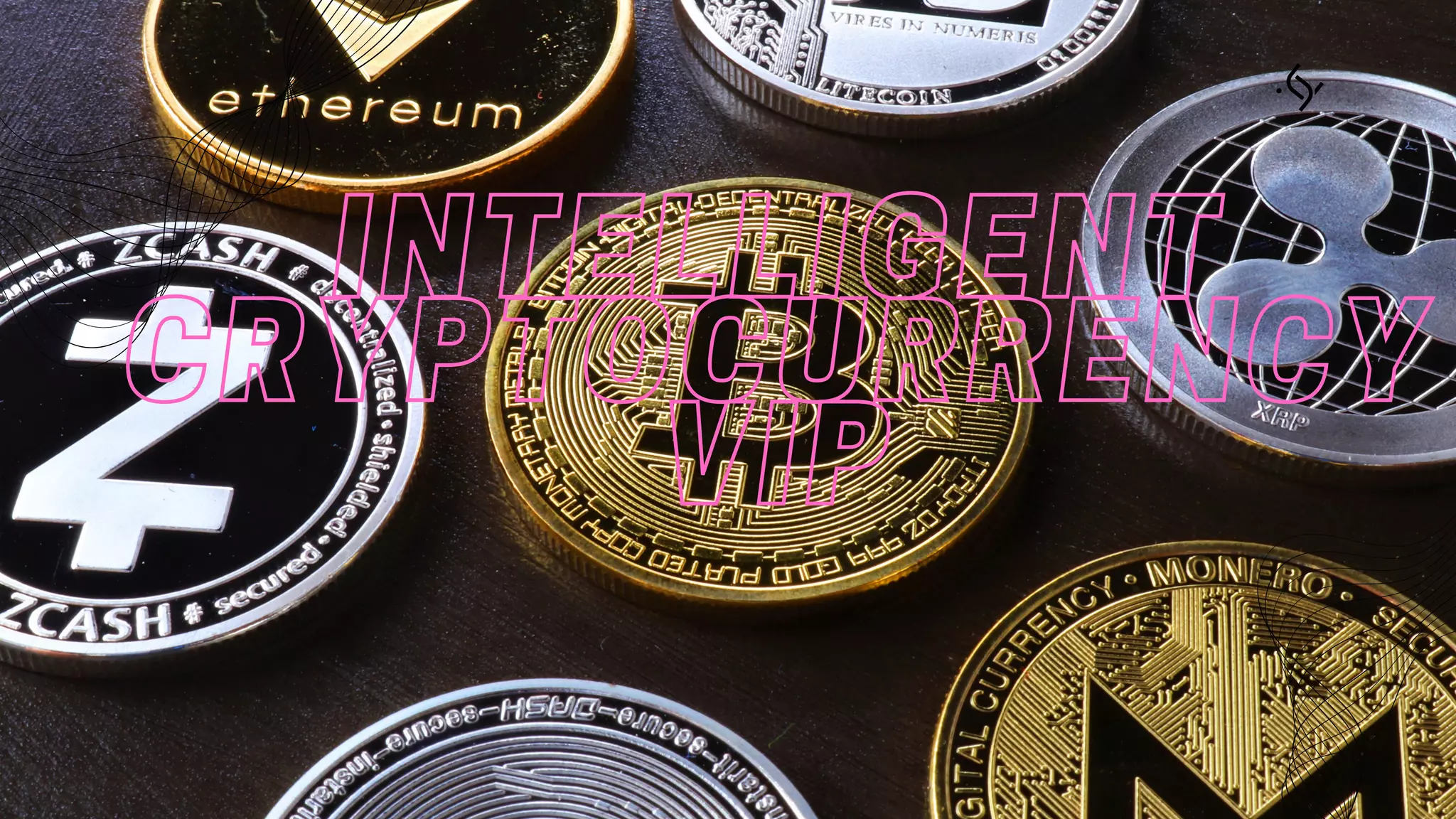
INTELLIGENT
CRYPTOCURRENCY
VIP
Introduction to Cryptocurrency and DeFi
Cryptocurrency and decentralized finance (DeFi) have
been making waves in the financial industry, offering
innovative
solutions and paving the way for financial inclusion. As
traditional banking systems face limitations and
exclusionary
practices, cryptocurrencies have emerged as a viable
alternative. In this article, we will delve into the concept
of
financial inclusion, explore the role of cryptocurrency in
bridging the gap, discuss the importance of platforms
like
CoinMarketCap, and highlight the benefits and
challenges of decentralized finance.
Understanding the Concept of Financial Inclusion
Financial inclusion refers to the accessibility and
availability of financial services to individuals and
businesses,
regardless of their socioeconomic status or geographical
location. Unfortunately, traditional financial systems
often fail
to reach those who need them the most, leaving a
significant portion of the world's population unbanked
or
underbanked. This lack of access hinders economic
growth, limits opportunities, and perpetuates social
inequality.
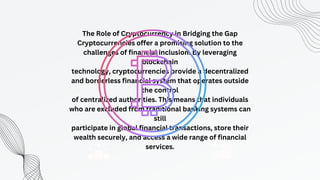
The Role of Cryptocurrency in Bridging the Gap
Cryptocurrencies offer a promising solution to the
challenges of financial inclusion. By leveraging
blockchain
technology, cryptocurrencies provide a decentralized
and borderless financial system that operates outside
the control
of centralized authorities. This means that individuals
who are excluded from traditional banking systems can
still
participate in global financial transactions, store their
wealth securely, and access a wide range of financial
services.
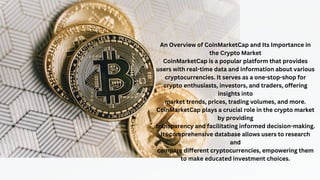
An Overview of CoinMarketCap and Its Importance in
the Crypto Market
CoinMarketCap is a popular platform that provides
users with real-time data and information about various
cryptocurrencies. It serves as a one-stop-shop for
crypto enthusiasts, investors, and traders, offering
insights into
market trends, prices, trading volumes, and more.
CoinMarketCap plays a crucial role in the crypto market
by providing
transparency and facilitating informed decision-making.
Its comprehensive database allows users to research
and
compare different cryptocurrencies, empowering them
to make educated investment choices.
The Benefits of Decentralized Finance (DeFi)
Decentralized finance, often referred to as DeFi, is an ecosystem of financial applications
built on blockchain
technology. DeFi aims to democratize and decentralize traditional financial services by
eliminating intermediaries and
providing direct peer-to-peer interactions. This innovative approach brings several benefits,
such as increased financial
freedom, lower transaction costs, enhanced security, and improved access to financial
services for the unbanked and
underbanked populations
>>>get a course on sale now <<<
01
Challenges and Risks in the Cryptocurrency and DeFi
Space
While cryptocurrency and DeFi offer exciting
opportunities, it is crucial to be aware of the challenges
and risks
associated with this evolving space. Volatility is a
prominent concern, as the value of cryptocurrencies can
fluctuate
dramatically within short periods. Regulatory
uncertainties and potential security vulnerabilities also
pose risks.
Additionally, the complexity of DeFi protocols and smart
contracts may expose users to potential hacks or scams.
It is
essential to conduct thorough research, exercise
caution, and only invest what you can afford to lose.
04
CUSTOMERS
How to Get Started with Cryptocurrency Investing
Getting started with cryptocurrency investing may seem
daunting for newcomers. However, with the right
knowledge
and approach, anyone can enter this exciting market.
The first step is to educate yourself about
cryptocurrencies,
blockchain technology, and the underlying principles. It
is crucial to choose a reputable exchange platform to
buy and
sell cryptocurrencies securely. Creating a digital wallet
to store your assets is also essential. Diversifying your
portfolio
and staying informed about market trends and news will
help you make informed investment decisions.
Exploring Popular Cryptocurrencies and Their Potential
for Financial
Inclusion
Several cryptocurrencies have gained widespread
recognition and adoption, each with its unique features
and potential
for financial inclusion. Bitcoin, the first and most well-
known cryptocurrency, has established itself as a store
of value
and a medium of exchange. Ethereum, on the other
hand, enables the creation of decentralized applications
and smart
contracts that can revolutionize various industries.
Other cryptocurrencies, such as Ripple, Litecoin, and
Cardano, also
offer unique value propositions and contribute to the
vision of financial inclusion⁶
GET ACCESS TO
A COURSE
Exploring Popular Cryptocurrencies and Their Potential
for Financial
Inclusion
Several cryptocurrencies have gained widespread
recognition and adoption, each with its unique features
and potential
for financial inclusion. Bitcoin, the first and most well-
known cryptocurrency, has established itself as a store
of value
and a medium of exchange. Ethereum, on the other
hand, enables the creation of decentralized applications
and smart
contracts that can revolutionize various industries.
Other cryptocurrencies, such as Ripple, Litecoin, and
Cardano, also
offer unique value propositions and contribute to the
vision of financial inclusion.
Access now !!!
Inclusion
The future of cryptocurrency and DeFi looks promising.
As blockchain technology continues to evolve and
mature, we
can expect increased adoption and integration of
cryptocurrencies into mainstream financial systems.
Governments and
regulatory bodies are gradually recognizing the
potential of cryptocurrencies and exploring ways to
regulate and
embrace them. DeFi is also expected to play a crucial
role in providing accessible and inclusive financial
services,
empowering individuals and communities worldwide.
The Future of Cryptocurrency and DeFi in Promoting
Financial
STRATEGY N°3
Conclusion
Cryptocurrency and DeFi have the potential to bridge the
gap for financial inclusion, providing accessible and
inclusive
financial services to individuals and businesses globally. By
leveraging blockchain technology, cryptocurrencies offer a
decentralized and borderless financial system that
empowers the unbanked and underbanked populations.
Platforms
like CoinMarketCap facilitate transparency and informed
decision-making in the crypto market. While challenges and
risks exist, proper education and caution can mitigate them.
As we look towards the future, cryptocurrency and DeFi
hold immense promise in promoting financial inclusion and
reshaping the global financial landscape.
CTA: Start your journey towards financial inclusion by
exploring the world of cryptocurrency and decentralized
finance.
Educate yourself, conduct thorough research, and take the
first steps towards a more inclusive financial future.
STRATEGY N°3
Watch a free
masterclass
video now!!!
ANGELO BREWING
STRATEGY N°3
How To Get Rich With
Bitcoin Even If You
Have No Clue About
Technology"
THANK'S FOR
READING
LARANA, INC.

Intelligent Cryptocurrency VIP

  • 1.
  • 2.
    Introduction to Cryptocurrencyand DeFi Cryptocurrency and decentralized finance (DeFi) have been making waves in the financial industry, offering innovative solutions and paving the way for financial inclusion. As traditional banking systems face limitations and exclusionary practices, cryptocurrencies have emerged as a viable alternative. In this article, we will delve into the concept of financial inclusion, explore the role of cryptocurrency in bridging the gap, discuss the importance of platforms like CoinMarketCap, and highlight the benefits and challenges of decentralized finance.
  • 3.
    Understanding the Conceptof Financial Inclusion Financial inclusion refers to the accessibility and availability of financial services to individuals and businesses, regardless of their socioeconomic status or geographical location. Unfortunately, traditional financial systems often fail to reach those who need them the most, leaving a significant portion of the world's population unbanked or underbanked. This lack of access hinders economic growth, limits opportunities, and perpetuates social inequality.
  • 4.
    The Role ofCryptocurrency in Bridging the Gap Cryptocurrencies offer a promising solution to the challenges of financial inclusion. By leveraging blockchain technology, cryptocurrencies provide a decentralized and borderless financial system that operates outside the control of centralized authorities. This means that individuals who are excluded from traditional banking systems can still participate in global financial transactions, store their wealth securely, and access a wide range of financial services.
  • 5.
    An Overview ofCoinMarketCap and Its Importance in the Crypto Market CoinMarketCap is a popular platform that provides users with real-time data and information about various cryptocurrencies. It serves as a one-stop-shop for crypto enthusiasts, investors, and traders, offering insights into market trends, prices, trading volumes, and more. CoinMarketCap plays a crucial role in the crypto market by providing transparency and facilitating informed decision-making. Its comprehensive database allows users to research and compare different cryptocurrencies, empowering them to make educated investment choices.
  • 6.
    The Benefits ofDecentralized Finance (DeFi) Decentralized finance, often referred to as DeFi, is an ecosystem of financial applications built on blockchain technology. DeFi aims to democratize and decentralize traditional financial services by eliminating intermediaries and providing direct peer-to-peer interactions. This innovative approach brings several benefits, such as increased financial freedom, lower transaction costs, enhanced security, and improved access to financial services for the unbanked and underbanked populations >>>get a course on sale now <<<
  • 7.
    01 Challenges and Risksin the Cryptocurrency and DeFi Space While cryptocurrency and DeFi offer exciting opportunities, it is crucial to be aware of the challenges and risks associated with this evolving space. Volatility is a prominent concern, as the value of cryptocurrencies can fluctuate dramatically within short periods. Regulatory uncertainties and potential security vulnerabilities also pose risks. Additionally, the complexity of DeFi protocols and smart contracts may expose users to potential hacks or scams. It is essential to conduct thorough research, exercise caution, and only invest what you can afford to lose. 04
  • 8.
    CUSTOMERS How to GetStarted with Cryptocurrency Investing Getting started with cryptocurrency investing may seem daunting for newcomers. However, with the right knowledge and approach, anyone can enter this exciting market. The first step is to educate yourself about cryptocurrencies, blockchain technology, and the underlying principles. It is crucial to choose a reputable exchange platform to buy and sell cryptocurrencies securely. Creating a digital wallet to store your assets is also essential. Diversifying your portfolio and staying informed about market trends and news will help you make informed investment decisions.
  • 9.
    Exploring Popular Cryptocurrenciesand Their Potential for Financial Inclusion Several cryptocurrencies have gained widespread recognition and adoption, each with its unique features and potential for financial inclusion. Bitcoin, the first and most well- known cryptocurrency, has established itself as a store of value and a medium of exchange. Ethereum, on the other hand, enables the creation of decentralized applications and smart contracts that can revolutionize various industries. Other cryptocurrencies, such as Ripple, Litecoin, and Cardano, also offer unique value propositions and contribute to the vision of financial inclusion⁶
  • 10.
    GET ACCESS TO ACOURSE Exploring Popular Cryptocurrencies and Their Potential for Financial Inclusion Several cryptocurrencies have gained widespread recognition and adoption, each with its unique features and potential for financial inclusion. Bitcoin, the first and most well- known cryptocurrency, has established itself as a store of value and a medium of exchange. Ethereum, on the other hand, enables the creation of decentralized applications and smart contracts that can revolutionize various industries. Other cryptocurrencies, such as Ripple, Litecoin, and Cardano, also offer unique value propositions and contribute to the vision of financial inclusion. Access now !!!
  • 11.
    Inclusion The future ofcryptocurrency and DeFi looks promising. As blockchain technology continues to evolve and mature, we can expect increased adoption and integration of cryptocurrencies into mainstream financial systems. Governments and regulatory bodies are gradually recognizing the potential of cryptocurrencies and exploring ways to regulate and embrace them. DeFi is also expected to play a crucial role in providing accessible and inclusive financial services, empowering individuals and communities worldwide. The Future of Cryptocurrency and DeFi in Promoting Financial
  • 12.
    STRATEGY N°3 Conclusion Cryptocurrency andDeFi have the potential to bridge the gap for financial inclusion, providing accessible and inclusive financial services to individuals and businesses globally. By leveraging blockchain technology, cryptocurrencies offer a decentralized and borderless financial system that empowers the unbanked and underbanked populations. Platforms like CoinMarketCap facilitate transparency and informed decision-making in the crypto market. While challenges and risks exist, proper education and caution can mitigate them. As we look towards the future, cryptocurrency and DeFi hold immense promise in promoting financial inclusion and reshaping the global financial landscape. CTA: Start your journey towards financial inclusion by exploring the world of cryptocurrency and decentralized finance. Educate yourself, conduct thorough research, and take the first steps towards a more inclusive financial future.
  • 13.
    STRATEGY N°3 Watch afree masterclass video now!!! ANGELO BREWING
  • 14.
    STRATEGY N°3 How ToGet Rich With Bitcoin Even If You Have No Clue About Technology"
  • 15.