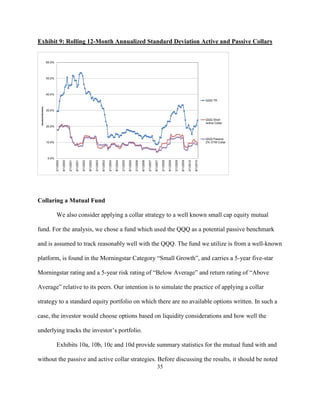
An Update of “Loosening Your Collar: Alternative Implementations of QQQ Collars”:

                          Credit Crisis and Out-of-Sample Performance

                                          Edward Szado *

                                      Thomas Schneeweis **

                                  Original Version: August 2009
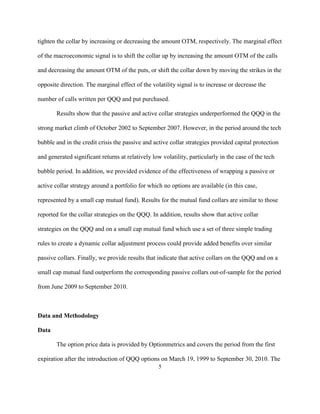
                                  Current Update: January 2011


*Doctoral Candidate, Isenberg School of Management, University of Massachusetts, Amherst,
MA 01003, Director of Research, INGARM, Amherst, MA 01002. INGARM gratefully
acknowledges research support provided by the Options Industry Council. Research results,
however, represent those of the authors and do not necessarily represent the views of the OIC.
Please address correspondence to Edward Szado, INGARM, 29 S. Pleasant St., Amherst, MA
01002, 413-256-0195, or email: eszado@ingarm.org.

**Michael and Cheryl Philipp Professor of Finance, Director of CISDM, Isenberg School of
Management, University of Massachusetts, Amherst.


                                              Abstract

This study provides an update to Szado and Schneeweis [2010]. The original study covered the
period from March 1999 through May 2009. This updated study extends the period of analysis
through September 2010.
The credit crisis and the associated decline in equity markets rekindled new interest in option
based equity collars and in protective strategies in general. In this paper we consider the
performance of passive and active implementations of the collar strategy on the QQQ ETF as
well as on a sample small cap equity mutual fund. As expected, the results of the analysis show
that a passive collar is most effective (relative to a long underlying position) in declining markets
and less effective in rising markets. This study also considers a more active implementation of
the collar strategy. Rather than simply applying a set of fixed rules as for the passive collar, in
the active collar adjusted strategy, we apply a set of rules which adapt the collar to varying
economic and market conditions. This approach is similar to applying a set of tactical asset
allocation rules to a set of investments. There are of course an unlimited number of conditioning
factors that can be used to determine the strategy implementation. In this paper, for purposes of
presentation, we combine three conditioning factors that have been suggested in academic
literature (momentum, volatility, and a compound macroeconomic factor (unemployment and
business cycle)) to generate a dynamic collar adjusted trading strategy. For the period of
analysis, the active collar adjustment strategy tends to outperform the passive collar both in-
sample as well as out-of-sample. Judgments as to the particular benefits of the passive and active
collar strategies are, of course, dependent on the risk tolerance of the individual investor.
Introduction

       This study provides an update to Szado and Schneeweis [2010]1. The original study

covered the period from March 1999 through May 2009. This updated study extends the period

of analysis through September 2010. In addition to the original analysis, this update includes out-

of-sample performance for the active collar strategies based on the trading rules set out in the

original paper.

        The credit crisis and the associated decline in equity markets rekindled new interest in

option based equity collars and in protective strategies in general. In 2008 the QQQ experienced

a drawdown of about 50% from peak to trough. Many other asset classes which are generally

considered effective equity diversifiers also faced significant losses. This type of contagion

across asset classes suggests that in times of major systematic stress, direct hedges through

protective option strategies may provide equity portfolios with greater downside risk protection

than standard multi-asset diversification programs. There are a variety of option strategies which

can provide capital protection for equity based portfolios. The focus of this paper is one of the

more straightforward options based strategies – the collar. A collar is an option based

investment strategy that effectively limits (or collars) the returns on an investment in an

underlying asset to fall within a chosen range. An investor who holds a long position in an

underlying asset can convert that position into a collar (collar his position) by purchasing a put

option on the underlying asset and simultaneously selling (writing) a call option on the

underlying asset. The strike price on the call defines the upper bound of the collar and is set

above the strike price for the put (which defines the lower bound of the collar). In a standard

1
 See “Loosening Your Collar – Alternative Implementations of QQQ Collars,” Edward Szado and
Thomas Schneeweis, Journal of Trading, Spring 2010, Vol. 5, No. 2, pp. 35-56

                                                 2
collar, the call and put have the same expiration dates. The value of a portfolio constructed in

this manner will essentially be restricted to fluctuate within the bounds set by the strike prices of

the options (adjusted for the net cost of the option positions).2

        In this paper, we extend previous research on collar strategies (Schneeweis and Spurgin

[2001] and Szado and Kazemi [2009] as well as the original paper this update is based on) by

considering the performance and risk characteristics of active as well as passive collars. In

addition, we provide an example of the effectiveness of applying a collar strategy to a sample

equity mutual fund on which options are not available. It is worth noting that this study does not

address whether these strategies generate “alpha” based on any specific definition of investor

risk aversion. The significance of the results may be interpreted differently by any individual

based on their particular risk aversion.

        In this study the performance of passively implemented collars on the Powershares QQQ

ETF (ticker: QQQQ) is analyzed. The collars are passive in the sense that they follow a rigid set

of rules which do not vary with market conditions. The passive implementations do vary in their

choice of the initial moneyness and time to expiration of the calls and puts. This study also

considers a more active implementation of the collar strategy. Rather than simply applying a set

of fixed rules as for the passive collar, for the active collar adjustment strategy, we apply a set of

rules which adapt the collar to varying economic and market conditions. This approach is similar

to applying a set of tactical asset allocation rules to a set of investments. There are of course an

2
 Collars can be visualized as a combination of covered call and protective put strategies. The collar
strategy essentially adds a long protective put to a covered call strategy. This provides the significant
downside protection which the covered call strategy lacks. The purchase of the long put is financed by the
sale of the call. In essence, the collar trades upside participation for downside protection. A tight collar
provides less upside participation and more downside protection than a loose collar. At one extreme, the
tightest collar (ATM puts and calls) effectively immunizes the portfolio from market movements. At the
other extreme (very far OTM puts and calls), the collar is essentially equivalent to a long index position.
                                                        3
unlimited number of conditioning factors that can be used to determine the strategy

implementation. In this paper, for purposes of presentation, we combine three conditioning

factors that have been suggested in academic literature (momentum, volatility, and a compound

macroeconomic factor (unemployment and business cycle)) to generate a dynamic collar

adjusted trading strategy.3 Finally, the study considers the implementation of an active and

passive collar strategy using QQQ options applied to a non-QQQ equity portfolio represented by

a small cap equity mutual fund. This provides an additional analysis of the use of the collar

strategy for a wider range of market participants.

        In the following sections we summarize the methodology and data used in this analysis. It

is important to note that all empirical research may be data and time period dependent. The

original analysis in Szado and Schneeweis [2010] covers the period from the introduction of

options on the QQQ (March 19, 1999) through May 31, 2009. This updated analysis covers the

period from March 19, 1999 through September 30, 2010. This period is broken into various sub-

periods to offer a better picture of the benefits and risk of the implemented collar strategies in

various market environments. In the methodology section we describe both the passive and

active collar implementations. In the active collar section we describe how we combine the

momentum, volatility and macroeconomic signals to generate a dynamic collar adjustment

trading strategy process4. In this process, the initial moneyness of the puts and calls is

determined based on the momentum and macroeconomic signals and the ratio of written calls is

determined by the volatility signal. The marginal effect of the momentum signal is to widen or


3
  While these collar implementations are active in the sense that the rules are dependent on manager
decisions, they are implemented systematically with no additional manager discretion.
4
  While we combine the three signals to generate the strategy, any one of the signals could be used on its
own to generate an active strategy.
                                                     4
tighten the collar by increasing or decreasing the amount OTM, respectively. The marginal effect

of the macroeconomic signal is to shift the collar up by increasing the amount OTM of the calls

and decreasing the amount OTM of the puts, or shift the collar down by moving the strikes in the

opposite direction. The marginal effect of the volatility signal is to increase or decrease the

number of calls written per QQQ and put purchased.

       Results show that the passive and active collar strategies underperformed the QQQ in the

strong market climb of October 2002 to September 2007. However, in the period around the tech

bubble and in the credit crisis the passive and active collar strategies provided capital protection

and generated significant returns at relatively low volatility, particularly in the case of the tech

bubble period. In addition, we provided evidence of the effectiveness of wrapping a passive or

active collar strategy around a portfolio for which no options are available (in this case,

represented by a small cap mutual fund). Results for the mutual fund collars are similar to those

reported for the collar strategies on the QQQ. In addition, results show that active collar

strategies on the QQQ and on a small cap mutual fund which use a set of three simple trading

rules to create a dynamic collar adjustment process could provide added benefits over similar

passive collars. Finally, we provide results that indicate that active collars on the QQQ and on a

small cap mutual fund outperform the corresponding passive collars out-of-sample for the period

from June 2009 to September 2010.


Data and Methodology

Data

       The option price data is provided by Optionmetrics and covers the period from the first

expiration after the introduction of QQQ options on March 19, 1999 to September 30, 2010. The
                                                   5
QQQ, NDX, Treasury bill and VIX data5 is provided by Bloomberg6, while mutual fund data is

provided by Morningstar. Business cycle announcement data are provided by the National

Bureau of Economic Research.


Methodology

        In order to assess the performance of active and passive collar strategies, we construct

indices which represent the return streams generated by such strategies. The passive strategies

follow a fixed set of option selection rules defining the initial moneyness and time to expiration

of the calls and puts, regardless of market conditions. In contrast, the active7 collar strategies

base their option selection rules on a combination of three simple market/economic based signals

(momentum, volatility, and a macroeconomic factor) and thus adjust to various market

conditions.

Passive Collar Strategy: We generate a daily time series of returns for each of the passive

strategies beginning on March 19, 19998. At the close on this day a 1-month call is written and a

1, 3 or 6-month put is purchased. Depending on the particular passive implementation, the initial

moneyness of the calls and puts are set at either 5%, 4%, 3%, 2%, 1% OTM or ATM. At the

close on the Friday prior to the following expiration, we take one of two actions: If 1-month puts

are used, the puts and calls are settled at intrinsic value and we roll into new 1-month puts and

calls with the specified moneyness. If a 3- or 6-month put is used, the calls are settled at intrinsic

5
  NDX, VIX and Initial Unemployment Claims data is collected from March 1998 to ensure sufficient lag
time for signal generation.
6
  In the original study this data was provided by Datastream.
7
  It should be noted that while we use the term active to represent these strategies, they are not truly
actively managed. They still follow an established set of selection rules, but the rules include a dynamic
element conditioned on economic variables.
8
  This is the Friday prior to the first expiration Saturday following the introduction of QQQ options.
                                                        6
value and new 1-month calls with the specified moneyness are rolled into, while the longer term

put is held for another month. When the new 1-month calls are written, the net proceeds from the

sale of the calls and the expiration of the previous calls are fully invested in the strategy and the

position is rebalanced to ensure a 1:1:1 ratio of the underlying, puts and calls. Once the 3- or 6-

month put expires, it is settled at intrinsic value and we once again roll into new puts and calls

with the specified moneyness and time to expiration. In order to include the impact of

transaction costs, the puts are purchased at the ask price and the calls are written at the bid price

when each new put or call position is established. Each trading day in between roll dates, the

options are priced at the mid-point between the bid and ask prices. In this manner, daily returns

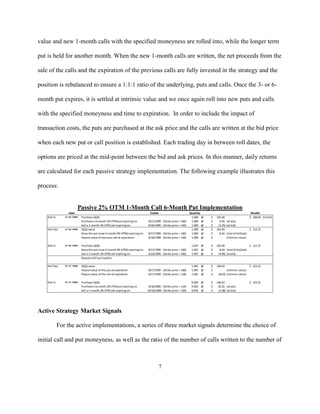
are calculated for each passive strategy implementation. The following example illustrates this

process:


                           Passive 2% OTM 1-Month Call 6-Month Put Implementation
                    Date                                                          Exdate                          Quantity                                      Wealth
    Roll In      3/ 19/ 1999   Purchase QQQ                                                                        1.000 @   $   102.44                        $ 108.69 (Initial)
                               Purchase a 6-month 2% OTM put expiring on:       9/17/1999 (Strike price = 100)     1.000 @   $     9.50    (at ask)
                               Sell a 1-month 2% OTM call expiring on:          4/16/1999 (Strike price = 104)     1.000 @   $    (3.25)   (at bid)
    Roll Out     4/ 16/ 1999   QQQ value                                                                           1.000 @   $   103.94                        $ 112.37
                               Keep the put (now 5-month 4% OTM) expiring on:   9/17/1999 (Strike price = 100)     1.000 @   $     8.44    (mid of bid/ask)
                               Payout value of previous call at expiration:     4/16/1999 (Strike price = 104)     1.000 @   $      -      (intrinsic value)

    Roll In      4/ 16/ 1999   Purchase QQQ                                                                        1.037 @   $   103.94                  $ 112.37
                               Keep the put (now 5-month 4% OTM) expiring on:   9/17/1999 (Strike price = 100)     1.037 @   $     8.44 (mid of bid/ask)
                               Sell a 1-month 2% OTM call expiring on:          5/22/1999 (Strike price = 106)     1.037 @   $    (4.00) (at bid)
                               Repeat until put expires

    Roll Out     9/ 17/ 1999   QQQ value                                                                           1.045 @   $   126.63                        $ 123.31
                               Payout value of the put at expiration:           9/17/1999 (Strike price = 100)     1.045 @   $      -    (intrinsic value)
                               Payout value of the call at expiration:          9/17/1999 (Strike price = 118)     1.045 @   $    (8.63) (intrinsic value)

    Roll In      9/ 17/ 1999   Purchase QQQ                                                                        0.924 @   $   126.63                        $ 123.31
                               Purchase a 6-month 2% OTM put expiring on:        3/18/2000 (Strike price = 124)    0.924 @   $    10.25 (at ask)
                               Sell a 1-month 2% OTM call expiring on:          10/16/1999 (Strike price = 129)    0.924 @   $    (3.38) (at bid)


Active Strategy Market Signals

              For the active implementations, a series of three market signals determine the choice of

initial call and put moneyness, as well as the ratio of the number of calls written to the number of


                                                                                        7
puts and QQQ shares purchased, while the initial time to expiration is fixed at one month for the

calls and 6 months for the puts.

Active Collar Adjustment Strategy: Three different sets of active market signals are used for the

strategy implementations, differing by their time horizon; short, medium and long-term. The

three signals are based on momentum, volatility and a compound macroeconomic indicator

(unemployment claims and business cycle), respectively. In order to ensure that the strategies are

investable, all signals use contemporaneously lagged data9.

Momentum Signal: The momentum signal is a simple moving average cross-over (SMACO) of

the NASDAQ-100 index (NDX)10. A SMACO compares a short-term moving average (SMA)

and a long-term moving average (LMA) to determine whether an upward or downward trend

exists. The rule is defined by the number of days covered by each of the moving averages. For

example, a 5/150 SMACO rule compares a 5 day SMA with a 150 day LMA. If the SMA is

greater (less) than the LMA, then an upward (downward) trend indicated, suggesting a buy (sell)

signal. Our choice of signals is based on Szakmary, Davidson, Schwarz [1999] and Lento

[2008]11, which both consider 1/50, 1/150, 5/150, 1/200 and 2/200 SMACO rules on the NDX.

Szakmary et al apply NASDAQ index SMACOs as buy/sell signals for individual stocks for the

period from 1973 to 199112. They find some significant excess returns, although their

significance does not survive transactions costs. Similarly, Lento finds some significant


9
  The signals are designed so that they are based only on data which existed prior to the date on which the
signal would have been generated in practice. For example, a signal for the March 19, 1999 option roll-in
date would only use data which existed on March 18, 1999 or earlier.
10
   The use of the NDX rather than the QQQ provides us with historical data beyond the introduction of the
QQQ. In this way, we can generate signals from the beginning of the QQQ data series.
11
   Additional evidence of the existence of momentum and potential explanations for its existence can be
found in Jegadeesh and Titman [2001] and Schneeweis, Kazemi and Spurgin [2008].
12
   In this paper they do not take short positions. They use the signals as in/out position indicators.
                                                       8
forecasting abilities in the same SMACO rules on the NASDAQ at a 10-day lag over the period

of 1995 to 2008. Following their methodology, we use 1/50, 5/150, and 1/200 SMACO rules on

the NDX. This provides us with a short, medium and long-term momentum signal. Each roll

date, we calculate the SMA and LMA for each of the three momentum rules and use them to

generate the momentum signals. All else equal, if the calculation results in a buy signal, the

collar would widen (increasing upside participation with a corresponding reduction in downside

protection). In contrast, all else equal, the collar would be tightened in response to sell signal

(increasing downside protection while reducing upside participation).

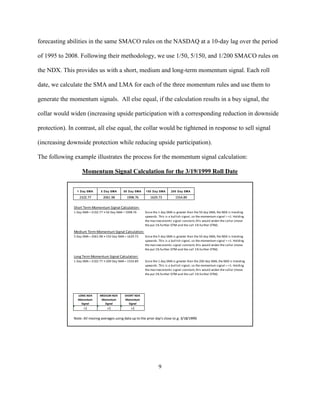
The following example illustrates the process for the momentum signal calculation:

                    Momentum Signal Calculation for the 3/19/1999 Roll Date


                 1 Day SMA       5 Day SMA      50 Day SMA    150 Day SMA      200 Day SMA

                  2102.77         2061.98         1998.76        1629.73          1554.89

               Short Term Momentum Signal Calculation:
               1 Day SMA = 2102.77 > 50 Day SMA = 1998.76    Since the 1 day SMA is greater than the 50 day SMA, the NDX is trending
                                                             upwards. This is a bullish signal, so the momentum signal = +1. Holding
                                                             the macroeconomic signal constant, this would widen the collar (move
                                                             the put 1% further OTM and the call 1% further OTM).

               Medium Term Momentum Signal Calculation:
               5 Day SMA = 2061.98 > 150 Day SMA = 1629.73   Since the 5 day SMA is greater than the 50 day SMA, the NDX is trending
                                                             upwards. This is a bullish signal, so the momentum signal = +1. Holding
                                                             the macroeconomic signal constant, this would widen the collar (move
                                                             the put 1% further OTM and the call 1% further OTM).

               Long Term Momentum Signal Calculation:
               1 Day SMA = 2102.77 > 200 Day SMA = 1554.89   Since the 1 day SMA is greater than the 200 day SMA, the NDX is trending
                                                             upwards. This is a bullish signal, so the momentum signal = +1. Holding
                                                             the macroeconomic signal constant, this would widen the collar (move
                                                             the put 1% further OTM and the call 1% further OTM).


                 LONG NDX       MEDIUM NDX       SHORT NDX
                 Momentum        Momentum        Momentum
                   Signal          Signal          Signal
                     +1              +1              +1

               Note: All moving averages using data up to the prior day's close (e.g. 3/18/1999)


                                                                      9
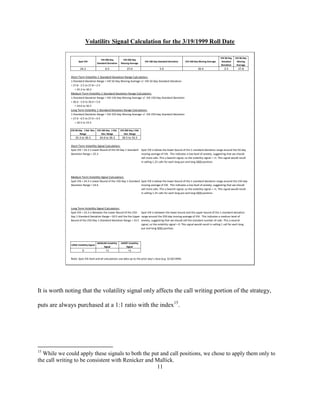
Volatility Signal: The volatility signal is based on Renicker and Mallick [2005]. Renicker and

Mallick create an “enhanced” S&P 500 buy-write strategy and back test it over the period from

1997 to September 2005.13 They find excess returns to a strategy which writes 0.75 calls to each

long index position when the markets short-term anxiety level is high (as indicated by a situation

in which the 1-month ATM S&P 500 implied volatility is more than 1 standard deviation above

its current 250-day moving average level), and writes 1.25 calls per index position when the

anxiety level is low (when the 1-month implied volatility is more than 1 standard deviation

below the 250-day average level)14. Their goal in varying the quantity of written calls is to have a

longer exposure to the market in times of high anxiety and shorter exposure in times of

complacency. We make two minor modifications to their strategy. First, we use the daily VIX

close as an indicator of implied volatility levels. Second, we consider a short, medium and long-

term time frame to generate the 3 corresponding signals. In order to match the time frames of our

momentum signals our short, medium and long-term volatility signals use 50, 150 and 250-day

windows respectively. In keeping with the methodology of Renicker and Mallick, on roll dates

we sell 0.75 (1.25) calls per index position when the previous day’s VIX close is more than 1

standard deviation above (below) its current moving average level, otherwise we sell 1 call per

index position as illustrated by the following formula:


# of Calls Written per Long Put and Long QQQ Position = 1 + (0.25 * Volatility Signal),

where the volatility signal is -1, 0 or +1.


13
  Note that since the Renicker and Mallick study reported results based on the period used in this study, the use of
this variable is not independent from the period used to analyze its impact on the collar strategy.
14
  When the 1-month implied volatility level is within the 1 standard deviation bounds, they follow a
standard 1:1 ratio buy-write.
                                                   10
Volatility Signal Calculation for the 3/19/1999 Roll Date

                                                                                                                                               VIX 50-Day   VIX 50-Day
                                          VIX 250-Day        VIX 250-Day
                    Spot VIX                                                     VIX 150-Day Standard Deviation   VIX 150-Day Moving Average    Standard     Moving
                                       Standard Deviation   Moving Average
                                                                                                                                               Deviation     Average
                      24.3                    6.5                 27.0                        5.9                           30.4                  2.5         27.8

              Short Term Volatility 1-Standard Deviation Range Calculation:
              1-Standard Deviation Range = VIX 50-Day Moving Average +/- VIX 50-Day Standard Deviation
              = 27.8 - 2.5 to 27.8 + 2.5
                 = 25.3 to 30.3
              Medium Term Volatility 1-Standard Deviation Range Calculation:
              1-Standard Deviation Range = VIX 150-Day Moving Average +/- VIX 150-Day Standard Deviation
              = 30.4 - 5.9 to 30.4 + 5.9
                 = 24.6 to 36.3
              Long Term Volatility 1-Standard Deviation Range Calculation:
              1-Standard Deviation Range = VIX 250-Day Moving Average +/- VIX 250-Day Standard Deviation
              = 27.0 - 6.5 to 27.0 + 6.5
                 = 20.5 to 33.5

              VIX 50-Day 1 Std. Dev. VIX 150-Day 1 Std.     VIX 250-Day 1 Std.
                      Range              Dev. Range            Dev. Range
                 25.3 to 30.3            24.6 to 36.3        20.5 to 33.5

              Short Term Volatility Signal Calculation:
              Spot VIX = 24.3 < Lower Bound of the 50-Day 1-Standard Spot VIX is below the lower bound of the 1-standard deviation range around the 50-day
              Deviation Range = 25.3                                 moving average of VIX. This indicates a low level of anxiety, suggesting that we should
                                                                     sell more calls. This a bearish signal, so the volatility signal = +1. This signal would result
                                                                     in selling 1.25 calls for each long put and long QQQ position.


              Medium Term Volatility Signal Calculation:
              Spot VIX = 24.3 < Lower Bound of the 150-Day 1-Standard Spot VIX is below the lower bound of the 1-standard deviation range around the 150-day
              Deviation Range = 24.6                                  moving average of VIX. This indicates a low level of anxiety, suggesting that we should
                                                                      sell more calls. This a bearish signal, so the volatility signal = +1. This signal would result
                                                                      in selling 1.25 calls for each long put and long QQQ position.


              Long Term Volatility Signal Calculation:
              Spot VIX = 24.3 is Between the Lower Bound of the 250- Spot VIX is between the lower bound and the upper bound of the 1-standard deviation
              Day 1-Standard Deviation Range = 20.5 and the the Upper range around the 250-day moving average of VIX. This indicates a medium level of
              Bound of the 250-Day 1-Standard Deviation Range = 33.5 anxiety, suggesting that we should sell the standard number of calls. This a neutral
                                                                      signal, so the volatility signal = 0. This signal would result in selling 1 call for each long
                                                                      put and long QQQ position.


                                       MEDIUM Volatility    SHORT Volatility
              LONG Volatility Signal
                                            Signal              Signal
                        0                     +1                   +1

              Note: Spot VIX level and all calculations use data up to the prior day's close (e.g. 3/18/1999)


It is worth noting that the volatility signal only affects the call writing portion of the strategy,

puts are always purchased at a 1:1 ratio with the index15.


15
  While we could apply these signals to both the put and call positions, we chose to apply them only to
the call writing to be consistent with Renicker and Mallick.
                                                    11
Macroeconomic Signal: The final variable used in the active collar adjustment strategy signal

process is based on the trend of initial unemployment claims and the state of the economy with

respect to the business cycle. Boyd, Hu and Jagannathan [2005] consider the impact of

unemployment rate surprise on the stock market in the period from 1973 to 2000. They find that

in expansionary periods, stocks typically rise on bad unemployment news, while the opposite

relationship holds in contractionary periods16. This is consistent with Veronesi [1999] which

suggests that bad news in expansionary periods and good news in contractionary periods are

typically correlated with an increase in uncertainty and an increase in the equity risk premium

(corresponding to an increase in expected returns and reduction in current prices). We use these

findings to construct a signal based on initial unemployment claims. The announcements from

the NBER’s Business Cycle Dating Committee are used to identify the state of the business

cycle. It is worth noting that NBER does not define a recession as two consecutive quarters of

negative GDP growth. They define it as follows: “A recession is a significant decline in

economic activity spread across the economy, lasting more than a few months, normally visible

in real GDP, real income, employment, industrial production and wholesale-retail sales”17. These

announcements are generally considered the authority on the current state of the business cycle.

Since there is often a significant delay in announcement dates, we base the signals on

announcement dates to avoid hindsight biases. For example, the December 2007 peak was

announced about one year later on December 1, 2008. Our signal would be based on an


16
   These results are somewhat counter-intuitive in the case of expansionary economies. One might expect
rising unemployment to negatively affect stock prices regardless of the business cycle, but the literature
cited above suggests that rising unemployment in expansionary economies causes expected future interest
rates to decline, increasing the value of equities, while rising unemployment in contractions indicates
slower future earnings growth rates, reducing the value of equities.
17
   See http://www.nber.org/cycles.html
                                                      12
expansionary economy until December 1, 2008. Since initial unemployment claims are released

on a weekly basis, we include a one-week lag in the calculations to ensure the investability of our

strategy. In order to closely match the macroeconomic signal methodology with those of the

momentum and volatility signals, we base our short, medium and long-term macroeconomic

signals on 1/10, 1/30 and 1/40 week SMACOs for weekly initial unemployment claims. Since

rising unemployment claims in an expansionary economy is a bullish stock market price and

volatility signal, if the SMA is greater than the LMA, we shift the collar towards the ATM put

and OTM call (increasing both strike prices) thereby increasing the portfolio’s exposure to

upside moves as well as increasing its vega18. In contractionary periods, rising unemployment

claims would cause us to shift the strike prices in the opposite direction.


18
  Since vega is highest for ATM options, moving the short call further OTM and moving the long put
towards the ATM will increase the vega of both option positions.
                                                  13
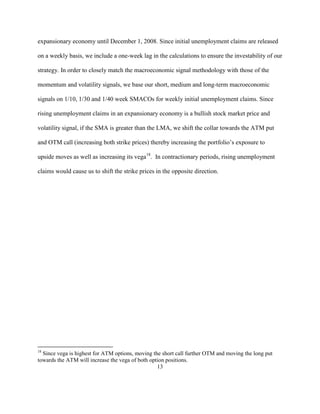
These calculations can be illustrated with the following example:

                        Macroeconomic Signal Calculation for the 3/19/1999 Roll Date

          NBER Announcements
                Date         Indication
             12/22/1992        Trough
             11/26/2001         Peak              (3/19/1999 is during an expansionary economy)
                                                  So on 3/19/1999, a downward trend in unemployment is a bearish signal.

                                                                                                                                     MEDIUM     SHORT
             1 W e e k S MA     40 W e e k S MA   30 W e e k S MA            10 W e e k S MA            LONG Unemployment Trend     Unemploym Unemploym
                                                                                                                                     ent Trend ent Trend

                 308.0              317.1             311.8                      311.4                           Down                 Down        Down

          Short Term Macroeconomic Signal Calculation:
          1 Week SMA = 308.0 < 10 Week SMA = 311.4                  Since the 1 week SMA is less than the 10 week SMA, unemployment is falling. In an
                                                                    expansionary economy this is a bearish signal, so the signal = -1. Holding the momentum
                                                                    signal constant, this would shift the collar down (move the put 1% further OTM and the
                                                                    call 1% less OTM).
          Medium Term Macroeconomic Signal Calculation:
          1 Week SMA = 308.0 < 30 Week SMA = 311.8                  Since the 1 week SMA is less than the 30 week SMA, unemployment is falling. In an
                                                                    expansionary economy this is a bearish signal, so the signal = -1. Holding the momentum
                                                                    signal constant, this would shift the collar down (move the put 1% further OTM and the
                                                                    call 1% less OTM).
          Long Term Macroeconomic Signal Calculation:
          1 Week SMA = 308.0 < 40 Week SMA = 317.1                  Since the 1 week SMA is less than the 40 week SMA, unemployment is falling. In an
                                                                    expansionary economy this is a bearish signal, so the signal = -1. Holding the momentum
                                                                    signal constant, this would shift the collar down (move the put 1% further OTM and the
                                                                    call 1% less OTM).

               LONG              MEDIUM              SHORT
           Macroeconomic       Macroeconomic      Macroeconomic
               Signal              Signal             Signal
                   -1                 -1                -1

          Note: All moving averages using data up to the prior week's close (e.g. 3/12/1999)


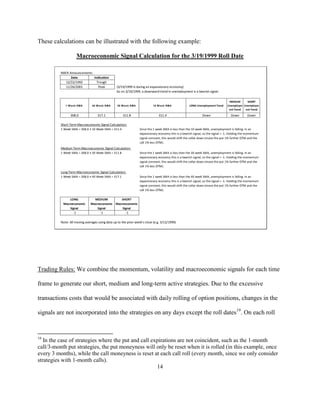
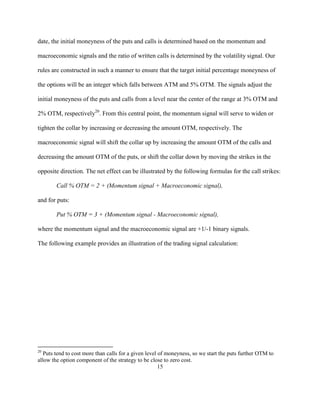
Trading Rules: We combine the momentum, volatility and macroeconomic signals for each time

frame to generate our short, medium and long-term active strategies. Due to the excessive

transactions costs that would be associated with daily rolling of option positions, changes in the

signals are not incorporated into the strategies on any days except the roll dates19. On each roll


19
   In the case of strategies where the put and call expirations are not coincident, such as the 1-month
call/3-month put strategies, the put moneyness will only be reset when it is rolled (in this example, once
every 3 months), while the call moneyness is reset at each call roll (every month, since we only consider
strategies with 1-month calls).
                                                      14
date, the initial moneyness of the puts and calls is determined based on the momentum and

macroeconomic signals and the ratio of written calls is determined by the volatility signal. Our

rules are constructed in such a manner to ensure that the target initial percentage moneyness of

the options will be an integer which falls between ATM and 5% OTM. The signals adjust the

initial moneyness of the puts and calls from a level near the center of the range at 3% OTM and

2% OTM, respectively20. From this central point, the momentum signal will serve to widen or

tighten the collar by increasing or decreasing the amount OTM, respectively. The

macroeconomic signal will shift the collar up by increasing the amount OTM of the calls and

decreasing the amount OTM of the puts, or shift the collar down by moving the strikes in the

opposite direction. The net effect can be illustrated by the following formulas for the call strikes:

        Call % OTM = 2 + (Momentum signal + Macroeconomic signal),

and for puts:

        Put % OTM = 3 + (Momentum signal - Macroeconomic signal),

where the momentum signal and the macroeconomic signal are +1/-1 binary signals.

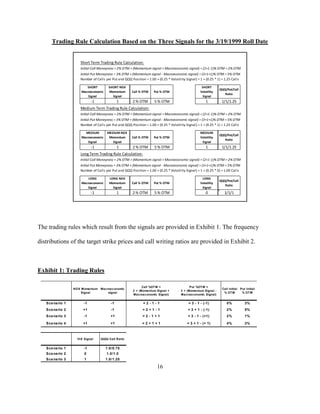
The following example provides an illustration of the trading signal calculation:


20
   Puts tend to cost more than calls for a given level of moneyness, so we start the puts further OTM to
allow the option component of the strategy to be close to zero cost.
                                                       15
Trading Rule Calculation Based on the Three Signals for the 3/19/1999 Roll Date


                     Short Term Trading Rule Calculation:
                     Initial Call Moneyness = 2% OTM + (Momentum signal + Macroeconomic signal) = (2+1-1)% OTM = 2% OTM
                     Initial Put Moneyness = 3% OTM + (Momentum signal - Macroeconomic signal) = (3+1+1)% OTM = 5% OTM
                     Number of Calls per Put and QQQ Position = 1.00 + (0.25 * Volatility Signal) = 1 + (0.25 * 1) = 1.25 Calls

                        SHORT          SHORT NDX                                                     SHORT
                                                                                                                 QQQ/Put/Call
                     Macroeconomic     Momentum        Call % OTM    Put % OTM                      Volatility
                                                                                                                    Ratio
                         Signal          Signal                                                       Signal
                            -1                1        2 % OTM        5 % OTM                           1         1/1/1.25
                     Medium Term Trading Rule Calculation:
                     Initial Call Moneyness = 2% OTM + (Momentum signal + Macroeconomic signal) = (2+1-1)% OTM = 2% OTM
                     Initial Put Moneyness = 3% OTM + (Momentum signal - Macroeconomic signal) = (3+1+1)% OTM = 5% OTM
                     Number of Calls per Put and QQQ Position = 1.00 + (0.25 * Volatility Signal) = 1 + (0.25 * 1) = 1.25 Calls

                       MEDIUM         MEDIUM NDX                                                    MEDIUM
                                                                                                                 QQQ/Put/Call
                     Macroeconomic     Momentum        Call % OTM    Put % OTM                      Volatility
                                                                                                                    Ratio
                         Signal          Signal                                                      Signal
                            -1                1        2 % OTM        5 % OTM                           1         1/1/1.25
                     Long Term Trading Rule Calculation:
                     Initial Call Moneyness = 2% OTM + (Momentum signal + Macroeconomic signal) = (2+1-1)% OTM = 2% OTM
                     Initial Put Moneyness = 3% OTM + (Momentum signal - Macroeconomic signal) = (3+1+1)% OTM = 5% OTM
                     Number of Calls per Put and QQQ Position = 1.00 + (0.25 * Volatility Signal) = 1 + (0.25 * 0) = 1.00 Calls

                         LONG          LONG NDX                                                      LONG
                                                                                                                 QQQ/Put/Call
                     Macroeconomic     Momentum        Call % OTM    Put % OTM                      Volatility
                                                                                                                    Ratio
                         Signal          Signal                                                      Signal
                            -1                1        2 % OTM        5 % OTM                           0           1/1/1


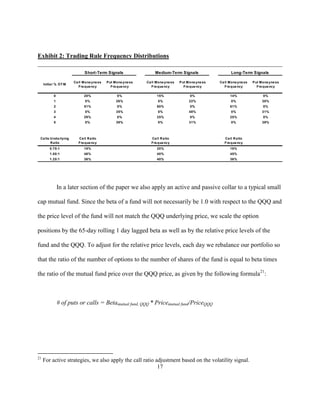
The trading rules which result from the signals are provided in Exhibit 1. The frequency

distributions of the target strike prices and call writing ratios are provided in Exhibit 2.


Exhibit 1: Trading Rules

                                                             Call %OT M =                    Put %OT M =
                  NDX Momentum    Macroeconomic                                                                    Call Initial   Put Initial
                                                       2 + (Momentum Signal +          3 + (Momentum Signal -
                      Signal          signal                                                                        % OT M         % OT M
                                                       Macroeconomic Signal)           Macroeconomic Signal)


   Sce na rio 1        -1                -1                   =2-1-1                        = 3 - 1 - (-1)            0%             3%
   Sce na rio 2       +1                 -1                   =2+1-1                        = 3 + 1 - (-1)            2%             5%
   Sce na rio 3        -1               +1                    =2-1+1                        = 3 - 1 - (+1)            2%             1%

   Sce na rio 4       +1                +1                    =2+1+1                       = 3 + 1 - (+ 1)            4%             3%


                   VIX Signal     QQQ/ Call Ratio


   Sce na rio 1        -1            1.0/ 0.75
   Sce na rio 2        0              1.0/ 1.0
   Sce na rio 3        1             1.0/ 1.25

                                                                       16
Exhibit 2: Trading Rule Frequency Distributions

                             Short-Term Signals                   Medium-Term Signals                     Long-Term Signals

                       Ca ll Mone yne ss   Put Mone yne ss   Ca ll Mone yne ss   Put Mone yne ss   Ca ll Mone yne ss   Put Mone yne ss
     Initia l % OT M
                          Fre que ncy        Fre que ncy        Fre que ncy        Fre que ncy        Fre que ncy        Fre que ncy

            0                20%                 0%                15%                 0%                14%                 0%
            1                 0%                26%                 0%                22%                 0%                30%
            2                51%                 0%                60%                 0%                61%                 0%
            3                 0%                35%                 0%                48%                 0%                31%
            4                29%                 0%                25%                 0%                25%                 0%
            5                 0%                39%                 0%                31%                 0%                39%


 Ca lls:U nde rlying     Ca ll R a tio                         Ca ll R a tio                         Ca ll R a tio
        R a tio          Fre que ncy                           Fre que ncy                           Fre que ncy
         0.75:1              18%                                   20%                                   19%
         1.00:1              46%                                   40%                                   45%
         1.25:1              36%                                   40%                                   36%


                In a later section of the paper we also apply an active and passive collar to a typical small

cap mutual fund. Since the beta of a fund will not necessarily be 1.0 with respect to the QQQ and

the price level of the fund will not match the QQQ underlying price, we scale the option

positions by the 65-day rolling 1 day lagged beta as well as by the relative price levels of the

fund and the QQQ. To adjust for the relative price levels, each day we rebalance our portfolio so

that the ratio of the number of options to the number of shares of the fund is equal to beta times

the ratio of the mutual fund price over the QQQ price, as given by the following formula21:


                # of puts or calls = Betamutual fund, QQQ * Pricemutual fund/PriceQQQ


21
     For active strategies, we also apply the call ratio adjustment based on the volatility signal.
                                                          17
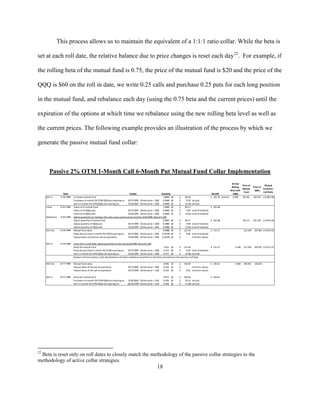
This process allows us to maintain the equivalent of a 1:1:1 ratio collar. While the beta is

set at each roll date, the relative balance due to price changes is reset each day22. For example, if

the rolling beta of the mutual fund is 0.75, the price of the mutual fund is $20 and the price of the

QQQ is $60 on the roll in date, we write 0.25 calls and purchase 0.25 puts for each long position

in the mutual fund, and rebalance each day (using the 0.75 beta and the current prices) until the

expiration of the options at which time we rebalance using the new rolling beta level as well as

the current prices. The following example provides an illustration of the process by which we

generate the passive mutual fund collar:


        Passive 2% OTM 1-Month Call 6-Month Put Mutual Fund Collar Implementation
                                                                                                                                                                                          65-Day
                                                                                                                                                                                                   Price of              Mutual
                                                                                                                                                                                          Rolling              Price of
                                                                                                                                                                                                   Mutual               Fund:Put:
                                                                                                                                                                                         Beta with              QQQ
                                                                                                                                                                                                     Fund               Call Ratio
                    Date                                                               Exdate                         Quantity                                          Wealth             QQQ
     Roll In     3/ 19/ 1999   Purchase mutual fund                                                                     1.0000 @    $     99.36                        $ 101.76 (Initial) 0.396     99.355     102.437 1:0.38:0.38
                               Purchase a 6-month 2% OTM QQQ put expiring on: 9/17/1999 (Strike price = 100)            0.3840 @    $      9.50    (at ask)
                               Sell a 1-month 2% OTM QQQ call expiring on:            4/16/1999 (Strike price = 104)    0.3840 @    $     (3.25)   (at bid)
     Value       3/ 22/ 1999   Value of of mutual fund                                                                  1.0000 @    $     99.17                        $ 101.88
                               Value of of QQQ puts                                   9/17/1999 (Strike price = 100)    0.3840 @    $      9.69    (mid of bid/ask)
                               Value of of QQQ calls                                  4/16/1999 (Strike price = 104)    0.3840 @    $     (2.63)   (mid of bid/ask)
     Rebalance   3/ 22/ 1999   Adjust quantities to maintain the ratio using current prices and the 3/19/1999 beta of 0.396
                               Adjust quantity of mutual fund                                                           0.9997 @    $     99.17                        $ 101.88                      99.171    101.187 1:0.39:0.39
                               Adjust quantity of QQQ puts                            9/17/1999 (Strike price = 100)    0.3880 @    $      9.69    (mid of bid/ask)
                               Adjust quantity of QQQ calls                           4/16/1999 (Strike price = 104)    0.3880 @    $     (2.63)   (mid of bid/ask)
     Roll Out    4/ 16/ 1999   Mutual fund value                                                                        0.9988 @    $    112.34                        $ 115.71                      112.339    107.062 1:0.42:0.42
                               Keep the put (now 5-month 4% OTM) expiring on: 9/17/1999 (Strike price = 100) 0.41543 @              $      8.44    (mid of bid/ask)
                               Payout value of previous call at expiration:           4/16/1999 (Strike price = 104) 0.41543 @      $       -      (intrinsic value)

     Roll In     4/ 16/ 1999   Since this is a roll date, adjust quantities to the new 4/16/1999 beta of 0.340
                               Keep the mutual fund                                                                    1.015 @         $ 112.34                     $ 115.71                 0.340   112.339    103.937 1:0.37:0.37
                               Keep the put (now 5-month 4% OTM) expiring on: 9/17/1999 (Strike price = 100)           0.373 @         $      8.44 (mid of bid/ask)
                               Sell a 1-month 2% OTM QQQ call expiring on:              5/22/1999 (Strike price = 106) 0.373 @         $     (4.00) (at bid)
                               Repeat until put expires, each day between roll dates rebalance quantities to the beta calculated on the previous roll date

     Roll Out    9/ 17/ 1999   Mutual fund value                                                                      0.966 @       $    146.04                        $ 145.61              0.469   146.041    126.625
                               Payout value of the put at expiration:               9/17/1999 (Strike price = 100)    0.523 @       $       -   (intrinsic value)
                               Payout value of the call at expiration:              9/17/1999 (Strike price = 118)    0.523 @       $      8.63 (intrinsic value)

     Roll In     9/ 17/ 1999   Keep the mutual fund                                                                   0.972 @       $    146.04                        $ 145.61
                               Purchase a 6-month 2% OTM QQQ put expiring on:       3/18/2000 (Strike price = 124)    0.526 @       $     10.25 (at ask)
                               Sell a 1-month 2% OTM QQQ call expiring on:         10/16/1999 (Strike price = 129)    0.526 @       $     (3.38) (at bid)


22
 Beta is reset only on roll dates to closely match the methodology of the passive collar strategies to the
methodology of active collar strategies.
                                                                                                                18
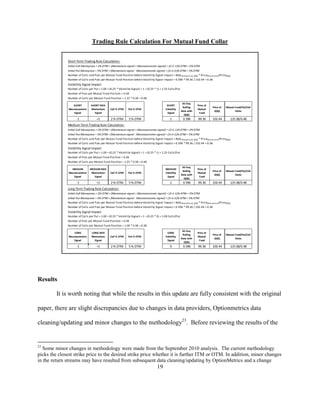
Trading Rule Calculation For Mutual Fund Collar


              Short Term Trading Rule Calculation:
              Initial Call Moneyness = 2% OTM + (Momentum signal + Macroeconomic signal) = (2+1-1)% OTM = 2% OTM
              Initial Put Moneyness = 3% OTM + (Momentum signal - Macroeconomic signal) = (3+1+1)% OTM = 5% OTM
              Number of Calls and Puts per Mutual Fund Position before Volatility Signal Impact = Beta Mutual Fund, QQQ * PriceMutual Fund/PriceQQQ
              Number of Calls and Puts per Mutual Fund Position before Volatility Signal Impact = 0.396 * 99.36 / 102.44 = 0.38
              Volatility Signal Impact:
              Number of Calls per Put = 1.00 + (0.25 * Volatility Signal) = 1 + (0.25 * 1) = 1.25 Calls/Put
              Number of Puts per Mutual Fund Position = 0.38
              Number of Calls per Mutual Fund Position = 1.25 * 0.38 = 0.48
                                                                                                               65-Day
                  SHORT          SHORT NDX                                                      SHORT                     Price of
                                                                                                               Rolling               Price of   Mutual Fund/Put/Call
               Macroeconomic     Momentum        Call % OTM     Put % OTM                      Volatility                 Mutual
                                                                                                              Beta with               QQQ              Ratio
                   Signal          Signal                                                        Signal                    Fund
                                                                                                                QQQ
                    -1               +1          2 % OTM        5 % OTM                            1           0.396      99.36      102.44        1/0.38/0.48
              Medium Term Trading Rule Calculation:
              Initial Call Moneyness = 2% OTM + (Momentum signal + Macroeconomic signal) = (2+1-1)% OTM = 2% OTM
              Initial Put Moneyness = 3% OTM + (Momentum signal - Macroeconomic signal) = (3+1+1)% OTM = 5% OTM
              Number of Calls and Puts per Mutual Fund Position before Volatility Signal Impact = Beta Mutual Fund, QQQ * PriceMutual Fund/PriceQQQ
              Number of Calls and Puts per Mutual Fund Position before Volatility Signal Impact = 0.396 * 99.36 / 102.44 = 0.38
              Volatility Signal Impact:
              Number of Calls per Put = 1.00 + (0.25 * Volatility Signal) = 1 + (0.25 * 1) = 1.25 Calls/Put
              Number of Puts per Mutual Fund Position = 0.38
              Number of Calls per Mutual Fund Position = 1.25 * 0.38 = 0.48
                                                                                                               65-Day
                 MEDIUM         MEDIUM NDX                                                     MEDIUM                     Price of
                                                                                                               Rolling               Price of   Mutual Fund/Put/Call
               Macroeconomic     Momentum        Call % OTM     Put % OTM                      Volatility                 Mutual
                                                                                                              Beta with               QQQ              Ratio
                   Signal          Signal                                                       Signal                     Fund
                                                                                                                QQQ
                    -1               +1          2 % OTM        5 % OTM                            1           0.396      99.36      102.44        1/0.38/0.48
              Long Term Trading Rule Calculation:
              Initial Call Moneyness = 2% OTM + (Momentum signal + Macroeconomic signal) = (2+1-1)% OTM = 2% OTM
              Initial Put Moneyness = 3% OTM + (Momentum signal - Macroeconomic signal) = (3+1+1)% OTM = 5% OTM
              Number of Calls and Puts per Mutual Fund Position before Volatility Signal Impact = Beta Mutual Fund, QQQ * PriceMutual Fund/PriceQQQ
              Number of Calls and Puts per Mutual Fund Position before Volatility Signal Impact = 0.396 * 99.36 / 102.44 = 0.38
              Volatility Signal Impact:
              Number of Calls per Put = 1.00 + (0.25 * Volatility Signal) = 1 + (0.25 * 0) = 1.00 Calls/Put
              Number of Puts per Mutual Fund Position = 0.38
              Number of Calls per Mutual Fund Position = 1.00 * 0.38 = 0.38
                                                                                                               65-Day
                   LONG          LONG NDX                                                       LONG                      Price of
                                                                                                               Rolling               Price of   Mutual Fund/Put/Call
               Macroeconomic     Momentum        Call % OTM     Put % OTM                      Volatility                 Mutual
                                                                                                              Beta with               QQQ              Ratio
                   Signal          Signal                                                       Signal                     Fund
                                                                                                                QQQ
                    -1               +1          2 % OTM        5 % OTM                            0           0.396      99.36      102.44        1/0.38/0.38


Results

         It is worth noting that while the results in this update are fully consistent with the original

paper, there are slight discrepancies due to changes in data providers, Optionmetrics data

cleaning/updating and minor changes to the methodology23. Before reviewing the results of the


23
   Some minor changes in methodology were made from the September 2010 analysis. The current methodology
picks the closest strike price to the desired strike price whether it is further ITM or OTM. In addition, minor changes
in the return streams may have resulted from subsequent data cleaning/updating by OptionMetrics and a change
                                                                                        19
passive and active approach to collar protection, it is perhaps important to briefly discuss three

issues in option based risk management:

1) The use of alternative approaches to protecting equity investments,

2) the impact of option based strategies on traditional forms of risk comparisons (e.g. Sharpe

Ratio), and

3) the necessity for analyzing results over alternative time periods.


Alternative Approaches to Option Based Risk Management: There are alternative option based

approaches to protecting equity based investments. The most obvious choice is typically the use

of protective puts. Unfortunately, the use of protective puts tends to be a relatively expensive

method of capital protection, especially in periods of high volatility. The existence of a negative

volatility risk premium and the resulting excess returns associated with put writing are indicative

of the potential cost of purchasing protective puts24. Another option based approach is the buy-

write or covered call strategy. The covered call strategy typically entails the writing of call

options against a long underlying index position at a one-to-one ratio. A number of studies have

suggested that covered call writing can provide return enhancement as well as a cushion to

mitigate losses from market downturns. These include Schneeweis and Spurgin [2001], Whaley

[2002] and Hill et al. [2006] which apply the strategy to the S&P 500 and Kapadia and Szado


from Datastream to Bloomberg for some supplemental data.from those options with full data over the life of the
option. The previous study chose the closest strike nearer the ATM whereas the current methodology picks the
closest strike
24
   The richness of put prices is not without controversy. While a great deal of literature supports option
richness (particularly for put options), extensive literature debates its existence (for example, see Ungar
and Moran [2009] and Bakshi and Kapadia [2003]).
                                                       20
[2007] which applies the buy-write to a broader index, the Russell 2000. Unfortunately, covered

call writing still leaves an investor exposed to large down moves.


Impact of Option Use on Traditional Risk Measures: It should also be noted that we have

included Sharpe ratios with our other performance measures for the sake of consistency with

previous literature, but great care should be taken in interpreting the Sharpe ratios. First, a

number of the calculated Sharpe ratios are negative. Negative Sharpe ratios are uninformative.

Second, even with positive excess returns, traditional risk-adjusted performance measures such

as the Sharpe ratio and Jensen’s alpha can be misleading. This is particularly true for portfolios

which include option strategies or other strategies which may result in skewed or kurtotic return

distributions. The Sharpe ratio and Jensen’s alpha assume normally distributed returns25. In

recognition of the fact that the return distributions generated by our collar strategies may be non-

normal, we utilize the Stutzer index and Leland’s alpha as measures of risk adjusted

performance. These measures adjust for the fact that investors which exhibit non-increasing

absolute risk aversion prefer positive skewness26. Therefore positively skewed return

distributions should exhibit lower expected returns than negatively skewed distributions, ceteris

paribus.


Alternative Time Period Analysis: This paper does not assume any particular model of investor

risk aversion. The significance of the results for any particular investor may therefore be

dependent on that investor’s individual risk tolerance. Results should therefore be presented over


25
     It is also quite possible to manipulate the Sharpe ratio. For example, see Spurgin [2001].
26
     See Arditti [1967].
                                                         21
various market conditions which provide investors a wider range of results consistent with a

particular risk environment. In order to assess the performance and risk management

characteristics of the passive and active collar strategies in different market environments, we

break up our time period into 3 sub-periods. In addition, the performance of the active strategies

is assessed in the out-of-sample period from June 2009 to September 2010.

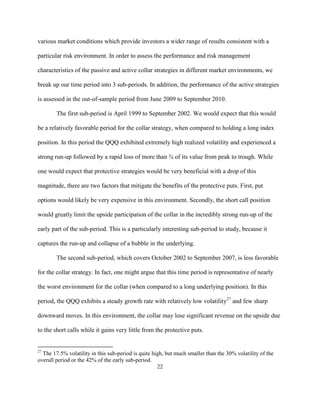
        The first sub-period is April 1999 to September 2002. We would expect that this would

be a relatively favorable period for the collar strategy, when compared to holding a long index

position. In this period the QQQ exhibited extremely high realized volatility and experienced a

strong run-up followed by a rapid loss of more than ¾ of its value from peak to trough. While

one would expect that protective strategies would be very beneficial with a drop of this

magnitude, there are two factors that mitigate the benefits of the protective puts. First, put

options would likely be very expensive in this environment. Secondly, the short call position

would greatly limit the upside participation of the collar in the incredibly strong run-up of the

early part of the sub-period. This is a particularly interesting sub-period to study, because it

captures the run-up and collapse of a bubble in the underlying.

        The second sub-period, which covers October 2002 to September 2007, is less favorable

for the collar strategy. In fact, one might argue that this time period is representative of nearly

the worst environment for the collar (when compared to a long underlying position). In this

period, the QQQ exhibits a steady growth rate with relatively low volatility27 and few sharp

downward moves. In this environment, the collar may lose significant revenue on the upside due

to the short calls while it gains very little from the protective puts.


27
  The 17.5% volatility in this sub-period is quite high, but much smaller than the 30% volatility of the
overall period or the 42% of the early sub-period.
                                                     22
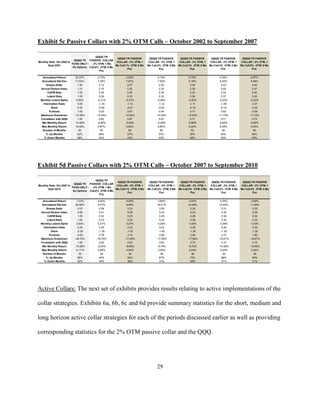
The final sub-period covers October 2007 to September 2010. This is another favorable

period for the collar and covers a major financial crisis which negatively impacted most asset

classes. While this favorable period includes a strong recovery following the collapse due to the

financial crisis, the recovery is not nearly as strong as the extremely strong run-up of the first

sub-period. Thus we have two relatively favorable sub-periods to consider (one that covers the

tech bubble and one that covers the credit crisis) as well as one clearly unfavorable sub-period. It

is worth noting that the first favorable period represents a strong run-up followed by a collapse

while the last favorable period represents the inverse – a crash followed by a recovery.

                    Before discussing the performance of the collar strategies, it is worth noting that the 1-

month/6-month and 1-month/3-month strategies require rebalancing each month in order to

reinvest the funds that are collected from the sale of the calls and the funds that are disbursed to

cover the cost of calls that expire ITM between put expirations. No adjustment is made for the

transactions costs that would be incurred by these rebalancing activities.

Exhibit 3: Growth of $100 in QQQ March 1999 to September 2010

                                                                                   QQQ TR Growth of $100
 $250.00
                    Pe
                                  Period 1 : Favorable,                                                                                                                              Period 3 : Favorable,
                                  Tech Bubble                                                                       Period 2 : Unfavorable
                                                                                                                                                                                     Credit Crisis

 $200.00

                                                                                                                                                                                                                  Out of
                                                                                                                                                                                                                  Sample
                                                                                                                                                                                                                  Period
 $150.00


 $100.00


  $50.00


     $-
           Mar-99


                                   Mar-00


                                                     Mar-01


                                                                       Mar-02


                                                                                         Mar-03


                                                                                                           Mar-04


                                                                                                                              Mar-05


                                                                                                                                                Mar-06


                                                                                                                                                                  Mar-07


                                                                                                                                                                                    Mar-08


                                                                                                                                                                                                      Mar-09


                                                                                                                                                                                                                        Mar-10
                                                                                                  Sep-03
                         Sep-99


                                            Sep-00


                                                              Sep-01


                                                                                Sep-02


                                                                                                                     Sep-04


                                                                                                                                       Sep-05


                                                                                                                                                         Sep-06


                                                                                                                                                                           Sep-07


                                                                                                                                                                                             Sep-08


                                                                                                                                                                                                               Sep-09


                                                                                                                                                                                                                                 Sep-10


                                                                                                                                                     23
Empirical Results

Passive Collars: We first consider the performance of passive collar strategies. Our discussion is

centered on 1-month call/6-month put collar strategies28. Results comparing the 1-month call/6-

month put collars to the 1-month call/1-month put collars are provided in Appendix B.

While the exhibits provide statistics for a wide range of collar implementations, our discussion is

focused on the 2% OTM strategies, since they represent a middle ground between the ATM and

the far OTM strategies. Exhibits 4a, 4b, 4c and 4d provide summary statistics for passive 1-

month call/6-month put collar strategies utilizing 2% OTM puts with ATM to 5% OTM calls for

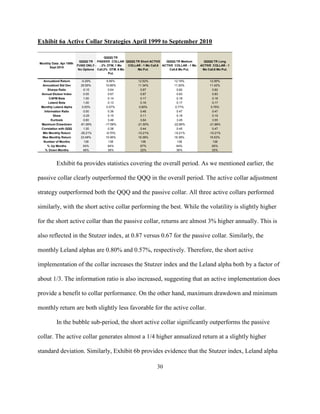
the full period as well as the three sub-periods. Similarly, Exhibits 5a, 5b, 5c and 5d provide

summary statistics for 2% OTM call collars which use ATM to 5% OTM puts. It is immediately

apparent when reviewing the exhibits that, while the performance characteristics of the strategy

are sensitive to the choice of moneyness for the options, they are far more sensitive to the market

environment (rising and/or falling) in which the strategy is implemented. In contrast, the choice

of time to maturity for the calls of 1-month versus 6-month can have a far more significant

impact, as evidenced by the results provided in Appendix B.

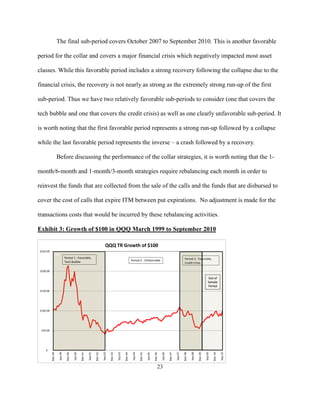
        The summary statistics for the overall period are provided in Exhibits 4a and 5a. Over the

138 months of the study, the 2% OTM collar significantly reduces risk and improves realized

returns. The returns are improved from a -0.3% annualized loss to a 9.6% gain, meanwhile

standard deviation is reduced by about 2/3 from 29.6% to 10.7%. Similarly, the Stutzer index

increased from 0.05 to 0.67, and the information ratio (relative to the QQQ) for the collar is


28
   Previous research indicates that these strategies have typically outperformed 1-month call/1-month put
strategies in the recent past. See, for example Szado and Kazemi [2008].
                                                      24
positive at 0.36. Perhaps the most visible impact of implementing the collar strategy is a

reduction of the maximum drawdown from -81.1% to -17.6% for the 138 month overall period.


Exhibit 4a Passive Collars with 2% OTM Puts – April 1999 to September 2010

                                         QQQQ TR
                                                       QQQQ TR PASSIVE        QQQQ TR PASSIVE        QQQQ TR PASSIVE        QQQQ TR PASSIVE        QQQQ TR PASSIVE
                          QQQQ TR PASSIVE COLLAR
Monthly Data: Apr 1999-                               COLLAR - 1% OTM, 1     COLLAR - 2% OTM, 1     COLLAR - 3% OTM, 1     COLLAR - 4% OTM, 1     COLLAR - 5% OTM, 1
                        FUND ONLY - - 0% OTM, 1 Mo
      Sept 2010                                       Mo Call.2% OTM. 6 Mo   Mo Call.2% OTM. 6 Mo   Mo Call.2% OTM. 6 Mo   Mo Call.2% OTM. 6 Mo   Mo Call.2% OTM. 6 Mo
                         No Options Call.2% OTM. 6 Mo
                                                               Put.                   Put.                   Put.                   Put.                   Put.
                                           Put.

  Annualized Return       -0.29%         10.13%              9.36%                   9.56%                  9.76%                10.02%                  8.76%
  Annualized Std Dev     29.55%          9.85%               10.13%                10.66%                 11.18%                 11.70%                 12.14%
     Sharpe Ratio          -0.10          0.76                0.66                    0.64                   0.63                  0.63                   0.50
 Annual Stutzer Index       0.05          0.77                0.68                    0.67                   0.66                  0.65                   0.54
      CAPM Beta             1.00          0.07                0.11                    0.14                   0.18                  0.22                   0.24
      Leland Beta           1.00          0.06                0.10                    0.13                   0.17                  0.21                   0.24
 Monthly Leland Alpha      0.00%         0.62%               0.56%                   0.57%                  0.59%                 0.61%                  0.51%
   Information Ratio        0.00          0.36                0.34                    0.36                   0.38                  0.41                   0.37
         Skew              -0.25          0.18                0.19                    0.15                   0.13                  0.08                   0.01
        Kurtosis            0.60          2.77                3.27                    3.48                   3.54                  2.79                   2.82
 Maximum Drawdown        -81.08%        -14.06%             -16.65%                -17.58%                -19.17%                -19.98%                -21.21%
 Correlation with QQQ       1.00          0.20                0.31                    0.38                   0.47                  0.54                   0.59
  Min Monthly Return     -26.21%         -8.63%              -8.99%                 -9.75%                 -9.89%                -10.54%                -10.59%
  Max Monthly Return     23.48%          12.81%              14.09%                15.06%                 15.48%                 15.37%                 15.64%
  Number of Months          138            138                 138                    138                    138                   138                    138
     % Up Months            54%           65%                 64%                     64%                    67%                   64%                    61%
    % Down Months           46%           35%                 36%                     36%                    33%                   36%                    39%


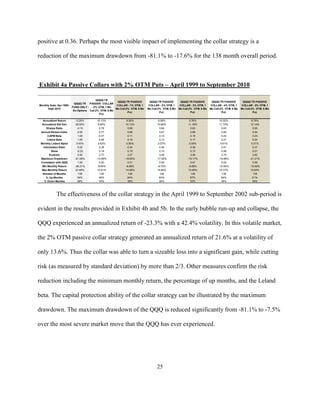
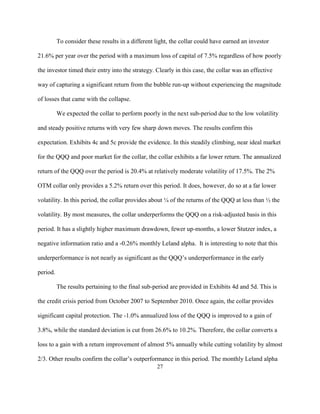
            The effectiveness of the collar strategy in the April 1999 to September 2002 sub-period is

evident in the results provided in Exhibit 4b and 5b. In the early bubble run-up and collapse, the

QQQ experienced an annualized return of -23.3% with a 42.4% volatility. In this volatile market,

the 2% OTM passive collar strategy generated an annualized return of 21.6% at a volatility of

only 13.6%. Thus the collar was able to turn a sizeable loss into a significant gain, while cutting

risk (as measured by standard deviation) by more than 2/3. Other measures confirm the risk

reduction including the minimum monthly return, the percentage of up months, and the Leland

beta. The capital protection ability of the collar strategy can be illustrated by the maximum

drawdown. The maximum drawdown of the QQQ is reduced significantly from -81.1% to -7.5%

over the most severe market move that the QQQ has ever experienced.


                                                                                   25
Exhibit 4b Passive Collars with 2% OTM Puts – April 1999 to September 2002

                                           QQQQ TR
                                                         QQQQ TR PASSIVE        QQQQ TR PASSIVE        QQQQ TR PASSIVE        QQQQ TR PASSIVE        QQQQ TR PASSIVE
                            QQQQ TR PASSIVE COLLAR
Monthly Data: Apr 1999-                                 COLLAR - 1% OTM, 1     COLLAR - 2% OTM, 1     COLLAR - 3% OTM, 1     COLLAR - 4% OTM, 1     COLLAR - 5% OTM, 1
                          FUND ONLY - - 0% OTM, 1 Mo
      Sept 2002                                         Mo Call.2% OTM. 6 Mo   Mo Call.2% OTM. 6 Mo   Mo Call.2% OTM. 6 Mo   Mo Call.2% OTM. 6 Mo   Mo Call.2% OTM. 6 Mo
                           No Options Call.2% OTM. 6 Mo
                                                                 Put.                   Put.                   Put.                   Put.                   Put.
                                             Put.

  Annualized Return         -23.31%        24.22%              22.09%                 21.59%                 19.86%                 18.30%                16.29%
  Annualized Std Dev        42.44%         13.27%              13.21%                 13.63%                 14.28%                 14.44%                14.85%
     Sharpe Ratio             -0.65         1.52                1.36                    1.28                   1.10                   0.98                  0.82
 Annual Stutzer Index         -0.51         1.42                1.31                    1.25                   1.09                   0.99                  0.84
      CAPM Beta                1.00         0.03                0.06                    0.08                   0.11                   0.14                  0.16
      Leland Beta              1.00         0.03                0.06                    0.08                   0.11                   0.14                  0.16
 Monthly Leland Alpha        0.00%         1.62%               1.52%                   1.53%                  1.47%                  1.40%                 1.31%
   Information Ratio           0.00         1.10                1.09                    1.09                   1.08                   1.07                  1.05
         Skew                  0.14         0.03                0.26                    0.39                   0.44                   0.43                  0.41
        Kurtosis              -0.70         1.15                2.08                    2.56                   2.86                   2.60                  2.89
 Maximum Drawdown           -81.08%        -7.54%              -7.54%                 -7.54%                 -9.16%                 -9.16%                -10.39%
 Correlation with QQQ          1.00         0.11                0.21                    0.26                   0.34                   0.41                  0.47
  Min Monthly Return        -26.21%        -7.54%              -7.54%                 -7.54%                 -9.16%                 -9.16%                -10.39%
  Max Monthly Return        23.48%         12.81%              14.09%                 15.06%                 15.48%                 15.37%                15.64%
  Number of Months              42            42                  42                     42                     42                     42                    42
     % Up Months              40%           79%                 74%                     74%                    74%                    67%                   64%
    % Down Months             60%           21%                 26%                     26%                    26%                    33%                   36%


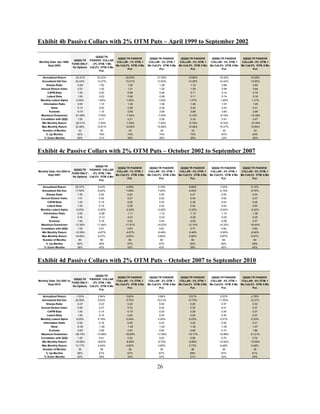
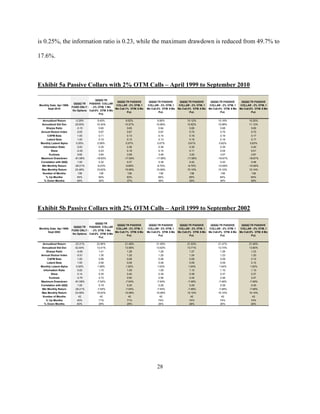
Exhibit 4c Passive Collars with 2% OTM Puts – October 2002 to September 2007

                                           QQQQ TR
                                                         QQQQ TR PASSIVE        QQQQ TR PASSIVE        QQQQ TR PASSIVE        QQQQ TR PASSIVE        QQQQ TR PASSIVE
                            QQQQ TR PASSIVE COLLAR
Monthly Data: Oct 2002 to                               COLLAR - 1% OTM, 1     COLLAR - 2% OTM, 1     COLLAR - 3% OTM, 1     COLLAR - 4% OTM, 1     COLLAR - 5% OTM, 1
                          FUND ONLY - - 0% OTM, 1 Mo
       Sept 2007                                        Mo Call.2% OTM. 6 Mo   Mo Call.2% OTM. 6 Mo   Mo Call.2% OTM. 6 Mo   Mo Call.2% OTM. 6 Mo   Mo Call.2% OTM. 6 Mo
                           No Options Call.2% OTM. 6 Mo
                                                                 Put.                   Put.                   Put.                   Put.                   Put.
                                             Put.

  Annualized Return         20.37%          5.43%              4.58%                   5.19%                  6.89%                  7.42%                  6.14%
  Annualized Std Dev        17.54%          6.42%              7.09%                   7.93%                  8.55%                  9.15%                  9.75%
     Sharpe Ratio             1.00           0.40               0.24                    0.30                   0.47                   0.50                   0.34
 Annual Stutzer Index         1.01           0.42               0.27                    0.32                   0.49                   0.52                   0.37
      CAPM Beta               1.00           0.19               0.26                    0.30                   0.38                   0.43                   0.48
      Leland Beta             1.00           0.19               0.28                    0.33                   0.40                   0.44                   0.50
 Monthly Leland Alpha        0.00%          -0.05%             -0.24%                 -0.26%                 -0.23%                 -0.24%                 -0.42%
   Information Ratio          0.00           -0.98              -1.11                  -1.12                  -1.10                  -1.15                  -1.36
         Skew                 0.34           -0.12              -0.21                  -0.23                  -0.25                  -0.02                  -0.20
        Kurtosis              1.63           0.18               0.03                    0.04                  -0.05                  -0.06                   0.37
 Maximum Drawdown           -12.36%        -11.44%            -11.81%                -14.02%                -12.10%                -14.32%                -16.44%
 Correlation with QQQ         1.00           0.51               0.63                    0.67                   0.77                   0.82                   0.86
  Min Monthly Return        -12.09%         -4.67%             -4.67%                 -5.49%                 -5.49%                 -5.50%                 -6.90%
  Max Monthly Return        18.48%          4.47%              4.87%                   5.60%                  5.90%                  6.87%                  6.87%
  Number of Months             60              60                 60                     60                     60                     60                     60
     % Up Months              62%            58%                57%                     57%                    62%                    60%                    58%
    % Down Months             38%            42%                43%                     43%                    38%                    40%                    42%


Exhibit 4d Passive Collars with 2% OTM Puts – October 2007 to September 2010

                                           QQQQ TR
                                                         QQQQ TR PASSIVE        QQQQ TR PASSIVE        QQQQ TR PASSIVE        QQQQ TR PASSIVE        QQQQ TR PASSIVE
                            QQQQ TR PASSIVE COLLAR
Monthly Data: Oct 2007 to                               COLLAR - 1% OTM, 1     COLLAR - 2% OTM, 1     COLLAR - 3% OTM, 1     COLLAR - 4% OTM, 1     COLLAR - 5% OTM, 1
                          FUND ONLY - - 0% OTM, 1 Mo
       Sept 2010                                        Mo Call.2% OTM. 6 Mo   Mo Call.2% OTM. 6 Mo   Mo Call.2% OTM. 6 Mo   Mo Call.2% OTM. 6 Mo   Mo Call.2% OTM. 6 Mo
                           No Options Call.2% OTM. 6 Mo
                                                                 Put.                   Put.                   Put.                   Put.                   Put.
                                             Put.

  Annualized Return          -1.03%         2.94%              3.63%                   3.84%                  3.51%                 5.22%                  4.76%
  Annualized Std Dev        26.56%          9.02%              9.70%                 10.21%                 10.70%                 11.93%                 12.27%
     Sharpe Ratio             -0.07          0.23               0.29                    0.30                   0.25                   0.37                   0.32
 Annual Stutzer Index          0.06          0.27               0.33                    0.34                   0.30                   0.41                   0.37
      CAPM Beta                1.00          0.14               0.19                    0.25                   0.28                   0.34                   0.37
      Leland Beta              1.00          0.15               0.20                    0.25                   0.28                   0.35                   0.37
 Monthly Leland Alpha         0.00%         0.19%              0.24%                   0.25%                  0.23%                 0.37%                  0.33%
   Information Ratio           0.00          0.16               0.20                    0.23                   0.22                   0.32                   0.31
         Skew                 -0.38          -1.26              -1.25                  -1.40                  -1.30                  -1.05                  -1.07
        Kurtosis              -0.62          2.56               2.40                    2.85                   2.66                   2.10                   1.89
 Maximum Drawdown           -49.74%        -14.06%            -16.65%                -17.58%                -19.17%                -19.98%                -21.21%
 Correlation with QQQ          1.00          0.41               0.52                    0.63                   0.68                   0.75                   0.79
  Min Monthly Return        -15.58%         -8.63%             -8.99%                 -9.75%                 -9.89%                -10.54%                -10.59%
  Max Monthly Return        13.17%          4.44%              4.90%                   4.90%                  5.73%                 6.48%                  6.48%
  Number of Months              36             36                 36                     36                     36                     36                     36
     % Up Months               58%           61%                67%                     67%                    69%                   67%                    61%
    % Down Months              42%           39%                33%                     33%                    31%                   33%                    39%


                                                                                     26
To consider these results in a different light, the collar could have earned an investor

21.6% per year over the period with a maximum loss of capital of 7.5% regardless of how poorly

the investor timed their entry into the strategy. Clearly in this case, the collar was an effective

way of capturing a significant return from the bubble run-up without experiencing the magnitude

of losses that came with the collapse.

          We expected the collar to perform poorly in the next sub-period due to the low volatility

and steady positive returns with very few sharp down moves. The results confirm this

expectation. Exhibits 4c and 5c provide the evidence. In this steadily climbing, near ideal market

for the QQQ and poor market for the collar, the collar exhibits a far lower return. The annualized

return of the QQQ over the period is 20.4% at relatively moderate volatility of 17.5%. The 2%

OTM collar only provides a 5.2% return over this period. It does, however, do so at a far lower

volatility. In this period, the collar provides about ¼ of the returns of the QQQ at less than ½ the

volatility. By most measures, the collar underperforms the QQQ on a risk-adjusted basis in this

period. It has a slightly higher maximum drawdown, fewer up-months, a lower Stutzer index, a

negative information ratio and a -0.26% monthly Leland alpha. It is interesting to note that this

underperformance is not nearly as significant as the QQQ’s underperformance in the early

period.

          The results pertaining to the final sub-period are provided in Exhibits 4d and 5d. This is

the credit crisis period from October 2007 to September 2010. Once again, the collar provides

significant capital protection. The -1.0% annualized loss of the QQQ is improved to a gain of

3.8%, while the standard deviation is cut from 26.6% to 10.2%. Therefore, the collar converts a

loss to a gain with a return improvement of almost 5% annually while cutting volatility by almost

2/3. Other results confirm the collar’s outperformance in this period. The monthly Leland alpha
                                                   27
is 0.25%, the information ratio is 0.23, while the maximum drawdown is reduced from 49.7% to

17.6%.


Exhibit 5a Passive Collars with 2% OTM Calls – April 1999 to September 2010

                                         QQQQ TR
                                                       QQQQ TR PASSIVE          QQQQ TR PASSIVE        QQQQ TR PASSIVE        QQQQ TR PASSIVE        QQQQ TR PASSIVE
                          QQQQ TR PASSIVE COLLAR
Monthly Data: Apr 1999-                               COLLAR - 2% OTM, 1       COLLAR - 2% OTM, 1     COLLAR - 2% OTM, 1     COLLAR - 2% OTM, 1     COLLAR - 2% OTM, 1
                        FUND ONLY - - 2% OTM, 1 Mo
      Sept 2010                                       Mo Call.1% OTM. 6 Mo     Mo Call.2% OTM. 6 Mo   Mo Call.3% OTM. 6 Mo   Mo Call.4% OTM. 6 Mo   Mo Call.5% OTM. 6 Mo
                         No Options Call.0% OTM. 6 Mo
                                                               Put.                     Put.                   Put.                   Put.                   Put.
                                           Put.

  Annualized Return          -0.29%         9.45%              9.52%                   9.56%                10.12%                 10.18%                 10.35%
  Annualized Std Dev        29.55%          10.34%             10.57%                10.66%                 10.82%                 10.98%                 11.12%
     Sharpe Ratio             -0.10          0.65               0.65                    0.64                   0.69                  0.68                   0.69
 Annual Stutzer Index          0.05          0.67               0.67                    0.67                   0.70                  0.70                   0.70
      CAPM Beta                1.00          0.11               0.13                    0.14                   0.16                  0.16                   0.17
      Leland Beta              1.00          0.10               0.13                    0.13                   0.15                  0.16                   0.17
 Monthly Leland Alpha         0.00%         0.56%              0.57%                   0.57%                  0.61%                 0.62%                  0.63%
   Information Ratio           0.00          0.35               0.36                    0.36                   0.39                  0.39                   0.40
         Skew                 -0.25          0.23               0.18                    0.15                   0.11                  0.04                   0.01
        Kurtosis               0.60          3.84               3.58                    3.48                   3.20                  3.07                   2.87
 Maximum Drawdown           -81.08%        -18.83%            -17.59%                -17.58%                -17.58%                -18.67%                -18.67%
 Correlation with QQQ          1.00          0.32               0.37                    0.38                   0.42                  0.43                   0.46
  Min Monthly Return        -26.21%         -9.23%             -9.69%                 -9.75%                 -9.75%                -10.06%                -10.06%
  Max Monthly Return        23.48%          15.02%             15.06%                15.06%                 15.10%                 15.10%                 15.14%
  Number of Months             138            138                138                    138                    138                   138                    138
     % Up Months               54%           64%                63%                     64%                    65%                   64%                    64%
    % Down Months              46%           36%                37%                     36%                    35%                   36%                    36%


Exhibit 5b Passive Collars with 2% OTM Calls – April 1999 to September 2002

                                           QQQQ TR
                                                         QQQQ TR PASSIVE        QQQQ TR PASSIVE        QQQQ TR PASSIVE        QQQQ TR PASSIVE        QQQQ TR PASSIVE
                            QQQQ TR PASSIVE COLLAR
Monthly Data: Apr 1999-                                 COLLAR - 2% OTM, 1     COLLAR - 2% OTM, 1     COLLAR - 2% OTM, 1     COLLAR - 2% OTM, 1     COLLAR - 2% OTM, 1
                          FUND ONLY - - 2% OTM, 1 Mo
      Sept 2002                                         Mo Call.1% OTM. 6 Mo   Mo Call.2% OTM. 6 Mo   Mo Call.3% OTM. 6 Mo   Mo Call.4% OTM. 6 Mo   Mo Call.5% OTM. 6 Mo
                           No Options Call.0% OTM. 6 Mo
                                                                 Put.                   Put.                   Put.                   Put.                   Put.
                                             Put.

  Annualized Return         -23.31%        22.96%              21.48%                21.59%                 21.53%                 21.47%                 21.06%
  Annualized Std Dev        42.44%         13.41%              13.58%                13.63%                 13.71%                 13.74%                 13.80%
     Sharpe Ratio             -0.65         1.41                1.28                   1.28                   1.27                   1.26                   1.23
 Annual Stutzer Index         -0.51         1.35                1.25                   1.25                   1.24                   1.23                   1.20
      CAPM Beta                1.00         0.06                0.08                   0.08                   0.09                   0.09                   0.10
      Leland Beta              1.00         0.06                0.08                   0.08                   0.09                   0.09                   0.10
 Monthly Leland Alpha        0.00%         1.58%               1.52%                  1.53%                  1.54%                  1.54%                  1.52%
   Information Ratio           0.00         1.10                1.09                   1.09                   1.10                   1.10                   1.10
         Skew                  0.14         0.35                0.40                   0.39                   0.38                   0.37                   0.37
        Kurtosis              -0.70         2.73                2.60                   2.56                   2.45                   2.46                   2.47
 Maximum Drawdown           -81.08%        -7.54%              -7.54%                -7.54%                 -7.48%                 -7.48%                 -7.48%
 Correlation with QQQ          1.00         0.19                0.25                   0.26                   0.29                   0.29                   0.30
  Min Monthly Return        -26.21%        -7.54%              -7.54%                -7.54%                 -7.48%                 -7.48%                 -7.48%
  Max Monthly Return        23.48%         15.02%              15.06%                15.06%                 15.10%                 15.10%                 15.14%
  Number of Months              42            42                  42                    42                     42                     42                     42
     % Up Months              40%           71%                 71%                    74%                    74%                    74%                    74%
    % Down Months             60%           29%                 29%                    26%                    26%                    26%                    26%


                                                                                      28
Exhibit 5c Passive Collars with 2% OTM Calls – October 2002 to September 2007

                                           QQQQ TR
                                                         QQQQ TR PASSIVE        QQQQ TR PASSIVE        QQQQ TR PASSIVE        QQQQ TR PASSIVE        QQQQ TR PASSIVE
                            QQQQ TR PASSIVE COLLAR
Monthly Data: Oct 2002 to                               COLLAR - 2% OTM, 1     COLLAR - 2% OTM, 1     COLLAR - 2% OTM, 1     COLLAR - 2% OTM, 1     COLLAR - 2% OTM, 1
                          FUND ONLY - - 2% OTM, 1 Mo
       Sept 2007                                        Mo Call.1% OTM. 6 Mo   Mo Call.2% OTM. 6 Mo   Mo Call.3% OTM. 6 Mo   Mo Call.4% OTM. 6 Mo   Mo Call.5% OTM. 6 Mo
                           No Options Call.0% OTM. 6 Mo
                                                                 Put.                   Put.                   Put.                   Put.                   Put.
                                             Put.

  Annualized Return       20.37%          3.73%                5.02%                   5.19%                  5.79%                  6.39%                  6.67%
  Annualized Std Dev      17.54%          7.35%                7.91%                   7.93%                  8.18%                  8.32%                  8.48%
     Sharpe Ratio           1.00           0.12                 0.27                    0.30                   0.36                   0.43                   0.45
 Annual Stutzer Index       1.01           0.15                 0.30                    0.32                   0.38                   0.45                   0.47
      CAPM Beta             1.00           0.26                 0.30                    0.30                   0.33                   0.34                   0.36
      Leland Beta           1.00           0.28                 0.33                    0.33                   0.36                   0.37                   0.38
 Monthly Leland Alpha      0.00%          -0.31%               -0.27%                 -0.26%                 -0.25%                 -0.22%                 -0.22%
   Information Ratio        0.00           -1.16                -1.13                  -1.12                  -1.11                  -1.08                  -1.07
         Skew               0.34           -0.28                -0.21                  -0.23                  -0.16                  -0.18                  -0.23
        Kurtosis            1.63           0.20                 0.07                    0.04                   0.17                   0.02                  -0.09
 Maximum Drawdown         -12.36%        -15.34%              -14.02%                -14.02%                -13.03%                -11.73%                -11.73%
 Correlation with QQQ       1.00           0.60                 0.67                    0.67                   0.71                   0.71                   0.73
  Min Monthly Return      -12.09%         -5.49%               -5.49%                 -5.49%                 -5.56%                 -5.56%                 -5.56%
  Max Monthly Return      18.48%          4.87%                5.60%                   5.60%                  6.25%                  6.25%                  6.25%
  Number of Months           60              60                   60                     60                     60                     60                     60
     % Up Months            62%            58%                  57%                     57%                    55%                    55%                    55%
    % Down Months           38%            42%                  43%                     43%                    45%                    45%                    45%


Exhibit 5d Passive Collars with 2% OTM Calls – October 2007 to September 2010

                                           QQQQ TR
                                                         QQQQ TR PASSIVE        QQQQ TR PASSIVE        QQQQ TR PASSIVE        QQQQ TR PASSIVE        QQQQ TR PASSIVE
                            QQQQ TR PASSIVE COLLAR
Monthly Data: Oct 2007 to                               COLLAR - 2% OTM, 1     COLLAR - 2% OTM, 1     COLLAR - 2% OTM, 1     COLLAR - 2% OTM, 1     COLLAR - 2% OTM, 1
                          FUND ONLY - - 2% OTM, 1 Mo
       Sept 2010                                        Mo Call.1% OTM. 6 Mo   Mo Call.2% OTM. 6 Mo   Mo Call.3% OTM. 6 Mo   Mo Call.4% OTM. 6 Mo   Mo Call.5% OTM. 6 Mo
                           No Options Call.0% OTM. 6 Mo
                                                                 Put.                   Put.                   Put.                   Put.                   Put.
                                             Put.

  Annualized Return        -1.03%          4.50%               4.08%                   3.84%                  4.93%                 4.25%                  4.80%
  Annualized Std Dev      26.56%           9.77%               9.96%                 10.21%                 10.49%                 10.93%                 11.26%
     Sharpe Ratio           -0.07           0.38                0.33                    0.30                   0.39                   0.31                   0.35
 Annual Stutzer Index        0.06           0.41                0.36                    0.34                   0.43                   0.35                   0.39
      CAPM Beta              1.00           0.22                0.23                    0.25                   0.28                   0.30                   0.32
      Leland Beta            1.00           0.23                0.24                    0.25                   0.28                   0.30                   0.33
 Monthly Leland Alpha       0.00%          0.31%               0.27%                   0.25%                  0.34%                 0.29%                  0.33%
   Information Ratio         0.00           0.25                0.23                    0.23                   0.29                   0.26                   0.30
         Skew               -0.38           -1.35               -1.42                  -1.40                  -1.39                  -1.39                  -1.30
        Kurtosis            -0.62           2.78                3.14                    2.85                   2.56                   2.37                   1.95
 Maximum Drawdown         -49.74%         -16.70%             -17.59%                -17.58%                -17.58%                -18.67%                -18.67%
 Correlation with QQQ        1.00           0.60                0.62                    0.63                   0.70                   0.72                   0.75
  Min Monthly Return      -15.58%          -9.23%              -9.69%                 -9.75%                 -9.75%                -10.06%                -10.06%
  Max Monthly Return      13.17%           4.90%               4.90%                   4.90%                  5.04%                 5.04%                  5.04%
  Number of Months            36              36                  36                     36                     36                     36                     36
     % Up Months             58%            64%                 64%                     67%                    72%                   69%                    69%
    % Down Months            42%            36%                 36%                     33%                    28%                   31%                    31%


Active Collars: The next set of exhibits provides results relating to active implementations of the

collar strategies. Exhibits 6a, 6b, 6c and 6d provide summary statistics for the short, medium and

long horizon active collar strategies for each of the periods discussed earlier as well as providing

corresponding statistics for the 2% OTM passive collar and the QQQ.


                                                                                      29
Exhibit 6a Active Collar Strategies April 1999 to September 2010

                                           QQQQ TR
                            QQQQ TR PASSIVE COLLAR QQQQ TR Short ACTIVE        QQQQ TR Medium         QQQQ TR Long
Monthly Data: Apr 1999-
                          FUND ONLY - - 2% OTM, 1 Mo    COLLAR - 1 Mo Call.6 ACTIVE COLLAR - 1 Mo   ACTIVE COLLAR - 1
      Sept 2010
                           No Options Call.2% OTM. 6 Mo      Mo Put.             Call.6 Mo Put.      Mo Call.6 Mo Put.
                                             Put.

  Annualized Return          -0.29%        9.56%               12.52%              12.16%                12.06%
  Annualized Std Dev        29.55%         10.66%              11.34%              11.50%                11.42%
     Sharpe Ratio             -0.10         0.64                0.87                 0.82                  0.82
 Annual Stutzer Index          0.05         0.67                0.87                 0.83                  0.83
      CAPM Beta                1.00         0.14                0.17                 0.18                  0.18
      Leland Beta              1.00         0.13                0.16                 0.17                  0.17
 Monthly Leland Alpha         0.00%        0.57%               0.80%                0.77%                 0.76%
   Information Ratio           0.00         0.36                0.48                 0.47                  0.47
         Skew                 -0.25         0.15                0.11                 0.18                  0.19
        Kurtosis               0.60         3.48                3.64                 3.45                  3.55
 Maximum Drawdown           -81.08%       -17.58%             -21.50%              -22.86%               -21.88%
 Correlation with QQQ          1.00         0.38                0.44                 0.45                  0.47
  Min Monthly Return        -26.21%        -9.75%             -10.21%              -10.21%               -10.21%
  Max Monthly Return        23.48%         15.06%              16.38%              16.38%                16.53%
  Number of Months             138           138                138                  138                   138
     % Up Months               54%          64%                 67%                  64%                   65%
    % Down Months              46%          36%                 33%                  36%                   35%


           Exhibit 6a provides statistics covering the overall period. As we mentioned earlier, the

passive collar clearly outperformed the QQQ in the overall period. The active collar adjustment

strategy outperformed both the QQQ and the passive collar. All three active collars performed

similarly, with the short active collar performing the best. While the volatility is slightly higher

for the short active collar than the passive collar, returns are almost 3% higher annually. This is

also reflected in the Stutzer index, at 0.87 versus 0.67 for the passive collar. Similarly, the

monthly Leland alphas are 0.80% and 0.57%, respectively. Therefore, the short active

implementation of the collar increases the Stutzer index and the Leland alpha both by a factor of

about 1/3. The information ratio is also increased, suggesting that an active implementation does

provide a benefit to collar performance. On the other hand, maximum drawdown and minimum

monthly return are both slightly less favorable for the active collar.

           In the bubble sub-period, the short active collar significantly outperforms the passive

collar. The active collar generates almost a 1/4 higher annualized return at a slightly higher

standard deviation. Similarly, Exhibit 6b provides evidence that the Stutzer index, Leland alpha

                                                                         30
and information ratio are all significantly higher for the active collar. In fact, in this period, the

active collar generates almost 2% per month of Leland’s alpha.


Exhibit 6b Active Collar Strategies April 1999 to Sept 2002

                                           QQQQ TR
                            QQQQ TR PASSIVE COLLAR QQQQ TR Short ACTIVE        QQQQ TR Medium         QQQQ TR Long
Monthly Data: Apr 1999-
                          FUND ONLY - - 2% OTM, 1 Mo    COLLAR - 1 Mo Call.6 ACTIVE COLLAR - 1 Mo   ACTIVE COLLAR - 1
      Sept 2002
                           No Options Call.2% OTM. 6 Mo      Mo Put.             Call.6 Mo Put.      Mo Call.6 Mo Put.
                                             Put.

  Annualized Return         -23.31%        21.59%             26.88%               25.21%                26.85%
  Annualized Std Dev        42.44%         13.63%             14.05%               14.39%                13.82%
     Sharpe Ratio             -0.65         1.28               1.62                  1.47                  1.65
 Annual Stutzer Index         -0.51         1.25               1.52                  1.40                  1.56
      CAPM Beta                1.00         0.08               0.11                  0.12                  0.12
      Leland Beta              1.00         0.08               0.12                  0.12                  0.12
 Monthly Leland Alpha        0.00%         1.53%              1.95%                 1.86%                 1.95%
   Information Ratio           0.00         1.09               1.26                  1.23                  1.27
         Skew                  0.14         0.39               0.36                  0.42                  0.51
        Kurtosis              -0.70         2.56               3.32                  3.08                  3.76
 Maximum Drawdown           -81.08%        -7.54%             -7.48%               -8.39%                -7.54%
 Correlation with QQQ          1.00         0.26               0.35                  0.37                  0.37
  Min Monthly Return        -26.21%        -7.54%             -7.48%               -8.39%                -7.54%
  Max Monthly Return        23.48%         15.06%             16.38%               16.38%                16.53%
  Number of Months              42            42                 42                   42                    42
     % Up Months              40%           74%                74%                   74%                   76%
    % Down Months             60%           26%                26%                   26%                   24%


           Exhibit 6c provides statistics for the second, unfavorable to the collar, sub-period. In this

sub-period, the short active strategy significantly mitigates the underperformance of the passive

strategy. While it still underperforms the QQQ, the monthly Leland alpha is improved from a -26

basis points to -5 basis points per month. Similarly, annualized returns are improved from 5.2%

to 7.7%, while volatility is slightly reduced. The active implementation also improves maximum

drawdown. The improvements of the medium horizon active strategy are even more significant

in this period.

           In the credit crisis sub-period, the active strategy outperforms the passive strategy and

significantly outperforms the QQQ. These results suggest that a dynamic collar adjustment

approach that is actively managed may have been able to significantly improve equity portfolio

performance during the credit crisis. However, “may” is the operative word. These results are

                                                                         31
only for the reported time frame and might not represent results for future time frames. In

addition, there may be alternative approaches which provide superior results. Exhibit 6d provides

the Leland alpha, which is increased from 0.25% for the passive collar to 0.37% for the active

collar. Annualized returns are increased from 3.8% to 5.2% while standard deviations are

increased somewhat from 10.2% to 12.2%. Similarly, the information ratio increases from 0.23

to 0.30, relative to the QQQ.

Exhibit 6c Active Collar Strategies October 2002 to Sept 2007

                                           QQQQ TR
                            QQQQ TR PASSIVE COLLAR QQQQ TR Short ACTIVE        QQQQ TR Medium         QQQQ TR Long
Monthly Data: Oct 2002 to
                          FUND ONLY - - 2% OTM, 1 Mo    COLLAR - 1 Mo Call.6 ACTIVE COLLAR - 1 Mo   ACTIVE COLLAR - 1
       Sept 2007
                           No Options Call.2% OTM. 6 Mo      Mo Put.             Call.6 Mo Put.      Mo Call.6 Mo Put.
                                             Put.

  Annualized Return      20.37%           5.19%               7.71%                  8.51%                  7.51%
  Annualized Std Dev     17.54%           7.93%               7.73%                  8.03%                  8.27%
     Sharpe Ratio          1.00            0.30                0.63                   0.70                   0.56
 Annual Stutzer Index      1.01            0.32                0.64                   0.71                   0.58
      CAPM Beta            1.00            0.30                0.31                   0.33                   0.37
      Leland Beta          1.00            0.33                0.32                   0.34                   0.38
 Monthly Leland Alpha     0.00%           -0.26%              -0.05%                -0.02%                 -0.16%
   Information Ratio       0.00            -1.12               -0.94                 -0.91                  -1.04
         Skew              0.34            -0.23               -0.08                 -0.07                  -0.14
        Kurtosis           1.63            0.04                0.63                   0.12                   0.06
 Maximum Drawdown        -12.36%         -14.02%             -10.49%               -11.81%                -12.12%
 Correlation with QQQ      1.00            0.67                0.69                   0.72                   0.77
  Min Monthly Return     -12.09%          -5.49%              -5.57%                -5.37%                 -5.37%
  Max Monthly Return     18.48%           5.60%               6.19%                  6.19%                  6.19%
  Number of Months          60               60                  60                    60                     60
     % Up Months           62%             57%                 63%                    60%                    60%
    % Down Months          38%             43%                 37%                    40%                    40%


Exhibit 6d Active Collar Strategies October 2007 to September 2010
                                           QQQQ TR
                            QQQQ TR PASSIVE COLLAR QQQQ TR Short ACTIVE        QQQQ TR Medium         QQQQ TR Long
Monthly Data: Oct 2007 to
                          FUND ONLY - - 2% OTM, 1 Mo    COLLAR - 1 Mo Call.6 ACTIVE COLLAR - 1 Mo   ACTIVE COLLAR - 1
        Sept 2010
                           No Options Call.2% OTM. 6 Mo      Mo Put.             Call.6 Mo Put.      Mo Call.6 Mo Put.
                                               Put.
   Annualized Return          -1.03%         3.84%            5.19%                  4.25%                3.89%
  Annualized Std Dev         26.56%          10.21%           12.20%                12.10%               12.12%
      Sharpe Ratio             -0.07          0.30             0.36                    0.28                 0.25
  Annual Stutzer Index          0.06          0.34             0.40                    0.33                 0.31
       CAPM Beta                1.00          0.25             0.31                    0.29                 0.30
       Leland Beta              1.00          0.25             0.32                    0.30                 0.31
 Monthly Leland Alpha          0.00%         0.25%            0.37%                  0.30%                0.27%
    Information Ratio           0.00          0.23             0.30                    0.25                 0.24
          Skew                 -0.38          -1.40            -0.99                  -0.87                -0.85
         Kurtosis              -0.62          2.85             1.26                    1.21                 1.16
  Maximum Drawdown           -49.74%        -17.58%          -21.50%                -22.86%              -21.88%
 Correlation with QQQ           1.00          0.63             0.67                    0.63                 0.65
   Min Monthly Return        -15.58%         -9.75%          -10.21%                -10.21%              -10.21%
  Max Monthly Return         13.17%          4.90%            6.28%                  5.56%                5.56%
   Number of Months              36             36              36                      36                   36
      % Up Months               58%           67%              64%                    61%                  61%
     % Down Months              42%           33%              36%                    39%                  39%


                                                                         32
Exhibit 7 summarizes many of these results graphically. The exhibit provides an

illustration of the growth of a $100 investment in the active QQQ collar and the 2% OTM

passive QQQ collar against the growth of a QQQ investment over the entire period. The

difference in the performance of the QQQ and the collar strategies is clearly evident as is the

added performance gained by implementing the active collar rather than the passive collar.


Exhibit 7: Growth of $100 in Active and Passive Collar Strategies


 $450.00


 $400.00
                                                                                                                                                                                                                                   QQQ SHORT
                                                                                                                                                                                                                                   ACTIVE COLLAR
 $350.00


 $300.00


 $250.00
                                                                                                                                                                                                                                   QQQ 2% OTM
                                                                                                                                                                                                                                   PASSIVE
                                                                                                                                                                                                                                   COLLAR
 $200.00


 $150.00


 $100.00                                                                                                                                                                                                                           QQQ TR


  $50.00


     $-
                                                                                                                       Mar-05
           Mar-99


                             Mar-00


                                               Mar-01


                                                                 Mar-02


                                                                                   Mar-03


                                                                                                     Mar-04


                                                                                                                                         Mar-06


                                                                                                                                                           Mar-07


                                                                                                                                                                             Mar-08


                                                                                                                                                                                               Mar-09


                                                                                                                                                                                                                 Mar-10
                    Sep-99


                                      Sep-00


                                                        Sep-01


                                                                          Sep-02


                                                                                            Sep-03


                                                                                                              Sep-04


                                                                                                                                Sep-05


                                                                                                                                                  Sep-06


                                                                                                                                                                    Sep-07


                                                                                                                                                                                      Sep-08


                                                                                                                                                                                                        Sep-09


                                                                                                                                                                                                                          Sep-10


                                                                                                                                                                       33
Exhibit 8: Rolling 12-Month Annualized Returns Active and Passive Collars


           120.00%


           100.00%


           80.00%


           60.00%


           40.00%
  Return


           20.00%                                                                                                                                                                                                                                                       QQQ Short Active
                                                                                                                                                                                                                                                                        Collar
            0.00%

                                                                                                                                                                                                                                                                        QQQ Passive 2%
           -20.00%                                                                                                                                                                                                                                                      OTM Collar


           -40.00%
                                                                                                                                                                                                                                                                        QQQ TR

           -60.00%


           -80.00%
                                                                                                                                              8/1/2005
                     2/1/2000

                                8/1/2000

                                           2/1/2001

                                                      8/1/2001

                                                                 2/1/2002

                                                                            8/1/2002

                                                                                       2/1/2003

                                                                                                  8/1/2003

                                                                                                             2/1/2004

                                                                                                                        8/1/2004

                                                                                                                                   2/1/2005


                                                                                                                                                         2/1/2006

                                                                                                                                                                    8/1/2006

                                                                                                                                                                               2/1/2007

                                                                                                                                                                                          8/1/2007

                                                                                                                                                                                                      2/1/2008

                                                                                                                                                                                                                 8/1/2008

                                                                                                                                                                                                                            2/1/2009

                                                                                                                                                                                                                                       8/1/2009

                                                                                                                                                                                                                                                  2/1/2010

                                                                                                                                                                                                                                                             8/1/2010

                 Exhibits 8 and 9 provide rolling 12-month annualized returns and standard deviations,

respectively. In Exhibit 8 it is clear that the returns to the collar strategies are much more stable

than those of the QQQ. In addition, the collars clearly avoid the worst of the negative returns

near the beginning and at the end of the period, while they do not fully participate in the few

extremely strong run-ups.

                 The rolling standard deviations provided in Exhibit 9 are evidence of the potential risk

reduction benefits of the collar strategy. The collar strategies exhibit lower standard deviations

throughout the entire period, with the difference ranging from about 5% to about 45%. It is also

worth noting that both exhibits indicate that the benefits of the active collar strategy over the

passive collar tend to be relatively subtle, particularly when compared to the difference between

the collars and the QQQ.


                                                                                                                                                                                                     34
Exhibit 9: Rolling 12-Month Annualized Standard Deviation Active and Passive Collars


                      60.0%


                      50.0%


                      40.0%

                                                                                                                                                                                                                                                                                QQQ TR
 Standard Deviation


                      30.0%


                                                                                                                                                                                                                                                                                QQQ Short
                                                                                                                                                                                                                                                                                Active Collar
                      20.0%


                                                                                                                                                                                                                                                                                QQQ Passive
                      10.0%                                                                                                                                                                                                                                                     2% OTM Collar


                      0.0%
                                                                                                                                                                             8/1/2006


                                                                                                                                                                                                              2/1/2008
                              2/1/2000

                                         8/1/2000

                                                    2/1/2001

                                                               8/1/2001

                                                                          2/1/2002

                                                                                     8/1/2002

                                                                                                2/1/2003

                                                                                                           8/1/2003

                                                                                                                      2/1/2004

                                                                                                                                 8/1/2004

                                                                                                                                            2/1/2005

                                                                                                                                                       8/1/2005

                                                                                                                                                                  2/1/2006


                                                                                                                                                                                        2/1/2007

                                                                                                                                                                                                   8/1/2007


                                                                                                                                                                                                                         8/1/2008

                                                                                                                                                                                                                                    2/1/2009

                                                                                                                                                                                                                                               8/1/2009

                                                                                                                                                                                                                                                          2/1/2010

                                                                                                                                                                                                                                                                     8/1/2010
Collaring a Mutual Fund

                              We also consider applying a collar strategy to a well known small cap equity mutual

fund. For the analysis, we chose a fund which used the QQQ as a potential passive benchmark

and is assumed to track reasonably well with the QQQ. The fund we utilize is from a well-known

platform, is found in the Morningstar Category “Small Growth”, and carries a 5-year five-star

Morningstar rating and a 5-year risk rating of “Below Average” and return rating of “Above

Average” relative to its peers. Our intention is to simulate the practice of applying a collar

strategy to a standard equity portfolio on which there are no available options written. In such a

case, the investor would choose options based on liquidity considerations and how well the

underlying tracks the investor’s portfolio.

                              Exhibits 10a, 10b, 10c and 10d provide summary statistics for the mutual fund with and

without the passive and active collar strategies. Before discussing the results, it should be noted
                                                                                                                                                                                                       35
that the strategies represented are not true collar overlays. The methodology does assume daily

rebalancing of the option and mutual fund positions to maintain the proper exposure and is thus

simply a first approximation at the performance of a true collar overlay. In the case of a true

overlay, far less rebalancing would be required to maintain the collar overlay. In order to easily

apply these strategies as overlays, the investor could allocate a portion of their portfolio to cash,

and use this cash reserve to manage the cash flows resulting from the option positions.

        While the active mutual fund collar underperforms the active QQQ collar in the overall

period (see Exhibit 10a), the improvement on the mutual fund is very significant. The return of

the active mutual fund collar is more than twice the return of the mutual fund, while the standard

deviation is about 1/3 lower. The Stutzer index increases from 0.12 to 0.45, the information ratio

(relative to the QQQ) is increased from 0.37 to 0.45, and the monthly Leland alpha is almost

doubled from 0.38% to 0.69%. In addition, maximum drawdown is significantly improved from

-69.7% to -24.5%. Similar results are found with the passive mutual fund collar. The passive

mutual fund collar provides a return almost twice the return of the mutual fund at about 2/3 the

standard deviation, significantly outperforming the mutual fund while slightly underperforming

the active mutual fund collar.

        In the first (tech bubble) sub-period, the collar strategy significantly improves the returns

of the mutual fund while reducing the standard deviation. As indicated in Exhibit 10b, the mutual

fund exhibits a -7.1% annualized loss at a 42.1% standard deviation. In contrast, the passive and

active mutual fund collars deliver 17.7% and 20.4% returns at 27.3% and 27.9% standard

deviations, respectively. Similarly, the Stutzer index and Leland alpha are improved from -0.07

and 1.34% to 0.60 and 2.03% for the passive collar and further improved to 0.68 and 2.26% for

the active collar.
                                                  36
Exhibit 10a Mutual Fund Collar Strategies April 1999 to September 2010

                                                        Small Cap Mutual Fund
                            QQQQ TR    Small Cap Mutual                       Small Cap Mutual Fund   QQQQ TR Short
Monthly Data: Apr 1999-                                 PASSIVE COLLAR - 2%
                          FUND ONLY - Fund FUND ONLY -                        Short ACTIVE COLLAR - ACTIVE COLLAR - 1
      Sept 2010                                           OTM, 1 Mo Call.2%
                           No Options    No Options                             1 Mo Call.6 Mo Put.  Mo Call.6 Mo Put.
                                                           OTM. 6 Mo Put.


  Annualized Return          -0.29%         4.71%              8.36%                10.49%               12.52%
  Annualized Std Dev        29.55%          28.05%             17.05%               17.56%               11.34%
     Sharpe Ratio             -0.10          0.07               0.33                  0.44                 0.87
 Annual Stutzer Index          0.05          0.12               0.38                  0.45                 0.87
      CAPM Beta                1.00          0.85               0.32                  0.34                 0.17
      Leland Beta              1.00          0.84               0.31                  0.33                 0.16
 Monthly Leland Alpha         0.00%         0.38%              0.53%                 0.69%                0.80%
   Information Ratio           0.00          0.37               0.35                  0.45                 0.48
         Skew                 -0.25          0.14               1.17                  1.11                 0.11
        Kurtosis               0.60          1.36               5.70                  5.18                 3.64
 Maximum Drawdown           -81.08%        -69.70%            -25.27%               -24.50%              -21.50%
 Correlation with QQQ          1.00          0.89               0.55                  0.57                 0.44
  Min Monthly Return        -26.21%        -21.66%            -12.12%               -12.54%              -10.21%
  Max Monthly Return        23.48%          27.66%             26.08%               26.61%               16.38%
  Number of Months             138           138                138                   138                  138
     % Up Months               54%           59%                57%                   59%                  67%
    % Down Months              46%           41%                43%                   41%                  33%


Exhibit 10b Mutual Fund Collar Strategies April 1999 to September 2002

                                                        Small Cap Mutual Fund
                            QQQQ TR    Small Cap Mutual                       Small Cap Mutual Fund   QQQQ TR Short
Monthly Data: Apr 1999-                                 PASSIVE COLLAR - 2%
                          FUND ONLY - Fund FUND ONLY -                        Short ACTIVE COLLAR - ACTIVE COLLAR - 1
      Sept 2002                                           OTM, 1 Mo Call.2%
                           No Options    No Options                             1 Mo Call.6 Mo Put.  Mo Call.6 Mo Put.
                                                           OTM. 6 Mo Put.


  Annualized Return         -23.31%         -7.05%             17.65%               20.35%                26.88%
  Annualized Std Dev        42.44%          42.14%             27.28%               27.86%                14.05%
     Sharpe Ratio             -0.65          -0.26              0.50                  0.58                  1.62
 Annual Stutzer Index         -0.51          -0.07              0.60                  0.68                  1.52
      CAPM Beta                1.00          0.89               0.40                  0.41                  0.11
      Leland Beta              1.00          0.89               0.40                  0.41                  0.12
 Monthly Leland Alpha        0.00%          1.34%              2.03%                 2.26%                 1.95%
   Information Ratio           0.00          0.84               1.23                  1.32                  1.26
         Skew                  0.14          0.41               0.71                  0.67                  0.36
        Kurtosis              -0.70          -0.41              1.15                  1.01                  3.32
 Maximum Drawdown           -81.08%        -69.70%            -25.27%               -24.50%               -7.48%
 Correlation with QQQ          1.00          0.89               0.62                  0.63                  0.35
  Min Monthly Return        -26.21%        -21.66%            -12.12%               -12.54%               -7.48%
  Max Monthly Return        23.48%          27.66%             26.08%               26.61%                16.38%
  Number of Months              42             42                42                    42                    42
     % Up Months              40%            48%                60%                   60%                   74%
    % Down Months             60%            52%                40%                   40%                   26%


                                                                           37
Exhibit 10c Mutual Fund Collar Strategies October 2002 to September 2007

                                                        Small Cap Mutual Fund
                            QQQQ TR    Small Cap Mutual                       Small Cap Mutual Fund   QQQQ TR Short
Monthly Data: Oct 2002 to                               PASSIVE COLLAR - 2%
                          FUND ONLY - Fund FUND ONLY -                        Short ACTIVE COLLAR - ACTIVE COLLAR - 1
       Sept 2007                                          OTM, 1 Mo Call.2%
                           No Options    No Options                             1 Mo Call.6 Mo Put.  Mo Call.6 Mo Put.
                                                           OTM. 6 Mo Put.


  Annualized Return       20.37%          19.12%             7.91%                   9.83%                 7.71%
  Annualized Std Dev      17.54%          14.20%             9.74%                   9.76%                 7.73%
     Sharpe Ratio           1.00           1.15               0.52                    0.72                  0.63
 Annual Stutzer Index       1.01           1.12               0.55                    0.73                  0.64
      CAPM Beta             1.00           0.67               0.25                    0.25                  0.31
      Leland Beta           1.00           0.70               0.28                    0.28                  0.32
 Monthly Leland Alpha      0.00%          0.30%              0.03%                   0.18%                -0.05%
   Information Ratio        0.00           -0.13              -0.79                  -0.67                 -0.94
         Skew               0.34           0.00               0.19                    0.28                 -0.08
        Kurtosis            1.63           0.26               -0.17                  -0.30                  0.63
 Maximum Drawdown         -12.36%        -13.76%             -9.79%                 -8.98%               -10.49%
 Correlation with QQQ       1.00           0.83               0.45                    0.45                  0.69
  Min Monthly Return      -12.09%         -9.18%             -5.19%                 -4.92%                -5.57%
  Max Monthly Return      18.48%          10.97%             7.40%                   7.56%                 6.19%
  Number of Months           60              60                 60                     60                    60
     % Up Months            62%            68%                57%                     58%                   63%
    % Down Months           38%            32%                43%                     42%                   37%


Exhibit 10d Mutual Fund Collar Strategies October 2007 to September 2010

                                                        Small Cap Mutual Fund
                            QQQQ TR    Small Cap Mutual                       Small Cap Mutual Fund   QQQQ TR Short
Monthly Data: Oct 2007 to                               PASSIVE COLLAR - 2%
                          FUND ONLY - Fund FUND ONLY -                        Short ACTIVE COLLAR - ACTIVE COLLAR - 1
       Sept 2010                                          OTM, 1 Mo Call.2%
                           No Options    No Options                             1 Mo Call.6 Mo Put.  Mo Call.6 Mo Put.
                                                           OTM. 6 Mo Put.


  Annualized Return        -1.03%         -2.93%              -0.86%                 1.00%                5.18%
  Annualized Std Dev      26.56%          25.17%              9.32%                10.80%                12.20%
     Sharpe Ratio           -0.07          -0.15               -0.18                  0.02                  0.36
 Annual Stutzer Index        0.06          -0.03               -0.14                  0.07                  0.40
      CAPM Beta              1.00          0.89                0.21                   0.27                  0.31
      Leland Beta            1.00          0.89                0.22                   0.28                  0.32
 Monthly Leland Alpha       0.00%         -0.17%              -0.13%                 0.02%                0.37%
   Information Ratio         0.00          -0.21               0.01                   0.10                  0.30
         Skew               -0.38          -0.49               -0.97                 -0.70                 -0.99
        Kurtosis            -0.62          0.17                1.33                   0.53                  1.26
 Maximum Drawdown         -49.74%        -47.51%             -16.85%               -20.36%               -21.50%
 Correlation with QQQ        1.00          0.94                0.59                   0.66                  0.67
  Min Monthly Return      -15.58%        -19.93%              -8.32%                -8.59%               -10.21%
  Max Monthly Return      13.17%          13.77%              4.14%                  5.24%                6.28%
  Number of Months            36             36                  36                    36                    36
     % Up Months             58%           56%                 53%                    58%                  64%
    % Down Months            42%           44%                 47%                    42%                  36%


           Exhibit 10c provides results for the unfavorable period. In the unfavorable period the

passive and active mutual fund collars both significantly underperform the mutual fund, with the

active mutual fund collar generating 9.8% returns at 9.8% volatility versus 19.1% returns at

14.2% volatility for the mutual fund. The performance differential between the active mutual

                                                                          38
fund collar and the mutual fund is not as significant as the differential for the QQQ collar and the

QQQ for this time period. The monthly Leland alpha for the active mutual fund collar is 0.18%

versus 0.30% for the mutual fund and 0.03% for the passive collar.

        The statistics for the credit crisis sub-period are provided in Exhibit 10d. In this period,

the active and passive mutual fund collars provide similar results, with the passive mutual fund

collar underperforming the active collar. Both mutual fund collars outperform the mutual fund in

this period. Both the mutual fund and the passive collar provide a negative Leland alpha in this

period (-0.17% and -0.13%, respectively). In contrast, the active collar provides a positive

0.02% Leland alpha in this sub-period. The passive collar improves returns of the mutual fund by

cutting losses by about 2/3 from -2.9% to -0.9%, while also cutting volatility by almost 2/3 from

25.2% to 9.3%. The active collar further improves returns to a gain of 1.0%, albeit with a slight

increase in volatility to 10.8%. The passive collar reduces the maximum drawdown and

minimum monthly return by more than ½, relative to the mutual fund. In contrast, the same

statistics for the active collar are slightly less favorable than for the passive collar.

        Exhibit 11 provides a graphical representation of the performance of an investment in the

small cap mutual fund versus the collared mutual fund. Once again, the outperformance of the

collared mutual funds is clearly evident in the overall period, with the active collar quite

consistently outperforming the passive collar.


                                                   39
Exhibit 11: Growth of $100 in Mutual Fund Strategies

   $400


   $350
                                                                                                                                                                                                                                  Managers Small Cap
                                                                                                                                                                                                                                  Short ACTIVE COLLAR
                                                                                                                                                                                                                                  - 1 Mo Call.6 Mo Put.
   $300


   $250                                                                                                                                                                                                                           Managers Small Cap
                                                                                                                                                                                                                                  PASSIVE COLLAR - 2%
                                                                                                                                                                                                                                  OTM, 1 Mo Call.2%
                                                                                                                                                                                                                                  OTM. 6 Mo Put.
   $200

                                                                                                                                                                                                                                  Managers Small Cap
                                                                                                                                                                                                                                  FUND ONLY - No
   $150
                                                                                                                                                                                                                                  Options


   $100
                                                                                                                                                                                                                                  QQQQ TR FUND ONLY
                                                                                                                                                                                                                                  - No Options

    $50


     $0
                                              Mar-01
          Mar-99


                            Mar-00


                                                                Mar-02


                                                                                  Mar-03


                                                                                                    Mar-04


                                                                                                                      Mar-05


                                                                                                                                        Mar-06


                                                                                                                                                          Mar-07


                                                                                                                                                                            Mar-08


                                                                                                                                                                                              Mar-09


                                                                                                                                                                                                                Mar-10
                                     Sep-00


                                                                                                                                                 Sep-06
                   Sep-99


                                                       Sep-01


                                                                         Sep-02


                                                                                           Sep-03


                                                                                                             Sep-04


                                                                                                                               Sep-05


                                                                                                                                                                   Sep-07


                                                                                                                                                                                     Sep-08


                                                                                                                                                                                                       Sep-09


                                                                                                                                                                                                                         Sep-10


Out-of-Sample Performance of Active Collar Strategy Rules

                   The analysis in Szado and Schneeweis [2010] covered the period from March 1999 to

May 2009. This update extends the period of analysis by 16 months to September 2010. The

addition of data allows us to consider the performance of the active collar strategies out-of-

sample. Exhibits 12a and 12b provide results covering the out-of-sample period. This period

covers the post-crisis recovery and is an unfavorable period for a collar strategy. Not

surprisingly, the collars underperform the underlying in this period. Exhibit 12a provides results

for the passive QQQ collar in this period. The results indicate that the 2% OTM passive collar

underperforms the QQQ in this period with an 11.4% return versus the 28.7% return of the QQQ,

and a 1.30 Sturzer index versus 1.31 for the QQQ. In contrast, the Leland alpha for the passive

collar is positive at 0.36%.
                                                                                                                                                                            40
What is of particular interest in this period is the relative performance of the active and

passive collars. These results are provided in Exhibit 12a for the QQQ collars and 12b for the

mutual fund collars. The results in Exhibit 12a indicate that all three active QQQ collars

outperform the passive collar out-of-sample. The annualized return of the short horizon active

collar is almost ½ higher than the passive collar (16.1%, versus 11.4%), albeit at a somewhat

higher standard deviation (10.3%, versus 8.6%). The Stutzer index (1.52 versus 1.30) and Leland

alpha (0.52%, versus 0.36%) both indicate that the active collar outperforms the passive collar on

a risk adjusted basis as well. However, the active collar does exhibit a slightly less favorable

maximum drawdown and minimum monthly return.


Exhibit 12a Passive and Active QQQ Collar Strategies June 2009 to September 2010

                                         QQQQ TR
Monthly Data: June 2009   QQQQ TR PASSIVE COLLAR QQQQ TR Short ACTIVE        QQQQ TR Medium         QQQQ TR Long
  to Sept 2010 (Out of  FUND ONLY - - 2% OTM, 1 Mo    COLLAR - 1 Mo Call.6 ACTIVE COLLAR - 1 Mo   ACTIVE COLLAR - 1
        Sample)          No Options Call.2% OTM. 6 Mo      Mo Put.             Call.6 Mo Put.      Mo Call.6 Mo Put.
                                           Put.

  Annualized Return      28.70%         11.38%             16.08%                16.46%                14.91%
  Annualized Std Dev     21.51%         8.64%              10.34%                10.45%                10.56%
     Sharpe Ratio           1.33         1.30               1.54                   1.56                  1.40
 Annual Stutzer Index       1.31         1.30               1.52                   1.53                  1.40
      CAPM Beta             1.00         0.24               0.33                   0.31                  0.34
      Leland Beta           1.00         0.25               0.33                   0.32                  0.35
 Monthly Leland Alpha      0.00%        0.36%              0.52%                  0.58%                 0.40%
   Information Ratio        0.00         -0.98              -0.77                 -0.73                 -0.86
         Skew              -0.26         -0.43              -0.27                 -0.31                 -0.22
        Kurtosis           -0.96         -0.44              -0.41                 -0.68                 -0.71
 Maximum Drawdown        -13.09%        -5.18%             -5.50%                -6.00%                -6.58%
 Correlation with QQQ       1.00         0.60               0.68                   0.64                  0.70
  Min Monthly Return      -7.39%        -3.81%             -4.05%                -4.02%                -3.98%
  Max Monthly Return     13.17%         4.90%              6.28%                  5.50%                 5.50%
  Number of Months           16            16                 16                    16                    16
     % Up Months            69%          63%                69%                    69%                   69%
    % Down Months           31%          38%                31%                    31%                   31%


          Exhibit 12b provides the out-of-sample performance for the active mutual fund collar.

The results for the active and passive mutual fund collars are similar to those of the QQQ collars.

The active mutual fund collar outperforms the passive collar out-of-sample. The annualized

                                                                       41
return of the short horizon active collar is almost twice that of the passive collar (11.6%, versus

6.5%), albeit at a somewhat higher standard deviation (10.2%, versus 8.4%). The Stutzer index

(1.16 versus 0.80) and Leland alpha (0.40%, versus 0.22%) both indicate that the active collar

outperforms the passive collar on a risk adjusted basis as well. However, once again the active

collar exhibits a slightly less favorable maximum drawdown and minimum monthly return.

Exhibit 12b Mutual Fund Collar Strategies June 2009 to September 2010

                                                      Small Cap Mutual Fund
Monthly Data: June 2009   QQQQ TR    Small Cap Mutual                       Small Cap Mutual Fund
                                                      PASSIVE COLLAR - 2%
  to Sept 2010 (Out of  FUND ONLY - Fund FUND ONLY -                        Short ACTIVE COLLAR -
                                                        OTM, 1 Mo Call.2%
        Sample)          No Options    No Options                             1 Mo Call.6 Mo Put.
                                                         OTM. 6 Mo Put.


  Annualized Return      28.70%          24.59%             6.52%                 11.64%
  Annualized Std Dev     21.51%          20.75%             8.36%                 10.16%
     Sharpe Ratio           1.33          1.18               0.77                   1.13
 Annual Stutzer Index       1.31          1.19               0.80                   1.16
      CAPM Beta             1.00          0.93               0.13                   0.23
      Leland Beta           1.00          0.93               0.14                   0.24
 Monthly Leland Alpha      0.00%         -0.12%             0.22%                  0.40%
   Information Ratio        0.00          -0.69              -1.10                 -0.91
         Skew              -0.26          -0.18              -0.46                 -0.16
        Kurtosis           -0.96          -0.52              -1.21                 -1.37
 Maximum Drawdown        -13.09%        -15.31%             -8.63%                -9.43%
 Correlation with QQQ       1.00          0.96               0.35                   0.49
  Min Monthly Return      -7.39%         -7.29%             -3.71%                -4.18%
  Max Monthly Return     13.17%          13.77%             3.69%                  5.24%
  Number of Months           16             16                16                     16
     % Up Months            69%           69%                63%                    56%
    % Down Months           31%           31%                38%                    44%


Conclusions

         In this update we consider the performance of passive and active implementations of the

collar strategy on the QQQ ETF as well as on a sample small cap equity mutual fund. The 138

month time horizon since the inception of QQQ options has provided us with a variety of market

conditions in which to test the performance characteristics of the collar. As expected, the results

of the analysis show that a passive collar strategy (whether on the QQQ or on the mutual fund) is

                                                                42
most effective (relative to a long underlying position) in declining markets and less effective in

rising markets. For the period of analysis, the active collar adjustment strategy tends to

outperform the passive collar, both in-sample and out-of-sample. Judgments as to the particular

benefits of the passive and active collar strategies are, of course, dependent on the risk tolerance

of the individual investor.


                                                 43
REFERENCES

Arditti, F. D., “Risk and the required return on equity.” Journal of Finance, 1967, Vol. 22, No. 1:
19-36.

Bakshi, G., and N. Kapadia, “Delta-Hedged Gains and the Negative Market Volatility Risk
Premium,” Review of Financial Studies, 2003, 16(2), pp. 527-566

Callan Associates Inc., “Profit/Loss an Historical Evaluation of the CBOE S&P 500 Buy-Write
Index Strategy,” Callan Associates Inc., Oct 2006

Feldman, Barry, and Dhruv Roy, “Passive Options-Based Investment Strategies: The Case of the
CBOE S&P 500 Buy Write Index,” Ibbotson Associates, July 28, 2004

Hill, Joanne M., Venkatesh Balasubramanian, Krag (Buzz) Gregory, and Ingrid Tierens,
“Finding Alpha via Covered Call Writing,” Financial Analysts Journal, Sept/Oct 2006, pp. 27-46

Jegadeesh, Narasimhan and Sheridan Titman, “Momentum,” University Of Illinois Working
Paper, October 23, 2001

Kapadia, Nikunj and Edward Szado, “The Risk Return Characteristics of the Buy-Write Strategy
on the Russell 2000 Index,” Journal of Alternative Investments, Spring 2007, pp. 39-56

Leland, Hayne E., “Beyond Mean-Variance: Performance Measurement in a Non-Symmetrical
World,” Financial Analysts Journal, Jan/Feb 1999, pp. 27-35

Renicker, Ryan and Devapriya Mallick., “Enhanced Call Overwriting,” Lehman,Brothers Global
Equity Research, Nov 17, 2005

Schneeweis, Thomas, Hossein Kazemi, and Richard Spurgin, “Momentum in Asset Returns: Are
Commodity Returns a Special Case?” Journal of Alternative Investments, Spring 2008, pp. 23-36

Schneeweis , Thomas and Richard B Spurgin., “The Benefits of Index Option-Based Strategies
for Institutional Portfolios,” Journal of Alternative Investments, Spring 2001, pp. 44-53

Spurgin, R., “How to Game your Sharpe Ratio,” Journal of Alternative Investments, Winter
2001, pp. 38-46

Stutzer, Michael, “A Portfolio Performance Index,” Financial Analysts Journal, May/June 2000,
Vol. 56, No. 3, pp. 52-61

Szado, Edward and Thomas Schneeweis, “Loosening Your Collar – Alternative Implementations
of QQQ Collars,” Journal of Trading, Spring 2010, Vol. 5, No. 2, pp. 35-56


                                                44
Szado, Edward and Hossein Kazemi “Collaring the Cube: Protection Options for a QQQ ETF
Portfolio,” Journal of Alternative Investments, Spring 2009, pp. 24-42

Ungar, J., and M.T. Moran, “The Cash-secured Put-Write Strategy and Performance of Related
Benchmark Indexes,” Journal of Alternative Investments, Spring 2009, pp. 43-56

Whaley, Robert E., “Return and Risk of CBOE Buy Write Monthly Index,” The Journal of
Derivatives Winter 2002, pp. 35-42


                                            45
Appendix A: Robust Measures of Risk-adjusted Returns

Stutzer Index

Stutzer (2000) begins with a manager whose motivation is to have his average returns exceed the

returns of a particular benchmark. Provided that the expected return of the manager’s portfolio is

greater than that of the benchmark, the probability that the manager’s average returns will

underperform the benchmark decays to zero exponentially with time. Since the manager would

like to ensure that he does not underperform the benchmark, he would like to maximize the rate

at which the probability of underperformance decays to zero. Therefore, Stutzer uses the decay

rate as a performance index.

Stutzer’s information statistic Ip is given as:


Where rt is the excess return of the portfolio and θ is chosen to maximize Ip. The Stutzer index is

derived from the information statistic using the following formula:


Where r is the mean excess return and Abs( r ) is the absolute value of the mean excess return.

When returns are normally distributed, the performance ratio is:


                                                  46
where λ is the Sharpe ratio.

Thus, if returns are normally distributed, the expected values of the Sharpe ratio and the Stutzer

index are equal. Otherwise, the Stutzer index penalizes high kurtosis and negative skewness.

Leland’s Alpha and Beta

Leland’s (1999) alpha and beta assume that market returns are normal but allow for non-

normality in security or portfolio returns. Consistent with the Stutzer index, Leland’s measures

reflect the preference for low kurtosis and positive skewness.

Utilizing Rubinstein’s (1976) equilibrium pricing equation,


where ρ[x,y] is the correlation of x and y, and –b is the exponent of the average investor’s

marginal utility function, Leland models portfolio returns as:


where Leland’s beta is given by:


and b is a market price of risk. If market returns are normally distributed, b is given by:


Thus, the Leland alpha follows:


                                                 47
Appendix B: 1-Month Call/3-Month and 1-Month Put Collars


Exhibit B1: Growth of $100, 1-Month Call/3-Month and 1-Month Put Collars

 $350.00


                                                                                                                                                                                                                                   QQQQ TR
 $300.00                                                                                                                                                                                                                           PASSIVE
                                                                                                                                                                                                                                   COLLAR - 2%
                                                                                                                                                                                                                                   OTM, 1 Mo
                                                                                                                                                                                                                                   Call.2% OTM.
 $250.00                                                                                                                                                                                                                           6 Mo Put.

                                                                                                                                                                                                                                   QQQQ TR
                                                                                                                                                                                                                                   PASSIVE
 $200.00                                                                                                                                                                                                                           COLLAR - 2%
                                                                                                                                                                                                                                   OTM, 1 Mo
                                                                                                                                                                                                                                   Call.2% OTM.
                                                                                                                                                                                                                                   3 Mo Put.
 $150.00
                                                                                                                                                                                                                                   QQQQ TR
                                                                                                                                                                                                                                   PASSIVE
                                                                                                                                                                                                                                   COLLAR - 2%
 $100.00                                                                                                                                                                                                                           OTM, 1 Mo
                                                                                                                                                                                                                                   Call.2% OTM.
                                                                                                                                                                                                                                   1 Mo Put.

  $50.00                                                                                                                                                                                                                           QQQQ TR
                                                                                                                                                                                                                                   FUND ONLY -
                                                                                                                                                                                                                                   No Options

     $-
                                                                                                     Mar-04
           Mar-99


                             Mar-00


                                               Mar-01


                                                                 Mar-02


                                                                                   Mar-03


                                                                                                                       Mar-05


                                                                                                                                         Mar-06


                                                                                                                                                           Mar-07


                                                                                                                                                                             Mar-08


                                                                                                                                                                                               Mar-09


                                                                                                                                                                                                                 Mar-10
                    Sep-99


                                      Sep-00


                                                        Sep-01


                                                                          Sep-02


                                                                                            Sep-03


                                                                                                              Sep-04


                                                                                                                                Sep-05


                                                                                                                                                  Sep-06


                                                                                                                                                                    Sep-07


                                                                                                                                                                                      Sep-08


                                                                                                                                                                                                        Sep-09


                                                                                                                                                                                                                          Sep-10


Exhibit B2: 1-Month Call/3-Month and 1-Month Put Collars April 1999 to September 2010

                                                                             QQQQ TR
                                                                                           QQQQ TR PASSIVE                                                                                                          QQQQ TR PASSIVE
                                                              QQQQ TR PASSIVE COLLAR
Monthly Data: Apr 1999-                                                                   COLLAR - 2% OTM, 1                                                                                                       COLLAR - 2% OTM, 1
                                                            FUND ONLY - - 2% OTM, 1 Mo
      Sept 2010                                                                           Mo Call.2% OTM. 3 Mo                                                                                                     Mo Call.2% OTM. 1 Mo
                                                             No Options Call.2% OTM. 6 Mo
                                                                                                   Put.                                                                                                                     Put.
                                                                               Put.

   Annualized Return                                              -0.29%                                       9.56%                                                   6.29%                                                         0.74%
   Annualized Std Dev                                            29.55%                                        10.66%                                                  9.09%                                                         6.26%
      Sharpe Ratio                                                 -0.10                                        0.64                                                    0.40                                                         -0.31
  Annual Stutzer Index                                              0.05                                        0.67                                                    0.43                                                         -0.28
       CAPM Beta                                                    1.00                                        0.14                                                    0.13                                                          0.16
       Leland Beta                                                  1.00                                        0.13                                                    0.12                                                          0.16
  Monthly Leland Alpha                                             0.00%                                       0.57%                                                   0.31%                                                        -0.16%
    Information Ratio                                               0.00                                        0.36                                                    0.24                                                          0.04
          Skew                                                     -0.25                                        0.15                                                    0.21                                                          0.15
         Kurtosis                                                   0.60                                        3.48                                                    2.28                                                         -0.12
  Maximum Drawdown                                               -81.08%                                      -17.58%                                                 -13.12%                                                      -21.60%
  Correlation with QQQ                                              1.00                                        0.38                                                    0.42                                                          0.77
   Min Monthly Return                                            -26.21%                                       -9.75%                                                  -6.49%                                                       -3.87%
   Max Monthly Return                                            23.48%                                        15.06%                                                  11.99%                                                        5.21%
   Number of Months                                                 138                                          138                                                     138                                                          138
      % Up Months                                                   54%                                         64%                                                     65%                                                           50%
     % Down Months                                                  46%                                         36%                                                     35%                                                           50%


                                                                                                                                                                    48
Exhibit B3: 1-Month Call/3-Month and 1-Month Put Collars April 1999 to September 2002

                                           QQQQ TR
                                                         QQQQ TR PASSIVE        QQQQ TR PASSIVE
                            QQQQ TR PASSIVE COLLAR
Monthly Data: Apr 1999-                                 COLLAR - 2% OTM, 1     COLLAR - 2% OTM, 1
                          FUND ONLY - - 2% OTM, 1 Mo
      Sept 2002                                         Mo Call.2% OTM. 3 Mo   Mo Call.2% OTM. 1 Mo
                           No Options Call.2% OTM. 6 Mo
                                                                 Put.                   Put.
                                             Put.

  Annualized Return         -23.31%        21.59%              12.61%                 -3.04%
  Annualized Std Dev        42.44%         13.63%              12.20%                  6.29%
     Sharpe Ratio             -0.65         1.28                0.70                   -1.13
 Annual Stutzer Index         -0.51         1.25                0.72                   -1.11
      CAPM Beta                1.00         0.08                0.08                    0.12
      Leland Beta              1.00         0.08                0.08                    0.12
 Monthly Leland Alpha        0.00%         1.53%               0.87%                  -0.36%
   Information Ratio           0.00         1.09                0.88                    0.54
         Skew                  0.14         0.39                0.28                    0.35
        Kurtosis              -0.70         2.56                1.45                   -0.31
 Maximum Drawdown           -81.08%        -7.54%              -6.49%                -21.42%
 Correlation with QQQ          1.00         0.26                0.29                    0.82
  Min Monthly Return        -26.21%        -7.54%              -6.49%                 -3.87%
  Max Monthly Return        23.48%         15.06%              11.99%                  4.11%
  Number of Months              42            42                 42                      42
     % Up Months              40%           74%                 69%                     40%
    % Down Months             60%           26%                 31%                     60%


Exhibit B4: 1-Month Call/3-Month and 1-Month Put Collars October 2002 to September 2007

                                           QQQQ TR
                                                         QQQQ TR PASSIVE        QQQQ TR PASSIVE
                            QQQQ TR PASSIVE COLLAR
Monthly Data: Oct 2002 to                               COLLAR - 2% OTM, 1     COLLAR - 2% OTM, 1
                          FUND ONLY - - 2% OTM, 1 Mo
       Sept 2007                                        Mo Call.2% OTM. 3 Mo   Mo Call.2% OTM. 1 Mo
                           No Options Call.2% OTM. 6 Mo
                                                                 Put.                   Put.
                                             Put.

  Annualized Return         20.37%          5.19%              4.23%                   3.43%
  Annualized Std Dev        17.54%          7.93%              6.80%                   5.81%
     Sharpe Ratio             1.00           0.30               0.20                    0.10
 Annual Stutzer Index         1.01           0.32               0.23                    0.13
      CAPM Beta               1.00           0.30               0.28                    0.27
      Leland Beta             1.00           0.33               0.29                    0.28
 Monthly Leland Alpha        0.00%          -0.26%             -0.29%                 -0.35%
   Information Ratio          0.00           -1.12              -1.19                  -1.27
         Skew                 0.34           -0.23              -0.19                   0.19
        Kurtosis              1.63           0.04               -0.05                   0.38
 Maximum Drawdown           -12.36%        -14.02%            -10.14%                 -6.74%
 Correlation with QQQ         1.00           0.67               0.72                    0.81
  Min Monthly Return        -12.09%         -5.49%             -4.11%                 -3.73%
  Max Monthly Return        18.48%          5.60%              4.75%                   5.21%
  Number of Months             60              60                60                      60
     % Up Months              62%            57%                63%                     57%
    % Down Months             38%            43%                37%                     43%


                                                             49
Exhibit B5: 1-Month Call/3-Month and 1-Month Put Collars October 2007 to September 2010

                                           QQQQ TR
                                                         QQQQ TR PASSIVE        QQQQ TR PASSIVE
                            QQQQ TR PASSIVE COLLAR
Monthly Data: Oct 2007 to                               COLLAR - 2% OTM, 1     COLLAR - 2% OTM, 1
                          FUND ONLY - - 2% OTM, 1 Mo
       Sept 2010                                        Mo Call.2% OTM. 3 Mo   Mo Call.2% OTM. 1 Mo
                           No Options Call.2% OTM. 6 Mo
                                                                 Put.                   Put.
                                             Put.

  Annualized Return        -1.03%         3.84%                2.68%                   0.81%
  Annualized Std Dev      26.56%          10.21%               8.09%                   6.92%
     Sharpe Ratio           -0.07          0.30                 0.23                    0.00
 Annual Stutzer Index        0.06          0.34                 0.26                    0.03
      CAPM Beta              1.00          0.25                 0.20                    0.21
      Leland Beta            1.00          0.25                 0.20                    0.21
 Monthly Leland Alpha       0.00%         0.25%                0.15%                  -0.01%
   Information Ratio         0.00          0.23                 0.17                    0.09
         Skew               -0.38          -1.40                -0.87                   0.03
        Kurtosis            -0.62          2.85                 -0.09                  -0.19
 Maximum Drawdown         -49.74%        -17.58%              -13.12%                -14.25%
 Correlation with QQQ        1.00          0.63                 0.65                    0.82
  Min Monthly Return      -15.58%         -9.75%               -5.25%                 -3.62%
  Max Monthly Return      13.17%          4.90%                3.54%                   4.93%
  Number of Months            36             36                  36                      36
     % Up Months             58%           67%                  64%                     50%
    % Down Months            42%           33%                  36%                     50%


                                                             50

Cisdm qqqactive-full

  • 1.
    An Update of“Loosening Your Collar: Alternative Implementations of QQQ Collars”: Credit Crisis and Out-of-Sample Performance Edward Szado * Thomas Schneeweis ** Original Version: August 2009 Current Update: January 2011 *Doctoral Candidate, Isenberg School of Management, University of Massachusetts, Amherst, MA 01003, Director of Research, INGARM, Amherst, MA 01002. INGARM gratefully acknowledges research support provided by the Options Industry Council. Research results, however, represent those of the authors and do not necessarily represent the views of the OIC. Please address correspondence to Edward Szado, INGARM, 29 S. Pleasant St., Amherst, MA 01002, 413-256-0195, or email: eszado@ingarm.org. **Michael and Cheryl Philipp Professor of Finance, Director of CISDM, Isenberg School of Management, University of Massachusetts, Amherst. Abstract This study provides an update to Szado and Schneeweis [2010]. The original study covered the period from March 1999 through May 2009. This updated study extends the period of analysis through September 2010. The credit crisis and the associated decline in equity markets rekindled new interest in option based equity collars and in protective strategies in general. In this paper we consider the performance of passive and active implementations of the collar strategy on the QQQ ETF as well as on a sample small cap equity mutual fund. As expected, the results of the analysis show that a passive collar is most effective (relative to a long underlying position) in declining markets and less effective in rising markets. This study also considers a more active implementation of the collar strategy. Rather than simply applying a set of fixed rules as for the passive collar, in the active collar adjusted strategy, we apply a set of rules which adapt the collar to varying economic and market conditions. This approach is similar to applying a set of tactical asset allocation rules to a set of investments. There are of course an unlimited number of conditioning factors that can be used to determine the strategy implementation. In this paper, for purposes of presentation, we combine three conditioning factors that have been suggested in academic literature (momentum, volatility, and a compound macroeconomic factor (unemployment and business cycle)) to generate a dynamic collar adjusted trading strategy. For the period of analysis, the active collar adjustment strategy tends to outperform the passive collar both in- sample as well as out-of-sample. Judgments as to the particular benefits of the passive and active collar strategies are, of course, dependent on the risk tolerance of the individual investor.
  • 2.
    Introduction This study provides an update to Szado and Schneeweis [2010]1. The original study covered the period from March 1999 through May 2009. This updated study extends the period of analysis through September 2010. In addition to the original analysis, this update includes out- of-sample performance for the active collar strategies based on the trading rules set out in the original paper. The credit crisis and the associated decline in equity markets rekindled new interest in option based equity collars and in protective strategies in general. In 2008 the QQQ experienced a drawdown of about 50% from peak to trough. Many other asset classes which are generally considered effective equity diversifiers also faced significant losses. This type of contagion across asset classes suggests that in times of major systematic stress, direct hedges through protective option strategies may provide equity portfolios with greater downside risk protection than standard multi-asset diversification programs. There are a variety of option strategies which can provide capital protection for equity based portfolios. The focus of this paper is one of the more straightforward options based strategies – the collar. A collar is an option based investment strategy that effectively limits (or collars) the returns on an investment in an underlying asset to fall within a chosen range. An investor who holds a long position in an underlying asset can convert that position into a collar (collar his position) by purchasing a put option on the underlying asset and simultaneously selling (writing) a call option on the underlying asset. The strike price on the call defines the upper bound of the collar and is set above the strike price for the put (which defines the lower bound of the collar). In a standard 1 See “Loosening Your Collar – Alternative Implementations of QQQ Collars,” Edward Szado and Thomas Schneeweis, Journal of Trading, Spring 2010, Vol. 5, No. 2, pp. 35-56 2
  • 3.
    collar, the calland put have the same expiration dates. The value of a portfolio constructed in this manner will essentially be restricted to fluctuate within the bounds set by the strike prices of the options (adjusted for the net cost of the option positions).2 In this paper, we extend previous research on collar strategies (Schneeweis and Spurgin [2001] and Szado and Kazemi [2009] as well as the original paper this update is based on) by considering the performance and risk characteristics of active as well as passive collars. In addition, we provide an example of the effectiveness of applying a collar strategy to a sample equity mutual fund on which options are not available. It is worth noting that this study does not address whether these strategies generate “alpha” based on any specific definition of investor risk aversion. The significance of the results may be interpreted differently by any individual based on their particular risk aversion. In this study the performance of passively implemented collars on the Powershares QQQ ETF (ticker: QQQQ) is analyzed. The collars are passive in the sense that they follow a rigid set of rules which do not vary with market conditions. The passive implementations do vary in their choice of the initial moneyness and time to expiration of the calls and puts. This study also considers a more active implementation of the collar strategy. Rather than simply applying a set of fixed rules as for the passive collar, for the active collar adjustment strategy, we apply a set of rules which adapt the collar to varying economic and market conditions. This approach is similar to applying a set of tactical asset allocation rules to a set of investments. There are of course an 2 Collars can be visualized as a combination of covered call and protective put strategies. The collar strategy essentially adds a long protective put to a covered call strategy. This provides the significant downside protection which the covered call strategy lacks. The purchase of the long put is financed by the sale of the call. In essence, the collar trades upside participation for downside protection. A tight collar provides less upside participation and more downside protection than a loose collar. At one extreme, the tightest collar (ATM puts and calls) effectively immunizes the portfolio from market movements. At the other extreme (very far OTM puts and calls), the collar is essentially equivalent to a long index position. 3
  • 4.
    unlimited number ofconditioning factors that can be used to determine the strategy implementation. In this paper, for purposes of presentation, we combine three conditioning factors that have been suggested in academic literature (momentum, volatility, and a compound macroeconomic factor (unemployment and business cycle)) to generate a dynamic collar adjusted trading strategy.3 Finally, the study considers the implementation of an active and passive collar strategy using QQQ options applied to a non-QQQ equity portfolio represented by a small cap equity mutual fund. This provides an additional analysis of the use of the collar strategy for a wider range of market participants. In the following sections we summarize the methodology and data used in this analysis. It is important to note that all empirical research may be data and time period dependent. The original analysis in Szado and Schneeweis [2010] covers the period from the introduction of options on the QQQ (March 19, 1999) through May 31, 2009. This updated analysis covers the period from March 19, 1999 through September 30, 2010. This period is broken into various sub- periods to offer a better picture of the benefits and risk of the implemented collar strategies in various market environments. In the methodology section we describe both the passive and active collar implementations. In the active collar section we describe how we combine the momentum, volatility and macroeconomic signals to generate a dynamic collar adjustment trading strategy process4. In this process, the initial moneyness of the puts and calls is determined based on the momentum and macroeconomic signals and the ratio of written calls is determined by the volatility signal. The marginal effect of the momentum signal is to widen or 3 While these collar implementations are active in the sense that the rules are dependent on manager decisions, they are implemented systematically with no additional manager discretion. 4 While we combine the three signals to generate the strategy, any one of the signals could be used on its own to generate an active strategy. 4
  • 5.
    tighten the collarby increasing or decreasing the amount OTM, respectively. The marginal effect of the macroeconomic signal is to shift the collar up by increasing the amount OTM of the calls and decreasing the amount OTM of the puts, or shift the collar down by moving the strikes in the opposite direction. The marginal effect of the volatility signal is to increase or decrease the number of calls written per QQQ and put purchased. Results show that the passive and active collar strategies underperformed the QQQ in the strong market climb of October 2002 to September 2007. However, in the period around the tech bubble and in the credit crisis the passive and active collar strategies provided capital protection and generated significant returns at relatively low volatility, particularly in the case of the tech bubble period. In addition, we provided evidence of the effectiveness of wrapping a passive or active collar strategy around a portfolio for which no options are available (in this case, represented by a small cap mutual fund). Results for the mutual fund collars are similar to those reported for the collar strategies on the QQQ. In addition, results show that active collar strategies on the QQQ and on a small cap mutual fund which use a set of three simple trading rules to create a dynamic collar adjustment process could provide added benefits over similar passive collars. Finally, we provide results that indicate that active collars on the QQQ and on a small cap mutual fund outperform the corresponding passive collars out-of-sample for the period from June 2009 to September 2010. Data and Methodology Data The option price data is provided by Optionmetrics and covers the period from the first expiration after the introduction of QQQ options on March 19, 1999 to September 30, 2010. The 5
  • 6.
    QQQ, NDX, Treasurybill and VIX data5 is provided by Bloomberg6, while mutual fund data is provided by Morningstar. Business cycle announcement data are provided by the National Bureau of Economic Research. Methodology In order to assess the performance of active and passive collar strategies, we construct indices which represent the return streams generated by such strategies. The passive strategies follow a fixed set of option selection rules defining the initial moneyness and time to expiration of the calls and puts, regardless of market conditions. In contrast, the active7 collar strategies base their option selection rules on a combination of three simple market/economic based signals (momentum, volatility, and a macroeconomic factor) and thus adjust to various market conditions. Passive Collar Strategy: We generate a daily time series of returns for each of the passive strategies beginning on March 19, 19998. At the close on this day a 1-month call is written and a 1, 3 or 6-month put is purchased. Depending on the particular passive implementation, the initial moneyness of the calls and puts are set at either 5%, 4%, 3%, 2%, 1% OTM or ATM. At the close on the Friday prior to the following expiration, we take one of two actions: If 1-month puts are used, the puts and calls are settled at intrinsic value and we roll into new 1-month puts and calls with the specified moneyness. If a 3- or 6-month put is used, the calls are settled at intrinsic 5 NDX, VIX and Initial Unemployment Claims data is collected from March 1998 to ensure sufficient lag time for signal generation. 6 In the original study this data was provided by Datastream. 7 It should be noted that while we use the term active to represent these strategies, they are not truly actively managed. They still follow an established set of selection rules, but the rules include a dynamic element conditioned on economic variables. 8 This is the Friday prior to the first expiration Saturday following the introduction of QQQ options. 6
  • 7.
    value and new1-month calls with the specified moneyness are rolled into, while the longer term put is held for another month. When the new 1-month calls are written, the net proceeds from the sale of the calls and the expiration of the previous calls are fully invested in the strategy and the position is rebalanced to ensure a 1:1:1 ratio of the underlying, puts and calls. Once the 3- or 6- month put expires, it is settled at intrinsic value and we once again roll into new puts and calls with the specified moneyness and time to expiration. In order to include the impact of transaction costs, the puts are purchased at the ask price and the calls are written at the bid price when each new put or call position is established. Each trading day in between roll dates, the options are priced at the mid-point between the bid and ask prices. In this manner, daily returns are calculated for each passive strategy implementation. The following example illustrates this process: Passive 2% OTM 1-Month Call 6-Month Put Implementation Date Exdate Quantity Wealth Roll In 3/ 19/ 1999 Purchase QQQ 1.000 @ $ 102.44 $ 108.69 (Initial) Purchase a 6-month 2% OTM put expiring on: 9/17/1999 (Strike price = 100) 1.000 @ $ 9.50 (at ask) Sell a 1-month 2% OTM call expiring on: 4/16/1999 (Strike price = 104) 1.000 @ $ (3.25) (at bid) Roll Out 4/ 16/ 1999 QQQ value 1.000 @ $ 103.94 $ 112.37 Keep the put (now 5-month 4% OTM) expiring on: 9/17/1999 (Strike price = 100) 1.000 @ $ 8.44 (mid of bid/ask) Payout value of previous call at expiration: 4/16/1999 (Strike price = 104) 1.000 @ $ - (intrinsic value) Roll In 4/ 16/ 1999 Purchase QQQ 1.037 @ $ 103.94 $ 112.37 Keep the put (now 5-month 4% OTM) expiring on: 9/17/1999 (Strike price = 100) 1.037 @ $ 8.44 (mid of bid/ask) Sell a 1-month 2% OTM call expiring on: 5/22/1999 (Strike price = 106) 1.037 @ $ (4.00) (at bid) Repeat until put expires Roll Out 9/ 17/ 1999 QQQ value 1.045 @ $ 126.63 $ 123.31 Payout value of the put at expiration: 9/17/1999 (Strike price = 100) 1.045 @ $ - (intrinsic value) Payout value of the call at expiration: 9/17/1999 (Strike price = 118) 1.045 @ $ (8.63) (intrinsic value) Roll In 9/ 17/ 1999 Purchase QQQ 0.924 @ $ 126.63 $ 123.31 Purchase a 6-month 2% OTM put expiring on: 3/18/2000 (Strike price = 124) 0.924 @ $ 10.25 (at ask) Sell a 1-month 2% OTM call expiring on: 10/16/1999 (Strike price = 129) 0.924 @ $ (3.38) (at bid) Active Strategy Market Signals For the active implementations, a series of three market signals determine the choice of initial call and put moneyness, as well as the ratio of the number of calls written to the number of 7
  • 8.
    puts and QQQshares purchased, while the initial time to expiration is fixed at one month for the calls and 6 months for the puts. Active Collar Adjustment Strategy: Three different sets of active market signals are used for the strategy implementations, differing by their time horizon; short, medium and long-term. The three signals are based on momentum, volatility and a compound macroeconomic indicator (unemployment claims and business cycle), respectively. In order to ensure that the strategies are investable, all signals use contemporaneously lagged data9. Momentum Signal: The momentum signal is a simple moving average cross-over (SMACO) of the NASDAQ-100 index (NDX)10. A SMACO compares a short-term moving average (SMA) and a long-term moving average (LMA) to determine whether an upward or downward trend exists. The rule is defined by the number of days covered by each of the moving averages. For example, a 5/150 SMACO rule compares a 5 day SMA with a 150 day LMA. If the SMA is greater (less) than the LMA, then an upward (downward) trend indicated, suggesting a buy (sell) signal. Our choice of signals is based on Szakmary, Davidson, Schwarz [1999] and Lento [2008]11, which both consider 1/50, 1/150, 5/150, 1/200 and 2/200 SMACO rules on the NDX. Szakmary et al apply NASDAQ index SMACOs as buy/sell signals for individual stocks for the period from 1973 to 199112. They find some significant excess returns, although their significance does not survive transactions costs. Similarly, Lento finds some significant 9 The signals are designed so that they are based only on data which existed prior to the date on which the signal would have been generated in practice. For example, a signal for the March 19, 1999 option roll-in date would only use data which existed on March 18, 1999 or earlier. 10 The use of the NDX rather than the QQQ provides us with historical data beyond the introduction of the QQQ. In this way, we can generate signals from the beginning of the QQQ data series. 11 Additional evidence of the existence of momentum and potential explanations for its existence can be found in Jegadeesh and Titman [2001] and Schneeweis, Kazemi and Spurgin [2008]. 12 In this paper they do not take short positions. They use the signals as in/out position indicators. 8
  • 9.
    forecasting abilities inthe same SMACO rules on the NASDAQ at a 10-day lag over the period of 1995 to 2008. Following their methodology, we use 1/50, 5/150, and 1/200 SMACO rules on the NDX. This provides us with a short, medium and long-term momentum signal. Each roll date, we calculate the SMA and LMA for each of the three momentum rules and use them to generate the momentum signals. All else equal, if the calculation results in a buy signal, the collar would widen (increasing upside participation with a corresponding reduction in downside protection). In contrast, all else equal, the collar would be tightened in response to sell signal (increasing downside protection while reducing upside participation). The following example illustrates the process for the momentum signal calculation: Momentum Signal Calculation for the 3/19/1999 Roll Date 1 Day SMA 5 Day SMA 50 Day SMA 150 Day SMA 200 Day SMA 2102.77 2061.98 1998.76 1629.73 1554.89 Short Term Momentum Signal Calculation: 1 Day SMA = 2102.77 > 50 Day SMA = 1998.76 Since the 1 day SMA is greater than the 50 day SMA, the NDX is trending upwards. This is a bullish signal, so the momentum signal = +1. Holding the macroeconomic signal constant, this would widen the collar (move the put 1% further OTM and the call 1% further OTM). Medium Term Momentum Signal Calculation: 5 Day SMA = 2061.98 > 150 Day SMA = 1629.73 Since the 5 day SMA is greater than the 50 day SMA, the NDX is trending upwards. This is a bullish signal, so the momentum signal = +1. Holding the macroeconomic signal constant, this would widen the collar (move the put 1% further OTM and the call 1% further OTM). Long Term Momentum Signal Calculation: 1 Day SMA = 2102.77 > 200 Day SMA = 1554.89 Since the 1 day SMA is greater than the 200 day SMA, the NDX is trending upwards. This is a bullish signal, so the momentum signal = +1. Holding the macroeconomic signal constant, this would widen the collar (move the put 1% further OTM and the call 1% further OTM). LONG NDX MEDIUM NDX SHORT NDX Momentum Momentum Momentum Signal Signal Signal +1 +1 +1 Note: All moving averages using data up to the prior day's close (e.g. 3/18/1999) 9
  • 10.
    Volatility Signal: Thevolatility signal is based on Renicker and Mallick [2005]. Renicker and Mallick create an “enhanced” S&P 500 buy-write strategy and back test it over the period from 1997 to September 2005.13 They find excess returns to a strategy which writes 0.75 calls to each long index position when the markets short-term anxiety level is high (as indicated by a situation in which the 1-month ATM S&P 500 implied volatility is more than 1 standard deviation above its current 250-day moving average level), and writes 1.25 calls per index position when the anxiety level is low (when the 1-month implied volatility is more than 1 standard deviation below the 250-day average level)14. Their goal in varying the quantity of written calls is to have a longer exposure to the market in times of high anxiety and shorter exposure in times of complacency. We make two minor modifications to their strategy. First, we use the daily VIX close as an indicator of implied volatility levels. Second, we consider a short, medium and long- term time frame to generate the 3 corresponding signals. In order to match the time frames of our momentum signals our short, medium and long-term volatility signals use 50, 150 and 250-day windows respectively. In keeping with the methodology of Renicker and Mallick, on roll dates we sell 0.75 (1.25) calls per index position when the previous day’s VIX close is more than 1 standard deviation above (below) its current moving average level, otherwise we sell 1 call per index position as illustrated by the following formula: # of Calls Written per Long Put and Long QQQ Position = 1 + (0.25 * Volatility Signal), where the volatility signal is -1, 0 or +1. 13 Note that since the Renicker and Mallick study reported results based on the period used in this study, the use of this variable is not independent from the period used to analyze its impact on the collar strategy. 14 When the 1-month implied volatility level is within the 1 standard deviation bounds, they follow a standard 1:1 ratio buy-write. 10
  • 11.
    Volatility Signal Calculationfor the 3/19/1999 Roll Date VIX 50-Day VIX 50-Day VIX 250-Day VIX 250-Day Spot VIX VIX 150-Day Standard Deviation VIX 150-Day Moving Average Standard Moving Standard Deviation Moving Average Deviation Average 24.3 6.5 27.0 5.9 30.4 2.5 27.8 Short Term Volatility 1-Standard Deviation Range Calculation: 1-Standard Deviation Range = VIX 50-Day Moving Average +/- VIX 50-Day Standard Deviation = 27.8 - 2.5 to 27.8 + 2.5 = 25.3 to 30.3 Medium Term Volatility 1-Standard Deviation Range Calculation: 1-Standard Deviation Range = VIX 150-Day Moving Average +/- VIX 150-Day Standard Deviation = 30.4 - 5.9 to 30.4 + 5.9 = 24.6 to 36.3 Long Term Volatility 1-Standard Deviation Range Calculation: 1-Standard Deviation Range = VIX 250-Day Moving Average +/- VIX 250-Day Standard Deviation = 27.0 - 6.5 to 27.0 + 6.5 = 20.5 to 33.5 VIX 50-Day 1 Std. Dev. VIX 150-Day 1 Std. VIX 250-Day 1 Std. Range Dev. Range Dev. Range 25.3 to 30.3 24.6 to 36.3 20.5 to 33.5 Short Term Volatility Signal Calculation: Spot VIX = 24.3 < Lower Bound of the 50-Day 1-Standard Spot VIX is below the lower bound of the 1-standard deviation range around the 50-day Deviation Range = 25.3 moving average of VIX. This indicates a low level of anxiety, suggesting that we should sell more calls. This a bearish signal, so the volatility signal = +1. This signal would result in selling 1.25 calls for each long put and long QQQ position. Medium Term Volatility Signal Calculation: Spot VIX = 24.3 < Lower Bound of the 150-Day 1-Standard Spot VIX is below the lower bound of the 1-standard deviation range around the 150-day Deviation Range = 24.6 moving average of VIX. This indicates a low level of anxiety, suggesting that we should sell more calls. This a bearish signal, so the volatility signal = +1. This signal would result in selling 1.25 calls for each long put and long QQQ position. Long Term Volatility Signal Calculation: Spot VIX = 24.3 is Between the Lower Bound of the 250- Spot VIX is between the lower bound and the upper bound of the 1-standard deviation Day 1-Standard Deviation Range = 20.5 and the the Upper range around the 250-day moving average of VIX. This indicates a medium level of Bound of the 250-Day 1-Standard Deviation Range = 33.5 anxiety, suggesting that we should sell the standard number of calls. This a neutral signal, so the volatility signal = 0. This signal would result in selling 1 call for each long put and long QQQ position. MEDIUM Volatility SHORT Volatility LONG Volatility Signal Signal Signal 0 +1 +1 Note: Spot VIX level and all calculations use data up to the prior day's close (e.g. 3/18/1999) It is worth noting that the volatility signal only affects the call writing portion of the strategy, puts are always purchased at a 1:1 ratio with the index15. 15 While we could apply these signals to both the put and call positions, we chose to apply them only to the call writing to be consistent with Renicker and Mallick. 11
  • 12.
    Macroeconomic Signal: Thefinal variable used in the active collar adjustment strategy signal process is based on the trend of initial unemployment claims and the state of the economy with respect to the business cycle. Boyd, Hu and Jagannathan [2005] consider the impact of unemployment rate surprise on the stock market in the period from 1973 to 2000. They find that in expansionary periods, stocks typically rise on bad unemployment news, while the opposite relationship holds in contractionary periods16. This is consistent with Veronesi [1999] which suggests that bad news in expansionary periods and good news in contractionary periods are typically correlated with an increase in uncertainty and an increase in the equity risk premium (corresponding to an increase in expected returns and reduction in current prices). We use these findings to construct a signal based on initial unemployment claims. The announcements from the NBER’s Business Cycle Dating Committee are used to identify the state of the business cycle. It is worth noting that NBER does not define a recession as two consecutive quarters of negative GDP growth. They define it as follows: “A recession is a significant decline in economic activity spread across the economy, lasting more than a few months, normally visible in real GDP, real income, employment, industrial production and wholesale-retail sales”17. These announcements are generally considered the authority on the current state of the business cycle. Since there is often a significant delay in announcement dates, we base the signals on announcement dates to avoid hindsight biases. For example, the December 2007 peak was announced about one year later on December 1, 2008. Our signal would be based on an 16 These results are somewhat counter-intuitive in the case of expansionary economies. One might expect rising unemployment to negatively affect stock prices regardless of the business cycle, but the literature cited above suggests that rising unemployment in expansionary economies causes expected future interest rates to decline, increasing the value of equities, while rising unemployment in contractions indicates slower future earnings growth rates, reducing the value of equities. 17 See http://www.nber.org/cycles.html 12
  • 13.
    expansionary economy untilDecember 1, 2008. Since initial unemployment claims are released on a weekly basis, we include a one-week lag in the calculations to ensure the investability of our strategy. In order to closely match the macroeconomic signal methodology with those of the momentum and volatility signals, we base our short, medium and long-term macroeconomic signals on 1/10, 1/30 and 1/40 week SMACOs for weekly initial unemployment claims. Since rising unemployment claims in an expansionary economy is a bullish stock market price and volatility signal, if the SMA is greater than the LMA, we shift the collar towards the ATM put and OTM call (increasing both strike prices) thereby increasing the portfolio’s exposure to upside moves as well as increasing its vega18. In contractionary periods, rising unemployment claims would cause us to shift the strike prices in the opposite direction. 18 Since vega is highest for ATM options, moving the short call further OTM and moving the long put towards the ATM will increase the vega of both option positions. 13
  • 14.
    These calculations canbe illustrated with the following example: Macroeconomic Signal Calculation for the 3/19/1999 Roll Date NBER Announcements Date Indication 12/22/1992 Trough 11/26/2001 Peak (3/19/1999 is during an expansionary economy) So on 3/19/1999, a downward trend in unemployment is a bearish signal. MEDIUM SHORT 1 W e e k S MA 40 W e e k S MA 30 W e e k S MA 10 W e e k S MA LONG Unemployment Trend Unemploym Unemploym ent Trend ent Trend 308.0 317.1 311.8 311.4 Down Down Down Short Term Macroeconomic Signal Calculation: 1 Week SMA = 308.0 < 10 Week SMA = 311.4 Since the 1 week SMA is less than the 10 week SMA, unemployment is falling. In an expansionary economy this is a bearish signal, so the signal = -1. Holding the momentum signal constant, this would shift the collar down (move the put 1% further OTM and the call 1% less OTM). Medium Term Macroeconomic Signal Calculation: 1 Week SMA = 308.0 < 30 Week SMA = 311.8 Since the 1 week SMA is less than the 30 week SMA, unemployment is falling. In an expansionary economy this is a bearish signal, so the signal = -1. Holding the momentum signal constant, this would shift the collar down (move the put 1% further OTM and the call 1% less OTM). Long Term Macroeconomic Signal Calculation: 1 Week SMA = 308.0 < 40 Week SMA = 317.1 Since the 1 week SMA is less than the 40 week SMA, unemployment is falling. In an expansionary economy this is a bearish signal, so the signal = -1. Holding the momentum signal constant, this would shift the collar down (move the put 1% further OTM and the call 1% less OTM). LONG MEDIUM SHORT Macroeconomic Macroeconomic Macroeconomic Signal Signal Signal -1 -1 -1 Note: All moving averages using data up to the prior week's close (e.g. 3/12/1999) Trading Rules: We combine the momentum, volatility and macroeconomic signals for each time frame to generate our short, medium and long-term active strategies. Due to the excessive transactions costs that would be associated with daily rolling of option positions, changes in the signals are not incorporated into the strategies on any days except the roll dates19. On each roll 19 In the case of strategies where the put and call expirations are not coincident, such as the 1-month call/3-month put strategies, the put moneyness will only be reset when it is rolled (in this example, once every 3 months), while the call moneyness is reset at each call roll (every month, since we only consider strategies with 1-month calls). 14
  • 15.
    date, the initialmoneyness of the puts and calls is determined based on the momentum and macroeconomic signals and the ratio of written calls is determined by the volatility signal. Our rules are constructed in such a manner to ensure that the target initial percentage moneyness of the options will be an integer which falls between ATM and 5% OTM. The signals adjust the initial moneyness of the puts and calls from a level near the center of the range at 3% OTM and 2% OTM, respectively20. From this central point, the momentum signal will serve to widen or tighten the collar by increasing or decreasing the amount OTM, respectively. The macroeconomic signal will shift the collar up by increasing the amount OTM of the calls and decreasing the amount OTM of the puts, or shift the collar down by moving the strikes in the opposite direction. The net effect can be illustrated by the following formulas for the call strikes: Call % OTM = 2 + (Momentum signal + Macroeconomic signal), and for puts: Put % OTM = 3 + (Momentum signal - Macroeconomic signal), where the momentum signal and the macroeconomic signal are +1/-1 binary signals. The following example provides an illustration of the trading signal calculation: 20 Puts tend to cost more than calls for a given level of moneyness, so we start the puts further OTM to allow the option component of the strategy to be close to zero cost. 15
  • 16.
    Trading Rule CalculationBased on the Three Signals for the 3/19/1999 Roll Date Short Term Trading Rule Calculation: Initial Call Moneyness = 2% OTM + (Momentum signal + Macroeconomic signal) = (2+1-1)% OTM = 2% OTM Initial Put Moneyness = 3% OTM + (Momentum signal - Macroeconomic signal) = (3+1+1)% OTM = 5% OTM Number of Calls per Put and QQQ Position = 1.00 + (0.25 * Volatility Signal) = 1 + (0.25 * 1) = 1.25 Calls SHORT SHORT NDX SHORT QQQ/Put/Call Macroeconomic Momentum Call % OTM Put % OTM Volatility Ratio Signal Signal Signal -1 1 2 % OTM 5 % OTM 1 1/1/1.25 Medium Term Trading Rule Calculation: Initial Call Moneyness = 2% OTM + (Momentum signal + Macroeconomic signal) = (2+1-1)% OTM = 2% OTM Initial Put Moneyness = 3% OTM + (Momentum signal - Macroeconomic signal) = (3+1+1)% OTM = 5% OTM Number of Calls per Put and QQQ Position = 1.00 + (0.25 * Volatility Signal) = 1 + (0.25 * 1) = 1.25 Calls MEDIUM MEDIUM NDX MEDIUM QQQ/Put/Call Macroeconomic Momentum Call % OTM Put % OTM Volatility Ratio Signal Signal Signal -1 1 2 % OTM 5 % OTM 1 1/1/1.25 Long Term Trading Rule Calculation: Initial Call Moneyness = 2% OTM + (Momentum signal + Macroeconomic signal) = (2+1-1)% OTM = 2% OTM Initial Put Moneyness = 3% OTM + (Momentum signal - Macroeconomic signal) = (3+1+1)% OTM = 5% OTM Number of Calls per Put and QQQ Position = 1.00 + (0.25 * Volatility Signal) = 1 + (0.25 * 0) = 1.00 Calls LONG LONG NDX LONG QQQ/Put/Call Macroeconomic Momentum Call % OTM Put % OTM Volatility Ratio Signal Signal Signal -1 1 2 % OTM 5 % OTM 0 1/1/1 The trading rules which result from the signals are provided in Exhibit 1. The frequency distributions of the target strike prices and call writing ratios are provided in Exhibit 2. Exhibit 1: Trading Rules Call %OT M = Put %OT M = NDX Momentum Macroeconomic Call Initial Put Initial 2 + (Momentum Signal + 3 + (Momentum Signal - Signal signal % OT M % OT M Macroeconomic Signal) Macroeconomic Signal) Sce na rio 1 -1 -1 =2-1-1 = 3 - 1 - (-1) 0% 3% Sce na rio 2 +1 -1 =2+1-1 = 3 + 1 - (-1) 2% 5% Sce na rio 3 -1 +1 =2-1+1 = 3 - 1 - (+1) 2% 1% Sce na rio 4 +1 +1 =2+1+1 = 3 + 1 - (+ 1) 4% 3% VIX Signal QQQ/ Call Ratio Sce na rio 1 -1 1.0/ 0.75 Sce na rio 2 0 1.0/ 1.0 Sce na rio 3 1 1.0/ 1.25 16
  • 17.
    Exhibit 2: TradingRule Frequency Distributions Short-Term Signals Medium-Term Signals Long-Term Signals Ca ll Mone yne ss Put Mone yne ss Ca ll Mone yne ss Put Mone yne ss Ca ll Mone yne ss Put Mone yne ss Initia l % OT M Fre que ncy Fre que ncy Fre que ncy Fre que ncy Fre que ncy Fre que ncy 0 20% 0% 15% 0% 14% 0% 1 0% 26% 0% 22% 0% 30% 2 51% 0% 60% 0% 61% 0% 3 0% 35% 0% 48% 0% 31% 4 29% 0% 25% 0% 25% 0% 5 0% 39% 0% 31% 0% 39% Ca lls:U nde rlying Ca ll R a tio Ca ll R a tio Ca ll R a tio R a tio Fre que ncy Fre que ncy Fre que ncy 0.75:1 18% 20% 19% 1.00:1 46% 40% 45% 1.25:1 36% 40% 36% In a later section of the paper we also apply an active and passive collar to a typical small cap mutual fund. Since the beta of a fund will not necessarily be 1.0 with respect to the QQQ and the price level of the fund will not match the QQQ underlying price, we scale the option positions by the 65-day rolling 1 day lagged beta as well as by the relative price levels of the fund and the QQQ. To adjust for the relative price levels, each day we rebalance our portfolio so that the ratio of the number of options to the number of shares of the fund is equal to beta times the ratio of the mutual fund price over the QQQ price, as given by the following formula21: # of puts or calls = Betamutual fund, QQQ * Pricemutual fund/PriceQQQ 21 For active strategies, we also apply the call ratio adjustment based on the volatility signal. 17
  • 18.
    This process allowsus to maintain the equivalent of a 1:1:1 ratio collar. While the beta is set at each roll date, the relative balance due to price changes is reset each day22. For example, if the rolling beta of the mutual fund is 0.75, the price of the mutual fund is $20 and the price of the QQQ is $60 on the roll in date, we write 0.25 calls and purchase 0.25 puts for each long position in the mutual fund, and rebalance each day (using the 0.75 beta and the current prices) until the expiration of the options at which time we rebalance using the new rolling beta level as well as the current prices. The following example provides an illustration of the process by which we generate the passive mutual fund collar: Passive 2% OTM 1-Month Call 6-Month Put Mutual Fund Collar Implementation 65-Day Price of Mutual Rolling Price of Mutual Fund:Put: Beta with QQQ Fund Call Ratio Date Exdate Quantity Wealth QQQ Roll In 3/ 19/ 1999 Purchase mutual fund 1.0000 @ $ 99.36 $ 101.76 (Initial) 0.396 99.355 102.437 1:0.38:0.38 Purchase a 6-month 2% OTM QQQ put expiring on: 9/17/1999 (Strike price = 100) 0.3840 @ $ 9.50 (at ask) Sell a 1-month 2% OTM QQQ call expiring on: 4/16/1999 (Strike price = 104) 0.3840 @ $ (3.25) (at bid) Value 3/ 22/ 1999 Value of of mutual fund 1.0000 @ $ 99.17 $ 101.88 Value of of QQQ puts 9/17/1999 (Strike price = 100) 0.3840 @ $ 9.69 (mid of bid/ask) Value of of QQQ calls 4/16/1999 (Strike price = 104) 0.3840 @ $ (2.63) (mid of bid/ask) Rebalance 3/ 22/ 1999 Adjust quantities to maintain the ratio using current prices and the 3/19/1999 beta of 0.396 Adjust quantity of mutual fund 0.9997 @ $ 99.17 $ 101.88 99.171 101.187 1:0.39:0.39 Adjust quantity of QQQ puts 9/17/1999 (Strike price = 100) 0.3880 @ $ 9.69 (mid of bid/ask) Adjust quantity of QQQ calls 4/16/1999 (Strike price = 104) 0.3880 @ $ (2.63) (mid of bid/ask) Roll Out 4/ 16/ 1999 Mutual fund value 0.9988 @ $ 112.34 $ 115.71 112.339 107.062 1:0.42:0.42 Keep the put (now 5-month 4% OTM) expiring on: 9/17/1999 (Strike price = 100) 0.41543 @ $ 8.44 (mid of bid/ask) Payout value of previous call at expiration: 4/16/1999 (Strike price = 104) 0.41543 @ $ - (intrinsic value) Roll In 4/ 16/ 1999 Since this is a roll date, adjust quantities to the new 4/16/1999 beta of 0.340 Keep the mutual fund 1.015 @ $ 112.34 $ 115.71 0.340 112.339 103.937 1:0.37:0.37 Keep the put (now 5-month 4% OTM) expiring on: 9/17/1999 (Strike price = 100) 0.373 @ $ 8.44 (mid of bid/ask) Sell a 1-month 2% OTM QQQ call expiring on: 5/22/1999 (Strike price = 106) 0.373 @ $ (4.00) (at bid) Repeat until put expires, each day between roll dates rebalance quantities to the beta calculated on the previous roll date Roll Out 9/ 17/ 1999 Mutual fund value 0.966 @ $ 146.04 $ 145.61 0.469 146.041 126.625 Payout value of the put at expiration: 9/17/1999 (Strike price = 100) 0.523 @ $ - (intrinsic value) Payout value of the call at expiration: 9/17/1999 (Strike price = 118) 0.523 @ $ 8.63 (intrinsic value) Roll In 9/ 17/ 1999 Keep the mutual fund 0.972 @ $ 146.04 $ 145.61 Purchase a 6-month 2% OTM QQQ put expiring on: 3/18/2000 (Strike price = 124) 0.526 @ $ 10.25 (at ask) Sell a 1-month 2% OTM QQQ call expiring on: 10/16/1999 (Strike price = 129) 0.526 @ $ (3.38) (at bid) 22 Beta is reset only on roll dates to closely match the methodology of the passive collar strategies to the methodology of active collar strategies. 18
  • 19.
    Trading Rule CalculationFor Mutual Fund Collar Short Term Trading Rule Calculation: Initial Call Moneyness = 2% OTM + (Momentum signal + Macroeconomic signal) = (2+1-1)% OTM = 2% OTM Initial Put Moneyness = 3% OTM + (Momentum signal - Macroeconomic signal) = (3+1+1)% OTM = 5% OTM Number of Calls and Puts per Mutual Fund Position before Volatility Signal Impact = Beta Mutual Fund, QQQ * PriceMutual Fund/PriceQQQ Number of Calls and Puts per Mutual Fund Position before Volatility Signal Impact = 0.396 * 99.36 / 102.44 = 0.38 Volatility Signal Impact: Number of Calls per Put = 1.00 + (0.25 * Volatility Signal) = 1 + (0.25 * 1) = 1.25 Calls/Put Number of Puts per Mutual Fund Position = 0.38 Number of Calls per Mutual Fund Position = 1.25 * 0.38 = 0.48 65-Day SHORT SHORT NDX SHORT Price of Rolling Price of Mutual Fund/Put/Call Macroeconomic Momentum Call % OTM Put % OTM Volatility Mutual Beta with QQQ Ratio Signal Signal Signal Fund QQQ -1 +1 2 % OTM 5 % OTM 1 0.396 99.36 102.44 1/0.38/0.48 Medium Term Trading Rule Calculation: Initial Call Moneyness = 2% OTM + (Momentum signal + Macroeconomic signal) = (2+1-1)% OTM = 2% OTM Initial Put Moneyness = 3% OTM + (Momentum signal - Macroeconomic signal) = (3+1+1)% OTM = 5% OTM Number of Calls and Puts per Mutual Fund Position before Volatility Signal Impact = Beta Mutual Fund, QQQ * PriceMutual Fund/PriceQQQ Number of Calls and Puts per Mutual Fund Position before Volatility Signal Impact = 0.396 * 99.36 / 102.44 = 0.38 Volatility Signal Impact: Number of Calls per Put = 1.00 + (0.25 * Volatility Signal) = 1 + (0.25 * 1) = 1.25 Calls/Put Number of Puts per Mutual Fund Position = 0.38 Number of Calls per Mutual Fund Position = 1.25 * 0.38 = 0.48 65-Day MEDIUM MEDIUM NDX MEDIUM Price of Rolling Price of Mutual Fund/Put/Call Macroeconomic Momentum Call % OTM Put % OTM Volatility Mutual Beta with QQQ Ratio Signal Signal Signal Fund QQQ -1 +1 2 % OTM 5 % OTM 1 0.396 99.36 102.44 1/0.38/0.48 Long Term Trading Rule Calculation: Initial Call Moneyness = 2% OTM + (Momentum signal + Macroeconomic signal) = (2+1-1)% OTM = 2% OTM Initial Put Moneyness = 3% OTM + (Momentum signal - Macroeconomic signal) = (3+1+1)% OTM = 5% OTM Number of Calls and Puts per Mutual Fund Position before Volatility Signal Impact = Beta Mutual Fund, QQQ * PriceMutual Fund/PriceQQQ Number of Calls and Puts per Mutual Fund Position before Volatility Signal Impact = 0.396 * 99.36 / 102.44 = 0.38 Volatility Signal Impact: Number of Calls per Put = 1.00 + (0.25 * Volatility Signal) = 1 + (0.25 * 0) = 1.00 Calls/Put Number of Puts per Mutual Fund Position = 0.38 Number of Calls per Mutual Fund Position = 1.00 * 0.38 = 0.38 65-Day LONG LONG NDX LONG Price of Rolling Price of Mutual Fund/Put/Call Macroeconomic Momentum Call % OTM Put % OTM Volatility Mutual Beta with QQQ Ratio Signal Signal Signal Fund QQQ -1 +1 2 % OTM 5 % OTM 0 0.396 99.36 102.44 1/0.38/0.38 Results It is worth noting that while the results in this update are fully consistent with the original paper, there are slight discrepancies due to changes in data providers, Optionmetrics data cleaning/updating and minor changes to the methodology23. Before reviewing the results of the 23 Some minor changes in methodology were made from the September 2010 analysis. The current methodology picks the closest strike price to the desired strike price whether it is further ITM or OTM. In addition, minor changes in the return streams may have resulted from subsequent data cleaning/updating by OptionMetrics and a change 19
  • 20.
    passive and activeapproach to collar protection, it is perhaps important to briefly discuss three issues in option based risk management: 1) The use of alternative approaches to protecting equity investments, 2) the impact of option based strategies on traditional forms of risk comparisons (e.g. Sharpe Ratio), and 3) the necessity for analyzing results over alternative time periods. Alternative Approaches to Option Based Risk Management: There are alternative option based approaches to protecting equity based investments. The most obvious choice is typically the use of protective puts. Unfortunately, the use of protective puts tends to be a relatively expensive method of capital protection, especially in periods of high volatility. The existence of a negative volatility risk premium and the resulting excess returns associated with put writing are indicative of the potential cost of purchasing protective puts24. Another option based approach is the buy- write or covered call strategy. The covered call strategy typically entails the writing of call options against a long underlying index position at a one-to-one ratio. A number of studies have suggested that covered call writing can provide return enhancement as well as a cushion to mitigate losses from market downturns. These include Schneeweis and Spurgin [2001], Whaley [2002] and Hill et al. [2006] which apply the strategy to the S&P 500 and Kapadia and Szado from Datastream to Bloomberg for some supplemental data.from those options with full data over the life of the option. The previous study chose the closest strike nearer the ATM whereas the current methodology picks the closest strike 24 The richness of put prices is not without controversy. While a great deal of literature supports option richness (particularly for put options), extensive literature debates its existence (for example, see Ungar and Moran [2009] and Bakshi and Kapadia [2003]). 20
  • 21.
    [2007] which appliesthe buy-write to a broader index, the Russell 2000. Unfortunately, covered call writing still leaves an investor exposed to large down moves. Impact of Option Use on Traditional Risk Measures: It should also be noted that we have included Sharpe ratios with our other performance measures for the sake of consistency with previous literature, but great care should be taken in interpreting the Sharpe ratios. First, a number of the calculated Sharpe ratios are negative. Negative Sharpe ratios are uninformative. Second, even with positive excess returns, traditional risk-adjusted performance measures such as the Sharpe ratio and Jensen’s alpha can be misleading. This is particularly true for portfolios which include option strategies or other strategies which may result in skewed or kurtotic return distributions. The Sharpe ratio and Jensen’s alpha assume normally distributed returns25. In recognition of the fact that the return distributions generated by our collar strategies may be non- normal, we utilize the Stutzer index and Leland’s alpha as measures of risk adjusted performance. These measures adjust for the fact that investors which exhibit non-increasing absolute risk aversion prefer positive skewness26. Therefore positively skewed return distributions should exhibit lower expected returns than negatively skewed distributions, ceteris paribus. Alternative Time Period Analysis: This paper does not assume any particular model of investor risk aversion. The significance of the results for any particular investor may therefore be dependent on that investor’s individual risk tolerance. Results should therefore be presented over 25 It is also quite possible to manipulate the Sharpe ratio. For example, see Spurgin [2001]. 26 See Arditti [1967]. 21
  • 22.
    various market conditionswhich provide investors a wider range of results consistent with a particular risk environment. In order to assess the performance and risk management characteristics of the passive and active collar strategies in different market environments, we break up our time period into 3 sub-periods. In addition, the performance of the active strategies is assessed in the out-of-sample period from June 2009 to September 2010. The first sub-period is April 1999 to September 2002. We would expect that this would be a relatively favorable period for the collar strategy, when compared to holding a long index position. In this period the QQQ exhibited extremely high realized volatility and experienced a strong run-up followed by a rapid loss of more than ¾ of its value from peak to trough. While one would expect that protective strategies would be very beneficial with a drop of this magnitude, there are two factors that mitigate the benefits of the protective puts. First, put options would likely be very expensive in this environment. Secondly, the short call position would greatly limit the upside participation of the collar in the incredibly strong run-up of the early part of the sub-period. This is a particularly interesting sub-period to study, because it captures the run-up and collapse of a bubble in the underlying. The second sub-period, which covers October 2002 to September 2007, is less favorable for the collar strategy. In fact, one might argue that this time period is representative of nearly the worst environment for the collar (when compared to a long underlying position). In this period, the QQQ exhibits a steady growth rate with relatively low volatility27 and few sharp downward moves. In this environment, the collar may lose significant revenue on the upside due to the short calls while it gains very little from the protective puts. 27 The 17.5% volatility in this sub-period is quite high, but much smaller than the 30% volatility of the overall period or the 42% of the early sub-period. 22
  • 23.
    The final sub-periodcovers October 2007 to September 2010. This is another favorable period for the collar and covers a major financial crisis which negatively impacted most asset classes. While this favorable period includes a strong recovery following the collapse due to the financial crisis, the recovery is not nearly as strong as the extremely strong run-up of the first sub-period. Thus we have two relatively favorable sub-periods to consider (one that covers the tech bubble and one that covers the credit crisis) as well as one clearly unfavorable sub-period. It is worth noting that the first favorable period represents a strong run-up followed by a collapse while the last favorable period represents the inverse – a crash followed by a recovery. Before discussing the performance of the collar strategies, it is worth noting that the 1- month/6-month and 1-month/3-month strategies require rebalancing each month in order to reinvest the funds that are collected from the sale of the calls and the funds that are disbursed to cover the cost of calls that expire ITM between put expirations. No adjustment is made for the transactions costs that would be incurred by these rebalancing activities. Exhibit 3: Growth of $100 in QQQ March 1999 to September 2010 QQQ TR Growth of $100 $250.00 Pe Period 1 : Favorable, Period 3 : Favorable, Tech Bubble Period 2 : Unfavorable Credit Crisis $200.00 Out of Sample Period $150.00 $100.00 $50.00 $- Mar-99 Mar-00 Mar-01 Mar-02 Mar-03 Mar-04 Mar-05 Mar-06 Mar-07 Mar-08 Mar-09 Mar-10 Sep-03 Sep-99 Sep-00 Sep-01 Sep-02 Sep-04 Sep-05 Sep-06 Sep-07 Sep-08 Sep-09 Sep-10 23
  • 24.
    Empirical Results Passive Collars:We first consider the performance of passive collar strategies. Our discussion is centered on 1-month call/6-month put collar strategies28. Results comparing the 1-month call/6- month put collars to the 1-month call/1-month put collars are provided in Appendix B. While the exhibits provide statistics for a wide range of collar implementations, our discussion is focused on the 2% OTM strategies, since they represent a middle ground between the ATM and the far OTM strategies. Exhibits 4a, 4b, 4c and 4d provide summary statistics for passive 1- month call/6-month put collar strategies utilizing 2% OTM puts with ATM to 5% OTM calls for the full period as well as the three sub-periods. Similarly, Exhibits 5a, 5b, 5c and 5d provide summary statistics for 2% OTM call collars which use ATM to 5% OTM puts. It is immediately apparent when reviewing the exhibits that, while the performance characteristics of the strategy are sensitive to the choice of moneyness for the options, they are far more sensitive to the market environment (rising and/or falling) in which the strategy is implemented. In contrast, the choice of time to maturity for the calls of 1-month versus 6-month can have a far more significant impact, as evidenced by the results provided in Appendix B. The summary statistics for the overall period are provided in Exhibits 4a and 5a. Over the 138 months of the study, the 2% OTM collar significantly reduces risk and improves realized returns. The returns are improved from a -0.3% annualized loss to a 9.6% gain, meanwhile standard deviation is reduced by about 2/3 from 29.6% to 10.7%. Similarly, the Stutzer index increased from 0.05 to 0.67, and the information ratio (relative to the QQQ) for the collar is 28 Previous research indicates that these strategies have typically outperformed 1-month call/1-month put strategies in the recent past. See, for example Szado and Kazemi [2008]. 24
  • 25.
    positive at 0.36.Perhaps the most visible impact of implementing the collar strategy is a reduction of the maximum drawdown from -81.1% to -17.6% for the 138 month overall period. Exhibit 4a Passive Collars with 2% OTM Puts – April 1999 to September 2010 QQQQ TR QQQQ TR PASSIVE QQQQ TR PASSIVE QQQQ TR PASSIVE QQQQ TR PASSIVE QQQQ TR PASSIVE QQQQ TR PASSIVE COLLAR Monthly Data: Apr 1999- COLLAR - 1% OTM, 1 COLLAR - 2% OTM, 1 COLLAR - 3% OTM, 1 COLLAR - 4% OTM, 1 COLLAR - 5% OTM, 1 FUND ONLY - - 0% OTM, 1 Mo Sept 2010 Mo Call.2% OTM. 6 Mo Mo Call.2% OTM. 6 Mo Mo Call.2% OTM. 6 Mo Mo Call.2% OTM. 6 Mo Mo Call.2% OTM. 6 Mo No Options Call.2% OTM. 6 Mo Put. Put. Put. Put. Put. Put. Annualized Return -0.29% 10.13% 9.36% 9.56% 9.76% 10.02% 8.76% Annualized Std Dev 29.55% 9.85% 10.13% 10.66% 11.18% 11.70% 12.14% Sharpe Ratio -0.10 0.76 0.66 0.64 0.63 0.63 0.50 Annual Stutzer Index 0.05 0.77 0.68 0.67 0.66 0.65 0.54 CAPM Beta 1.00 0.07 0.11 0.14 0.18 0.22 0.24 Leland Beta 1.00 0.06 0.10 0.13 0.17 0.21 0.24 Monthly Leland Alpha 0.00% 0.62% 0.56% 0.57% 0.59% 0.61% 0.51% Information Ratio 0.00 0.36 0.34 0.36 0.38 0.41 0.37 Skew -0.25 0.18 0.19 0.15 0.13 0.08 0.01 Kurtosis 0.60 2.77 3.27 3.48 3.54 2.79 2.82 Maximum Drawdown -81.08% -14.06% -16.65% -17.58% -19.17% -19.98% -21.21% Correlation with QQQ 1.00 0.20 0.31 0.38 0.47 0.54 0.59 Min Monthly Return -26.21% -8.63% -8.99% -9.75% -9.89% -10.54% -10.59% Max Monthly Return 23.48% 12.81% 14.09% 15.06% 15.48% 15.37% 15.64% Number of Months 138 138 138 138 138 138 138 % Up Months 54% 65% 64% 64% 67% 64% 61% % Down Months 46% 35% 36% 36% 33% 36% 39% The effectiveness of the collar strategy in the April 1999 to September 2002 sub-period is evident in the results provided in Exhibit 4b and 5b. In the early bubble run-up and collapse, the QQQ experienced an annualized return of -23.3% with a 42.4% volatility. In this volatile market, the 2% OTM passive collar strategy generated an annualized return of 21.6% at a volatility of only 13.6%. Thus the collar was able to turn a sizeable loss into a significant gain, while cutting risk (as measured by standard deviation) by more than 2/3. Other measures confirm the risk reduction including the minimum monthly return, the percentage of up months, and the Leland beta. The capital protection ability of the collar strategy can be illustrated by the maximum drawdown. The maximum drawdown of the QQQ is reduced significantly from -81.1% to -7.5% over the most severe market move that the QQQ has ever experienced. 25
  • 26.
    Exhibit 4b PassiveCollars with 2% OTM Puts – April 1999 to September 2002 QQQQ TR QQQQ TR PASSIVE QQQQ TR PASSIVE QQQQ TR PASSIVE QQQQ TR PASSIVE QQQQ TR PASSIVE QQQQ TR PASSIVE COLLAR Monthly Data: Apr 1999- COLLAR - 1% OTM, 1 COLLAR - 2% OTM, 1 COLLAR - 3% OTM, 1 COLLAR - 4% OTM, 1 COLLAR - 5% OTM, 1 FUND ONLY - - 0% OTM, 1 Mo Sept 2002 Mo Call.2% OTM. 6 Mo Mo Call.2% OTM. 6 Mo Mo Call.2% OTM. 6 Mo Mo Call.2% OTM. 6 Mo Mo Call.2% OTM. 6 Mo No Options Call.2% OTM. 6 Mo Put. Put. Put. Put. Put. Put. Annualized Return -23.31% 24.22% 22.09% 21.59% 19.86% 18.30% 16.29% Annualized Std Dev 42.44% 13.27% 13.21% 13.63% 14.28% 14.44% 14.85% Sharpe Ratio -0.65 1.52 1.36 1.28 1.10 0.98 0.82 Annual Stutzer Index -0.51 1.42 1.31 1.25 1.09 0.99 0.84 CAPM Beta 1.00 0.03 0.06 0.08 0.11 0.14 0.16 Leland Beta 1.00 0.03 0.06 0.08 0.11 0.14 0.16 Monthly Leland Alpha 0.00% 1.62% 1.52% 1.53% 1.47% 1.40% 1.31% Information Ratio 0.00 1.10 1.09 1.09 1.08 1.07 1.05 Skew 0.14 0.03 0.26 0.39 0.44 0.43 0.41 Kurtosis -0.70 1.15 2.08 2.56 2.86 2.60 2.89 Maximum Drawdown -81.08% -7.54% -7.54% -7.54% -9.16% -9.16% -10.39% Correlation with QQQ 1.00 0.11 0.21 0.26 0.34 0.41 0.47 Min Monthly Return -26.21% -7.54% -7.54% -7.54% -9.16% -9.16% -10.39% Max Monthly Return 23.48% 12.81% 14.09% 15.06% 15.48% 15.37% 15.64% Number of Months 42 42 42 42 42 42 42 % Up Months 40% 79% 74% 74% 74% 67% 64% % Down Months 60% 21% 26% 26% 26% 33% 36% Exhibit 4c Passive Collars with 2% OTM Puts – October 2002 to September 2007 QQQQ TR QQQQ TR PASSIVE QQQQ TR PASSIVE QQQQ TR PASSIVE QQQQ TR PASSIVE QQQQ TR PASSIVE QQQQ TR PASSIVE COLLAR Monthly Data: Oct 2002 to COLLAR - 1% OTM, 1 COLLAR - 2% OTM, 1 COLLAR - 3% OTM, 1 COLLAR - 4% OTM, 1 COLLAR - 5% OTM, 1 FUND ONLY - - 0% OTM, 1 Mo Sept 2007 Mo Call.2% OTM. 6 Mo Mo Call.2% OTM. 6 Mo Mo Call.2% OTM. 6 Mo Mo Call.2% OTM. 6 Mo Mo Call.2% OTM. 6 Mo No Options Call.2% OTM. 6 Mo Put. Put. Put. Put. Put. Put. Annualized Return 20.37% 5.43% 4.58% 5.19% 6.89% 7.42% 6.14% Annualized Std Dev 17.54% 6.42% 7.09% 7.93% 8.55% 9.15% 9.75% Sharpe Ratio 1.00 0.40 0.24 0.30 0.47 0.50 0.34 Annual Stutzer Index 1.01 0.42 0.27 0.32 0.49 0.52 0.37 CAPM Beta 1.00 0.19 0.26 0.30 0.38 0.43 0.48 Leland Beta 1.00 0.19 0.28 0.33 0.40 0.44 0.50 Monthly Leland Alpha 0.00% -0.05% -0.24% -0.26% -0.23% -0.24% -0.42% Information Ratio 0.00 -0.98 -1.11 -1.12 -1.10 -1.15 -1.36 Skew 0.34 -0.12 -0.21 -0.23 -0.25 -0.02 -0.20 Kurtosis 1.63 0.18 0.03 0.04 -0.05 -0.06 0.37 Maximum Drawdown -12.36% -11.44% -11.81% -14.02% -12.10% -14.32% -16.44% Correlation with QQQ 1.00 0.51 0.63 0.67 0.77 0.82 0.86 Min Monthly Return -12.09% -4.67% -4.67% -5.49% -5.49% -5.50% -6.90% Max Monthly Return 18.48% 4.47% 4.87% 5.60% 5.90% 6.87% 6.87% Number of Months 60 60 60 60 60 60 60 % Up Months 62% 58% 57% 57% 62% 60% 58% % Down Months 38% 42% 43% 43% 38% 40% 42% Exhibit 4d Passive Collars with 2% OTM Puts – October 2007 to September 2010 QQQQ TR QQQQ TR PASSIVE QQQQ TR PASSIVE QQQQ TR PASSIVE QQQQ TR PASSIVE QQQQ TR PASSIVE QQQQ TR PASSIVE COLLAR Monthly Data: Oct 2007 to COLLAR - 1% OTM, 1 COLLAR - 2% OTM, 1 COLLAR - 3% OTM, 1 COLLAR - 4% OTM, 1 COLLAR - 5% OTM, 1 FUND ONLY - - 0% OTM, 1 Mo Sept 2010 Mo Call.2% OTM. 6 Mo Mo Call.2% OTM. 6 Mo Mo Call.2% OTM. 6 Mo Mo Call.2% OTM. 6 Mo Mo Call.2% OTM. 6 Mo No Options Call.2% OTM. 6 Mo Put. Put. Put. Put. Put. Put. Annualized Return -1.03% 2.94% 3.63% 3.84% 3.51% 5.22% 4.76% Annualized Std Dev 26.56% 9.02% 9.70% 10.21% 10.70% 11.93% 12.27% Sharpe Ratio -0.07 0.23 0.29 0.30 0.25 0.37 0.32 Annual Stutzer Index 0.06 0.27 0.33 0.34 0.30 0.41 0.37 CAPM Beta 1.00 0.14 0.19 0.25 0.28 0.34 0.37 Leland Beta 1.00 0.15 0.20 0.25 0.28 0.35 0.37 Monthly Leland Alpha 0.00% 0.19% 0.24% 0.25% 0.23% 0.37% 0.33% Information Ratio 0.00 0.16 0.20 0.23 0.22 0.32 0.31 Skew -0.38 -1.26 -1.25 -1.40 -1.30 -1.05 -1.07 Kurtosis -0.62 2.56 2.40 2.85 2.66 2.10 1.89 Maximum Drawdown -49.74% -14.06% -16.65% -17.58% -19.17% -19.98% -21.21% Correlation with QQQ 1.00 0.41 0.52 0.63 0.68 0.75 0.79 Min Monthly Return -15.58% -8.63% -8.99% -9.75% -9.89% -10.54% -10.59% Max Monthly Return 13.17% 4.44% 4.90% 4.90% 5.73% 6.48% 6.48% Number of Months 36 36 36 36 36 36 36 % Up Months 58% 61% 67% 67% 69% 67% 61% % Down Months 42% 39% 33% 33% 31% 33% 39% 26
  • 27.
    To consider theseresults in a different light, the collar could have earned an investor 21.6% per year over the period with a maximum loss of capital of 7.5% regardless of how poorly the investor timed their entry into the strategy. Clearly in this case, the collar was an effective way of capturing a significant return from the bubble run-up without experiencing the magnitude of losses that came with the collapse. We expected the collar to perform poorly in the next sub-period due to the low volatility and steady positive returns with very few sharp down moves. The results confirm this expectation. Exhibits 4c and 5c provide the evidence. In this steadily climbing, near ideal market for the QQQ and poor market for the collar, the collar exhibits a far lower return. The annualized return of the QQQ over the period is 20.4% at relatively moderate volatility of 17.5%. The 2% OTM collar only provides a 5.2% return over this period. It does, however, do so at a far lower volatility. In this period, the collar provides about ¼ of the returns of the QQQ at less than ½ the volatility. By most measures, the collar underperforms the QQQ on a risk-adjusted basis in this period. It has a slightly higher maximum drawdown, fewer up-months, a lower Stutzer index, a negative information ratio and a -0.26% monthly Leland alpha. It is interesting to note that this underperformance is not nearly as significant as the QQQ’s underperformance in the early period. The results pertaining to the final sub-period are provided in Exhibits 4d and 5d. This is the credit crisis period from October 2007 to September 2010. Once again, the collar provides significant capital protection. The -1.0% annualized loss of the QQQ is improved to a gain of 3.8%, while the standard deviation is cut from 26.6% to 10.2%. Therefore, the collar converts a loss to a gain with a return improvement of almost 5% annually while cutting volatility by almost 2/3. Other results confirm the collar’s outperformance in this period. The monthly Leland alpha 27
  • 28.
    is 0.25%, theinformation ratio is 0.23, while the maximum drawdown is reduced from 49.7% to 17.6%. Exhibit 5a Passive Collars with 2% OTM Calls – April 1999 to September 2010 QQQQ TR QQQQ TR PASSIVE QQQQ TR PASSIVE QQQQ TR PASSIVE QQQQ TR PASSIVE QQQQ TR PASSIVE QQQQ TR PASSIVE COLLAR Monthly Data: Apr 1999- COLLAR - 2% OTM, 1 COLLAR - 2% OTM, 1 COLLAR - 2% OTM, 1 COLLAR - 2% OTM, 1 COLLAR - 2% OTM, 1 FUND ONLY - - 2% OTM, 1 Mo Sept 2010 Mo Call.1% OTM. 6 Mo Mo Call.2% OTM. 6 Mo Mo Call.3% OTM. 6 Mo Mo Call.4% OTM. 6 Mo Mo Call.5% OTM. 6 Mo No Options Call.0% OTM. 6 Mo Put. Put. Put. Put. Put. Put. Annualized Return -0.29% 9.45% 9.52% 9.56% 10.12% 10.18% 10.35% Annualized Std Dev 29.55% 10.34% 10.57% 10.66% 10.82% 10.98% 11.12% Sharpe Ratio -0.10 0.65 0.65 0.64 0.69 0.68 0.69 Annual Stutzer Index 0.05 0.67 0.67 0.67 0.70 0.70 0.70 CAPM Beta 1.00 0.11 0.13 0.14 0.16 0.16 0.17 Leland Beta 1.00 0.10 0.13 0.13 0.15 0.16 0.17 Monthly Leland Alpha 0.00% 0.56% 0.57% 0.57% 0.61% 0.62% 0.63% Information Ratio 0.00 0.35 0.36 0.36 0.39 0.39 0.40 Skew -0.25 0.23 0.18 0.15 0.11 0.04 0.01 Kurtosis 0.60 3.84 3.58 3.48 3.20 3.07 2.87 Maximum Drawdown -81.08% -18.83% -17.59% -17.58% -17.58% -18.67% -18.67% Correlation with QQQ 1.00 0.32 0.37 0.38 0.42 0.43 0.46 Min Monthly Return -26.21% -9.23% -9.69% -9.75% -9.75% -10.06% -10.06% Max Monthly Return 23.48% 15.02% 15.06% 15.06% 15.10% 15.10% 15.14% Number of Months 138 138 138 138 138 138 138 % Up Months 54% 64% 63% 64% 65% 64% 64% % Down Months 46% 36% 37% 36% 35% 36% 36% Exhibit 5b Passive Collars with 2% OTM Calls – April 1999 to September 2002 QQQQ TR QQQQ TR PASSIVE QQQQ TR PASSIVE QQQQ TR PASSIVE QQQQ TR PASSIVE QQQQ TR PASSIVE QQQQ TR PASSIVE COLLAR Monthly Data: Apr 1999- COLLAR - 2% OTM, 1 COLLAR - 2% OTM, 1 COLLAR - 2% OTM, 1 COLLAR - 2% OTM, 1 COLLAR - 2% OTM, 1 FUND ONLY - - 2% OTM, 1 Mo Sept 2002 Mo Call.1% OTM. 6 Mo Mo Call.2% OTM. 6 Mo Mo Call.3% OTM. 6 Mo Mo Call.4% OTM. 6 Mo Mo Call.5% OTM. 6 Mo No Options Call.0% OTM. 6 Mo Put. Put. Put. Put. Put. Put. Annualized Return -23.31% 22.96% 21.48% 21.59% 21.53% 21.47% 21.06% Annualized Std Dev 42.44% 13.41% 13.58% 13.63% 13.71% 13.74% 13.80% Sharpe Ratio -0.65 1.41 1.28 1.28 1.27 1.26 1.23 Annual Stutzer Index -0.51 1.35 1.25 1.25 1.24 1.23 1.20 CAPM Beta 1.00 0.06 0.08 0.08 0.09 0.09 0.10 Leland Beta 1.00 0.06 0.08 0.08 0.09 0.09 0.10 Monthly Leland Alpha 0.00% 1.58% 1.52% 1.53% 1.54% 1.54% 1.52% Information Ratio 0.00 1.10 1.09 1.09 1.10 1.10 1.10 Skew 0.14 0.35 0.40 0.39 0.38 0.37 0.37 Kurtosis -0.70 2.73 2.60 2.56 2.45 2.46 2.47 Maximum Drawdown -81.08% -7.54% -7.54% -7.54% -7.48% -7.48% -7.48% Correlation with QQQ 1.00 0.19 0.25 0.26 0.29 0.29 0.30 Min Monthly Return -26.21% -7.54% -7.54% -7.54% -7.48% -7.48% -7.48% Max Monthly Return 23.48% 15.02% 15.06% 15.06% 15.10% 15.10% 15.14% Number of Months 42 42 42 42 42 42 42 % Up Months 40% 71% 71% 74% 74% 74% 74% % Down Months 60% 29% 29% 26% 26% 26% 26% 28
  • 29.
    Exhibit 5c PassiveCollars with 2% OTM Calls – October 2002 to September 2007 QQQQ TR QQQQ TR PASSIVE QQQQ TR PASSIVE QQQQ TR PASSIVE QQQQ TR PASSIVE QQQQ TR PASSIVE QQQQ TR PASSIVE COLLAR Monthly Data: Oct 2002 to COLLAR - 2% OTM, 1 COLLAR - 2% OTM, 1 COLLAR - 2% OTM, 1 COLLAR - 2% OTM, 1 COLLAR - 2% OTM, 1 FUND ONLY - - 2% OTM, 1 Mo Sept 2007 Mo Call.1% OTM. 6 Mo Mo Call.2% OTM. 6 Mo Mo Call.3% OTM. 6 Mo Mo Call.4% OTM. 6 Mo Mo Call.5% OTM. 6 Mo No Options Call.0% OTM. 6 Mo Put. Put. Put. Put. Put. Put. Annualized Return 20.37% 3.73% 5.02% 5.19% 5.79% 6.39% 6.67% Annualized Std Dev 17.54% 7.35% 7.91% 7.93% 8.18% 8.32% 8.48% Sharpe Ratio 1.00 0.12 0.27 0.30 0.36 0.43 0.45 Annual Stutzer Index 1.01 0.15 0.30 0.32 0.38 0.45 0.47 CAPM Beta 1.00 0.26 0.30 0.30 0.33 0.34 0.36 Leland Beta 1.00 0.28 0.33 0.33 0.36 0.37 0.38 Monthly Leland Alpha 0.00% -0.31% -0.27% -0.26% -0.25% -0.22% -0.22% Information Ratio 0.00 -1.16 -1.13 -1.12 -1.11 -1.08 -1.07 Skew 0.34 -0.28 -0.21 -0.23 -0.16 -0.18 -0.23 Kurtosis 1.63 0.20 0.07 0.04 0.17 0.02 -0.09 Maximum Drawdown -12.36% -15.34% -14.02% -14.02% -13.03% -11.73% -11.73% Correlation with QQQ 1.00 0.60 0.67 0.67 0.71 0.71 0.73 Min Monthly Return -12.09% -5.49% -5.49% -5.49% -5.56% -5.56% -5.56% Max Monthly Return 18.48% 4.87% 5.60% 5.60% 6.25% 6.25% 6.25% Number of Months 60 60 60 60 60 60 60 % Up Months 62% 58% 57% 57% 55% 55% 55% % Down Months 38% 42% 43% 43% 45% 45% 45% Exhibit 5d Passive Collars with 2% OTM Calls – October 2007 to September 2010 QQQQ TR QQQQ TR PASSIVE QQQQ TR PASSIVE QQQQ TR PASSIVE QQQQ TR PASSIVE QQQQ TR PASSIVE QQQQ TR PASSIVE COLLAR Monthly Data: Oct 2007 to COLLAR - 2% OTM, 1 COLLAR - 2% OTM, 1 COLLAR - 2% OTM, 1 COLLAR - 2% OTM, 1 COLLAR - 2% OTM, 1 FUND ONLY - - 2% OTM, 1 Mo Sept 2010 Mo Call.1% OTM. 6 Mo Mo Call.2% OTM. 6 Mo Mo Call.3% OTM. 6 Mo Mo Call.4% OTM. 6 Mo Mo Call.5% OTM. 6 Mo No Options Call.0% OTM. 6 Mo Put. Put. Put. Put. Put. Put. Annualized Return -1.03% 4.50% 4.08% 3.84% 4.93% 4.25% 4.80% Annualized Std Dev 26.56% 9.77% 9.96% 10.21% 10.49% 10.93% 11.26% Sharpe Ratio -0.07 0.38 0.33 0.30 0.39 0.31 0.35 Annual Stutzer Index 0.06 0.41 0.36 0.34 0.43 0.35 0.39 CAPM Beta 1.00 0.22 0.23 0.25 0.28 0.30 0.32 Leland Beta 1.00 0.23 0.24 0.25 0.28 0.30 0.33 Monthly Leland Alpha 0.00% 0.31% 0.27% 0.25% 0.34% 0.29% 0.33% Information Ratio 0.00 0.25 0.23 0.23 0.29 0.26 0.30 Skew -0.38 -1.35 -1.42 -1.40 -1.39 -1.39 -1.30 Kurtosis -0.62 2.78 3.14 2.85 2.56 2.37 1.95 Maximum Drawdown -49.74% -16.70% -17.59% -17.58% -17.58% -18.67% -18.67% Correlation with QQQ 1.00 0.60 0.62 0.63 0.70 0.72 0.75 Min Monthly Return -15.58% -9.23% -9.69% -9.75% -9.75% -10.06% -10.06% Max Monthly Return 13.17% 4.90% 4.90% 4.90% 5.04% 5.04% 5.04% Number of Months 36 36 36 36 36 36 36 % Up Months 58% 64% 64% 67% 72% 69% 69% % Down Months 42% 36% 36% 33% 28% 31% 31% Active Collars: The next set of exhibits provides results relating to active implementations of the collar strategies. Exhibits 6a, 6b, 6c and 6d provide summary statistics for the short, medium and long horizon active collar strategies for each of the periods discussed earlier as well as providing corresponding statistics for the 2% OTM passive collar and the QQQ. 29
  • 30.
    Exhibit 6a ActiveCollar Strategies April 1999 to September 2010 QQQQ TR QQQQ TR PASSIVE COLLAR QQQQ TR Short ACTIVE QQQQ TR Medium QQQQ TR Long Monthly Data: Apr 1999- FUND ONLY - - 2% OTM, 1 Mo COLLAR - 1 Mo Call.6 ACTIVE COLLAR - 1 Mo ACTIVE COLLAR - 1 Sept 2010 No Options Call.2% OTM. 6 Mo Mo Put. Call.6 Mo Put. Mo Call.6 Mo Put. Put. Annualized Return -0.29% 9.56% 12.52% 12.16% 12.06% Annualized Std Dev 29.55% 10.66% 11.34% 11.50% 11.42% Sharpe Ratio -0.10 0.64 0.87 0.82 0.82 Annual Stutzer Index 0.05 0.67 0.87 0.83 0.83 CAPM Beta 1.00 0.14 0.17 0.18 0.18 Leland Beta 1.00 0.13 0.16 0.17 0.17 Monthly Leland Alpha 0.00% 0.57% 0.80% 0.77% 0.76% Information Ratio 0.00 0.36 0.48 0.47 0.47 Skew -0.25 0.15 0.11 0.18 0.19 Kurtosis 0.60 3.48 3.64 3.45 3.55 Maximum Drawdown -81.08% -17.58% -21.50% -22.86% -21.88% Correlation with QQQ 1.00 0.38 0.44 0.45 0.47 Min Monthly Return -26.21% -9.75% -10.21% -10.21% -10.21% Max Monthly Return 23.48% 15.06% 16.38% 16.38% 16.53% Number of Months 138 138 138 138 138 % Up Months 54% 64% 67% 64% 65% % Down Months 46% 36% 33% 36% 35% Exhibit 6a provides statistics covering the overall period. As we mentioned earlier, the passive collar clearly outperformed the QQQ in the overall period. The active collar adjustment strategy outperformed both the QQQ and the passive collar. All three active collars performed similarly, with the short active collar performing the best. While the volatility is slightly higher for the short active collar than the passive collar, returns are almost 3% higher annually. This is also reflected in the Stutzer index, at 0.87 versus 0.67 for the passive collar. Similarly, the monthly Leland alphas are 0.80% and 0.57%, respectively. Therefore, the short active implementation of the collar increases the Stutzer index and the Leland alpha both by a factor of about 1/3. The information ratio is also increased, suggesting that an active implementation does provide a benefit to collar performance. On the other hand, maximum drawdown and minimum monthly return are both slightly less favorable for the active collar. In the bubble sub-period, the short active collar significantly outperforms the passive collar. The active collar generates almost a 1/4 higher annualized return at a slightly higher standard deviation. Similarly, Exhibit 6b provides evidence that the Stutzer index, Leland alpha 30
  • 31.
    and information ratioare all significantly higher for the active collar. In fact, in this period, the active collar generates almost 2% per month of Leland’s alpha. Exhibit 6b Active Collar Strategies April 1999 to Sept 2002 QQQQ TR QQQQ TR PASSIVE COLLAR QQQQ TR Short ACTIVE QQQQ TR Medium QQQQ TR Long Monthly Data: Apr 1999- FUND ONLY - - 2% OTM, 1 Mo COLLAR - 1 Mo Call.6 ACTIVE COLLAR - 1 Mo ACTIVE COLLAR - 1 Sept 2002 No Options Call.2% OTM. 6 Mo Mo Put. Call.6 Mo Put. Mo Call.6 Mo Put. Put. Annualized Return -23.31% 21.59% 26.88% 25.21% 26.85% Annualized Std Dev 42.44% 13.63% 14.05% 14.39% 13.82% Sharpe Ratio -0.65 1.28 1.62 1.47 1.65 Annual Stutzer Index -0.51 1.25 1.52 1.40 1.56 CAPM Beta 1.00 0.08 0.11 0.12 0.12 Leland Beta 1.00 0.08 0.12 0.12 0.12 Monthly Leland Alpha 0.00% 1.53% 1.95% 1.86% 1.95% Information Ratio 0.00 1.09 1.26 1.23 1.27 Skew 0.14 0.39 0.36 0.42 0.51 Kurtosis -0.70 2.56 3.32 3.08 3.76 Maximum Drawdown -81.08% -7.54% -7.48% -8.39% -7.54% Correlation with QQQ 1.00 0.26 0.35 0.37 0.37 Min Monthly Return -26.21% -7.54% -7.48% -8.39% -7.54% Max Monthly Return 23.48% 15.06% 16.38% 16.38% 16.53% Number of Months 42 42 42 42 42 % Up Months 40% 74% 74% 74% 76% % Down Months 60% 26% 26% 26% 24% Exhibit 6c provides statistics for the second, unfavorable to the collar, sub-period. In this sub-period, the short active strategy significantly mitigates the underperformance of the passive strategy. While it still underperforms the QQQ, the monthly Leland alpha is improved from a -26 basis points to -5 basis points per month. Similarly, annualized returns are improved from 5.2% to 7.7%, while volatility is slightly reduced. The active implementation also improves maximum drawdown. The improvements of the medium horizon active strategy are even more significant in this period. In the credit crisis sub-period, the active strategy outperforms the passive strategy and significantly outperforms the QQQ. These results suggest that a dynamic collar adjustment approach that is actively managed may have been able to significantly improve equity portfolio performance during the credit crisis. However, “may” is the operative word. These results are 31
  • 32.
    only for thereported time frame and might not represent results for future time frames. In addition, there may be alternative approaches which provide superior results. Exhibit 6d provides the Leland alpha, which is increased from 0.25% for the passive collar to 0.37% for the active collar. Annualized returns are increased from 3.8% to 5.2% while standard deviations are increased somewhat from 10.2% to 12.2%. Similarly, the information ratio increases from 0.23 to 0.30, relative to the QQQ. Exhibit 6c Active Collar Strategies October 2002 to Sept 2007 QQQQ TR QQQQ TR PASSIVE COLLAR QQQQ TR Short ACTIVE QQQQ TR Medium QQQQ TR Long Monthly Data: Oct 2002 to FUND ONLY - - 2% OTM, 1 Mo COLLAR - 1 Mo Call.6 ACTIVE COLLAR - 1 Mo ACTIVE COLLAR - 1 Sept 2007 No Options Call.2% OTM. 6 Mo Mo Put. Call.6 Mo Put. Mo Call.6 Mo Put. Put. Annualized Return 20.37% 5.19% 7.71% 8.51% 7.51% Annualized Std Dev 17.54% 7.93% 7.73% 8.03% 8.27% Sharpe Ratio 1.00 0.30 0.63 0.70 0.56 Annual Stutzer Index 1.01 0.32 0.64 0.71 0.58 CAPM Beta 1.00 0.30 0.31 0.33 0.37 Leland Beta 1.00 0.33 0.32 0.34 0.38 Monthly Leland Alpha 0.00% -0.26% -0.05% -0.02% -0.16% Information Ratio 0.00 -1.12 -0.94 -0.91 -1.04 Skew 0.34 -0.23 -0.08 -0.07 -0.14 Kurtosis 1.63 0.04 0.63 0.12 0.06 Maximum Drawdown -12.36% -14.02% -10.49% -11.81% -12.12% Correlation with QQQ 1.00 0.67 0.69 0.72 0.77 Min Monthly Return -12.09% -5.49% -5.57% -5.37% -5.37% Max Monthly Return 18.48% 5.60% 6.19% 6.19% 6.19% Number of Months 60 60 60 60 60 % Up Months 62% 57% 63% 60% 60% % Down Months 38% 43% 37% 40% 40% Exhibit 6d Active Collar Strategies October 2007 to September 2010 QQQQ TR QQQQ TR PASSIVE COLLAR QQQQ TR Short ACTIVE QQQQ TR Medium QQQQ TR Long Monthly Data: Oct 2007 to FUND ONLY - - 2% OTM, 1 Mo COLLAR - 1 Mo Call.6 ACTIVE COLLAR - 1 Mo ACTIVE COLLAR - 1 Sept 2010 No Options Call.2% OTM. 6 Mo Mo Put. Call.6 Mo Put. Mo Call.6 Mo Put. Put. Annualized Return -1.03% 3.84% 5.19% 4.25% 3.89% Annualized Std Dev 26.56% 10.21% 12.20% 12.10% 12.12% Sharpe Ratio -0.07 0.30 0.36 0.28 0.25 Annual Stutzer Index 0.06 0.34 0.40 0.33 0.31 CAPM Beta 1.00 0.25 0.31 0.29 0.30 Leland Beta 1.00 0.25 0.32 0.30 0.31 Monthly Leland Alpha 0.00% 0.25% 0.37% 0.30% 0.27% Information Ratio 0.00 0.23 0.30 0.25 0.24 Skew -0.38 -1.40 -0.99 -0.87 -0.85 Kurtosis -0.62 2.85 1.26 1.21 1.16 Maximum Drawdown -49.74% -17.58% -21.50% -22.86% -21.88% Correlation with QQQ 1.00 0.63 0.67 0.63 0.65 Min Monthly Return -15.58% -9.75% -10.21% -10.21% -10.21% Max Monthly Return 13.17% 4.90% 6.28% 5.56% 5.56% Number of Months 36 36 36 36 36 % Up Months 58% 67% 64% 61% 61% % Down Months 42% 33% 36% 39% 39% 32
  • 33.
    Exhibit 7 summarizesmany of these results graphically. The exhibit provides an illustration of the growth of a $100 investment in the active QQQ collar and the 2% OTM passive QQQ collar against the growth of a QQQ investment over the entire period. The difference in the performance of the QQQ and the collar strategies is clearly evident as is the added performance gained by implementing the active collar rather than the passive collar. Exhibit 7: Growth of $100 in Active and Passive Collar Strategies $450.00 $400.00 QQQ SHORT ACTIVE COLLAR $350.00 $300.00 $250.00 QQQ 2% OTM PASSIVE COLLAR $200.00 $150.00 $100.00 QQQ TR $50.00 $- Mar-05 Mar-99 Mar-00 Mar-01 Mar-02 Mar-03 Mar-04 Mar-06 Mar-07 Mar-08 Mar-09 Mar-10 Sep-99 Sep-00 Sep-01 Sep-02 Sep-03 Sep-04 Sep-05 Sep-06 Sep-07 Sep-08 Sep-09 Sep-10 33
  • 34.
    Exhibit 8: Rolling12-Month Annualized Returns Active and Passive Collars 120.00% 100.00% 80.00% 60.00% 40.00% Return 20.00% QQQ Short Active Collar 0.00% QQQ Passive 2% -20.00% OTM Collar -40.00% QQQ TR -60.00% -80.00% 8/1/2005 2/1/2000 8/1/2000 2/1/2001 8/1/2001 2/1/2002 8/1/2002 2/1/2003 8/1/2003 2/1/2004 8/1/2004 2/1/2005 2/1/2006 8/1/2006 2/1/2007 8/1/2007 2/1/2008 8/1/2008 2/1/2009 8/1/2009 2/1/2010 8/1/2010 Exhibits 8 and 9 provide rolling 12-month annualized returns and standard deviations, respectively. In Exhibit 8 it is clear that the returns to the collar strategies are much more stable than those of the QQQ. In addition, the collars clearly avoid the worst of the negative returns near the beginning and at the end of the period, while they do not fully participate in the few extremely strong run-ups. The rolling standard deviations provided in Exhibit 9 are evidence of the potential risk reduction benefits of the collar strategy. The collar strategies exhibit lower standard deviations throughout the entire period, with the difference ranging from about 5% to about 45%. It is also worth noting that both exhibits indicate that the benefits of the active collar strategy over the passive collar tend to be relatively subtle, particularly when compared to the difference between the collars and the QQQ. 34
  • 35.
    Exhibit 9: Rolling12-Month Annualized Standard Deviation Active and Passive Collars 60.0% 50.0% 40.0% QQQ TR Standard Deviation 30.0% QQQ Short Active Collar 20.0% QQQ Passive 10.0% 2% OTM Collar 0.0% 8/1/2006 2/1/2008 2/1/2000 8/1/2000 2/1/2001 8/1/2001 2/1/2002 8/1/2002 2/1/2003 8/1/2003 2/1/2004 8/1/2004 2/1/2005 8/1/2005 2/1/2006 2/1/2007 8/1/2007 8/1/2008 2/1/2009 8/1/2009 2/1/2010 8/1/2010 Collaring a Mutual Fund We also consider applying a collar strategy to a well known small cap equity mutual fund. For the analysis, we chose a fund which used the QQQ as a potential passive benchmark and is assumed to track reasonably well with the QQQ. The fund we utilize is from a well-known platform, is found in the Morningstar Category “Small Growth”, and carries a 5-year five-star Morningstar rating and a 5-year risk rating of “Below Average” and return rating of “Above Average” relative to its peers. Our intention is to simulate the practice of applying a collar strategy to a standard equity portfolio on which there are no available options written. In such a case, the investor would choose options based on liquidity considerations and how well the underlying tracks the investor’s portfolio. Exhibits 10a, 10b, 10c and 10d provide summary statistics for the mutual fund with and without the passive and active collar strategies. Before discussing the results, it should be noted 35
  • 36.
    that the strategiesrepresented are not true collar overlays. The methodology does assume daily rebalancing of the option and mutual fund positions to maintain the proper exposure and is thus simply a first approximation at the performance of a true collar overlay. In the case of a true overlay, far less rebalancing would be required to maintain the collar overlay. In order to easily apply these strategies as overlays, the investor could allocate a portion of their portfolio to cash, and use this cash reserve to manage the cash flows resulting from the option positions. While the active mutual fund collar underperforms the active QQQ collar in the overall period (see Exhibit 10a), the improvement on the mutual fund is very significant. The return of the active mutual fund collar is more than twice the return of the mutual fund, while the standard deviation is about 1/3 lower. The Stutzer index increases from 0.12 to 0.45, the information ratio (relative to the QQQ) is increased from 0.37 to 0.45, and the monthly Leland alpha is almost doubled from 0.38% to 0.69%. In addition, maximum drawdown is significantly improved from -69.7% to -24.5%. Similar results are found with the passive mutual fund collar. The passive mutual fund collar provides a return almost twice the return of the mutual fund at about 2/3 the standard deviation, significantly outperforming the mutual fund while slightly underperforming the active mutual fund collar. In the first (tech bubble) sub-period, the collar strategy significantly improves the returns of the mutual fund while reducing the standard deviation. As indicated in Exhibit 10b, the mutual fund exhibits a -7.1% annualized loss at a 42.1% standard deviation. In contrast, the passive and active mutual fund collars deliver 17.7% and 20.4% returns at 27.3% and 27.9% standard deviations, respectively. Similarly, the Stutzer index and Leland alpha are improved from -0.07 and 1.34% to 0.60 and 2.03% for the passive collar and further improved to 0.68 and 2.26% for the active collar. 36
  • 37.
    Exhibit 10a MutualFund Collar Strategies April 1999 to September 2010 Small Cap Mutual Fund QQQQ TR Small Cap Mutual Small Cap Mutual Fund QQQQ TR Short Monthly Data: Apr 1999- PASSIVE COLLAR - 2% FUND ONLY - Fund FUND ONLY - Short ACTIVE COLLAR - ACTIVE COLLAR - 1 Sept 2010 OTM, 1 Mo Call.2% No Options No Options 1 Mo Call.6 Mo Put. Mo Call.6 Mo Put. OTM. 6 Mo Put. Annualized Return -0.29% 4.71% 8.36% 10.49% 12.52% Annualized Std Dev 29.55% 28.05% 17.05% 17.56% 11.34% Sharpe Ratio -0.10 0.07 0.33 0.44 0.87 Annual Stutzer Index 0.05 0.12 0.38 0.45 0.87 CAPM Beta 1.00 0.85 0.32 0.34 0.17 Leland Beta 1.00 0.84 0.31 0.33 0.16 Monthly Leland Alpha 0.00% 0.38% 0.53% 0.69% 0.80% Information Ratio 0.00 0.37 0.35 0.45 0.48 Skew -0.25 0.14 1.17 1.11 0.11 Kurtosis 0.60 1.36 5.70 5.18 3.64 Maximum Drawdown -81.08% -69.70% -25.27% -24.50% -21.50% Correlation with QQQ 1.00 0.89 0.55 0.57 0.44 Min Monthly Return -26.21% -21.66% -12.12% -12.54% -10.21% Max Monthly Return 23.48% 27.66% 26.08% 26.61% 16.38% Number of Months 138 138 138 138 138 % Up Months 54% 59% 57% 59% 67% % Down Months 46% 41% 43% 41% 33% Exhibit 10b Mutual Fund Collar Strategies April 1999 to September 2002 Small Cap Mutual Fund QQQQ TR Small Cap Mutual Small Cap Mutual Fund QQQQ TR Short Monthly Data: Apr 1999- PASSIVE COLLAR - 2% FUND ONLY - Fund FUND ONLY - Short ACTIVE COLLAR - ACTIVE COLLAR - 1 Sept 2002 OTM, 1 Mo Call.2% No Options No Options 1 Mo Call.6 Mo Put. Mo Call.6 Mo Put. OTM. 6 Mo Put. Annualized Return -23.31% -7.05% 17.65% 20.35% 26.88% Annualized Std Dev 42.44% 42.14% 27.28% 27.86% 14.05% Sharpe Ratio -0.65 -0.26 0.50 0.58 1.62 Annual Stutzer Index -0.51 -0.07 0.60 0.68 1.52 CAPM Beta 1.00 0.89 0.40 0.41 0.11 Leland Beta 1.00 0.89 0.40 0.41 0.12 Monthly Leland Alpha 0.00% 1.34% 2.03% 2.26% 1.95% Information Ratio 0.00 0.84 1.23 1.32 1.26 Skew 0.14 0.41 0.71 0.67 0.36 Kurtosis -0.70 -0.41 1.15 1.01 3.32 Maximum Drawdown -81.08% -69.70% -25.27% -24.50% -7.48% Correlation with QQQ 1.00 0.89 0.62 0.63 0.35 Min Monthly Return -26.21% -21.66% -12.12% -12.54% -7.48% Max Monthly Return 23.48% 27.66% 26.08% 26.61% 16.38% Number of Months 42 42 42 42 42 % Up Months 40% 48% 60% 60% 74% % Down Months 60% 52% 40% 40% 26% 37
  • 38.
    Exhibit 10c MutualFund Collar Strategies October 2002 to September 2007 Small Cap Mutual Fund QQQQ TR Small Cap Mutual Small Cap Mutual Fund QQQQ TR Short Monthly Data: Oct 2002 to PASSIVE COLLAR - 2% FUND ONLY - Fund FUND ONLY - Short ACTIVE COLLAR - ACTIVE COLLAR - 1 Sept 2007 OTM, 1 Mo Call.2% No Options No Options 1 Mo Call.6 Mo Put. Mo Call.6 Mo Put. OTM. 6 Mo Put. Annualized Return 20.37% 19.12% 7.91% 9.83% 7.71% Annualized Std Dev 17.54% 14.20% 9.74% 9.76% 7.73% Sharpe Ratio 1.00 1.15 0.52 0.72 0.63 Annual Stutzer Index 1.01 1.12 0.55 0.73 0.64 CAPM Beta 1.00 0.67 0.25 0.25 0.31 Leland Beta 1.00 0.70 0.28 0.28 0.32 Monthly Leland Alpha 0.00% 0.30% 0.03% 0.18% -0.05% Information Ratio 0.00 -0.13 -0.79 -0.67 -0.94 Skew 0.34 0.00 0.19 0.28 -0.08 Kurtosis 1.63 0.26 -0.17 -0.30 0.63 Maximum Drawdown -12.36% -13.76% -9.79% -8.98% -10.49% Correlation with QQQ 1.00 0.83 0.45 0.45 0.69 Min Monthly Return -12.09% -9.18% -5.19% -4.92% -5.57% Max Monthly Return 18.48% 10.97% 7.40% 7.56% 6.19% Number of Months 60 60 60 60 60 % Up Months 62% 68% 57% 58% 63% % Down Months 38% 32% 43% 42% 37% Exhibit 10d Mutual Fund Collar Strategies October 2007 to September 2010 Small Cap Mutual Fund QQQQ TR Small Cap Mutual Small Cap Mutual Fund QQQQ TR Short Monthly Data: Oct 2007 to PASSIVE COLLAR - 2% FUND ONLY - Fund FUND ONLY - Short ACTIVE COLLAR - ACTIVE COLLAR - 1 Sept 2010 OTM, 1 Mo Call.2% No Options No Options 1 Mo Call.6 Mo Put. Mo Call.6 Mo Put. OTM. 6 Mo Put. Annualized Return -1.03% -2.93% -0.86% 1.00% 5.18% Annualized Std Dev 26.56% 25.17% 9.32% 10.80% 12.20% Sharpe Ratio -0.07 -0.15 -0.18 0.02 0.36 Annual Stutzer Index 0.06 -0.03 -0.14 0.07 0.40 CAPM Beta 1.00 0.89 0.21 0.27 0.31 Leland Beta 1.00 0.89 0.22 0.28 0.32 Monthly Leland Alpha 0.00% -0.17% -0.13% 0.02% 0.37% Information Ratio 0.00 -0.21 0.01 0.10 0.30 Skew -0.38 -0.49 -0.97 -0.70 -0.99 Kurtosis -0.62 0.17 1.33 0.53 1.26 Maximum Drawdown -49.74% -47.51% -16.85% -20.36% -21.50% Correlation with QQQ 1.00 0.94 0.59 0.66 0.67 Min Monthly Return -15.58% -19.93% -8.32% -8.59% -10.21% Max Monthly Return 13.17% 13.77% 4.14% 5.24% 6.28% Number of Months 36 36 36 36 36 % Up Months 58% 56% 53% 58% 64% % Down Months 42% 44% 47% 42% 36% Exhibit 10c provides results for the unfavorable period. In the unfavorable period the passive and active mutual fund collars both significantly underperform the mutual fund, with the active mutual fund collar generating 9.8% returns at 9.8% volatility versus 19.1% returns at 14.2% volatility for the mutual fund. The performance differential between the active mutual 38
  • 39.
    fund collar andthe mutual fund is not as significant as the differential for the QQQ collar and the QQQ for this time period. The monthly Leland alpha for the active mutual fund collar is 0.18% versus 0.30% for the mutual fund and 0.03% for the passive collar. The statistics for the credit crisis sub-period are provided in Exhibit 10d. In this period, the active and passive mutual fund collars provide similar results, with the passive mutual fund collar underperforming the active collar. Both mutual fund collars outperform the mutual fund in this period. Both the mutual fund and the passive collar provide a negative Leland alpha in this period (-0.17% and -0.13%, respectively). In contrast, the active collar provides a positive 0.02% Leland alpha in this sub-period. The passive collar improves returns of the mutual fund by cutting losses by about 2/3 from -2.9% to -0.9%, while also cutting volatility by almost 2/3 from 25.2% to 9.3%. The active collar further improves returns to a gain of 1.0%, albeit with a slight increase in volatility to 10.8%. The passive collar reduces the maximum drawdown and minimum monthly return by more than ½, relative to the mutual fund. In contrast, the same statistics for the active collar are slightly less favorable than for the passive collar. Exhibit 11 provides a graphical representation of the performance of an investment in the small cap mutual fund versus the collared mutual fund. Once again, the outperformance of the collared mutual funds is clearly evident in the overall period, with the active collar quite consistently outperforming the passive collar. 39
  • 40.
    Exhibit 11: Growthof $100 in Mutual Fund Strategies $400 $350 Managers Small Cap Short ACTIVE COLLAR - 1 Mo Call.6 Mo Put. $300 $250 Managers Small Cap PASSIVE COLLAR - 2% OTM, 1 Mo Call.2% OTM. 6 Mo Put. $200 Managers Small Cap FUND ONLY - No $150 Options $100 QQQQ TR FUND ONLY - No Options $50 $0 Mar-01 Mar-99 Mar-00 Mar-02 Mar-03 Mar-04 Mar-05 Mar-06 Mar-07 Mar-08 Mar-09 Mar-10 Sep-00 Sep-06 Sep-99 Sep-01 Sep-02 Sep-03 Sep-04 Sep-05 Sep-07 Sep-08 Sep-09 Sep-10 Out-of-Sample Performance of Active Collar Strategy Rules The analysis in Szado and Schneeweis [2010] covered the period from March 1999 to May 2009. This update extends the period of analysis by 16 months to September 2010. The addition of data allows us to consider the performance of the active collar strategies out-of- sample. Exhibits 12a and 12b provide results covering the out-of-sample period. This period covers the post-crisis recovery and is an unfavorable period for a collar strategy. Not surprisingly, the collars underperform the underlying in this period. Exhibit 12a provides results for the passive QQQ collar in this period. The results indicate that the 2% OTM passive collar underperforms the QQQ in this period with an 11.4% return versus the 28.7% return of the QQQ, and a 1.30 Sturzer index versus 1.31 for the QQQ. In contrast, the Leland alpha for the passive collar is positive at 0.36%. 40
  • 41.
    What is ofparticular interest in this period is the relative performance of the active and passive collars. These results are provided in Exhibit 12a for the QQQ collars and 12b for the mutual fund collars. The results in Exhibit 12a indicate that all three active QQQ collars outperform the passive collar out-of-sample. The annualized return of the short horizon active collar is almost ½ higher than the passive collar (16.1%, versus 11.4%), albeit at a somewhat higher standard deviation (10.3%, versus 8.6%). The Stutzer index (1.52 versus 1.30) and Leland alpha (0.52%, versus 0.36%) both indicate that the active collar outperforms the passive collar on a risk adjusted basis as well. However, the active collar does exhibit a slightly less favorable maximum drawdown and minimum monthly return. Exhibit 12a Passive and Active QQQ Collar Strategies June 2009 to September 2010 QQQQ TR Monthly Data: June 2009 QQQQ TR PASSIVE COLLAR QQQQ TR Short ACTIVE QQQQ TR Medium QQQQ TR Long to Sept 2010 (Out of FUND ONLY - - 2% OTM, 1 Mo COLLAR - 1 Mo Call.6 ACTIVE COLLAR - 1 Mo ACTIVE COLLAR - 1 Sample) No Options Call.2% OTM. 6 Mo Mo Put. Call.6 Mo Put. Mo Call.6 Mo Put. Put. Annualized Return 28.70% 11.38% 16.08% 16.46% 14.91% Annualized Std Dev 21.51% 8.64% 10.34% 10.45% 10.56% Sharpe Ratio 1.33 1.30 1.54 1.56 1.40 Annual Stutzer Index 1.31 1.30 1.52 1.53 1.40 CAPM Beta 1.00 0.24 0.33 0.31 0.34 Leland Beta 1.00 0.25 0.33 0.32 0.35 Monthly Leland Alpha 0.00% 0.36% 0.52% 0.58% 0.40% Information Ratio 0.00 -0.98 -0.77 -0.73 -0.86 Skew -0.26 -0.43 -0.27 -0.31 -0.22 Kurtosis -0.96 -0.44 -0.41 -0.68 -0.71 Maximum Drawdown -13.09% -5.18% -5.50% -6.00% -6.58% Correlation with QQQ 1.00 0.60 0.68 0.64 0.70 Min Monthly Return -7.39% -3.81% -4.05% -4.02% -3.98% Max Monthly Return 13.17% 4.90% 6.28% 5.50% 5.50% Number of Months 16 16 16 16 16 % Up Months 69% 63% 69% 69% 69% % Down Months 31% 38% 31% 31% 31% Exhibit 12b provides the out-of-sample performance for the active mutual fund collar. The results for the active and passive mutual fund collars are similar to those of the QQQ collars. The active mutual fund collar outperforms the passive collar out-of-sample. The annualized 41
  • 42.
    return of theshort horizon active collar is almost twice that of the passive collar (11.6%, versus 6.5%), albeit at a somewhat higher standard deviation (10.2%, versus 8.4%). The Stutzer index (1.16 versus 0.80) and Leland alpha (0.40%, versus 0.22%) both indicate that the active collar outperforms the passive collar on a risk adjusted basis as well. However, once again the active collar exhibits a slightly less favorable maximum drawdown and minimum monthly return. Exhibit 12b Mutual Fund Collar Strategies June 2009 to September 2010 Small Cap Mutual Fund Monthly Data: June 2009 QQQQ TR Small Cap Mutual Small Cap Mutual Fund PASSIVE COLLAR - 2% to Sept 2010 (Out of FUND ONLY - Fund FUND ONLY - Short ACTIVE COLLAR - OTM, 1 Mo Call.2% Sample) No Options No Options 1 Mo Call.6 Mo Put. OTM. 6 Mo Put. Annualized Return 28.70% 24.59% 6.52% 11.64% Annualized Std Dev 21.51% 20.75% 8.36% 10.16% Sharpe Ratio 1.33 1.18 0.77 1.13 Annual Stutzer Index 1.31 1.19 0.80 1.16 CAPM Beta 1.00 0.93 0.13 0.23 Leland Beta 1.00 0.93 0.14 0.24 Monthly Leland Alpha 0.00% -0.12% 0.22% 0.40% Information Ratio 0.00 -0.69 -1.10 -0.91 Skew -0.26 -0.18 -0.46 -0.16 Kurtosis -0.96 -0.52 -1.21 -1.37 Maximum Drawdown -13.09% -15.31% -8.63% -9.43% Correlation with QQQ 1.00 0.96 0.35 0.49 Min Monthly Return -7.39% -7.29% -3.71% -4.18% Max Monthly Return 13.17% 13.77% 3.69% 5.24% Number of Months 16 16 16 16 % Up Months 69% 69% 63% 56% % Down Months 31% 31% 38% 44% Conclusions In this update we consider the performance of passive and active implementations of the collar strategy on the QQQ ETF as well as on a sample small cap equity mutual fund. The 138 month time horizon since the inception of QQQ options has provided us with a variety of market conditions in which to test the performance characteristics of the collar. As expected, the results of the analysis show that a passive collar strategy (whether on the QQQ or on the mutual fund) is 42
  • 43.
    most effective (relativeto a long underlying position) in declining markets and less effective in rising markets. For the period of analysis, the active collar adjustment strategy tends to outperform the passive collar, both in-sample and out-of-sample. Judgments as to the particular benefits of the passive and active collar strategies are, of course, dependent on the risk tolerance of the individual investor. 43
  • 44.
    REFERENCES Arditti, F. D.,“Risk and the required return on equity.” Journal of Finance, 1967, Vol. 22, No. 1: 19-36. Bakshi, G., and N. Kapadia, “Delta-Hedged Gains and the Negative Market Volatility Risk Premium,” Review of Financial Studies, 2003, 16(2), pp. 527-566 Callan Associates Inc., “Profit/Loss an Historical Evaluation of the CBOE S&P 500 Buy-Write Index Strategy,” Callan Associates Inc., Oct 2006 Feldman, Barry, and Dhruv Roy, “Passive Options-Based Investment Strategies: The Case of the CBOE S&P 500 Buy Write Index,” Ibbotson Associates, July 28, 2004 Hill, Joanne M., Venkatesh Balasubramanian, Krag (Buzz) Gregory, and Ingrid Tierens, “Finding Alpha via Covered Call Writing,” Financial Analysts Journal, Sept/Oct 2006, pp. 27-46 Jegadeesh, Narasimhan and Sheridan Titman, “Momentum,” University Of Illinois Working Paper, October 23, 2001 Kapadia, Nikunj and Edward Szado, “The Risk Return Characteristics of the Buy-Write Strategy on the Russell 2000 Index,” Journal of Alternative Investments, Spring 2007, pp. 39-56 Leland, Hayne E., “Beyond Mean-Variance: Performance Measurement in a Non-Symmetrical World,” Financial Analysts Journal, Jan/Feb 1999, pp. 27-35 Renicker, Ryan and Devapriya Mallick., “Enhanced Call Overwriting,” Lehman,Brothers Global Equity Research, Nov 17, 2005 Schneeweis, Thomas, Hossein Kazemi, and Richard Spurgin, “Momentum in Asset Returns: Are Commodity Returns a Special Case?” Journal of Alternative Investments, Spring 2008, pp. 23-36 Schneeweis , Thomas and Richard B Spurgin., “The Benefits of Index Option-Based Strategies for Institutional Portfolios,” Journal of Alternative Investments, Spring 2001, pp. 44-53 Spurgin, R., “How to Game your Sharpe Ratio,” Journal of Alternative Investments, Winter 2001, pp. 38-46 Stutzer, Michael, “A Portfolio Performance Index,” Financial Analysts Journal, May/June 2000, Vol. 56, No. 3, pp. 52-61 Szado, Edward and Thomas Schneeweis, “Loosening Your Collar – Alternative Implementations of QQQ Collars,” Journal of Trading, Spring 2010, Vol. 5, No. 2, pp. 35-56 44
  • 45.
    Szado, Edward andHossein Kazemi “Collaring the Cube: Protection Options for a QQQ ETF Portfolio,” Journal of Alternative Investments, Spring 2009, pp. 24-42 Ungar, J., and M.T. Moran, “The Cash-secured Put-Write Strategy and Performance of Related Benchmark Indexes,” Journal of Alternative Investments, Spring 2009, pp. 43-56 Whaley, Robert E., “Return and Risk of CBOE Buy Write Monthly Index,” The Journal of Derivatives Winter 2002, pp. 35-42 45
  • 46.
    Appendix A: RobustMeasures of Risk-adjusted Returns Stutzer Index Stutzer (2000) begins with a manager whose motivation is to have his average returns exceed the returns of a particular benchmark. Provided that the expected return of the manager’s portfolio is greater than that of the benchmark, the probability that the manager’s average returns will underperform the benchmark decays to zero exponentially with time. Since the manager would like to ensure that he does not underperform the benchmark, he would like to maximize the rate at which the probability of underperformance decays to zero. Therefore, Stutzer uses the decay rate as a performance index. Stutzer’s information statistic Ip is given as: Where rt is the excess return of the portfolio and θ is chosen to maximize Ip. The Stutzer index is derived from the information statistic using the following formula: Where r is the mean excess return and Abs( r ) is the absolute value of the mean excess return. When returns are normally distributed, the performance ratio is: 46
  • 47.
    where λ isthe Sharpe ratio. Thus, if returns are normally distributed, the expected values of the Sharpe ratio and the Stutzer index are equal. Otherwise, the Stutzer index penalizes high kurtosis and negative skewness. Leland’s Alpha and Beta Leland’s (1999) alpha and beta assume that market returns are normal but allow for non- normality in security or portfolio returns. Consistent with the Stutzer index, Leland’s measures reflect the preference for low kurtosis and positive skewness. Utilizing Rubinstein’s (1976) equilibrium pricing equation, where ρ[x,y] is the correlation of x and y, and –b is the exponent of the average investor’s marginal utility function, Leland models portfolio returns as: where Leland’s beta is given by: and b is a market price of risk. If market returns are normally distributed, b is given by: Thus, the Leland alpha follows: 47
  • 48.
    Appendix B: 1-MonthCall/3-Month and 1-Month Put Collars Exhibit B1: Growth of $100, 1-Month Call/3-Month and 1-Month Put Collars $350.00 QQQQ TR $300.00 PASSIVE COLLAR - 2% OTM, 1 Mo Call.2% OTM. $250.00 6 Mo Put. QQQQ TR PASSIVE $200.00 COLLAR - 2% OTM, 1 Mo Call.2% OTM. 3 Mo Put. $150.00 QQQQ TR PASSIVE COLLAR - 2% $100.00 OTM, 1 Mo Call.2% OTM. 1 Mo Put. $50.00 QQQQ TR FUND ONLY - No Options $- Mar-04 Mar-99 Mar-00 Mar-01 Mar-02 Mar-03 Mar-05 Mar-06 Mar-07 Mar-08 Mar-09 Mar-10 Sep-99 Sep-00 Sep-01 Sep-02 Sep-03 Sep-04 Sep-05 Sep-06 Sep-07 Sep-08 Sep-09 Sep-10 Exhibit B2: 1-Month Call/3-Month and 1-Month Put Collars April 1999 to September 2010 QQQQ TR QQQQ TR PASSIVE QQQQ TR PASSIVE QQQQ TR PASSIVE COLLAR Monthly Data: Apr 1999- COLLAR - 2% OTM, 1 COLLAR - 2% OTM, 1 FUND ONLY - - 2% OTM, 1 Mo Sept 2010 Mo Call.2% OTM. 3 Mo Mo Call.2% OTM. 1 Mo No Options Call.2% OTM. 6 Mo Put. Put. Put. Annualized Return -0.29% 9.56% 6.29% 0.74% Annualized Std Dev 29.55% 10.66% 9.09% 6.26% Sharpe Ratio -0.10 0.64 0.40 -0.31 Annual Stutzer Index 0.05 0.67 0.43 -0.28 CAPM Beta 1.00 0.14 0.13 0.16 Leland Beta 1.00 0.13 0.12 0.16 Monthly Leland Alpha 0.00% 0.57% 0.31% -0.16% Information Ratio 0.00 0.36 0.24 0.04 Skew -0.25 0.15 0.21 0.15 Kurtosis 0.60 3.48 2.28 -0.12 Maximum Drawdown -81.08% -17.58% -13.12% -21.60% Correlation with QQQ 1.00 0.38 0.42 0.77 Min Monthly Return -26.21% -9.75% -6.49% -3.87% Max Monthly Return 23.48% 15.06% 11.99% 5.21% Number of Months 138 138 138 138 % Up Months 54% 64% 65% 50% % Down Months 46% 36% 35% 50% 48
  • 49.
    Exhibit B3: 1-MonthCall/3-Month and 1-Month Put Collars April 1999 to September 2002 QQQQ TR QQQQ TR PASSIVE QQQQ TR PASSIVE QQQQ TR PASSIVE COLLAR Monthly Data: Apr 1999- COLLAR - 2% OTM, 1 COLLAR - 2% OTM, 1 FUND ONLY - - 2% OTM, 1 Mo Sept 2002 Mo Call.2% OTM. 3 Mo Mo Call.2% OTM. 1 Mo No Options Call.2% OTM. 6 Mo Put. Put. Put. Annualized Return -23.31% 21.59% 12.61% -3.04% Annualized Std Dev 42.44% 13.63% 12.20% 6.29% Sharpe Ratio -0.65 1.28 0.70 -1.13 Annual Stutzer Index -0.51 1.25 0.72 -1.11 CAPM Beta 1.00 0.08 0.08 0.12 Leland Beta 1.00 0.08 0.08 0.12 Monthly Leland Alpha 0.00% 1.53% 0.87% -0.36% Information Ratio 0.00 1.09 0.88 0.54 Skew 0.14 0.39 0.28 0.35 Kurtosis -0.70 2.56 1.45 -0.31 Maximum Drawdown -81.08% -7.54% -6.49% -21.42% Correlation with QQQ 1.00 0.26 0.29 0.82 Min Monthly Return -26.21% -7.54% -6.49% -3.87% Max Monthly Return 23.48% 15.06% 11.99% 4.11% Number of Months 42 42 42 42 % Up Months 40% 74% 69% 40% % Down Months 60% 26% 31% 60% Exhibit B4: 1-Month Call/3-Month and 1-Month Put Collars October 2002 to September 2007 QQQQ TR QQQQ TR PASSIVE QQQQ TR PASSIVE QQQQ TR PASSIVE COLLAR Monthly Data: Oct 2002 to COLLAR - 2% OTM, 1 COLLAR - 2% OTM, 1 FUND ONLY - - 2% OTM, 1 Mo Sept 2007 Mo Call.2% OTM. 3 Mo Mo Call.2% OTM. 1 Mo No Options Call.2% OTM. 6 Mo Put. Put. Put. Annualized Return 20.37% 5.19% 4.23% 3.43% Annualized Std Dev 17.54% 7.93% 6.80% 5.81% Sharpe Ratio 1.00 0.30 0.20 0.10 Annual Stutzer Index 1.01 0.32 0.23 0.13 CAPM Beta 1.00 0.30 0.28 0.27 Leland Beta 1.00 0.33 0.29 0.28 Monthly Leland Alpha 0.00% -0.26% -0.29% -0.35% Information Ratio 0.00 -1.12 -1.19 -1.27 Skew 0.34 -0.23 -0.19 0.19 Kurtosis 1.63 0.04 -0.05 0.38 Maximum Drawdown -12.36% -14.02% -10.14% -6.74% Correlation with QQQ 1.00 0.67 0.72 0.81 Min Monthly Return -12.09% -5.49% -4.11% -3.73% Max Monthly Return 18.48% 5.60% 4.75% 5.21% Number of Months 60 60 60 60 % Up Months 62% 57% 63% 57% % Down Months 38% 43% 37% 43% 49
  • 50.
    Exhibit B5: 1-MonthCall/3-Month and 1-Month Put Collars October 2007 to September 2010 QQQQ TR QQQQ TR PASSIVE QQQQ TR PASSIVE QQQQ TR PASSIVE COLLAR Monthly Data: Oct 2007 to COLLAR - 2% OTM, 1 COLLAR - 2% OTM, 1 FUND ONLY - - 2% OTM, 1 Mo Sept 2010 Mo Call.2% OTM. 3 Mo Mo Call.2% OTM. 1 Mo No Options Call.2% OTM. 6 Mo Put. Put. Put. Annualized Return -1.03% 3.84% 2.68% 0.81% Annualized Std Dev 26.56% 10.21% 8.09% 6.92% Sharpe Ratio -0.07 0.30 0.23 0.00 Annual Stutzer Index 0.06 0.34 0.26 0.03 CAPM Beta 1.00 0.25 0.20 0.21 Leland Beta 1.00 0.25 0.20 0.21 Monthly Leland Alpha 0.00% 0.25% 0.15% -0.01% Information Ratio 0.00 0.23 0.17 0.09 Skew -0.38 -1.40 -0.87 0.03 Kurtosis -0.62 2.85 -0.09 -0.19 Maximum Drawdown -49.74% -17.58% -13.12% -14.25% Correlation with QQQ 1.00 0.63 0.65 0.82 Min Monthly Return -15.58% -9.75% -5.25% -3.62% Max Monthly Return 13.17% 4.90% 3.54% 4.93% Number of Months 36 36 36 36 % Up Months 58% 67% 64% 50% % Down Months 42% 33% 36% 50% 50