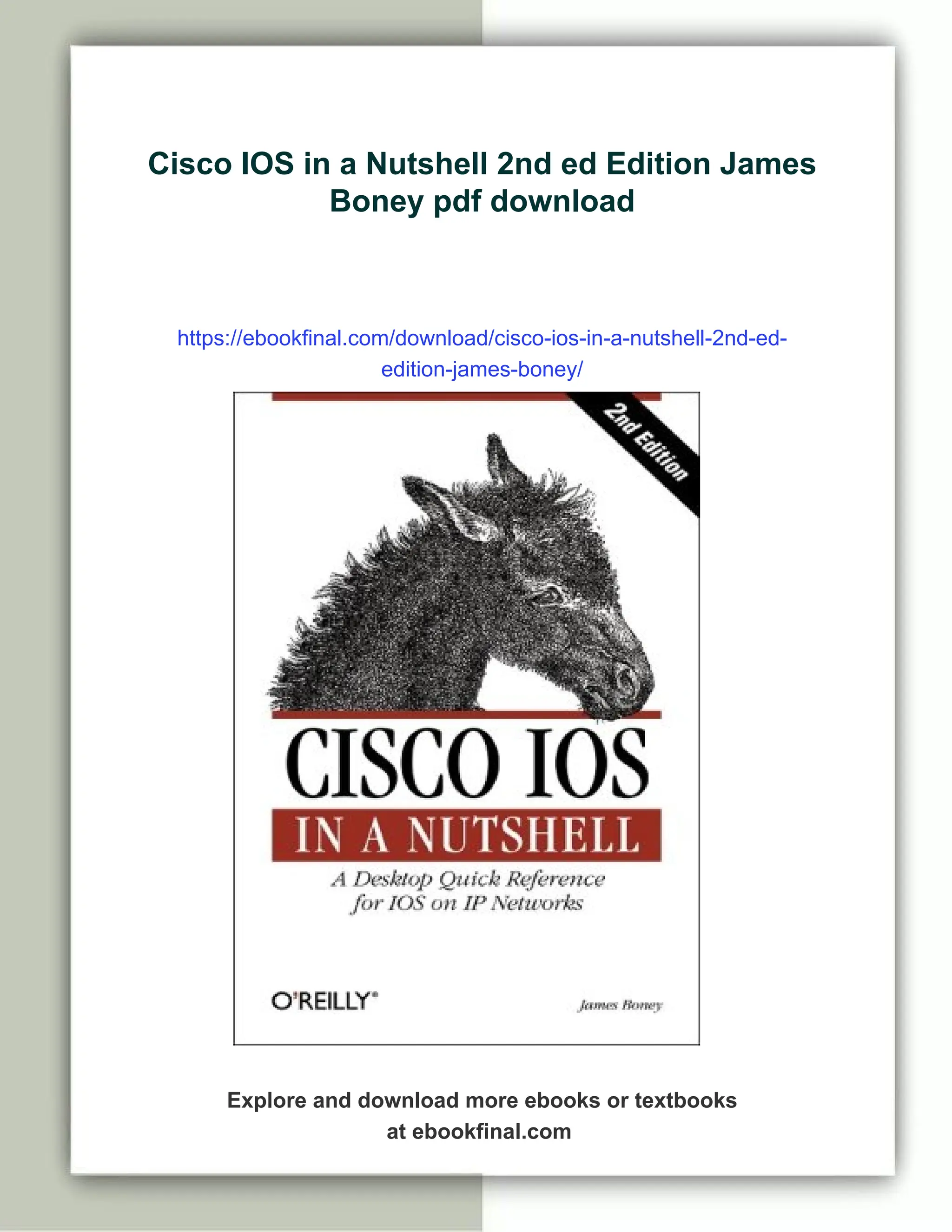
Cisco IOS in a Nutshell 2nd ed Edition James
Boney pdf download
https://ebookfinal.com/download/cisco-ios-in-a-nutshell-2nd-ed-
edition-james-boney/
Explore and download more ebooks or textbooks
at ebookfinal.com
We have selected some products that you may be interested in
Click the link to download now or visit ebookfinal.com
for more options!.
Cisco IOS in a Nutshell A Desktop Quick Reference for IOS
on IP Networks 1st Edition James Boney
https://ebookfinal.com/download/cisco-ios-in-a-nutshell-a-desktop-
quick-reference-for-ios-on-ip-networks-1st-edition-james-boney/
Java in a nutshell 2nd ed Edition David Flanagan
https://ebookfinal.com/download/java-in-a-nutshell-2nd-ed-edition-
david-flanagan/
Cisco IOS Cookbook 2nd Edition Cookbooks O Reilly Kevin
Dooley
https://ebookfinal.com/download/cisco-ios-cookbook-2nd-edition-
cookbooks-o-reilly-kevin-dooley/
LPI Linux Certification in a Nutshell 2nd ed Edition
Steven Pritchard
https://ebookfinal.com/download/lpi-linux-certification-in-a-
nutshell-2nd-ed-edition-steven-pritchard/
C in a Nutshell 1st ed Edition Ray Lischner
https://ebookfinal.com/download/c-in-a-nutshell-1st-ed-edition-ray-
lischner/
UML 2 0 in a Nutshell 1st ed Edition Dan Pilone
https://ebookfinal.com/download/uml-2-0-in-a-nutshell-1st-ed-edition-
dan-pilone/
Python in a nutshell Second Edition Alex Martelli
https://ebookfinal.com/download/python-in-a-nutshell-second-edition-
alex-martelli/
SQL in a Nutshell 3rd Edition Kevin Kline
https://ebookfinal.com/download/sql-in-a-nutshell-3rd-edition-kevin-
kline/
Quantum Field Theory in a Nutshell Second Edition A. Zee
https://ebookfinal.com/download/quantum-field-theory-in-a-nutshell-
second-edition-a-zee/
Cisco IOS in a Nutshell 2nd ed Edition James Boney
Digital Instant Download
Author(s): James Boney
ISBN(s): 9780596008697, 0596008694
Edition: 2nd ed
File Details: PDF, 3.05 MB
Year: 2005
Language: english
1
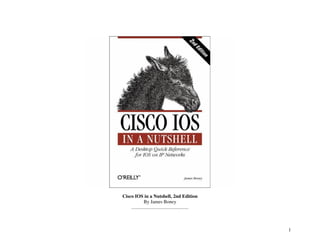
Cisco IOS in a Nutshell, 2nd Edition
By James Boney
...............................................
2
Publisher: O'Reilly
Pub Date: August 2005
ISBN: 0-596-00869-4
Pages: 796
Overview
Cisco routers are everywhere that networks are. They come in all sizes, from inexpensive units for homes and small offices to
equipment costing well over $100,000 and capable of routing at gigabit speeds. A fixture in today's networks, Cisco claims roughly
70% of the router market, producing high-end switches, hubs, and other network hardware. One unifying thread runs through the
product line: virtually all of Cisco's products run the Internetwork Operating System, or IOS.
If you work with Cisco routers, it's likely that you deal with Cisco's IOS software--an extremely powerful and complex operating
system, with an equally complex configuration language. With a cryptic command-line interface and thousands of commands--some
of which mean different things in different situations--it doesn't have a reputation for being user-friendly.
Fortunately, there's help. This second edition of Cisco IOS in a Nutshell consolidates the most important commands and features of
IOS into a single, well-organized volume that you'll find refreshingly user-friendly.
This handy, two-part reference covers IOS configuration for the TCP/IP protocol family. The first section includes chapters on the
user interface, configuring lines and interfaces, access lists, routing protocols, and dial-on-demand routing and security. A brief,
example-filled tutorial shows you how to accomplish common tasks.
3
The second part is a classic O'Reilly quick reference to all the commands for working with TCP/IP and the lower-level protocols on
which it relies. Brief descriptions and lists of options help you zero in on the commands you for the task at hand. Updated to cover
Cisco IOS Software Major Release 12.3, this second edition includes lots of examples of the most common configuration steps for the
routers themselves. It's a timely guide that any network administrator will come to rely on.
Table of Contents
Copyright Preface Organization What's New in This Edition Conventions Safari Enabled We'd Like to
Hear from You Acknowledgments Chapter 1. Getting Started Section 1.1. IOS User Modes Section 1.2.
Command-Line Completion Section 1.3. Get to Know the Question Mark Section 1.4. Command-Line Editing Keys
Section 1.5. Pausing Output Section 1.6. show Commands Chapter 2. IOS Images and Configuration Files Section
2.1. IOS Image Filenames Section 2.2. The New Cisco IOS Packaging Model Section 2.3. Loading Image Files Through
the Network Section 2.4. Using the IOS Filesystem for Images Section 2.5. The Router's Configuration Section 2.6.
Loading Configuration Files Chapter 3. Basic Router Configuration Section 3.1. Setting the Router Name Section
3.2. Setting the System Prompt Section 3.3. Configuration Comments Section 3.4. The Enable Password Section
3.5. Mapping Hostnames to IP Addresses Section 3.6. Setting the Router's Time Section 3.7. Enabling SNMP
Section 3.8. Cisco Discovery Protocol Section 3.9. System Banners Chapter 4. Line Commands Section 4.1. The
line Command Section 4.2. The Console Port Section 4.3. Virtual Terminals (VTYs) Section 4.4. Asynchronous
Ports (TTYs) Section 4.5. The Auxiliary (AUX) Port Section 4.6. show line Section 4.7. Reverse Telnet
Section 4.8. Common Configuration Items Chapter 5. Interface Commands Section 5.1. Naming and Numbering
Interfaces Section 5.2. Basic Interface Configuration Commands Section 5.3. The Loopback Interface Section 5.4.
The Null Interface Section 5.5. Ethernet, Fast Ethernet, and Gigabit Ethernet Interfaces Section 5.6. Token Ring
Interfaces Section 5.7. ISDN Interfaces Section 5.8. Serial Interfaces Section 5.9. Asynchronous Interfaces
Section 5.10. Interface show Commands Chapter 6. Networking Technologies Section 6.1. Frame Relay Section
6.2. ATM Section 6.3. DSL Section 6.4. Cable Section 6.5. VoIP Chapter 7. Access Lists Section 7.1.
How Packets Match a List Entry Section 7.2. Types of Access Lists Section 7.3. Specific Topics Chapter 8. IP
Routing Topics Section 8.1. Autonomous System (AS) Numbers Section 8.2. Interior and Exterior Gateway Protocols
Section 8.3. Distance-Vector and Link-State Routing Protocols Section 8.4. Static Routes Section 8.5. Split Horizon
4
Section 8.6. Passive Interfaces Section 8.7. Fast Switching and Process Switching Chapter 9. Interior Routing
Protocols Section 9.1. RIP Section 9.2. IGRP Section 9.3. EIGRP Section 9.4. OSPF Section 9.5. IS-
IS Chapter 10. Border Gateway Protocol Section 10.1. Introduction to BGP Section 10.2. A Simple BGP
Configuration Section 10.3. Route Filtering Section 10.4. An Advanced BGP Configuration Section 10.5. Neighbor
Authentication Section 10.6. Peer Groups Section 10.7. Route Reflectors Section 10.8. BGP Confederacies
Section 10.9. BGP TTL Security Chapter 11. Quality of Service Section 11.1. Marking Section 11.2. Older Queuing
Methods Section 11.3. Modern IOS QoS Tools Section 11.4. Congestion Avoidance Section 11.5. Traffic Policing
Section 11.6. Traffic Shaping Section 11.7. AutoQoS Section 11.8. QoS Device Manager Chapter 12. Dial-on-
Demand Routing Section 12.1. Configuring a Simple DDR Connection Section 12.2. Sample Legacy DDR
Configurations Section 12.3. Dialer Interfaces (Dialer Profiles) Section 12.4. Multilink PPP Section 12.5. Snapshot
DDR Chapter 13. Specialized Networking Topics Section 13.1. Bridging Section 13.2. Hot Standby Routing
Protocol (HSRP) Section 13.3. Network Address Translation (NAT) Section 13.4. Tunnels Section 13.5. Encrypted
Tunnels Section 13.6. Multicast Routing Section 13.7. Multiprotocol Label Switching (MPLS) Chapter 14. Switches
and VLANs Section 14.1. Switch Terminology Section 14.2. IOS on Switches Section 14.3. Basic Switch
Configuration Section 14.4. Trunking Section 14.5. Switch Monitor Port for IDS or Sniffers Section 14.6.
Troubleshooting Switches Chapter 15. Router Security Section 15.1. Securing Enable Mode Access Section 15.2.
Routine Security Measures Section 15.3. Restricting Access to Your Router Chapter 16. Troubleshooting and Logging
Section 16.1. ping Section 16.2. trace Section 16.3. Debugging Section 16.4. Logging Chapter 17. Quick
Reference aaa accounting aaa accounting delay-start aaa accounting gigawords aaa accounting nested aaa
accounting resource aaa accounting send stop-record authentication failure aaa accounting session-duration ntp-adjusted
aaa accounting suppress null-username aaa accounting update aaa authentication attempts login aaa authentication
banner aaa authentication enable default aaa authentication fail-message aaa authentication local-override aaa
authentication login aaa authentication password-prompt aaa authentication ppp aaa authentication username-prompt
aaa authorization aaa authorization config-commands aaa authorization reverse-access aaa authorization template
aaa configuration route aaa group server radius aaa group server tacacs+ aaa new-model absolute-timeout
access-class access-enable access-list access-list rate-limit access-template activation-character
aggregate-address alias area authentication area default-cost area nssa area-password area range
area stub area virtual-link arp (global) arp (interface) arp timeout async-bootp async default ip
address async default routing async dynamic address async dynamic routing async mode atm address
atm arp-server atm esi-address atm lecs-address atm lecs-address-default atm nsap-address atm pvc
atm-vc autobaud autocommand autodetect encapsulation autohangup auto discovery qos auto qos
5
voip auto secure autoselect auto-summary backup bandwidth (interface) bandwidth (policy-map)
banner exec banner incoming banner login banner motd bgp always-compare-med bgp bestpath as-path
ignore bgp bestpath med-confed bgp bestpath missing-as-worst bgp client-to-client reflection bgp cluster-id
bgp confederation identifier bgp confederation peers bgp dampening bgp default local-preference bgp default
route-target filter bgp deterministic med bgp fast-external-fallover bgp log-neighbor-changes bgp-policy
bridge acquire bridge address bridge cmf bridge crb bridge forward-time bridge-group bridge-group
aging-time bridge-group circuit-group bridge-group input-address-list bridge-group input-lsap-list bridge-group
input-pattern bridge-group input-type-list bridge-group output-address-list bridge-group output-lsap-list bridge-
group output-pattern bridge-group output-type-list bridge-group path-cost bridge-group priority bridge-group
spanning-disabled bridge hello-time bridge irb bridge max-age bridge multicast-source bridge priority
bridge protocol bridge route busy-message cable helper-address calendar set callback forced-wait cd
cdp advertise-v2 cdp enable cdp holdtime cdp run cdp timer channel-group (controller) channel-
group (interface) chat-script class (frame-relay) class (MPLS) class (policy-map) class-map clear
client-atm-address name clock calendar-valid clock rate clock read-calendar clock set clock summer-time
clock timezone clock update-calendar compress config-register configure controller copy
crc custom-queue-list databits data-character-bits dce-terminal-timing enable debug default-
information default-information originate default-metric default-name delay delete description
dialer aaa dialer callback-secure dialer callback-server dialer caller dialer dtr dialer enable-timeout
dialer fast-idle dialer-group dialer hold-queue dialer idle-timeout dialer in-band dialer isdn dialer-list
dialer load-threshold dialer map dialer map snapshot dialer max-link dialer pool dialer pool-member
dialer priority dialer remote-name dialer rotary-group dialer rotor dialer string dialer wait-for-carrier-
time dialer watch-disable dialer watch-group dialer watch-list dir disable disconnect disconnect-
character disconnect ssh dispatch-character distance distance bgp distance eigrp distribute-list in
distribute-list out domain-password downward-compatible-config down-when-looped drop dte-invert-txc
early-token-release editing eigrp log-neighbor-changes enable enable last-resort enable password
enable secret enable use-tacacs encapsulation (ATM/MPLS) encapsulation (interface) end erase
escape-character exception core-file exception dump exception memory exception protocol exception
spurious-interrupt exec exec-timeout exit fair-queue (policy-map class) fair-queue (interface) fair-
queue aggregate-limit fair-queue individual-limit fair-queue limit fair-queue qos-group fair-queue tos fair-
queue weight fddi burst-count fddi c-min fddi cmt-signal-bits fddi duplicate-address-check fddi
encapsulate fddi frames-per-token fddi smt-frames fddi tb-min fddi tl-min-time fddi token-rotation-time
6
fddi t-out fddi valid-transmission-time flowcontrol format frame-relay adaptive-shaping frame-relay [ bc |
be] frame-relay becn-response-enable frame-relay broadcast-queue frame-relay cir frame-relay class frame-
relay custom-queue-list frame-relay de-group frame-relay de-list frame-relay idle-timer frame-relay interface-
dlci frame-relay intf-type frame-relay inverse-arp frame-relay ip rtp header-compression frame-relay ip tcp
header-compression frame-relay lmi-type frame-relay local-dlci frame-relay map frame-relay map bridge
frame-relay map clns frame-relay map ip compress frame-relay map ip rtp header-compression frame-relay map ip tcp
header-compression frame-relay mincir frame-relay multicast-dlci frame-relay payload-compress packet-by-packet
frame-relay priority-dlci-group frame-relay priority-group frame-relay route frame-relay svc frame-relay
switching frame-relay traffic-rate frame-relay traffic-shaping fsck ftp-server enable ftp-server topdir
full-duplex full-help group-range half-duplex half-duplex controlled-carrier help history hold-
character hold-queue hostname hssi external-loop-request hssi internal-clock hub ignore-dcd
interface interface bvi interface dialer interface group-async ip access-group ip access-list ip
accounting ip accounting-list ip accounting-threshold ip accounting-transits ip address ip address
negotiated ip address-pool ip alias ip as-path access-list ip authentication ip bandwidth-percent eigrp
ip bgp-community new-format ip bootp server ip broadcast-address ip cef ip cef traffic-statistics ip cgmp
ip classless ip community-list ip default-gateway ip default-network ip dhcp-server ip directed-
broadcast ip domain-list ip domain-lookup ip domain-name ip dvmrp accept-filter ip dvmrp auto-
summary ip dvmrp default-information ip dvmrp metric ip dvmrp metric-offset ip dvmrp output-report-delay
ip dvmrp reject-non-pruners ip dvmrp routehog-notification ip dvmrp route-limit ip dvmrp summary-address ip
dvmrp unicast-routing ip forward-protocol ip ftp passive ip ftp password ip ftp source-interface ip ftp
username ip hello-interval eigrp ip helper-address ip hold-time eigrp ip host ip http ip identd ip
igmp access-group ip igmp explicit-tracking ip igmp helper-address ip igmp join-group ip igmp query-interval
ip igmp query-max-response-time ip igmp query-timeout ip igmp static-group ip igmp version ip irdp ip
load-sharing ip local policy route-map ip local pool ip mask-reply ip mroute ip mroute-cache ip mtu
ip multicast boundary ip multicast cache-headers ip multicast helper-map ip multicast rate-limit ip multicast-
routing ip multicast ttl-threshold ip name-server ip nat ip nat inside destination ip nat inside source ip
nat outside source ip nat pool ip nat stateful id ip nat translation ip nbar pdlm ip nbar port-map ip nbar
protocol-discovery ip netmask-format ip nhrp authentication ip nhrp holdtime ip nhrp interest ip nhrp map
ip nhrp map multicast ip nhrp max-send ip nhrp network-id ip nhrp nhs ip nhrp record ip nhrp
responder ip nhrp server-only ip nhrp trigger-svc ip nhrp use ip ospf authentication ip ospf authentication-
key ip ospf cost ip ospf dead-interval ip ospf demand-circuit ip ospf hello-interval ip ospf message-digest-
7
key ip ospf name-lookup ip ospf network ip ospf priority ip ospf retransmit-interval ip ospf transmit-delay
ip pim ip pim accept-rp ip pim message-interval ip pim minimum-vc-rate ip pim multipoint-signalling ip
pim nbma-mode ip pim neighbor-filter ip pim query-interval ip pim rp-address ip pim rp-announce-filter ip
pim send-rp-announce ip pim send-rp-discovery ip pim vc-count ip pim version ip policy-list ip policy
route-map ip proxy-arp ip radius source-interface ip rarp-server ip rcmd rcp-enable ip rcmd remote-host
ip rcmd remote-username ip rcmd rsh-enable ip redirects ip rip authentication ip rip receive version ip rip
send version ip rip triggered ip rip v2-broadcast ip route ip route-cache ip route-cache policy ip route
priority high ip route profile ip router isis ip routing ip rtp compression-connections ip rtp header-
compression ip rtp priority ip scp server enable ip source-route ip split-horizon ip ssh ip subnet-zero
ip summary-address eigrp ip summary-address rip ip tcp chunk-size ip tcp compression-connections ip tcp
header-compression ip tcp mtu-path-discovery ip tcp queuemax ip tcp synwait-time ip tcp window-size ip
telnet source-interface ip tftp source-interface ip unnumbered ip unreachables isdn answer1, isdn answer2
isdn autodetect isdn bchan-number-order isdn busy isdn caller isdn call interface isdn calling-number
isdn conference-code isdn disconnect interface isdn fast-rollover-delay isdn incoming-voice isdn leased-line bri
128 isdn not-end-to-end isdn nsf-service isdn outgoing-voice isdn overlap-receiving isdn send-alerting
isdn sending-complete isdn service isdn spid1 (spid2) isdn switch-type isdn tei isdn tei-negotiation
isdn transfer-code isdn twait-disable isdn voice-priority isis advertise-prefix isis authentication key-chain
isis authentication mode isis authentication send-only isis circuit-type isis csnp-interval isis hello-interval
isis hello-multiplier isis lsp-interval isis metric isis password isis priority isis retransmit-interval isis
retransmit-throttle-interval is-type keepalive key key chain key config-key key-string lane auto-
config-atm-address lane bus-atm-address lane client lane client-atm-address lane config-atm-address lane
config database lane database lane fixed-config-atm-address lane global-lecs-address lane le-arp lane
server-atm-address lane server-bus line linecode link-test location logging logging buffered
logging buffered xml logging console logging console xml logging count logging facility logging history
logging history size logging host logging monitor logging on logging source-interface logging
synchronous logging trap login login authentication logout-warning loopback mac-address-table
aging-time mac-address-table dynamic mac-address-table secure mac-address-table static map-class dialer
map-class frame-relay map-group map-list match access-group match any match as-path match class-
map match community-list match cos match destination-address mac match discard-class match dscp
match fr-dlci match input-interface match interface match ip address match ip dscp match ip next-hop
match ip precedence match ip route-source match ip rtp match length match metric match mpls
8
experimental match mpls-label match not match packet length match precedence match protocol
match qos-group match route-type match source-address mac match tag maximum-paths max-reserved-
bandwidth media-type member menu menu command menu text menu title metric holddown
metric maximum-hops metric weights mkdir modem monitor session more motd-banner mpls
atm control-vc mpls atm cos mpls atm disable-headend-vc mpls atm multi-vc mpls atm vpi mpls atm vp-
tunnel mpls cos-map mpls ip mpls ip default-route mpls ip encapsulate explicit-null mpls ip ttl-expiration
pop mpls label protocol mpls label range mpls mtu mpls prefix-map mpls request-labels for mrinfo
mstat mtrace mtu name elan-id name local-seg-id name preempt name server-atm-address
neighbor neighbor advertisement-interval neighbor database-filter neighbor default-originate neighbor
description neighbor distribute-list neighbor filter-list neighbor maximum-prefix neighbor next-hop-self
neighbor password neighbor peer-group neighbor prefix-list neighbor remote-as neighbor route-map
neighbor route-reflector-client neighbor send-community neighbor send-label neighbor shutdown neighbor soft-
reconfiguration inbound neighbor ttl-security neighbor timers neighbor ttl-security neighbor update-source
neighbor version neighbor weight net network network backdoor network weight nrzi-encoding
ntp access-group ntp authenticate ntp authentication-key ntp broadcast ntp broadcast client ntp
broadcastdelay ntp disable ntp master ntp peer ntp server ntp source ntp trusted-key ntp update-
calendar offset-list ospf auto-cost reference-bandwidth ospf log-adj-changes output-delay padding
parity passive-interface password peer default ip address peer neighbor-route physical-layer ping
police policy-map ppp ppp authentication ppp bridge ip ppp chap ppp compress ppp multilink
ppp quality ppp reliable-link ppp use-tacacs priority-group priority-list privilege level (global)
privilege level (line) prompt pulse-time pvc qos pre-classify queue-limit queue-list radius-
server random-detect random-detect discard-class random-detect discard-class-based random-detect dscp
random-detect ecn random-detect exponential-weighting-constant random-detect flow rate-limit redistribute
refuse-message reload rename ring-speed rlogin rmdir route-map router rsh
rxspeed send service service compress-config service linenumber service-module 56k service-module
t1 service-policy (interface) service-policy (policy-map) service timestamps session-limit session-timeout
set as-path set atm-clp set automatic-tag set community set cos set default interface set discard-
class set dscp set fr-de set interface set ip default next-hop set ip next-hop set ip precedence set ip
tos set level set local-preference set metric set metric-type set metric-type internal set mpls-label
set origin set ospf router-id set-overload-bit set precedence set qos-group set tag setup set
weight shape show shutdown smt-queue-threshold snapshot snmp-server snmp-server chassis-
9
id snmp-server community snmp-server contact snmp-server enable traps snmp-server engine-id snmp-
server group snmp-server host snmp-server location snmp-server packetsize snmp-server queue-length
snmp-server system-shutdown snmp-server tftp-server-list snmp-server trap-source snmp-server trap-timeout
snmp-server user snmp-server view snmp trap link-status source-address spanning-tree backbonefast
spanning-tree cost spanning-tree port-priority spanning-tree vlan speed squeeze squelch sscop cc-
timer sscop keepalive-timer sscop max-cc sscop poll-timer sscop rcv-window sscop send-window
standby authentication standby ip standby preempt standby priority standby timers standby track
stopbits summary-address synchronization table-map tacacs-server attempts tacacs-server authenticate
tacacs-server directed-request tacacs-server extended tacacs-server host tacacs-server key tacacs-server last-
resort tacacs-server notify tacacs-server optional-passwords tacacs-server retransmit tacacs-server timeout
tag-switching terminal editing terminal escape-character terminal history terminal length terminal monitor
tftp-server timers basic timers bgp timers spf trace, traceroute traffic-shape adaptive traffic-shape
fecn-adapt traffic-shape group traffic-shape rate traffic-share transport tunnel checksum tunnel
destination tunnel key tunnel mode tunnel sequence-datagrams tunnel source txspeed undebug
undelete username vacant-message validate-update-source variance verify version vlan vlan
database vtp client vtp domain vtp password vtp server vtp transparent vtp v2-mode vty-async
vty-async dynamic-routing vty-async header-compression vty-async keepalive vty-async mtu vty-async ppp
authentication vty-async ppp use-tacacs width write Appendix A. Appendix: Network Basics Section A.1.
IPv4 Subnetting Section A.2. OSI Reference Model Section A.3. IPv6 About the Author Colophon Index
Cisco IOS in a Nutshell, Second Edition
by James Boney
Copyright © 2005 O'Reilly Media, Inc. All rights reserved.
Printed in the United States of America.
Published by O'Reilly Media, Inc., 1005 Gravenstein Highway North, Sebastopol, CA 95472.
10
O'Reilly books may be purchased for educational, business, or sales promotional use. Online editions are also available for most titles
(safari.oreilly.com). For more information, contact our corporate/institutional sales department: (800) 998-9938 or
corporate@oreilly.com.
Editors: Mike Loukides and Debra Cameron
Production Editor: Jamie Peppard
Cover Designer: Ellie Volckhausen
Interior Designer: David Futato
Printing History:
January 2002: First Edition.
August 2005: Second Edition.
Nutshell Handbook, the Nutshell Handbook logo, and the O'Reilly logo are registered trademarks of O'Reilly Media, Inc. Cisco IOS in
a Nutshell, the image of donkey, and related trade dress are trademarks of O'Reilly Media, Inc.
Cisco IOS and all Cisco-based trademarks are registered trademarks of Cisco Systems, Inc. in the United States and other countries.
O'Reilly Media is independent of Cisco Systems, Inc.
Many of the designations used by manufacturers and sellers to distinguish their products are claimed as trademarks. Where those
designations appear in this book, and O'Reilly Media, Inc. was aware of a trademark claim, the designations have been printed in caps
or initial caps.
While every precaution has been taken in the preparation of this book, the publisher and authors assume no responsibility for errors or
omissions, or for damages resulting from the use of the information contained herein.
ISBN: 0-596-00869-4
11
[M]
Preface
This is a book for everybody who has to deal with Cisco's routers.
As you well know, Cisco Systems has created an extremely diverse line of routers and other network products. One unifying thread
runs through the product line: virtually all of Cisco's products run the Internetwork Operating System (IOS). This is both a great
advantage and a great disadvantage. On the one hand, when you're familiar with one Cisco router, you're reasonably familiar with
them all. Someone using a small DSL router in a home office could look at a configuration file for a high-end router at an ISP and not
be lost. He might not understand how to configure the more esoteric routing protocols or high-speed network interfaces, but he'd be
looking at a language that was recognizably the same.
On the other hand, this uniformity means that just about everything has been crammed into IOS at one time or another. IOS is
massivethere's no other way to say it. And it has evolved over many years. The command-line interface isn't graceful, and is often
non-uniform: many commands don't do what you think they should, and the same command verbs can mean completely different
things in different contexts. This inconsistency is probably a natural result of evolution at an extremely large company with an
extremely large number of developers, but it doesn't make life any easier.
So, where do you find out what commands you need to know? There's the almost mythical "green wall" of Cisco documentation, but
it's difficult to find what you need in tens of thousands of pages. Of course, even getting to Cisco's online documentation may be
impossible if your router doesn't work. And the volume of documentation is imposing. A search for ip cef traffic-statisticsnot
one of the more frequently used commandsyields 163 hits. How do you get to the right one? Beats me. That's why I wrote this book.
This book is primarily a quick reference to the commands that are most frequently needed to configure Cisco routers for standard IP
routing tasks. There are plenty of weasel words in there, and they're needed. This is far from a complete quick ref to all of IOSsuch a
quick ref would probably be well over 2000 pages long, clearly too long to be useful. Therefore, I haven't attempted to cover protocols
other than IP (although there is support for everything from AppleTalk to SNA), nor any of the more exotic creatures in the IP space.
And even in areas I have covered thoroughly, I was still forced to exclude commands that are useful only in limited cases.
12
Above all, this is a network administrator's book: it represents practical experience with IP routing on Cisco routers and covers the
commands that you're likely to need. No doubt some readers will disagree with the choices I've made, such disagreement is inevitable.
But though you occasionally won't find information about a command you need to use, you will far more often find, at your fingertips,
precisely what you need to know.
More than anything else, the goal of this book is to give you information quickly. It aspires not to give you in-depth knowledge of how
IP routing works, but to help you remember what arguments you need to give to the snmp-server enable traps command, or to
help you scan through the many commands that start with ip to jog your memory about which one configures the forwarding of
broadcast packets to selected subnets. If I succeed in doing that, I'm happy.
Organization
This book consists primarily of two parts. The first could be considered a tutorial, but that doesn't quite capture its purpose. I try to
teach the basic principles behind configuring the router, but there are many other sources for that information (for example, Scott
Ballew's Managing IP Networks with Cisco Routers, or Kevin Dooley and Ian J. Brown's Cisco Cookbook, both from O'Reilly). This
part of the book quickly breezes through as many examples of different configuration tasks as possible. I provide explanations, but the
focus is on the examples. By studying them, you'll see how to accomplish many of the tasks involved in setting up a router.
The bulk of the book is the quick reference. There's nothing fancy here, it's organized alphabetically and shows the commands that I
felt were most useful to someone using a Cisco router in an IP environment.
What's New in This Edition
In this edition, we updated the book with features that were integrated into Cisco's latest major IOS release, 12.3, along with highlights
from minor release 12.4. Some of the new features you'll find are AutoSecure, AutoQoS, and the new IOS naming model. We've also
expanded other sections to include IS-IS routing, MPLS, and some new hardware types. Previously neglected topics such as quality-
of-service and multicast routing have been expanded (a new chapter, Chapter 11, covers quality-of-service; multicasting is discussed
in Chapter 13). You'll also find a new appendix that covers IP subnetting, the OSI network model, and other useful nuggets.
13
We've broken from our previous mantra of "routing-only topics" to include VLANs and switching, adding a new chapter on these
topics (Chapter 14). Since the book was first written, routing and switching have come quite a long way; switches are a pretty
fundamental part of Cisco's product line. And now, you'll find IOS on most of their newer switches instead of CatOS.
This book has grown substantially since its first edition. And I hope you'll find that its usefulness has grown as well.
Conventions
The following conventions are used in this book:
Italic
Used for filenames, URLs, and occasionally for emphasis or clarity
Constant width
Used for commands, command keywords, and anything else that has to be typed literally
Constant width italic
Used for parameters or arguments that must be substituted in commands
Constant width bold
14
Used for user input
[Keywords and other stuff]
Used for optional keywords and arguments
{choice-1 | choice-2}
Used to signify either choice-1 or choice-2
This icon signifies a tip relating to the nearby text.
This icon indicates a warning relating to the nearby text.
One of the confusing things about working with a Cisco router is the notion of a command context. Most commands are legal only in
limited situations; all of the quick-reference entries include a command context that indicates how the command is to be used. A
context of "command" means that the command is for interactive use and is not entered into the router's configuration; you do not
need to enter the configuration mode (configure terminal) to give the command, and you can't include it in a configuration file that
you upload. A context of "global" indicates that a command doesn't require any specific context; you can give it as soon as you've
entered the configuration mode. A context of "interface" indicates that you must be in the interface configuration submode to give the
command; "line" means that you must be in the line configuration submode, and so on.
15
IOS has no concept of a continuation character for breaking up command lines that are too long. That may be okay for a router, but it's
a problem for a book; still, I've decided not to invent a continuation character for the purposes of this book. I've split long commands
across lines as it seemed most convenient and clear; just remember that you have to type it all on one line.
Safari Enabled
When you see a Safari® Enabled icon on the cover of your favorite technology book, that means the book is available
online through the O'Reilly Network Safari Bookshelf.
Safari offers a solution that's better than e-books. It's a virtual library that lets you easily search thousands of top tech books, cut and
paste code samples, download chapters, and find quick answers when you need the most accurate, current information. Try it free at
http://safari.oreilly.com.
We'd Like to Hear from You
Please address comments and questions concerning this book to the publisher:
O'Reilly Media, Inc.
1005 Gravenstein Highway North
Sebastopol, CA 95472
(800) 998-9938 (in the United States or Canada)
(707) 829-0515 (international or local)
(707) 829-0104 (fax)
There is a web page for this book, which lists errata and any additional information. You can access this page at:
http://www.oreilly.com/catalog/cisiosnut2/
16
To comment or ask technical questions about this book, send email to:
bookquestions@oreilly.com
For more information about books, conferences, Resource Centers, and the O'Reilly Network, see the O'Reilly web site at:
http://www.oreilly.com
Acknowledgments
As I began to plan the second edition of this book, I proclaimed that this time the writing would be effortless. I reassured everyone that
the book would be completed very quickly. Evidently, I had tossed away lessons learned from the previous writing experience.
As it turned out, this edition wasn't easy or quick. Looking back, this edition proved to be every bit as long a journey as the first one.
Now that the journey is over, I'd like to thank the people who helped me along the way.
I wish to thank my editors for their heroic efforts. For the first edition, Mike Loukides performed a great deal of work and provided
fantastic guidance. Without him, this book would not exist today. For the second edition, I owe editor Deb Cameron a tremendous
amount of gratitude. Besides being a terrific editor, she displayed a depth of patience when faced with my seemingly natural ability for
procrastination. Without her help and hard work, this second edition would never have been completed.
I'd like to thank all the reviewers from the first edition: Terry Slattery, Scott Ballew, Kevin Kelleher, Kennedy Clark, Val
Pavlichenko, and Duke Meesuk. For the second edition, new reviewers provided invaluable feedback and deserve my thanks: Trey
McMahon, Kevin Dooley, Ian J. Brown, and Theodore Wallingford. You guys went above and beyond the call of duty.
I'd like to thank my wife Peggy. Once again, she provided moral support. And she had to listen to me say, countless times, "I have to
go work on the new book," which she probably found significantly more irritating than before. Also, she had the added strenuous task
of watching our beautiful little daughter while I wrote this edition.
17
Finally, I need to rectify a glaring omission from the acknowledgments in the first edition. I'd like to thank my parents, George and
Gail Boney. Not only did they tolerate me for the last thirty-three years, but they provided an endless amount of support, which would
be too much to quantify and impossible to repay.
Chapter 1. Getting Started
In the first edition of this book, I may have dated myself a bit by starting this chapter off with the following paragraph:
The modern world is networked in a way that could barely be imagined a few decades ago. Today, the Internet reaches into virtually
every business and almost every home. Our children and even our grandparents speak of dot-coms, email, and web sites. The Internet
is now part of our culture.
Almost four years have passed since then, which does not seem like much time at all. But in the networking and computer fields, that's
a very long time indeed. Our children and grandparents now speak of dot-bombs, MP3s, broadband, voice over IP, instant messaging,
and outsourcing. Even the once-killer app email has been surpassed by the gratification of instant messaging. Things have certainly
changed, which leaves us to wonder what the next few years will bring.
No matter what happens, Cisco is likely to continue its dominance of the networking world. Even that little router sitting on your cable
or DSL connection at home could very well be a Cisco device. Routers and switches are the glue that holds the Internet together. And
Cisco is the most prominent router manufacturer, holding the largest share of the market. Their routers come in all shapes and sizes,
from inexpensive units for homes and small offices to equipment that costs hundreds of thousands of dollars, used by very large ISPs
and telcos. Almost all of their devicesfrom the smallest to the largestrun the Internetwork Operating System (IOS) . Therefore, they
share the same command set, the same user interface, and the same configuration techniques. While a small home network router
doesn't have the features or the capacity of an ISP's router, you configure them pretty much the same way. Both routers use access
lists, have similar security mechanisms, support the same set of protocols in the same way, and so on.
As Cisco continues developing its product line, it's clear that the Internetwork Operating System (IOS) is a key part of its strategy. As
new products come out, they all have the familiar IOS interface.
18
IOS is an extremely powerful and complex operating system with an equally complex configuration language. There are many
commands, with many options, and if you get something wrong you can easily take your company offline. That's why I've decided to
provide a quick-reference guide to IOS. As large a book as this is, though, it's impossible to cover all of IOS. Therefore, I've limited
the discussion to IOS configuration for the TCP/IP protocol family. I've included all the commands that you need to work with TCP/IP
and the lower-level protocols on which it relies. In the last edition, I apologized for not including other protocols such as IPX due to
the lack of space in a handy reference. Today, there is hardly a need for such an apology, as TCP/IP has become the standard
networking protocol for all but the most legacy network environments.
This book is intended as a quick reference, not as a step-by-step exposition of routing protocols or as an IOS tutorial. I haven't focused
on thorough explanation; instead, I've tried to give lots of examples of the things people most frequently need to do when configuring
a Cisco router, with just enough explanation to get you by. I'll start with the user interface (Chapters 1, 2, and 3), then talk about
configuring lines and interfaces (Chapters 4, 5, and 6), access lists (Chapter 7), and routing protocols (Chapters 8, 9, and 10). Chapter
11, new in this edition, addresses quality of service issues, while Chapter 12 describes dial-on-demand routing. Chapter 13 covers a
variety of networking topics, including bridging, Network Address Translation (NAT), tunnels, and Multiprotocol Label Switching
(MPLS). Chapter 14, also new to this edition, describes working with switches and VLANs. Chapters 15 and 16 cover IOS security
and troubleshooting, respectively. Chapter 17 is the quick reference. Chances are, by the time the next edition of this book appears, the
quick-reference section will be pretty well thumbed and worn out.
At first, the Cisco user interface appears cryptic. After learning the interface's structure, you'll become much more comfortable with it.
Once you have learned some special features, you'll be able to work with the router's configuration easily.
1.1. IOS User Modes
IOS has two primary modes of operation: user mode and privileged mode. When you first connect to the router, you are placed in user
mode. The Cisco documentation refers to this as the user exec mode; I am going to omit "exec" throughout this book. The user mode
is indicated by the prompt:
Router>
19
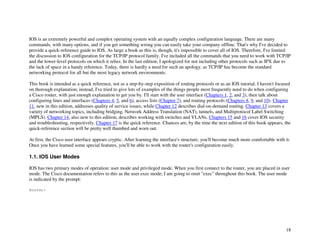
The word "Router" is replaced with your router's hostname if the hostname is already configured.
The show commands in user mode are limited to a few basic levels. You cannot edit or view configurations at this stage; you can only
view the router status and other miscellaneous information. To obtain a basic listing of commands, type a question mark:
Router>?
Editing the router's configuration requires you to be in the privileged exec mode, which I call "privileged mode ." Use the enable
command to enter this mode:
Router>enable
Password:
Router# Privileged mode prompt
You can always tell whether you are in user mode or privileged mode by looking at the prompt. The user mode prompt has a > at the
end; the privileged mode prompt always has a # at the end, regardless of the submode.
If you are familiar with Unix, you can equate privileged mode to "root" access. You could also equate it to the administrator level in
Windows 2000 or the supervisor in NetWare. In this mode, you have permission to access everything inside the router, including
configuration commands. However, you can't type configuration commands directly. Before you can change the router's actual
configuration, you must enter a submode of the privileged mode by giving the command configure terminal (see "Command-Line
Completion" later in this chapter for a shortcut). This command can be entered only when you are in privileged mode.
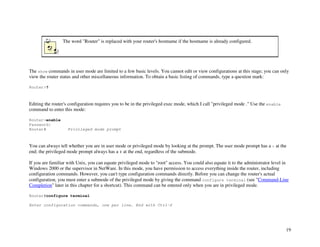
Router#configure terminal
Enter configuration commands, one per line. End with Ctrl-Z
20
Router(config)# Configuration mode
To exit configuration mode, you can use the command exit or type Ctrl-z. To exit privileged mode, you can use the disable
command. So to exit both configuration and enable mode, use the following sequence of commands:
Router(config)#exit
Router#disable
Router>
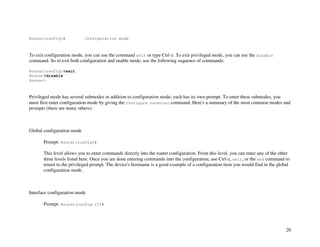
Privileged mode has several submodes in addition to configuration mode; each has its own prompt. To enter these submodes, you
must first enter configuration mode by giving the configure terminal command. Here's a summary of the most common modes and
prompts (there are many others):
Global configuration mode
Prompt: Router(config)#
This level allows you to enter commands directly into the router configuration. From this level, you can enter any of the other
three levels listed here. Once you are done entering commands into the configuration, use Ctrl-z, exit, or the end command to
return to the privileged prompt. The device's hostname is a good example of a configuration item you would find in the global
configuration mode .
Interface configuration mode
Prompt: Router(config-if)#
Discovering Diverse Content Through
Random Scribd Documents
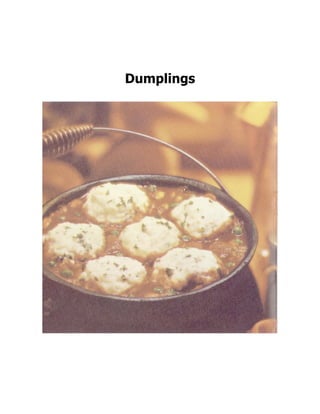
Dumplings
11
Add ¾ cup milk to 2 cups Bisquick. Mix thoroughly with fork. Drop
by spoonfuls onto chicken, meat, or vegetables in boiling stew (not
into liquid). Cook over low heat for 10 minutes with kettle uncovered
and 10 minutes with kettle covered. Liquid should just bubble gently.
Remove dumplings. Makes 10 to 12.
Dress up your dumplings 5 ways
Kind Add to recipe Serve with
Corn ¾ cup whole kernel corn, 1 tbsp.
chopped onion
beef stew
Walnut-Celery ½ cup coarsely chopped walnuts, ½
cup finely chopped celery
chicken
fricassee
Raisin ½ cup raisins chicken
fricassee
Mint ½ tsp. dried mint lamb stew
Pimiento-Green
Pepper
2 tbsp. each chopped pimiento and
green pepper
veal stew
Chicken Fricassee with Bisquick Dumplings
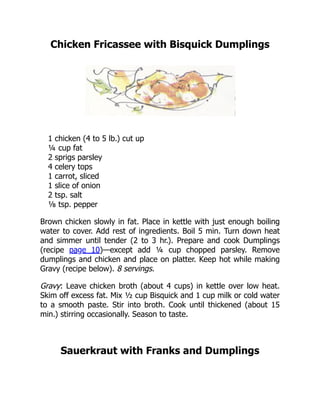
1 chicken (4 to 5 lb.) cut up
¼ cup fat
2 sprigs parsley
4 celery tops
1 carrot, sliced
1 slice of onion
2 tsp. salt
⅛ tsp. pepper
Brown chicken slowly in fat. Place in kettle with just enough boiling
water to cover. Add rest of ingredients. Boil 5 min. Turn down heat
and simmer until tender (2 to 3 hr.). Prepare and cook Dumplings
(recipe page 10)—except add ¼ cup chopped parsley. Remove
dumplings and chicken and place on platter. Keep hot while making
Gravy (recipe below). 8 servings.
Gravy: Leave chicken broth (about 4 cups) in kettle over low heat.
Skim off excess fat. Mix ½ cup Bisquick and 1 cup milk or cold water
to a smooth paste. Stir into broth. Cook until thickened (about 15
min.) stirring occasionally. Season to taste.
Sauerkraut with Franks and Dumplings
12
Add 2 cups water to two no. 303 cans sauerkraut in saucepan.
Simmer 30 minutes. Bury 8 frankfurters (or 1 lb.) in sauerkraut.
Prepare and cook ½ Dumplings (recipe page 10). Add ½ tsp.
caraway seeds, if desired. Serve hot. 4 servings.
Pork and Dumplings
Brown 6 pork chops in deep skillet or heavy kettle. Season. Add 1
medium onion, thinly sliced, and ¼ cup water. Cover skillet; simmer
until meat is tender (40 to 50 min.). Add 1½ to 3 cups water.
Prepare and cook Dumplings (recipe page 10). Remove meat and
dumplings to hot platter while making gravy. 6 servings.
Dessert Dumplings
Mix in saucepan 3 tbsp. Bisquick, 3 tbsp. sugar, and ¼ tsp. salt.
Gradually stir in 1½ cups juice from canned fruit. Bring to boil; boil
gently 2 min. stirring constantly. Stir in 1 cup canned or fresh fruit, 2
to 3 tsp. lemon juice, ½ tsp. grated lemon or orange rind, and ¹/₁₆
tsp. nutmeg or cinnamon. Prepare and cook Dumplings (recipe page
10). Serve immediately. 6 servings.
Nut Bread
13
½ cup sugar
1 egg
1¼ cups milk
3 cups Bisquick
1½ cups chopped Diamond Walnuts
Heat oven to 350° (mod.). Mix sugar, egg, milk, and Bisquick. Then
beat vigorously for 30 seconds. Batter may still be slightly lumpy. Stir
in Diamond Walnuts. Pour into well greased loaf pan, 9×5×3″. Bake
45 to 50 min., until toothpick stuck into center comes out clean.
Crack in top is typical. Cool before slicing.
Banana Nut Bread
Follow Nut Bread recipe (page 12)—except use ¾ cup sugar and
only ½ cup milk. Use only ¾ cup chopped nuts and add 1 cup
mashed bananas (2 to 3 bananas).
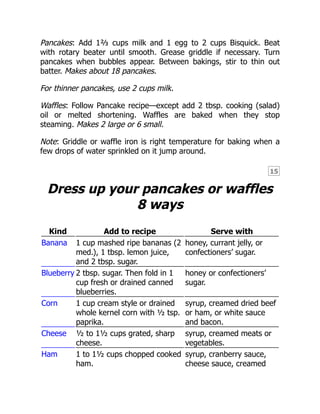
Orange Nut Bread
Follow Nut Bread recipe (page 12)—except use ¾ cup sugar and
instead of milk use orange juice plus 1 tbsp. grated orange rind. Use
only ¾ cup chopped nuts. Bake 50 to 55 min.
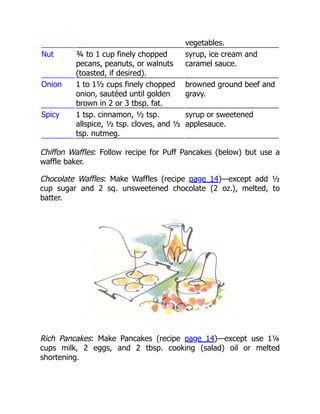
Fruit Nut Bread
Follow Nut Bread recipe (page 12)—except use ¾ cup sugar and
instead of milk use orange juice. Use only ¾ cup chopped nuts and
add 1 cup chopped dried apricots or other dried fruit. Bake 55 to 60
min.
Orange-Honey Nut Bread
Follow Nut Bread recipe (page 12)—except use only ¼ cup sugar
and add ½ cup honey. Instead of 1¼ cups milk, use only ¾ cup
orange juice plus 1 tbsp. grated orange rind. Use only ¾ cup
chopped nuts.
Little Gift Breads
Bake them in cans! Follow Nut Bread recipe (page 12) or any of the
variations. Divide batter between 3 well greased no. 2 cans or 5 well
greased soup cans, filling cans slightly more than half full. Bake
uncovered no. 2 cans 45 to 50 min.; soup cans about 40 min. in
mod. oven (350°) until toothpick stuck into center comes out clean.
14
Serving, Storing, Freezing Ideas:
• Cool thoroughly before slicing. Use thin sharp knife to prevent
crumbling.
• Nut bread slices spread with cream cheese are delicious for teas
as well as lunch boxes.
• Nut breads with the orange juice base are an excellent bread for
mailing as a gift.
• Individual round nut breads make attractive gifts for Christmas
and other holidays.
• Nut breads will keep a week in the refrigerator if wrapped tightly
in aluminum foil, and will keep well wrapped in foil in the freezer.
Pancakes and Waffles
Waffles are topped with cherry jam, pancakes stacked with 1
cup warm chunk pineapple.
15
Pancakes: Add 1⅔ cups milk and 1 egg to 2 cups Bisquick. Beat
with rotary beater until smooth. Grease griddle if necessary. Turn
pancakes when bubbles appear. Between bakings, stir to thin out
batter. Makes about 18 pancakes.
For thinner pancakes, use 2 cups milk.
Waffles: Follow Pancake recipe—except add 2 tbsp. cooking (salad)
oil or melted shortening. Waffles are baked when they stop
steaming. Makes 2 large or 6 small.
Note: Griddle or waffle iron is right temperature for baking when a
few drops of water sprinkled on it jump around.
Dress up your pancakes or waffles
8 ways
Kind Add to recipe Serve with
Banana 1 cup mashed ripe bananas (2
med.), 1 tbsp. lemon juice,
and 2 tbsp. sugar.
honey, currant jelly, or
confectioners’ sugar.
Blueberry 2 tbsp. sugar. Then fold in 1
cup fresh or drained canned
blueberries.
honey or confectioners’
sugar.
Corn 1 cup cream style or drained
whole kernel corn with ½ tsp.
paprika.
syrup, creamed dried beef
or ham, or white sauce
and bacon.
Cheese ½ to 1½ cups grated, sharp
cheese.
syrup, creamed meats or
vegetables.
Ham 1 to 1½ cups chopped cooked
ham.
syrup, cranberry sauce,
cheese sauce, creamed
vegetables.
Nut ¾ to 1 cup finely chopped
pecans, peanuts, or walnuts
(toasted, if desired).
syrup, ice cream and
caramel sauce.
Onion 1 to 1½ cups finely chopped
onion, sautéed until golden
brown in 2 or 3 tbsp. fat.
browned ground beef and
gravy.
Spicy 1 tsp. cinnamon, ½ tsp.
allspice, ½ tsp. cloves, and ½
tsp. nutmeg.
syrup or sweetened
applesauce.
Chiffon Waffles: Follow recipe for Puff Pancakes (below) but use a
waffle baker.
Chocolate Waffles: Make Waffles (recipe page 14)—except add ½
cup sugar and 2 sq. unsweetened chocolate (2 oz.), melted, to
batter.
Rich Pancakes: Make Pancakes (recipe page 14)—except use 1¼
cups milk, 2 eggs, and 2 tbsp. cooking (salad) oil or melted
shortening.
16
Puff Pancakes: Beat 2 eggs with rotary beater until soft peaks form.
Blend in 1 cup milk. Add 2⅓ cups Bisquick and 2 tbsp. sugar. Mix
just until thoroughly dampened. Fold in ¼ cup cooking (salad) oil or
melted shortening. Spoon onto medium-hot ungreased griddle.
When puffed up, and bubbles begin to break, cook on other side.
Serve with syrup or as dessert with warm fruit, such as strawberries,
and whipped cream. Makes 15 to 20 pancakes.
Main dish pancakes and waffles ...
Tuna Royal Pancakes
Pancakes (recipe page 14)
7-oz. can tuna, drained and broken
¼ cup chopped onion
½ cup grated Parmesan or processed cheese
½ cup chopped celery
¼ cup chopped pimiento
about 2 tsp. lemon juice
10½-oz. can cream of celery or chicken soup
2 tbsp. Bisquick
¼ tsp. salt
⅛ tsp. pepper
2 cups milk
Heat oven to 400° (mod. hot). Make 10 thinner pancakes (5″ size).
Keep warm between towels until ready to serve. Mix tuna, onion, ¼
cup of the cheese, celery, pimiento, and lemon juice. Spoon 2 tbsp.
of mixture on each pancake. Roll and place folded side down in
11½×7½×1½″ oblong baking dish. Heat in oven about 10 min. Mix
soup, Bisquick, salt, pepper, and milk. Heat until thickened. Pour
over pancakes and sprinkle with the remaining ¼ cup grated
cheese. If desired, place under broiler until bubbly. 10 servings.
Waffle Supper Royal
Serve waffles with creamed chicken or turkey and top with whole
cranberry sauce. Wonderful Sunday supper!
Waffle Club Rabbit
Make Waffles (recipe page 14) using 2 cups milk. Bake until very
crisp and brown. Serve waffles (whole or sections) with a slice or
more of fresh tomato arranged on each serving. Spoon Cheese
Sauce (recipe below) over, then top with strips of crisp bacon.
Cheese Sauce: Mix 1½ cups medium white sauce, 2 cups grated
sharp Cheddar cheese (½ lb.). If desired, add ¼ tsp. dry mustard
and few grains thyme. Heat slowly until cheese melts and blends
with sauce. 6 servings.
Chicken Griddle Cakes
17
Make 8 large Pancakes (recipe page 14) using about ½ cup batter
for each. Spoon ¼ cup Creamed Chicken (recipe below) onto half of
each pancake. Fold over other half. Place on baking sheet. Sprinkle 1
tbsp. grated sharp cheese over each cake. Slip under broiler or in
oven for a moment to melt cheese. 8 servings.
Creamed Chicken: Melt 2 tbsp. butter. Remove from heat. Blend in
¼ cup Bisquick and 1 tsp. salt. Gradually stir in 1½ cups milk. Bring
to boil over low heat, stirring constantly. Boil 1 min. Stir in 2 cups
finely diced cooked chicken. Season to taste with pepper and poultry
seasoning. Heat until chicken is hot.
Brunch and dessert pancakes
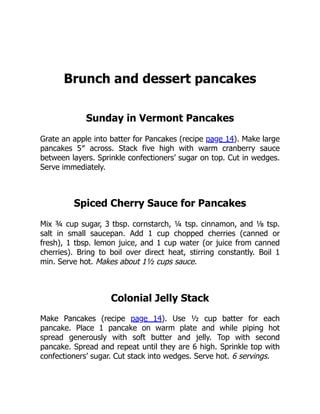
Sunday in Vermont Pancakes
Grate an apple into batter for Pancakes (recipe page 14). Make large
pancakes 5″ across. Stack five high with warm cranberry sauce
between layers. Sprinkle confectioners’ sugar on top. Cut in wedges.
Serve immediately.
Spiced Cherry Sauce for Pancakes
Mix ¾ cup sugar, 3 tbsp. cornstarch, ¼ tsp. cinnamon, and ⅛ tsp.
salt in small saucepan. Add 1 cup chopped cherries (canned or
fresh), 1 tbsp. lemon juice, and 1 cup water (or juice from canned
cherries). Bring to boil over direct heat, stirring constantly. Boil 1
min. Serve hot. Makes about 1½ cups sauce.
Colonial Jelly Stack
Make Pancakes (recipe page 14). Use ½ cup batter for each
pancake. Place 1 pancake on warm plate and while piping hot
spread generously with soft butter and jelly. Top with second
pancake. Spread and repeat until they are 6 high. Sprinkle top with
confectioners’ sugar. Cut stack into wedges. Serve hot. 6 servings.
Maple Whip
Cream ½ cup soft butter. Add 1 cup maple-flavored syrup gradually.
Beat until smooth and spreading consistency. Serve on hot pancakes
or waffles. This can be refrigerated for future use.
Strawberry Blintzes
Pancakes (recipe page 14)
1 cup cottage cheese (small curd)
4-oz. pkg. cream cheese
1½ tbsp. lemon rind
3 tbsp. lemon juice
¼ cup sugar
10-oz. pkg. frozen strawberries (thawed)
1 tbsp. lemon juice
¼ tsp. almond extract
Heat oven to 400° (mod. hot). Combine cottage cheese, cream
cheese, lemon rind, the 3 tbsp. lemon juice, and sugar; whip until
creamy. Place ¼ cup filling on each pancake and roll up. Place rolled
side down in 11×7″ baking dish. Heat in oven for 10 min. just before
serving. Heat the strawberries, the 1 tbsp. lemon juice, and almond
extract. Spoon over pancakes. Serve immediately. 6 servings.
18
Quantity Pancakes
For 60 Pancakes. Serves 15.
10 cups Bisquick (40-oz. pkg. or two 20-oz. pkg.)
8⅓ cups milk
5 eggs
For 100 Pancakes. Serves 25.
15 cups Bisquick (60-oz. pkg.)
3 qt. milk
7 eggs
Add milk and eggs to Bisquick. Beat with rotary beater until smooth.
Bake as directed on page 14.
Shortcake
Heat oven to 450° (hot). Add ¾ cup cream (or ½ cup milk plus ¼
cup butter, melted) to 2 cups Bisquick. Add 2 tbsp. sugar, if desired.
Mix thoroughly with fork. Keep dough soft; if too sticky, add
Bisquick. Knead 10 times on floured surface. Pat or roll dough to half
19
the thickness desired in baked shortcakes. Shortcakes double in
volume during baking. Cut into individual shortcakes with floured
cutter. Bake about 10 min. Split. Butter, if desired. Place fruit
between layers and over top. Makes six 3″ shortcakes. For 1 large
shortcake, pat out ½ dough in round layer pan, 8×1½″, dot with
butter. Pat out rest of dough, and place over top. Bake 15 to 20 min.
Double-Decker Fruit Shortcake
Heat oven to 400° (mod. hot). Make Shortcake dough (recipe page
18) and roll into two 8″ square pieces. Fit one piece into an 8″
square pan, pressing dough about ½″ up sides of pan. Be careful to
press together any tears in the dough. Spread 2 cups washed fresh
raspberries or blueberries over dough, sprinkle with ¼ to ½ cup
sugar. Cover with the other square of dough. Bake about 25 min.,
until well browned. Cut into squares and serve warm or cold with
Sauce (recipe below). 9 servings.
Sauce: Mix ½ cup sugar and 1 tbsp. cornstarch in saucepan. Stir in
¼ cup cold water, ¼ cup butter, and 1 cup washed fresh raspberries
or blueberries, mashed. Bring to a boil and boil 1 min.
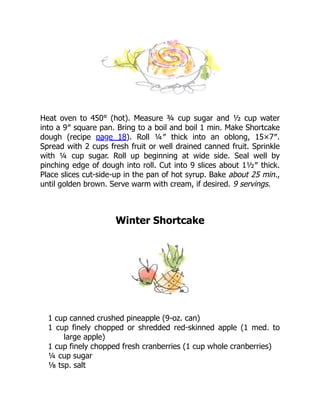
Fruit Roll
Heat oven to 450° (hot). Measure ¾ cup sugar and ½ cup water
into a 9″ square pan. Bring to a boil and boil 1 min. Make Shortcake
dough (recipe page 18). Roll ¼″ thick into an oblong, 15×7″.
Spread with 2 cups fresh fruit or well drained canned fruit. Sprinkle
with ¼ cup sugar. Roll up beginning at wide side. Seal well by
pinching edge of dough into roll. Cut into 9 slices about 1½″ thick.
Place slices cut-side-up in the pan of hot syrup. Bake about 25 min.,
until golden brown. Serve warm with cream, if desired. 9 servings.
Winter Shortcake
1 cup canned crushed pineapple (9-oz. can)
1 cup finely chopped or shredded red-skinned apple (1 med. to
large apple)
1 cup finely chopped fresh cranberries (1 cup whole cranberries)
¼ cup sugar
⅛ tsp. salt
20
Mix all ingredients. Let stand at room temperature ½ to 1 hr. before
serving. Make Shortcake dough (recipe page 18). Cut individual
shortcakes. Split while piping hot and serve shortcake style with the
fruit mixture. 6 servings.
Peach-Orange Shortcake
Heat oven to 450° (hot). Make Shortcake dough (recipe page 18)—
except add grated rind of 1 orange to Bisquick before adding liquid.
Spread dough in greased 13×9½×2″ pan. Sprinkle with 2 tbsp.
sugar, if desired. Bake 10 to 12 min. Cut into 12 squares. For each
serving, spoon sliced peaches between 2 squares and on top. Top
with whipped cream. 6 servings.
Sour Cream-Strawberry Shortcake
Make Shortcake dough (recipe page 18). Cut individual shortcakes.
Split layers. Spoon frozen strawberries and commercial sour cream
between layers and over top.
Velvet Crumb Cake
1⅓ cups Bisquick
¾ cup sugar
3 tbsp. soft shortening
21
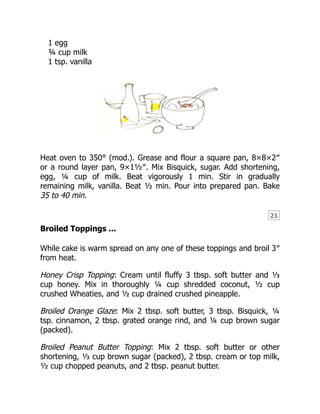
1 egg
¾ cup milk
1 tsp. vanilla
Heat oven to 350° (mod.). Grease and flour a square pan, 8×8×2″
or a round layer pan, 9×1½″. Mix Bisquick, sugar. Add shortening,
egg, ¼ cup of milk. Beat vigorously 1 min. Stir in gradually
remaining milk, vanilla. Beat ½ min. Pour into prepared pan. Bake
35 to 40 min.
Broiled Toppings ...
While cake is warm spread on any one of these toppings and broil 3″
from heat.
Honey Crisp Topping: Cream until fluffy 3 tbsp. soft butter and ⅓
cup honey. Mix in thoroughly ¼ cup shredded coconut, ½ cup
crushed Wheaties, and ½ cup drained crushed pineapple.
Broiled Orange Glaze: Mix 2 tbsp. soft butter, 3 tbsp. Bisquick, ¼
tsp. cinnamon, 2 tbsp. grated orange rind, and ¼ cup brown sugar
(packed).
Broiled Peanut Butter Topping: Mix 2 tbsp. soft butter or other
shortening, ⅓ cup brown sugar (packed), 2 tbsp. cream or top milk,
½ cup chopped peanuts, and 2 tbsp. peanut butter.
Welcome to our website – the ideal destination for book lovers and
knowledge seekers. With a mission to inspire endlessly, we offer a
vast collection of books, ranging from classic literary works to
specialized publications, self-development books, and children's
literature. Each book is a new journey of discovery, expanding
knowledge and enriching the soul of the reade
Our website is not just a platform for buying books, but a bridge
connecting readers to the timeless values of culture and wisdom. With
an elegant, user-friendly interface and an intelligent search system,
we are committed to providing a quick and convenient shopping
experience. Additionally, our special promotions and home delivery
services ensure that you save time and fully enjoy the joy of reading.
Let us accompany you on the journey of exploring knowledge and
personal growth!
ebookfinal.com

Cisco IOS in a Nutshell 2nd ed Edition James Boney

  • 1.
    Cisco IOS ina Nutshell 2nd ed Edition James Boney pdf download https://ebookfinal.com/download/cisco-ios-in-a-nutshell-2nd-ed- edition-james-boney/ Explore and download more ebooks or textbooks at ebookfinal.com
  • 2.
    We have selectedsome products that you may be interested in Click the link to download now or visit ebookfinal.com for more options!. Cisco IOS in a Nutshell A Desktop Quick Reference for IOS on IP Networks 1st Edition James Boney https://ebookfinal.com/download/cisco-ios-in-a-nutshell-a-desktop- quick-reference-for-ios-on-ip-networks-1st-edition-james-boney/ Java in a nutshell 2nd ed Edition David Flanagan https://ebookfinal.com/download/java-in-a-nutshell-2nd-ed-edition- david-flanagan/ Cisco IOS Cookbook 2nd Edition Cookbooks O Reilly Kevin Dooley https://ebookfinal.com/download/cisco-ios-cookbook-2nd-edition- cookbooks-o-reilly-kevin-dooley/ LPI Linux Certification in a Nutshell 2nd ed Edition Steven Pritchard https://ebookfinal.com/download/lpi-linux-certification-in-a- nutshell-2nd-ed-edition-steven-pritchard/
  • 3.
    C in aNutshell 1st ed Edition Ray Lischner https://ebookfinal.com/download/c-in-a-nutshell-1st-ed-edition-ray- lischner/ UML 2 0 in a Nutshell 1st ed Edition Dan Pilone https://ebookfinal.com/download/uml-2-0-in-a-nutshell-1st-ed-edition- dan-pilone/ Python in a nutshell Second Edition Alex Martelli https://ebookfinal.com/download/python-in-a-nutshell-second-edition- alex-martelli/ SQL in a Nutshell 3rd Edition Kevin Kline https://ebookfinal.com/download/sql-in-a-nutshell-3rd-edition-kevin- kline/ Quantum Field Theory in a Nutshell Second Edition A. Zee https://ebookfinal.com/download/quantum-field-theory-in-a-nutshell- second-edition-a-zee/
  • 5.
    Cisco IOS ina Nutshell 2nd ed Edition James Boney Digital Instant Download Author(s): James Boney ISBN(s): 9780596008697, 0596008694 Edition: 2nd ed File Details: PDF, 3.05 MB Year: 2005 Language: english
  • 6.
    1 Cisco IOS ina Nutshell, 2nd Edition By James Boney ...............................................
  • 7.
    2 Publisher: O'Reilly Pub Date:August 2005 ISBN: 0-596-00869-4 Pages: 796 Overview Cisco routers are everywhere that networks are. They come in all sizes, from inexpensive units for homes and small offices to equipment costing well over $100,000 and capable of routing at gigabit speeds. A fixture in today's networks, Cisco claims roughly 70% of the router market, producing high-end switches, hubs, and other network hardware. One unifying thread runs through the product line: virtually all of Cisco's products run the Internetwork Operating System, or IOS. If you work with Cisco routers, it's likely that you deal with Cisco's IOS software--an extremely powerful and complex operating system, with an equally complex configuration language. With a cryptic command-line interface and thousands of commands--some of which mean different things in different situations--it doesn't have a reputation for being user-friendly. Fortunately, there's help. This second edition of Cisco IOS in a Nutshell consolidates the most important commands and features of IOS into a single, well-organized volume that you'll find refreshingly user-friendly. This handy, two-part reference covers IOS configuration for the TCP/IP protocol family. The first section includes chapters on the user interface, configuring lines and interfaces, access lists, routing protocols, and dial-on-demand routing and security. A brief, example-filled tutorial shows you how to accomplish common tasks.
  • 8.
    3 The second partis a classic O'Reilly quick reference to all the commands for working with TCP/IP and the lower-level protocols on which it relies. Brief descriptions and lists of options help you zero in on the commands you for the task at hand. Updated to cover Cisco IOS Software Major Release 12.3, this second edition includes lots of examples of the most common configuration steps for the routers themselves. It's a timely guide that any network administrator will come to rely on. Table of Contents Copyright Preface Organization What's New in This Edition Conventions Safari Enabled We'd Like to Hear from You Acknowledgments Chapter 1. Getting Started Section 1.1. IOS User Modes Section 1.2. Command-Line Completion Section 1.3. Get to Know the Question Mark Section 1.4. Command-Line Editing Keys Section 1.5. Pausing Output Section 1.6. show Commands Chapter 2. IOS Images and Configuration Files Section 2.1. IOS Image Filenames Section 2.2. The New Cisco IOS Packaging Model Section 2.3. Loading Image Files Through the Network Section 2.4. Using the IOS Filesystem for Images Section 2.5. The Router's Configuration Section 2.6. Loading Configuration Files Chapter 3. Basic Router Configuration Section 3.1. Setting the Router Name Section 3.2. Setting the System Prompt Section 3.3. Configuration Comments Section 3.4. The Enable Password Section 3.5. Mapping Hostnames to IP Addresses Section 3.6. Setting the Router's Time Section 3.7. Enabling SNMP Section 3.8. Cisco Discovery Protocol Section 3.9. System Banners Chapter 4. Line Commands Section 4.1. The line Command Section 4.2. The Console Port Section 4.3. Virtual Terminals (VTYs) Section 4.4. Asynchronous Ports (TTYs) Section 4.5. The Auxiliary (AUX) Port Section 4.6. show line Section 4.7. Reverse Telnet Section 4.8. Common Configuration Items Chapter 5. Interface Commands Section 5.1. Naming and Numbering Interfaces Section 5.2. Basic Interface Configuration Commands Section 5.3. The Loopback Interface Section 5.4. The Null Interface Section 5.5. Ethernet, Fast Ethernet, and Gigabit Ethernet Interfaces Section 5.6. Token Ring Interfaces Section 5.7. ISDN Interfaces Section 5.8. Serial Interfaces Section 5.9. Asynchronous Interfaces Section 5.10. Interface show Commands Chapter 6. Networking Technologies Section 6.1. Frame Relay Section 6.2. ATM Section 6.3. DSL Section 6.4. Cable Section 6.5. VoIP Chapter 7. Access Lists Section 7.1. How Packets Match a List Entry Section 7.2. Types of Access Lists Section 7.3. Specific Topics Chapter 8. IP Routing Topics Section 8.1. Autonomous System (AS) Numbers Section 8.2. Interior and Exterior Gateway Protocols Section 8.3. Distance-Vector and Link-State Routing Protocols Section 8.4. Static Routes Section 8.5. Split Horizon
  • 9.
    4 Section 8.6. PassiveInterfaces Section 8.7. Fast Switching and Process Switching Chapter 9. Interior Routing Protocols Section 9.1. RIP Section 9.2. IGRP Section 9.3. EIGRP Section 9.4. OSPF Section 9.5. IS- IS Chapter 10. Border Gateway Protocol Section 10.1. Introduction to BGP Section 10.2. A Simple BGP Configuration Section 10.3. Route Filtering Section 10.4. An Advanced BGP Configuration Section 10.5. Neighbor Authentication Section 10.6. Peer Groups Section 10.7. Route Reflectors Section 10.8. BGP Confederacies Section 10.9. BGP TTL Security Chapter 11. Quality of Service Section 11.1. Marking Section 11.2. Older Queuing Methods Section 11.3. Modern IOS QoS Tools Section 11.4. Congestion Avoidance Section 11.5. Traffic Policing Section 11.6. Traffic Shaping Section 11.7. AutoQoS Section 11.8. QoS Device Manager Chapter 12. Dial-on- Demand Routing Section 12.1. Configuring a Simple DDR Connection Section 12.2. Sample Legacy DDR Configurations Section 12.3. Dialer Interfaces (Dialer Profiles) Section 12.4. Multilink PPP Section 12.5. Snapshot DDR Chapter 13. Specialized Networking Topics Section 13.1. Bridging Section 13.2. Hot Standby Routing Protocol (HSRP) Section 13.3. Network Address Translation (NAT) Section 13.4. Tunnels Section 13.5. Encrypted Tunnels Section 13.6. Multicast Routing Section 13.7. Multiprotocol Label Switching (MPLS) Chapter 14. Switches and VLANs Section 14.1. Switch Terminology Section 14.2. IOS on Switches Section 14.3. Basic Switch Configuration Section 14.4. Trunking Section 14.5. Switch Monitor Port for IDS or Sniffers Section 14.6. Troubleshooting Switches Chapter 15. Router Security Section 15.1. Securing Enable Mode Access Section 15.2. Routine Security Measures Section 15.3. Restricting Access to Your Router Chapter 16. Troubleshooting and Logging Section 16.1. ping Section 16.2. trace Section 16.3. Debugging Section 16.4. Logging Chapter 17. Quick Reference aaa accounting aaa accounting delay-start aaa accounting gigawords aaa accounting nested aaa accounting resource aaa accounting send stop-record authentication failure aaa accounting session-duration ntp-adjusted aaa accounting suppress null-username aaa accounting update aaa authentication attempts login aaa authentication banner aaa authentication enable default aaa authentication fail-message aaa authentication local-override aaa authentication login aaa authentication password-prompt aaa authentication ppp aaa authentication username-prompt aaa authorization aaa authorization config-commands aaa authorization reverse-access aaa authorization template aaa configuration route aaa group server radius aaa group server tacacs+ aaa new-model absolute-timeout access-class access-enable access-list access-list rate-limit access-template activation-character aggregate-address alias area authentication area default-cost area nssa area-password area range area stub area virtual-link arp (global) arp (interface) arp timeout async-bootp async default ip address async default routing async dynamic address async dynamic routing async mode atm address atm arp-server atm esi-address atm lecs-address atm lecs-address-default atm nsap-address atm pvc atm-vc autobaud autocommand autodetect encapsulation autohangup auto discovery qos auto qos
  • 10.
    5 voip auto secureautoselect auto-summary backup bandwidth (interface) bandwidth (policy-map) banner exec banner incoming banner login banner motd bgp always-compare-med bgp bestpath as-path ignore bgp bestpath med-confed bgp bestpath missing-as-worst bgp client-to-client reflection bgp cluster-id bgp confederation identifier bgp confederation peers bgp dampening bgp default local-preference bgp default route-target filter bgp deterministic med bgp fast-external-fallover bgp log-neighbor-changes bgp-policy bridge acquire bridge address bridge cmf bridge crb bridge forward-time bridge-group bridge-group aging-time bridge-group circuit-group bridge-group input-address-list bridge-group input-lsap-list bridge-group input-pattern bridge-group input-type-list bridge-group output-address-list bridge-group output-lsap-list bridge- group output-pattern bridge-group output-type-list bridge-group path-cost bridge-group priority bridge-group spanning-disabled bridge hello-time bridge irb bridge max-age bridge multicast-source bridge priority bridge protocol bridge route busy-message cable helper-address calendar set callback forced-wait cd cdp advertise-v2 cdp enable cdp holdtime cdp run cdp timer channel-group (controller) channel- group (interface) chat-script class (frame-relay) class (MPLS) class (policy-map) class-map clear client-atm-address name clock calendar-valid clock rate clock read-calendar clock set clock summer-time clock timezone clock update-calendar compress config-register configure controller copy crc custom-queue-list databits data-character-bits dce-terminal-timing enable debug default- information default-information originate default-metric default-name delay delete description dialer aaa dialer callback-secure dialer callback-server dialer caller dialer dtr dialer enable-timeout dialer fast-idle dialer-group dialer hold-queue dialer idle-timeout dialer in-band dialer isdn dialer-list dialer load-threshold dialer map dialer map snapshot dialer max-link dialer pool dialer pool-member dialer priority dialer remote-name dialer rotary-group dialer rotor dialer string dialer wait-for-carrier- time dialer watch-disable dialer watch-group dialer watch-list dir disable disconnect disconnect- character disconnect ssh dispatch-character distance distance bgp distance eigrp distribute-list in distribute-list out domain-password downward-compatible-config down-when-looped drop dte-invert-txc early-token-release editing eigrp log-neighbor-changes enable enable last-resort enable password enable secret enable use-tacacs encapsulation (ATM/MPLS) encapsulation (interface) end erase escape-character exception core-file exception dump exception memory exception protocol exception spurious-interrupt exec exec-timeout exit fair-queue (policy-map class) fair-queue (interface) fair- queue aggregate-limit fair-queue individual-limit fair-queue limit fair-queue qos-group fair-queue tos fair- queue weight fddi burst-count fddi c-min fddi cmt-signal-bits fddi duplicate-address-check fddi encapsulate fddi frames-per-token fddi smt-frames fddi tb-min fddi tl-min-time fddi token-rotation-time
  • 11.
    6 fddi t-out fddivalid-transmission-time flowcontrol format frame-relay adaptive-shaping frame-relay [ bc | be] frame-relay becn-response-enable frame-relay broadcast-queue frame-relay cir frame-relay class frame- relay custom-queue-list frame-relay de-group frame-relay de-list frame-relay idle-timer frame-relay interface- dlci frame-relay intf-type frame-relay inverse-arp frame-relay ip rtp header-compression frame-relay ip tcp header-compression frame-relay lmi-type frame-relay local-dlci frame-relay map frame-relay map bridge frame-relay map clns frame-relay map ip compress frame-relay map ip rtp header-compression frame-relay map ip tcp header-compression frame-relay mincir frame-relay multicast-dlci frame-relay payload-compress packet-by-packet frame-relay priority-dlci-group frame-relay priority-group frame-relay route frame-relay svc frame-relay switching frame-relay traffic-rate frame-relay traffic-shaping fsck ftp-server enable ftp-server topdir full-duplex full-help group-range half-duplex half-duplex controlled-carrier help history hold- character hold-queue hostname hssi external-loop-request hssi internal-clock hub ignore-dcd interface interface bvi interface dialer interface group-async ip access-group ip access-list ip accounting ip accounting-list ip accounting-threshold ip accounting-transits ip address ip address negotiated ip address-pool ip alias ip as-path access-list ip authentication ip bandwidth-percent eigrp ip bgp-community new-format ip bootp server ip broadcast-address ip cef ip cef traffic-statistics ip cgmp ip classless ip community-list ip default-gateway ip default-network ip dhcp-server ip directed- broadcast ip domain-list ip domain-lookup ip domain-name ip dvmrp accept-filter ip dvmrp auto- summary ip dvmrp default-information ip dvmrp metric ip dvmrp metric-offset ip dvmrp output-report-delay ip dvmrp reject-non-pruners ip dvmrp routehog-notification ip dvmrp route-limit ip dvmrp summary-address ip dvmrp unicast-routing ip forward-protocol ip ftp passive ip ftp password ip ftp source-interface ip ftp username ip hello-interval eigrp ip helper-address ip hold-time eigrp ip host ip http ip identd ip igmp access-group ip igmp explicit-tracking ip igmp helper-address ip igmp join-group ip igmp query-interval ip igmp query-max-response-time ip igmp query-timeout ip igmp static-group ip igmp version ip irdp ip load-sharing ip local policy route-map ip local pool ip mask-reply ip mroute ip mroute-cache ip mtu ip multicast boundary ip multicast cache-headers ip multicast helper-map ip multicast rate-limit ip multicast- routing ip multicast ttl-threshold ip name-server ip nat ip nat inside destination ip nat inside source ip nat outside source ip nat pool ip nat stateful id ip nat translation ip nbar pdlm ip nbar port-map ip nbar protocol-discovery ip netmask-format ip nhrp authentication ip nhrp holdtime ip nhrp interest ip nhrp map ip nhrp map multicast ip nhrp max-send ip nhrp network-id ip nhrp nhs ip nhrp record ip nhrp responder ip nhrp server-only ip nhrp trigger-svc ip nhrp use ip ospf authentication ip ospf authentication- key ip ospf cost ip ospf dead-interval ip ospf demand-circuit ip ospf hello-interval ip ospf message-digest-
  • 12.
    7 key ip ospfname-lookup ip ospf network ip ospf priority ip ospf retransmit-interval ip ospf transmit-delay ip pim ip pim accept-rp ip pim message-interval ip pim minimum-vc-rate ip pim multipoint-signalling ip pim nbma-mode ip pim neighbor-filter ip pim query-interval ip pim rp-address ip pim rp-announce-filter ip pim send-rp-announce ip pim send-rp-discovery ip pim vc-count ip pim version ip policy-list ip policy route-map ip proxy-arp ip radius source-interface ip rarp-server ip rcmd rcp-enable ip rcmd remote-host ip rcmd remote-username ip rcmd rsh-enable ip redirects ip rip authentication ip rip receive version ip rip send version ip rip triggered ip rip v2-broadcast ip route ip route-cache ip route-cache policy ip route priority high ip route profile ip router isis ip routing ip rtp compression-connections ip rtp header- compression ip rtp priority ip scp server enable ip source-route ip split-horizon ip ssh ip subnet-zero ip summary-address eigrp ip summary-address rip ip tcp chunk-size ip tcp compression-connections ip tcp header-compression ip tcp mtu-path-discovery ip tcp queuemax ip tcp synwait-time ip tcp window-size ip telnet source-interface ip tftp source-interface ip unnumbered ip unreachables isdn answer1, isdn answer2 isdn autodetect isdn bchan-number-order isdn busy isdn caller isdn call interface isdn calling-number isdn conference-code isdn disconnect interface isdn fast-rollover-delay isdn incoming-voice isdn leased-line bri 128 isdn not-end-to-end isdn nsf-service isdn outgoing-voice isdn overlap-receiving isdn send-alerting isdn sending-complete isdn service isdn spid1 (spid2) isdn switch-type isdn tei isdn tei-negotiation isdn transfer-code isdn twait-disable isdn voice-priority isis advertise-prefix isis authentication key-chain isis authentication mode isis authentication send-only isis circuit-type isis csnp-interval isis hello-interval isis hello-multiplier isis lsp-interval isis metric isis password isis priority isis retransmit-interval isis retransmit-throttle-interval is-type keepalive key key chain key config-key key-string lane auto- config-atm-address lane bus-atm-address lane client lane client-atm-address lane config-atm-address lane config database lane database lane fixed-config-atm-address lane global-lecs-address lane le-arp lane server-atm-address lane server-bus line linecode link-test location logging logging buffered logging buffered xml logging console logging console xml logging count logging facility logging history logging history size logging host logging monitor logging on logging source-interface logging synchronous logging trap login login authentication logout-warning loopback mac-address-table aging-time mac-address-table dynamic mac-address-table secure mac-address-table static map-class dialer map-class frame-relay map-group map-list match access-group match any match as-path match class- map match community-list match cos match destination-address mac match discard-class match dscp match fr-dlci match input-interface match interface match ip address match ip dscp match ip next-hop match ip precedence match ip route-source match ip rtp match length match metric match mpls
  • 13.
    8 experimental match mpls-labelmatch not match packet length match precedence match protocol match qos-group match route-type match source-address mac match tag maximum-paths max-reserved- bandwidth media-type member menu menu command menu text menu title metric holddown metric maximum-hops metric weights mkdir modem monitor session more motd-banner mpls atm control-vc mpls atm cos mpls atm disable-headend-vc mpls atm multi-vc mpls atm vpi mpls atm vp- tunnel mpls cos-map mpls ip mpls ip default-route mpls ip encapsulate explicit-null mpls ip ttl-expiration pop mpls label protocol mpls label range mpls mtu mpls prefix-map mpls request-labels for mrinfo mstat mtrace mtu name elan-id name local-seg-id name preempt name server-atm-address neighbor neighbor advertisement-interval neighbor database-filter neighbor default-originate neighbor description neighbor distribute-list neighbor filter-list neighbor maximum-prefix neighbor next-hop-self neighbor password neighbor peer-group neighbor prefix-list neighbor remote-as neighbor route-map neighbor route-reflector-client neighbor send-community neighbor send-label neighbor shutdown neighbor soft- reconfiguration inbound neighbor ttl-security neighbor timers neighbor ttl-security neighbor update-source neighbor version neighbor weight net network network backdoor network weight nrzi-encoding ntp access-group ntp authenticate ntp authentication-key ntp broadcast ntp broadcast client ntp broadcastdelay ntp disable ntp master ntp peer ntp server ntp source ntp trusted-key ntp update- calendar offset-list ospf auto-cost reference-bandwidth ospf log-adj-changes output-delay padding parity passive-interface password peer default ip address peer neighbor-route physical-layer ping police policy-map ppp ppp authentication ppp bridge ip ppp chap ppp compress ppp multilink ppp quality ppp reliable-link ppp use-tacacs priority-group priority-list privilege level (global) privilege level (line) prompt pulse-time pvc qos pre-classify queue-limit queue-list radius- server random-detect random-detect discard-class random-detect discard-class-based random-detect dscp random-detect ecn random-detect exponential-weighting-constant random-detect flow rate-limit redistribute refuse-message reload rename ring-speed rlogin rmdir route-map router rsh rxspeed send service service compress-config service linenumber service-module 56k service-module t1 service-policy (interface) service-policy (policy-map) service timestamps session-limit session-timeout set as-path set atm-clp set automatic-tag set community set cos set default interface set discard- class set dscp set fr-de set interface set ip default next-hop set ip next-hop set ip precedence set ip tos set level set local-preference set metric set metric-type set metric-type internal set mpls-label set origin set ospf router-id set-overload-bit set precedence set qos-group set tag setup set weight shape show shutdown smt-queue-threshold snapshot snmp-server snmp-server chassis-
  • 14.
    9 id snmp-server communitysnmp-server contact snmp-server enable traps snmp-server engine-id snmp- server group snmp-server host snmp-server location snmp-server packetsize snmp-server queue-length snmp-server system-shutdown snmp-server tftp-server-list snmp-server trap-source snmp-server trap-timeout snmp-server user snmp-server view snmp trap link-status source-address spanning-tree backbonefast spanning-tree cost spanning-tree port-priority spanning-tree vlan speed squeeze squelch sscop cc- timer sscop keepalive-timer sscop max-cc sscop poll-timer sscop rcv-window sscop send-window standby authentication standby ip standby preempt standby priority standby timers standby track stopbits summary-address synchronization table-map tacacs-server attempts tacacs-server authenticate tacacs-server directed-request tacacs-server extended tacacs-server host tacacs-server key tacacs-server last- resort tacacs-server notify tacacs-server optional-passwords tacacs-server retransmit tacacs-server timeout tag-switching terminal editing terminal escape-character terminal history terminal length terminal monitor tftp-server timers basic timers bgp timers spf trace, traceroute traffic-shape adaptive traffic-shape fecn-adapt traffic-shape group traffic-shape rate traffic-share transport tunnel checksum tunnel destination tunnel key tunnel mode tunnel sequence-datagrams tunnel source txspeed undebug undelete username vacant-message validate-update-source variance verify version vlan vlan database vtp client vtp domain vtp password vtp server vtp transparent vtp v2-mode vty-async vty-async dynamic-routing vty-async header-compression vty-async keepalive vty-async mtu vty-async ppp authentication vty-async ppp use-tacacs width write Appendix A. Appendix: Network Basics Section A.1. IPv4 Subnetting Section A.2. OSI Reference Model Section A.3. IPv6 About the Author Colophon Index Cisco IOS in a Nutshell, Second Edition by James Boney Copyright © 2005 O'Reilly Media, Inc. All rights reserved. Printed in the United States of America. Published by O'Reilly Media, Inc., 1005 Gravenstein Highway North, Sebastopol, CA 95472.
  • 15.
    10 O'Reilly books maybe purchased for educational, business, or sales promotional use. Online editions are also available for most titles (safari.oreilly.com). For more information, contact our corporate/institutional sales department: (800) 998-9938 or corporate@oreilly.com. Editors: Mike Loukides and Debra Cameron Production Editor: Jamie Peppard Cover Designer: Ellie Volckhausen Interior Designer: David Futato Printing History: January 2002: First Edition. August 2005: Second Edition. Nutshell Handbook, the Nutshell Handbook logo, and the O'Reilly logo are registered trademarks of O'Reilly Media, Inc. Cisco IOS in a Nutshell, the image of donkey, and related trade dress are trademarks of O'Reilly Media, Inc. Cisco IOS and all Cisco-based trademarks are registered trademarks of Cisco Systems, Inc. in the United States and other countries. O'Reilly Media is independent of Cisco Systems, Inc. Many of the designations used by manufacturers and sellers to distinguish their products are claimed as trademarks. Where those designations appear in this book, and O'Reilly Media, Inc. was aware of a trademark claim, the designations have been printed in caps or initial caps. While every precaution has been taken in the preparation of this book, the publisher and authors assume no responsibility for errors or omissions, or for damages resulting from the use of the information contained herein. ISBN: 0-596-00869-4
  • 16.
    11 [M] Preface This is abook for everybody who has to deal with Cisco's routers. As you well know, Cisco Systems has created an extremely diverse line of routers and other network products. One unifying thread runs through the product line: virtually all of Cisco's products run the Internetwork Operating System (IOS). This is both a great advantage and a great disadvantage. On the one hand, when you're familiar with one Cisco router, you're reasonably familiar with them all. Someone using a small DSL router in a home office could look at a configuration file for a high-end router at an ISP and not be lost. He might not understand how to configure the more esoteric routing protocols or high-speed network interfaces, but he'd be looking at a language that was recognizably the same. On the other hand, this uniformity means that just about everything has been crammed into IOS at one time or another. IOS is massivethere's no other way to say it. And it has evolved over many years. The command-line interface isn't graceful, and is often non-uniform: many commands don't do what you think they should, and the same command verbs can mean completely different things in different contexts. This inconsistency is probably a natural result of evolution at an extremely large company with an extremely large number of developers, but it doesn't make life any easier. So, where do you find out what commands you need to know? There's the almost mythical "green wall" of Cisco documentation, but it's difficult to find what you need in tens of thousands of pages. Of course, even getting to Cisco's online documentation may be impossible if your router doesn't work. And the volume of documentation is imposing. A search for ip cef traffic-statisticsnot one of the more frequently used commandsyields 163 hits. How do you get to the right one? Beats me. That's why I wrote this book. This book is primarily a quick reference to the commands that are most frequently needed to configure Cisco routers for standard IP routing tasks. There are plenty of weasel words in there, and they're needed. This is far from a complete quick ref to all of IOSsuch a quick ref would probably be well over 2000 pages long, clearly too long to be useful. Therefore, I haven't attempted to cover protocols other than IP (although there is support for everything from AppleTalk to SNA), nor any of the more exotic creatures in the IP space. And even in areas I have covered thoroughly, I was still forced to exclude commands that are useful only in limited cases.
  • 17.
    12 Above all, thisis a network administrator's book: it represents practical experience with IP routing on Cisco routers and covers the commands that you're likely to need. No doubt some readers will disagree with the choices I've made, such disagreement is inevitable. But though you occasionally won't find information about a command you need to use, you will far more often find, at your fingertips, precisely what you need to know. More than anything else, the goal of this book is to give you information quickly. It aspires not to give you in-depth knowledge of how IP routing works, but to help you remember what arguments you need to give to the snmp-server enable traps command, or to help you scan through the many commands that start with ip to jog your memory about which one configures the forwarding of broadcast packets to selected subnets. If I succeed in doing that, I'm happy. Organization This book consists primarily of two parts. The first could be considered a tutorial, but that doesn't quite capture its purpose. I try to teach the basic principles behind configuring the router, but there are many other sources for that information (for example, Scott Ballew's Managing IP Networks with Cisco Routers, or Kevin Dooley and Ian J. Brown's Cisco Cookbook, both from O'Reilly). This part of the book quickly breezes through as many examples of different configuration tasks as possible. I provide explanations, but the focus is on the examples. By studying them, you'll see how to accomplish many of the tasks involved in setting up a router. The bulk of the book is the quick reference. There's nothing fancy here, it's organized alphabetically and shows the commands that I felt were most useful to someone using a Cisco router in an IP environment. What's New in This Edition In this edition, we updated the book with features that were integrated into Cisco's latest major IOS release, 12.3, along with highlights from minor release 12.4. Some of the new features you'll find are AutoSecure, AutoQoS, and the new IOS naming model. We've also expanded other sections to include IS-IS routing, MPLS, and some new hardware types. Previously neglected topics such as quality- of-service and multicast routing have been expanded (a new chapter, Chapter 11, covers quality-of-service; multicasting is discussed in Chapter 13). You'll also find a new appendix that covers IP subnetting, the OSI network model, and other useful nuggets.
  • 18.
    13 We've broken fromour previous mantra of "routing-only topics" to include VLANs and switching, adding a new chapter on these topics (Chapter 14). Since the book was first written, routing and switching have come quite a long way; switches are a pretty fundamental part of Cisco's product line. And now, you'll find IOS on most of their newer switches instead of CatOS. This book has grown substantially since its first edition. And I hope you'll find that its usefulness has grown as well. Conventions The following conventions are used in this book: Italic Used for filenames, URLs, and occasionally for emphasis or clarity Constant width Used for commands, command keywords, and anything else that has to be typed literally Constant width italic Used for parameters or arguments that must be substituted in commands Constant width bold
  • 19.
    14 Used for userinput [Keywords and other stuff] Used for optional keywords and arguments {choice-1 | choice-2} Used to signify either choice-1 or choice-2 This icon signifies a tip relating to the nearby text. This icon indicates a warning relating to the nearby text. One of the confusing things about working with a Cisco router is the notion of a command context. Most commands are legal only in limited situations; all of the quick-reference entries include a command context that indicates how the command is to be used. A context of "command" means that the command is for interactive use and is not entered into the router's configuration; you do not need to enter the configuration mode (configure terminal) to give the command, and you can't include it in a configuration file that you upload. A context of "global" indicates that a command doesn't require any specific context; you can give it as soon as you've entered the configuration mode. A context of "interface" indicates that you must be in the interface configuration submode to give the command; "line" means that you must be in the line configuration submode, and so on.
  • 20.
    15 IOS has noconcept of a continuation character for breaking up command lines that are too long. That may be okay for a router, but it's a problem for a book; still, I've decided not to invent a continuation character for the purposes of this book. I've split long commands across lines as it seemed most convenient and clear; just remember that you have to type it all on one line. Safari Enabled When you see a Safari® Enabled icon on the cover of your favorite technology book, that means the book is available online through the O'Reilly Network Safari Bookshelf. Safari offers a solution that's better than e-books. It's a virtual library that lets you easily search thousands of top tech books, cut and paste code samples, download chapters, and find quick answers when you need the most accurate, current information. Try it free at http://safari.oreilly.com. We'd Like to Hear from You Please address comments and questions concerning this book to the publisher: O'Reilly Media, Inc. 1005 Gravenstein Highway North Sebastopol, CA 95472 (800) 998-9938 (in the United States or Canada) (707) 829-0515 (international or local) (707) 829-0104 (fax) There is a web page for this book, which lists errata and any additional information. You can access this page at: http://www.oreilly.com/catalog/cisiosnut2/
  • 21.
    16 To comment orask technical questions about this book, send email to: bookquestions@oreilly.com For more information about books, conferences, Resource Centers, and the O'Reilly Network, see the O'Reilly web site at: http://www.oreilly.com Acknowledgments As I began to plan the second edition of this book, I proclaimed that this time the writing would be effortless. I reassured everyone that the book would be completed very quickly. Evidently, I had tossed away lessons learned from the previous writing experience. As it turned out, this edition wasn't easy or quick. Looking back, this edition proved to be every bit as long a journey as the first one. Now that the journey is over, I'd like to thank the people who helped me along the way. I wish to thank my editors for their heroic efforts. For the first edition, Mike Loukides performed a great deal of work and provided fantastic guidance. Without him, this book would not exist today. For the second edition, I owe editor Deb Cameron a tremendous amount of gratitude. Besides being a terrific editor, she displayed a depth of patience when faced with my seemingly natural ability for procrastination. Without her help and hard work, this second edition would never have been completed. I'd like to thank all the reviewers from the first edition: Terry Slattery, Scott Ballew, Kevin Kelleher, Kennedy Clark, Val Pavlichenko, and Duke Meesuk. For the second edition, new reviewers provided invaluable feedback and deserve my thanks: Trey McMahon, Kevin Dooley, Ian J. Brown, and Theodore Wallingford. You guys went above and beyond the call of duty. I'd like to thank my wife Peggy. Once again, she provided moral support. And she had to listen to me say, countless times, "I have to go work on the new book," which she probably found significantly more irritating than before. Also, she had the added strenuous task of watching our beautiful little daughter while I wrote this edition.
  • 22.
    17 Finally, I needto rectify a glaring omission from the acknowledgments in the first edition. I'd like to thank my parents, George and Gail Boney. Not only did they tolerate me for the last thirty-three years, but they provided an endless amount of support, which would be too much to quantify and impossible to repay. Chapter 1. Getting Started In the first edition of this book, I may have dated myself a bit by starting this chapter off with the following paragraph: The modern world is networked in a way that could barely be imagined a few decades ago. Today, the Internet reaches into virtually every business and almost every home. Our children and even our grandparents speak of dot-coms, email, and web sites. The Internet is now part of our culture. Almost four years have passed since then, which does not seem like much time at all. But in the networking and computer fields, that's a very long time indeed. Our children and grandparents now speak of dot-bombs, MP3s, broadband, voice over IP, instant messaging, and outsourcing. Even the once-killer app email has been surpassed by the gratification of instant messaging. Things have certainly changed, which leaves us to wonder what the next few years will bring. No matter what happens, Cisco is likely to continue its dominance of the networking world. Even that little router sitting on your cable or DSL connection at home could very well be a Cisco device. Routers and switches are the glue that holds the Internet together. And Cisco is the most prominent router manufacturer, holding the largest share of the market. Their routers come in all shapes and sizes, from inexpensive units for homes and small offices to equipment that costs hundreds of thousands of dollars, used by very large ISPs and telcos. Almost all of their devicesfrom the smallest to the largestrun the Internetwork Operating System (IOS) . Therefore, they share the same command set, the same user interface, and the same configuration techniques. While a small home network router doesn't have the features or the capacity of an ISP's router, you configure them pretty much the same way. Both routers use access lists, have similar security mechanisms, support the same set of protocols in the same way, and so on. As Cisco continues developing its product line, it's clear that the Internetwork Operating System (IOS) is a key part of its strategy. As new products come out, they all have the familiar IOS interface.
  • 23.
    18 IOS is anextremely powerful and complex operating system with an equally complex configuration language. There are many commands, with many options, and if you get something wrong you can easily take your company offline. That's why I've decided to provide a quick-reference guide to IOS. As large a book as this is, though, it's impossible to cover all of IOS. Therefore, I've limited the discussion to IOS configuration for the TCP/IP protocol family. I've included all the commands that you need to work with TCP/IP and the lower-level protocols on which it relies. In the last edition, I apologized for not including other protocols such as IPX due to the lack of space in a handy reference. Today, there is hardly a need for such an apology, as TCP/IP has become the standard networking protocol for all but the most legacy network environments. This book is intended as a quick reference, not as a step-by-step exposition of routing protocols or as an IOS tutorial. I haven't focused on thorough explanation; instead, I've tried to give lots of examples of the things people most frequently need to do when configuring a Cisco router, with just enough explanation to get you by. I'll start with the user interface (Chapters 1, 2, and 3), then talk about configuring lines and interfaces (Chapters 4, 5, and 6), access lists (Chapter 7), and routing protocols (Chapters 8, 9, and 10). Chapter 11, new in this edition, addresses quality of service issues, while Chapter 12 describes dial-on-demand routing. Chapter 13 covers a variety of networking topics, including bridging, Network Address Translation (NAT), tunnels, and Multiprotocol Label Switching (MPLS). Chapter 14, also new to this edition, describes working with switches and VLANs. Chapters 15 and 16 cover IOS security and troubleshooting, respectively. Chapter 17 is the quick reference. Chances are, by the time the next edition of this book appears, the quick-reference section will be pretty well thumbed and worn out. At first, the Cisco user interface appears cryptic. After learning the interface's structure, you'll become much more comfortable with it. Once you have learned some special features, you'll be able to work with the router's configuration easily. 1.1. IOS User Modes IOS has two primary modes of operation: user mode and privileged mode. When you first connect to the router, you are placed in user mode. The Cisco documentation refers to this as the user exec mode; I am going to omit "exec" throughout this book. The user mode is indicated by the prompt: Router>
  • 24.
    19 The word "Router"is replaced with your router's hostname if the hostname is already configured. The show commands in user mode are limited to a few basic levels. You cannot edit or view configurations at this stage; you can only view the router status and other miscellaneous information. To obtain a basic listing of commands, type a question mark: Router>? Editing the router's configuration requires you to be in the privileged exec mode, which I call "privileged mode ." Use the enable command to enter this mode: Router>enable Password: Router# Privileged mode prompt You can always tell whether you are in user mode or privileged mode by looking at the prompt. The user mode prompt has a > at the end; the privileged mode prompt always has a # at the end, regardless of the submode. If you are familiar with Unix, you can equate privileged mode to "root" access. You could also equate it to the administrator level in Windows 2000 or the supervisor in NetWare. In this mode, you have permission to access everything inside the router, including configuration commands. However, you can't type configuration commands directly. Before you can change the router's actual configuration, you must enter a submode of the privileged mode by giving the command configure terminal (see "Command-Line Completion" later in this chapter for a shortcut). This command can be entered only when you are in privileged mode. Router#configure terminal Enter configuration commands, one per line. End with Ctrl-Z
  • 25.
    20 Router(config)# Configuration mode Toexit configuration mode, you can use the command exit or type Ctrl-z. To exit privileged mode, you can use the disable command. So to exit both configuration and enable mode, use the following sequence of commands: Router(config)#exit Router#disable Router> Privileged mode has several submodes in addition to configuration mode; each has its own prompt. To enter these submodes, you must first enter configuration mode by giving the configure terminal command. Here's a summary of the most common modes and prompts (there are many others): Global configuration mode Prompt: Router(config)# This level allows you to enter commands directly into the router configuration. From this level, you can enter any of the other three levels listed here. Once you are done entering commands into the configuration, use Ctrl-z, exit, or the end command to return to the privileged prompt. The device's hostname is a good example of a configuration item you would find in the global configuration mode . Interface configuration mode Prompt: Router(config-if)#
  • 26.
    Discovering Diverse ContentThrough Random Scribd Documents
  • 27.
  • 28.
    11 Add ¾ cupmilk to 2 cups Bisquick. Mix thoroughly with fork. Drop by spoonfuls onto chicken, meat, or vegetables in boiling stew (not into liquid). Cook over low heat for 10 minutes with kettle uncovered and 10 minutes with kettle covered. Liquid should just bubble gently. Remove dumplings. Makes 10 to 12. Dress up your dumplings 5 ways Kind Add to recipe Serve with Corn ¾ cup whole kernel corn, 1 tbsp. chopped onion beef stew Walnut-Celery ½ cup coarsely chopped walnuts, ½ cup finely chopped celery chicken fricassee Raisin ½ cup raisins chicken fricassee Mint ½ tsp. dried mint lamb stew Pimiento-Green Pepper 2 tbsp. each chopped pimiento and green pepper veal stew
  • 29.
    Chicken Fricassee withBisquick Dumplings 1 chicken (4 to 5 lb.) cut up ¼ cup fat 2 sprigs parsley 4 celery tops 1 carrot, sliced 1 slice of onion 2 tsp. salt ⅛ tsp. pepper Brown chicken slowly in fat. Place in kettle with just enough boiling water to cover. Add rest of ingredients. Boil 5 min. Turn down heat and simmer until tender (2 to 3 hr.). Prepare and cook Dumplings (recipe page 10)—except add ¼ cup chopped parsley. Remove dumplings and chicken and place on platter. Keep hot while making Gravy (recipe below). 8 servings. Gravy: Leave chicken broth (about 4 cups) in kettle over low heat. Skim off excess fat. Mix ½ cup Bisquick and 1 cup milk or cold water to a smooth paste. Stir into broth. Cook until thickened (about 15 min.) stirring occasionally. Season to taste. Sauerkraut with Franks and Dumplings
  • 30.
    12 Add 2 cupswater to two no. 303 cans sauerkraut in saucepan. Simmer 30 minutes. Bury 8 frankfurters (or 1 lb.) in sauerkraut. Prepare and cook ½ Dumplings (recipe page 10). Add ½ tsp. caraway seeds, if desired. Serve hot. 4 servings. Pork and Dumplings Brown 6 pork chops in deep skillet or heavy kettle. Season. Add 1 medium onion, thinly sliced, and ¼ cup water. Cover skillet; simmer until meat is tender (40 to 50 min.). Add 1½ to 3 cups water. Prepare and cook Dumplings (recipe page 10). Remove meat and dumplings to hot platter while making gravy. 6 servings. Dessert Dumplings Mix in saucepan 3 tbsp. Bisquick, 3 tbsp. sugar, and ¼ tsp. salt. Gradually stir in 1½ cups juice from canned fruit. Bring to boil; boil gently 2 min. stirring constantly. Stir in 1 cup canned or fresh fruit, 2 to 3 tsp. lemon juice, ½ tsp. grated lemon or orange rind, and ¹/₁₆ tsp. nutmeg or cinnamon. Prepare and cook Dumplings (recipe page 10). Serve immediately. 6 servings.
  • 31.
  • 32.
    13 ½ cup sugar 1egg 1¼ cups milk 3 cups Bisquick 1½ cups chopped Diamond Walnuts Heat oven to 350° (mod.). Mix sugar, egg, milk, and Bisquick. Then beat vigorously for 30 seconds. Batter may still be slightly lumpy. Stir in Diamond Walnuts. Pour into well greased loaf pan, 9×5×3″. Bake 45 to 50 min., until toothpick stuck into center comes out clean. Crack in top is typical. Cool before slicing. Banana Nut Bread
  • 33.
    Follow Nut Breadrecipe (page 12)—except use ¾ cup sugar and only ½ cup milk. Use only ¾ cup chopped nuts and add 1 cup mashed bananas (2 to 3 bananas). Orange Nut Bread Follow Nut Bread recipe (page 12)—except use ¾ cup sugar and instead of milk use orange juice plus 1 tbsp. grated orange rind. Use only ¾ cup chopped nuts. Bake 50 to 55 min. Fruit Nut Bread Follow Nut Bread recipe (page 12)—except use ¾ cup sugar and instead of milk use orange juice. Use only ¾ cup chopped nuts and add 1 cup chopped dried apricots or other dried fruit. Bake 55 to 60 min. Orange-Honey Nut Bread
  • 34.
    Follow Nut Breadrecipe (page 12)—except use only ¼ cup sugar and add ½ cup honey. Instead of 1¼ cups milk, use only ¾ cup orange juice plus 1 tbsp. grated orange rind. Use only ¾ cup chopped nuts. Little Gift Breads Bake them in cans! Follow Nut Bread recipe (page 12) or any of the variations. Divide batter between 3 well greased no. 2 cans or 5 well greased soup cans, filling cans slightly more than half full. Bake uncovered no. 2 cans 45 to 50 min.; soup cans about 40 min. in mod. oven (350°) until toothpick stuck into center comes out clean.
  • 35.
    14 Serving, Storing, FreezingIdeas: • Cool thoroughly before slicing. Use thin sharp knife to prevent crumbling. • Nut bread slices spread with cream cheese are delicious for teas as well as lunch boxes. • Nut breads with the orange juice base are an excellent bread for mailing as a gift. • Individual round nut breads make attractive gifts for Christmas and other holidays. • Nut breads will keep a week in the refrigerator if wrapped tightly in aluminum foil, and will keep well wrapped in foil in the freezer.
  • 36.
    Pancakes and Waffles Wafflesare topped with cherry jam, pancakes stacked with 1 cup warm chunk pineapple.
  • 37.
    15 Pancakes: Add 1⅔cups milk and 1 egg to 2 cups Bisquick. Beat with rotary beater until smooth. Grease griddle if necessary. Turn pancakes when bubbles appear. Between bakings, stir to thin out batter. Makes about 18 pancakes. For thinner pancakes, use 2 cups milk. Waffles: Follow Pancake recipe—except add 2 tbsp. cooking (salad) oil or melted shortening. Waffles are baked when they stop steaming. Makes 2 large or 6 small. Note: Griddle or waffle iron is right temperature for baking when a few drops of water sprinkled on it jump around. Dress up your pancakes or waffles 8 ways Kind Add to recipe Serve with Banana 1 cup mashed ripe bananas (2 med.), 1 tbsp. lemon juice, and 2 tbsp. sugar. honey, currant jelly, or confectioners’ sugar. Blueberry 2 tbsp. sugar. Then fold in 1 cup fresh or drained canned blueberries. honey or confectioners’ sugar. Corn 1 cup cream style or drained whole kernel corn with ½ tsp. paprika. syrup, creamed dried beef or ham, or white sauce and bacon. Cheese ½ to 1½ cups grated, sharp cheese. syrup, creamed meats or vegetables. Ham 1 to 1½ cups chopped cooked ham. syrup, cranberry sauce, cheese sauce, creamed
  • 38.
    vegetables. Nut ¾ to1 cup finely chopped pecans, peanuts, or walnuts (toasted, if desired). syrup, ice cream and caramel sauce. Onion 1 to 1½ cups finely chopped onion, sautéed until golden brown in 2 or 3 tbsp. fat. browned ground beef and gravy. Spicy 1 tsp. cinnamon, ½ tsp. allspice, ½ tsp. cloves, and ½ tsp. nutmeg. syrup or sweetened applesauce. Chiffon Waffles: Follow recipe for Puff Pancakes (below) but use a waffle baker. Chocolate Waffles: Make Waffles (recipe page 14)—except add ½ cup sugar and 2 sq. unsweetened chocolate (2 oz.), melted, to batter. Rich Pancakes: Make Pancakes (recipe page 14)—except use 1¼ cups milk, 2 eggs, and 2 tbsp. cooking (salad) oil or melted shortening.
  • 39.
    16 Puff Pancakes: Beat2 eggs with rotary beater until soft peaks form. Blend in 1 cup milk. Add 2⅓ cups Bisquick and 2 tbsp. sugar. Mix just until thoroughly dampened. Fold in ¼ cup cooking (salad) oil or melted shortening. Spoon onto medium-hot ungreased griddle. When puffed up, and bubbles begin to break, cook on other side. Serve with syrup or as dessert with warm fruit, such as strawberries, and whipped cream. Makes 15 to 20 pancakes.
  • 40.
    Main dish pancakesand waffles ... Tuna Royal Pancakes Pancakes (recipe page 14) 7-oz. can tuna, drained and broken ¼ cup chopped onion ½ cup grated Parmesan or processed cheese ½ cup chopped celery ¼ cup chopped pimiento about 2 tsp. lemon juice 10½-oz. can cream of celery or chicken soup 2 tbsp. Bisquick ¼ tsp. salt ⅛ tsp. pepper 2 cups milk Heat oven to 400° (mod. hot). Make 10 thinner pancakes (5″ size). Keep warm between towels until ready to serve. Mix tuna, onion, ¼ cup of the cheese, celery, pimiento, and lemon juice. Spoon 2 tbsp. of mixture on each pancake. Roll and place folded side down in 11½×7½×1½″ oblong baking dish. Heat in oven about 10 min. Mix soup, Bisquick, salt, pepper, and milk. Heat until thickened. Pour
  • 41.
    over pancakes andsprinkle with the remaining ¼ cup grated cheese. If desired, place under broiler until bubbly. 10 servings. Waffle Supper Royal Serve waffles with creamed chicken or turkey and top with whole cranberry sauce. Wonderful Sunday supper! Waffle Club Rabbit Make Waffles (recipe page 14) using 2 cups milk. Bake until very crisp and brown. Serve waffles (whole or sections) with a slice or more of fresh tomato arranged on each serving. Spoon Cheese Sauce (recipe below) over, then top with strips of crisp bacon. Cheese Sauce: Mix 1½ cups medium white sauce, 2 cups grated sharp Cheddar cheese (½ lb.). If desired, add ¼ tsp. dry mustard and few grains thyme. Heat slowly until cheese melts and blends with sauce. 6 servings. Chicken Griddle Cakes
  • 42.
    17 Make 8 largePancakes (recipe page 14) using about ½ cup batter for each. Spoon ¼ cup Creamed Chicken (recipe below) onto half of each pancake. Fold over other half. Place on baking sheet. Sprinkle 1 tbsp. grated sharp cheese over each cake. Slip under broiler or in oven for a moment to melt cheese. 8 servings. Creamed Chicken: Melt 2 tbsp. butter. Remove from heat. Blend in ¼ cup Bisquick and 1 tsp. salt. Gradually stir in 1½ cups milk. Bring to boil over low heat, stirring constantly. Boil 1 min. Stir in 2 cups finely diced cooked chicken. Season to taste with pepper and poultry seasoning. Heat until chicken is hot.
  • 43.
    Brunch and dessertpancakes Sunday in Vermont Pancakes Grate an apple into batter for Pancakes (recipe page 14). Make large pancakes 5″ across. Stack five high with warm cranberry sauce between layers. Sprinkle confectioners’ sugar on top. Cut in wedges. Serve immediately. Spiced Cherry Sauce for Pancakes Mix ¾ cup sugar, 3 tbsp. cornstarch, ¼ tsp. cinnamon, and ⅛ tsp. salt in small saucepan. Add 1 cup chopped cherries (canned or fresh), 1 tbsp. lemon juice, and 1 cup water (or juice from canned cherries). Bring to boil over direct heat, stirring constantly. Boil 1 min. Serve hot. Makes about 1½ cups sauce. Colonial Jelly Stack Make Pancakes (recipe page 14). Use ½ cup batter for each pancake. Place 1 pancake on warm plate and while piping hot spread generously with soft butter and jelly. Top with second pancake. Spread and repeat until they are 6 high. Sprinkle top with confectioners’ sugar. Cut stack into wedges. Serve hot. 6 servings.
  • 44.
    Maple Whip Cream ½cup soft butter. Add 1 cup maple-flavored syrup gradually. Beat until smooth and spreading consistency. Serve on hot pancakes or waffles. This can be refrigerated for future use. Strawberry Blintzes Pancakes (recipe page 14) 1 cup cottage cheese (small curd) 4-oz. pkg. cream cheese 1½ tbsp. lemon rind 3 tbsp. lemon juice ¼ cup sugar 10-oz. pkg. frozen strawberries (thawed) 1 tbsp. lemon juice ¼ tsp. almond extract Heat oven to 400° (mod. hot). Combine cottage cheese, cream cheese, lemon rind, the 3 tbsp. lemon juice, and sugar; whip until creamy. Place ¼ cup filling on each pancake and roll up. Place rolled side down in 11×7″ baking dish. Heat in oven for 10 min. just before serving. Heat the strawberries, the 1 tbsp. lemon juice, and almond extract. Spoon over pancakes. Serve immediately. 6 servings.
  • 45.
    18 Quantity Pancakes For 60Pancakes. Serves 15. 10 cups Bisquick (40-oz. pkg. or two 20-oz. pkg.) 8⅓ cups milk 5 eggs For 100 Pancakes. Serves 25. 15 cups Bisquick (60-oz. pkg.) 3 qt. milk 7 eggs Add milk and eggs to Bisquick. Beat with rotary beater until smooth. Bake as directed on page 14.
  • 46.
    Shortcake Heat oven to450° (hot). Add ¾ cup cream (or ½ cup milk plus ¼ cup butter, melted) to 2 cups Bisquick. Add 2 tbsp. sugar, if desired. Mix thoroughly with fork. Keep dough soft; if too sticky, add Bisquick. Knead 10 times on floured surface. Pat or roll dough to half
  • 47.
    19 the thickness desiredin baked shortcakes. Shortcakes double in volume during baking. Cut into individual shortcakes with floured cutter. Bake about 10 min. Split. Butter, if desired. Place fruit between layers and over top. Makes six 3″ shortcakes. For 1 large shortcake, pat out ½ dough in round layer pan, 8×1½″, dot with butter. Pat out rest of dough, and place over top. Bake 15 to 20 min. Double-Decker Fruit Shortcake Heat oven to 400° (mod. hot). Make Shortcake dough (recipe page 18) and roll into two 8″ square pieces. Fit one piece into an 8″ square pan, pressing dough about ½″ up sides of pan. Be careful to press together any tears in the dough. Spread 2 cups washed fresh raspberries or blueberries over dough, sprinkle with ¼ to ½ cup sugar. Cover with the other square of dough. Bake about 25 min., until well browned. Cut into squares and serve warm or cold with Sauce (recipe below). 9 servings. Sauce: Mix ½ cup sugar and 1 tbsp. cornstarch in saucepan. Stir in ¼ cup cold water, ¼ cup butter, and 1 cup washed fresh raspberries or blueberries, mashed. Bring to a boil and boil 1 min. Fruit Roll
  • 48.
    Heat oven to450° (hot). Measure ¾ cup sugar and ½ cup water into a 9″ square pan. Bring to a boil and boil 1 min. Make Shortcake dough (recipe page 18). Roll ¼″ thick into an oblong, 15×7″. Spread with 2 cups fresh fruit or well drained canned fruit. Sprinkle with ¼ cup sugar. Roll up beginning at wide side. Seal well by pinching edge of dough into roll. Cut into 9 slices about 1½″ thick. Place slices cut-side-up in the pan of hot syrup. Bake about 25 min., until golden brown. Serve warm with cream, if desired. 9 servings. Winter Shortcake 1 cup canned crushed pineapple (9-oz. can) 1 cup finely chopped or shredded red-skinned apple (1 med. to large apple) 1 cup finely chopped fresh cranberries (1 cup whole cranberries) ¼ cup sugar ⅛ tsp. salt
  • 49.
    20 Mix all ingredients.Let stand at room temperature ½ to 1 hr. before serving. Make Shortcake dough (recipe page 18). Cut individual shortcakes. Split while piping hot and serve shortcake style with the fruit mixture. 6 servings. Peach-Orange Shortcake Heat oven to 450° (hot). Make Shortcake dough (recipe page 18)— except add grated rind of 1 orange to Bisquick before adding liquid. Spread dough in greased 13×9½×2″ pan. Sprinkle with 2 tbsp. sugar, if desired. Bake 10 to 12 min. Cut into 12 squares. For each serving, spoon sliced peaches between 2 squares and on top. Top with whipped cream. 6 servings. Sour Cream-Strawberry Shortcake Make Shortcake dough (recipe page 18). Cut individual shortcakes. Split layers. Spoon frozen strawberries and commercial sour cream between layers and over top.
  • 50.
    Velvet Crumb Cake 1⅓cups Bisquick ¾ cup sugar 3 tbsp. soft shortening
  • 51.
    21 1 egg ¾ cupmilk 1 tsp. vanilla Heat oven to 350° (mod.). Grease and flour a square pan, 8×8×2″ or a round layer pan, 9×1½″. Mix Bisquick, sugar. Add shortening, egg, ¼ cup of milk. Beat vigorously 1 min. Stir in gradually remaining milk, vanilla. Beat ½ min. Pour into prepared pan. Bake 35 to 40 min. Broiled Toppings ... While cake is warm spread on any one of these toppings and broil 3″ from heat. Honey Crisp Topping: Cream until fluffy 3 tbsp. soft butter and ⅓ cup honey. Mix in thoroughly ¼ cup shredded coconut, ½ cup crushed Wheaties, and ½ cup drained crushed pineapple. Broiled Orange Glaze: Mix 2 tbsp. soft butter, 3 tbsp. Bisquick, ¼ tsp. cinnamon, 2 tbsp. grated orange rind, and ¼ cup brown sugar (packed). Broiled Peanut Butter Topping: Mix 2 tbsp. soft butter or other shortening, ⅓ cup brown sugar (packed), 2 tbsp. cream or top milk, ½ cup chopped peanuts, and 2 tbsp. peanut butter.
  • 52.
    Welcome to ourwebsite – the ideal destination for book lovers and knowledge seekers. With a mission to inspire endlessly, we offer a vast collection of books, ranging from classic literary works to specialized publications, self-development books, and children's literature. Each book is a new journey of discovery, expanding knowledge and enriching the soul of the reade Our website is not just a platform for buying books, but a bridge connecting readers to the timeless values of culture and wisdom. With an elegant, user-friendly interface and an intelligent search system, we are committed to providing a quick and convenient shopping experience. Additionally, our special promotions and home delivery services ensure that you save time and fully enjoy the joy of reading. Let us accompany you on the journey of exploring knowledge and personal growth! ebookfinal.com