© 2015 Cisco and/or its affiliates. All rights reserved. This document is Cisco Public. Page 4 of 6
Data Analytics: Cisco Fog Data Services
Manage the volume, variety, and velocity of IoT data by using Cisco Fog Data Services (Table 1). These
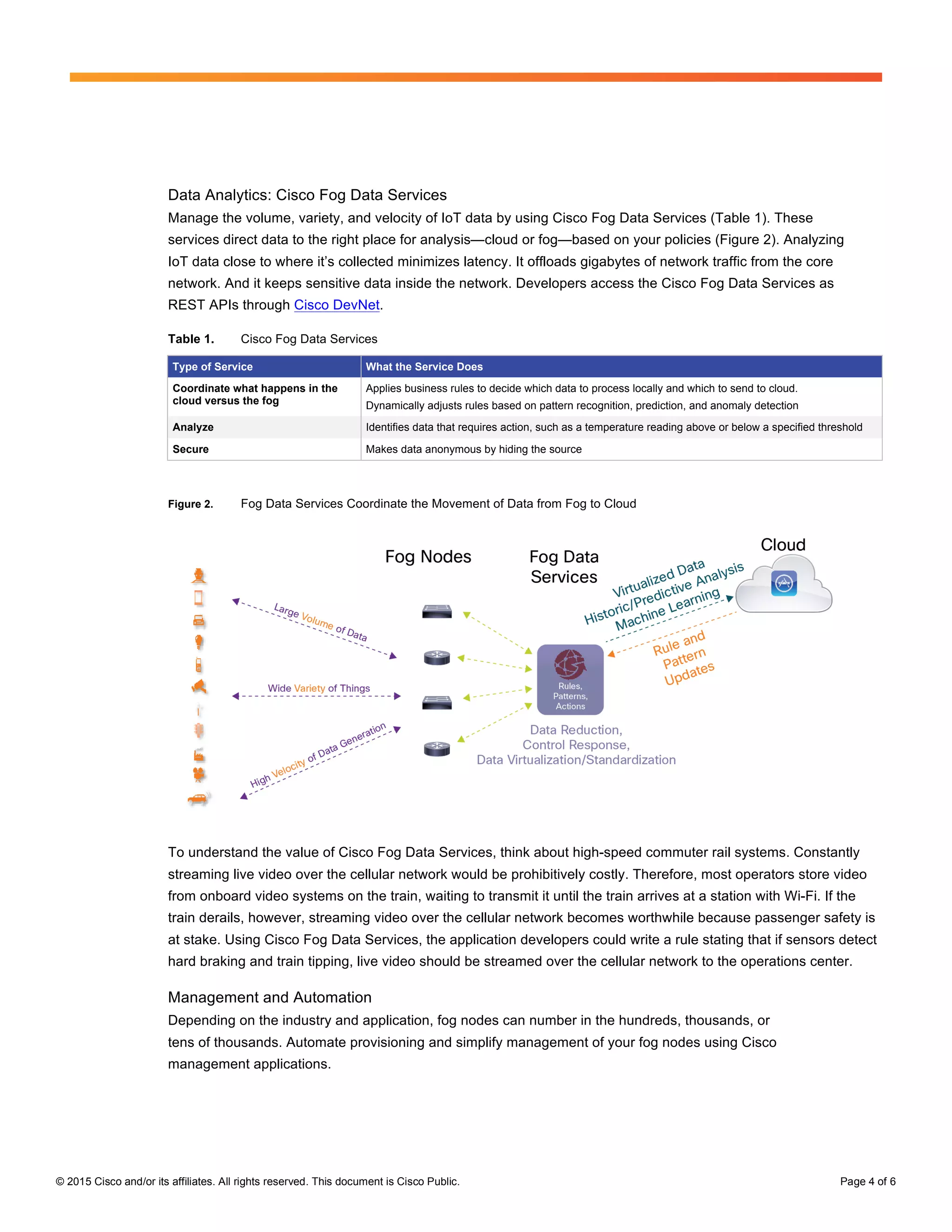
services direct data to the right place for analysis—cloud or fog—based on your policies (Figure 2). Analyzing
IoT data close to where it’s collected minimizes latency. It offloads gigabytes of network traffic from the core
network. And it keeps sensitive data inside the network. Developers access the Cisco Fog Data Services as
REST APIs through Cisco DevNet.
Table 1. Cisco Fog Data Services
Type of Service What the Service Does
Coordinate what happens in the
cloud versus the fog
Applies business rules to decide which data to process locally and which to send to cloud.
Dynamically adjusts rules based on pattern recognition, prediction, and anomaly detection
Analyze Identifies data that requires action, such as a temperature reading above or below a specified threshold
Secure Makes data anonymous by hiding the source
Figure 2. Fog Data Services Coordinate the Movement of Data from Fog to Cloud
To understand the value of Cisco Fog Data Services, think about high-speed commuter rail systems. Constantly
streaming live video over the cellular network would be prohibitively costly. Therefore, most operators store video
from onboard video systems on the train, waiting to transmit it until the train arrives at a station with Wi-Fi. If the
train derails, however, streaming video over the cellular network becomes worthwhile because passenger safety is
at stake. Using Cisco Fog Data Services, the application developers could write a rule stating that if sensors detect
hard braking and train tipping, live video should be streamed over the cellular network to the operations center.
Management and Automation
Depending on the industry and application, fog nodes can number in the hundreds, thousands, or
tens of thousands. Automate provisioning and simplify management of your fog nodes using Cisco
management applications.

Cisco Fog Strategy For Big and Smart Data

  • 1.
    © 2015 Ciscoand/or its affiliates. All rights reserved. This document is Cisco Public. Page 4 of 6 Data Analytics: Cisco Fog Data Services Manage the volume, variety, and velocity of IoT data by using Cisco Fog Data Services (Table 1). These services direct data to the right place for analysis—cloud or fog—based on your policies (Figure 2). Analyzing IoT data close to where it’s collected minimizes latency. It offloads gigabytes of network traffic from the core network. And it keeps sensitive data inside the network. Developers access the Cisco Fog Data Services as REST APIs through Cisco DevNet. Table 1. Cisco Fog Data Services Type of Service What the Service Does Coordinate what happens in the cloud versus the fog Applies business rules to decide which data to process locally and which to send to cloud. Dynamically adjusts rules based on pattern recognition, prediction, and anomaly detection Analyze Identifies data that requires action, such as a temperature reading above or below a specified threshold Secure Makes data anonymous by hiding the source Figure 2. Fog Data Services Coordinate the Movement of Data from Fog to Cloud To understand the value of Cisco Fog Data Services, think about high-speed commuter rail systems. Constantly streaming live video over the cellular network would be prohibitively costly. Therefore, most operators store video from onboard video systems on the train, waiting to transmit it until the train arrives at a station with Wi-Fi. If the train derails, however, streaming video over the cellular network becomes worthwhile because passenger safety is at stake. Using Cisco Fog Data Services, the application developers could write a rule stating that if sensors detect hard braking and train tipping, live video should be streamed over the cellular network to the operations center. Management and Automation Depending on the industry and application, fog nodes can number in the hundreds, thousands, or tens of thousands. Automate provisioning and simplify management of your fog nodes using Cisco management applications.