2016 CISA® Review Course
Hafiz Sheikh Adnan Ahmed – CISA, COBIT 5, ISO 27001 LA
[PECB Certified Trainer]
Quick Reference Review
• Importance of Information Security Management
• Inventory and Classification of Information Assets
• Physical/Environmental Exposures and Controls
• Logical Access
• Auditing Information Security Management Framework
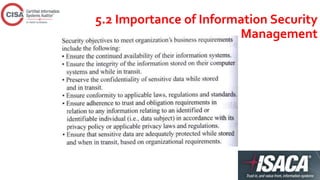
5.2 Importance of Information Security
Management
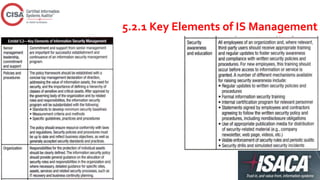
5.2.1 Key Elements of IS Management
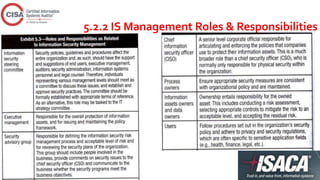
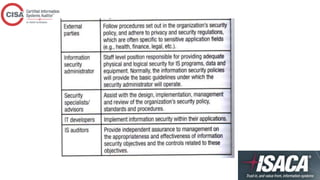
5.2.2 IS Management Roles & Responsibilities
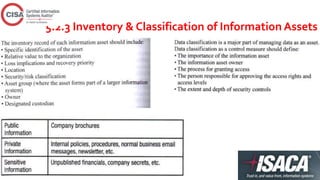
5.2.3 Inventory & Classification of Information Assets
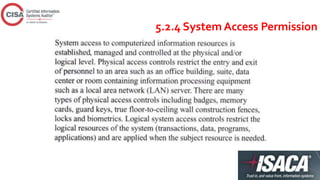
5.2.4 System Access Permission
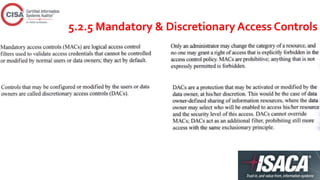
5.2.5 Mandatory & Discretionary Access Controls
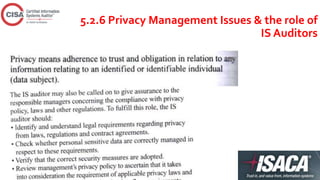
5.2.6 Privacy Management Issues & the role of
IS Auditors
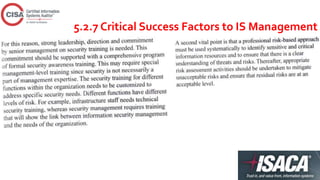
5.2.7 Critical Success Factors to IS Management
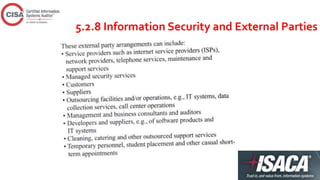
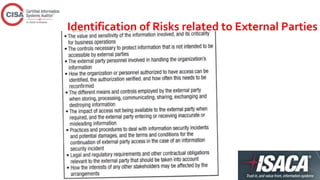
5.2.8 Information Security and External Parties
Identification of Risks related to External Parties
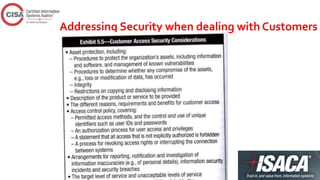
Addressing Security when dealing with Customers
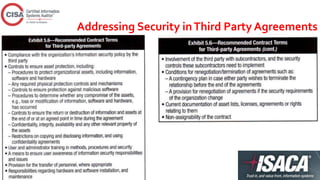
Addressing Security inThird Party Agreements
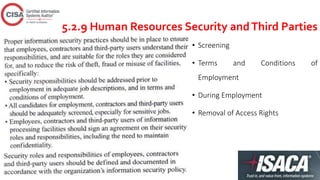
5.2.9 Human Resources Security andThird Parties
• Screening
• Terms and Conditions of
Employment
• During Employment
• Removal of Access Rights
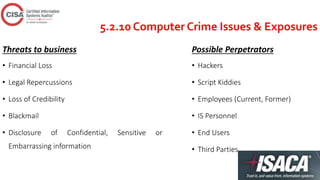
5.2.10 Computer Crime Issues & Exposures
Threats to business
• Financial Loss
• Legal Repercussions
• Loss of Credibility
• Blackmail
• Disclosure of Confidential, Sensitive or
Embarrassing information
Possible Perpetrators
• Hackers
• Script Kiddies
• Employees (Current, Former)
• IS Personnel
• End Users
• Third Parties
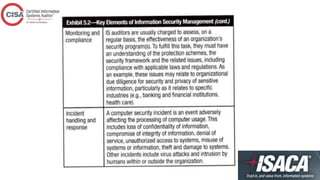
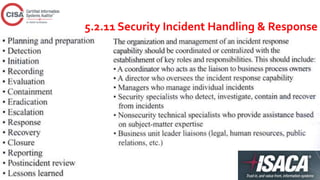
5.2.11 Security Incident Handling & Response
5.3 Logical Access
• Primary means used to manage and protect information assets
• IS auditors to analyze and evaluate the effectiveness of a logical access control in
accomplishing IS objectives and avoiding losses resulting from exposures
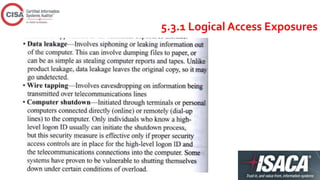
5.3.1 Logical Access Exposures
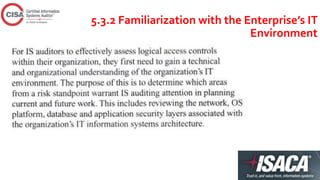
5.3.2 Familiarization with the Enterprise’s IT
Environment
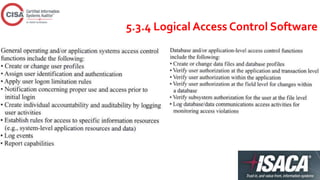
5.3.4 Logical Access Control Software
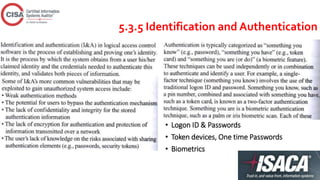
5.3.5 Identification and Authentication
• Logon ID & Passwords
• Token devices, One time Passwords
• Biometrics
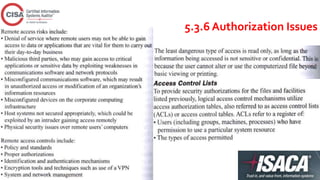
5.3.6 Authorization Issues
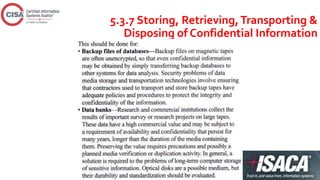
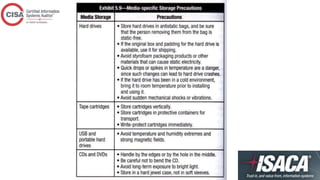
5.3.7 Storing, Retrieving,Transporting &
Disposing of Confidential Information
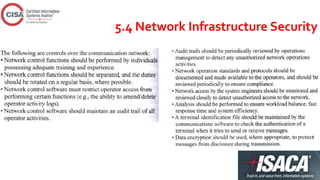
5.4 Network Infrastructure Security
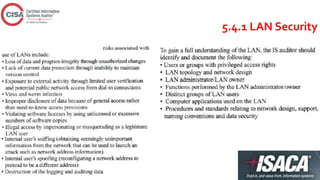
5.4.1 LAN Security
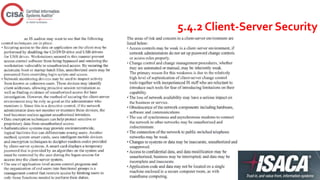
5.4.2 Client-Server Security
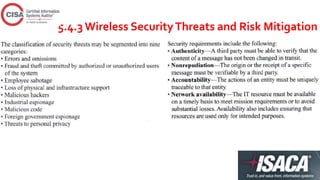
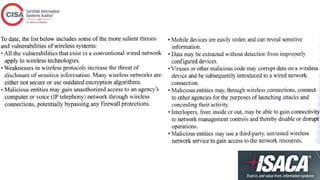
5.4.3Wireless SecurityThreats and Risk Mitigation
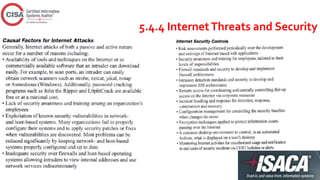
5.4.4 InternetThreats and Security
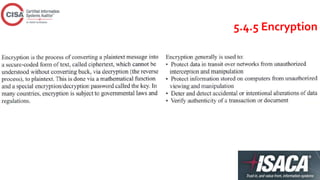
5.4.5 Encryption
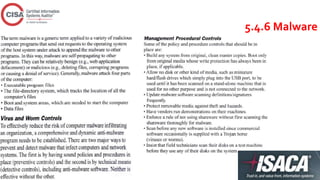
5.4.6 Malware
5.4.7Voice-Over IP (VOIP)
• VOIP Security Issues
• A computer system disruption terminates the telephone
• A backup communication facility should be planned
• IP telephones and their supporting equipment require the care and maintenance
as computer systems do
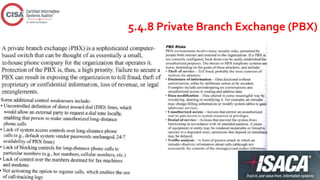
5.4.8 Private Branch Exchange (PBX)
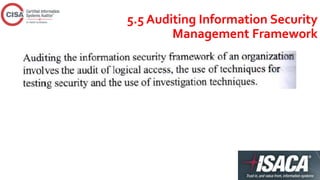
5.5 Auditing Information Security
Management Framework
5.5.1 Auditing Information Security Management
Framework
• Review written Policies, Procedures and Standards
• Logical Access Security Policies
• Formal Security Awareness and Training
• Data Ownership and Custodians
• Data Users and new Users
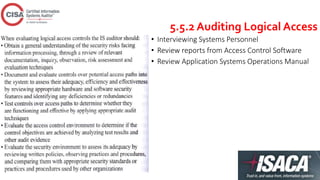
5.5.2 Auditing Logical Access
• Interviewing Systems Personnel
• Review reports from Access Control Software
• Review Application Systems Operations Manual
5.5.3Techniques forTesting Security
• Terminal Cards and Keys
• Logon IDs and Passwords
• Logging and Reporting of Computer Access Violations
• Review Access Controls and Password Administration
5.5.4 InvestigationTechniques
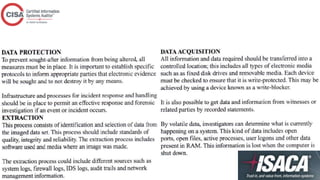
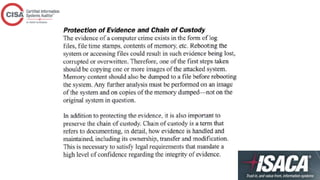
Investigation of Computer Crime
• Laws exist but not reported due to negative publicity
• Proper procedures to be used in case of aftermath
• The environment and evidence must be left unaltered
• Specialist law enforcement and evidence must be left unaltered
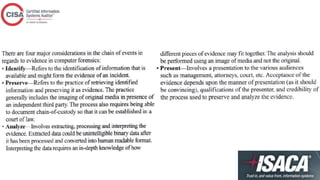
Computer Forensics
• Process of identifying, preserving, analyzing, presenting digital evidence in a
manner that is legally acceptable in any legal proceedings
• Any electronic data or document can be used as digital evidence
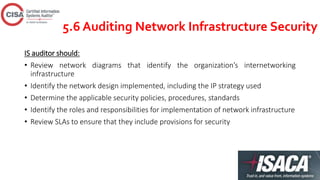
5.6 Auditing Network Infrastructure Security
IS auditor should:
• Review network diagrams that identify the organization’s internetworking
infrastructure
• Identify the network design implemented, including the IP strategy used
• Determine the applicable security policies, procedures, standards
• Identify the roles and responsibilities for implementation of network infrastructure
• Review SLAs to ensure that they include provisions for security
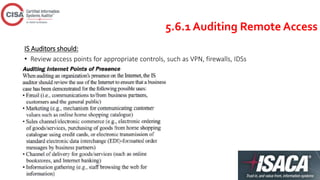
5.6.1 Auditing Remote Access
IS Auditors should:
• Review access points for appropriate controls, such as VPN, firewalls, IDSs
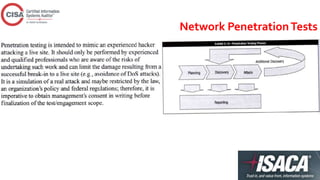
Network PenetrationTests
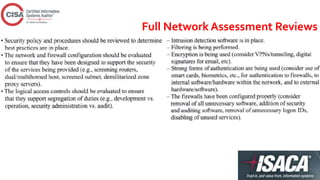
Full Network Assessment Reviews
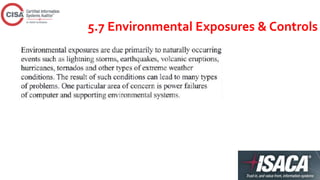
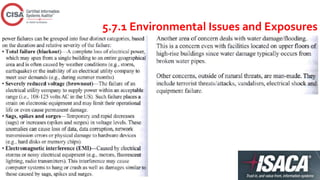
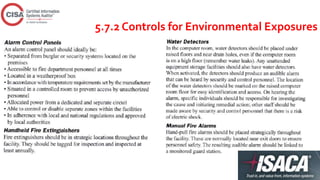
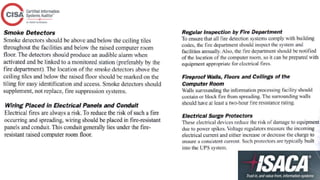
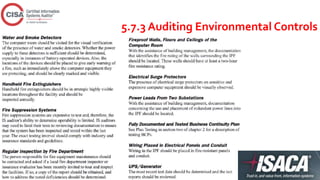
5.7 Environmental Exposures & Controls
5.7.1 Environmental Issues and Exposures
5.7.2 Controls for Environmental Exposures
5.7.3 Auditing Environmental Controls
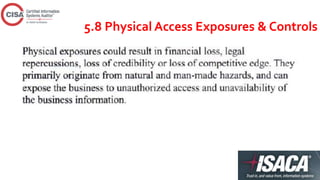
5.8 Physical Access Exposures & Controls
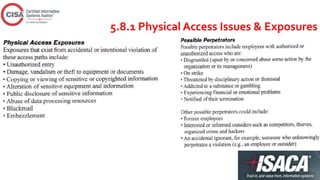
5.8.1 Physical Access Issues & Exposures
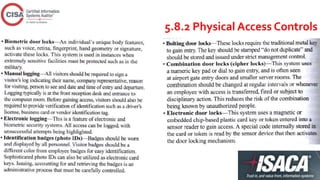
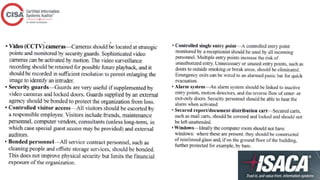
5.8.2 Physical Access Controls
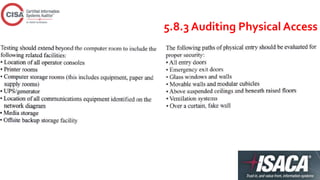
5.8.3 Auditing Physical Access
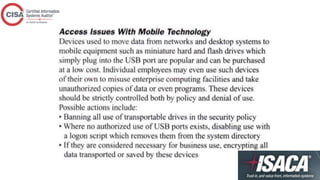
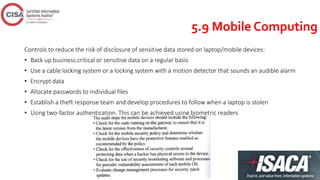
5.9 Mobile Computing
Controls to reduce the risk of disclosure of sensitive data stored on laptop/mobile devices:
• Back up business critical or sensitive data on a regular basis
• Use a cable locking system or a locking system with a motion detector that sounds an audible alarm
• Encrypt data
• Allocate passwords to individual files
• Establish a theft response team and develop procedures to follow when a laptop is stolen
• Using two-factor authentication. This can be achieved using biometric readers
Self-Assessment Questions
1. An IS auditor has just completed a review of an organization that has
mainframe computer and two database servers where all production data
reside. Which of the following weaknesses would be considered MOST
serious?
a) The security officer also serves as the DBA
b) Password controls are not administered over the two database servers
c) There’s no business continuity plan for the mainframe system’s noncritical applications
d) Most LANs do not back up file-server-fixed disks regularly
Self-Assessment Questions
2. An organization is proposing to install a single sign-on facility giving
access to all systems. The organization should be aware that:
a) Maximum unauthorized access would be possible if a password is disclosed
b) User access rights would be restricted by the additional security parameters
c) The security administrator’s workload would increase
d) User access rights would be increased
Self-Assessment Questions
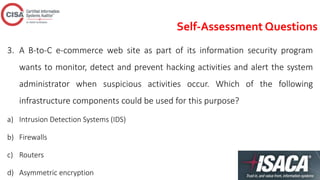
3. A B-to-C e-commerce web site as part of its information security program
wants to monitor, detect and prevent hacking activities and alert the system
administrator when suspicious activities occur. Which of the following
infrastructure components could be used for this purpose?
a) Intrusion Detection Systems (IDS)
b) Firewalls
c) Routers
d) Asymmetric encryption
Self-Assessment Questions
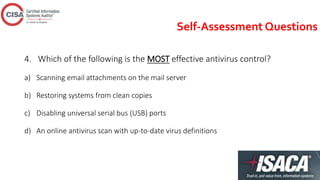
4. Which of the following is the MOST effective antivirus control?
a) Scanning email attachments on the mail server
b) Restoring systems from clean copies
c) Disabling universal serial bus (USB) ports
d) An online antivirus scan with up-to-date virus definitions
Answers
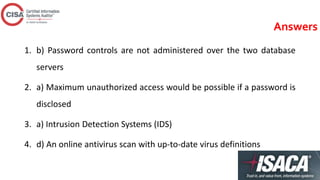
1. b) Password controls are not administered over the two database
servers
2. a) Maximum unauthorized access would be possible if a password is
disclosed
3. a) Intrusion Detection Systems (IDS)
4. d) An online antivirus scan with up-to-date virus definitions
CISA Training - Chapter 5 - 2016

CISA Training - Chapter 5 - 2016

  • 1.
    2016 CISA® ReviewCourse Hafiz Sheikh Adnan Ahmed – CISA, COBIT 5, ISO 27001 LA [PECB Certified Trainer]
  • 2.
    Quick Reference Review •Importance of Information Security Management • Inventory and Classification of Information Assets • Physical/Environmental Exposures and Controls • Logical Access • Auditing Information Security Management Framework
  • 3.
    5.2 Importance ofInformation Security Management
  • 4.
    5.2.1 Key Elementsof IS Management
  • 6.
    5.2.2 IS ManagementRoles & Responsibilities
  • 8.
    5.2.3 Inventory &Classification of Information Assets
  • 9.
  • 10.
    5.2.5 Mandatory &Discretionary Access Controls
  • 11.
    5.2.6 Privacy ManagementIssues & the role of IS Auditors
  • 12.
    5.2.7 Critical SuccessFactors to IS Management
  • 13.
    5.2.8 Information Securityand External Parties
  • 14.
    Identification of Risksrelated to External Parties
  • 15.
    Addressing Security whendealing with Customers
  • 16.
  • 17.
    5.2.9 Human ResourcesSecurity andThird Parties • Screening • Terms and Conditions of Employment • During Employment • Removal of Access Rights
  • 18.
    5.2.10 Computer CrimeIssues & Exposures Threats to business • Financial Loss • Legal Repercussions • Loss of Credibility • Blackmail • Disclosure of Confidential, Sensitive or Embarrassing information Possible Perpetrators • Hackers • Script Kiddies • Employees (Current, Former) • IS Personnel • End Users • Third Parties
  • 22.
    5.2.11 Security IncidentHandling & Response
  • 23.
    5.3 Logical Access •Primary means used to manage and protect information assets • IS auditors to analyze and evaluate the effectiveness of a logical access control in accomplishing IS objectives and avoiding losses resulting from exposures
  • 24.
  • 25.
    5.3.2 Familiarization withthe Enterprise’s IT Environment
  • 26.
    5.3.4 Logical AccessControl Software
  • 27.
    5.3.5 Identification andAuthentication • Logon ID & Passwords • Token devices, One time Passwords • Biometrics
  • 28.
  • 30.
    5.3.7 Storing, Retrieving,Transporting& Disposing of Confidential Information
  • 32.
  • 33.
  • 34.
  • 35.
  • 37.
  • 38.
  • 39.
  • 40.
    5.4.7Voice-Over IP (VOIP) •VOIP Security Issues • A computer system disruption terminates the telephone • A backup communication facility should be planned • IP telephones and their supporting equipment require the care and maintenance as computer systems do
  • 41.
    5.4.8 Private BranchExchange (PBX)
  • 42.
    5.5 Auditing InformationSecurity Management Framework
  • 43.
    5.5.1 Auditing InformationSecurity Management Framework • Review written Policies, Procedures and Standards • Logical Access Security Policies • Formal Security Awareness and Training • Data Ownership and Custodians • Data Users and new Users
  • 44.
    5.5.2 Auditing LogicalAccess • Interviewing Systems Personnel • Review reports from Access Control Software • Review Application Systems Operations Manual
  • 45.
    5.5.3Techniques forTesting Security •Terminal Cards and Keys • Logon IDs and Passwords • Logging and Reporting of Computer Access Violations • Review Access Controls and Password Administration
  • 46.
    5.5.4 InvestigationTechniques Investigation ofComputer Crime • Laws exist but not reported due to negative publicity • Proper procedures to be used in case of aftermath • The environment and evidence must be left unaltered • Specialist law enforcement and evidence must be left unaltered Computer Forensics • Process of identifying, preserving, analyzing, presenting digital evidence in a manner that is legally acceptable in any legal proceedings • Any electronic data or document can be used as digital evidence
  • 50.
    5.6 Auditing NetworkInfrastructure Security IS auditor should: • Review network diagrams that identify the organization’s internetworking infrastructure • Identify the network design implemented, including the IP strategy used • Determine the applicable security policies, procedures, standards • Identify the roles and responsibilities for implementation of network infrastructure • Review SLAs to ensure that they include provisions for security
  • 51.
    5.6.1 Auditing RemoteAccess IS Auditors should: • Review access points for appropriate controls, such as VPN, firewalls, IDSs
  • 52.
  • 53.
  • 54.
  • 55.
  • 56.
    5.7.2 Controls forEnvironmental Exposures
  • 58.
  • 59.
    5.8 Physical AccessExposures & Controls
  • 60.
    5.8.1 Physical AccessIssues & Exposures
  • 61.
  • 63.
  • 64.
    5.9 Mobile Computing Controlsto reduce the risk of disclosure of sensitive data stored on laptop/mobile devices: • Back up business critical or sensitive data on a regular basis • Use a cable locking system or a locking system with a motion detector that sounds an audible alarm • Encrypt data • Allocate passwords to individual files • Establish a theft response team and develop procedures to follow when a laptop is stolen • Using two-factor authentication. This can be achieved using biometric readers
  • 65.
    Self-Assessment Questions 1. AnIS auditor has just completed a review of an organization that has mainframe computer and two database servers where all production data reside. Which of the following weaknesses would be considered MOST serious? a) The security officer also serves as the DBA b) Password controls are not administered over the two database servers c) There’s no business continuity plan for the mainframe system’s noncritical applications d) Most LANs do not back up file-server-fixed disks regularly
  • 66.
    Self-Assessment Questions 2. Anorganization is proposing to install a single sign-on facility giving access to all systems. The organization should be aware that: a) Maximum unauthorized access would be possible if a password is disclosed b) User access rights would be restricted by the additional security parameters c) The security administrator’s workload would increase d) User access rights would be increased
  • 67.
    Self-Assessment Questions 3. AB-to-C e-commerce web site as part of its information security program wants to monitor, detect and prevent hacking activities and alert the system administrator when suspicious activities occur. Which of the following infrastructure components could be used for this purpose? a) Intrusion Detection Systems (IDS) b) Firewalls c) Routers d) Asymmetric encryption
  • 68.
    Self-Assessment Questions 4. Whichof the following is the MOST effective antivirus control? a) Scanning email attachments on the mail server b) Restoring systems from clean copies c) Disabling universal serial bus (USB) ports d) An online antivirus scan with up-to-date virus definitions
  • 69.
    Answers 1. b) Passwordcontrols are not administered over the two database servers 2. a) Maximum unauthorized access would be possible if a password is disclosed 3. a) Intrusion Detection Systems (IDS) 4. d) An online antivirus scan with up-to-date virus definitions