Presented by
Aglaia
MBA IV Tri.
104 Economics for managers
Ambar Agarwal
School of Management
UNIT 4th
Circular Flow of Income
Lecture No. 7
Circular Flow of economic activities
• Economic interdependence of Consumers and Sellers.
• Between Consumers and Sellers the circular Flow of Goods, Services, Income and
Expenditure takes place.
• Other Entities may be Foreign Nations, Government.
Circular Flow of Economic Activities and Income (Two Sector economy)
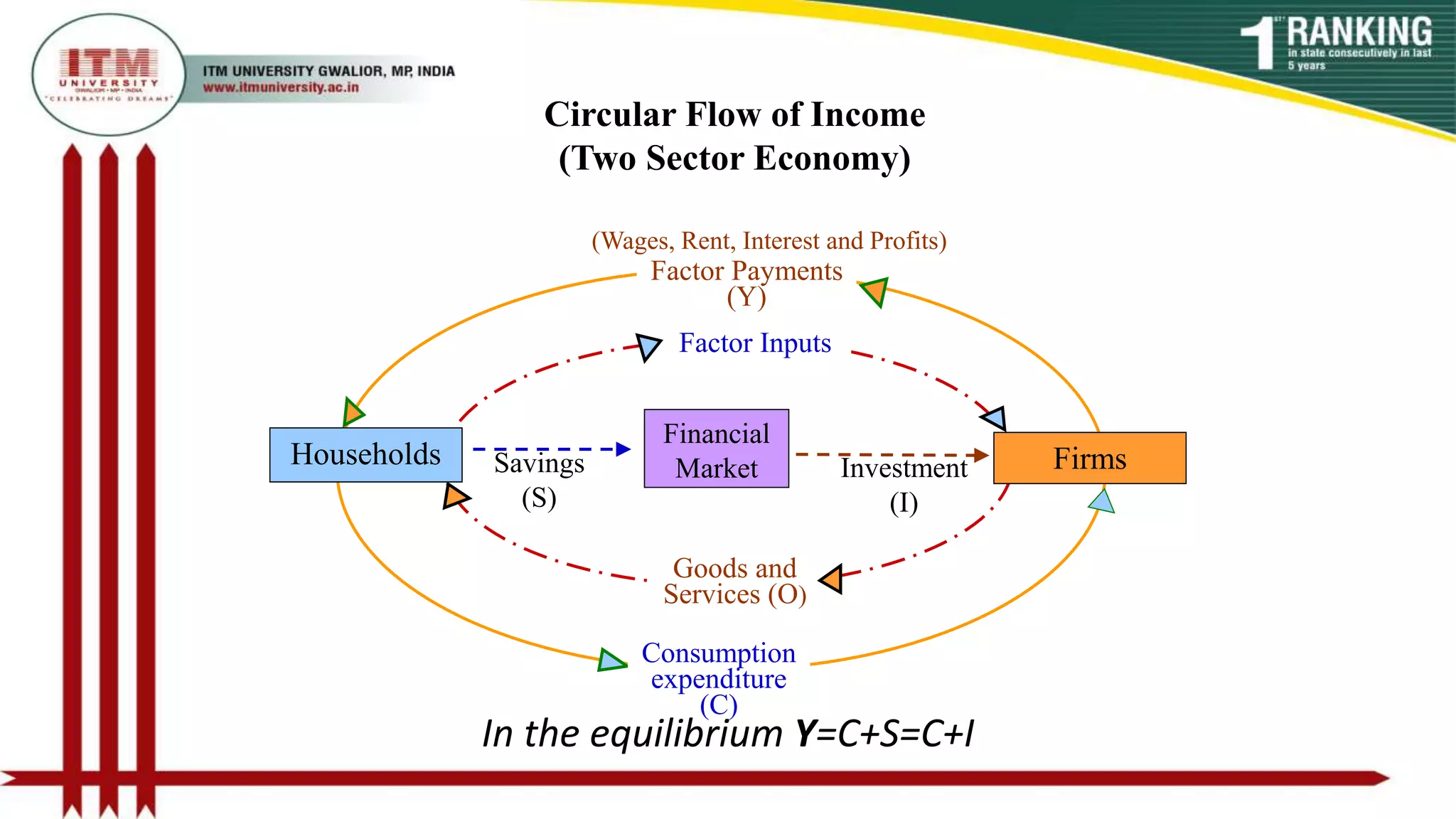
The simple model of the circular flow assumes two players
Firms
• Produce and supply the goods and services.
• Require various factors of production to produce these goods and services.
Households
• Include a set of individuals living in the same house
• Take joint decision about the consumption of goods and services.
• Provide services in terms of factor inputs to the firms
• Get paid for these services by firms which households spend on consumption.
• Money flows from firms to households as factor payments and from households to
firms as expenditure on goods and services.
• It is a circular flow of money or income
Cont’d
• Savings are taken out of Circular flow, so these are called “Withdrawals”
• Savings deposited in Capital Markets goes to the firms as Investment Expenditure, which is
known as known as “Injections”.
• If Savings are kept with households, it is known as “Leakages”.
Circular Flow of Income
(Two Sector Economy)
In the equilibrium Y=C+S=C+I
(Wages, Rent, Interest and Profits)
Factor Payments
(Y)
Consumption
expenditure
(C)
Firms
Households
Goods and
Services (O)
Factor Inputs
Financial
Market Investment
(I)
Savings
(S)
Equilibrium
• Aggregate Income = Aggregate Expenditure
• Y = E
• Aggregate Income = C+S
• Aggregate Expenditure = C+I
• S = I
• Hence Y = E or
• Aggregate Demand = Aggregate Expenditure
Three Sector Model
Equilibrium
• Total Expenditure (E)= C+I+G
• Total Income (Y) = C+S+T
• In Equilibrium E = Y
• So C+I+G = C+S+T
Circular Flow of Income
(Four Sector Economy)
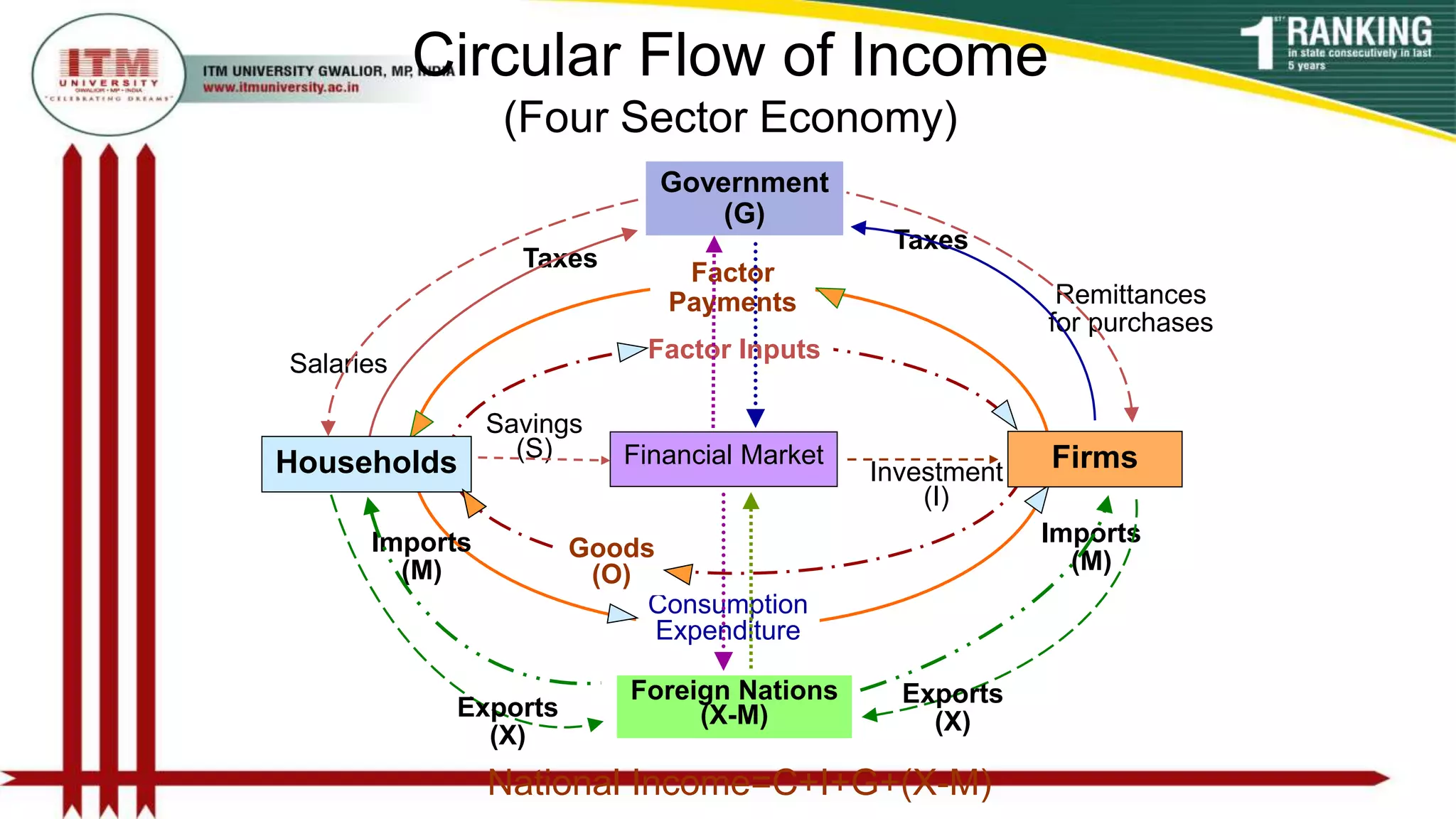
The third sector is Government (G)
• Government Spending
– Subsidies, defence, health care, education, infrastructure
– Provides salaries to the households
– Pays to firms for purchases of goods and services
• Government Revenue
– Households and firms pay various taxes and other payments and provide factor
inputs to the government.
– Government borrows from the financial market to fill revenue gap.
The fourth sector is the external sector
• Imports (M): Outflow of income occurs when the domestic firms buy goods and services
from foreign ones.
• Exports (X): Inflow of income takes place when foreign firms buy goods and services from
domestic ones
Circular Flow of Income
(Four Sector Economy)
Government
(G)
Remittances
for purchases
Foreign Nations
(X-M)
Salaries
Taxes
Taxes
Consumption
Expenditure
Financial Market
Investment
(I)
Savings
(S) Firms
Households
Factor Inputs
Goods
(O)
Factor
Payments
Imports
(M)
Imports
(M)
Exports
(X)
Exports
(X)
National Income=C+I+G+(X-M)
circular flow of income.pdf

circular flow of income.pdf

  • 1.
    Presented by Aglaia MBA IVTri. 104 Economics for managers Ambar Agarwal School of Management UNIT 4th Circular Flow of Income Lecture No. 7
  • 2.
    Circular Flow ofeconomic activities • Economic interdependence of Consumers and Sellers. • Between Consumers and Sellers the circular Flow of Goods, Services, Income and Expenditure takes place. • Other Entities may be Foreign Nations, Government.
  • 3.
    Circular Flow ofEconomic Activities and Income (Two Sector economy) The simple model of the circular flow assumes two players Firms • Produce and supply the goods and services. • Require various factors of production to produce these goods and services. Households • Include a set of individuals living in the same house • Take joint decision about the consumption of goods and services. • Provide services in terms of factor inputs to the firms • Get paid for these services by firms which households spend on consumption. • Money flows from firms to households as factor payments and from households to firms as expenditure on goods and services. • It is a circular flow of money or income
  • 4.
    Cont’d • Savings aretaken out of Circular flow, so these are called “Withdrawals” • Savings deposited in Capital Markets goes to the firms as Investment Expenditure, which is known as known as “Injections”. • If Savings are kept with households, it is known as “Leakages”.
  • 5.
    Circular Flow ofIncome (Two Sector Economy) In the equilibrium Y=C+S=C+I (Wages, Rent, Interest and Profits) Factor Payments (Y) Consumption expenditure (C) Firms Households Goods and Services (O) Factor Inputs Financial Market Investment (I) Savings (S)
  • 6.
    Equilibrium • Aggregate Income= Aggregate Expenditure • Y = E • Aggregate Income = C+S • Aggregate Expenditure = C+I • S = I • Hence Y = E or • Aggregate Demand = Aggregate Expenditure
  • 7.
  • 8.
    Equilibrium • Total Expenditure(E)= C+I+G • Total Income (Y) = C+S+T • In Equilibrium E = Y • So C+I+G = C+S+T
  • 9.
    Circular Flow ofIncome (Four Sector Economy) The third sector is Government (G) • Government Spending – Subsidies, defence, health care, education, infrastructure – Provides salaries to the households – Pays to firms for purchases of goods and services • Government Revenue – Households and firms pay various taxes and other payments and provide factor inputs to the government. – Government borrows from the financial market to fill revenue gap. The fourth sector is the external sector • Imports (M): Outflow of income occurs when the domestic firms buy goods and services from foreign ones. • Exports (X): Inflow of income takes place when foreign firms buy goods and services from domestic ones
  • 10.
    Circular Flow ofIncome (Four Sector Economy) Government (G) Remittances for purchases Foreign Nations (X-M) Salaries Taxes Taxes Consumption Expenditure Financial Market Investment (I) Savings (S) Firms Households Factor Inputs Goods (O) Factor Payments Imports (M) Imports (M) Exports (X) Exports (X) National Income=C+I+G+(X-M)