Students:
Dinu Ada
Mihai Luminita
Mihai Marina
Grupa 8212
Teacher:
Mihai Frumuselu
Location
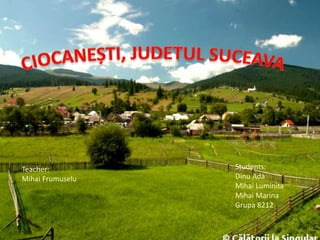
• Ciocănești is a commune located in Suceava
County, Romania. It is composed of two
villages, Botoș and Ciocănești. These were
part of Iacobeni Commune until 2002, when
they were split off.
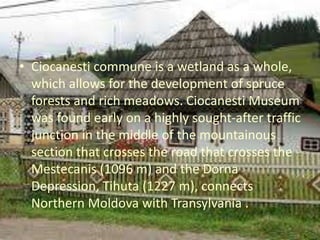
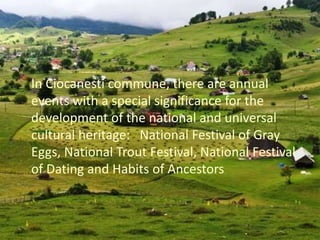
• Ciocanesti commune is a wetland as a whole,
which allows for the development of spruce
forests and rich meadows. Ciocanesti Museum
was found early on a highly sought-after traffic
junction in the middle of the mountainous
section that crosses the road that crosses the
Mestecanis (1096 m) and the Dorna
Depression, Tihuta (1227 m), connects
Northern Moldova with Transylvania .
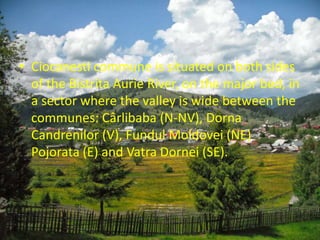
• Ciocanesti commune is situated on both sides
of the Bistrita Aurie River, on the major bed, in
a sector where the valley is wide between the
communes: Cârlibaba (N-NV), Dorna
Candrenilor (V), Fundul Moldovei (NE)
Pojorata (E) and Vatra Dornei (SE).
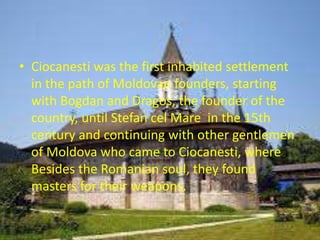
• Ciocanesti was the first inhabited settlement
in the path of Moldovan founders, starting
with Bogdan and Dragos, the founder of the
country, until Stefan cel Mare in the 15th
century and continuing with other gentlemen
of Moldova who came to Ciocanesti, where
Besides the Romanian soul, they found
masters for their weapons.
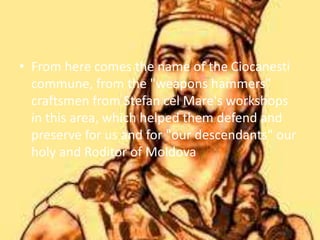
• From here comes the name of the Ciocanesti
commune, from the "weapons hammers"
craftsmen from Stefan cel Mare's workshops
in this area, which helped them defend and
preserve for us and for "our descendants" our
holy and Roditor of Moldova
Gold in Bukovina
•
Gold - the adornment of Bukovina, the Golden
Bistrita - also meant to be one of the traditional
values ​​by resuming the tourist expulsion, as once
the beauties of the sword, the bow, the buzzard,
and the secret ritual of marriage was enshrined in
the wedding ring that celebrates the wedding,
One of the greatest mysteries administered by
our traditional Orthodox faith, defended with the
price of life through the traditions of the oldest
times, represents us.
• The commune, preserves rich and unalterable
ethnographic, folklore and testimonies about
the ancient occupations of the inhabitants of
these lands, about customs and customs,
songs and dances, the art of the popular port,
artisan crafts
•
In Ciocanesti commune, there are annual
events with a special significance for the
development of the national and universal
cultural heritage: National Festival of Gray
Eggs, National Trout Festival, National Festival
of Dating and Habits of Ancestors
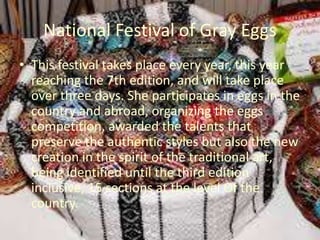
National Festival of Gray Eggs
• This festival takes place every year, this year
reaching the 7th edition, and will take place
over three days. She participates in eggs in the
country and abroad, organizing the eggs
competition, awarded the talents that
preserve the authentic styles but also the new
creation in the spirit of the traditional art,
being identified until the third edition
inclusive, 15 sections at the level Of the
country.
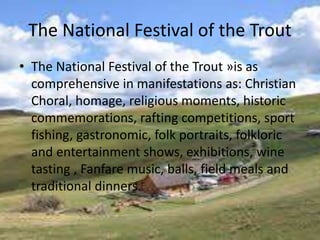
The National Festival of the Trout
• The National Festival of the Trout »is as
comprehensive in manifestations as: Christian
Choral, homage, religious moments, historic
commemorations, rafting competitions, sport
fishing, gastronomic, folk portraits, folkloric
and entertainment shows, exhibitions, wine
tasting , Fanfare music, balls, field meals and
traditional dinners.
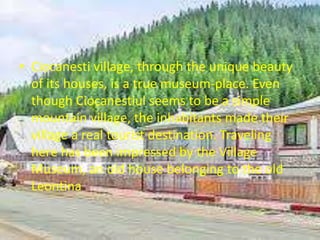
• Ciocanesti village, through the unique beauty
of its houses, is a true museum-place. Even
though Ciocanestiul seems to be a simple
mountain village, the inhabitants made their
village a real tourist destination. Traveling
here has been impressed by the Village
Museum, an old house belonging to the old
Leontina
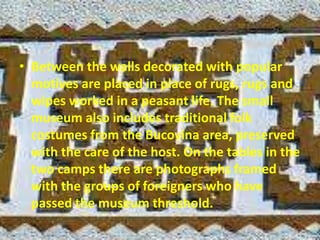
• Between the walls decorated with popular
motives are placed in place of rugs, rugs and
wipes worked in a peasant life. The small
museum also includes traditional folk
costumes from the Bucovina area, preserved
with the care of the host. On the tables in the
two camps there are photographs framed
with the groups of foreigners who have
passed the museum threshold.
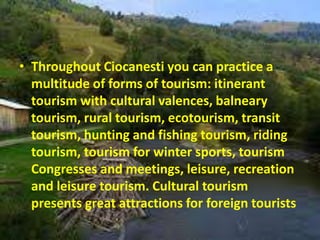
• Throughout Ciocanesti you can practice a
multitude of forms of tourism: itinerant
tourism with cultural valences, balneary
tourism, rural tourism, ecotourism, transit
tourism, hunting and fishing tourism, riding
tourism, tourism for winter sports, tourism
Congresses and meetings, leisure, recreation
and leisure tourism. Cultural tourism
presents great attractions for foreign tourists
In addition, a great attraction of the area is the
numerous artisanal activities that take place
here: painting icons, painting eggs (20
handicrafts workshops), wood crafts, wood
sculptors, leather and leatherwork, hide and
masks.
Bibliography
• http://www.ciocanestibucovina.eu/

Ciocanesti

  • 1.
    Students: Dinu Ada Mihai Luminita MihaiMarina Grupa 8212 Teacher: Mihai Frumuselu
  • 2.
    Location • Ciocănești isa commune located in Suceava County, Romania. It is composed of two villages, Botoș and Ciocănești. These were part of Iacobeni Commune until 2002, when they were split off.
  • 3.
    • Ciocanesti communeis a wetland as a whole, which allows for the development of spruce forests and rich meadows. Ciocanesti Museum was found early on a highly sought-after traffic junction in the middle of the mountainous section that crosses the road that crosses the Mestecanis (1096 m) and the Dorna Depression, Tihuta (1227 m), connects Northern Moldova with Transylvania .
  • 4.
    • Ciocanesti communeis situated on both sides of the Bistrita Aurie River, on the major bed, in a sector where the valley is wide between the communes: Cârlibaba (N-NV), Dorna Candrenilor (V), Fundul Moldovei (NE) Pojorata (E) and Vatra Dornei (SE).
  • 5.
    • Ciocanesti wasthe first inhabited settlement in the path of Moldovan founders, starting with Bogdan and Dragos, the founder of the country, until Stefan cel Mare in the 15th century and continuing with other gentlemen of Moldova who came to Ciocanesti, where Besides the Romanian soul, they found masters for their weapons.
  • 6.
    • From herecomes the name of the Ciocanesti commune, from the "weapons hammers" craftsmen from Stefan cel Mare's workshops in this area, which helped them defend and preserve for us and for "our descendants" our holy and Roditor of Moldova
  • 7.
    Gold in Bukovina • Gold- the adornment of Bukovina, the Golden Bistrita - also meant to be one of the traditional values ​​by resuming the tourist expulsion, as once the beauties of the sword, the bow, the buzzard, and the secret ritual of marriage was enshrined in the wedding ring that celebrates the wedding, One of the greatest mysteries administered by our traditional Orthodox faith, defended with the price of life through the traditions of the oldest times, represents us.
  • 8.
    • The commune,preserves rich and unalterable ethnographic, folklore and testimonies about the ancient occupations of the inhabitants of these lands, about customs and customs, songs and dances, the art of the popular port, artisan crafts
  • 9.
    • In Ciocanesti commune,there are annual events with a special significance for the development of the national and universal cultural heritage: National Festival of Gray Eggs, National Trout Festival, National Festival of Dating and Habits of Ancestors
  • 10.
    National Festival ofGray Eggs • This festival takes place every year, this year reaching the 7th edition, and will take place over three days. She participates in eggs in the country and abroad, organizing the eggs competition, awarded the talents that preserve the authentic styles but also the new creation in the spirit of the traditional art, being identified until the third edition inclusive, 15 sections at the level Of the country.
  • 11.
    The National Festivalof the Trout • The National Festival of the Trout »is as comprehensive in manifestations as: Christian Choral, homage, religious moments, historic commemorations, rafting competitions, sport fishing, gastronomic, folk portraits, folkloric and entertainment shows, exhibitions, wine tasting , Fanfare music, balls, field meals and traditional dinners.
  • 12.
    • Ciocanesti village,through the unique beauty of its houses, is a true museum-place. Even though Ciocanestiul seems to be a simple mountain village, the inhabitants made their village a real tourist destination. Traveling here has been impressed by the Village Museum, an old house belonging to the old Leontina
  • 13.
    • Between thewalls decorated with popular motives are placed in place of rugs, rugs and wipes worked in a peasant life. The small museum also includes traditional folk costumes from the Bucovina area, preserved with the care of the host. On the tables in the two camps there are photographs framed with the groups of foreigners who have passed the museum threshold.
  • 14.
    • Throughout Ciocanestiyou can practice a multitude of forms of tourism: itinerant tourism with cultural valences, balneary tourism, rural tourism, ecotourism, transit tourism, hunting and fishing tourism, riding tourism, tourism for winter sports, tourism Congresses and meetings, leisure, recreation and leisure tourism. Cultural tourism presents great attractions for foreign tourists
  • 15.
    In addition, agreat attraction of the area is the numerous artisanal activities that take place here: painting icons, painting eggs (20 handicrafts workshops), wood crafts, wood sculptors, leather and leatherwork, hide and masks.
  • 16.