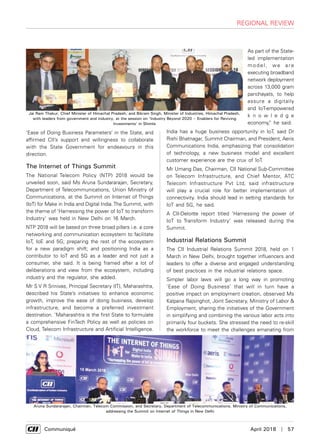
www.bfwindia.com | Toll Free:18004253332
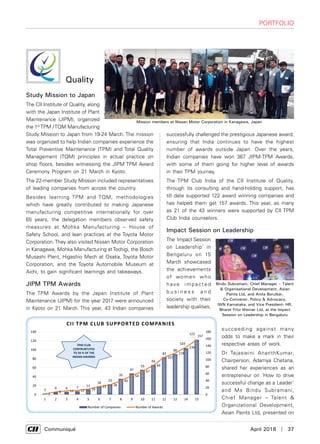
     Communiqué	 April 2018  |  1
Edited, printed and published by Chandrajit Banerjee, Director General, CII, on behalf of Confederation of Indian Industry fromThe Mantosh Sondhi Centre,
23, Institutional Area, Lodi Road, New Delhi-110003, Tel: 91-11-24629994-7, Fax: 91-11-24626149, Email: info@cii.in, Website: www.cii.in
Printed at Lustra Print Process Pvt. Ltd., K No. 51/21, Rohad, Bahadurgarh (Haryana), PIN Code-124507  Registration No. 34541/79
Journal of the Confederation of Indian Industry
We welcome your feedback and suggestions. Do write to us at communique@cii.in
Contents Volume 40  No. 4  April 2018
newsmaker
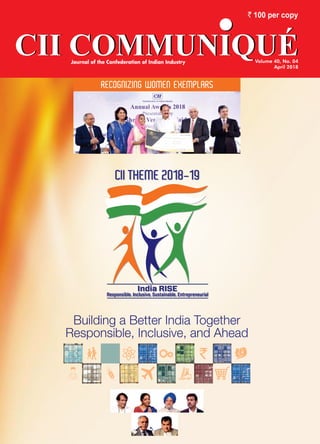
05		 Recognizing Woman Exemplars
spotlight
07		 CII LEADERSHIP 2018-19
08		 CII Theme: India RISE
	 	 • Responsible • Inclusive
	 	 • Sustainable • Entrepreneurial
first person
23		 ‘A fulfilling and productive year’, says
		 Shobana Kamineni
mindspace
25		 Industry Associations: Agents of Change,
		 Partners for Progress
plus...
Portfolio for Excellence
Building Capacity
Engaging with the world
REGIONAL REVIEW
... AND MORE
cover story
10		 Building a Better India Together:
Responsible, Inclusive, and Ahead
CII, in its Annual Session held in New Delhi on
8 and 9 April, brought together thought leaders
from Government, industry, civil society and the
media, to exchange ideas and perspectives on
‘Building a Better India Together.'
     Communiqué	 April 2018  |  3
4  |  April 2018	 Communiqué
     Communiqué	 April 2018  |  5
M
r M Venkaiah Naidu, Vice President
of India, presented three grassroots
women leaders with the CII
Foundation Woman Exemplar Award 2018 for
their extraordinary contribution in transforming
the excluded and disadvantaged communities
in India. Ms Munni Begam, Ms Asha and
MsVechulou Kanuo were conferred the awards in the fields
of education, health, and micro-enterprise, respectively,
at an exclusive Award Ceremony on 8 April in New Delhi.
The CII Foundation Woman Exemplar Program promotes
women empowerment at the community level by
discovering, recognizing and supporting grassroot women
leaders who reach out beyond their limitations and
positively impact their community.The program, since its
inception in 2005, has recognized and further empowered
'Exemplar' women who have battled social injustice,
stigma, poverty, illiteracy and exploitation, to triumph,
and ignite the spirit of empowerment in others.
The Foundation is creating a network of these
outstanding change-makers to spur dynamic learning
and exchange amongst them. The program will also
explore partnerships between CII members and these
women to build a progressive and inclusive India.
The Exemplars 2018
Born into a family of farm laborers and married off when
she was just 12, Munni Begam home-schooled herself
by writing with coal on waste paper, to become an
advocate for women’s functional literacy, a campaigner
for women’s education, and an advisor to the gram
panchayat. This ‘Malala of Eastern UP’ has transformed
the lives of 5,770 illiterate rural women through
functional literacy classes and advocacy for access to
government schemes and entitlements in the Jaunpur
and Pratapgarh districts of Uttar Pradesh.
Married by the age of 9, a daily wage laborer
at 11, losing a newborn child at 16, and
widowed and diagnosed as HIV positive…
Asha is a survivor and campaigner for the
rights of people living with HIV. She founded
Saksham, the Ajmer chapter of the Positive
Women’s Network, to help HIV affected people
with access to government health services and welfare
schemes. She has provided counseling, free treatment
and nutritional supplements to over 6011 HIV patients in
Nasirabad, Rajasthan’s most high-prevalence HIV belt.
Vechulou Kanuo grew up with very limited resources
on a small farm in an isolated Naga village on the
Indo-Burmese border. She has transformed a bankrupt
organization, the Chakhesang Women’s Welfare Society,
into one of the most successful livelihoods ventures
in Nagaland, introducing modern agriculture and animal
husbandry to 10,586 women, farmers and youth, seeding
thousands of small entrepreneurs in the deep rural
interiors of the State.The only woman to be invited to
traditional Naga tribal council meetings, Vechulou has
become the voice of Naga women.
Selected by an eminent panel from industry and the
social sector, the three awardees were shortlisted through
a 4-step rigorous process from over 225 nominations
received from NGOs across the country, and received
a cash reward of `3,00,000 each. The award, now in its
14th
year, was supported by JK Tyres (Health category)
and JCB India (Micro-Enterprise category).The 15 finalists
of this year’s program will be part of the CII Foundation
leadership training and mentoring program.
The CII Foundation organized a capacity-building
workshop for the 15 finalists on 5-6 April in New Delhi,
to understand their future plans, areas of support, draft
a mentoring program, and provide them the opportunity
to interact with industry members.
Recognizing Woman Exemplars
NEWSMAKER
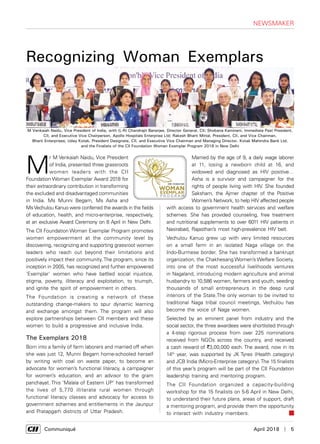
M Venkaiah Naidu, Vice President of India, with (L-R) Chandrajit Banerjee, Director General, CII; Shobana Kamineni, Immediate Past President,
CII, and Executive Vice Chairperson, Apollo Hospitals Enterprise Ltd; Rakesh Bharti Mittal, President, CII, and Vice Chairman,
Bharti Enterprises; Uday Kotak, President Designate, CII, and Executive Vice Chairman and Managing Director, Kotak Mahindra Bank Ltd,
and the Finalists of the CII Foundation Woman Exemplar Program 2018 in New Delhi
6  |  April 2018	 Communiqué
     Communiqué	 April 2018  |  7
CII LEADERSHIP 2018-19
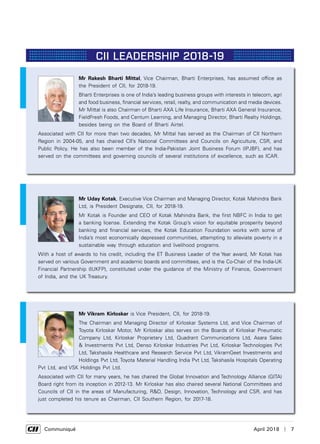
Mr Rakesh Bharti Mittal, Vice Chairman, Bharti Enterprises, has assumed office as
the President of CII, for 2018-19.
Bharti Enterprises is one of India’s leading business groups with interests in telecom, agri
and food business, financial services, retail, realty, and communication and media devices.
Mr Mittal is also Chairman of Bharti AXA Life Insurance, Bharti AXA General Insurance,
FieldFresh Foods, and Centum Learning, and Managing Director, Bharti Realty Holdings,
besides being on the Board of Bharti Airtel.
Associated with CII for more than two decades, Mr Mittal has served as the Chairman of CII Northern
Region in 2004-05, and has chaired CII’s National Committees and Councils on Agriculture, CSR, and
Public Policy. He has also been member of the India-Pakistan Joint Business Forum (IPJBF), and has
served on the committees and governing councils of several institutions of excellence, such as ICAR.
Mr Uday Kotak, Executive Vice Chairman and Managing Director, Kotak Mahindra Bank
Ltd, is President Designate, CII, for 2018-19.
Mr Kotak is Founder and CEO of Kotak Mahindra Bank, the first NBFC in India to get
a banking license. Extending the Kotak Group’s vision for equitable prosperity beyond
banking and financial services, the Kotak Education Foundation works with some of
India’s most economically depressed communities, attempting to alleviate poverty in a
sustainable way through education and livelihood programs.
With a host of awards to his credit, including the ET Business Leader of the Year award, Mr Kotak has
served on various Government and academic boards and committees, and is the Co-Chair of the India-UK
Financial Partnership (IUKFP), constituted under the guidance of the Ministry of Finance, Government
of India, and the UK Treasury.
Mr Vikram Kirloskar is Vice President, CII, for 2018-19.
The Chairman and Managing Director of Kirloskar Systems Ltd, and Vice Chairman of
Toyota Kirloskar Motor, Mr Kirloskar also serves on the Boards of Kirloskar Pneumatic
Company Ltd, Kirloskar Proprietary Ltd, Quadrant Communications Ltd, Asara Sales
& Investments Pvt Ltd, Denso Kirloskar Industries Pvt Ltd, Kirloskar Technologies Pvt
Ltd, Takshasila Healthcare and Research Service Pvt Ltd, VikramGeet Investments and
Holdings Pvt Ltd, Toyota Material Handling India Pvt Ltd, Takshasila Hospitals Operating
Pvt Ltd, and VSK Holdings Pvt Ltd.
Associated with CII for many years, he has chaired the Global Innovation and Technology Alliance (GITA)
Board right from its inception in 2012-13. Mr Kirloskar has also chaired several National Committees and
Councils of CII in the areas of Manufacturing, R&D, Design, Innovation, Technology and CSR, and has
just completed his tenure as Chairman, CII Southern Region, for 2017-18.
8  |  April 2018	 Communiqué
SPOTLIGHT
agenda
R
eclaiming its tag of the fastest-growing large
economy in the world, India has emerged as a
strong global player and is set on a strong and
sustained growth trajectory as it approaches the 75th
year of its Independence. Indian industry is ready to
'rise' to become the foremost catalyst in India’s growth
journey and play a vital role in fostering an environment
conducive for overall national development.
Building on the priorities of its previous themes, CII
would action its agenda for the year ahead under its
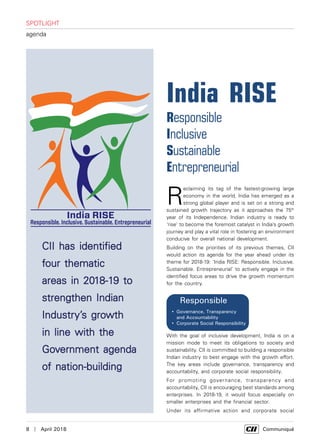
theme for 2018-19: ‘India RISE: Responsible. Inclusive.
Sustainable. Entrepreneurial’ to actively engage in the
identified focus areas to drive the growth momentum
for the country.
 
 
• 
• 
• 
• 
• 
• 
• 
• 

• 
• 
• 
• 

• 

• 

• 

• 
With the goal of inclusive development, India is on a
mission mode to meet its obligations to society and
sustainability. CII is committed to building a responsible
Indian industry to best engage with the growth effort.
The key areas include governance, transparency and
accountability, and corporate social responsibility.
For promoting governance, transparency and
accountability, CII is encouraging best standards among
enterprises. In 2018-19, it would focus especially on
smaller enterprises and the financial sector.
Under its affirmative action and corporate social
India RISE
Responsible
Inclusive
Sustainable
Entrepreneurial
CII has identified
four thematic
areas in 2018-19 to
strengthen Indian
Industry’s growth
in line with the
Government agenda
of nation-building
     Communiqué	 April 2018  |  9
SPOTLIGHT
responsibility agenda, converging industry’s human
development activities with targeted measures for the
weaker sections of society – women, children and the
underprivileged, would be the primary focus for CII.


• 
• 
• 
• 
• 
 • 
• 

• 

• 


For ensuring that all citizens have equal access to the
right opportunities, CII is strongly engaged in education,
skill development, on-the-job training, and career
development, and reaches out to about one million
youth every year through its various programs.
During 2018-19, in the area of agriculture, CII’s focus
would be on doubling farmers’ incomes, promoting
Farmer Producer Organizations (FPOs), and creating
and nurturing agri start-ups.
With rapid advancements in technology there is an
urgent need to step up technology in the classroom and
adequately train teachers with the necessary equipment
for this purpose. Therefore, special emphasis would
be placed on upgrading technology in education, and
teacher training.
Technological advancements have already impacted
employment and are rapidly changing the demand for
skills. CII would work towards creating an environment
that would facilitate upskilling and re-skilling for aligning
with emerging technologies.
In healthcare, the focus would be on model healthcare
with quality and affordable costs of access to medical
facilities and global care.
To boost employment, CII would engage in creating more
jobs through job fairs, and enhance
employability through its model career
centers, apprenticeship programs, and
public private partnerships.
 
 
• 
• 
• 
• 
• 
• 
• 
• 

• 
• 
• 
• 

• 

• 

• 

• 
For meeting its sustainability goals,
the areas of focus for CII during 2018-19 would be
on renewable energy, energy efficiency and waste
management, water management, climate change
and green business. CII is already a pioneer in
these thematic areas and plans to further expand its
operations in the coming years.
 
 
• 
• 
• 
• 
• 
• 
• 
• 

• 
• 
• 
• 

• 

• 

• 

• 
Developing and fostering an entrepreneurial ecosystem
with capable, competitive and advanced enterprises is
crucial for India’s growth. CII works across different
sectors and regions, both domestically and globally, to
facilitate entrepreneurship and open new avenues for
Indian enterprises.
This year’s agenda features diverse themes including
financing growth and technology with a focus on
the financial sector; business development and
connectivity platforms to facilitate infrastructure
along with promoting technology and innovation
through R&D, and new emerging technologies such
as blockchain; and promoting next gen-manufacturing
and industry 4.0 by fostering digital transformation
and stimulating sectors with a focus on artificial
intelligence.
In the area of international business development, the
focus areas for 2018-19 would be on promoting service
enhancing market access, facilitating international trade
policy and trade facilitation. Increasing productivity and
building MSME competitiveness would be the key areas
of focus in ease of doing business.
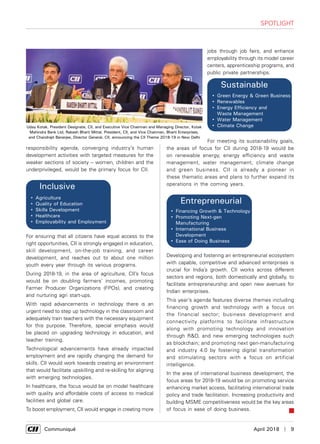
Uday Kotak, President Designate, CII, and Executive Vice Chairman and Managing Director, Kotak
Mahindra Bank Ltd; Rakesh Bharti Mittal, President, CII, and Vice Chairman, Bharti Enterprises,
and Chandrajit Banerjee, Director General, CII, announcing the CII Theme 2018-19 in New Delhi
10  |  April 2018	 Communiqué
The past year was a momentous one for the
Indian economy and industry. Amidst a slew of
reforms and changes in domestic policies with
far-reaching impact, the global environment
saw the emergence of varying degrees of
protectionism in various forms. Alongside, the
imperative of inclusive development called for
innovative solutions in employment, education,
social equity and healthcare, as well as better
governance at all levels and in all spheres.
Against this backdrop, CII, in its Annual Session
held in New Delhi on 8 and 9 April, brought
together thought leaders from Government,
industry, civil society and the media, to exchange
ideas and perspectives on 'Building a Better India
Together: Responsible, Inclusive, and Ahead.'
Our cover story brings you the highlights of
these discussions.
A
s India integrates deeper into the global economy,
it is becoming increasingly clear that the country
needs to focus both on meeting international
competition and its own developmental challenges.
The Government launched several initiatives last year,
such as Make in India, Skill India, and Digital India,
among others, towards make the vision of integrated
inclusive development a reality.
For industry, grappling with the challenges of disruptive
technologies, restrictive trade laws, environmental
responsibilities and more demanding and discerning
customers, the imperative is for sharper focus on
producing excellent goods and services, along with
building skills, generating jobs, and mainstreaming the
marginalized.
India has several plus factors for sustainable development.
The country’s demographic dividend can be leveraged
to give growth a huge boost, provided its young,
enterprising and enthusiastic workforce can be trained
cover story
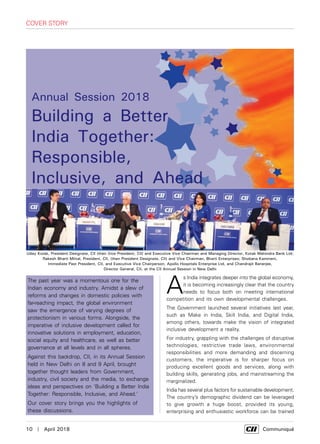
Uday Kotak, President Designate, CII (then Vice President, CII) and Executive Vice Chairman and Managing Director, Kotak Mahindra Bank Ltd;
Rakesh Bharti Mittal, President, CII, (then President Designate, CII) and Vice Chairman, Bharti Enterprises; Shobana Kamineni,
Immediate Past President, CII, and Executive Vice Chairperson, Apollo Hospitals Enterprise Ltd, and Chandrajit Banerjee,
Director General, CII, at the CII Annual Session in New Delhi
Annual Session 2018
Building a Better
India Together:
Responsible,
Inclusive, and Ahead
     Communiqué	 April 2018  |  11
cover story
and skilled to contribute productively to the national
economy. Rapid urbanization is changing the country’s
landscape, and technology has made inroads into its
remotest corners.
While the advantages are many, so are the constraints.
Pockets of acute poverty still exist, lack of infrastructure
impedes growth, there is a resource crunch, manpower
is not adequately or appropriately skilled…
The discussions at the CII Annual Session 2018
encompassed a range of issues ranging from the
fiscal conundrum and building the financial sector
to transforming the backward districts of India, the
business of sports, and concerns of climate change.
Various sessions brought to the fore the critical need
for industry to work in close partnership and alignment
with Government towards the common goal of inclusive
and widespread economic growth.
India is aspirational, and is impatient for development,
said Mr Arun Jaitley, Minister of Finance and Corporate
Affairs, in a video-recorded address at the inaugural
session. "I see 2018 as a year of consolidation," he
said, noting that India has accepted the idea of reforms,
Co n f i d e n t o f
India’s economic
resilience, Mr Suresh
Prabhu, Minister of
Commerce and Industry,
and Civil Aviation, averred
that India would be a $5
trillion economy. "It is
only a matter of time,"
he said, addressing
a special plenary on
'Priority of India's Trade
Policy in the midst of
Rising Protectionism' at
the CII Annual Session, on 9 April.
Commenting on the present global economic scenario,
Mr Prabhu observed that with the recent measures taken
by countries affecting global trade, we might be living
in 'a new normal.' Trade, he said, can only happen once
products are manufactured. “India must produce, and
increase the scale of production to increase its share in
the global economy,” he stressed, adding that, as different
definitions of globalization are emerging, India must face
the challenge and convert it to an opportunity.
Recognizing that services from India would lead exports,
‘India will be a $5 trillion economy‘
and also generate more jobs,
he said the Government
has allocated `5,000 crores
for 12 champion service
sectors. However, for India
to become a $5 trillion dollar
economy, manufacturing
too has to grow strongly,
he said, asking industry to
share its regulatory concerns
with his Ministry towards
their resolution. Inputs are
being sought from start-ups
as the existing laws were
not made with such enterprises in mind, he said. The
Government, he said, is also working on improving the
Ease of Doing Business at the district level.
Turning to Aviation, the Minister said there are good
opportunities for growth for different aspects of aviation,
including air cargo, and aerospace manufacturing.
Ms Shobana Kamineni stressed that India needs to
integrate into Global Value Chains (GVCs) and the
global world to become a $5 trillion economy. We must
strive to see small industry grow to medium scale,
and medium industry to large, she said.
and the positive fallout of path-breaking initiatives like
the Goods and Services Tax (GST) and the Insolvency
and Bankruptcy Code is gradually strengthening.
Appreciating CII's nation-building efforts, Mr Jaitley said
it is important for Government and industry to work
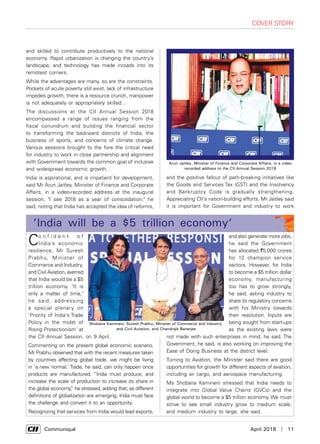
Shobana Kamineni; Suresh Prabhu, Minister of Commerce and Industry,
and Civil Aviation, and Chandrajit Banerjee
Arun Jaitley, Minister of Finance and Corporate Affairs, in a video
recorded address to the CII Annual Session 2018
12  |  April 2018	 Communiqué
     Communiqué	 April 2018  |  13
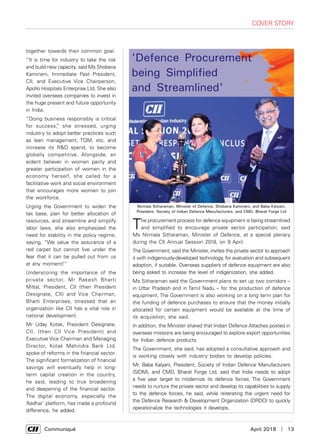
The procurement process for defence equipment is being streamlined
and simplified to encourage private sector participation, said
Ms Nirmala Sitharaman, Minister of Defence, at a special plenary
during the CII Annual Session 2018, on 9 April.
The Government, said the Minister, invites the private sector to approach
it with indigenously-developed technology, for evaluation and subsequent
adoption, if suitable. Overseas suppliers of defence equipment are also
being asked to increase the level of indigenization, she added.
Ms Sitharaman said the Government plans to set up two corridors –
in Uttar Pradesh and in Tamil Nadu – for the production of defence
equipment. The Government is also working on a long term plan for
the funding of defence purchases to ensure that the money initially
allocated for certain equipment would be available at the time of
its acquisition, she said.
In addition, the Minister shared that Indian Defence Attaches posted in
overseas missions are being encouraged to explore export opportunities
for Indian defence products.
The Government, she said, has adopted a consultative approach and
is working closely with industry bodies to develop policies.
Mr. Baba Kalyani, President, Society of Indian Defence Manufacturers
(SIDM), and CMD, Bharat Forge Ltd, said that India needs to adopt
a five year target to modernize its defence forces. The Government
needs to nurture the private sector and develop its capabilities to supply
to the defence forces, he said, while reiterating the urgent need for
the Defence Research & Development Organization (DRDO) to quickly
operationalize the technologies it develops.
'Defence Procurement
being Simplified
and Streamlined'
together towards their common goal.
“It is time for industry to take the risk
and build new capacity, said Ms Shobana
Kamineni, Immediate Past President,
CII, and Executive Vice Chairperson,
Apollo Hospitals Enterprise Ltd. She also
invited overseas companies to invest in
the huge present and future opportunity
in India.
“Doing business responsibly is critical
for success,” she stressed, urging
industry to adopt better practices such
as lean management, TQM, etc, and
increase its R&D spend, to become
globally competitive. Alongside, an
ardent believer in women parity and
greater participation of women in the
economy herself, she called for a
facilitative work and social environment
that encourages more women to join
the workforce.
Urging the Government to widen the
tax base, plan for better allocation of
resources, and streamline and simplify
labor laws, she also emphasized the
need for stability in the policy regime,
saying, “We value the assurance of a
red carpet but cannot live under the
fear that it can be pulled out from us
at any moment!”
Underscoring the importance of the
private sector, Mr Rakesh Bharti
Mittal, President, CII (then President
Designate, CII) and Vice Chairman,
Bharti Enterprises, stressed that an
organization like CII has a vital role in
national development.
Mr Uday Kotak, President Designate,
CII, (then CII Vice President) and
Executive Vice Chairman and Managing
Director, Kotak Mahindra Bank Ltd,
spoke of reforms in the financial sector.
The significant formalization of financial
savings will eventually help in long-
term capital creation in the country,
he said, leading to true broadening
and deepening of the financial sector.
The digital economy, especially the
‘Aadhar’ platform, has made a profound
difference, he added.
Nirmala Sitharaman, Minister of Defence, Shobana Kamineni, and Baba Kalyani,
President, Society of Indian Defence Manufacturers, and CMD, Bharat Forge Ltd
cover story
14  |  April 2018	 Communiqué
is the only way for the sector to flourish.
“Government will extend all support and
ensure we work as partners in an impactful
outcome-driven manner,” he said.
Emphasizing the need for concerted
efforts of Government and industry for
the development of sports, he explained
that in the ‘matching grant scheme,’ any
amount donated by any organization to
support any sport or sport-related event,
person or program, would be matched by
an equal contribution by the Government
in the same kitty. We have to ensure
that India's path to sporting prominence
is paved with an inclusive effort from all
stakeholders, he said.
cover story
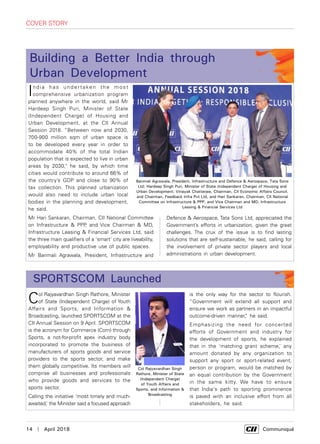
India has undert aken the most
comprehensive urbanization program
planned anywhere in the world, said Mr
Hardeep Singh Puri, Minister of State
(Independent Charge) of Housing and
Urban Development, at the CII Annual
Session 2018. “Between now and 2030,
700-900 million sqm of urban space is
to be developed every year in order to
accommodate 40% of the total Indian
population that is expected to live in urban
areas by 2030," he said, by which time
cities would contribute to around 66% of
the country’s GDP and close to 90% of
tax collection. This planned urbanization
would also need to include urban local
bodies in the planning and development,
he said.
Mr Hari Sankaran, Chairman, CII National Committee
on Infrastructure & PPP, and Vice Chairman & MD,
Infrastructure Leasing & Financial Services Ltd, said
the three main qualifiers of a 'smart' city are liveability,
employability and productive use of public spaces.
Mr Banmali Agrawala, President, Infrastructure and
Building a Better India through
Urban Development
Col Rajyavardhan Singh Rathore, Minister
of State (Independent Charge) of Youth
Affairs and Sports, and Information &
Broadcasting, launched SportsCom at the
CII Annual Session on 9 April. SportsCom
is the acronym for Commerce (Com) through
Sports, a not-for-profit apex industry body
incorporated to promote the business of
manufacturers of sports goods and service
providers to the sports sector, and make
them globally competitive. Its members will
comprise all businesses and professionals
who provide goods and services to the
sports sector.
Calling the initiative ‘most timely and much-
awaited,’ the Minister said a focused approach
SportsCom Launched
Banmali Agrawala, President, Infrastructure and Defence & Aerospace, Tata Sons
Ltd; Hardeep Singh Puri, Minister of State (Independent Charge) of Housing and
Urban Development; Vinayak Chatterjee, Chairman, CII Economic Affairs Council,
and Chairman, Feedback Infra Pvt Ltd, and Hari Sankaran, Chairman, CII National
Committee on Infrastructure & PPP, and Vice Chairman and MD, Infrastructure
Leasing & Financial Services Ltd
Col Rajyavardhan Singh
Rathore, Minister of State
(Independent Charge)
of Youth Affairs and
Sports, and Information &
Broadcasting
Defence & Aerospace, Tata Sons Ltd, appreciated the
Government’s efforts in urbanization, given the great
challenges. The crux of the issue is to find lasting
solutions that are self-sustainable, he said, calling for
the involvement of private sector players and local
administrations in urban development.
     Communiqué	 April 2018  |  15
cover story
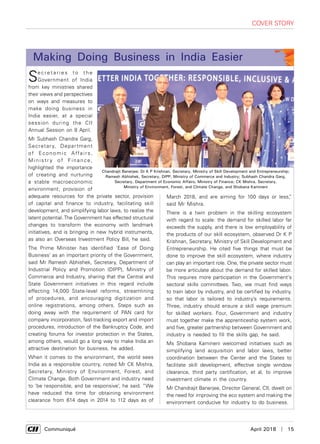
Se c r e t a r i e s t o t h e
Government of India
from key ministries shared
their views and perspectives
on ways and measures to
make doing business in
India easier, at a special
session during the CII
Annual Session on 8 April.
Mr Subhash Chandra Garg,
Secretary, Department
of Economic Affairs,
Ministr y of Finance,
highlighted the importance
of creating and nurturing
a stable macroeconomic
environment; provision of
adequate resources for the private sector, provision
of capital and finance to industry, facilitating skill
development, and simplifying labor laws, to realize the
latent potential.The Government has effected structural
changes to transform the economy with landmark
initiatives, and is bringing in new hybrid instruments,
as also an Overseas Investment Policy Bill, he said.
The Prime Minister has identified ‘Ease of Doing
Business’ as an important priority of the Government,
said Mr Ramesh Abhishek, Secretary, Department of
Industrial Policy and Promotion (DIPP), Ministry of
Commerce and Industry, sharing that the Central and
State Government initiatives in this regard include
effecting 14,000 State-level reforms, streamlining
of procedures, and encouraging digitization and
online registrations, among others. Steps such as
doing away with the requirement of PAN card for
company incorporation, fast-tracking export and import
procedures, introduction of the Bankruptcy Code, and
creating forums for investor protection in the States,
among others, would go a long way to make India an
attractive destination for business, he added.
When it comes to the environment, the world sees
India as a responsible country, noted Mr CK Mishra,
Secretary, Ministry of Environment, Forest, and
Climate Change. Both Government and industry need
to ‘be responsible, and be responsive’, he said. “We
have reduced the time for obtaining environment
clearance from 614 days in 2014 to 112 days as of
Making Doing Business in India Easier
Chandrajit Banerjee; Dr K P Krishnan, Secretary, Ministry of Skill Development and Entrepreneurship;
Ramesh Abhishek, Secretary, DIPP, Ministry of Commerce and Industry; Subhash Chandra Garg,
Secretary, Department of Economic Affairs, Ministry of Finance; CK Mishra, Secretary,
Ministry of Environment, Forest, and Climate Change, and Shobana Kamineni
March 2018, and are aiming for 100 days or less,”
said Mr Mishra.
There is a twin problem in the skilling ecosystem
with regard to scale: the demand for skilled labor far
exceeds the supply, and there is low employability of
the products of our skill ecosystem, observed Dr K P
Krishnan, Secretary, Ministry of Skill Development and
Entrepreneurship. He cited five things that must be
done to improve the skill ecosystem, where industry
can play an important role. One, the private sector must
be more articulate about the demand for skilled labor.
This requires more participation in the Government's
sectoral skills committees. Two, we must find ways
to train labor by industry, and be certified by industry,
so that labor is tailored to industry’s requirements.
Three, industry should ensure a skill wage premium
for skilled workers. Four, Government and industry
must together make the apprenticeship system work,
and five, greater partnership between Government and
industry is needed to fill the skills gap, he said.
Ms Shobana Kamineni welcomed initiatives such as
simplifying land acquisition and labor laws, better
coordination between the Center and the States to
facilitate skill development, effective single window
clearance, third party certification, et al, to improve
investment climate in the country.
Mr Chandrajit Banerjee, Director General, CII, dwelt on
the need for improving the eco system and making the
environment conducive for industry to do business.
16  |  April 2018	 Communiqué
cover story
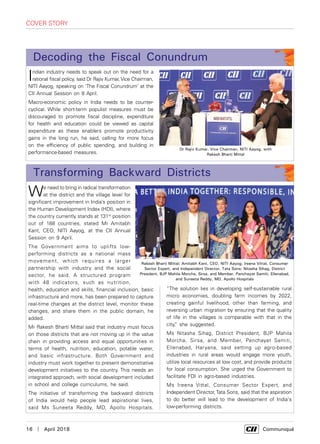
Indian industry needs to speak out on the need for a
rational fiscal policy, said Dr Rajiv Kumar, Vice Chairman,
NITI Aayog, speaking on ‘The Fiscal Conundrum’ at the
CII Annual Session on 8 April.
Macro-economic policy in India needs to be counter-
cyclical. While short-term populist measures must be
discouraged to promote fiscal discipline, expenditure
for health and education could be viewed as capital
expenditure as these enablers promote productivity
gains in the long run, he said, calling for more focus
on the efficiency of public spending, and building in
performance-based measures.
We need to bring in radical transformation
at the district and the village level for
significant improvement in India’s position in
the Human Development Index (HDI), where
the country currently stands at 131st
position
out of 188 countries, stated Mr Amitabh
Kant, CEO, NITI Aayog, at the CII Annual
Session on 9 April.
The Government aims to uplifts low-
performing districts as a national mass
movement, which requires a larger
partnership with industry and the social
sector, he said. A structured program
with 48 indicators, such as nutrition,
health, education and skills, financial inclusion, basic
infrastructure and more, has been prepared to capture
real-time changes at the district level, monitor these
changes, and share them in the public domain, he
added.
Mr Rakesh Bharti Mittal said that industry must focus
on those districts that are not moving up in the value
chain in providing access and equal opportunities in
terms of health, nutrition, education, potable water,
and basic infrastructure. Both Government and
industry must work together to present demonstrative
development initiatives to the country. This needs an
integrated approach, with social development included
in school and college curriculums, he said.
The initiative of transforming the backward districts
of India would help people lead aspirational lives,
said Ms Suneeta Reddy, MD, Apollo Hospitals.
Transforming Backward Districts
Decoding the Fiscal Conundrum
Dr Rajiv Kumar, Vice Chairman, NITI Aayog, with
Rakesh Bharti Mittal
Rakesh Bharti Mittal; Amitabh Kant, CEO, NITI Aayog; Ireena Vittal, Consumer
Sector Expert, and Independent Director, Tata Sons; Nitasha Sihag, District
President, BJP Mahila Morcha, Sirsa, and Member, Panchayat Samiti, Ellenabad,
and Suneeta Reddy, MD, Apollo Hospitals
“The solution lies in developing self-sustainable rural
micro economies, doubling farm incomes by 2022,
creating gainful livelihood, other than farming, and
reversing urban migration by ensuring that the quality
of life in the villages is comparable with that in the
city,” she suggested.
Ms Nitasha Sihag, District President, BJP Mahila
Morcha, Sirsa, and Member, Panchayat Samiti,
Ellenabad, Haryana, said setting up agro-based
industries in rural areas would engage more youth,
utilize local resources at low cost, and provide products
for local consumption. She urged the Government to
facilitate FDI in agro-based industries.
Ms Ireena Vittal, Consumer Sector Expert, and
Independent Director,Tata Sons, said that the aspiration
to do better will lead to the development of India's
low-performing districts.
     Communiqué	 April 2018  |  17
Debate on Staggered vs Simultaneous Elections
effect, which is critical for India,” said
Mr Kris Gopalakrishnan, Past President,
CII, and Chairman, Axilor Ventures,
elaborating on the vision behind the
initiative. Importantly, these companies
would be guided to become well-
governed sustainable enterprises with
long-term value creation and success, he
added. Urging people to invest in young
companies and participate in wealth
creation and the creation of opportunities,
Mr Gopalakrishnan pointed out that with
90% of the funding for new start-ups
coming from overseas, many successful
Indian companies at present are creating
wealth outside the country.
CII launched the ‘Future Business
Group’ to build and develop home-
grown aspirational companies, at the
Annual Session, on 9 April. The Group
would identify and nurture promising
companies with the potential to grow
into billion dollar companies over the
next 5 years through mentoring, hand-
holding and funding support, explained
Mr Rajan Navani, Chairman, CII Council
on Future Businesses, and MD, Jetline
Group of Companies.
“The aim is to groom and develop
companies that not only create wealth
for the nation but also generate jobs
and opportunities with a multiplier
Launch of CII Future Business Group
cover story
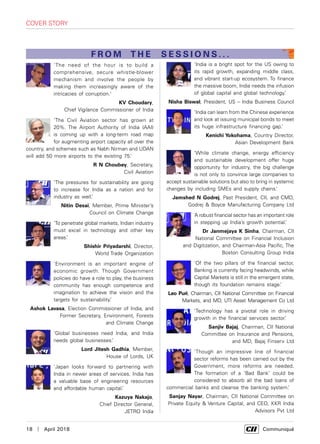
Staggered or Simultaneous Elections: The Way
Forward for India? was the topic of a lively debate
amongst political leaders at the CII Annual Session on
8 April. Their views, in a nutshell:
‘One Nation, One Election’ is definitely a commonsense
statement. Elections are tone-setters for democracy.
To avoid monetary profligacy and to have an efficient
government, simultaneous elections can be considered
as the way forward.’
Meenakshi Lekhi, MP, Bharatiya Janata Party
'One Nation – One Election is not feasible and is
impractical as an idea. There is no national consensus
on this. We need to respect democracy and the
democratic polity.’
D Raja, MP, Communist Party of India
‘Today, the climate of consensus-building is lacking.
The Election Commission has time and again said that
elections should be in a participative mode; however
this has been impeded in recent times. Strengthening
the faith of the public is a top priority. There are far
more pressing subjects for the nation which need to
be taken up, rather than timing of elections.’
Gaurav Gogoi, MP, Indian National Congress
‘The ratio of governance to campaigning is the worst
in India. The concept of ‘One Nation – Two Elections’
with elections carried out in two separate cycles with
a two and half year gap in between, could give the
country some reasonable time to evaluate and not
get distracted.’
Baijayant Jay Panda, MP
‘The idea of simultaneous elections is quite worrisome.
The more fundamental point to address is encouraging
the inclusion of good-intending and high-thinking people
into Parliament.’
Sanjay Jha, Spokesperson,
Indian National Congress
Sanjay Jha, Spokesperson, Indian National Congress; Baijayant Jay Panda, MP; Subodh Bhargava, Past President, CII; D Raja, MP,
Communist Party of India; Meenakshi Lekhi, MP, Bharatiya Janata Party, and Gaurav Gogoi, MP, Indian National Congress
Kris Gopalakrishnan,
Past President, CII, and
Chairman, Axilor Ventures, and
Rajan Navani, Chairman,
CII Council on Future Businesses,
and MD, Jetline Group of
Companies
18  |  April 2018	 Communiqué
cover story
'The need of the hour is to build a
comprehensive, secure whistle-blower
mechanism and involve the people by
making them increasingly aware of the
intricacies of corruption.'
KV Choudary,
Chief Vigilance Commissioner of India
‘The Civil Aviation sector has grown at
20%. The Airport Authority of India (AAI)
is coming up with a long-term road map
for augmenting airport capacity all over the
country, and schemes such as Nabh Nirman and UDAN
will add 50 more airports to the existing 75.’
R N Choubey, Secretary,
Civil Aviation
‘The pressures for sustainability are going
to increase for India as a nation and for
industry as well.’
Nitin Desai, Member, Prime Minister’s
Council on Climate Change
‘To penetrate global markets, Indian industry
must excel in technology and other key
areas.’
Shishir Priyadarshi, Director,
World Trade Organization
‘Environment is an important engine of
economic growth. Though Government
policies do have a role to play, the business
community has enough competence and
imagination to achieve the vision and the
targets for sustainability.’
Ashok Lavasa, Election Commissioner of India, and
Former Secretary, Environment, Forests
and Climate Change
‘Global businesses need India, and India
needs global businesses.’
Lord Jitesh Gadhia, Member,
House of Lords, UK
‘Japan looks forward to partnering with
India in newer areas of services. India has
a valuable base of engineering resources
and affordable human capital.’
Kazuya Nakajo,
Chief Director General,
JETRO India
‘India is a bright spot for the US owing to
its rapid growth, expanding middle class,
and vibrant start-up ecosystem. To finance
the massive boom, India needs the infusion
of global capital and global technology.’
Nisha Biswal, President, US – India Business Council
‘India can learn from the Chinese experience
and look at issuing municipal bonds to meet
its huge infrastructure financing gap.’
Kenichi Yokohama, Country Director,
Asian Development Bank
‘While climate change, energy efficiency
and sustainable development offer huge
opportunity for industry, the big challenge
is not only to convince large companies to
accept sustainable solutions but also to bring in systemic
changes by including SMEs and supply chains.’
Jamshed N Godrej, Past President, CII, and CMD,
Godrej & Boyce Manufacturing Company Ltd
‘A robust financial sector has an important role
in stepping up India’s growth potential.’
Dr Janmejaya K Sinha, Chairman, CII
National Committee on Financial Inclusion
and Digitization, and Chairman-Asia Pacific, The
Boston Consulting Group India
‘Of the two pillars of the financial sector,
Banking is currently facing headwinds, while
Capital Markets is still in the emergent state,
though its foundation remains stage.’
Leo Puri, Chairman, CII National Committee on Financial
Markets, and MD, UTI Asset Management Co Ltd
‘Technology has a pivotal role in driving
growth in the financial services sector.’
Sanjiv Bajaj, Chairman, CII National
Committee on Insurance and Pensions,
and MD, Bajaj Finserv Ltd
‘Though an impressive line of financial
sector reforms has been carried out by the
Government, more reforms are needed.
The formation of a ‘Bad Bank’ could be
considered to absorb all the bad loans of
commercial banks and cleanse the banking system.’
Sanjay Nayar, Chairman, CII National Committee on
Private Equity & Venture Capital, and CEO, KKR India
Advisors Pvt Ltd
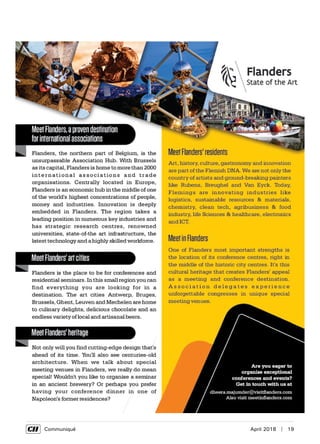
FROM THE SESSIONS . . .
     Communiqué	 April 2018  |  19
20  |  April 2018	 Communiqué
‘Sports in India is yet to be recognized
as an economic sector. The absence of
industry status along with the lack of
sporting culture, has traditionally limited
corporate investments in Indian sports to non-profit
CSR activities and initiatives. Sports is now a big
global business where fans and corporates invest
their time and money.’
Jalaj Dani, Co-Chairman, CII National Committee on
Sports, and Co-Promoter, Asian Paints
‘Although India needs more courts and
judges, single appeal should become the
norm for the country.’
Fali Nariman, Senior Advocate,
Supreme Court of India
‘The current 20% growth of the aviation
sector comes on the back of extensive
coordination of the stakeholders. The
same coordination must continue to tap
the unrealized potential of Indian aviation.’
Ajay Singh, CMD,
Spice Jet
‘New technologies are all about ‘smart' and
Indians are very smart. The opening up of
Vernacular India would offer a new world
of opportunities for businesses to grow
further and deeper.’
Deep Kalra, CEO, MakeMyTrip
‘Supportive institutions and a conducive
environment are needed to help businesses
grow. Many Indian companies, despite starting
off with a great idea, are not able to scale up
and create viable financial models because of
the constraints of the ecosystem.’
Ajay Kaushal, Director and Co-Founder, BillDesk
‘The use of CSR funds for protecting and
promoting our heritage will encourage
culture as a social responsibility.’
Major General (Retd.) L K Gupta,
Chairman, Indian National Trust for Art and Cultural
Heritage (INTACH)
‘Justice ultimately is about delivery.’
Suhel Seth, Managing Partner,
Counselage India
‘Ease of doing business’ is a monumental
factor that attracts foreign investors.
Opening FDI in 21 sectors, the welcoming
attitude of the State Governments, and
GST give India an edge over the rest of
the world.’
Krish Iyer, President & CEO,
Walmart India Pvt Ltd
‘The products manufactured by India
have two major advantages – they meet
global standards and are well priced.
Indian industry can be a major partner in
Industry 4.0.’
Christian H Kienzle, CEO,
Argo Hytos Group
‘Indian industry needs to identify how it can
go the extra mile, and global businesses
must leverage the opportunities provided
by the Indian economy to the fullest
extent.’
Tarun Das,
Former Chief Mentor, CII
‘The Indian Government’s expenditure is
rising at 6.0% per annum, which is much
faster than the 4.6% annual rise in its income.
India needs to undertake deep structural
reforms and promote rapid industrial growth
to correct this imbalance.’
Prof. Soumitra Dutta,
Professor of Management and
Former Dean, S C Johnson College of Business,
Cornell University, USA
‘We need grass root level initiatives to
develop effective tools in entertaining
audiences, ensuring health, growing
businesses, and building a sustainable,
secure and prosperous future for coming
generations.’
Vijender Singh,
Boxer
‘Sports can free you, it gives you confidence,
employment...it can catapult you as a
person.’
Rahul Bose,
Film Actor
cover story
FROM THE SESSIONS . . .
     Communiqué	 April 2018  |  21
B
rought out in conjunction with
the CII Annual Meeting 2018,
the book, 'Building a Better
India Together: Inclusive.
Responsible. Ahead.' brings together
some of the country’s best minds
from diverse backgrounds to offer their
perspectives and ideas on creating
the India of the future. It captures key
challenges for the country’s growth and
suggests solutions with far-reaching
impact.
The contributors to this comprehensive
vision document span the spectrum of
thought leadership. And so there are
essays by corporate leaders such as
Mr Rakesh Bharti Mittal, President, CII,
Ms Shobana Kamineni, President, CII, 2017-18, Mr R Seshasayee, Past President, CII, Mr Vinayak Chatterjee,Chairman, CII
Economic Affairs Council, and Mr Chandrajit Banerjee, Director General, CII; Dr Rajiv Kumar, Vice Chairman, NITI Aayog
and Mr Amitabh Kant, CEO, NITI Aayog; bankers Mr Uday Kotak, who is President Designate, CII, and Ms Arundhati
Bhattacharya; spiritual leader Sadhguru JaggiVasudev; Singaporean diplomat ProfTommy Koh, space scientist
Dr K Kasturirangan; renowned jurist Fali S Nariman; economists Dr Ashok Gulati and Dr Jahangir Aziz;
entrepreneur Subroto Bagchi; marketing expert Suhel Seth; management consultant Ireena Vittal,
and panchayat leader from Rajasthan, Chhavi Rajawat.
‘Despite spending a large part of my life in wealth creation for all our stakeholders,
I am instinctively drawn to drive equity and empowerment in society. To me, two
sectors which lie at the heart of socio-economic change and empowerment in
India are agriculture and education. While the former is important for the sheer number
of people who depend on it for their livelihood, the latter is clearly the principal instrument of
empowerment in any society.
…I firmly believe that participation by the private sector can help consolidate fragmented landholdings and augment
investment to facilitate farm mechanization, modern irrigation and use of scientific methods and high yielding
varieties. Equally important, we can also expect crop diversification and better cross-linkages with industry, hence
the Model Land Leasing Law suggested by the NITI Aayog is critical. It is encouraging that a few States such as
Punjab, Rajasthan, Haryana, and Maharashtra, amongst others, have already adopted it.
….I see a solution to the complex quality issue in well-planned public-private partnership programs, which have
proved to be enormously successful in other areas, particularly infrastructure. Good privately-managed schools can
partner with government schools in their localities to transfer best practices and improve pedagogical standards.'
Rakesh Bharti Mittal, President, CII, and Vice Chairman, Bharti Enterprises
Excerpts from some essays...
`000
www.rupapublications.com
Non-fiction
Inclusive. Responsible. Ahead.
BUILDING A BETTER
TOGETHER
INDIA
India’s march from being a ‘potentially’ great power to a truly
great power has never been as rapid as it is now.
What has created this momentum? How can we move ahead
uninterrupted? How can new employment opportunities
and self-employment avenues help India rise and seize
the moment?Some of the country’s best minds from the most diverse
of backgrounds come together in ‘Building a Better India
Together: Inclusive. Responsible.Ahead.’ to offer their
perspectives and ideas on creating the India of the future.
The galaxy of contributors to this comprehensive vision
document are corporate leaders Shobana Kamineni, R.
Seshasayee, Rakesh Bharti Mittal and Vinayak Chatterjee;
CII director general Chandrajit Banerjee; spiritual master
Sadhguru Jaggi Vasudev; NITI Aayog’s Amitabh Kant;
Singaporean diplomat and professor Tommy Koh; space
scientist K. Kasturirangan; renowned jurist Fali S. Nariman;
bankers Uday Kotak and Arundhati Bhattacharya; economists
Ashok Gulati and Jahangir Aziz; entrepreneur and author
Subroto Bagchi; marketing maven Suhel Seth; management
consultant Ireena Vittal; and elected grassroots leader
Chhavi Rajawat.
BUILDINGABETTERINDIATOGETHER
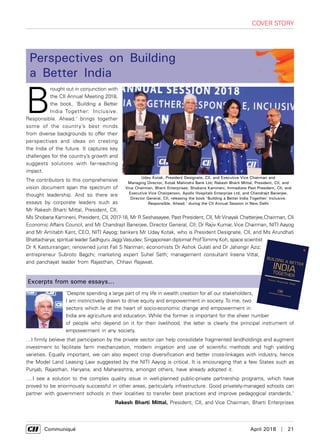
Uday Kotak, President Designate, CII, and Executive Vice Chairman and
Managing Director, Kotak Mahindra Bank Ltd; Rakesh Bharti Mittal, President, CII, and
Vice Chairman, Bharti Enterprises; Shobana Kamineni, Immediate Past President, CII, and
Executive Vice Chairperson, Apollo Hospitals Enterprise Ltd, and Chandrajit Banerjee,
Director General, CII, releasing the book 'Building a Better India Together: Inclusive.
Responsible. Ahead.' during the CII Annual Session in New Delhi
cover story
Perspectives on Building
a Better India
22  |  April 2018	 Communiqué
‘Our leadership is responding emphatically to global actions - Make in India, the International Solar
Alliance, strong bilateral engagement with many countries, negotiations on free trade agreements,
and joint military exercises are creating new models of engagement with the world.
This isn't the time for cynicism, this is a time when the world needs India, when the old order is
changing and a new order is yet to be defined. India can craft a new destiny and shape the world order
at the same time. Our objective should be to open new doors for our workers and entrepreneurs.
…There is a big responsibility for Indian industry. It is business that generates wealth for nations. But this wealth has
to come from legitimate endeavors. I cannot stress enough that society’s expectations from industry as a responsible
and responsive entity are very high. Our commitment to society, in the form of community efforts, attention to
the environment and, above all, to ethical and transparent operations, is key to our success as industry. We must
continuously work to build the trust of the community in industry and ensure that misgivings are alleviated.’
Shobana Kamineni, Immediate Past President, CII, and Executive Vice Chairperson, Apollo Hospitals Enterprise Ltd
'Post 2016-17, I see three mega trends emerging in the Indian banking industry.
First, stressed assets woes and the capital crunch will see subdued growth in public sector banks.
Over the next five years, private sector banks will increase their industry share from 30% to 50%.
The second mega trend is the formalization of savings, which we are already witnessing. From
here on, land, bullion and jewelry will not be preferred investment options. Further, if we look at
Indian private banks, four of the top five are majority foreign-owned. The majority ownership of
Chinese companies is still held by Chinese savers. Likewise, US companies. I am not an advocate for curtailing
foreign investments; however, I think the time has come for Indian savers to benefit from the creation of wealth
out of Indian opportunities. The third trend is digital. Without going into the pros and cons of Aadhaar, digital
combined with Aadhaar is a massive game-changer.
….This is the right time for the governance structure and the policy apparatus to be updated to keep pace with
the rapidly–changing world. We need stronger governance of the broader economy combined with the maturity to
respect outcomes. While reforms are important and welcome, the need of the hour is a change in mindset at all
levels of State and private enterprise.'
Uday Kotak, President Designate, CII, and Executive Vice Chairman and Managing Director, Kotak Mahindra Bank Ltd
'To summarize some of the ideas that industry is keen to develop for a better future for the
country...
First, it is important to devise the right skilling strategies to make the Indian workforce a key
player in the global economy. A differentiated skill-set is required to be built up with the active
participation of industry. This should align with domestic requirements as well the imperatives of
a rapidly-changing technology scenario.
Two, a number of sectors have been identified where India can lead in the coming Fourth Industrial Revolution.
India needs to get the balance of its manufacturing and services sectors right to tap into the immense potential
that it enjoys as a mover in both sectors.
Three, ease of doing business is deriving huge benefits due to the participation of the State Governments in the
effort. The committed efforts of the States are translating into action on the ground in attracting investments. But
the effort needs to continue down to the next level of district administration.
Four, with world trade rapidly shifting in terms of global supply chains, India must constantly transform to synchronize
with emerging trends. The participation of Micro, Medium and Small Enterprises (MSMEs) can be strengthened if
they develop competitiveness and build closer linkages with the world.
Five, the new growth paradigm that India is shaping today depends on a close collaboration of Central and State
Governments and industry.'
Chandrajit Banerjee, Director General, CII
cover story
     Communiqué	 April 2018  |  23
first person
You assumed charge as President, CII, at a time
when the growth of the country had moderated.
What were your priorities when you took over?
When I became President of CII, growth had been
slow for a couple of quarters, and my objective was to
add 1 percentage point to the growth rate for the year
and indeed for the next two years, so that we could
achieve double-digit pace. With a faster GDP, there is
so much more that we can do in terms of job creation
and development.
This year, the CII theme was built around 'India@75:
Inclusive. Ahead. Responsible.' I am happy that the
India@75 idea resonated with the Government and was
mentioned by the Prime Minister several times. In fact,
many of the targets set by the Government have 2022
as the end year, in line with what CII has been talking
about since 2008.
I must say that CII’s voice this year was heard very
seriously, and many of our policy recommendations found
place in the Government’s announcements. I had the
opportunity to interact with the Prime Minister several
times, including at an exclusive meeting with him, and at
various outgoing and incoming high-level visits, including
at the World Economic Forum (WEF) annual meeting at
Davos. With CII’s long association with WEF, our activities
got excellent traction this year and had high visibility.
The introduction of the Goods and Services Tax (GST)
was historic and a long-awaited move. How did CII
adapt to this major tax reform?
CII worked very intensively on GST, providing policy
inputs on coverage, rates, slabs, exports, e-way bills
and procedural issues to the Government, which was
very responsive to our suggestions. CII conducted
workshops and training sessions across the country as
an accredited Government partner. On two occasions,
we organized industry interactions with the Revenue
Secretary who listened patiently to our concerns.
For me, personally, it was a memorable opportunity to be
present at the historic midnight session in the Central Hall
of Parliament when the Prime Minister launched GST.
The Government’s reform agenda was quite fast-
paced during the year. What were some CII
recommendations that were addressed by various
ministries?
Our policy work covered a comprehensive list including
overall economic growth, financial sector and bank
recapitalization, Budget 2018-19, and most industry
sectors. I am particularly happy that the Government
brought out policies enabling fixed term employment,
redefinition of MSME, and the New Industrial Policy, all
of which CII had been working on for some time.
Our recommendations for the MSME sector on Trade
Receivables System (TreDs), Delayed Payments, and
Public Procurement have also been announced, which
will bring great relief to these enterprises.
The CII theme placed the accent on ‘Inclusive India.’
Please elaborate on some of the initiatives taken.
Under the sub-theme of Inclusive India, we stepped up
skill development, job fairs, and women empowerment.
Two model career centers were opened. Our skill
development activities extend to about one million youth
every year, which is a notable achievement. I would like
to mention that the Budget announced teachers training
initiatives in schools, and funding for R&D in higher
education institutes, which CII had called for.
CII’s suggestion on universal health coverage was
partially accepted in Ayushman Bharat, to be further
expanded later.
Our activities under Affirmative Action continue under
the four heads of employability, entrepreneurship,
education and employment. With the active support
and initiatives of our members, CII has been able to
emerge as a pioneer and frontrunner in this space, and
I look forward to our continued engagement with this
important issue.
India Ahead was another pillar of the CII theme. What
were the major initiatives taken on this dimension
during the year?
The India Ahead segment of our work focused
intensively on building competitiveness. At the national
CII’s voice this year was heard very seriously and many of
our policy recommendations found place in the Government’s
announcements, says Shobana Kamineni
‘A Fulfilling and Productive Year’
24  |  April 2018	 Communiqué
level, this involved policy advocacy with almost every
ministry and department of the Government. At the
regional level too, CII worked closely with the States
on building a facilitative investment climate.
It is a matter of pride that India now ranks 100 in the
World Bank ‘Doing Business’ report, and I am sure its
position will continue to improve. CII has been providing
very specific inputs on this issue to the Central and
State Governments.
CII set up the Society of Indian Defence Manufacturers
as part of its overall engagement in establishing new
sectoral associations.This will converge all private sector
interventions in the defence production space.
The CII Centers of Excellence lead our work in
competitiveness and productivity with enterprises,
providing a range of targeted training programs. In
quality, green buildings and sustainability, the Centers
offer relevant programs of global class, and I urge you to
take advantage of their extensive training calendars.
International engagement also puts India 'ahead.’ Over
the year, we opened two new offices in Iran and
South Africa to provide market facilitation services,
particularly for MSMEs that want to go overseas. CII
handled 100 visiting overseas delegations and organized
56 missions overseas, helping Indian industry to work
with the world.
CII’s technology work was particularly active as Industry
4.0 gathers pace. With our technology development
centers and the Global Innovation and Technology
Alliance in partnership with the Department of Science
and Technology, there is intensive engagement for
industry.
The CII major trade fairs this year brought together
lakhs of people for new opportunities. World Food India
was the first expo for food processing in the country,
with high international participation. Besides the Auto
Expo, the Global Exhibition on Services, Textiles India,
the India-Canada Tech Summit and many more, we had
a number of State investor summits.
Coming to Responsible India, what were your
priorities for the year? As the first woman President
of CII, was gender empowerment a special priority
for you?
I must say that under Responsible India, we had a
productive year. With corporate governance as a strong
agenda, we worked on Company Law, the Insolvency
and Bankruptcy Law, and the Competition Law.
Sustainability remained a priority and CII is a strong
partner with the Government, apart from working
with firms through the Centers of Excellence for
sustainability, water, and green business. We launched
the WatSmart tool that enables companies to reduce
water consumption.
The CII Foundation stepped up its activities for women
and child benefits, sanitation and toilet construction,
building awareness on open defecation, waste
management, and relief in disaster-hit areas.
Women were a special focus during the year. Apart
from research activities and the annual Women
Exemplar Awards to women leaders at the grassroots,
CII partnered with NITI Aayog to promote women
entrepreneurship.
I was especially happy to steer the ‘Power of Parity’
initiative which aims at increasing the participation of
women in the workforce. A committee headed by
Rumjhum Chatterjee is activating new steps for gender
empowerment.
Would you have any message for members as you
step down as President of CII?
I cannot stress enough that society’s expectations from
industry as a responsible and responsive entity are
very high. Our commitment to society, in the form of
community efforts, attention to the environment and,
above all, to ethical and transparent operations, is the key
to our success as industry. We must continuously work
on building the trust of the community in industry.
It is important for each enterprise to understand the
larger impact of responsible and ethical behavior on
industry as a whole. If we ask for self-certification or
third-party regulation or light-handed regulations, we
must ensure that we comply in both letter and spirit. In
the absence of this, the regulatory framework becomes
even more stringent, making compliance lengthy and
costly for all enterprises.
It is absolutely imperative that compliance be accorded
high importance by businesses. I would request
members to sign the CII Code for Governance.
I had very intensive agenda for CII at the beginning
of my term. It was fantastic to get the full support
and cooperation of everyone at CII to align with this
agenda.
Thank You!
Shobana Kamineni is Immediate Past President, CII, and Executive
Vice Chairperson, Apollo Hospitals Enterprise Ltd
spotlight
     Communiqué	 April 2018  |  25
I
ndustries all over
the world are facing
critical challenges
rooted in globalization,
slower growth, impact of
disruptive technologies, and
unforeseen competitive
threats, which are impacting
their competitiveness.
Industry associations have
played an active role in
catalyzing development at
the district, regional, national
and global levels. Through
their vast memberships
spanning business sectors
and geographies, such
associations offer in-depth
understanding of industry-
specific trends, and have
significant influence on
business sustainability.
In today’s globalized
world, where no issue
remains isolated, there are
interdependencies and larger
effects that require strategic
and collective interventions
for positive outcomes.
In such a VUCA (Volatile,
Uncertain, Complex and
Ambiguous) world, industry
associations have a key role in crafting a shared
understanding of roles and responsibilities of different
developmental actors.
To this effect, CII under the aegis of its unique CII
Associations’ Council (ASCON), comprising a strong
membership of 110+ national sectoral associations,
organized its first-ever ‘Global Industry Associations
Global Industry Associations
Agents of Change: Partners for Progress
mindspace
industry
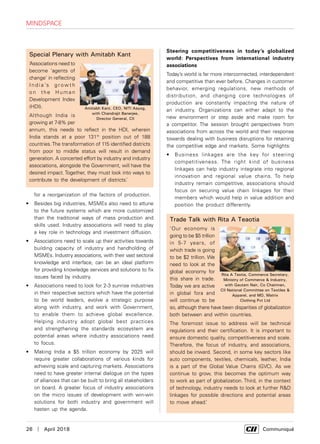
‘Globalization is going through
a phase where countries are
revisiting and evaluating their
roles. Industry associations play
an extremely significant role in
this context as they are creating
the real spirit of development
by benefiting India along with
all others.’
Suresh Prabhu,
Minister of Commerce and
Industry, and Civil Aviation
‘Six major shifts, namely,
globalization and future
markets, the digital revolution,
move towards a knowledge
economy, urbanization driven
by growth in tier 2 and 3 cities,
climate change and resource
scarcity, and increasing focus
on responsible behavior, are
reshaping the world, creating
new opportunities and challenges
for industry.’
Shobana Kamineni,
Immediate Past President, CII (then President, CII), and
Executive Vice Chairperson, Apollo Hospitals Enterprise Ltd
Summit.’ The event, with
the theme, ‘Partnering for
Progress and Prosperity,’
was inaugurated by Mr
Suresh Prabhu, Minister of
Commerce and Industry, and
Civil Aviation, on 26 March in
New Delhi.
Our MINDSPACE section
this month brings you the
highlights of this unique
event.
Summit Themes
Role of Associations in
attaining $5 trillion GDP
for India by 2025
I n d i a , b a cke d by i t s
demographic potential,
urbanization, economic
growth and labor force,
currently stands on the path
of a phenomenal growth
trajectory. The country is
well-poised to become
a $5 trillion economy by
2025. The new wave of
ubiquitous connectivity and
digital interface is expected
to be a game-changer. In
the changing paradigm,
the role of associations in
shaping India’s overall growth becomes even more
significant.
Highlights of the discussion:
•	 Technology disruptions are exerting pressures on
the economic factors of production. The adoption of
new trends such as digitized production, automated
production, fintech, and artificial intelligence, will
be crucial for future production systems and calls
26  |  April 2018	 Communiqué
for a reorganization of the factors of production.
•	 Besides big industries, MSMEs also need to attune
to the future systems which are more customized
than the traditional ways of mass production and
skills used. Industry associations will need to play
a key role in technology and investment diffusion.
•	 Associations need to scale up their activities towards
building capacity of industry and handholding of
MSMEs. Industry associations, with their vast sectoral
knowledge and interface, can be an ideal platform
for providing knowledge services and solutions to fix
issues faced by industry.
•	 Associations need to look for 2-3 sunrise industries
in their respective sectors which have the potential
to be world leaders, evolve a strategic purpose
along with industry, and work with Government,
to enable them to achieve global excellence.
Helping industry adopt global best practices
and strengthening the standards ecosystem are
potential areas where industry associations need
to focus.
•	 Making India a $5 trillion economy by 2025 will
require greater collaborations of various kinds for
achieving scale and capturing markets. Associations
need to have greater internal dialogue on the types
of alliances that can be built to bring all stakeholders
on board. A greater focus of industry associations
on the micro issues of development with win-win
solutions for both industry and government will
hasten up the agenda.
mindspace
Trade Talk with Rita A Teaotia
‘Our economy is
going to be $5 trillion
in 5-7 years, of
which trade is going
to be $2 trillion. We
need to look at the
global economy for
this share in trade.
Today we are active
in global fora and
will continue to be
so, although there have been disparities of globalization
both between and within countries.
The foremost issue to address will be technical
regulations and their certification. It is important to
ensure domestic quality, competitiveness and scale.
Therefore, the focus of industry, and associations,
should be inward. Second, in some key sectors like
auto components, textiles, chemicals, leather, India
is a part of the Global Value Chains (GVC). As we
continue to grow, this becomes the optimum way
to work as part of globalization. Third, in the context
of technology, industry needs to look at further R&D
linkages for possible directions and potential areas
to move ahead.’
Special Plenary with Amitabh Kant
‘Associations need to
become ‘agents of
change’ in reflecting
I n d i a ’s g r ow t h
on the Human
Development Index
(HDI).
Although India is
growing at 7-8% per
annum, this needs to reflect in the HDI, wherein
India stands at a poor 131th
position out of 188
countries.The transformation of 115 identified districts
from poor to middle status will result in demand
generation. A concerted effort by industry and industry
associations, alongside the Government, will have the
desired impact. Together, they must look into ways to
contribute to the development of districts.’
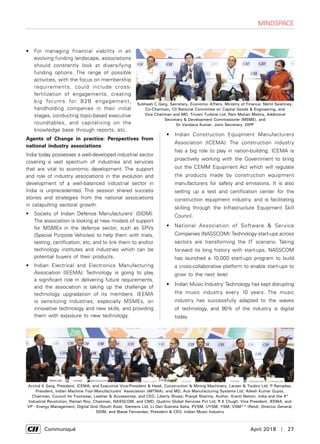
Amitabh Kant, CEO, NITI Aayog,
with Chandrajit Banerjee,
Director General, CII
Steering competitiveness in today’s globalized
world: Perspectives from international industry
associations
Today’s world is far more interconnected, interdependent
and competitive than ever before. Changes in customer
behavior, emerging regulations, new methods of
distribution, and changing core technologies of
production are constantly impacting the nature of
an industry. Organizations can either adapt to the
new environment or step aside and make room for
a competitor. The session brought perspectives from
associations from across the world and their response
towards dealing with business disruptions for retaining
the competitive edge and markets. Some highlights:
•	 Business linkages are the key for steering
competitiveness. The right kind of business
linkages can help industry integrate into regional
innovation and regional value chains. To help
industry remain competitive, associations should
focus on securing value chain linkages for their
members which would help in value addition and
position the product differently.
Rita A Teotia, Commerce Secretary,
Ministry of Commerce & Industry,
with Gautam Nair, Co Chairman,
CII National Committee on Textiles &
Apparel, and MD, Matrix
Clothing Pvt Ltd
     Communiqué	 April 2018  |  27
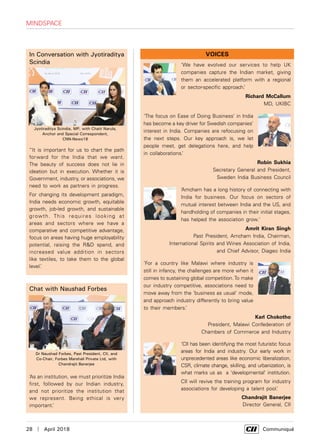
Subhash C Garg, Secretary, Economic Affairs, Ministry of Finance; Nikhil Sawhney,
Co-Chairman, CII National Committee on Capital Goods & Engineering, and
Vice Chairman and MD, Triveni Turbine Ltd; Ram Mohan Mishra, Additional
Secretary & Development Commissioner (MSME), and
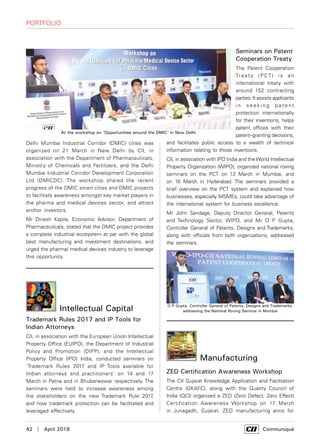
Dr Vandana Kumar, Joint Secretary, DIPP
mindspace
•	 For managing financial viability in an
evolving funding landscape, associations
should constantly look at diversifying
funding options. The range of possible
activities, with the focus on membership
requirements, could include cross-
fertilization of engagements, creating
big forums for B2B engagement,
handholding companies in their initial
stages, conducting topic-based executive
roundtables, and capitalizing on the
knowledge base through reports, etc.
Agents of Change in practice: Perspectives from
national industry associations
India today possesses a well-developed industrial sector
covering a vast spectrum of industries and services
that are vital to economic development. The support
and role of industry associations in the evolution and
development of a well-balanced industrial sector in
India is unprecedented. This session shared success
stories and strategies from the national associations
in catapulting sectoral growth.
•	 Society of Indian Defence Manufacturers’ (SIDM):
The association is looking at new models of support
for MSMEs in the defence sector, such as SPVs
(Special Purpose Vehicles) to help them with trials,
testing, certification, etc, and to link them to anchor
technology institutes and industries which can be
potential buyers of their products.
•	 Indian Electrical and Electronics Manufacturing
Association (IEEMA): Technology is going to play
a significant role in delivering future requirements,
and the association is taking up the challenge of
technology upgradation of its members. IEEMA
is sensitizing industries, especially MSMEs, on
innovative technology and new skills, and providing
them with exposure to new technology.
•	 Indian Construction Equipment Manufacturers
Association (ICEMA): The construction industry
has a big role to play in nation-building. ICEMA is
proactively working with the Government to bring
out the CEMM Equipment Act which will regulate
the products made by construction equipment
manufacturers for safety and emissions. It is also
setting up a test and certification center for the
construction equipment industry, and is facilitating
skilling through the Infrastructure Equipment Skill
Council.
•	 National Association of Software & Service
Companies (NASSCOM):Technology start-ups across
sectors are transforming the IT scenario. Taking
forward its long history with start-ups, NASSCOM
has launched a 10,000 start-ups program to build
a cross-collaborative platform to enable start-ups to
grow to the next level.
•	 Indian Music Industry:Technology has kept disrupting
the music industry every 10 years. The music
industry has successfully adapted to the waves
of technology, and 90% of the industry is digital
today.
Arvind K Garg, President, ICEMA, and Executive Vice-President & Head, Construction & Mining Machinery, Larsen & Toubro Ltd; P Ramadas,
President, Indian Machine Tool Manufacturers' Association (IMTMA), and MD, Ace Manufacturing Systems Ltd; Adesh Kumar Gupta,
Chairman, Council for Footwear, Leather & Accessories, and CEO, Liberty Shoes; Pranjal Sharma, Author, Kranti Nation: India and the 4th
Industrial Revolution; Raman Roy, Chairman, NASSCOM, and CMD, Quatrro Global Services Pvt Ltd; R K Chugh, Vice President, IEEMA, and
VP –Energy Management, Digital Grid (South Asia), Siemens Ltd; Lt Gen Subrata Saha, PVSM, UYSM, YSM, VSM** (Retd), Director General,
SIDM, and Blaise Fernandes, President & CEO, Indian Music Industry
28  |  April 2018	 Communiqué
In Conversation with Jyotiraditya
Scindia
“It is important for us to chart the path
forward for the India that we want.
The beauty of success does not lie in
ideation but in execution. Whether it is
Government, industry, or associations, we
need to work as partners in progress.
For changing its development paradigm,
India needs economic growth, equitable
growth, job-led growth, and sustainable
growth. This requires looking at
areas and sectors where we have a
comparative and competitive advantage,
focus on areas having huge employability
potential, raising the R&D spend, and
increased value addition in sectors
like textiles, to take them to the global
level.’
Chat with Naushad Forbes
‘As an institution, we must prioritize India
first, followed by our Indian industry,
and not prioritize the institution that
we represent. Being ethical is very
important.’
Dr Naushad Forbes, Past President, CII, and
Co-Chair, Forbes Marshall Private Ltd, with
Chandrajit Banerjee
Jyotiraditya Scindia, MP, with Chaiti Narula,
Anchor and Special Correspondent,
CNN-News18
‘We have evolved our services to help UK
companies capture the Indian market, giving
them an accelerated platform with a regional
or sector-specific approach.’
Richard McCallum
MD, UKIBC
‘The focus on Ease of Doing Business’ in India
has become a key driver for Swedish companies’
interest in India. Companies are refocusing on
the next steps. Our key approach is, we let
people meet, get delegations here, and help
in collaborations.’
Robin Sukhia
Secretary General and President,
Sweden India Business Council
‘Amcham has a long history of connecting with
India for business. Our focus on sectors of
mutual interest between India and the US, and
handholding of companies in their initial stages,
has helped the association grow.'
Amrit Kiran Singh
Past President, Amcham India, Chairman,
International Spirits and Wines Association of India,
and Chief Advisor, Diageo India
‘For a country like Malawi where industry is
still in infancy, the challenges are more when it
comes to sustaining global competition.To make
our industry competitive, associations need to
move away from the ‘business as usual’ mode,
and approach industry differently to bring value
to their members.’
Karl Chokotho
President, Malawi Confederation of
Chambers of Commerce and Industry
‘CII has been identifying the most futuristic focus
areas for India and industry. Our early work in
unprecedented areas like economic liberalization,
CSR, climate change, skilling, and urbanization, is
what marks us as a ‘developmental' institution.
CII will revive the training program for industry
associations for developing a talent pool.’
Chandrajit Banerjee
Director General, CII
VOICES
mindspace
     Communiqué	 April 2018  |  29
South Asia Gas Enterprise
(Siddho Mal Group)
A-6, Connaught Place, New Delhi-110001
Ph: +91-11-23324245 / 43581237
E-mail:
www.sage-india.com
siddhomalage@vsnl.net
Undersea Natural Gas Pipeline from Iran/Oman to India
AfganistanAfganistan
Iran Landfall PointKuh-e-Mobarak
Ra's Al Jifan
Gujarat Landfall PointSohar Port
Gas Pipelines are more competitive than LNG upto a distance of 2500/3000 kms, due to high
cost of gas liquefaction/transportation/re-gasification ( 5-6 USD / mmbtu).
In India’s quest for Energy Security, through a New Route, , a Global Consortium, is
developing a $4.5 Billion world's deepest Common Carrier Natural Gas Pipeline, directly from
IrantoGujaratcoastinIndia,throughtheArabianSea.
( A route via Oman is also being explored in order to meet Oman’s needs for Iranian gas
through this pipeline).
SAGE
Fuelling India's 'Make in India' plans and Gas based Economy vision by this path-breaking
infrastructureProject,forhighereconomicgrowth.
Meeting needs of Power/Fertilizer Industry for affordably priced gas, while moving to a low
carboneconomy,afterParisClimateChangeDeal.
Alternative & safer route to bring/swap Turkmenistan/Russian & other region's Gas to India
Gujarat coast.
Annual saving of USD one billion approx. ( Rs.6000/7000 Cr. ) in comparison with similar
quantity LNG import.
Gas Qty: 31.1 mmscmd under a 20/25 years Long-Term Gas Supply Contract with Iran.
Pipeline tariff: USD 2.5 per mmbtu range.
DNV-GL, Norway / Engineers India Ltd. (EIL) / SBI Capital Markets Ltd. confirmed Project
Feasibility.
30  |  April 2018	 Communiqué
     Communiqué	 April 2018  |  31
32  |  April 2018	 Communiqué
Portfolio for Excellence
Green Business
Green Metro Corridor
The CII India Green Business Center platinum-rated
Majlis Park – Durgabai Deshmukh South Campus Pink
Corridor of the Delhi Metro was formally inaugurated
for passenger services on 14 March by Mr Hardeep
Singh Puri, Minister of State (Independent Charge) of
Housing and Urban Affairs, and Mr Arvind Kejriwal Chief
Minister of Delhi, in the presence of Dr Harsh Vardhan,
Minister of Science and Technology, Earth Sciences,
Environment, Forests and Climate Change, Dr Mangu
Singh, MD, DMRC, Dr Prem C Jain, Chairman, IGBC,
and many other dignitaries.
Green Eye Hospital
Madhav Netralaya City
Centre at Nagpur gained
the unique distinction
of becoming India’s first
‘IGBC platinum-rated
green eye hospital,’
rated under the IGBC
green healthcare rating
system.
Mr Devendra Fadnavis, Chief Minister of Maharashtra,
presented the IGBC plaque and certificate to Dr Shrikant
Andhare, President, Madhav Netralaya, on 18 March
in Nagpur.
Other dignitaries present on the occasion included Mr
Nitin Gadkari, Union Minister of Road Transport and
Highways; Mr Jagat Prakash Nadda, Union Minister
of Health and Family Welfare; Mr
Chandrashekhar Bawankule, Minister
of Energy, Maharashtra; Ms Nanda
Jichkar, Mayor of Nagpur, and Dr
Mohan Bhagwat, RSS Chief.
Green Village in Rajasthan
Raithal, the adopted digital village of
ICICI Bank in Rajasthan, has become
the first digital village in the country
to be certified as a platinum-rated
‘green village’ under the CII IGBC
Green Village Rating System.
The award, presented at a function on
27 March, recognizes Raithal village as
a ‘global leader' for creating an ecosystem that meets
criteria such as health and hygiene, village infrastructure,
water conservation, energy availability and efficiency,
materials and resources, and social and community actions,
as well as green innovation.
Energy Efficiency
An advanced training program on Energy Efficiency
on 22-23 March in Bengaluru disseminated the latest
techniques and advancements in the field of energy
management, including innovative energy-saving ideas,
through actual implemented case studies.
Devendra Fadnavis, Chief
Minister of Maharashtra, and
Dr Prem C Jain presenting
the IGBC award to
Dr Shrikant Andhare, President,
Madhav Netralaya, in Nagpur
Recognition for IGBC rated green village in Rajasthan
Dr Prem C Jain, Chairman, IGBC, presenting the IGBC plaque to Dr Mangu Singh, MD, DMRC,
in the presence of (L-R) Kailash Gahlot, Transport Minister, Delhi; Arvind Kejriwal, Chief
Minister of Delhi; Hardeep Singh Puri, Union Minister of State (Independent Charge) of Housing
and Urban Affairs, and Dr Harsh Vardhan, Union Minister of Science and
Technology, Earth Sciences, Environment, Forests, and Climate Change
     Communiqué	 April 2018  |  33
Portfolio
Food and Agriculture
Exposure Visit for Andhra Pradesh
Banana Farmers
CII’s Food and Agriculture Center of Excellence
(CII FACE) works across specific crop value chains, engaging
with industry, farmers groups and the Government, with
the objective of increasing farm incomes, improving
value addition, catalyzing post-harvest infrastructure
development, and creating brand value of the specific
commodity.
The Center has signed an MoU with the Department of
Horticulture, Andhra Pradesh, to work on banana and mango
value chains in the State. As a part of this initiative, CII
FACE organized an exposure visit of 30 progressive banana
farmers from Anantapur and Kadapa districts of Andhra
Pradesh to Theni and Tiruchirappalli districts of Tamil Nadu,
from 7-10 March.
Tamil Nadu is the largest banana-producing State in India
and the Tamil Nadu Banana Growers Federation has made
significant strides in adoption of scientific banana cultivation
and value-added banana products. CII has a long association
with the Federation.
The farmers from Andhra Pradesh interacted directly with
the farmer members of the Tamil Nadu Banana Growers
Federation to understand their best practices.They also visited
a pack house, ripening chambers and solar drying units, and
learnt about value-added banana products.
At the Horticulture College and Research Institute, Periyakulam,
and the National Research Center for Banana, Tiruchirapalli,
the farmers interacted with the faculty and scientists to learn
about good cultivation, crop management, and harvesting
practices, as also the different value-added products that
could be manufactured from banana.
CII FACE will work with the Department of Horticulture,
Andhra Pradesh, to explore to replicate these learnings in
the State.
Banana farmers from Andhra Pradesh on an exposure
visit to Tamil Nadu
34  |  April 2018	 Communiqué
     Communiqué	 April 2018  |  35
Portfolio
Intelligent Solutions for
Connected Manufacturing
In today’s new industrial era, game-changing innovations such
as Industry 4.0, smart manufacturing, and digital factories
are changing the way products are manufactured. To remain
competitive, manufacturing companies, now, more than
ever before, need knowledge, training and state-of-the-art
information and communication technology to improve
productivity, shorten product development cycles and mass
produce customized products as efficiently and cost-effectively
as possible.
In India, the aim to increase the share of the manufacturing
sector to GDP to 25% by 2020 necessitates building the
digital ftramework for the country.
Industry 4.0 is driven mainly by four key disruptions:
•	 The rise in data volumes, computational power, and
connectivity, especially new low power wide area
networks.
•	 The emergence of analytics and business intelligence
capabilities.
•	 New forms of human-machine interaction such as touch
interfaces and augmented reality systems.
•	 Improvements in transferring digital instructions to
the physical world, such as advanced robotics and 3D
printing.
To support member companies in the application of Industry
4.0 levers and value drivers, the CII Naoroji Godrej Center
of Manufacturing Excellence (CII CME), with Bosch India as
the Knowledge Partner, organized a training-cum-plant visit
to the Bosch plant at Bidadi, Karnataka, on 8 and 9 March.
The workshop, combined with visits to the Industry 4.0
showroom and shop floor exposed the participants to smart
solutions and Industry 4.0 concepts.
Manufacturing
Excellence
Exclusive Workshop on Connected Manufacturing at the Bosch Plant,
in Bidadi, Karnataka
36  |  April 2018	 Communiqué
     Communiqué	 April 2018  |  37
Quality
Portfolio
Study Mission to Japan
The CII Institute of Quality, along
with the Japan Institute of Plant
Maintenance (JIPM), organized
the 1st
TPM /TQM Manufacturing
Study Mission to Japan from 19-24 March. The mission
was organized to help Indian companies experience the
Total Preventive Maintenance (TPM) and Total Quality
Management (TQM) principles in actual practice on
shop floors, besides witnessing the JIPM TPM Award
Ceremony Program on 21 March in Kyoto.
The 22-member Study Mission included representatives
of leading companies from across the country.
Besides learning TPM and TQM, methodologies
which have greatly contributed to making Japanese
manufacturing competitive internationally for over
65 years, the delegation members observed safety
measures at Mohka Manufacturing – House of
Safety School, and lean practices at the Toyota Motor
Corporation. They also visited Nissan Motor Corporation
in Kanagawa, Mohka Manufacturing atTochigi, the Bosch
Musashi Plant, Higashio Mech at Osaka, Toyota Motor
Corporation, and the Toyota Automobile Museum at
Aichi, to gain significant learnings and takeaways.
JIPM TPM Awards
The TPM Awards by the Japan Institute of Plant
Maintenance (JIPM) for the year 2017 were announced
in Kyoto on 21 March. This year, 43 Indian companies
successfully challenged the prestigious Japanese award,
ensuring that India continues to have the highest
number of awards outside Japan. Over the years,
Indian companies have won 367 JIPM-TPM Awards,
with some of them going for higher level of awards
in their TPM journey.
The TPM Club India of the CII Institute of Quality,
through its consulting and hand-holding support, has
till date supported 122 award winning companies and
has helped them get 157 awards. This year, as many
as 21 of the 43 winners were supported by CII TPM
Club India counselors.
Impact Session on Leadership
The `Impact Session
on Leadership’ in
Bengaluru on 15
March showcased
the achievements
of women who
have impacted
b u s i n e s s a n d
society with their
leadership qualities,
succeeding against many
odds to make a mark in their
respective areas of work.
Dr Tejaswini AnanthKumar,
Chairperson, Adamya Chetana,
shared her experiences as an
entrepreneur on `How to drive
successful change as a Leader’
and Ms Bindu Subramani,
Chief Manager – Talent &
Organizational Development,
Asian Paints Ltd, presented on
Mission members at Nissan Motor Corporation in Kanagawa, Japan
Bindu Subramani, Chief Manager – Talent
& Organisational Development, Asian
Paints Ltd, and Anita Borulkar,
Co-Convenor, Policy & Advocacy,
IWN Karnataka, and Vice President- HR,
Bharat Fritz Werner Ltd, at the Impact
Session on Leadership in Bengaluru
38  |  April 2018	 Communiqué
Portfolio
the `Leadership that works’.
Both speakers, addressing over 70
industrial professionals, spoke on
various aspects of leadership in
transforming businesses, such as
motivation, ambition, stakeholder
support during implementations,
and quality and sustainability
challenges.
CII inks MoU with
Tamkeen, Bahrain
The CII Institute of Quality, pursuing
its efforts to expand its training
and consulting footprint with
India’s neighbors, has inked a
Memorandum of Understanding
(MoU) with Tamkeen (Labor Fund),
Bahrain, to deliver various training
and consulting products.
In terms of the MoU, signed on 7
March in Bahrain, Tamkeen and the
CII Institute of Quality shall exchange
respective professional experiences
on member services. CII shall support
Bahrain’s private sector on quality
enhancement and competitiveness
by exchanging information about
products and industrial processes,
besides conducting delegation visits
to explore best practices in both
countries.
For more information about the CII Institute
of Quality, please contact
Japan Mission: ravi.joshi@cii.in
JIPM-TPM Awards, and the TPM Club
India: vinay.kumar@cii.in
CII IQ services and proposed collaboration
with Tamkeen: sudarsan@cii.in or
jayashree.das@cii.in
Leadership Development Programs:
sudha.s@cii.in
CII inks MoU with Tamkeen, Bahrain
SME Competitiveness
5S Lead Assessor Certification Course
T h e C I I C e n t e r
o f E x c e l l e n c e f o r
Competitiveness for
SMEs conducted a 3-day
certification course on
5S Lead Assessor from
20 - 22 March at Swaraj
Division, Mahindra &
Mahindra Ltd, Mohali.This
course gave the participants in-depth knowledge of the various elements of
5S, and its application in all kinds of industries to build a culture of continuous
improvement while maintaining a quality management environment. The
certificate course aims to develop the skills and expertise needed to audit
as well as to manage workplace management system audits effectively.
Industrial and Electrical Safety
‘Creating a workforce
in line with the national
mission on Zero Effect,
Zero Defect’ was the
theme of the training
course-cum-workshop on
‘Industrial and Electrical
Safety’ organized on 15
- 16 March at the Maruti
Center for Excellence (MACE), Manesar.
More than 30 delegates from different organizations learned to understand
and implement safety, health, environment protection measures and meet
legal compliances on safety, while improving profit, productivity and quality
through workplace safety.
Detailed Energy Audits
Mankind Pharmaceutical company,
Paonta Sahib, 5-9 March:The energy
auditors identified energy savings
worth `1.58 crores with the payback
period of one year, mainly in the
boiler and steam system.
Panesar Agriculture Works Ltd,
Ludhiana, 21 March: Total energy
saving opportunity of 8 - 10% of the
total energy bill was identified.
Participants of the three-day certification course on
5S Lead Assessor in Mohali
Training Course-cum-Workshop on Industrial and
Electrical Safety at Manesar
Detailed Energy Audit at Panesar Agriculture
Works Ltd, Ludhiana, in progress
     Communiqué	 April 2018  |  39
40  |  April 2018	 Communiqué
     Communiqué	 April 2018  |  41
Building Capacity
Agriculture
Arbitration
Automotives
At the 6th
edition of Agricon 2018 in Chennai
Webinar on Arbitration
Managing business relationships between a company
and important stakeholders is critical for good
Conference on Automotive R&D Trends
The Tamil Nadu Technology Development & Promotion
Center (TNTDPC) of CII, in partnership with Victorian
Government Trade & Investment, Australia, organized
the 10th
edition of the Conference on Automotive R&D
Trends, on 14 March in Chennai, with the theme of
‘Redefine R&D: Regulatory Changes for Sustainable
Mobility.’
The conference helped stakeholders understand the
current scenario of automotive R&D, the challenges
ahead, and the technologies involved, and share their
expectations.
AgriCon 2018
AgriCon 2018, a conference on Precision Agriculture
Technologies, in its 6th
edition, looked at technology
innovation, new products, new markets, next-generation
technology, and implications for allied industries. With
the focus on research and development in productivity
and farm engineering, the discussions focused on
ways to double farmers’ incomes through smart
farming, effective utilization of agricultural inputs and
post-harvest management.
Culture is deeply associated with agriculture, said Mr
K Pandiarajan, Minister for Tamil Official Language and
Tamil Culture, Tamil Nadu, inaugurating the conference
which was organized by the Tamil Nadu Technology
Development and Promotion Center (TNTDPC) of CII
on 16 March in Chennai. The conference was chaired
by Mr S Chandramohan, Group CFO & President, TAFE
Ltd. The topics spanned current practices and future
potential, water and nutrient management, engineering
and design excellence for agricultural implements and
pumps, and the role of ICT in agriculture.
governance. Arbitration Dispute Resolution (ADR) is an
important tool for solving disputes. Rather than court-
room litigations, the benefits of ADR include lower costs,
quicker dispute resolutions, and outcomes that preserve
and sometimes even improve relationships.
The Andhra Pradesh Technology Development and
Promotion Center (APTDC) of CII organized a webinar
on ‘Recent Amendments in Arbitration Act 2015’ on
12 March to discuss best practices such as arbitration
and conciliation in resolving disputes to avoid court
litigation. The participants were also briefed about the
recent amendments in the Arbitration and Conciliation
(Amendment) Act, 2015, and 2018.
Opportunities for Pharma and Medical
Devices Sector in DMIC Cities
A workshop highlighting opportunities for Pharma
and Medical Devices enterprises in the upcoming
Business Development
42  |  April 2018	 Communiqué
ZED Certification Awareness Workshop
The CII Gujarat Knowledge Application and Facilitation
Centre (GKAFC), along with the Quality Council of
India (QCI) organized a ZED (Zero Defect, Zero Effect)
Certification Awareness Workshop on 17 March
in Junagadh, Gujarat. ZED manufacturing aims for
At the workshop on ‘Opportunities around the DMIC’ in New Delhi
Intellectual Capital
Trademark Rules 2017 and IP Tools for
Indian Attorneys
CII, in association with the European Union Intellectual
Property Office (EUIPO), the Department of Industrial
Policy and Promotion (DIPP), and the Intellectual
Property Office (IPO) India, conducted seminars on
‘Trademark Rules 2017 and IP Tools available for
Indian attorneys and practitioners’ on 14 and 17
March in Patna and in Bhubaneswar respectively. The
seminars were held to increase awareness among
the stakeholders on the new Trademark Rule 2017,
and how trademark protection can be facilitated and
leveraged effectively.
Seminars on Patent
Cooperation Treaty
The Patent Cooperation
Treat y (PCT) is an
international treaty with
around 152 contracting
parties. It assists applicants
i n s e e k i n g p a t e n t
protection internationally
for their inventions, helps
patent offices with their
patent–granting decisions,
and facilitates public access to a wealth of technical
information relating to those inventions.
CII, in association with IPO India and the World Intellectual
Property Organization (WIPO), organized national roving
seminars on the PCT on 12 March in Mumbai, and
on 16 March in Hyderabad. The seminars provided a
brief overview on the PCT system and explained how
businesses, especially MSMEs, could take advantage of
the international system for business excellence.
Mr John Sandage, Deputy Director General, Patents
and Technology Sector, WIPO, and Mr O P Gupta,
Controller General of Patents, Designs and Trademarks,
along with officials from both organizations, addressed
the seminars.
O P Gupta, Controller General of Patents, Designs and Trademarks,
addressing the National Roving Seminar in Mumbai
Manufacturing
Delhi Mumbai Industrial Corridor (DMIC) cities was
organized on 21 March in New Delhi by CII, in
association with the Department of Pharmaceuticals,
Ministry of Chemicals and Fertilizers, and the Delhi
Mumbai Industrial Corridor Development Corporation
Ltd (DMICDC). The workshop shared the recent
progress of the DMIC smart cities and DMIC projects
to facilitate awareness amongst key market players in
the pharma and medical devices sector, and attract
anchor investors.
Mr Dinesh Kapila, Economic Advisor, Department of
Pharmaceuticals, stated that the DMIC project provides
a complete industrial ecosystem at par with the global
best manufacturing and investment destinations, and
urged the pharma/ medical devices industry to leverage
this opportunity.
Portfolio
     Communiqué	 April 2018  |  43
Quality
Internal Auditor Training Workshop on ISO
9001:2015 QMS
The adoption of a quality management system based
on international standards helps an organization improve
its overall performance and provides a sound basis for
sustainable development initiatives. The CII GKAFC
organized a 2-day interactive certification training
Internal Auditor Training Workshop on ISO 9001:2015 QMS
in Ahmedabad
adopting ‘zero defect’ production processes, without
impacting the environment, i.e. with ‘zero effect’ on
the environment.
The workshop was held to sensitize and create
awareness amongst MSMEs and other enterprises
about ZED manufacturing, and counsel them about
the assessment and ratings, and their benefits for the
enterprises.
workshop for internal auditors on ISO 9001:2015, on
12-13 March in Ahmedabad, in order to equip in-house
quality teams with appropriate knowledge on planning,
implementing, managing, sustaining and auditing
effective quality management systems within their
organization.
Practical exercises and case-studies kept the sessions
interactive, interesting and adaptive.The delegates were
awarded certificates of merit based on their performance
in an end-of-course test.
Portfolio
44  |  April 2018	 Communiqué
Engaging with the World
T
he Commonwealth represents a combined market
of 52 countries with a population of 2.4 billion
and a GDP of approximately US$9.6 trillion! India
comprises a large segment of this demographic and
contributes significantly to its economic basket. By
2020, Commonwealth trade is expected to double to
US$1 trillion. According to research conducted by the
Commonwealth Secretariat, trade within Commonwealth
nations is 19% cheaper on average than with other
countries, thanks to the advantages of a shared
language, complementary legal systems and business
practices.
A Strategic Partnership
In an effort to enhance
Indian industry’s business
e n g a g e m e n t w i t h
Commonwealth countries,
C I I e n g a g e s w i t h a
range of Commonwealth
organizations, including the
Commonwealth Secretariat,
t h e C o m m o n w e a l t h
Enterprise and Investment
Council (CWEIC) and the
Royal Commonwealth
Society (RCS).
CII formally became a
founding strategic partner
of the CWEIC in July 2015.
The two organizations
planned to focus on the
key themes of skills, SMEs
and sustainability which are
vital for the success of all
Commonwealth countries.
S i n c e t h e n , C I I a n d
CWEIC have collaborated
on a variety of industry
engagement programs over
the years, including at the
Commonwealth Business
Indian Industry and the Commonwealth
Forum in Malta, interaction of CommonwealthFIRST
Export Champions with the visiting CII CEOs Delegation
to UK, and a University-Industry Dialogue, in addition
to supporting various visiting Government dignitaries
and industry missions.
Vision for the Future
CII is committed to better realizing the untapped
potential of connecting private sectors, institutions and
authorities across Commonwealth countries to explore
trade and investment opportunities and collaborative
activities, as well as for learning and sharing best
practices. CII will continue to deepen its engagement
with its partners to develop new partnerships across the
Commonwealth domain.
G o i n g f o r w a r d a n d
recognizing the value
o f i n t e g r a t i n g i n t o
Commonwealth markets,
CII and CWIEC would
continue to work together
in further strengthening
the institutional relationship
as well as facilitating the
business connect with
India.
CII will continue to facilitate
business connections
and opportunities for
CommonwealthFirst Export
Champions, mentoring
and encouraging them
to consider business
opportunities in India.
CWEIC is committed to
establishing a footprint
in India with the support
of CII, and to developing
a CommonwealthFirst
program for Indian MSMEs
while exploring funding
options for the program.
CII - Royal Commonwealth Society
(RCS) India Visitor Visa Campaign
CII and RCS are collaborating on an initiative to
enhance mobility for Indian visitors to the UK.
While Indian tourism and business is a huge
contributor to the UK economy, the UK's market
share of Indian tourists has halved in the last
ten years, Currently, Indian nationals pay £337
for a two year UK visitor visa. Interestingly, a
visa pilot scheme under a UK-China agreement,
implemented in January 2016, has significantly
reduced visa costs for Chinese visitors by providing
a two-year multiple entry visa for the price of
standard six-month entry. This reduces the cost
of a two year visa from £337 to £89.
The campaign to enhance tourist mobility from
India asks for extending the China visa pilot
scheme to Indian nationals, reducing the cost
and hassle of obtaining multiple visas for frequent
travelers.
Extending the Chinese visa pilot scheme to
India will help boost tourist numbers, encourage
business visitors, and further strengthen familial
ties between the two countries.
     Communiqué	 April 2018  |  45
FRANCE
Indo-French CEOs Forum
On the occasion of the state visit to India of Mr Emmanuel Macron,
President of France, the 10th
meeting of the Indo-French CEOs Forum
was convened in New Delhi on 10 March. The meeting took place
in the presence of Mr Ramesh Abhishek, Secretary, Department of
Industrial Policy and Promotion, Ministry of Commerce and Industry,
India, and Ms Claire Cheremetenski, Special Secretary, FrenchTreasury,
Ministry of Economy and Finances, France.
The Forum is co-chaired by Mr Dhruv M Sawhney, Past President,
CII, and CMD, Triveni Turbine Ltd (India) and Mr Paul Hermelin,
Chairman & CEO, Capgemini (France).
Members on both sides discussed the opportunities for cooperation
in sectors such as energy and environment, urban renewal and
infrastructure, smart cities, waste management, communication,
defence, and manufacturing.
CII signed an Mo U with
MEDEF International during
the meeting to collaborate in
promoting the participation
of French companies and
sharing of French expertise in
the development of smart cities
in India.
Africa
India-Francophone Africa
Committee
The first meeting of the CII-CCIFI India-
Francophone Africa (French-speaking
countries in Africa) Committee was
jointly organized by CII and the Chamber
of Commerce and Industry France-India
(CCIFI) on 27 March in New Delhi. The
meeting was held within the framework
of the 13th
CII-EXIM Bank Conclave on
India-Africa Project Partnerships, as a
tripartite platform involving India, France,
and French-speaking countries in Africa.
Mr Jean Bosco Ntunzwenimana, Minister
ofTransport, Public Works and Equipment,
Burundi, Mr Ibrahima Kassory Fofana,
Minister of State for Investment and
Projects, Guinea, and Mr Herbert Gotran
Djono-Ahaba, Minister for Energy,
Central African Republic, addressed the
meeting.
Mr Dan Oiknine, Chairman, CCIFI, and Co-
Chair of the Committee, explained that the
Committee has been established
to develop a new approach in
terms of investment, sharing
experiences, government policies
and developing a joint approach in
terms of specific projects in French-
speaking African countries.
Mr Oiknine also moderated a panel
discussion on ‘Exploring joint
Africa-India-France opportunities
in key sectors’ during which the
panelists shared their thoughts
on opportunities and areas of
co-operation in sectors such as
healthcare and pharma, energy,
infrastructure, agri-business and
IT and skill development.
At the 10th
Meeting of the Indo-French CEOs Forum in New Delhi
Gérard Wolf, President, MEDEF, and
Chandrajit Banerjee, Director General, CII,
exchanging the CII-MEDEF International MoU,
as Dhruv M Sawhney, Past President, CII, and
CMD, Triveni Turbine Ltd looks on
Engaging with the World
At the First Meeting of the CII-CCIFI India-Francophone Africa Committee in New Delhi
HUNGARY
Exploring Cooperation
with Hungary
CII organized an interactive
session with Mr László Süveges,
Director - Asia and Middle East,
Hungarian National Trading House,
46  |  April 2018	 Communiqué
on 6 March in New
Delhi, to explore
opportunities for
mutual cooperation.
Mr László Süveges
was accompanied
by a b u s i n e s s
delegation from
the healthcare,
biotechnology, ICT,
agricultural and food
industry, among others.
Hungary has professional knowledge and technologies
in oil management, water treatment, agriculture and
food processing, and therefore could support India in
these areas, said Mr Süveges. He announced that the
Hungarian National Trading House will organize an 'India
Day' in Hungary to enable companies there to know
more about opportunities in India.
Mr Deep Kapuria, Chairman, CII Central Europe
Committee, and Chairman, The Hi-Tech Group, said
the potential for development of bilateral relations is
massive. India offers Hungary opportunities in sectors
such as energy, tourism, agriculture and food processing,
and MSMEs, he said.
László Süveges, Director – Asia and
Middle East, Hungarian National Trading
House with Deep Kapuria, Chairman,
CII Central Europe Committee, and
Chairman, The Hi-Tech Group,
at an interaction in New Delhi
MYANMAR
Myanmar India Business Conclave
CII, in association with the Department of Commerce,
Ministry of Commerce and Industry, India and the
Indian Embassy in Myanmar, organized the Myanmar
India Business Conclave on 21 – 22 March in Yangon.
The conclave included a CEO roundtable discussion
with a ministerial delegation from Myanmar and
India.
Since both India and Myanmar have agriculture-based
economies, there is tremendous potential to work
together on agriculture processes, mechanization of
agriculture, and irrigation facilitation, said Mr C R
Chaudhary, Minister of State of Commerce and Industry,
India, in his opening address. He also suggested
collaborations in healthcare and pharma, where India
has emerged as a global player.
Mr U Aung Htoo, Deputy Minister for Commerce,
Myanmar, invited Indian companies to invest in Myanmar,
which is currently developing three special economic
zones.
Mr Vikram Misri, Ambassador of India to Myanmar, and
Dr Maung Maung Lay, Vice President of the Union of
Myanmar Federation of Chambers of Commerce and
Industry, both called for enhancing mutual ties.
Dr Naushad Forbes, Past President, CII, Chairman, CII
International Council, and Co-Chairman, Forbes Marshall
Pvt Ltd, said that easing of movement of people from
the land border would influence the lives of millions on
both sides. The Thilawa SEZ provides a one-stop-shop
solution for industry keen to invest in Myanmar, and
base Myanmar as a manufacturing hub for the region,
he said.
The conclave focused on the following areas with scope
for collaboration between the two countries:
•	 Agriculture and Agro-processing: Collaborating for
sustainable initiatives
•	 Power and Infrastructure: Leveraging on Indian
capabilities and sharing experiences
•	 IT, Education and Soft Skills: Capacity-building and
developing partnerships
•	 Health and Pharma: Needs and oportunities in
Myanmar, and what India can offer.
Vikram Misri, Ambassador of India to Myanmar; C R Chaudhary,
Minister of State of Commerce and Industry, India; U Aung Htoo,
Deputy Minister for Commerce, Myanmar; and Dr Naushad Forbes,
Past President, CII, Chairman, CII International Council, and
Co-Chairman, Forbes Marshall Pvt. Ltd, at the
Myanmar India Business Conclave in Yangon
Portugal
Portugal - India Business Roundtable
In a first-of-its-kind interaction, a Portugal-India Business
Roundtable was held on 11 April in London with nearly
40 top Indian companies based in the UK with interests
across Europe. A large Portuguese government and
business delegation comprising over 40 members,
participated in the roundtable, which was addressed by
Mr António Costa, Prime Minister of Portugal.
“India is a world leader in many areas but the strongest
Engaging with the World
     Communiqué	 April 2018  |  47
Dr David Landsman, Chair, CII IBF-UK, and Chair, and Executive
Director, Tata Ltd, presenting a memento to António Costa, Prime
Minister of Portugal, at the Portugal India Business Roundtable in
London. Also seen: YK Sinha, High Commissioner of India to the UK
shining star is undoubtedly new technologies. Portugal
too is leading Europe in new technologies, with many
multinational corporations choosing our country as their
digital, tech and innovation hubs in Europe. This sets the
stage for deeper economic engagement between the
two countries and makes Portugal even more attractive
for Indian companies,” said Mr Costa.
Mr Y K Sinha, High Commissioner of India to the UK,
said it was the right time not only for Indian companies
to enhance partnerships across Europe, but also for
Portuguese companies to explore doing business in
India.
The interaction was chaired by Dr David Landsman,
Chair, CII India Business Forum (UK) and Executive
Director, Tata Ltd. “India is among the fastest-
growing economies and Portugal is looking to the
emerging economies for new opportunities, so
both countries have an active interest in deepening
economic engagement. Major Portuguese investors
in India operate in the metals and manufacturing,
industrial machinery, construction and infrastructure
space. Portugal’s Golden Visa scheme to attract non-
European investors has facilitated several important
Indian investments, especially in hospitality, renewable
energy, IT and food, with huge scope to do more
together, he said.
The Portuguese government delegation comprised of
Mr Manuel Caldeira Cabral, Minister of Economy, Amb
Manuel Lobo Antunes, Ambassador of Portugal in the
UK, Mr Eurico Brilhante Dias, Secretary of State for
Internationalization, Ms Rita Faden, Head of Cabinet
of the Prime Minister, Mr Bernardo Trindade, Executive
Director, Portugal In, and Ms Chitra Stern, Executive
Committee Member, Portugal In.
Representatives of a diverse range of Indian-
headquartered companies and Indian-owned entities
in the UK, including the Hinduja Group,Tata Consultancy
Services, Tech Mahindra, Wipro, ICICI Bank, L&T
Infotech, Cox & Kings, Taj Hotels, Dabur, Ty-Phoo, and
Piramal Pharma Solutions, among many others, attended
the interaction.
Engaging with the World
SLOVENIA
Exploring Opportunities in Slovenia
CII, in partnership with the Embassy of
Slovenia, organized an interactive session with
Mr Iztok Mirošič, Deputy Minister of Foreign Affairs,
Slovenia, and select members of Indian industry, on
6 March in New Delhi, to explore opportunities for
cooperation between India and Slovenia.
India is one of the most important trading partners
of Slovenia in Asia, said Mr Mirošič, adding that the
capacities of Slovenian industry, combined with the
high level of technological innovations, know-how
and experience of Slovenian businesses in the Indian
market, could stimulate further bilateral cooperation.
He invited Indian companies to benefit from the
geostrategic position of Slovenia and its comparative
advantages, listing the most promising sectors in
his country as environmental technologies, energy
efficiency, automobile components and tourism.
Slovenia’s new Investment Stimulation Act would
further improve the business environment for potential
investors, he added. Some Indian companies have
shown interest in greenfield investment in Slovenia,
especially in automobile components, he said.
Moderating the session, Mr Deep Kapuria, Chairman,
CII Central Europe Committee, and Chairman, The
Hi-Tech Group, suggested that Indian and Slovenian
companies could collaborate in IT, chemicals, civil
aviation, and electronics, among others. He urged
Deep Kapuria, Chairman, CII Central Europe Committee, and
Chairman, The Hi-Tech Group, greeting Iztok Mirošič, Deputy
Minister of Foreign Affairs, Slovenia, at an interaction in New Delhi,
as Jozef Drofenik, Ambassador of Slovenia in India, looks on
48  |  April 2018	 Communiqué
Slovenian companies to look at opportunities in some
of the Tier-II cities in India.
Mr Jožef Drofenik, Ambassador of Slovenia to
India, and Ms Mateja Vodeb Ghosh, Minister
Plenipotentiary, Embassy of Slovenia, also spoke.
Members of the Slovenian business delegation had
the opportunity to present their products and services
to the Indian participants and explore opportunities for
collaboration.
UNITED STATES OF AMERICA
CII IBF USA Meeting
Members of the CII India Business Forum USA (Indian
companies with investments and operations in the
United States) held their first set of strategy meetings
for the year on 13 March, in Washington DC.
Company representatives had the opportunity to engage
with officials from the White House’s National Security
Council and the US Department of Commerce on
issues related to the recent imposition of steel and
aluminum tariffs by the US on national security grounds,
proposed legislation pertaining to changes to Foreign
Direct Investment (FDI) by the Committee on Foreign
Investment in the US, as well as suggested changes
to the Foreign Agents Registration Act (FARA), which
could have a potentially chilling effect on FDI into the
United States.
CII IBF USA members with Santosh Jha, Deputy Chief of Mission,
and Puneet Kundal, Minister Commerce, Embassy of India in USA,
in Washington DC
Engaging with the World
IBF members also met with Ambassador Santosh
Jha, Deputy Chief of Mission, and Mr Puneet Kundal,
Minister Commerce, Embassy of India, as well as
Ambassador Richard Verma, Vice-Chairman, The Asia
Group, and former US Ambassador to India, to discuss
overall trade, commercial and strategic challenges and
opportunities. The discussions touched on the trend of
protectionism in global trade, the strengthening of the
US-India strategic and defense partnership, etc. The
meetings, hosted by the law firm Arnold & Porter, also
included an interaction with former US Senator Chris
Dodd and Congressman Kevin Yoder on the current
political and electoral landscape and legislation on high
skill labor mobility.
‘Doing Business in America and Managing
the Risk’
CII hosted interactive sessions on ‘Doing Business
in America & Managing the Risk’ featuring experts
from the US-based law firm Ropers, Majeski, Kohn &
Bentley (RMKB) in New Delhi and Bengaluru, on 7 and
9 March respectively. Leaders and legal experts from
the firm addressed CII members on the necessary
compliance laws and regulatory systems required for
Indian companies to invest in and/or forge business
collaborations with US companies.
Ambassador Rich Verma, Vice Chairman of the Asia Group, with
CII IBF USA members in Washington DC
Legal seminar on ‘Doing Business in America & Managing the Risk’ in Bengaluru ( left) and in New Delhi
     Communiqué	 April 2018  |  49
Engaging with the World
VIETNAM
CII, in association with
other chambers, organized
the India Vietnam Business
Forum on 3 March in New
Delhi, in honor of the visiting
Vietnamese President,
Mr Tran Dai Quang, who
was accompanied by a
ministerial and industry
delegation to India.
“India continues to be
among Vietnam’s top
ten trading partners as the bilateral trade turnover
has increased 16% per annum on average in the
past decade. India has given priority to Vietnam in
development cooperation and education and training,
and is promoting bilateral cooperation in science and
technology, information and communication, energy, oil
and gas, agriculture and tourism,” said the President.
Vietnam is one of India’s closest partners in the South
East Asian region and is an important neighbor in India’s
East, said Dr Subhash Ramrao Bhamre, Minister of
State of Defence, India.
Mr Sumant Sinha, Founder Chairman and CEO, Renew
Sumant Sinha, Founder Chairman
and CEO, Renew Power
Ventures Pvt Ltd, with Tran Dai
Quang, President of Vietnam, at
an interaction in New Delhi
Form IV - (See Rule 8)
1. Place of Publication New Delhi
2. Periodicity of Its Publication Monthly
3. Printer’s Name
Whether Citizen of India?
(If foreigner, state of the
Country of origin) Address
Chandrajit Banerjee
Yes
Confederation of Indian Industry,
The Mantosh Sondhi Centre,
23, Institutional Area, Lodi Road,
New Delhi-110003
4. Publisher’s Name
Whether Citizen of India?
(If foreigner, state of the
Country of origin) Address
Chandrajit Banerjee
Yes
Confederation of Indian Industry,
The Mantosh Sondhi Centre,
23, Institutional Area, Lodi Road,
New Delhi-110003
5. Editor’s Name
(If foreigner, state of the
Country of origin) Address
Chandrajit Banerjee
Confederation of Indian Industry,
The Mantosh Sondhi Centre,
23, Institutional Area, Lodi Road,
New Delhi-110003
6. Name and Address of
individuals who own the
newspaper and partners or
share holders holding more
than one per cent of the
total capital
Confederation of Indian Industry,
The Mantosh Sondhi Centre,
23, Institutional Area, Lodi Road,
New Delhi-110003
I, Chandrajit Banerjee, hereby declare that the parcticulars given above
are true to the best of my knowledge and belief.
Date: 26 April 2018
Chandrajit Banerjee
Publisher/Printer
Power Ventures Pvt Ltd, spoke of opportunities to
share knowledge and promote technology transfer in
dairy and livestock, poultry, coffee, rubber, cold chain
infrastructure, and renewable energy.
50  |  April 2018	 Communiqué
     Communiqué	 April 2018  |  51
Regional Review
Eastern RegionE
Rebuild East, Invest in Development
The eastern part of the country is resource and talent-
rich, offering numerous advantages for business and
industry, said Ms Shobana Kamineni, Immediate Past
President, CII (then President, CII), and Executive Vice
Chairperson, Apollo Hospitals Enterprise Ltd, at the
Annual Regional Meeting and Conference on ‘Rebuild
East, Invest in Development' in Kolkata on 17 March.
Mr Sanjiv Puri, CEO and Executive Director, ITC Ltd,
Mr Bijoy Kumar Mallick, Commissioner, Haldia CEST
and Central Excise Commissionerate, Mr Abdul Matlub
Ahmad, Chairman, Nitol-Niloy Group, Bangladesh, and
Mr Chandrajit Banerjee, Director General, CII, deliberated
on the advantages of the East.
At a panel discussion on ‘Invest in Development: Focus
West Bengal’, Ms Vandana Yadav, Secretary, Commerce
& Industries, West Bengal, highlighted the initiatives
of the State to enhance the ease of doing business.
A CEOs’ Speak session deliberated on the growth
engines of the east.
At the Conference, CII Eastern Region took the initiative
to sponsor the education of three girl children for one
year.
Krushi Odisha
Mr Naveen Patnaik, Chief Minister of Odisha,
inaugurated the four-day Krushi Odisha exhibition of
farm equipment and machineries in Bhubaneswar, on
6 March.
The exhibition, jointly organized by the Department of
Agriculture and Farmers' Empowerment, Odisha, and
CII, featured displays and demonstrations by about 170
leading farm equipment-makers and companies engaged
in agriculture and allied sectors, B2B and B2G meetings,
and a Krushak Pathshala, an interactive tutorial for
farmers on modern methods of farming. About 10,000
farmers from 30 districts of Odisha were updated by
experts on the latest farm technologies and modern
agricultural practices, and provided hands-on training on
enhancing cropping intensity and high-yielding varieties
of seeds. The event also showcased the pisciculture,
animal husbandry, marine and animal resources of the
State.
Krushi Odisha also featured a panel discussion on food
processing and farm processing.
Krushi Odisha – Odisha Investor Summit
The Odisha Investor Summit: Session on Opportunities
in Agriculture and Sea Food Processing Sector in
Shobana Kamineni, Immediate Past President, CII, and Executive
Vice Chairperson, Apollo Hospitals Enterprise Ltd, addressing the
Annual Regional Meeting of CII Eastern Region in Kolkata
Naveen Patnaik, Chief Minister of Odisha, inaugurating
Krushi Odisha, in Bhubaneswar
At the Krushi Odisha-Odisha Investment Summit in Bhubaneswar
52  |  April 2018	 Communiqué
Odisha, organized alongside the Krushi Odisha event,
was inaugurated by Mr Pradeep Maharathy, Minister
of Agriculture and Farmers' Empowerment, Fisheries
& Animal Resources Development, Panchayati Raj &
Drinking Water, Odisha.
A compendium of investible projects in agriculture
and allied sectors in Odisha was released at the
Summit. There were panel discussions on investment
opportunities through private equity, and on seafood
processing.
Hill Business Summit
Ms Mamata Banerjee, Chief Minister of West Bengal,
invited investment to the tune of of `1,500 crores in
Darjeeling and Kalimpong, at the Hill Business Summit,
organized by CII, in association with the Government
of West Bengal, on 13 – 14 March in Darjeeling. She
assured prospective investors of support, help and
cooperation from the State Government.
The Chief Minister asked CII to prepare an action plan
to resolve the water scarcity prevalent in the hills, and
to submit the final report on the vision document of
Mungpoo. She also appreciated the CII Skill Center
set up in Darjeeling in association with the Gorkhaland
Territorial Administration (GTA).
Breaking the Glass Ceiling
The Indian Women Network (IWN) West Bengal,
celebrated International Women’s Day on 8 March
with a panel discussion on ‘Challenges in Breaking the
Glass Ceiling.’ Women achievers from various walks of
life highlighted the need for gender parity and gender
sensitization.
CII Bihar Annual Day
The CII Bihar State Council organized a session on
Sustainable Inclusive Growth coinciding with its Annual
Day on 9 March in Patna.
From the State Government, Mr Vijay Kumar Sinha,
Minister of Labour Resources, Mr Sanjeev Chaurasia,
MLA, and Mr R S Srivastav, Investment Commissioner,
Department of Industries, and MD, Bihar Industrial
Area Development Authority, shared their views on
accelerating industrial growth in the State.
Session on Income Tax
In an interactive session in Raipur on 16 March, Mr
D K Gupta, Vice Chairman, Income Tax Settlement
Commission, Additional Bench, Kolkata, and Mr S M
Ashraf, Member, Income Tax Settlement Commission,
Additional Bench, Kolkata, briefed CII members about to
how to resolve tax disputes in respect of Indian Income
Tax and Wealth Tax with the Income Tax Department.
Opportunity Odisha – Invest in
Development
CII Odisha marked its annual meet with a session on
‘Opportunity Odisha – Invest in Development' on 15
March in Bhubaneswar. Mr Anant Das, Minister of
Industries, Mr Sanjeev Chopra, Principal Secretary,
Industries, and Mr L N Gupta, Additional Chief Secretary,
MSME, participated from the State Government.
Mamata Banerjee, Chief Minister of West Bengal, speaking at the
Hill Business Summit in Darjeeling
Panel discussion on the ‘Challenges in Breaking the Glass Ceiling’
in Kolkata
Bihar Annual Day in Patna
Interactive Session on Income Tax Settlement in Raipur
Odisha Annual Day and Session on Opportunity Odisha – Invest in
Development, in Bhubaneswar
regional review
     Communiqué	 April 2018  |  53
Hill Business Synergy
CII, in association with the Micro Small and Medium
Enterprises & Textiles (MSME&T) Department, West
Bengal, organized Hill Business Synergy on 15 March
in Darjeeling.
Hill Business Synergy was a business event where
different government departments, banks/financial
institutions and other related agencies got together under
one umbrella to provide multi-dimensional, interactive
and customized solutions to the business needs of
MSMEs. It also created business-facilitating institutional
arrangements for the sector. Helpdesks were put up to
provide information on licensing, loans, financial schemes,
etc. While proposals amounting to approximately
`9 crores were submitted by different enterprises,
around 250 entrepreneurs visited different pavilions for
assistance, and around 200 entrepreneurs attended
different help desks/clinics to seek clarifications.
Session with Gour Gopal Das
CII North Bengal Zonal Council organized a motivational
session with Gaur Gopal Das, on the ‘Importance of
Ethics and Values in Modern Day Life Crisis and Balancing’
on 4 March in Siliguri. Serving in the leadership at
ISKCON, Mumbai, Gaur Gopal Das has been speaking at
various prestigious colleges in India and abroad for over
two decades. His lecture, interspersed with anecdotes,
offered simple solutions for difficult problems.
CII North Bengal Annual Meeting
At the CII North Bengal Zonal Council Annual Meeting
on 3 March in Siliguri, Mr Kamal Kishore Tewari,
Partner, K. Tea Corporation, took over as Chairman,
while Mr Anand Kumar Agarwal, Director, Chuniajhora
Tea Co Ltd, is the new Vice Chairman of the Council
for 2018 – 19.
The Business Session was followed by an interactive
session with Mr Rajiva Sinha, Additional Chief Secretary,
Micro and Small Scale Enterprises and Textiles, West
Bengal.
West Bengal-Poised to Lead
To mark its Annual Meeting on 8 March, the CII West
Bengal State Council organized a Public Session on
‘West Bengal-Poised to Lead- Burgeoning Infrastructure
Landscape: Fostering Growth.’
Mr Avijit Mukerji, Regional Managing Partner,
PriceWaterhouse & Co Chartered Accountants LLP,
took over as Chairman, CII West Bengal. Mr Abraham
Stephanos, MD, Tata Steel Processing & Distribution
Ltd, is the Vice Chairman for 2018-19.
30th
Quality Circle Convention – Regional Final
CII has been organizing Quality Circles (QC) for the
last thirty years, to encourage workers to embrace
quality, exchange ideas and share their experiences.
At the 30th
Regional Quality Circle Convention Final for
the Eastern Region, held on 5 March in Kolkata, the
top three teams from the 12 qualifiers were from RSB
Transmissions (I) Ltd, Unit 1, Tata Steel Jamshedpur,
and Tata Steel Kalinga Nagar, respectively.
Entrepreneurs at the Hill Business Synergy initiative in Darjeeling
CII North Bengal Annual Meeting in Siliguri
Vineet Kumar, Chairman, Kolkata Port Trust, addressing the
session on ‘West Bengal-Poised to Lead- Burgeoning Infrastructure
Landscape’ in Kolkata
Team presentation during the 30th
Quality Circle – Eastern Regional
Final in Kolkata
regional review
54  |  April 2018	 Communiqué
nORTH EASTern RegionNE
Food Processing Conclaves
In a bid to create a strong and sustainable procurement
process and also assess the future demand trends in the
food processing sector in the North East, CII organized Food
Processing Conclaves in Aizawl on 19 March, and in Guwahati
on 23 March.
The conclave in Aizawl, organized in association
with the Union Ministry of Food Processing
Industries, was inaugurated by Lt Gen Nirbhay
Sharma, PVSM, UYSM, AVSM, VSM (Retd),
Governor of Mizoram. The Conclave discussed
a range of subjects including the need for
improving infrastructure, creating market
linkages, etc.
In Guwahati, under the theme of ‘Focus Assam:
The Future Food Basket of India,’ the conclave
explored how to facilitate seamless backward
integration for industry by plugging the existing gaps in the
supply chain in terms of availability of raw materials and
market linkages.
Mr Ravi Capoor, Additional Chief Secretary, Assam, said the
State Government would set up Primary Processing Centers
(PPC) at sourcing points, pointing to Assam’s natural advantage
in products such as bay leaf, banana, oranges and finest
turmeric.
Mr K K Mittal, Additional Chief Secretary and Agriculture
Production Commissioner, Assam, listed key State Government
initiatives such as training programs for farmers and Farmer
Producer Organizations on the latest technologies.
Ms Neelima Dwivedi, Vice President – Public Policy,
Government Affairs & Sustainability, India Region –
S K Barua, Chairman, CII Assam, and MD, Numaligarh Refinery Ltd;
Neelima Dwivedi, Vice President – Public Policy, Govt Affairs &
Sustainability, India Region – Pepsico India Holding Pvt Ltd; Ravi Capoor,
Additional Chief Secretary, Industries & Commerce, Assam, C K Das,
Member, North East Council, and K K Mittal, Additional Chief Secretary &
Agriculture Production Commissioner, Assam, at the
Food Processing Conclave in Guwahati
Nirbhay Sharma,
PVSM, UYSM,
AVSM,
VSM (Retd),
Governor of
Mizoram
regional review
     Communiqué	 April 2018  |  55
regional review
northern Region
N
Pepsico India Holding Pvt Ltd, highlighted the huge
opportunity for the food processing sector in the
North East, while Mr Arvind Das, COO, Godrej
Tyson Foods Ltd, spoke of issues such as wastage,
logistics and packaging.
The Conclave also featured two technical sessions:
on value addition and technology intervention, and on
Central and State Government schemes and market
linkages.
New India: Translating Aspirations into Reality
CII Northern Region marked its Annual Regional Meeting
with a conference on ‘New India: Translating Aspirations
into Reality’ on 23 March in New Delhi.
Speaking at the inaugural session, Mr Suresh Prabhu,
Minister of Commerce & Industry, and Civil Aviation,
urged the private sector to work as a team with the
Government for translating the vision of New India into
reality. A plan where people and Government work
together on a single platform has to be put in place
with collaborative efforts and shared responsibilities,
he said.
Path-breaking initiatives have been taken by the
Government to enhance the contribution of manufacturing
to GDP to 20% from the present 16%, he said, such
as pumping in an unprecedented `3.75 lakh crores
into Indian Railways, investments in infrastructure,
strengthening of Ease of Doing Business, comprehensive
policy for air cargo, etc.
Haryana at present ranks first in the dynamic ratings on
the Ease of Doing Business Index, said Capt Abhimanyu,
Minister of Finance, Haryana. Noting that measures
like Jan Dhan, Mudra Yojna, Pradhan Mantri Suraksha
Bima Yojna, Demonetization, GST, etc. have laid a strong
foundation for translating the vision of New India into
reality, he urged CII to extend beyond the boundaries
of industrial development and work for other significant
and crucial sectors like agriculture.
“Global growth is now expected to pick up considerably
and reach close to 4% for the next two years. With the
uptick in India’s GDP over the last two quarters, India
has the potential for 8% growth rate in the coming
few years,” said Ms Shobana Kamineni, Immediate Past
President, CII, (then President, CII) and Executive Vice
Chairperson, Apollo Hospitals Enterprise Ltd.
Mr Chandrajit Banerjee, Director General, CII, said CII
would continue to work closely with the Central and
State Governments in realizing the Prime Minister’s
vision of creating a ‘New India’ by 2022. “Our initiatives
during the year would focus on creating an inclusively
developed India by 2022 that will shape the new world
order through economic strength, technological vitality
and moral leadership,” he added.
Mr Sumant Sinha, out-going Chairman, CII (NR) and
Chairman & CEO, ReNew Power Ventures Pvt Ltd,
said, “It is imperative to identify certain parameters and
work on those in a time-bound manner to take India
to a higher and sustainable growth trajectory. While
the Central Government is giving a vision and working
towards creating a necessary ecosystem, the real action
is in the States. The support and backing of the citizens
is imperative to bring about major transformation," he
added.
Industry Beyond 2020
The State Government will take all appropriate measures
to sustain and attract fresh investments to the hill state,
said Mr Jai Ram Thakur, Chief Minister of Himachal
Pradesh, at the session on ‘Industry Beyond 2020 –
Enablers for Reviving Investments’ organized by CII
on 9 March in Shimla. (Year 2020 marks the sunset
of incentives given to industry in the State under the
Central Incentive Package). All issues and challenges being
faced by industry will be addressed and a conducive
ecosystem for growth and sustenance of industry will
be provided, he added, inviting industry to share its
issues and assuring amicable solutions for them. He also
emphasized the Government’s commitment to harness
the tourism potential of the State.
Mr IMJS Sidhu, Chairman, CII Himachal Pradesh,
and President and Director-in-charge, Vardhman
Textiles Ltd, called for a consolidated push towards
infra development, improvement in connectivity and
accelerated implementation of reforms, to improve the
Capt Abhimanyu, Minister of Finance, Haryana, in conversation with
Suresh Prabhu, Union Minister of Commerce and Industry,and Civil
Aviation, at the conference on ‘New India: Translating Aspirations
into Reality’ in New Delhi
56  |  April 2018	 Communiqué
     Communiqué	 April 2018  |  57
regional review
‘Ease of Doing Business Parameters’ in the State, and
affirmed CII’s support and willingness to collaborate
with the State Government for endeavours in this
direction.
The Internet of Things Summit
The National Telecom Policy (NTP) 2018 would be
unveiled soon, said Ms Aruna Sundararajan, Secretary,
Department of Telecommunications, Union Ministry of
Communications, at the Summit on Internet of Things
(IoT) for Make in India and Digital India.The Summit, with
the theme of ‘Harnessing the power of IoT to transform
Industry’ was held in New Delhi on 16 March.
NTP 2018 will be based on three broad pillars i.e. a core
networking and communication ecosystem to facilitate
IoT, IoE and 5G; preparing the rest of the ecosystem
for a new paradigm shift; and positioning India as a
contributor to IoT and 5G as a leader and not just a
consumer, she said. It is being framed after a lot of
deliberations and view from the ecosystem, including
industry and the regulator, she added.
Mr S V R Srinivas, Principal Secretary (IT), Maharashtra,
described his State’s initiatives to enhance economic
growth, improve the ease of doing business, develop
infrastructure, and become a preferred investment
destination. ‘Maharashtra is the first State to formulate
a comprehensive FinTech Policy as well as policies on
Cloud, Telecom Infrastructure and Artificial Intelligence.
As part of the State-
led implementation
model, we are
executing broadband
network deployment
across 13,000 gram
panchayats, to help
assure a digitally
and IoT-empowered
k n o w l e d g e
economy,” he said.
India has a huge business opportunity in IoT, said Dr
Rishi Bhatnagar, Summit Chairman, and President, Aeris
Communications India, emphasizing that consolidation
of technology, a new business model and excellent
customer experience are the crux of IoT.
Mr Umang Das, Chairman, CII National Sub-Committee
on Telecom Infrastructure, and Chief Mentor, ATC
Telecom Infrastructure Pvt Ltd, said infrastructure
will play a crucial role for better implementation of
connectivity. India should lead in setting standards for
IoT and 5G, he said.
A CII-Deloitte report titled ‘Harnessing the power of
IoT to Transform Industry’ was released during the
Summit.
Industrial Relations Summit
The CII Industrial Relations Summit 2018, held on 1
March in New Delhi, brought together influencers and
leaders to offer a diverse and engaged understanding
of best practices in the industrial relations space.
Simpler labor laws will go a long way in promoting
‘Ease of Doing Business’ that will in turn have a
positive impact on employment creation, observed Ms
Kalpana Rajsinghot, Joint Secretary, Ministry of Labor &
Employment, sharing the initiatives of the Government
in simplifying and combining the various labor acts into
primarily four buckets. She stressed the need to re-skill
the workforce to meet the challenges emanating from
Jai Ram Thakur, Chief Minister of Himachal Pradesh, and Bikram Singh, Minister of Industries, Himachal Pradesh,
with leaders from government and industry, at the session on ‘Industry Beyond 2020 – Enablers for Reviving
Investments’ in Shimla
Aruna Sundararajan, Chairman, Telecom Commission, and Secretary, Department of Telecommunications, Ministry of Communications,
addressing the Summit on Internet of Things in New Delhi
58  |  April 2018	 Communiqué
new disruptive technologies.
Mr Virjesh Upadhyay, All India General Secretary,
Bhartiya Mazdoor Sangh, called for greater dialogue,
trust, and communication between employer and
employee. Stronger relations will reduce the need
for either side to reach out to the Government for
adjudication, he said, pointing out that the growth of
the employee is directly linked with growth of the
company, and it is critical for both to understand the
same.
While Mr S Y Siddiqui, Chief Mentor, Maruti Suzuki
India Ltd, highlighted ‘engagement’ as the way forward
for employee relations, Mr D L Sharma, Chairman,
CII NR Committee on HR & IR, and MD, Vardhman
Threads & Yarns Ltd, said management and workforce
both now see each other as an important part of their
growth story.
Chandigarh: An Aspirational Destination.
Chandigarh has achieved 14.3 MW of
solar power generation through rooftops,
and the administration is targeting
generation of 50 MW power through
rooftop solar by 2019-2020, announced
Mr Anurag Aggarwal, Home Secretary,
Chandigarh Administration, at the
session on ‘Chandigarh: An Aspirational
Destination’ coinciding with the Annual
Session of the CII Chandigarh on 7
March. Chandigarh is the only city
where the administration has covered all government
buildings with solar rooftops and the focus is now on
private homes, he added, calling for the maximum
participation of citizens to make the solar rooftop
revolution a success.
Mr Davesh Moudgil, Mayor, Municipal Corporation,
Chandigarh, said storage is the most pressing challenge
for the solar industry today, and requested CII along
with other stakeholders, to explore solutions. Grid
connectivity is a challenge and energy storage is going
to be the next big invention for mankind, he felt. Our aim
is to make Chandigarh
a citizen-centric city
where citizens not
only share their views,
s u g g e s t i o n s a n d
expertise in planning
but also contribute
in implementation of
projects, added the
Mayor.
Ecosystem for Making Industry Competitive
CII organized a session on ‘Creating
Ecosystem for Making Industry
Competitive’ coinciding with the Annual
Session of the CII Punjab State Council,
on 7 March in Chandigarh.
“The State Government is committed
towards reviving the past glory of
Punjab. The target is to turn the
State from revenue deficit to revenue
surplus in the next three years,”
said Mr Manpreet Badal, Minister
of Finance, Planning & Program Implementation,
Punjab.
Mr R K Verma, Principal Secretary, Industries &
Commerce, and IT, Punjab, described the Government’s
efforts to re-engineer the processes of six core
departments - Industry, Power, Pollution Control, Labor,
Housing and Local Department, and Taxation, to make
them extremely simple, industry-friendly and completely
digital.
Next Gen Manufacturing in Haryana
CII Haryana organized a Panel Discussion on ‘Gearing
up for Next Gen Manufacturing in Haryana’ during its
Annual Session in Gurugram on 14 March.
Mr V Umashankar, CEO, Gurugram Metropolitan
Development Authority (GMDA), who was the chief
guest, said the GMDA has introduced GIS implementation
in its allied departments, covering services relating to
infrastructure, property, power, health, planning, and
land governance, amongst others.
At the Industrial Relations Summit in New Delhi
Anurag
Aggarwal,
Home Secretary,
Chandigarh
Administration
Manpreet Badal,
Minister of
Finance, Planning
& Program
Implementation,
Punjab
At the session on Gearing up for Next Gen Manufacturing in
Haryana, in Gurugram
regional review
     Communiqué	 April 2018  |  59
southern Region
S
Industry Next Summit 2018
CII Southern Region organized the Industry Next
Summit – ‘The Emerging New Growth Paradigm’ as
part of its Annual Regional Meeting in Bengaluru on
24 March.
The Government plans to develop 2 lakh kms of
highways, with 12 express highways, said Mr Nitin
Gadkari, Minister of Road Transport & Highways, and
Shipping, reiterating that progress in the road sector
has been growing consistently, in his inaugural address.
Current road construction is at 28 km a day and the
target for next year is 40 km per day, he said.
Mr Gadkari said work on a new highway between
Bengaluru and Mysore at the cost of `7000 crores has
commenced, while work on the `16000 crore express
highway project between Bengaluru and Chennai is
expected to start shortly.
Emphasizing the urgent need to reduce pollution, he
urged the automobile industry to produce vehicles
that would run on electricity and alternate fuels like
ethanol and methanol which could be produced from
agricultural waste.
Delivering the keynote address, Mr Suvarna Raju,
Chairman, Hindustan Aeronautical Ltd (HAL) said that
India is currently the 9th
largest civil aviation market in
the world and is projected to become the 3rd
largest by
2020. Domestic capability is being significantly enhanced
with extensive tie-ups, joint ventures and technology
transfers, he said.
Interactive Session with Nirmala Sitharaman
The proposed Tamil Nadu Defence Production Quad
(Quadrilateral) project would revive the Defence Public
Sector Undertakings (DPSU) in the State and also
encourage MSMEs to work closely with PSUs for
defence indigenization, said Ms Nirmala Sitharaman,
Minister of Defence, at an exclusive interaction with
CII members in Trichy on 16 March. The proposed
quadrilateral would connect Chennai,Trichy, Coimbatore,
Salem and Hosur.
She also spoke about various initiatives of the
Government in defence and aerospace.
Reimagining and Building Telangana
CII Telangana organized a
conference on ‘Reimagining and
Building Telangana’ with the focus
on Competitiveness, Inclusiveness
and Governance, alongside its
Annual Meeting on 16 March.
The conference deliberated on
the role of industry in Telangana’s
development.
In his inaugural address, Mr
ESL Narasimhan, Governor of Telangana and Andhra
Pradesh, called on industry and Government to work
together to provide good education and affordable
and quality healthcare to all. Every citizen has a key
role in promoting inclusiveness, he said. Technology,
he observed, is a facilitator, and cannot replace the
‘human touch’.
Dr SK Joshi, Chief Secretary, Telangana, said the
Industrial Policy and other sector-specific policies
introduced by the State Government are showing
immense positive results, with the State attaining the
No.1 ranking in Ease of Doing Business.
Boosting Indo-Australia Academic Ties
CII Southern Region and Victorian Government Trade
R Dinesh, Chairman, CII Southern Region, and JMD, TVS & Sons
Pvt Ltd; Suvarna Raju, Chairman, HAL Ltd; Nitin Gadkari, Minister
of Road Transport & Highways, and Shipping, and Vikram Kirloskar,
Vice President, CII (then Chairman, CII SR), and Vice Chairman,
Toyota Kirloskar Motor Pvt Ltd, at the Industry Next Summit
in Bengaluru
Nirmala Sitharaman, Minister of Defence, addressing
an interactive session in Trichy
ESL Narasimhan,
Governor of Telangana
& Andhra Pradesh
regional review
60  |  April 2018	 Communiqué
     Communiqué	 April 2018  |  61
regional review
and Investment,
Australia, jointly
o r g a n i ze d a n
Indo-Australian
Colloquium on
Higher Education
on 13 March in
Chennai.
M r P h i l i p
D a l i d a k i s ,
Minister for Trade
and Investment,
Innovation and
Digital Economy
and Small Business, State Government of Victoria,
Australia, who was the Chief Guest, said that
universities in his country, particularly in Victoria
and Melbourne, draw a good enrolment of students
from India. “We are ready to provide the best of
environment for pursuing higher education in various
disciplines and making industry-institution partnership
a viable proposition,” he said.
Ms R Lily, Additional Secretary, Higher Education, Tamil
Nadu, said the State has taken steps to provide quality
higher education with a concerted focus on academia
and R&D, as also imparting skill sets for industry-ready
jobs.
‘Made in South India - Transforming
Manufacturing’
With the aim to strengthen the ecosystem and enable
digital transformation of the manufacturing sector in
South India, CII Southern Region organized a conference
on ‘Made in South India - Transforming Manufacturing’
on 23 March in Bengaluru.
Mr Vikram Kirloskar, Vice President, CII (then Chairman,
CII (SR) ) said Industry 4.0 would have a large impact on
employment in India. Industry will need to grow faster
than productivity improvement to generate enough jobs
in the future, he said.
Mr B Santhanam, Chairman, CII Manufacturing & Digital
Excellence Initiative, said digitalization will dictate the
way products are manufactured, services are rendered,
and skills are developed globally.
WomenCon
The CII Indian Women Network (IWN) Tamil Nadu
organized ‘WomenCon’ with the theme ‘PRESS for
PROGRESS’ on 15 March in Chennai.
Dr V Shanta, Chairperson, Cancer Institute, Dr. Santhosh
Babu, CMD, Handicrafts Development Corporation Ltd,
Tamil Nadu, and Ms Gowri Kailasam, Chair, IWN Tamil
Nadu, and President, Rane Madras Ltd, addressed the
conference.
Kerala Water Summit
The CII Kerala Water Summit on 6 March in
Thiruvananthapuram brought key stakeholders together
to explore sustainable water management solutions to
ensure water security in Kerala.
Justice (Retd) P Sathasivam, Governor of Kerala, in his
valedictory address, highlighted the role of technology
in effective utilization.
Mr Mathew T Thomas, Minister for Water Resources,
Philip Dalidakis, Minister for Trade and
Investment, Innovation and Digital Economy
and Small Business, State Government of
Victoria, Australia, addressing the
Indo-Australian Colloquium on Higher
Education in Chennai
At the ‘Made in South India’ Conference in Bengaluru
At WomenCon in Chennai
Mathew T Thomas, Minister for Water Resources, Kerala,
addressing the CII Kerala Water Summit in Thiruvananthapuram
62  |  April 2018	 Communiqué
regional review
Kerala, highlighted the need for good water governance
to effectively manage water distribution.
Business Opportunities in Estonia
Ms Ur ve Palo,
M i n i s t e r o f
Entrepreneurship
and IT, Estonia,
briefed CII members
about the immense
business potential in
Estonia, especially
for ICT and start-
ups, at a session
on 10 March, in
Chennai.
Mr Viljar Lubi, Vice Minister, Ministry of Economic
Affairs & Communication, Estonia, Mr Riho Kruuv,
Ambassador of Estonia to India, and Mr Bharat Joshi,
British Deputy High Commissioner, Chennai, also
spoke.
Interactive session on Estonia,
in Chennai
Your business
is customer centric.
Is it?
To find out, apply for the CII Award for Customer
Obsession Program. It involves two rounds of stringent
evaluation using a world class framework,
followed by a jury assessment. For the record,
very few qualify for the top honours.
While the award is an endorsement of an
organisation’s customer focus, the program itself is a
valuable auditing opportunity, the results of which help
you shape corrective strategies. So register right
away. You’ll be richer for it.
Visit ciicustomerobsessionawards.com for
more details.
W WESTERN Region
Driving Growth in the New Age Economy’
A host of eminent
speakers from
across industries
a n d s e c t o r s
including food,
entertainment,
literature, IT,
manufacturing,
ser vices and
education shared
their thoughts on
‘Driving Growth
in the New Age
Economy’ at
the CII Western
Region Annual
Piruz Khambatta, In-coming Chairman,
CII Western Region, and CMD, Rasna Pvt
Ltd; Shobana Kamineni, Immediate Past
President, CII (then President, CII) and
Executive Vice Chairperson, Apollo Hospitals
Enterprise Ltd, and Ninad Karpe, Out-going
Chairman, CII Western Region, at the Annual
Regional Meeting in Mumbai
     Communiqué	 April 2018  |  63
regional review
Session in Mumbai on 16 March. There were panel
discussions on a multitude of subjects including
managing disruptions, the role of exports to emerging
markets in driving the next wave of growth, the business
of food, the business of films, and the importance of
literature in business.
The key speakers included Ms Shobana Kamineni,
Immediate Past President, CII, (then President, CII)
and Executive Vice Chairperson, Apollo Hospitals;
Dr Naushad Forbes, Past President, CII, and Co-
Chairman, Forbes Marshall Pvt Ltd, Mr R Mukundan,
MD & CEO, Tata Chemicals Ltd; Mr R Balki, Filmmaker
and Screenwriter; Mr Anil Dharker, Founder & Director,
Mumbai International Literary Festival, Columnist
and Writer; Mr Sanjeev Kapoor, Celebrity Chef; Mr
Rajan Navani, Vice Chairman & MD, Jetline Group of
Companies; Mr Sudhanshu Vats, Group CEO, Viacom
18 Media Pvt Ltd, and Mr Chandrajit Banerjee, Director
General, CII, among others.
Preceding the Annual Regional Meeting, special sessions
were organized in all the States and Zones in the
region too.
Digitizing India Summit 2018
The 2nd
edition of the Digitizing India Summit with the
theme ‘Digital Transformation – Changing the Business
Dynamics’ was organized in Mumbai on 6 March.
Chaired by Dr Anish Shah, Chairman, CII International
Trade & Investment Sub-Committee, and President –
Strategy & Member of the Group Executive Board,
Mahindra & Mahindra Ltd, the Summit covered a
wide range of topics including leveraging artificial
intelligence (AI), the Internet of Things (IOT) and
Industry 4.0.
Dr Gopichand Katragadda, Group Chief Technology
Officer and Innovation Head, Tata Sons, Mr Anil Nair,
MD - Country Digital Acceleration, Cisco Systems;
Mr Manish Maheshwari, CEO, Network18 Digital; Ms
Farhana Haque, Vice President - IoT, Vodafone India Ltd;
Mr Nitin Chugh, Country Head – Digital Banking, HDFC
Bank Ltd; and Mr Amey Mashelkar, Head, Jio-GenNext,
were among the key speakers.
Session on Kenya
Mr Samuel K Tunai, Governor of Narok County, Kenya,
described the investment and trade opportunities
available in Kenya, at an interactive session on 13
March in Mumbai.
Mr R Kannan, Head - Corporate Performance
Management, Hinduja Group, highlighted investment
opportunities in kenya, in sector such as agriculture,
healthcare, industrial manufacturing, energy and
natural resources, education, infrastructure and urban
development, and leisure and tourism.
Building Business Ties with Malta
M r C a r m e l o
Abela, Minister for
Foreign Affairs and
Trade Promotion,
Malt a, shared
the importance
of enhancing co-
operation in areas
of tourism, trade and cultural ties, and suggested new
areas of engagement in sectors like manufacturing,
maritime and logistics, at a business session on 7
March in Mumbai. The session was followed by B2B
meetings with the business delegation.
Mr Stephen Borg, High Commissioner of Malta in
India, also spoke.
30th
Regional Workskills Competition
More than 130 contestants across trades participated
in the annual 30th
Regional Workskills Competition held
in Mumbai from 26-28 March. The regional and national
At the Digitizing India Summit 2018 in Mumbai
Session on Kenya in Mumbai
At the Business Session on Malta
in Mumbai
Winners of the 30th
Regional Workskills Competition 2018,
in Mumbai
64  |  April 2018	 Communiqué
Workskills India Competitions organized by CII, are
recognized by the Directorate General of Employment
& Training (D.G.E. & T.), Ministry of Labor.
Promoting Agri-Business in Madhya Pradesh
An interactive session
was organized with Mr
PC Meena, Additional
C h i e f S e c r e t a r y
& Commissioner,
Agriculture Production,
and Mr Satyanand,
C o m m i s s i o n e r &
Director - Horticulture & Food Processing, Madhya
Pradesh on 9 March in Mumbai.
The aim was to promote exports
and food processing in Madhya
Pradesh by establishing market
linkages between institutional
buyers and producer organizations
for horticulture produce such
as fruits, vegetables, spices,
aromatic and medicinal crops.
CSR-CSO Bridge 2018
The CSR-CSO Bridge 2018,
organized on 9 March in Pune, focused on the
Sustainable Development Goals (SDGs) declared by the
United Nations, that aim to build a more prosperous,
more equal and more secure world by the year 2030.
It was a platform for stakeholders to discuss and
exchange ideas, experiences and expectations around
the challenges involved in the implementation of the
SDGs.
Education Excellence Forum
CII's Education Excellence Forum (EEF) is an industry-
institution joint initiative to address employability concerns
through industry-institute interface, across the region.
Two student development
programs were organized
in Mumbai this month.
O n 9 M a r ch , M r
Rohtash Gupta, CFO,
eClerx Solution Pvt
Ltd,. interacted with
the students of Thakur
College of Engineering and
Technology on decision
making techniques. On 23 March, students were taken
for an industrial visit to Veena Diecasters and Engineering
Plant to get firsthand exposure to plant operations.
Industry Interaction with MBA Students
An industry interaction with MBA students from
Georgetown McDonough School of Business, USA,
on 7 March in Mumbai, featured panel discussions
on topics like India's high tech companies, and the
challenges and opportunities for young entrepreneurs.
The role of technology in improving efficiency and
bringing transparency was also discussed.
CII-GSDM Skill Gap Study
CII, in association with the Gujarat Skill Development
Mission, and the Department of Employment andTraining,
Gujarat, conducted the Skill Gap Study through focused
group discussions with industry personnel on 9, 10 and
14 March, in Baroda, Rajkot and Surat, respectively. The
intention was to understand the present and future
demands for skilled human resources by industry, to enable
the Government to introduce/ modify relevant vocational
training services and courses in its training institutes.
Interactive session on Agri-business
in Madhya Pradesh, in Mumbai
At the CSR-CSO Bridge 2018 in Pune
Students on an industrial visit to
Veena Diecasters and Engineering
Plant in Mumbai
Students from McDonough School of Business, Georgetown University, USA,
with panelists at an interactive session in Mumbai
Skill Gap Study in progress in Rajkot
regional review
P.R. No. DL(S) - 17/3494/2016-2018
Regn. No. 34541/79
Edited, printed and published by:
Chandrajit Banerjee, Director General, CII, on behalf of Confederation of Indian Industry from The Mantosh Sondhi Centre,
23, Institutional Area, Lodi Road, New Delhi-110003 Tel: 91-11-24629994-7 Fax: 91-11-24626149 Email: info@cii.in Website: www.cii.in
Printed at Lustra Print Process Pvt. Ltd., K No. 51/21, Rohad, Bahadurgarh-124507 (Haryana) Registration No. 34541/79
Postal date on 20th
and 21st
Total pages 64+Covers

CII Communique April 2018

  • 2.
    www.bfwindia.com | TollFree:18004253332
  • 3.
  • 4.
    Edited, printed andpublished by Chandrajit Banerjee, Director General, CII, on behalf of Confederation of Indian Industry fromThe Mantosh Sondhi Centre, 23, Institutional Area, Lodi Road, New Delhi-110003, Tel: 91-11-24629994-7, Fax: 91-11-24626149, Email: info@cii.in, Website: www.cii.in Printed at Lustra Print Process Pvt. Ltd., K No. 51/21, Rohad, Bahadurgarh (Haryana), PIN Code-124507  Registration No. 34541/79 Journal of the Confederation of Indian Industry We welcome your feedback and suggestions. Do write to us at communique@cii.in Contents Volume 40  No. 4  April 2018 newsmaker 05 Recognizing Woman Exemplars spotlight 07 CII LEADERSHIP 2018-19 08 CII Theme: India RISE • Responsible • Inclusive • Sustainable • Entrepreneurial first person 23 ‘A fulfilling and productive year’, says Shobana Kamineni mindspace 25 Industry Associations: Agents of Change, Partners for Progress plus... Portfolio for Excellence Building Capacity Engaging with the world REGIONAL REVIEW ... AND MORE cover story 10 Building a Better India Together: Responsible, Inclusive, and Ahead CII, in its Annual Session held in New Delhi on 8 and 9 April, brought together thought leaders from Government, industry, civil society and the media, to exchange ideas and perspectives on ‘Building a Better India Together.'
  • 5.
  • 6.
    4  |  April2018 Communiqué
  • 7.
         Communiqué April 2018 |  5 M r M Venkaiah Naidu, Vice President of India, presented three grassroots women leaders with the CII Foundation Woman Exemplar Award 2018 for their extraordinary contribution in transforming the excluded and disadvantaged communities in India. Ms Munni Begam, Ms Asha and MsVechulou Kanuo were conferred the awards in the fields of education, health, and micro-enterprise, respectively, at an exclusive Award Ceremony on 8 April in New Delhi. The CII Foundation Woman Exemplar Program promotes women empowerment at the community level by discovering, recognizing and supporting grassroot women leaders who reach out beyond their limitations and positively impact their community.The program, since its inception in 2005, has recognized and further empowered 'Exemplar' women who have battled social injustice, stigma, poverty, illiteracy and exploitation, to triumph, and ignite the spirit of empowerment in others. The Foundation is creating a network of these outstanding change-makers to spur dynamic learning and exchange amongst them. The program will also explore partnerships between CII members and these women to build a progressive and inclusive India. The Exemplars 2018 Born into a family of farm laborers and married off when she was just 12, Munni Begam home-schooled herself by writing with coal on waste paper, to become an advocate for women’s functional literacy, a campaigner for women’s education, and an advisor to the gram panchayat. This ‘Malala of Eastern UP’ has transformed the lives of 5,770 illiterate rural women through functional literacy classes and advocacy for access to government schemes and entitlements in the Jaunpur and Pratapgarh districts of Uttar Pradesh. Married by the age of 9, a daily wage laborer at 11, losing a newborn child at 16, and widowed and diagnosed as HIV positive… Asha is a survivor and campaigner for the rights of people living with HIV. She founded Saksham, the Ajmer chapter of the Positive Women’s Network, to help HIV affected people with access to government health services and welfare schemes. She has provided counseling, free treatment and nutritional supplements to over 6011 HIV patients in Nasirabad, Rajasthan’s most high-prevalence HIV belt. Vechulou Kanuo grew up with very limited resources on a small farm in an isolated Naga village on the Indo-Burmese border. She has transformed a bankrupt organization, the Chakhesang Women’s Welfare Society, into one of the most successful livelihoods ventures in Nagaland, introducing modern agriculture and animal husbandry to 10,586 women, farmers and youth, seeding thousands of small entrepreneurs in the deep rural interiors of the State.The only woman to be invited to traditional Naga tribal council meetings, Vechulou has become the voice of Naga women. Selected by an eminent panel from industry and the social sector, the three awardees were shortlisted through a 4-step rigorous process from over 225 nominations received from NGOs across the country, and received a cash reward of `3,00,000 each. The award, now in its 14th year, was supported by JK Tyres (Health category) and JCB India (Micro-Enterprise category).The 15 finalists of this year’s program will be part of the CII Foundation leadership training and mentoring program. The CII Foundation organized a capacity-building workshop for the 15 finalists on 5-6 April in New Delhi, to understand their future plans, areas of support, draft a mentoring program, and provide them the opportunity to interact with industry members. Recognizing Woman Exemplars NEWSMAKER M Venkaiah Naidu, Vice President of India, with (L-R) Chandrajit Banerjee, Director General, CII; Shobana Kamineni, Immediate Past President, CII, and Executive Vice Chairperson, Apollo Hospitals Enterprise Ltd; Rakesh Bharti Mittal, President, CII, and Vice Chairman, Bharti Enterprises; Uday Kotak, President Designate, CII, and Executive Vice Chairman and Managing Director, Kotak Mahindra Bank Ltd, and the Finalists of the CII Foundation Woman Exemplar Program 2018 in New Delhi
  • 8.
    6  |  April2018 Communiqué
  • 9.
         Communiqué April 2018 |  7 CII LEADERSHIP 2018-19 Mr Rakesh Bharti Mittal, Vice Chairman, Bharti Enterprises, has assumed office as the President of CII, for 2018-19. Bharti Enterprises is one of India’s leading business groups with interests in telecom, agri and food business, financial services, retail, realty, and communication and media devices. Mr Mittal is also Chairman of Bharti AXA Life Insurance, Bharti AXA General Insurance, FieldFresh Foods, and Centum Learning, and Managing Director, Bharti Realty Holdings, besides being on the Board of Bharti Airtel. Associated with CII for more than two decades, Mr Mittal has served as the Chairman of CII Northern Region in 2004-05, and has chaired CII’s National Committees and Councils on Agriculture, CSR, and Public Policy. He has also been member of the India-Pakistan Joint Business Forum (IPJBF), and has served on the committees and governing councils of several institutions of excellence, such as ICAR. Mr Uday Kotak, Executive Vice Chairman and Managing Director, Kotak Mahindra Bank Ltd, is President Designate, CII, for 2018-19. Mr Kotak is Founder and CEO of Kotak Mahindra Bank, the first NBFC in India to get a banking license. Extending the Kotak Group’s vision for equitable prosperity beyond banking and financial services, the Kotak Education Foundation works with some of India’s most economically depressed communities, attempting to alleviate poverty in a sustainable way through education and livelihood programs. With a host of awards to his credit, including the ET Business Leader of the Year award, Mr Kotak has served on various Government and academic boards and committees, and is the Co-Chair of the India-UK Financial Partnership (IUKFP), constituted under the guidance of the Ministry of Finance, Government of India, and the UK Treasury. Mr Vikram Kirloskar is Vice President, CII, for 2018-19. The Chairman and Managing Director of Kirloskar Systems Ltd, and Vice Chairman of Toyota Kirloskar Motor, Mr Kirloskar also serves on the Boards of Kirloskar Pneumatic Company Ltd, Kirloskar Proprietary Ltd, Quadrant Communications Ltd, Asara Sales & Investments Pvt Ltd, Denso Kirloskar Industries Pvt Ltd, Kirloskar Technologies Pvt Ltd, Takshasila Healthcare and Research Service Pvt Ltd, VikramGeet Investments and Holdings Pvt Ltd, Toyota Material Handling India Pvt Ltd, Takshasila Hospitals Operating Pvt Ltd, and VSK Holdings Pvt Ltd. Associated with CII for many years, he has chaired the Global Innovation and Technology Alliance (GITA) Board right from its inception in 2012-13. Mr Kirloskar has also chaired several National Committees and Councils of CII in the areas of Manufacturing, R&D, Design, Innovation, Technology and CSR, and has just completed his tenure as Chairman, CII Southern Region, for 2017-18.
  • 10.
    8  |  April2018 Communiqué SPOTLIGHT agenda R eclaiming its tag of the fastest-growing large economy in the world, India has emerged as a strong global player and is set on a strong and sustained growth trajectory as it approaches the 75th year of its Independence. Indian industry is ready to 'rise' to become the foremost catalyst in India’s growth journey and play a vital role in fostering an environment conducive for overall national development. Building on the priorities of its previous themes, CII would action its agenda for the year ahead under its theme for 2018-19: ‘India RISE: Responsible. Inclusive. Sustainable. Entrepreneurial’ to actively engage in the identified focus areas to drive the growth momentum for the country.     •  •  •  •  •  •  •  •   •  •  •  •   •   •   •   •  With the goal of inclusive development, India is on a mission mode to meet its obligations to society and sustainability. CII is committed to building a responsible Indian industry to best engage with the growth effort. The key areas include governance, transparency and accountability, and corporate social responsibility. For promoting governance, transparency and accountability, CII is encouraging best standards among enterprises. In 2018-19, it would focus especially on smaller enterprises and the financial sector. Under its affirmative action and corporate social India RISE Responsible Inclusive Sustainable Entrepreneurial CII has identified four thematic areas in 2018-19 to strengthen Indian Industry’s growth in line with the Government agenda of nation-building
  • 11.
         Communiqué April 2018 |  9 SPOTLIGHT responsibility agenda, converging industry’s human development activities with targeted measures for the weaker sections of society – women, children and the underprivileged, would be the primary focus for CII.   •  •  •  •  •   •  •   •   •    For ensuring that all citizens have equal access to the right opportunities, CII is strongly engaged in education, skill development, on-the-job training, and career development, and reaches out to about one million youth every year through its various programs. During 2018-19, in the area of agriculture, CII’s focus would be on doubling farmers’ incomes, promoting Farmer Producer Organizations (FPOs), and creating and nurturing agri start-ups. With rapid advancements in technology there is an urgent need to step up technology in the classroom and adequately train teachers with the necessary equipment for this purpose. Therefore, special emphasis would be placed on upgrading technology in education, and teacher training. Technological advancements have already impacted employment and are rapidly changing the demand for skills. CII would work towards creating an environment that would facilitate upskilling and re-skilling for aligning with emerging technologies. In healthcare, the focus would be on model healthcare with quality and affordable costs of access to medical facilities and global care. To boost employment, CII would engage in creating more jobs through job fairs, and enhance employability through its model career centers, apprenticeship programs, and public private partnerships.     •  •  •  •  •  •  •  •   •  •  •  •   •   •   •   •  For meeting its sustainability goals, the areas of focus for CII during 2018-19 would be on renewable energy, energy efficiency and waste management, water management, climate change and green business. CII is already a pioneer in these thematic areas and plans to further expand its operations in the coming years.     •  •  •  •  •  •  •  •   •  •  •  •   •   •   •   •  Developing and fostering an entrepreneurial ecosystem with capable, competitive and advanced enterprises is crucial for India’s growth. CII works across different sectors and regions, both domestically and globally, to facilitate entrepreneurship and open new avenues for Indian enterprises. This year’s agenda features diverse themes including financing growth and technology with a focus on the financial sector; business development and connectivity platforms to facilitate infrastructure along with promoting technology and innovation through R&D, and new emerging technologies such as blockchain; and promoting next gen-manufacturing and industry 4.0 by fostering digital transformation and stimulating sectors with a focus on artificial intelligence. In the area of international business development, the focus areas for 2018-19 would be on promoting service enhancing market access, facilitating international trade policy and trade facilitation. Increasing productivity and building MSME competitiveness would be the key areas of focus in ease of doing business. Uday Kotak, President Designate, CII, and Executive Vice Chairman and Managing Director, Kotak Mahindra Bank Ltd; Rakesh Bharti Mittal, President, CII, and Vice Chairman, Bharti Enterprises, and Chandrajit Banerjee, Director General, CII, announcing the CII Theme 2018-19 in New Delhi
  • 12.
    10  |  April2018 Communiqué The past year was a momentous one for the Indian economy and industry. Amidst a slew of reforms and changes in domestic policies with far-reaching impact, the global environment saw the emergence of varying degrees of protectionism in various forms. Alongside, the imperative of inclusive development called for innovative solutions in employment, education, social equity and healthcare, as well as better governance at all levels and in all spheres. Against this backdrop, CII, in its Annual Session held in New Delhi on 8 and 9 April, brought together thought leaders from Government, industry, civil society and the media, to exchange ideas and perspectives on 'Building a Better India Together: Responsible, Inclusive, and Ahead.' Our cover story brings you the highlights of these discussions. A s India integrates deeper into the global economy, it is becoming increasingly clear that the country needs to focus both on meeting international competition and its own developmental challenges. The Government launched several initiatives last year, such as Make in India, Skill India, and Digital India, among others, towards make the vision of integrated inclusive development a reality. For industry, grappling with the challenges of disruptive technologies, restrictive trade laws, environmental responsibilities and more demanding and discerning customers, the imperative is for sharper focus on producing excellent goods and services, along with building skills, generating jobs, and mainstreaming the marginalized. India has several plus factors for sustainable development. The country’s demographic dividend can be leveraged to give growth a huge boost, provided its young, enterprising and enthusiastic workforce can be trained cover story Uday Kotak, President Designate, CII (then Vice President, CII) and Executive Vice Chairman and Managing Director, Kotak Mahindra Bank Ltd; Rakesh Bharti Mittal, President, CII, (then President Designate, CII) and Vice Chairman, Bharti Enterprises; Shobana Kamineni, Immediate Past President, CII, and Executive Vice Chairperson, Apollo Hospitals Enterprise Ltd, and Chandrajit Banerjee, Director General, CII, at the CII Annual Session in New Delhi Annual Session 2018 Building a Better India Together: Responsible, Inclusive, and Ahead
  • 13.
         Communiqué April 2018 |  11 cover story and skilled to contribute productively to the national economy. Rapid urbanization is changing the country’s landscape, and technology has made inroads into its remotest corners. While the advantages are many, so are the constraints. Pockets of acute poverty still exist, lack of infrastructure impedes growth, there is a resource crunch, manpower is not adequately or appropriately skilled… The discussions at the CII Annual Session 2018 encompassed a range of issues ranging from the fiscal conundrum and building the financial sector to transforming the backward districts of India, the business of sports, and concerns of climate change. Various sessions brought to the fore the critical need for industry to work in close partnership and alignment with Government towards the common goal of inclusive and widespread economic growth. India is aspirational, and is impatient for development, said Mr Arun Jaitley, Minister of Finance and Corporate Affairs, in a video-recorded address at the inaugural session. "I see 2018 as a year of consolidation," he said, noting that India has accepted the idea of reforms, Co n f i d e n t o f India’s economic resilience, Mr Suresh Prabhu, Minister of Commerce and Industry, and Civil Aviation, averred that India would be a $5 trillion economy. "It is only a matter of time," he said, addressing a special plenary on 'Priority of India's Trade Policy in the midst of Rising Protectionism' at the CII Annual Session, on 9 April. Commenting on the present global economic scenario, Mr Prabhu observed that with the recent measures taken by countries affecting global trade, we might be living in 'a new normal.' Trade, he said, can only happen once products are manufactured. “India must produce, and increase the scale of production to increase its share in the global economy,” he stressed, adding that, as different definitions of globalization are emerging, India must face the challenge and convert it to an opportunity. Recognizing that services from India would lead exports, ‘India will be a $5 trillion economy‘ and also generate more jobs, he said the Government has allocated `5,000 crores for 12 champion service sectors. However, for India to become a $5 trillion dollar economy, manufacturing too has to grow strongly, he said, asking industry to share its regulatory concerns with his Ministry towards their resolution. Inputs are being sought from start-ups as the existing laws were not made with such enterprises in mind, he said. The Government, he said, is also working on improving the Ease of Doing Business at the district level. Turning to Aviation, the Minister said there are good opportunities for growth for different aspects of aviation, including air cargo, and aerospace manufacturing. Ms Shobana Kamineni stressed that India needs to integrate into Global Value Chains (GVCs) and the global world to become a $5 trillion economy. We must strive to see small industry grow to medium scale, and medium industry to large, she said. and the positive fallout of path-breaking initiatives like the Goods and Services Tax (GST) and the Insolvency and Bankruptcy Code is gradually strengthening. Appreciating CII's nation-building efforts, Mr Jaitley said it is important for Government and industry to work Shobana Kamineni; Suresh Prabhu, Minister of Commerce and Industry, and Civil Aviation, and Chandrajit Banerjee Arun Jaitley, Minister of Finance and Corporate Affairs, in a video recorded address to the CII Annual Session 2018
  • 14.
    12  |  April2018 Communiqué
  • 15.
         Communiqué April 2018 |  13 The procurement process for defence equipment is being streamlined and simplified to encourage private sector participation, said Ms Nirmala Sitharaman, Minister of Defence, at a special plenary during the CII Annual Session 2018, on 9 April. The Government, said the Minister, invites the private sector to approach it with indigenously-developed technology, for evaluation and subsequent adoption, if suitable. Overseas suppliers of defence equipment are also being asked to increase the level of indigenization, she added. Ms Sitharaman said the Government plans to set up two corridors – in Uttar Pradesh and in Tamil Nadu – for the production of defence equipment. The Government is also working on a long term plan for the funding of defence purchases to ensure that the money initially allocated for certain equipment would be available at the time of its acquisition, she said. In addition, the Minister shared that Indian Defence Attaches posted in overseas missions are being encouraged to explore export opportunities for Indian defence products. The Government, she said, has adopted a consultative approach and is working closely with industry bodies to develop policies. Mr. Baba Kalyani, President, Society of Indian Defence Manufacturers (SIDM), and CMD, Bharat Forge Ltd, said that India needs to adopt a five year target to modernize its defence forces. The Government needs to nurture the private sector and develop its capabilities to supply to the defence forces, he said, while reiterating the urgent need for the Defence Research & Development Organization (DRDO) to quickly operationalize the technologies it develops. 'Defence Procurement being Simplified and Streamlined' together towards their common goal. “It is time for industry to take the risk and build new capacity, said Ms Shobana Kamineni, Immediate Past President, CII, and Executive Vice Chairperson, Apollo Hospitals Enterprise Ltd. She also invited overseas companies to invest in the huge present and future opportunity in India. “Doing business responsibly is critical for success,” she stressed, urging industry to adopt better practices such as lean management, TQM, etc, and increase its R&D spend, to become globally competitive. Alongside, an ardent believer in women parity and greater participation of women in the economy herself, she called for a facilitative work and social environment that encourages more women to join the workforce. Urging the Government to widen the tax base, plan for better allocation of resources, and streamline and simplify labor laws, she also emphasized the need for stability in the policy regime, saying, “We value the assurance of a red carpet but cannot live under the fear that it can be pulled out from us at any moment!” Underscoring the importance of the private sector, Mr Rakesh Bharti Mittal, President, CII (then President Designate, CII) and Vice Chairman, Bharti Enterprises, stressed that an organization like CII has a vital role in national development. Mr Uday Kotak, President Designate, CII, (then CII Vice President) and Executive Vice Chairman and Managing Director, Kotak Mahindra Bank Ltd, spoke of reforms in the financial sector. The significant formalization of financial savings will eventually help in long- term capital creation in the country, he said, leading to true broadening and deepening of the financial sector. The digital economy, especially the ‘Aadhar’ platform, has made a profound difference, he added. Nirmala Sitharaman, Minister of Defence, Shobana Kamineni, and Baba Kalyani, President, Society of Indian Defence Manufacturers, and CMD, Bharat Forge Ltd cover story
  • 16.
    14  |  April2018 Communiqué is the only way for the sector to flourish. “Government will extend all support and ensure we work as partners in an impactful outcome-driven manner,” he said. Emphasizing the need for concerted efforts of Government and industry for the development of sports, he explained that in the ‘matching grant scheme,’ any amount donated by any organization to support any sport or sport-related event, person or program, would be matched by an equal contribution by the Government in the same kitty. We have to ensure that India's path to sporting prominence is paved with an inclusive effort from all stakeholders, he said. cover story India has undert aken the most comprehensive urbanization program planned anywhere in the world, said Mr Hardeep Singh Puri, Minister of State (Independent Charge) of Housing and Urban Development, at the CII Annual Session 2018. “Between now and 2030, 700-900 million sqm of urban space is to be developed every year in order to accommodate 40% of the total Indian population that is expected to live in urban areas by 2030," he said, by which time cities would contribute to around 66% of the country’s GDP and close to 90% of tax collection. This planned urbanization would also need to include urban local bodies in the planning and development, he said. Mr Hari Sankaran, Chairman, CII National Committee on Infrastructure & PPP, and Vice Chairman & MD, Infrastructure Leasing & Financial Services Ltd, said the three main qualifiers of a 'smart' city are liveability, employability and productive use of public spaces. Mr Banmali Agrawala, President, Infrastructure and Building a Better India through Urban Development Col Rajyavardhan Singh Rathore, Minister of State (Independent Charge) of Youth Affairs and Sports, and Information & Broadcasting, launched SportsCom at the CII Annual Session on 9 April. SportsCom is the acronym for Commerce (Com) through Sports, a not-for-profit apex industry body incorporated to promote the business of manufacturers of sports goods and service providers to the sports sector, and make them globally competitive. Its members will comprise all businesses and professionals who provide goods and services to the sports sector. Calling the initiative ‘most timely and much- awaited,’ the Minister said a focused approach SportsCom Launched Banmali Agrawala, President, Infrastructure and Defence & Aerospace, Tata Sons Ltd; Hardeep Singh Puri, Minister of State (Independent Charge) of Housing and Urban Development; Vinayak Chatterjee, Chairman, CII Economic Affairs Council, and Chairman, Feedback Infra Pvt Ltd, and Hari Sankaran, Chairman, CII National Committee on Infrastructure & PPP, and Vice Chairman and MD, Infrastructure Leasing & Financial Services Ltd Col Rajyavardhan Singh Rathore, Minister of State (Independent Charge) of Youth Affairs and Sports, and Information & Broadcasting Defence & Aerospace, Tata Sons Ltd, appreciated the Government’s efforts in urbanization, given the great challenges. The crux of the issue is to find lasting solutions that are self-sustainable, he said, calling for the involvement of private sector players and local administrations in urban development.
  • 17.
         Communiqué April 2018 |  15 cover story Se c r e t a r i e s t o t h e Government of India from key ministries shared their views and perspectives on ways and measures to make doing business in India easier, at a special session during the CII Annual Session on 8 April. Mr Subhash Chandra Garg, Secretary, Department of Economic Affairs, Ministr y of Finance, highlighted the importance of creating and nurturing a stable macroeconomic environment; provision of adequate resources for the private sector, provision of capital and finance to industry, facilitating skill development, and simplifying labor laws, to realize the latent potential.The Government has effected structural changes to transform the economy with landmark initiatives, and is bringing in new hybrid instruments, as also an Overseas Investment Policy Bill, he said. The Prime Minister has identified ‘Ease of Doing Business’ as an important priority of the Government, said Mr Ramesh Abhishek, Secretary, Department of Industrial Policy and Promotion (DIPP), Ministry of Commerce and Industry, sharing that the Central and State Government initiatives in this regard include effecting 14,000 State-level reforms, streamlining of procedures, and encouraging digitization and online registrations, among others. Steps such as doing away with the requirement of PAN card for company incorporation, fast-tracking export and import procedures, introduction of the Bankruptcy Code, and creating forums for investor protection in the States, among others, would go a long way to make India an attractive destination for business, he added. When it comes to the environment, the world sees India as a responsible country, noted Mr CK Mishra, Secretary, Ministry of Environment, Forest, and Climate Change. Both Government and industry need to ‘be responsible, and be responsive’, he said. “We have reduced the time for obtaining environment clearance from 614 days in 2014 to 112 days as of Making Doing Business in India Easier Chandrajit Banerjee; Dr K P Krishnan, Secretary, Ministry of Skill Development and Entrepreneurship; Ramesh Abhishek, Secretary, DIPP, Ministry of Commerce and Industry; Subhash Chandra Garg, Secretary, Department of Economic Affairs, Ministry of Finance; CK Mishra, Secretary, Ministry of Environment, Forest, and Climate Change, and Shobana Kamineni March 2018, and are aiming for 100 days or less,” said Mr Mishra. There is a twin problem in the skilling ecosystem with regard to scale: the demand for skilled labor far exceeds the supply, and there is low employability of the products of our skill ecosystem, observed Dr K P Krishnan, Secretary, Ministry of Skill Development and Entrepreneurship. He cited five things that must be done to improve the skill ecosystem, where industry can play an important role. One, the private sector must be more articulate about the demand for skilled labor. This requires more participation in the Government's sectoral skills committees. Two, we must find ways to train labor by industry, and be certified by industry, so that labor is tailored to industry’s requirements. Three, industry should ensure a skill wage premium for skilled workers. Four, Government and industry must together make the apprenticeship system work, and five, greater partnership between Government and industry is needed to fill the skills gap, he said. Ms Shobana Kamineni welcomed initiatives such as simplifying land acquisition and labor laws, better coordination between the Center and the States to facilitate skill development, effective single window clearance, third party certification, et al, to improve investment climate in the country. Mr Chandrajit Banerjee, Director General, CII, dwelt on the need for improving the eco system and making the environment conducive for industry to do business.
  • 18.
    16  |  April2018 Communiqué cover story Indian industry needs to speak out on the need for a rational fiscal policy, said Dr Rajiv Kumar, Vice Chairman, NITI Aayog, speaking on ‘The Fiscal Conundrum’ at the CII Annual Session on 8 April. Macro-economic policy in India needs to be counter- cyclical. While short-term populist measures must be discouraged to promote fiscal discipline, expenditure for health and education could be viewed as capital expenditure as these enablers promote productivity gains in the long run, he said, calling for more focus on the efficiency of public spending, and building in performance-based measures. We need to bring in radical transformation at the district and the village level for significant improvement in India’s position in the Human Development Index (HDI), where the country currently stands at 131st position out of 188 countries, stated Mr Amitabh Kant, CEO, NITI Aayog, at the CII Annual Session on 9 April. The Government aims to uplifts low- performing districts as a national mass movement, which requires a larger partnership with industry and the social sector, he said. A structured program with 48 indicators, such as nutrition, health, education and skills, financial inclusion, basic infrastructure and more, has been prepared to capture real-time changes at the district level, monitor these changes, and share them in the public domain, he added. Mr Rakesh Bharti Mittal said that industry must focus on those districts that are not moving up in the value chain in providing access and equal opportunities in terms of health, nutrition, education, potable water, and basic infrastructure. Both Government and industry must work together to present demonstrative development initiatives to the country. This needs an integrated approach, with social development included in school and college curriculums, he said. The initiative of transforming the backward districts of India would help people lead aspirational lives, said Ms Suneeta Reddy, MD, Apollo Hospitals. Transforming Backward Districts Decoding the Fiscal Conundrum Dr Rajiv Kumar, Vice Chairman, NITI Aayog, with Rakesh Bharti Mittal Rakesh Bharti Mittal; Amitabh Kant, CEO, NITI Aayog; Ireena Vittal, Consumer Sector Expert, and Independent Director, Tata Sons; Nitasha Sihag, District President, BJP Mahila Morcha, Sirsa, and Member, Panchayat Samiti, Ellenabad, and Suneeta Reddy, MD, Apollo Hospitals “The solution lies in developing self-sustainable rural micro economies, doubling farm incomes by 2022, creating gainful livelihood, other than farming, and reversing urban migration by ensuring that the quality of life in the villages is comparable with that in the city,” she suggested. Ms Nitasha Sihag, District President, BJP Mahila Morcha, Sirsa, and Member, Panchayat Samiti, Ellenabad, Haryana, said setting up agro-based industries in rural areas would engage more youth, utilize local resources at low cost, and provide products for local consumption. She urged the Government to facilitate FDI in agro-based industries. Ms Ireena Vittal, Consumer Sector Expert, and Independent Director,Tata Sons, said that the aspiration to do better will lead to the development of India's low-performing districts.
  • 19.
         Communiqué April 2018 |  17 Debate on Staggered vs Simultaneous Elections effect, which is critical for India,” said Mr Kris Gopalakrishnan, Past President, CII, and Chairman, Axilor Ventures, elaborating on the vision behind the initiative. Importantly, these companies would be guided to become well- governed sustainable enterprises with long-term value creation and success, he added. Urging people to invest in young companies and participate in wealth creation and the creation of opportunities, Mr Gopalakrishnan pointed out that with 90% of the funding for new start-ups coming from overseas, many successful Indian companies at present are creating wealth outside the country. CII launched the ‘Future Business Group’ to build and develop home- grown aspirational companies, at the Annual Session, on 9 April. The Group would identify and nurture promising companies with the potential to grow into billion dollar companies over the next 5 years through mentoring, hand- holding and funding support, explained Mr Rajan Navani, Chairman, CII Council on Future Businesses, and MD, Jetline Group of Companies. “The aim is to groom and develop companies that not only create wealth for the nation but also generate jobs and opportunities with a multiplier Launch of CII Future Business Group cover story Staggered or Simultaneous Elections: The Way Forward for India? was the topic of a lively debate amongst political leaders at the CII Annual Session on 8 April. Their views, in a nutshell: ‘One Nation, One Election’ is definitely a commonsense statement. Elections are tone-setters for democracy. To avoid monetary profligacy and to have an efficient government, simultaneous elections can be considered as the way forward.’ Meenakshi Lekhi, MP, Bharatiya Janata Party 'One Nation – One Election is not feasible and is impractical as an idea. There is no national consensus on this. We need to respect democracy and the democratic polity.’ D Raja, MP, Communist Party of India ‘Today, the climate of consensus-building is lacking. The Election Commission has time and again said that elections should be in a participative mode; however this has been impeded in recent times. Strengthening the faith of the public is a top priority. There are far more pressing subjects for the nation which need to be taken up, rather than timing of elections.’ Gaurav Gogoi, MP, Indian National Congress ‘The ratio of governance to campaigning is the worst in India. The concept of ‘One Nation – Two Elections’ with elections carried out in two separate cycles with a two and half year gap in between, could give the country some reasonable time to evaluate and not get distracted.’ Baijayant Jay Panda, MP ‘The idea of simultaneous elections is quite worrisome. The more fundamental point to address is encouraging the inclusion of good-intending and high-thinking people into Parliament.’ Sanjay Jha, Spokesperson, Indian National Congress Sanjay Jha, Spokesperson, Indian National Congress; Baijayant Jay Panda, MP; Subodh Bhargava, Past President, CII; D Raja, MP, Communist Party of India; Meenakshi Lekhi, MP, Bharatiya Janata Party, and Gaurav Gogoi, MP, Indian National Congress Kris Gopalakrishnan, Past President, CII, and Chairman, Axilor Ventures, and Rajan Navani, Chairman, CII Council on Future Businesses, and MD, Jetline Group of Companies
  • 20.
    18  |  April2018 Communiqué cover story 'The need of the hour is to build a comprehensive, secure whistle-blower mechanism and involve the people by making them increasingly aware of the intricacies of corruption.' KV Choudary, Chief Vigilance Commissioner of India ‘The Civil Aviation sector has grown at 20%. The Airport Authority of India (AAI) is coming up with a long-term road map for augmenting airport capacity all over the country, and schemes such as Nabh Nirman and UDAN will add 50 more airports to the existing 75.’ R N Choubey, Secretary, Civil Aviation ‘The pressures for sustainability are going to increase for India as a nation and for industry as well.’ Nitin Desai, Member, Prime Minister’s Council on Climate Change ‘To penetrate global markets, Indian industry must excel in technology and other key areas.’ Shishir Priyadarshi, Director, World Trade Organization ‘Environment is an important engine of economic growth. Though Government policies do have a role to play, the business community has enough competence and imagination to achieve the vision and the targets for sustainability.’ Ashok Lavasa, Election Commissioner of India, and Former Secretary, Environment, Forests and Climate Change ‘Global businesses need India, and India needs global businesses.’ Lord Jitesh Gadhia, Member, House of Lords, UK ‘Japan looks forward to partnering with India in newer areas of services. India has a valuable base of engineering resources and affordable human capital.’ Kazuya Nakajo, Chief Director General, JETRO India ‘India is a bright spot for the US owing to its rapid growth, expanding middle class, and vibrant start-up ecosystem. To finance the massive boom, India needs the infusion of global capital and global technology.’ Nisha Biswal, President, US – India Business Council ‘India can learn from the Chinese experience and look at issuing municipal bonds to meet its huge infrastructure financing gap.’ Kenichi Yokohama, Country Director, Asian Development Bank ‘While climate change, energy efficiency and sustainable development offer huge opportunity for industry, the big challenge is not only to convince large companies to accept sustainable solutions but also to bring in systemic changes by including SMEs and supply chains.’ Jamshed N Godrej, Past President, CII, and CMD, Godrej & Boyce Manufacturing Company Ltd ‘A robust financial sector has an important role in stepping up India’s growth potential.’ Dr Janmejaya K Sinha, Chairman, CII National Committee on Financial Inclusion and Digitization, and Chairman-Asia Pacific, The Boston Consulting Group India ‘Of the two pillars of the financial sector, Banking is currently facing headwinds, while Capital Markets is still in the emergent state, though its foundation remains stage.’ Leo Puri, Chairman, CII National Committee on Financial Markets, and MD, UTI Asset Management Co Ltd ‘Technology has a pivotal role in driving growth in the financial services sector.’ Sanjiv Bajaj, Chairman, CII National Committee on Insurance and Pensions, and MD, Bajaj Finserv Ltd ‘Though an impressive line of financial sector reforms has been carried out by the Government, more reforms are needed. The formation of a ‘Bad Bank’ could be considered to absorb all the bad loans of commercial banks and cleanse the banking system.’ Sanjay Nayar, Chairman, CII National Committee on Private Equity & Venture Capital, and CEO, KKR India Advisors Pvt Ltd FROM THE SESSIONS . . .
  • 21.
  • 22.
    20  |  April2018 Communiqué ‘Sports in India is yet to be recognized as an economic sector. The absence of industry status along with the lack of sporting culture, has traditionally limited corporate investments in Indian sports to non-profit CSR activities and initiatives. Sports is now a big global business where fans and corporates invest their time and money.’ Jalaj Dani, Co-Chairman, CII National Committee on Sports, and Co-Promoter, Asian Paints ‘Although India needs more courts and judges, single appeal should become the norm for the country.’ Fali Nariman, Senior Advocate, Supreme Court of India ‘The current 20% growth of the aviation sector comes on the back of extensive coordination of the stakeholders. The same coordination must continue to tap the unrealized potential of Indian aviation.’ Ajay Singh, CMD, Spice Jet ‘New technologies are all about ‘smart' and Indians are very smart. The opening up of Vernacular India would offer a new world of opportunities for businesses to grow further and deeper.’ Deep Kalra, CEO, MakeMyTrip ‘Supportive institutions and a conducive environment are needed to help businesses grow. Many Indian companies, despite starting off with a great idea, are not able to scale up and create viable financial models because of the constraints of the ecosystem.’ Ajay Kaushal, Director and Co-Founder, BillDesk ‘The use of CSR funds for protecting and promoting our heritage will encourage culture as a social responsibility.’ Major General (Retd.) L K Gupta, Chairman, Indian National Trust for Art and Cultural Heritage (INTACH) ‘Justice ultimately is about delivery.’ Suhel Seth, Managing Partner, Counselage India ‘Ease of doing business’ is a monumental factor that attracts foreign investors. Opening FDI in 21 sectors, the welcoming attitude of the State Governments, and GST give India an edge over the rest of the world.’ Krish Iyer, President & CEO, Walmart India Pvt Ltd ‘The products manufactured by India have two major advantages – they meet global standards and are well priced. Indian industry can be a major partner in Industry 4.0.’ Christian H Kienzle, CEO, Argo Hytos Group ‘Indian industry needs to identify how it can go the extra mile, and global businesses must leverage the opportunities provided by the Indian economy to the fullest extent.’ Tarun Das, Former Chief Mentor, CII ‘The Indian Government’s expenditure is rising at 6.0% per annum, which is much faster than the 4.6% annual rise in its income. India needs to undertake deep structural reforms and promote rapid industrial growth to correct this imbalance.’ Prof. Soumitra Dutta, Professor of Management and Former Dean, S C Johnson College of Business, Cornell University, USA ‘We need grass root level initiatives to develop effective tools in entertaining audiences, ensuring health, growing businesses, and building a sustainable, secure and prosperous future for coming generations.’ Vijender Singh, Boxer ‘Sports can free you, it gives you confidence, employment...it can catapult you as a person.’ Rahul Bose, Film Actor cover story FROM THE SESSIONS . . .
  • 23.
         Communiqué April 2018 |  21 B rought out in conjunction with the CII Annual Meeting 2018, the book, 'Building a Better India Together: Inclusive. Responsible. Ahead.' brings together some of the country’s best minds from diverse backgrounds to offer their perspectives and ideas on creating the India of the future. It captures key challenges for the country’s growth and suggests solutions with far-reaching impact. The contributors to this comprehensive vision document span the spectrum of thought leadership. And so there are essays by corporate leaders such as Mr Rakesh Bharti Mittal, President, CII, Ms Shobana Kamineni, President, CII, 2017-18, Mr R Seshasayee, Past President, CII, Mr Vinayak Chatterjee,Chairman, CII Economic Affairs Council, and Mr Chandrajit Banerjee, Director General, CII; Dr Rajiv Kumar, Vice Chairman, NITI Aayog and Mr Amitabh Kant, CEO, NITI Aayog; bankers Mr Uday Kotak, who is President Designate, CII, and Ms Arundhati Bhattacharya; spiritual leader Sadhguru JaggiVasudev; Singaporean diplomat ProfTommy Koh, space scientist Dr K Kasturirangan; renowned jurist Fali S Nariman; economists Dr Ashok Gulati and Dr Jahangir Aziz; entrepreneur Subroto Bagchi; marketing expert Suhel Seth; management consultant Ireena Vittal, and panchayat leader from Rajasthan, Chhavi Rajawat. ‘Despite spending a large part of my life in wealth creation for all our stakeholders, I am instinctively drawn to drive equity and empowerment in society. To me, two sectors which lie at the heart of socio-economic change and empowerment in India are agriculture and education. While the former is important for the sheer number of people who depend on it for their livelihood, the latter is clearly the principal instrument of empowerment in any society. …I firmly believe that participation by the private sector can help consolidate fragmented landholdings and augment investment to facilitate farm mechanization, modern irrigation and use of scientific methods and high yielding varieties. Equally important, we can also expect crop diversification and better cross-linkages with industry, hence the Model Land Leasing Law suggested by the NITI Aayog is critical. It is encouraging that a few States such as Punjab, Rajasthan, Haryana, and Maharashtra, amongst others, have already adopted it. ….I see a solution to the complex quality issue in well-planned public-private partnership programs, which have proved to be enormously successful in other areas, particularly infrastructure. Good privately-managed schools can partner with government schools in their localities to transfer best practices and improve pedagogical standards.' Rakesh Bharti Mittal, President, CII, and Vice Chairman, Bharti Enterprises Excerpts from some essays... `000 www.rupapublications.com Non-fiction Inclusive. Responsible. Ahead. BUILDING A BETTER TOGETHER INDIA India’s march from being a ‘potentially’ great power to a truly great power has never been as rapid as it is now. What has created this momentum? How can we move ahead uninterrupted? How can new employment opportunities and self-employment avenues help India rise and seize the moment?Some of the country’s best minds from the most diverse of backgrounds come together in ‘Building a Better India Together: Inclusive. Responsible.Ahead.’ to offer their perspectives and ideas on creating the India of the future. The galaxy of contributors to this comprehensive vision document are corporate leaders Shobana Kamineni, R. Seshasayee, Rakesh Bharti Mittal and Vinayak Chatterjee; CII director general Chandrajit Banerjee; spiritual master Sadhguru Jaggi Vasudev; NITI Aayog’s Amitabh Kant; Singaporean diplomat and professor Tommy Koh; space scientist K. Kasturirangan; renowned jurist Fali S. Nariman; bankers Uday Kotak and Arundhati Bhattacharya; economists Ashok Gulati and Jahangir Aziz; entrepreneur and author Subroto Bagchi; marketing maven Suhel Seth; management consultant Ireena Vittal; and elected grassroots leader Chhavi Rajawat. BUILDINGABETTERINDIATOGETHER Uday Kotak, President Designate, CII, and Executive Vice Chairman and Managing Director, Kotak Mahindra Bank Ltd; Rakesh Bharti Mittal, President, CII, and Vice Chairman, Bharti Enterprises; Shobana Kamineni, Immediate Past President, CII, and Executive Vice Chairperson, Apollo Hospitals Enterprise Ltd, and Chandrajit Banerjee, Director General, CII, releasing the book 'Building a Better India Together: Inclusive. Responsible. Ahead.' during the CII Annual Session in New Delhi cover story Perspectives on Building a Better India
  • 24.
    22  |  April2018 Communiqué ‘Our leadership is responding emphatically to global actions - Make in India, the International Solar Alliance, strong bilateral engagement with many countries, negotiations on free trade agreements, and joint military exercises are creating new models of engagement with the world. This isn't the time for cynicism, this is a time when the world needs India, when the old order is changing and a new order is yet to be defined. India can craft a new destiny and shape the world order at the same time. Our objective should be to open new doors for our workers and entrepreneurs. …There is a big responsibility for Indian industry. It is business that generates wealth for nations. But this wealth has to come from legitimate endeavors. I cannot stress enough that society’s expectations from industry as a responsible and responsive entity are very high. Our commitment to society, in the form of community efforts, attention to the environment and, above all, to ethical and transparent operations, is key to our success as industry. We must continuously work to build the trust of the community in industry and ensure that misgivings are alleviated.’ Shobana Kamineni, Immediate Past President, CII, and Executive Vice Chairperson, Apollo Hospitals Enterprise Ltd 'Post 2016-17, I see three mega trends emerging in the Indian banking industry. First, stressed assets woes and the capital crunch will see subdued growth in public sector banks. Over the next five years, private sector banks will increase their industry share from 30% to 50%. The second mega trend is the formalization of savings, which we are already witnessing. From here on, land, bullion and jewelry will not be preferred investment options. Further, if we look at Indian private banks, four of the top five are majority foreign-owned. The majority ownership of Chinese companies is still held by Chinese savers. Likewise, US companies. I am not an advocate for curtailing foreign investments; however, I think the time has come for Indian savers to benefit from the creation of wealth out of Indian opportunities. The third trend is digital. Without going into the pros and cons of Aadhaar, digital combined with Aadhaar is a massive game-changer. ….This is the right time for the governance structure and the policy apparatus to be updated to keep pace with the rapidly–changing world. We need stronger governance of the broader economy combined with the maturity to respect outcomes. While reforms are important and welcome, the need of the hour is a change in mindset at all levels of State and private enterprise.' Uday Kotak, President Designate, CII, and Executive Vice Chairman and Managing Director, Kotak Mahindra Bank Ltd 'To summarize some of the ideas that industry is keen to develop for a better future for the country... First, it is important to devise the right skilling strategies to make the Indian workforce a key player in the global economy. A differentiated skill-set is required to be built up with the active participation of industry. This should align with domestic requirements as well the imperatives of a rapidly-changing technology scenario. Two, a number of sectors have been identified where India can lead in the coming Fourth Industrial Revolution. India needs to get the balance of its manufacturing and services sectors right to tap into the immense potential that it enjoys as a mover in both sectors. Three, ease of doing business is deriving huge benefits due to the participation of the State Governments in the effort. The committed efforts of the States are translating into action on the ground in attracting investments. But the effort needs to continue down to the next level of district administration. Four, with world trade rapidly shifting in terms of global supply chains, India must constantly transform to synchronize with emerging trends. The participation of Micro, Medium and Small Enterprises (MSMEs) can be strengthened if they develop competitiveness and build closer linkages with the world. Five, the new growth paradigm that India is shaping today depends on a close collaboration of Central and State Governments and industry.' Chandrajit Banerjee, Director General, CII cover story
  • 25.
         Communiqué April 2018 |  23 first person You assumed charge as President, CII, at a time when the growth of the country had moderated. What were your priorities when you took over? When I became President of CII, growth had been slow for a couple of quarters, and my objective was to add 1 percentage point to the growth rate for the year and indeed for the next two years, so that we could achieve double-digit pace. With a faster GDP, there is so much more that we can do in terms of job creation and development. This year, the CII theme was built around 'India@75: Inclusive. Ahead. Responsible.' I am happy that the India@75 idea resonated with the Government and was mentioned by the Prime Minister several times. In fact, many of the targets set by the Government have 2022 as the end year, in line with what CII has been talking about since 2008. I must say that CII’s voice this year was heard very seriously, and many of our policy recommendations found place in the Government’s announcements. I had the opportunity to interact with the Prime Minister several times, including at an exclusive meeting with him, and at various outgoing and incoming high-level visits, including at the World Economic Forum (WEF) annual meeting at Davos. With CII’s long association with WEF, our activities got excellent traction this year and had high visibility. The introduction of the Goods and Services Tax (GST) was historic and a long-awaited move. How did CII adapt to this major tax reform? CII worked very intensively on GST, providing policy inputs on coverage, rates, slabs, exports, e-way bills and procedural issues to the Government, which was very responsive to our suggestions. CII conducted workshops and training sessions across the country as an accredited Government partner. On two occasions, we organized industry interactions with the Revenue Secretary who listened patiently to our concerns. For me, personally, it was a memorable opportunity to be present at the historic midnight session in the Central Hall of Parliament when the Prime Minister launched GST. The Government’s reform agenda was quite fast- paced during the year. What were some CII recommendations that were addressed by various ministries? Our policy work covered a comprehensive list including overall economic growth, financial sector and bank recapitalization, Budget 2018-19, and most industry sectors. I am particularly happy that the Government brought out policies enabling fixed term employment, redefinition of MSME, and the New Industrial Policy, all of which CII had been working on for some time. Our recommendations for the MSME sector on Trade Receivables System (TreDs), Delayed Payments, and Public Procurement have also been announced, which will bring great relief to these enterprises. The CII theme placed the accent on ‘Inclusive India.’ Please elaborate on some of the initiatives taken. Under the sub-theme of Inclusive India, we stepped up skill development, job fairs, and women empowerment. Two model career centers were opened. Our skill development activities extend to about one million youth every year, which is a notable achievement. I would like to mention that the Budget announced teachers training initiatives in schools, and funding for R&D in higher education institutes, which CII had called for. CII’s suggestion on universal health coverage was partially accepted in Ayushman Bharat, to be further expanded later. Our activities under Affirmative Action continue under the four heads of employability, entrepreneurship, education and employment. With the active support and initiatives of our members, CII has been able to emerge as a pioneer and frontrunner in this space, and I look forward to our continued engagement with this important issue. India Ahead was another pillar of the CII theme. What were the major initiatives taken on this dimension during the year? The India Ahead segment of our work focused intensively on building competitiveness. At the national CII’s voice this year was heard very seriously and many of our policy recommendations found place in the Government’s announcements, says Shobana Kamineni ‘A Fulfilling and Productive Year’
  • 26.
    24  |  April2018 Communiqué level, this involved policy advocacy with almost every ministry and department of the Government. At the regional level too, CII worked closely with the States on building a facilitative investment climate. It is a matter of pride that India now ranks 100 in the World Bank ‘Doing Business’ report, and I am sure its position will continue to improve. CII has been providing very specific inputs on this issue to the Central and State Governments. CII set up the Society of Indian Defence Manufacturers as part of its overall engagement in establishing new sectoral associations.This will converge all private sector interventions in the defence production space. The CII Centers of Excellence lead our work in competitiveness and productivity with enterprises, providing a range of targeted training programs. In quality, green buildings and sustainability, the Centers offer relevant programs of global class, and I urge you to take advantage of their extensive training calendars. International engagement also puts India 'ahead.’ Over the year, we opened two new offices in Iran and South Africa to provide market facilitation services, particularly for MSMEs that want to go overseas. CII handled 100 visiting overseas delegations and organized 56 missions overseas, helping Indian industry to work with the world. CII’s technology work was particularly active as Industry 4.0 gathers pace. With our technology development centers and the Global Innovation and Technology Alliance in partnership with the Department of Science and Technology, there is intensive engagement for industry. The CII major trade fairs this year brought together lakhs of people for new opportunities. World Food India was the first expo for food processing in the country, with high international participation. Besides the Auto Expo, the Global Exhibition on Services, Textiles India, the India-Canada Tech Summit and many more, we had a number of State investor summits. Coming to Responsible India, what were your priorities for the year? As the first woman President of CII, was gender empowerment a special priority for you? I must say that under Responsible India, we had a productive year. With corporate governance as a strong agenda, we worked on Company Law, the Insolvency and Bankruptcy Law, and the Competition Law. Sustainability remained a priority and CII is a strong partner with the Government, apart from working with firms through the Centers of Excellence for sustainability, water, and green business. We launched the WatSmart tool that enables companies to reduce water consumption. The CII Foundation stepped up its activities for women and child benefits, sanitation and toilet construction, building awareness on open defecation, waste management, and relief in disaster-hit areas. Women were a special focus during the year. Apart from research activities and the annual Women Exemplar Awards to women leaders at the grassroots, CII partnered with NITI Aayog to promote women entrepreneurship. I was especially happy to steer the ‘Power of Parity’ initiative which aims at increasing the participation of women in the workforce. A committee headed by Rumjhum Chatterjee is activating new steps for gender empowerment. Would you have any message for members as you step down as President of CII? I cannot stress enough that society’s expectations from industry as a responsible and responsive entity are very high. Our commitment to society, in the form of community efforts, attention to the environment and, above all, to ethical and transparent operations, is the key to our success as industry. We must continuously work on building the trust of the community in industry. It is important for each enterprise to understand the larger impact of responsible and ethical behavior on industry as a whole. If we ask for self-certification or third-party regulation or light-handed regulations, we must ensure that we comply in both letter and spirit. In the absence of this, the regulatory framework becomes even more stringent, making compliance lengthy and costly for all enterprises. It is absolutely imperative that compliance be accorded high importance by businesses. I would request members to sign the CII Code for Governance. I had very intensive agenda for CII at the beginning of my term. It was fantastic to get the full support and cooperation of everyone at CII to align with this agenda. Thank You! Shobana Kamineni is Immediate Past President, CII, and Executive Vice Chairperson, Apollo Hospitals Enterprise Ltd spotlight
  • 27.
         Communiqué April 2018 |  25 I ndustries all over the world are facing critical challenges rooted in globalization, slower growth, impact of disruptive technologies, and unforeseen competitive threats, which are impacting their competitiveness. Industry associations have played an active role in catalyzing development at the district, regional, national and global levels. Through their vast memberships spanning business sectors and geographies, such associations offer in-depth understanding of industry- specific trends, and have significant influence on business sustainability. In today’s globalized world, where no issue remains isolated, there are interdependencies and larger effects that require strategic and collective interventions for positive outcomes. In such a VUCA (Volatile, Uncertain, Complex and Ambiguous) world, industry associations have a key role in crafting a shared understanding of roles and responsibilities of different developmental actors. To this effect, CII under the aegis of its unique CII Associations’ Council (ASCON), comprising a strong membership of 110+ national sectoral associations, organized its first-ever ‘Global Industry Associations Global Industry Associations Agents of Change: Partners for Progress mindspace industry ‘Globalization is going through a phase where countries are revisiting and evaluating their roles. Industry associations play an extremely significant role in this context as they are creating the real spirit of development by benefiting India along with all others.’ Suresh Prabhu, Minister of Commerce and Industry, and Civil Aviation ‘Six major shifts, namely, globalization and future markets, the digital revolution, move towards a knowledge economy, urbanization driven by growth in tier 2 and 3 cities, climate change and resource scarcity, and increasing focus on responsible behavior, are reshaping the world, creating new opportunities and challenges for industry.’ Shobana Kamineni, Immediate Past President, CII (then President, CII), and Executive Vice Chairperson, Apollo Hospitals Enterprise Ltd Summit.’ The event, with the theme, ‘Partnering for Progress and Prosperity,’ was inaugurated by Mr Suresh Prabhu, Minister of Commerce and Industry, and Civil Aviation, on 26 March in New Delhi. Our MINDSPACE section this month brings you the highlights of this unique event. Summit Themes Role of Associations in attaining $5 trillion GDP for India by 2025 I n d i a , b a cke d by i t s demographic potential, urbanization, economic growth and labor force, currently stands on the path of a phenomenal growth trajectory. The country is well-poised to become a $5 trillion economy by 2025. The new wave of ubiquitous connectivity and digital interface is expected to be a game-changer. In the changing paradigm, the role of associations in shaping India’s overall growth becomes even more significant. Highlights of the discussion: • Technology disruptions are exerting pressures on the economic factors of production. The adoption of new trends such as digitized production, automated production, fintech, and artificial intelligence, will be crucial for future production systems and calls
  • 28.
    26  |  April2018 Communiqué for a reorganization of the factors of production. • Besides big industries, MSMEs also need to attune to the future systems which are more customized than the traditional ways of mass production and skills used. Industry associations will need to play a key role in technology and investment diffusion. • Associations need to scale up their activities towards building capacity of industry and handholding of MSMEs. Industry associations, with their vast sectoral knowledge and interface, can be an ideal platform for providing knowledge services and solutions to fix issues faced by industry. • Associations need to look for 2-3 sunrise industries in their respective sectors which have the potential to be world leaders, evolve a strategic purpose along with industry, and work with Government, to enable them to achieve global excellence. Helping industry adopt global best practices and strengthening the standards ecosystem are potential areas where industry associations need to focus. • Making India a $5 trillion economy by 2025 will require greater collaborations of various kinds for achieving scale and capturing markets. Associations need to have greater internal dialogue on the types of alliances that can be built to bring all stakeholders on board. A greater focus of industry associations on the micro issues of development with win-win solutions for both industry and government will hasten up the agenda. mindspace Trade Talk with Rita A Teaotia ‘Our economy is going to be $5 trillion in 5-7 years, of which trade is going to be $2 trillion. We need to look at the global economy for this share in trade. Today we are active in global fora and will continue to be so, although there have been disparities of globalization both between and within countries. The foremost issue to address will be technical regulations and their certification. It is important to ensure domestic quality, competitiveness and scale. Therefore, the focus of industry, and associations, should be inward. Second, in some key sectors like auto components, textiles, chemicals, leather, India is a part of the Global Value Chains (GVC). As we continue to grow, this becomes the optimum way to work as part of globalization. Third, in the context of technology, industry needs to look at further R&D linkages for possible directions and potential areas to move ahead.’ Special Plenary with Amitabh Kant ‘Associations need to become ‘agents of change’ in reflecting I n d i a ’s g r ow t h on the Human Development Index (HDI). Although India is growing at 7-8% per annum, this needs to reflect in the HDI, wherein India stands at a poor 131th position out of 188 countries.The transformation of 115 identified districts from poor to middle status will result in demand generation. A concerted effort by industry and industry associations, alongside the Government, will have the desired impact. Together, they must look into ways to contribute to the development of districts.’ Amitabh Kant, CEO, NITI Aayog, with Chandrajit Banerjee, Director General, CII Steering competitiveness in today’s globalized world: Perspectives from international industry associations Today’s world is far more interconnected, interdependent and competitive than ever before. Changes in customer behavior, emerging regulations, new methods of distribution, and changing core technologies of production are constantly impacting the nature of an industry. Organizations can either adapt to the new environment or step aside and make room for a competitor. The session brought perspectives from associations from across the world and their response towards dealing with business disruptions for retaining the competitive edge and markets. Some highlights: • Business linkages are the key for steering competitiveness. The right kind of business linkages can help industry integrate into regional innovation and regional value chains. To help industry remain competitive, associations should focus on securing value chain linkages for their members which would help in value addition and position the product differently. Rita A Teotia, Commerce Secretary, Ministry of Commerce & Industry, with Gautam Nair, Co Chairman, CII National Committee on Textiles & Apparel, and MD, Matrix Clothing Pvt Ltd
  • 29.
         Communiqué April 2018 |  27 Subhash C Garg, Secretary, Economic Affairs, Ministry of Finance; Nikhil Sawhney, Co-Chairman, CII National Committee on Capital Goods & Engineering, and Vice Chairman and MD, Triveni Turbine Ltd; Ram Mohan Mishra, Additional Secretary & Development Commissioner (MSME), and Dr Vandana Kumar, Joint Secretary, DIPP mindspace • For managing financial viability in an evolving funding landscape, associations should constantly look at diversifying funding options. The range of possible activities, with the focus on membership requirements, could include cross- fertilization of engagements, creating big forums for B2B engagement, handholding companies in their initial stages, conducting topic-based executive roundtables, and capitalizing on the knowledge base through reports, etc. Agents of Change in practice: Perspectives from national industry associations India today possesses a well-developed industrial sector covering a vast spectrum of industries and services that are vital to economic development. The support and role of industry associations in the evolution and development of a well-balanced industrial sector in India is unprecedented. This session shared success stories and strategies from the national associations in catapulting sectoral growth. • Society of Indian Defence Manufacturers’ (SIDM): The association is looking at new models of support for MSMEs in the defence sector, such as SPVs (Special Purpose Vehicles) to help them with trials, testing, certification, etc, and to link them to anchor technology institutes and industries which can be potential buyers of their products. • Indian Electrical and Electronics Manufacturing Association (IEEMA): Technology is going to play a significant role in delivering future requirements, and the association is taking up the challenge of technology upgradation of its members. IEEMA is sensitizing industries, especially MSMEs, on innovative technology and new skills, and providing them with exposure to new technology. • Indian Construction Equipment Manufacturers Association (ICEMA): The construction industry has a big role to play in nation-building. ICEMA is proactively working with the Government to bring out the CEMM Equipment Act which will regulate the products made by construction equipment manufacturers for safety and emissions. It is also setting up a test and certification center for the construction equipment industry, and is facilitating skilling through the Infrastructure Equipment Skill Council. • National Association of Software & Service Companies (NASSCOM):Technology start-ups across sectors are transforming the IT scenario. Taking forward its long history with start-ups, NASSCOM has launched a 10,000 start-ups program to build a cross-collaborative platform to enable start-ups to grow to the next level. • Indian Music Industry:Technology has kept disrupting the music industry every 10 years. The music industry has successfully adapted to the waves of technology, and 90% of the industry is digital today. Arvind K Garg, President, ICEMA, and Executive Vice-President & Head, Construction & Mining Machinery, Larsen & Toubro Ltd; P Ramadas, President, Indian Machine Tool Manufacturers' Association (IMTMA), and MD, Ace Manufacturing Systems Ltd; Adesh Kumar Gupta, Chairman, Council for Footwear, Leather & Accessories, and CEO, Liberty Shoes; Pranjal Sharma, Author, Kranti Nation: India and the 4th Industrial Revolution; Raman Roy, Chairman, NASSCOM, and CMD, Quatrro Global Services Pvt Ltd; R K Chugh, Vice President, IEEMA, and VP –Energy Management, Digital Grid (South Asia), Siemens Ltd; Lt Gen Subrata Saha, PVSM, UYSM, YSM, VSM** (Retd), Director General, SIDM, and Blaise Fernandes, President & CEO, Indian Music Industry
  • 30.
    28  |  April2018 Communiqué In Conversation with Jyotiraditya Scindia “It is important for us to chart the path forward for the India that we want. The beauty of success does not lie in ideation but in execution. Whether it is Government, industry, or associations, we need to work as partners in progress. For changing its development paradigm, India needs economic growth, equitable growth, job-led growth, and sustainable growth. This requires looking at areas and sectors where we have a comparative and competitive advantage, focus on areas having huge employability potential, raising the R&D spend, and increased value addition in sectors like textiles, to take them to the global level.’ Chat with Naushad Forbes ‘As an institution, we must prioritize India first, followed by our Indian industry, and not prioritize the institution that we represent. Being ethical is very important.’ Dr Naushad Forbes, Past President, CII, and Co-Chair, Forbes Marshall Private Ltd, with Chandrajit Banerjee Jyotiraditya Scindia, MP, with Chaiti Narula, Anchor and Special Correspondent, CNN-News18 ‘We have evolved our services to help UK companies capture the Indian market, giving them an accelerated platform with a regional or sector-specific approach.’ Richard McCallum MD, UKIBC ‘The focus on Ease of Doing Business’ in India has become a key driver for Swedish companies’ interest in India. Companies are refocusing on the next steps. Our key approach is, we let people meet, get delegations here, and help in collaborations.’ Robin Sukhia Secretary General and President, Sweden India Business Council ‘Amcham has a long history of connecting with India for business. Our focus on sectors of mutual interest between India and the US, and handholding of companies in their initial stages, has helped the association grow.' Amrit Kiran Singh Past President, Amcham India, Chairman, International Spirits and Wines Association of India, and Chief Advisor, Diageo India ‘For a country like Malawi where industry is still in infancy, the challenges are more when it comes to sustaining global competition.To make our industry competitive, associations need to move away from the ‘business as usual’ mode, and approach industry differently to bring value to their members.’ Karl Chokotho President, Malawi Confederation of Chambers of Commerce and Industry ‘CII has been identifying the most futuristic focus areas for India and industry. Our early work in unprecedented areas like economic liberalization, CSR, climate change, skilling, and urbanization, is what marks us as a ‘developmental' institution. CII will revive the training program for industry associations for developing a talent pool.’ Chandrajit Banerjee Director General, CII VOICES mindspace
  • 31.
         Communiqué April 2018 |  29 South Asia Gas Enterprise (Siddho Mal Group) A-6, Connaught Place, New Delhi-110001 Ph: +91-11-23324245 / 43581237 E-mail: www.sage-india.com siddhomalage@vsnl.net Undersea Natural Gas Pipeline from Iran/Oman to India AfganistanAfganistan Iran Landfall PointKuh-e-Mobarak Ra's Al Jifan Gujarat Landfall PointSohar Port Gas Pipelines are more competitive than LNG upto a distance of 2500/3000 kms, due to high cost of gas liquefaction/transportation/re-gasification ( 5-6 USD / mmbtu). In India’s quest for Energy Security, through a New Route, , a Global Consortium, is developing a $4.5 Billion world's deepest Common Carrier Natural Gas Pipeline, directly from IrantoGujaratcoastinIndia,throughtheArabianSea. ( A route via Oman is also being explored in order to meet Oman’s needs for Iranian gas through this pipeline). SAGE Fuelling India's 'Make in India' plans and Gas based Economy vision by this path-breaking infrastructureProject,forhighereconomicgrowth. Meeting needs of Power/Fertilizer Industry for affordably priced gas, while moving to a low carboneconomy,afterParisClimateChangeDeal. Alternative & safer route to bring/swap Turkmenistan/Russian & other region's Gas to India Gujarat coast. Annual saving of USD one billion approx. ( Rs.6000/7000 Cr. ) in comparison with similar quantity LNG import. Gas Qty: 31.1 mmscmd under a 20/25 years Long-Term Gas Supply Contract with Iran. Pipeline tariff: USD 2.5 per mmbtu range. DNV-GL, Norway / Engineers India Ltd. (EIL) / SBI Capital Markets Ltd. confirmed Project Feasibility.
  • 32.
    30  |  April2018 Communiqué
  • 33.
  • 34.
    32  |  April2018 Communiqué Portfolio for Excellence Green Business Green Metro Corridor The CII India Green Business Center platinum-rated Majlis Park – Durgabai Deshmukh South Campus Pink Corridor of the Delhi Metro was formally inaugurated for passenger services on 14 March by Mr Hardeep Singh Puri, Minister of State (Independent Charge) of Housing and Urban Affairs, and Mr Arvind Kejriwal Chief Minister of Delhi, in the presence of Dr Harsh Vardhan, Minister of Science and Technology, Earth Sciences, Environment, Forests and Climate Change, Dr Mangu Singh, MD, DMRC, Dr Prem C Jain, Chairman, IGBC, and many other dignitaries. Green Eye Hospital Madhav Netralaya City Centre at Nagpur gained the unique distinction of becoming India’s first ‘IGBC platinum-rated green eye hospital,’ rated under the IGBC green healthcare rating system. Mr Devendra Fadnavis, Chief Minister of Maharashtra, presented the IGBC plaque and certificate to Dr Shrikant Andhare, President, Madhav Netralaya, on 18 March in Nagpur. Other dignitaries present on the occasion included Mr Nitin Gadkari, Union Minister of Road Transport and Highways; Mr Jagat Prakash Nadda, Union Minister of Health and Family Welfare; Mr Chandrashekhar Bawankule, Minister of Energy, Maharashtra; Ms Nanda Jichkar, Mayor of Nagpur, and Dr Mohan Bhagwat, RSS Chief. Green Village in Rajasthan Raithal, the adopted digital village of ICICI Bank in Rajasthan, has become the first digital village in the country to be certified as a platinum-rated ‘green village’ under the CII IGBC Green Village Rating System. The award, presented at a function on 27 March, recognizes Raithal village as a ‘global leader' for creating an ecosystem that meets criteria such as health and hygiene, village infrastructure, water conservation, energy availability and efficiency, materials and resources, and social and community actions, as well as green innovation. Energy Efficiency An advanced training program on Energy Efficiency on 22-23 March in Bengaluru disseminated the latest techniques and advancements in the field of energy management, including innovative energy-saving ideas, through actual implemented case studies. Devendra Fadnavis, Chief Minister of Maharashtra, and Dr Prem C Jain presenting the IGBC award to Dr Shrikant Andhare, President, Madhav Netralaya, in Nagpur Recognition for IGBC rated green village in Rajasthan Dr Prem C Jain, Chairman, IGBC, presenting the IGBC plaque to Dr Mangu Singh, MD, DMRC, in the presence of (L-R) Kailash Gahlot, Transport Minister, Delhi; Arvind Kejriwal, Chief Minister of Delhi; Hardeep Singh Puri, Union Minister of State (Independent Charge) of Housing and Urban Affairs, and Dr Harsh Vardhan, Union Minister of Science and Technology, Earth Sciences, Environment, Forests, and Climate Change
  • 35.
         Communiqué April 2018 |  33 Portfolio Food and Agriculture Exposure Visit for Andhra Pradesh Banana Farmers CII’s Food and Agriculture Center of Excellence (CII FACE) works across specific crop value chains, engaging with industry, farmers groups and the Government, with the objective of increasing farm incomes, improving value addition, catalyzing post-harvest infrastructure development, and creating brand value of the specific commodity. The Center has signed an MoU with the Department of Horticulture, Andhra Pradesh, to work on banana and mango value chains in the State. As a part of this initiative, CII FACE organized an exposure visit of 30 progressive banana farmers from Anantapur and Kadapa districts of Andhra Pradesh to Theni and Tiruchirappalli districts of Tamil Nadu, from 7-10 March. Tamil Nadu is the largest banana-producing State in India and the Tamil Nadu Banana Growers Federation has made significant strides in adoption of scientific banana cultivation and value-added banana products. CII has a long association with the Federation. The farmers from Andhra Pradesh interacted directly with the farmer members of the Tamil Nadu Banana Growers Federation to understand their best practices.They also visited a pack house, ripening chambers and solar drying units, and learnt about value-added banana products. At the Horticulture College and Research Institute, Periyakulam, and the National Research Center for Banana, Tiruchirapalli, the farmers interacted with the faculty and scientists to learn about good cultivation, crop management, and harvesting practices, as also the different value-added products that could be manufactured from banana. CII FACE will work with the Department of Horticulture, Andhra Pradesh, to explore to replicate these learnings in the State. Banana farmers from Andhra Pradesh on an exposure visit to Tamil Nadu
  • 36.
    34  |  April2018 Communiqué
  • 37.
         Communiqué April 2018 |  35 Portfolio Intelligent Solutions for Connected Manufacturing In today’s new industrial era, game-changing innovations such as Industry 4.0, smart manufacturing, and digital factories are changing the way products are manufactured. To remain competitive, manufacturing companies, now, more than ever before, need knowledge, training and state-of-the-art information and communication technology to improve productivity, shorten product development cycles and mass produce customized products as efficiently and cost-effectively as possible. In India, the aim to increase the share of the manufacturing sector to GDP to 25% by 2020 necessitates building the digital ftramework for the country. Industry 4.0 is driven mainly by four key disruptions: • The rise in data volumes, computational power, and connectivity, especially new low power wide area networks. • The emergence of analytics and business intelligence capabilities. • New forms of human-machine interaction such as touch interfaces and augmented reality systems. • Improvements in transferring digital instructions to the physical world, such as advanced robotics and 3D printing. To support member companies in the application of Industry 4.0 levers and value drivers, the CII Naoroji Godrej Center of Manufacturing Excellence (CII CME), with Bosch India as the Knowledge Partner, organized a training-cum-plant visit to the Bosch plant at Bidadi, Karnataka, on 8 and 9 March. The workshop, combined with visits to the Industry 4.0 showroom and shop floor exposed the participants to smart solutions and Industry 4.0 concepts. Manufacturing Excellence Exclusive Workshop on Connected Manufacturing at the Bosch Plant, in Bidadi, Karnataka
  • 38.
    36  |  April2018 Communiqué
  • 39.
         Communiqué April 2018 |  37 Quality Portfolio Study Mission to Japan The CII Institute of Quality, along with the Japan Institute of Plant Maintenance (JIPM), organized the 1st TPM /TQM Manufacturing Study Mission to Japan from 19-24 March. The mission was organized to help Indian companies experience the Total Preventive Maintenance (TPM) and Total Quality Management (TQM) principles in actual practice on shop floors, besides witnessing the JIPM TPM Award Ceremony Program on 21 March in Kyoto. The 22-member Study Mission included representatives of leading companies from across the country. Besides learning TPM and TQM, methodologies which have greatly contributed to making Japanese manufacturing competitive internationally for over 65 years, the delegation members observed safety measures at Mohka Manufacturing – House of Safety School, and lean practices at the Toyota Motor Corporation. They also visited Nissan Motor Corporation in Kanagawa, Mohka Manufacturing atTochigi, the Bosch Musashi Plant, Higashio Mech at Osaka, Toyota Motor Corporation, and the Toyota Automobile Museum at Aichi, to gain significant learnings and takeaways. JIPM TPM Awards The TPM Awards by the Japan Institute of Plant Maintenance (JIPM) for the year 2017 were announced in Kyoto on 21 March. This year, 43 Indian companies successfully challenged the prestigious Japanese award, ensuring that India continues to have the highest number of awards outside Japan. Over the years, Indian companies have won 367 JIPM-TPM Awards, with some of them going for higher level of awards in their TPM journey. The TPM Club India of the CII Institute of Quality, through its consulting and hand-holding support, has till date supported 122 award winning companies and has helped them get 157 awards. This year, as many as 21 of the 43 winners were supported by CII TPM Club India counselors. Impact Session on Leadership The `Impact Session on Leadership’ in Bengaluru on 15 March showcased the achievements of women who have impacted b u s i n e s s a n d society with their leadership qualities, succeeding against many odds to make a mark in their respective areas of work. Dr Tejaswini AnanthKumar, Chairperson, Adamya Chetana, shared her experiences as an entrepreneur on `How to drive successful change as a Leader’ and Ms Bindu Subramani, Chief Manager – Talent & Organizational Development, Asian Paints Ltd, presented on Mission members at Nissan Motor Corporation in Kanagawa, Japan Bindu Subramani, Chief Manager – Talent & Organisational Development, Asian Paints Ltd, and Anita Borulkar, Co-Convenor, Policy & Advocacy, IWN Karnataka, and Vice President- HR, Bharat Fritz Werner Ltd, at the Impact Session on Leadership in Bengaluru
  • 40.
    38  |  April2018 Communiqué Portfolio the `Leadership that works’. Both speakers, addressing over 70 industrial professionals, spoke on various aspects of leadership in transforming businesses, such as motivation, ambition, stakeholder support during implementations, and quality and sustainability challenges. CII inks MoU with Tamkeen, Bahrain The CII Institute of Quality, pursuing its efforts to expand its training and consulting footprint with India’s neighbors, has inked a Memorandum of Understanding (MoU) with Tamkeen (Labor Fund), Bahrain, to deliver various training and consulting products. In terms of the MoU, signed on 7 March in Bahrain, Tamkeen and the CII Institute of Quality shall exchange respective professional experiences on member services. CII shall support Bahrain’s private sector on quality enhancement and competitiveness by exchanging information about products and industrial processes, besides conducting delegation visits to explore best practices in both countries. For more information about the CII Institute of Quality, please contact Japan Mission: ravi.joshi@cii.in JIPM-TPM Awards, and the TPM Club India: vinay.kumar@cii.in CII IQ services and proposed collaboration with Tamkeen: sudarsan@cii.in or jayashree.das@cii.in Leadership Development Programs: sudha.s@cii.in CII inks MoU with Tamkeen, Bahrain SME Competitiveness 5S Lead Assessor Certification Course T h e C I I C e n t e r o f E x c e l l e n c e f o r Competitiveness for SMEs conducted a 3-day certification course on 5S Lead Assessor from 20 - 22 March at Swaraj Division, Mahindra & Mahindra Ltd, Mohali.This course gave the participants in-depth knowledge of the various elements of 5S, and its application in all kinds of industries to build a culture of continuous improvement while maintaining a quality management environment. The certificate course aims to develop the skills and expertise needed to audit as well as to manage workplace management system audits effectively. Industrial and Electrical Safety ‘Creating a workforce in line with the national mission on Zero Effect, Zero Defect’ was the theme of the training course-cum-workshop on ‘Industrial and Electrical Safety’ organized on 15 - 16 March at the Maruti Center for Excellence (MACE), Manesar. More than 30 delegates from different organizations learned to understand and implement safety, health, environment protection measures and meet legal compliances on safety, while improving profit, productivity and quality through workplace safety. Detailed Energy Audits Mankind Pharmaceutical company, Paonta Sahib, 5-9 March:The energy auditors identified energy savings worth `1.58 crores with the payback period of one year, mainly in the boiler and steam system. Panesar Agriculture Works Ltd, Ludhiana, 21 March: Total energy saving opportunity of 8 - 10% of the total energy bill was identified. Participants of the three-day certification course on 5S Lead Assessor in Mohali Training Course-cum-Workshop on Industrial and Electrical Safety at Manesar Detailed Energy Audit at Panesar Agriculture Works Ltd, Ludhiana, in progress
  • 41.
  • 42.
    40  |  April2018 Communiqué
  • 43.
         Communiqué April 2018 |  41 Building Capacity Agriculture Arbitration Automotives At the 6th edition of Agricon 2018 in Chennai Webinar on Arbitration Managing business relationships between a company and important stakeholders is critical for good Conference on Automotive R&D Trends The Tamil Nadu Technology Development & Promotion Center (TNTDPC) of CII, in partnership with Victorian Government Trade & Investment, Australia, organized the 10th edition of the Conference on Automotive R&D Trends, on 14 March in Chennai, with the theme of ‘Redefine R&D: Regulatory Changes for Sustainable Mobility.’ The conference helped stakeholders understand the current scenario of automotive R&D, the challenges ahead, and the technologies involved, and share their expectations. AgriCon 2018 AgriCon 2018, a conference on Precision Agriculture Technologies, in its 6th edition, looked at technology innovation, new products, new markets, next-generation technology, and implications for allied industries. With the focus on research and development in productivity and farm engineering, the discussions focused on ways to double farmers’ incomes through smart farming, effective utilization of agricultural inputs and post-harvest management. Culture is deeply associated with agriculture, said Mr K Pandiarajan, Minister for Tamil Official Language and Tamil Culture, Tamil Nadu, inaugurating the conference which was organized by the Tamil Nadu Technology Development and Promotion Center (TNTDPC) of CII on 16 March in Chennai. The conference was chaired by Mr S Chandramohan, Group CFO & President, TAFE Ltd. The topics spanned current practices and future potential, water and nutrient management, engineering and design excellence for agricultural implements and pumps, and the role of ICT in agriculture. governance. Arbitration Dispute Resolution (ADR) is an important tool for solving disputes. Rather than court- room litigations, the benefits of ADR include lower costs, quicker dispute resolutions, and outcomes that preserve and sometimes even improve relationships. The Andhra Pradesh Technology Development and Promotion Center (APTDC) of CII organized a webinar on ‘Recent Amendments in Arbitration Act 2015’ on 12 March to discuss best practices such as arbitration and conciliation in resolving disputes to avoid court litigation. The participants were also briefed about the recent amendments in the Arbitration and Conciliation (Amendment) Act, 2015, and 2018. Opportunities for Pharma and Medical Devices Sector in DMIC Cities A workshop highlighting opportunities for Pharma and Medical Devices enterprises in the upcoming Business Development
  • 44.
    42  |  April2018 Communiqué ZED Certification Awareness Workshop The CII Gujarat Knowledge Application and Facilitation Centre (GKAFC), along with the Quality Council of India (QCI) organized a ZED (Zero Defect, Zero Effect) Certification Awareness Workshop on 17 March in Junagadh, Gujarat. ZED manufacturing aims for At the workshop on ‘Opportunities around the DMIC’ in New Delhi Intellectual Capital Trademark Rules 2017 and IP Tools for Indian Attorneys CII, in association with the European Union Intellectual Property Office (EUIPO), the Department of Industrial Policy and Promotion (DIPP), and the Intellectual Property Office (IPO) India, conducted seminars on ‘Trademark Rules 2017 and IP Tools available for Indian attorneys and practitioners’ on 14 and 17 March in Patna and in Bhubaneswar respectively. The seminars were held to increase awareness among the stakeholders on the new Trademark Rule 2017, and how trademark protection can be facilitated and leveraged effectively. Seminars on Patent Cooperation Treaty The Patent Cooperation Treat y (PCT) is an international treaty with around 152 contracting parties. It assists applicants i n s e e k i n g p a t e n t protection internationally for their inventions, helps patent offices with their patent–granting decisions, and facilitates public access to a wealth of technical information relating to those inventions. CII, in association with IPO India and the World Intellectual Property Organization (WIPO), organized national roving seminars on the PCT on 12 March in Mumbai, and on 16 March in Hyderabad. The seminars provided a brief overview on the PCT system and explained how businesses, especially MSMEs, could take advantage of the international system for business excellence. Mr John Sandage, Deputy Director General, Patents and Technology Sector, WIPO, and Mr O P Gupta, Controller General of Patents, Designs and Trademarks, along with officials from both organizations, addressed the seminars. O P Gupta, Controller General of Patents, Designs and Trademarks, addressing the National Roving Seminar in Mumbai Manufacturing Delhi Mumbai Industrial Corridor (DMIC) cities was organized on 21 March in New Delhi by CII, in association with the Department of Pharmaceuticals, Ministry of Chemicals and Fertilizers, and the Delhi Mumbai Industrial Corridor Development Corporation Ltd (DMICDC). The workshop shared the recent progress of the DMIC smart cities and DMIC projects to facilitate awareness amongst key market players in the pharma and medical devices sector, and attract anchor investors. Mr Dinesh Kapila, Economic Advisor, Department of Pharmaceuticals, stated that the DMIC project provides a complete industrial ecosystem at par with the global best manufacturing and investment destinations, and urged the pharma/ medical devices industry to leverage this opportunity. Portfolio
  • 45.
         Communiqué April 2018 |  43 Quality Internal Auditor Training Workshop on ISO 9001:2015 QMS The adoption of a quality management system based on international standards helps an organization improve its overall performance and provides a sound basis for sustainable development initiatives. The CII GKAFC organized a 2-day interactive certification training Internal Auditor Training Workshop on ISO 9001:2015 QMS in Ahmedabad adopting ‘zero defect’ production processes, without impacting the environment, i.e. with ‘zero effect’ on the environment. The workshop was held to sensitize and create awareness amongst MSMEs and other enterprises about ZED manufacturing, and counsel them about the assessment and ratings, and their benefits for the enterprises. workshop for internal auditors on ISO 9001:2015, on 12-13 March in Ahmedabad, in order to equip in-house quality teams with appropriate knowledge on planning, implementing, managing, sustaining and auditing effective quality management systems within their organization. Practical exercises and case-studies kept the sessions interactive, interesting and adaptive.The delegates were awarded certificates of merit based on their performance in an end-of-course test. Portfolio
  • 46.
    44  |  April2018 Communiqué Engaging with the World T he Commonwealth represents a combined market of 52 countries with a population of 2.4 billion and a GDP of approximately US$9.6 trillion! India comprises a large segment of this demographic and contributes significantly to its economic basket. By 2020, Commonwealth trade is expected to double to US$1 trillion. According to research conducted by the Commonwealth Secretariat, trade within Commonwealth nations is 19% cheaper on average than with other countries, thanks to the advantages of a shared language, complementary legal systems and business practices. A Strategic Partnership In an effort to enhance Indian industry’s business e n g a g e m e n t w i t h Commonwealth countries, C I I e n g a g e s w i t h a range of Commonwealth organizations, including the Commonwealth Secretariat, t h e C o m m o n w e a l t h Enterprise and Investment Council (CWEIC) and the Royal Commonwealth Society (RCS). CII formally became a founding strategic partner of the CWEIC in July 2015. The two organizations planned to focus on the key themes of skills, SMEs and sustainability which are vital for the success of all Commonwealth countries. S i n c e t h e n , C I I a n d CWEIC have collaborated on a variety of industry engagement programs over the years, including at the Commonwealth Business Indian Industry and the Commonwealth Forum in Malta, interaction of CommonwealthFIRST Export Champions with the visiting CII CEOs Delegation to UK, and a University-Industry Dialogue, in addition to supporting various visiting Government dignitaries and industry missions. Vision for the Future CII is committed to better realizing the untapped potential of connecting private sectors, institutions and authorities across Commonwealth countries to explore trade and investment opportunities and collaborative activities, as well as for learning and sharing best practices. CII will continue to deepen its engagement with its partners to develop new partnerships across the Commonwealth domain. G o i n g f o r w a r d a n d recognizing the value o f i n t e g r a t i n g i n t o Commonwealth markets, CII and CWIEC would continue to work together in further strengthening the institutional relationship as well as facilitating the business connect with India. CII will continue to facilitate business connections and opportunities for CommonwealthFirst Export Champions, mentoring and encouraging them to consider business opportunities in India. CWEIC is committed to establishing a footprint in India with the support of CII, and to developing a CommonwealthFirst program for Indian MSMEs while exploring funding options for the program. CII - Royal Commonwealth Society (RCS) India Visitor Visa Campaign CII and RCS are collaborating on an initiative to enhance mobility for Indian visitors to the UK. While Indian tourism and business is a huge contributor to the UK economy, the UK's market share of Indian tourists has halved in the last ten years, Currently, Indian nationals pay £337 for a two year UK visitor visa. Interestingly, a visa pilot scheme under a UK-China agreement, implemented in January 2016, has significantly reduced visa costs for Chinese visitors by providing a two-year multiple entry visa for the price of standard six-month entry. This reduces the cost of a two year visa from £337 to £89. The campaign to enhance tourist mobility from India asks for extending the China visa pilot scheme to Indian nationals, reducing the cost and hassle of obtaining multiple visas for frequent travelers. Extending the Chinese visa pilot scheme to India will help boost tourist numbers, encourage business visitors, and further strengthen familial ties between the two countries.
  • 47.
         Communiqué April 2018 |  45 FRANCE Indo-French CEOs Forum On the occasion of the state visit to India of Mr Emmanuel Macron, President of France, the 10th meeting of the Indo-French CEOs Forum was convened in New Delhi on 10 March. The meeting took place in the presence of Mr Ramesh Abhishek, Secretary, Department of Industrial Policy and Promotion, Ministry of Commerce and Industry, India, and Ms Claire Cheremetenski, Special Secretary, FrenchTreasury, Ministry of Economy and Finances, France. The Forum is co-chaired by Mr Dhruv M Sawhney, Past President, CII, and CMD, Triveni Turbine Ltd (India) and Mr Paul Hermelin, Chairman & CEO, Capgemini (France). Members on both sides discussed the opportunities for cooperation in sectors such as energy and environment, urban renewal and infrastructure, smart cities, waste management, communication, defence, and manufacturing. CII signed an Mo U with MEDEF International during the meeting to collaborate in promoting the participation of French companies and sharing of French expertise in the development of smart cities in India. Africa India-Francophone Africa Committee The first meeting of the CII-CCIFI India- Francophone Africa (French-speaking countries in Africa) Committee was jointly organized by CII and the Chamber of Commerce and Industry France-India (CCIFI) on 27 March in New Delhi. The meeting was held within the framework of the 13th CII-EXIM Bank Conclave on India-Africa Project Partnerships, as a tripartite platform involving India, France, and French-speaking countries in Africa. Mr Jean Bosco Ntunzwenimana, Minister ofTransport, Public Works and Equipment, Burundi, Mr Ibrahima Kassory Fofana, Minister of State for Investment and Projects, Guinea, and Mr Herbert Gotran Djono-Ahaba, Minister for Energy, Central African Republic, addressed the meeting. Mr Dan Oiknine, Chairman, CCIFI, and Co- Chair of the Committee, explained that the Committee has been established to develop a new approach in terms of investment, sharing experiences, government policies and developing a joint approach in terms of specific projects in French- speaking African countries. Mr Oiknine also moderated a panel discussion on ‘Exploring joint Africa-India-France opportunities in key sectors’ during which the panelists shared their thoughts on opportunities and areas of co-operation in sectors such as healthcare and pharma, energy, infrastructure, agri-business and IT and skill development. At the 10th Meeting of the Indo-French CEOs Forum in New Delhi Gérard Wolf, President, MEDEF, and Chandrajit Banerjee, Director General, CII, exchanging the CII-MEDEF International MoU, as Dhruv M Sawhney, Past President, CII, and CMD, Triveni Turbine Ltd looks on Engaging with the World At the First Meeting of the CII-CCIFI India-Francophone Africa Committee in New Delhi HUNGARY Exploring Cooperation with Hungary CII organized an interactive session with Mr László Süveges, Director - Asia and Middle East, Hungarian National Trading House,
  • 48.
    46  |  April2018 Communiqué on 6 March in New Delhi, to explore opportunities for mutual cooperation. Mr László Süveges was accompanied by a b u s i n e s s delegation from the healthcare, biotechnology, ICT, agricultural and food industry, among others. Hungary has professional knowledge and technologies in oil management, water treatment, agriculture and food processing, and therefore could support India in these areas, said Mr Süveges. He announced that the Hungarian National Trading House will organize an 'India Day' in Hungary to enable companies there to know more about opportunities in India. Mr Deep Kapuria, Chairman, CII Central Europe Committee, and Chairman, The Hi-Tech Group, said the potential for development of bilateral relations is massive. India offers Hungary opportunities in sectors such as energy, tourism, agriculture and food processing, and MSMEs, he said. László Süveges, Director – Asia and Middle East, Hungarian National Trading House with Deep Kapuria, Chairman, CII Central Europe Committee, and Chairman, The Hi-Tech Group, at an interaction in New Delhi MYANMAR Myanmar India Business Conclave CII, in association with the Department of Commerce, Ministry of Commerce and Industry, India and the Indian Embassy in Myanmar, organized the Myanmar India Business Conclave on 21 – 22 March in Yangon. The conclave included a CEO roundtable discussion with a ministerial delegation from Myanmar and India. Since both India and Myanmar have agriculture-based economies, there is tremendous potential to work together on agriculture processes, mechanization of agriculture, and irrigation facilitation, said Mr C R Chaudhary, Minister of State of Commerce and Industry, India, in his opening address. He also suggested collaborations in healthcare and pharma, where India has emerged as a global player. Mr U Aung Htoo, Deputy Minister for Commerce, Myanmar, invited Indian companies to invest in Myanmar, which is currently developing three special economic zones. Mr Vikram Misri, Ambassador of India to Myanmar, and Dr Maung Maung Lay, Vice President of the Union of Myanmar Federation of Chambers of Commerce and Industry, both called for enhancing mutual ties. Dr Naushad Forbes, Past President, CII, Chairman, CII International Council, and Co-Chairman, Forbes Marshall Pvt Ltd, said that easing of movement of people from the land border would influence the lives of millions on both sides. The Thilawa SEZ provides a one-stop-shop solution for industry keen to invest in Myanmar, and base Myanmar as a manufacturing hub for the region, he said. The conclave focused on the following areas with scope for collaboration between the two countries: • Agriculture and Agro-processing: Collaborating for sustainable initiatives • Power and Infrastructure: Leveraging on Indian capabilities and sharing experiences • IT, Education and Soft Skills: Capacity-building and developing partnerships • Health and Pharma: Needs and oportunities in Myanmar, and what India can offer. Vikram Misri, Ambassador of India to Myanmar; C R Chaudhary, Minister of State of Commerce and Industry, India; U Aung Htoo, Deputy Minister for Commerce, Myanmar; and Dr Naushad Forbes, Past President, CII, Chairman, CII International Council, and Co-Chairman, Forbes Marshall Pvt. Ltd, at the Myanmar India Business Conclave in Yangon Portugal Portugal - India Business Roundtable In a first-of-its-kind interaction, a Portugal-India Business Roundtable was held on 11 April in London with nearly 40 top Indian companies based in the UK with interests across Europe. A large Portuguese government and business delegation comprising over 40 members, participated in the roundtable, which was addressed by Mr António Costa, Prime Minister of Portugal. “India is a world leader in many areas but the strongest Engaging with the World
  • 49.
         Communiqué April 2018 |  47 Dr David Landsman, Chair, CII IBF-UK, and Chair, and Executive Director, Tata Ltd, presenting a memento to António Costa, Prime Minister of Portugal, at the Portugal India Business Roundtable in London. Also seen: YK Sinha, High Commissioner of India to the UK shining star is undoubtedly new technologies. Portugal too is leading Europe in new technologies, with many multinational corporations choosing our country as their digital, tech and innovation hubs in Europe. This sets the stage for deeper economic engagement between the two countries and makes Portugal even more attractive for Indian companies,” said Mr Costa. Mr Y K Sinha, High Commissioner of India to the UK, said it was the right time not only for Indian companies to enhance partnerships across Europe, but also for Portuguese companies to explore doing business in India. The interaction was chaired by Dr David Landsman, Chair, CII India Business Forum (UK) and Executive Director, Tata Ltd. “India is among the fastest- growing economies and Portugal is looking to the emerging economies for new opportunities, so both countries have an active interest in deepening economic engagement. Major Portuguese investors in India operate in the metals and manufacturing, industrial machinery, construction and infrastructure space. Portugal’s Golden Visa scheme to attract non- European investors has facilitated several important Indian investments, especially in hospitality, renewable energy, IT and food, with huge scope to do more together, he said. The Portuguese government delegation comprised of Mr Manuel Caldeira Cabral, Minister of Economy, Amb Manuel Lobo Antunes, Ambassador of Portugal in the UK, Mr Eurico Brilhante Dias, Secretary of State for Internationalization, Ms Rita Faden, Head of Cabinet of the Prime Minister, Mr Bernardo Trindade, Executive Director, Portugal In, and Ms Chitra Stern, Executive Committee Member, Portugal In. Representatives of a diverse range of Indian- headquartered companies and Indian-owned entities in the UK, including the Hinduja Group,Tata Consultancy Services, Tech Mahindra, Wipro, ICICI Bank, L&T Infotech, Cox & Kings, Taj Hotels, Dabur, Ty-Phoo, and Piramal Pharma Solutions, among many others, attended the interaction. Engaging with the World SLOVENIA Exploring Opportunities in Slovenia CII, in partnership with the Embassy of Slovenia, organized an interactive session with Mr Iztok Mirošič, Deputy Minister of Foreign Affairs, Slovenia, and select members of Indian industry, on 6 March in New Delhi, to explore opportunities for cooperation between India and Slovenia. India is one of the most important trading partners of Slovenia in Asia, said Mr Mirošič, adding that the capacities of Slovenian industry, combined with the high level of technological innovations, know-how and experience of Slovenian businesses in the Indian market, could stimulate further bilateral cooperation. He invited Indian companies to benefit from the geostrategic position of Slovenia and its comparative advantages, listing the most promising sectors in his country as environmental technologies, energy efficiency, automobile components and tourism. Slovenia’s new Investment Stimulation Act would further improve the business environment for potential investors, he added. Some Indian companies have shown interest in greenfield investment in Slovenia, especially in automobile components, he said. Moderating the session, Mr Deep Kapuria, Chairman, CII Central Europe Committee, and Chairman, The Hi-Tech Group, suggested that Indian and Slovenian companies could collaborate in IT, chemicals, civil aviation, and electronics, among others. He urged Deep Kapuria, Chairman, CII Central Europe Committee, and Chairman, The Hi-Tech Group, greeting Iztok Mirošič, Deputy Minister of Foreign Affairs, Slovenia, at an interaction in New Delhi, as Jozef Drofenik, Ambassador of Slovenia in India, looks on
  • 50.
    48  |  April2018 Communiqué Slovenian companies to look at opportunities in some of the Tier-II cities in India. Mr Jožef Drofenik, Ambassador of Slovenia to India, and Ms Mateja Vodeb Ghosh, Minister Plenipotentiary, Embassy of Slovenia, also spoke. Members of the Slovenian business delegation had the opportunity to present their products and services to the Indian participants and explore opportunities for collaboration. UNITED STATES OF AMERICA CII IBF USA Meeting Members of the CII India Business Forum USA (Indian companies with investments and operations in the United States) held their first set of strategy meetings for the year on 13 March, in Washington DC. Company representatives had the opportunity to engage with officials from the White House’s National Security Council and the US Department of Commerce on issues related to the recent imposition of steel and aluminum tariffs by the US on national security grounds, proposed legislation pertaining to changes to Foreign Direct Investment (FDI) by the Committee on Foreign Investment in the US, as well as suggested changes to the Foreign Agents Registration Act (FARA), which could have a potentially chilling effect on FDI into the United States. CII IBF USA members with Santosh Jha, Deputy Chief of Mission, and Puneet Kundal, Minister Commerce, Embassy of India in USA, in Washington DC Engaging with the World IBF members also met with Ambassador Santosh Jha, Deputy Chief of Mission, and Mr Puneet Kundal, Minister Commerce, Embassy of India, as well as Ambassador Richard Verma, Vice-Chairman, The Asia Group, and former US Ambassador to India, to discuss overall trade, commercial and strategic challenges and opportunities. The discussions touched on the trend of protectionism in global trade, the strengthening of the US-India strategic and defense partnership, etc. The meetings, hosted by the law firm Arnold & Porter, also included an interaction with former US Senator Chris Dodd and Congressman Kevin Yoder on the current political and electoral landscape and legislation on high skill labor mobility. ‘Doing Business in America and Managing the Risk’ CII hosted interactive sessions on ‘Doing Business in America & Managing the Risk’ featuring experts from the US-based law firm Ropers, Majeski, Kohn & Bentley (RMKB) in New Delhi and Bengaluru, on 7 and 9 March respectively. Leaders and legal experts from the firm addressed CII members on the necessary compliance laws and regulatory systems required for Indian companies to invest in and/or forge business collaborations with US companies. Ambassador Rich Verma, Vice Chairman of the Asia Group, with CII IBF USA members in Washington DC Legal seminar on ‘Doing Business in America & Managing the Risk’ in Bengaluru ( left) and in New Delhi
  • 51.
         Communiqué April 2018 |  49 Engaging with the World VIETNAM CII, in association with other chambers, organized the India Vietnam Business Forum on 3 March in New Delhi, in honor of the visiting Vietnamese President, Mr Tran Dai Quang, who was accompanied by a ministerial and industry delegation to India. “India continues to be among Vietnam’s top ten trading partners as the bilateral trade turnover has increased 16% per annum on average in the past decade. India has given priority to Vietnam in development cooperation and education and training, and is promoting bilateral cooperation in science and technology, information and communication, energy, oil and gas, agriculture and tourism,” said the President. Vietnam is one of India’s closest partners in the South East Asian region and is an important neighbor in India’s East, said Dr Subhash Ramrao Bhamre, Minister of State of Defence, India. Mr Sumant Sinha, Founder Chairman and CEO, Renew Sumant Sinha, Founder Chairman and CEO, Renew Power Ventures Pvt Ltd, with Tran Dai Quang, President of Vietnam, at an interaction in New Delhi Form IV - (See Rule 8) 1. Place of Publication New Delhi 2. Periodicity of Its Publication Monthly 3. Printer’s Name Whether Citizen of India? (If foreigner, state of the Country of origin) Address Chandrajit Banerjee Yes Confederation of Indian Industry, The Mantosh Sondhi Centre, 23, Institutional Area, Lodi Road, New Delhi-110003 4. Publisher’s Name Whether Citizen of India? (If foreigner, state of the Country of origin) Address Chandrajit Banerjee Yes Confederation of Indian Industry, The Mantosh Sondhi Centre, 23, Institutional Area, Lodi Road, New Delhi-110003 5. Editor’s Name (If foreigner, state of the Country of origin) Address Chandrajit Banerjee Confederation of Indian Industry, The Mantosh Sondhi Centre, 23, Institutional Area, Lodi Road, New Delhi-110003 6. Name and Address of individuals who own the newspaper and partners or share holders holding more than one per cent of the total capital Confederation of Indian Industry, The Mantosh Sondhi Centre, 23, Institutional Area, Lodi Road, New Delhi-110003 I, Chandrajit Banerjee, hereby declare that the parcticulars given above are true to the best of my knowledge and belief. Date: 26 April 2018 Chandrajit Banerjee Publisher/Printer Power Ventures Pvt Ltd, spoke of opportunities to share knowledge and promote technology transfer in dairy and livestock, poultry, coffee, rubber, cold chain infrastructure, and renewable energy.
  • 52.
    50  |  April2018 Communiqué
  • 53.
         Communiqué April 2018 |  51 Regional Review Eastern RegionE Rebuild East, Invest in Development The eastern part of the country is resource and talent- rich, offering numerous advantages for business and industry, said Ms Shobana Kamineni, Immediate Past President, CII (then President, CII), and Executive Vice Chairperson, Apollo Hospitals Enterprise Ltd, at the Annual Regional Meeting and Conference on ‘Rebuild East, Invest in Development' in Kolkata on 17 March. Mr Sanjiv Puri, CEO and Executive Director, ITC Ltd, Mr Bijoy Kumar Mallick, Commissioner, Haldia CEST and Central Excise Commissionerate, Mr Abdul Matlub Ahmad, Chairman, Nitol-Niloy Group, Bangladesh, and Mr Chandrajit Banerjee, Director General, CII, deliberated on the advantages of the East. At a panel discussion on ‘Invest in Development: Focus West Bengal’, Ms Vandana Yadav, Secretary, Commerce & Industries, West Bengal, highlighted the initiatives of the State to enhance the ease of doing business. A CEOs’ Speak session deliberated on the growth engines of the east. At the Conference, CII Eastern Region took the initiative to sponsor the education of three girl children for one year. Krushi Odisha Mr Naveen Patnaik, Chief Minister of Odisha, inaugurated the four-day Krushi Odisha exhibition of farm equipment and machineries in Bhubaneswar, on 6 March. The exhibition, jointly organized by the Department of Agriculture and Farmers' Empowerment, Odisha, and CII, featured displays and demonstrations by about 170 leading farm equipment-makers and companies engaged in agriculture and allied sectors, B2B and B2G meetings, and a Krushak Pathshala, an interactive tutorial for farmers on modern methods of farming. About 10,000 farmers from 30 districts of Odisha were updated by experts on the latest farm technologies and modern agricultural practices, and provided hands-on training on enhancing cropping intensity and high-yielding varieties of seeds. The event also showcased the pisciculture, animal husbandry, marine and animal resources of the State. Krushi Odisha also featured a panel discussion on food processing and farm processing. Krushi Odisha – Odisha Investor Summit The Odisha Investor Summit: Session on Opportunities in Agriculture and Sea Food Processing Sector in Shobana Kamineni, Immediate Past President, CII, and Executive Vice Chairperson, Apollo Hospitals Enterprise Ltd, addressing the Annual Regional Meeting of CII Eastern Region in Kolkata Naveen Patnaik, Chief Minister of Odisha, inaugurating Krushi Odisha, in Bhubaneswar At the Krushi Odisha-Odisha Investment Summit in Bhubaneswar
  • 54.
    52  |  April2018 Communiqué Odisha, organized alongside the Krushi Odisha event, was inaugurated by Mr Pradeep Maharathy, Minister of Agriculture and Farmers' Empowerment, Fisheries & Animal Resources Development, Panchayati Raj & Drinking Water, Odisha. A compendium of investible projects in agriculture and allied sectors in Odisha was released at the Summit. There were panel discussions on investment opportunities through private equity, and on seafood processing. Hill Business Summit Ms Mamata Banerjee, Chief Minister of West Bengal, invited investment to the tune of of `1,500 crores in Darjeeling and Kalimpong, at the Hill Business Summit, organized by CII, in association with the Government of West Bengal, on 13 – 14 March in Darjeeling. She assured prospective investors of support, help and cooperation from the State Government. The Chief Minister asked CII to prepare an action plan to resolve the water scarcity prevalent in the hills, and to submit the final report on the vision document of Mungpoo. She also appreciated the CII Skill Center set up in Darjeeling in association with the Gorkhaland Territorial Administration (GTA). Breaking the Glass Ceiling The Indian Women Network (IWN) West Bengal, celebrated International Women’s Day on 8 March with a panel discussion on ‘Challenges in Breaking the Glass Ceiling.’ Women achievers from various walks of life highlighted the need for gender parity and gender sensitization. CII Bihar Annual Day The CII Bihar State Council organized a session on Sustainable Inclusive Growth coinciding with its Annual Day on 9 March in Patna. From the State Government, Mr Vijay Kumar Sinha, Minister of Labour Resources, Mr Sanjeev Chaurasia, MLA, and Mr R S Srivastav, Investment Commissioner, Department of Industries, and MD, Bihar Industrial Area Development Authority, shared their views on accelerating industrial growth in the State. Session on Income Tax In an interactive session in Raipur on 16 March, Mr D K Gupta, Vice Chairman, Income Tax Settlement Commission, Additional Bench, Kolkata, and Mr S M Ashraf, Member, Income Tax Settlement Commission, Additional Bench, Kolkata, briefed CII members about to how to resolve tax disputes in respect of Indian Income Tax and Wealth Tax with the Income Tax Department. Opportunity Odisha – Invest in Development CII Odisha marked its annual meet with a session on ‘Opportunity Odisha – Invest in Development' on 15 March in Bhubaneswar. Mr Anant Das, Minister of Industries, Mr Sanjeev Chopra, Principal Secretary, Industries, and Mr L N Gupta, Additional Chief Secretary, MSME, participated from the State Government. Mamata Banerjee, Chief Minister of West Bengal, speaking at the Hill Business Summit in Darjeeling Panel discussion on the ‘Challenges in Breaking the Glass Ceiling’ in Kolkata Bihar Annual Day in Patna Interactive Session on Income Tax Settlement in Raipur Odisha Annual Day and Session on Opportunity Odisha – Invest in Development, in Bhubaneswar regional review
  • 55.
         Communiqué April 2018 |  53 Hill Business Synergy CII, in association with the Micro Small and Medium Enterprises & Textiles (MSME&T) Department, West Bengal, organized Hill Business Synergy on 15 March in Darjeeling. Hill Business Synergy was a business event where different government departments, banks/financial institutions and other related agencies got together under one umbrella to provide multi-dimensional, interactive and customized solutions to the business needs of MSMEs. It also created business-facilitating institutional arrangements for the sector. Helpdesks were put up to provide information on licensing, loans, financial schemes, etc. While proposals amounting to approximately `9 crores were submitted by different enterprises, around 250 entrepreneurs visited different pavilions for assistance, and around 200 entrepreneurs attended different help desks/clinics to seek clarifications. Session with Gour Gopal Das CII North Bengal Zonal Council organized a motivational session with Gaur Gopal Das, on the ‘Importance of Ethics and Values in Modern Day Life Crisis and Balancing’ on 4 March in Siliguri. Serving in the leadership at ISKCON, Mumbai, Gaur Gopal Das has been speaking at various prestigious colleges in India and abroad for over two decades. His lecture, interspersed with anecdotes, offered simple solutions for difficult problems. CII North Bengal Annual Meeting At the CII North Bengal Zonal Council Annual Meeting on 3 March in Siliguri, Mr Kamal Kishore Tewari, Partner, K. Tea Corporation, took over as Chairman, while Mr Anand Kumar Agarwal, Director, Chuniajhora Tea Co Ltd, is the new Vice Chairman of the Council for 2018 – 19. The Business Session was followed by an interactive session with Mr Rajiva Sinha, Additional Chief Secretary, Micro and Small Scale Enterprises and Textiles, West Bengal. West Bengal-Poised to Lead To mark its Annual Meeting on 8 March, the CII West Bengal State Council organized a Public Session on ‘West Bengal-Poised to Lead- Burgeoning Infrastructure Landscape: Fostering Growth.’ Mr Avijit Mukerji, Regional Managing Partner, PriceWaterhouse & Co Chartered Accountants LLP, took over as Chairman, CII West Bengal. Mr Abraham Stephanos, MD, Tata Steel Processing & Distribution Ltd, is the Vice Chairman for 2018-19. 30th Quality Circle Convention – Regional Final CII has been organizing Quality Circles (QC) for the last thirty years, to encourage workers to embrace quality, exchange ideas and share their experiences. At the 30th Regional Quality Circle Convention Final for the Eastern Region, held on 5 March in Kolkata, the top three teams from the 12 qualifiers were from RSB Transmissions (I) Ltd, Unit 1, Tata Steel Jamshedpur, and Tata Steel Kalinga Nagar, respectively. Entrepreneurs at the Hill Business Synergy initiative in Darjeeling CII North Bengal Annual Meeting in Siliguri Vineet Kumar, Chairman, Kolkata Port Trust, addressing the session on ‘West Bengal-Poised to Lead- Burgeoning Infrastructure Landscape’ in Kolkata Team presentation during the 30th Quality Circle – Eastern Regional Final in Kolkata regional review
  • 56.
    54  |  April2018 Communiqué nORTH EASTern RegionNE Food Processing Conclaves In a bid to create a strong and sustainable procurement process and also assess the future demand trends in the food processing sector in the North East, CII organized Food Processing Conclaves in Aizawl on 19 March, and in Guwahati on 23 March. The conclave in Aizawl, organized in association with the Union Ministry of Food Processing Industries, was inaugurated by Lt Gen Nirbhay Sharma, PVSM, UYSM, AVSM, VSM (Retd), Governor of Mizoram. The Conclave discussed a range of subjects including the need for improving infrastructure, creating market linkages, etc. In Guwahati, under the theme of ‘Focus Assam: The Future Food Basket of India,’ the conclave explored how to facilitate seamless backward integration for industry by plugging the existing gaps in the supply chain in terms of availability of raw materials and market linkages. Mr Ravi Capoor, Additional Chief Secretary, Assam, said the State Government would set up Primary Processing Centers (PPC) at sourcing points, pointing to Assam’s natural advantage in products such as bay leaf, banana, oranges and finest turmeric. Mr K K Mittal, Additional Chief Secretary and Agriculture Production Commissioner, Assam, listed key State Government initiatives such as training programs for farmers and Farmer Producer Organizations on the latest technologies. Ms Neelima Dwivedi, Vice President – Public Policy, Government Affairs & Sustainability, India Region – S K Barua, Chairman, CII Assam, and MD, Numaligarh Refinery Ltd; Neelima Dwivedi, Vice President – Public Policy, Govt Affairs & Sustainability, India Region – Pepsico India Holding Pvt Ltd; Ravi Capoor, Additional Chief Secretary, Industries & Commerce, Assam, C K Das, Member, North East Council, and K K Mittal, Additional Chief Secretary & Agriculture Production Commissioner, Assam, at the Food Processing Conclave in Guwahati Nirbhay Sharma, PVSM, UYSM, AVSM, VSM (Retd), Governor of Mizoram regional review
  • 57.
         Communiqué April 2018 |  55 regional review northern Region N Pepsico India Holding Pvt Ltd, highlighted the huge opportunity for the food processing sector in the North East, while Mr Arvind Das, COO, Godrej Tyson Foods Ltd, spoke of issues such as wastage, logistics and packaging. The Conclave also featured two technical sessions: on value addition and technology intervention, and on Central and State Government schemes and market linkages. New India: Translating Aspirations into Reality CII Northern Region marked its Annual Regional Meeting with a conference on ‘New India: Translating Aspirations into Reality’ on 23 March in New Delhi. Speaking at the inaugural session, Mr Suresh Prabhu, Minister of Commerce & Industry, and Civil Aviation, urged the private sector to work as a team with the Government for translating the vision of New India into reality. A plan where people and Government work together on a single platform has to be put in place with collaborative efforts and shared responsibilities, he said. Path-breaking initiatives have been taken by the Government to enhance the contribution of manufacturing to GDP to 20% from the present 16%, he said, such as pumping in an unprecedented `3.75 lakh crores into Indian Railways, investments in infrastructure, strengthening of Ease of Doing Business, comprehensive policy for air cargo, etc. Haryana at present ranks first in the dynamic ratings on the Ease of Doing Business Index, said Capt Abhimanyu, Minister of Finance, Haryana. Noting that measures like Jan Dhan, Mudra Yojna, Pradhan Mantri Suraksha Bima Yojna, Demonetization, GST, etc. have laid a strong foundation for translating the vision of New India into reality, he urged CII to extend beyond the boundaries of industrial development and work for other significant and crucial sectors like agriculture. “Global growth is now expected to pick up considerably and reach close to 4% for the next two years. With the uptick in India’s GDP over the last two quarters, India has the potential for 8% growth rate in the coming few years,” said Ms Shobana Kamineni, Immediate Past President, CII, (then President, CII) and Executive Vice Chairperson, Apollo Hospitals Enterprise Ltd. Mr Chandrajit Banerjee, Director General, CII, said CII would continue to work closely with the Central and State Governments in realizing the Prime Minister’s vision of creating a ‘New India’ by 2022. “Our initiatives during the year would focus on creating an inclusively developed India by 2022 that will shape the new world order through economic strength, technological vitality and moral leadership,” he added. Mr Sumant Sinha, out-going Chairman, CII (NR) and Chairman & CEO, ReNew Power Ventures Pvt Ltd, said, “It is imperative to identify certain parameters and work on those in a time-bound manner to take India to a higher and sustainable growth trajectory. While the Central Government is giving a vision and working towards creating a necessary ecosystem, the real action is in the States. The support and backing of the citizens is imperative to bring about major transformation," he added. Industry Beyond 2020 The State Government will take all appropriate measures to sustain and attract fresh investments to the hill state, said Mr Jai Ram Thakur, Chief Minister of Himachal Pradesh, at the session on ‘Industry Beyond 2020 – Enablers for Reviving Investments’ organized by CII on 9 March in Shimla. (Year 2020 marks the sunset of incentives given to industry in the State under the Central Incentive Package). All issues and challenges being faced by industry will be addressed and a conducive ecosystem for growth and sustenance of industry will be provided, he added, inviting industry to share its issues and assuring amicable solutions for them. He also emphasized the Government’s commitment to harness the tourism potential of the State. Mr IMJS Sidhu, Chairman, CII Himachal Pradesh, and President and Director-in-charge, Vardhman Textiles Ltd, called for a consolidated push towards infra development, improvement in connectivity and accelerated implementation of reforms, to improve the Capt Abhimanyu, Minister of Finance, Haryana, in conversation with Suresh Prabhu, Union Minister of Commerce and Industry,and Civil Aviation, at the conference on ‘New India: Translating Aspirations into Reality’ in New Delhi
  • 58.
    56  |  April2018 Communiqué
  • 59.
         Communiqué April 2018 |  57 regional review ‘Ease of Doing Business Parameters’ in the State, and affirmed CII’s support and willingness to collaborate with the State Government for endeavours in this direction. The Internet of Things Summit The National Telecom Policy (NTP) 2018 would be unveiled soon, said Ms Aruna Sundararajan, Secretary, Department of Telecommunications, Union Ministry of Communications, at the Summit on Internet of Things (IoT) for Make in India and Digital India.The Summit, with the theme of ‘Harnessing the power of IoT to transform Industry’ was held in New Delhi on 16 March. NTP 2018 will be based on three broad pillars i.e. a core networking and communication ecosystem to facilitate IoT, IoE and 5G; preparing the rest of the ecosystem for a new paradigm shift; and positioning India as a contributor to IoT and 5G as a leader and not just a consumer, she said. It is being framed after a lot of deliberations and view from the ecosystem, including industry and the regulator, she added. Mr S V R Srinivas, Principal Secretary (IT), Maharashtra, described his State’s initiatives to enhance economic growth, improve the ease of doing business, develop infrastructure, and become a preferred investment destination. ‘Maharashtra is the first State to formulate a comprehensive FinTech Policy as well as policies on Cloud, Telecom Infrastructure and Artificial Intelligence. As part of the State- led implementation model, we are executing broadband network deployment across 13,000 gram panchayats, to help assure a digitally and IoT-empowered k n o w l e d g e economy,” he said. India has a huge business opportunity in IoT, said Dr Rishi Bhatnagar, Summit Chairman, and President, Aeris Communications India, emphasizing that consolidation of technology, a new business model and excellent customer experience are the crux of IoT. Mr Umang Das, Chairman, CII National Sub-Committee on Telecom Infrastructure, and Chief Mentor, ATC Telecom Infrastructure Pvt Ltd, said infrastructure will play a crucial role for better implementation of connectivity. India should lead in setting standards for IoT and 5G, he said. A CII-Deloitte report titled ‘Harnessing the power of IoT to Transform Industry’ was released during the Summit. Industrial Relations Summit The CII Industrial Relations Summit 2018, held on 1 March in New Delhi, brought together influencers and leaders to offer a diverse and engaged understanding of best practices in the industrial relations space. Simpler labor laws will go a long way in promoting ‘Ease of Doing Business’ that will in turn have a positive impact on employment creation, observed Ms Kalpana Rajsinghot, Joint Secretary, Ministry of Labor & Employment, sharing the initiatives of the Government in simplifying and combining the various labor acts into primarily four buckets. She stressed the need to re-skill the workforce to meet the challenges emanating from Jai Ram Thakur, Chief Minister of Himachal Pradesh, and Bikram Singh, Minister of Industries, Himachal Pradesh, with leaders from government and industry, at the session on ‘Industry Beyond 2020 – Enablers for Reviving Investments’ in Shimla Aruna Sundararajan, Chairman, Telecom Commission, and Secretary, Department of Telecommunications, Ministry of Communications, addressing the Summit on Internet of Things in New Delhi
  • 60.
    58  |  April2018 Communiqué new disruptive technologies. Mr Virjesh Upadhyay, All India General Secretary, Bhartiya Mazdoor Sangh, called for greater dialogue, trust, and communication between employer and employee. Stronger relations will reduce the need for either side to reach out to the Government for adjudication, he said, pointing out that the growth of the employee is directly linked with growth of the company, and it is critical for both to understand the same. While Mr S Y Siddiqui, Chief Mentor, Maruti Suzuki India Ltd, highlighted ‘engagement’ as the way forward for employee relations, Mr D L Sharma, Chairman, CII NR Committee on HR & IR, and MD, Vardhman Threads & Yarns Ltd, said management and workforce both now see each other as an important part of their growth story. Chandigarh: An Aspirational Destination. Chandigarh has achieved 14.3 MW of solar power generation through rooftops, and the administration is targeting generation of 50 MW power through rooftop solar by 2019-2020, announced Mr Anurag Aggarwal, Home Secretary, Chandigarh Administration, at the session on ‘Chandigarh: An Aspirational Destination’ coinciding with the Annual Session of the CII Chandigarh on 7 March. Chandigarh is the only city where the administration has covered all government buildings with solar rooftops and the focus is now on private homes, he added, calling for the maximum participation of citizens to make the solar rooftop revolution a success. Mr Davesh Moudgil, Mayor, Municipal Corporation, Chandigarh, said storage is the most pressing challenge for the solar industry today, and requested CII along with other stakeholders, to explore solutions. Grid connectivity is a challenge and energy storage is going to be the next big invention for mankind, he felt. Our aim is to make Chandigarh a citizen-centric city where citizens not only share their views, s u g g e s t i o n s a n d expertise in planning but also contribute in implementation of projects, added the Mayor. Ecosystem for Making Industry Competitive CII organized a session on ‘Creating Ecosystem for Making Industry Competitive’ coinciding with the Annual Session of the CII Punjab State Council, on 7 March in Chandigarh. “The State Government is committed towards reviving the past glory of Punjab. The target is to turn the State from revenue deficit to revenue surplus in the next three years,” said Mr Manpreet Badal, Minister of Finance, Planning & Program Implementation, Punjab. Mr R K Verma, Principal Secretary, Industries & Commerce, and IT, Punjab, described the Government’s efforts to re-engineer the processes of six core departments - Industry, Power, Pollution Control, Labor, Housing and Local Department, and Taxation, to make them extremely simple, industry-friendly and completely digital. Next Gen Manufacturing in Haryana CII Haryana organized a Panel Discussion on ‘Gearing up for Next Gen Manufacturing in Haryana’ during its Annual Session in Gurugram on 14 March. Mr V Umashankar, CEO, Gurugram Metropolitan Development Authority (GMDA), who was the chief guest, said the GMDA has introduced GIS implementation in its allied departments, covering services relating to infrastructure, property, power, health, planning, and land governance, amongst others. At the Industrial Relations Summit in New Delhi Anurag Aggarwal, Home Secretary, Chandigarh Administration Manpreet Badal, Minister of Finance, Planning & Program Implementation, Punjab At the session on Gearing up for Next Gen Manufacturing in Haryana, in Gurugram regional review
  • 61.
         Communiqué April 2018 |  59 southern Region S Industry Next Summit 2018 CII Southern Region organized the Industry Next Summit – ‘The Emerging New Growth Paradigm’ as part of its Annual Regional Meeting in Bengaluru on 24 March. The Government plans to develop 2 lakh kms of highways, with 12 express highways, said Mr Nitin Gadkari, Minister of Road Transport & Highways, and Shipping, reiterating that progress in the road sector has been growing consistently, in his inaugural address. Current road construction is at 28 km a day and the target for next year is 40 km per day, he said. Mr Gadkari said work on a new highway between Bengaluru and Mysore at the cost of `7000 crores has commenced, while work on the `16000 crore express highway project between Bengaluru and Chennai is expected to start shortly. Emphasizing the urgent need to reduce pollution, he urged the automobile industry to produce vehicles that would run on electricity and alternate fuels like ethanol and methanol which could be produced from agricultural waste. Delivering the keynote address, Mr Suvarna Raju, Chairman, Hindustan Aeronautical Ltd (HAL) said that India is currently the 9th largest civil aviation market in the world and is projected to become the 3rd largest by 2020. Domestic capability is being significantly enhanced with extensive tie-ups, joint ventures and technology transfers, he said. Interactive Session with Nirmala Sitharaman The proposed Tamil Nadu Defence Production Quad (Quadrilateral) project would revive the Defence Public Sector Undertakings (DPSU) in the State and also encourage MSMEs to work closely with PSUs for defence indigenization, said Ms Nirmala Sitharaman, Minister of Defence, at an exclusive interaction with CII members in Trichy on 16 March. The proposed quadrilateral would connect Chennai,Trichy, Coimbatore, Salem and Hosur. She also spoke about various initiatives of the Government in defence and aerospace. Reimagining and Building Telangana CII Telangana organized a conference on ‘Reimagining and Building Telangana’ with the focus on Competitiveness, Inclusiveness and Governance, alongside its Annual Meeting on 16 March. The conference deliberated on the role of industry in Telangana’s development. In his inaugural address, Mr ESL Narasimhan, Governor of Telangana and Andhra Pradesh, called on industry and Government to work together to provide good education and affordable and quality healthcare to all. Every citizen has a key role in promoting inclusiveness, he said. Technology, he observed, is a facilitator, and cannot replace the ‘human touch’. Dr SK Joshi, Chief Secretary, Telangana, said the Industrial Policy and other sector-specific policies introduced by the State Government are showing immense positive results, with the State attaining the No.1 ranking in Ease of Doing Business. Boosting Indo-Australia Academic Ties CII Southern Region and Victorian Government Trade R Dinesh, Chairman, CII Southern Region, and JMD, TVS & Sons Pvt Ltd; Suvarna Raju, Chairman, HAL Ltd; Nitin Gadkari, Minister of Road Transport & Highways, and Shipping, and Vikram Kirloskar, Vice President, CII (then Chairman, CII SR), and Vice Chairman, Toyota Kirloskar Motor Pvt Ltd, at the Industry Next Summit in Bengaluru Nirmala Sitharaman, Minister of Defence, addressing an interactive session in Trichy ESL Narasimhan, Governor of Telangana & Andhra Pradesh regional review
  • 62.
    60  |  April2018 Communiqué
  • 63.
         Communiqué April 2018 |  61 regional review and Investment, Australia, jointly o r g a n i ze d a n Indo-Australian Colloquium on Higher Education on 13 March in Chennai. M r P h i l i p D a l i d a k i s , Minister for Trade and Investment, Innovation and Digital Economy and Small Business, State Government of Victoria, Australia, who was the Chief Guest, said that universities in his country, particularly in Victoria and Melbourne, draw a good enrolment of students from India. “We are ready to provide the best of environment for pursuing higher education in various disciplines and making industry-institution partnership a viable proposition,” he said. Ms R Lily, Additional Secretary, Higher Education, Tamil Nadu, said the State has taken steps to provide quality higher education with a concerted focus on academia and R&D, as also imparting skill sets for industry-ready jobs. ‘Made in South India - Transforming Manufacturing’ With the aim to strengthen the ecosystem and enable digital transformation of the manufacturing sector in South India, CII Southern Region organized a conference on ‘Made in South India - Transforming Manufacturing’ on 23 March in Bengaluru. Mr Vikram Kirloskar, Vice President, CII (then Chairman, CII (SR) ) said Industry 4.0 would have a large impact on employment in India. Industry will need to grow faster than productivity improvement to generate enough jobs in the future, he said. Mr B Santhanam, Chairman, CII Manufacturing & Digital Excellence Initiative, said digitalization will dictate the way products are manufactured, services are rendered, and skills are developed globally. WomenCon The CII Indian Women Network (IWN) Tamil Nadu organized ‘WomenCon’ with the theme ‘PRESS for PROGRESS’ on 15 March in Chennai. Dr V Shanta, Chairperson, Cancer Institute, Dr. Santhosh Babu, CMD, Handicrafts Development Corporation Ltd, Tamil Nadu, and Ms Gowri Kailasam, Chair, IWN Tamil Nadu, and President, Rane Madras Ltd, addressed the conference. Kerala Water Summit The CII Kerala Water Summit on 6 March in Thiruvananthapuram brought key stakeholders together to explore sustainable water management solutions to ensure water security in Kerala. Justice (Retd) P Sathasivam, Governor of Kerala, in his valedictory address, highlighted the role of technology in effective utilization. Mr Mathew T Thomas, Minister for Water Resources, Philip Dalidakis, Minister for Trade and Investment, Innovation and Digital Economy and Small Business, State Government of Victoria, Australia, addressing the Indo-Australian Colloquium on Higher Education in Chennai At the ‘Made in South India’ Conference in Bengaluru At WomenCon in Chennai Mathew T Thomas, Minister for Water Resources, Kerala, addressing the CII Kerala Water Summit in Thiruvananthapuram
  • 64.
    62  |  April2018 Communiqué regional review Kerala, highlighted the need for good water governance to effectively manage water distribution. Business Opportunities in Estonia Ms Ur ve Palo, M i n i s t e r o f Entrepreneurship and IT, Estonia, briefed CII members about the immense business potential in Estonia, especially for ICT and start- ups, at a session on 10 March, in Chennai. Mr Viljar Lubi, Vice Minister, Ministry of Economic Affairs & Communication, Estonia, Mr Riho Kruuv, Ambassador of Estonia to India, and Mr Bharat Joshi, British Deputy High Commissioner, Chennai, also spoke. Interactive session on Estonia, in Chennai Your business is customer centric. Is it? To find out, apply for the CII Award for Customer Obsession Program. It involves two rounds of stringent evaluation using a world class framework, followed by a jury assessment. For the record, very few qualify for the top honours. While the award is an endorsement of an organisation’s customer focus, the program itself is a valuable auditing opportunity, the results of which help you shape corrective strategies. So register right away. You’ll be richer for it. Visit ciicustomerobsessionawards.com for more details. W WESTERN Region Driving Growth in the New Age Economy’ A host of eminent speakers from across industries a n d s e c t o r s including food, entertainment, literature, IT, manufacturing, ser vices and education shared their thoughts on ‘Driving Growth in the New Age Economy’ at the CII Western Region Annual Piruz Khambatta, In-coming Chairman, CII Western Region, and CMD, Rasna Pvt Ltd; Shobana Kamineni, Immediate Past President, CII (then President, CII) and Executive Vice Chairperson, Apollo Hospitals Enterprise Ltd, and Ninad Karpe, Out-going Chairman, CII Western Region, at the Annual Regional Meeting in Mumbai
  • 65.
         Communiqué April 2018 |  63 regional review Session in Mumbai on 16 March. There were panel discussions on a multitude of subjects including managing disruptions, the role of exports to emerging markets in driving the next wave of growth, the business of food, the business of films, and the importance of literature in business. The key speakers included Ms Shobana Kamineni, Immediate Past President, CII, (then President, CII) and Executive Vice Chairperson, Apollo Hospitals; Dr Naushad Forbes, Past President, CII, and Co- Chairman, Forbes Marshall Pvt Ltd, Mr R Mukundan, MD & CEO, Tata Chemicals Ltd; Mr R Balki, Filmmaker and Screenwriter; Mr Anil Dharker, Founder & Director, Mumbai International Literary Festival, Columnist and Writer; Mr Sanjeev Kapoor, Celebrity Chef; Mr Rajan Navani, Vice Chairman & MD, Jetline Group of Companies; Mr Sudhanshu Vats, Group CEO, Viacom 18 Media Pvt Ltd, and Mr Chandrajit Banerjee, Director General, CII, among others. Preceding the Annual Regional Meeting, special sessions were organized in all the States and Zones in the region too. Digitizing India Summit 2018 The 2nd edition of the Digitizing India Summit with the theme ‘Digital Transformation – Changing the Business Dynamics’ was organized in Mumbai on 6 March. Chaired by Dr Anish Shah, Chairman, CII International Trade & Investment Sub-Committee, and President – Strategy & Member of the Group Executive Board, Mahindra & Mahindra Ltd, the Summit covered a wide range of topics including leveraging artificial intelligence (AI), the Internet of Things (IOT) and Industry 4.0. Dr Gopichand Katragadda, Group Chief Technology Officer and Innovation Head, Tata Sons, Mr Anil Nair, MD - Country Digital Acceleration, Cisco Systems; Mr Manish Maheshwari, CEO, Network18 Digital; Ms Farhana Haque, Vice President - IoT, Vodafone India Ltd; Mr Nitin Chugh, Country Head – Digital Banking, HDFC Bank Ltd; and Mr Amey Mashelkar, Head, Jio-GenNext, were among the key speakers. Session on Kenya Mr Samuel K Tunai, Governor of Narok County, Kenya, described the investment and trade opportunities available in Kenya, at an interactive session on 13 March in Mumbai. Mr R Kannan, Head - Corporate Performance Management, Hinduja Group, highlighted investment opportunities in kenya, in sector such as agriculture, healthcare, industrial manufacturing, energy and natural resources, education, infrastructure and urban development, and leisure and tourism. Building Business Ties with Malta M r C a r m e l o Abela, Minister for Foreign Affairs and Trade Promotion, Malt a, shared the importance of enhancing co- operation in areas of tourism, trade and cultural ties, and suggested new areas of engagement in sectors like manufacturing, maritime and logistics, at a business session on 7 March in Mumbai. The session was followed by B2B meetings with the business delegation. Mr Stephen Borg, High Commissioner of Malta in India, also spoke. 30th Regional Workskills Competition More than 130 contestants across trades participated in the annual 30th Regional Workskills Competition held in Mumbai from 26-28 March. The regional and national At the Digitizing India Summit 2018 in Mumbai Session on Kenya in Mumbai At the Business Session on Malta in Mumbai Winners of the 30th Regional Workskills Competition 2018, in Mumbai
  • 66.
    64  |  April2018 Communiqué Workskills India Competitions organized by CII, are recognized by the Directorate General of Employment & Training (D.G.E. & T.), Ministry of Labor. Promoting Agri-Business in Madhya Pradesh An interactive session was organized with Mr PC Meena, Additional C h i e f S e c r e t a r y & Commissioner, Agriculture Production, and Mr Satyanand, C o m m i s s i o n e r & Director - Horticulture & Food Processing, Madhya Pradesh on 9 March in Mumbai. The aim was to promote exports and food processing in Madhya Pradesh by establishing market linkages between institutional buyers and producer organizations for horticulture produce such as fruits, vegetables, spices, aromatic and medicinal crops. CSR-CSO Bridge 2018 The CSR-CSO Bridge 2018, organized on 9 March in Pune, focused on the Sustainable Development Goals (SDGs) declared by the United Nations, that aim to build a more prosperous, more equal and more secure world by the year 2030. It was a platform for stakeholders to discuss and exchange ideas, experiences and expectations around the challenges involved in the implementation of the SDGs. Education Excellence Forum CII's Education Excellence Forum (EEF) is an industry- institution joint initiative to address employability concerns through industry-institute interface, across the region. Two student development programs were organized in Mumbai this month. O n 9 M a r ch , M r Rohtash Gupta, CFO, eClerx Solution Pvt Ltd,. interacted with the students of Thakur College of Engineering and Technology on decision making techniques. On 23 March, students were taken for an industrial visit to Veena Diecasters and Engineering Plant to get firsthand exposure to plant operations. Industry Interaction with MBA Students An industry interaction with MBA students from Georgetown McDonough School of Business, USA, on 7 March in Mumbai, featured panel discussions on topics like India's high tech companies, and the challenges and opportunities for young entrepreneurs. The role of technology in improving efficiency and bringing transparency was also discussed. CII-GSDM Skill Gap Study CII, in association with the Gujarat Skill Development Mission, and the Department of Employment andTraining, Gujarat, conducted the Skill Gap Study through focused group discussions with industry personnel on 9, 10 and 14 March, in Baroda, Rajkot and Surat, respectively. The intention was to understand the present and future demands for skilled human resources by industry, to enable the Government to introduce/ modify relevant vocational training services and courses in its training institutes. Interactive session on Agri-business in Madhya Pradesh, in Mumbai At the CSR-CSO Bridge 2018 in Pune Students on an industrial visit to Veena Diecasters and Engineering Plant in Mumbai Students from McDonough School of Business, Georgetown University, USA, with panelists at an interactive session in Mumbai Skill Gap Study in progress in Rajkot regional review
  • 68.
    P.R. No. DL(S)- 17/3494/2016-2018 Regn. No. 34541/79 Edited, printed and published by: Chandrajit Banerjee, Director General, CII, on behalf of Confederation of Indian Industry from The Mantosh Sondhi Centre, 23, Institutional Area, Lodi Road, New Delhi-110003 Tel: 91-11-24629994-7 Fax: 91-11-24626149 Email: info@cii.in Website: www.cii.in Printed at Lustra Print Process Pvt. Ltd., K No. 51/21, Rohad, Bahadurgarh-124507 (Haryana) Registration No. 34541/79 Postal date on 20th and 21st Total pages 64+Covers