INVESTOR PRESENTATION
CIBC Whistler Institutional Investor Conference
January 21, 2016
Scott Thomson, President and CEO, Finning International
Forward Looking Information
2
Monetary amounts are in Canadian dollars and from continuing operations unless noted otherwise
This report contains statements about the Company’s business outlook, objectives, plans, strategic priorities and other statements that are not historical facts. A
statement Finning makes is forward-looking when it uses what the Company knows and expects today to make a statement about the future. Forward-looking
statements may include words such as aim, anticipate, assumption, believe, could, expect, goal, guidance, intend, may, objective, outlook, plan, project, seek,
should, strategy, strive, target, and will. Forward-looking statements in this report include, but are not limited to, statements with respect to: expectations with respect
to the economy and associated impact on the Company’s financial results; expected revenue; expected free cash flow; EBIT margin; ROIC; market share growth;
expected results from service excellence action plans; anticipated asset utilization; inventory turns and parts service levels; the expected target range of the
Company’s net debt to invested capital ratio; and the expected financial impact from the acquisition of the operating assets of the Caterpillar dealer in
Saskatchewan. All such forward-looking statements are made pursuant to the ‘safe harbour’ provisions of applicable Canadian securities laws.
Unless otherwise indicated by us, forward-looking statements in this report reflect Finning’s expectations at January 21, 2016. Except as may be required by
Canadian securities laws, Finning does not undertake any obligation to update or revise any forward-looking statement, whether as a result of new information,
future events, or otherwise.
Forward-looking statements, by their very nature, are subject to numerous risks and uncertainties and are based on several assumptions which give rise to the
possibility that actual results could differ materially from the expectations expressed in or implied by such forward-looking statements and that Finning’s business
outlook, objectives, plans, strategic priorities and other statements that are not historical facts may not be achieved. As a result, Finning cannot guarantee that any
forward-looking statement will materialize. Factors that could cause actual results or events to differ materially from those expressed in or implied by these forward-
looking statements include: general economic and market conditions; foreign exchange rates; commodity prices; the level of customer confidence and spending,
and the demand for, and prices of, Finning’s products and services; Finning’s dependence on the continued market acceptance of Caterpillar’s products and
Caterpillar’s timely supply of parts and equipment; Finning’s ability to continue to improve productivity and operational efficiencies while continuing to maintain
customer service; Finning’s ability to manage cost pressures as growth in revenue occurs; Finning’s ability to reduce costs in response to slowing activity levels;
Finning’s ability to attract sufficient skilled labour resources to meet growing product support demand; Finning’s ability to negotiate and renew collective bargaining
agreements with satisfactory terms for Finning’s employees and the Company; the intensity of competitive activity; Finning’s ability to raise the capital needed to
implement its business plan; regulatory initiatives or proceedings, litigation and changes in laws or regulations; stock market volatility; changes in political and
economic environments for operations; the integrity, reliability, availability and benefits from information technology and the data processed by that technology.
Forward-looking statements are provided in this report for the purpose of giving information about management’s current expectations and plans and allowing
investors and others to get a better understanding of Finning’s operating environment. However, readers are cautioned that it may not be appropriate to use such
forward-looking statements for any other purpose.
Forward-looking statements made in this report are based on a number of assumptions that Finning believed were reasonable on the day the Company made the
forward-looking statements. Refer in particular to the Outlook section of this MD&A. Some of the assumptions, risks, and other factors which could cause results to
differ materially from those expressed in the forward-looking statements contained in this report are discussed in Section 4 of the Company’s current AIF.
Finning cautions readers that the risks described in the AIF are not the only ones that could impact the Company. Additional risks and uncertainties not currently
known to the Company or that are currently deemed to be immaterial may also have a material adverse effect on Finning’s business, financial condition, or results of
operations.
Except as otherwise indicated, forward-looking statements do not reflect the potential impact of any non-recurring or other unusual items or of any dispositions,
mergers, acquisitions, other business combinations or other transactions that may be announced or that may occur after the date hereof. The financial impact of
these transactions and non-recurring and other unusual items can be complex and depends on the facts particular to each of them. Finning therefore cannot
describe the expected impact in a meaningful way or in the same way Finning presents known risks affecting its business.
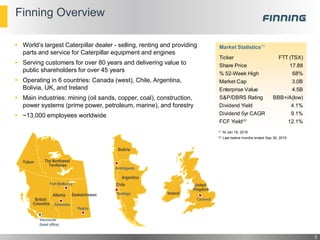
Finning Overview
 World’s largest Caterpillar dealer - selling, renting and providing
parts and service for Caterpillar equipment and engines
 Serving customers for over 80 years and delivering value to
public shareholders for over 45 years
 Operating in 6 countries: Canada (west), Chile, Argentina,
Bolivia, UK, and Ireland
 Main industries: mining (oil sands, copper, coal), construction,
power systems (prime power, petroleum, marine), and forestry
 ~13,000 employees worldwide
3
Vancouver
(head office)
Edmonton
Fort McMurray
British
Columbia
Yukon
Alberta
The Northwest
Territories
Regina
Saskatchewan Santiago
Antofagasta
Bolivia
Argentina
Chile
Cannock
United
Kingdom
Ireland
(1) At Jan 18, 2016
(2) Last twelve months ended Sep 30, 2015
Market Statistics(1)
Ticker FTT (TSX)
Share Price 17.88
% 52-Week High 68%
Market Cap 3.0B
Enterprise Value 4.5B
S&P/DBRS Rating BBB+/A(low)
Dividend Yield 4.1%
Dividend 5yr CAGR 9.1%
FCF Yield(2)
12.1%
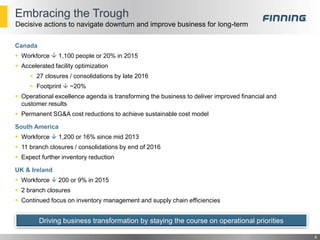
Embracing the Trough
4
Decisive actions to navigate downturn and improve business for long-term
Canada
 Workforce  1,100 people or 20% in 2015
 Accelerated facility optimization
 27 closures / consolidations by late 2016
 Footprint  ~20%
 Operational excellence agenda is transforming the business to deliver improved financial and
customer results
 Permanent SG&A cost reductions to achieve sustainable cost model
South America
 Workforce  1,200 or 16% since mid 2013
 11 branch closures / consolidations by end of 2016
 Expect further inventory reduction
UK & Ireland
 Workforce  200 or 9% in 2015
 2 branch closures
 Continued focus on inventory management and supply chain efficiencies
Driving business transformation by staying the course on operational priorities
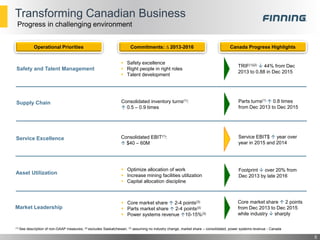
Transforming Canadian Business
5
Safety and Talent Management
Operational Priorities Canada Progress HighlightsCommitments: ∆ 2013-2016
Supply Chain
Service Excellence
Market Leadership
Core market share  2 points
from Dec 2013 to Dec 2015
while industry  sharply
Service EBIT$  year over
year in 2015 and 2014
Parts turns(1)  0.8 times
from Dec 2013 to Dec 2015
TRIF(1)(2)  44% from Dec
2013 to 0.88 in Dec 2015
(1) See description of non-GAAP measures; (2) excludes Saskatchewan; (3) assuming no industry change, market share – consolidated, power systems revenue - Canada
Progress in challenging environment
Consolidated inventory turns(1):
 0.5 – 0.9 times
Consolidated EBIT(1):
 $40 – 60M
 Core market share  2-4 points(3)
 Parts market share  2-4 points(3)
 Power systems revenue 10-15%(3)
 Safety excellence
 Right people in right roles
 Talent development
Asset Utilization
Footprint  over 20% from
Dec 2013 by late 2016
 Optimize allocation of work
 Increase mining facilities utilization
 Capital allocation discipline
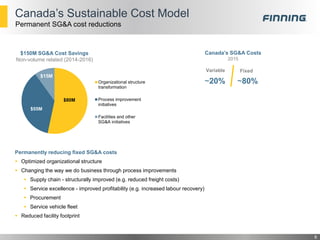
Canada’s Sustainable Cost Model
6
Permanent SG&A cost reductions
$150M SG&A Cost Savings
Non-volume related (2014-2016)
$80M
$55M
$15M
Organizational structure
transformation
Process improvement
initiatives
Facilities and other
SG&A initiatives
Permanently reducing fixed SG&A costs
 Optimized organizational structure
 Changing the way we do business through process improvements
 Supply chain - structurally improved (e.g. reduced freight costs)
 Service excellence - improved profitability (e.g. increased labour recovery)
 Procurement
 Service vehicle fleet
 Reduced facility footprint
~80%
Canada’s SG&A Costs
2015
~20%
Variable Fixed
Resilient Business Model
7
Consistently strong cash flows
$ millions 2012 2013 2014 2015 LTM(1)
EBITDA adjusted(2) 701 736 747 661
Net rental expenditures (93) (73) (35) (28)
Net capital expenditures (113) (74) (63) (48)
Free cash flow – FCF (37) 441 483 363
13%
14%
16%
19%
0%
5%
10%
15%
20%
25%
2012 2013 2014 2015
LTM
Dividends as % of EBITDA
23% 24%
34%
0%
5%
10%
15%
20%
25%
30%
35%
40%
2012 2013 2014 2015
LTM
Dividends as % of FCF
2.2
1.7
1.3
2.2
0.0
0.5
1.0
1.5
2.0
2.5
2012 2013 2014 2015
LTM
Net debt to EBITDA ratio
(2) See description of non-GAAP measures and reconciliation
(1) Last twelve months ended Sep 30, 2015
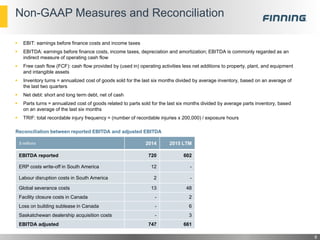
Non-GAAP Measures and Reconciliation
8
 EBIT: earnings before finance costs and income taxes
 EBITDA: earnings before finance costs, income taxes, depreciation and amortization; EBITDA is commonly regarded as an
indirect measure of operating cash flow
 Free cash flow (FCF): cash flow provided by (used in) operating activities less net additions to property, plant, and equipment
and intangible assets
 Inventory turns = annualized cost of goods sold for the last six months divided by average inventory, based on an average of
the last two quarters
 Net debt: short and long term debt, net of cash
 Parts turns = annualized cost of goods related to parts sold for the last six months divided by average parts inventory, based
on an average of the last six months
 TRIF: total recordable injury frequency = (number of recordable injuries x 200,000) / exposure hours
$ millions 2014 2015 LTM
EBITDA reported 720 602
ERP costs write-off in South America 12 -
Labour disruption costs in South America 2 -
Global severance costs 13 48
Facility closure costs in Canada - 2
Loss on building sublease in Canada - 6
Saskatchewan dealership acquisition costs - 3
EBITDA adjusted 747 661
Reconciliation between reported EBITDA and adjusted EBITDA

Cibc whistler conference presentation print final

  • 1.
    INVESTOR PRESENTATION CIBC WhistlerInstitutional Investor Conference January 21, 2016 Scott Thomson, President and CEO, Finning International
  • 2.
    Forward Looking Information 2 Monetaryamounts are in Canadian dollars and from continuing operations unless noted otherwise This report contains statements about the Company’s business outlook, objectives, plans, strategic priorities and other statements that are not historical facts. A statement Finning makes is forward-looking when it uses what the Company knows and expects today to make a statement about the future. Forward-looking statements may include words such as aim, anticipate, assumption, believe, could, expect, goal, guidance, intend, may, objective, outlook, plan, project, seek, should, strategy, strive, target, and will. Forward-looking statements in this report include, but are not limited to, statements with respect to: expectations with respect to the economy and associated impact on the Company’s financial results; expected revenue; expected free cash flow; EBIT margin; ROIC; market share growth; expected results from service excellence action plans; anticipated asset utilization; inventory turns and parts service levels; the expected target range of the Company’s net debt to invested capital ratio; and the expected financial impact from the acquisition of the operating assets of the Caterpillar dealer in Saskatchewan. All such forward-looking statements are made pursuant to the ‘safe harbour’ provisions of applicable Canadian securities laws. Unless otherwise indicated by us, forward-looking statements in this report reflect Finning’s expectations at January 21, 2016. Except as may be required by Canadian securities laws, Finning does not undertake any obligation to update or revise any forward-looking statement, whether as a result of new information, future events, or otherwise. Forward-looking statements, by their very nature, are subject to numerous risks and uncertainties and are based on several assumptions which give rise to the possibility that actual results could differ materially from the expectations expressed in or implied by such forward-looking statements and that Finning’s business outlook, objectives, plans, strategic priorities and other statements that are not historical facts may not be achieved. As a result, Finning cannot guarantee that any forward-looking statement will materialize. Factors that could cause actual results or events to differ materially from those expressed in or implied by these forward- looking statements include: general economic and market conditions; foreign exchange rates; commodity prices; the level of customer confidence and spending, and the demand for, and prices of, Finning’s products and services; Finning’s dependence on the continued market acceptance of Caterpillar’s products and Caterpillar’s timely supply of parts and equipment; Finning’s ability to continue to improve productivity and operational efficiencies while continuing to maintain customer service; Finning’s ability to manage cost pressures as growth in revenue occurs; Finning’s ability to reduce costs in response to slowing activity levels; Finning’s ability to attract sufficient skilled labour resources to meet growing product support demand; Finning’s ability to negotiate and renew collective bargaining agreements with satisfactory terms for Finning’s employees and the Company; the intensity of competitive activity; Finning’s ability to raise the capital needed to implement its business plan; regulatory initiatives or proceedings, litigation and changes in laws or regulations; stock market volatility; changes in political and economic environments for operations; the integrity, reliability, availability and benefits from information technology and the data processed by that technology. Forward-looking statements are provided in this report for the purpose of giving information about management’s current expectations and plans and allowing investors and others to get a better understanding of Finning’s operating environment. However, readers are cautioned that it may not be appropriate to use such forward-looking statements for any other purpose. Forward-looking statements made in this report are based on a number of assumptions that Finning believed were reasonable on the day the Company made the forward-looking statements. Refer in particular to the Outlook section of this MD&A. Some of the assumptions, risks, and other factors which could cause results to differ materially from those expressed in the forward-looking statements contained in this report are discussed in Section 4 of the Company’s current AIF. Finning cautions readers that the risks described in the AIF are not the only ones that could impact the Company. Additional risks and uncertainties not currently known to the Company or that are currently deemed to be immaterial may also have a material adverse effect on Finning’s business, financial condition, or results of operations. Except as otherwise indicated, forward-looking statements do not reflect the potential impact of any non-recurring or other unusual items or of any dispositions, mergers, acquisitions, other business combinations or other transactions that may be announced or that may occur after the date hereof. The financial impact of these transactions and non-recurring and other unusual items can be complex and depends on the facts particular to each of them. Finning therefore cannot describe the expected impact in a meaningful way or in the same way Finning presents known risks affecting its business.
  • 3.
    Finning Overview  World’slargest Caterpillar dealer - selling, renting and providing parts and service for Caterpillar equipment and engines  Serving customers for over 80 years and delivering value to public shareholders for over 45 years  Operating in 6 countries: Canada (west), Chile, Argentina, Bolivia, UK, and Ireland  Main industries: mining (oil sands, copper, coal), construction, power systems (prime power, petroleum, marine), and forestry  ~13,000 employees worldwide 3 Vancouver (head office) Edmonton Fort McMurray British Columbia Yukon Alberta The Northwest Territories Regina Saskatchewan Santiago Antofagasta Bolivia Argentina Chile Cannock United Kingdom Ireland (1) At Jan 18, 2016 (2) Last twelve months ended Sep 30, 2015 Market Statistics(1) Ticker FTT (TSX) Share Price 17.88 % 52-Week High 68% Market Cap 3.0B Enterprise Value 4.5B S&P/DBRS Rating BBB+/A(low) Dividend Yield 4.1% Dividend 5yr CAGR 9.1% FCF Yield(2) 12.1%
  • 4.
    Embracing the Trough 4 Decisiveactions to navigate downturn and improve business for long-term Canada  Workforce  1,100 people or 20% in 2015  Accelerated facility optimization  27 closures / consolidations by late 2016  Footprint  ~20%  Operational excellence agenda is transforming the business to deliver improved financial and customer results  Permanent SG&A cost reductions to achieve sustainable cost model South America  Workforce  1,200 or 16% since mid 2013  11 branch closures / consolidations by end of 2016  Expect further inventory reduction UK & Ireland  Workforce  200 or 9% in 2015  2 branch closures  Continued focus on inventory management and supply chain efficiencies Driving business transformation by staying the course on operational priorities
  • 5.
    Transforming Canadian Business 5 Safetyand Talent Management Operational Priorities Canada Progress HighlightsCommitments: ∆ 2013-2016 Supply Chain Service Excellence Market Leadership Core market share  2 points from Dec 2013 to Dec 2015 while industry  sharply Service EBIT$  year over year in 2015 and 2014 Parts turns(1)  0.8 times from Dec 2013 to Dec 2015 TRIF(1)(2)  44% from Dec 2013 to 0.88 in Dec 2015 (1) See description of non-GAAP measures; (2) excludes Saskatchewan; (3) assuming no industry change, market share – consolidated, power systems revenue - Canada Progress in challenging environment Consolidated inventory turns(1):  0.5 – 0.9 times Consolidated EBIT(1):  $40 – 60M  Core market share  2-4 points(3)  Parts market share  2-4 points(3)  Power systems revenue 10-15%(3)  Safety excellence  Right people in right roles  Talent development Asset Utilization Footprint  over 20% from Dec 2013 by late 2016  Optimize allocation of work  Increase mining facilities utilization  Capital allocation discipline
  • 6.
    Canada’s Sustainable CostModel 6 Permanent SG&A cost reductions $150M SG&A Cost Savings Non-volume related (2014-2016) $80M $55M $15M Organizational structure transformation Process improvement initiatives Facilities and other SG&A initiatives Permanently reducing fixed SG&A costs  Optimized organizational structure  Changing the way we do business through process improvements  Supply chain - structurally improved (e.g. reduced freight costs)  Service excellence - improved profitability (e.g. increased labour recovery)  Procurement  Service vehicle fleet  Reduced facility footprint ~80% Canada’s SG&A Costs 2015 ~20% Variable Fixed
  • 7.
    Resilient Business Model 7 Consistentlystrong cash flows $ millions 2012 2013 2014 2015 LTM(1) EBITDA adjusted(2) 701 736 747 661 Net rental expenditures (93) (73) (35) (28) Net capital expenditures (113) (74) (63) (48) Free cash flow – FCF (37) 441 483 363 13% 14% 16% 19% 0% 5% 10% 15% 20% 25% 2012 2013 2014 2015 LTM Dividends as % of EBITDA 23% 24% 34% 0% 5% 10% 15% 20% 25% 30% 35% 40% 2012 2013 2014 2015 LTM Dividends as % of FCF 2.2 1.7 1.3 2.2 0.0 0.5 1.0 1.5 2.0 2.5 2012 2013 2014 2015 LTM Net debt to EBITDA ratio (2) See description of non-GAAP measures and reconciliation (1) Last twelve months ended Sep 30, 2015
  • 8.
    Non-GAAP Measures andReconciliation 8  EBIT: earnings before finance costs and income taxes  EBITDA: earnings before finance costs, income taxes, depreciation and amortization; EBITDA is commonly regarded as an indirect measure of operating cash flow  Free cash flow (FCF): cash flow provided by (used in) operating activities less net additions to property, plant, and equipment and intangible assets  Inventory turns = annualized cost of goods sold for the last six months divided by average inventory, based on an average of the last two quarters  Net debt: short and long term debt, net of cash  Parts turns = annualized cost of goods related to parts sold for the last six months divided by average parts inventory, based on an average of the last six months  TRIF: total recordable injury frequency = (number of recordable injuries x 200,000) / exposure hours $ millions 2014 2015 LTM EBITDA reported 720 602 ERP costs write-off in South America 12 - Labour disruption costs in South America 2 - Global severance costs 13 48 Facility closure costs in Canada - 2 Loss on building sublease in Canada - 6 Saskatchewan dealership acquisition costs - 3 EBITDA adjusted 747 661 Reconciliation between reported EBITDA and adjusted EBITDA