Time and the Ages
Making sense of time
• 2014 – what does this mean?
• Time has been going for longer than this
• Dates back to thousands of years before
• Capture an accurate sense of history we must
have a system to keep track of time
• ‘Gregorian calendar’
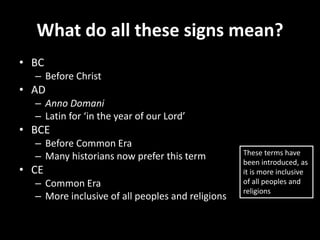
What do all these signs mean?
• BC
– Before Christ
• AD
– Anno Domani
– Latin for ‘in the year of our Lord’
• BCE
– Before Common Era
– Many historians now prefer this term
• CE
– Common Era
– More inclusive of all peoples and religions
These terms have
been introduced, as
it is more inclusive
of all peoples and
religions
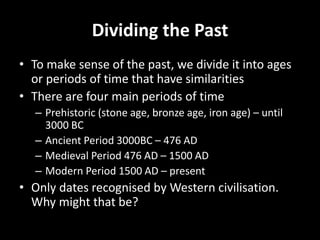
Dividing the Past
• To make sense of the past, we divide it into ages
or periods of time that have similarities
• There are four main periods of time
– Prehistoric (stone age, bronze age, iron age) – until
3000 BC
– Ancient Period 3000BC – 476 AD
– Medieval Period 476 AD – 1500 AD
– Modern Period 1500 AD – present
• Only dates recognised by Western civilisation.
Why might that be?
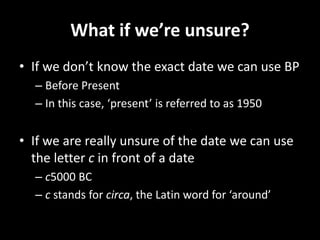
What if we’re unsure?
• If we don’t know the exact date we can use BP
– Before Present
– In this case, ‘present’ is referred to as 1950
• If we are really unsure of the date we can use
the letter c in front of a date
– c5000 BC
– c stands for circa, the Latin word for ‘around’
How do we keep track of history?
• The best stories are told from start to finish
• History makes more sense in a chronological
order
• Timelines help us view the worlds history
• It arranges a number of events in chronological
order
• Helps us view what has happened in relation to
other things that have happened
• How one event has led onto another
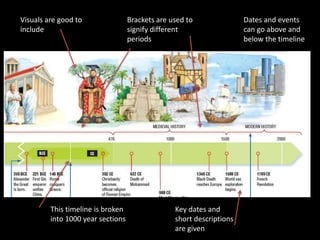
Visuals are good to
include
Dates and events
can go above and
below the timeline
This timeline is broken
into 1000 year sections
Key dates and
short descriptions
are given
Brackets are used to
signify different
periods
Timelines
• Timelines can show periods of time dating
back to as far as possible that we know
• Timelines can also represent a more personal
history, for example the span of your life and
the important things that have happened
• Timelines can represent anything from the
history of an organisation, your pets life or the
entire history of the world
Activity
• Create a timeline that represents your life
• The beginning will represent when you were born and
the end will represent the present
• Include important events that have meant something
to you during your life
– It could be starting school,
• MAKE SURE YOU REMEMBER…
– Include the dates
– Small annotations explaining the events
– 2cm scale for each year
– Pictures

Time and ages powerpoint

  • 1.
  • 3.
    Making sense oftime • 2014 – what does this mean? • Time has been going for longer than this • Dates back to thousands of years before • Capture an accurate sense of history we must have a system to keep track of time • ‘Gregorian calendar’
  • 4.
    What do allthese signs mean? • BC – Before Christ • AD – Anno Domani – Latin for ‘in the year of our Lord’ • BCE – Before Common Era – Many historians now prefer this term • CE – Common Era – More inclusive of all peoples and religions These terms have been introduced, as it is more inclusive of all peoples and religions
  • 5.
    Dividing the Past •To make sense of the past, we divide it into ages or periods of time that have similarities • There are four main periods of time – Prehistoric (stone age, bronze age, iron age) – until 3000 BC – Ancient Period 3000BC – 476 AD – Medieval Period 476 AD – 1500 AD – Modern Period 1500 AD – present • Only dates recognised by Western civilisation. Why might that be?
  • 6.
    What if we’reunsure? • If we don’t know the exact date we can use BP – Before Present – In this case, ‘present’ is referred to as 1950 • If we are really unsure of the date we can use the letter c in front of a date – c5000 BC – c stands for circa, the Latin word for ‘around’
  • 7.
    How do wekeep track of history? • The best stories are told from start to finish • History makes more sense in a chronological order • Timelines help us view the worlds history • It arranges a number of events in chronological order • Helps us view what has happened in relation to other things that have happened • How one event has led onto another
  • 8.
    Visuals are goodto include Dates and events can go above and below the timeline This timeline is broken into 1000 year sections Key dates and short descriptions are given Brackets are used to signify different periods
  • 9.
    Timelines • Timelines canshow periods of time dating back to as far as possible that we know • Timelines can also represent a more personal history, for example the span of your life and the important things that have happened • Timelines can represent anything from the history of an organisation, your pets life or the entire history of the world
  • 10.
    Activity • Create atimeline that represents your life • The beginning will represent when you were born and the end will represent the present • Include important events that have meant something to you during your life – It could be starting school, • MAKE SURE YOU REMEMBER… – Include the dates – Small annotations explaining the events – 2cm scale for each year – Pictures