Chronicle workshops
Doing it differently
Sisse Grøn
sig@teamarbejdsliv.dk
IEA Melbourne, 2015
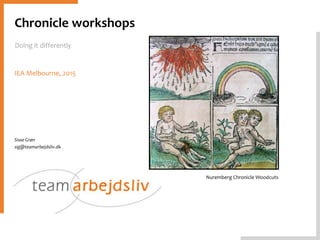
Nuremberg Chronicle Woodcuts
THE POTENTIAL
”Wow, we have come a long way, we are quite good…it takes
professionalism to do what we have done. It shows how easy it
is to let things get out of hand and how important we are in a
child’s life…the child’s ambassador”
(Reflexion from a cronicle workshop for child-care workers)
2
25-11-2016
INTRODUCTION
• A method to facilitate a structured group-based process
centered around the group’s history
• Inspired by action research, narrative sociology,
organizational theory
Participative
Democratic ideal
• It can be data collection
• Or serve the aim of the organization
• It is strongly engaging and rewarding for the participants
3
25-11-2016
HOW TO DO IT - PREPARATION
• Selection
Variety
Group size
• Clarify objective and expected outcome
• Write a detailed program
• Set the scene
Bare wall and round circle without tables
Establish a pre-defined time-line
Write headings
Bring post-its in different colors and pens
4
25-11-2016
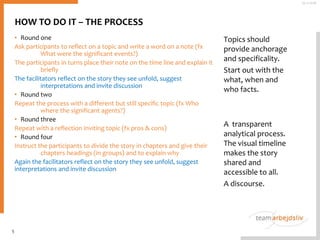
• Round one
Ask participants to reflect on a topic and write a word on a note (fx
What were the significant events?)
The participants in turns place their note on the time line and explain it
briefly
The facilitators reflect on the story they see unfold, suggest
interpretations and invite discussion
• Round two
Repeat the process with a different but still specific topic (fx Who
where the significant agents?)
• Round three
Repeat with a reflection inviting topic (fx pros & cons)
• Round four
Instruct the participants to divide the story in chapters and give their
chapters headings (in groups) and to explain why
Again the facilitators reflect on the story they see unfold, suggest
interpretations and invite discussion
Topics should
provide anchorage
and specificality.
Start out with the
what, when and
who facts.
A transparent
analytical process.
The visual timeline
makes the story
shared and
accessible to all.
A discourse.
5
25-11-2016
HOW TO DO IT – THE PROCESS
HOW TO DO IT – FOLLOW UP
• Document the process (two or more facilitators works best)
• Report it to the organisation – write it up
• Use it as data
For the participants the proces is usually a positive experience, but the
knowledge is internalised, thus it can be an invisible result.
For researchers it serves well as data, if the process is documented.
6
25-11-2016
THE FIREFLY
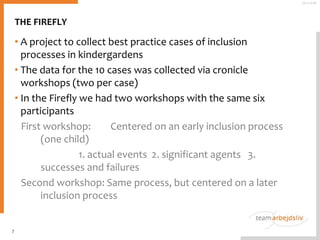
• A project to collect best practice cases of inclusion
processes in kindergardens
• The data for the 10 cases was collected via cronicle
workshops (two per case)
• In the Firefly we had two workshops with the same six
participants
First workshop: Centered on an early inclusion process
(one child)
1. actual events 2. significant agents 3.
successes and failures
Second workshop: Same process, but centered on a later
inclusion process
7
25-11-2016
THE FIREFLY
8
25-11-2016
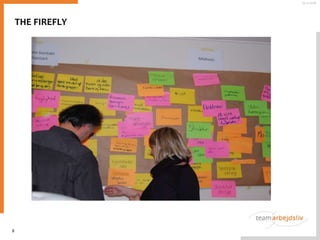
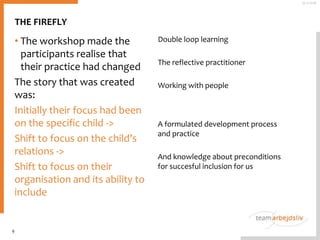
• The workshop made the
participants realise that
their practice had changed
The story that was created
was:
Initially their focus had been
on the specific child ->
Shift to focus on the child’s
relations ->
Shift to focus on their
organisation and its ability to
include
Double loop learning
The reflective practitioner
Working with people
A formulated development process
and practice
And knowledge about preconditions
for succesful inclusion for us
9
25-11-2016
THE FIREFLY
LOOP
”Wow, we have come a long way, we are quite good…it takes
professionalism to do what we have done. It shows how easy it
is to let things get out of hand and how important we are in a
child’s life…the child’s ambassador”
(Reflexion from a cronicle workshop for child-care workers)
10
25-11-2016
LIMITATIONS
• Works best with reflective practitioners
• Who likes to talk
• And a group that actually has a shared story
• It tends to disguise discrepancies
• Bullying and harassments are not suitable topics
11
25-11-2016

Chronicle workshops

  • 1.
    Chronicle workshops Doing itdifferently Sisse Grøn sig@teamarbejdsliv.dk IEA Melbourne, 2015 Nuremberg Chronicle Woodcuts
  • 2.
    THE POTENTIAL ”Wow, wehave come a long way, we are quite good…it takes professionalism to do what we have done. It shows how easy it is to let things get out of hand and how important we are in a child’s life…the child’s ambassador” (Reflexion from a cronicle workshop for child-care workers) 2 25-11-2016
  • 3.
    INTRODUCTION • A methodto facilitate a structured group-based process centered around the group’s history • Inspired by action research, narrative sociology, organizational theory Participative Democratic ideal • It can be data collection • Or serve the aim of the organization • It is strongly engaging and rewarding for the participants 3 25-11-2016
  • 4.
    HOW TO DOIT - PREPARATION • Selection Variety Group size • Clarify objective and expected outcome • Write a detailed program • Set the scene Bare wall and round circle without tables Establish a pre-defined time-line Write headings Bring post-its in different colors and pens 4 25-11-2016
  • 5.
    • Round one Askparticipants to reflect on a topic and write a word on a note (fx What were the significant events?) The participants in turns place their note on the time line and explain it briefly The facilitators reflect on the story they see unfold, suggest interpretations and invite discussion • Round two Repeat the process with a different but still specific topic (fx Who where the significant agents?) • Round three Repeat with a reflection inviting topic (fx pros & cons) • Round four Instruct the participants to divide the story in chapters and give their chapters headings (in groups) and to explain why Again the facilitators reflect on the story they see unfold, suggest interpretations and invite discussion Topics should provide anchorage and specificality. Start out with the what, when and who facts. A transparent analytical process. The visual timeline makes the story shared and accessible to all. A discourse. 5 25-11-2016 HOW TO DO IT – THE PROCESS
  • 6.
    HOW TO DOIT – FOLLOW UP • Document the process (two or more facilitators works best) • Report it to the organisation – write it up • Use it as data For the participants the proces is usually a positive experience, but the knowledge is internalised, thus it can be an invisible result. For researchers it serves well as data, if the process is documented. 6 25-11-2016
  • 7.
    THE FIREFLY • Aproject to collect best practice cases of inclusion processes in kindergardens • The data for the 10 cases was collected via cronicle workshops (two per case) • In the Firefly we had two workshops with the same six participants First workshop: Centered on an early inclusion process (one child) 1. actual events 2. significant agents 3. successes and failures Second workshop: Same process, but centered on a later inclusion process 7 25-11-2016
  • 8.
  • 9.
    • The workshopmade the participants realise that their practice had changed The story that was created was: Initially their focus had been on the specific child -> Shift to focus on the child’s relations -> Shift to focus on their organisation and its ability to include Double loop learning The reflective practitioner Working with people A formulated development process and practice And knowledge about preconditions for succesful inclusion for us 9 25-11-2016 THE FIREFLY
  • 10.
    LOOP ”Wow, we havecome a long way, we are quite good…it takes professionalism to do what we have done. It shows how easy it is to let things get out of hand and how important we are in a child’s life…the child’s ambassador” (Reflexion from a cronicle workshop for child-care workers) 10 25-11-2016
  • 11.
    LIMITATIONS • Works bestwith reflective practitioners • Who likes to talk • And a group that actually has a shared story • It tends to disguise discrepancies • Bullying and harassments are not suitable topics 11 25-11-2016