CHRONIC BRONCHITIS
BY BHAVIN CHAUHAN
Chronic bronchitis
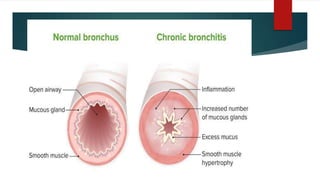
Chronic bronchitis is defined as
persistent cough with sputum
production for at least 3 months in at
least 2 consecutive years.

Etiology
 Cigarette smoking – Most common cause
 Air pollutants
 Toxic industrial inhalants
 Respiratory tract infection
Clinical features
 Persistent cough with sputum production
 Fever
 Wheezing and tightness of chest
 Breathlessness-late in onset
 Blue boaters-distinctive clinical pattern seen in chronic
bronchitis; Low pao2,high paco2 ,right heart failure
Clinical features
 Usually affect middle – aged men
who are heavy smokers
 Early symptoms – Persistent
productive cough for many years,
fever
Later stage
 Dyspnea on exertion
 Blue boaters : Pts. Develop
Hypercapnia, hypoxemia and
mild cyanosis.
Leading causes of death in COPD
 Respiratory failure
 Lung cancer
 Cardiovascular disease
PT assessment
 [A] General assessment
 demographic data:
 Name-
 Age-
 Gender-
 BMI-
 Occupation-
 Provisional diagnosis-chronic bronchitis
.
 Chief complaints:he/she feels difficulty in breathing,early
morning cough since many years.
 History:
 1.h/o present illness:
 2.h/o past medical or surgical conditions
 3.h/o family:
 .4.personal habits: smoking
 5.h/o environmental:ask about their residence and type of
workplace
[C] subjective assessment
1.breathlessness
o Progressive exertional dyspnea
o Duration:
o Severity (assessed by NYHA scale)
o Pattern: orthopnea
o Precipitating factors: on exertion,exposure with pollutants
o Relieving factors:rest,bronchodilators
 2.Cough-present
o Type: chronic productive cough
o Frequency: It is intermittent in initial stage,and becomes
continuous progressively.
o Duration: morning
o Severity: increased by infections, fog,worst in winter season.
 3.Sputum:-present
o Color-white(without infection)
o Smell-
o Quantity-
o Grade-mucoid(without infection),
if infection present -mucopurulent sputum
 4.hemoptysis:-may be present
 5.wheeze: present during expiration.
Wheeze-More during morning and in winter
 6.chest pain: absent
 Other symptoms: fever in acute exacerbation,
Fatigue, peripheral edema
[D]objective assessment
 On observation:
1.General observation:-
o Level of consciousness-alert
o General health and body built:-obese in blue boaters.
o cyanosis-present
o Peripheral cyanosis
2.observation of chest:
o Shape-barrel shaped chest
o Breathing pattern-abnormal apical breathing
o Use of accessory muscles-present
 3.JVP-increased
4.Extremities:
clubbing-absent
Edema-Peripheral
 On palpation:-
 chest expansion-Reduced thoracic movt.
 Paradoxical indrawing develops.
 Vocal fremitus-heard
 Position of trachea-midline
 On percussion:hyperresonance
 On examination:-
 Vitals:- RR decreased in exacerbation
 Chest expansion:-
 Auscultation (heart sounds):-S1 and S2 present
 Breath sound: Vesicular sound with Prolonged expiration; rhonchi
may be heard
 ROM :-shoulder joint reduced, thoracic spine reduced
 Exercise tolerance -Reduced
 Investigations
 PFT:-reduced FEV1/FVC
 ABG:-paco2 increased,pao2 decreased
 Chest x ray:-no characteristic abnormality in early
stages
 ECG-show features of right atrial and ventricular
hypertrophy; Tall p waves.
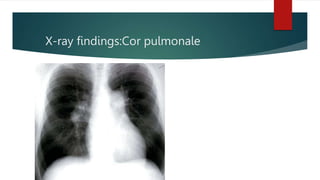
X-ray findings:Cor pulmonale
Impairments
Impairments:-
1.Structural impairments:-Obstruction of airways peripheral
cyanosis,Weight loss and cor pulmonale in later stages
2. Functional impairments:-increased work of breathing,decreased
endurance,Patient easily get tired (Fatigue),
Thank you

Chronic bronchitis Physio assessment.pptx

  • 1.
  • 2.
    Chronic bronchitis Chronic bronchitisis defined as persistent cough with sputum production for at least 3 months in at least 2 consecutive years.
  • 3.
  • 4.
    Etiology  Cigarette smoking– Most common cause  Air pollutants  Toxic industrial inhalants  Respiratory tract infection
  • 5.
    Clinical features  Persistentcough with sputum production  Fever  Wheezing and tightness of chest  Breathlessness-late in onset  Blue boaters-distinctive clinical pattern seen in chronic bronchitis; Low pao2,high paco2 ,right heart failure
  • 6.
    Clinical features  Usuallyaffect middle – aged men who are heavy smokers  Early symptoms – Persistent productive cough for many years, fever Later stage  Dyspnea on exertion  Blue boaters : Pts. Develop Hypercapnia, hypoxemia and mild cyanosis.
  • 7.
    Leading causes ofdeath in COPD  Respiratory failure  Lung cancer  Cardiovascular disease
  • 8.
    PT assessment  [A]General assessment  demographic data:  Name-  Age-  Gender-  BMI-  Occupation-  Provisional diagnosis-chronic bronchitis
  • 9.
    .  Chief complaints:he/shefeels difficulty in breathing,early morning cough since many years.  History:  1.h/o present illness:  2.h/o past medical or surgical conditions  3.h/o family:  .4.personal habits: smoking  5.h/o environmental:ask about their residence and type of workplace
  • 10.
    [C] subjective assessment 1.breathlessness oProgressive exertional dyspnea o Duration: o Severity (assessed by NYHA scale) o Pattern: orthopnea o Precipitating factors: on exertion,exposure with pollutants o Relieving factors:rest,bronchodilators
  • 11.
     2.Cough-present o Type:chronic productive cough o Frequency: It is intermittent in initial stage,and becomes continuous progressively. o Duration: morning o Severity: increased by infections, fog,worst in winter season.
  • 12.
     3.Sputum:-present o Color-white(withoutinfection) o Smell- o Quantity- o Grade-mucoid(without infection), if infection present -mucopurulent sputum
  • 13.
     4.hemoptysis:-may bepresent  5.wheeze: present during expiration. Wheeze-More during morning and in winter  6.chest pain: absent  Other symptoms: fever in acute exacerbation, Fatigue, peripheral edema
  • 14.
    [D]objective assessment  Onobservation: 1.General observation:- o Level of consciousness-alert o General health and body built:-obese in blue boaters. o cyanosis-present o Peripheral cyanosis 2.observation of chest: o Shape-barrel shaped chest o Breathing pattern-abnormal apical breathing o Use of accessory muscles-present
  • 15.
     3.JVP-increased 4.Extremities: clubbing-absent Edema-Peripheral  Onpalpation:-  chest expansion-Reduced thoracic movt.  Paradoxical indrawing develops.  Vocal fremitus-heard  Position of trachea-midline  On percussion:hyperresonance
  • 16.
     On examination:- Vitals:- RR decreased in exacerbation  Chest expansion:-  Auscultation (heart sounds):-S1 and S2 present  Breath sound: Vesicular sound with Prolonged expiration; rhonchi may be heard  ROM :-shoulder joint reduced, thoracic spine reduced  Exercise tolerance -Reduced
  • 17.
     Investigations  PFT:-reducedFEV1/FVC  ABG:-paco2 increased,pao2 decreased  Chest x ray:-no characteristic abnormality in early stages  ECG-show features of right atrial and ventricular hypertrophy; Tall p waves.
  • 18.
  • 20.
    Impairments Impairments:- 1.Structural impairments:-Obstruction ofairways peripheral cyanosis,Weight loss and cor pulmonale in later stages 2. Functional impairments:-increased work of breathing,decreased endurance,Patient easily get tired (Fatigue),
  • 21.