
Yue Liao, MPH
Genevieve Dunton, PhD, MPH
University of Southern California
Institute for Health Promotion & Disease Prevention Research
Presented at the 36th Annual Meeting of the Society of Behavioral Medicine
April, 2015
How Morning Cognitive and Feeling States Predict
Daily Physical Activity Levels amongAdults
Cognitive Factors, Affective Feelings,
and Physical Activity
 Cognitive factors have been shown as correlates
of physical activity
 Self-efficacy
 Outcome expectancy
 Intention
 Affective feelings can influence one’s cognitive
factors in relation to physical activity
 Negative affect (e.g., stress) as a barrier
to habitual physical activity
Rhodes & Nigg, 2011; Bauman et al., 2012; Loehr et al., 2014; Schwabe & Wolf,
Current Research Gap
 Most studies examined the inter-individual
(i.e., between person) effects of
cognitive/affective variables on physical
activity levels
 Treat these variables as a static (“global”) construct
for each person
 Short-term intra-individual (i.e., within person)
effects might offer new insights and implications for
theory and intervention development
Aims of Current Study
 Use Ecological Momentary Assessment (EMA) to
capture adults’ cognitive and feeling states in the
morning of their daily lives
 EMA – a real-time self-report method to measure
current behaviors, cognitive/feeling states
repeatedly in people’s everyday lives
 Examine whether one’s morning cognitive and
feeling states predict his/her physical activity
levels during that day
Methods
 110 adults from Project MOBILE
 Mean age = 40.8 (SD = 9.8)
 72% female
 30% Hispanic
 63% overweight/obese
 An electronic EMA survey was delivered via a
mobile app each morning between 6:30-6:45 am
for up to 12 days
 3 waves of 4 consecutive days
 each wave separated by 6 months in between
 each wave consisted of 2 weekdays and 2 weekend
days
Measures – EMA Surveys
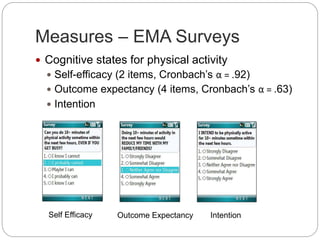
 Cognitive states for physical activity
 Self-efficacy (2 items, Cronbach’s α = .92)
 Outcome expectancy (4 items, Cronbach’s α = .63)
 Intention
Self Efficacy Outcome Expectancy Intention
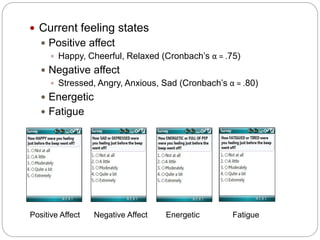
Positive Affect Negative Affect Energetic Fatigue
 Current feeling states
 Positive affect
 Happy, Cheerful, Relaxed (Cronbach’s α = .75)
 Negative affect
 Stressed, Angry, Anxious, Sad (Cronbach’s α = .80)
 Energetic
 Fatigue
Measures - Physical Activity
 Accelerometer (Actigraph GT2M) was worn
around the waist during waking hours across the
12 monitoring days
 Activity counts were converted to total moderate-
to-vigorous physical activity (MVPA) minutes for
each day
 MVPA was defined as 2,020 activity counts per
minute
 Only included valid days for analysis
Belcher et al., 2010; Troiano et al., 2008
Data Analysis
 Multilevel linear regression model
 Outcome: Total MVPA minutes of each day
 Predictor: Morning cognitive/feeling state of that day
 Within-person effect: one’s cognitive/feeling state relative to
his/her usual level in the morning
 Between-person effect: one’s usual cognitive/feeling state
relative to the group mean
 All models controlled for age, gender, ethnicity, and
weight status
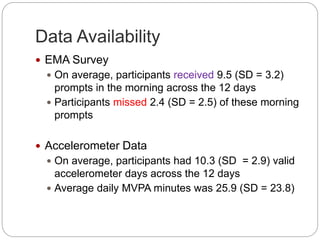
Data Availability
 EMA Survey
 On average, participants received 9.5 (SD = 3.2)
prompts in the morning across the 12 days
 Participants missed 2.4 (SD = 2.5) of these morning
prompts
 Accelerometer Data
 On average, participants had 10.3 (SD = 2.9) valid
accelerometer days across the 12 days
 Average daily MVPA minutes was 25.9 (SD = 23.8)
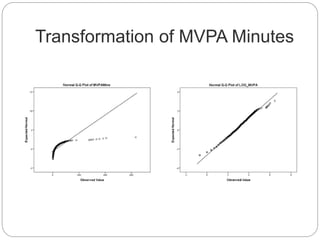
Transformation of MVPA Minutes
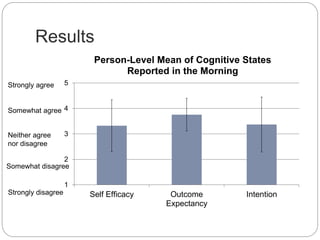
Results
1
2
3
4
5
Self Efficacy Outcome
Expectancy
Intention
Person-Level Mean of Cognitive States
Reported in the Morning
Strongly disagree
Somewhat disagree
Neither agree
nor disagree
Somewhat agree
Strongly agree
1
2
3
4
5
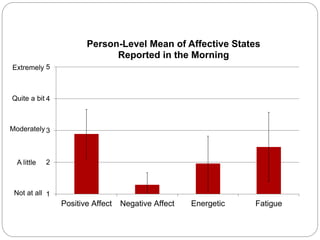
Positive Affect Negative Affect Energetic Fatigue
Person-Level Mean of Affective States
Reported in the Morning
Not at all
A little
Moderately
Quite a bit
Extremely
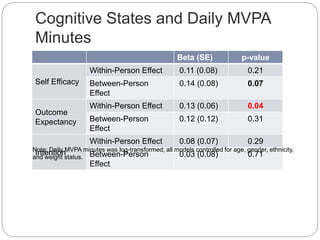
Cognitive States and Daily MVPA
Minutes
Beta (SE) p-value
Self Efficacy
Within-Person Effect 0.11 (0.08) 0.21
Between-Person
Effect
0.14 (0.08) 0.07
Outcome
Expectancy
Within-Person Effect 0.13 (0.06) 0.04
Between-Person
Effect
0.12 (0.12) 0.31
Intention
Within-Person Effect 0.08 (0.07) 0.29
Between-Person
Effect
0.03 (0.08) 0.71
Note: Daily MVPA minutes was log-transformed; all models controlled for age, gender, ethnicity,
and weight status.
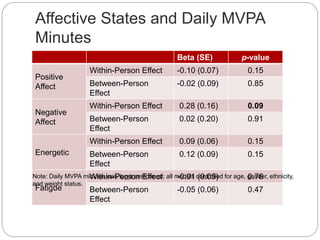
Affective States and Daily MVPA
Minutes
Beta (SE) p-value
Positive
Affect
Within-Person Effect -0.10 (0.07) 0.15
Between-Person
Effect
-0.02 (0.09) 0.85
Negative
Affect
Within-Person Effect 0.28 (0.16) 0.09
Between-Person
Effect
0.02 (0.20) 0.91
Energetic
Within-Person Effect 0.09 (0.06) 0.15
Between-Person
Effect
0.12 (0.09) 0.15
Fatigue
Within-Person Effect -0.01 (0.05) 0.76
Between-Person
Effect
-0.05 (0.06) 0.47
Note: Daily MVPA minutes was log-transformed; all models controlled for age, gender, ethnicity,
and weight status.
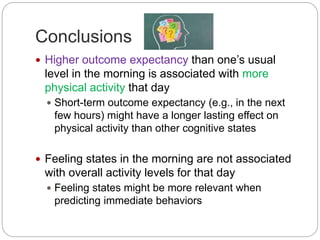
Conclusions
 Higher outcome expectancy than one’s usual
level in the morning is associated with more
physical activity that day
 Short-term outcome expectancy (e.g., in the next
few hours) might have a longer lasting effect on
physical activity than other cognitive states
 Feeling states in the morning are not associated
with overall activity levels for that day
 Feeling states might be more relevant when
predicting immediate behaviors
Limitations
 Short monitoring period
 A pre-set morning prompting schedule might not
reflect people’s different waking times
 Limited EMA items for each cognitive/feeling state
construct
Future Directions
 Use EMA data to explore the multilevel
mediational effect of cognitive state, feeling state,
and physical activity level
 Interventions could focus on how to boost
people’s short-term (e.g., in the next few hours)
cognitive factors to promote daily physical activity
 Especially given the recent evidence that short
bouts of physical activity can be health beneficial
Fan et al., 2013; Loprinzi & Cardinal, 20
Acknowledgements
 Funding agency
 American Cancer Society 118283-MRSGT-10-012-01-
CPPB (Dunton, PI)
 Participants
 App programmer
 Jennifer Beaudin, S. M. (Massachusetts Institute of
Technology)
 Project staff
 Keito Kawabata (Project Manager)
 Student interns

Morning Cognitive States Predict Daily Physical Activity Levels - Findings from an EMA Mobile Phone Study

  • 1.
    Yue Liao, MPH GenevieveDunton, PhD, MPH University of Southern California Institute for Health Promotion & Disease Prevention Research Presented at the 36th Annual Meeting of the Society of Behavioral Medicine April, 2015 How Morning Cognitive and Feeling States Predict Daily Physical Activity Levels amongAdults
  • 2.
    Cognitive Factors, AffectiveFeelings, and Physical Activity  Cognitive factors have been shown as correlates of physical activity  Self-efficacy  Outcome expectancy  Intention  Affective feelings can influence one’s cognitive factors in relation to physical activity  Negative affect (e.g., stress) as a barrier to habitual physical activity Rhodes & Nigg, 2011; Bauman et al., 2012; Loehr et al., 2014; Schwabe & Wolf,
  • 3.
    Current Research Gap Most studies examined the inter-individual (i.e., between person) effects of cognitive/affective variables on physical activity levels  Treat these variables as a static (“global”) construct for each person  Short-term intra-individual (i.e., within person) effects might offer new insights and implications for theory and intervention development
  • 4.
    Aims of CurrentStudy  Use Ecological Momentary Assessment (EMA) to capture adults’ cognitive and feeling states in the morning of their daily lives  EMA – a real-time self-report method to measure current behaviors, cognitive/feeling states repeatedly in people’s everyday lives  Examine whether one’s morning cognitive and feeling states predict his/her physical activity levels during that day
  • 5.
    Methods  110 adultsfrom Project MOBILE  Mean age = 40.8 (SD = 9.8)  72% female  30% Hispanic  63% overweight/obese  An electronic EMA survey was delivered via a mobile app each morning between 6:30-6:45 am for up to 12 days  3 waves of 4 consecutive days  each wave separated by 6 months in between  each wave consisted of 2 weekdays and 2 weekend days
  • 6.
    Measures – EMASurveys  Cognitive states for physical activity  Self-efficacy (2 items, Cronbach’s α = .92)  Outcome expectancy (4 items, Cronbach’s α = .63)  Intention Self Efficacy Outcome Expectancy Intention
  • 7.
    Positive Affect NegativeAffect Energetic Fatigue  Current feeling states  Positive affect  Happy, Cheerful, Relaxed (Cronbach’s α = .75)  Negative affect  Stressed, Angry, Anxious, Sad (Cronbach’s α = .80)  Energetic  Fatigue
  • 8.
    Measures - PhysicalActivity  Accelerometer (Actigraph GT2M) was worn around the waist during waking hours across the 12 monitoring days  Activity counts were converted to total moderate- to-vigorous physical activity (MVPA) minutes for each day  MVPA was defined as 2,020 activity counts per minute  Only included valid days for analysis Belcher et al., 2010; Troiano et al., 2008
  • 9.
    Data Analysis  Multilevellinear regression model  Outcome: Total MVPA minutes of each day  Predictor: Morning cognitive/feeling state of that day  Within-person effect: one’s cognitive/feeling state relative to his/her usual level in the morning  Between-person effect: one’s usual cognitive/feeling state relative to the group mean  All models controlled for age, gender, ethnicity, and weight status
  • 10.
    Data Availability  EMASurvey  On average, participants received 9.5 (SD = 3.2) prompts in the morning across the 12 days  Participants missed 2.4 (SD = 2.5) of these morning prompts  Accelerometer Data  On average, participants had 10.3 (SD = 2.9) valid accelerometer days across the 12 days  Average daily MVPA minutes was 25.9 (SD = 23.8)
  • 11.
  • 12.
    Results 1 2 3 4 5 Self Efficacy Outcome Expectancy Intention Person-LevelMean of Cognitive States Reported in the Morning Strongly disagree Somewhat disagree Neither agree nor disagree Somewhat agree Strongly agree
  • 13.
    1 2 3 4 5 Positive Affect NegativeAffect Energetic Fatigue Person-Level Mean of Affective States Reported in the Morning Not at all A little Moderately Quite a bit Extremely
  • 14.
    Cognitive States andDaily MVPA Minutes Beta (SE) p-value Self Efficacy Within-Person Effect 0.11 (0.08) 0.21 Between-Person Effect 0.14 (0.08) 0.07 Outcome Expectancy Within-Person Effect 0.13 (0.06) 0.04 Between-Person Effect 0.12 (0.12) 0.31 Intention Within-Person Effect 0.08 (0.07) 0.29 Between-Person Effect 0.03 (0.08) 0.71 Note: Daily MVPA minutes was log-transformed; all models controlled for age, gender, ethnicity, and weight status.
  • 15.
    Affective States andDaily MVPA Minutes Beta (SE) p-value Positive Affect Within-Person Effect -0.10 (0.07) 0.15 Between-Person Effect -0.02 (0.09) 0.85 Negative Affect Within-Person Effect 0.28 (0.16) 0.09 Between-Person Effect 0.02 (0.20) 0.91 Energetic Within-Person Effect 0.09 (0.06) 0.15 Between-Person Effect 0.12 (0.09) 0.15 Fatigue Within-Person Effect -0.01 (0.05) 0.76 Between-Person Effect -0.05 (0.06) 0.47 Note: Daily MVPA minutes was log-transformed; all models controlled for age, gender, ethnicity, and weight status.
  • 16.
    Conclusions  Higher outcomeexpectancy than one’s usual level in the morning is associated with more physical activity that day  Short-term outcome expectancy (e.g., in the next few hours) might have a longer lasting effect on physical activity than other cognitive states  Feeling states in the morning are not associated with overall activity levels for that day  Feeling states might be more relevant when predicting immediate behaviors
  • 17.
    Limitations  Short monitoringperiod  A pre-set morning prompting schedule might not reflect people’s different waking times  Limited EMA items for each cognitive/feeling state construct
  • 18.
    Future Directions  UseEMA data to explore the multilevel mediational effect of cognitive state, feeling state, and physical activity level  Interventions could focus on how to boost people’s short-term (e.g., in the next few hours) cognitive factors to promote daily physical activity  Especially given the recent evidence that short bouts of physical activity can be health beneficial Fan et al., 2013; Loprinzi & Cardinal, 20
  • 19.
    Acknowledgements  Funding agency American Cancer Society 118283-MRSGT-10-012-01- CPPB (Dunton, PI)  Participants  App programmer  Jennifer Beaudin, S. M. (Massachusetts Institute of Technology)  Project staff  Keito Kawabata (Project Manager)  Student interns

Editor's Notes

  • #3 For example: positive feelings may increase one’s motivation negative feelings might decrease one’s intention Theory of Planned Behavior The TPB has been used extensively within the PA domain (7). Our review indicated that more than 200 studies have applied the model to predict and explain PA. Self-Efficacy Theory The SET has been presented more recently within the Social Cognitive Theory (SCT). Self-efficacy can be viewed as, and has been found to be, both a determinant and a consequence of PA participation. Behavioral actions were regulated and influenced by the anticipation of negative emotional consequences of those actions (i.e., anxiety and fear). Such consequences amount to an outcome expectancy, the influence of which can be assuaged given stronger self-efficacy to perform the desired behavior.  Positive outcome expectancies influence responses in personal judgments of confidence. “In addition, they can also ‘get derailed’ by situational contexts or self-states (e.g., distraction or multiple goals pursuit, inadequate and habitual responses, bad mood, etc.). Thus, the adoption of a physically active lifestyle might imply the acquisition of several skills required not only for the execution of the behaviour itself, but also for its integration into the personal daily routine.”
  • #4 Prior work showed some cognitive factors/affective feelings associated with subsequent physical activity in the next 2 hours
  • #6 Age ranged from 27 to 73.
  • #9 The cut-point for MVPA was defined as 2,020 activity counts per minute, which is consistent with national surveillance studies (Belcher et al., 2010; Troiano et al., 2008).
  • #11 Participants were more likely to miss the morning prompt vs. the other prompts. People who with less available data did not differ with people who had more data in terms of demographics and physical activity levels.
  • #13 Compare to other prompts, people reported higher self efficacy, outcome expectancy, and intention in the morning prompts.
  • #14 1=not at all, 2=a little, 3=moderately, 4=quite a bit, 5=extremely Compare to other prompts, people reported lower positive affect, lower positive affect, less energetic, and more fatigue in the morning prompts.
  • #15 Higher outcome expectancy (than one’s usual level) in the morning predicted greater total MVPA minutes for that day (WP effect) Higher self-efficacy in the morning (than other people in the sample) predicted greater total MVPA minutes for that day (BP effect)
  • #16 Greater negative affect in the morning (than one’s usual level) predicted greater total MVPA minutes for that day (WP effect)
  • #17 Will not reduce my time with family/friends; help me feel less stressed; not make me feel too tired to do my daily work; help me feel more energetic
  • #19 Engaging in nonbouts, as opposed to bouts (i.e., >10 mins) of PA, is just as strongly associated with several biologic health outcomes, suggesting that adults who perceive themselves as having little time to exercise may still be able to enhance their health by adopting an active lifestyle approach. “Our findings showed that for weight gain prevention, accumulated higher-intensity PA bouts of <10 minutes are highly beneficial, supporting the public health promotion message that “every minute counts.” – Fan et al.