Chp 3 Skin Terms PresentationBy Demetrius Bates
Dermatitis	Dermatitis is known as the inflammation of the skin. Dermatitis can come from different sources such as allergic reactions to poison ivy, flowers or herb plants, burns and sunburns, some chemicals such as chlorine, cleansers, and detergents, and sometimes glues, perfumes, and nail polishes as well.There are three types of dermatitis: atopic, contact allergy and contact irritant. They all have different causes of symptoms.
Types of Dermatitis- Atopic	Atopic dermatitis may be caused by allergies, asthma, stress, or hay-fever and there appears to be a genetic predisposition for atopic conditions.Atopic dermatitis may be caused by deficiencies in the immune system.Some outgrow this skin problem but some children approximately 75% develop asthma or hay-fever later on in life.
Types of Dermatitis – Contact AllergyContact allergy occurs when a highly reactive  chemical substance comes in direct contact with the skin.Can occur within days of contact usually at the contact point.Only small quantities of the substance is required to cause the reaction.
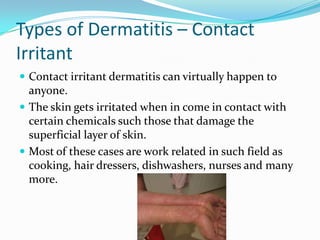
Types of Dermatitis – Contact IrritantContact irritant dermatitis can virtually happen to anyone.The skin gets irritated when in come in contact with certain chemicals such those that damage the superficial layer of skin.Most of these cases are work related in such field as cooking, hair dressers, dishwashers, nurses and many more.
MelanomaMelanoma is defined as a black tumor. It is a malignant cancerous tumor of melanocytes that usually forms on the skin but can be found in the bowel or the eye.The main cause of melanoma is exposure to sunlight. However UV rays are not the only cause of Melanoma because some get this without exposure to the sun.
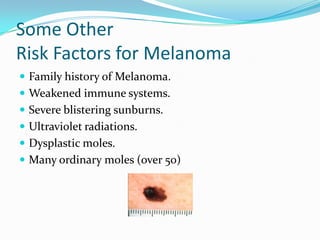
Some Other Risk Factors for MelanomaFamily history of Melanoma.Weakened immune systems.Severe blistering sunburns.Ultraviolet radiations.Dysplastic moles.Many ordinary moles (over 50)
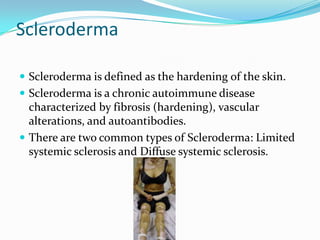
SclerodermaScleroderma is defined as the hardening of the skin.Scleroderma is a chronic autoimmune disease characterized by fibrosis (hardening), vascular alterations, and autoantibodies.There are two common types of Scleroderma: Limited systemic sclerosis and Diffuse systemic sclerosis.
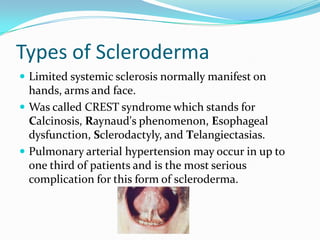
Types of SclerodermaLimited systemic sclerosis normally manifest on hands, arms and face.Was called CREST syndrome which stands for Calcinosis, Raynaud's phenomenon, Esophageal dysfunction, Sclerodactyly, and Telangiectasias.Pulmonary arterial hypertension may occur in up to one third of patients and is the most serious complication for this form of scleroderma.
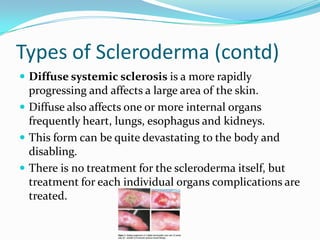
Types of Scleroderma (contd)Diffuse systemic sclerosis is a more rapidly progressing and affects a large area of the skin.Diffuse also affects one or more internal organs frequently heart, lungs, esophagus and kidneys.This form can be quite devastating to the body and disabling.There is no treatment for the scleroderma itself, but treatment for each individual organs complications are treated.
Onychomycosis Onychomycosis is defined as the abnormal condition of nail fungus.It is the most common disease of the nails and constitutes about a half of all nail abnormalities.The nail plate becomes thickened, yellow or cloudy appearance.
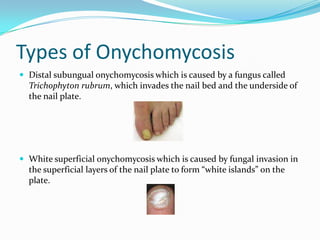
Types of OnychomycosisDistal subungual onychomycosis which is caused by a fungus called Trichophyton rubrum, which invades the nail bed and the underside of the nail plate.White superficial onychomycosis which is caused by fungal invasion in the superficial layers of the nail plate to form “white islands” on the plate.
Types of Onychomycosis contdProximal subungual onychomycosis which is fungal penetration of the newly formed nail plate through the proximal nail fold. The least common but found in people who are immunocompromised.Candidal onychomycosis which happens to people who frequently immerse their hands in water. This usually requires prior nail damage by infection or trauma.

Chp 3 skin terms presentation

  • 1.
    Chp 3 SkinTerms PresentationBy Demetrius Bates
  • 2.
    Dermatitis Dermatitis is knownas the inflammation of the skin. Dermatitis can come from different sources such as allergic reactions to poison ivy, flowers or herb plants, burns and sunburns, some chemicals such as chlorine, cleansers, and detergents, and sometimes glues, perfumes, and nail polishes as well.There are three types of dermatitis: atopic, contact allergy and contact irritant. They all have different causes of symptoms.
  • 3.
    Types of Dermatitis-Atopic Atopic dermatitis may be caused by allergies, asthma, stress, or hay-fever and there appears to be a genetic predisposition for atopic conditions.Atopic dermatitis may be caused by deficiencies in the immune system.Some outgrow this skin problem but some children approximately 75% develop asthma or hay-fever later on in life.
  • 4.
    Types of Dermatitis– Contact AllergyContact allergy occurs when a highly reactive chemical substance comes in direct contact with the skin.Can occur within days of contact usually at the contact point.Only small quantities of the substance is required to cause the reaction.
  • 5.
    Types of Dermatitis– Contact IrritantContact irritant dermatitis can virtually happen to anyone.The skin gets irritated when in come in contact with certain chemicals such those that damage the superficial layer of skin.Most of these cases are work related in such field as cooking, hair dressers, dishwashers, nurses and many more.
  • 6.
    MelanomaMelanoma is definedas a black tumor. It is a malignant cancerous tumor of melanocytes that usually forms on the skin but can be found in the bowel or the eye.The main cause of melanoma is exposure to sunlight. However UV rays are not the only cause of Melanoma because some get this without exposure to the sun.
  • 7.
    Some Other RiskFactors for MelanomaFamily history of Melanoma.Weakened immune systems.Severe blistering sunburns.Ultraviolet radiations.Dysplastic moles.Many ordinary moles (over 50)
  • 8.
    SclerodermaScleroderma is definedas the hardening of the skin.Scleroderma is a chronic autoimmune disease characterized by fibrosis (hardening), vascular alterations, and autoantibodies.There are two common types of Scleroderma: Limited systemic sclerosis and Diffuse systemic sclerosis.
  • 9.
    Types of SclerodermaLimitedsystemic sclerosis normally manifest on hands, arms and face.Was called CREST syndrome which stands for Calcinosis, Raynaud's phenomenon, Esophageal dysfunction, Sclerodactyly, and Telangiectasias.Pulmonary arterial hypertension may occur in up to one third of patients and is the most serious complication for this form of scleroderma.
  • 10.
    Types of Scleroderma(contd)Diffuse systemic sclerosis is a more rapidly progressing and affects a large area of the skin.Diffuse also affects one or more internal organs frequently heart, lungs, esophagus and kidneys.This form can be quite devastating to the body and disabling.There is no treatment for the scleroderma itself, but treatment for each individual organs complications are treated.
  • 11.
    Onychomycosis Onychomycosis isdefined as the abnormal condition of nail fungus.It is the most common disease of the nails and constitutes about a half of all nail abnormalities.The nail plate becomes thickened, yellow or cloudy appearance.
  • 12.
    Types of OnychomycosisDistalsubungual onychomycosis which is caused by a fungus called Trichophyton rubrum, which invades the nail bed and the underside of the nail plate.White superficial onychomycosis which is caused by fungal invasion in the superficial layers of the nail plate to form “white islands” on the plate.
  • 13.
    Types of OnychomycosiscontdProximal subungual onychomycosis which is fungal penetration of the newly formed nail plate through the proximal nail fold. The least common but found in people who are immunocompromised.Candidal onychomycosis which happens to people who frequently immerse their hands in water. This usually requires prior nail damage by infection or trauma.