
CHOLINERGIC
AUTONOMIC
NERVOUS SYSTEM
Prepared By Raheel Ahmad
Northwest Institute of Health Sciences
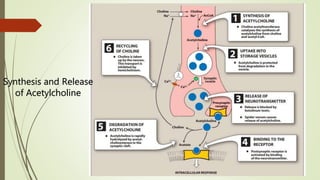
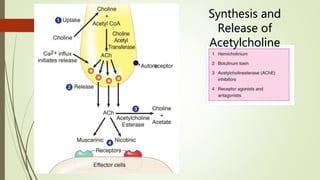
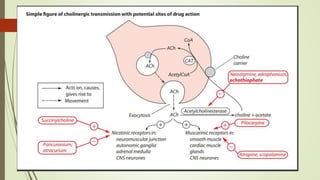
Synthesis and Release
of Acetylcholine
Synthesis and
Release of
Acetylcholine
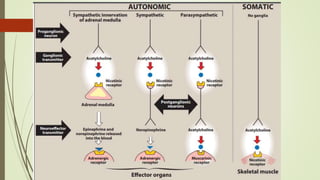
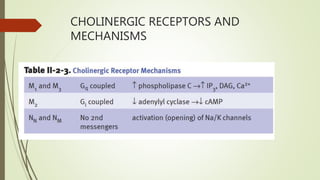
CHOLINERGIC RECEPTORS AND
MECHANISMS
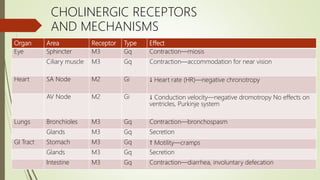
Organ Area Receptor Type Effect
Eye Sphincter M3 Gq Contraction—miosis
Ciliary muscle M3 Gq Contraction—accommodation for near vision
Heart SA Node M2 Gi ↓ Heart rate (HR)—negative chronotropy
AV Node M2 Gi ↓ Conduction velocity—negative dromotropy No effects on
ventricles, Purkinje system
Lungs Bronchioles M3 Gq Contraction—bronchospasm
Glands M3 Gq Secretion
GI Tract Stomach M3 Gq ↑ Motility—cramps
Glands M3 Gq Secretion
Intestine M3 Gq Contraction—diarrhea, involuntary defecation
CHOLINERGIC RECEPTORS
AND MECHANISMS
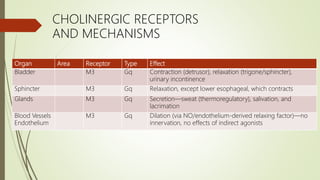
Organ Area Receptor Type Effect
Bladder M3 Gq Contraction (detrusor), relaxation (trigone/sphincter),
urinary incontinence
Sphincter M3 Gq Relaxation, except lower esophageal, which contracts
Glands M3 Gq Secretion—sweat (thermoregulatory), salivation, and
lacrimation
Blood Vessels
Endothelium
M3 Gq Dilation (via NO/endothelium-derived relaxing factor)—no
innervation, no effects of indirect agonists
CHOLINERGIC RECEPTORS
AND MECHANISMS
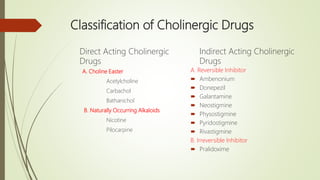
Classification of Cholinergic Drugs
Direct Acting Cholinergic
Drugs
A. Choline Easter
Acetylcholine
Carbachol
Bathanichol
B. Naturally Occurring Alkaloids
Nicotine
Pilocarpine
Indirect Acting Cholinergic
Drugs
A. Reversible Inhibitor
 Ambenonium
 Donepezil
 Galantamine
 Neostigmine
 Physostigmine
 Pyridostigmine
 Rivastigmine
B. Irreversible Inhibitor
 Pralidoxime
Direct Acting
Cholinergic Drugs
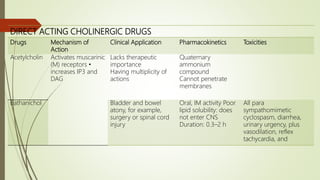
DIRECT ACTING CHOLINERGIC DRUGS
Drugs Mechanism of
Action
Clinical Application Pharmacokinetics Toxicities
Acetylcholin Activates muscarinic
(M) receptors •
increases IP3 and
DAG
Lacks therapeutic
importance
Having multiplicity of
actions
Quaternary
ammonium
compound
Cannot penetrate
membranes
Bathanichol Bladder and bowel
atony, for example,
surgery or spinal cord
injury
Oral, IM activity Poor
lipid solubility: does
not enter CNS
Duration: 0.3–2 h
All para
sympathomimetic
cyclospasm, diarrhea,
urinary urgency, plus
vasodilation, reflex
tachycardia, and
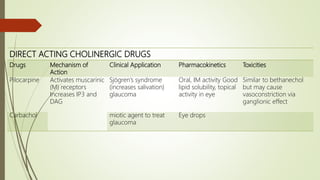
DIRECT ACTING CHOLINERGIC DRUGS
Drugs Mechanism of
Action
Clinical Application Pharmacokinetics Toxicities
Pilocarpine Activates muscarinic
(M) receptors
Increases IP3 and
DAG
Sjögren’s syndrome
(increases salivation)
glaucoma
Oral, IM activity Good
lipid solubility, topical
activity in eye
Similar to bethanechol
but may cause
vasoconstriction via
ganglionic effect
Carbachol miotic agent to treat
glaucoma
Eye drops
INDIRECT ACTING
CHOLINERGIC DRUGS
INDIRECT ACTING CHOLINERGIC DRUGS
 Indirect acting cholinergic drugs inhibit Acetyl cholinesterase enzyme and
increase the level of acetylcholine
 These drugs are further classified in to two groups
A. Reversible Acetyl cholinesterase inhibitors
B. Irreversible Acetyl cholinesterase inhibitors
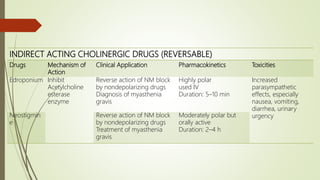
INDIRECT ACTING CHOLINERGIC DRUGS (REVERSABLE)
Drugs Mechanism of
Action
Clinical Application Pharmacokinetics Toxicities
Edroponium Inhibit
Acetylcholine
esterase
enzyme
Reverse action of NM block
by nondepolarizing drugs
Diagnosis of myasthenia
gravis
Highly polar
used IV
Duration: 5–10 min
Increased
parasympathetic
effects, especially
nausea, vomiting,
diarrhea, urinary
urgencyNeostigmin
e
Reverse action of NM block
by nondepolarizing drugs
Treatment of myasthenia
gravis
Moderately polar but
orally active
Duration: 2–4 h
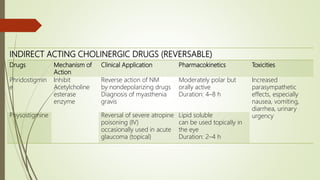
INDIRECT ACTING CHOLINERGIC DRUGS (REVERSABLE)
Drugs Mechanism of
Action
Clinical Application Pharmacokinetics Toxicities
Phridostigmin
e
Inhibit
Acetylcholine
esterase
enzyme
Reverse action of NM
by nondepolarizing drugs
Diagnosis of myasthenia
gravis
Moderately polar but
orally active
Duration: 4–8 h
Increased
parasympathetic
effects, especially
nausea, vomiting,
diarrhea, urinary
urgencyPhysostigmine Reversal of severe atropine
poisoning (IV)
occasionally used in acute
glaucoma (topical)
Lipid soluble
can be used topically in
the eye
Duration: 2–4 h
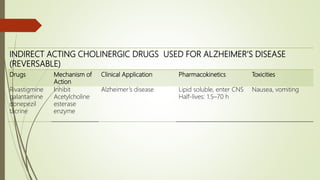
INDIRECT ACTING CHOLINERGIC DRUGS USED FOR ALZHEIMER’S DISEASE
(REVERSABLE)
Drugs Mechanism of
Action
Clinical Application Pharmacokinetics Toxicities
Rivastigmine
galantamine
donepezil
tacrine
Inhibit
Acetylcholine
esterase
enzyme
Alzheimer’s disease Lipid soluble, enter CNS
Half-lives: 1.5–70 h
Nausea, vomiting
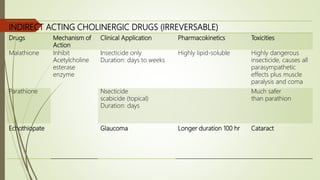
INDIRECT ACTING CHOLINERGIC DRUGS (IRREVERSABLE)
Drugs Mechanism of
Action
Clinical Application Pharmacokinetics Toxicities
Malathione Inhibit
Acetylcholine
esterase
enzyme
Insecticide only
Duration: days to weeks
Highly lipid-soluble Highly dangerous
insecticide, causes all
parasympathetic
effects plus muscle
paralysis and coma
Parathione Nsecticide
scabicide (topical)
Duration: days
Much safer
than parathion
Echothiopate Glaucoma Longer duration 100 hr Cataract
TOXICITIES OF ANTI
CHOLINESTERASE
AGENTS
Prepared By Dr. Raheel Ahmad
Northwest Institute of Health Sciences
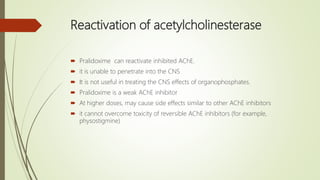
Reactivation of acetylcholinesterase
 Pralidoxime can reactivate inhibited AChE.
 it is unable to penetrate into the CNS
 It is not useful in treating the CNS effects of organophosphates.
 Pralidoxime is a weak AChE inhibitor
 At higher doses, may cause side effects similar to other AChE inhibitors
 it cannot overcome toxicity of reversible AChE inhibitors (for example,
physostigmine)
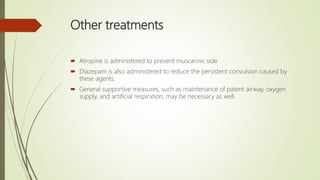
Other treatments
 Atropine is administered to prevent muscarinic side
 Diazepam is also administered to reduce the persistent convulsion caused by
these agents.
 General supportive measures, such as maintenance of patent airway, oxygen
supply, and artificial respiration, may be necessary as well.
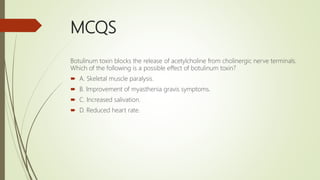
MCQS
Botulinum toxin blocks the release of acetylcholine from cholinergic nerve terminals.
Which of the following is a possible effect of botulinum toxin?
 A. Skeletal muscle paralysis.
 B. Improvement of myasthenia gravis symptoms.
 C. Increased salivation.
 D. Reduced heart rate.
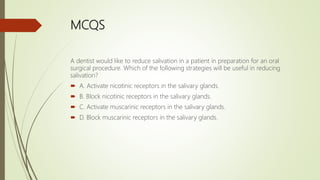
MCQS
A dentist would like to reduce salivation in a patient in preparation for an oral
surgical procedure. Which of the following strategies will be useful in reducing
salivation?
 A. Activate nicotinic receptors in the salivary glands.
 B. Block nicotinic receptors in the salivary glands.
 C. Activate muscarinic receptors in the salivary glands.
 D. Block muscarinic receptors in the salivary glands.
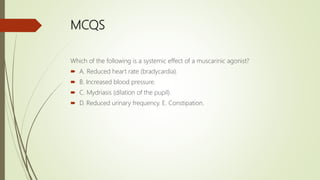
MCQS
Which of the following is a systemic effect of a muscarinic agonist?
 A. Reduced heart rate (bradycardia).
 B. Increased blood pressure.
 C. Mydriasis (dilation of the pupil).
 D. Reduced urinary frequency. E. Constipation.
MCQS
If an ophthalmologist wants to dilate the pupils for an eye examination, which of the
following drugs/classes of drugs could be theoretically useful?
 A. Muscarinic receptor activator (agonist).
 B. Muscarinic receptor inhibitor (antagonist).
 C. Acetylcholine.
 D. Pilocarpine.
 E. Neostigmine
MCQS
 5 In Alzheimer’s disease, there is a deficiency of cholinergic neuronal function in
the brain. Theoretically, which of the following strategies will be useful in treating
the symptoms of Alzheimer’s disease?
 A. Inhibiting cholinergic receptors in the brain.
 B. Inhibiting the release of acetylcholine in the brain.
 C. Inhibiting the acetylcholinesterase enzyme in the brain.
 D. Activating the acetylcholinesterase enzyme in the brain.
MCQS
6 An elderly female who lives in a farm house was brought to the emergency room
in serious condition after ingesting a liquid from an unlabeled bottle found near her
bed, apparently in a suicide attempt. She presented with diarrhea, frequent
urination, convulsions, breathing difficulties, constricted pupils (miosis), and excessive
salivation. Which of the following is correct regarding this patient?
 A. She most likely consumed an organophosphate pesticide.
 B. The symptoms are consistent with sympathetic activation.
 C. Her symptoms can be treated using an anticholinesterase agent.
 D. Her symptoms can be treated using a cholinergic agonist.
MCQS
Sarin is a volatile nerve agent that inhibits cholinesterase enzymes. Which of the
following symptoms would you expect to see in a patient exposed to sarin?
 A. Urinary retention.
 B. Tachycardia.
 C. Constriction of pupils (miosis).
 D. Dilation of the pupils (mydriasis). E. Dry mouth
MCQS
 Head and neck irradiation in cancer patients can decrease salivary secretion and
cause dry mouth. All of the following drugs or classes of drugs are theoretically
useful in improving secretion of saliva in these patients except:
 A. Muscarinic antagonists.
 B. Muscarinic agonists.
 C. Anticholinesterase agents.
 D. Pilocarpine.
 E. Neostigmine
MCQS
Which of the following drugs or classes of drugs will be useful in treating the
symptoms of myasthenia gravis?
 A. Nicotinic antagonists.
 B. Muscarinic agonists.
 C. Muscarinic antagonists.
 D. Anticholinesterase agents.
MCQS
Atropa belladonna is a plant that contains atropine (a muscarinic antagonist). Which
of the following drugs or classes of drugs will be useful in treating poisoning with
belladonna?
 A. Malathion.
 B. Physostigmine.
 C. Muscarinic antagonists.
 D. Nicotinic antagonists.

Cholinergic nervous system

  • 1.
    CHOLINERGIC AUTONOMIC NERVOUS SYSTEM Prepared ByRaheel Ahmad Northwest Institute of Health Sciences
  • 3.
  • 4.
  • 5.
  • 6.
    Organ Area ReceptorType Effect Eye Sphincter M3 Gq Contraction—miosis Ciliary muscle M3 Gq Contraction—accommodation for near vision Heart SA Node M2 Gi ↓ Heart rate (HR)—negative chronotropy AV Node M2 Gi ↓ Conduction velocity—negative dromotropy No effects on ventricles, Purkinje system Lungs Bronchioles M3 Gq Contraction—bronchospasm Glands M3 Gq Secretion GI Tract Stomach M3 Gq ↑ Motility—cramps Glands M3 Gq Secretion Intestine M3 Gq Contraction—diarrhea, involuntary defecation CHOLINERGIC RECEPTORS AND MECHANISMS
  • 7.
    Organ Area ReceptorType Effect Bladder M3 Gq Contraction (detrusor), relaxation (trigone/sphincter), urinary incontinence Sphincter M3 Gq Relaxation, except lower esophageal, which contracts Glands M3 Gq Secretion—sweat (thermoregulatory), salivation, and lacrimation Blood Vessels Endothelium M3 Gq Dilation (via NO/endothelium-derived relaxing factor)—no innervation, no effects of indirect agonists CHOLINERGIC RECEPTORS AND MECHANISMS
  • 8.
    Classification of CholinergicDrugs Direct Acting Cholinergic Drugs A. Choline Easter Acetylcholine Carbachol Bathanichol B. Naturally Occurring Alkaloids Nicotine Pilocarpine Indirect Acting Cholinergic Drugs A. Reversible Inhibitor  Ambenonium  Donepezil  Galantamine  Neostigmine  Physostigmine  Pyridostigmine  Rivastigmine B. Irreversible Inhibitor  Pralidoxime
  • 9.
  • 10.
    DIRECT ACTING CHOLINERGICDRUGS Drugs Mechanism of Action Clinical Application Pharmacokinetics Toxicities Acetylcholin Activates muscarinic (M) receptors • increases IP3 and DAG Lacks therapeutic importance Having multiplicity of actions Quaternary ammonium compound Cannot penetrate membranes Bathanichol Bladder and bowel atony, for example, surgery or spinal cord injury Oral, IM activity Poor lipid solubility: does not enter CNS Duration: 0.3–2 h All para sympathomimetic cyclospasm, diarrhea, urinary urgency, plus vasodilation, reflex tachycardia, and
  • 11.
    DIRECT ACTING CHOLINERGICDRUGS Drugs Mechanism of Action Clinical Application Pharmacokinetics Toxicities Pilocarpine Activates muscarinic (M) receptors Increases IP3 and DAG Sjögren’s syndrome (increases salivation) glaucoma Oral, IM activity Good lipid solubility, topical activity in eye Similar to bethanechol but may cause vasoconstriction via ganglionic effect Carbachol miotic agent to treat glaucoma Eye drops
  • 12.
  • 13.
    INDIRECT ACTING CHOLINERGICDRUGS  Indirect acting cholinergic drugs inhibit Acetyl cholinesterase enzyme and increase the level of acetylcholine  These drugs are further classified in to two groups A. Reversible Acetyl cholinesterase inhibitors B. Irreversible Acetyl cholinesterase inhibitors
  • 14.
    INDIRECT ACTING CHOLINERGICDRUGS (REVERSABLE) Drugs Mechanism of Action Clinical Application Pharmacokinetics Toxicities Edroponium Inhibit Acetylcholine esterase enzyme Reverse action of NM block by nondepolarizing drugs Diagnosis of myasthenia gravis Highly polar used IV Duration: 5–10 min Increased parasympathetic effects, especially nausea, vomiting, diarrhea, urinary urgencyNeostigmin e Reverse action of NM block by nondepolarizing drugs Treatment of myasthenia gravis Moderately polar but orally active Duration: 2–4 h
  • 15.
    INDIRECT ACTING CHOLINERGICDRUGS (REVERSABLE) Drugs Mechanism of Action Clinical Application Pharmacokinetics Toxicities Phridostigmin e Inhibit Acetylcholine esterase enzyme Reverse action of NM by nondepolarizing drugs Diagnosis of myasthenia gravis Moderately polar but orally active Duration: 4–8 h Increased parasympathetic effects, especially nausea, vomiting, diarrhea, urinary urgencyPhysostigmine Reversal of severe atropine poisoning (IV) occasionally used in acute glaucoma (topical) Lipid soluble can be used topically in the eye Duration: 2–4 h
  • 16.
    INDIRECT ACTING CHOLINERGICDRUGS USED FOR ALZHEIMER’S DISEASE (REVERSABLE) Drugs Mechanism of Action Clinical Application Pharmacokinetics Toxicities Rivastigmine galantamine donepezil tacrine Inhibit Acetylcholine esterase enzyme Alzheimer’s disease Lipid soluble, enter CNS Half-lives: 1.5–70 h Nausea, vomiting
  • 17.
    INDIRECT ACTING CHOLINERGICDRUGS (IRREVERSABLE) Drugs Mechanism of Action Clinical Application Pharmacokinetics Toxicities Malathione Inhibit Acetylcholine esterase enzyme Insecticide only Duration: days to weeks Highly lipid-soluble Highly dangerous insecticide, causes all parasympathetic effects plus muscle paralysis and coma Parathione Nsecticide scabicide (topical) Duration: days Much safer than parathion Echothiopate Glaucoma Longer duration 100 hr Cataract
  • 18.
    TOXICITIES OF ANTI CHOLINESTERASE AGENTS PreparedBy Dr. Raheel Ahmad Northwest Institute of Health Sciences
  • 19.
    Reactivation of acetylcholinesterase Pralidoxime can reactivate inhibited AChE.  it is unable to penetrate into the CNS  It is not useful in treating the CNS effects of organophosphates.  Pralidoxime is a weak AChE inhibitor  At higher doses, may cause side effects similar to other AChE inhibitors  it cannot overcome toxicity of reversible AChE inhibitors (for example, physostigmine)
  • 20.
    Other treatments  Atropineis administered to prevent muscarinic side  Diazepam is also administered to reduce the persistent convulsion caused by these agents.  General supportive measures, such as maintenance of patent airway, oxygen supply, and artificial respiration, may be necessary as well.
  • 22.
    MCQS Botulinum toxin blocksthe release of acetylcholine from cholinergic nerve terminals. Which of the following is a possible effect of botulinum toxin?  A. Skeletal muscle paralysis.  B. Improvement of myasthenia gravis symptoms.  C. Increased salivation.  D. Reduced heart rate.
  • 23.
    MCQS A dentist wouldlike to reduce salivation in a patient in preparation for an oral surgical procedure. Which of the following strategies will be useful in reducing salivation?  A. Activate nicotinic receptors in the salivary glands.  B. Block nicotinic receptors in the salivary glands.  C. Activate muscarinic receptors in the salivary glands.  D. Block muscarinic receptors in the salivary glands.
  • 24.
    MCQS Which of thefollowing is a systemic effect of a muscarinic agonist?  A. Reduced heart rate (bradycardia).  B. Increased blood pressure.  C. Mydriasis (dilation of the pupil).  D. Reduced urinary frequency. E. Constipation.
  • 25.
    MCQS If an ophthalmologistwants to dilate the pupils for an eye examination, which of the following drugs/classes of drugs could be theoretically useful?  A. Muscarinic receptor activator (agonist).  B. Muscarinic receptor inhibitor (antagonist).  C. Acetylcholine.  D. Pilocarpine.  E. Neostigmine
  • 26.
    MCQS  5 InAlzheimer’s disease, there is a deficiency of cholinergic neuronal function in the brain. Theoretically, which of the following strategies will be useful in treating the symptoms of Alzheimer’s disease?  A. Inhibiting cholinergic receptors in the brain.  B. Inhibiting the release of acetylcholine in the brain.  C. Inhibiting the acetylcholinesterase enzyme in the brain.  D. Activating the acetylcholinesterase enzyme in the brain.
  • 27.
    MCQS 6 An elderlyfemale who lives in a farm house was brought to the emergency room in serious condition after ingesting a liquid from an unlabeled bottle found near her bed, apparently in a suicide attempt. She presented with diarrhea, frequent urination, convulsions, breathing difficulties, constricted pupils (miosis), and excessive salivation. Which of the following is correct regarding this patient?  A. She most likely consumed an organophosphate pesticide.  B. The symptoms are consistent with sympathetic activation.  C. Her symptoms can be treated using an anticholinesterase agent.  D. Her symptoms can be treated using a cholinergic agonist.
  • 28.
    MCQS Sarin is avolatile nerve agent that inhibits cholinesterase enzymes. Which of the following symptoms would you expect to see in a patient exposed to sarin?  A. Urinary retention.  B. Tachycardia.  C. Constriction of pupils (miosis).  D. Dilation of the pupils (mydriasis). E. Dry mouth
  • 29.
    MCQS  Head andneck irradiation in cancer patients can decrease salivary secretion and cause dry mouth. All of the following drugs or classes of drugs are theoretically useful in improving secretion of saliva in these patients except:  A. Muscarinic antagonists.  B. Muscarinic agonists.  C. Anticholinesterase agents.  D. Pilocarpine.  E. Neostigmine
  • 30.
    MCQS Which of thefollowing drugs or classes of drugs will be useful in treating the symptoms of myasthenia gravis?  A. Nicotinic antagonists.  B. Muscarinic agonists.  C. Muscarinic antagonists.  D. Anticholinesterase agents.
  • 31.
    MCQS Atropa belladonna isa plant that contains atropine (a muscarinic antagonist). Which of the following drugs or classes of drugs will be useful in treating poisoning with belladonna?  A. Malathion.  B. Physostigmine.  C. Muscarinic antagonists.  D. Nicotinic antagonists.

Editor's Notes

  • #23 Correct answer = A. Acetylcholine released by cholinergic neurons acts on nicotinic receptors in the skeletal muscle cells to cause contraction. Therefore, blockade of ACh release causes skeletal muscle paralysis. Myasthenia gravis is an autoimmune disease where antibodies are produced against nicotinic receptors and inactivate nicotinic receptors. A reduction in ACh release therefore worsens (not improves) the symptoms of this condition. Reduction in ACh release by botulinum toxin causes reduction in secretions including saliva (not increase in salivation) causing dry mouth and an increase (not reduction) in heart rate due to reduced vagal activity.
  • #24 Correct answer = D. Salivary glands contain muscarinic receptors, not nicotinic receptors. Activation of muscarinic receptors in the salivary glands causes secretion of saliva. Blocking muscarinic receptors, using drugs such as atropine, reduces salivary secretions and makes the mouth dry
  • #25 Correct answer = A. A muscarinic agonist binds to and activates muscarinic receptors in the heart, endothelial cells (blood vessels), the gut, and iris sphincter (eye) and urinary bladder wall muscles, in addition to several other tissues. Activation of muscarinic receptors by an agonist causes a reduction in heart rate, constriction of circular muscles in the iris sphincter leading to constriction of the pupil (miosis), increased GI motility (hence, diarrhea, not constipation), and contraction of bladder muscles leading to an increase (not decrease) in urination frequency. In the endothelial cells of blood vessels, muscarinic activation produces release of nitric oxide that causes vasorelaxation and a reduction (not increase) in blood pressure.
  • #26 Correct answer = B. Muscarinic agonists (for example, ACh, pilocarpine) contract the circular smooth muscles in the iris sphincter and constrict the pupil (miosis). Anticholinesterases (for example, neostigmine, physostigmine) also cause miosis by increasing the level of ACh. Muscarinic antagonists, on the other hand, relax the circular smooth muscles in the iris sphincter and cause dilation of the pupil (mydriasis).
  • #27 Correct answer = C. Since there is already a deficiency in brain cholinergic function in Alzheimer’s disease, inhibiting cholinergic receptors or inhibiting the release of ACh will worsen the condition. Activating the acetylcholinesterase enzyme will increase the degradation of ACh, which will again worsen the condition. However, inhibiting the acetylcholinesterase enzyme will help to increase the levels of ACh in the brain and thereby help to relieve the symptoms of Alzheimer’s disease
  • #28 Correct answer = A. The symptoms are consistent with that of cholinergic crisis. Since the elderly female lives on a farm and since the symptoms are consistent with that of cholinergic crisis (usually caused by cholinesterase inhibitors), it may be assumed that she has consumed an organophosphate pesticide (irreversible cholinesterase inhibitor). Assuming that the symptoms are caused by organophosphate poisoning, administering an anticholinesterase agent or a cholinergic agonist will worsen the condition. The symptoms are not consistent with that of sympathetic activation, as sympathetic activation will cause symptoms opposite to that of cholinergic crisis seen in this patient.
  • #29 Correct answer = C. Sarin is an organophosphate nerve gas that inhibits cholinesterase enzymes and increases ACh levels. Therefore, symptoms of cholinergic crisis (increased urination, bradycardia, excessive secretions, constriction of pupils, etc.) should be expected in patients exposed to sarin. Urinary retention, tachycardia, mydriasis, and dry mouth are usually seen with muscarinic antagonists.
  • #30 Correct answer = A. Activation of muscarinic receptors in the salivary glands causes secretion of saliva. This can be achieved in theory by using a muscarinic agonist such as pilocarpine or an anticholinesterase agent such as neostigmine (increases levels of ACh). Muscarinic antagonists (anticholinergic drugs) will reduce salivary secretion and worsen dry mouth.
  • #31 Correct answer = D. The function of nicotinic receptors in skeletal muscles is diminished in myasthenia gravis due to the development of antibodies to nicotinic receptors in the patient’s body (autoimmune disease). Any drug that can increase the levels of ACh in the neuromuscular junction can improve symptoms in myasthenia gravis. Thus, cholinesterase inhibitors help to improve the symptoms of myasthenia gravis. Muscarinic drugs have no role in myasthenia gravis, and nicotinic antagonists will worsen the symptoms.
  • #32 Correct answer = B. Atropine is a competitive muscarinic receptor antagonist that causes anticholinergic effects. Muscarinic agonists or any other drugs that can increase the levels of ACh will be able to counteract the effects of atropine. Thus, anticholinesterases such as malathion and physostigmine can counteract the effects of atropine in theory. However, malathion being an irreversible inhibitor of acetylcholinesterase is not used for systemic treatment in patients. Muscarinic antagonists will worsen the toxicity of atropine. Nicotinic antagonists could worsen the toxicity by acting on parasympathetic ganglionic receptors and thus reducing the release of ACh.