⦁ Introduction
⦁ What is cloud storage?
⦁ How does cloud storage work?
⦁ Cloud Storage - Business Benefits
⦁ What does it cost to users?
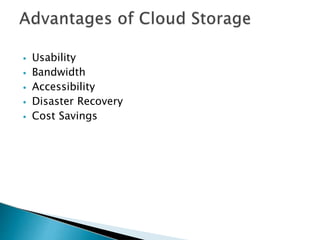
⦁ Advantages of Cloud Storage
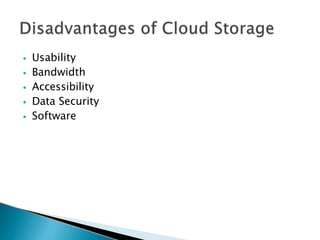
⦁ Disadvantages of Cloud Storage
⦁ Conclusion
⦁ Cloud storage is a model of data storage in which
the digital data is stored in logical pools, the
physical storage spans multiple servers (and often
locations), and the physical environment is typically
owned and managed by a hosting company.
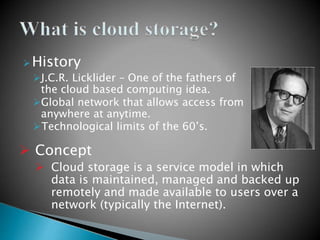
History
J.C.R. Licklider – One of the fathers of
the cloud based computing idea.
Global network that allows access from
anywhere at anytime.
Technological limits of the 60’s.
 Concept
 Cloud storage is a service model in which
data is maintained, managed and backed up
remotely and made available to users over a
network (typically the Internet).
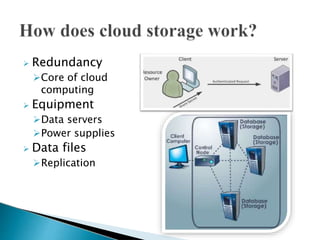
 Redundancy
Core of cloud
computing
 Equipment
Data servers
Power supplies
 Data files
Replication
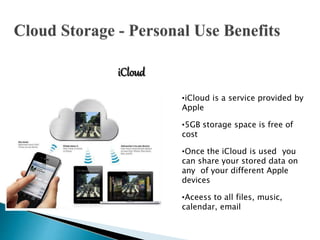
iCloud
•iCloud is a service provided by
Apple
•5GB storage space is free of
cost
•Once the iCloud is used you
can share your stored data on
any of your different Apple
devices
•Aceess to all files, music,
calendar, email
⦁ With cloud storage, there's no need for CDs,
external hard drives, or localized servers.
⦁ Data is quickly and automatically updated in
the cloud and available for your retrieval
whenever you need it.
• Should your office become the victim of a burglary, fire, or
natural disaster, your data is safe and secure in the cloud, even if
your physical assets are destroyed.
• One of the greatest benefits of cloud storage is its ability to grow
with its users.
• With no need for physical, on-site storage space, you can have a
smaller workspace, less equipment to buy, and fewer IT
employees to maintain your equipment and manage your data.
⦁ Security: Many companies may not want to hand
over their data to an external organization to store,
fearing that they may not have the right security
software to protect the company’s data.
🞄 Performance: There were several incidents that
some cloud-service providers temporarily went
down or lost customer’s data.
⦁ Usability
⦁ Bandwidth
⦁ Accessibility
⦁ Disaster Recovery
⦁ Cost Savings
⦁ Usability
⦁ Bandwidth
⦁ Accessibility
⦁ Data Security
⦁ Software
⦁ Grid Computing was the last research-led
centralised approach.
⦁ However there are concerns that the mainstream
adoption of cloud computing could cause many
problems for users.
⦁ Many new open source systems appearing that you
can install and run on your local cluster.
ChodonKumar.pptx

ChodonKumar.pptx

  • 2.
    ⦁ Introduction ⦁ Whatis cloud storage? ⦁ How does cloud storage work? ⦁ Cloud Storage - Business Benefits ⦁ What does it cost to users? ⦁ Advantages of Cloud Storage ⦁ Disadvantages of Cloud Storage ⦁ Conclusion
  • 3.
    ⦁ Cloud storageis a model of data storage in which the digital data is stored in logical pools, the physical storage spans multiple servers (and often locations), and the physical environment is typically owned and managed by a hosting company.
  • 4.
    History J.C.R. Licklider –One of the fathers of the cloud based computing idea. Global network that allows access from anywhere at anytime. Technological limits of the 60’s.  Concept  Cloud storage is a service model in which data is maintained, managed and backed up remotely and made available to users over a network (typically the Internet).
  • 5.
     Redundancy Core ofcloud computing  Equipment Data servers Power supplies  Data files Replication
  • 6.
    iCloud •iCloud is aservice provided by Apple •5GB storage space is free of cost •Once the iCloud is used you can share your stored data on any of your different Apple devices •Aceess to all files, music, calendar, email
  • 7.
    ⦁ With cloudstorage, there's no need for CDs, external hard drives, or localized servers. ⦁ Data is quickly and automatically updated in the cloud and available for your retrieval whenever you need it. • Should your office become the victim of a burglary, fire, or natural disaster, your data is safe and secure in the cloud, even if your physical assets are destroyed. • One of the greatest benefits of cloud storage is its ability to grow with its users. • With no need for physical, on-site storage space, you can have a smaller workspace, less equipment to buy, and fewer IT employees to maintain your equipment and manage your data.
  • 8.
    ⦁ Security: Manycompanies may not want to hand over their data to an external organization to store, fearing that they may not have the right security software to protect the company’s data. 🞄 Performance: There were several incidents that some cloud-service providers temporarily went down or lost customer’s data.
  • 9.
    ⦁ Usability ⦁ Bandwidth ⦁Accessibility ⦁ Disaster Recovery ⦁ Cost Savings
  • 10.
    ⦁ Usability ⦁ Bandwidth ⦁Accessibility ⦁ Data Security ⦁ Software
  • 11.
    ⦁ Grid Computingwas the last research-led centralised approach. ⦁ However there are concerns that the mainstream adoption of cloud computing could cause many problems for users. ⦁ Many new open source systems appearing that you can install and run on your local cluster.