China’s Economy: Slowing,
Distorted and Debt-Addicted
Marcus Wright
Senior Economist, RBS, February 2016
China – the problems behind the headlines
China’s economy is:
• Slowing – GDP growth has slowed more than the headline
figures suggest, investment and production in particular
• Distorted – overly reliant on investment with little sign of
rebalancing
• Debt-addicted – a post-crisis debt build-up that is proving hard
to shake off
• Coupled with ad-hoc and uncoordinated policy we believe
China is more likely in a hard landing than a ‘bumpy landing’.
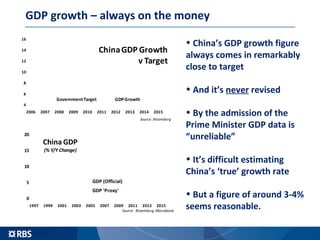
GDP growth – always on the money
4
6
8
10
12
14
16
2006 2007 2008 2009 2010 2011 2012 2013 2014 2015
ChinaGDP Growth
v Target
GovernmentTarget GDPGrowth
Source: Bloomberg
0
5
10
15
20
1997 1999 2001 2003 2005 2007 2009 2011 2013 2015
China GDP
(% Y/Y Change)
GDP (Official)
GDP 'Proxy'
Source: Bloomberg, Macrobond
• China’s GDP growth figure
always comes in remarkably
close to target
• And it’s never revised
• By the admission of the
Prime Minister GDP data is
“unreliable”
• It’s difficult estimating
China’s ‘true’ growth rate
• But a figure of around 3-4%
seems reasonable.
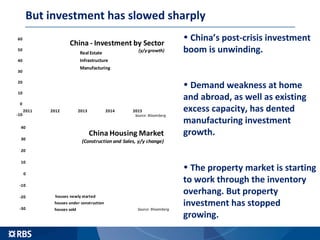
But investment has slowed sharply
-10
0
10
20
30
40
50
60
2011 2012 2013 2014 2015
China - Investment by Sector
(y/ygrowth)Real Estate
Infrastructure
Manufacturing
Source: Bloomberg
• China’s post-crisis investment
boom is unwinding.
• Demand weakness at home
and abroad, as well as existing
excess capacity, has dented
manufacturing investment
growth.
• The property market is starting
to work through the inventory
overhang. But property
investment has stopped
growing.
-30
-20
-10
0
10
20
30
40
China Housing Market
(Construction and Sales, y/y change)
houses newly started
houses under construction
houses sold Source: Bloomberg
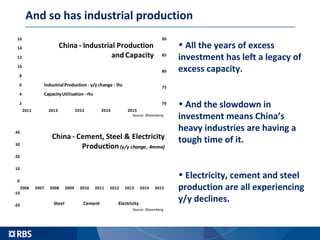
And so has industrial production
70
75
80
85
90
2
4
6
8
10
12
14
16
2011 2012 2013 2014 2015
China - Industrial Production
and Capacity
IndustrialProduction- y/y change - lhs
CapacityUtilisation- rhs
Source: Bloomberg
-20
-10
0
10
20
30
40
2006 2007 2008 2009 2010 2011 2012 2013 2014 2015
China - Cement, Steel & Electricity
Production(y/y change, 4mma)
Steel Cement Electricity
Source: Bloomberg
• All the years of excess
investment has left a legacy of
excess capacity.
• And the slowdown in
investment means China’s
heavy industries are having a
tough time of it.
• Electricity, cement and steel
production are all experiencing
y/y declines.
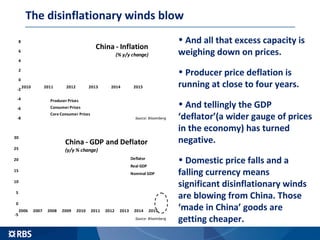
The disinflationary winds blow
-5
0
5
10
15
20
25
30
2006 2007 2008 2009 2010 2011 2012 2013 2014 2015
China - GDP and Deflator
(y/y % change)
Deflator
Real GDP
Nominal GDP
Source: Bloomberg
-8
-6
-4
-2
0
2
4
6
8
2010 2011 2012 2013 2014 2015
China - Inflation
(% y/y change)
Producer Prices
Consumer Prices
Core Consumer Prices
Source: Bloomberg
• And all that excess capacity is
weighing down on prices.
• Producer price deflation is
running at close to four years.
• And tellingly the GDP
‘deflator’(a wider gauge of prices
in the economy) has turned
negative.
• Domestic price falls and a
falling currency means
significant disinflationary winds
are blowing from China. Those
‘made in China’ goods are
getting cheaper.
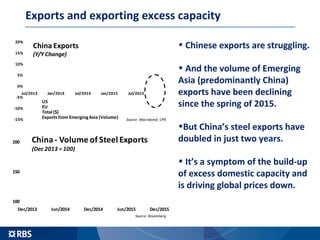
Exports and exporting excess capacity
100
150
200
Dec/2013 Jun/2014 Dec/2014 Jun/2015 Dec/2015
China- Volume of Steel Exports
(Dec 2013 = 100)
Source: Bloomberg
• Chinese exports are struggling.
• And the volume of Emerging
Asia (predominantly China)
exports have been declining
since the spring of 2015.
•But China’s steel exports have
doubled in just two years.
• It’s a symptom of the build-up
of excess domestic capacity and
is driving global prices down.
-15%
-10%
-5%
0%
5%
10%
15%
20%
Jul/2013 Jan/2014 Jul/2014 Jan/2015 Jul/2015
China Exports
(Y/Y Change)
US
EU
Total($)
Exportsfrom EmergingAsia (Volume) Source: Macrobond, CPB
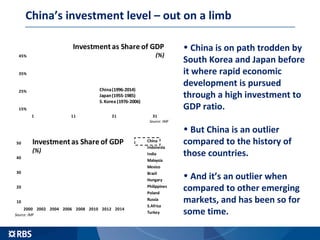
• China is on path trodden by
South Korea and Japan before
it where rapid economic
development is pursued
through a high investment to
GDP ratio.
• But China is an outlier
compared to the history of
those countries.
• And it’s an outlier when
compared to other emerging
markets, and has been so for
some time.
China’s investment level – out on a limb
15%
25%
35%
45%
1 11 21 31
Investment as Share of GDP
(%)
China(1996-2014)
Japan(1955-1985)
S.Korea (1976-2006)
Source: IMF
10
20
30
40
50
2000 2002 2004 2006 2008 2010 2012 2014
Investmentas Share of GDP
(%)
China
Indonesia
India
Malaysia
Mexico
Brazil
Hungary
Philippines
Poland
Russia
S.Africa
Turkey
Source: IMF
Rebalancing at a snail’s pace, if at all
30
35
40
45
50
55
1978 1982 1986 1990 1994 1998 2002 2006 2010 2014
China - Consumption v Investment as
% of GDP
Household Consumption Investment
Source: Bloomberg
30
35
40
45
50
55
2006 2007 2008 2009 2010 2011 2012 2013 2014 2015
China - Manufacturing and Services
as share of GDP (%)
Services
Manufacturing
Source: Bloomberg
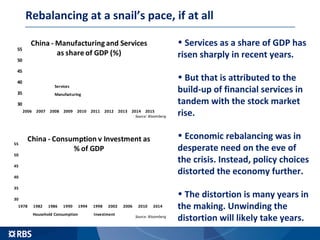
• Services as a share of GDP has
risen sharply in recent years.
• But that is attributed to the
build-up of financial services in
tandem with the stock market
rise.
• Economic rebalancing was in
desperate need on the eve of
the crisis. Instead, policy choices
distorted the economy further.
• The distortion is many years in
the making. Unwinding the
distortion will likely take years.
More signs of a lack of rebalancing
30
40
50
60
70
80
1995 1997 1999 2001 2003 2005 2007 2009 2011 2013
Share of Total Labour Compensation
in GDP (%)
China US
S.Korea Indonesia
Japan
Source: Conference Board
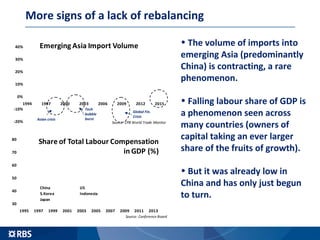
• The volume of imports into
emerging Asia (predominantly
China) is contracting, a rare
phenomenon.
• Falling labour share of GDP is
a phenomenon seen across
many countries (owners of
capital taking an ever larger
share of the fruits of growth).
• But it was already low in
China and has only just begun
to turn.
-20%
-10%
0%
10%
20%
30%
40%
1994 1997 2000 2003 2006 2009 2012 2015
EmergingAsia Import Volume
Source: CPB World Trade Monitor
Asian crisis
Tech
bubble
burst
Global Fin.
Crisis
Loans are supposedly not in great demand…
3
4
5
6
7
50
60
70
80
90
2009 2010 2011 2012 2013 2014 2015
China - Lending Rate
v Loan Demand
Index of Loan Demand - lhs
Benchmark 1 year Lending Rate - rhs
Source: Bloomberg
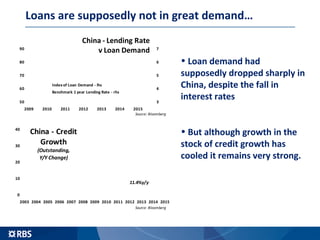
• Loan demand had
supposedly dropped sharply in
China, despite the fall in
interest rates
• But although growth in the
stock of credit growth has
cooled it remains very strong.
0
10
20
30
40
2003 2004 2005 2006 2007 2008 2009 2010 2011 2012 2013 2014 2015
China - Credit
Growth
(Outstanding,
Y/Y Change)
Source: Bloomberg
11.4%y/y
Just when you think they’re getting on top of all that credit…
0
500
1,000
1,500
2,000
2,500
3,000
China - Aggregate Financing
(RMBBillions)
Source: Bloomberg
-100%
0%
100%
200%
300%
-20%
0%
20%
40%
60%
Jan/2014 Jul/2014 Jan/2015 Jul/2015
China - Loan and Corporate Bond
Growth (Y/YChange)
Loans -lhs CorporateBonds -rhs
Source: Bloomberg
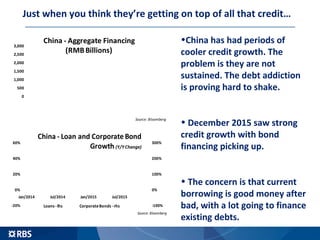
•China has had periods of
cooler credit growth. The
problem is they are not
sustained. The debt addiction
is proving hard to shake.
• December 2015 saw strong
credit growth with bond
financing picking up.
• The concern is that current
borrowing is good money after
bad, with a lot going to finance
existing debts.
How can this debt build-up be pain free?
15
18
21
24
27
30
33
100
120
140
160
180
200
220
2006 2007 2008 2009 2010 2011 2012 2013 2014 2015
China - Debt to GDP
and Debt Servicing (%)
Debtto GDP - lhs
DebyServicingCostsas % of GDP- rhs Source: BIS, Bloomberg
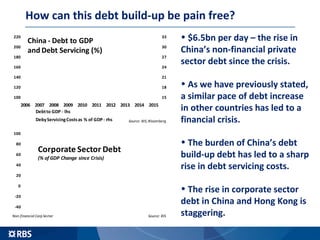
• $6.5bn per day – the rise in
China’s non-financial private
sector debt since the crisis.
• As we have previously stated,
a similar pace of debt increase
in other countries has led to a
financial crisis.
• The burden of China’s debt
build-up debt has led to a sharp
rise in debt servicing costs.
• The rise in corporate sector
debt in China and Hong Kong is
staggering.
-40
-20
0
20
40
60
80
100
Corporate Sector Debt
(% of GDP Change since Crisis)
Source: BISNon-financial Corp Sector
Forget equities, look at policy
• 2016 has been marked by falls in China’s currency and equities.
• The equity sell-off tells us little about China’s wider economy.
But the policy response does.
• In recent months economic policy in China has been reactive,
ad-hoc and seemingly uncoordinated between state institutions.
• And more fundamentally it shows there is a reluctance on the
part of the authorities to let the market have the final say in the
setting of prices in the economy.
The problems with pushing ahead with reforms
• Policy makers’ reluctance over market reform reflects two things
1. Conflict within the Chinese Communist Party (CCP)
about reform. Vested interest groups appear more
entrenched than previously thought.
2. Letting the market have the final say in the setting
of prices too readily conflicts with the CCP’s aims of
social stability and therefore the primacy of the Party.
• Authorities struggling with macroeconomic management and
crisis mitigation more than previously thought.
• This gives us less confidence the CCP can do/ will do the right
thing when it comes to reform and cleaning up the banking sector.
…and finally
• China’s debt binge – which has yet to begin unwinding –
remains too readily dismissed by the consensus.
• Our previous view of China experiencing a ‘bumpy’ landing is
changing. A ‘hard-landing’ is now the most likely scenario.
• China’s slowdown is already impacting the global economy
through the channels of growth, trade, inflation, interest rate
expectations and financial linkages. There is more to come on
all these fronts.
•We will elaborate more on this view and the impact it will
have on the UK and global economies in a future release.
Follow us on Twitter
@RBS_Economics
https://twitter.com/rbs_economics
Or visit us online
Disclaimer
This material is published by The Royal Bank of Scotland plc (“RBS”), for information purposes only and
should not be regarded as providing any specific advice. Recipients should make their own independent
evaluation of this information and no action should be taken, solely relying on it. This material should not be
reproduced or disclosed without our consent. It is not intended for distribution in any jurisdiction in which this
would be prohibited. Whilst this information is believed to be reliable, it has not been independently verified by
RBS and RBS makes no representation or warranty (express or implied) of any kind, as regards the accuracy
or completeness of this information, nor does it accept any responsibility or liability for any loss or damage
arising in any way from any use made of or reliance placed on, this information. Unless otherwise stated, any
views, forecasts, or estimates are solely those of RBS’s RBS Economics Department, as of this date and are
subject to change without notice. The classification of this document is PUBLIC. The Royal Bank of Scotland
plc. Registered in Scotland No. 90312. Registered Office: 36 St Andrew Square, Edinburgh EH2 2YB. The
Royal Bank of Scotland plc is authorised by the Prudential Regulation Authority and regulated by the Financial
Conduct Authority and the Prudential Regulation Authority. © Copyright 2015 The Royal Bank of Scotland
Group plc. All rights reserved

China's economy: slowing distorted and debt-addicted

  • 1.
    China’s Economy: Slowing, Distortedand Debt-Addicted Marcus Wright Senior Economist, RBS, February 2016
  • 2.
    China – theproblems behind the headlines China’s economy is: • Slowing – GDP growth has slowed more than the headline figures suggest, investment and production in particular • Distorted – overly reliant on investment with little sign of rebalancing • Debt-addicted – a post-crisis debt build-up that is proving hard to shake off • Coupled with ad-hoc and uncoordinated policy we believe China is more likely in a hard landing than a ‘bumpy landing’.
  • 3.
    GDP growth –always on the money 4 6 8 10 12 14 16 2006 2007 2008 2009 2010 2011 2012 2013 2014 2015 ChinaGDP Growth v Target GovernmentTarget GDPGrowth Source: Bloomberg 0 5 10 15 20 1997 1999 2001 2003 2005 2007 2009 2011 2013 2015 China GDP (% Y/Y Change) GDP (Official) GDP 'Proxy' Source: Bloomberg, Macrobond • China’s GDP growth figure always comes in remarkably close to target • And it’s never revised • By the admission of the Prime Minister GDP data is “unreliable” • It’s difficult estimating China’s ‘true’ growth rate • But a figure of around 3-4% seems reasonable.
  • 4.
    But investment hasslowed sharply -10 0 10 20 30 40 50 60 2011 2012 2013 2014 2015 China - Investment by Sector (y/ygrowth)Real Estate Infrastructure Manufacturing Source: Bloomberg • China’s post-crisis investment boom is unwinding. • Demand weakness at home and abroad, as well as existing excess capacity, has dented manufacturing investment growth. • The property market is starting to work through the inventory overhang. But property investment has stopped growing. -30 -20 -10 0 10 20 30 40 China Housing Market (Construction and Sales, y/y change) houses newly started houses under construction houses sold Source: Bloomberg
  • 5.
    And so hasindustrial production 70 75 80 85 90 2 4 6 8 10 12 14 16 2011 2012 2013 2014 2015 China - Industrial Production and Capacity IndustrialProduction- y/y change - lhs CapacityUtilisation- rhs Source: Bloomberg -20 -10 0 10 20 30 40 2006 2007 2008 2009 2010 2011 2012 2013 2014 2015 China - Cement, Steel & Electricity Production(y/y change, 4mma) Steel Cement Electricity Source: Bloomberg • All the years of excess investment has left a legacy of excess capacity. • And the slowdown in investment means China’s heavy industries are having a tough time of it. • Electricity, cement and steel production are all experiencing y/y declines.
  • 6.
    The disinflationary windsblow -5 0 5 10 15 20 25 30 2006 2007 2008 2009 2010 2011 2012 2013 2014 2015 China - GDP and Deflator (y/y % change) Deflator Real GDP Nominal GDP Source: Bloomberg -8 -6 -4 -2 0 2 4 6 8 2010 2011 2012 2013 2014 2015 China - Inflation (% y/y change) Producer Prices Consumer Prices Core Consumer Prices Source: Bloomberg • And all that excess capacity is weighing down on prices. • Producer price deflation is running at close to four years. • And tellingly the GDP ‘deflator’(a wider gauge of prices in the economy) has turned negative. • Domestic price falls and a falling currency means significant disinflationary winds are blowing from China. Those ‘made in China’ goods are getting cheaper.
  • 7.
    Exports and exportingexcess capacity 100 150 200 Dec/2013 Jun/2014 Dec/2014 Jun/2015 Dec/2015 China- Volume of Steel Exports (Dec 2013 = 100) Source: Bloomberg • Chinese exports are struggling. • And the volume of Emerging Asia (predominantly China) exports have been declining since the spring of 2015. •But China’s steel exports have doubled in just two years. • It’s a symptom of the build-up of excess domestic capacity and is driving global prices down. -15% -10% -5% 0% 5% 10% 15% 20% Jul/2013 Jan/2014 Jul/2014 Jan/2015 Jul/2015 China Exports (Y/Y Change) US EU Total($) Exportsfrom EmergingAsia (Volume) Source: Macrobond, CPB
  • 8.
    • China ison path trodden by South Korea and Japan before it where rapid economic development is pursued through a high investment to GDP ratio. • But China is an outlier compared to the history of those countries. • And it’s an outlier when compared to other emerging markets, and has been so for some time. China’s investment level – out on a limb 15% 25% 35% 45% 1 11 21 31 Investment as Share of GDP (%) China(1996-2014) Japan(1955-1985) S.Korea (1976-2006) Source: IMF 10 20 30 40 50 2000 2002 2004 2006 2008 2010 2012 2014 Investmentas Share of GDP (%) China Indonesia India Malaysia Mexico Brazil Hungary Philippines Poland Russia S.Africa Turkey Source: IMF
  • 9.
    Rebalancing at asnail’s pace, if at all 30 35 40 45 50 55 1978 1982 1986 1990 1994 1998 2002 2006 2010 2014 China - Consumption v Investment as % of GDP Household Consumption Investment Source: Bloomberg 30 35 40 45 50 55 2006 2007 2008 2009 2010 2011 2012 2013 2014 2015 China - Manufacturing and Services as share of GDP (%) Services Manufacturing Source: Bloomberg • Services as a share of GDP has risen sharply in recent years. • But that is attributed to the build-up of financial services in tandem with the stock market rise. • Economic rebalancing was in desperate need on the eve of the crisis. Instead, policy choices distorted the economy further. • The distortion is many years in the making. Unwinding the distortion will likely take years.
  • 10.
    More signs ofa lack of rebalancing 30 40 50 60 70 80 1995 1997 1999 2001 2003 2005 2007 2009 2011 2013 Share of Total Labour Compensation in GDP (%) China US S.Korea Indonesia Japan Source: Conference Board • The volume of imports into emerging Asia (predominantly China) is contracting, a rare phenomenon. • Falling labour share of GDP is a phenomenon seen across many countries (owners of capital taking an ever larger share of the fruits of growth). • But it was already low in China and has only just begun to turn. -20% -10% 0% 10% 20% 30% 40% 1994 1997 2000 2003 2006 2009 2012 2015 EmergingAsia Import Volume Source: CPB World Trade Monitor Asian crisis Tech bubble burst Global Fin. Crisis
  • 11.
    Loans are supposedlynot in great demand… 3 4 5 6 7 50 60 70 80 90 2009 2010 2011 2012 2013 2014 2015 China - Lending Rate v Loan Demand Index of Loan Demand - lhs Benchmark 1 year Lending Rate - rhs Source: Bloomberg • Loan demand had supposedly dropped sharply in China, despite the fall in interest rates • But although growth in the stock of credit growth has cooled it remains very strong. 0 10 20 30 40 2003 2004 2005 2006 2007 2008 2009 2010 2011 2012 2013 2014 2015 China - Credit Growth (Outstanding, Y/Y Change) Source: Bloomberg 11.4%y/y
  • 12.
    Just when youthink they’re getting on top of all that credit… 0 500 1,000 1,500 2,000 2,500 3,000 China - Aggregate Financing (RMBBillions) Source: Bloomberg -100% 0% 100% 200% 300% -20% 0% 20% 40% 60% Jan/2014 Jul/2014 Jan/2015 Jul/2015 China - Loan and Corporate Bond Growth (Y/YChange) Loans -lhs CorporateBonds -rhs Source: Bloomberg •China has had periods of cooler credit growth. The problem is they are not sustained. The debt addiction is proving hard to shake. • December 2015 saw strong credit growth with bond financing picking up. • The concern is that current borrowing is good money after bad, with a lot going to finance existing debts.
  • 13.
    How can thisdebt build-up be pain free? 15 18 21 24 27 30 33 100 120 140 160 180 200 220 2006 2007 2008 2009 2010 2011 2012 2013 2014 2015 China - Debt to GDP and Debt Servicing (%) Debtto GDP - lhs DebyServicingCostsas % of GDP- rhs Source: BIS, Bloomberg • $6.5bn per day – the rise in China’s non-financial private sector debt since the crisis. • As we have previously stated, a similar pace of debt increase in other countries has led to a financial crisis. • The burden of China’s debt build-up debt has led to a sharp rise in debt servicing costs. • The rise in corporate sector debt in China and Hong Kong is staggering. -40 -20 0 20 40 60 80 100 Corporate Sector Debt (% of GDP Change since Crisis) Source: BISNon-financial Corp Sector
  • 14.
    Forget equities, lookat policy • 2016 has been marked by falls in China’s currency and equities. • The equity sell-off tells us little about China’s wider economy. But the policy response does. • In recent months economic policy in China has been reactive, ad-hoc and seemingly uncoordinated between state institutions. • And more fundamentally it shows there is a reluctance on the part of the authorities to let the market have the final say in the setting of prices in the economy.
  • 15.
    The problems withpushing ahead with reforms • Policy makers’ reluctance over market reform reflects two things 1. Conflict within the Chinese Communist Party (CCP) about reform. Vested interest groups appear more entrenched than previously thought. 2. Letting the market have the final say in the setting of prices too readily conflicts with the CCP’s aims of social stability and therefore the primacy of the Party. • Authorities struggling with macroeconomic management and crisis mitigation more than previously thought. • This gives us less confidence the CCP can do/ will do the right thing when it comes to reform and cleaning up the banking sector.
  • 16.
    …and finally • China’sdebt binge – which has yet to begin unwinding – remains too readily dismissed by the consensus. • Our previous view of China experiencing a ‘bumpy’ landing is changing. A ‘hard-landing’ is now the most likely scenario. • China’s slowdown is already impacting the global economy through the channels of growth, trade, inflation, interest rate expectations and financial linkages. There is more to come on all these fronts. •We will elaborate more on this view and the impact it will have on the UK and global economies in a future release.
  • 17.
    Follow us onTwitter @RBS_Economics https://twitter.com/rbs_economics Or visit us online
  • 18.
    Disclaimer This material ispublished by The Royal Bank of Scotland plc (“RBS”), for information purposes only and should not be regarded as providing any specific advice. Recipients should make their own independent evaluation of this information and no action should be taken, solely relying on it. This material should not be reproduced or disclosed without our consent. It is not intended for distribution in any jurisdiction in which this would be prohibited. Whilst this information is believed to be reliable, it has not been independently verified by RBS and RBS makes no representation or warranty (express or implied) of any kind, as regards the accuracy or completeness of this information, nor does it accept any responsibility or liability for any loss or damage arising in any way from any use made of or reliance placed on, this information. Unless otherwise stated, any views, forecasts, or estimates are solely those of RBS’s RBS Economics Department, as of this date and are subject to change without notice. The classification of this document is PUBLIC. The Royal Bank of Scotland plc. Registered in Scotland No. 90312. Registered Office: 36 St Andrew Square, Edinburgh EH2 2YB. The Royal Bank of Scotland plc is authorised by the Prudential Regulation Authority and regulated by the Financial Conduct Authority and the Prudential Regulation Authority. © Copyright 2015 The Royal Bank of Scotland Group plc. All rights reserved