
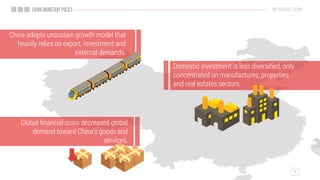





China adopts unsustain growth model that
heavily relies on export, investment and
external demands.
INTRODUCTION
Global financial crisis decreased global
demand toward China’s goods and
services.
Domestic investment is less diversified, only
concentrated on manufactures, properties
and real estates sectors.
INTRODUCTION
INTRODUCTION
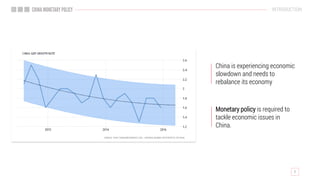
China is experiencing economic
slowdown and needs to
rebalance its economy
Monetary policy is required to
tackle economic issues in
China.
ECONOMIC SITUATION
All China’s macroeconomic
accounts exhibit imbalances
reflecting its economic slowdown.
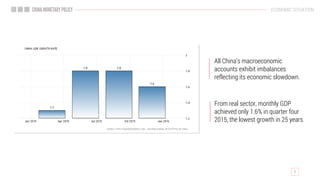
From real sector, monthly GDP
achieved only 1.6% in quarter four
2015, the lowest growth in 25 years.
ECONOMIC SITUATION
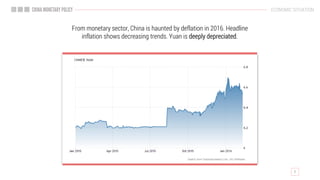
From monetary sector, China is haunted by deflation in 2016. Headline
inflation shows decreasing trends. Yuan is deeply depreciated.
ECONOMIC SITUATION
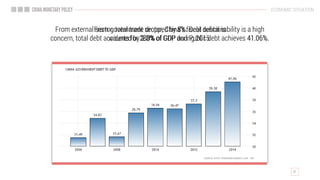
From external sector, total trade dropped by 8%. Debt sustainability is a high
concern, total debt accounts for 280% of GDP and Public debt achieves 41.06%.
From government sector, China’s fiscal deficit is
widened by 2.3% of GDP during 2015.
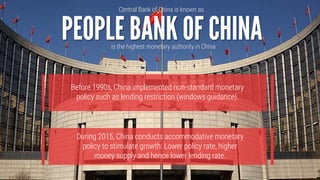
During 2015, China conducts accommodative monetary
policy to stimulate growth: Lower policy rate, higher
money supply and hence lower lending rate.
Central Bank of China is known as
is the highest monetary authority in China
Before 1990s, China implemented non-standard monetary
policy such as lending restriction (windows guidance).
MONETARY POLICY
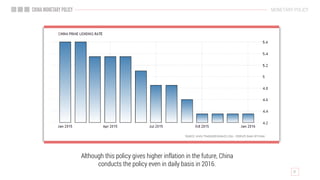
Although this policy gives higher inflation in the future, China
conducts the policy even in daily basis in 2016.
INFLATION
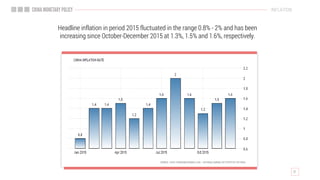
Headline inflation in period 2015 fluctuated in the range 0.8% - 2% and has been
increasing since October-December 2015 at 1.3%, 1.5% and 1.6%, respectively.
INFLATION
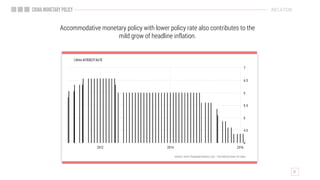
Accommodative monetary policy with lower policy rate also contributes to the
mild grow of headline inflation.
INFLATION
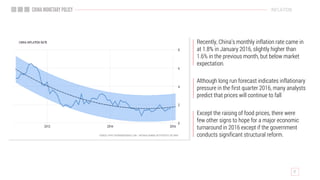
Although long run forecast indicates inflationary
pressure in the first quarter 2016, many analysts
predict that prices will continue to fall
Recently, China’s monthly inflation rate came in
at 1.8% in January 2016, slightly higher than
1.6% in the previous month, but below market
expectation.
Except the raising of food prices, there were
few other signs to hope for a major economic
turnaround in 2016 except if the government
conducts significant structural reform.
CURRENCY PERFORMANCE
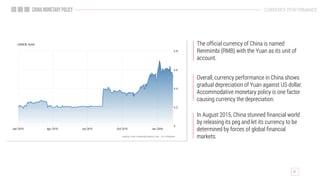
Overall, currency performance in China shows
gradual depreciation of Yuan against US dollar.
Accommodative monetary policy is one factor
causing currency the depreciation.
The official currency of China is named
Renmimbi (RMB) with the Yuan as its unit of
account.
In August 2015, China stunned financial world
by releasing its peg and let its currency to be
determined by forces of global financial
markets.
In managing further depreciation, China erodes it foreign exchange
reserves and conduct capital control.
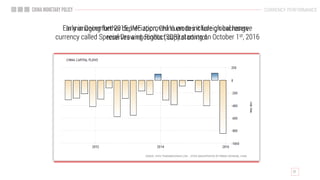
Early in December 2015, IMF approved Yuan to include global reserve
currency called Special Drawing Rights (SDR) starting on October 1st, 2016
CURRENCY PERFORMANCE
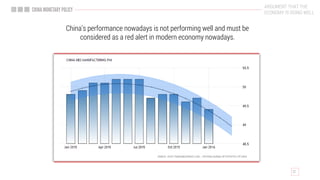
China’s performance nowadays is not performing well and must be
considered as a red alert in modern economy nowadays.
ARGUMENT THAT THE
ECONOMY IS DOING WELL
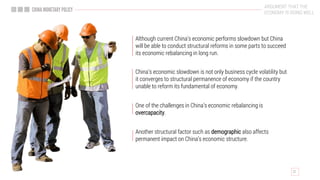
Another structural factor such as demographic also affects
permanent impact on China’s economic structure.
Although current China’s economic performs slowdown but China
will be able to conduct structural reforms in some parts to succeed
its economic rebalancing in long run.
China’s economic slowdown is not only business cycle volatility but
it converges to structural permanence of economy if the country
unable to reform its fundamental of economy.
One of the challenges in China’s economic rebalancing is
overcapacity.
ARGUMENT THAT THE
ECONOMY IS DOING WELL
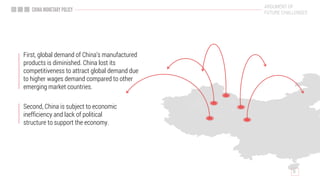
Second, China is subject to economic
inefficiency and lack of political
structure to support the economy.
First, global demand of China’s manufactured
products is diminished. China lost its
competitiveness to attract global demand due
to higher wages demand compared to other
emerging market countries.
ARGUMENT OF
FUTURE CHALLENGES
ARGUMENT OF
FUTURE CHALLENGES
Third, demographic
and environmental
factor threat China’s
structure of economy
to slowdown in the
long run.
Fourth, education
quality in China is also
a future challenge to
create better economy.
Data reliability also
exposes future challenge
for China’s economy.
Monetary policy can be realized through Yuan
appreciation, higher policy rate, hence higher yield
of government bonds and increased capital inflow,
but market for investment must be diversified to
accommodate capital inflow.
Monetary policy must be formulated to
tackle the issue of economic rebalancing.
MONETARY POLICY
RECOMMENDATION
Monetary policy needs to give disincentive to
export-based sector while give incentive to
consumption sector.
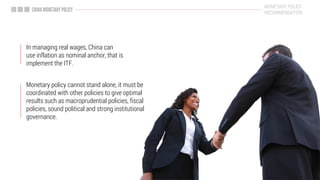
Monetary policy cannot stand alone, it must be
coordinated with other policies to give optimal
results such as macroprudential policies, fiscal
policies, sound political and strong institutional
governance.
In managing real wages, China can
use inflation as nominal anchor, that is
implement the ITF.
MONETARY POLICY
RECOMMENDATION
CONCLUSION
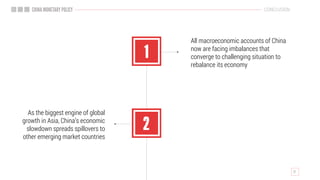
As the biggest engine of global
growth in Asia, China’s economic
slowdown spreads spillovers to
other emerging market countries
All macroeconomic accounts of China
now are facing imbalances that
converge to challenging situation to
rebalance its economy
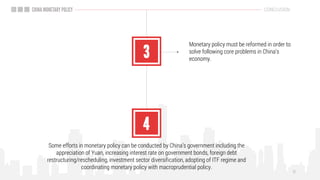
Monetary policy must be reformed in order to
solve following core problems in China’s
economy.
Some efforts in monetary policy can be conducted by China’s government including the
appreciation of Yuan, increasing interest rate on government bonds, foreign debt
restructuring/rescheduling, investment sector diversification, adopting of ITF regime and
coordinating monetary policy with macroprudential policy.
CONCLUSION

China monetary policy (final)

  • 4.
    China adopts unsustaingrowth model that heavily relies on export, investment and external demands. INTRODUCTION Global financial crisis decreased global demand toward China’s goods and services. Domestic investment is less diversified, only concentrated on manufactures, properties and real estates sectors.
  • 5.
  • 6.
    INTRODUCTION China is experiencingeconomic slowdown and needs to rebalance its economy Monetary policy is required to tackle economic issues in China.
  • 8.
    ECONOMIC SITUATION All China’smacroeconomic accounts exhibit imbalances reflecting its economic slowdown. From real sector, monthly GDP achieved only 1.6% in quarter four 2015, the lowest growth in 25 years.
  • 9.
    ECONOMIC SITUATION From monetarysector, China is haunted by deflation in 2016. Headline inflation shows decreasing trends. Yuan is deeply depreciated.
  • 10.
    ECONOMIC SITUATION From externalsector, total trade dropped by 8%. Debt sustainability is a high concern, total debt accounts for 280% of GDP and Public debt achieves 41.06%. From government sector, China’s fiscal deficit is widened by 2.3% of GDP during 2015.
  • 12.
    During 2015, Chinaconducts accommodative monetary policy to stimulate growth: Lower policy rate, higher money supply and hence lower lending rate. Central Bank of China is known as is the highest monetary authority in China Before 1990s, China implemented non-standard monetary policy such as lending restriction (windows guidance).
  • 13.
    MONETARY POLICY Although thispolicy gives higher inflation in the future, China conducts the policy even in daily basis in 2016.
  • 15.
    INFLATION Headline inflation inperiod 2015 fluctuated in the range 0.8% - 2% and has been increasing since October-December 2015 at 1.3%, 1.5% and 1.6%, respectively.
  • 16.
    INFLATION Accommodative monetary policywith lower policy rate also contributes to the mild grow of headline inflation.
  • 17.
    INFLATION Although long runforecast indicates inflationary pressure in the first quarter 2016, many analysts predict that prices will continue to fall Recently, China’s monthly inflation rate came in at 1.8% in January 2016, slightly higher than 1.6% in the previous month, but below market expectation. Except the raising of food prices, there were few other signs to hope for a major economic turnaround in 2016 except if the government conducts significant structural reform.
  • 19.
    CURRENCY PERFORMANCE Overall, currencyperformance in China shows gradual depreciation of Yuan against US dollar. Accommodative monetary policy is one factor causing currency the depreciation. The official currency of China is named Renmimbi (RMB) with the Yuan as its unit of account. In August 2015, China stunned financial world by releasing its peg and let its currency to be determined by forces of global financial markets.
  • 20.
    In managing furtherdepreciation, China erodes it foreign exchange reserves and conduct capital control. Early in December 2015, IMF approved Yuan to include global reserve currency called Special Drawing Rights (SDR) starting on October 1st, 2016 CURRENCY PERFORMANCE
  • 22.
    China’s performance nowadaysis not performing well and must be considered as a red alert in modern economy nowadays. ARGUMENT THAT THE ECONOMY IS DOING WELL
  • 23.
    Another structural factorsuch as demographic also affects permanent impact on China’s economic structure. Although current China’s economic performs slowdown but China will be able to conduct structural reforms in some parts to succeed its economic rebalancing in long run. China’s economic slowdown is not only business cycle volatility but it converges to structural permanence of economy if the country unable to reform its fundamental of economy. One of the challenges in China’s economic rebalancing is overcapacity. ARGUMENT THAT THE ECONOMY IS DOING WELL
  • 25.
    Second, China issubject to economic inefficiency and lack of political structure to support the economy. First, global demand of China’s manufactured products is diminished. China lost its competitiveness to attract global demand due to higher wages demand compared to other emerging market countries. ARGUMENT OF FUTURE CHALLENGES
  • 26.
    ARGUMENT OF FUTURE CHALLENGES Third,demographic and environmental factor threat China’s structure of economy to slowdown in the long run. Fourth, education quality in China is also a future challenge to create better economy. Data reliability also exposes future challenge for China’s economy.
  • 28.
    Monetary policy canbe realized through Yuan appreciation, higher policy rate, hence higher yield of government bonds and increased capital inflow, but market for investment must be diversified to accommodate capital inflow. Monetary policy must be formulated to tackle the issue of economic rebalancing. MONETARY POLICY RECOMMENDATION Monetary policy needs to give disincentive to export-based sector while give incentive to consumption sector.
  • 29.
    Monetary policy cannotstand alone, it must be coordinated with other policies to give optimal results such as macroprudential policies, fiscal policies, sound political and strong institutional governance. In managing real wages, China can use inflation as nominal anchor, that is implement the ITF. MONETARY POLICY RECOMMENDATION
  • 31.
    CONCLUSION As the biggestengine of global growth in Asia, China’s economic slowdown spreads spillovers to other emerging market countries All macroeconomic accounts of China now are facing imbalances that converge to challenging situation to rebalance its economy
  • 32.
    Monetary policy mustbe reformed in order to solve following core problems in China’s economy. Some efforts in monetary policy can be conducted by China’s government including the appreciation of Yuan, increasing interest rate on government bonds, foreign debt restructuring/rescheduling, investment sector diversification, adopting of ITF regime and coordinating monetary policy with macroprudential policy. CONCLUSION