Renewable Energy
An IEA Perspective
Amb. Richard H. Jones
Deputy Executive Director
International Energy Agency

VI Encuentro Internacional de Energías Renovables
         Santiago, Chile, 10-11 May 2012            © OECD/IEA 2010
Contents

                   Recent trends


                   Costs and Benefits


                   Outlook for renewables in IEA scenarios


                   Opportunities for Chile


                   Principles and examples for effective policies


© OECD/IEA 2010
Strong Growth in Electricity …


                                Wind    Bioenergy   Solar PV   Hydro   other

                   Generation
                                 338      296         31       3503     74
                   2010 [TWh]

                  CAGR 2005-
                                26.5%     8.8%       50.8%     3.1%    4.6%
                   2010 [%]

© OECD/IEA 2010
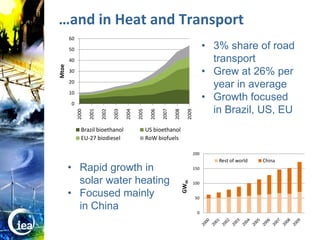
…and in Heat and Transport
                         60

                         50                                                                                   • 3% share of road
                  Mtoe   40                                                                                     transport
                         30                                                                                   • Grew at 26% per
                         20
                                                                                                                year in average
                         10

                         0
                                                                                                              • Growth focused
                                                                                                                in Brazil, US, EU
                                     2001
                              2000


                                            2002

                                                   2003

                                                          2004

                                                                 2005

                                                                         2006

                                                                                2007

                                                                                       2008

                                                                                                 2009
                                Brazil bioethanol                       US bioethanol
                                EU-27 biodiesel                         RoW biofuels

                                                                                                        200
                                                                                                                 Rest of world   China
                         • Rapid growth in                                                              150


                           solar water heating                                                GWth      100

                         • Focused mainly                                                                50

                           in China                                                                       0


© OECD/IEA 2010
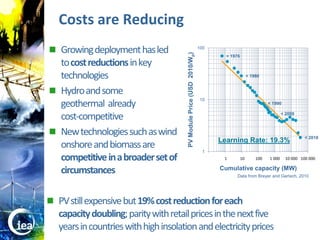
Costs are Reducing
                   Growing deployment has led                                            100


                                                          PV Module Price (USD 2010/Wp)
                                                                                                  < 1976
                    to cost reductions in key
                    technologies                                                                                < 1980


                   Hydro and some
                                                                                           10
                    geothermal already                                                                                    < 1990


                    cost-competitive                                                                                              < 2000


                   New technologies such as wind                                                                                            < 2010
                                                                                                Learning Rate: 19.3%
                    onshore and biomass are
                                                                                            1
                    competitive in a broader set of                                              1         10       100   1 000     10 000 100 000


                    circumstances                                                               Cumulative capacity (MW)
                                                                                                      Data from Breyer and Gerlach, 2010


                   PV still expensive but 19% cost reduction for each
                     capacity doubling; parity with retail prices in the next five
                     years in countries with high insolation and electricity prices
© OECD/IEA 2010
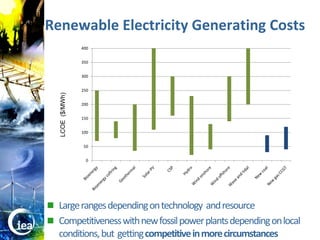
Renewable Electricity Generating Costs
                                    400


                                    350


                                    300


                                    250
                     LCOE ($/MWh)


                                    200


                                    150


                                    100


                                     50


                                      0


                   Large ranges depending on technology and resource
                   Competitiveness with new fossil power plants depending on local
© OECD/IEA 2010
                     conditions, but getting competitive in more circumstances
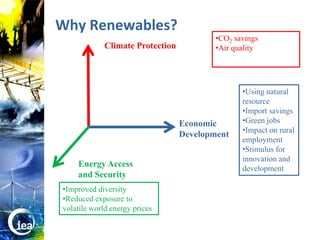
Why Renewables?
                                                            •CO2 savings
                               Climate Protection           •Air quality


                                                                   •Using natural
                                                                   resource
                                                                   •Import savings
                                                    Economic       •Green jobs
                                                                   •Impact on rural
                                                    Development
                                                                   employment
                                                                   •Stimulus for
                                                                   innovation and
                      Energy Access                                development
                      and Security
                  •Improved diversity
                  •Reduced exposure to
                  volatile world energy prices


© OECD/IEA 2010
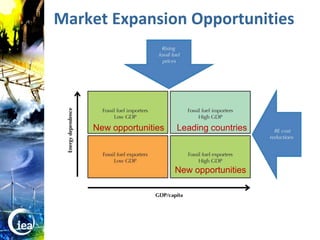
Market Expansion Opportunities


                      New opportunities   Leading countries


                                          New opportunities


© OECD/IEA 2010
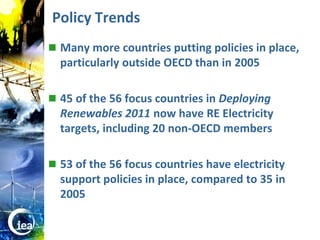
Policy Trends
                   Many more countries putting policies in place,
                    particularly outside OECD than in 2005

                   45 of the 56 focus countries in Deploying
                    Renewables 2011 now have RE Electricity
                    targets, including 20 non-OECD members

                   53 of the 56 focus countries have electricity
                    support policies in place, compared to 35 in
                    2005


© OECD/IEA 2010
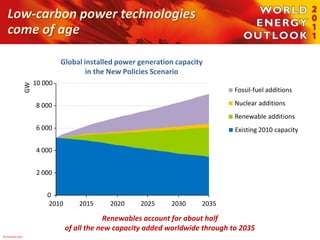
Low-carbon power technologies
   come of age

                                Global installed power generation capacity
                                        in the New Policies Scenario
                       10 000
                  GW


                                                                                   Fossil-fuel additions

                       8 000                                                       Nuclear additions
                                                                                   Renewable additions
                       6 000                                                       Existing 2010 capacity

                       4 000


                       2 000


                           0
                           2010       2015     2020    2025     2030     2035

                                              Renewables account for about half
                                  of all the new capacity added worldwide through to 2035
© OECD/IEA 2011
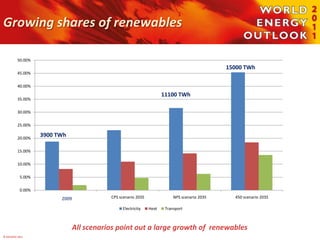
Growing shares of renewables

          50.00%
                                                                                                15000 TWh
          45.00%

          40.00%

                                                                       11100 TWh
          35.00%

          30.00%

          25.00%

          20.00%
                    3900 TWh

          15.00%

          10.00%

            5.00%

            0.00%
                          2008
                          2009              CPS scenario 2035               NPS scenario 2035     450 scenario 2035

                                                 Electricity    Heat    Transport


                                 All scenarios point out a large growth of renewables
© OECD/IEA 2011
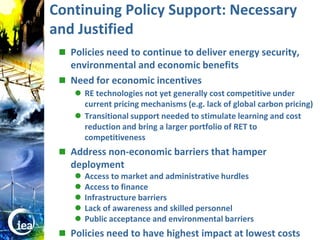
Continuing Policy Support: Necessary
                  and Justified
                    Policies need to continue to deliver energy security,
                     environmental and economic benefits
                    Need for economic incentives
                       RE technologies not yet generally cost competitive under
                        current pricing mechanisms (e.g. lack of global carbon pricing)
                       Transitional support needed to stimulate learning and cost
                        reduction and bring a larger portfolio of RET to
                        competitiveness
                    Address non-economic barriers that hamper
                     deployment
                         Access to market and administrative hurdles
                         Access to finance
                         Infrastructure barriers
                         Lack of awareness and skilled personnel
                         Public acceptance and environmental barriers
© OECD/IEA 2010
                    Policies need to have highest impact at lowest costs
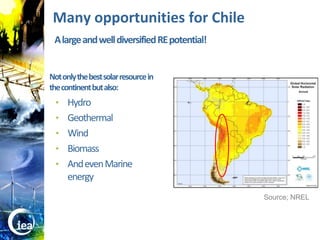
Many opportunities for Chile
                   A large and well diversified RE potential!


                  Not only the best solar resource in
                  the continent but also:
                    • Hydro
                    • Geothermal
                    • Wind
                    • Biomass
                    • And even Marine
                        energy
                                                                Source; NREL


© OECD/IEA 2010
Overarching Best-Practice
                  Policy Principles

                  1. Predictable RE policy framework, integrated
                       into overall energy strategy
                  2.   Portfolio of incentives based on technology
                       and market maturity
                  3.   Dynamic policy approach based on monitoring
                       of national and global market trends
                  4.   Tackle non-economic barriers
                  5.   Address system integration issues


© OECD/IEA 2010
Many Good Market Based Policy
                  Examples…

                   US States – quotas and fiscal incentives
                   Brazil – tendering scheme
                   Europe – emerging flexible and market-
                    oriented premium systems

                     •Opportunity to benefit from many years of
                     policy experience and emerging best practice
                     •Policy portfolio needs to be tailored to national
                     priorities and conditions


© OECD/IEA 2010
Conclusions
                   RE is an important component of any secure
                    and sustainable energy economy
                   Renewables are cost competitive in an
                    increasingly wider set of circumstances
                   Chile has a large and diverse resource base
                   Policy experience is available to help develop
                    portfolio of policies suited to Chile’s priorities
                    and conditions


© OECD/IEA 2010

Renewable Energy: An IEA Perspective

  • 1.
    Renewable Energy An IEAPerspective Amb. Richard H. Jones Deputy Executive Director International Energy Agency VI Encuentro Internacional de Energías Renovables Santiago, Chile, 10-11 May 2012 © OECD/IEA 2010
  • 2.
    Contents  Recent trends  Costs and Benefits  Outlook for renewables in IEA scenarios  Opportunities for Chile  Principles and examples for effective policies © OECD/IEA 2010
  • 3.
    Strong Growth inElectricity … Wind Bioenergy Solar PV Hydro other Generation 338 296 31 3503 74 2010 [TWh] CAGR 2005- 26.5% 8.8% 50.8% 3.1% 4.6% 2010 [%] © OECD/IEA 2010
  • 4.
    …and in Heatand Transport 60 50 • 3% share of road Mtoe 40 transport 30 • Grew at 26% per 20 year in average 10 0 • Growth focused in Brazil, US, EU 2001 2000 2002 2003 2004 2005 2006 2007 2008 2009 Brazil bioethanol US bioethanol EU-27 biodiesel RoW biofuels 200 Rest of world China • Rapid growth in 150 solar water heating GWth 100 • Focused mainly 50 in China 0 © OECD/IEA 2010
  • 5.
    Costs are Reducing  Growing deployment has led 100 PV Module Price (USD 2010/Wp) < 1976 to cost reductions in key technologies < 1980  Hydro and some 10 geothermal already < 1990 cost-competitive < 2000  New technologies such as wind < 2010 Learning Rate: 19.3% onshore and biomass are 1 competitive in a broader set of 1 10 100 1 000 10 000 100 000 circumstances Cumulative capacity (MW) Data from Breyer and Gerlach, 2010  PV still expensive but 19% cost reduction for each capacity doubling; parity with retail prices in the next five years in countries with high insolation and electricity prices © OECD/IEA 2010
  • 6.
    Renewable Electricity GeneratingCosts 400 350 300 250 LCOE ($/MWh) 200 150 100 50 0  Large ranges depending on technology and resource  Competitiveness with new fossil power plants depending on local © OECD/IEA 2010 conditions, but getting competitive in more circumstances
  • 7.
    Why Renewables? •CO2 savings Climate Protection •Air quality •Using natural resource •Import savings Economic •Green jobs •Impact on rural Development employment •Stimulus for innovation and Energy Access development and Security •Improved diversity •Reduced exposure to volatile world energy prices © OECD/IEA 2010
  • 8.
    Market Expansion Opportunities New opportunities Leading countries New opportunities © OECD/IEA 2010
  • 9.
    Policy Trends  Many more countries putting policies in place, particularly outside OECD than in 2005  45 of the 56 focus countries in Deploying Renewables 2011 now have RE Electricity targets, including 20 non-OECD members  53 of the 56 focus countries have electricity support policies in place, compared to 35 in 2005 © OECD/IEA 2010
  • 10.
    Low-carbon power technologies come of age Global installed power generation capacity in the New Policies Scenario 10 000 GW Fossil-fuel additions 8 000 Nuclear additions Renewable additions 6 000 Existing 2010 capacity 4 000 2 000 0 2010 2015 2020 2025 2030 2035 Renewables account for about half of all the new capacity added worldwide through to 2035 © OECD/IEA 2011
  • 11.
    Growing shares ofrenewables 50.00% 15000 TWh 45.00% 40.00% 11100 TWh 35.00% 30.00% 25.00% 20.00% 3900 TWh 15.00% 10.00% 5.00% 0.00% 2008 2009 CPS scenario 2035 NPS scenario 2035 450 scenario 2035 Electricity Heat Transport All scenarios point out a large growth of renewables © OECD/IEA 2011
  • 12.
    Continuing Policy Support:Necessary and Justified  Policies need to continue to deliver energy security, environmental and economic benefits  Need for economic incentives  RE technologies not yet generally cost competitive under current pricing mechanisms (e.g. lack of global carbon pricing)  Transitional support needed to stimulate learning and cost reduction and bring a larger portfolio of RET to competitiveness  Address non-economic barriers that hamper deployment  Access to market and administrative hurdles  Access to finance  Infrastructure barriers  Lack of awareness and skilled personnel  Public acceptance and environmental barriers © OECD/IEA 2010  Policies need to have highest impact at lowest costs
  • 13.
    Many opportunities forChile A large and well diversified RE potential! Not only the best solar resource in the continent but also: • Hydro • Geothermal • Wind • Biomass • And even Marine energy Source; NREL © OECD/IEA 2010
  • 14.
    Overarching Best-Practice Policy Principles 1. Predictable RE policy framework, integrated into overall energy strategy 2. Portfolio of incentives based on technology and market maturity 3. Dynamic policy approach based on monitoring of national and global market trends 4. Tackle non-economic barriers 5. Address system integration issues © OECD/IEA 2010
  • 15.
    Many Good MarketBased Policy Examples…  US States – quotas and fiscal incentives  Brazil – tendering scheme  Europe – emerging flexible and market- oriented premium systems •Opportunity to benefit from many years of policy experience and emerging best practice •Policy portfolio needs to be tailored to national priorities and conditions © OECD/IEA 2010
  • 16.
    Conclusions  RE is an important component of any secure and sustainable energy economy  Renewables are cost competitive in an increasingly wider set of circumstances  Chile has a large and diverse resource base  Policy experience is available to help develop portfolio of policies suited to Chile’s priorities and conditions © OECD/IEA 2010

Editor's Notes