Artificial Intelligence and its Social aspects
 
http://www. youtube .com/watch? v=lJZTWwy6eUw &mode=related&search=
Recognize this picture…
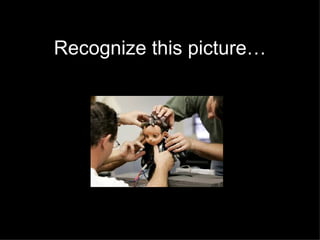
Zeno- 17 inch tall robotic companion Unlike artificial robotic toys, Zeno is an interactive learning companion,  Who can engage in conversation and convey human emotion through a face made of a skin-like, patented material his creator calls frubber. Available within the next three years for $200-300
… The issue of the “uncanny valley” theory… The theory states that humans have a positive psychological reaction to robots that look somewhat like humans, but that robots made to look very realistic end up seeming grotesque instead of comforting. people should look at robotics as a new age art form -Hanson believes that Zeno is the closest prototype we are going to get to the robots seen in the movies
The KISMET organization… “ Traditionally, autonomous robots are designed to operate as independently and remotely as possible from humans, often performing tasks in hazardous and hostile environments. However, a new range of application domains (domestic, entertainment, health care, etc.) are driving the development of robots that can interact and cooperate with people, and play a part in their daily lives.”  Kismet overview (http://www.ai.mit.edu/projects/sociable/overview.html)
What is Kismet? http://www. ai . mit . edu/projects/sociable/movies/hardware-narrative . mov
How is Kismet different? Kismet has the knowledge programed to adjust its postion in relation to the person it is talking to Like humans, Kismet has many different “systems” in its make up: attention, motor, behaviour, perceptual and motivation
Social Impacts People and Machines: Will AI machines someday replace humans in the workplace? How safe are we with this design? Reliability: Could if reach the point that these machines would not do as they are programmed? How do we know that they are going to always work?
Conclusion There should come a time where we draw the line in the humanization of robots They are good as tools for learning  If the research continues and advances continue, scientists should educate the public
Thank you for listening and I hope you learned something!
Bibliography http://www.ai.mit.edu/projects/humanoid-robotics-group/kismet/kismet.html http://www.msnbc.msn.com/id/20748776/ http://links999.net/robotics/artificial_intelligence/AI_ethical.html

Artificial Intelligence and Socially Empathetic Robots

  • 1.
    Artificial Intelligence andits Social aspects
  • 2.
  • 3.
    http://www. youtube .com/watch?v=lJZTWwy6eUw &mode=related&search=
  • 4.
  • 5.
    Zeno- 17 inchtall robotic companion Unlike artificial robotic toys, Zeno is an interactive learning companion, Who can engage in conversation and convey human emotion through a face made of a skin-like, patented material his creator calls frubber. Available within the next three years for $200-300
  • 6.
    … The issueof the “uncanny valley” theory… The theory states that humans have a positive psychological reaction to robots that look somewhat like humans, but that robots made to look very realistic end up seeming grotesque instead of comforting. people should look at robotics as a new age art form -Hanson believes that Zeno is the closest prototype we are going to get to the robots seen in the movies
  • 7.
    The KISMET organization…“ Traditionally, autonomous robots are designed to operate as independently and remotely as possible from humans, often performing tasks in hazardous and hostile environments. However, a new range of application domains (domestic, entertainment, health care, etc.) are driving the development of robots that can interact and cooperate with people, and play a part in their daily lives.” Kismet overview (http://www.ai.mit.edu/projects/sociable/overview.html)
  • 8.
    What is Kismet?http://www. ai . mit . edu/projects/sociable/movies/hardware-narrative . mov
  • 9.
    How is Kismetdifferent? Kismet has the knowledge programed to adjust its postion in relation to the person it is talking to Like humans, Kismet has many different “systems” in its make up: attention, motor, behaviour, perceptual and motivation
  • 10.
    Social Impacts Peopleand Machines: Will AI machines someday replace humans in the workplace? How safe are we with this design? Reliability: Could if reach the point that these machines would not do as they are programmed? How do we know that they are going to always work?
  • 11.
    Conclusion There shouldcome a time where we draw the line in the humanization of robots They are good as tools for learning If the research continues and advances continue, scientists should educate the public
  • 12.
    Thank you forlistening and I hope you learned something!
  • 13.