Children’s Music Genre Analysis
By Sydney Thomas
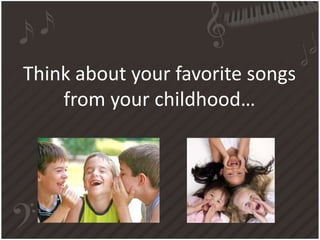
Think about your favorite songs
from your childhood…
Chances are that the songs you thought of
included one or more of the following:
-Baby Beluga
-Baby Bumble Bee
-Farmer in the Dell
-Five Little Monkeys Swinging in the Tree
-If You’re Happy and You Know It
-Itsy Bitsy Spider
-Miss Mary Mack
-The Wheels on the Bus
-Twinkle, Twinkle Little Star
-You Are My Sunshine
These songs are all
The genre of Children’s Music is not quite
as simple as it seems though.
It has:
- A complex history
- A detailed scene
- Characteristic patterns in the music
Complex History
1940s
• Young People's Records/Children's Record Guild
• Golden Records
These organizations were established, creating the
Children’s Music genre
1950s
• Pete Seeger (“Grandfather of Children’s Music”)
• Ella Jenkins (Rhythms and Rhyme)
With the introduction of these artists’ albums, the
perception of children’s music was changed forever
Complex History
1960s
• Mary Poppins soundtrack tops Billboard Charts
• Peter, Paul and Mary enter the children's music
world
Singers who previous sung adult music, begin to
enter the children’s music industry
1970s
• Schoolhouse Rock debuts on ABC
• Raffi's Singable Songs for the Very Young is
released
Music begins to focus on education
Complex History
1980s/1990s
• The Wiggles release their debut album
• Barney first aired on PBS
Television become one of the main ways for
children’s music to be heard
2000s
• Kidz Bop series debuts
Children’s music shifts to follow the style of popular
music
Detailed Scene
Where is it heard?
• Daycare
• School
• Home
• Cars
• Playgrounds
• Television
• Radio
Detailed Scene
Who sings it?
• Parents
• Daycare Providers
• Children
• Television Characters
What values do the songs bring?
• Entertainment
• Educational
– Manners
– Letters, Numbers, Days of the Week, etc.
– Emotions
– Animals, People
Characteristic Patterns
• Repetition
Characteristic Patterns
• Rhymes
• Motions to accompany the song
Characteristic Patterns
• Upbeat music
• Humor
• Repetition
• Short phrases
• Simple words
Characteristic Patterns
• These characteristics of the Children’s Music
genre are intended to:
– Appeal to children
– Be easy to remember
– Be easy to sing
– Engage children
Resources
• http://kidsmusic.about.com/od/childrensmusic101/a/history.
htm
• http://kidsmusic.about.com/od/childrensmusic101/a/timeline
.htm
• http://en.wikipedia.org/wiki/Children%27s_song
• http://www.articlesbase.com/music-articles/childrens-music-
repetition-in-music-and-its-history-1806480.html
• http://ezinearticles.com/?Childrens-Music---Repetition-in-
Music-and-Its-History&id=3676686
• http://youtube.com

Children’s music genre analysis

  • 1.
    Children’s Music GenreAnalysis By Sydney Thomas
  • 2.
    Think about yourfavorite songs from your childhood…
  • 3.
    Chances are thatthe songs you thought of included one or more of the following: -Baby Beluga -Baby Bumble Bee -Farmer in the Dell -Five Little Monkeys Swinging in the Tree -If You’re Happy and You Know It -Itsy Bitsy Spider -Miss Mary Mack -The Wheels on the Bus -Twinkle, Twinkle Little Star -You Are My Sunshine
  • 4.
  • 5.
    The genre ofChildren’s Music is not quite as simple as it seems though. It has: - A complex history - A detailed scene - Characteristic patterns in the music
  • 6.
    Complex History 1940s • YoungPeople's Records/Children's Record Guild • Golden Records These organizations were established, creating the Children’s Music genre 1950s • Pete Seeger (“Grandfather of Children’s Music”) • Ella Jenkins (Rhythms and Rhyme) With the introduction of these artists’ albums, the perception of children’s music was changed forever
  • 7.
    Complex History 1960s • MaryPoppins soundtrack tops Billboard Charts • Peter, Paul and Mary enter the children's music world Singers who previous sung adult music, begin to enter the children’s music industry 1970s • Schoolhouse Rock debuts on ABC • Raffi's Singable Songs for the Very Young is released Music begins to focus on education
  • 8.
    Complex History 1980s/1990s • TheWiggles release their debut album • Barney first aired on PBS Television become one of the main ways for children’s music to be heard 2000s • Kidz Bop series debuts Children’s music shifts to follow the style of popular music
  • 9.
    Detailed Scene Where isit heard? • Daycare • School • Home • Cars • Playgrounds • Television • Radio
  • 10.
    Detailed Scene Who singsit? • Parents • Daycare Providers • Children • Television Characters What values do the songs bring? • Entertainment • Educational – Manners – Letters, Numbers, Days of the Week, etc. – Emotions – Animals, People
  • 11.
  • 12.
    Characteristic Patterns • Rhymes •Motions to accompany the song
  • 13.
    Characteristic Patterns • Upbeatmusic • Humor • Repetition • Short phrases • Simple words
  • 14.
    Characteristic Patterns • Thesecharacteristics of the Children’s Music genre are intended to: – Appeal to children – Be easy to remember – Be easy to sing – Engage children
  • 15.
    Resources • http://kidsmusic.about.com/od/childrensmusic101/a/history. htm • http://kidsmusic.about.com/od/childrensmusic101/a/timeline .htm •http://en.wikipedia.org/wiki/Children%27s_song • http://www.articlesbase.com/music-articles/childrens-music- repetition-in-music-and-its-history-1806480.html • http://ezinearticles.com/?Childrens-Music---Repetition-in- Music-and-Its-History&id=3676686 • http://youtube.com