MILLENNIUM DEVELOPMENT
GOAL 4 IN NIGERIA: THE CASE SO
 FAR,AND THE LIKELIHOOD OF
   REACHING THE TARGET.
OUTLINE
•   BACKGROUND
•   CURRENT TRENDS AND PATTERNS
•   POLICY ISSUES
•   CHALLENGES
•   LIKELIHOOD OF REACHING THE GOAL.
BACKGROUND
• MDG 4 is to reduce child mortality.
• Target is to reduce child mortality by two thirds in
  2005.
• Focus in this case is under-5 mortality indicator in
  Nigeria; a country in Sub-Saharan Africa region.
• Reduce under-5 mortality from a value of 191
  per 1,000 live births in 1990 to 64 per live births
  in 2005.
• Other indicators are immunization rate in one
  year olds, and infant mortality.
BACKGROUND
• Nigeria is a large country with a population of
  148.1 million people
• West Africa, Sub-Saharan Africa
• Has one of the highest rates of child mortality
• One of the poor nations
• Somewhat decentralised healthcare system
  via the 3 tier system
• Private and Public sector involved in
  healthcare delivery
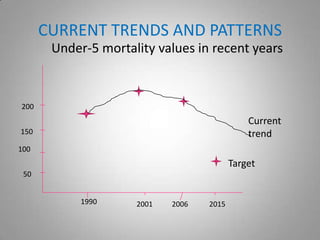
CURRENT TRENDS AND PATTERNS
       Under-5 mortality values in recent years


200
                                              Current
150                                           trend
100
                                          Target
 50


            1990     2001   2006   2015
MAJOR CAUSES OF UNDER-5
          MORTALITY IN NIGERIA
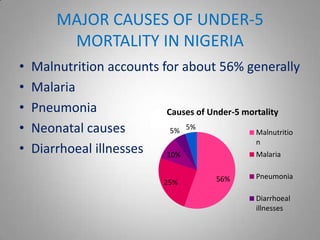
•   Malnutrition accounts for about 56% generally
•   Malaria
•   Pneumonia              Causes of Under-5 mortality
•   Neonatal causes         5% 5%              Malnutritio
                                               n
•   Diarrhoeal illnesses   10%                 Malaria


                                         56%     Pneumonia
                              25%

                                                 Diarrhoeal
                                                 illnesses
CURRENT POLICIES AND SYSTEMS IN PLACE

• Policies on child health mainly built on
  recommendations by WHO AND UNICEF
  priorities.
• Strategies in place are;
1.   Integrated Maternal and Child health; 2003
2.   Partnership for Maternal and child health; 2007
3.   National co-ordination and roll out to states
4.   Integrated management of childhood illnesses.
MAIN INTERVENTIONS BASED ON
               STRATEGY
•   ANC in mother
•   Putting to breast 30 minutes after birth
•   Exclusive Breastfeeding 0-5 months
•   Expanded programme on immunization
•   Use of Insecticide treated Mosquito bed nets
•   Use of ORT for Diarrhoea
•   Use of oral Zinc in diarrhoea
•   Use of antibiotics in pneumonia
CHALLENGES
• Political: 3 tier system in place, corruption, poor
  governance and commitment
• Structural: Weak infrastructure, lack of adequate
  staff, equipment, poor programme
  implementation.
• Cultural: Beliefs and taboos such as Abiku/
  Ogbanje
• Financial: Inadequate resources
• Poor data collection, analysis and registration
  systems.
LIKELIHOOD OF MEETING THE TARGET
• Nigeria MDG progress report 2004 says its
  unlikely.
• UN report indicates 0 percent probability.
• 2005 report says its probable in the face of
  improved governance and commitment, more
  financial resources.
• But have the recent figures and happenings
  proved it?
LIKELIHOOD CONT’D AND CONCLUSION

• UN requires 4.5% decline to achieve the
  goal, but current rate is less than 2.5%.
• Current political and economic situation in the
  country, worsening the healthcare system.
• Other MDGs also lagging behind hence
  affecting the overall picture.
• The goal not attainable in 2015, maybe in later
  years.
REFERENCES
• UNICEF-At a glance: Nigeria.
  ttp://www.unicef.org/infobycountry/nigeria.html.
• MDG Monitor: Tracking the millennium development
  goal in Nigeria. http://www.mdgmonitor.org/factsheets
• Christopher J.L. Murray et al. Can we achieve Millennium
  Development Goal 4? New analysis of country trends and
  forecasts of under-5 mortality to 2015. Lancelot 2007;
  370: 1040-1054.
• United Nations Development programme Nigeria: MDGs
  at a glance.
  http://www.ng.undp.org/mdgsngprogress.shtml.
• Andy Haines, Andrew Cassels; Can the millennium
  development goals be attained? BMJ 2004; 329; 394-397.

Millennium Development Goal 4 In Nigeria[1]

  • 1.
    MILLENNIUM DEVELOPMENT GOAL 4IN NIGERIA: THE CASE SO FAR,AND THE LIKELIHOOD OF REACHING THE TARGET.
  • 2.
    OUTLINE • BACKGROUND • CURRENT TRENDS AND PATTERNS • POLICY ISSUES • CHALLENGES • LIKELIHOOD OF REACHING THE GOAL.
  • 3.
    BACKGROUND • MDG 4is to reduce child mortality. • Target is to reduce child mortality by two thirds in 2005. • Focus in this case is under-5 mortality indicator in Nigeria; a country in Sub-Saharan Africa region. • Reduce under-5 mortality from a value of 191 per 1,000 live births in 1990 to 64 per live births in 2005. • Other indicators are immunization rate in one year olds, and infant mortality.
  • 4.
    BACKGROUND • Nigeria isa large country with a population of 148.1 million people • West Africa, Sub-Saharan Africa • Has one of the highest rates of child mortality • One of the poor nations • Somewhat decentralised healthcare system via the 3 tier system • Private and Public sector involved in healthcare delivery
  • 5.
    CURRENT TRENDS ANDPATTERNS Under-5 mortality values in recent years 200 Current 150 trend 100 Target 50 1990 2001 2006 2015
  • 6.
    MAJOR CAUSES OFUNDER-5 MORTALITY IN NIGERIA • Malnutrition accounts for about 56% generally • Malaria • Pneumonia Causes of Under-5 mortality • Neonatal causes 5% 5% Malnutritio n • Diarrhoeal illnesses 10% Malaria 56% Pneumonia 25% Diarrhoeal illnesses
  • 7.
    CURRENT POLICIES ANDSYSTEMS IN PLACE • Policies on child health mainly built on recommendations by WHO AND UNICEF priorities. • Strategies in place are; 1. Integrated Maternal and Child health; 2003 2. Partnership for Maternal and child health; 2007 3. National co-ordination and roll out to states 4. Integrated management of childhood illnesses.
  • 8.
    MAIN INTERVENTIONS BASEDON STRATEGY • ANC in mother • Putting to breast 30 minutes after birth • Exclusive Breastfeeding 0-5 months • Expanded programme on immunization • Use of Insecticide treated Mosquito bed nets • Use of ORT for Diarrhoea • Use of oral Zinc in diarrhoea • Use of antibiotics in pneumonia
  • 9.
    CHALLENGES • Political: 3tier system in place, corruption, poor governance and commitment • Structural: Weak infrastructure, lack of adequate staff, equipment, poor programme implementation. • Cultural: Beliefs and taboos such as Abiku/ Ogbanje • Financial: Inadequate resources • Poor data collection, analysis and registration systems.
  • 10.
    LIKELIHOOD OF MEETINGTHE TARGET • Nigeria MDG progress report 2004 says its unlikely. • UN report indicates 0 percent probability. • 2005 report says its probable in the face of improved governance and commitment, more financial resources. • But have the recent figures and happenings proved it?
  • 11.
    LIKELIHOOD CONT’D ANDCONCLUSION • UN requires 4.5% decline to achieve the goal, but current rate is less than 2.5%. • Current political and economic situation in the country, worsening the healthcare system. • Other MDGs also lagging behind hence affecting the overall picture. • The goal not attainable in 2015, maybe in later years.
  • 12.
    REFERENCES • UNICEF-At aglance: Nigeria. ttp://www.unicef.org/infobycountry/nigeria.html. • MDG Monitor: Tracking the millennium development goal in Nigeria. http://www.mdgmonitor.org/factsheets • Christopher J.L. Murray et al. Can we achieve Millennium Development Goal 4? New analysis of country trends and forecasts of under-5 mortality to 2015. Lancelot 2007; 370: 1040-1054. • United Nations Development programme Nigeria: MDGs at a glance. http://www.ng.undp.org/mdgsngprogress.shtml. • Andy Haines, Andrew Cassels; Can the millennium development goals be attained? BMJ 2004; 329; 394-397.

Editor's Notes

  • #6 Compared with global trends according to regions.
  • #7 Poverty accounts for the many cases of malnutrition, with about 70% of Nigerians living below the poverty line i.e. on less than $ 1 a day.Malaria is endemic in Nigeria; tropics, poor sanitation. Generally these diseases thrive in the tropics, poor sanitation and ventilation.
  • #12 Political crises e.g the Niger Delta, weak infrastructures, inadequate facilities, inadequate human and material resources.Current global economic crises which is likely to reduce foreign aid.Other MDGs like Maternal mortality, poverty levels, sanitation.