Hapag-Asa Integrated
Feeding Program
“Fullness of Life through Feeding the Body and Feeding the Spirit”
CHILD DEVELOPMENT:
NURTURING THE FUTURE
OUTLINE
What is Child Development?
Domains of Child Development
Stages of Child Development
Factors affecting Child Development
Parent Involvement
Early Childhood Education
Session Objectives
▪ Define the Child Development;
▪ Explain the different stages of Child Development;
▪ Discuss the domains of Child Development;
▪ Enumerate factors affecting Child Development;
▪ Explain the importance of parent involvement in
child development;
▪ Familiarize the role of Early Childhood Education in
Child Development;
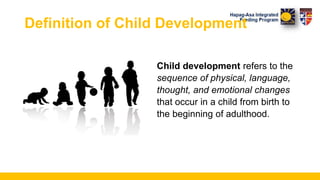
Definition of Child Development
Child development refers to the
sequence of physical, language,
thought, and emotional changes
that occur in a child from birth to
the beginning of adulthood.
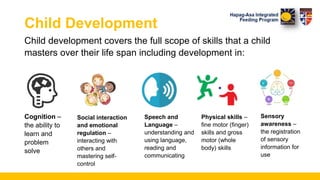
Child Development
Sensory
awareness –
the registration
of sensory
information for
use
Child development covers the full scope of skills that a child
masters over their life span including development in:
Cognition –
the ability to
learn and
problem
solve
Social interaction
and emotional
regulation –
interacting with
others and
mastering self-
control
Speech and
Language –
understanding and
using language,
reading and
communicating
Physical skills –
fine motor (finger)
skills and gross
motor (whole
body) skills
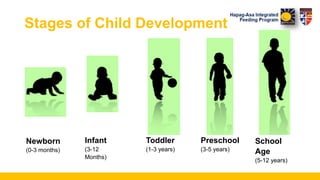
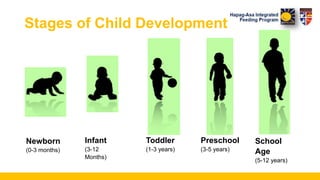
Stages of Child Development
School
Age
(5-12 years)
Newborn
(0-3 months)
Infant
(3-12
Months)
Toddler
(1-3 years)
Preschool
(3-5 years)
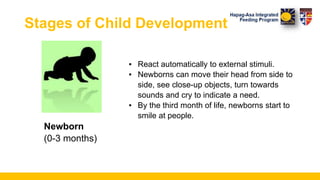
Stages of Child Development
▪ React automatically to external stimuli.
▪ Newborns can move their head from side to
side, see close-up objects, turn towards
sounds and cry to indicate a need.
▪ By the third month of life, newborns start to
smile at people.
Newborn
(0-3 months)
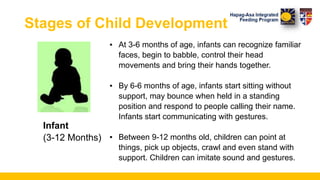
Stages of Child Development
▪ At 3-6 months of age, infants can recognize familiar
faces, begin to babble, control their head
movements and bring their hands together.
▪ By 6-6 months of age, infants start sitting without
support, may bounce when held in a standing
position and respond to people calling their name.
Infants start communicating with gestures.
▪ Between 9-12 months old, children can point at
things, pick up objects, crawl and even stand with
support. Children can imitate sound and gestures.
Infant
(3-12 Months)
Stages of Child Development
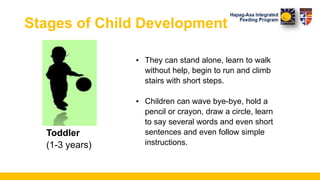
▪ They can stand alone, learn to walk
without help, begin to run and climb
stairs with short steps.
▪ Children can wave bye-bye, hold a
pencil or crayon, draw a circle, learn
to say several words and even short
sentences and even follow simple
instructions.
Toddler
(1-3 years)
Stages of Child Development
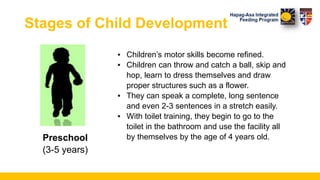
▪ Children’s motor skills become refined.
▪ Children can throw and catch a ball, skip and
hop, learn to dress themselves and draw
proper structures such as a flower.
▪ They can speak a complete, long sentence
and even 2-3 sentences in a stretch easily.
▪ With toilet training, they begin to go to the
toilet in the bathroom and use the facility all
by themselves by the age of 4 years old.
Preschool
(3-5 years)
Stages of Child Development
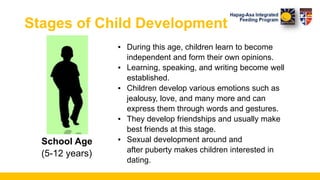
▪ During this age, children learn to become
independent and form their own opinions.
▪ Learning, speaking, and writing become well
established.
▪ Children develop various emotions such as
jealousy, love, and many more and can
express them through words and gestures.
▪ They develop friendships and usually make
best friends at this stage.
▪ Sexual development around and
after puberty makes children interested in
dating.
School Age
(5-12 years)
Stages of Child Development
School
Age
(5-12 years)
Newborn
(0-3 months)
Infant
(3-12
Months)
Toddler
(1-3 years)
Preschool
(3-5 years)
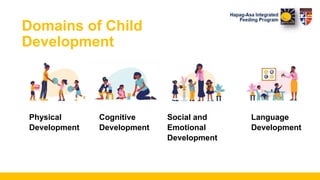
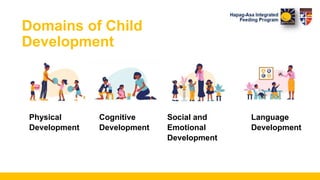
Domains of Child
Development
Language
Development
Physical
Development
Cognitive
Development
Social and
Emotional
Development
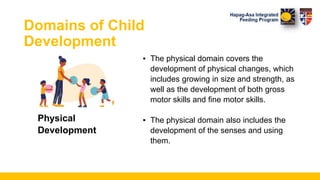
Domains of Child
Development
▪ The physical domain covers the
development of physical changes, which
includes growing in size and strength, as
well as the development of both gross
motor skills and fine motor skills.
▪ The physical domain also includes the
development of the senses and using
them.
Physical
Development
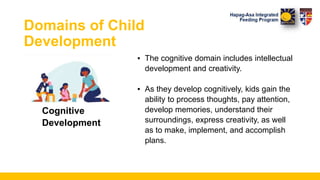
Domains of Child
Development
▪ The cognitive domain includes intellectual
development and creativity.
▪ As they develop cognitively, kids gain the
ability to process thoughts, pay attention,
develop memories, understand their
surroundings, express creativity, as well
as to make, implement, and accomplish
plans.
Cognitive
Development
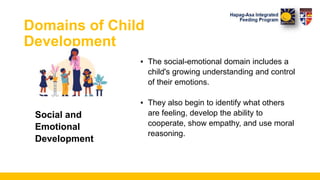
Domains of Child
Development
▪ The social-emotional domain includes a
child's growing understanding and control
of their emotions.
▪ They also begin to identify what others
are feeling, develop the ability to
cooperate, show empathy, and use moral
reasoning.
Social and
Emotional
Development
Domains of Child
Development
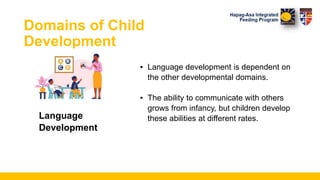
▪ Language development is dependent on
the other developmental domains.
▪ The ability to communicate with others
grows from infancy, but children develop
these abilities at different rates.
Language
Development
Domains of Child
Development
Language
Development
Physical
Development
Cognitive
Development
Social and
Emotional
Development
Factors affecting
Child Development
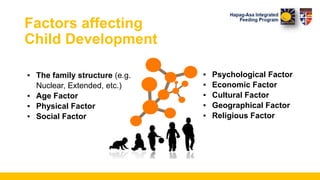
▪ The family structure (e.g.
Nuclear, Extended, etc.)
▪ Age Factor
▪ Physical Factor
▪ Social Factor
▪ Psychological Factor
▪ Economic Factor
▪ Cultural Factor
▪ Geographical Factor
▪ Religious Factor
Parent Involvement in
Child Development
Parent involvement outlines
the commitment and active
participation of a parent or
career to the school and
children.
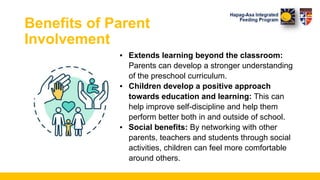
Benefits of Parent
Involvement
▪ Extends learning beyond the classroom:
Parents can develop a stronger understanding
of the preschool curriculum.
▪ Children develop a positive approach
towards education and learning: This can
help improve self-discipline and help them
perform better both in and outside of school.
▪ Social benefits: By networking with other
parents, teachers and students through social
activities, children can feel more comfortable
around others.
Early Childhood
Education
▪ ECE programs are designed to be
developmentally appropriate,
recognizing that children progress
through various stages of growth and
development.
▪ Early Childhood Education (ECE) is a
critical phase in a child's development
that encompasses a range of
educational and developmental
experiences.
▪ Early Childhood Education
(ECE) is a phase of
education that covers the
period from birth to eight
years old.
▪ It focuses on the holistic
development of a child and
provides a strong foundation
for lifelong learning.
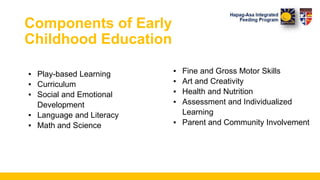
Components of Early
Childhood Education
▪ Play-based Learning
▪ Curriculum
▪ Social and Emotional
Development
▪ Language and Literacy
▪ Math and Science
▪ Fine and Gross Motor Skills
▪ Art and Creativity
▪ Health and Nutrition
▪ Assessment and Individualized
Learning
▪ Parent and Community Involvement
References:
▪ What is Child Development? Retrieved from https://childdevelopment.com.au/areas-of-
concern/what-is-child-development/
▪ Domains of Child Development. Retrieved from
https://www.orchidsinternationalschool.com/blog/parents-corner/childs-development
▪ WHY IS PARENT INVOLVEMENT IMPORTANT IN A CHILD'S DEVELOPMENT?
Retrieved from https://www.whitelodge.education/blog/parent-involvement-in-a-childs-
development
▪ What Are the 5 Stages of Child Development? Retrieved from
https://www.medicinenet.com/what_are_the_5_stages_of_child_development/article.ht
m
Contact us at:
Assisi Development Foundation | Hapag-Asa Secretariat
Unit 503 Prestige Tower,
F. Ortigas Jr. Rd., Ortigas Center,
1605 Pasig City
(02) 8632 1001
hapagasa@gmail.com
www.hapagasafeeding.com
https://www.facebook.com/hapagasafeeding

CHILD DEVELOPMENT PRESENTATION on nurturing the future.pptx

  • 1.
    Hapag-Asa Integrated Feeding Program “Fullnessof Life through Feeding the Body and Feeding the Spirit” CHILD DEVELOPMENT: NURTURING THE FUTURE
  • 2.
    OUTLINE What is ChildDevelopment? Domains of Child Development Stages of Child Development Factors affecting Child Development Parent Involvement Early Childhood Education
  • 3.
    Session Objectives ▪ Definethe Child Development; ▪ Explain the different stages of Child Development; ▪ Discuss the domains of Child Development; ▪ Enumerate factors affecting Child Development; ▪ Explain the importance of parent involvement in child development; ▪ Familiarize the role of Early Childhood Education in Child Development;
  • 4.
    Definition of ChildDevelopment Child development refers to the sequence of physical, language, thought, and emotional changes that occur in a child from birth to the beginning of adulthood.
  • 5.
    Child Development Sensory awareness – theregistration of sensory information for use Child development covers the full scope of skills that a child masters over their life span including development in: Cognition – the ability to learn and problem solve Social interaction and emotional regulation – interacting with others and mastering self- control Speech and Language – understanding and using language, reading and communicating Physical skills – fine motor (finger) skills and gross motor (whole body) skills
  • 6.
    Stages of ChildDevelopment School Age (5-12 years) Newborn (0-3 months) Infant (3-12 Months) Toddler (1-3 years) Preschool (3-5 years)
  • 7.
    Stages of ChildDevelopment ▪ React automatically to external stimuli. ▪ Newborns can move their head from side to side, see close-up objects, turn towards sounds and cry to indicate a need. ▪ By the third month of life, newborns start to smile at people. Newborn (0-3 months)
  • 8.
    Stages of ChildDevelopment ▪ At 3-6 months of age, infants can recognize familiar faces, begin to babble, control their head movements and bring their hands together. ▪ By 6-6 months of age, infants start sitting without support, may bounce when held in a standing position and respond to people calling their name. Infants start communicating with gestures. ▪ Between 9-12 months old, children can point at things, pick up objects, crawl and even stand with support. Children can imitate sound and gestures. Infant (3-12 Months)
  • 9.
    Stages of ChildDevelopment ▪ They can stand alone, learn to walk without help, begin to run and climb stairs with short steps. ▪ Children can wave bye-bye, hold a pencil or crayon, draw a circle, learn to say several words and even short sentences and even follow simple instructions. Toddler (1-3 years)
  • 10.
    Stages of ChildDevelopment ▪ Children’s motor skills become refined. ▪ Children can throw and catch a ball, skip and hop, learn to dress themselves and draw proper structures such as a flower. ▪ They can speak a complete, long sentence and even 2-3 sentences in a stretch easily. ▪ With toilet training, they begin to go to the toilet in the bathroom and use the facility all by themselves by the age of 4 years old. Preschool (3-5 years)
  • 11.
    Stages of ChildDevelopment ▪ During this age, children learn to become independent and form their own opinions. ▪ Learning, speaking, and writing become well established. ▪ Children develop various emotions such as jealousy, love, and many more and can express them through words and gestures. ▪ They develop friendships and usually make best friends at this stage. ▪ Sexual development around and after puberty makes children interested in dating. School Age (5-12 years)
  • 12.
    Stages of ChildDevelopment School Age (5-12 years) Newborn (0-3 months) Infant (3-12 Months) Toddler (1-3 years) Preschool (3-5 years)
  • 13.
  • 14.
    Domains of Child Development ▪The physical domain covers the development of physical changes, which includes growing in size and strength, as well as the development of both gross motor skills and fine motor skills. ▪ The physical domain also includes the development of the senses and using them. Physical Development
  • 15.
    Domains of Child Development ▪The cognitive domain includes intellectual development and creativity. ▪ As they develop cognitively, kids gain the ability to process thoughts, pay attention, develop memories, understand their surroundings, express creativity, as well as to make, implement, and accomplish plans. Cognitive Development
  • 16.
    Domains of Child Development ▪The social-emotional domain includes a child's growing understanding and control of their emotions. ▪ They also begin to identify what others are feeling, develop the ability to cooperate, show empathy, and use moral reasoning. Social and Emotional Development
  • 17.
    Domains of Child Development ▪Language development is dependent on the other developmental domains. ▪ The ability to communicate with others grows from infancy, but children develop these abilities at different rates. Language Development
  • 18.
  • 19.
    Factors affecting Child Development ▪The family structure (e.g. Nuclear, Extended, etc.) ▪ Age Factor ▪ Physical Factor ▪ Social Factor ▪ Psychological Factor ▪ Economic Factor ▪ Cultural Factor ▪ Geographical Factor ▪ Religious Factor
  • 20.
    Parent Involvement in ChildDevelopment Parent involvement outlines the commitment and active participation of a parent or career to the school and children.
  • 21.
    Benefits of Parent Involvement ▪Extends learning beyond the classroom: Parents can develop a stronger understanding of the preschool curriculum. ▪ Children develop a positive approach towards education and learning: This can help improve self-discipline and help them perform better both in and outside of school. ▪ Social benefits: By networking with other parents, teachers and students through social activities, children can feel more comfortable around others.
  • 22.
    Early Childhood Education ▪ ECEprograms are designed to be developmentally appropriate, recognizing that children progress through various stages of growth and development. ▪ Early Childhood Education (ECE) is a critical phase in a child's development that encompasses a range of educational and developmental experiences. ▪ Early Childhood Education (ECE) is a phase of education that covers the period from birth to eight years old. ▪ It focuses on the holistic development of a child and provides a strong foundation for lifelong learning.
  • 23.
    Components of Early ChildhoodEducation ▪ Play-based Learning ▪ Curriculum ▪ Social and Emotional Development ▪ Language and Literacy ▪ Math and Science ▪ Fine and Gross Motor Skills ▪ Art and Creativity ▪ Health and Nutrition ▪ Assessment and Individualized Learning ▪ Parent and Community Involvement
  • 24.
    References: ▪ What isChild Development? Retrieved from https://childdevelopment.com.au/areas-of- concern/what-is-child-development/ ▪ Domains of Child Development. Retrieved from https://www.orchidsinternationalschool.com/blog/parents-corner/childs-development ▪ WHY IS PARENT INVOLVEMENT IMPORTANT IN A CHILD'S DEVELOPMENT? Retrieved from https://www.whitelodge.education/blog/parent-involvement-in-a-childs- development ▪ What Are the 5 Stages of Child Development? Retrieved from https://www.medicinenet.com/what_are_the_5_stages_of_child_development/article.ht m
  • 26.
    Contact us at: AssisiDevelopment Foundation | Hapag-Asa Secretariat Unit 503 Prestige Tower, F. Ortigas Jr. Rd., Ortigas Center, 1605 Pasig City (02) 8632 1001 hapagasa@gmail.com www.hapagasafeeding.com https://www.facebook.com/hapagasafeeding