1
Assignment
on
Seed Production Technology of Chickpea
Submitted by
Ashish H. Nayi
1st
Semester
M.Sc. in Seed Science and Technology
Submitted to
Dr. J. N. Patel
Research Scientist & Unit Head
Bidi tobacco Research station
A.A.U., Anand.
Course title : Seed production principles and techniques in field crops
Course Number : SST 503
Course credit : 2+1
2
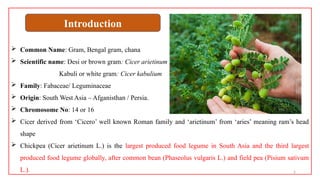
 Common Name: Gram, Bengal gram, chana
 Scientific name: Desi or brown gram: Cicer arietinum
Kabuli or white gram: Cicer kabulium
 Family: Fabaceae/ Leguminaceae
 Origin: South West Asia – Afganisthan / Persia.
 Chromosome No: 14 or 16
 Cicer derived from ‘Cicero’ well known Roman family and ‘arietinum’ from ‘aries’ meaning ram’s head
shape
 Chickpea (Cicer arietinum L.) is the largest produced food legume in South Asia and the third largest
produced food legume globally, after common bean (Phaseolus vulgaris L.) and field pea (Pisium sativum
L.).
Introduction
3
Continue…..
 In addition to having high protein content (20-22%), chickpea is rich in fiber, minerals (phosphorus,
calcium, magnesium, iron and zinc) and β-carotene. Its lipid fraction is high in unsaturated fatty acids.
 Chickpea plays a significant role in improving soil fertility by fixing the atmospheric nitrogen. Chickpea
meets 80% of its nitrogen (N) requirement from symbiotic nitrogen fixation and can fix up to 140 kg N/
ha from air.
 It leaves substantial amount of residual nitrogen for subsequent crops and adds plenty of organic matter to
maintain and improve soil health and fertility. Because of its deep tap root system, chickpea can withstand
drought conditions by extracting water from deeper layers in the soil profile.
4
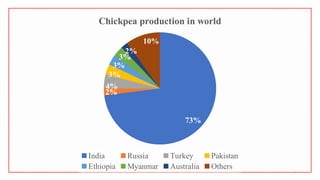
73%
2%
4%
3%
3%
3%
2%
10%
Chickpea production in world
India Russia Turkey Pakistan
Ethiopia Myanmar Australia Others
5
6
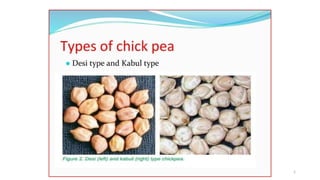
Two distinct types of chickpea are recognized.
 Chickpeas with colored and thick seed coat are called desi type.
 The common seed colors include various shades and combinations of brown, yellow, green and black
 The seeds are generally small and angular with a rough surface.
 The flowers are generally pink and the plants show various degrees of anthocyanin pigmentation, although
some desi types have white flowers and no anthocyanin pigmentation on the stem.
 The desi types account for 80-85% of chickpea area. The splits (dal) and flour (besan) are invariably
made from desi type.
Types of chickpea
Desi chickpea
7
 The kabuli type chickpeas are characterized by white or beige-colored seed with ram’s head shape, thin
seed coat, smooth seed surface, white flowers, and lack of anthocyanin pigmentation on the stem.
 As compared to desi types, the kabuli types have higher levels of sucrose and lower levels of fiber.
 The kabuli types generally have large sized seeds and receive higher market price than desi types. The
price premium in kabuli types generally increases as the seed size increases.
Kabuli chickpea
8
Chickpea is a herbaceous annual and the plant height generally ranges from 30-70 cm. It has tap
root system, which is usually deep and strong. The lateral roots develop nodules with the symbiotic
Rhizobium bacteria, capable of fixing atmospheric nitrogen in plant-usable form. The nodules (slightly
flattened, fan-like lobes) are visible about one month after plant emergence, and generally confined to the
top 15 cm of the surface.
The entire surface of the plant shoot, except the corolla, is densely covered with fine hairs known
as trichomes. Many are glandular and secrete a highly acidic substance containing malic, oxalic and citric
acids. These acids play an important role in protecting the plant against insect-pests.
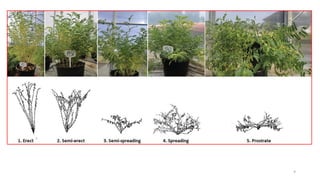
The plants have primary, secondary and tertiary branches. Five growth habits, based on angle of
branches from the vertical, are classified as: erect, semi-erect, semi-spreading, spreading and prostrate. The
erect and semi-erect varieties enable mechanical harvesting
General plant characteristics
9
10
Chickpea is a cool season food legume and grown as a winter crop in the tropics and as a summer or
spring crop in the temperate environments. It likes cool, dry and bright weather. Temperature, day length and
availability of moisture are the three major abiotic factors affecting flowering. In general, flowering is delayed
under low temperatures and also under short-days. Genetic variability exists in chickpea germplasm for
response to variation in day length (photoperiod sensitivity) and also for response to variation in temperature
(thermal sensitivity) and has been exploited in development of short-duration cultivars. Chickpea is sensitive
to high (maximum daily temperature >35°C) as well as low (mean of maximum and minimum daily
temperatures)
Climatic requirement
11
Chickpea is grown in rabi (post rainy season) following a kharif (rainy season) crop. The sowing is done in the
month of October or November. Late sowing (December-January) should be avoided as the late-sown crop may experience
moisture stress and high temperature at the critical stage of pod-filling, leading to reduced yield and seed quality
Crop season and sowing time
12
Chickpea can be successfully grown in a variety of soil types including coarse-textured sandy to fine-textured
deep black soils (vertisols). However, the best suited soils are deep loams or silty clay loams with a pH ranging from 6.0 to
8.0. Saline soil and fields with a high water table are not suitable for chickpea
Suitable soil type
13
Chickpea plants are highly sensitive to poor aeration in the soil. Seedling emergence and plant growth are
hindered if field surface is compact. Therefore, the field should have loose tilth and good drainage. The stubble and
debris from the previous crop should be removed as these can harbor the pathogens that cause root diseases, such as
collar rot.
Field preparation
14
The seeds should be treated with fungicides (2 g thiram + 1 g carbendazim kg-1 seed) before sowing for reducing
seed and soil borne fungal diseases. Phosphorus solubilizing bacteria (PSB) have been identified, which improve
availability of phosphorus to plants. Thus, seed treatment with PSB is recommended. If chickpea is being grown for the
first time, the seeds should be inoculated with Rhizobium culture. The seeds should be treated first with fungicides and then
with PSB and Rhizobium, following the procedure recommended by suppliers. The culture-treated seeds should be dried in
the shade and sown as soon as possible thereafter. If the seed is to be treated with pesticides, always apply insecticides first,
followed by fungicides, and finally Rhizobium culture/phosphate solubilizing bacteria or follow instructions on the packets
Seed treatment
15
Sowing is usually done on conserved soil moisture. A pre-sowing irrigation may be needed, if the available soil
moisture is not adequate for germination. Kabuli chickpea should never be irrigated immediately after sowing, particularly
in deep black soils. This is because the kabuli chickpea seeds have thin seed coat and deteriorate faster as compared to desi
type and are also more susceptible to seed rot and seedling damping off.
Seed should be sown deeply enough to make contact with moist soil. A depth of 5-8 cm seems to be ideal for the
emergence of chickpea.
Sowing depth
Sowing
16
Line sowing is a must in the crop grown for seed production as it facilitates interculture operations, rouging and
field inspection. Row-to-row spacing of 30 cm and plant-to-plant spacing of 10 cm are generally used, which give a plant
population of about 33 plants per m2
(330,000 plants/ ha). Wider row spacing (45–60 cm) can be used in large seeded
kabuli chickpea and irrigated crops (both desi and kabuli types), which are expected to have greater plant width. Broadbed
and furrow system or ridge and furrow system are very useful for irrigation, drainage and interculture operations.
Spacing
17
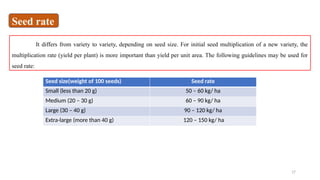
It differs from variety to variety, depending on seed size. For initial seed multiplication of a new variety, the
multiplication rate (yield per plant) is more important than yield per unit area. The following guidelines may be used for
seed rate:
Seed size(weight of 100 seeds) Seed rate
Small (less than 20 g) 50 – 60 kg/ ha
Medium (20 – 30 g) 60 – 90 kg/ ha
Large (30 – 40 g) 90 – 120 kg/ ha
Extra-large (more than 40 g) 120 – 150 kg/ ha
Seed rate
18
 Chickpea seedlings have hypogeal emergence, i.e, their cotyledons remain underground, while providing
energy to the rapidly growing roots and shoots.
 Emergence occurs in 7-15 days after sowing, depending on soil temperature and sowing depth.
Seedling emergence
19
Chickpea has an indeterminate growth habit in which vegetative growth continues even after the
start of flowering. Hence, there is often a sequence of leaf, flower bud, flower and pod development along
each branch. The duration of vegetative growth before flowering generally ranges from 40 to 80 days
depending on the variety, location, availability of soil moisture and weather conditions. A number of pseudo–
flowers or false flower buds develop during the changeover from leaf buds to flower buds on the stem.
Excessive vegetative growth is a problem of long growing season environments, as in northern and eastern
India when soil moisture and temperature conditions remain favorable during the early reproductive growth
stages.
Plant growth
20
Chickpeas have typical papilionaceous flowers. Most cultivars produce a single flower at each
flowering node. A few cultivars with two flowers per node (twin or double flowered) are also found. The
flowers are pink, white or blue in color. Anthesis in chickpea takes place throughout the day. Anther
dehiscence occurs inside the bud 24 hrs before the opening of the flower. Thus, chickpea flowers
are truly cleistogamous and self-fertilized. After dehiscence the anthers become shriveled while the
standard and wing petals are fully expanded. Under favorable conditions, the time taken from
fertilization to the first appearance of pod (pod set) is about 6 days
Pollination and fertilization
21
Maturity
After pod set, the pod wall grows rapidly for the first 10 to 15 days while seed growth occurs later.
Soon after development of pods and seed filling, senescence of subtending leaves begins. If there is plenty of
soil moisture, flowering and podding will continue on the upper nodes. Chickpea can tolerate high
temperature if there is adequate soil moisture. Chickpea is ready to harvest when 90% of the stems and pods
loose their green color and turn light golden yellow
22
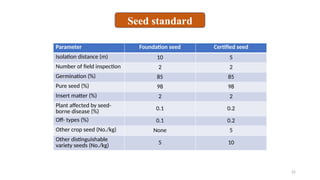
Parameter Foundation seed Certified seed
Isolation distance (m) 10 5
Number of field inspection 2 2
Germination (%) 85 85
Pure seed (%) 98 98
Insert matter (%) 2 2
Plant affected by seed-
borne disease (%)
0.1 0.2
Off- types (%) 0.1 0.2
Other crop seed (No./kg) None 5
Other distinguishable
variety seeds (No./kg) 5 10
Seed standard
23
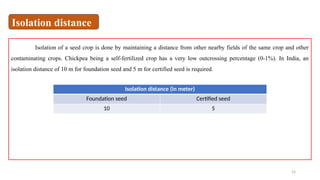
Isolation of a seed crop is done by maintaining a distance from other nearby fields of the same crop and other
contaminating crops. Chickpea being a self-fertilized crop has a very low outcrossing percentage (0-1%). In India, an
isolation distance of 10 m for foundation seed and 5 m for certified seed is required.
Isolation distance
Isolation distance (in meter)
Foundation seed Certified seed
10 5
24
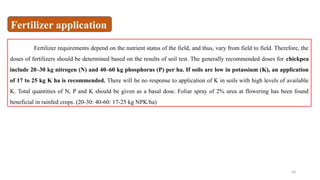
Fertilizer requirements depend on the nutrient status of the field, and thus, vary from field to field. Therefore, the
doses of fertilizers should be determined based on the results of soil test. The generally recommended doses for chickpea
include 20–30 kg nitrogen (N) and 40–60 kg phosphorus (P) per ha. If soils are low in potassium (K), an application
of 17 to 25 kg K ha is recommended. There will be no response to application of K in soils with high levels of available
K. Total quantities of N, P and K should be given as a basal dose. Foliar spray of 2% urea at flowering has been found
beneficial in rainfed crops. (20-30: 40-60: 17-25 kg NPK/ha)
Fertilizer application
25
Chickpea is generally grown as a rainfed crop, but two irrigations, one each at branching and pod filling
stages, are recommended for higher yield. Higher number of irrigations may lead to excessive vegetative growth in
heavy soils.
Chickpea is a poor competitor with weeds at all stages of growth. Pre-emergence herbicides, such as Fluchloralin
@ 1 kg a.i. per ha or Pendimethalin @ 1.0 to 1.5 kg a.i. per ha were found effective in controlling early flush of weeds.
Mechanical / manual weeding can be done where wide row spacing is used.
Irrigation
Weed management
26
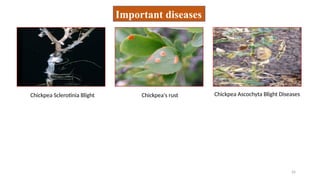
Important diseases
Chickpea Sclerotinia Blight Chickpea's rust Chickpea Ascochyta Blight Diseases
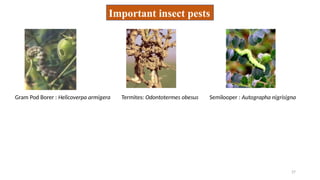
Important insect pests
27
Gram Pod Borer : Helicoverpa armigera Semilooper : Autographa nigrisigna
Termites: Odontotermes obesus
28
It refers to systematic examination of seed production fields and removal of undesirable plants that may
contaminate the seed crop. Rouging not only maintains varietal purity but also protects the seed crop from seed-borne
diseases. The off-type plants, other crop species (with similar seed size), weed plants, parasitic weeds such as Cuscuta spp.
and plants infected with seed-borne fungal diseases and viruses should be removed from the seed fields from time to time
The time of harvesting is crucial in maintaining the quality of seeds. The crop should be harvested when leaves
start to senesce and start shedding, pods turn yellow, plants are dry, and seed feels hard and rattles within the pod. After
harvest, the plants can be dried in the sun for a few days to ensure that seeds get dried well. Threshing can be done using
commercially available power threshers.
Rouging
Harvesting and threshing
29
Cleaning and upgrading is based on physical differences between dried crop seed, and shriveled, broken, or
damaged seed. good seeds are cleaned to remove the undesirable contaminants such as plant parts, soil particles, stones,
weed seed, other seed, poor seed and undesirable contaminants. The cleaning and grading of seeds is first achieved by
winnowing and then through a set of mechanical sieves. In addition to air cleaners and aspirators, indented separators, disc
separators, gravity separators, spiral separators and drum separators are frequently used.
The seed must be properly dried before storage. The ideal seed moisture level is 10-12% for short-term storage
(up to 8 months). After drying, the seed should be either stored in polythene-lined gunny bags or in safe storage structures
(metal bins or earthen containers). The bags should be kept in a rodent free room and placed on wooden planks (not more
than five in a stack) and away from walls to avoid dampness to the seeds
Seed processing
Seed storage
30
Summary
Common Name: Gram, Bengal gram, chana
Scientific name: Desi or brown gram: Cicer arietinum
Kabuli or white gram: Cicer kabulium
Family: Fabaceae
Origin: South West Asia – Afganisthan / Persia.
Chromosome Number : Desi gram: 2n= 14 or 16
Kabuli gram: 2n= 16
Land Requirement
field should have loose tilth and good drainage
Isolation Distance
Foundation seed: 10 m
Certified seed: 5 m
Seed Sowing
For seed production sowing may be done during October or November is more conductive
31
Popular varieties:
Avrodhi, Pusa-256/BG-256, C-235, Gaurav, RS-10, RS-11, ICCC-2, Aparna, Type-2, Pusa-209
Fertilizer Requirement: 20-30: 40-60: 17-25 kg NPK/ha
Irrigation Requirement: two irrigations, one each at branching and pod filling stages
Harvesting:
The crop should be harvested when leaves start to senesce and start shedding, pods turn yellow, plants are dry,
and seed feels hard and rattles within the pod.
32
Questions
(1). Scientific name of chickpea…
a) Cicer arietinum
b) Oryza sativa
c) Triticum aestivum
d) Zea mays
Ans: a
(2). Chromosome number of kabuli chickpea
e) 10
f) 24
g) 16
h) 42
Ans: c
33
(3). Protein content in chickpea..
a) 40-42%
b) 10-15%
c) 28-30%
d) 20-22%
Ans: d
(4). How much nitrogen could chickpea fix in soil through symbiotic nitrogen fixation..
e) Up to 110 kg N/ha
f) Up to 140 kg N/ha
g) Up to 100 kg N/ha
h) Up to 90kg N/ha
Ans: b
34
(5). Origin of chickpea..
a) South West Asia
b) South America
c) South korea
d) Australia
Ans: a
(6). Minimum isolation distance in foundation seed production of chickpea
e) 25m
f) 15m
g) 10m
h) 50m
Ans: c
35
(7). Minimum germination percentage is mandatory for foundation & certified seed production of chickpea..
a) 95%
b) 98%
c) 80%
d) 85%
Ans: d
(8). Which country contribute highest in term of total production of chickpea in the world.
e) China
f) USA
g) India
h) Russia
Ans: c
36
(9). Indian institute of pulse research is located at…
a) Bhopal(MP)
b) Kanpur (UP)
c) Pune(MH)
d) Junagadh(GJ)
Ans: b
(10). What is the minimum standard for the pureseed(%) in certified seed of chickpea..
e) 85%
f) 95%
g) 98%
h) 80%
Ans: c
37
Gratitude

chickpea seed production(introduction types)pptx

  • 1.
    1 Assignment on Seed Production Technologyof Chickpea Submitted by Ashish H. Nayi 1st Semester M.Sc. in Seed Science and Technology Submitted to Dr. J. N. Patel Research Scientist & Unit Head Bidi tobacco Research station A.A.U., Anand. Course title : Seed production principles and techniques in field crops Course Number : SST 503 Course credit : 2+1
  • 2.
    2  Common Name:Gram, Bengal gram, chana  Scientific name: Desi or brown gram: Cicer arietinum Kabuli or white gram: Cicer kabulium  Family: Fabaceae/ Leguminaceae  Origin: South West Asia – Afganisthan / Persia.  Chromosome No: 14 or 16  Cicer derived from ‘Cicero’ well known Roman family and ‘arietinum’ from ‘aries’ meaning ram’s head shape  Chickpea (Cicer arietinum L.) is the largest produced food legume in South Asia and the third largest produced food legume globally, after common bean (Phaseolus vulgaris L.) and field pea (Pisium sativum L.). Introduction
  • 3.
    3 Continue…..  In additionto having high protein content (20-22%), chickpea is rich in fiber, minerals (phosphorus, calcium, magnesium, iron and zinc) and β-carotene. Its lipid fraction is high in unsaturated fatty acids.  Chickpea plays a significant role in improving soil fertility by fixing the atmospheric nitrogen. Chickpea meets 80% of its nitrogen (N) requirement from symbiotic nitrogen fixation and can fix up to 140 kg N/ ha from air.  It leaves substantial amount of residual nitrogen for subsequent crops and adds plenty of organic matter to maintain and improve soil health and fertility. Because of its deep tap root system, chickpea can withstand drought conditions by extracting water from deeper layers in the soil profile.
  • 4.
    4 73% 2% 4% 3% 3% 3% 2% 10% Chickpea production inworld India Russia Turkey Pakistan Ethiopia Myanmar Australia Others
  • 5.
  • 6.
    6 Two distinct typesof chickpea are recognized.  Chickpeas with colored and thick seed coat are called desi type.  The common seed colors include various shades and combinations of brown, yellow, green and black  The seeds are generally small and angular with a rough surface.  The flowers are generally pink and the plants show various degrees of anthocyanin pigmentation, although some desi types have white flowers and no anthocyanin pigmentation on the stem.  The desi types account for 80-85% of chickpea area. The splits (dal) and flour (besan) are invariably made from desi type. Types of chickpea Desi chickpea
  • 7.
    7  The kabulitype chickpeas are characterized by white or beige-colored seed with ram’s head shape, thin seed coat, smooth seed surface, white flowers, and lack of anthocyanin pigmentation on the stem.  As compared to desi types, the kabuli types have higher levels of sucrose and lower levels of fiber.  The kabuli types generally have large sized seeds and receive higher market price than desi types. The price premium in kabuli types generally increases as the seed size increases. Kabuli chickpea
  • 8.
    8 Chickpea is aherbaceous annual and the plant height generally ranges from 30-70 cm. It has tap root system, which is usually deep and strong. The lateral roots develop nodules with the symbiotic Rhizobium bacteria, capable of fixing atmospheric nitrogen in plant-usable form. The nodules (slightly flattened, fan-like lobes) are visible about one month after plant emergence, and generally confined to the top 15 cm of the surface. The entire surface of the plant shoot, except the corolla, is densely covered with fine hairs known as trichomes. Many are glandular and secrete a highly acidic substance containing malic, oxalic and citric acids. These acids play an important role in protecting the plant against insect-pests. The plants have primary, secondary and tertiary branches. Five growth habits, based on angle of branches from the vertical, are classified as: erect, semi-erect, semi-spreading, spreading and prostrate. The erect and semi-erect varieties enable mechanical harvesting General plant characteristics
  • 9.
  • 10.
    10 Chickpea is acool season food legume and grown as a winter crop in the tropics and as a summer or spring crop in the temperate environments. It likes cool, dry and bright weather. Temperature, day length and availability of moisture are the three major abiotic factors affecting flowering. In general, flowering is delayed under low temperatures and also under short-days. Genetic variability exists in chickpea germplasm for response to variation in day length (photoperiod sensitivity) and also for response to variation in temperature (thermal sensitivity) and has been exploited in development of short-duration cultivars. Chickpea is sensitive to high (maximum daily temperature >35°C) as well as low (mean of maximum and minimum daily temperatures) Climatic requirement
  • 11.
    11 Chickpea is grownin rabi (post rainy season) following a kharif (rainy season) crop. The sowing is done in the month of October or November. Late sowing (December-January) should be avoided as the late-sown crop may experience moisture stress and high temperature at the critical stage of pod-filling, leading to reduced yield and seed quality Crop season and sowing time
  • 12.
    12 Chickpea can besuccessfully grown in a variety of soil types including coarse-textured sandy to fine-textured deep black soils (vertisols). However, the best suited soils are deep loams or silty clay loams with a pH ranging from 6.0 to 8.0. Saline soil and fields with a high water table are not suitable for chickpea Suitable soil type
  • 13.
    13 Chickpea plants arehighly sensitive to poor aeration in the soil. Seedling emergence and plant growth are hindered if field surface is compact. Therefore, the field should have loose tilth and good drainage. The stubble and debris from the previous crop should be removed as these can harbor the pathogens that cause root diseases, such as collar rot. Field preparation
  • 14.
    14 The seeds shouldbe treated with fungicides (2 g thiram + 1 g carbendazim kg-1 seed) before sowing for reducing seed and soil borne fungal diseases. Phosphorus solubilizing bacteria (PSB) have been identified, which improve availability of phosphorus to plants. Thus, seed treatment with PSB is recommended. If chickpea is being grown for the first time, the seeds should be inoculated with Rhizobium culture. The seeds should be treated first with fungicides and then with PSB and Rhizobium, following the procedure recommended by suppliers. The culture-treated seeds should be dried in the shade and sown as soon as possible thereafter. If the seed is to be treated with pesticides, always apply insecticides first, followed by fungicides, and finally Rhizobium culture/phosphate solubilizing bacteria or follow instructions on the packets Seed treatment
  • 15.
    15 Sowing is usuallydone on conserved soil moisture. A pre-sowing irrigation may be needed, if the available soil moisture is not adequate for germination. Kabuli chickpea should never be irrigated immediately after sowing, particularly in deep black soils. This is because the kabuli chickpea seeds have thin seed coat and deteriorate faster as compared to desi type and are also more susceptible to seed rot and seedling damping off. Seed should be sown deeply enough to make contact with moist soil. A depth of 5-8 cm seems to be ideal for the emergence of chickpea. Sowing depth Sowing
  • 16.
    16 Line sowing isa must in the crop grown for seed production as it facilitates interculture operations, rouging and field inspection. Row-to-row spacing of 30 cm and plant-to-plant spacing of 10 cm are generally used, which give a plant population of about 33 plants per m2 (330,000 plants/ ha). Wider row spacing (45–60 cm) can be used in large seeded kabuli chickpea and irrigated crops (both desi and kabuli types), which are expected to have greater plant width. Broadbed and furrow system or ridge and furrow system are very useful for irrigation, drainage and interculture operations. Spacing
  • 17.
    17 It differs fromvariety to variety, depending on seed size. For initial seed multiplication of a new variety, the multiplication rate (yield per plant) is more important than yield per unit area. The following guidelines may be used for seed rate: Seed size(weight of 100 seeds) Seed rate Small (less than 20 g) 50 – 60 kg/ ha Medium (20 – 30 g) 60 – 90 kg/ ha Large (30 – 40 g) 90 – 120 kg/ ha Extra-large (more than 40 g) 120 – 150 kg/ ha Seed rate
  • 18.
    18  Chickpea seedlingshave hypogeal emergence, i.e, their cotyledons remain underground, while providing energy to the rapidly growing roots and shoots.  Emergence occurs in 7-15 days after sowing, depending on soil temperature and sowing depth. Seedling emergence
  • 19.
    19 Chickpea has anindeterminate growth habit in which vegetative growth continues even after the start of flowering. Hence, there is often a sequence of leaf, flower bud, flower and pod development along each branch. The duration of vegetative growth before flowering generally ranges from 40 to 80 days depending on the variety, location, availability of soil moisture and weather conditions. A number of pseudo– flowers or false flower buds develop during the changeover from leaf buds to flower buds on the stem. Excessive vegetative growth is a problem of long growing season environments, as in northern and eastern India when soil moisture and temperature conditions remain favorable during the early reproductive growth stages. Plant growth
  • 20.
    20 Chickpeas have typicalpapilionaceous flowers. Most cultivars produce a single flower at each flowering node. A few cultivars with two flowers per node (twin or double flowered) are also found. The flowers are pink, white or blue in color. Anthesis in chickpea takes place throughout the day. Anther dehiscence occurs inside the bud 24 hrs before the opening of the flower. Thus, chickpea flowers are truly cleistogamous and self-fertilized. After dehiscence the anthers become shriveled while the standard and wing petals are fully expanded. Under favorable conditions, the time taken from fertilization to the first appearance of pod (pod set) is about 6 days Pollination and fertilization

  • 21.
    21 Maturity After pod set,the pod wall grows rapidly for the first 10 to 15 days while seed growth occurs later. Soon after development of pods and seed filling, senescence of subtending leaves begins. If there is plenty of soil moisture, flowering and podding will continue on the upper nodes. Chickpea can tolerate high temperature if there is adequate soil moisture. Chickpea is ready to harvest when 90% of the stems and pods loose their green color and turn light golden yellow
  • 22.
    22 Parameter Foundation seedCertified seed Isolation distance (m) 10 5 Number of field inspection 2 2 Germination (%) 85 85 Pure seed (%) 98 98 Insert matter (%) 2 2 Plant affected by seed- borne disease (%) 0.1 0.2 Off- types (%) 0.1 0.2 Other crop seed (No./kg) None 5 Other distinguishable variety seeds (No./kg) 5 10 Seed standard
  • 23.
    23 Isolation of aseed crop is done by maintaining a distance from other nearby fields of the same crop and other contaminating crops. Chickpea being a self-fertilized crop has a very low outcrossing percentage (0-1%). In India, an isolation distance of 10 m for foundation seed and 5 m for certified seed is required. Isolation distance Isolation distance (in meter) Foundation seed Certified seed 10 5
  • 24.
    24 Fertilizer requirements dependon the nutrient status of the field, and thus, vary from field to field. Therefore, the doses of fertilizers should be determined based on the results of soil test. The generally recommended doses for chickpea include 20–30 kg nitrogen (N) and 40–60 kg phosphorus (P) per ha. If soils are low in potassium (K), an application of 17 to 25 kg K ha is recommended. There will be no response to application of K in soils with high levels of available K. Total quantities of N, P and K should be given as a basal dose. Foliar spray of 2% urea at flowering has been found beneficial in rainfed crops. (20-30: 40-60: 17-25 kg NPK/ha) Fertilizer application
  • 25.
    25 Chickpea is generallygrown as a rainfed crop, but two irrigations, one each at branching and pod filling stages, are recommended for higher yield. Higher number of irrigations may lead to excessive vegetative growth in heavy soils. Chickpea is a poor competitor with weeds at all stages of growth. Pre-emergence herbicides, such as Fluchloralin @ 1 kg a.i. per ha or Pendimethalin @ 1.0 to 1.5 kg a.i. per ha were found effective in controlling early flush of weeds. Mechanical / manual weeding can be done where wide row spacing is used. Irrigation Weed management
  • 26.
    26 Important diseases Chickpea SclerotiniaBlight Chickpea's rust Chickpea Ascochyta Blight Diseases
  • 27.
    Important insect pests 27 GramPod Borer : Helicoverpa armigera Semilooper : Autographa nigrisigna Termites: Odontotermes obesus
  • 28.
    28 It refers tosystematic examination of seed production fields and removal of undesirable plants that may contaminate the seed crop. Rouging not only maintains varietal purity but also protects the seed crop from seed-borne diseases. The off-type plants, other crop species (with similar seed size), weed plants, parasitic weeds such as Cuscuta spp. and plants infected with seed-borne fungal diseases and viruses should be removed from the seed fields from time to time The time of harvesting is crucial in maintaining the quality of seeds. The crop should be harvested when leaves start to senesce and start shedding, pods turn yellow, plants are dry, and seed feels hard and rattles within the pod. After harvest, the plants can be dried in the sun for a few days to ensure that seeds get dried well. Threshing can be done using commercially available power threshers. Rouging Harvesting and threshing
  • 29.
    29 Cleaning and upgradingis based on physical differences between dried crop seed, and shriveled, broken, or damaged seed. good seeds are cleaned to remove the undesirable contaminants such as plant parts, soil particles, stones, weed seed, other seed, poor seed and undesirable contaminants. The cleaning and grading of seeds is first achieved by winnowing and then through a set of mechanical sieves. In addition to air cleaners and aspirators, indented separators, disc separators, gravity separators, spiral separators and drum separators are frequently used. The seed must be properly dried before storage. The ideal seed moisture level is 10-12% for short-term storage (up to 8 months). After drying, the seed should be either stored in polythene-lined gunny bags or in safe storage structures (metal bins or earthen containers). The bags should be kept in a rodent free room and placed on wooden planks (not more than five in a stack) and away from walls to avoid dampness to the seeds Seed processing Seed storage
  • 30.
    30 Summary Common Name: Gram,Bengal gram, chana Scientific name: Desi or brown gram: Cicer arietinum Kabuli or white gram: Cicer kabulium Family: Fabaceae Origin: South West Asia – Afganisthan / Persia. Chromosome Number : Desi gram: 2n= 14 or 16 Kabuli gram: 2n= 16 Land Requirement field should have loose tilth and good drainage Isolation Distance Foundation seed: 10 m Certified seed: 5 m Seed Sowing For seed production sowing may be done during October or November is more conductive
  • 31.
    31 Popular varieties: Avrodhi, Pusa-256/BG-256,C-235, Gaurav, RS-10, RS-11, ICCC-2, Aparna, Type-2, Pusa-209 Fertilizer Requirement: 20-30: 40-60: 17-25 kg NPK/ha Irrigation Requirement: two irrigations, one each at branching and pod filling stages Harvesting: The crop should be harvested when leaves start to senesce and start shedding, pods turn yellow, plants are dry, and seed feels hard and rattles within the pod.
  • 32.
    32 Questions (1). Scientific nameof chickpea… a) Cicer arietinum b) Oryza sativa c) Triticum aestivum d) Zea mays Ans: a (2). Chromosome number of kabuli chickpea e) 10 f) 24 g) 16 h) 42 Ans: c
  • 33.
    33 (3). Protein contentin chickpea.. a) 40-42% b) 10-15% c) 28-30% d) 20-22% Ans: d (4). How much nitrogen could chickpea fix in soil through symbiotic nitrogen fixation.. e) Up to 110 kg N/ha f) Up to 140 kg N/ha g) Up to 100 kg N/ha h) Up to 90kg N/ha Ans: b
  • 34.
    34 (5). Origin ofchickpea.. a) South West Asia b) South America c) South korea d) Australia Ans: a (6). Minimum isolation distance in foundation seed production of chickpea e) 25m f) 15m g) 10m h) 50m Ans: c
  • 35.
    35 (7). Minimum germinationpercentage is mandatory for foundation & certified seed production of chickpea.. a) 95% b) 98% c) 80% d) 85% Ans: d (8). Which country contribute highest in term of total production of chickpea in the world. e) China f) USA g) India h) Russia Ans: c
  • 36.
    36 (9). Indian instituteof pulse research is located at… a) Bhopal(MP) b) Kanpur (UP) c) Pune(MH) d) Junagadh(GJ) Ans: b (10). What is the minimum standard for the pureseed(%) in certified seed of chickpea.. e) 85% f) 95% g) 98% h) 80% Ans: c
  • 37.