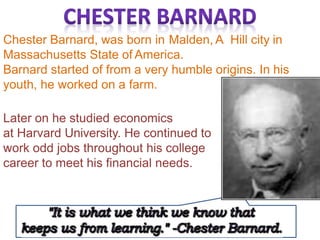
Chester Barnard, was born in Malden, A Hill city in
Massachusetts State of America.
Barnard started of from a very humble origins. In his
youth, he worked on a farm.
Later on he studied economics
at Harvard University. He continued to
work odd jobs throughout his college
career to meet his financial needs.
In fact he completed most of the requirements for a
Bachelor’s degree in economics just 3 years than 4.
But a lack of funds forced him to drop
out of Harvard before he completed a
final science requirement in physics or
chemistry.
However, a number of universities
later granted him honorary doctorates.
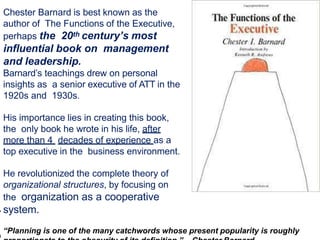
Chester Barnard is best known as the
author of The Functions of the Executive,
perhaps the 20th century’s most
influential book on management
and leadership.
Barnard’s teachings drew on personal
insights as a senior executive of ATT in the
1920s and 1930s.
His importance lies in creating this book,
the only book he wrote in his life, after
more than 4 decades of experience as a
top executive in the business environment.
He revolutionized the complete theory of
organizational structures, by focusing on
the organization as a cooperative
system.
“Planning is one of the many catchwords whose present popularity is roughly
Entire book is classified into 4
sections:
1. Preliminary Considerations
concerning
Cooperative Systems
2.The Theory and Structure of
Formal Organization
3. The Elements of Formal
Organization
Decoding
Organizations
&
Cooperative
Systems
Preliminary Considerations concerning Cooperative
Systems
“Formal organization is that
kind of cooperation among
men that is conscious,
deliberate, purposeful.”
He Specifies that a
formal organization is
part of a
"cooperative
system.“
With this statement, he was
the first theoretician to enter
the realm of Systems
approach to the study of
Decoding
Organizations
&
Cooperative
Systems
Preliminary Considerations concerning Cooperative
Systems
“Is complex of physical,
biological, personal,
and social components
which are in a specific
systematic
relationship by reason
of the cooperation of
two or more persons
for at least one definite
Elements of
Org.
An organization comes into being when
(1)there are persons able to communicate with each
other
(2)who are willing to contribute action
(3)to accomplish a common purpose.
We infer two things from the
Elements:
that an organization
that cannot
accomplish its
purpose cannot
that an organization
that accomplishes its
purpose has no
reason for existence.
Complete, Incomplete, Subordinate, and
Dominant Organizations
“Overlaying or embedded in the complex of informal
organizations, which in the aggregate we call great national
and local societies, is a network of formal organizations.” –
Complete, Incomplete, Subordinate, and Dominant
Organizations
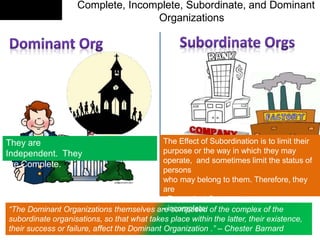
“The Dominant Organizations themselves are composed of the complex of the
subordinate organisations, so that what takes place within the latter, their existence,
their success or failure, affect the Dominant Organization .” – Chester Barnard
They are
Independent. They
are Complete.
The Effect of Subordination is to limit their
purpose or the way in which they may
operate, and sometimes limit the status of
persons
who may belong to them. Therefore, they
are
- Dependent &
- incomplete.
The Elements of Formal
Organisation
Contribution -
Satisfaction Equilibrium
The Theory of
Authority
Contribution- Satisfaction
Equilibriu
m (Barnard’s Theory of
Motivation)
Work > Incentives = No
Motivation Work ≈ Incentive =
No Motivation Incentive >
Work = Motivation!
Wor
k
Incentiv
e
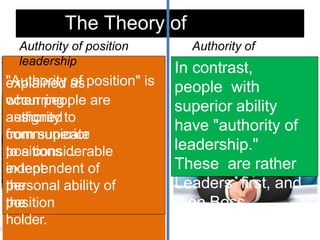
The Theory of
Authority
Authority of position Authority of
leadership
"Authority of position" is
explained as
occurring
when people are
assigned
authority to
communicate
from superior
positions…
to a considerable
extent
independent of
the
personal ability of
the
position
holder.
In contrast,
people with
superior ability
have "authority of
leadership."
These are rather
Leaders first, and
then Boss.
The Functions of Executive
1.Maintenance of
Organization
Communication
2.Securing Essential Services
from Individuals
3. Formulation of Purpose &
Objectives
Bringing persons into
cooperative Relationship with
the organization
Eliciting of services from
Maintenance
of
Communicati
on
Securing Essential
Services from
Individuals
Developing Org Chart, specifying
duties,
Securing informal
Organization
Purpose can be geographic, social and
functional.
Purpose must be sub-divided into fragments,
and specific objectives must reflect the detailed
purposes and actions.
It also includes defining the ends of
organisation.
Herbert A. Simon, Behavior
Scientist, in a 1988 interview,
was quoted as follows:
“Of course I built squarely on
Barnard (for my book
Admistrative Behavior), and
have always felt deeply
indebted to him; science is a
cumulative endeavor. My
general debt is expressed in the
acknowledgements ."To Mr.
Charles
I. Barnard I owe a special
debt…”
The Functions of the
Executive appeared in at least
four lists of "best" or "most
influential" management and
business books between 2001
and 2011.
There is no significant
mention of the education of
staff (i.e., the executive's role
as a teacher)
The book does not consider
how an executive of a
corporation interacts with the
board of directors or
stockholders.
A passage on page 319
("…It is consequently
necessary to say things in
a form which is not correct
from the standpoint of
the speaker or writer…")
has been interpreted as
"advocating lying.“-
Frederick, William Crittenden
(1995)

Chester Barnard.pptx

  • 1.
    Chester Barnard, wasborn in Malden, A Hill city in Massachusetts State of America. Barnard started of from a very humble origins. In his youth, he worked on a farm. Later on he studied economics at Harvard University. He continued to work odd jobs throughout his college career to meet his financial needs.
  • 2.
    In fact hecompleted most of the requirements for a Bachelor’s degree in economics just 3 years than 4. But a lack of funds forced him to drop out of Harvard before he completed a final science requirement in physics or chemistry. However, a number of universities later granted him honorary doctorates.
  • 3.
    Chester Barnard isbest known as the author of The Functions of the Executive, perhaps the 20th century’s most influential book on management and leadership. Barnard’s teachings drew on personal insights as a senior executive of ATT in the 1920s and 1930s. His importance lies in creating this book, the only book he wrote in his life, after more than 4 decades of experience as a top executive in the business environment. He revolutionized the complete theory of organizational structures, by focusing on the organization as a cooperative system. “Planning is one of the many catchwords whose present popularity is roughly
  • 5.
    Entire book isclassified into 4 sections: 1. Preliminary Considerations concerning Cooperative Systems 2.The Theory and Structure of Formal Organization 3. The Elements of Formal Organization
  • 6.
    Decoding Organizations & Cooperative Systems Preliminary Considerations concerningCooperative Systems “Formal organization is that kind of cooperation among men that is conscious, deliberate, purposeful.” He Specifies that a formal organization is part of a "cooperative system.“ With this statement, he was the first theoretician to enter the realm of Systems approach to the study of
  • 7.
    Decoding Organizations & Cooperative Systems Preliminary Considerations concerningCooperative Systems “Is complex of physical, biological, personal, and social components which are in a specific systematic relationship by reason of the cooperation of two or more persons for at least one definite
  • 8.
    Elements of Org. An organizationcomes into being when (1)there are persons able to communicate with each other (2)who are willing to contribute action (3)to accomplish a common purpose. We infer two things from the Elements: that an organization that cannot accomplish its purpose cannot that an organization that accomplishes its purpose has no reason for existence.
  • 9.
    Complete, Incomplete, Subordinate,and Dominant Organizations “Overlaying or embedded in the complex of informal organizations, which in the aggregate we call great national and local societies, is a network of formal organizations.” –
  • 10.
    Complete, Incomplete, Subordinate,and Dominant Organizations “The Dominant Organizations themselves are composed of the complex of the subordinate organisations, so that what takes place within the latter, their existence, their success or failure, affect the Dominant Organization .” – Chester Barnard They are Independent. They are Complete. The Effect of Subordination is to limit their purpose or the way in which they may operate, and sometimes limit the status of persons who may belong to them. Therefore, they are - Dependent & - incomplete.
  • 11.
    The Elements ofFormal Organisation Contribution - Satisfaction Equilibrium The Theory of Authority
  • 12.
    Contribution- Satisfaction Equilibriu m (Barnard’sTheory of Motivation) Work > Incentives = No Motivation Work ≈ Incentive = No Motivation Incentive > Work = Motivation! Wor k Incentiv e
  • 13.
    The Theory of Authority Authorityof position Authority of leadership "Authority of position" is explained as occurring when people are assigned authority to communicate from superior positions… to a considerable extent independent of the personal ability of the position holder. In contrast, people with superior ability have "authority of leadership." These are rather Leaders first, and then Boss.
  • 14.
    The Functions ofExecutive 1.Maintenance of Organization Communication 2.Securing Essential Services from Individuals 3. Formulation of Purpose & Objectives
  • 15.
    Bringing persons into cooperativeRelationship with the organization Eliciting of services from Maintenance of Communicati on Securing Essential Services from Individuals Developing Org Chart, specifying duties, Securing informal Organization
  • 16.
    Purpose can begeographic, social and functional. Purpose must be sub-divided into fragments, and specific objectives must reflect the detailed purposes and actions. It also includes defining the ends of organisation.
  • 17.
    Herbert A. Simon,Behavior Scientist, in a 1988 interview, was quoted as follows: “Of course I built squarely on Barnard (for my book Admistrative Behavior), and have always felt deeply indebted to him; science is a cumulative endeavor. My general debt is expressed in the acknowledgements ."To Mr. Charles I. Barnard I owe a special debt…” The Functions of the Executive appeared in at least four lists of "best" or "most influential" management and business books between 2001 and 2011. There is no significant mention of the education of staff (i.e., the executive's role as a teacher) The book does not consider how an executive of a corporation interacts with the board of directors or stockholders. A passage on page 319 ("…It is consequently necessary to say things in a form which is not correct from the standpoint of the speaker or writer…") has been interpreted as "advocating lying.“- Frederick, William Crittenden (1995)