Chess , game of skill and strategy
between two people , played using
specially designed pieces on a square
board comprised of 64 alternating light
and dark squares in eight rows of eight
squares each. Chess , with a history
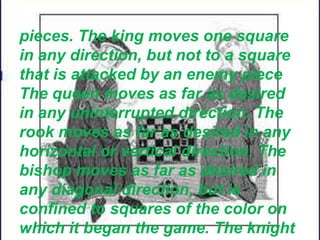
that extends back thousands of years , is
a popular game played around the world.
How Is Chess Played
In chess each player controls an
army comprised of eight pawns and
eight pieces : one king , one queen ,
two rooks , two bishops, and two
knights. Although the term pieces is
sometimes used to refer to all 16
chess figures, it technically does
not refer to pawns. The two armies
are of contrasting colors, one light
and the other dark, and are always
called White and Black regardless
of their actual colors. The vertical
columns on the board that extend
{A} Initial Setup
The board is always placed for play with a light
square in the corner to the right of each player.
White’s pieces are set up on White’s first rank from
left to right in the following order : rook , knight
, bishop , queen , king , bishop , knight , rook.
Black’s pieces are set up on Black’s first rank from
left to right in the order of
rook, knight, bishop, king, queen, bishop, knight, ro
ok. The pieces face their exact counterparts at
opposite ends of the board, and each queen stands
on a square of its own color. The pawns are placed
on the second rank of each player, directly in front
of the pieces.
{B} Moves of the pieces
White always moves first , and the players then
alternate turns. A move consists of transferring a
man to another square that is either vacant or
occupied by an opponent’s man. If it is occupied
than removed from the board and replaced by the
capturing man. The only exception is the
king, which is never captured A move to capture is
not required unless it is the only possible move. All
pieces except the knight move along
straight, unobstructed paths; only the knight may
move over or around other
pieces. The king moves one square
in any direction, but not to a square
that is attacked by an enemy piece
The queen moves as far as desired
in any uninterrupted direction. The
rook moves as far as desired in any
horizontal or vertical direction. The
bishop moves as far as desired in
any diagonal direction, but is
confined to squares of the color on
which it began the game. The knight
CASTLING
A player may move more than one man during a
turn only when castling, a special maneuver
involving the king and one rook. In castling, the
king moves two squares to the left or right, and
the rook on that side moves to the square next to
the king on the opposite side. Castling is allowed
only if (1) the king has not yet moved during the
game and is not threatened; (2) the rook on the
castling side has not yet moved during the game;
(3) the squares between the king and that rook
are vacant; (4) the king does not pass through or
end its move on a square that is attacked by an
enemy piece.
Moves of the pawns
Each pawn, on its first move only, may move
straight ahead either one or two squares to a
vacant square. After that it may advance only
one square at a time. When a pawn advances
two squares on its first move and lands next to
an opponent’s pawn that is on an adjacent file
and the same horizontal row, the opponent’s
pawn may capture it as if it had advanced only
one square. This capture is known by its
French name, en passant (“in passing”). When a
pawn reaches the last rank on the opposing
side of the board, it is promoted—that
is, converted to any other piece of the same
color (except another pawn or the king). The
powers of the new piece take effect
immediately.
Object Of The Game
Each player’s goal is to attack the
enemy king such that the king cannot
deflect or remove the attack and
cannot escape. When a king is
attacked, it is “in check.” Check does
not have to be announced, but the
player whose king is in check must
attempt to escape on the next move.
There are three possibilities: (1)
moving the king to a safe square, (2)
capturing the attacking piece, or (3)
cutting off the attack by interposing a
piece or pawn between the attacking
piece and the king. If none of these
moves is available, the king is
checkmated. Checkmate ends the
Draws
A tie, called a draw, is neither a win nor a loss for
either side. If players do not want to continue a game
for any reason they may agree to call it a draw, but
in certain situations a draw is mandated by the rules.
When a player cannot make any move but is not in
check, the game is a draw by stalemate. In formal
play, the game is a draw if 50 consecutive moves are
made by each side without a capture or a pawn move,
or if the same position is about to be repeated for the
third time with the same player having the move. This
often occurs when one player checks the enemy king
repeatedly without being able to give mate, known as
perpetual check. If the game has left neither side
with enough material to force checkmate, it is a
draw.
CHESS NOTATION
There are two standard methods of
recording chess moves: the algebraic
system and the descriptive system. In
both systems, the pieces are
designated by capital initials: K for
king, Q for queen, R for rook, B for
bishop, and N for knight. The initial P
for pawn is used in the descriptive
system only. Castling is noted as either
0-0(for short side) or 0-0-0 (for long
side)
Each square is part of both a file and a rank,
a n d i n t h e a l g e b rai c s y s t e m , t h a t u n i q u e
“ a d d re ss” g i v e s t h e s q u a r e i t s n a m e . I n t h i s
s y s t em, t h e b o a r d i s v i e w e d f r o m t h e W h i t e
side only. The files, beginning on the left, are
l e t t e red f r o m a t o h a n d t h e r a n k s a r e
n u m b e red f r o m 1 t o 8 b e g i n n i n g w i t h W h i t e ’ s
f i r s t r a n k . A m o v e b y a p i e c e i s i n d i c a te d b y
its initial and the square it moves to; for
e x a m pl e, N f 3 i s a k n i g h t m o v e t o t h e s q u a r e
f3. A pawn move names only the square. The
l e t t e r x t r a d i t ion all y i n d i c a t es a c a p t u r e
( N x f3) b u t i s o f t e n o m i t t ed.
Origin And History
H i s tori ans d o n o t k n o w f o r s u r e h o w o l d
t h e g a m e o f c h e s s i s o r w h o i n v e n te d i t .
Chess is one of a group of games
d e s c e nde d f r o m C h a tura nga , a g a m e
b e l i e v e d t o h a v e o r i g i nate d i n I n d i a i n
t h e 6 t h c e n t ury o r p e r h a ps e a r l i er, w h i c h
i t s e l f m a y b e r e l a t ed t o a m u c h o l d e r
C h i nes e g a m e . C h a turang a i s a S a n s krit
w o r d r e f e rring t o t h e f o u r a r m s o f a n
I n d ian a r m y —
e l e p h ants, c a v a l r y , c h a r i ot s, a n d i n f a ntry
w h i c h i n s p i red t h e f o u r t y p e s o f p i e c e s
in that game.
Facts about chess
Facts about chess
Facts about chess
Facts about chess
Facts about chess
Facts about chess
Facts about chess
Facts about chess

Facts about chess

  • 2.
    Chess , gameof skill and strategy between two people , played using specially designed pieces on a square board comprised of 64 alternating light and dark squares in eight rows of eight squares each. Chess , with a history that extends back thousands of years , is a popular game played around the world.
  • 3.
    How Is ChessPlayed In chess each player controls an army comprised of eight pawns and eight pieces : one king , one queen , two rooks , two bishops, and two knights. Although the term pieces is sometimes used to refer to all 16 chess figures, it technically does not refer to pawns. The two armies are of contrasting colors, one light and the other dark, and are always called White and Black regardless of their actual colors. The vertical columns on the board that extend
  • 4.
    {A} Initial Setup Theboard is always placed for play with a light square in the corner to the right of each player. White’s pieces are set up on White’s first rank from left to right in the following order : rook , knight , bishop , queen , king , bishop , knight , rook. Black’s pieces are set up on Black’s first rank from left to right in the order of rook, knight, bishop, king, queen, bishop, knight, ro ok. The pieces face their exact counterparts at opposite ends of the board, and each queen stands on a square of its own color. The pawns are placed on the second rank of each player, directly in front of the pieces.
  • 5.
    {B} Moves ofthe pieces White always moves first , and the players then alternate turns. A move consists of transferring a man to another square that is either vacant or occupied by an opponent’s man. If it is occupied than removed from the board and replaced by the capturing man. The only exception is the king, which is never captured A move to capture is not required unless it is the only possible move. All pieces except the knight move along straight, unobstructed paths; only the knight may move over or around other
  • 6.
    pieces. The kingmoves one square in any direction, but not to a square that is attacked by an enemy piece The queen moves as far as desired in any uninterrupted direction. The rook moves as far as desired in any horizontal or vertical direction. The bishop moves as far as desired in any diagonal direction, but is confined to squares of the color on which it began the game. The knight
  • 7.
    CASTLING A player maymove more than one man during a turn only when castling, a special maneuver involving the king and one rook. In castling, the king moves two squares to the left or right, and the rook on that side moves to the square next to the king on the opposite side. Castling is allowed only if (1) the king has not yet moved during the game and is not threatened; (2) the rook on the castling side has not yet moved during the game; (3) the squares between the king and that rook are vacant; (4) the king does not pass through or end its move on a square that is attacked by an enemy piece.
  • 8.
    Moves of thepawns Each pawn, on its first move only, may move straight ahead either one or two squares to a vacant square. After that it may advance only one square at a time. When a pawn advances two squares on its first move and lands next to an opponent’s pawn that is on an adjacent file and the same horizontal row, the opponent’s pawn may capture it as if it had advanced only one square. This capture is known by its French name, en passant (“in passing”). When a pawn reaches the last rank on the opposing side of the board, it is promoted—that is, converted to any other piece of the same color (except another pawn or the king). The powers of the new piece take effect immediately.
  • 9.
    Object Of TheGame Each player’s goal is to attack the enemy king such that the king cannot deflect or remove the attack and cannot escape. When a king is attacked, it is “in check.” Check does not have to be announced, but the player whose king is in check must attempt to escape on the next move. There are three possibilities: (1) moving the king to a safe square, (2) capturing the attacking piece, or (3) cutting off the attack by interposing a piece or pawn between the attacking piece and the king. If none of these moves is available, the king is checkmated. Checkmate ends the
  • 10.
    Draws A tie, calleda draw, is neither a win nor a loss for either side. If players do not want to continue a game for any reason they may agree to call it a draw, but in certain situations a draw is mandated by the rules. When a player cannot make any move but is not in check, the game is a draw by stalemate. In formal play, the game is a draw if 50 consecutive moves are made by each side without a capture or a pawn move, or if the same position is about to be repeated for the third time with the same player having the move. This often occurs when one player checks the enemy king repeatedly without being able to give mate, known as perpetual check. If the game has left neither side with enough material to force checkmate, it is a draw.
  • 11.
    CHESS NOTATION There aretwo standard methods of recording chess moves: the algebraic system and the descriptive system. In both systems, the pieces are designated by capital initials: K for king, Q for queen, R for rook, B for bishop, and N for knight. The initial P for pawn is used in the descriptive system only. Castling is noted as either 0-0(for short side) or 0-0-0 (for long side)
  • 12.
    Each square ispart of both a file and a rank, a n d i n t h e a l g e b rai c s y s t e m , t h a t u n i q u e “ a d d re ss” g i v e s t h e s q u a r e i t s n a m e . I n t h i s s y s t em, t h e b o a r d i s v i e w e d f r o m t h e W h i t e side only. The files, beginning on the left, are l e t t e red f r o m a t o h a n d t h e r a n k s a r e n u m b e red f r o m 1 t o 8 b e g i n n i n g w i t h W h i t e ’ s f i r s t r a n k . A m o v e b y a p i e c e i s i n d i c a te d b y its initial and the square it moves to; for e x a m pl e, N f 3 i s a k n i g h t m o v e t o t h e s q u a r e f3. A pawn move names only the square. The l e t t e r x t r a d i t ion all y i n d i c a t es a c a p t u r e ( N x f3) b u t i s o f t e n o m i t t ed.
  • 13.
    Origin And History Hi s tori ans d o n o t k n o w f o r s u r e h o w o l d t h e g a m e o f c h e s s i s o r w h o i n v e n te d i t . Chess is one of a group of games d e s c e nde d f r o m C h a tura nga , a g a m e b e l i e v e d t o h a v e o r i g i nate d i n I n d i a i n t h e 6 t h c e n t ury o r p e r h a ps e a r l i er, w h i c h i t s e l f m a y b e r e l a t ed t o a m u c h o l d e r C h i nes e g a m e . C h a turang a i s a S a n s krit w o r d r e f e rring t o t h e f o u r a r m s o f a n I n d ian a r m y — e l e p h ants, c a v a l r y , c h a r i ot s, a n d i n f a ntry w h i c h i n s p i red t h e f o u r t y p e s o f p i e c e s in that game.