St. Camillus Collegeof Manaoag Foundation, Inc.
Brgy. Licsi, Manaoag, Pangasinan
First Semester S.Y. 2022-2023
PATHFit 3 – PE 1: PHYSICAL ACTIVITY TOWARDS
HEALTH AND FITNESS 3
ORIGIN
Chess first appearedin India about the 6th
century CE. By the 10th
century it
had spread from Asia to the Middle East and Europe. Some regard the
game “chaturanga” to be the precursor of modern chess because of the
different piece abilities and the win condition being the capture of a
singular piece (king).
Since at least the 15th century, chess has been known as the “royal game”
because of its popularity among the nobility. Rules and set design slowly
evolved until both reached today’s standard in the early 19th century.
CHESS
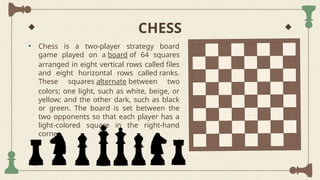
• Chess isa two-player strategy board
game played on a board of 64 squares
arranged in eight vertical rows called files
and eight horizontal rows called ranks.
These squares alternate between two
colors: one light, such as white, beige, or
yellow; and the other dark, such as black
or green. The board is set between the
two opponents so that each player has a
light-colored square in the right-hand
corner.
6.
OBJECTIVE
The objectiveis to checkmate the opponent’s king by placing it under
an inescapable threat of capture. To this end, a player’s pieces are
used to attack and capture the opponent’s pieces, while supporting
each other. In addition to checkmate, the game can be won by
voluntary resignation by the opponent, which typically occurs when
too much material is lost, or if checkmate appears unavoidable. A
game may also result in a draw in several ways.
SETUP AT THESTART OF THE GAME
Each player begins the game with 16 pieces: one king, one queen,
two rooks, two knights, two bishops, and eight pawns. Each of the six
pieces moves differently, with the most powerful being the queen and
the least powerful the pawn.
By convention, the game pieces are divided into white and black sets,
and the players are referred to as “White” and “Black” respectively.
Each player begins the game with 16 pieces of the specified color,
which consist of one king, one queen, two rocks, two bishops, two
knights, and eight pawns. Each queen is set on a square of its own
color, the white queen on a light square and the black queen on a
dark.
MOVEMENT
The playerwith the white pieces always moves first. After the first
move, players alternately move one piece per turn (except for
castling, when two pieces are moved). Pieces are moved to either an
unoccupied square or one occupied by an opponent’s piece occupies.
A player may not make any move that would put or leave the player’s
own king under attack. A player cannot “pass”; at each turn one must
make a legal move. (this is the basis for the finesse called
zugzwang).
If the player to move has no legal move, the game is over; it is either
a checkmate (a loss for the player with no legal moves) if the king is
under attack, or a stalemate (a draw) if the king is not.
CHESS PIECE ANDTHEIR MOVEMENT
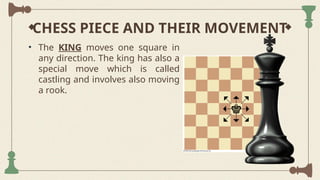
• The KING moves one square in
any direction. The king has also a
special move which is called
castling and involves also moving
a rook.
13.
CHESS PIECE ANDTHEIR MOVEMENT
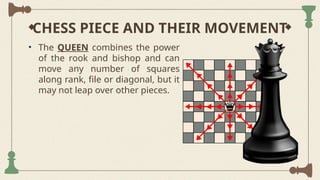
• The QUEEN combines the power
of the rook and bishop and can
move any number of squares
along rank, file or diagonal, but it
may not leap over other pieces.
14.
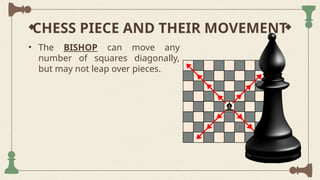
CHESS PIECE ANDTHEIR MOVEMENT
• The BISHOP can move any
number of squares diagonally,
but may not leap over pieces.
15.
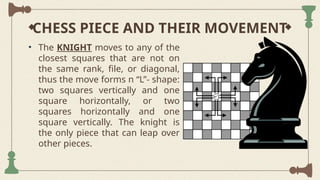
CHESS PIECE ANDTHEIR MOVEMENT
• The KNIGHT moves to any of the
closest squares that are not on
the same rank, file, or diagonal,
thus the move forms n “L”- shape:
two squares vertically and one
square horizontally, or two
squares horizontally and one
square vertically. The knight is
the only piece that can leap over
other pieces.
16.
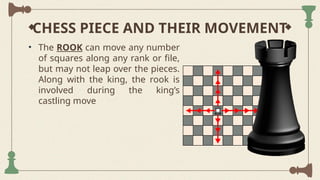
CHESS PIECE ANDTHEIR MOVEMENT
• The ROOK can move any number
of squares along any rank or file,
but may not leap over the pieces.
Along with the king, the rook is
involved during the king’s
castling move
17.
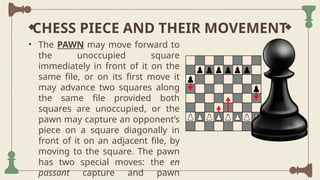
CHESS PIECE ANDTHEIR MOVEMENT
• The PAWN may move forward to
the unoccupied square
immediately in front of it on the
same file, or on its first move it
may advance two squares along
the same file provided both
squares are unoccupied, or the
pawn may capture an opponent’s
piece on a square diagonally in
front of it on an adjacent file, by
moving to the square. The pawn
has two special moves: the en
passant capture and pawn
OTHER MOVEMENT
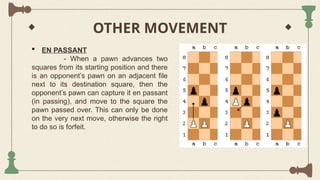
ENPASSANT
- When a pawn advances two
squares from its starting position and there
is an opponent’s pawn on an adjacent file
next to its destination square, then the
opponent’s pawn can capture it en passant
(in passing), and move to the square the
pawn passed over. This can only be done
on the very next move, otherwise the right
to do so is forfeit.
20.
OTHER MOVEMENT
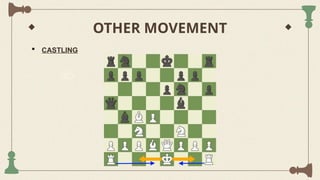
CASTLING
-Once in every game, each king is allowed to make a special move, known as
castling. Castling consists of moving the king two squares along the first rank toward a rook
(which is on the player's first rank) and then placing the rook on the last square that the king
has just crossed. Castling is permissible under the following conditions:
• Neither the king nor the rook have previously moved during the game.
• There cannot be any pieces between the king and the rook.
• The king cannot be in check, nor can the king pass through squares that are
under attack by enemy pieces, or move to a square where it would result in a
check.
• NOTE: castling is permissible if the rook is attacked, or if the rook crosses a
square that is attacked.
OTHER MOVEMENT
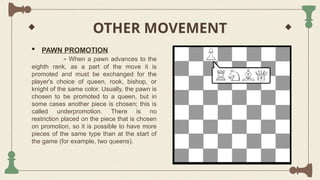
PAWNPROMOTION
- When a pawn advances to the
eighth rank, as a part of the move it is
promoted and must be exchanged for the
player's choice of queen, rook, bishop, or
knight of the same color. Usually, the pawn is
chosen to be promoted to a queen, but in
some cases another piece is chosen; this is
called underpromotion. There is no
restriction placed on the piece that is chosen
on promotion, so it is possible to have more
pieces of the same type than at the start of
the game (for example, two queens).
23.
OTHER MOVEMENT
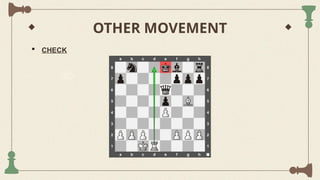
CHECK
-When a king is under immediate attack by one or two of the opponent's pieces,
it is said to be in check. A response to a check is a legal move if it results in a position where
the king is no longer under direct attack (that is, not in check). This can involve capturing the
checking piece; interposing a piece between the checking piece and the king (which is
possible only if the attacking piece is a queen, rook, or bishop and there is a square between
it and the king); or moving the king to a square where it is not under attack. Castling is not a
permissible response to a check. The object of the game is to checkmate the opponent; this
occurs when the opponent's king is in check, and there is no legal way to remove it from
attack. It is illegal for a player to make a move that would put or leave the player's own king
in check.
In casual games it is common to announce "check" when putting the opponent's king in
check, but this is not required by the rules of the game, and is not usually done in
tournaments.
END OF THEGAME
WIN
Games may be won in the following ways:
• Checkmate
• Resignation – either player may resign, conceding the game to the other player. It is
usually considered poor etiquette to play on in a truly hopeless position, and for this
reason high level games rarely end with a checkmate.
• Loss on time – in games with a time control, a player may also lose by running out of
time, even with a much superior position.
• Forfeit - a player who cheats, or violates the rules of the game, or violates the rules
specified for the particular tournament may be forfeited. In high level tournaments,
players have been forfeited for such things as arriving late for the game (even by a
matter of seconds), receiving a call or text on a cell phone, refusing to undergo a drug
test, refusing to undergo a body search for electronic devices and unsporting behavior
(such as refusing to shake the opponent's hand).
27.
END OF THEGAME
DRAW
Games may end in a draw in several ways:
• Draw by Agreement - draws are most commonly reached by mutual agreement
between the players. The correct procedure is to verbally offer the draw, make a move,
then start the opponent's clock. Traditionally players have been allowed to agree a
draw at any time in the game, occasionally even without playing a move; in recent
years efforts have been made to discourage short draws, for example by forbidding
draw offers before move thirty.
• Stalemate – the player whose turn it is to move is not in check, but has no legal move.
• Threefold Repetition of a Position - this most commonly occurs when neither side is
able to avoid repeating moves without incurring a disadvantage. In this situation, either
player may claim a draw; this requires the players to keep a valid written record of the
game so that the claim may be verified by the arbiter if challenged. The three
occurrences of the position need not occur on consecutive moves for a claim to be
valid. FIDE rules make no mention of perpetual check; this is merely a specific type of
draw by threefold repetition.
28.
END OF THEGAME
DRAW
• The Fifty-Move Rule - if during the previous 50 moves no pawn has been moved and
no capture has been made, either player may claim a draw, as for the threefold-
repetition rule. There are in fact several known endgames where it is theoretically
possible to force a mate but which require more than 50 moves before the pawn move
or capture is made; examples include some endgames with two knights against a pawn
and some pawnless endgames such as queen against two bishops. These endings are
rare, and few players study them in detail, so the fifty-move rule is considered practical
for over the board play. Some correspondence chess organizations allow exceptions to
the fifty-move rule.
• Fivefold Repitition of a Position - similar to the threefold-repetition rule, but in this
case no player needs to claim the draw for the game to be drawn. This rule took effect
on 1 July 2014. It establishes that there is a theoretical upper bound on the length of
lawful chess games.
29.
END OF THEGAME
DRAW
• The Seventy-Five-Move Rule - similar to the fifty-move rule; however, if the
final move in the sequence resulted in checkmate, this takes precedence. As
for the fivefold-repetition rule, this applies independently of claims by the
players. The rule also took effect on 1 July 2014 and also establishes,
independently, an upper bound on the game length.
• Insufficient Material - a player may claim a draw if the opponent has
insufficient material to checkmate, for example if the player has only the king
left and the opponent has only the king and a bishop. Such a claim is only
valid if checkmate is impossible. Under the revised rule that took effect on 1
July 2009, which only refers to the impossibility of reaching checkmate
without explicitly relating this to the players' material, the game is ended
immediately in a draw, not requiring a claim by a player.
30.
St. Camillus Collegeof Manaoag Foundation, Inc.
Brgy. Licsi, Manaoag, Pangasinan
First Semester S.Y. 2022-2023
PATHFit 3 – PE 1: PHYSICAL ACTIVITY TOWARDS HEALTH AND
FITNESS 3
THANK YOU FOR LISTENING!
Editor's Notes
#19 En-passant is French for in-passing. This move was introduced when pawns were allowed to move two squares ahead on the first move. This move can only be employed to capture an opponent pawn when it has moved two steps forward in it’s first move thereby avoiding a capture. This is a rule that acts as a hidden opportunity to some since it is not easily visible.
Employing this move to someone that is unaware may garner weird looks and an argument over the rules of chess. Nevertheless, it was all done in the spirit of fairness!
Interestingly, en-passant can be employed for a maximum of 8 times in a game of chess. This can only happen if all the pawns are moved two squares ahead in their first move.
#20 Castling is a defensive move that allows the King to ‘jump’ it’s way from the center to the sides of the board. Castling can be either done on the King’s side or the Queen’s side between the King and the Rook provided that there aren’t any other pieces between them and the pawn structure ahead is undisturbed. Castling is an essential part of a winning strategy with over 80% of grandmaster victories involve Castling. The pawn structure here has an important role to play in deciding the outcome of the game.
Professional players resort to castling in their fourth and fifth moves which is very early on in the game. It is an extremely vital move that can make the winning difference.
Castling can be done only when:-
The king and rook have not been moved
The king is NOT in check
The king does not pass through check
No pieces lie between the king and rook
#21 Castling is a defensive move that allows the King to ‘jump’ it’s way from the center to the sides of the board. Castling can be either done on the King’s side or the Queen’s side between the King and the Rook provided that there aren’t any other pieces between them and the pawn structure ahead is undisturbed. Castling is an essential part of a winning strategy with over 80% of grandmaster victories involve Castling. The pawn structure here has an important role to play in deciding the outcome of the game.
Professional players resort to castling in their fourth and fifth moves which is very early on in the game. It is an extremely vital move that can make the winning difference.
Castling can be done only when:-
The king and rook have not been moved
The king is NOT in check
The king does not pass through check
No pieces lie between the king and rook