Lecture	
  13	
  
An,bio,cs	


  Important	


  Term	


  Extra	
  explana,on	


  Addi,onal	
  notes	


• 	
  	
   • 	
  	
   • 	
  	
   • 	
  	
  
‫هذا‬
	
  
‫العمل‬
	
  
‫ال‬
	
  
‫يغني‬
	
  
‫عن‬
	
  
‫املرجع‬
	
  
‫األساسي‬
	
  
‫للمذاكرة‬
	
  
Objectives
• Define antibiotic ,chemotherapy and selective toxicity.
• Describe the difference between bactericidal &
bacteriostatic antibiotics.
• Recognize the narrow and broad spectrum antibiotics.
• Define the therapeutic index.
• Know the mechanism of action of antimicrobial agents.
• Recognize the various classes of antimicrobial agents
(action, spectrum and side effects)
• Explain the criteria for an ideal antimicrobial.
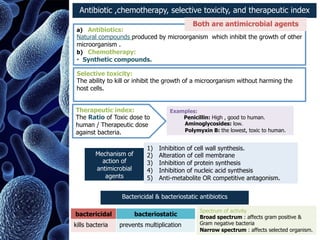
Antibiotic ,chemotherapy, selective toxicity, and therapeutic index
a) Antibiotics:
Natural compounds produced by microorganism which inhibit the growth of other
microorganism .
b) Chemotherapy:
• Synthetic compounds.
Selective toxicity:
The ability to kill or inhibit the growth of a microorganism without harming the
host cells.
Therapeutic index:
The Ratio of Toxic dose to
human / Therapeutic dose
against bacteria.
Examples:
Penicillin: High , good to human.
Aminoglycosides: low.
Polymyxin B: the lowest, toxic to human.
Both are antimicrobial agents
Mechanism of
action of
antimicrobial
agents
1) Inhibition of cell wall synthesis.
2) Alteration of cell membrane
3) Inhibition of protein synthesis
4) Inhibition of nucleic acid synthesis
5) Anti-metabolite OR competitive antagonism.
Bactericidal & bacteriostatic antibiotics
Spectrum of activity
Broad spectrum : affects gram positive &
Gram negative bacteria
Narrow spectrum : affects selected organism.
bactericidal bacteriostatic
kills bacteria prevents multiplication
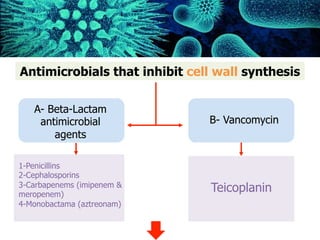
Antimicrobials that inhibit cell wall synthesis
A- Beta-Lactam
antimicrobial
agents
1-Penicillins
2-Cephalosporins
3-Carbapenems (imipenem &
meropenem)
4-Monobactama (aztreonam)
Teicoplanin
B- Vancomycin
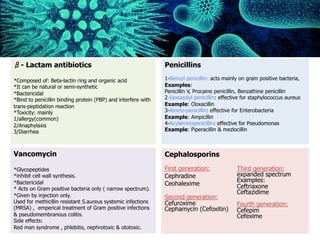
β- Lactam antibiotics
*Composed of: Beta-lactin ring and organic acid
*It can be natural or semi-synthetic
*Bactericidal
*Bind to penicillin binding protein (PBP) and interfere with
trans-peptidation reaction
*Toxicity: mainly
1/allergy(common)
2/Anaphylaxis
3/Diarrhea
Penicillins
1-Benzyl penicillin: acts mainly on gram positive bacteria,
Examples:
Penicillin V, Procaine penicillin, Benzathine penicillin
2-Isoxazolyl penicillin: effective for staphylococcus aureus
Example: Cloxacillin
3-Amino-penicillin: effective for Enterobacteria
Example: Ampicillin
4-Acylaminopenicillin: effective for Pseudomonas
Example: Piperacillin & mezlocillin
Cephalosporins
First generation:
Cephradine
Ceohalexime
Second generation:
Cefuroxime
Cephamycin (Cefoxitin)
Vancomycin
*Glycopeptides
*inhibit cell wall synthesis.
*Bactericidal
* Acts on Gram positive bacteria only ( narrow spectrum).
*Given by injection only.
Used for methicillin resistant S.aureus systemic infections
(MRSA) , emperical treatment of Gram positive infections
& pseudomembranous colitis.
Side effects:
Red man syndrome , phlebitis, nephrotoxic & ototoxic.
Third generation:
expanded spectrum
Examples:
Ceftriaxone
Ceftazidime
Fourth generation:
Cefepim
Cefexime
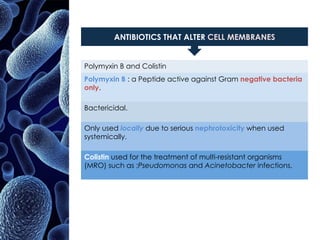
ANTIBIOTICS THAT ALTER CELL MEMBRANES
Polymyxin B and Colistin
Polymyxin B : a Peptide active against Gram negative bacteria
only.
Bactericidal.
Only used locally due to serious nephrotoxicity when used
systemically.
Colistin used for the treatment of multi-resistant organisms
(MRO) such as ;Pseudomonas and Acinetobacter infections.
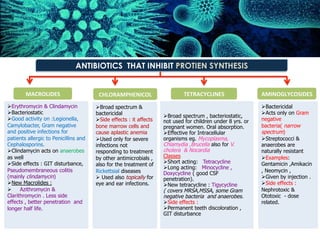
ANTIBIOTICS THAT INHIBIT PROTIEN SYNTHESIS
AMINOGLYCOSIDES	
  
MACROLIDES	
   CHLORAMPHENICOL	
   TETRACYCLINES	
  
ØBactericidal
ØActs only on Gram
negative
bacteria( narrow
spectrum)
ØStreptococci &
anaerobes are
naturally resistant
ØExamples:
Gentamicin ,Amikacin
, Neomycin ,
ØGiven by injection .
ØSide effects :
Nephrotoxic &
Ototoxic - dose
related.
ØBroad spectrum , bacteriostatic,
not used for children under 8 yrs. or
pregnant women. Oral absorption.
ØEffective for Intracellular
organisms eg. Mycoplasma,
Chlamydia ,Brucella also for V.
cholera & Nocardia
Classes
ØShort acting: Tetracycline
ØLong acting: Minocycline ,
Doxycycline ( good CSF
penetration).
ØNew tetracycline : Tigycycline
( covers MRSA,MSSA, some Gram
negative bacteria and anaerobes.
ØSide effects :
ØPermanent teeth discoloration ,
GIT disturbance
ØBroad spectrum &
bactericidal
ØSide effects : it affects
bone marrow cells and
cause aplastic anemia
ØUsed only for severe
infections not
responding to treatment
by other antimicrobials ,
also for the treatment of
Rickettsial diseases.
Ø Used also topically for
eye and ear infections.
ØErythromycin & Clindamycin
ØBacteriostatic
ØGood activity on :Legionella,
Camylobacter, Gram negative
and positive infections for
patients allergic to Penicillins and
Cephalosporins.
ØClindamycin acts on anaerobes
as well
ØSide effects : GIT disturbance,
Pseudomembraneous colitis
(mainly clindamycin).
ØNew Macrolides :
Ø Azithromycin &
Clarithromycin . Less side
effects , better penetration and
longer half life.
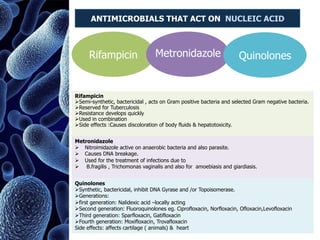
ANTIMICROBIALS THAT ACT ON NUCLEIC ACID
Rifampicin Metronidazole Quinolones
Rifampicin
ØSemi-synthetic, bactericidal , acts on Gram positive bacteria and selected Gram negative bacteria.
ØReserved for Tuberculosis
ØResistance develops quickly
ØUsed in combination
ØSide effects :Causes discoloration of body fluids & hepatotoxicity.
Metronidazole
Ø Nitroimidazole active on anaerobic bacteria and also parasite.
Ø Causes DNA breakage.
Ø Used for the treatment of infections due to
Ø B.fragilis , Trichomonas vaginalis and also for amoebiasis and giardiasis.
Quinolones
ØSynthetic, bactericidal, inhibit DNA Gyrase and /or Topoisomerase.
ØGenerations:
Øfirst generation: Nalidexic acid –locally acting
ØSecond generation: Fluoroquinolones eg. Ciprofloxacin, Norfloxacin, Ofloxacin,Levofloxacin
ØThird generation: Sparfloxacin, Gatifloxacin
ØFourth generation: Moxifloxacin, Trovafloxacin
Side effects: affects cartilage ( animals) & heart
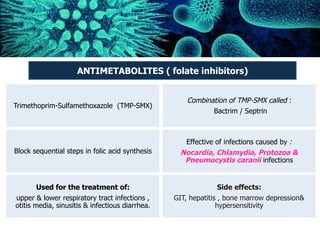
ANTIMETABOLITES ( folate inhibitors)
Used for the treatment of:
upper & lower respiratory tract infections ,
otitis media, sinusitis & infectious diarrhea.
Block sequential steps in folic acid synthesis
Combination of TMP-SMX called :
Bactrim / Septrin
Trimethoprim-Sulfamethoxazole (TMP-SMX)
Effective of infections caused by :
Nocardia, Chlamydia, Protozoa &
Pneumocystis caranii infections
Side effects:
GIT, hepatitis , bone marrow depression&
hypersensitivity
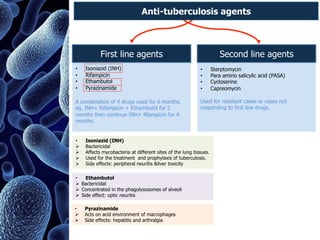
• Isoniazid (INH)
• Rifampicin
• Ethambutol
• Pyrazinamide
A combination of 4 drugs used for 6 months.
eg. INH+ Rifampicin + Ethambutol for 2
months then continue INH+ Rfampicin for 4
months.
• Sterptomycin
• Para amino salicylic acid (PASA)
• Cycloserine
• Capreomycin
Used for resistant cases or cases not
responding to first line drugs.
First line agents Second line agents
• Isoniazid (INH)
Ø Bactericidal
Ø Affects mycobacteria at different sites of the lung tissues.
Ø Used for the treatment and prophylaxis of tuberculosis.
Ø Side effects: peripheral neuritis &liver toxicity
• Ethambutol
Ø Bactericidal
Ø Concentrated in the phagolysosomes of alveoli
Ø Side effect: optic neuritis
• Pyrazinamide
Ø Acts on acid environment of macrophages
Ø Side effects: hepatitis and arthralgia
Anti-tuberculosis agents
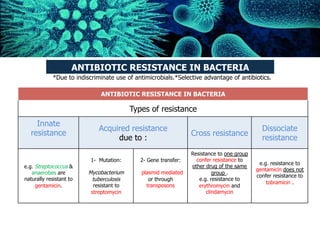
ANTIBIOTIC RESISTANCE IN BACTERIA
*Due to indiscriminate use of antimicrobials.*Selective advantage of antibiotics.
ANTIBIOTIC RESISTANCE IN BACTERIA
Types of resistance
Innate
resistance
Acquired resistance
due to :
Cross resistance
Dissociate
resistance
e.g. Streptococcus &
anaerobes are
naturally resistant to
gentamicin.
1- Mutation:
Mycobacterium
tuberculosis
resistant to
streptomycin
2- Gene transfer:
plasmid mediated
or through
transposons
Resistance to one group
confer resistance to
other drug of the same
group .
e.g. resistance to
erythromycin and
clindamycin
e.g. resistance to
gentamicin does not
confer resistance to
tobramicin .
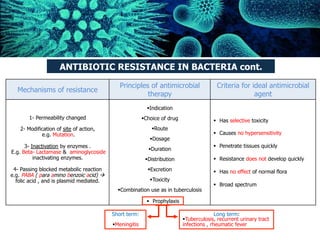
ANTIBIOTIC RESISTANCE IN BACTERIA cont.
Mechanisms of resistance
Principles of antimicrobial
therapy
Criteria for ideal antimicrobial
agent
1- Permeability changed
2- Modification of site of action,
e.g. Mutation.
3- Inactivation by enzymes .
E.g. Beta- Lactamase & aminoglycoside
inactivating enzymes.
4- Passing blocked metabolic reaction
e.g. PABA ( para amino benzoic acid) à
folic acid , and is plasmid mediated.


§Indication
§Choice of drug
§Route
§Dosage
§Duration
§Distribution
§Excretion
§Toxicity
§Combination use as in tuberculosis
	
  
§ Has selective toxicity
§ Causes no hypersensitivity
§ Penetrate tissues quickly
§ Resistance does not develop quickly
§ Has no effect of normal flora
§ Broad spectrum
§ Prophylaxis
Short term:
§Meningitis
Long term:
§Tuberculosis, recurrent urinary tract
infections , rheumatic fever
Antibiotics can do harm and develop resistance so must be
used judiciously.
Antibiotics potentiate (increase strength) the function of human
immune system to fight microbes.
We must know the toxicity , pharmacokinetics, and spectrum of
activity of antimicrobials to make best guess of use.
REMEMBER….
Online Quiz
Videos
Books that could help you
Pull my
pili!
Fine!
Just click
HERE
Lippincott’s Illustrated Reviews
Video 1
http://youtu.be/IVBCrzjOl40
Video 2
http://youtu.be/057phDG4mKU
Boys Team
Girls Team
• Ali	
  Alzahrani	
  
• Khalid	
  Sharahily	
  
• Ahmad	
  Alzahrani	
  
• Zeyad	
  Alsalem	
  
• Muhammad	
  Dossary	
  
• Meshal	
  Alhazmy	
  
• Hamzah	
  Alfiar	
  
• Lamya	
  Alsaghan	
  	
  
• Nojood	
  Alhaidri 	
  	
  
• Monera	
  Alayuni	
  
• Alanoud	
  AlOmair	
  
• Shahad	
  Alenezi	
  
• Aisha	
  Al-­‐Sabbagh	
  
• Bodour	
  Julaidan	
  
• Noura	
  AlTawil	
  
• Deema	
  AlFaris	
  
• Sara	
  Al-­‐Hussein	
  
• Suha	
  Alenezy	
  
• La,fah	
  Alsukait	
  
• Dalal	
  Alhuzaimi	
  
• Reema	
  Allhaidan	
  
Microbiology.435@gmail.com
@microbiology435
http://ask.fm/microbiology435
Contact	
  us!	
  
We do things
better
	
  
‫فمن‬ ‫أصبنا‬ ‫إن‬
‫اهلل‬
‫فمن‬ ‫أخطأنا‬ ‫وإن‬ ،‫وجل‬ ‫عز‬
‫أنفسنا‬
‫والشيطان‬

13- Antibiotics.pdf

  • 1.
    Lecture  13   An,bio,cs        Important                              Term                              Extra  explana,on                              Addi,onal  notes       •     •     •     •     ‫هذا‬   ‫العمل‬   ‫ال‬   ‫يغني‬   ‫عن‬   ‫املرجع‬   ‫األساسي‬   ‫للمذاكرة‬  
  • 2.
    Objectives • Define antibiotic,chemotherapy and selective toxicity. • Describe the difference between bactericidal & bacteriostatic antibiotics. • Recognize the narrow and broad spectrum antibiotics. • Define the therapeutic index. • Know the mechanism of action of antimicrobial agents. • Recognize the various classes of antimicrobial agents (action, spectrum and side effects) • Explain the criteria for an ideal antimicrobial.
  • 3.
    Antibiotic ,chemotherapy, selectivetoxicity, and therapeutic index a) Antibiotics: Natural compounds produced by microorganism which inhibit the growth of other microorganism . b) Chemotherapy: • Synthetic compounds. Selective toxicity: The ability to kill or inhibit the growth of a microorganism without harming the host cells. Therapeutic index: The Ratio of Toxic dose to human / Therapeutic dose against bacteria. Examples: Penicillin: High , good to human. Aminoglycosides: low. Polymyxin B: the lowest, toxic to human. Both are antimicrobial agents Mechanism of action of antimicrobial agents 1) Inhibition of cell wall synthesis. 2) Alteration of cell membrane 3) Inhibition of protein synthesis 4) Inhibition of nucleic acid synthesis 5) Anti-metabolite OR competitive antagonism. Bactericidal & bacteriostatic antibiotics Spectrum of activity Broad spectrum : affects gram positive & Gram negative bacteria Narrow spectrum : affects selected organism. bactericidal bacteriostatic kills bacteria prevents multiplication
  • 4.
    Antimicrobials that inhibitcell wall synthesis A- Beta-Lactam antimicrobial agents 1-Penicillins 2-Cephalosporins 3-Carbapenems (imipenem & meropenem) 4-Monobactama (aztreonam) Teicoplanin B- Vancomycin
  • 5.
    β- Lactam antibiotics *Composedof: Beta-lactin ring and organic acid *It can be natural or semi-synthetic *Bactericidal *Bind to penicillin binding protein (PBP) and interfere with trans-peptidation reaction *Toxicity: mainly 1/allergy(common) 2/Anaphylaxis 3/Diarrhea Penicillins 1-Benzyl penicillin: acts mainly on gram positive bacteria, Examples: Penicillin V, Procaine penicillin, Benzathine penicillin 2-Isoxazolyl penicillin: effective for staphylococcus aureus Example: Cloxacillin 3-Amino-penicillin: effective for Enterobacteria Example: Ampicillin 4-Acylaminopenicillin: effective for Pseudomonas Example: Piperacillin & mezlocillin Cephalosporins First generation: Cephradine Ceohalexime Second generation: Cefuroxime Cephamycin (Cefoxitin) Vancomycin *Glycopeptides *inhibit cell wall synthesis. *Bactericidal * Acts on Gram positive bacteria only ( narrow spectrum). *Given by injection only. Used for methicillin resistant S.aureus systemic infections (MRSA) , emperical treatment of Gram positive infections & pseudomembranous colitis. Side effects: Red man syndrome , phlebitis, nephrotoxic & ototoxic. Third generation: expanded spectrum Examples: Ceftriaxone Ceftazidime Fourth generation: Cefepim Cefexime
  • 6.
    ANTIBIOTICS THAT ALTERCELL MEMBRANES Polymyxin B and Colistin Polymyxin B : a Peptide active against Gram negative bacteria only. Bactericidal. Only used locally due to serious nephrotoxicity when used systemically. Colistin used for the treatment of multi-resistant organisms (MRO) such as ;Pseudomonas and Acinetobacter infections.
  • 7.
    ANTIBIOTICS THAT INHIBITPROTIEN SYNTHESIS AMINOGLYCOSIDES   MACROLIDES   CHLORAMPHENICOL   TETRACYCLINES   ØBactericidal ØActs only on Gram negative bacteria( narrow spectrum) ØStreptococci & anaerobes are naturally resistant ØExamples: Gentamicin ,Amikacin , Neomycin , ØGiven by injection . ØSide effects : Nephrotoxic & Ototoxic - dose related. ØBroad spectrum , bacteriostatic, not used for children under 8 yrs. or pregnant women. Oral absorption. ØEffective for Intracellular organisms eg. Mycoplasma, Chlamydia ,Brucella also for V. cholera & Nocardia Classes ØShort acting: Tetracycline ØLong acting: Minocycline , Doxycycline ( good CSF penetration). ØNew tetracycline : Tigycycline ( covers MRSA,MSSA, some Gram negative bacteria and anaerobes. ØSide effects : ØPermanent teeth discoloration , GIT disturbance ØBroad spectrum & bactericidal ØSide effects : it affects bone marrow cells and cause aplastic anemia ØUsed only for severe infections not responding to treatment by other antimicrobials , also for the treatment of Rickettsial diseases. Ø Used also topically for eye and ear infections. ØErythromycin & Clindamycin ØBacteriostatic ØGood activity on :Legionella, Camylobacter, Gram negative and positive infections for patients allergic to Penicillins and Cephalosporins. ØClindamycin acts on anaerobes as well ØSide effects : GIT disturbance, Pseudomembraneous colitis (mainly clindamycin). ØNew Macrolides : Ø Azithromycin & Clarithromycin . Less side effects , better penetration and longer half life.
  • 8.
    ANTIMICROBIALS THAT ACTON NUCLEIC ACID Rifampicin Metronidazole Quinolones Rifampicin ØSemi-synthetic, bactericidal , acts on Gram positive bacteria and selected Gram negative bacteria. ØReserved for Tuberculosis ØResistance develops quickly ØUsed in combination ØSide effects :Causes discoloration of body fluids & hepatotoxicity. Metronidazole Ø Nitroimidazole active on anaerobic bacteria and also parasite. Ø Causes DNA breakage. Ø Used for the treatment of infections due to Ø B.fragilis , Trichomonas vaginalis and also for amoebiasis and giardiasis. Quinolones ØSynthetic, bactericidal, inhibit DNA Gyrase and /or Topoisomerase. ØGenerations: Øfirst generation: Nalidexic acid –locally acting ØSecond generation: Fluoroquinolones eg. Ciprofloxacin, Norfloxacin, Ofloxacin,Levofloxacin ØThird generation: Sparfloxacin, Gatifloxacin ØFourth generation: Moxifloxacin, Trovafloxacin Side effects: affects cartilage ( animals) & heart
  • 9.
    ANTIMETABOLITES ( folateinhibitors) Used for the treatment of: upper & lower respiratory tract infections , otitis media, sinusitis & infectious diarrhea. Block sequential steps in folic acid synthesis Combination of TMP-SMX called : Bactrim / Septrin Trimethoprim-Sulfamethoxazole (TMP-SMX) Effective of infections caused by : Nocardia, Chlamydia, Protozoa & Pneumocystis caranii infections Side effects: GIT, hepatitis , bone marrow depression& hypersensitivity
  • 10.
    • Isoniazid (INH) •Rifampicin • Ethambutol • Pyrazinamide A combination of 4 drugs used for 6 months. eg. INH+ Rifampicin + Ethambutol for 2 months then continue INH+ Rfampicin for 4 months. • Sterptomycin • Para amino salicylic acid (PASA) • Cycloserine • Capreomycin Used for resistant cases or cases not responding to first line drugs. First line agents Second line agents • Isoniazid (INH) Ø Bactericidal Ø Affects mycobacteria at different sites of the lung tissues. Ø Used for the treatment and prophylaxis of tuberculosis. Ø Side effects: peripheral neuritis &liver toxicity • Ethambutol Ø Bactericidal Ø Concentrated in the phagolysosomes of alveoli Ø Side effect: optic neuritis • Pyrazinamide Ø Acts on acid environment of macrophages Ø Side effects: hepatitis and arthralgia Anti-tuberculosis agents
  • 11.
    ANTIBIOTIC RESISTANCE INBACTERIA *Due to indiscriminate use of antimicrobials.*Selective advantage of antibiotics. ANTIBIOTIC RESISTANCE IN BACTERIA Types of resistance Innate resistance Acquired resistance due to : Cross resistance Dissociate resistance e.g. Streptococcus & anaerobes are naturally resistant to gentamicin. 1- Mutation: Mycobacterium tuberculosis resistant to streptomycin 2- Gene transfer: plasmid mediated or through transposons Resistance to one group confer resistance to other drug of the same group . e.g. resistance to erythromycin and clindamycin e.g. resistance to gentamicin does not confer resistance to tobramicin .
  • 12.
    ANTIBIOTIC RESISTANCE INBACTERIA cont. Mechanisms of resistance Principles of antimicrobial therapy Criteria for ideal antimicrobial agent 1- Permeability changed 2- Modification of site of action, e.g. Mutation. 3- Inactivation by enzymes . E.g. Beta- Lactamase & aminoglycoside inactivating enzymes. 4- Passing blocked metabolic reaction e.g. PABA ( para amino benzoic acid) à folic acid , and is plasmid mediated.     §Indication §Choice of drug §Route §Dosage §Duration §Distribution §Excretion §Toxicity §Combination use as in tuberculosis   § Has selective toxicity § Causes no hypersensitivity § Penetrate tissues quickly § Resistance does not develop quickly § Has no effect of normal flora § Broad spectrum § Prophylaxis Short term: §Meningitis Long term: §Tuberculosis, recurrent urinary tract infections , rheumatic fever
  • 13.
    Antibiotics can doharm and develop resistance so must be used judiciously. Antibiotics potentiate (increase strength) the function of human immune system to fight microbes. We must know the toxicity , pharmacokinetics, and spectrum of activity of antimicrobials to make best guess of use. REMEMBER….
  • 14.
    Online Quiz Videos Books thatcould help you Pull my pili! Fine! Just click HERE Lippincott’s Illustrated Reviews Video 1 http://youtu.be/IVBCrzjOl40 Video 2 http://youtu.be/057phDG4mKU
  • 15.
    Boys Team Girls Team •Ali  Alzahrani   • Khalid  Sharahily   • Ahmad  Alzahrani   • Zeyad  Alsalem   • Muhammad  Dossary   • Meshal  Alhazmy   • Hamzah  Alfiar   • Lamya  Alsaghan     • Nojood  Alhaidri     • Monera  Alayuni   • Alanoud  AlOmair   • Shahad  Alenezi   • Aisha  Al-­‐Sabbagh   • Bodour  Julaidan   • Noura  AlTawil   • Deema  AlFaris   • Sara  Al-­‐Hussein   • Suha  Alenezy   • La,fah  Alsukait   • Dalal  Alhuzaimi   • Reema  Allhaidan   Microbiology.435@gmail.com @microbiology435 http://ask.fm/microbiology435 Contact  us!   We do things better   ‫فمن‬ ‫أصبنا‬ ‫إن‬ ‫اهلل‬ ‫فمن‬ ‫أخطأنا‬ ‫وإن‬ ،‫وجل‬ ‫عز‬ ‫أنفسنا‬ ‫والشيطان‬