NAVODAYA VIDYALAYA SAMITI, BHOPAL REGION
CHEMISTRY REVISION PAPER - 8
AMINES AND BIO MOLECULES
Class : XII Max. Marks: 70
Time : 3hrs.
General Instructions:
(i) All questions are compulsory.
(ii) Marks for each question are indicated against it.
(iii) Q.No.1and 8carrying 1 mark each.
(iv) Q.No.9to 18 carrying 2 marks each.
(v) Q.No.19 to 27 carrying 3 marks each
(vi) Q.No. 28 to 30carrying 5 marks each
(vii) Use log Tables, if necessary, Use of calculators is not permitted.
Answer the following questions:
1. Which biologically active compounds are used to increase blood pressure?
2. Write chemical reaction of aniline with benzoyl chloride and write the name of
the product obtained.
3. Why cannot aromatic primary amines be prepared by Gabriel phthalimide
synthesis?
4. Give the difference between α-helix and β-pleated structure?
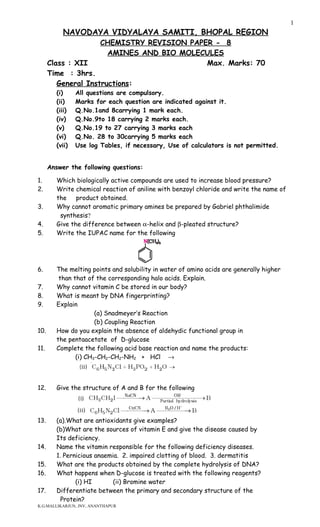
5. Write the IUPAC name for the following
6. The melting points and solubility in water of amino acids are generally higher
than that of the corresponding halo acids. Explain.
7. Why cannot vitamin C be stored in our body?
8. What is meant by DNA fingerprinting?
9. Explain
(a) Snadmeyer’s Reaction
(b) Coupling Reaction
10. How do you explain the absence of aldehydic functional group in
the pentaacetate of D-glucose
11. Complete the following acid base reaction and name the products:
(i) CH3-CH2-CH2-NH2 + HCl →
12. Give the structure of A and B for the following
13. (a).What are antioxidants give examples?
(b)What are the sources of vitamin E and give the disease caused by
Its deficiency.
14. Name the vitamin responsible for the following deficiency diseases.
1. Pernicious anaemia. 2. impaired clotting of blood. 3. dermatitis
15. What are the products obtained by the complete hydrolysis of DNA?
16. What happens when D-glucose is treated with the following reagents?
(i) HI (ii) Bromine water
17. Differentiate between the primary and secondary structure of the
Protein?
K.G.MALLIKARJUN, JNV, ANANTHAPUR
1
18. How will you convert
(i) Benzene into aniline (ii) Benzene into N,N-dimethylaniline
19. Give reasons for the following:
(i) amines less acidic than alcohols of comparable molecular masses?
(ii) primary amines have higher boiling point than tertiary amines?
(iii) aliphatic amines stronger bases than aromatic amines.
20. An aromatic compound ‘A’ on treatment with aqueous ammonia and heating
forms compound ‘B’ which on heating with Br2 and KOH forms a compound
‘C’ of molecular formla C6H7N. Write the structures and IUPAC names of
compounds A,B and C
21. Explain the following:-
1. Native protein 2.Denaturation 3. Renaturation
22. Write short notes on the following
(i) Carbylamne reaction
(ii) Diazotisation
(iii) Hofmann’s bromamide reaction
23. Give the reactions of glucose that cannot be explained by chain
structure of glucose
24. Give one chemical test to distinguish between the following pairs of compounds.
(a) Methylamine and dimethyamine
(b) Secondary and tertiary amines
(cd) Aniline and Benzylamine
25. What are proteins and give the differences between gobular and
fibrous proteins.
26. How will you convert
(i) Ethanoic acid into methanamine
(ii) Ethanamine into methanamine
(iii) Nitromethane into dimethylamine
27. (i).What is anomers and draw the two anomeric forms of glucose
(ii) Explain with suitable examples reducing and non-reducing sugars.
(iii) Explain ‘invert sugar’ with the help of a chemical equation.
(iv) What is a nucleotide and give the linkage between them.
28. Account for the following
(i) .pKb of aniline is more than that of methylamine.
(ii) Ethylamine is soluble in water whereas aniline is not.
(iii) Methylamine in water reacts with ferric chloride to precipitate
hydrated ferric oxide.
(iv) Anline des not undergo Friedel – Crafts reaction.
(v) Diazonium salts of aromatic amines are more stable than those of
aliphatic amines.
29. (i). How do you explain the amphoteric behaviour of amino acids?
(ii). Define the following:-
1. peptide linkage
2. zwitterions.
(iii). What are different RNA? Give their functions.
(iv) What are nucleic acids and give their functions.
30. (i). Mention the main differences between amylose and amylopectin .
(ii).Where is the glycosidic linkage between the two units of
sucrose, lactose and maltose.
(iii). Give the reactions that are evidence for the ring structure of
glucose.
(iv). Give examples for reducing and non-reducing sugars.
K.G.MALLIKARJUN, JNV, ANANTHAPUR
2
(v). What are enzyme and give their functions.?
K.G.MALLIKARJUN, JNV, ANANTHAPUR
3

Chemistry slot test 8

  • 1.
    NAVODAYA VIDYALAYA SAMITI,BHOPAL REGION CHEMISTRY REVISION PAPER - 8 AMINES AND BIO MOLECULES Class : XII Max. Marks: 70 Time : 3hrs. General Instructions: (i) All questions are compulsory. (ii) Marks for each question are indicated against it. (iii) Q.No.1and 8carrying 1 mark each. (iv) Q.No.9to 18 carrying 2 marks each. (v) Q.No.19 to 27 carrying 3 marks each (vi) Q.No. 28 to 30carrying 5 marks each (vii) Use log Tables, if necessary, Use of calculators is not permitted. Answer the following questions: 1. Which biologically active compounds are used to increase blood pressure? 2. Write chemical reaction of aniline with benzoyl chloride and write the name of the product obtained. 3. Why cannot aromatic primary amines be prepared by Gabriel phthalimide synthesis? 4. Give the difference between α-helix and β-pleated structure? 5. Write the IUPAC name for the following 6. The melting points and solubility in water of amino acids are generally higher than that of the corresponding halo acids. Explain. 7. Why cannot vitamin C be stored in our body? 8. What is meant by DNA fingerprinting? 9. Explain (a) Snadmeyer’s Reaction (b) Coupling Reaction 10. How do you explain the absence of aldehydic functional group in the pentaacetate of D-glucose 11. Complete the following acid base reaction and name the products: (i) CH3-CH2-CH2-NH2 + HCl → 12. Give the structure of A and B for the following 13. (a).What are antioxidants give examples? (b)What are the sources of vitamin E and give the disease caused by Its deficiency. 14. Name the vitamin responsible for the following deficiency diseases. 1. Pernicious anaemia. 2. impaired clotting of blood. 3. dermatitis 15. What are the products obtained by the complete hydrolysis of DNA? 16. What happens when D-glucose is treated with the following reagents? (i) HI (ii) Bromine water 17. Differentiate between the primary and secondary structure of the Protein? K.G.MALLIKARJUN, JNV, ANANTHAPUR 1
  • 2.
    18. How willyou convert (i) Benzene into aniline (ii) Benzene into N,N-dimethylaniline 19. Give reasons for the following: (i) amines less acidic than alcohols of comparable molecular masses? (ii) primary amines have higher boiling point than tertiary amines? (iii) aliphatic amines stronger bases than aromatic amines. 20. An aromatic compound ‘A’ on treatment with aqueous ammonia and heating forms compound ‘B’ which on heating with Br2 and KOH forms a compound ‘C’ of molecular formla C6H7N. Write the structures and IUPAC names of compounds A,B and C 21. Explain the following:- 1. Native protein 2.Denaturation 3. Renaturation 22. Write short notes on the following (i) Carbylamne reaction (ii) Diazotisation (iii) Hofmann’s bromamide reaction 23. Give the reactions of glucose that cannot be explained by chain structure of glucose 24. Give one chemical test to distinguish between the following pairs of compounds. (a) Methylamine and dimethyamine (b) Secondary and tertiary amines (cd) Aniline and Benzylamine 25. What are proteins and give the differences between gobular and fibrous proteins. 26. How will you convert (i) Ethanoic acid into methanamine (ii) Ethanamine into methanamine (iii) Nitromethane into dimethylamine 27. (i).What is anomers and draw the two anomeric forms of glucose (ii) Explain with suitable examples reducing and non-reducing sugars. (iii) Explain ‘invert sugar’ with the help of a chemical equation. (iv) What is a nucleotide and give the linkage between them. 28. Account for the following (i) .pKb of aniline is more than that of methylamine. (ii) Ethylamine is soluble in water whereas aniline is not. (iii) Methylamine in water reacts with ferric chloride to precipitate hydrated ferric oxide. (iv) Anline des not undergo Friedel – Crafts reaction. (v) Diazonium salts of aromatic amines are more stable than those of aliphatic amines. 29. (i). How do you explain the amphoteric behaviour of amino acids? (ii). Define the following:- 1. peptide linkage 2. zwitterions. (iii). What are different RNA? Give their functions. (iv) What are nucleic acids and give their functions. 30. (i). Mention the main differences between amylose and amylopectin . (ii).Where is the glycosidic linkage between the two units of sucrose, lactose and maltose. (iii). Give the reactions that are evidence for the ring structure of glucose. (iv). Give examples for reducing and non-reducing sugars. K.G.MALLIKARJUN, JNV, ANANTHAPUR 2
  • 3.
    (v). What areenzyme and give their functions.? K.G.MALLIKARJUN, JNV, ANANTHAPUR 3