Chemistry
John Joemmel Rodelas
BS Chemical Engineering, UPLB ‘14
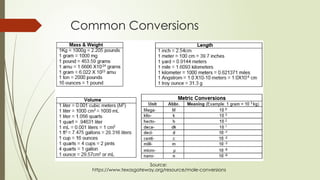
Common Conversions
Source:
https://www.texasgateway.org/resource/mole-conversions
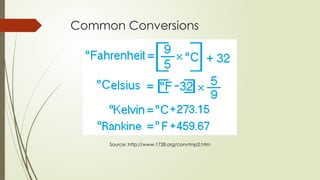
Common Conversions
Source: http://www.1728.org/convtmp2.htm
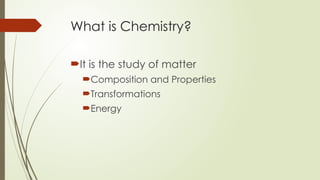
What is Chemistry?
It is the study of matter
Composition and Properties
Transformations
Energy
Laws
Law of Conservation of Mass
Law of Constant Composition
Law of Multiple Proportions
Laws
Law of Conservation of Mass
Total mass of products = Total mass of reactants
Mass output = Mass input
Laws
Law of Constant Composition
All samples of a compound has same
composition
Laws
Law of Multiple Proportions
The ratio of masses for combined elements to
form a compound is given by a certain ratio
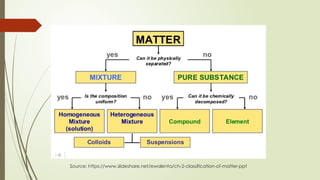
Source: https://www.slideshare.net/ewalenta/ch-2-classification-of-matter-ppt
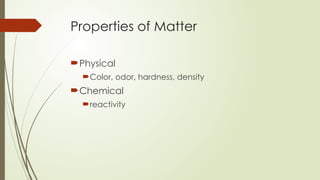
Properties of Matter
Physical
Color, odor, hardness, density
Chemical
reactivity
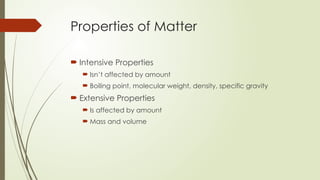
Properties of Matter
 Intensive Properties
 Isn’t affected by amount
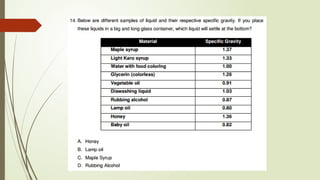
 Boiling point, molecular weight, density, specific gravity
 Extensive Properties
 Is affected by amount
 Mass and volume
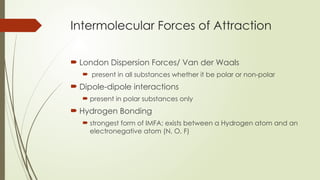
Intermolecular Forces of Attraction
 London Dispersion Forces/ Van der Waals
 present in all substances whether it be polar or non-polar
 Dipole-dipole interactions
 present in polar substances only
 Hydrogen Bonding
 strongest form of IMFA; exists between a Hydrogen atom and an
electronegative atom (N, O, F)
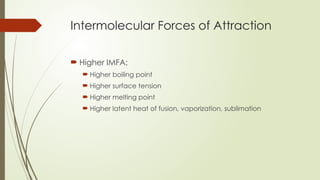
Intermolecular Forces of Attraction
 Higher IMFA:
 Higher boiling point
 Higher surface tension
 Higher melting point
 Higher latent heat of fusion, vaporization, sublimation
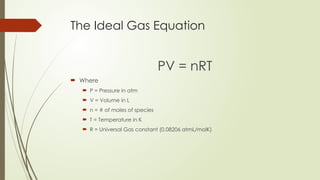
The Ideal Gas Equation
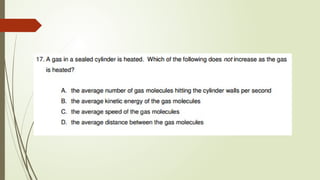
PV = nRT
 Where
 P = Pressure in atm
 V = Volume in L
 n = # of moles of species
 T = Temperature in K
 R = Universal Gas constant (0.08206 atmL/molK)
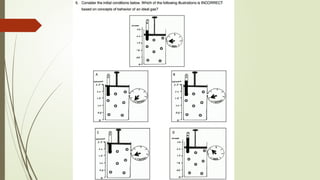
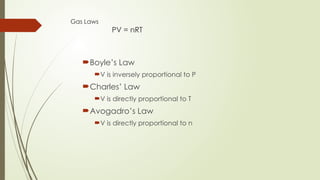
Gas Laws
PV = nRT
Boyle’s Law
V is inversely proportional to P
Charles’ Law
V is directly proportional to T
Avogadro’s Law
V is directly proportional to n
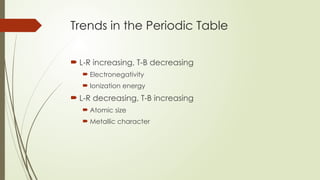
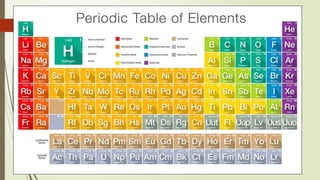
Trends in the Periodic Table
 L-R increasing, T-B decreasing
 Electronegativity
 Ionization energy
 L-R decreasing, T-B increasing
 Atomic size
 Metallic character
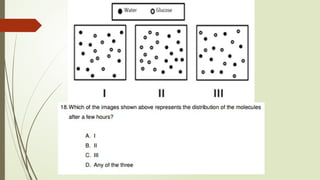
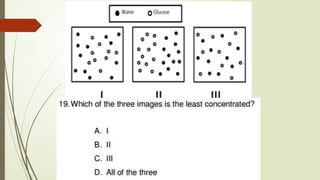
Solutions
 Homogeneous mixture
 Solute is dissolved in a solvent
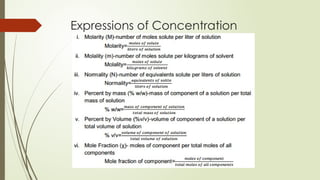
Expressions of Concentration
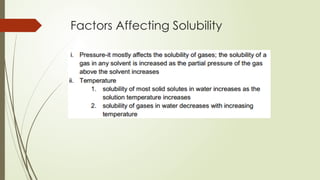
Factors Affecting Solubility
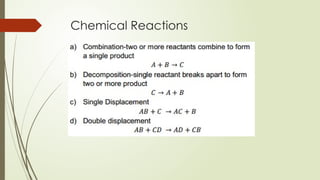
Chemical Reactions
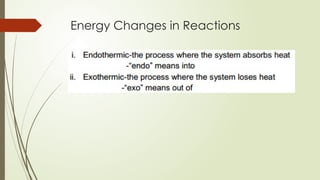
Energy Changes in Reactions

Chemistry, science, formulas, exercise.pptx