Chemistry Jeopardy : Are you ready for the test?
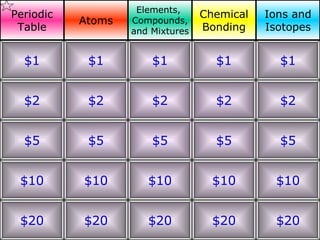
$2 $5 $10 $20 $1 $2 $5 $10 $20 $1 $2 $5 $10 $20 $1 $2 $5 $10 $20 $1 $2 $5 $10 $20 $1 Periodic Table Atoms Elements,  Compounds, and Mixtures Chemical Bonding Ions and Isotopes
Periodic Table: $1:  Each horizontal row of the Periodic Table is known as a _________.
Periodic Table: Answer:  Period
Periodic Table: $2:  Each vertical column on the Periodic Table is known as a _________.
Periodic Table: Answer:  Group (or Family)
Periodic Table: $5:  What is the group number of Helium and Neon?
Periodic Table: Answer:  Group 18 (The Noble Gases)
Periodic Table: $10:  Nickel, Copper, and Gold are part of which group?
Periodic Table  Answer:  The Transition Metals
Periodic Table:  $20:  What is the group name of Group #17, and how many valence electrons does each of its elements have?
Periodic Table:  Answer:  Halogens, 7 valence electrons
Atoms: $1:  What is the positive part of the atom? A) Electron Cloud  B)  Nucleus
Atoms:  Answer: B) Nucleus
Atoms: $2:  How do you calculate the number of neutrons in an atom?
Atoms:  Answer:  Atomic Mass – Atomic Number
Atoms:  $5:  Which subatomic particle (proton, neutron, or electron) has no mass?
Atoms:  Answer:  Electrons
Atoms:  $10:  How many electrons fit in the first three energy levels?
Atoms:  Answer:  2, 8, 8+10
Atoms:  $20:  What makes radioactive isotopes unstable?  (Why do the nuclei of these atoms break down?)
Atoms:  Answer: There is not a stable amount of neutrons to hold the nucleus together (There are too few or too many neutrons)
Elements, Compounds, and Mixtures:  $1:  True or False: Elements are composed of 2 or more substances.
Elements, Compounds, and Mixtures:   Answer:  False
Elements, Compounds, and Mixtures:   $2:  True or False: Compounds are chemically combined, but they can be physically separated.
Elements, Compounds, and Mixtures:   Answer:  False
Elements, Compounds, and Mixtures:   $5:  What kind of change (physical or chemical) takes place when water evaporates into the air?
Elements, Compounds, and Mixtures:   Answer:  Physical Change
Elements, Compounds, and Mixtures:   $10:  What type of mixture is salt water? A) Solution B) Suspension C) Colloid
Elements, Compounds, and Mixtures:   Answer:  A) Solution
Elements, Compounds, and Mixtures:   $20:  Water is considered the “Universal ____”
Elements, Compounds, and Mixtures:   Answer:  Solvent
Chemical Bonding:  $1:  In a covalent bond, atoms _____ electrons.
Chemical Bonding:   Answer:  Share
Chemical Bonding:  $2:  In an ionic bond, electrons are __________ between atoms.
Chemical Bonding:   Answer:  transferred
Chemical Bonding:   $5:  How many valence electrons would Beryllium like to donate?
Chemical Bonding:   Answer:  2
Chemical Bonding:   $10:  When carbon shares its valence electrons with 4 Hydrogen atoms, is this an example of an ionic bond or a covalent bond?
Chemical Bonding:   Answer:  Covalent
Chemical Bonding:   $20:  What kind of force holds positive and negative ions together?
Chemical Bonding:   Answer:  Electromagnetic force
Ions and Isotopes:  $1:  A charged particle is called a(n) ______.
Ions and Isotopes:   Answer:  Ion
Ions and Isotopes:  $2: Isotopes have the same number of _____. A) Neutrons B)  Protons C)  Atomic Mass
Ions and Isotopes:   Answer: B) Protons
Ions and Isotopes:   $5:  Carbon-12 and Carbon-14 have a different number of _______.
Ions and Isotopes:   Answer:  Neutrons
Ions and Isotopes:   $10:  Chlorine has 17 Protons, 17 Neutrons, and 17 Electrons. Is this an ion, isotope, or neutral atom?
Ions and Isotopes:  Answer:  Isotope
Ions and Isotopes: $20:  How many electrons are in an oxygen atom with a charge of -2?
Ions and Isotopes:   Answer:  10 electrons
Final Jeopardy Answer
Final Jeopardy  Question

Chemistry Jeopardy