COMMUNICATION STUDIES
Paper Ones
Jodi Chase
With Examiners Script and Solutions
2014-2020
Communications Studies 2014 Paper 1
Solutions
Module 1 Module 2 Module 3
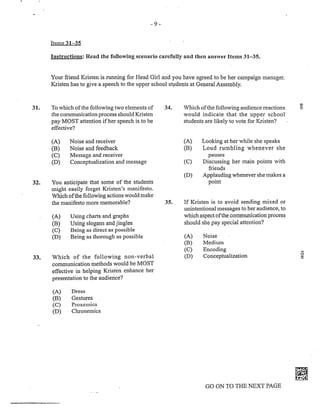
1) C 16) A 31) D
2) D 17) C 32) A
3) D 18) A 33) A
4) C 19) D 34) B
5) D 20) B 35) B
6) B 21) D 36) D
7) B 22) B 37) B
8) D 23) D 38) A
9) C 24) C 39) C
10) B 25) C 40) D
11) A 26) A 41) C
12) D 27) B 42) D
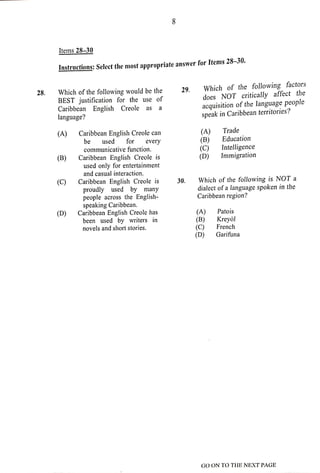
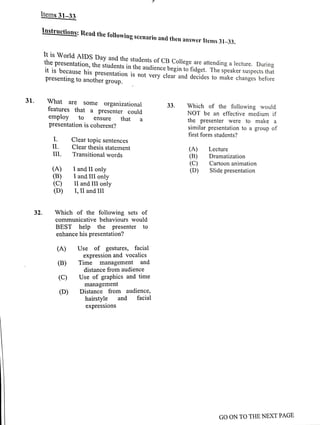
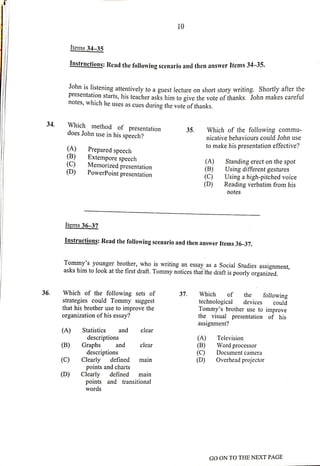
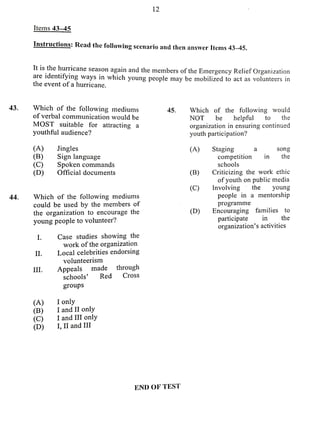
13) A 28) A 43) A
14) D 29) C 44) D
15) B 30) C 45) B
%.
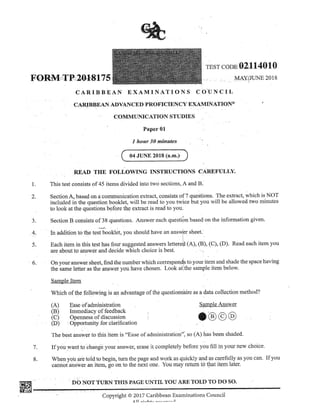
FORM TP 201s161
3.
4.
5.
1.
2.
MAY/JUNE 2015
CARIBBEAN EXAMINATIONS COUNCIL
CARJBREAN ADVANCED PROFICIENCY EXAMINATION@
' CdunaUNIcATIoNs STUDIES
UNITl-Paper01
t hour 30 minutes
06 MAY 2015 (a.m.)
READ THE FOLLOWING INSTRUCTIONS CAREFULLY
'fhis test consists of 45 items dividbd into two sections. A and B.
Section A, based oll a cofiununication extract, consists of 7 questions. The extract, which
is NOT incltrded in the question booklet, will be read to you twice but you will be allowed
two minutes to look at the questions bef<rre the extract is read to you.
Section B consists of 38 questions. Answer each question based on the information given.
In addition to the test booklet, you should have an answer sheet.
Each item in this test has four suggested answers lettered (A), (B), (c), (D). Read each item
you are about to answer and decide which choice is best.
Sample Item
Which of the following is an advantage of the
questionnaire as a data-collection method?
(A) Eade of administration
(B) Iuunediacy of feedback
(C) Openness of discussion
(D) Opportunity for clarification
TEST CODE O2II401A
SampleAnswer
o@@@
6. On your answer sheet, find the number which corresponds to your item and shade the space
having the same letter as the answer you have chosen. Look at the sample item below.
I
-
I
I
I
I
r
I
1
8.
The best answer to this item is "Ease of administration", so (A) has been shacled.
If you want to change your answer, erase it completely and fill in your new choice.
When you are told to begin, turn the page and work as quickly and a.s carefully as you can.
If you cannot answer an item, go on to the next one. You may retum to that item later.
po NoT TUBN rrrrs PAGE UNTrL yOU ARE TOLD TO DO SO.
Copyright O Z0L4 Caribbean Examinations Council
2-
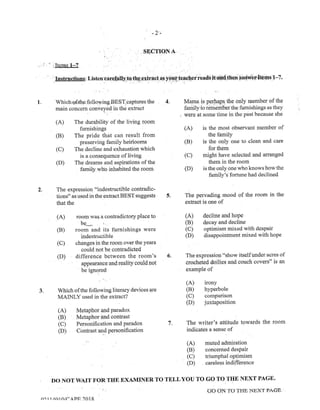
SECTION A
Items 1-7
Instructions: you will hear an extract. It will be read twice. Listen carefully before answering
the questions based on the extract.
1.
2. Which of the following details does NOT
support the main idea of the passage?
(A) "picking the little h'arvest of cocoa"
(B) "somersaulting monkeys howled
in dark voices"
(C) "pouis spotting the hillsides with
fistfuls of gold"
The MAIN idea of the extract is that during 5.
petit-car6me in Kumaca
(A) the village was beautiful
(B) agriculturalactivitiesflourished
(C) the villagers sPoke of current
affairs
(D) nature came alive with colour and
sound
(D) "the forest bees came quick in blue 7 .
sunshine to new blossoms"
According to the extract, "petit-car6me"
refers to the
(A) time of harvest
(B) time that flowers bloom
(C) dry spell during the rainy season
(D) time when the animals are most
vocal
The phrase "fresh-feathered birds flitted
with song" is an examPle of
(A) simile
(B) alliteration
(C) onomatoPoeia
(D) personification
The expression "the guardian immortelles
were in sporadic blootn" suggests that
(A) some of the trees were in bloom
(B) the trees bloomed all year round
(C) the trees had never bloomed before
(D) some trees bloomed onlY at this
time of the Year
6. The phrase "parrots squawking like
matriarchal fishwives" is an example of
which pair of literary devices?
(A) Paradox and metaPhor
(B) Simile and onomatoPoeia
(C) Simile and Personificatiotr
(D) Personificationandonomatopoeia
Which of the following is the MOST
appropriate comtnent on the effectiveness
of the phrase "pouis spotting the hillside
with fistfuls of gold"?
(A) The phrase reflects the extent to
which the flowers were covering
the hillsides during petit-carOrne'
(B)'T"o,l'"?:':["#"111'l?;,iH:;
and tightly bunched together
during petit-car6me'
(C) The Phrase helPs the reader to
appreciate that the flowers were
rich and easY to get hold of
during petit-car6me.
(D) The writer allows the reader to
visualize how the bunched, rich,
bright Yellow flowers covered the
landscaPe during Petit-car€me as
comPared to other times'
3.
4.
DO NOT WAIT FOR THE EXAMINER TO TELLYOU TO GO TO TIIE NEXT PAGE'
GO ON TO TI{E NEXT PAGE
SECTION B
Items 8-11
Instructions: Read the following scenario carefully and then answer Items g-ll.
The media is filled with reports of teenagers being distracted by digital technology and neglecting
their school work as a result. Haldane, a sociology student, decidesio investigateliris phenomenon
at his school which is located in the countryside. He intends to use interviews to collect data.
10.
8. Which of the following activities would
Haldane need to undertake as part of his
research?
Haldane found an article entitled "Modern
Technology Causing Canadian Students
to Fail". This article could be useful to his
research as it
(A) is reliable and accurate
(B) cah yield sufficient dara
(C) provides secondary data
(D) can provide prirnary data
Why would it be UNACCEPTABLE
for Haldane to apply the findings of his
research to all teenagers?
(A) The school is in a rural area.
(B) He plans to use only interviews.
(C) The respondents might not tell the
truth.
(D) He plans to use only students from
his school.
I.
II.
ilI.
Talking to parents and teachers
F'inding out how many students
own digital devices
Choosing a sample that is
representative of his school's
population
I and II only ll.
I arrd III only
II and III only
I, II and III
Costliness of the procedure
Wide geographic coverage of
informants
Considerable depth of the
information to be collected
lligh reliability of the information
to be collected
(A)
(B)
(c)
(D)
9. Which of the fcrllowing would be an
advantage if Haldane conducted interviews?
(A)
(B)
(c)
(D)
02114010/CAPE 2015
GO ON TO THE NEXT PAGE
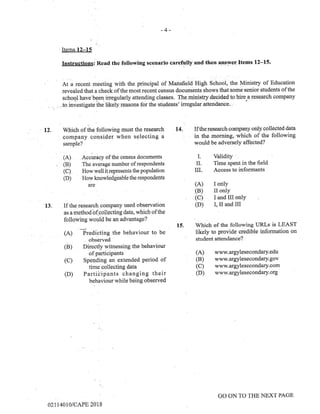
-4-
l!989 12-1s
Instructions: Read the following scenario carefully and then answer lterns 12-15.
At a recent meeting with the principal of Mansfield High School, the Ministry of Education revealed
that a check of the most recent census documents shows that some senior students of the school have
been irregularly attending classes. The ministry decided to hire a research company to investigate
the likely reasolls for the students' irregular attendance.
12. The MOST suitable type of studywhichthe
company could use to conduct this research
is
survey
interviews
experiment
observation
13. Which of the following fypes of sampling
methods would BEST suit the ministry's
purpose?
(A) Random
(B) Discrete
(C) Purposive
(D) Convenience
Which of the following must the research
company consider when selecting a
sample?
14.
(A)
(B)
(c)
(D)
(A)
(B)
(c)
(D)
How aware the respondents are
Accuracy of the census documents
The average number ofrespondents
How well it represents the
population
1s. Which of the fbllowing would be the
MOST reliable source of secondary data
for this study?
(A) The principal's log book
(B) Student report card/book
(C) Student attendance registers
(D) Letters of excuse from Parents
n. I I iall^/rr A Dt an 1<
GO ON TO THE NEXT PAGE
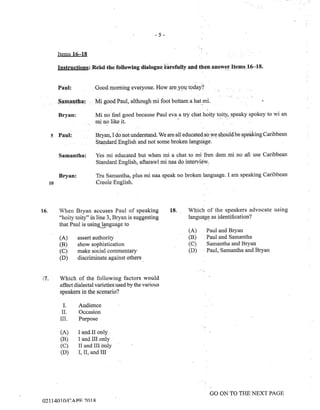
Items 16-20
Instructionl: Read the following extract carefully and then answer Items 16-20.
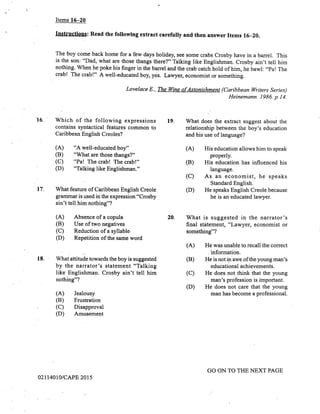
The boy come back home for a few days holiday, see some crabs Closby have in a barrel. This
is the son: "l)ad, what are those thangs there?" Talking like Englishman. Crosby ain't tell him
nothing. When he poke his finger in the barrel and the crab catch hold of him, he bawl: "pa! The
crab! The crab!" A well-educated boy, yes. Lawyer, economist or something.
Lovelace E., The Wine o-f Astonishment (Caribbean Writers Series)
Heinetnann 1986. p.14.
19.
'16. Which of the following expressions
contains syntactical features common to
Caribbean English Creoles?
(A) "A well-educated boy"
(B) "What are those thangs?"
(C) "Pa! The crab! The crab!"
(D) "Talking like Englishman."
What feature of Caribbean English Creole
grammar is used in the expression "Crosby
ain't tell him nothing"?
(A) Absence of a copula
(B) Use of two negatives
(C) Reduction of a syllable,
(D) Repetition of the same word
',i
What attitude towards the boy is suggested
by the narrator's statement "Talking
like Englishman. Crosby ain't tell him
nothing"?
(A) Jealousy
(B) Frustration
(C) Disapproval
(D) Amusement
What does the extract suggest about the
relationship between the boy's education
and his use oflanguage?
(A) His education allows him to speak
properly.
(B) His education has influenced his
language.
(C) As an economist, he speaks
Standard English.
(D) He speaks English Creole because
he is an educated lawver.
What is suggested in the narrator's
final statement, "Lawyer, economist or
something"?
(A) He was unable to recall the correct
infonnation.
(B) He is not in awe of the young man's
educational achievements.
(C) He does not think that the young
man's profession is important.
(D) He does not care that the young
man has become a professional.
17.
20.
18.
02114010/CAPE 2015
GO ON'TO THE NEXT PAGE
-6-
Ltpqs.2-1--?5
Instructions: Read the following extract from the poem carefully and then answer ltems?l-Z5.
"Sonnyts Lettahtt
From Prison, Jebb Avenue
S.W 2Inglan
Dear Mama
Good day
I hope that when these few lines
Reach you they may
Find you in the best of health
I don't know how to tell yu dis
For I did mek a solemn pramise
To tek care a lickle Jim
, An try mi bes fi look out fi im.
Mama,I really did try mi bes
But none di less
Sony fi tell yu dat poor lickle Jim get arres
It was de miggle a di rush hour
When all of a sudden a police van pull up
Out jump tree policeman
De whole a dem carryin baton
f)em walk straight up to mi and Jim
One a dem hold on to Jim
Seh dem tekin im in
Jim tell im fi leggo a im
For im nuh do nuttn
And im nuh tief, not even a button
Mama, I jus couldn stan up deh an nuh do nuttn
So mi jook one in im eye and im started fi cry
Mi hit im pon im mout and im started fi shout
Mi kick im pon im shin so im started fi spin
Mi hit im pon im chin an im drop pon a bin
An crash
An dead
Mama, don't fret
Don't get depress an downhearted
Be of good courage
Till I hear from yu.
Adaptedfrom Linton Kwesi Johnson, "Sonny's Lettah".
In The Spoken Word Revolution: Redux edited by Mark Eleveld,
Sourcebook Media Fusion, 2007.
02t141tllcAPE 201s
GO ON TO THE NEXT PAGE
24.
21. What is the speaker's purpose for writing
this letter?
Based on the tonb of the letter, the
relationship between mother and son can
be described as
(A)
(B)
(c)
(D)
'fo protest against police brutality
and injustice
To apologize for being locked up
along with Jim
To inform his mother ofhis current
address and console her
To tell his mother that he and Jim
are in jail and to explain why ln which of the following countries
Sonny MOST likely incarcerated?
bitter
tense
cordial
affectionate
England
.Iamaica
America
Barbados
(A)
(B)
(c)
(D)
(A)
(B)
(c)
(D)
25. is
22. The register of the poem may be described,
AS
23.
(A)
(B)
(c)
fol
(A)
(B)
(c)
Which of the fbllowing is NOT a purpose
for which the writer uses Caribbean Rnglish
Creole in the poem?
formal
frozen
intimate
consultatlve
To provide aestheticpleasure to the
reader
To serve as a vehicle of easy
commtrnication between inmates
To show that it is more suited than
standard English to discuss
the issues of racism and social
injustice
To persuade the reader that the
issues of racism and social
injustice deserve discussion
(D)
02114010/CAPE 2015
GO ON TO THE NEXT PRCE
-8-
Items 26-28
Instlfuctions: The following conversation about a funeral service took place between these
two persons in a shoe store in Jamaica. Rearl it carefully then answer ltems 26-28.
Percy:
Mildred:
Percy:
Mildred:
Percy:
I can't believe that Mavis gone, bttt I'm really glad she had a great funeral.
The kids and grandkids came from foreign for the funeral?
Yes, Ma'am. One of them talk so nice, like the people in the television shows.
But the other one?! Poor Mavis must be spinning in her grave.
What you mean?
Well, I couldn't understand a thing he was saying dwing the eulogy he was giving.
All I could hear was "I and I this" and "I and I that". He should know that people
don't talk so in church.
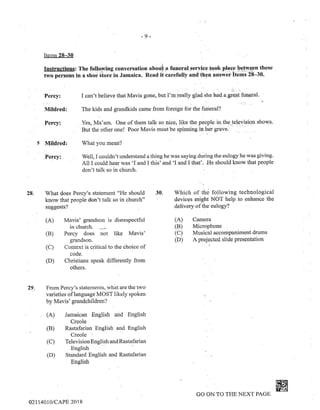
26. From Pergy's statements, what are the two varieties of language MOST likely spoken by Mavis'
grandchildren?
(A) Jamaican English and English Creole
(B) Rastafarian English and English Creole
(C) Standard English and Television English
(D) Standard English and Rastafarian English
27. What does Percy's statement "He should know that people don't talk so in church" suggests?
(A) Percy does not like Mavis' grandson.
(B) Context is critical to the choice of code.
(C) There is a code reserved only for church'
(D) Christians speak differently from others.
Which of the following technologies would NOT help to enhance the delivery of the eulogy?
(A) Fax machine
(B) Microphone
(C) Musical accomPaniment
(D) A projected slide presentation '
n /^ A nF,4n i c
GO ON TO THE NEXT PAGE
Items 29-3I
Instructions: select the most appropriate answer for Items zg-31.
29. An English Creole may be defined as a language
(A) with limited linguistic functions
(B) used by the poorest people in the society
(C) only rmderstood by some persons in the society
(D) developed from contact between European languages andAfrican languages
30. In which of the following expressions is the process of reduplication evident?
(A) Step-sister
(B) Eye-water
(C) A waa gwaan
(D) Chaka-chaka house
31. Which of the following is NOT an element of the process of communication?
(A) Noise
(B) Sender
(C) Medium
(D) Message ,
0211401O/CAPE 2015
GO ON TO THE NEXT PAGE
-10-
Items 32-36
Instructions: Read the following conversation carefully then answer ltems 31-35.
You don't belleve ln
those tblngr, do you?
Auspac Media. The Feature People.
Retrieved 19 November 2013 from
www. a us o ac m e dia co nu a u
What kind of communication context is
depicted in the conversation?
(A) Small group
(B) Intbrcultural
(C) Intrapersonal
(D) Interpersonal
35.
32. the man's body language in Box 1 indicates
that he is
(A) thrilled
(B) irritated
(C) supportive
(D) indifferent
33. The stimulus that leads to the
conceptualization of the message in Box 36'
I is the
(A) well
(B) coin
(C) purse
(D) shrub
34. A communicative artefact in the
conversation is the
(A) sky
(ts) bas
(C) coin
shru!
0211401O/CAPE 2015
Which of the following words describes
the man's tone in Box 4?
(A)
(B)
(c)
(D)
Anger
Disdain
Dismay
Consolation
GO ON TO T'HE NEXT PAGE
Items 37-39
Instructions: Read the following scenario carefully and then answer Items 37-Ag.
An election campaign is taking place for a vacant parliamentary seat. The candidates are willing
to use every means at their disposal to win the support of the voting public.
37. Which of the following features of non-verbal communication would candiclates be LEAST likelv
to use when giving speeches?
(A) Waving their hands in the air
(B) Turning their backs to the audience
(C) Smiling at the women in the audience
(D) Embracing a spouse or other close family member
il
3b' Which of the following verbal strategies would NOT help candidates to effectively get their
message across?
(A) Sarcasm
(B) Statistics
(C) Party slogans
(D) Public seruice announcements
39. Websites established for the putpose of wooing voters would MOST likely include
I. video clips of the candidates'activities
il. a link to a webpage where donations may be made
m. a link to a social rnedia website
(A) I only
(B) II only
(C) I and II only
(D) I and II,I only
' ,l
GO ON TO THE NEXT PAGE
02114010/CAPE 2015
t2-
trtbms 40-43
Instruction$: The following scene shows the effects of inappropriate losfings on social metlia
by tbree persons. Read lt carefully and then answer Items 4043.
Retrieved 19 November 2013 from
htfit ://www. geekculture, co nuf olt oftechi o! archives/I 0 4 L html)
42.
40. Which of the following is a result of
INAPPROPRIATE use of social media?
(A) LoSs of family time
(B) Rejection by employers
(C) Damage to the characters'
reputation
(D) Access by future employers to the
Internet
The scene suggests that INAPPROPRIATE
postings can be made by
What general message do the non-verbal
artefacts convey?
(A) The characters have different
treasured items.
(B) The character with the least needs
is a woman.
(C) The characters are unemployed and
in need of money.
(D) Members of the public are giving
the characters donations.
Which of the following could be considered
the artistJs purpose for depicting the scene?
(A) To sho* that social media are
dangerous
(B) To warn against indiscriminate use
of social media
(C) To ridicule persons addicted to
using social media
(D) To show that social media are a sign
of the end times
41.
43.
(A)
(B)
(c)
(D)
young people only
persons ofdifferent ages only
the three characters in the cartoon
persons of different ages and
genders
Forrn=
it was an
"T9.rrassing
Yqr Thbe
video.
Unemployable due
to stupid personal
stuff I put on mv
facebook page.
Me too!
Adaptedfrom Signs of the Social Neworking Times.
o2tr40to/cAPE 2015
GO ON TO THE NEXT PAGE
--tJ-
Items 44-45
Instructions: Read the following scenario carefully and then answer Items 44-45,
A student submitted the following draft conclusion for her expository essay on "Types of Luxury
Cars".
If you are going to buy a luxury car, you must carefully consider what you want. There are various
brands of luxury cars on the market - Cadillac, Infiniti, Volvo, Land Rover, Lamborghini, Porsche,
Mercedes Benz, Lexus, BMW, Audi. Some luxury cars can damage the environment and then our
children would suffer the consequences.
The purpose of the second sentence is to 45.
44. What is the writer's airn in the last sentence?
(A)
(B)
(c)
(D)
show off the student's knowledge
of luxury cars
list the cars from most to least
luxurious
present a list ofcars for the reader
to choose from
have the reader carefully consider
various brands ofluxury cars
To express the main idea of the
paragraph
To convey the concluding idea of
the paragraph
To focus the paragraph on
environmental conservation
To provide a detail to help the
reader choose a luxurv brand
(A)
(B)
(c)
(D)
IF YOU FINISH
END OF TEST
rl I
BEF'ORE TIME IS CALLED, CIIECKYOUR WORK ON TIIIS TEST.
0211401O/CAPE 2015
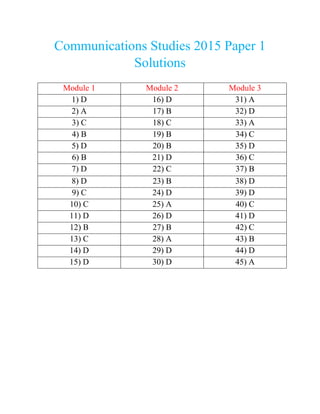
Communications Studies 2015 Paper 1
Solutions
Module 1 Module 2 Module 3
1) D 16) D 31) A
2) A 17) B 32) D
3) C 18) C 33) A
4) B 19) B 34) C
5) D 20) B 35) D
6) B 21) D 36) C
7) D 22) C 37) B
8) D 23) B 38) D
9) C 24) D 39) D
10) C 25) A 40) C
11) D 26) D 41) D
12) B 27) B 42) C
13) C 28) A 43) B
14) D 29) D 44) D
15) D 30) D 45) A
TEST CODE 02114010-ES
FORM TP 2016-ES MAY/JUNE 2016
C A R I B B E A N E X A M I N A T I O N S C O U N C I L
CARIBBEAN ADVANCED PROFICIENCY EXAMINATION®
COMMUNICATION STUDIES
Paper 01
30 minutes
EXAMINER'S SCRIPT
ITEMS1
-7
Copyright © 2014 Caribbean Examinations Council
All rights reserved.
021140 l 0/CAPE 2016-ES
- 2 -
1. Say to the candidates:
2. Say to the candidates:
3. Two minutes later, say to candidates
4. Read the following poem twice at normal reading pace. (DO NOT dictate the poem for candidates
to write.)
Departure Lounge
The young man,
when the flight is called
is blowing his nose to clear
the sadness of departure.
The girl who's leaving looks
composed. They're travelling
on different planes
to different destinations.
Each time
we die a little.
When we are young
These moments devastate.
But partings down the years
have helped to make me
ready to say goodbye
Mervyn Morris
02114010/CAPE 2016-ES
GO ON TO THE NEXT PAGE
Now listen carefully while I read this poem twice. Remember, you may make notes
as I read.
Look at the items now for two minutes.
Items 1-7 constitute Section A of this paper. They are based on a poem, which I will read
to you. You will be given two minutes to look at the items before you listen to the poem.
Then I will read the poem to you twice.
You are required to listen carefully to the poem before answering the items. You may make
notes while you listen to the reading. You must NOT begin to answer the items until you are
told to do so.
You are required to respond to the items on your answer sheet by selecting the correct
option from the four options lettered A-D.
- 3 -
5. After you have read the poem the first time, pause for a few seconds and then say to the candidates:
6. After you have read the poem a second time, pause for a few seconds and then say to the candidates:
7. Quietly invite the invigilator to take over the examination process.
Instructions to the Invigilator
8. Seventy-five minutes later, tell candidates that they have 15 minutes left.
9. Fifteen minutes later, at the end of the allotted 90 minutes, collect all papers and dismiss the
candidates.
02114040/CAPE 2016-ES
You have 90 minutes to answer all the items on Paper 01. When you are finished answering those
items which are based on this poem, go straight to Section B and answer Items 8-45. Do not wait
for any further instructions. The invigilator will tell you when the last 15 minutes are left.
I shall now read the poem a second time.
- 1 -
02114010/CAPE 2016
TEST CODE 02114010
MAY/JUNE2016
C A R I B B E A N E X A M I N A T I O N S C O U N C I L
CARIBBEAN ADVANCED PROFICIENCY EXAMINATIONS
COMMUNICATION STUDIES
UNIT 1 – Paper 01
1 hour 30 minutes
04 MAY 2016 (a.m.)
READ THE FOLLOWING INSTRUCTIONS CAREFULLY.
1. This test consists of 45 items divided into two sections, A and B.
2. Section A, based on a communication extract, consists of 7 questions. The extract, which is
NOT included in the question booklet, will be read to you twice but you will be allowed two
minutes to look at the questions before the extract is read to you.
3. Section B consists of 38 questions. Answer each question based on the information given.
4. In addition to the test booklet, you should have an answer sheet.
5. Each item in this test has four suggested answers lettered (A), (B), (C), (D). Read each item
you are about to answer and decide which choice is best. ·
6. On your answer sheet, find the number which corresponds to your item and shade the space
having the same letter as the answer you have chosen. Look at the sample item below.
Sample Item
Which of the following is an advantage of the
questionnaire as a data-collection method? Sample Answer
(A) Ease of administration Ⓐ Ⓑ Ⓒ Ⓓ
(B) Immediacy of feedback
(C) Openness of discussion
(D) Opportunity for clarification
The best answer to this item is "Ease of administration", so (A) has been shaded.
7. If you want to change your answer, erase it completely and fill in your new choice.
8. When you are told to begin, turn the page and work as quickly and as carefully as you can.
If you cannot answer an item, go on to the next one. You may return to that item later.
_ _DO NOT TURN THIS PAGE UNTIL YOU ARE TOLD TO DO SO __
Copyright © 2015 Caribbean Examinations Council
- 2 -
02114010/CAPE 2016
SECTION A
Items 1 – 7
Instructions: You will hear an extract. It will be read twice. Listen carefully before answering the
questions based on the extract.
1. What is the setting in the first stanza?
(A) A funeral
(B) An airport
(C) A train station
(D) An underground station
2. Which of the following BEST expresses the
meaning of the phrase “blowing his nose to
clear the sadness of departure”?
(A) The young man is crying.
(B) The young man is devastated by the
departure.
(C) The young man copes with his grief
by weeping.
(D) The impending departure has made
the young man ill.
3. Which of the following BEST explains the
purpose of stanza two?
(A) To show that everyone has to die
(B) To include all young people in the
grief of partings
(C) To encourage people to empathize
with one another
(D) To show that the speaker is not alone
in the departure lounge.
4. The tone of the poem can be described as
(A) sober
(B) caustic
(C) nostalgic
(D) regretful
5. Which of the following expressions from
the poem does NOT refer to the central
theme of the poem?
(A) “ready to say goodbye”
(B) “Each time we die a little”
(C) “These moments devastate”
(D) “blowing his nose to clear the sadness
of departure”
6. The main idea of the poem is that
(A) the author learns to accept paintings
(B) people find it painful to deal with
partings
(C) people eventually learn to deal with
partings
(D) two young people are parting
company on different flights
7. Which of the following literary devices are
NOT used in the poem?
I. Pun
II. Metaphor
III. Oxymoron
(A) I and II only
(B) I and III only
(C) II and III only
(D) I, II and III
GO ON TO THE NEXT PAGE
- 3 -
02114010/CAPE 2016
SECTION B
Items 8 – 10
Instructions: Read the following scenario carefully and then answer Items 8 – 10.
A researcher was gathering information on the impact of streaming within a particular high school. He
held a discussion with five sets of students from remedial classes in different forms or grades on how
they are being affected by their placement.
8. What method of data collection did the researcher use?
(A) Interview
(B) Focus group
(C) Questionnaire
(D) Participant observation
9. Apart from the students, which of the following persons may be the BEST source of primary data for
this research?
(A) Parents
(B) Teachers
(C) Education Officers
(D) Deans of Discipline
10. Which of the following is an advantage of using a questionnaire for this particular study?
(A) Results can be easily quantified.
(B) It has a low rate of response
(C) The researcher is able to ask follow-up questions.
(D) Respondents don’t have to think carefully before formulating a response.
GO ON TO THE NEXT PAGE
- 4 -
02114010/CAPE 2016
Items 11 – 15
Instructions: Read the following scenario carefully and then answer Items 11 – 15.
At a recent meeting with the principal of Argyle Secondary School, the Ministry of Education revealed
that a check of the most recent census documents shows that some senior students of the school have
been attending classes irregularly. The Ministry decided to hire a research company to investigate the
likely reasons for the students’ irregular attendance.
11. Which of the following would be the MOST
appropriate population for this study?
(A) All students of A rgyle Secondary
that have been attending classes
irr egu larly
(B) All senior students of Argyle
Secondary that have been attending
classes irregularly
(C) All students of secondary students in
the country that have been attending
classes irregularly
(D) All senior students of secondary
students in the country that have been
attending classes irregularly
12. Relevant demographic data about the
student that the researcher might seek to
obtain would include
I. Age
II. Address
III. Number of days absent
(A) I and II only
(B) I and III only
(C) II and III only
(D) I, II and III
13. If the research company only collected data
in the morning, which of the following
would affect the data?
I. Validity
II. Time spent in the field
III. Access to information
(A) I only
(B) II only
(C) I and III only
(D) I, II and III
14. If the research company was observing the
patterns of absenteeism among senior
students, which of the following would be
an advantage?
(A) Directly experiencing the behaviour
of participants
(B) Allowing its biases to affect what is
observed
(C) Spending a long enough period of
time collecting data
(D) Participants changing their behaviour
while being observed
15. Which of the following URLs is NOT likely
to provide trustworthy information on
student attendance.
(A) www.argylesecondary.edu
(B) www.ttministryofeducation.gov
(C) www.parentsargylesecondary.org
(D) www.argyleabsentstudents.com
GO ON TO THE NEXT PAGE
- 5 -
02114010/CAPE 2016
Items 16 – 20
Instructions: Read the following scenario carefully and then answer Items 16 – 20.
The boy come back home for a few days holiday, see some crabs Crosby have in a barrel. This is the
son: “Dad, what are those thangs there?” Talking like Englishman. Crosby ain’t tell him nothing. When
he poke his finger in the barrel and the crab catch hold of him, he bawl: “Pa! The crab! The crab!” A
well-educated boy, yes. Lawyer, economist or something.
Lovelace E., 1982, The Wine of Astonishment, p. 14.
16. Which of the following expressions
contains syntactical features common to
Caribbean English Creoles?
(A) “A well-educated boy”
(B) “what are those thangs?”
(C) “Pa! The crab! The crab!”
(D) “Talking like Englishman.”
17. What features of Caribbean English Creole
grammar is used in the expression “Crosby
ain’t tell him nothing”?
(A) Reduplication
(B) Double negative
(C) Syllable reduction
(D) Zero copula structure
18. What attitude does the text ‘Talking like
Englishman. Crosby ain’t tell him nothing.’
suggest that the narrator has towards the
boy?
(A) Jealousy
(B) Frustration
(C) Amusement
(D) Disapproval
19. What does the extract suggest about the
relationship between the boy’s education
and his use of language?
(A) His education makes him speak
properly.
(B) His education has influenced his
language.
(C) As an economist, he speaks Standard
English.
(D) He speaks English Creole because he
is an educated lawyer.
20. What is suggested in the narrator’s final
statement, “Lawyer, economist or
something”?
(A) He was unable to recall the correct
information.
(B) He is not in awe of the young man’s
educational achievements.
(C) He does not think that the young
man’s profession is important.
(D) He does not care that the young man
has become a professional.
GO ON TO THE NEXT PAGE
6
02114010/CAPE 2016
Items 21 – 25
Instructions: Read the following scenario carefully and then answer Items 21 – 25.
Miss Clemmie keep on looking at Ascot as if he is stranger and Dagoman sit on the bench outside as
if he too fraid to come near the lady. The children start play round the car and make as if to open the
door and Ascot snap at them so bad that my mother had to say, “Hi Ascot, is your own little brothers
yu treating so?”
“Half brother,” Ascot say.
From then on things just get from bad to worse. Ascot look like he real vex with Miss Clemmie, and the
wife and stepfather look like they real vex with Ascot. So finally Ascot say, “Come let me take you all
home for I have to get back to Kingston tonight.” But by this time Dagoman face set and he say he
prefer to walk and Miss Clemmie and the children get into the car alone, and even though Miss
Clemmie look like she going to cry, you can still see she feeling proud to have her son driving her in
car. But as they drive off, all we can hear is Ascot shouting at the children to take their dirty feet off
the car seat.
Adapted from “Ascot” Summer Lightning and other stories
By Olive Senior, Longman Caribbean Writers, 1986.
21. Which of the following does NOT
contribute to the tension among the
characters?
(A) Ascot snapping at the children
(B) Miss Clemmie looking at Ascot as if
he is a stranger
(C) Dagoman silently angry with Ascot for
snapping at the children
(D) Miss Clemmie feeling proud to have
Ascot drive her in his car
22. When Ascot says “Come let me take you
all home ...”, he aims to
(A) make Dagoman angry
(B) get back to Kingston that night
(C) ease the tension among the family
(D) take his mother and her other children
for a drive
23. Which of the following does NOT convey
a communicative behaviour?
(A) ‘Ascot snap at them’.
(B) ‘Dagoman sit on the bench outside’.
(C) ‘The children start play round the car’.
(D) ‘The wife and stepfather look like
they real vex with Ascot’.
24. The writer’s use of English Creole throughout
the extract suggests all of the following
EXCEPT that she
(A) accepts that English Creole is a
broken language
(B) thinks that English Creole is an
authentic language
(C) thinks that English Creole can be
used for literary purposes
(D) accepts that English Creole is a
means of communication by people
25. Which of the following grammatical
features is NOT present in the first sentence
of the extract?
(A) Reduplication
(B) Subject-adjective structure
(C) Unmarked noun with singular
meaning
(D) Unmarked verb with past-time
reference
GO ON TO THE NEXT PAGE
7
02114010/CAPE 2016
Items 26 – 28
Instructions: Read the following extract carefully and then answer Items 26 – 28.
“Eh-eh! Don’t shout at me,” was all he got for his pains. “Don’t you deafen me. What’s that the young
varmint says, Maud?”
Mrs. Dovecot came over and got him to understand after two or three attempts.
“Three pence, Maudie,” he cackled. “Three pence! Did yo’ hear thet, Maud? Did yo’ ever hear the
like? I’ll bet you ain’t never did. Three pence! The lad’ll have money what I’s got to sweat blood for,
just to gi thet Megahey what’s got his bread so well-buttered off ‘pon both sides, not to mention the
middle. Three pence! Ha ha! … oh Maudie … .” And he broke down once in helpless laughter. Clement
went out and sat under the breadfruit tree that grew before the door, resting his back against the trunk.
Adapted from Uriel Narinesingh,
Voyage … An Anthology of Short Stories and Poems, 2006, p.118.
26. Which of the following types of registers is used in the dialogue?
(A) Frozen
(B) Formal
(C) Intimate
(D) Consultative
27. How might the following expressions be BEST classified?
I ‘he cackled’
II ‘he broke down once in helpless laughter’
III ‘Clement went out and sat under the breadfruit tree’
(A) Proxemics
(B) Paralanguage
(C) Verbal communication
(C) Non-verbal communication
28. Which of the following are non-standard English texts?
I ‘what I’s got to sweat blood for’
II ‘Three pence!’
III ‘Did yo’ hear thet, Maud?’
(A) I and II only
(B) I and III only
(C) II and III only
(C) I, II and III
GO ON TO THE NEXT PAGE
8
02114010/CAPE 2016
Items 29 – 30
Instructions: Select the most appropriate answer for Items 29 – 30.
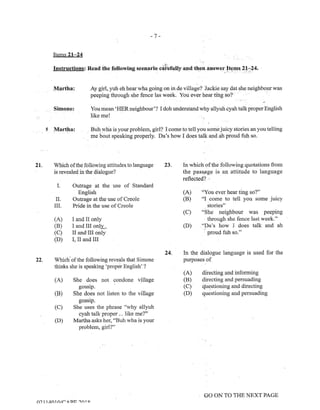
29. Which of the following BEST explains the meaning of the term ‘lingua franca’?
(A) A language which is derived from French and used by African slaves.
(B) Any language which is native to African peoples who have been transplanted.
(C) Any language which is foreign to a speaker who moves to a new speech community.
(D) A language used as a common means of communication by speakers whose native languages
are different.
30. Which of the following are examples of language performing a social function?
I Making a request
II Talking to oneself
III Audio conferencing
(A) I and II only
(B) I and III only
(C) II and III only
(D) I, II, and III
GO ON TO THE NEXT PAGE
9
02114010/CAPE 2016
Items 31 – 33
Instructions: Read the following scenario carefully and then answer Items 31 – 33.
A group of ten students from McIntosh High in Jamaica are visiting Cuba to improve their knowledge
of Spanish and Cuban culture. They are being hosted by students from José Martí High. When they
return to school, they will be required to write a report on their experience.
31. Which of the following contexts of communication BEST describes the interaction between the two
groups of students?
(A) Intercultural
(B) Small-group
(C) Interpersonal
(D) Organizational
32. In which of the following genres will the report MOST likely be written?
I Narrative
II Exposition
III Argument
(A) I and II only
(B) I and III only
(C) II and III only
(D) I, II and III
33. While in Cuba, the students attended a seminar. The guest speaker noticed that many of the visitors
seemed restless during his presentation, even though he was speaking audibly. Which of the following
was NOT likely responsible for their restlessness?
(A) He was speaking too fast.
(B) He was speaking in a monotone.
(C) He was using many unfamiliar words.
(D) He complemented his speech with projected slides.
GO ON TO THE NEXT PAGE
10
02114010/CAPE 2016
Items 34 – 37
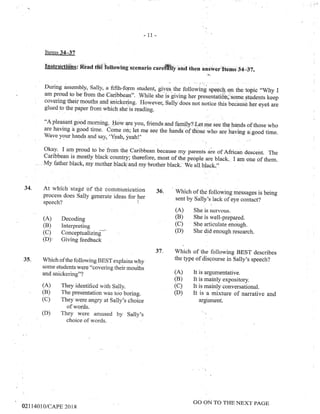
Instructions: Read the following scenario carefully and then answer Items 34 – 37.
During assembly, Sally, a fifth form student, gives the following speech on the topic “Why I am proud
to be from the Caribbean.” While she is giving her presentation, some students keep covering their
mouths and snickering. However, Sally does not notice this because her eyes are glued to the paper
from which she is reading.
‘A pleasant good morning. How are you, friends and family? Let me see the hands of those who are
having a good time. Come on: let me see the hands of those who are having a good time. Wave your
hands and say, “Yeah, yeah!”
Okay. I am proud to be from the Caribbean because my parents are of African descent. The Caribbean
is mostly black country; therefore, most of the people are black. I am one of them. My father black,
my mother black and my brother black. We all black.’
34. Which of the following is the stage of the
communication process at which Sally
generated ideas for her speech?
(A) Decoding
(B) Interpreting
(C) Conceptualizing
(D) Giving feedback
35. Which of the following BEST explains why
some students covered their mouths and
glanced at one another?
(A) They identified with Sally.
(B) The presentation was too boring.
(C) They were angry at Sally’s choice of
words.
(D) They were amused by Sally’s choice
of words.
36. Which of the following is NOT a message
that Sally’s lack of eye contact could be
sending?
(A) She is nervous.
(B) She is well prepared.
(C) She is not articulate enough.
(D) She did not do enough research.
37. Which of the following BEST describes the
method of discourse in Sally’s speech?
(A) It is argumentative.
(B) It is mainly expository.
(C) It is mainly conversational.
(D) It is a mixture of narrative and
argument.
GO ON TO THE NEXT PAGE
11
02114010/CAPE 2016
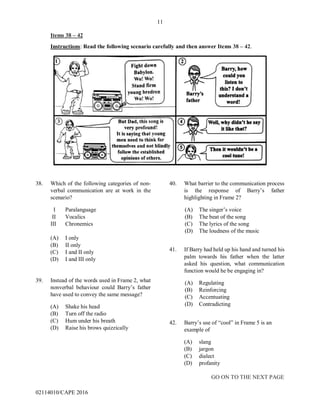
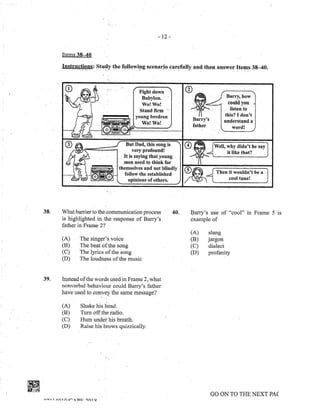
Items 38 – 42
Instructions: Read the following scenario carefully and then answer Items 38 – 42.
38. Which of the following categories of non-
verbal communication are at work in the
scenario?
I Paralanguage
II Vocalics
III Chronemics
(A) I only
(B) II only
(C) I and II only
(D) I and III only
39. Instead of the words used in Frame 2, what
nonverbal behaviour could Barry’s father
have used to convey the same message?
(A) Shake his head
(B) Turn off the radio
(C) Hum under his breath
(D) Raise his brows quizzically
40. What barrier to the communication process
is the response of Barry’s father
highlighting in Frame 2?
(A) The singer’s voice
(B) The beat of the song
(C) The lyrics of the song
(D) The loudness of the music
41. If Barry had held up his hand and turned his
palm towards his father when the latter
asked his question, what communication
function would he be engaging in?
(A) Regulating
(B) Reinforcing
(C) Accentuating
(D) Contradicting
42. Barry’s use of “cool” in Frame 5 is an
example of
(A) slang
(B) jargon
(C) dialect
(D) profanity
GO ON TO THE NEXT PAGE
12
02114010/CAPE 2016
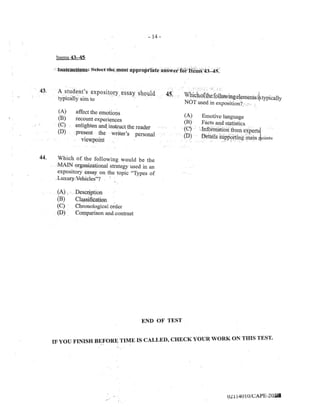
Items 43 – 45
Instructions: Read the following scenario carefully and then answer Items 43 – 45.
A sixth-form class was practising to write expository essays. The students were exposed to the various
features of exposition and guidelines for producing this type of essay in an academic context.
43. A student’s expository essay should typically aim to
(A) recount experiences
(B) affect the emotions
(C) enlighten and instruct the reader
(D) present the writer’s personal viewpoint
44. Which of the following would be MAIN organizational strategy used in an expository essay on the
topic: “Types of luxury vehicles”?
(A) Description
(B) Classification
(C) Chronological order
(D) Comparison and contrast
45. Which of the following techniques is typically NOT used in exposition?
(A) Emotive language
(B) Facts and statistics
(C) Information from experts
(D) Details supporting main points
END OF TEST
IF YOU FINISH BEFORE TIME IS CALLED, CHECK YOUR WORK ON THIS TEST.
Communications Studies 2016 Paper 1
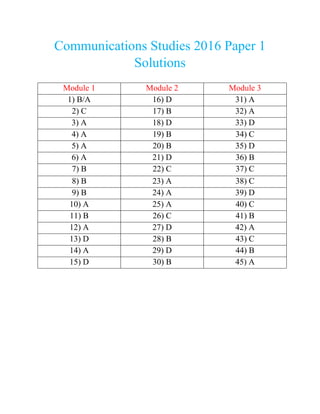
Solutions
Module 1 Module 2 Module 3
1) B/A 16) D 31) A
2) C 17) B 32) A
3) A 18) D 33) D
4) A 19) B 34) C
5) A 20) B 35) D
6) A 21) D 36) B
7) B 22) C 37) C
8) B 23) A 38) C
9) B 24) A 39) D
10) A 25) A 40) C
11) B 26) C 41) B
12) A 27) D 42) A
13) D 28) B 43) C
14) A 29) D 44) B
15) D 30) B 45) A


1. This test consists of 45 items divided into two sections, A and B.
2. Section A, based on a communication extract, consists of 7 questions. The extract, which is NOT
included in the question booklet, will be read to you twice but you will be allowed two minutes to
look at the questions before the extract is read to you.
3. Section B consists of 38 questions. Answer each question based on the information given.
4. In addition to the test booklet, you should have an answer sheet.
5. Each item in this test has four suggested answers, lettered (A), (B), (C), (D). Read each item you are
about to answer, and decide which choice is best.
6. On your answer sheet, find the number which corresponds to your item and shade the space having
the same letter as the answer you have chosen. Look at the sample item below.
Sample Item
Which of the following is an advantage of the
questionnaire as a data-collection method?
(A) Opportunity for clarification
(B) Immediacy of feedback
(C) Openness of discussion
(D) Ease of administration
The best answer to this item is “Ease of administration”, so (D) has been shaded.
7. If you want to change your answer, erase it completely before you fill in your new choice.
8. When you are told to begin, turn the page and work as quickly and as carefully as you can. If you cannot
answer an item, omit it and go on to the next one. You may return to that item later.
DO NOT TURN THIS PAGE UNTIL YOU ARE TOLD TO DO SO.
Copyright © 2016 Caribbean Examinations Council ®.
All rights reserved.
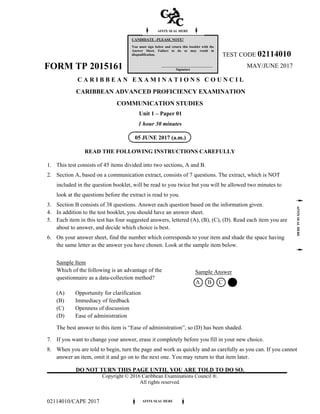
02114010/CAPE 2017
FORM TP 2015161
CANDIDATE –PLEASE NOTE!
You must sign below and return this booklet with the
Answer Sheet. Failure to do so may result in
disqualification.
______________________________
Signature
MAY/JUNE 2017
C A R I B B E A N E X A M I N A T I O N S C O U N C I L
CARIBBEAN ADVANCED PROFICIENCY EXAMINATION
COMMUNICATION STUDIES
Unit 1 – Paper 01
1 hour 30 minutes
05 JUNE 2017 (a.m.)
READ THE FOLLOWING INSTRUCTIONS CAREFULLY
Sample Answer
AFFIX SEAL HERE
AFFIX
SEAL
HERE
AFFIX SEAL HERE
TEST CODE 02114010
02114010/CAPE 2017 EXTRACT 
CAPE COMMUNICATION STUDIES
MAY/JUNE 2017
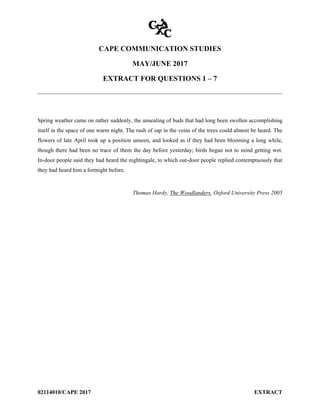
EXTRACT FOR QUESTIONS 1 – 7
Spring weather came on rather suddenly, the unsealing of buds that had long been swollen accomplishing
itself in the space of one warm night. The rush of sap in the veins of the trees could almost be heard. The
flowers of late April took up a position unseen, and looked as if they had been blooming a long while,
though there had been no trace of them the day before yesterday; birds began not to mind getting wet.
In-door people said they had heard the nightingale, to which out-door people replied contemptuously that
they had heard him a fortnight before.
Thomas Hardy, The Woodlanders, Oxford University Press 2005
02114010/CAPE 2017 GO ON TO THE NEXT PAGE 
- 2 -
SECTION A
Items 1 – 7
Instructions: You will hear an extract. It will be read twice. Listen carefully before answering the
questions based on the extract.
1. What is the main idea of the extract?
(A) Spring is a time of tremendous
beauty.
(B) Birds are part of the beauty of
spring.
(C) Spring seems to have appeared
overnight.
(D) The spring rains make everything
beautiful.
2. The writer’s main purpose is to
(A) show that spring comes right after
winter
(B) comment on what the birds do at
springtime
(C) convey the memorable impact of spring’s
arrival
(D) describe the beauty of the natural world
during springtime.
3. The expression “The flowers of late April took
up a position unseen” is an example of
(A) metaphor
(B) hyperbole
(C) alliteration
(D) personification
4. What is the dominant imagery used by the writer
in the extract?
(A) Aural
(B) Visual
(C) Tactile
(D) Olfactory
5. The word that BEST describes the mood of the
passage is
(A) idyllic
(B) sombre
(C) peaceful
(D) exhilarating
6. The word closest in meaning to “unsealing” as
used in the extract is
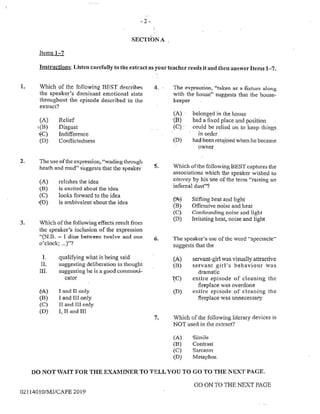
(A) gaping
(B) opening
(C) exposing
(D) prospering
7. Which of the following devices is reflected in the
final sentence?
(A) Irony
(B) Contrast
(C) Oxymoron
(D) Personification
DO NOT WAIT FOR THE EXAMINER TO TELL YOU TO GO TO THE NEXT PAGE
02114010/CAPE 2017 GO ON TO THE NEXT PAGE
 
- 3 -
SECTION B
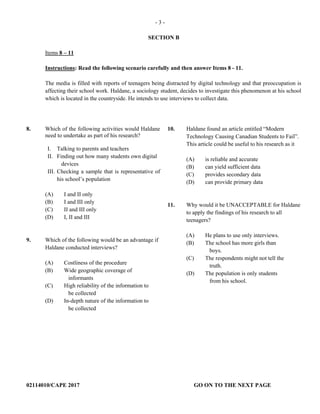
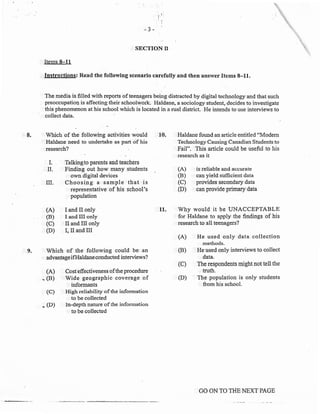
Items 8 – 11
Instructions: Read the following scenario carefully and then answer Items 8 - 11.
The media is filled with reports of teenagers being distracted by digital technology and that preoccupation is
affecting their school work. Haldane, a sociology student, decides to investigate this phenomenon at his school
which is located in the countryside. He intends to use interviews to collect data.
8. Which of the following activities would Haldane
need to undertake as part of his research?
I. Talking to parents and teachers
II. Finding out how many students own digital
devices
III. Checking a sample that is representative of
his school’s population
(A) I and II only
(B) I and III only
(C) II and III only
(D) I, II and III
9. Which of the following would be an advantage if
Haldane conducted interviews?
(A) Costliness of the procedure
(B) Wide geographic coverage of
informants
(C) High reliability of the information to
be collected
(D) In-depth nature of the information to
be collected
10. Haldane found an article entitled “Modern
Technology Causing Canadian Students to Fail”.
This article could be useful to his research as it
(A) is reliable and accurate
(B) can yield sufficient data
(C) provides secondary data
(D) can provide primary data
11. Why would it be UNACCEPTABLE for Haldane
to apply the findings of his research to all
teenagers?
(A) He plans to use only interviews.
(B) The school has more girls than
boys.
(C) The respondents might not tell the
truth.
(D) The population is only students
from his school.
02114010/CAPE 2017 GO ON TO THE NEXT PAGE
 
- 4 -
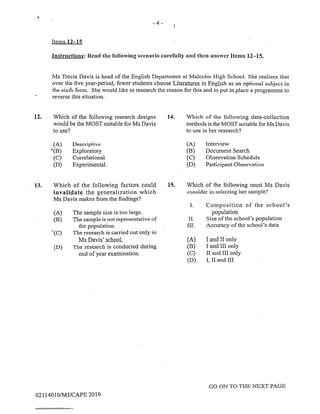
Items 12 – 15
Instructions: Read the following scenario carefully and then answer Items 12 - 15.
Ms Trecia Davis is head of the English Department at Malcolm High School. She realizes that over a five year-
period, fewer students are choosing Literatures in English as an option in the sixth form. She would like to
research the reason for this to put in place a programme to reverse the situation.
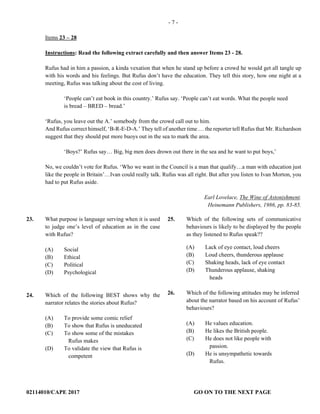
12. Which of the following outcomes would NOT be
achieved if Ms Davis uses school records for the
past ten years as a data source?
(A) Validity
(B) Accuracy
(C) Credibility
(D) Subjectivity
13. Which of the following factors can invalidate the
generalization which the researcher makes from
the findings?
(A) The sample size is too large.
(B) The sample is not representative of
the population.
(C) The research is carried out only in
Ms Davis’ school.
(D) The research is conducted during
end of year examination of year
examination.
14. Which of the following MUST the researcher
consider when selecting a sample?
I. Composition of the school’s
population
II. Size of the school’s population
III. Accuracy of the school’s data
(A) I and II only
(B) I and III only
(C) II and III only
(D) I, II and III
15. The mode of writing that Ms. Davis should
employ in her report is
(A) narration
(B) argument
(C) exposition
(D) description
02114010/CAPE 2017 GO ON TO THE NEXT PAGE
 
- 5 -
Items 16 – 19
Instructions: Read the following extract carefully and then answer Items 16 - 19.
The boy came back home for a few days holiday, see some crabs Crosby have in a barrel. This is the son: “Dad,
what are those thangs there?” Talking like Englishman. Crosby ain’t tell him nothing. When he poke his finger
in the barrel and the crab catch hold of him, he bawl: “Pa! The crab! The crab!” A well-educated boy, yes.
Lawyer, economist or something.
Earl Lovelace E, The Wine of Astonishment.
Heinemann Publishers 1986, p. 14.
16. Which of the following expressions contains
syntactical features common to Caribbean
English Creoles?
(A) “A well-educated boy”
(B) “What are those thangs?”
(C) “Pa! The crab! The crab!”
(D) “Talking like Englishman.”
17. What feature of Caribbean English Creole
grammar is used in the expression “Crosby ain’t
tell him nothing”?
(A) Absence of a copula
(B) Reduction of a syllable
(C) Use of double negatives
(D) Repetition of the same word
18. What attitude towards the boy is suggested by the
narrator’s statement, “Talking like Englishman.
Crosby ain’t tell him nothing.”?
(A) Jealousy
(B) Frustration
(C) Disapproval
(D) Amusement
19. What does the extract suggest about the
relationship between the boy’s education and his
use of language?
(A) His education has influenced his
language.
(B) His education hindered his use of
Standard English.
(C) He speaks English Creole because
he is an educated lawyer.
(D) His education has nothing to do
with his use of Standard English.
02114010/CAPE 2017 GO ON TO THE NEXT PAGE
 
- 6 -
Items 20 – 22
Instructions: Read the following poem carefully and then answer Items 20 - 22.
‘Eh-eh! Don’t shout at me,’ was all he got for his pains. ‘Don’t you deafen me.
What’s that the young varmint says, Maud?’
Mrs Dovecot came over and got him to understand after two of three attempts.
“Three pence, Maudie,” he cackled. “Three pence! Did yo’ hear thet, Maud? Did yo’ ever hear the like? I’ll bet
you ain’t never did. Three pence! The lad’ll have money what I’s got to sweat blood for, just to gi thet Megahey
what’s got his bread so well-buttered off ‘pon both sides, not to mention the middle. Three pence! Ha ha! ...oh
Maudie…” And he broke down once in helpless laughter. Clement went out and sat under the breadfruit tree
that grew before the door, resting his back against the trunk.
Adapted from Uriel Narinesingh, Voyage: An Anthology of Short Stories and Poems.
Royards Publishing, 2006, p.118
20. Which of the following expressions contains features of non-standard English dialect?
I. “… you ain’t never did.”
II. “… what I’s got to sweat blood for …”
III. “… sat under the breadfruit tree …”
(A) I and II only
(B) I and III only
(C) II and III only
(D) I, II and III
21. Which of the following communicative behaviours is NOT present in the extract?
(A) Vocalics
(B) Chronemics
(C) Proxemics
(D) Facial Expression
22. Which of the following registers is used in the dialogue?
(A) Casual
(B) Frozen
(C) Formal
(D) Consultative
02114010/CAPE 2017 GO ON TO THE NEXT PAGE 
- 7 -
Items 23 – 28
Instructions: Read the following extract carefully and then answer Items 23 - 28.
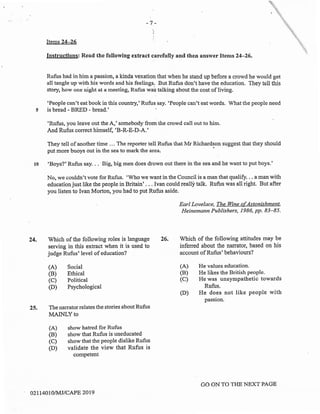
Rufus had in him a passion, a kinda vexation that when he stand up before a crowd he would get all tangle up
with his words and his feelings. But Rufus don’t have the education. They tell this story, how one night at a
meeting, Rufus was talking about the cost of living.
‘People can’t eat book in this country.’ Rufus say. ‘People can’t eat words. What the people need
is bread – BRED – bread.’
‘Rufus, you leave out the A.’ somebody from the crowd call out to him.
And Rufus correct himself, ‘B-R-E-D-A.’ They tell of another time … the reporter tell Rufus that Mr. Richardson
suggest that they should put more buoys out in the sea to mark the area.
‘Boys?’ Rufus say… Big, big men does drown out there in the sea and he want to put boys,’
No, we couldn’t vote for Rufus. ‘Who we want in the Council is a man that qualify…a man with education just
like the people in Britain’…Ivan could really talk. Rufus was all right. But after you listen to Ivan Morton, you
had to put Rufus aside.
Earl Lovelace, The Wine of Astonishment.
Heinemann Publishers, 1986, pp. 83-85.
23. What purpose is language serving when it is used
to judge one’s level of education as in the case
with Rufus?
(A) Social
(B) Ethical
(C) Political
(D) Psychological
24. Which of the following BEST shows why the
narrator relates the stories about Rufus?
(A) To provide some comic relief
(B) To show that Rufus is uneducated
(C) To show some of the mistakes
Rufus makes
(D) To validate the view that Rufus is
competent
25. Which of the following sets of communicative
behaviours is likely to be displayed by the people
as they listened to Rufus speak??
(A) Lack of eye contact, loud cheers
(B) Loud cheers, thunderous applause
(C) Shaking heads, lack of eye contact
(D) Thunderous applause, shaking
heads
26. Which of the following attitudes may be inferred
about the narrator based on his account of Rufus’
behaviours?
(A) He values education.
(B) He likes the British people.
(C) He does not like people with
passion.
(D) He is unsympathetic towards
Rufus.
02114010/CAPE 2017 GO ON TO THE NEXT PAGE 
- 8 -
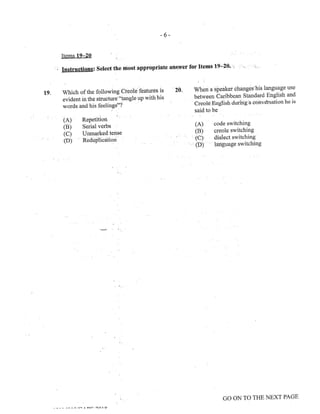
27. Which of the following Creole features is evident
in the structure “tangle up with his words and his
feelings”?
(A) Repetition
(B) Reduplication
(C) Unmarked present tense
(D) Unmarked past participle
28. Which of the following words appropriately
capture(s) the crowd’s attitude towards Rufus?
I. Affection
II. Dissatisfaction
III. Contempt
(A) II only
(B) III only
(C) I and II only
(D) I, II and III
02114010/CAPE 2017 GO ON TO THE NEXT PAGE 
- 9 -
Items 29 – 30
Instructions: Select the most appropriate answer for Items 29 - 30.
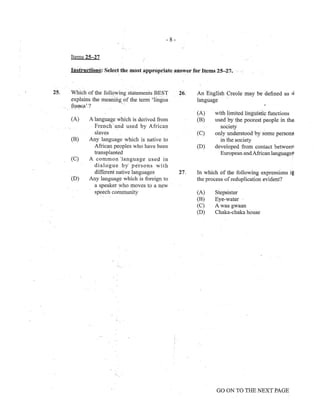
29. An English Creole in the Caribbean may be defined as a language
(A) with limited linguistic functions
(B) used by the poorest people in society
(C) only understood by some persons in the society
(D) developed from contact between Europeans and Africans
30. In which of the following expressions is the process of reduplication evident?
(A) Eye-water
(B) Step-sister
(C) A waa gwaan
(D) Chaka-chaka house
02114010/CAPE 2017 GO ON TO THE NEXT PAGE 
- 10 -
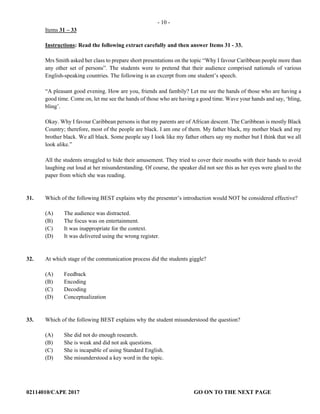
Items 31 – 33
Instructions: Read the following extract carefully and then answer Items 31 - 33.
Mrs Smith asked her class to prepare short presentations on the topic “Why I favour Caribbean people more than
any other set of persons”. The students were to pretend that their audience comprised nationals of various
English-speaking countries. The following is an excerpt from one student’s speech.
“A pleasant good evening. How are you, friends and fambily? Let me see the hands of those who are having a
good time. Come on, let me see the hands of those who are having a good time. Wave your hands and say, ‘bling,
bling’.
Okay. Why I favour Caribbean persons is that my parents are of African descent. The Caribbean is mostly Black
Country; therefore, most of the people are black. I am one of them. My father black, my mother black and my
brother black. We all black. Some people say I look like my father others say my mother but I think that we all
look alike.”
All the students struggled to hide their amusement. They tried to cover their mouths with their hands to avoid
laughing out loud at her misunderstanding. Of course, the speaker did not see this as her eyes were glued to the
paper from which she was reading.
31. Which of the following BEST explains why the presenter’s introduction would NOT be considered effective?
(A) The audience was distracted.
(B) The focus was on entertainment.
(C) It was inappropriate for the context.
(D) It was delivered using the wrong register.
32. At which stage of the communication process did the students giggle?
(A) Feedback
(B) Encoding
(C) Decoding
(D) Conceptualization
33. Which of the following BEST explains why the student misunderstood the question?
(A) She did not do enough research.
(B) She is weak and did not ask questions.
(C) She is incapable of using Standard English.
(D) She misunderstood a key word in the topic.
02114010/CAPE 2017 GO ON TO THE NEXT PAGE 
- 11 -
Items 34 – 38
Instructions: Read the following cartoon carefully and then answer Items 34 - 38.
Auspac Media. The Feature People.
Retrieved 19 November 2013 from
www.auspacmedia.com.au.
34. The man’s body language Box 1 indicates that he
is
(A) thrilled
(B) irritated
(C) indifferent
(D) supportive
35. The stimulus that prompted the conversation in
Box 1 is the
(A) well
(B) coin
(C) purse
(D) shrub
36. Which of the following words describes the man’s
tone in Box 4?
(A) Angry
(B) Disdainful
(C) Despairing
(D) Conciliatory
37. A communicative artefact relevant to the
conversation is the
(A) sky
(B) bag
(C) coin
(D) shrub
38. What kind of communication context is depicted
in the conversation?
(A) Small group
(B) Intercultural
(C) Intrapersonal
(D) Interpersonal
02114010/CAPE 2017 GO ON TO THE NEXT PAGE 
- 12 -
Item 39
Instructions: The following scene shows the effects of inappropriate postings on social media
by three persons. Read it carefully and then answer Item 39.
Adapted from Signs of the Social Networking Times.
Retrieved 19 November 2013 from
http://www.geekculture.com/javaftech/javaarchives/1041.html.
39. Which of the following is the result of the inappropriate use of social media by the characters?
(A) Loss of family time
(B) Delayed response from employers
(C) Damage to the characters’ reputations
(D) Access by future employers to the Internet.
02114010/CAPE 2017 GO ON TO THE NEXT PAGE 
- 13 -
Items 40 – 42
Instructions: Read the following advertisement carefully and then answer Items 40 - 42. 
40. Which of the following language techniques is NOT used in the advertisement?
(A) Pun
(B) Sarcasm
(C) Repetition
(D) Rhetorical question
41. The MAIN function of the first line of the advertisement is to
(A) capture the reader’s attention
(B) introduce the advertisement
(C) help the reader to lose weight
(D) encourage the reader to respond
42. “Slims a day keeps the fat away” is an example of which of the following language techniques?
(A) Simile
(B) Rhyme
(C) Repetition
(D) Personification
02114010/CAPE 2017 
- 14 -
Item 43 refers to the following scenario.
You are asked to speak to a group of twenty kindergarten children on the topic of environmental
cleanliness.
43. Which of the following would be the MOST appropriate way to share the information with your
audience?
(A) Panel discussion
(B) Animation and speech
(C) A televised documentary
(D) A PowerPoint presentation
44. Which of the following is the correct sequence that a presenter should follow to successfully complete the
communication process?
(A) Encoding the message, selecting the channel, selecting audience, disseminating the message
(B) Encoding the message, transmitting the message, selecting channel, disseminating the
message
(C) Conceiving the message, encoding the message, selecting the channel, disseminating the
message
(D) Conceiving the message, interpreting the feedback, selecting audience, disseminating the
message
45. Which of the following is NOT a feature of exposition?
(A) Use of emotive language
(B) Use of supporting details
(C) Use of information from experts
(D) Use of facts and relevant statistics
END OF TEST
IF YOU FINISH BEFORE TIME IS CALLED, CHECK YOUR WORK ON THIS TEST.
 
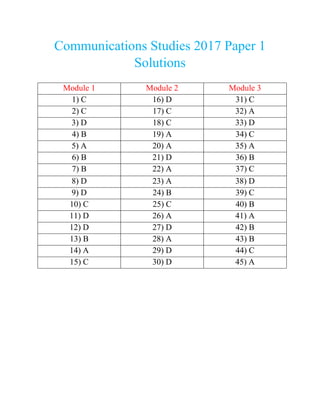
Communications Studies 2017 Paper 1
Solutions
Module 1 Module 2 Module 3
1) C 16) D 31) C
2) C 17) C 32) A
3) D 18) C 33) D
4) B 19) A 34) C
5) A 20) A 35) A
6) B 21) D 36) B
7) B 22) A 37) C
8) D 23) A 38) D
9) D 24) B 39) C
10) C 25) C 40) B
11) D 26) A 41) A
12) D 27) D 42) B
13) B 28) A 43) B
14) A 29) D 44) C
15) C 30) D 45) A
t
g
s
r
g
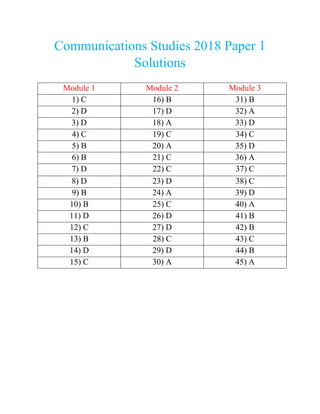
Communications Studies 2018 Paper 1
Solutions
Module 1 Module 2 Module 3
1) C 16) B 31) B
2) D 17) D 32) A
3) D 18) A 33) D
4) C 19) C 34) C
5) B 20) A 35) D
6) B 21) C 36) A
7) D 22) C 37) C
8) D 23) D 38) C
9) B 24) A 39) D
10) B 25) C 40) A
11) D 26) D 41) B
12) C 27) D 42) B
13) B 28) C 43) C
14) D 29) D 44) B
15) C 30) A 45) A
TEST CODE 02114010-ES
FORM TP 2017-ES MAY/JUNE 2019
C A R I B B E A N E X A M I N A T I O N S C O U N C I L
CARIBBEAN ADVANCED PROFICIENCY EXAMINATION®
COMMUNICATION STUDIES
Paper 01
30 minutes
EXAMINER'S SCRIPT
ITEMS1-7
Copyright © 2017 Caribbean Examinations Council
All rights reserved.
021140 l 0/CAPE 2019-ES
- 2 -
1. Say to the candidates:
2. Say to the candidates:
3. Two minutes later, say to candidates
4. Read the following extract twice atnormal reading pace. (DONOT dictatetheextract for candidates
to write.)
YESTERDAY afternoon set in misty and cold. I had half a mind to spend it by my study fire, instead
of wading through heath and mud to Wuthering Heights. On coming up from dinner, however,
(N.B. - I dine between twelve and one o'clock; the housekeeper, a matronly lady, taken as a fixture
along with the house, could not, or would not, comprehend my request that I might be served at five)
- on mounting the stairs with this lazy intention, and stepping into the room, I saw a servant-girl on
her knees surrounded by brushes and coal-scuttles, and raising an infernal dust as she extinguished
the flames with heaps of cinders. This spectacle drove me back immediately; I took my hat, and, after
a four-miles' walk, arrived at Heathcliff's garden-gate just in time to escape the first feathery flakes
of a snow-shower.
WUTHERING HEIGHTS by Emily Bronté ... Chapter 2
02114010/CAPE 2019-ES
GO ON TO THE NEXT PAGE
Items 1-7 constitute Section A of this paper. They are based on an extract, which I will read
to you. You will be given two minutes to look at the items before you listen to the poem.
Then I will read the extract to you twice.
You are required to listen carefully to the extract before answering the items. You may make
notes while you listen to the reading. You must NOT begin to answer the items until you are
told to do so.
You are required to respond to the items on your answer sheet by selecting the correct
option from the four options lettered A-D.
Look at the items now for two minutes.
Now listen carefully while I read this extract twice. Remember, you may make notes
as I read.
- 3 -
5. After you have read the extract the first time, pause for a few seconds and then say to the candidates:
6. After you have read the extract a second time, pause for a few seconds and then say to the candidates:
7. Quietly invite the invigilator to take over the examination process.
Instructions to the Invigilator
8. Seventy-five minutes later, tell candidates that they have 15 minutes left.
9. Fifteen minutes later, at the end of the allotted 90 minutes, collect all papers and dismiss the
candidates.
02114040/CAPE 2019-ES
I shall now read the extract a second time.
You have 90 minutes to answer all the items on Paper 01. When you are finished answering those
items which are based on this extract, go straight to Section B and answer Items 8-45. Do not wait
for any further instructions. The invigilator will tell you when the last 15 minutes are left.
Communications Studies 2019 Paper 1
Solutions
Module 1 Module 2 Module 3
1) C 16) C 31) C
2) D 17) B 32) B
3) A 18) C 33) B
4) D 19) D 34) D
5) A 20) D 35) C
6) C 21) D 36) A
7) D 22) B 37) C
8) D 23) D 38) B
9) D 24) A 39) D
10) C 25) B 40) C
11) D 26) A 41) B
12) B 27) D 42) A
13) B 28) C 43) B
14) A 29) D 44) C
15) D 30) B 45) B

Communication_Studies_Paper_1s_2014-2020_with_solutions_5.pdf

  • 1.
    COMMUNICATION STUDIES Paper Ones JodiChase With Examiners Script and Solutions 2014-2020
  • 17.
    Communications Studies 2014Paper 1 Solutions Module 1 Module 2 Module 3 1) C 16) A 31) D 2) D 17) C 32) A 3) D 18) A 33) A 4) C 19) D 34) B 5) D 20) B 35) B 6) B 21) D 36) D 7) B 22) B 37) B 8) D 23) D 38) A 9) C 24) C 39) C 10) B 25) C 40) D 11) A 26) A 41) C 12) D 27) B 42) D 13) A 28) A 43) A 14) D 29) C 44) D 15) B 30) C 45) B
  • 21.
    %. FORM TP 201s161 3. 4. 5. 1. 2. MAY/JUNE2015 CARIBBEAN EXAMINATIONS COUNCIL CARJBREAN ADVANCED PROFICIENCY EXAMINATION@ ' CdunaUNIcATIoNs STUDIES UNITl-Paper01 t hour 30 minutes 06 MAY 2015 (a.m.) READ THE FOLLOWING INSTRUCTIONS CAREFULLY 'fhis test consists of 45 items dividbd into two sections. A and B. Section A, based oll a cofiununication extract, consists of 7 questions. The extract, which is NOT incltrded in the question booklet, will be read to you twice but you will be allowed two minutes to look at the questions bef<rre the extract is read to you. Section B consists of 38 questions. Answer each question based on the information given. In addition to the test booklet, you should have an answer sheet. Each item in this test has four suggested answers lettered (A), (B), (c), (D). Read each item you are about to answer and decide which choice is best. Sample Item Which of the following is an advantage of the questionnaire as a data-collection method? (A) Eade of administration (B) Iuunediacy of feedback (C) Openness of discussion (D) Opportunity for clarification TEST CODE O2II401A SampleAnswer o@@@ 6. On your answer sheet, find the number which corresponds to your item and shade the space having the same letter as the answer you have chosen. Look at the sample item below. I - I I I I r I 1 8. The best answer to this item is "Ease of administration", so (A) has been shacled. If you want to change your answer, erase it completely and fill in your new choice. When you are told to begin, turn the page and work as quickly and a.s carefully as you can. If you cannot answer an item, go on to the next one. You may retum to that item later. po NoT TUBN rrrrs PAGE UNTrL yOU ARE TOLD TO DO SO. Copyright O Z0L4 Caribbean Examinations Council
  • 22.
    2- SECTION A Items 1-7 Instructions:you will hear an extract. It will be read twice. Listen carefully before answering the questions based on the extract. 1. 2. Which of the following details does NOT support the main idea of the passage? (A) "picking the little h'arvest of cocoa" (B) "somersaulting monkeys howled in dark voices" (C) "pouis spotting the hillsides with fistfuls of gold" The MAIN idea of the extract is that during 5. petit-car6me in Kumaca (A) the village was beautiful (B) agriculturalactivitiesflourished (C) the villagers sPoke of current affairs (D) nature came alive with colour and sound (D) "the forest bees came quick in blue 7 . sunshine to new blossoms" According to the extract, "petit-car6me" refers to the (A) time of harvest (B) time that flowers bloom (C) dry spell during the rainy season (D) time when the animals are most vocal The phrase "fresh-feathered birds flitted with song" is an examPle of (A) simile (B) alliteration (C) onomatoPoeia (D) personification The expression "the guardian immortelles were in sporadic blootn" suggests that (A) some of the trees were in bloom (B) the trees bloomed all year round (C) the trees had never bloomed before (D) some trees bloomed onlY at this time of the Year 6. The phrase "parrots squawking like matriarchal fishwives" is an example of which pair of literary devices? (A) Paradox and metaPhor (B) Simile and onomatoPoeia (C) Simile and Personificatiotr (D) Personificationandonomatopoeia Which of the following is the MOST appropriate comtnent on the effectiveness of the phrase "pouis spotting the hillside with fistfuls of gold"? (A) The phrase reflects the extent to which the flowers were covering the hillsides during petit-carOrne' (B)'T"o,l'"?:':["#"111'l?;,iH:; and tightly bunched together during petit-car6me' (C) The Phrase helPs the reader to appreciate that the flowers were rich and easY to get hold of during petit-car6me. (D) The writer allows the reader to visualize how the bunched, rich, bright Yellow flowers covered the landscaPe during Petit-car€me as comPared to other times' 3. 4. DO NOT WAIT FOR THE EXAMINER TO TELLYOU TO GO TO TIIE NEXT PAGE' GO ON TO TI{E NEXT PAGE
  • 23.
    SECTION B Items 8-11 Instructions:Read the following scenario carefully and then answer Items g-ll. The media is filled with reports of teenagers being distracted by digital technology and neglecting their school work as a result. Haldane, a sociology student, decidesio investigateliris phenomenon at his school which is located in the countryside. He intends to use interviews to collect data. 10. 8. Which of the following activities would Haldane need to undertake as part of his research? Haldane found an article entitled "Modern Technology Causing Canadian Students to Fail". This article could be useful to his research as it (A) is reliable and accurate (B) cah yield sufficient dara (C) provides secondary data (D) can provide prirnary data Why would it be UNACCEPTABLE for Haldane to apply the findings of his research to all teenagers? (A) The school is in a rural area. (B) He plans to use only interviews. (C) The respondents might not tell the truth. (D) He plans to use only students from his school. I. II. ilI. Talking to parents and teachers F'inding out how many students own digital devices Choosing a sample that is representative of his school's population I and II only ll. I arrd III only II and III only I, II and III Costliness of the procedure Wide geographic coverage of informants Considerable depth of the information to be collected lligh reliability of the information to be collected (A) (B) (c) (D) 9. Which of the fcrllowing would be an advantage if Haldane conducted interviews? (A) (B) (c) (D) 02114010/CAPE 2015 GO ON TO THE NEXT PAGE
  • 24.
    -4- l!989 12-1s Instructions: Readthe following scenario carefully and then answer lterns 12-15. At a recent meeting with the principal of Mansfield High School, the Ministry of Education revealed that a check of the most recent census documents shows that some senior students of the school have been irregularly attending classes. The ministry decided to hire a research company to investigate the likely reasolls for the students' irregular attendance. 12. The MOST suitable type of studywhichthe company could use to conduct this research is survey interviews experiment observation 13. Which of the following fypes of sampling methods would BEST suit the ministry's purpose? (A) Random (B) Discrete (C) Purposive (D) Convenience Which of the following must the research company consider when selecting a sample? 14. (A) (B) (c) (D) (A) (B) (c) (D) How aware the respondents are Accuracy of the census documents The average number ofrespondents How well it represents the population 1s. Which of the fbllowing would be the MOST reliable source of secondary data for this study? (A) The principal's log book (B) Student report card/book (C) Student attendance registers (D) Letters of excuse from Parents n. I I iall^/rr A Dt an 1< GO ON TO THE NEXT PAGE
  • 25.
    Items 16-20 Instructionl: Readthe following extract carefully and then answer Items 16-20. The boy come back home for a few days holiday, see some crabs Closby have in a barrel. This is the son: "l)ad, what are those thangs there?" Talking like Englishman. Crosby ain't tell him nothing. When he poke his finger in the barrel and the crab catch hold of him, he bawl: "pa! The crab! The crab!" A well-educated boy, yes. Lawyer, economist or something. Lovelace E., The Wine o-f Astonishment (Caribbean Writers Series) Heinetnann 1986. p.14. 19. '16. Which of the following expressions contains syntactical features common to Caribbean English Creoles? (A) "A well-educated boy" (B) "What are those thangs?" (C) "Pa! The crab! The crab!" (D) "Talking like Englishman." What feature of Caribbean English Creole grammar is used in the expression "Crosby ain't tell him nothing"? (A) Absence of a copula (B) Use of two negatives (C) Reduction of a syllable, (D) Repetition of the same word ',i What attitude towards the boy is suggested by the narrator's statement "Talking like Englishman. Crosby ain't tell him nothing"? (A) Jealousy (B) Frustration (C) Disapproval (D) Amusement What does the extract suggest about the relationship between the boy's education and his use oflanguage? (A) His education allows him to speak properly. (B) His education has influenced his language. (C) As an economist, he speaks Standard English. (D) He speaks English Creole because he is an educated lawver. What is suggested in the narrator's final statement, "Lawyer, economist or something"? (A) He was unable to recall the correct infonnation. (B) He is not in awe of the young man's educational achievements. (C) He does not think that the young man's profession is important. (D) He does not care that the young man has become a professional. 17. 20. 18. 02114010/CAPE 2015 GO ON'TO THE NEXT PAGE
  • 26.
    -6- Ltpqs.2-1--?5 Instructions: Read thefollowing extract from the poem carefully and then answer ltems?l-Z5. "Sonnyts Lettahtt From Prison, Jebb Avenue S.W 2Inglan Dear Mama Good day I hope that when these few lines Reach you they may Find you in the best of health I don't know how to tell yu dis For I did mek a solemn pramise To tek care a lickle Jim , An try mi bes fi look out fi im. Mama,I really did try mi bes But none di less Sony fi tell yu dat poor lickle Jim get arres It was de miggle a di rush hour When all of a sudden a police van pull up Out jump tree policeman De whole a dem carryin baton f)em walk straight up to mi and Jim One a dem hold on to Jim Seh dem tekin im in Jim tell im fi leggo a im For im nuh do nuttn And im nuh tief, not even a button Mama, I jus couldn stan up deh an nuh do nuttn So mi jook one in im eye and im started fi cry Mi hit im pon im mout and im started fi shout Mi kick im pon im shin so im started fi spin Mi hit im pon im chin an im drop pon a bin An crash An dead Mama, don't fret Don't get depress an downhearted Be of good courage Till I hear from yu. Adaptedfrom Linton Kwesi Johnson, "Sonny's Lettah". In The Spoken Word Revolution: Redux edited by Mark Eleveld, Sourcebook Media Fusion, 2007. 02t141tllcAPE 201s GO ON TO THE NEXT PAGE
  • 27.
    24. 21. What isthe speaker's purpose for writing this letter? Based on the tonb of the letter, the relationship between mother and son can be described as (A) (B) (c) (D) 'fo protest against police brutality and injustice To apologize for being locked up along with Jim To inform his mother ofhis current address and console her To tell his mother that he and Jim are in jail and to explain why ln which of the following countries Sonny MOST likely incarcerated? bitter tense cordial affectionate England .Iamaica America Barbados (A) (B) (c) (D) (A) (B) (c) (D) 25. is 22. The register of the poem may be described, AS 23. (A) (B) (c) fol (A) (B) (c) Which of the fbllowing is NOT a purpose for which the writer uses Caribbean Rnglish Creole in the poem? formal frozen intimate consultatlve To provide aestheticpleasure to the reader To serve as a vehicle of easy commtrnication between inmates To show that it is more suited than standard English to discuss the issues of racism and social injustice To persuade the reader that the issues of racism and social injustice deserve discussion (D) 02114010/CAPE 2015 GO ON TO THE NEXT PRCE
  • 28.
    -8- Items 26-28 Instlfuctions: Thefollowing conversation about a funeral service took place between these two persons in a shoe store in Jamaica. Rearl it carefully then answer ltems 26-28. Percy: Mildred: Percy: Mildred: Percy: I can't believe that Mavis gone, bttt I'm really glad she had a great funeral. The kids and grandkids came from foreign for the funeral? Yes, Ma'am. One of them talk so nice, like the people in the television shows. But the other one?! Poor Mavis must be spinning in her grave. What you mean? Well, I couldn't understand a thing he was saying dwing the eulogy he was giving. All I could hear was "I and I this" and "I and I that". He should know that people don't talk so in church. 26. From Pergy's statements, what are the two varieties of language MOST likely spoken by Mavis' grandchildren? (A) Jamaican English and English Creole (B) Rastafarian English and English Creole (C) Standard English and Television English (D) Standard English and Rastafarian English 27. What does Percy's statement "He should know that people don't talk so in church" suggests? (A) Percy does not like Mavis' grandson. (B) Context is critical to the choice of code. (C) There is a code reserved only for church' (D) Christians speak differently from others. Which of the following technologies would NOT help to enhance the delivery of the eulogy? (A) Fax machine (B) Microphone (C) Musical accomPaniment (D) A projected slide presentation ' n /^ A nF,4n i c GO ON TO THE NEXT PAGE
  • 29.
    Items 29-3I Instructions: selectthe most appropriate answer for Items zg-31. 29. An English Creole may be defined as a language (A) with limited linguistic functions (B) used by the poorest people in the society (C) only rmderstood by some persons in the society (D) developed from contact between European languages andAfrican languages 30. In which of the following expressions is the process of reduplication evident? (A) Step-sister (B) Eye-water (C) A waa gwaan (D) Chaka-chaka house 31. Which of the following is NOT an element of the process of communication? (A) Noise (B) Sender (C) Medium (D) Message , 0211401O/CAPE 2015 GO ON TO THE NEXT PAGE
  • 30.
    -10- Items 32-36 Instructions: Readthe following conversation carefully then answer ltems 31-35. You don't belleve ln those tblngr, do you? Auspac Media. The Feature People. Retrieved 19 November 2013 from www. a us o ac m e dia co nu a u What kind of communication context is depicted in the conversation? (A) Small group (B) Intbrcultural (C) Intrapersonal (D) Interpersonal 35. 32. the man's body language in Box 1 indicates that he is (A) thrilled (B) irritated (C) supportive (D) indifferent 33. The stimulus that leads to the conceptualization of the message in Box 36' I is the (A) well (B) coin (C) purse (D) shrub 34. A communicative artefact in the conversation is the (A) sky (ts) bas (C) coin shru! 0211401O/CAPE 2015 Which of the following words describes the man's tone in Box 4? (A) (B) (c) (D) Anger Disdain Dismay Consolation GO ON TO T'HE NEXT PAGE
  • 31.
    Items 37-39 Instructions: Readthe following scenario carefully and then answer Items 37-Ag. An election campaign is taking place for a vacant parliamentary seat. The candidates are willing to use every means at their disposal to win the support of the voting public. 37. Which of the following features of non-verbal communication would candiclates be LEAST likelv to use when giving speeches? (A) Waving their hands in the air (B) Turning their backs to the audience (C) Smiling at the women in the audience (D) Embracing a spouse or other close family member il 3b' Which of the following verbal strategies would NOT help candidates to effectively get their message across? (A) Sarcasm (B) Statistics (C) Party slogans (D) Public seruice announcements 39. Websites established for the putpose of wooing voters would MOST likely include I. video clips of the candidates'activities il. a link to a webpage where donations may be made m. a link to a social rnedia website (A) I only (B) II only (C) I and II only (D) I and II,I only ' ,l GO ON TO THE NEXT PAGE 02114010/CAPE 2015
  • 32.
    t2- trtbms 40-43 Instruction$: Thefollowing scene shows the effects of inappropriate losfings on social metlia by tbree persons. Read lt carefully and then answer Items 4043. Retrieved 19 November 2013 from htfit ://www. geekculture, co nuf olt oftechi o! archives/I 0 4 L html) 42. 40. Which of the following is a result of INAPPROPRIATE use of social media? (A) LoSs of family time (B) Rejection by employers (C) Damage to the characters' reputation (D) Access by future employers to the Internet The scene suggests that INAPPROPRIATE postings can be made by What general message do the non-verbal artefacts convey? (A) The characters have different treasured items. (B) The character with the least needs is a woman. (C) The characters are unemployed and in need of money. (D) Members of the public are giving the characters donations. Which of the following could be considered the artistJs purpose for depicting the scene? (A) To sho* that social media are dangerous (B) To warn against indiscriminate use of social media (C) To ridicule persons addicted to using social media (D) To show that social media are a sign of the end times 41. 43. (A) (B) (c) (D) young people only persons ofdifferent ages only the three characters in the cartoon persons of different ages and genders Forrn= it was an "T9.rrassing Yqr Thbe video. Unemployable due to stupid personal stuff I put on mv facebook page. Me too! Adaptedfrom Signs of the Social Neworking Times. o2tr40to/cAPE 2015 GO ON TO THE NEXT PAGE
  • 33.
    --tJ- Items 44-45 Instructions: Readthe following scenario carefully and then answer Items 44-45, A student submitted the following draft conclusion for her expository essay on "Types of Luxury Cars". If you are going to buy a luxury car, you must carefully consider what you want. There are various brands of luxury cars on the market - Cadillac, Infiniti, Volvo, Land Rover, Lamborghini, Porsche, Mercedes Benz, Lexus, BMW, Audi. Some luxury cars can damage the environment and then our children would suffer the consequences. The purpose of the second sentence is to 45. 44. What is the writer's airn in the last sentence? (A) (B) (c) (D) show off the student's knowledge of luxury cars list the cars from most to least luxurious present a list ofcars for the reader to choose from have the reader carefully consider various brands ofluxury cars To express the main idea of the paragraph To convey the concluding idea of the paragraph To focus the paragraph on environmental conservation To provide a detail to help the reader choose a luxurv brand (A) (B) (c) (D) IF YOU FINISH END OF TEST rl I BEF'ORE TIME IS CALLED, CIIECKYOUR WORK ON TIIIS TEST. 0211401O/CAPE 2015
  • 34.
    Communications Studies 2015Paper 1 Solutions Module 1 Module 2 Module 3 1) D 16) D 31) A 2) A 17) B 32) D 3) C 18) C 33) A 4) B 19) B 34) C 5) D 20) B 35) D 6) B 21) D 36) C 7) D 22) C 37) B 8) D 23) B 38) D 9) C 24) D 39) D 10) C 25) A 40) C 11) D 26) D 41) D 12) B 27) B 42) C 13) C 28) A 43) B 14) D 29) D 44) D 15) D 30) D 45) A
  • 35.
    TEST CODE 02114010-ES FORMTP 2016-ES MAY/JUNE 2016 C A R I B B E A N E X A M I N A T I O N S C O U N C I L CARIBBEAN ADVANCED PROFICIENCY EXAMINATION® COMMUNICATION STUDIES Paper 01 30 minutes EXAMINER'S SCRIPT ITEMS1 -7 Copyright © 2014 Caribbean Examinations Council All rights reserved. 021140 l 0/CAPE 2016-ES
  • 36.
    - 2 - 1.Say to the candidates: 2. Say to the candidates: 3. Two minutes later, say to candidates 4. Read the following poem twice at normal reading pace. (DO NOT dictate the poem for candidates to write.) Departure Lounge The young man, when the flight is called is blowing his nose to clear the sadness of departure. The girl who's leaving looks composed. They're travelling on different planes to different destinations. Each time we die a little. When we are young These moments devastate. But partings down the years have helped to make me ready to say goodbye Mervyn Morris 02114010/CAPE 2016-ES GO ON TO THE NEXT PAGE Now listen carefully while I read this poem twice. Remember, you may make notes as I read. Look at the items now for two minutes. Items 1-7 constitute Section A of this paper. They are based on a poem, which I will read to you. You will be given two minutes to look at the items before you listen to the poem. Then I will read the poem to you twice. You are required to listen carefully to the poem before answering the items. You may make notes while you listen to the reading. You must NOT begin to answer the items until you are told to do so. You are required to respond to the items on your answer sheet by selecting the correct option from the four options lettered A-D.
  • 37.
    - 3 - 5.After you have read the poem the first time, pause for a few seconds and then say to the candidates: 6. After you have read the poem a second time, pause for a few seconds and then say to the candidates: 7. Quietly invite the invigilator to take over the examination process. Instructions to the Invigilator 8. Seventy-five minutes later, tell candidates that they have 15 minutes left. 9. Fifteen minutes later, at the end of the allotted 90 minutes, collect all papers and dismiss the candidates. 02114040/CAPE 2016-ES You have 90 minutes to answer all the items on Paper 01. When you are finished answering those items which are based on this poem, go straight to Section B and answer Items 8-45. Do not wait for any further instructions. The invigilator will tell you when the last 15 minutes are left. I shall now read the poem a second time.
  • 38.
    - 1 - 02114010/CAPE2016 TEST CODE 02114010 MAY/JUNE2016 C A R I B B E A N E X A M I N A T I O N S C O U N C I L CARIBBEAN ADVANCED PROFICIENCY EXAMINATIONS COMMUNICATION STUDIES UNIT 1 – Paper 01 1 hour 30 minutes 04 MAY 2016 (a.m.) READ THE FOLLOWING INSTRUCTIONS CAREFULLY. 1. This test consists of 45 items divided into two sections, A and B. 2. Section A, based on a communication extract, consists of 7 questions. The extract, which is NOT included in the question booklet, will be read to you twice but you will be allowed two minutes to look at the questions before the extract is read to you. 3. Section B consists of 38 questions. Answer each question based on the information given. 4. In addition to the test booklet, you should have an answer sheet. 5. Each item in this test has four suggested answers lettered (A), (B), (C), (D). Read each item you are about to answer and decide which choice is best. · 6. On your answer sheet, find the number which corresponds to your item and shade the space having the same letter as the answer you have chosen. Look at the sample item below. Sample Item Which of the following is an advantage of the questionnaire as a data-collection method? Sample Answer (A) Ease of administration Ⓐ Ⓑ Ⓒ Ⓓ (B) Immediacy of feedback (C) Openness of discussion (D) Opportunity for clarification The best answer to this item is "Ease of administration", so (A) has been shaded. 7. If you want to change your answer, erase it completely and fill in your new choice. 8. When you are told to begin, turn the page and work as quickly and as carefully as you can. If you cannot answer an item, go on to the next one. You may return to that item later. _ _DO NOT TURN THIS PAGE UNTIL YOU ARE TOLD TO DO SO __ Copyright © 2015 Caribbean Examinations Council
  • 39.
    - 2 - 02114010/CAPE2016 SECTION A Items 1 – 7 Instructions: You will hear an extract. It will be read twice. Listen carefully before answering the questions based on the extract. 1. What is the setting in the first stanza? (A) A funeral (B) An airport (C) A train station (D) An underground station 2. Which of the following BEST expresses the meaning of the phrase “blowing his nose to clear the sadness of departure”? (A) The young man is crying. (B) The young man is devastated by the departure. (C) The young man copes with his grief by weeping. (D) The impending departure has made the young man ill. 3. Which of the following BEST explains the purpose of stanza two? (A) To show that everyone has to die (B) To include all young people in the grief of partings (C) To encourage people to empathize with one another (D) To show that the speaker is not alone in the departure lounge. 4. The tone of the poem can be described as (A) sober (B) caustic (C) nostalgic (D) regretful 5. Which of the following expressions from the poem does NOT refer to the central theme of the poem? (A) “ready to say goodbye” (B) “Each time we die a little” (C) “These moments devastate” (D) “blowing his nose to clear the sadness of departure” 6. The main idea of the poem is that (A) the author learns to accept paintings (B) people find it painful to deal with partings (C) people eventually learn to deal with partings (D) two young people are parting company on different flights 7. Which of the following literary devices are NOT used in the poem? I. Pun II. Metaphor III. Oxymoron (A) I and II only (B) I and III only (C) II and III only (D) I, II and III GO ON TO THE NEXT PAGE
  • 40.
    - 3 - 02114010/CAPE2016 SECTION B Items 8 – 10 Instructions: Read the following scenario carefully and then answer Items 8 – 10. A researcher was gathering information on the impact of streaming within a particular high school. He held a discussion with five sets of students from remedial classes in different forms or grades on how they are being affected by their placement. 8. What method of data collection did the researcher use? (A) Interview (B) Focus group (C) Questionnaire (D) Participant observation 9. Apart from the students, which of the following persons may be the BEST source of primary data for this research? (A) Parents (B) Teachers (C) Education Officers (D) Deans of Discipline 10. Which of the following is an advantage of using a questionnaire for this particular study? (A) Results can be easily quantified. (B) It has a low rate of response (C) The researcher is able to ask follow-up questions. (D) Respondents don’t have to think carefully before formulating a response. GO ON TO THE NEXT PAGE
  • 41.
    - 4 - 02114010/CAPE2016 Items 11 – 15 Instructions: Read the following scenario carefully and then answer Items 11 – 15. At a recent meeting with the principal of Argyle Secondary School, the Ministry of Education revealed that a check of the most recent census documents shows that some senior students of the school have been attending classes irregularly. The Ministry decided to hire a research company to investigate the likely reasons for the students’ irregular attendance. 11. Which of the following would be the MOST appropriate population for this study? (A) All students of A rgyle Secondary that have been attending classes irr egu larly (B) All senior students of Argyle Secondary that have been attending classes irregularly (C) All students of secondary students in the country that have been attending classes irregularly (D) All senior students of secondary students in the country that have been attending classes irregularly 12. Relevant demographic data about the student that the researcher might seek to obtain would include I. Age II. Address III. Number of days absent (A) I and II only (B) I and III only (C) II and III only (D) I, II and III 13. If the research company only collected data in the morning, which of the following would affect the data? I. Validity II. Time spent in the field III. Access to information (A) I only (B) II only (C) I and III only (D) I, II and III 14. If the research company was observing the patterns of absenteeism among senior students, which of the following would be an advantage? (A) Directly experiencing the behaviour of participants (B) Allowing its biases to affect what is observed (C) Spending a long enough period of time collecting data (D) Participants changing their behaviour while being observed 15. Which of the following URLs is NOT likely to provide trustworthy information on student attendance. (A) www.argylesecondary.edu (B) www.ttministryofeducation.gov (C) www.parentsargylesecondary.org (D) www.argyleabsentstudents.com GO ON TO THE NEXT PAGE
  • 42.
    - 5 - 02114010/CAPE2016 Items 16 – 20 Instructions: Read the following scenario carefully and then answer Items 16 – 20. The boy come back home for a few days holiday, see some crabs Crosby have in a barrel. This is the son: “Dad, what are those thangs there?” Talking like Englishman. Crosby ain’t tell him nothing. When he poke his finger in the barrel and the crab catch hold of him, he bawl: “Pa! The crab! The crab!” A well-educated boy, yes. Lawyer, economist or something. Lovelace E., 1982, The Wine of Astonishment, p. 14. 16. Which of the following expressions contains syntactical features common to Caribbean English Creoles? (A) “A well-educated boy” (B) “what are those thangs?” (C) “Pa! The crab! The crab!” (D) “Talking like Englishman.” 17. What features of Caribbean English Creole grammar is used in the expression “Crosby ain’t tell him nothing”? (A) Reduplication (B) Double negative (C) Syllable reduction (D) Zero copula structure 18. What attitude does the text ‘Talking like Englishman. Crosby ain’t tell him nothing.’ suggest that the narrator has towards the boy? (A) Jealousy (B) Frustration (C) Amusement (D) Disapproval 19. What does the extract suggest about the relationship between the boy’s education and his use of language? (A) His education makes him speak properly. (B) His education has influenced his language. (C) As an economist, he speaks Standard English. (D) He speaks English Creole because he is an educated lawyer. 20. What is suggested in the narrator’s final statement, “Lawyer, economist or something”? (A) He was unable to recall the correct information. (B) He is not in awe of the young man’s educational achievements. (C) He does not think that the young man’s profession is important. (D) He does not care that the young man has become a professional. GO ON TO THE NEXT PAGE
  • 43.
    6 02114010/CAPE 2016 Items 21– 25 Instructions: Read the following scenario carefully and then answer Items 21 – 25. Miss Clemmie keep on looking at Ascot as if he is stranger and Dagoman sit on the bench outside as if he too fraid to come near the lady. The children start play round the car and make as if to open the door and Ascot snap at them so bad that my mother had to say, “Hi Ascot, is your own little brothers yu treating so?” “Half brother,” Ascot say. From then on things just get from bad to worse. Ascot look like he real vex with Miss Clemmie, and the wife and stepfather look like they real vex with Ascot. So finally Ascot say, “Come let me take you all home for I have to get back to Kingston tonight.” But by this time Dagoman face set and he say he prefer to walk and Miss Clemmie and the children get into the car alone, and even though Miss Clemmie look like she going to cry, you can still see she feeling proud to have her son driving her in car. But as they drive off, all we can hear is Ascot shouting at the children to take their dirty feet off the car seat. Adapted from “Ascot” Summer Lightning and other stories By Olive Senior, Longman Caribbean Writers, 1986. 21. Which of the following does NOT contribute to the tension among the characters? (A) Ascot snapping at the children (B) Miss Clemmie looking at Ascot as if he is a stranger (C) Dagoman silently angry with Ascot for snapping at the children (D) Miss Clemmie feeling proud to have Ascot drive her in his car 22. When Ascot says “Come let me take you all home ...”, he aims to (A) make Dagoman angry (B) get back to Kingston that night (C) ease the tension among the family (D) take his mother and her other children for a drive 23. Which of the following does NOT convey a communicative behaviour? (A) ‘Ascot snap at them’. (B) ‘Dagoman sit on the bench outside’. (C) ‘The children start play round the car’. (D) ‘The wife and stepfather look like they real vex with Ascot’. 24. The writer’s use of English Creole throughout the extract suggests all of the following EXCEPT that she (A) accepts that English Creole is a broken language (B) thinks that English Creole is an authentic language (C) thinks that English Creole can be used for literary purposes (D) accepts that English Creole is a means of communication by people 25. Which of the following grammatical features is NOT present in the first sentence of the extract? (A) Reduplication (B) Subject-adjective structure (C) Unmarked noun with singular meaning (D) Unmarked verb with past-time reference GO ON TO THE NEXT PAGE
  • 44.
    7 02114010/CAPE 2016 Items 26– 28 Instructions: Read the following extract carefully and then answer Items 26 – 28. “Eh-eh! Don’t shout at me,” was all he got for his pains. “Don’t you deafen me. What’s that the young varmint says, Maud?” Mrs. Dovecot came over and got him to understand after two or three attempts. “Three pence, Maudie,” he cackled. “Three pence! Did yo’ hear thet, Maud? Did yo’ ever hear the like? I’ll bet you ain’t never did. Three pence! The lad’ll have money what I’s got to sweat blood for, just to gi thet Megahey what’s got his bread so well-buttered off ‘pon both sides, not to mention the middle. Three pence! Ha ha! … oh Maudie … .” And he broke down once in helpless laughter. Clement went out and sat under the breadfruit tree that grew before the door, resting his back against the trunk. Adapted from Uriel Narinesingh, Voyage … An Anthology of Short Stories and Poems, 2006, p.118. 26. Which of the following types of registers is used in the dialogue? (A) Frozen (B) Formal (C) Intimate (D) Consultative 27. How might the following expressions be BEST classified? I ‘he cackled’ II ‘he broke down once in helpless laughter’ III ‘Clement went out and sat under the breadfruit tree’ (A) Proxemics (B) Paralanguage (C) Verbal communication (C) Non-verbal communication 28. Which of the following are non-standard English texts? I ‘what I’s got to sweat blood for’ II ‘Three pence!’ III ‘Did yo’ hear thet, Maud?’ (A) I and II only (B) I and III only (C) II and III only (C) I, II and III GO ON TO THE NEXT PAGE
  • 45.
    8 02114010/CAPE 2016 Items 29– 30 Instructions: Select the most appropriate answer for Items 29 – 30. 29. Which of the following BEST explains the meaning of the term ‘lingua franca’? (A) A language which is derived from French and used by African slaves. (B) Any language which is native to African peoples who have been transplanted. (C) Any language which is foreign to a speaker who moves to a new speech community. (D) A language used as a common means of communication by speakers whose native languages are different. 30. Which of the following are examples of language performing a social function? I Making a request II Talking to oneself III Audio conferencing (A) I and II only (B) I and III only (C) II and III only (D) I, II, and III GO ON TO THE NEXT PAGE
  • 46.
    9 02114010/CAPE 2016 Items 31– 33 Instructions: Read the following scenario carefully and then answer Items 31 – 33. A group of ten students from McIntosh High in Jamaica are visiting Cuba to improve their knowledge of Spanish and Cuban culture. They are being hosted by students from José Martí High. When they return to school, they will be required to write a report on their experience. 31. Which of the following contexts of communication BEST describes the interaction between the two groups of students? (A) Intercultural (B) Small-group (C) Interpersonal (D) Organizational 32. In which of the following genres will the report MOST likely be written? I Narrative II Exposition III Argument (A) I and II only (B) I and III only (C) II and III only (D) I, II and III 33. While in Cuba, the students attended a seminar. The guest speaker noticed that many of the visitors seemed restless during his presentation, even though he was speaking audibly. Which of the following was NOT likely responsible for their restlessness? (A) He was speaking too fast. (B) He was speaking in a monotone. (C) He was using many unfamiliar words. (D) He complemented his speech with projected slides. GO ON TO THE NEXT PAGE
  • 47.
    10 02114010/CAPE 2016 Items 34– 37 Instructions: Read the following scenario carefully and then answer Items 34 – 37. During assembly, Sally, a fifth form student, gives the following speech on the topic “Why I am proud to be from the Caribbean.” While she is giving her presentation, some students keep covering their mouths and snickering. However, Sally does not notice this because her eyes are glued to the paper from which she is reading. ‘A pleasant good morning. How are you, friends and family? Let me see the hands of those who are having a good time. Come on: let me see the hands of those who are having a good time. Wave your hands and say, “Yeah, yeah!” Okay. I am proud to be from the Caribbean because my parents are of African descent. The Caribbean is mostly black country; therefore, most of the people are black. I am one of them. My father black, my mother black and my brother black. We all black.’ 34. Which of the following is the stage of the communication process at which Sally generated ideas for her speech? (A) Decoding (B) Interpreting (C) Conceptualizing (D) Giving feedback 35. Which of the following BEST explains why some students covered their mouths and glanced at one another? (A) They identified with Sally. (B) The presentation was too boring. (C) They were angry at Sally’s choice of words. (D) They were amused by Sally’s choice of words. 36. Which of the following is NOT a message that Sally’s lack of eye contact could be sending? (A) She is nervous. (B) She is well prepared. (C) She is not articulate enough. (D) She did not do enough research. 37. Which of the following BEST describes the method of discourse in Sally’s speech? (A) It is argumentative. (B) It is mainly expository. (C) It is mainly conversational. (D) It is a mixture of narrative and argument. GO ON TO THE NEXT PAGE
  • 48.
    11 02114010/CAPE 2016 Items 38– 42 Instructions: Read the following scenario carefully and then answer Items 38 – 42. 38. Which of the following categories of non- verbal communication are at work in the scenario? I Paralanguage II Vocalics III Chronemics (A) I only (B) II only (C) I and II only (D) I and III only 39. Instead of the words used in Frame 2, what nonverbal behaviour could Barry’s father have used to convey the same message? (A) Shake his head (B) Turn off the radio (C) Hum under his breath (D) Raise his brows quizzically 40. What barrier to the communication process is the response of Barry’s father highlighting in Frame 2? (A) The singer’s voice (B) The beat of the song (C) The lyrics of the song (D) The loudness of the music 41. If Barry had held up his hand and turned his palm towards his father when the latter asked his question, what communication function would he be engaging in? (A) Regulating (B) Reinforcing (C) Accentuating (D) Contradicting 42. Barry’s use of “cool” in Frame 5 is an example of (A) slang (B) jargon (C) dialect (D) profanity GO ON TO THE NEXT PAGE
  • 49.
    12 02114010/CAPE 2016 Items 43– 45 Instructions: Read the following scenario carefully and then answer Items 43 – 45. A sixth-form class was practising to write expository essays. The students were exposed to the various features of exposition and guidelines for producing this type of essay in an academic context. 43. A student’s expository essay should typically aim to (A) recount experiences (B) affect the emotions (C) enlighten and instruct the reader (D) present the writer’s personal viewpoint 44. Which of the following would be MAIN organizational strategy used in an expository essay on the topic: “Types of luxury vehicles”? (A) Description (B) Classification (C) Chronological order (D) Comparison and contrast 45. Which of the following techniques is typically NOT used in exposition? (A) Emotive language (B) Facts and statistics (C) Information from experts (D) Details supporting main points END OF TEST IF YOU FINISH BEFORE TIME IS CALLED, CHECK YOUR WORK ON THIS TEST.
  • 50.
    Communications Studies 2016Paper 1 Solutions Module 1 Module 2 Module 3 1) B/A 16) D 31) A 2) C 17) B 32) A 3) A 18) D 33) D 4) A 19) B 34) C 5) A 20) B 35) D 6) A 21) D 36) B 7) B 22) C 37) C 8) B 23) A 38) C 9) B 24) A 39) D 10) A 25) A 40) C 11) B 26) C 41) B 12) A 27) D 42) A 13) D 28) B 43) C 14) A 29) D 44) B 15) D 30) B 45) A
  • 51.
            1. This testconsists of 45 items divided into two sections, A and B. 2. Section A, based on a communication extract, consists of 7 questions. The extract, which is NOT included in the question booklet, will be read to you twice but you will be allowed two minutes to look at the questions before the extract is read to you. 3. Section B consists of 38 questions. Answer each question based on the information given. 4. In addition to the test booklet, you should have an answer sheet. 5. Each item in this test has four suggested answers, lettered (A), (B), (C), (D). Read each item you are about to answer, and decide which choice is best. 6. On your answer sheet, find the number which corresponds to your item and shade the space having the same letter as the answer you have chosen. Look at the sample item below. Sample Item Which of the following is an advantage of the questionnaire as a data-collection method? (A) Opportunity for clarification (B) Immediacy of feedback (C) Openness of discussion (D) Ease of administration The best answer to this item is “Ease of administration”, so (D) has been shaded. 7. If you want to change your answer, erase it completely before you fill in your new choice. 8. When you are told to begin, turn the page and work as quickly and as carefully as you can. If you cannot answer an item, omit it and go on to the next one. You may return to that item later. DO NOT TURN THIS PAGE UNTIL YOU ARE TOLD TO DO SO. Copyright © 2016 Caribbean Examinations Council ®. All rights reserved. 02114010/CAPE 2017 FORM TP 2015161 CANDIDATE –PLEASE NOTE! You must sign below and return this booklet with the Answer Sheet. Failure to do so may result in disqualification. ______________________________ Signature MAY/JUNE 2017 C A R I B B E A N E X A M I N A T I O N S C O U N C I L CARIBBEAN ADVANCED PROFICIENCY EXAMINATION COMMUNICATION STUDIES Unit 1 – Paper 01 1 hour 30 minutes 05 JUNE 2017 (a.m.) READ THE FOLLOWING INSTRUCTIONS CAREFULLY Sample Answer AFFIX SEAL HERE AFFIX SEAL HERE AFFIX SEAL HERE TEST CODE 02114010
  • 52.
    02114010/CAPE 2017 EXTRACT  CAPECOMMUNICATION STUDIES MAY/JUNE 2017 EXTRACT FOR QUESTIONS 1 – 7 Spring weather came on rather suddenly, the unsealing of buds that had long been swollen accomplishing itself in the space of one warm night. The rush of sap in the veins of the trees could almost be heard. The flowers of late April took up a position unseen, and looked as if they had been blooming a long while, though there had been no trace of them the day before yesterday; birds began not to mind getting wet. In-door people said they had heard the nightingale, to which out-door people replied contemptuously that they had heard him a fortnight before. Thomas Hardy, The Woodlanders, Oxford University Press 2005
  • 53.
    02114010/CAPE 2017 GOON TO THE NEXT PAGE  - 2 - SECTION A Items 1 – 7 Instructions: You will hear an extract. It will be read twice. Listen carefully before answering the questions based on the extract. 1. What is the main idea of the extract? (A) Spring is a time of tremendous beauty. (B) Birds are part of the beauty of spring. (C) Spring seems to have appeared overnight. (D) The spring rains make everything beautiful. 2. The writer’s main purpose is to (A) show that spring comes right after winter (B) comment on what the birds do at springtime (C) convey the memorable impact of spring’s arrival (D) describe the beauty of the natural world during springtime. 3. The expression “The flowers of late April took up a position unseen” is an example of (A) metaphor (B) hyperbole (C) alliteration (D) personification 4. What is the dominant imagery used by the writer in the extract? (A) Aural (B) Visual (C) Tactile (D) Olfactory 5. The word that BEST describes the mood of the passage is (A) idyllic (B) sombre (C) peaceful (D) exhilarating 6. The word closest in meaning to “unsealing” as used in the extract is (A) gaping (B) opening (C) exposing (D) prospering 7. Which of the following devices is reflected in the final sentence? (A) Irony (B) Contrast (C) Oxymoron (D) Personification DO NOT WAIT FOR THE EXAMINER TO TELL YOU TO GO TO THE NEXT PAGE
  • 54.
    02114010/CAPE 2017 GOON TO THE NEXT PAGE   - 3 - SECTION B Items 8 – 11 Instructions: Read the following scenario carefully and then answer Items 8 - 11. The media is filled with reports of teenagers being distracted by digital technology and that preoccupation is affecting their school work. Haldane, a sociology student, decides to investigate this phenomenon at his school which is located in the countryside. He intends to use interviews to collect data. 8. Which of the following activities would Haldane need to undertake as part of his research? I. Talking to parents and teachers II. Finding out how many students own digital devices III. Checking a sample that is representative of his school’s population (A) I and II only (B) I and III only (C) II and III only (D) I, II and III 9. Which of the following would be an advantage if Haldane conducted interviews? (A) Costliness of the procedure (B) Wide geographic coverage of informants (C) High reliability of the information to be collected (D) In-depth nature of the information to be collected 10. Haldane found an article entitled “Modern Technology Causing Canadian Students to Fail”. This article could be useful to his research as it (A) is reliable and accurate (B) can yield sufficient data (C) provides secondary data (D) can provide primary data 11. Why would it be UNACCEPTABLE for Haldane to apply the findings of his research to all teenagers? (A) He plans to use only interviews. (B) The school has more girls than boys. (C) The respondents might not tell the truth. (D) The population is only students from his school.
  • 55.
    02114010/CAPE 2017 GOON TO THE NEXT PAGE   - 4 - Items 12 – 15 Instructions: Read the following scenario carefully and then answer Items 12 - 15. Ms Trecia Davis is head of the English Department at Malcolm High School. She realizes that over a five year- period, fewer students are choosing Literatures in English as an option in the sixth form. She would like to research the reason for this to put in place a programme to reverse the situation. 12. Which of the following outcomes would NOT be achieved if Ms Davis uses school records for the past ten years as a data source? (A) Validity (B) Accuracy (C) Credibility (D) Subjectivity 13. Which of the following factors can invalidate the generalization which the researcher makes from the findings? (A) The sample size is too large. (B) The sample is not representative of the population. (C) The research is carried out only in Ms Davis’ school. (D) The research is conducted during end of year examination of year examination. 14. Which of the following MUST the researcher consider when selecting a sample? I. Composition of the school’s population II. Size of the school’s population III. Accuracy of the school’s data (A) I and II only (B) I and III only (C) II and III only (D) I, II and III 15. The mode of writing that Ms. Davis should employ in her report is (A) narration (B) argument (C) exposition (D) description
  • 56.
    02114010/CAPE 2017 GOON TO THE NEXT PAGE   - 5 - Items 16 – 19 Instructions: Read the following extract carefully and then answer Items 16 - 19. The boy came back home for a few days holiday, see some crabs Crosby have in a barrel. This is the son: “Dad, what are those thangs there?” Talking like Englishman. Crosby ain’t tell him nothing. When he poke his finger in the barrel and the crab catch hold of him, he bawl: “Pa! The crab! The crab!” A well-educated boy, yes. Lawyer, economist or something. Earl Lovelace E, The Wine of Astonishment. Heinemann Publishers 1986, p. 14. 16. Which of the following expressions contains syntactical features common to Caribbean English Creoles? (A) “A well-educated boy” (B) “What are those thangs?” (C) “Pa! The crab! The crab!” (D) “Talking like Englishman.” 17. What feature of Caribbean English Creole grammar is used in the expression “Crosby ain’t tell him nothing”? (A) Absence of a copula (B) Reduction of a syllable (C) Use of double negatives (D) Repetition of the same word 18. What attitude towards the boy is suggested by the narrator’s statement, “Talking like Englishman. Crosby ain’t tell him nothing.”? (A) Jealousy (B) Frustration (C) Disapproval (D) Amusement 19. What does the extract suggest about the relationship between the boy’s education and his use of language? (A) His education has influenced his language. (B) His education hindered his use of Standard English. (C) He speaks English Creole because he is an educated lawyer. (D) His education has nothing to do with his use of Standard English.
  • 57.
    02114010/CAPE 2017 GOON TO THE NEXT PAGE   - 6 - Items 20 – 22 Instructions: Read the following poem carefully and then answer Items 20 - 22. ‘Eh-eh! Don’t shout at me,’ was all he got for his pains. ‘Don’t you deafen me. What’s that the young varmint says, Maud?’ Mrs Dovecot came over and got him to understand after two of three attempts. “Three pence, Maudie,” he cackled. “Three pence! Did yo’ hear thet, Maud? Did yo’ ever hear the like? I’ll bet you ain’t never did. Three pence! The lad’ll have money what I’s got to sweat blood for, just to gi thet Megahey what’s got his bread so well-buttered off ‘pon both sides, not to mention the middle. Three pence! Ha ha! ...oh Maudie…” And he broke down once in helpless laughter. Clement went out and sat under the breadfruit tree that grew before the door, resting his back against the trunk. Adapted from Uriel Narinesingh, Voyage: An Anthology of Short Stories and Poems. Royards Publishing, 2006, p.118 20. Which of the following expressions contains features of non-standard English dialect? I. “… you ain’t never did.” II. “… what I’s got to sweat blood for …” III. “… sat under the breadfruit tree …” (A) I and II only (B) I and III only (C) II and III only (D) I, II and III 21. Which of the following communicative behaviours is NOT present in the extract? (A) Vocalics (B) Chronemics (C) Proxemics (D) Facial Expression 22. Which of the following registers is used in the dialogue? (A) Casual (B) Frozen (C) Formal (D) Consultative
  • 58.
    02114010/CAPE 2017 GOON TO THE NEXT PAGE  - 7 - Items 23 – 28 Instructions: Read the following extract carefully and then answer Items 23 - 28. Rufus had in him a passion, a kinda vexation that when he stand up before a crowd he would get all tangle up with his words and his feelings. But Rufus don’t have the education. They tell this story, how one night at a meeting, Rufus was talking about the cost of living. ‘People can’t eat book in this country.’ Rufus say. ‘People can’t eat words. What the people need is bread – BRED – bread.’ ‘Rufus, you leave out the A.’ somebody from the crowd call out to him. And Rufus correct himself, ‘B-R-E-D-A.’ They tell of another time … the reporter tell Rufus that Mr. Richardson suggest that they should put more buoys out in the sea to mark the area. ‘Boys?’ Rufus say… Big, big men does drown out there in the sea and he want to put boys,’ No, we couldn’t vote for Rufus. ‘Who we want in the Council is a man that qualify…a man with education just like the people in Britain’…Ivan could really talk. Rufus was all right. But after you listen to Ivan Morton, you had to put Rufus aside. Earl Lovelace, The Wine of Astonishment. Heinemann Publishers, 1986, pp. 83-85. 23. What purpose is language serving when it is used to judge one’s level of education as in the case with Rufus? (A) Social (B) Ethical (C) Political (D) Psychological 24. Which of the following BEST shows why the narrator relates the stories about Rufus? (A) To provide some comic relief (B) To show that Rufus is uneducated (C) To show some of the mistakes Rufus makes (D) To validate the view that Rufus is competent 25. Which of the following sets of communicative behaviours is likely to be displayed by the people as they listened to Rufus speak?? (A) Lack of eye contact, loud cheers (B) Loud cheers, thunderous applause (C) Shaking heads, lack of eye contact (D) Thunderous applause, shaking heads 26. Which of the following attitudes may be inferred about the narrator based on his account of Rufus’ behaviours? (A) He values education. (B) He likes the British people. (C) He does not like people with passion. (D) He is unsympathetic towards Rufus.
  • 59.
    02114010/CAPE 2017 GOON TO THE NEXT PAGE  - 8 - 27. Which of the following Creole features is evident in the structure “tangle up with his words and his feelings”? (A) Repetition (B) Reduplication (C) Unmarked present tense (D) Unmarked past participle 28. Which of the following words appropriately capture(s) the crowd’s attitude towards Rufus? I. Affection II. Dissatisfaction III. Contempt (A) II only (B) III only (C) I and II only (D) I, II and III
  • 60.
    02114010/CAPE 2017 GOON TO THE NEXT PAGE  - 9 - Items 29 – 30 Instructions: Select the most appropriate answer for Items 29 - 30. 29. An English Creole in the Caribbean may be defined as a language (A) with limited linguistic functions (B) used by the poorest people in society (C) only understood by some persons in the society (D) developed from contact between Europeans and Africans 30. In which of the following expressions is the process of reduplication evident? (A) Eye-water (B) Step-sister (C) A waa gwaan (D) Chaka-chaka house
  • 61.
    02114010/CAPE 2017 GOON TO THE NEXT PAGE  - 10 - Items 31 – 33 Instructions: Read the following extract carefully and then answer Items 31 - 33. Mrs Smith asked her class to prepare short presentations on the topic “Why I favour Caribbean people more than any other set of persons”. The students were to pretend that their audience comprised nationals of various English-speaking countries. The following is an excerpt from one student’s speech. “A pleasant good evening. How are you, friends and fambily? Let me see the hands of those who are having a good time. Come on, let me see the hands of those who are having a good time. Wave your hands and say, ‘bling, bling’. Okay. Why I favour Caribbean persons is that my parents are of African descent. The Caribbean is mostly Black Country; therefore, most of the people are black. I am one of them. My father black, my mother black and my brother black. We all black. Some people say I look like my father others say my mother but I think that we all look alike.” All the students struggled to hide their amusement. They tried to cover their mouths with their hands to avoid laughing out loud at her misunderstanding. Of course, the speaker did not see this as her eyes were glued to the paper from which she was reading. 31. Which of the following BEST explains why the presenter’s introduction would NOT be considered effective? (A) The audience was distracted. (B) The focus was on entertainment. (C) It was inappropriate for the context. (D) It was delivered using the wrong register. 32. At which stage of the communication process did the students giggle? (A) Feedback (B) Encoding (C) Decoding (D) Conceptualization 33. Which of the following BEST explains why the student misunderstood the question? (A) She did not do enough research. (B) She is weak and did not ask questions. (C) She is incapable of using Standard English. (D) She misunderstood a key word in the topic.
  • 62.
    02114010/CAPE 2017 GOON TO THE NEXT PAGE  - 11 - Items 34 – 38 Instructions: Read the following cartoon carefully and then answer Items 34 - 38. Auspac Media. The Feature People. Retrieved 19 November 2013 from www.auspacmedia.com.au. 34. The man’s body language Box 1 indicates that he is (A) thrilled (B) irritated (C) indifferent (D) supportive 35. The stimulus that prompted the conversation in Box 1 is the (A) well (B) coin (C) purse (D) shrub 36. Which of the following words describes the man’s tone in Box 4? (A) Angry (B) Disdainful (C) Despairing (D) Conciliatory 37. A communicative artefact relevant to the conversation is the (A) sky (B) bag (C) coin (D) shrub 38. What kind of communication context is depicted in the conversation? (A) Small group (B) Intercultural (C) Intrapersonal (D) Interpersonal
  • 63.
    02114010/CAPE 2017 GOON TO THE NEXT PAGE  - 12 - Item 39 Instructions: The following scene shows the effects of inappropriate postings on social media by three persons. Read it carefully and then answer Item 39. Adapted from Signs of the Social Networking Times. Retrieved 19 November 2013 from http://www.geekculture.com/javaftech/javaarchives/1041.html. 39. Which of the following is the result of the inappropriate use of social media by the characters? (A) Loss of family time (B) Delayed response from employers (C) Damage to the characters’ reputations (D) Access by future employers to the Internet.
  • 64.
    02114010/CAPE 2017 GOON TO THE NEXT PAGE  - 13 - Items 40 – 42 Instructions: Read the following advertisement carefully and then answer Items 40 - 42.  40. Which of the following language techniques is NOT used in the advertisement? (A) Pun (B) Sarcasm (C) Repetition (D) Rhetorical question 41. The MAIN function of the first line of the advertisement is to (A) capture the reader’s attention (B) introduce the advertisement (C) help the reader to lose weight (D) encourage the reader to respond 42. “Slims a day keeps the fat away” is an example of which of the following language techniques? (A) Simile (B) Rhyme (C) Repetition (D) Personification
  • 65.
    02114010/CAPE 2017  - 14- Item 43 refers to the following scenario. You are asked to speak to a group of twenty kindergarten children on the topic of environmental cleanliness. 43. Which of the following would be the MOST appropriate way to share the information with your audience? (A) Panel discussion (B) Animation and speech (C) A televised documentary (D) A PowerPoint presentation 44. Which of the following is the correct sequence that a presenter should follow to successfully complete the communication process? (A) Encoding the message, selecting the channel, selecting audience, disseminating the message (B) Encoding the message, transmitting the message, selecting channel, disseminating the message (C) Conceiving the message, encoding the message, selecting the channel, disseminating the message (D) Conceiving the message, interpreting the feedback, selecting audience, disseminating the message 45. Which of the following is NOT a feature of exposition? (A) Use of emotive language (B) Use of supporting details (C) Use of information from experts (D) Use of facts and relevant statistics END OF TEST IF YOU FINISH BEFORE TIME IS CALLED, CHECK YOUR WORK ON THIS TEST.
  • 66.
  • 67.
    Communications Studies 2017Paper 1 Solutions Module 1 Module 2 Module 3 1) C 16) D 31) C 2) C 17) C 32) A 3) D 18) C 33) D 4) B 19) A 34) C 5) A 20) A 35) A 6) B 21) D 36) B 7) B 22) A 37) C 8) D 23) A 38) D 9) D 24) B 39) C 10) C 25) C 40) B 11) D 26) A 41) A 12) D 27) D 42) B 13) B 28) A 43) B 14) A 29) D 44) C 15) C 30) D 45) A
  • 81.
  • 86.
    Communications Studies 2018Paper 1 Solutions Module 1 Module 2 Module 3 1) C 16) B 31) B 2) D 17) D 32) A 3) D 18) A 33) D 4) C 19) C 34) C 5) B 20) A 35) D 6) B 21) C 36) A 7) D 22) C 37) C 8) D 23) D 38) C 9) B 24) A 39) D 10) B 25) C 40) A 11) D 26) D 41) B 12) C 27) D 42) B 13) B 28) C 43) C 14) D 29) D 44) B 15) C 30) A 45) A
  • 87.
    TEST CODE 02114010-ES FORMTP 2017-ES MAY/JUNE 2019 C A R I B B E A N E X A M I N A T I O N S C O U N C I L CARIBBEAN ADVANCED PROFICIENCY EXAMINATION® COMMUNICATION STUDIES Paper 01 30 minutes EXAMINER'S SCRIPT ITEMS1-7 Copyright © 2017 Caribbean Examinations Council All rights reserved. 021140 l 0/CAPE 2019-ES
  • 88.
    - 2 - 1.Say to the candidates: 2. Say to the candidates: 3. Two minutes later, say to candidates 4. Read the following extract twice atnormal reading pace. (DONOT dictatetheextract for candidates to write.) YESTERDAY afternoon set in misty and cold. I had half a mind to spend it by my study fire, instead of wading through heath and mud to Wuthering Heights. On coming up from dinner, however, (N.B. - I dine between twelve and one o'clock; the housekeeper, a matronly lady, taken as a fixture along with the house, could not, or would not, comprehend my request that I might be served at five) - on mounting the stairs with this lazy intention, and stepping into the room, I saw a servant-girl on her knees surrounded by brushes and coal-scuttles, and raising an infernal dust as she extinguished the flames with heaps of cinders. This spectacle drove me back immediately; I took my hat, and, after a four-miles' walk, arrived at Heathcliff's garden-gate just in time to escape the first feathery flakes of a snow-shower. WUTHERING HEIGHTS by Emily Bronté ... Chapter 2 02114010/CAPE 2019-ES GO ON TO THE NEXT PAGE Items 1-7 constitute Section A of this paper. They are based on an extract, which I will read to you. You will be given two minutes to look at the items before you listen to the poem. Then I will read the extract to you twice. You are required to listen carefully to the extract before answering the items. You may make notes while you listen to the reading. You must NOT begin to answer the items until you are told to do so. You are required to respond to the items on your answer sheet by selecting the correct option from the four options lettered A-D. Look at the items now for two minutes. Now listen carefully while I read this extract twice. Remember, you may make notes as I read.
  • 89.
    - 3 - 5.After you have read the extract the first time, pause for a few seconds and then say to the candidates: 6. After you have read the extract a second time, pause for a few seconds and then say to the candidates: 7. Quietly invite the invigilator to take over the examination process. Instructions to the Invigilator 8. Seventy-five minutes later, tell candidates that they have 15 minutes left. 9. Fifteen minutes later, at the end of the allotted 90 minutes, collect all papers and dismiss the candidates. 02114040/CAPE 2019-ES I shall now read the extract a second time. You have 90 minutes to answer all the items on Paper 01. When you are finished answering those items which are based on this extract, go straight to Section B and answer Items 8-45. Do not wait for any further instructions. The invigilator will tell you when the last 15 minutes are left.
  • 101.
    Communications Studies 2019Paper 1 Solutions Module 1 Module 2 Module 3 1) C 16) C 31) C 2) D 17) B 32) B 3) A 18) C 33) B 4) D 19) D 34) D 5) A 20) D 35) C 6) C 21) D 36) A 7) D 22) B 37) C 8) D 23) D 38) B 9) D 24) A 39) D 10) C 25) B 40) C 11) D 26) A 41) B 12) B 27) D 42) A 13) B 28) C 43) B 14) A 29) D 44) C 15) D 30) B 45) B