CHEMISTRY
INVESTIGATORY PROJECT
SETTING OF CEMENT
Name:- Sthitaprajna Nayak
Class:- XII
Roll No:-39
2017-18
JAWAHAR
NAVODAYA VIDYALAYA
BARO, KENDRAPARA
DEPARTMENT OF CHEMISTRY
CERTIFICATE
This is to certify that Sthitaprajna Nayak a student of class 12th
has
successfully completed the research on the below mentioned project under
the guidance of Mrs. Surava Das (subject teacher)during the year 2017-18 in
partial fulfillment of Chemistry examination conducted by AISSCE, New
Delhi.
Signature of External Examiner Signature Of Chemistry Teacher
Signature Of Principal
Date-
ACKNOWLEDGEMENT
In the accomplishment of this project
successfully, many people have best owned upon
me their blessings and the heart pledged support,
this time I am utilizing to thank all the people who
have been concerned with project.
Primarily I would thank god for being
able to complete this project with success. Then I
would like to thank my principal Mr. S.K.Das and
Chemistry teacher Mrs.Surava Das, whose valuable
guidance has been the ones that helped me patch
this project and make it full proof success his
suggestions and his instructions has served as the
major contributor towards the completion of the
project.
Then I would like to thank my parents
and friends who have helped me with their valuable
suggestions and guidance has been helpful in
various phases of the completion of the project.
Last but not the least I would like
to thank my classmates who have helped me a lot.
INDEX
1.CERTIFICATE OF EXCELLENCE
2. ACKNOWLEDGEMENT
3. AIM OF PROJECT
4. INTRODUCTION
5. THEORY
6. APPARATUS REQUIRED
7. PROCEDURE FOLLOWED
8. OBSERVATION
9. CONCLUSION
10. PRECAUTION
11. BIBLIOGRAPHY
AIM OF THE
EXPERIMENT
To study the setting of mixture of cement with
sand, time and fly ash with respect to time and
strength.
INTRODUCTION
In the most general sense of the
word, CEMENT is a binder, a substance that sets
and hardens independently, and can bind other
materials together. The word “ cement “ traces to
the Romans, who used the term opus
caementicium to describe masonry resembling
modern concrete that was made from crushed rock
with burnt lime as binder. The volcanic ash and a
pulverized brick additive that were added to the
burnt lime to obtain a hydraulic binder were later
referred to as cementum, cimentum, cament and
cement.
The most important use of
cement is the production of mortar and concrete
The bonding of natural or artificial aggregates to
form a strong building material that is durable in
the face of normal environment effects.
Portland
cement
Cement is made by heating limestone
(calcium cabonate), with small quantities of other
materials (such as clay) to 1450C in a kiln, in aprocess
known as calcination, whereby a molecule of carbon
dioxide is liberated from the calcium carbonate to form
calcium oxide,or quicklime,which is then blended with
the other materials that have been included ih the mix.
The resulting hard substance, called ‘clinker’, is then
ground with a small amount of gypsum into a powder to
make ‘Ordinary Portland Cement’, the most commonly
used type of cement(often referred to as OPC).Portland
cement is a basic ingredient of concrete, mortar and non
speciality grout. The most common use for portland
cement is in the production of concrete. Concrete is a
composite material consisting of aggregate (gravel and
sand), cement and water. As a construction material,
concrete can be cast in almost any shape desired and
once hardened, can become a structural (load baering)
element. Portland cement may be gray or white.
CONsTRUCTION OF bUIlDINgs UsINg
CEMENT
Cement used in construction is characterised as
hydraulic or non-hydraulic. Hydraulic cements (eg.
Portland cement) harden because of hydration
chemical reactions that occurs independently
Of the mixture’s water content; they can harden
even underwater or when constantly exposed to
wet weather. The chemical reaction that results
when the anhydrous cement powder is mixed with
water produces hydrates that are not water-
soluble. Non-hydraulic cements (eg. Lime and
gypsum plaster) must be kept dry in order to retain
their strength.
theory
eFFeCt oF QUALIty oF SAND oN
SettING oF CeMeNt MortAr
Sand obtained from different sources has different
qualities. For example, Sea sand obtained from sea
contains unwanted salts and retards setting of cement
and is not suitable for making mortar.
On the other hand, Pit sand is obtained from pits in the
soil and the River sand obtained from riverbed is
considered excellent for preparing mortar and
concrete.
eFFeCt oF tIMe oN SettING oF
CeMeNt MortAr
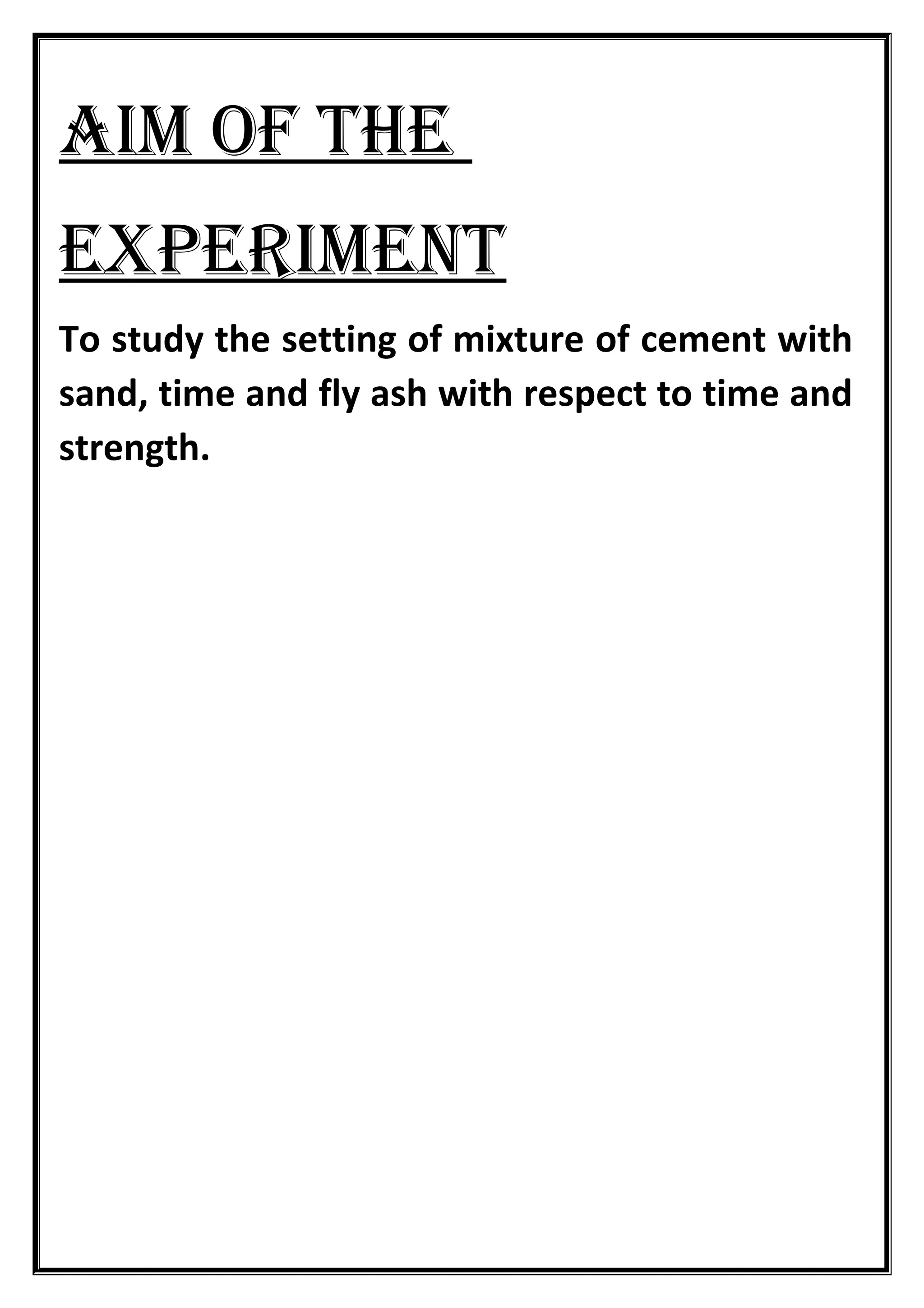
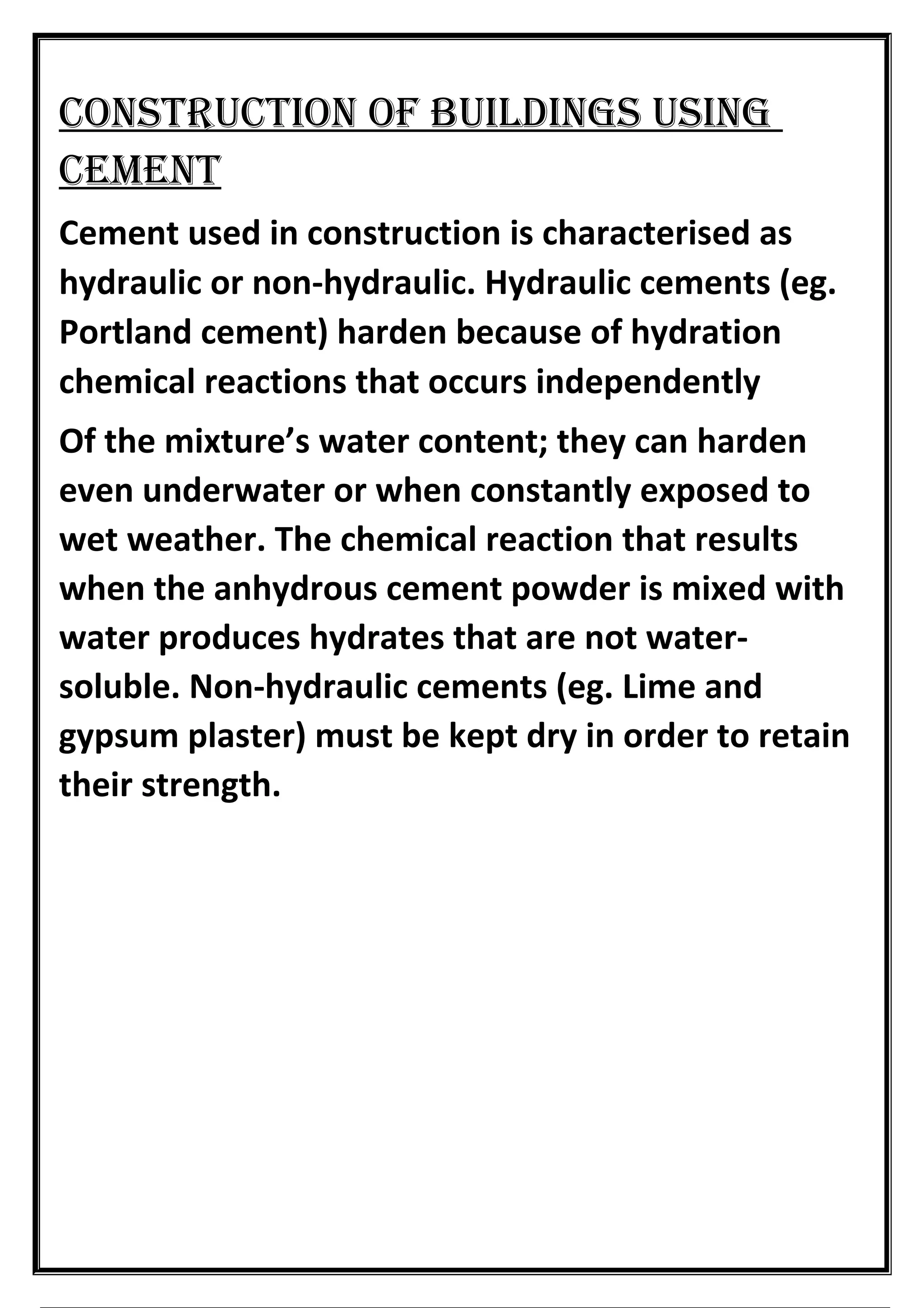
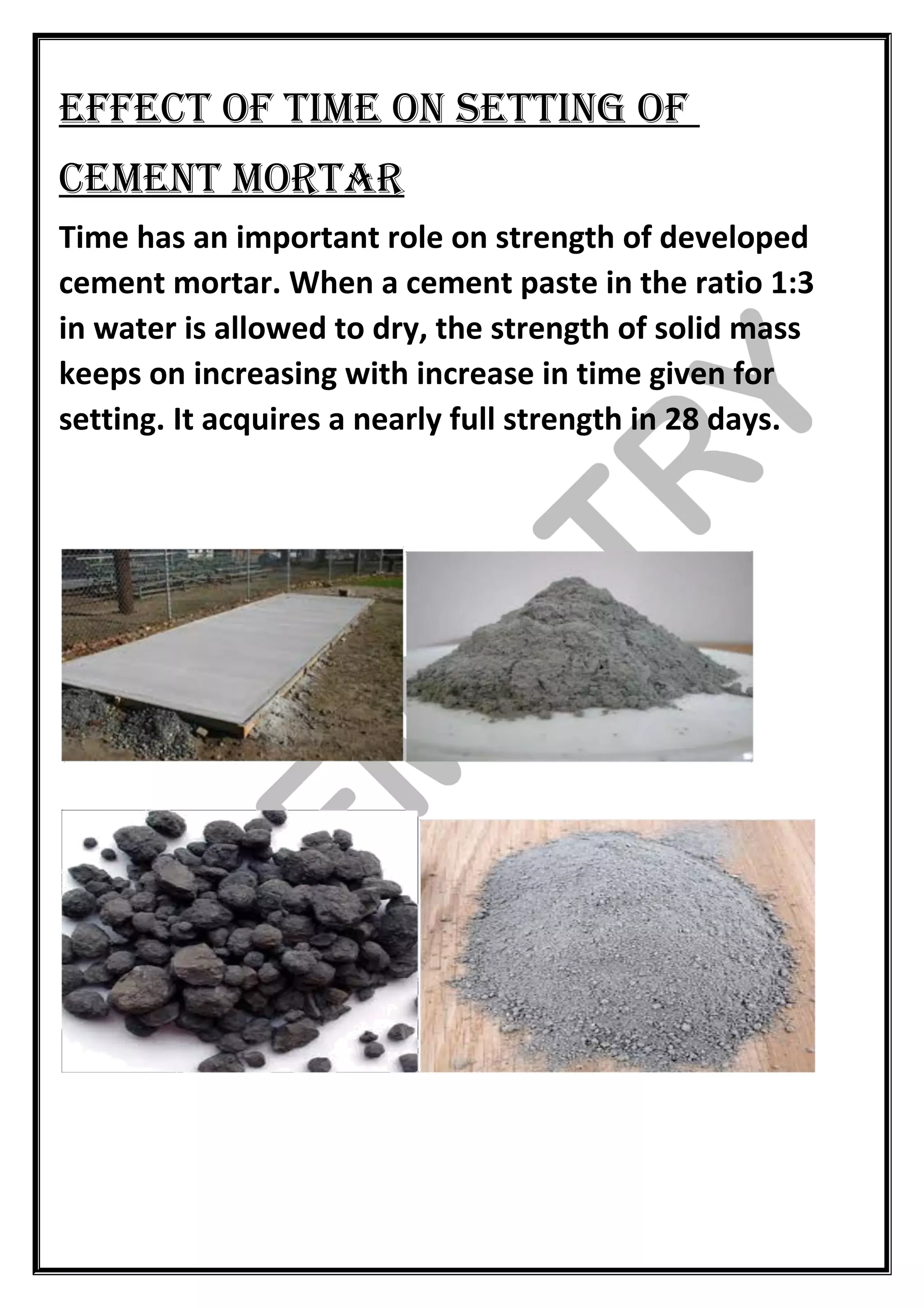
Time has an important role on strength of developed
cement mortar. When a cement paste in the ratio 1:3
in water is allowed to dry, the strength of solid mass
keeps on increasing with increase in time given for
setting. It acquires a nearly full strength in 28 days.
APPArAtUS reQUIreD
1. Beakers, glass rods, weight box, matchboxes
BEAKER GLASS RODS
WEIGHT
MATCHBOX BEAKERS
2. Limestone, river sand, cement and fly ash
LIMESTONE RIVER SAND
PROCEDURE
1. Prepare mixtures of various compositions as given
in Observation table.
2. Take each of the given mixtures in different beakers
and prepare their pastes by adding minimum amount of
water
3. Take nine cases of empty match boxes and mark them
from 1 to 9.
4. Fill the three cases with the paste of each
composition.
5. Spray water from time to time over the paste ,so
that they remain moist all the time.
6. After three days, take out one slab of each
composition and test their strengths.
7. Similarly, take out a set of three slabs after 7 days
after 30 days respectively and test their strengths
OBSERVATION
SL. COMPOSITION OF MIXTURE MINIMUM WEIGHT TO BREAK
NO. AND RATIO THE SLAB AFTER
3 DAYS 7 DAYS 10 DAYS
1
18
GRAM 20 GRAM 30 GRAMCEMENT:RIVER SAND(1:3)
2
16
GRAM 18 GRAM 26 GRAM
CEMENT:RIVER SAND:FLY
ASH
(2:9:1)
3
10
GRAM 15 GRAM 20 GRAMCEMENT:RIVER SAND:LIME
(1:3:1)
By seeing the observation we can estimate the
hardness of the slab.
CONCLUSION
The strength of the slab increases with
the increase in setting time allowed.
PRECAUTION:-
 Handle the glass wares safely.
 Allow the time required to set.
Spray only required amount of
water.
BIBLIOGRAPHY:-
1.www.google.co.in
2.www.cbse.nc.in
3.www.icbse.com
4.www.ncert.nic.in

Chemistry investigatory project on cement

  • 1.
    CHEMISTRY INVESTIGATORY PROJECT SETTING OFCEMENT Name:- Sthitaprajna Nayak Class:- XII Roll No:-39 2017-18
  • 2.
    JAWAHAR NAVODAYA VIDYALAYA BARO, KENDRAPARA DEPARTMENTOF CHEMISTRY CERTIFICATE This is to certify that Sthitaprajna Nayak a student of class 12th has successfully completed the research on the below mentioned project under the guidance of Mrs. Surava Das (subject teacher)during the year 2017-18 in partial fulfillment of Chemistry examination conducted by AISSCE, New Delhi. Signature of External Examiner Signature Of Chemistry Teacher Signature Of Principal Date-
  • 3.
    ACKNOWLEDGEMENT In the accomplishmentof this project successfully, many people have best owned upon me their blessings and the heart pledged support, this time I am utilizing to thank all the people who have been concerned with project. Primarily I would thank god for being able to complete this project with success. Then I would like to thank my principal Mr. S.K.Das and Chemistry teacher Mrs.Surava Das, whose valuable guidance has been the ones that helped me patch this project and make it full proof success his suggestions and his instructions has served as the major contributor towards the completion of the project. Then I would like to thank my parents and friends who have helped me with their valuable suggestions and guidance has been helpful in various phases of the completion of the project. Last but not the least I would like to thank my classmates who have helped me a lot.
  • 4.
    INDEX 1.CERTIFICATE OF EXCELLENCE 2.ACKNOWLEDGEMENT 3. AIM OF PROJECT 4. INTRODUCTION 5. THEORY 6. APPARATUS REQUIRED 7. PROCEDURE FOLLOWED 8. OBSERVATION 9. CONCLUSION 10. PRECAUTION 11. BIBLIOGRAPHY
  • 5.
    AIM OF THE EXPERIMENT Tostudy the setting of mixture of cement with sand, time and fly ash with respect to time and strength.
  • 6.
    INTRODUCTION In the mostgeneral sense of the word, CEMENT is a binder, a substance that sets and hardens independently, and can bind other materials together. The word “ cement “ traces to the Romans, who used the term opus caementicium to describe masonry resembling modern concrete that was made from crushed rock with burnt lime as binder. The volcanic ash and a pulverized brick additive that were added to the burnt lime to obtain a hydraulic binder were later referred to as cementum, cimentum, cament and cement. The most important use of cement is the production of mortar and concrete The bonding of natural or artificial aggregates to form a strong building material that is durable in the face of normal environment effects.
  • 7.
    Portland cement Cement is madeby heating limestone (calcium cabonate), with small quantities of other materials (such as clay) to 1450C in a kiln, in aprocess known as calcination, whereby a molecule of carbon dioxide is liberated from the calcium carbonate to form calcium oxide,or quicklime,which is then blended with the other materials that have been included ih the mix. The resulting hard substance, called ‘clinker’, is then ground with a small amount of gypsum into a powder to make ‘Ordinary Portland Cement’, the most commonly used type of cement(often referred to as OPC).Portland cement is a basic ingredient of concrete, mortar and non speciality grout. The most common use for portland cement is in the production of concrete. Concrete is a composite material consisting of aggregate (gravel and sand), cement and water. As a construction material, concrete can be cast in almost any shape desired and once hardened, can become a structural (load baering) element. Portland cement may be gray or white.
  • 8.
    CONsTRUCTION OF bUIlDINgsUsINg CEMENT Cement used in construction is characterised as hydraulic or non-hydraulic. Hydraulic cements (eg. Portland cement) harden because of hydration chemical reactions that occurs independently Of the mixture’s water content; they can harden even underwater or when constantly exposed to wet weather. The chemical reaction that results when the anhydrous cement powder is mixed with water produces hydrates that are not water- soluble. Non-hydraulic cements (eg. Lime and gypsum plaster) must be kept dry in order to retain their strength.
  • 9.
    theory eFFeCt oF QUALItyoF SAND oN SettING oF CeMeNt MortAr Sand obtained from different sources has different qualities. For example, Sea sand obtained from sea contains unwanted salts and retards setting of cement and is not suitable for making mortar. On the other hand, Pit sand is obtained from pits in the soil and the River sand obtained from riverbed is considered excellent for preparing mortar and concrete.
  • 10.
    eFFeCt oF tIMeoN SettING oF CeMeNt MortAr Time has an important role on strength of developed cement mortar. When a cement paste in the ratio 1:3 in water is allowed to dry, the strength of solid mass keeps on increasing with increase in time given for setting. It acquires a nearly full strength in 28 days.
  • 11.
    APPArAtUS reQUIreD 1. Beakers,glass rods, weight box, matchboxes BEAKER GLASS RODS WEIGHT MATCHBOX BEAKERS 2. Limestone, river sand, cement and fly ash LIMESTONE RIVER SAND
  • 13.
    PROCEDURE 1. Prepare mixturesof various compositions as given in Observation table. 2. Take each of the given mixtures in different beakers and prepare their pastes by adding minimum amount of water 3. Take nine cases of empty match boxes and mark them from 1 to 9. 4. Fill the three cases with the paste of each composition. 5. Spray water from time to time over the paste ,so that they remain moist all the time. 6. After three days, take out one slab of each composition and test their strengths. 7. Similarly, take out a set of three slabs after 7 days after 30 days respectively and test their strengths
  • 14.
    OBSERVATION SL. COMPOSITION OFMIXTURE MINIMUM WEIGHT TO BREAK NO. AND RATIO THE SLAB AFTER 3 DAYS 7 DAYS 10 DAYS 1 18 GRAM 20 GRAM 30 GRAMCEMENT:RIVER SAND(1:3) 2 16 GRAM 18 GRAM 26 GRAM CEMENT:RIVER SAND:FLY ASH (2:9:1) 3 10 GRAM 15 GRAM 20 GRAMCEMENT:RIVER SAND:LIME (1:3:1) By seeing the observation we can estimate the hardness of the slab.
  • 15.
    CONCLUSION The strength ofthe slab increases with the increase in setting time allowed. PRECAUTION:-  Handle the glass wares safely.  Allow the time required to set. Spray only required amount of water.
  • 16.