Chemical kinetics
Basics….
1) Reaction rate How we measure rate
2) Rate laws How the rate depend on amount of factors
3) Half life (𝑡1/2) How long it takes to react 50% of its reactants.
4) Arrhenius equation How rate constants changes with T.
5) Mechanisms Link between rate and molecular scale
processes
Basics…..
• Molarity refers to the concentration of a compound or ion in a
solution, normality refers to the molar concentration only of the
acid component or only of the base component of the solution.
M= Moles/Lit of solvent used in solution
N= Eq/V
Eq- No. of gm equivalents of solute
V- Volume of solvent in Lit.
• The relation between normality and molarity is N = M x n where
N refers to normality, M is molarity, and n denotes the number of
equivalents.
Need of Chemical Kinetics
• To study, understand and interpret conditions of instability of
p’ceutical product as well as to be able to offer
• Recognize alterations in stability may occur when a drug is combined
with other ingredients.
• Knowing the rate at which a drug deteriorates at various hydrogen ion
concentrations allows one to choose a vehicle that will retard or
prevent the degradation.
• The pharmacist is able to assist the physician & patient regarding
storage & use of medicinal agents.
• Molecularity of reactions
Unimolecular, Bimolecular & Termolecular reactions
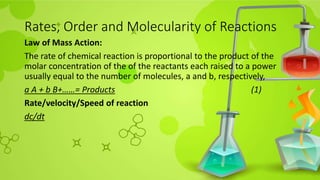
Rates, Order and Molecularity of Reactions
Law of Mass Action:
The rate of chemical reaction is proportional to the product of the
molar concentration of the of the reactants each raised to a power
usually equal to the number of molecules, a and b, respectively,
a A + b B+……= Products (1)
Rate/velocity/Speed of reaction
dc/dt
APPLICATIONS
1) Drug stability: help to predict shelf life of drug.
2) Dissolution: Drug is expected to release from solid dosage form and
immediately get into molecular solutions.
3) Drug release: prodrugs (agents who don’t have therapeutic activity
but converted back in vivo to their parent compounds)
Eg. Levodopa is prodrug of Dopamine.
4) Pharmacokinetics: ADME mechanism
5) Drug action: Interaction of drugs with bio membranes or receptors
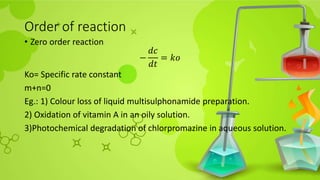
Order of reaction
• Zero order reaction
−
𝑑𝑐
𝑑𝑡
= 𝑘𝑜
Ko= Specific rate constant
m+n=0
Eg.: 1) Colour loss of liquid multisulphonamide preparation.
2) Oxidation of vitamin A in an oily solution.
3)Photochemical degradation of chlorpromazine in aqueous solution.
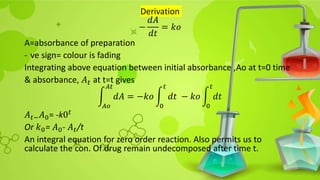
Derivation
−
𝑑𝐴
𝑑𝑡
= 𝑘𝑜
A=absorbance of preparation
- ve sign= colour is fading
Integrating above equation between initial absorbance ,Ao at t=0 time
& absorbance, 𝐴𝑡 at t=t gives
𝐴𝑜
𝐴𝑡
𝑑𝐴 = −𝑘𝑜
0
𝑡
𝑑𝑡 − 𝑘𝑜
0
𝑡
𝑑𝑡
𝐴𝑡−𝐴0= -k0𝑡
Or 𝑘0= 𝐴0- 𝐴𝑡/t
An integral equation for zero order reaction. Also permits us to
calculate the con. Of drug remain undecomposed after time t.
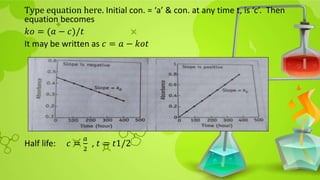
Type equation here. Initial con. = ‘a’ & con. at any time t, is ‘c’. Then
equation becomes
𝑘𝑜 = (𝑎 − 𝑐)/𝑡
It may be written as 𝑐 = 𝑎 − 𝑘𝑜𝑡
Half life: 𝑐 =
𝑎
2
, 𝑡 = 𝑡1/2
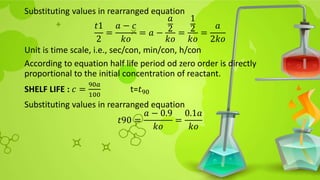
Substituting values in rearranged equation
𝑡1
2
=
𝑎 − 𝑐
𝑘𝑜
= 𝑎 −
𝑎
2
𝑘𝑜
=
1
2
𝑘𝑜
=
𝑎
2𝑘𝑜
Unit is time scale, i.e., sec/con, min/con, h/con
According to equation half life period od zero order is directly
proportional to the initial concentration of reactant.
SHELF LIFE : 𝑐 =
90𝑎
100
t=𝑡90
Substituting values in rearranged equation
𝑡90 =
𝑎 − 0.9
𝑘𝑜
=
0.1𝑎
𝑘𝑜
APPARENT ZERO ORDER - SUSPENSIONS
 It may be first order but
behaves like a zero order,
depending on the
experimental conditions.
 Degradation is possible only
when drug is available in
solution form.
 As the drug in solutions starts
to degrade suspended
particles act as reservoir &
continuously release drug in
solution. Thus con. Remains
constant throughout the
process.
 In case of no reservoir; −
𝑑 𝐴
𝑑𝑡
=
𝑘1[𝐴]
]
FIRST ORDER REACTION
• −
𝑑𝑐
𝑑𝑡
∝ 𝑐 or −
𝑑𝑐
𝑑𝑡
= 𝑘1𝑐
Derivation
A Products
According to definition of 1st order,
−
𝑑𝑐
𝑑𝑡
= 𝑘1𝑐
𝑐0
𝑐1
𝑑𝑐
𝑐
= −𝑘1
𝑜
𝑡
𝑑𝑡
[𝐼𝑛 𝑐]𝑐𝑜
𝑐𝑡
=-k1[𝑡]0
𝑡
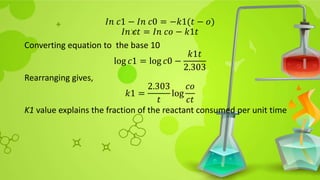
𝐼𝑛 𝑐1 − 𝐼𝑛 𝑐0 = −𝑘1(𝑡 − 𝑜)
𝐼𝑛 𝑐𝑡 = 𝐼𝑛 𝑐𝑜 − 𝑘1𝑡
Converting equation to the base 10
log 𝑐1 = log 𝑐0 −
𝑘1𝑡
2.303
Rearranging gives,
𝑘1 =
2.303
𝑡
log
𝑐𝑜
𝑐𝑡
K1 value explains the fraction of the reactant consumed per unit time
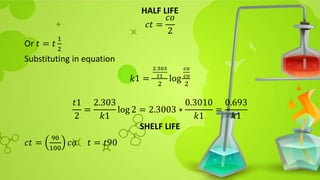
HALF LIFE
𝑐𝑡 =
𝑐𝑜
2
Or 𝑡 = 𝑡
1
2
Substituting in equation
𝑘1 =
2.303
𝑡1
2
log
𝑐𝑜
𝑐𝑜
2
𝑡1
2
=
2.303
𝑘1
log 2 = 2.3003 ∗
0.3010
𝑘1
=
0.693
𝑘1
SHELF LIFE
𝑐𝑡 =
90
100
𝑐𝑜 𝑡 = 𝑡90
Substituting in rearranged equation
𝑡90 =
2.303
𝑘1
log
𝑐𝑜
0.9𝑐0
𝑡90 =
2.303
𝑘1
log
10
9
= 2.303 ∗
0.04575
𝑘1
=
0.105
𝑘1
Pseudo first Order Reaction
−
𝑑𝑐
𝑑𝑡
= 𝑘2[𝐴][𝐵]
A& B= reactants, K2= 2nd order rate constant
Reaction conditions are maintained such that B present in excess
amount compared to A. That’s why equation changes to
−
𝑑𝑐
𝑑𝑡
= 𝑘2 𝐴 𝑐𝑜𝑛𝑠𝑡𝑎𝑛𝑡 = 𝑘1[𝐴]
SECOND ORDER REACTION
A+B=Products
Rate equation can be written as:
−
𝑑𝐴
𝑑𝑡
= −
𝑑𝐵
𝑑𝑡
= 𝑘2[𝐴]1[𝐵]1
[A] & [B]= concentration of A & B respectively
K2= Specific rate constant for 2nd order.
i.e. Rate of reaction is 1st order W.R.T. A & again 1st order W.R.T B.
Therefore, m+n=2
For identification/evidence purpose; Plot graph of log con. Vs. time.
Straight line indicating 1st order w.r.t A & again 1st order w.r.t B.
DERIVATION
−
𝑑𝐴
𝑑𝑡
= −
𝑑𝐵
𝑑𝑡
= 𝑘2[𝐴][𝐵]
Let ‘a’ & ‘b’ be the initial con. Of A&B, and ‘x’ be the con. Of each
species reacting in time t. On substituting these gives,
𝑑𝑥
𝑑𝑡
= 𝑘2 𝑎 − 𝑥 (𝑏 − 𝑥)
By considering case in which a=b i.e. (both having same con.) then the
equation will be
𝑑𝑥
𝑑𝑡
= 𝑘2(𝑎 − 𝑥)2
Integrating above equation on employing the conditions x=0 at t=0 &
x=x at t=t, gives
0
𝑥
𝑑𝑥/(𝑎 − 𝑥)2 = 𝑘2
0
𝑡
𝑑𝑡
1
(1−𝑥)
−
1
(𝑎−0)
= 𝑘2(𝑡 − 0)
𝑎−𝑎+𝑥
𝑎(𝑎−𝑥)
=𝑘2 𝑡 − 0
𝑥
𝑎 𝑎−𝑥
= 𝑘2𝑡
Or
𝑘2 =
1
𝑎𝑡
∗
𝑥
𝑎−𝑥
(a=b)
𝑘2 = 2.303/𝑡 𝑎 − 𝑏 log
𝑏 𝑎−𝑥
𝑎 𝑏−𝑥
(a≠b)
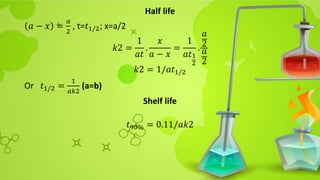
Half life
𝑎 − 𝑥 =
𝑎
2
, t=𝑡1/2; x=a/2
𝑘2 =
1
𝑎𝑡
.
𝑥
𝑎 − 𝑥
=
1
𝑎𝑡1
2
.
𝑎
2
𝑎
2
𝑘2 = 1/𝑎𝑡1/2
Or 𝑡1/2 =
1
𝑎𝑘2
(a=b)
Shelf life
𝑡90% = 0.11/𝑎𝑘2
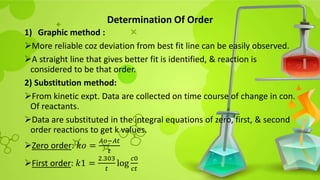
Determination Of Order
1) Graphic method :
More reliable coz deviation from best fit line can be easily observed.
A straight line that gives better fit is identified, & reaction is
considered to be that order.
2) Substitution method:
From kinetic expt. Data are collected on time course of change in con.
Of reactants.
Data are substituted in the integral equations of zero, first, & second
order reactions to get k values.
Zero order: 𝑘𝑜 =
𝐴𝑜−𝐴𝑡
𝑡
First order: 𝑘1 =
2.303
𝑡
log
𝑐0
𝑐𝑡
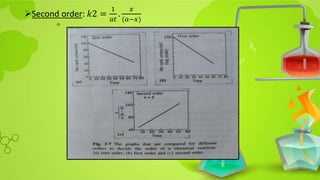
Second order: 𝑘2 =
1
𝑎𝑡
.
𝑥
(𝑎−𝑥)
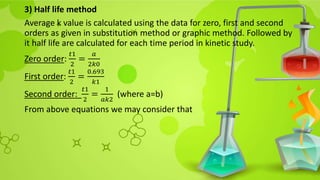
3) Half life method
Average k value is calculated using the data for zero, first and second
orders as given in substitution method or graphic method. Followed by
it half life are calculated for each time period in kinetic study.
Zero order:
𝑡1
2
=
𝑎
2𝑘0
First order:
𝑡1
2
=
0.693
𝑘1
Second order:
𝑡1
2
=
1
𝑎𝑘2
(where a=b)
From above equations we may consider that

Chemical kinetics pp.pptx

  • 1.
  • 2.
    Basics…. 1) Reaction rateHow we measure rate 2) Rate laws How the rate depend on amount of factors 3) Half life (𝑡1/2) How long it takes to react 50% of its reactants. 4) Arrhenius equation How rate constants changes with T. 5) Mechanisms Link between rate and molecular scale processes
  • 3.
    Basics….. • Molarity refersto the concentration of a compound or ion in a solution, normality refers to the molar concentration only of the acid component or only of the base component of the solution. M= Moles/Lit of solvent used in solution N= Eq/V Eq- No. of gm equivalents of solute V- Volume of solvent in Lit. • The relation between normality and molarity is N = M x n where N refers to normality, M is molarity, and n denotes the number of equivalents.
  • 4.
    Need of ChemicalKinetics • To study, understand and interpret conditions of instability of p’ceutical product as well as to be able to offer • Recognize alterations in stability may occur when a drug is combined with other ingredients. • Knowing the rate at which a drug deteriorates at various hydrogen ion concentrations allows one to choose a vehicle that will retard or prevent the degradation. • The pharmacist is able to assist the physician & patient regarding storage & use of medicinal agents. • Molecularity of reactions Unimolecular, Bimolecular & Termolecular reactions
  • 5.
    Rates, Order andMolecularity of Reactions Law of Mass Action: The rate of chemical reaction is proportional to the product of the molar concentration of the of the reactants each raised to a power usually equal to the number of molecules, a and b, respectively, a A + b B+……= Products (1) Rate/velocity/Speed of reaction dc/dt
  • 6.
    APPLICATIONS 1) Drug stability:help to predict shelf life of drug. 2) Dissolution: Drug is expected to release from solid dosage form and immediately get into molecular solutions. 3) Drug release: prodrugs (agents who don’t have therapeutic activity but converted back in vivo to their parent compounds) Eg. Levodopa is prodrug of Dopamine. 4) Pharmacokinetics: ADME mechanism 5) Drug action: Interaction of drugs with bio membranes or receptors
  • 7.
    Order of reaction •Zero order reaction − 𝑑𝑐 𝑑𝑡 = 𝑘𝑜 Ko= Specific rate constant m+n=0 Eg.: 1) Colour loss of liquid multisulphonamide preparation. 2) Oxidation of vitamin A in an oily solution. 3)Photochemical degradation of chlorpromazine in aqueous solution.
  • 8.
    Derivation − 𝑑𝐴 𝑑𝑡 = 𝑘𝑜 A=absorbance ofpreparation - ve sign= colour is fading Integrating above equation between initial absorbance ,Ao at t=0 time & absorbance, 𝐴𝑡 at t=t gives 𝐴𝑜 𝐴𝑡 𝑑𝐴 = −𝑘𝑜 0 𝑡 𝑑𝑡 − 𝑘𝑜 0 𝑡 𝑑𝑡 𝐴𝑡−𝐴0= -k0𝑡 Or 𝑘0= 𝐴0- 𝐴𝑡/t An integral equation for zero order reaction. Also permits us to calculate the con. Of drug remain undecomposed after time t.
  • 9.
    Type equation here.Initial con. = ‘a’ & con. at any time t, is ‘c’. Then equation becomes 𝑘𝑜 = (𝑎 − 𝑐)/𝑡 It may be written as 𝑐 = 𝑎 − 𝑘𝑜𝑡 Half life: 𝑐 = 𝑎 2 , 𝑡 = 𝑡1/2
  • 10.
    Substituting values inrearranged equation 𝑡1 2 = 𝑎 − 𝑐 𝑘𝑜 = 𝑎 − 𝑎 2 𝑘𝑜 = 1 2 𝑘𝑜 = 𝑎 2𝑘𝑜 Unit is time scale, i.e., sec/con, min/con, h/con According to equation half life period od zero order is directly proportional to the initial concentration of reactant. SHELF LIFE : 𝑐 = 90𝑎 100 t=𝑡90 Substituting values in rearranged equation 𝑡90 = 𝑎 − 0.9 𝑘𝑜 = 0.1𝑎 𝑘𝑜
  • 11.
    APPARENT ZERO ORDER- SUSPENSIONS  It may be first order but behaves like a zero order, depending on the experimental conditions.  Degradation is possible only when drug is available in solution form.  As the drug in solutions starts to degrade suspended particles act as reservoir & continuously release drug in solution. Thus con. Remains constant throughout the process.  In case of no reservoir; − 𝑑 𝐴 𝑑𝑡 = 𝑘1[𝐴] ]
  • 12.
    FIRST ORDER REACTION •− 𝑑𝑐 𝑑𝑡 ∝ 𝑐 or − 𝑑𝑐 𝑑𝑡 = 𝑘1𝑐 Derivation A Products According to definition of 1st order, − 𝑑𝑐 𝑑𝑡 = 𝑘1𝑐 𝑐0 𝑐1 𝑑𝑐 𝑐 = −𝑘1 𝑜 𝑡 𝑑𝑡 [𝐼𝑛 𝑐]𝑐𝑜 𝑐𝑡 =-k1[𝑡]0 𝑡
  • 13.
    𝐼𝑛 𝑐1 −𝐼𝑛 𝑐0 = −𝑘1(𝑡 − 𝑜) 𝐼𝑛 𝑐𝑡 = 𝐼𝑛 𝑐𝑜 − 𝑘1𝑡 Converting equation to the base 10 log 𝑐1 = log 𝑐0 − 𝑘1𝑡 2.303 Rearranging gives, 𝑘1 = 2.303 𝑡 log 𝑐𝑜 𝑐𝑡 K1 value explains the fraction of the reactant consumed per unit time
  • 14.
    HALF LIFE 𝑐𝑡 = 𝑐𝑜 2 Or𝑡 = 𝑡 1 2 Substituting in equation 𝑘1 = 2.303 𝑡1 2 log 𝑐𝑜 𝑐𝑜 2 𝑡1 2 = 2.303 𝑘1 log 2 = 2.3003 ∗ 0.3010 𝑘1 = 0.693 𝑘1 SHELF LIFE 𝑐𝑡 = 90 100 𝑐𝑜 𝑡 = 𝑡90
  • 15.
    Substituting in rearrangedequation 𝑡90 = 2.303 𝑘1 log 𝑐𝑜 0.9𝑐0 𝑡90 = 2.303 𝑘1 log 10 9 = 2.303 ∗ 0.04575 𝑘1 = 0.105 𝑘1 Pseudo first Order Reaction − 𝑑𝑐 𝑑𝑡 = 𝑘2[𝐴][𝐵] A& B= reactants, K2= 2nd order rate constant Reaction conditions are maintained such that B present in excess amount compared to A. That’s why equation changes to − 𝑑𝑐 𝑑𝑡 = 𝑘2 𝐴 𝑐𝑜𝑛𝑠𝑡𝑎𝑛𝑡 = 𝑘1[𝐴]
  • 16.
    SECOND ORDER REACTION A+B=Products Rateequation can be written as: − 𝑑𝐴 𝑑𝑡 = − 𝑑𝐵 𝑑𝑡 = 𝑘2[𝐴]1[𝐵]1 [A] & [B]= concentration of A & B respectively K2= Specific rate constant for 2nd order. i.e. Rate of reaction is 1st order W.R.T. A & again 1st order W.R.T B. Therefore, m+n=2 For identification/evidence purpose; Plot graph of log con. Vs. time. Straight line indicating 1st order w.r.t A & again 1st order w.r.t B.
  • 17.
    DERIVATION − 𝑑𝐴 𝑑𝑡 = − 𝑑𝐵 𝑑𝑡 = 𝑘2[𝐴][𝐵] Let‘a’ & ‘b’ be the initial con. Of A&B, and ‘x’ be the con. Of each species reacting in time t. On substituting these gives, 𝑑𝑥 𝑑𝑡 = 𝑘2 𝑎 − 𝑥 (𝑏 − 𝑥) By considering case in which a=b i.e. (both having same con.) then the equation will be 𝑑𝑥 𝑑𝑡 = 𝑘2(𝑎 − 𝑥)2 Integrating above equation on employing the conditions x=0 at t=0 & x=x at t=t, gives 0 𝑥 𝑑𝑥/(𝑎 − 𝑥)2 = 𝑘2 0 𝑡 𝑑𝑡
  • 18.
    1 (1−𝑥) − 1 (𝑎−0) = 𝑘2(𝑡 −0) 𝑎−𝑎+𝑥 𝑎(𝑎−𝑥) =𝑘2 𝑡 − 0 𝑥 𝑎 𝑎−𝑥 = 𝑘2𝑡 Or 𝑘2 = 1 𝑎𝑡 ∗ 𝑥 𝑎−𝑥 (a=b) 𝑘2 = 2.303/𝑡 𝑎 − 𝑏 log 𝑏 𝑎−𝑥 𝑎 𝑏−𝑥 (a≠b)
  • 19.
    Half life 𝑎 −𝑥 = 𝑎 2 , t=𝑡1/2; x=a/2 𝑘2 = 1 𝑎𝑡 . 𝑥 𝑎 − 𝑥 = 1 𝑎𝑡1 2 . 𝑎 2 𝑎 2 𝑘2 = 1/𝑎𝑡1/2 Or 𝑡1/2 = 1 𝑎𝑘2 (a=b) Shelf life 𝑡90% = 0.11/𝑎𝑘2
  • 20.
    Determination Of Order 1)Graphic method : More reliable coz deviation from best fit line can be easily observed. A straight line that gives better fit is identified, & reaction is considered to be that order. 2) Substitution method: From kinetic expt. Data are collected on time course of change in con. Of reactants. Data are substituted in the integral equations of zero, first, & second order reactions to get k values. Zero order: 𝑘𝑜 = 𝐴𝑜−𝐴𝑡 𝑡 First order: 𝑘1 = 2.303 𝑡 log 𝑐0 𝑐𝑡
  • 21.
    Second order: 𝑘2= 1 𝑎𝑡 . 𝑥 (𝑎−𝑥)
  • 22.
    3) Half lifemethod Average k value is calculated using the data for zero, first and second orders as given in substitution method or graphic method. Followed by it half life are calculated for each time period in kinetic study. Zero order: 𝑡1 2 = 𝑎 2𝑘0 First order: 𝑡1 2 = 0.693 𝑘1 Second order: 𝑡1 2 = 1 𝑎𝑘2 (where a=b) From above equations we may consider that