PROTECH SYSTEM & SOLUTIONS
By Manish Singh
Protech System & Solutions
Concept Of Earthing System
All the people living or working in residential,
commercial & industrial installations,
particularly the operator personal who are in
close operation & contact with electrical
systems & Machineries, should essentially be
protected against possible electrification. To
achieve this protection, earthing system of
an installation is defined, designed &
installed according to the standard
requirements…………..
Objective of Earthing
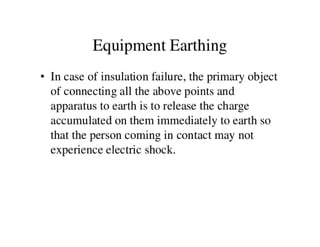
1- Provide an alternative path for the fault current
to flow so that it will not endanger to user.
2- Ensure that all exposed conductive parts do
not reach a dangerous potential.
3- Maintain the voltage at any Part of an electrical
system at a known value so as to prevent over
current or excessive voltage in the appliances or
equipments.
Good Earthing Means
Good Earthing must have low
impedance enough to ensure that
sufficient current can flow through the
safety device so that it disconnects the
supply ( < 0.4 seconds ). Fault of the
circuit which melt the fuse. Hence, the
appliance is disconnected
automatically from the supply mains.
Quality of Good Earthing
1- Must be of low electrical resistance.
2- Must be of good corrosion resistance.
3- Must be able to dissipate high fault current
repeatedly.
Purpose of Earthing
1- To save human life from danger of electrical shock or death by blowing a fuse
i.e To provide an alternative path for the fault current to flow so that it will not
endanger the user.
2- To protect building, machineries appliances under fault conditions i.e To
ensure that all exposed conductive parts do not reach a dangerous potential.
3- To provide safe path to dissipate lightning short circuit currents.
4- To provide stable platform for operation of sensitive electronic equipments i.e
To maintain the voltage at any part of an electrical system at a known value so as
to prevent over current or excessive voltage on the appliances or equipments.
5- To provide protection against static electricity for friction.
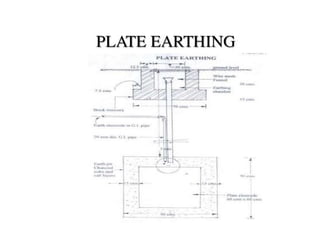
Difference Between Chemical Earthing
& Conventional Earthing
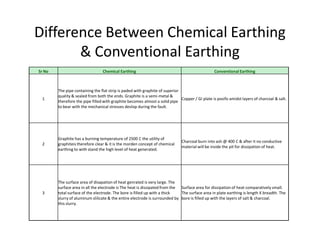
Sr No Chemical Earthing Conventional Earthing
1
The pipe containing the flat strip is paded with graphite of superior
quality & sealed from both the ends. Graphite is a semi-metal &
therefore the pipe filled with graphite becomes almost a solid pipe
to bear with the mechanical stresses devlop during the fault.
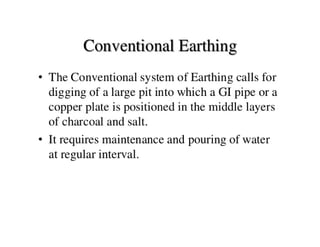
Copper / GI plate is posifo amidst layers of charcoal & salt.
2
Graphite has a burning temperature of 2500 C the utility of
graphiteis therefore clear & it is the morden concept of chemical
earthing to with stand the high level of heat generated.
Charcoal burn into ash @ 400 C & after it no conductive
material will be inside the pit for dissipation of heat.
3
The surface area of disapation of heat genrated is very large. The
surface area in all the electrode is The heat is dissipated from the
total surface of the electrode. The bore is filled up with a thick
slurry of aluminum slilicate & the entire electrode is surrounded by
this slurry.
Surface area for dissipation of heat comparatively small.
The surface area in plate earthing is length X breadth. The
bore is filled up with the layers of salt & charcoal.
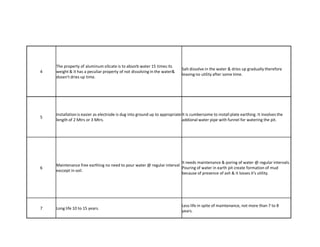
4
The property of aluminum silicate is to absorb water 15 times its
weight & it has a peculiar property of not dissolving in the water&
dosen't dries up time.
Salt dissolve in the water & dries up gradually therefore
leaving no utility after some time.
5
Installationis easier as electrode is dug into ground up to appropriate
length of 2 Mtrs or 3 Mtrs.
It is cumbersome to install plate earthing. It involves the
addional water pipe with funnel for watering the pit.
6
Maintenance free earthing no need to pour water @ regular interval
exccept in soil.
It needs maintenance & poring of water @ regular intervals.
Pouring of water in earth pit create formation of mud
because of presence of ash & it losses it's utility.
7 Long life 10 to 15 years.
Less life in spite of maintenance, not more than 7 to 8
years.
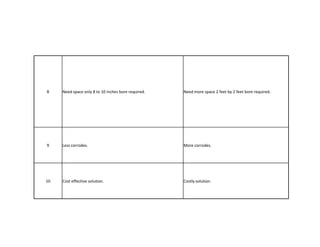
8 Need space only 8 to 10 inches bore required. Need more space 2 feet by 2 feet bore required.
9 Less corrodes. More corrodes.
10 Cost effective solution. Costly solution.
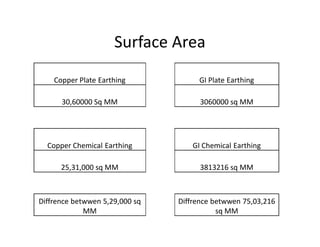
Surface Area
Copper Plate Earthing GI Plate Earthing
30,60000 Sq MM 3060000 sq MM
Copper Chemical Earthing GI Chemical Earthing
25,31,000 sq MM 3813216 sq MM
Diffrence betwwen 5,29,000 sq
MM
Diffrence betwwen 75,03,216
sq MM
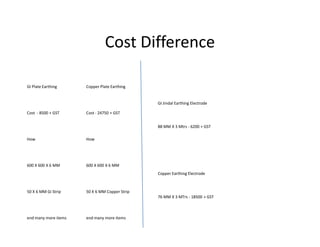
Cost Difference
GI Plate Earthing Copper Plate Earthing
Cost - 8500 + GST Cost - 24750 + GST
How How
600 X 600 X 6 MM 600 X 600 X 6 MM
50 X 6 MM Gi Strip 50 X 6 MM Copper Strip
end many more items end many more items
GI Jindal Earthing Electrode
88 MM X 3 Mtrs - 6200 + GST
Copper Earthing Electrode
76 MM X 3 MTrs - 18500 + GST
Presentation by Protech System &
Solutions
Thank You
Mr.Bharat Singh Chauhan ( MD )
Contact No – 9999722390 / 9458883888
Mail ID :- protechearthing@gmail.com
By
Manish Singh
9927884999
Mail ID :- manishsingh1210@gmail.com

CHEMICAL EARTHING ELECTRODE

  • 1.
    PROTECH SYSTEM &SOLUTIONS By Manish Singh Protech System & Solutions
  • 3.
    Concept Of EarthingSystem All the people living or working in residential, commercial & industrial installations, particularly the operator personal who are in close operation & contact with electrical systems & Machineries, should essentially be protected against possible electrification. To achieve this protection, earthing system of an installation is defined, designed & installed according to the standard requirements…………..
  • 5.
    Objective of Earthing 1-Provide an alternative path for the fault current to flow so that it will not endanger to user. 2- Ensure that all exposed conductive parts do not reach a dangerous potential. 3- Maintain the voltage at any Part of an electrical system at a known value so as to prevent over current or excessive voltage in the appliances or equipments.
  • 6.
    Good Earthing Means GoodEarthing must have low impedance enough to ensure that sufficient current can flow through the safety device so that it disconnects the supply ( < 0.4 seconds ). Fault of the circuit which melt the fuse. Hence, the appliance is disconnected automatically from the supply mains.
  • 7.
    Quality of GoodEarthing 1- Must be of low electrical resistance. 2- Must be of good corrosion resistance. 3- Must be able to dissipate high fault current repeatedly.
  • 8.
    Purpose of Earthing 1-To save human life from danger of electrical shock or death by blowing a fuse i.e To provide an alternative path for the fault current to flow so that it will not endanger the user. 2- To protect building, machineries appliances under fault conditions i.e To ensure that all exposed conductive parts do not reach a dangerous potential. 3- To provide safe path to dissipate lightning short circuit currents. 4- To provide stable platform for operation of sensitive electronic equipments i.e To maintain the voltage at any part of an electrical system at a known value so as to prevent over current or excessive voltage on the appliances or equipments. 5- To provide protection against static electricity for friction.
  • 25.
    Difference Between ChemicalEarthing & Conventional Earthing Sr No Chemical Earthing Conventional Earthing 1 The pipe containing the flat strip is paded with graphite of superior quality & sealed from both the ends. Graphite is a semi-metal & therefore the pipe filled with graphite becomes almost a solid pipe to bear with the mechanical stresses devlop during the fault. Copper / GI plate is posifo amidst layers of charcoal & salt. 2 Graphite has a burning temperature of 2500 C the utility of graphiteis therefore clear & it is the morden concept of chemical earthing to with stand the high level of heat generated. Charcoal burn into ash @ 400 C & after it no conductive material will be inside the pit for dissipation of heat. 3 The surface area of disapation of heat genrated is very large. The surface area in all the electrode is The heat is dissipated from the total surface of the electrode. The bore is filled up with a thick slurry of aluminum slilicate & the entire electrode is surrounded by this slurry. Surface area for dissipation of heat comparatively small. The surface area in plate earthing is length X breadth. The bore is filled up with the layers of salt & charcoal.
  • 26.
    4 The property ofaluminum silicate is to absorb water 15 times its weight & it has a peculiar property of not dissolving in the water& dosen't dries up time. Salt dissolve in the water & dries up gradually therefore leaving no utility after some time. 5 Installationis easier as electrode is dug into ground up to appropriate length of 2 Mtrs or 3 Mtrs. It is cumbersome to install plate earthing. It involves the addional water pipe with funnel for watering the pit. 6 Maintenance free earthing no need to pour water @ regular interval exccept in soil. It needs maintenance & poring of water @ regular intervals. Pouring of water in earth pit create formation of mud because of presence of ash & it losses it's utility. 7 Long life 10 to 15 years. Less life in spite of maintenance, not more than 7 to 8 years.
  • 27.
    8 Need spaceonly 8 to 10 inches bore required. Need more space 2 feet by 2 feet bore required. 9 Less corrodes. More corrodes. 10 Cost effective solution. Costly solution.
  • 28.
    Surface Area Copper PlateEarthing GI Plate Earthing 30,60000 Sq MM 3060000 sq MM Copper Chemical Earthing GI Chemical Earthing 25,31,000 sq MM 3813216 sq MM Diffrence betwwen 5,29,000 sq MM Diffrence betwwen 75,03,216 sq MM
  • 29.
    Cost Difference GI PlateEarthing Copper Plate Earthing Cost - 8500 + GST Cost - 24750 + GST How How 600 X 600 X 6 MM 600 X 600 X 6 MM 50 X 6 MM Gi Strip 50 X 6 MM Copper Strip end many more items end many more items GI Jindal Earthing Electrode 88 MM X 3 Mtrs - 6200 + GST Copper Earthing Electrode 76 MM X 3 MTrs - 18500 + GST
  • 30.
    Presentation by ProtechSystem & Solutions Thank You Mr.Bharat Singh Chauhan ( MD ) Contact No – 9999722390 / 9458883888 Mail ID :- protechearthing@gmail.com By Manish Singh 9927884999 Mail ID :- manishsingh1210@gmail.com