Cheerleading
 By: Brook McCool
      Fall 2011
History of Cheerleading
• The earliest record of cheerleading is in 1898.
  The official birth date is considered November
  2nd, 1898.
• In the 1870s a gentleman by the name of Thomas
  Peebler brought together six guys to lead a yell on
  the sidelines.
• Organized cheering (or cheerleading) dates back to
  1898.It was developed to motivate the sports
  teams to win.
Cheerleading is a sport.
• Cheerleading is a popular extracurricular for
  both kids and teens. The sport's
  combination of healthy competition and
  physical fitness is a great way for young
  people to stay in shape while learning to
  work in a team environment.
Competition Cheerleading
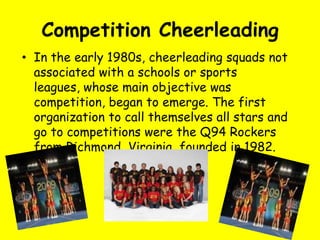
• In the early 1980s, cheerleading squads not
  associated with a schools or sports
  leagues, whose main objective was
  competition, began to emerge. The first
  organization to call themselves all stars and
  go to competitions were the Q94 Rockers
  from Richmond, Virginia, founded in 1982.
High School Cheerleading
• In high school, there are usually two squads
  per school, varsity team and a junior varsity
  team.
• These squads have become a part of a year-
  round sport, starting with tryouts in the
  spring, to year-round practice, to sporting
  events to cheer at in the fall and winter.
College Cheerleading
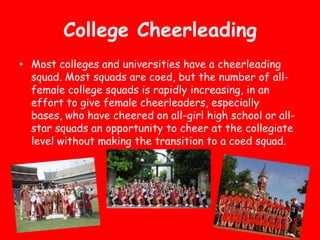
• Most colleges and universities have a cheerleading
  squad. Most squads are coed, but the number of all-
  female college squads is rapidly increasing, in an
  effort to give female cheerleaders, especially
  bases, who have cheered on all-girl high school or all-
  star squads an opportunity to cheer at the collegiate
  level without making the transition to a coed squad.
Youth Cheerleading
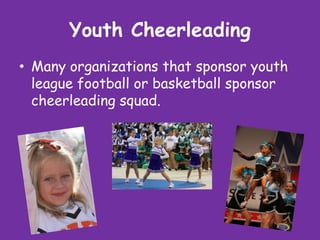
• Many organizations that sponsor youth
  league football or basketball sponsor
  cheerleading squad.
Injuries
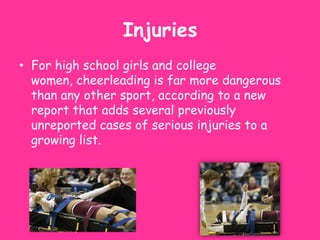
• For high school girls and college
  women, cheerleading is far more dangerous
  than any other sport, according to a new
  report that adds several previously
  unreported cases of serious injuries to a
  growing list.
Credits
www.gooleimages.com
 www.wikapedia.com
  www.about.com

Cheerleading

  • 1.
    Cheerleading By: BrookMcCool Fall 2011
  • 2.
    History of Cheerleading •The earliest record of cheerleading is in 1898. The official birth date is considered November 2nd, 1898. • In the 1870s a gentleman by the name of Thomas Peebler brought together six guys to lead a yell on the sidelines. • Organized cheering (or cheerleading) dates back to 1898.It was developed to motivate the sports teams to win.
  • 3.
    Cheerleading is asport. • Cheerleading is a popular extracurricular for both kids and teens. The sport's combination of healthy competition and physical fitness is a great way for young people to stay in shape while learning to work in a team environment.
  • 4.
    Competition Cheerleading • Inthe early 1980s, cheerleading squads not associated with a schools or sports leagues, whose main objective was competition, began to emerge. The first organization to call themselves all stars and go to competitions were the Q94 Rockers from Richmond, Virginia, founded in 1982.
  • 5.
    High School Cheerleading •In high school, there are usually two squads per school, varsity team and a junior varsity team. • These squads have become a part of a year- round sport, starting with tryouts in the spring, to year-round practice, to sporting events to cheer at in the fall and winter.
  • 6.
    College Cheerleading • Mostcolleges and universities have a cheerleading squad. Most squads are coed, but the number of all- female college squads is rapidly increasing, in an effort to give female cheerleaders, especially bases, who have cheered on all-girl high school or all- star squads an opportunity to cheer at the collegiate level without making the transition to a coed squad.
  • 7.
    Youth Cheerleading • Manyorganizations that sponsor youth league football or basketball sponsor cheerleading squad.
  • 8.
    Injuries • For highschool girls and college women, cheerleading is far more dangerous than any other sport, according to a new report that adds several previously unreported cases of serious injuries to a growing list.
  • 10.

Editor's Notes

  • #3 The earliest record of cheerleading is in 1898. The official birth date is considered November 2nd, 1898.In the 1870s a gentleman by the name of Thomas Peebler brought together six guys to lead a yell on the sidelines.Organized cheering (or cheerleading) dates back to 1898.It was developed to motivate the sports teams to win.
  • #5 The earliest record of cheerleading is in 1898. The official birth date is considered November 2nd, 1898.In the 1870s a gentleman by the name of Thomas Peebler brought together six guys to lead a yell on the sidelines.Organized cheering (or cheerleading) dates back to 1898.It was developed to motivate the sports teams to win.
  • #6 In high school, there are usually two squads per school, varsity team and a junior varsity team.These squads have become a part of a year-round sport, starting with tryouts in the spring, to year-round practice, to sporting events to cheer at in the fall and winter.
  • #7 Most colleges and universities have a cheerleading squad. Most squads are coed, but the number of all-female college squads is rapidly increasing, in an effort to give female cheerleaders, especially bases, who have cheered on all-girl high school or all-star squads an opportunity to cheer at the collegiate level without making the transition to a coed squad.
  • #8 Most colleges and universities have a cheerleading squad. Most squads are coed, but the number of all-female college squads is rapidly increasing, in an effort to give female cheerleaders, especially bases, who have cheered on all-girl high school or all-star squads an opportunity to cheer at the collegiate level without making the transition to a coed squad.
  • #9 For high school girls and college women, cheerleading is far more dangerous than any other sport, according to a new report that adds several previously unreported cases of serious injuries to a growing list.
  • #10 Thanks for watching my slide show.