Intelligent Supply Chains
Værdikæder i netværk og
plug’n play supply chains
Professor Charles Møller, Ph.D.
Center for Industrial Production
Aalborg University, Denmark
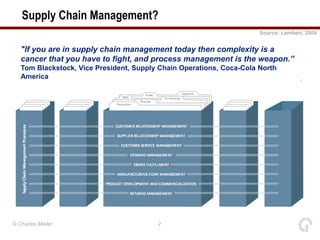
Supply Chain Management?
                                                                      Source: Lambert, 2008


   "If you are in supply chain management today then complexity is a
   cancer that you have to fight, and process management is the weapon.”
   Tom Blackstock, Vice President, Supply Chain Operations, Coca-Cola North
   America


© Charles Møller                         2
Why do we need intelligent Supply Chains?


© Charles Møller             3
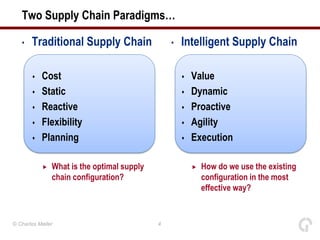
Two Supply Chain Paradigms…

   •   Traditional Supply Chain                 •   Intelligent Supply Chain

          Cost                                        Value
          Static                                      Dynamic
          Reactive                                    Proactive
          Flexibility                                 Agility
          Planning                                    Execution

              What is the optimal supply                  How do we use the existing
               chain configuration?                         configuration in the most
                                                            effective way?


© Charles Møller                            4
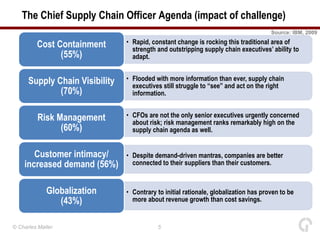
The Chief Supply Chain Officer Agenda (impact of challenge)
                                                                                      Source: IBM, 2009

         Cost Containment       • Rapid, constant change is rocking this traditional area of
                                  strength and outstripping supply chain executives’ ability to
               (55%)              adapt.


      Supply Chain Visibility   • Flooded with more information than ever, supply chain
                                  executives still struggle to “see” and act on the right
              (70%)               information.


         Risk Management        • CFOs are not the only senior executives urgently concerned
                                  about risk; risk management ranks remarkably high on the
               (60%)              supply chain agenda as well.


       Customer intimacy/       • Despite demand-driven mantras, companies are better
    increased demand (56%)        connected to their suppliers than their customers.


             Globalization      • Contrary to initial rationale, globalization has proven to be
                (43%)             more about revenue growth than cost savings.


© Charles Møller                           5
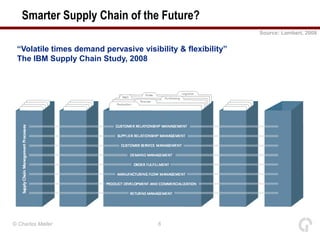
Smarter Supply Chain of the Future?
                                                              Source: Lambert, 2008


 “Volatile times demand pervasive visibility & flexibility”
 The IBM Supply Chain Study, 2008


© Charles Møller                       6
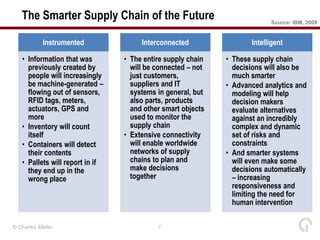
The Smarter Supply Chain of the Future                                  Source: IBM, 2009


            Instrumented              Interconnected                 Intelligent

   • Information that was        • The entire supply chain   • These supply chain
     previously created by         will be connected – not     decisions will also be
     people will increasingly      just customers,             much smarter
     be machine-generated –        suppliers and IT          • Advanced analytics and
     flowing out of sensors,       systems in general, but     modeling will help
     RFID tags, meters,            also parts, products        decision makers
     actuators, GPS and            and other smart objects     evaluate alternatives
     more                          used to monitor the         against an incredibly
   • Inventory will count          supply chain                complex and dynamic
     itself                      • Extensive connectivity      set of risks and
   • Containers will detect        will enable worldwide       constraints
     their contents                networks of supply        • And smarter systems
   • Pallets will report in if     chains to plan and          will even make some
     they end up in the            make decisions              decisions automatically
     wrong place                   together                    – increasing
                                                               responsiveness and
                                                               limiting the need for
                                                               human intervention

© Charles Møller                           7
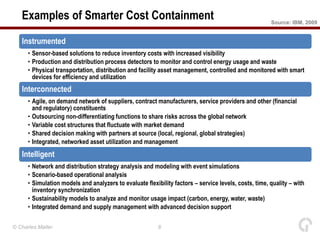
Examples of Smarter Cost Containment                                                                Source: IBM, 2009


   Instrumented
      • Sensor-based solutions to reduce inventory costs with increased visibility
      • Production and distribution process detectors to monitor and control energy usage and waste
      • Physical transportation, distribution and facility asset management, controlled and monitored with smart
        devices for efficiency and utilization
   Interconnected
      • Agile, on demand network of suppliers, contract manufacturers, service providers and other (financial
        and regulatory) constituents
      • Outsourcing non-differentiating functions to share risks across the global network
      • Variable cost structures that fluctuate with market demand
      • Shared decision making with partners at source (local, regional, global strategies)
      • Integrated, networked asset utilization and management
   Intelligent
      • Network and distribution strategy analysis and modeling with event simulations
      • Scenario-based operational analysis
      • Simulation models and analyzers to evaluate flexibility factors – service levels, costs, time, quality – with
        inventory synchronization
      • Sustainability models to analyze and monitor usage impact (carbon, energy, water, waste)
      • Integrated demand and supply management with advanced decision support

© Charles Møller                                          8
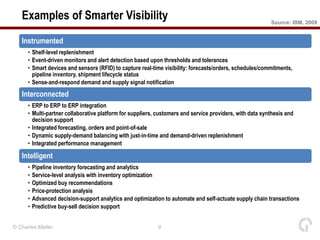
Examples of Smarter Visibility                                                                         Source: IBM, 2009


   Instrumented
      • Shelf-level replenishment
      • Event-driven monitors and alert detection based upon thresholds and tolerances
      • Smart devices and sensors (RFID) to capture real-time visibility: forecasts/orders, schedules/commitments,
        pipeline inventory, shipment lifecycle status
      • Sense-and-respond demand and supply signal notification
   Interconnected
      • ERP to ERP to ERP integration
      • Multi-partner collaborative platform for suppliers, customers and service providers, with data synthesis and
        decision support
      • Integrated forecasting, orders and point-of-sale
      • Dynamic supply-demand balancing with just-in-time and demand-driven replenishment
      • Integrated performance management

   Intelligent
      •   Pipeline inventory forecasting and analytics
      •   Service-level analysis with inventory optimization
      •   Optimized buy recommendations
      •   Price-protection analysis
      •   Advanced decision-support analytics and optimization to automate and self-actuate supply chain transactions
      •   Predictive buy-sell decision support


© Charles Møller                                            9
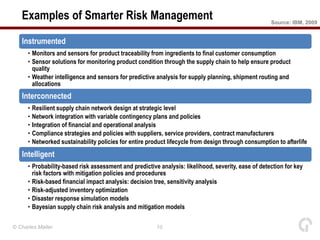
Examples of Smarter Risk Management                                                                 Source: IBM, 2009


   Instrumented
      • Monitors and sensors for product traceability from ingredients to final customer consumption
      • Sensor solutions for monitoring product condition through the supply chain to help ensure product
        quality
      • Weather intelligence and sensors for predictive analysis for supply planning, shipment routing and
        allocations
   Interconnected
      •   Resilient supply chain network design at strategic level
      •   Network integration with variable contingency plans and policies
      •   Integration of financial and operational analysis
      •   Compliance strategies and policies with suppliers, service providers, contract manufacturers
      •   Networked sustainability policies for entire product lifecycle from design through consumption to afterlife
   Intelligent
      • Probability-based risk assessment and predictive analysis: likelihood, severity, ease of detection for key
        risk factors with mitigation policies and procedures
      • Risk-based financial impact analysis: decision tree, sensitivity analysis
      • Risk-adjusted inventory optimization
      • Disaster response simulation models
      • Bayesian supply chain risk analysis and mitigation models

© Charles Møller                                          10
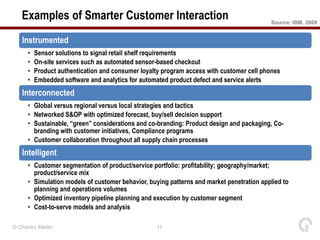
Examples of Smarter Customer Interaction                                               Source: IBM, 2009


   Instrumented
      •   Sensor solutions to signal retail shelf requirements
      •   On-site services such as automated sensor-based checkout
      •   Product authentication and consumer loyalty program access with customer cell phones
      •   Embedded software and analytics for automated product defect and service alerts
   Interconnected
      • Global versus regional versus local strategies and tactics
      • Networked S&OP with optimized forecast, buy/sell decision support
      • Sustainable, “green” considerations and co-branding: Product design and packaging, Co-
        branding with customer initiatives, Compliance programs
      • Customer collaboration throughout all supply chain processes
   Intelligent
      • Customer segmentation of product/service portfolio: profitability; geography/market;
        product/service mix
      • Simulation models of customer behavior, buying patterns and market penetration applied to
        planning and operations volumes
      • Optimized inventory pipeline planning and execution by customer segment
      • Cost-to-serve models and analysis

© Charles Møller                                   11
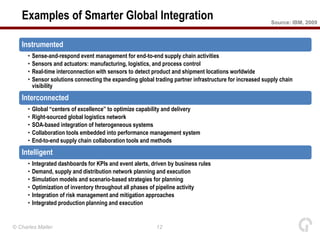
Examples of Smarter Global Integration                                                                  Source: IBM, 2009


   Instrumented
      •   Sense-and-respond event management for end-to-end supply chain activities
      •   Sensors and actuators: manufacturing, logistics, and process control
      •   Real-time interconnection with sensors to detect product and shipment locations worldwide
      •   Sensor solutions connecting the expanding global trading partner infrastructure for increased supply chain
          visibility
   Interconnected
      •   Global “centers of excellence” to optimize capability and delivery
      •   Right-sourced global logistics network
      •   SOA-based integration of heterogeneous systems
      •   Collaboration tools embedded into performance management system
      •   End-to-end supply chain collaboration tools and methods
   Intelligent
      •   Integrated dashboards for KPIs and event alerts, driven by business rules
      •   Demand, supply and distribution network planning and execution
      •   Simulation models and scenario-based strategies for planning
      •   Optimization of inventory throughout all phases of pipeline activity
      •   Integration of risk management and mitigation approaches
      •   Integrated production planning and execution


© Charles Møller                                            12
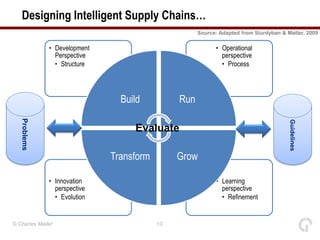
Designing Intelligent Supply Chains…
                                                     Source: Adapted from Siurdyban & Møller, 2009

              • Development                                • Operational
                Perspective                                  perspective
                • Structure                                  • Process


                                Build          Run
   Problems


                                                                                       Guidelines
                                   Evaluate

                              Transform        Grow

              • Innovation                                 • Learning
                perspective                                  perspective
                • Evolution                                  • Refinement


© Charles Møller                          13
Værdikæder i netværk – plug’n play supply chain (1)
   •   Problemstilling/rationale
        Fremstilling foregår i dag i åbne globale værdikæder
        Det gælder også for danske fremstillingsvirksomheder, hvor specielt de
          større virksomheder organiserer deres fremstillingsaktiviteter i globale
          værdikæder
        Det giver ikke alene virksomhederne optimal adgang til nye markeder, men
          også til teknologi, forskning samt højtuddannet og kvalificeret arbejdskraft
        Dansk industri består imidlertid overvejende af små og mellemstore
          virksomheder, hvor en meget stor andel fungerer som fleksible
          underleverandørvirksomheder, der pga. størrelse og ressourcer primært
          fokuserer på nærmarkeder
        Problemet for mange af disse virksomheder er, at selv om de besidder en høj
          kompetence inden for hvert deres felt, så kan de ikke alene matche de store
          internationale kunders krav
        De har ikke adgang til et netværk af samarbejdspartnere, der
          komplementerer deres specialer og de har ikke kapitalstyrke eller opgaver
          nok til at kunne opretholde specialistkompetencer
        Der ligger derfor store muligheder for Danske underleverandører, hvis
          mulighederne for samarbejde i netværk forbedres

© Charles Møller                          14
Værdikæder i netværk – plug’n play supply chain (2)
   •   Mulige forsknings og udviklingsopgaver
        Udvikle metoder og teorier for, hvordan man optimerer/opdeler og skaber øget værdi i
          komplekse værdikæder
        Integration mellem OEM’s og mindre leverandørers ”produktionssystemer”
           Udvikling af et fleksibelt IT system, der kan samle værdikæder i et netværk med
             ukendte partnere
           Udvikling af en virtuel markedsplads til hurtig udbygning af netværk
        Udvikling af metoder, der sikrer, at vi som minimum får den sammen produktivitet i
          netværk som i forhold til single location produktion
        Udvikling af metoder og teknologier der understøtter distribueret R&D
           Innovativ udvikling i netværk, eg. i sammen med kunden, leverandører og videncentre
           Integration af teknologileverandører i udvikling
        Udforskning af netværkssamarbejde og konceptet ”Intelligente” forsyningskæder
        Centrale faktorer og egenskaber der karakteriserer netværk, som bringer dem op på et
          langsigtet vedvarende kompetitivt niveau
        Identifikation af hvilke teknologier, der kan blive danske spydspidser inden for design af
          nye produktionssystemer
        Udvikling af konceptuelle modeller for netværk og tilsvarende produktionssystemer


© Charles Møller                                15
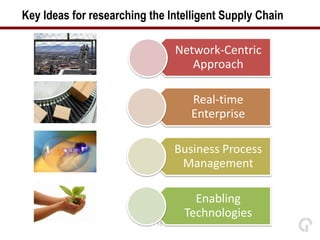
Key Ideas for researching the Intelligent Supply Chain

                                Network-Centric
                                   Approach

                                   Real-time
                                   Enterprise

                                Business Process
                                 Management

                                   Enabling
                                 Technologies
                           16

Intelligent Supply Chains af Charles Møller, CIP på AAU

  • 1.
    Intelligent Supply Chains Værdikæderi netværk og plug’n play supply chains Professor Charles Møller, Ph.D. Center for Industrial Production Aalborg University, Denmark
  • 2.
    Supply Chain Management? Source: Lambert, 2008 "If you are in supply chain management today then complexity is a cancer that you have to fight, and process management is the weapon.” Tom Blackstock, Vice President, Supply Chain Operations, Coca-Cola North America © Charles Møller 2
  • 3.
    Why do weneed intelligent Supply Chains? © Charles Møller 3
  • 4.
    Two Supply ChainParadigms… • Traditional Supply Chain • Intelligent Supply Chain  Cost  Value  Static  Dynamic  Reactive  Proactive  Flexibility  Agility  Planning  Execution  What is the optimal supply  How do we use the existing chain configuration? configuration in the most effective way? © Charles Møller 4
  • 5.
    The Chief SupplyChain Officer Agenda (impact of challenge) Source: IBM, 2009 Cost Containment • Rapid, constant change is rocking this traditional area of strength and outstripping supply chain executives’ ability to (55%) adapt. Supply Chain Visibility • Flooded with more information than ever, supply chain executives still struggle to “see” and act on the right (70%) information. Risk Management • CFOs are not the only senior executives urgently concerned about risk; risk management ranks remarkably high on the (60%) supply chain agenda as well. Customer intimacy/ • Despite demand-driven mantras, companies are better increased demand (56%) connected to their suppliers than their customers. Globalization • Contrary to initial rationale, globalization has proven to be (43%) more about revenue growth than cost savings. © Charles Møller 5
  • 6.
    Smarter Supply Chainof the Future? Source: Lambert, 2008 “Volatile times demand pervasive visibility & flexibility” The IBM Supply Chain Study, 2008 © Charles Møller 6
  • 7.
    The Smarter SupplyChain of the Future Source: IBM, 2009 Instrumented Interconnected Intelligent • Information that was • The entire supply chain • These supply chain previously created by will be connected – not decisions will also be people will increasingly just customers, much smarter be machine-generated – suppliers and IT • Advanced analytics and flowing out of sensors, systems in general, but modeling will help RFID tags, meters, also parts, products decision makers actuators, GPS and and other smart objects evaluate alternatives more used to monitor the against an incredibly • Inventory will count supply chain complex and dynamic itself • Extensive connectivity set of risks and • Containers will detect will enable worldwide constraints their contents networks of supply • And smarter systems • Pallets will report in if chains to plan and will even make some they end up in the make decisions decisions automatically wrong place together – increasing responsiveness and limiting the need for human intervention © Charles Møller 7
  • 8.
    Examples of SmarterCost Containment Source: IBM, 2009 Instrumented • Sensor-based solutions to reduce inventory costs with increased visibility • Production and distribution process detectors to monitor and control energy usage and waste • Physical transportation, distribution and facility asset management, controlled and monitored with smart devices for efficiency and utilization Interconnected • Agile, on demand network of suppliers, contract manufacturers, service providers and other (financial and regulatory) constituents • Outsourcing non-differentiating functions to share risks across the global network • Variable cost structures that fluctuate with market demand • Shared decision making with partners at source (local, regional, global strategies) • Integrated, networked asset utilization and management Intelligent • Network and distribution strategy analysis and modeling with event simulations • Scenario-based operational analysis • Simulation models and analyzers to evaluate flexibility factors – service levels, costs, time, quality – with inventory synchronization • Sustainability models to analyze and monitor usage impact (carbon, energy, water, waste) • Integrated demand and supply management with advanced decision support © Charles Møller 8
  • 9.
    Examples of SmarterVisibility Source: IBM, 2009 Instrumented • Shelf-level replenishment • Event-driven monitors and alert detection based upon thresholds and tolerances • Smart devices and sensors (RFID) to capture real-time visibility: forecasts/orders, schedules/commitments, pipeline inventory, shipment lifecycle status • Sense-and-respond demand and supply signal notification Interconnected • ERP to ERP to ERP integration • Multi-partner collaborative platform for suppliers, customers and service providers, with data synthesis and decision support • Integrated forecasting, orders and point-of-sale • Dynamic supply-demand balancing with just-in-time and demand-driven replenishment • Integrated performance management Intelligent • Pipeline inventory forecasting and analytics • Service-level analysis with inventory optimization • Optimized buy recommendations • Price-protection analysis • Advanced decision-support analytics and optimization to automate and self-actuate supply chain transactions • Predictive buy-sell decision support © Charles Møller 9
  • 10.
    Examples of SmarterRisk Management Source: IBM, 2009 Instrumented • Monitors and sensors for product traceability from ingredients to final customer consumption • Sensor solutions for monitoring product condition through the supply chain to help ensure product quality • Weather intelligence and sensors for predictive analysis for supply planning, shipment routing and allocations Interconnected • Resilient supply chain network design at strategic level • Network integration with variable contingency plans and policies • Integration of financial and operational analysis • Compliance strategies and policies with suppliers, service providers, contract manufacturers • Networked sustainability policies for entire product lifecycle from design through consumption to afterlife Intelligent • Probability-based risk assessment and predictive analysis: likelihood, severity, ease of detection for key risk factors with mitigation policies and procedures • Risk-based financial impact analysis: decision tree, sensitivity analysis • Risk-adjusted inventory optimization • Disaster response simulation models • Bayesian supply chain risk analysis and mitigation models © Charles Møller 10
  • 11.
    Examples of SmarterCustomer Interaction Source: IBM, 2009 Instrumented • Sensor solutions to signal retail shelf requirements • On-site services such as automated sensor-based checkout • Product authentication and consumer loyalty program access with customer cell phones • Embedded software and analytics for automated product defect and service alerts Interconnected • Global versus regional versus local strategies and tactics • Networked S&OP with optimized forecast, buy/sell decision support • Sustainable, “green” considerations and co-branding: Product design and packaging, Co- branding with customer initiatives, Compliance programs • Customer collaboration throughout all supply chain processes Intelligent • Customer segmentation of product/service portfolio: profitability; geography/market; product/service mix • Simulation models of customer behavior, buying patterns and market penetration applied to planning and operations volumes • Optimized inventory pipeline planning and execution by customer segment • Cost-to-serve models and analysis © Charles Møller 11
  • 12.
    Examples of SmarterGlobal Integration Source: IBM, 2009 Instrumented • Sense-and-respond event management for end-to-end supply chain activities • Sensors and actuators: manufacturing, logistics, and process control • Real-time interconnection with sensors to detect product and shipment locations worldwide • Sensor solutions connecting the expanding global trading partner infrastructure for increased supply chain visibility Interconnected • Global “centers of excellence” to optimize capability and delivery • Right-sourced global logistics network • SOA-based integration of heterogeneous systems • Collaboration tools embedded into performance management system • End-to-end supply chain collaboration tools and methods Intelligent • Integrated dashboards for KPIs and event alerts, driven by business rules • Demand, supply and distribution network planning and execution • Simulation models and scenario-based strategies for planning • Optimization of inventory throughout all phases of pipeline activity • Integration of risk management and mitigation approaches • Integrated production planning and execution © Charles Møller 12
  • 13.
    Designing Intelligent SupplyChains… Source: Adapted from Siurdyban & Møller, 2009 • Development • Operational Perspective perspective • Structure • Process Build Run Problems Guidelines Evaluate Transform Grow • Innovation • Learning perspective perspective • Evolution • Refinement © Charles Møller 13
  • 14.
    Værdikæder i netværk– plug’n play supply chain (1) • Problemstilling/rationale  Fremstilling foregår i dag i åbne globale værdikæder  Det gælder også for danske fremstillingsvirksomheder, hvor specielt de større virksomheder organiserer deres fremstillingsaktiviteter i globale værdikæder  Det giver ikke alene virksomhederne optimal adgang til nye markeder, men også til teknologi, forskning samt højtuddannet og kvalificeret arbejdskraft  Dansk industri består imidlertid overvejende af små og mellemstore virksomheder, hvor en meget stor andel fungerer som fleksible underleverandørvirksomheder, der pga. størrelse og ressourcer primært fokuserer på nærmarkeder  Problemet for mange af disse virksomheder er, at selv om de besidder en høj kompetence inden for hvert deres felt, så kan de ikke alene matche de store internationale kunders krav  De har ikke adgang til et netværk af samarbejdspartnere, der komplementerer deres specialer og de har ikke kapitalstyrke eller opgaver nok til at kunne opretholde specialistkompetencer  Der ligger derfor store muligheder for Danske underleverandører, hvis mulighederne for samarbejde i netværk forbedres © Charles Møller 14
  • 15.
    Værdikæder i netværk– plug’n play supply chain (2) • Mulige forsknings og udviklingsopgaver  Udvikle metoder og teorier for, hvordan man optimerer/opdeler og skaber øget værdi i komplekse værdikæder  Integration mellem OEM’s og mindre leverandørers ”produktionssystemer”  Udvikling af et fleksibelt IT system, der kan samle værdikæder i et netværk med ukendte partnere  Udvikling af en virtuel markedsplads til hurtig udbygning af netværk  Udvikling af metoder, der sikrer, at vi som minimum får den sammen produktivitet i netværk som i forhold til single location produktion  Udvikling af metoder og teknologier der understøtter distribueret R&D  Innovativ udvikling i netværk, eg. i sammen med kunden, leverandører og videncentre  Integration af teknologileverandører i udvikling  Udforskning af netværkssamarbejde og konceptet ”Intelligente” forsyningskæder  Centrale faktorer og egenskaber der karakteriserer netværk, som bringer dem op på et langsigtet vedvarende kompetitivt niveau  Identifikation af hvilke teknologier, der kan blive danske spydspidser inden for design af nye produktionssystemer  Udvikling af konceptuelle modeller for netværk og tilsvarende produktionssystemer © Charles Møller 15
  • 16.
    Key Ideas forresearching the Intelligent Supply Chain Network-Centric Approach Real-time Enterprise Business Process Management Enabling Technologies 16