The Challenge of
 Homelessness:
Charity vs Justice
Key Terms that Come to Mind
     Charity                Justice
    Short Term             Long Term
       Love                  Fairness
       Help                   Equity
      Giving            Righting Wrongs
  Giver/Recipient          Entitlement
      Money             Systemic Causes
    Assistance      Justice Leads to Charity
   Compassion             Compassion
    Symptoms
Standard Definitions
The word "charity" entered the English language through the Old French word "charité"
which was derived from the Latin "caritas". Originally in Latin the word caritas meant
preciousness, dearness, high price...

...(T)he act of giving money, goods or time to the unfortunate,

..(T)he most obvious expression of the virtue of charity is giving the objects of it the means
they need to survive. (Wikipedia)
Standard Definitions
The word "charity" entered the English language through the Old French word "charité"
which was derived from the Latin "caritas". Originally in Latin the word caritas meant
preciousness, dearness, high price...

...(T)he act of giving money, goods or time to the unfortunate,

..(T)he most obvious expression of the virtue of charity is giving the objects of it the means
they need to survive. (Wikipedia)

Catholic social teaching distinguishes three dimensions of basic justice: commutative
justice, distributive justice, and social justice

 • Commutative justice calls for fundamental fairness in all agreements and exchanges
   between individuals or private social groups

 • Distributive justice requires that the allocation of income, wealth, and power in
   society be evaluated in light of its effects on persons whose basic material needs are
   unmet.

 • Social justice implies that persons have an obligation to be active and productive
   participants in the life of society and that society has a duty to enable them to
   participate in this way.
Theological Reflection: “Doing Justice”

The link between justice and power:

“…what does it mean to say that ours is a God of
 justice? ...Fundamentally, justice has to do with the
 exercise of power. To say that God is a God of
 justice is to say that (God) is a God who cares
 about the right exercise of power or authority…

When power is exercised in a way that violates
 those (right) standards we call it injustice.”
*Pages 71 and 72 in Good News about Injustice by Gary Haugin of the International Justice Mission
Theological Reflection: “Doing Justice”


Power and “Powers”
Theological Reflection: “Doing Justice”


  Jesus’ Challenge to the “Power
System” (doing justice as challenge)
 Key: Engaging in Symbolic Acts and “Telling
 Stories” (Providing an Alternate Narrative)
Theological Reflection: “Doing Justice”


              Jesus’ Challenge to the “Power
            System” (doing justice as challenge)
              Key: Engaging in Symbolic Acts and “Telling
              Stories” (Providing an Alternate Narrative)
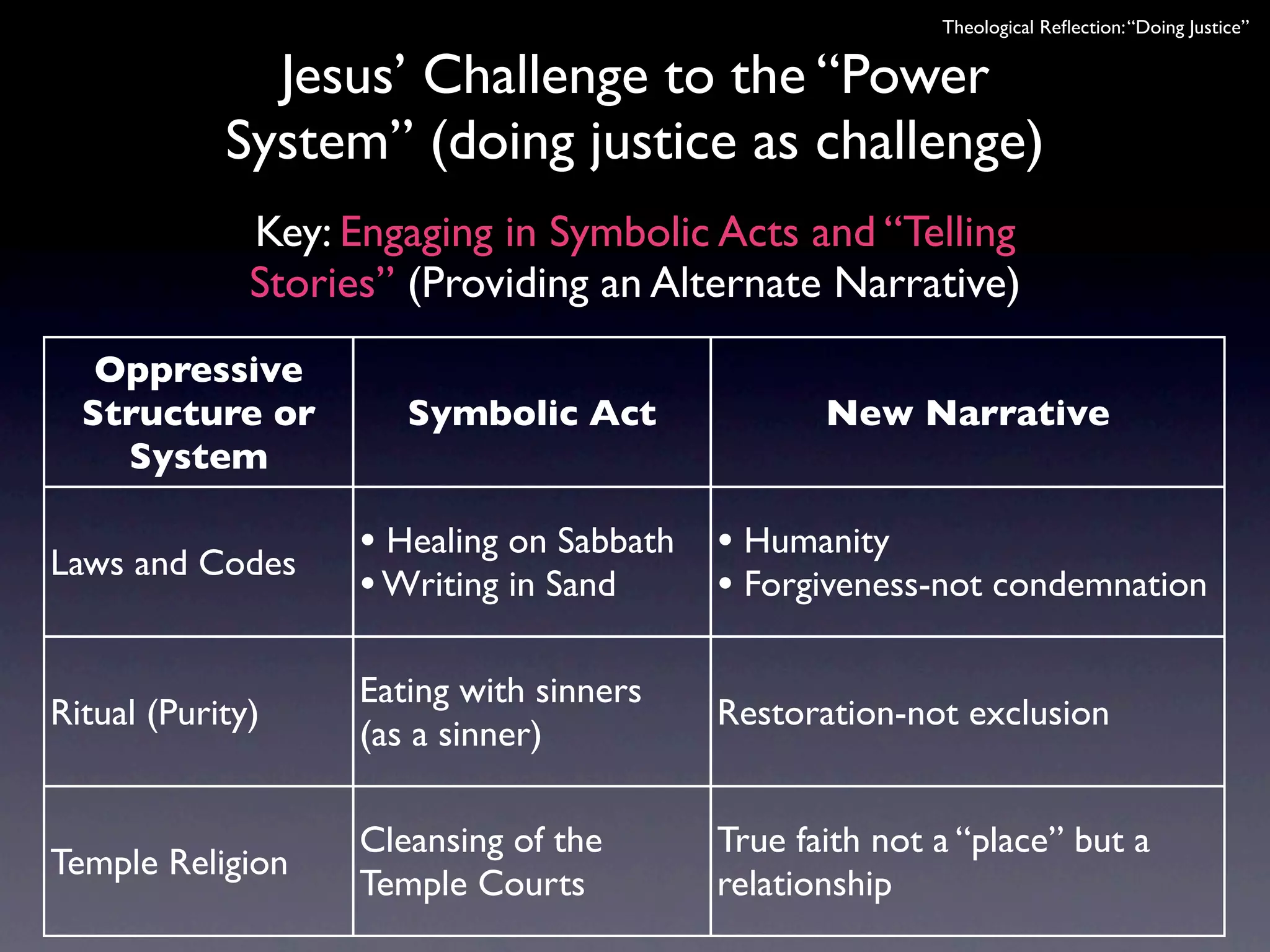
   Oppressive
  Structure or         Symbolic Act              New Narrative
    System

Laws and Codes
                    • Healing on Sabbath • Humanity
                    • Writing in Sand    • Forgiveness-not condemnation

                    Eating with sinners
Ritual (Purity)                           Restoration-not exclusion
                    (as a sinner)

                    Cleansing of the      True faith not a “place” but a
Temple Religion
                    Temple Courts         relationship
Theological Reflection: “Doing Justice”


     The Challenge as “Witness”
John Howard Yoder’s The Christian Witness to the State
Theological Reflection: “Doing Justice”


        The Challenge as “Witness”
John Howard Yoder’s The Christian Witness to the State
 ...the Christian accepts the powers that be and speaks to them in a corrective way.

 ...the Christian witness to the state will not be an imagined pattern of ideal society... An
 ideal or even a “proper” society in a fallen world is by definition impossible. The
 Christian speaks not of how to... seek to create the ideal society but of how the state
 can best fulfill its responsibilities in a fallen society. The Christian witness will therefore
 always express itself in terms of specific criticisms, addressed to given injustices in a
 particular time and place, and specific suggestions for improvements to remedy the
 identified abuse.
Theological Reflection: “Doing Justice”


          The Challenge as “Witness”
John Howard Yoder’s The Christian Witness to the State
 ...the Christian accepts the powers that be and speaks to them in a corrective way.

 ...the Christian witness to the state will not be an imagined pattern of ideal society... An
 ideal or even a “proper” society in a fallen world is by definition impossible. The
 Christian speaks not of how to... seek to create the ideal society but of how the state
 can best fulfill its responsibilities in a fallen society. The Christian witness will therefore
 always express itself in terms of specific criticisms, addressed to given injustices in a
 particular time and place, and specific suggestions for improvements to remedy the
 identified abuse.

 • The witness to the state must be representative of the church’s clear conviction...
 • The witness of the church must be consistent with her own behavior. Only if she
     herself is demonstrably and ethically working on a given problem does the church
     have a right to speak to others...
 •   There should be no sense of a responsibility to “cover the field” with a full gamut of
     statements of every kind of subject that be of any moral significance.
Theological Reflection: “Doing Justice”


                      The Key...
Matthew 9

Jesus was going through all the cities and villages, teaching
in their synagogues and proclaiming the gospel of the
kingdom, and healing every kind of disease and every kind
of sickness.

Seeing the people, He felt compassion for them,
because they were distressed and dispirited like sheep
without a shepherd.

Then He said to His disciples, "The harvest is plentiful, but
the workers are few. Therefore beseech the Lord of the
harvest to send out workers into His harvest."
A More Complete Model for
Thinking About Responding to the
   Challenge of Homelessness
A More Complete Model for
Thinking About Responding to the
   Challenge of Homelessness
A More Complete Model for
 Thinking About Responding to the
    Challenge of Homelessness


Charity
A More Complete Model for
 Thinking About Responding to the
    Challenge of Homelessness


Charity                    Justice
A More Complete Model for
 Thinking About Responding to the
    Challenge of Homelessness


Charity                    Justice
A More Complete Model for
 Thinking About Responding to the
    Challenge of Homelessness
          Relationship-Focused


Charity                          Justice
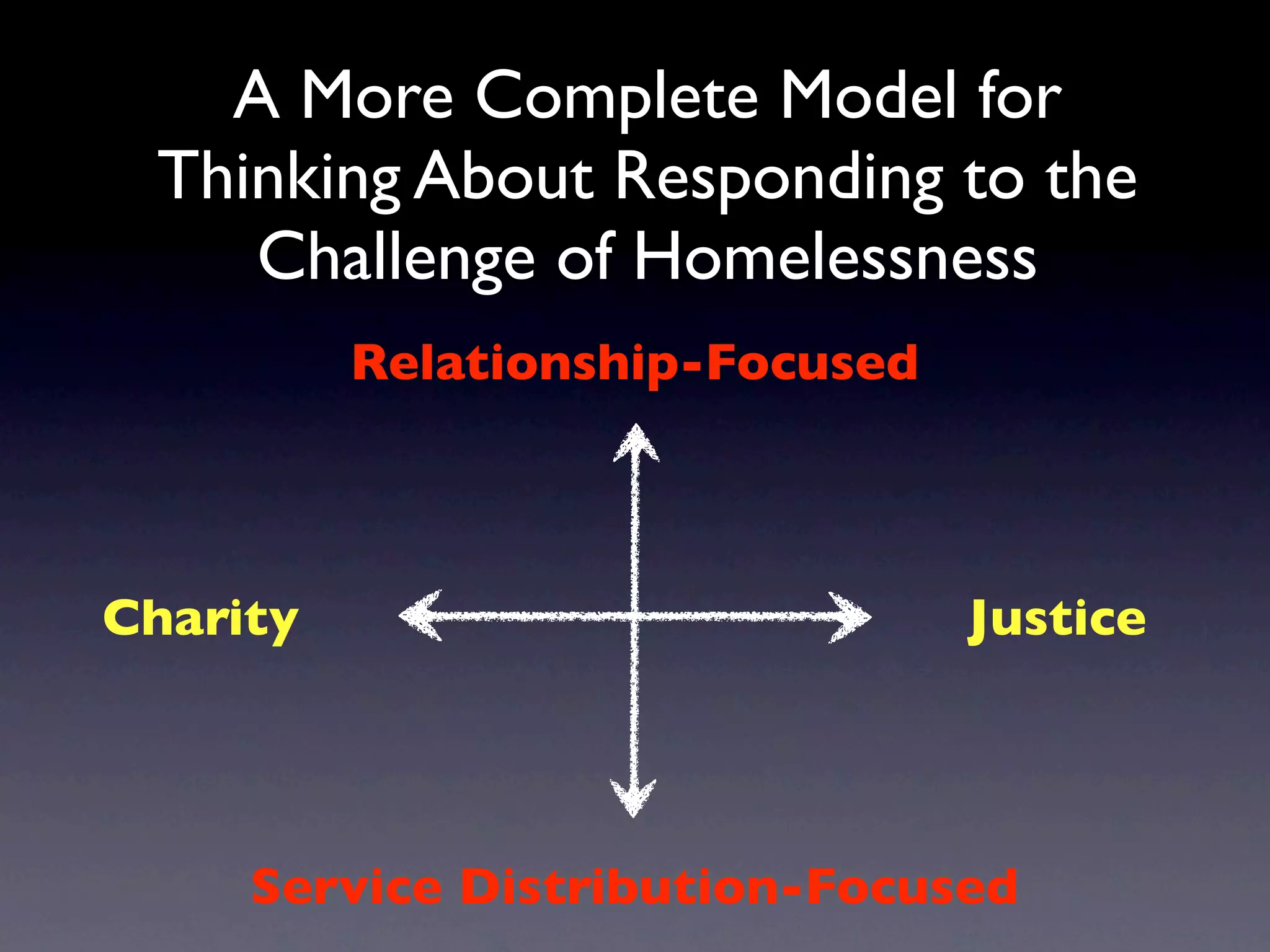
A More Complete Model for
 Thinking About Responding to the
    Challenge of Homelessness
          Relationship-Focused


Charity                          Justice


     Service Distribution-Focused

Charity Versus Justice

  • 1.
    The Challenge of Homelessness: Charity vs Justice
  • 2.
    Key Terms thatCome to Mind Charity Justice Short Term Long Term Love Fairness Help Equity Giving Righting Wrongs Giver/Recipient Entitlement Money Systemic Causes Assistance Justice Leads to Charity Compassion Compassion Symptoms
  • 3.
  • 4.
    Standard Definitions The word"charity" entered the English language through the Old French word "charité" which was derived from the Latin "caritas". Originally in Latin the word caritas meant preciousness, dearness, high price... ...(T)he act of giving money, goods or time to the unfortunate, ..(T)he most obvious expression of the virtue of charity is giving the objects of it the means they need to survive. (Wikipedia)
  • 5.
    Standard Definitions The word"charity" entered the English language through the Old French word "charité" which was derived from the Latin "caritas". Originally in Latin the word caritas meant preciousness, dearness, high price... ...(T)he act of giving money, goods or time to the unfortunate, ..(T)he most obvious expression of the virtue of charity is giving the objects of it the means they need to survive. (Wikipedia) Catholic social teaching distinguishes three dimensions of basic justice: commutative justice, distributive justice, and social justice • Commutative justice calls for fundamental fairness in all agreements and exchanges between individuals or private social groups • Distributive justice requires that the allocation of income, wealth, and power in society be evaluated in light of its effects on persons whose basic material needs are unmet. • Social justice implies that persons have an obligation to be active and productive participants in the life of society and that society has a duty to enable them to participate in this way.
  • 6.
    Theological Reflection: “DoingJustice” The link between justice and power: “…what does it mean to say that ours is a God of justice? ...Fundamentally, justice has to do with the exercise of power. To say that God is a God of justice is to say that (God) is a God who cares about the right exercise of power or authority… When power is exercised in a way that violates those (right) standards we call it injustice.” *Pages 71 and 72 in Good News about Injustice by Gary Haugin of the International Justice Mission
  • 7.
    Theological Reflection: “DoingJustice” Power and “Powers”
  • 8.
    Theological Reflection: “DoingJustice” Jesus’ Challenge to the “Power System” (doing justice as challenge) Key: Engaging in Symbolic Acts and “Telling Stories” (Providing an Alternate Narrative)
  • 9.
    Theological Reflection: “DoingJustice” Jesus’ Challenge to the “Power System” (doing justice as challenge) Key: Engaging in Symbolic Acts and “Telling Stories” (Providing an Alternate Narrative) Oppressive Structure or Symbolic Act New Narrative System Laws and Codes • Healing on Sabbath • Humanity • Writing in Sand • Forgiveness-not condemnation Eating with sinners Ritual (Purity) Restoration-not exclusion (as a sinner) Cleansing of the True faith not a “place” but a Temple Religion Temple Courts relationship
  • 10.
    Theological Reflection: “DoingJustice” The Challenge as “Witness” John Howard Yoder’s The Christian Witness to the State
  • 11.
    Theological Reflection: “DoingJustice” The Challenge as “Witness” John Howard Yoder’s The Christian Witness to the State ...the Christian accepts the powers that be and speaks to them in a corrective way. ...the Christian witness to the state will not be an imagined pattern of ideal society... An ideal or even a “proper” society in a fallen world is by definition impossible. The Christian speaks not of how to... seek to create the ideal society but of how the state can best fulfill its responsibilities in a fallen society. The Christian witness will therefore always express itself in terms of specific criticisms, addressed to given injustices in a particular time and place, and specific suggestions for improvements to remedy the identified abuse.
  • 12.
    Theological Reflection: “DoingJustice” The Challenge as “Witness” John Howard Yoder’s The Christian Witness to the State ...the Christian accepts the powers that be and speaks to them in a corrective way. ...the Christian witness to the state will not be an imagined pattern of ideal society... An ideal or even a “proper” society in a fallen world is by definition impossible. The Christian speaks not of how to... seek to create the ideal society but of how the state can best fulfill its responsibilities in a fallen society. The Christian witness will therefore always express itself in terms of specific criticisms, addressed to given injustices in a particular time and place, and specific suggestions for improvements to remedy the identified abuse. • The witness to the state must be representative of the church’s clear conviction... • The witness of the church must be consistent with her own behavior. Only if she herself is demonstrably and ethically working on a given problem does the church have a right to speak to others... • There should be no sense of a responsibility to “cover the field” with a full gamut of statements of every kind of subject that be of any moral significance.
  • 13.
    Theological Reflection: “DoingJustice” The Key... Matthew 9 Jesus was going through all the cities and villages, teaching in their synagogues and proclaiming the gospel of the kingdom, and healing every kind of disease and every kind of sickness. Seeing the people, He felt compassion for them, because they were distressed and dispirited like sheep without a shepherd. Then He said to His disciples, "The harvest is plentiful, but the workers are few. Therefore beseech the Lord of the harvest to send out workers into His harvest."
  • 14.
    A More CompleteModel for Thinking About Responding to the Challenge of Homelessness
  • 15.
    A More CompleteModel for Thinking About Responding to the Challenge of Homelessness
  • 16.
    A More CompleteModel for Thinking About Responding to the Challenge of Homelessness Charity
  • 17.
    A More CompleteModel for Thinking About Responding to the Challenge of Homelessness Charity Justice
  • 18.
    A More CompleteModel for Thinking About Responding to the Challenge of Homelessness Charity Justice
  • 19.
    A More CompleteModel for Thinking About Responding to the Challenge of Homelessness Relationship-Focused Charity Justice
  • 20.
    A More CompleteModel for Thinking About Responding to the Challenge of Homelessness Relationship-Focused Charity Justice Service Distribution-Focused