At the endof this chapter, you should be able to:
• Characterize artistic literacy;
• Discuss the value of art, education, and practical life;
• Identify approaches to developing/designing
curriculum that cultivates the arts and creativity
among learners;
• Formulate a personal definition of creativity; and
• Design creative and innovative classroom activities for
specific topic and grade level of students.
OBJECTIVES
3.
• The knowledgeand understanding required to
participate authentically in the arts. While
individuals can learn about dance, media, music,
theater, and visual arts through reading print text,
artistic literacy requires that they engage in artistic
creation processes directly though the use of
materials and in specific space.
• Researchers have recognized that there are
significant benefits of arts learning and
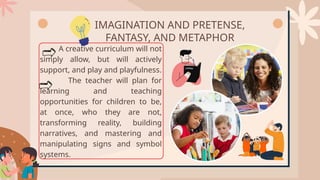
engagement in schooling. (Eisner et al. 2002)
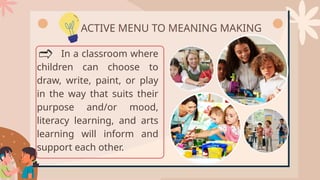
ARTISTIC LITERACY
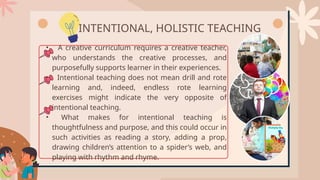
4.
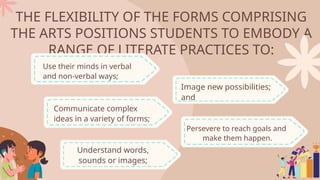
THE FLEXIBILITY OFTHE FORMS COMPRISING
THE ARTS POSITIONS STUDENTS TO EMBODY A
RANGE OF LITERATE PRACTICES TO:
Communicate complex
ideas in a variety of forms;
Use their minds in verbal
and non-verbal ways;
Image new possibilities;
and
Understand words,
sounds or images;
Persevere to reach goals and
make them happen.
5.
• Being ableto critically read, write, and speak
about art should not be the sole constituting
factor for what counts as literacy in the Arts
(Shenfield, 2015).
• The cultivation of Imagination and creativity and
the formation of deeper theory surrounding
multimodality and multi-literacies in the Arts are
paramount.
ARTISTIC LITERACY
6.
• Being ableto critically read, write, and speak
about art should not be the sole constituting
factor for what counts as literacy in the Arts
(Shenfield, 2015).
• The cultivation of Imagination and creativity and
the formation of deeper theory surrounding
multimodality and multi-literacies in the Arts are
paramount.
ARTISTIC LITERACY
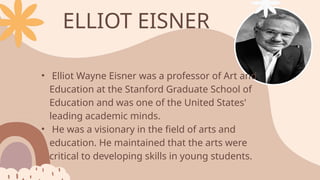
• Elliot WayneEisner was a professor of Art and
Education at the Stanford Graduate School of
Education and was one of the United States'
leading academic minds.
• He was a visionary in the field of arts and
education. He maintained that the arts were
critical to developing skills in young students.
ELLIOT EISNER
9.
VALUABLE LESSONS orBENEFITS that
Education can Learn from THE ARTS
• Form and content cannot be
separated. How something is said
or done shapes the content of
experience
In education, how something
is taught, how curricula are
organized, and how schools are
designed impact upon what
students will learn. Thus, the
real main effects of practice are
considered to be as “side
effects”.
2. Everything interacts; there is no
content without form and no form
without content.
When the content of a
form is changed, so too, is
the form altered. Form and
content are like two sides of
a coin. One cannot have one
without the other.
10.
VALUABLE LESSONS orBENEFITS that
Education can Learn from THE ARTS
3. Nuance matters. To the extent to
which teaching is an art, attention
to nuance is critical.
It can also be said that the
aesthetic lives are the details that
the maker can shape in the course
of creation. How a word is spoken,
how a gesture is made, how a line is
written, and how a melody is played,
all affects the character of the
whole. All depend upon the
modulation of the nuance that
constitute the act.
4. Surprise is not to be seen as an
intruder in the process of inquiry,
but as a part of the rewards one
reaps when working artistically.
No surprise, no discovery; and if
there’s no discovery, there will be
no progress. Therefore, educators
should not resist surprise, but
create the conditions to make it
happen. It is one of the most
powerful sources of intrinsic
satisfaction.
11.
VALUABLE LESSONS orBENEFITS that
Education can Learn from THE ARTS
5. Slowing down perception is the
most promising way to see what is
actually there.
• It is true that we have certain words to
designate high levels of intelligence.
We describe somebody as being swift,
or bright, or sharp, or fast on the
pickup.
• Yet, one of the qualities we ought to be
promoting in our schools is a slowing
down of perception: the ability to take
one’s time, to smell the flowers, to
really perceive in the Dewayan sense,
and not merely to recognize what one
looks at.
6. The limits of language are not
the limits of cognition. We know
more than we can tell.
• Literacy is associated with high-
level forms of cognition. We tend
to think that to know, one has to
be able to say.
• As Michael Polany reminds us, we
know more than we can tell. That
is, the implications of that idea
are profound for education.
12.
VALUABLE LESSONS orBENEFITS that
Education can Learn from THE ARTS
5. Slowing down perception is the
most promising way to see what is
actually there.
• It is true that we have certain words to
designate high levels of intelligence.
We describe somebody as being swift,
or bright, or sharp, or fast on the
pickup.
• Yet, one of the qualities we ought to be
promoting in our schools is a slowing
down of perception: the ability to take
one’s time, to smell the flowers, to
really perceive in the Dewayan sense,
and not merely to recognize what one
looks at.
6. The limits of language are not
the limits of cognition. We know
more than we can tell.
• Literacy is associated with high-
level forms of cognition. We tend
to think that to know, one has to
be able to say.
• As Michael Polany reminds us, we
know more than we can tell. That
is, the implications of that idea
are profound for education.
13.
VALUABLE LESSONS orBENEFITS that
Education can Learn from THE ARTS
7. Somatic experience is one of the
most important indicators that
someone has gotten it right.
• Somatic experience is abody
knowledge; a sense of rightness of fit,
an ability to discriminate without being
able to articulate the conditions that
made it possible. Thus body knows and
forms the basis for intuition.
• As Susanne Langer once commented,
"the senses are our first avenues to
consciousness”. Therefore, there is
nothing in the head that was not first
in the hand.
8. Open-ended tasks permit the exercise of
imagination, and the exercise of
imagination is one of the most important
of human aptitudes.
• In the arts, imagination is a primary
virtue, not necessity, which is the mother
of invention.
• It should be in the teaching of
mathematics, in all the sciences, in
history and, indeed, in virtually all that
humans create.
• This achievement would require for its
realization a culture of schooling in
which imaginative aspects of the human
condition were made possible.
• use avariety of artistic media, symbols, and metaphors to
communicate their own ideas and to respond to the artistic
communications of others;
• develop creative personal realization in at least one art form in
which they continue active involvement as an adult;
• cultivate culture, history, and other connections through
diverse forms and genres of artwork;
• find joy, inspiration, intellectual stimulation, and meaning
when they participate in the arts; and
• seek artistic experiences and support the arts in their
communities.
LITERATURE ON ART EDUCATION AND ART STANDARDS
IN EDUCATION CITED THE FOLLOWING AS COMMON
TRAITS OF ARTISTICALLY LITERATE INDIVIDUALS:
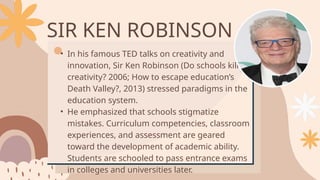
SIR KEN ROBINSON
•In his famous TED talks on creativity and
innovation, Sir Ken Robinson (Do schools kill
creativity? 2006; How to escape education’s
Death Valley?, 2013) stressed paradigms in the
education system.
• He emphasized that schools stigmatize
mistakes. Curriculum competencies, classroom
experiences, and assessment are geared
toward the development of academic ability.
Students are schooled to pass entrance exams
in colleges and universities later.
18.
• educate thewell-being of learner and shift from the
conventional leanings toward academic ability alone;
• give equal weight to the arts, the humanities , and the
physical education;
• facilitate learning and work toward stimulating
curiosity among learners;
• awaken and develop powers of creativity among
learners; and
• view intelligence as diverse, dynamic, and distinct,
contrary to common belief should be academic ability-
geared.
BECAUSE OF THIS PAINFUL TRUTH, ROBINSON
CHALLENGED EDUCATORS TO:
19.
In “First Literacies:Art, Creativity, Play,
Constructive Meaning-Making,” McArdle and
Wright asserted that educators should make
deliberate connections with children’s first
literacies of art and play. The authors proposed
four essential components to developing or
designing a curriculum that cultivates students’
artistic and creative literacy.
20.
A creative curriculumwill not
simply allow, but will actively
support, and play and playfulness.
The teacher will plan for
learning and teaching
opportunities for children to be,
at once, who they are not,
transforming reality, building
narratives, and mastering and
manipulating signs and symbol
systems.
IMAGINATION AND PRETENSE,
FANTASY, AND METAPHOR
21.
In a classroomwhere
children can choose to
draw, write, paint, or play
in the way that suits their
purpose and/or mood,
literacy learning, and arts
learning will inform and
support each other.
ACTIVE MENU TO MEANING MAKING
22.
• A creativecurriculum requires a creative teacher,
who understands the creative processes, and
purposefully supports learner in their experiences.
• Intentional teaching does not mean drill and rote
learning and, indeed, endless rote learning
exercises might indicate the very opposite of
intentional teaching.
• What makes for intentional teaching is
thoughtfulness and purpose, and this could occur in
such activities as reading a story, adding a prop,
drawing children’s attention to a spider’s web, and
playing with rhythm and rhyme.
INTENTIONAL, HOLISTIC TEACHING
23.
• Educators mustbe reminded of the
importance of understanding children as
current citizens, with capacities and
capabilities in the here and now.
• It is vital for teachers to know and appreciate
children and what they know by being
mindful of the present and making time for
conversation, interacting with the children as
they draw.
• Teacher must try to avoid letting the busy
management work of their days take
precedence and distract them from the
‘being.
CO-PLAYER, CO-ARTIST