CHARACTERISTICS OF
VERBS
8 Characteristics of Verbs:
1. Form 5. Agreement
2. Tense 6. Gerunds and Infinitives
Action – Verbs are words that describe actions or events that can be done by
someone or something.
Example: I ran a marathon yesterday.
I run every morning for exercise
Tense – Verbs can show the time of the action – present, past or future – through the
use of tense
Examples:
Present Tense – I walk to school everyday.
Past Tense – I cooked rice yesterday.
Future Tense – John will attend a party tomorrow.
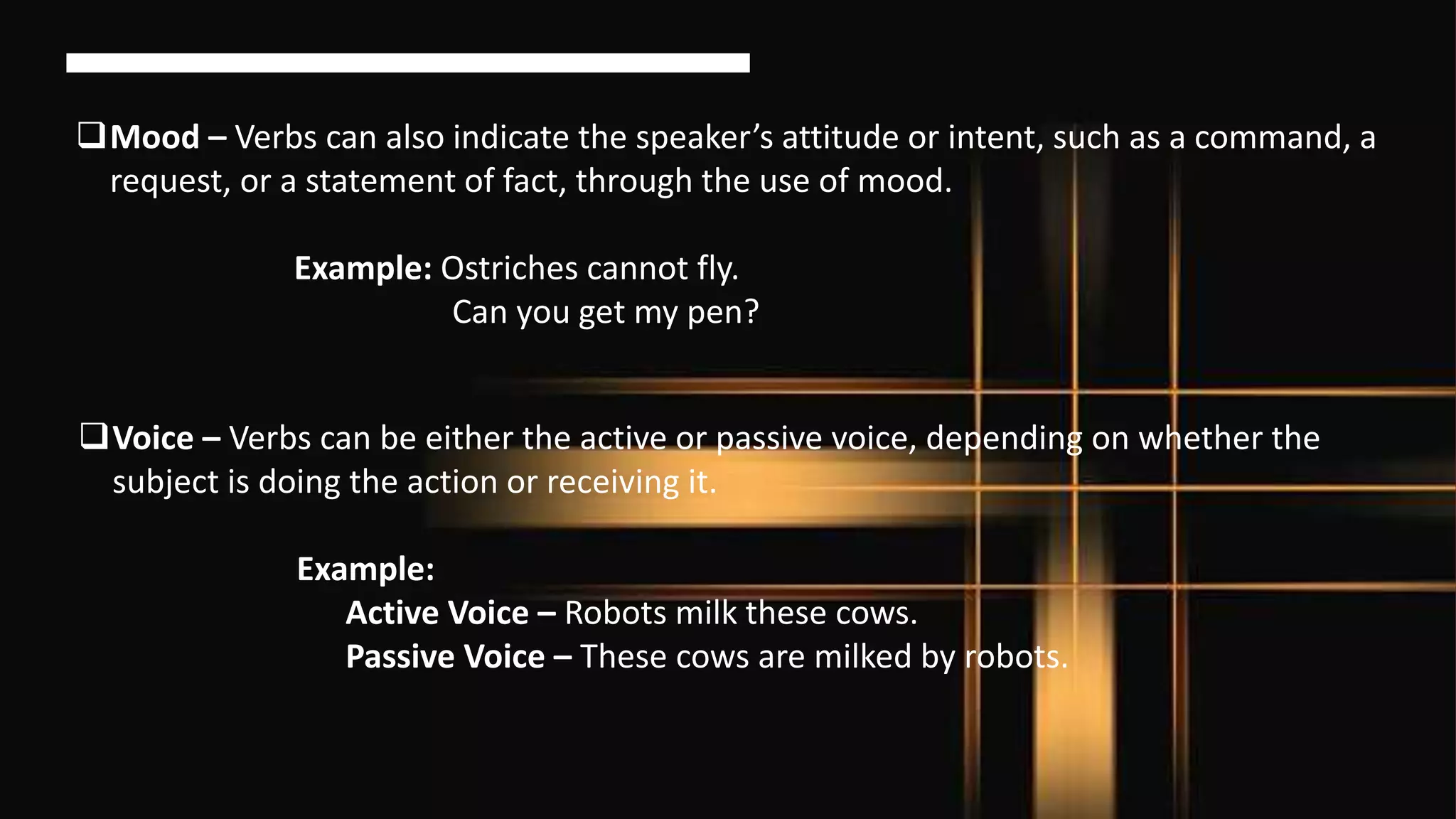
Mood – Verbs can also indicate the speaker’s attitude or intent, such as a command, a
request, or a statement of fact, through the use of mood.
Example: Ostriches cannot fly.
Can you get my pen?
Voice – Verbs can be either the active or passive voice, depending on whether the
subject is doing the action or receiving it.
Example:
Active Voice – Robots milk these cows.
Passive Voice – These cows are milked by robots.
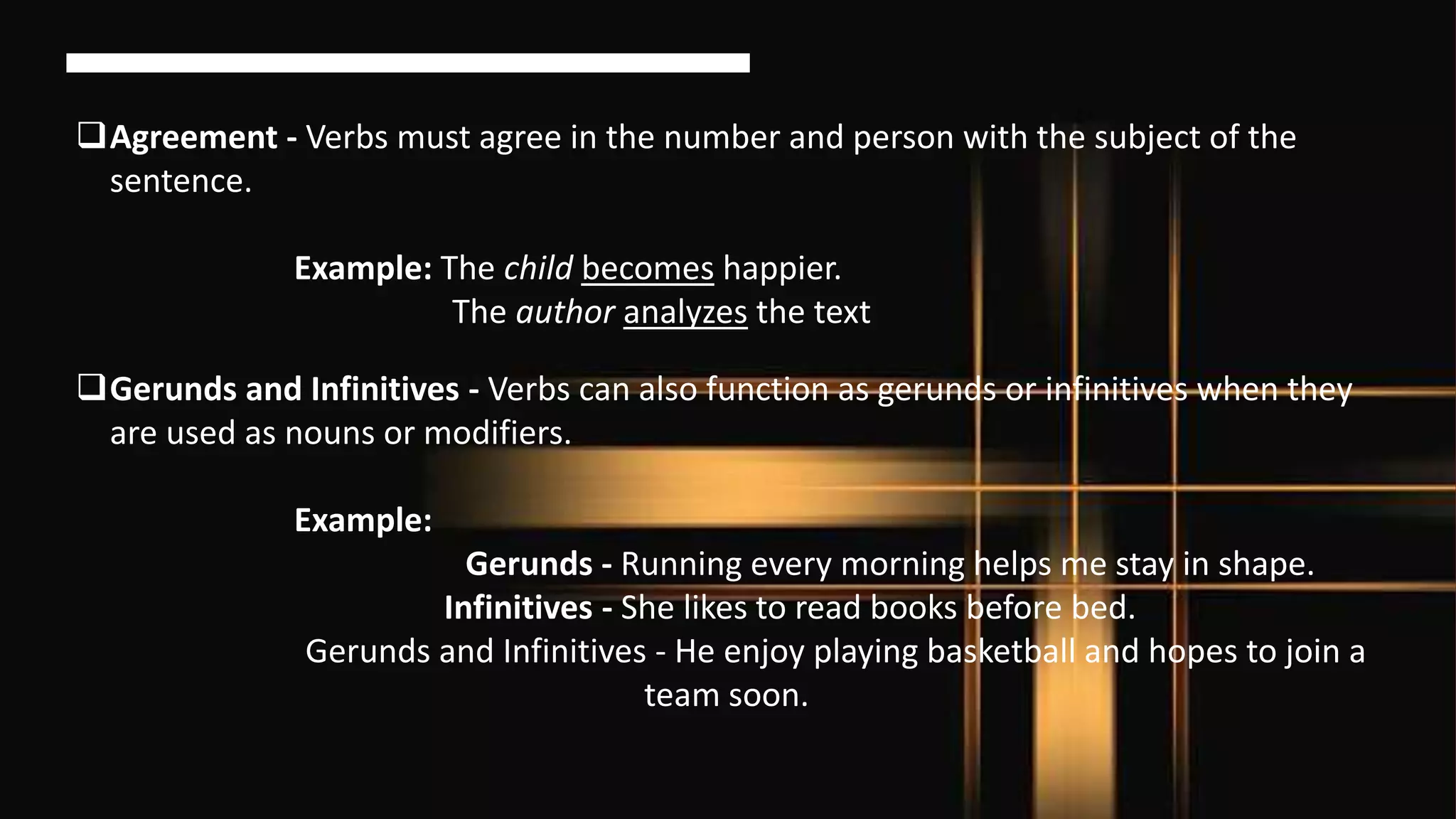
Agreement - Verbs must agree in the number and person with the subject of the
sentence.
Example: The child becomes happier.
The author analyzes the text
Gerunds and Infinitives - Verbs can also function as gerunds or infinitives when they
are used as nouns or modifiers.
Example:
Gerunds - Running every morning helps me stay in shape.
Infinitives - She likes to read books before bed.
Gerunds and Infinitives - He enjoy playing basketball and hopes to join a
team soon.
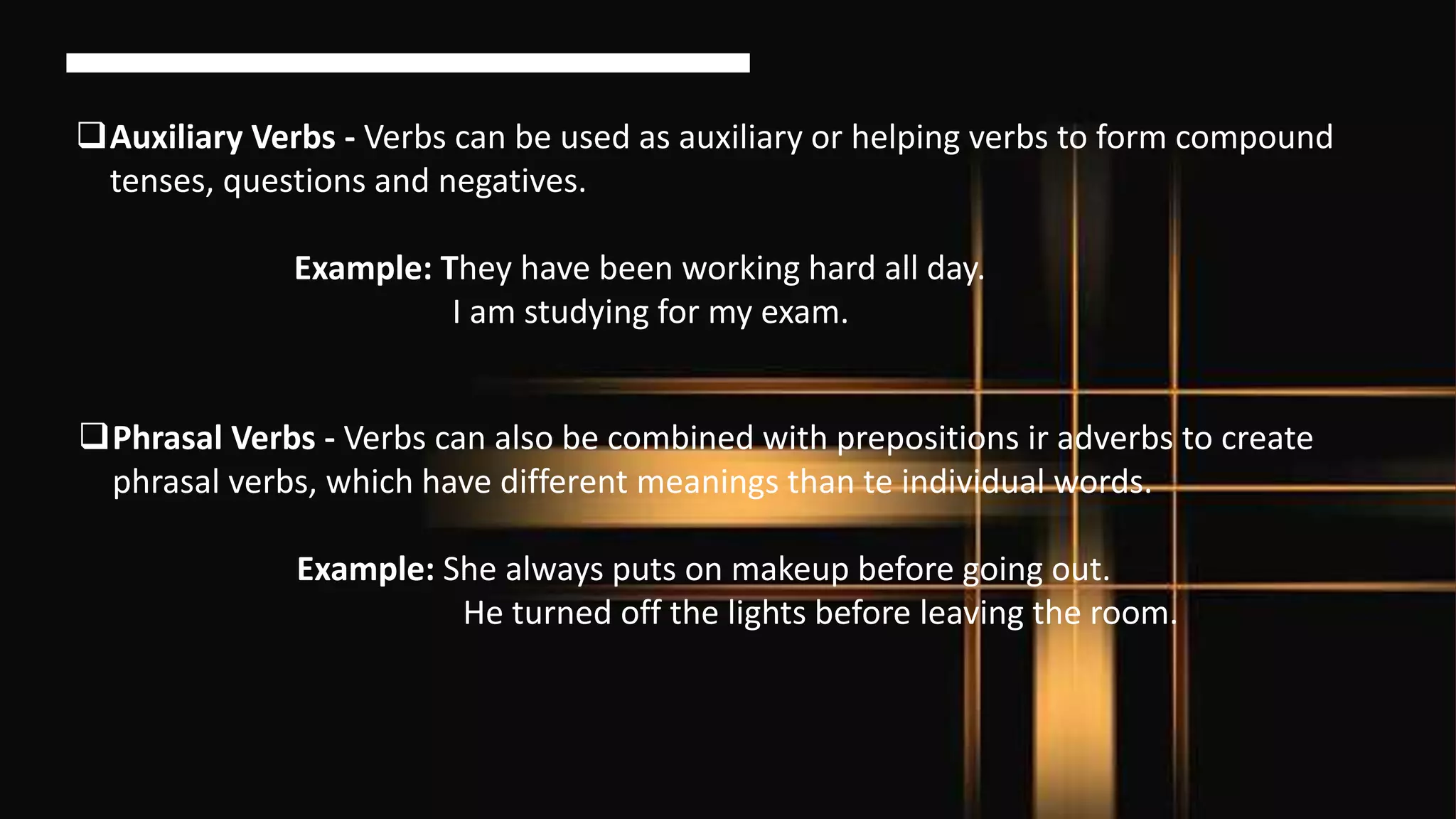
Auxiliary Verbs - Verbs can be used as auxiliary or helping verbs to form compound
tenses, questions and negatives.
Example: They have been working hard all day.
I am studying for my exam.
Phrasal Verbs - Verbs can also be combined with prepositions ir adverbs to create
phrasal verbs, which have different meanings than te individual words.
Example: She always puts on makeup before going out.
He turned off the lights before leaving the room.
THANK YOU FOR LISTENING
Prepared by: Wenafe G. Rañola

Characteristics of verbs.pptx

  • 1.
    CHARACTERISTICS OF VERBS 8 Characteristicsof Verbs: 1. Form 5. Agreement 2. Tense 6. Gerunds and Infinitives
  • 2.
    Action – Verbsare words that describe actions or events that can be done by someone or something. Example: I ran a marathon yesterday. I run every morning for exercise Tense – Verbs can show the time of the action – present, past or future – through the use of tense Examples: Present Tense – I walk to school everyday. Past Tense – I cooked rice yesterday. Future Tense – John will attend a party tomorrow.
  • 3.
    Mood – Verbscan also indicate the speaker’s attitude or intent, such as a command, a request, or a statement of fact, through the use of mood. Example: Ostriches cannot fly. Can you get my pen? Voice – Verbs can be either the active or passive voice, depending on whether the subject is doing the action or receiving it. Example: Active Voice – Robots milk these cows. Passive Voice – These cows are milked by robots.
  • 4.
    Agreement - Verbsmust agree in the number and person with the subject of the sentence. Example: The child becomes happier. The author analyzes the text Gerunds and Infinitives - Verbs can also function as gerunds or infinitives when they are used as nouns or modifiers. Example: Gerunds - Running every morning helps me stay in shape. Infinitives - She likes to read books before bed. Gerunds and Infinitives - He enjoy playing basketball and hopes to join a team soon.
  • 5.
    Auxiliary Verbs -Verbs can be used as auxiliary or helping verbs to form compound tenses, questions and negatives. Example: They have been working hard all day. I am studying for my exam. Phrasal Verbs - Verbs can also be combined with prepositions ir adverbs to create phrasal verbs, which have different meanings than te individual words. Example: She always puts on makeup before going out. He turned off the lights before leaving the room.
  • 6.
    THANK YOU FORLISTENING Prepared by: Wenafe G. Rañola