Motion & Forces
Motion& Forces
Defining Force
Defining Force
Force
Force
Newton’s First Law
Newton’s First Law
Friction
Friction
2.
Force
Force
Force
Force
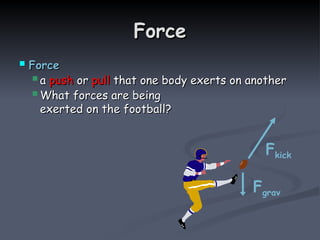
a
apush
push or
or pull
pull that one body exerts on another
that one body exerts on another
What forces are being
What forces are being
exerted on the football?
exerted on the football?
Fkick
Fgrav
3.
Force
Force
Sometimes itis obvious that a
Sometimes it is obvious that a force
force has
has
been applied.
been applied.
But other forces aren't as noticeable.
But other forces aren't as noticeable.
A force can cause the
A force can cause the motion
motion of an object
of an object
to
to change
change.
.
If you have played billiards, you know that
If you have played billiards, you know that
you can force a ball at rest to roll into a
you can force a ball at rest to roll into a
pocket by striking it with another ball.
pocket by striking it with another ball.
4.
Changing Motion
Changing Motion
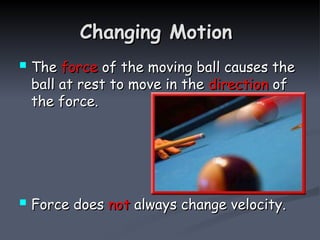
The
The force
force of the moving ball causes the
of the moving ball causes the
ball at rest to move in the
ball at rest to move in the direction
direction of
of
the force.
the force.
Force does
Force does not
not always change velocity.
always change velocity.
5.
Force
Force
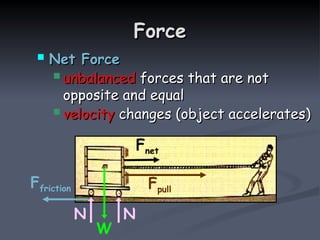
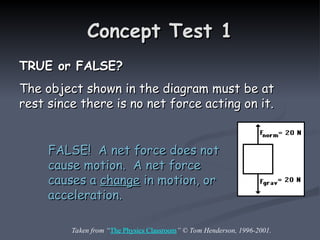
Net Force
NetForce
unbalanced
unbalanced forces that are not
forces that are not
opposite and equal
opposite and equal
velocity
velocity changes (object accelerates)
changes (object accelerates)
Ffriction
W
Fpull
Fnet
N
N
6.
Balanced Forces
Balanced Forces
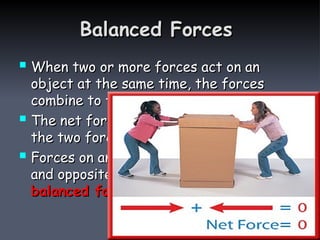
When two or more forces act on an
When two or more forces act on an
object at the same time, the forces
object at the same time, the forces
combine to form the
combine to form the net force
net force
The net force on the box is zero because
The net force on the box is zero because
the two forces cancel each other.
the two forces cancel each other.
Forces on an object that are equal in size
Forces on an object that are equal in size
and opposite in direction are called
and opposite in direction are called
balanced forces
balanced forces.
.
7.
Force
Force
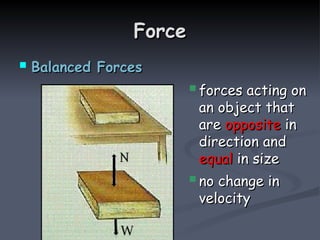
Balanced Forces
BalancedForces
forces acting on
forces acting on
an object that
an object that
are
are opposite
opposite in
in
direction and
direction and
equal
equal in size
in size
no change in
no change in
velocity
velocity
8.
Unbalanced Forces
Unbalanced Forces
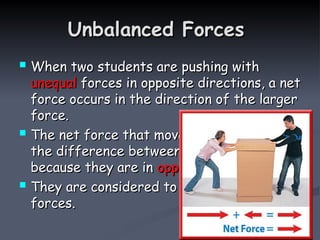
When two students are pushing with
When two students are pushing with
unequal
unequal forces in opposite directions, a net
forces in opposite directions, a net
force occurs in the direction of the larger
force occurs in the direction of the larger
force.
force.
The net force that moves the box will be
The net force that moves the box will be
the difference between the two forces
the difference between the two forces
because they are in
because they are in opposite
opposite directions.
directions.
They are considered to be unbalanced
They are considered to be unbalanced
forces.
forces.
9.
Unbalanced Forces
Unbalanced Forces
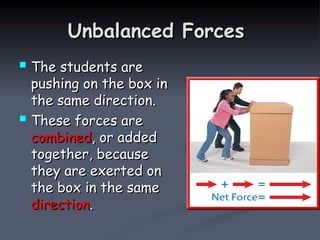
The students are
The students are
pushing on the box in
pushing on the box in
the same direction.
the same direction.
These forces are
These forces are
combined
combined, or added
, or added
together, because
together, because
they are exerted on
they are exerted on
the box in the same
the box in the same
direction
direction.
.
10.
Unbalanced Forces
Unbalanced Forces
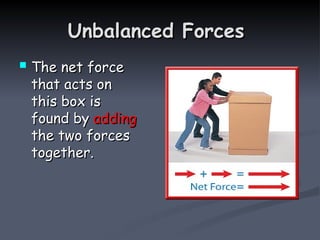
The net force
The net force
that acts on
that acts on
this box is
this box is
found by
found by adding
adding
the two forces
the two forces
together.
together.
11.
Inertia and Mass
Inertiaand Mass
Inertia
Inertia is the tendency of an object to
is the tendency of an object to
resist any change in its motion
resist any change in its motion
If an object is moving, it will have
If an object is moving, it will have
uniform
uniform motion.
motion.
It will keep moving at the same speed
It will keep moving at the same speed
and in the same direction unless an
and in the same direction unless an
unbalanced
unbalanced force acts on it
force acts on it
12.
Inertia and Mass
Inertiaand Mass
The velocity of the object remains
The velocity of the object remains
constant
constant unless a force changes it.
unless a force changes it.
If an object is at rest, it tends to
If an object is at rest, it tends to
remain at rest. Its velocity is
remain at rest. Its velocity is zero
zero
unless a force makes it move.
unless a force makes it move.
The inertia of an object is related to its
The inertia of an object is related to its
mass. The greater the
mass. The greater the mass
mass of an
of an
object is, the greater its inertia
object is, the greater its inertia
13.
What happens ina crash?
What happens in a crash?
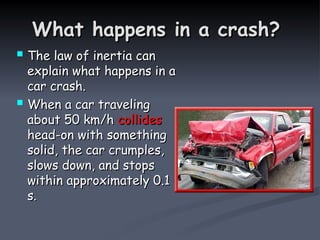
The law of inertia can
The law of inertia can
explain what happens in a
explain what happens in a
car crash.
car crash.
When a car traveling
When a car traveling
about 50 km/h
about 50 km/h collides
collides
head-on with something
head-on with something
solid, the car crumples,
solid, the car crumples,
slows down, and stops
slows down, and stops
within approximately 0.1
within approximately 0.1
s.
s.
14.
What happens ina crash?
What happens in a crash?
Any passenger not wearing a safety belt
Any passenger not wearing a safety belt
continues to move
continues to move forward
forward at the same speed
at the same speed
the car was traveling.
the car was traveling.
Within about 0.02 s (
Within about 0.02 s (1/50
1/50 of a second) after
of a second) after
the car stops, unbelted passengers slam into
the car stops, unbelted passengers slam into
the dashboard, steering wheel, windshield, or
the dashboard, steering wheel, windshield, or
the backs of the front seats.
the backs of the front seats.
The force needed to slow a person from 50
The force needed to slow a person from 50
km/h to zero in 0.1 s is equal to
km/h to zero in 0.1 s is equal to 14
14 times the
times the
force that gravity exerts on the person.
force that gravity exerts on the person.
15.
What happens ina crash?
What happens in a crash?
The belt loosens a little as it restrains
The belt loosens a little as it restrains
the person, increasing the time it takes
the person, increasing the time it takes
to slow the person down.
to slow the person down.
This reduces the
This reduces the force
force exerted on the
exerted on the
person.
person.
The safety belt also prevents the
The safety belt also prevents the
person from being
person from being thrown
thrown out of the
out of the
car.
car.
16.
Safety Belts
Safety Belts
Air bags also reduce injuries in car
Air bags also reduce injuries in car
crashes by providing a
crashes by providing a cushion
cushion that
that
reduces the force on the car's occupants.
reduces the force on the car's occupants.
When impact occurs, a chemical
When impact occurs, a chemical reaction
reaction
occurs in the air bag that produces
occurs in the air bag that produces
nitrogen gas.
nitrogen gas.
The air bag expands rapidly and then
The air bag expands rapidly and then
deflates just as quickly as the
deflates just as quickly as the nitrogen
nitrogen
gas escapes out of tiny holes in the bag.
gas escapes out of tiny holes in the bag.
17.
Newton’s First Law
Newton’sFirst Law
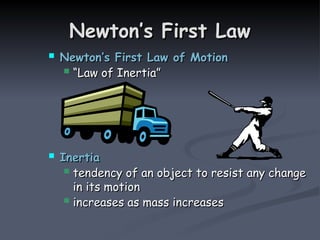
Newton’s First Law of Motion
Newton’s First Law of Motion
“
“Law of Inertia”
Law of Inertia”
Inertia
Inertia
tendency of an object to resist any change
tendency of an object to resist any change
in its motion
in its motion
increases as mass increases
increases as mass increases
Concept Test 2
ConceptTest 2
You are a passenger in a car and not wearing your
You are a passenger in a car and not wearing your
seat belt.
seat belt.
Without increasing or decreasing its speed, the
Without increasing or decreasing its speed, the
car makes a sharp left turn, and you find yourself
car makes a sharp left turn, and you find yourself
colliding with the right-hand door.
colliding with the right-hand door.
Which is the correct analysis of the situation? ...
Which is the correct analysis of the situation? ...
20.
ConcepTest 2
ConcepTest 2
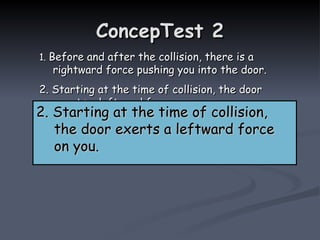
1.
1.Before and after the collision, there is a
Before and after the collision, there is a
rightward force pushing you into the door.
rightward force pushing you into the door.
2. Starting at the time of collision, the door
2. Starting at the time of collision, the door
exerts a leftward force on you.
exerts a leftward force on you.
3. both of the above
3. both of the above
4. neither of the above
4. neither of the above
2. Starting at the time of collision,
2. Starting at the time of collision,
the door exerts a leftward force
the door exerts a leftward force
on you.
on you.
21.
Friction
Friction
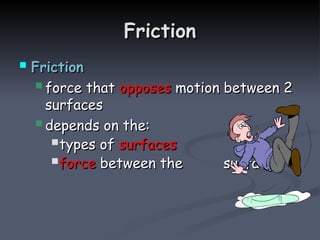
Friction
Friction
forcethat
force that opposes
opposes motion between 2
motion between 2
surfaces
surfaces
depends on the:
depends on the:
types of
types of surfaces
surfaces
force
force between the
between the surfaces
surfaces
22.
Friction
Friction
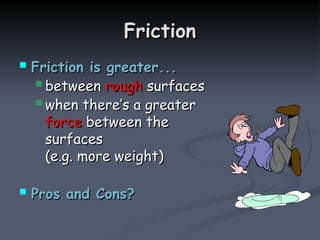
Friction isgreater...
Friction is greater...
between
between rough
rough surfaces
surfaces
when there’s a greater
when there’s a greater
force
force between the
between the
surfaces
surfaces
(e.g. more weight)
(e.g. more weight)
Pros and Cons?
Pros and Cons?