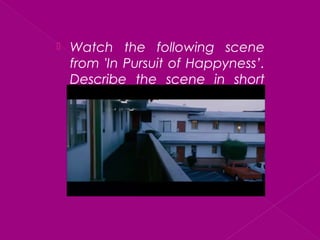
 Watch the following scene
from 'In Pursuit of Happyness’.
Describe the scene in short
sentences.
We can use the present perfect simple to talk about finished
actions and events in the past when there is no time reference,
or when it’s not important, or we don’t know exactly when the
action happened.
Common expressions that refer to periods of time which
continue to the present include: so far, up to now,
over/during the last three years
Some time expressions can refer to both a period of time that
has finished and a period of time that continues in the present:
this morning, today, this week, this month
 Ever/never
Use ‘ever/never’ to talk and ask
about life experiences when
the person is still alive:
Have you everever been to the
South Pole?
I’ve nevernever been to Asia.
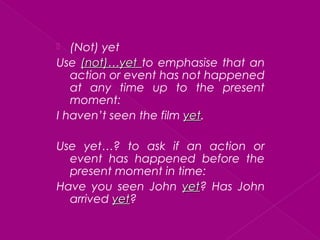
 (Not) yet
Use (not)…yet(not)…yet to emphasise that an
action or event has not happened
at any time up to the present
moment:
I haven’t seen the film yetyet.
Use yet…? to ask if an action or
event has happened before the
present moment in time:
Have you seen John yetyet? Has John
arrived yetyet?
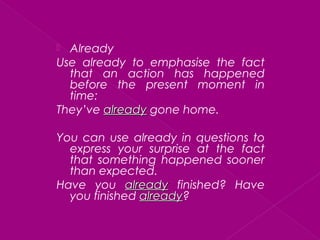
 Already
Use already to emphasise the fact
that an action has happened
before the present moment in
time:
They’ve alreadyalready gone home.
You can use already in questions to
express your surprise at the fact
that something happened sooner
than expected.
Have you alreadyalready finished? Have
you finished alreadyalready?
1) READ ABOUT SIMON REEVE. CIRCLE THE CORRECT FORM OF
THE VERBS.
Simon Reeve is an author and TV presenter. Several of his books
and TV programmes 1) won/have won international awards.
He 2) made / has made a series of fascinating travel
documentaries for the BBC. He 3) travelled/has travelled to
the four corners of the earth. In 2006 he 4) circled/has
circled the earth following the Equator. In 2008 he 5)
did/has done the same again, but this time following the
tropic of Capricorn. He 6) visited/has visited some of the
most dangerous places on earth. He 7) also went/has also
been to places no other foreign visitor 8) ever visited/has
ever visited. His taste for travel first 9) developed/has
developed when he and his family 10) drove/have driven
across Europe on their summer holidays.
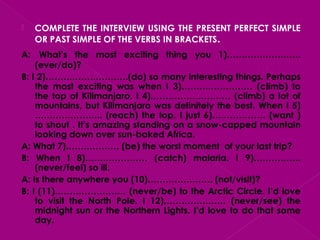
 COMPLETE THE INTERVIEW USING THE PRESENT PERFECT SIMPLE
OR PAST SIMPLE OF THE VERBS IN BRACKETS.
A: What’s the most exciting thing you 1)…………………….
(ever/do)?
B: I 2)……………………….(do) so many interesting things. Perhaps
the most exciting was when I 3)…………………… (climb) to
the top of Kilimanjaro. I 4)……………………… (climb) a lot of
mountains, but Kilimanjaro was definitely the best. When I 5)
………………….. (reach) the top, I just 6)……………… (want )
to shout . It’s amazing standing on a snow-capped mountain
looking down over sun-baked Africa.
A: What 7)……………… (be) the worst moment of your last trip?
B: When I 8)………………… (catch) malaria. I 9)…………….
(never/feel) so ill.
A: Is there anywhere you (10)…………………. (not/visit)?
B: I (11)…………………… (never/be) to the Arctic Circle. I’d love
to visit the North Pole. I 12)………………… (never/see) the
midnight sun or the Northern Lights. I’d love to do that some
day.
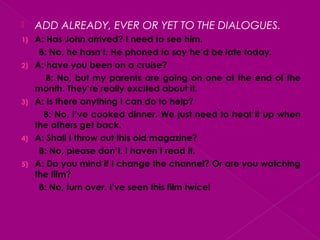
 ADD ALREADY, EVER OR YET TO THE DIALOGUES.
1) A: Has John arrived? I need to see him.
B: No, he hasn’t. He phoned to say he’d be late today.
2) A: have you been on a cruise?
B: No, but my parents are going on one at the end of the
month. They’re really excited about it.
3) A: Is there anything I can do to help?
B: No, I’ve cooked dinner. We just need to heat it up when
the others get back.
4) A: Shall I throw out this old magazine?
B: No, please don’t. I haven’t read it.
5) A: Do you mind if I change the channel? Or are you watching
the film?
B: No, turn over. I’ve seen this film twice!
 ADD ALREADY, EVER OR YET TO THE DIALOGUES.
1) A: Has John arrived? I need to see him.
B: No, he hasn’t. He phoned to say he’d be late today.
2) A: have you been on a cruise?
B: No, but my parents are going on one at the end of the
month. They’re really excited about it.
3) A: Is there anything I can do to help?
B: No, I’ve cooked dinner. We just need to heat it up when
the others get back.
4) A: Shall I throw out this old magazine?
B: No, please don’t. I haven’t read it.
5) A: Do you mind if I change the channel? Or are you watching
the film?
B: No, turn over. I’ve seen this film twice!

Tenses grammar 2015

  • 2.
     Watch thefollowing scene from 'In Pursuit of Happyness’. Describe the scene in short sentences.
  • 3.
    We can usethe present perfect simple to talk about finished actions and events in the past when there is no time reference, or when it’s not important, or we don’t know exactly when the action happened. Common expressions that refer to periods of time which continue to the present include: so far, up to now, over/during the last three years Some time expressions can refer to both a period of time that has finished and a period of time that continues in the present: this morning, today, this week, this month
  • 4.
     Ever/never Use ‘ever/never’to talk and ask about life experiences when the person is still alive: Have you everever been to the South Pole? I’ve nevernever been to Asia.
  • 5.
     (Not) yet Use(not)…yet(not)…yet to emphasise that an action or event has not happened at any time up to the present moment: I haven’t seen the film yetyet. Use yet…? to ask if an action or event has happened before the present moment in time: Have you seen John yetyet? Has John arrived yetyet?
  • 6.
     Already Use alreadyto emphasise the fact that an action has happened before the present moment in time: They’ve alreadyalready gone home. You can use already in questions to express your surprise at the fact that something happened sooner than expected. Have you alreadyalready finished? Have you finished alreadyalready?
  • 7.
    1) READ ABOUTSIMON REEVE. CIRCLE THE CORRECT FORM OF THE VERBS. Simon Reeve is an author and TV presenter. Several of his books and TV programmes 1) won/have won international awards. He 2) made / has made a series of fascinating travel documentaries for the BBC. He 3) travelled/has travelled to the four corners of the earth. In 2006 he 4) circled/has circled the earth following the Equator. In 2008 he 5) did/has done the same again, but this time following the tropic of Capricorn. He 6) visited/has visited some of the most dangerous places on earth. He 7) also went/has also been to places no other foreign visitor 8) ever visited/has ever visited. His taste for travel first 9) developed/has developed when he and his family 10) drove/have driven across Europe on their summer holidays.
  • 8.
     COMPLETE THEINTERVIEW USING THE PRESENT PERFECT SIMPLE OR PAST SIMPLE OF THE VERBS IN BRACKETS. A: What’s the most exciting thing you 1)……………………. (ever/do)? B: I 2)……………………….(do) so many interesting things. Perhaps the most exciting was when I 3)…………………… (climb) to the top of Kilimanjaro. I 4)……………………… (climb) a lot of mountains, but Kilimanjaro was definitely the best. When I 5) ………………….. (reach) the top, I just 6)……………… (want ) to shout . It’s amazing standing on a snow-capped mountain looking down over sun-baked Africa. A: What 7)……………… (be) the worst moment of your last trip? B: When I 8)………………… (catch) malaria. I 9)……………. (never/feel) so ill. A: Is there anywhere you (10)…………………. (not/visit)? B: I (11)…………………… (never/be) to the Arctic Circle. I’d love to visit the North Pole. I 12)………………… (never/see) the midnight sun or the Northern Lights. I’d love to do that some day.
  • 9.
     ADD ALREADY,EVER OR YET TO THE DIALOGUES. 1) A: Has John arrived? I need to see him. B: No, he hasn’t. He phoned to say he’d be late today. 2) A: have you been on a cruise? B: No, but my parents are going on one at the end of the month. They’re really excited about it. 3) A: Is there anything I can do to help? B: No, I’ve cooked dinner. We just need to heat it up when the others get back. 4) A: Shall I throw out this old magazine? B: No, please don’t. I haven’t read it. 5) A: Do you mind if I change the channel? Or are you watching the film? B: No, turn over. I’ve seen this film twice!
  • 10.
     ADD ALREADY,EVER OR YET TO THE DIALOGUES. 1) A: Has John arrived? I need to see him. B: No, he hasn’t. He phoned to say he’d be late today. 2) A: have you been on a cruise? B: No, but my parents are going on one at the end of the month. They’re really excited about it. 3) A: Is there anything I can do to help? B: No, I’ve cooked dinner. We just need to heat it up when the others get back. 4) A: Shall I throw out this old magazine? B: No, please don’t. I haven’t read it. 5) A: Do you mind if I change the channel? Or are you watching the film? B: No, turn over. I’ve seen this film twice!