Soil Formation
Soils may be formed in place from rock or
formed in weathered rock and minerals that
have been transported from where the
original rock occurred.
Rocks
Consist of mixtures of minerals.
Igneous
Metamorphic
Sedimentary
Igneous rocks are formed from molten
magma and contain primary minerals.
Sedimentary rocks are formed by deposition
and cementation of weathered products.
Metamorphic rocks are formed from igneous
or sedimentary rocks by high pressure and
temperature.
Weathering
Physical disintegration
Chemical decomposition
Physical disintegration causes decrease in
size without appreciably altering
composition. Differential stresses due to
heating and cooling or expansion of ice
break the rock. Abrasion due to water
containing sediment or wind carrying debris
is another type of physical weathering.
Chemical decomposition and synthesis alter
chemical composition. Four types of
chemical weathering reactions are:
hydrolysis, hydration, acid dissolution and
redox (particularly, Fe2+
/ Fe3+
).
Five Factors of Soil Formation
Parent material
Climate
Organisms
Topography
Time
Soils defined -dynamic natural bodies
having properties derived from the
combined effect of climate and biotic
activities, as modified by topography, acting
on parent material over time.
Parent Material
Geologic material in which a soil forms.
Residual sedentary
Transported Agent
Colluvial gravity
Alluvial water
Marine water
Lacustrine water
Glacial ice
Eolian wind
Residual
Develops in place from the underlying rock.
If soil is young, properties tend to reflect
effect of parent material. For example,
Igneous and metamorphic rock, if
Siliceous (granite and granite gneiss)
acid and sandy
Ferromagnesian (basalt and diorite)
nonacid and clayey
Sedimentary, if
Limestone sand or clay impurities lead
to sandy or clayey soil
Sandstone shallow if SiO2 cements but
deep if CaCO3 cements particles together
Shale clay minerals in shale give
rise to a clayey soil
Colluvial
Consists of coarse and stony debris
detached from rocks and carried downslope
by gravity.
Alluvial
These deposits occur as alluvial fans, flood
plains and deltas.
Alluvial fan occurs at the discharge of an
upland stream into a broader valley below.
Coarse textured material.
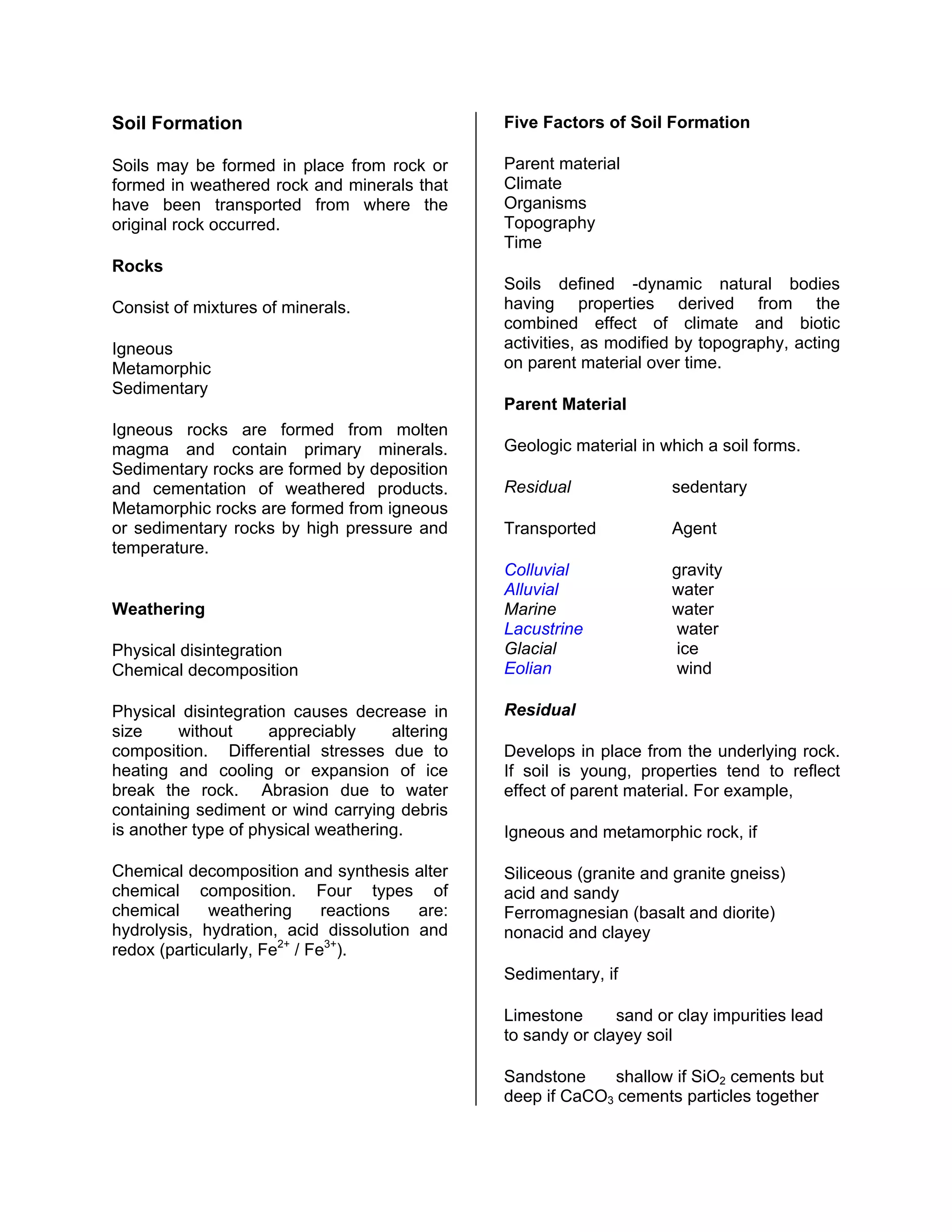
Complex soilscape on a flood plain.
Flood plains are adjacent to streams and
rivers. During floods, coarse sediment is
deposited nearest the existing channel and
fine sediment further away, resulting in a
natural levee. Changes in the course of the
stream result in a complex spatial pattern of
alternating coarse and fine sediments
throughout the flood plain. If there is a
change in grade, the stream may cut
through existing deposits, thereby forming
terraces.
A delta occurs at the mouth of river and
marks the downstream extent of a flood
plain.
Marine Sediments
Unconsolidated marine sediments
deposited by streams emptying into oceans
may undergo uplift. Common along Atlantic
and Gulf coasts. Vary from sandy to clayey.
Glacial Deposits
From a series of glaciations during the
Pleistocene epoch. Each advancing ice
sheet accumulated a great mass of
unconsolidated material which was
deposited as glacial drift when the glacier
melted and retreated. Material directly
deposition from the ice is called glacial till
and occurs in formations called moraines.
Streams originating in a glacier transported
sediment away and produced outwash
plains. Where regional topography
impounded glacial melt, lakes formed and
lacustrine deposits accumulated. Deltas of
coarser materials occur in what was the
inflow region whereas finer materials were
deposited further away.
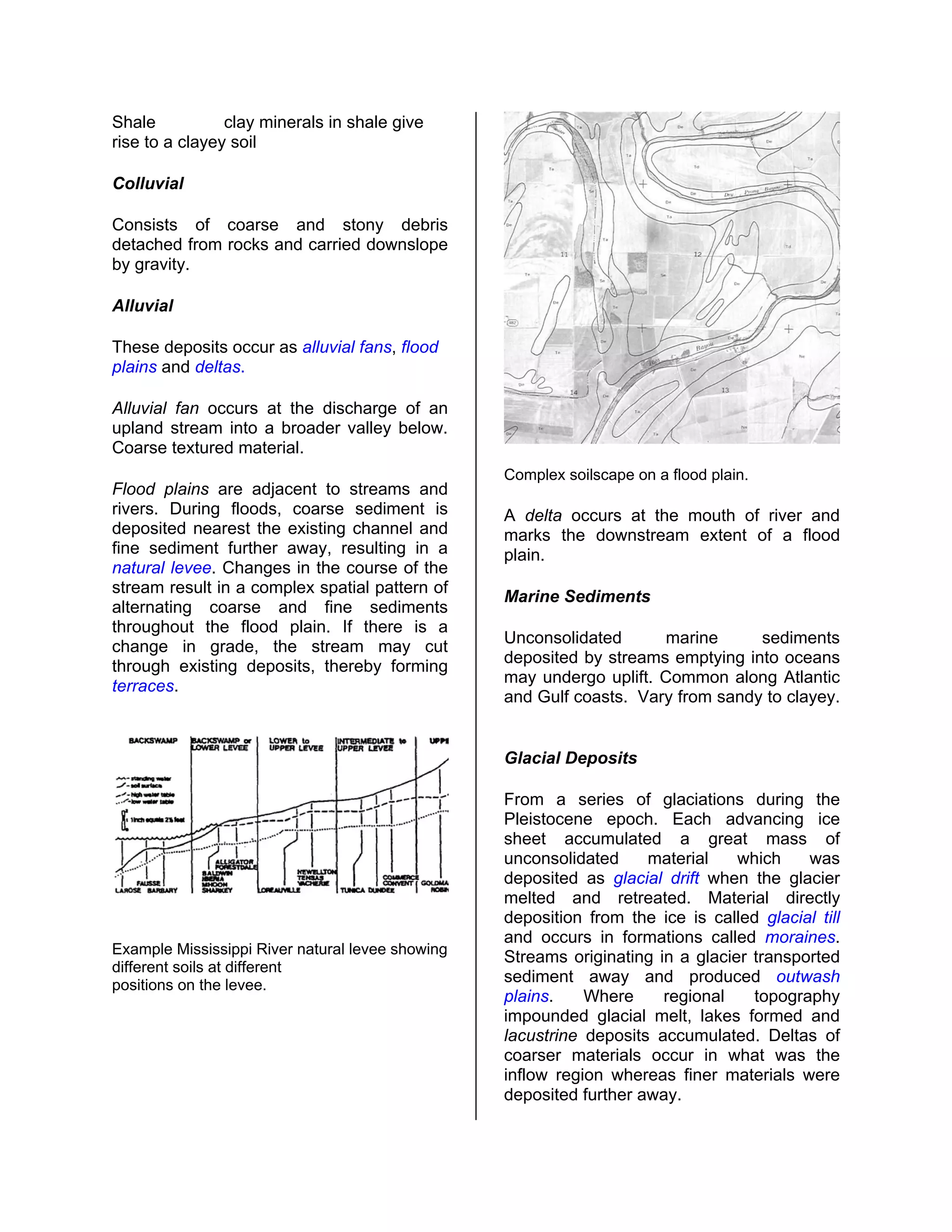
Example Mississippi River natural levee showing
different soils at different
positions on the levee.
Leaching of soluble materials like CaCO3
increases with increasing precipitation.
Movement of clay in soil profile increase
with increasing precipitation.
Silicate clay and Al and Fe oxide formation
increase with increasing temperature.
Generally, high rainfall and temperature
leads to deep weathering and soil leaching.
Just contrast weathered profile of humid
tropical soils with profile of arid soils from
which soluble salts have not been leached.
Climate also indirectly influences soil
formation by its effect on natural vegetation.
For example, trees under humid climate,
grasses under semiarid climate and brush
under arid climate.
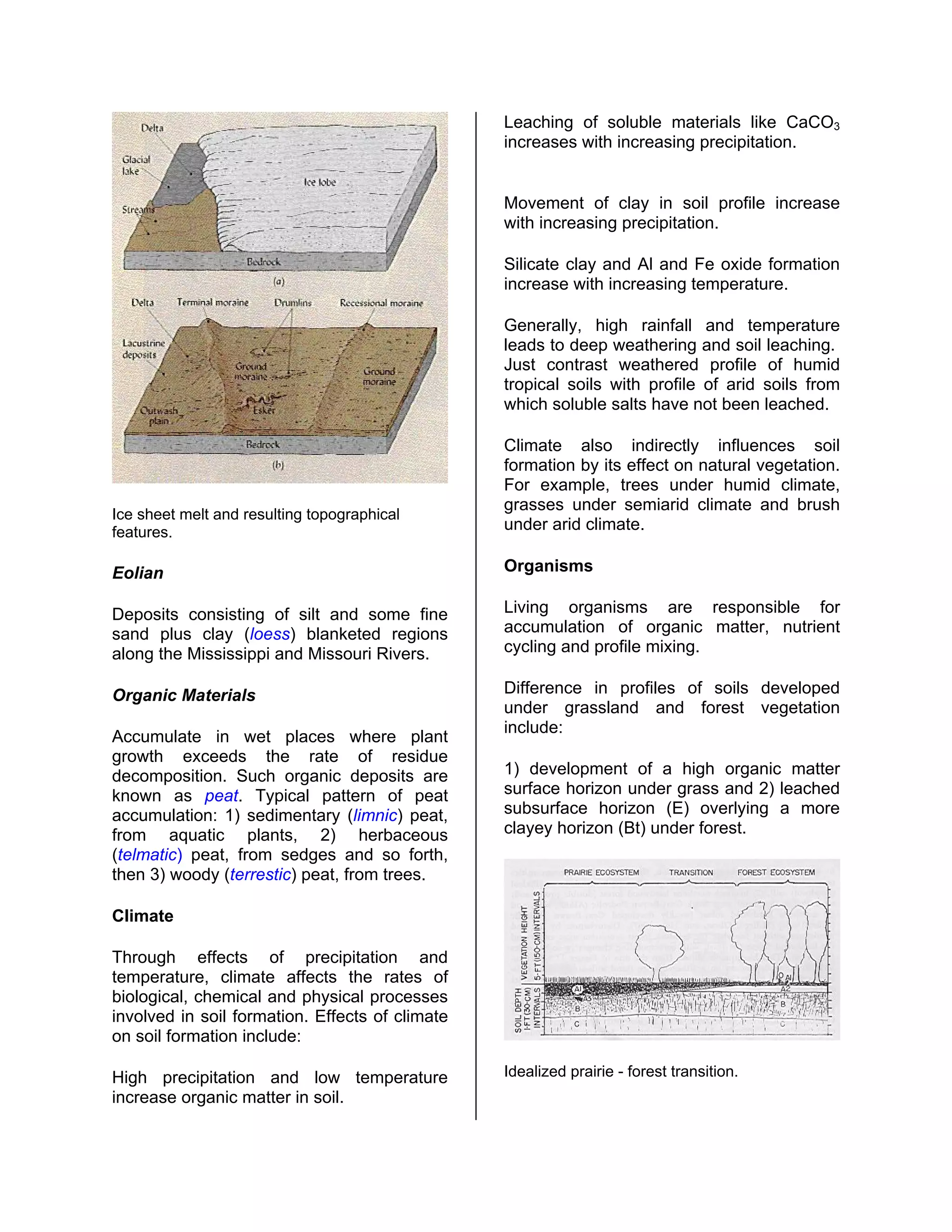
Ice sheet melt and resulting topographical
features.
OrganismsEolian
Living organisms are responsible for
accumulation of organic matter, nutrient
cycling and profile mixing.
Deposits consisting of silt and some fine
sand plus clay (loess) blanketed regions
along the Mississippi and Missouri Rivers.
Difference in profiles of soils developed
under grassland and forest vegetation
include:
Organic Materials
Accumulate in wet places where plant
growth exceeds the rate of residue
decomposition. Such organic deposits are
known as peat. Typical pattern of peat
accumulation: 1) sedimentary (limnic) peat,
from aquatic plants, 2) herbaceous
(telmatic) peat, from sedges and so forth,
then 3) woody (terrestic) peat, from trees.
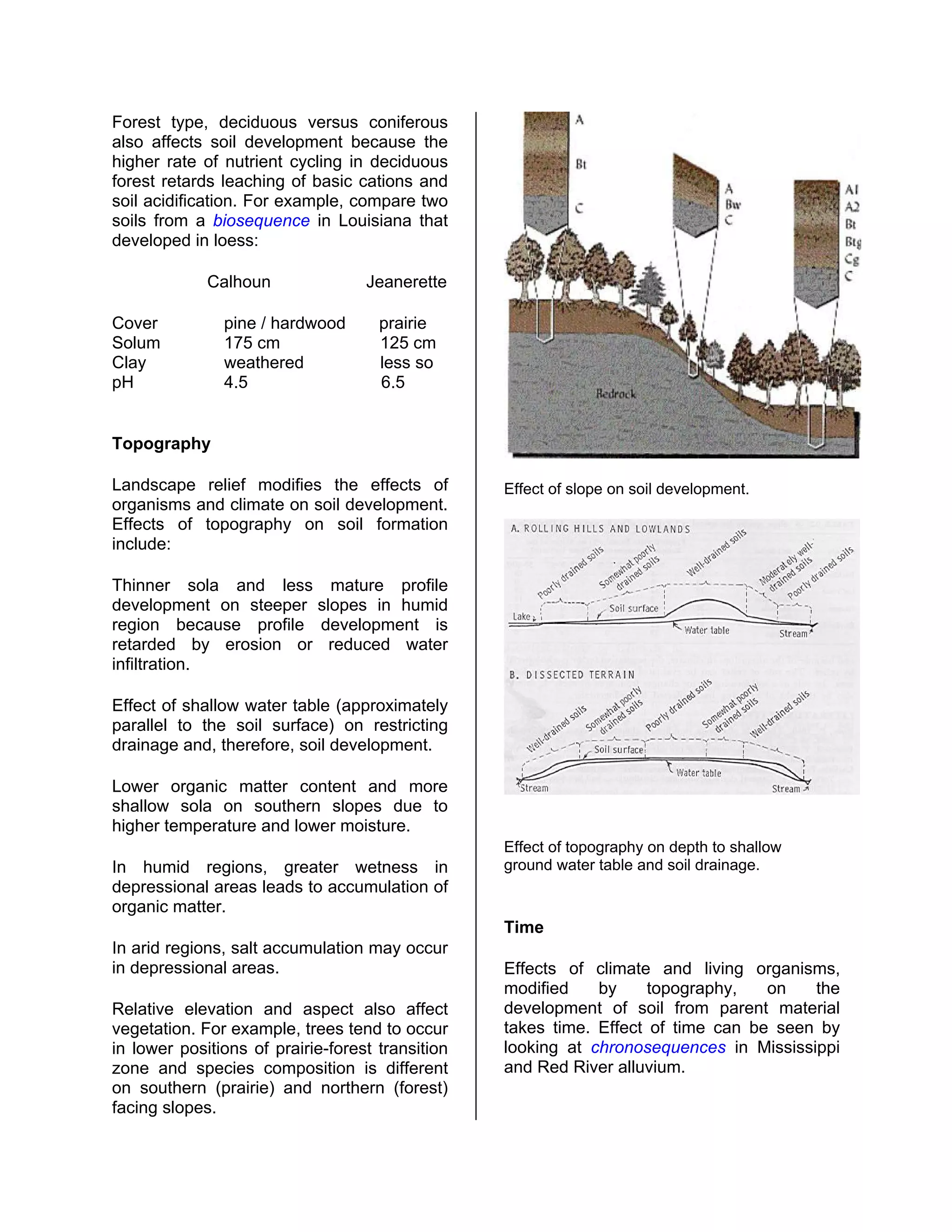
1) development of a high organic matter
surface horizon under grass and 2) leached
subsurface horizon (E) overlying a more
clayey horizon (Bt) under forest.
Idealized prairie - forest transition.
Climate
Through effects of precipitation and
temperature, climate affects the rates of
biological, chemical and physical processes
involved in soil formation. Effects of climate
on soil formation include:
High precipitation and low temperature
increase organic matter in soil.
Forest type, deciduous versus coniferous
also affects soil development because the
higher rate of nutrient cycling in deciduous
forest retards leaching of basic cations and
soil acidification. For example, compare two
soils from a biosequence in Louisiana that
developed in loess:
Calhoun Jeanerette
Cover pine / hardwood prairie
Solum 175 cm 125 cm
Clay weathered less so
pH 4.5 6.5
Topography
Landscape relief modifies the effects of
organisms and climate on soil development.
Effects of topography on soil formation
include:
Effect of slope on soil development.
Thinner sola and less mature profile
development on steeper slopes in humid
region because profile development is
retarded by erosion or reduced water
infiltration.
Effect of shallow water table (approximately
parallel to the soil surface) on restricting
drainage and, therefore, soil development.
Lower organic matter content and more
shallow sola on southern slopes due to
higher temperature and lower moisture.
Effect of topography on depth to shallow
ground water table and soil drainage.In humid regions, greater wetness in
depressional areas leads to accumulation of
organic matter.
Time
Effects of climate and living organisms,
modified by topography, on the
development of soil from parent material
takes time. Effect of time can be seen by
looking at chronosequences in Mississippi
and Red River alluvium.
In arid regions, salt accumulation may occur
in depressional areas.
Relative elevation and aspect also affect
vegetation. For example, trees tend to occur
in lower positions of prairie-forest transition
zone and species composition is different
on southern (prairie) and northern (forest)
facing slopes.
Translocation -movement of mineral and
organic soil constituents in the developing
soil profile.
The sequence of soils, Severn, Roxanna
and Gallion (natural levees of the Red
River) exhibits increasing extent of profile
development including depth to CaCO3.
Addition -as of organic matter or by
deposition.Soil Channel Age CaCO3 Depth
Severn recent < 50 cm
Roxanna older > 50 cm
Gallion older leached
Loss -as by leaching of soluble constituents
or due to erosion.
Example of Soil Genesis
Convent, Bruin and Dundee (natural levees
of increasingly older channels of the
Mississippi River) range from 3,000 to 6,000
years old.
Assume uniform parent material (loess) at
time zero.
1. Production of organic matter by plants.
Roots proliferate in the soil and organic
debris litters the surface of parent material.
Addition.
Convent Bruin Dundee
< 3000 yr > 3000 > 4000
15 cm 45 + 60 +
2. Nonliving organic matter is biochemically
altered by microorganisms and physically
incorporated into the surface as by
earthworms. Transformation.
50 years
3. Weathering and transport of weathering
products takes longer. Soluble salts are
dissolved and transported downward by
percolating water. Depending on rainfall and
internal drainage, salts may be lost or
precipitated at a lower depth. Organic acids
accelerate weathering of minerals and
secondary minerals are formed.
Accumulation of organic matter extends
deeper into the surface soil. Clay minerals
are moved by water from near the soil
surface to deeper in the developing profile.
Transformation and translocation.
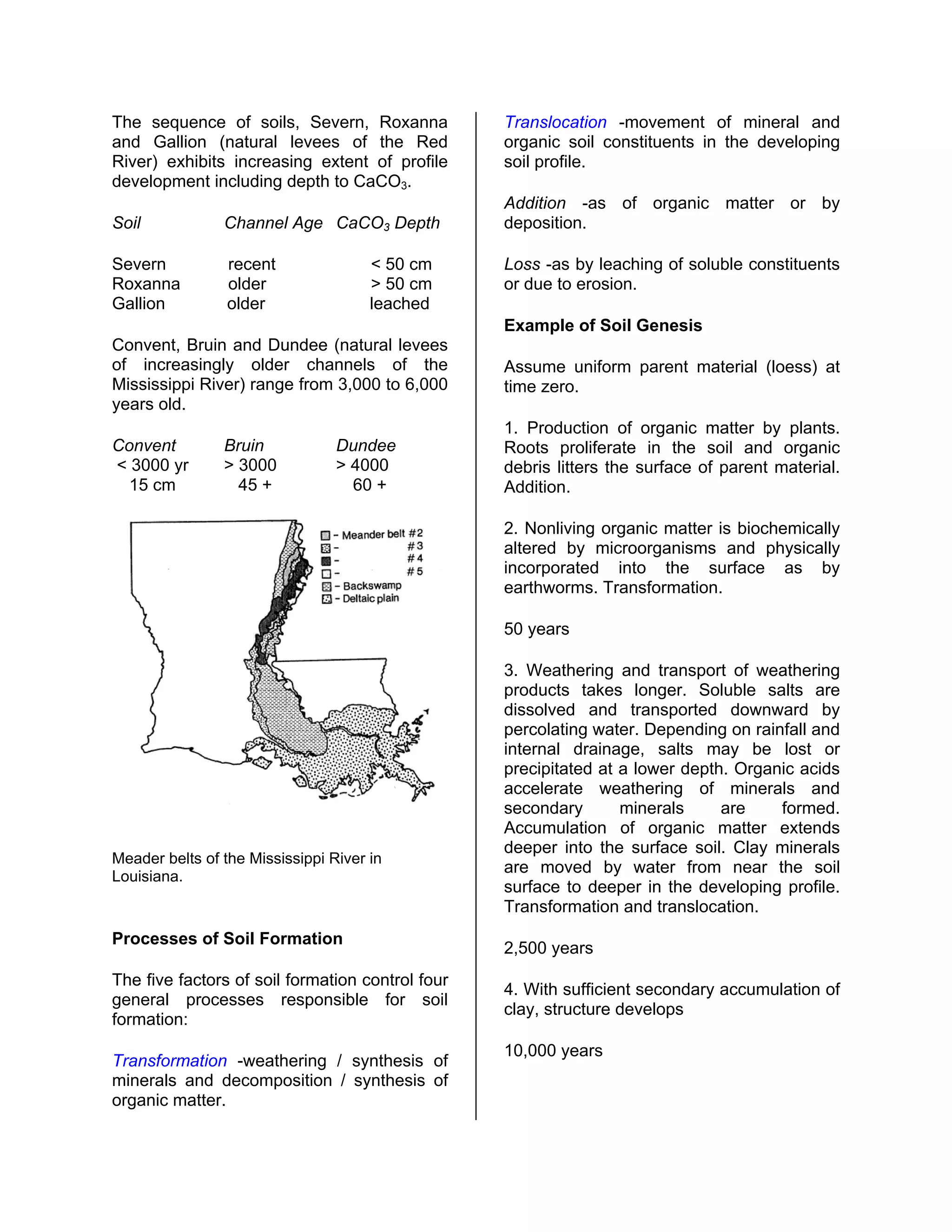
Meader belts of the Mississippi River in
Louisiana.
Processes of Soil Formation
2,500 years
The five factors of soil formation control four
general processes responsible for soil
formation:
4. With sufficient secondary accumulation of
clay, structure develops
10,000 years
Transformation -weathering / synthesis of
minerals and decomposition / synthesis of
organic matter.
Designations of Soil Profile Horizons
Besides the five master horizons there are
subordinate and transitional horizons.
Subordinate horizons include:
Ap Plow layer
Bt Accumulation of silicate clay
Bs Organic matter and Al and Fe oxides
Bx Fragipan (dense and brittle)
Transitional horizons are gradations from
one master horizon to another such as AE,
EB, BE and BC.

Chapter2

  • 1.
    Soil Formation Soils maybe formed in place from rock or formed in weathered rock and minerals that have been transported from where the original rock occurred. Rocks Consist of mixtures of minerals. Igneous Metamorphic Sedimentary Igneous rocks are formed from molten magma and contain primary minerals. Sedimentary rocks are formed by deposition and cementation of weathered products. Metamorphic rocks are formed from igneous or sedimentary rocks by high pressure and temperature. Weathering Physical disintegration Chemical decomposition Physical disintegration causes decrease in size without appreciably altering composition. Differential stresses due to heating and cooling or expansion of ice break the rock. Abrasion due to water containing sediment or wind carrying debris is another type of physical weathering. Chemical decomposition and synthesis alter chemical composition. Four types of chemical weathering reactions are: hydrolysis, hydration, acid dissolution and redox (particularly, Fe2+ / Fe3+ ). Five Factors of Soil Formation Parent material Climate Organisms Topography Time Soils defined -dynamic natural bodies having properties derived from the combined effect of climate and biotic activities, as modified by topography, acting on parent material over time. Parent Material Geologic material in which a soil forms. Residual sedentary Transported Agent Colluvial gravity Alluvial water Marine water Lacustrine water Glacial ice Eolian wind Residual Develops in place from the underlying rock. If soil is young, properties tend to reflect effect of parent material. For example, Igneous and metamorphic rock, if Siliceous (granite and granite gneiss) acid and sandy Ferromagnesian (basalt and diorite) nonacid and clayey Sedimentary, if Limestone sand or clay impurities lead to sandy or clayey soil Sandstone shallow if SiO2 cements but deep if CaCO3 cements particles together
  • 2.
    Shale clay mineralsin shale give rise to a clayey soil Colluvial Consists of coarse and stony debris detached from rocks and carried downslope by gravity. Alluvial These deposits occur as alluvial fans, flood plains and deltas. Alluvial fan occurs at the discharge of an upland stream into a broader valley below. Coarse textured material. Complex soilscape on a flood plain. Flood plains are adjacent to streams and rivers. During floods, coarse sediment is deposited nearest the existing channel and fine sediment further away, resulting in a natural levee. Changes in the course of the stream result in a complex spatial pattern of alternating coarse and fine sediments throughout the flood plain. If there is a change in grade, the stream may cut through existing deposits, thereby forming terraces. A delta occurs at the mouth of river and marks the downstream extent of a flood plain. Marine Sediments Unconsolidated marine sediments deposited by streams emptying into oceans may undergo uplift. Common along Atlantic and Gulf coasts. Vary from sandy to clayey. Glacial Deposits From a series of glaciations during the Pleistocene epoch. Each advancing ice sheet accumulated a great mass of unconsolidated material which was deposited as glacial drift when the glacier melted and retreated. Material directly deposition from the ice is called glacial till and occurs in formations called moraines. Streams originating in a glacier transported sediment away and produced outwash plains. Where regional topography impounded glacial melt, lakes formed and lacustrine deposits accumulated. Deltas of coarser materials occur in what was the inflow region whereas finer materials were deposited further away. Example Mississippi River natural levee showing different soils at different positions on the levee.
  • 3.
    Leaching of solublematerials like CaCO3 increases with increasing precipitation. Movement of clay in soil profile increase with increasing precipitation. Silicate clay and Al and Fe oxide formation increase with increasing temperature. Generally, high rainfall and temperature leads to deep weathering and soil leaching. Just contrast weathered profile of humid tropical soils with profile of arid soils from which soluble salts have not been leached. Climate also indirectly influences soil formation by its effect on natural vegetation. For example, trees under humid climate, grasses under semiarid climate and brush under arid climate. Ice sheet melt and resulting topographical features. OrganismsEolian Living organisms are responsible for accumulation of organic matter, nutrient cycling and profile mixing. Deposits consisting of silt and some fine sand plus clay (loess) blanketed regions along the Mississippi and Missouri Rivers. Difference in profiles of soils developed under grassland and forest vegetation include: Organic Materials Accumulate in wet places where plant growth exceeds the rate of residue decomposition. Such organic deposits are known as peat. Typical pattern of peat accumulation: 1) sedimentary (limnic) peat, from aquatic plants, 2) herbaceous (telmatic) peat, from sedges and so forth, then 3) woody (terrestic) peat, from trees. 1) development of a high organic matter surface horizon under grass and 2) leached subsurface horizon (E) overlying a more clayey horizon (Bt) under forest. Idealized prairie - forest transition. Climate Through effects of precipitation and temperature, climate affects the rates of biological, chemical and physical processes involved in soil formation. Effects of climate on soil formation include: High precipitation and low temperature increase organic matter in soil.
  • 4.
    Forest type, deciduousversus coniferous also affects soil development because the higher rate of nutrient cycling in deciduous forest retards leaching of basic cations and soil acidification. For example, compare two soils from a biosequence in Louisiana that developed in loess: Calhoun Jeanerette Cover pine / hardwood prairie Solum 175 cm 125 cm Clay weathered less so pH 4.5 6.5 Topography Landscape relief modifies the effects of organisms and climate on soil development. Effects of topography on soil formation include: Effect of slope on soil development. Thinner sola and less mature profile development on steeper slopes in humid region because profile development is retarded by erosion or reduced water infiltration. Effect of shallow water table (approximately parallel to the soil surface) on restricting drainage and, therefore, soil development. Lower organic matter content and more shallow sola on southern slopes due to higher temperature and lower moisture. Effect of topography on depth to shallow ground water table and soil drainage.In humid regions, greater wetness in depressional areas leads to accumulation of organic matter. Time Effects of climate and living organisms, modified by topography, on the development of soil from parent material takes time. Effect of time can be seen by looking at chronosequences in Mississippi and Red River alluvium. In arid regions, salt accumulation may occur in depressional areas. Relative elevation and aspect also affect vegetation. For example, trees tend to occur in lower positions of prairie-forest transition zone and species composition is different on southern (prairie) and northern (forest) facing slopes.
  • 5.
    Translocation -movement ofmineral and organic soil constituents in the developing soil profile. The sequence of soils, Severn, Roxanna and Gallion (natural levees of the Red River) exhibits increasing extent of profile development including depth to CaCO3. Addition -as of organic matter or by deposition.Soil Channel Age CaCO3 Depth Severn recent < 50 cm Roxanna older > 50 cm Gallion older leached Loss -as by leaching of soluble constituents or due to erosion. Example of Soil Genesis Convent, Bruin and Dundee (natural levees of increasingly older channels of the Mississippi River) range from 3,000 to 6,000 years old. Assume uniform parent material (loess) at time zero. 1. Production of organic matter by plants. Roots proliferate in the soil and organic debris litters the surface of parent material. Addition. Convent Bruin Dundee < 3000 yr > 3000 > 4000 15 cm 45 + 60 + 2. Nonliving organic matter is biochemically altered by microorganisms and physically incorporated into the surface as by earthworms. Transformation. 50 years 3. Weathering and transport of weathering products takes longer. Soluble salts are dissolved and transported downward by percolating water. Depending on rainfall and internal drainage, salts may be lost or precipitated at a lower depth. Organic acids accelerate weathering of minerals and secondary minerals are formed. Accumulation of organic matter extends deeper into the surface soil. Clay minerals are moved by water from near the soil surface to deeper in the developing profile. Transformation and translocation. Meader belts of the Mississippi River in Louisiana. Processes of Soil Formation 2,500 years The five factors of soil formation control four general processes responsible for soil formation: 4. With sufficient secondary accumulation of clay, structure develops 10,000 years Transformation -weathering / synthesis of minerals and decomposition / synthesis of organic matter.
  • 6.
    Designations of SoilProfile Horizons Besides the five master horizons there are subordinate and transitional horizons. Subordinate horizons include: Ap Plow layer Bt Accumulation of silicate clay Bs Organic matter and Al and Fe oxides Bx Fragipan (dense and brittle) Transitional horizons are gradations from one master horizon to another such as AE, EB, BE and BC.