For internal circulation of BSNL only
E2-E3 CIVIL
TECHNICAL
Structural Design using
STAAD PRO
WELCOME
• This is a presentation for the E2-E3 Civil Technical
Module for the Topic: Structural Design using STAAD
PRO
• Eligibility: Those officers of civil wing who have got the
Up-gradation from E2 to E3.
• This presentation is last updated on 21-3-2011.
• You can also visit the Digital library of BSNL to see this
topic.
For internal circulation of BSNL only
AGENDA
Introduction
Features of STAAD PRO
Types of structures & Elements
Axis & Sign Convention in STAAD PRO
Steps of Design using STAAD PRO
Typical Command Sequence in STAAD PRO
For internal circulation of BSNL only
INTRODUCTION
Use of Computers in Structural Design of Buildings
• Computers can perform complicated computations at a
high-speed therefore computer programs are used for
analysis & design of structural members.
• Computer results are dependent on effectiveness of
software as certain assumptions are made in the
development of programs.
• But now, with experience, these softwares have been
revised & updated & computer programs can be relied
upon to give accurate results.
For internal circulation of BSNL only
INTRODUCTION
• Limitations of Hand Computation Methods
– Applicable for small problems
– Tedious for even medium sized problems
– 3-d analysis almost impossible
• Advantages of Computer Analysis
– Matrix methods of structural analysis
– Development of numerical techniques
– Finite element method
– 3-d analysis can be done.
For internal circulation of BSNL only
STAAD PRO
Use of Computers in Structural Design of Buildings
• STAAD Pro is a very powerful program which can be
used fro 3-D analysis & is useful for analysis and
design of multi-storied buildings.
• Full range of analysis including static, P-delta,
response spectrum, time history, cable etc. and
• Steel design ,
• Concrete design and
• Timber design is available in STAAD PRO
For internal circulation of BSNL only
STAAD PRO
STAAD PRO
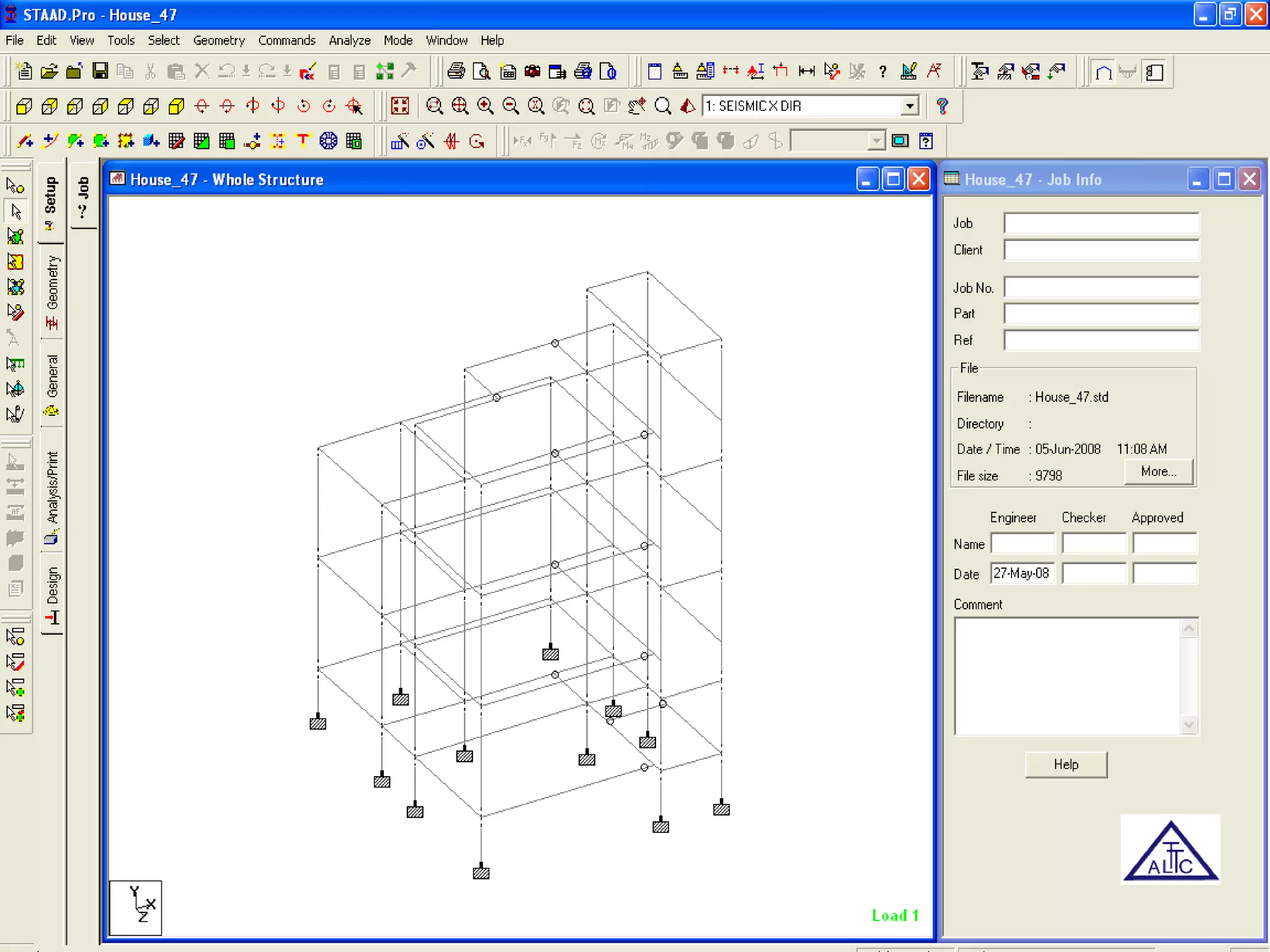
It provides the user environment for –
• Model development (Graphical as well as input
editor)
• Model visualization on screen,
• Analysis & design, and
• Verification
• Pre and Post Processor
• Isometric and perspective view and 3D shapes.
For internal circulation of BSNL only
Features of STAAD PRO
• Object-oriented 2D/3D graphical model generation
with Flexible zoom, pan and multiple views.
• Built-in command file editor for text edit.
• Customizable structural templates for creating a
model.
• Unlimited Undo and Redo
• Pull down menus, floating tool bars, tool tip help &
quick data input through spreadsheets.
• FPS, Metric or SI units.
For internal circulation of BSNL only
Features of STAAD PRO
• Supports truss & beam members, plates, solids, linear
and non-linear cables & curvilinear beams.
• Advanced automatic load generation facilities for
area, floor & moving loads.
• Display of loads, supports, properties, joints,
members, etc
 Rectangular and also cylindrical & reverse cylindrical
coordinate systems with mix and match capabilities. c
For internal circulation of BSNL only
Features of STAAD PRO
• Easy auto mesh & auto refinement of user-defined
polygonal element boundary by simple mouse clicks,
including openings & column/ wall lines.
• Joint, member/ element, mesh generation with flexible
user-controlled numbering scheme
• Import/ Export DSF, DWG and Excel files.
• Presentation quality printer plots of geometry and results
as part of run output.
• Efficient algorithm minimizes disk space requirements.
For internal circulation of BSNL only
Features of STAAD PRO
Model Generation
 Easy “snap-to” construction grid for laying out beams
and columns on irregular grids.
 Segments of repetitive geometry may be used to
generate complex structural models.
 Generate, copy, repeat, mirror, pivot, etc. for quick and
easy geometry generation.
 Comprehensive graphical editing.
 Library of commonly used structures and display of
properties, loadings, supports, orientations etc.
For internal circulation of BSNL only
Features of STAAD PRO
Model Generation
 Graphical specification & display of properties,
loadings, supports, orientations etc.
 Import/Export of Auto Cad 2D/3D files to start model.
 Access to text editor to modify model quickly through
command syntax.
 User-controlled scale factors for deflected shapes.
 Customizable node/member & renumbering scheme.
Analysis & Design
For internal circulation of BSNL only
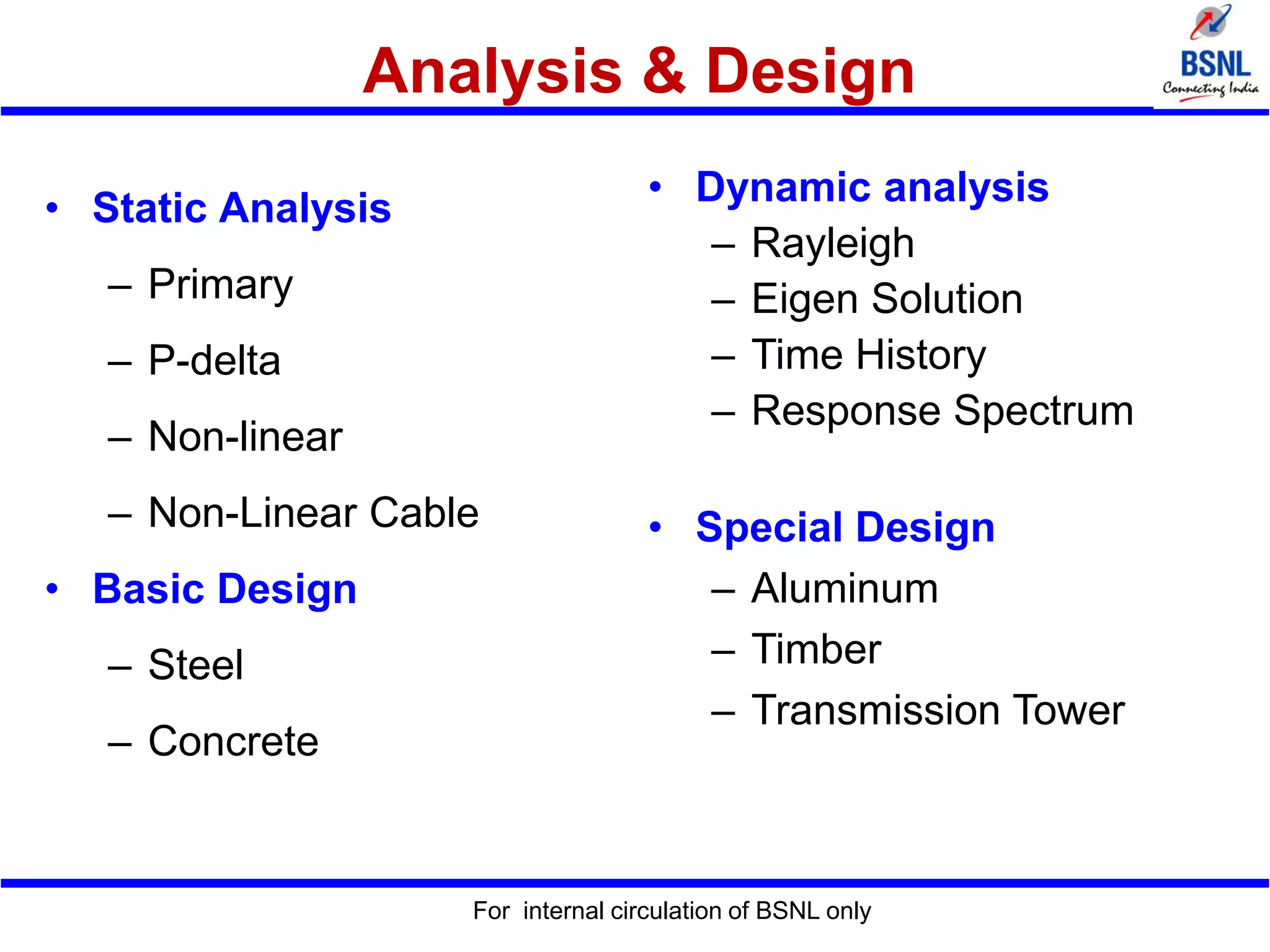
• Static Analysis
– Primary
– P-delta
– Non-linear
– Non-Linear Cable
• Basic Design
– Steel
– Concrete
• Dynamic analysis
– Rayleigh
– Eigen Solution
– Time History
– Response Spectrum
• Special Design
– Aluminum
– Timber
– Transmission Tower
Structure Types
For internal circulation of BSNL only
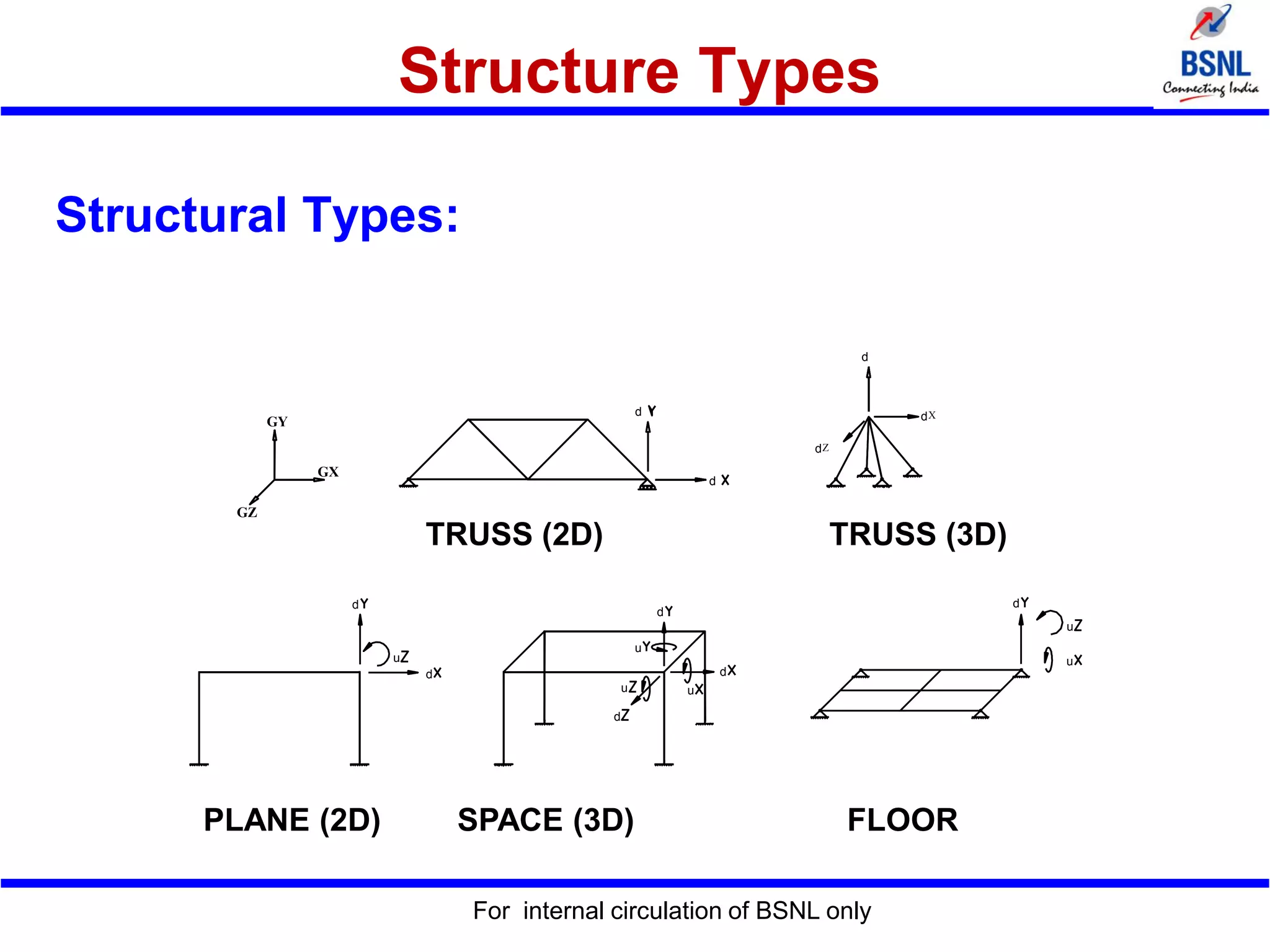
Structural Types:
d
d
d
d
d
d
d
u
d
d
u
u
u
d
u
u
GX
GY
GZ
d
X
Z
TRUSS (2D) TRUSS (3D)
PLANE (2D) SPACE (3D) FLOOR
Element Types
For internal circulation of BSNL only
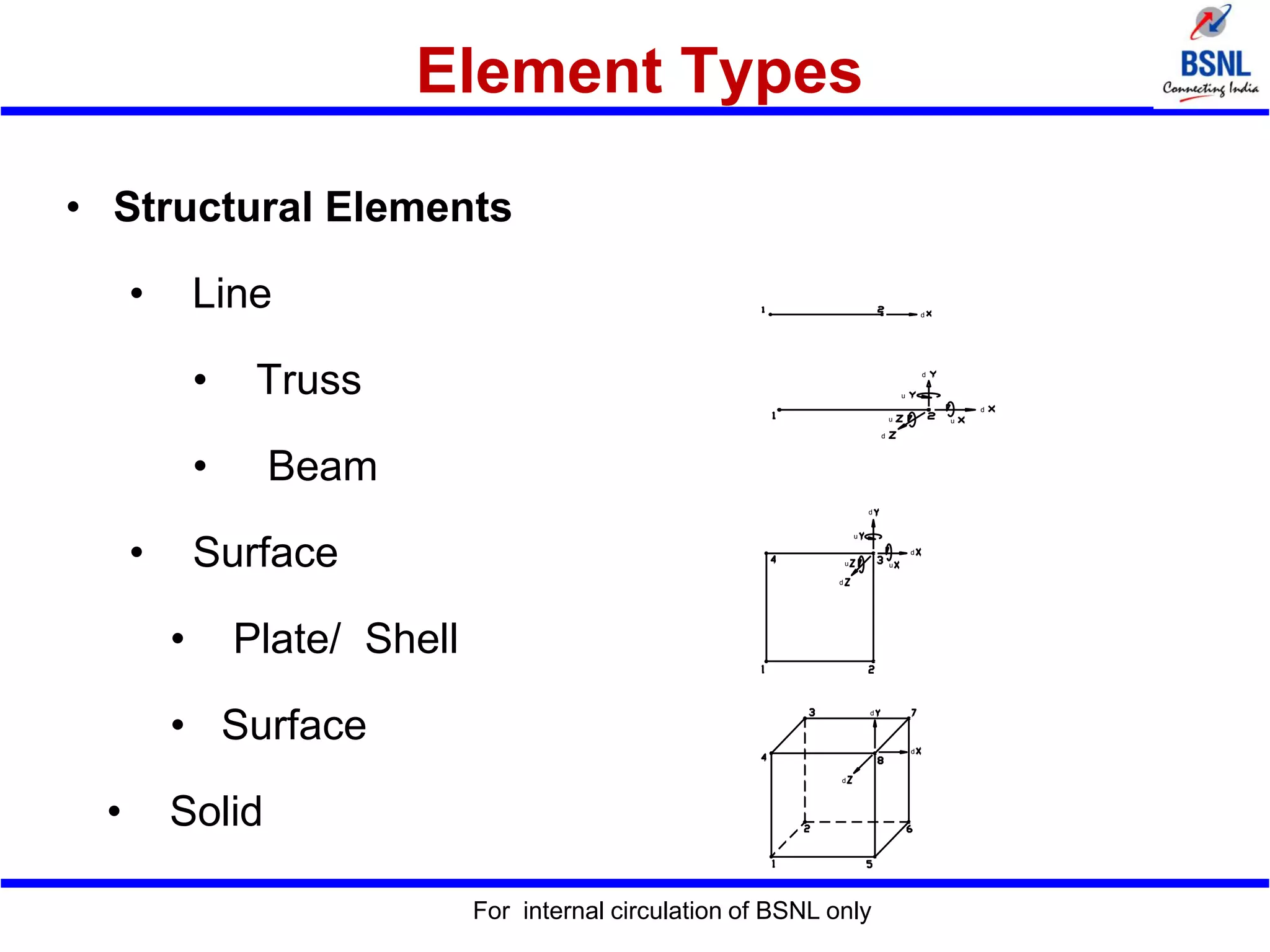
• Structural Elements
• Line
• Truss
• Beam
• Surface
• Plate/ Shell
• Surface
• Solid
d
d
d
d
u
u
u
u
d
u u
d
d
d
d
d
Boundary Condition
For internal circulation of BSNL only
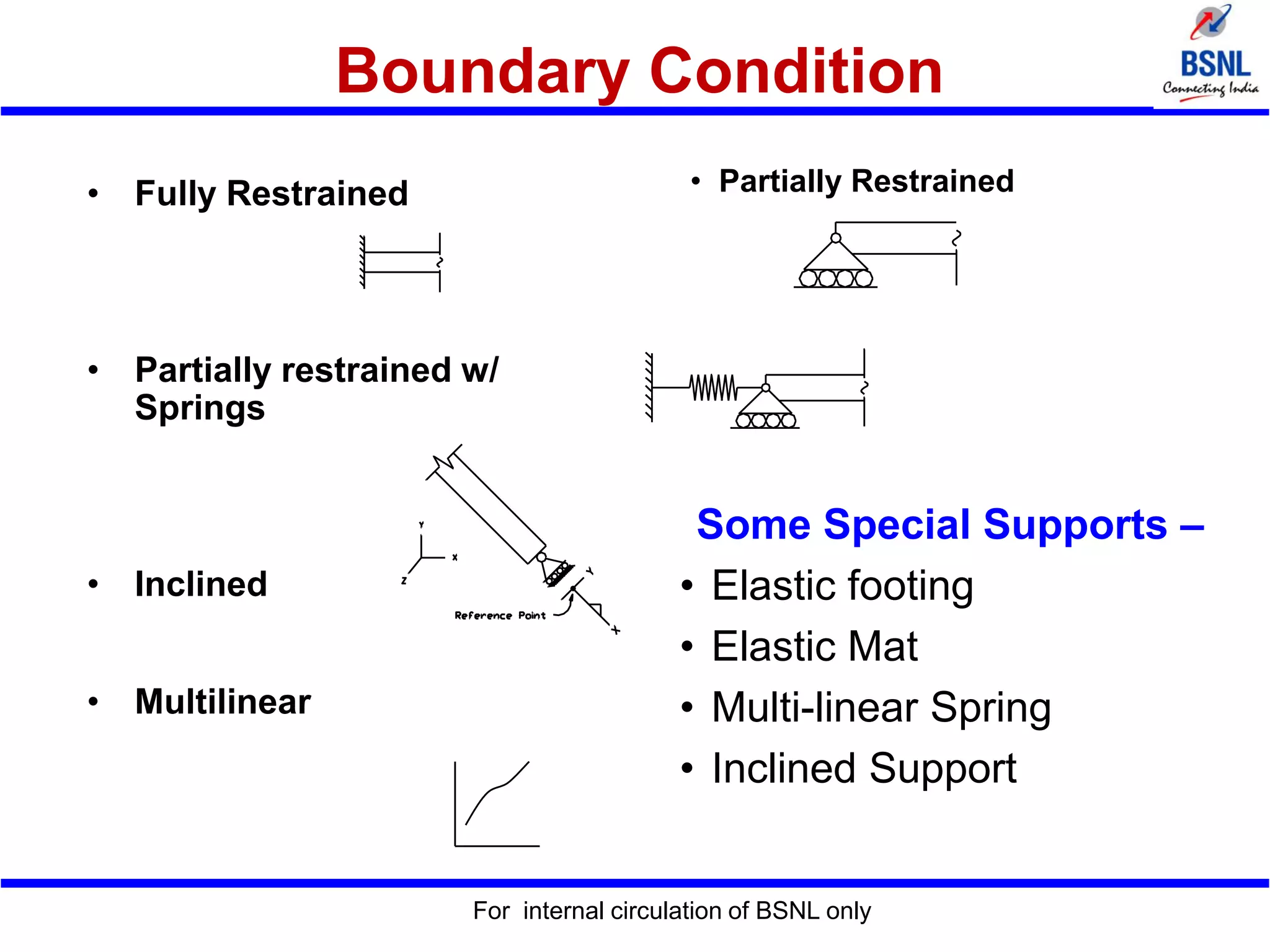
• Fully Restrained
• Partially restrained w/
Springs
• Inclined
• Multilinear
• Partially Restrained
Some Special Supports –
• Elastic footing
• Elastic Mat
• Multi-linear Spring
• Inclined Support
Using STAAD PRO
Using STAAD PRO for Analysis & Design of Building –
Steps In Design
• Manual design of slabs, staircases, chajjas, lintels etc.
• Preparing structural model of building
• Preparing data for STAAD PRO program at all levels
i.e load intensities at all floors & wall load etc.
• Perform Analysis after complete feeding of data and
obtain the analysis out-put.
• Once analysis is completed for different load
combination design is performed for load envelope.
For internal circulation of BSNL only
Using STAAD PRO
Using STAAD PRO for Analysis & Design of Building
– Steps In Design
• STAAD PRO gives beam and column designs at all levels &
column reactions for design of foundations.
• Manual design of footings.
• After design by STAADPRO we note down area of steel for
column at various levels & grouping is done.
• For beams we note down main reinforcement & Shear
reinforcement at various sections & do detailing.
• Detailing of reinf done manually as per SP34 & IS 13920
• Prepare structural drawings using AutoCad or manually.
For internal circulation of BSNL only
Steps for Static Analysis
• Geometric Modeling
• Material Properties
• Sectional Properties
• Supports : Boundary Conditions
• Loads & Load combinations
• Special Commands
• Analysis Specification
• Design Command
For internal circulation of BSNL only
Geometric Modeling
• Nodal Co-ordinate Data
• Selection of Elements : Element Library
• Beam Elements : Beams, Columns, Truss Members
• Plate Elements : Structural Walls, Floor Slabs
• Plane Stress Elements : Shear Walls, Floor Slabs Acting
As Rigid Diaphragm To Lateral Loading
• Solid Elements : Thick Raft, Block Foundations
Surface Element:
– Rectangular
– Default Division 10X10, no. can be controlled
– Mainly introduced for Shear Wall Modeling & Design
For internal circulation of BSNL only
Sectional & Material Properties
• Beam Elements : Cross Section
• Plate Elements : Thickness
• Solid Elements : NIL
• Material means a set of:
– Modulus of Elasticity
– Poisson’s Ratio
– Weight Density
– Thermal Coefficient
– Damping Ratio
– Shear Modulus
• Geometric Constant
– Beta (
) Angle
– Reference Point
For internal circulation of BSNL only
Axis & Sign Convention
For internal circulation of BSNL only
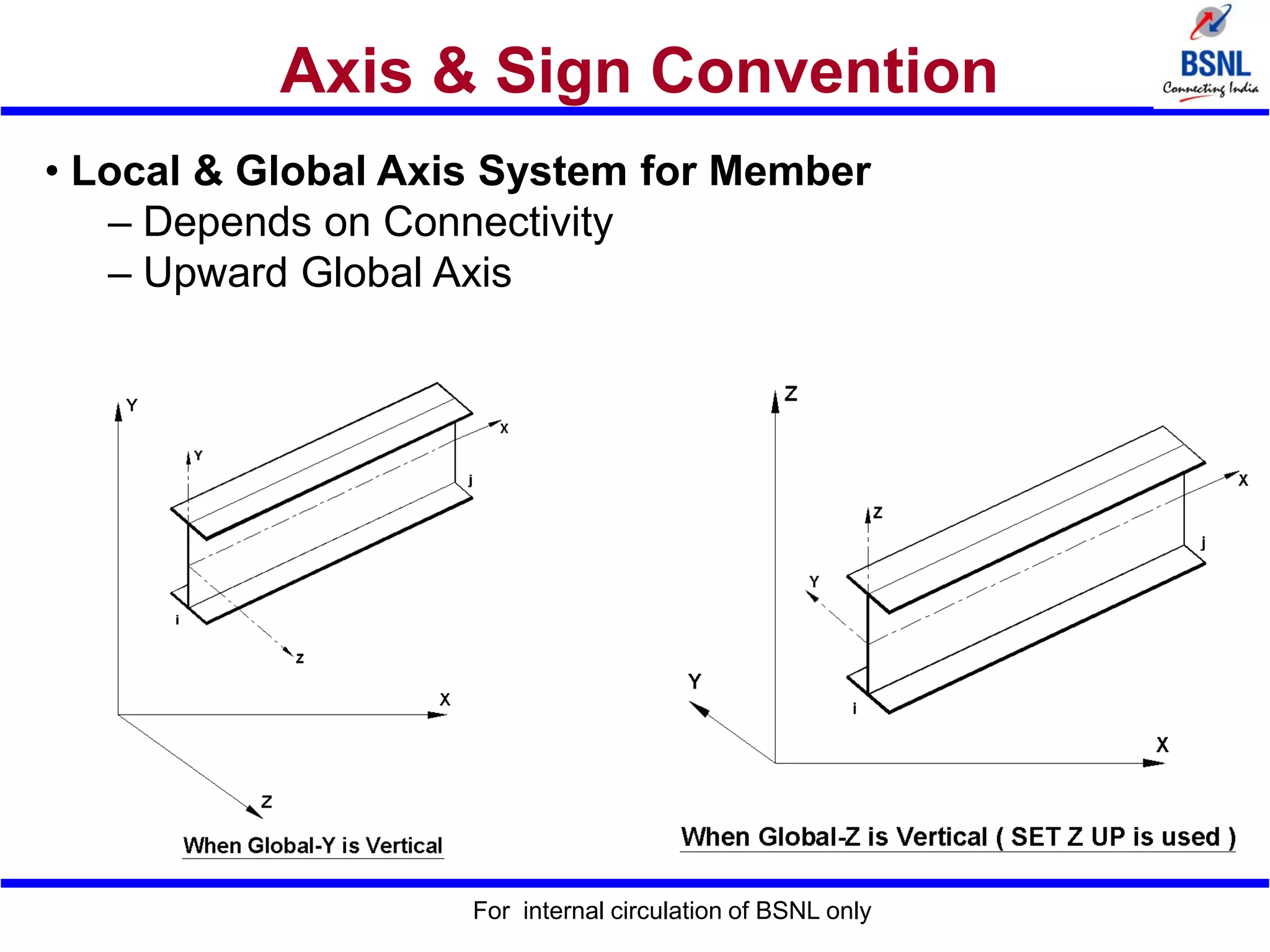
• Local & Global Axis System for Member
– Depends on Connectivity
– Upward Global Axis
Axis & Sign Convention
For internal circulation of BSNL only
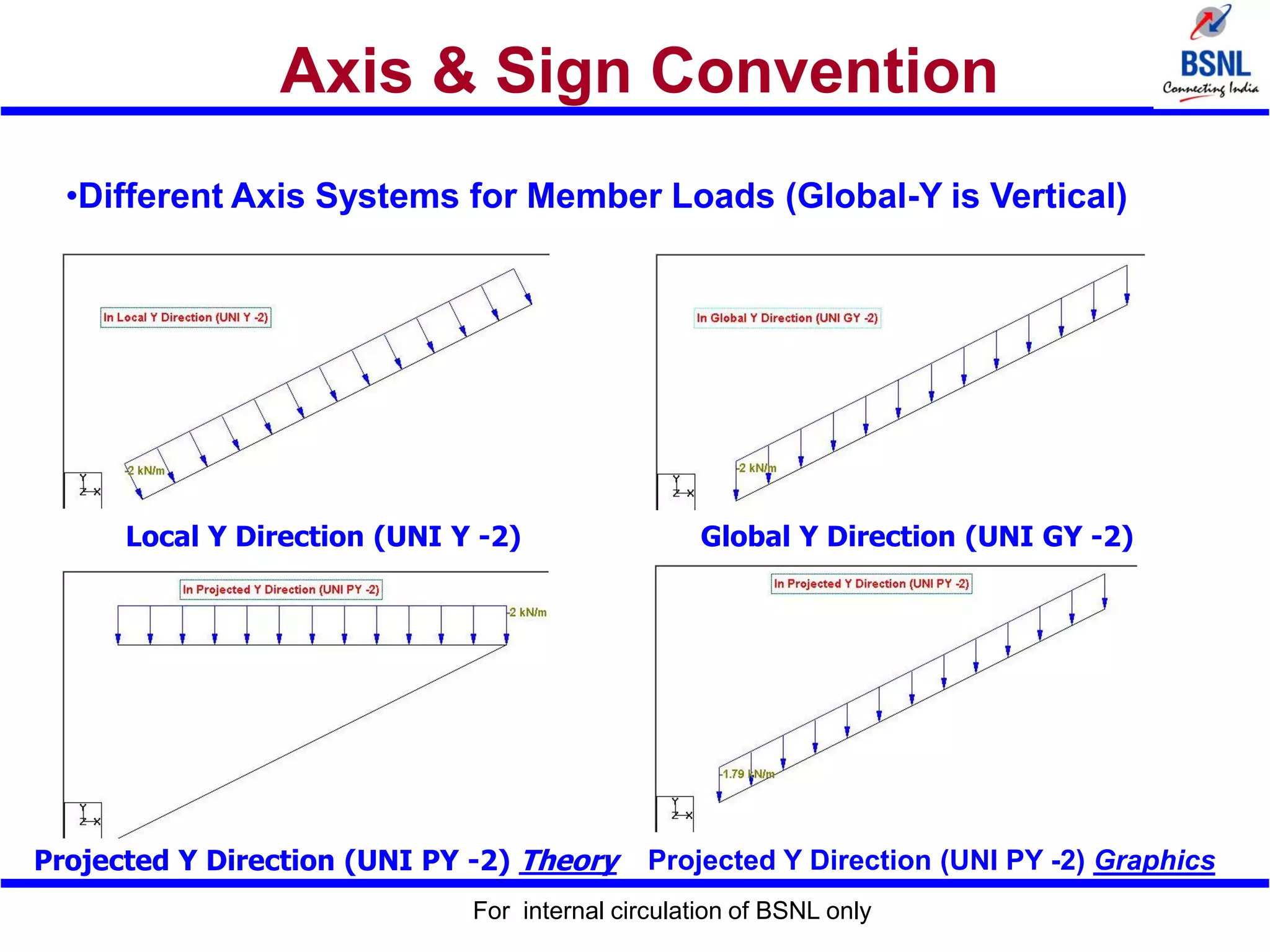
•Different Axis Systems for Member Loads (Global-Y is Vertical)
Local Y Direction (UNI Y -2) Global Y Direction (UNI GY -2)
Projected Y Direction (UNI PY -2) Theory Projected Y Direction (UNI PY -2) Graphics
Axis & Sign Convention
For internal circulation of BSNL only
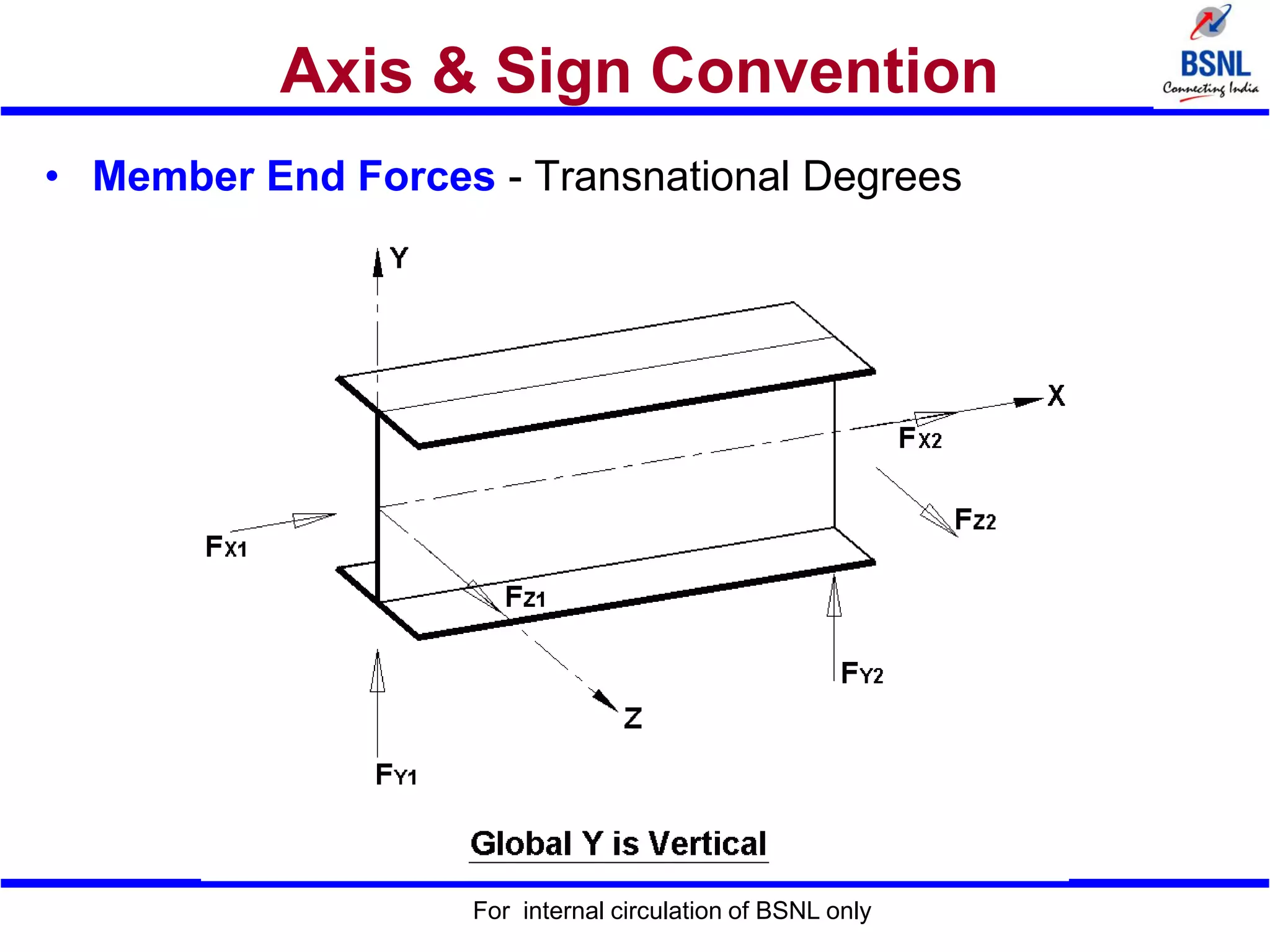
• Member End Forces - Transnational Degrees
Axis & Sign Convention
For internal circulation of BSNL only
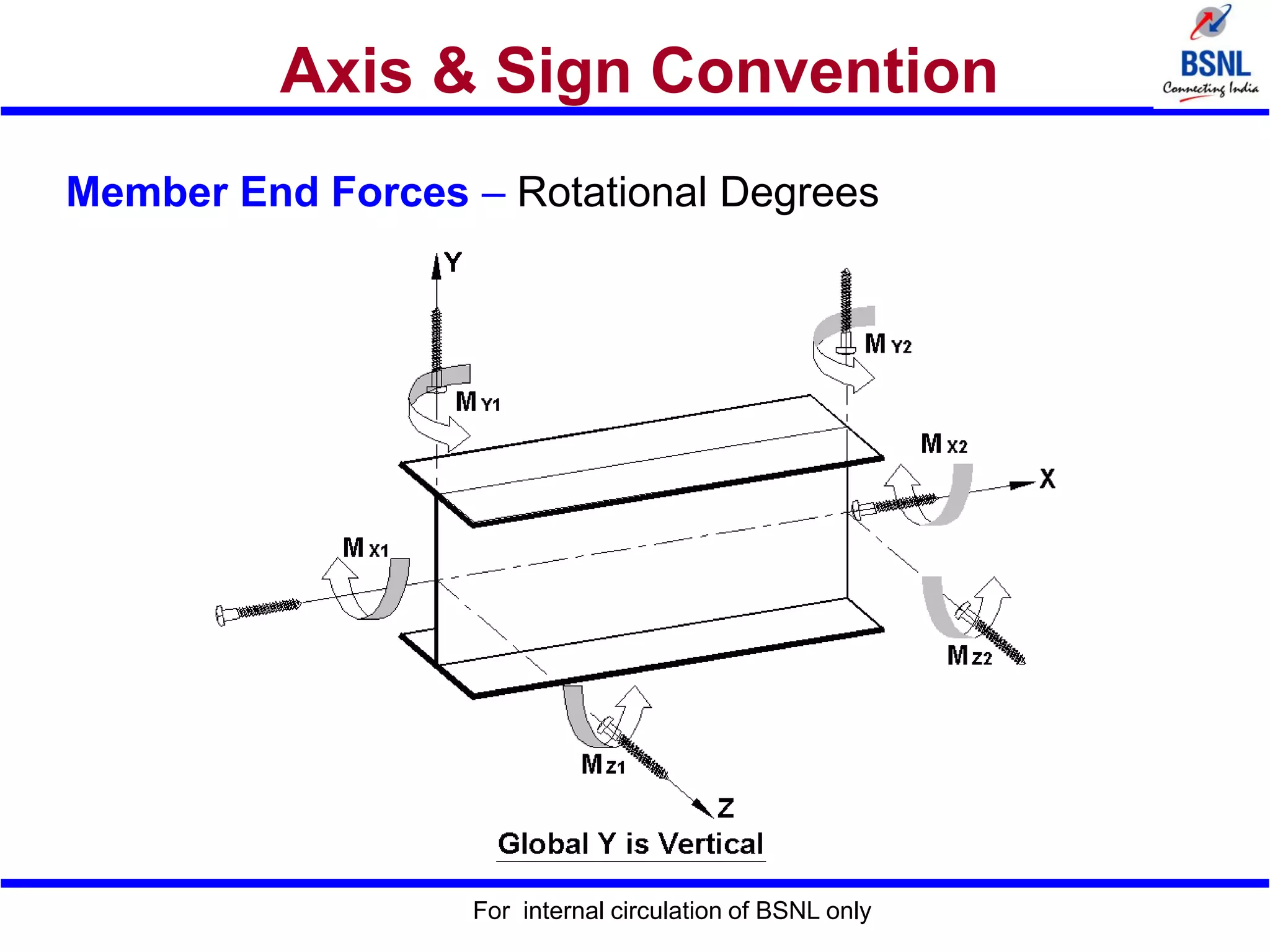
Member End Forces – Rotational Degrees
Loads
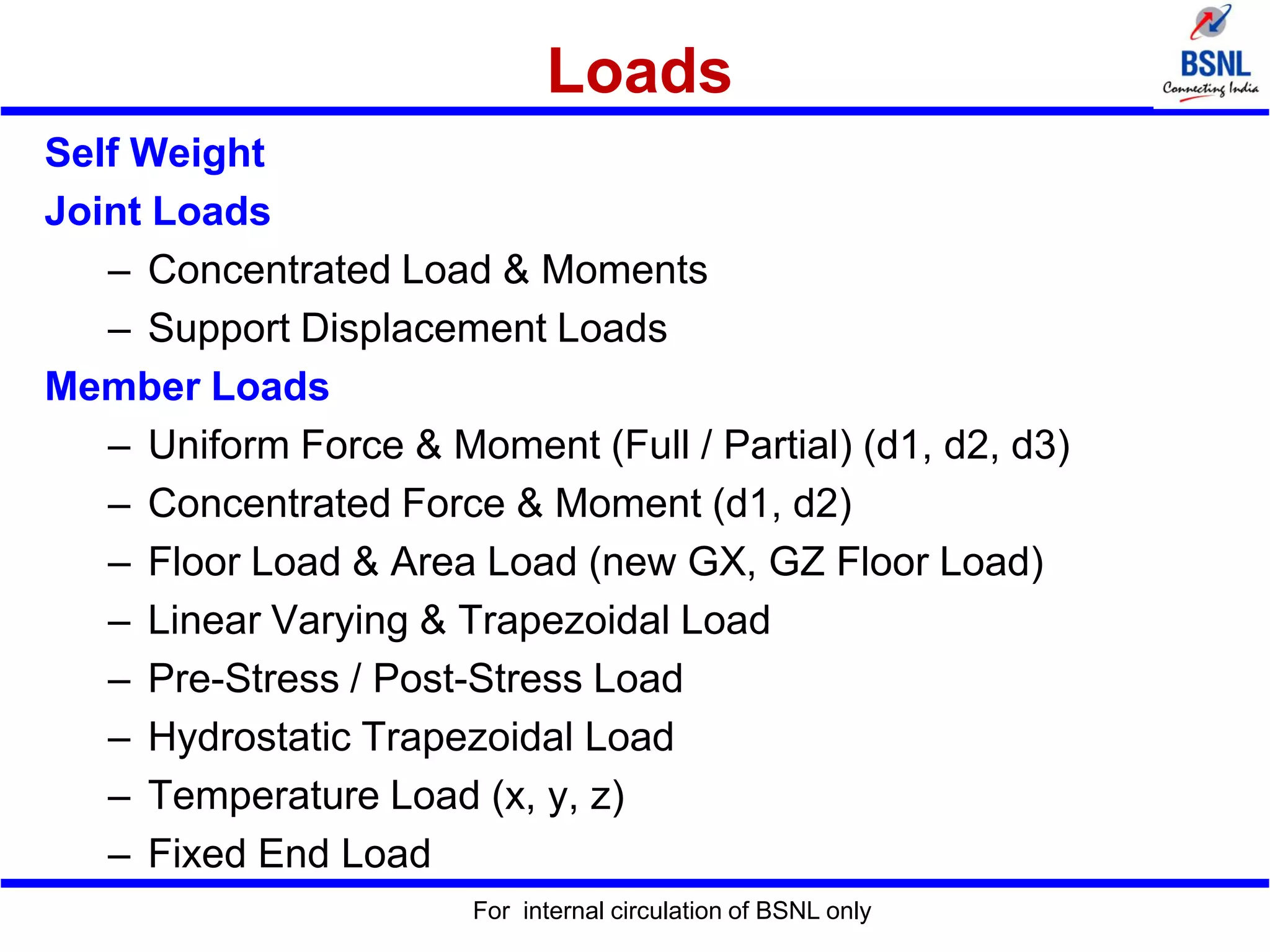
Self Weight
Joint Loads
– Concentrated Load & Moments
– Support Displacement Loads
Member Loads
– Uniform Force & Moment (Full / Partial) (d1, d2, d3)
– Concentrated Force & Moment (d1, d2)
– Floor Load & Area Load (new GX, GZ Floor Load)
– Linear Varying & Trapezoidal Load
– Pre-Stress / Post-Stress Load
– Hydrostatic Trapezoidal Load
– Temperature Load (x, y, z)
– Fixed End Load
For internal circulation of BSNL only
Loads
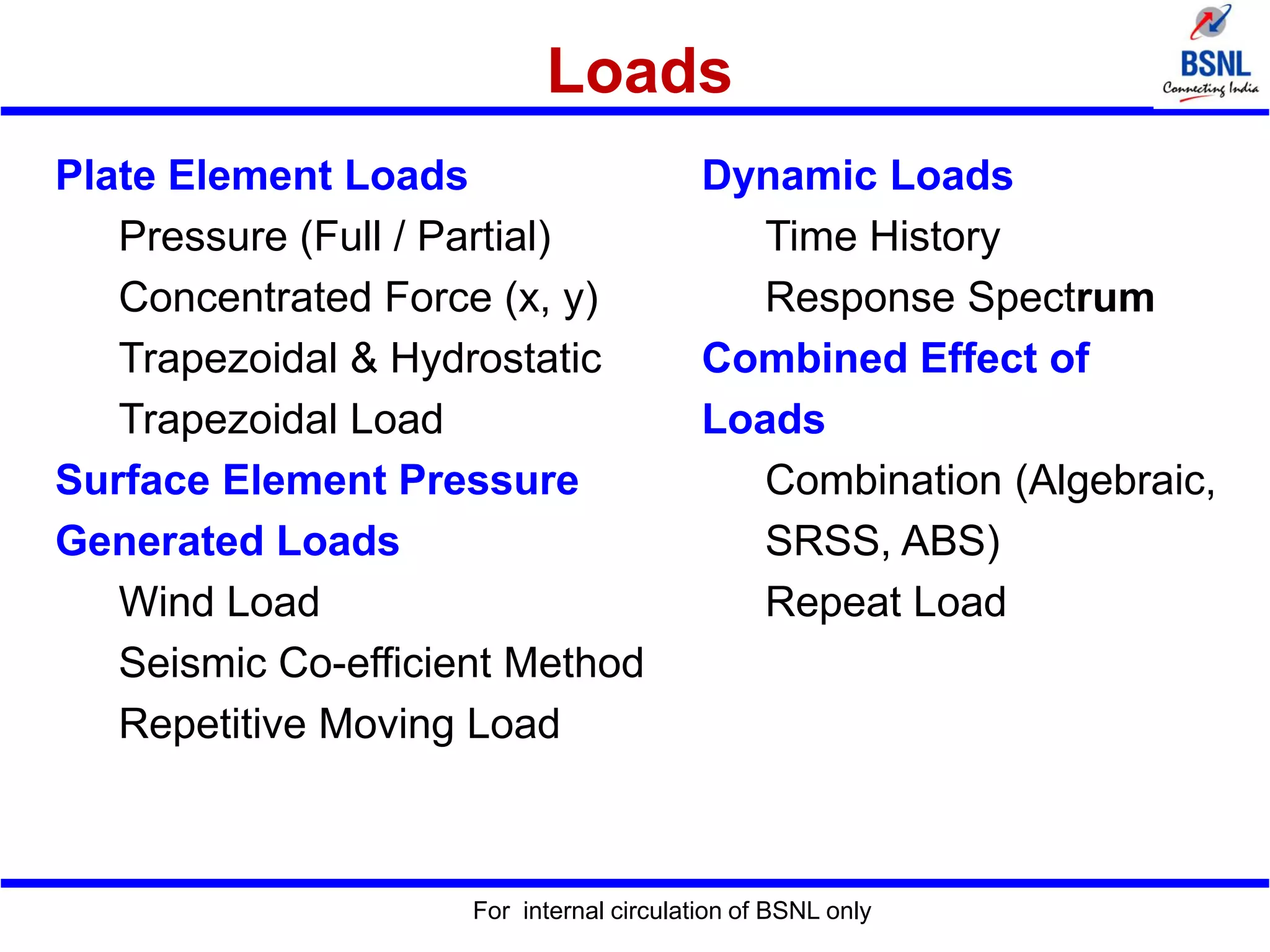
Plate Element Loads
Pressure (Full / Partial)
Concentrated Force (x, y)
Trapezoidal & Hydrostatic
Trapezoidal Load
Surface Element Pressure
Generated Loads
Wind Load
Seismic Co-efficient Method
Repetitive Moving Load
Dynamic Loads
Time History
Response Spectrum
Combined Effect of
Loads
Combination (Algebraic,
SRSS, ABS)
Repeat Load
For internal circulation of BSNL only
Codes & Shapes
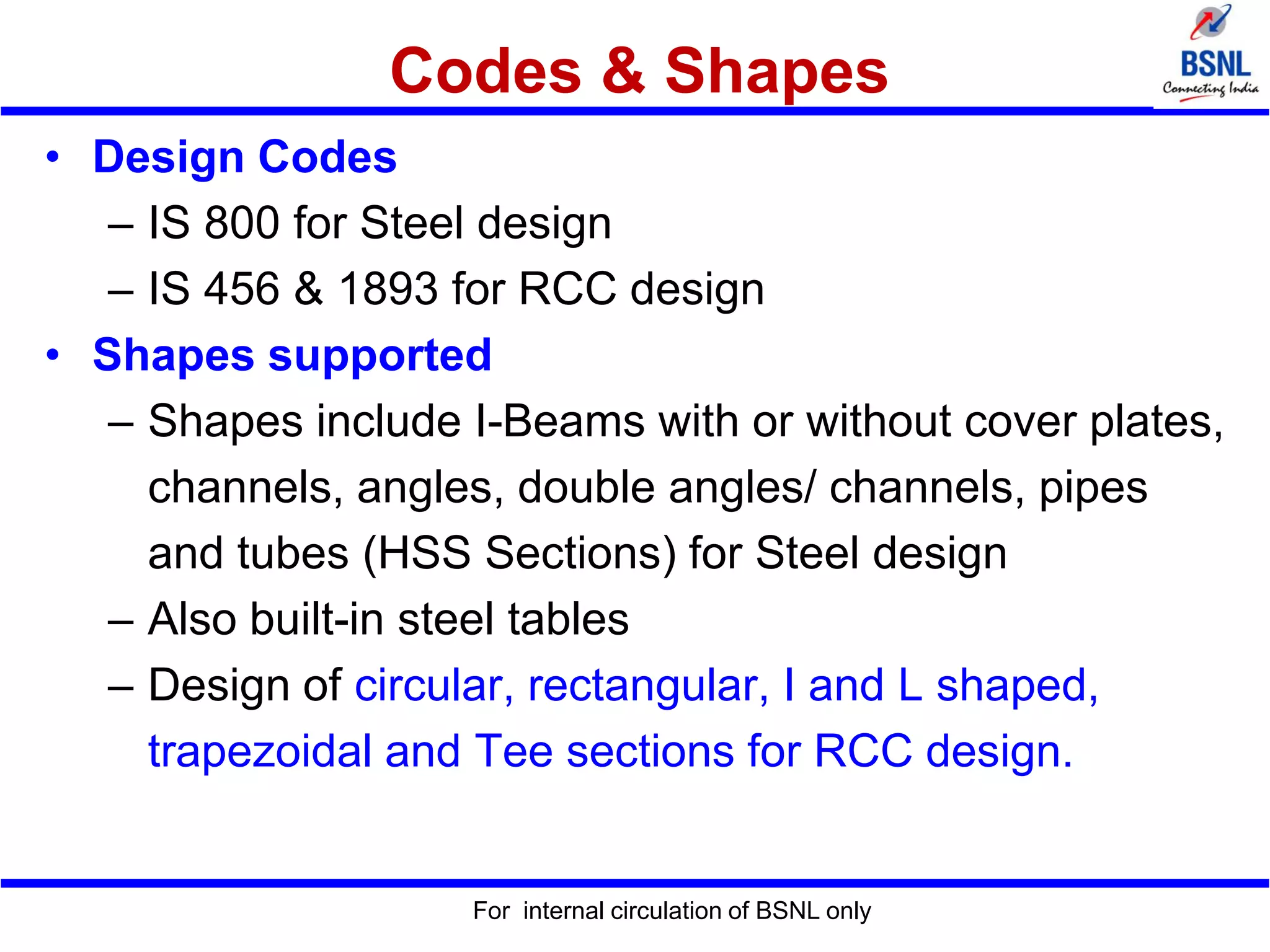
• Design Codes
– IS 800 for Steel design
– IS 456 & 1893 for RCC design
• Shapes supported
– Shapes include I-Beams with or without cover plates,
channels, angles, double angles/ channels, pipes
and tubes (HSS Sections) for Steel design
– Also built-in steel tables
– Design of circular, rectangular, I and L shaped,
trapezoidal and Tee sections for RCC design.
For internal circulation of BSNL only
Earthquake Analysis
• IS 1893 – 2002 (Part 1) Parameters:
– Seismic Zone Coefficient
– Response Reduction Factor
– Importance Factor
– Soil Site Factor
– Type of Structure
– Damping Ratio (obtain Multiplication Factor for Sa/g)
– Depth of Foundation below Ground Level
• Reduction of Ah due to Depth of Foundation
• Acceleration as Function of Time Period and Soil Type
• Evaluation of Base Shear
• Distribution of Lateral Storey Forces
For internal circulation of BSNL only
Typical Command Sequence
STAAD SPACE
UNIT METER KN
JOINT COORDINATES
MEMBER INCIDENCES
MATERIAL CONSTANTS
MEMBER PROPERTY
SUPPORTS
DEFINE 1893 LOAD
ZONE…. RF….. I ….
JOINT WEIGHT
LOAD 1 SEISMIC X DIRECTION
LOAD 2 SEISMIC Z DIRECTION
LOAD 3 LOAD
SELFWEIGHT
LOAD 4 ….
LOAD COMB 11
PERFORM ANALYSIS
PRINT SUPPORT REACTION
START CONCRETE DESIGN
CODE INDIAN
FC ….. ALL
FYMAIN ….. ALL
FYSEC …. ALL
DESIGN COLUMN
DESIGN BEAM
END CONCRETE DESIGN
FINISH
For internal circulation of BSNL only

Chapter02.structural design using staad pro

  • 1.
    For internal circulationof BSNL only E2-E3 CIVIL TECHNICAL Structural Design using STAAD PRO
  • 2.
    WELCOME • This isa presentation for the E2-E3 Civil Technical Module for the Topic: Structural Design using STAAD PRO • Eligibility: Those officers of civil wing who have got the Up-gradation from E2 to E3. • This presentation is last updated on 21-3-2011. • You can also visit the Digital library of BSNL to see this topic. For internal circulation of BSNL only
  • 3.
    For internal circulationof BSNL only AGENDA Introduction Features of STAAD PRO Types of structures & Elements Axis & Sign Convention in STAAD PRO Steps of Design using STAAD PRO Typical Command Sequence in STAAD PRO
  • 4.
    For internal circulationof BSNL only INTRODUCTION Use of Computers in Structural Design of Buildings • Computers can perform complicated computations at a high-speed therefore computer programs are used for analysis & design of structural members. • Computer results are dependent on effectiveness of software as certain assumptions are made in the development of programs. • But now, with experience, these softwares have been revised & updated & computer programs can be relied upon to give accurate results.
  • 5.
    For internal circulationof BSNL only INTRODUCTION • Limitations of Hand Computation Methods – Applicable for small problems – Tedious for even medium sized problems – 3-d analysis almost impossible • Advantages of Computer Analysis – Matrix methods of structural analysis – Development of numerical techniques – Finite element method – 3-d analysis can be done.
  • 6.
    For internal circulationof BSNL only STAAD PRO Use of Computers in Structural Design of Buildings • STAAD Pro is a very powerful program which can be used fro 3-D analysis & is useful for analysis and design of multi-storied buildings. • Full range of analysis including static, P-delta, response spectrum, time history, cable etc. and • Steel design , • Concrete design and • Timber design is available in STAAD PRO
  • 7.
    For internal circulationof BSNL only STAAD PRO STAAD PRO It provides the user environment for – • Model development (Graphical as well as input editor) • Model visualization on screen, • Analysis & design, and • Verification • Pre and Post Processor • Isometric and perspective view and 3D shapes.
  • 8.
    For internal circulationof BSNL only Features of STAAD PRO Features of STAAD PRO • Object-oriented 2D/3D graphical model generation with Flexible zoom, pan and multiple views. • Built-in command file editor for text edit. • Customizable structural templates for creating a model. • Unlimited Undo and Redo • Pull down menus, floating tool bars, tool tip help & quick data input through spreadsheets. • FPS, Metric or SI units.
  • 9.
    For internal circulationof BSNL only Features of STAAD PRO Features of STAAD PRO • Supports truss & beam members, plates, solids, linear and non-linear cables & curvilinear beams. • Advanced automatic load generation facilities for area, floor & moving loads. • Display of loads, supports, properties, joints, members, etc  Rectangular and also cylindrical & reverse cylindrical coordinate systems with mix and match capabilities. c
  • 10.
    For internal circulationof BSNL only Features of STAAD PRO Features of STAAD PRO • Easy auto mesh & auto refinement of user-defined polygonal element boundary by simple mouse clicks, including openings & column/ wall lines. • Joint, member/ element, mesh generation with flexible user-controlled numbering scheme • Import/ Export DSF, DWG and Excel files. • Presentation quality printer plots of geometry and results as part of run output. • Efficient algorithm minimizes disk space requirements.
  • 11.
    For internal circulationof BSNL only Features of STAAD PRO Features of STAAD PRO Model Generation  Easy “snap-to” construction grid for laying out beams and columns on irregular grids.  Segments of repetitive geometry may be used to generate complex structural models.  Generate, copy, repeat, mirror, pivot, etc. for quick and easy geometry generation.  Comprehensive graphical editing.  Library of commonly used structures and display of properties, loadings, supports, orientations etc.
  • 12.
    For internal circulationof BSNL only Features of STAAD PRO Features of STAAD PRO Model Generation  Graphical specification & display of properties, loadings, supports, orientations etc.  Import/Export of Auto Cad 2D/3D files to start model.  Access to text editor to modify model quickly through command syntax.  User-controlled scale factors for deflected shapes.  Customizable node/member & renumbering scheme.
  • 13.
    Analysis & Design Forinternal circulation of BSNL only • Static Analysis – Primary – P-delta – Non-linear – Non-Linear Cable • Basic Design – Steel – Concrete • Dynamic analysis – Rayleigh – Eigen Solution – Time History – Response Spectrum • Special Design – Aluminum – Timber – Transmission Tower
  • 14.
    Structure Types For internalcirculation of BSNL only Structural Types: d d d d d d d u d d u u u d u u GX GY GZ d X Z TRUSS (2D) TRUSS (3D) PLANE (2D) SPACE (3D) FLOOR
  • 15.
    Element Types For internalcirculation of BSNL only • Structural Elements • Line • Truss • Beam • Surface • Plate/ Shell • Surface • Solid d d d d u u u u d u u d d d d d
  • 16.
    Boundary Condition For internalcirculation of BSNL only • Fully Restrained • Partially restrained w/ Springs • Inclined • Multilinear • Partially Restrained Some Special Supports – • Elastic footing • Elastic Mat • Multi-linear Spring • Inclined Support
  • 17.
    Using STAAD PRO UsingSTAAD PRO for Analysis & Design of Building – Steps In Design • Manual design of slabs, staircases, chajjas, lintels etc. • Preparing structural model of building • Preparing data for STAAD PRO program at all levels i.e load intensities at all floors & wall load etc. • Perform Analysis after complete feeding of data and obtain the analysis out-put. • Once analysis is completed for different load combination design is performed for load envelope. For internal circulation of BSNL only
  • 18.
    Using STAAD PRO UsingSTAAD PRO for Analysis & Design of Building – Steps In Design • STAAD PRO gives beam and column designs at all levels & column reactions for design of foundations. • Manual design of footings. • After design by STAADPRO we note down area of steel for column at various levels & grouping is done. • For beams we note down main reinforcement & Shear reinforcement at various sections & do detailing. • Detailing of reinf done manually as per SP34 & IS 13920 • Prepare structural drawings using AutoCad or manually. For internal circulation of BSNL only
  • 19.
    Steps for StaticAnalysis • Geometric Modeling • Material Properties • Sectional Properties • Supports : Boundary Conditions • Loads & Load combinations • Special Commands • Analysis Specification • Design Command For internal circulation of BSNL only
  • 20.
    Geometric Modeling • NodalCo-ordinate Data • Selection of Elements : Element Library • Beam Elements : Beams, Columns, Truss Members • Plate Elements : Structural Walls, Floor Slabs • Plane Stress Elements : Shear Walls, Floor Slabs Acting As Rigid Diaphragm To Lateral Loading • Solid Elements : Thick Raft, Block Foundations Surface Element: – Rectangular – Default Division 10X10, no. can be controlled – Mainly introduced for Shear Wall Modeling & Design For internal circulation of BSNL only
  • 21.
    Sectional & MaterialProperties • Beam Elements : Cross Section • Plate Elements : Thickness • Solid Elements : NIL • Material means a set of: – Modulus of Elasticity – Poisson’s Ratio – Weight Density – Thermal Coefficient – Damping Ratio – Shear Modulus • Geometric Constant – Beta ( ) Angle – Reference Point For internal circulation of BSNL only
  • 22.
    Axis & SignConvention For internal circulation of BSNL only • Local & Global Axis System for Member – Depends on Connectivity – Upward Global Axis
  • 23.
    Axis & SignConvention For internal circulation of BSNL only •Different Axis Systems for Member Loads (Global-Y is Vertical) Local Y Direction (UNI Y -2) Global Y Direction (UNI GY -2) Projected Y Direction (UNI PY -2) Theory Projected Y Direction (UNI PY -2) Graphics
  • 24.
    Axis & SignConvention For internal circulation of BSNL only • Member End Forces - Transnational Degrees
  • 25.
    Axis & SignConvention For internal circulation of BSNL only Member End Forces – Rotational Degrees
  • 26.
    Loads Self Weight Joint Loads –Concentrated Load & Moments – Support Displacement Loads Member Loads – Uniform Force & Moment (Full / Partial) (d1, d2, d3) – Concentrated Force & Moment (d1, d2) – Floor Load & Area Load (new GX, GZ Floor Load) – Linear Varying & Trapezoidal Load – Pre-Stress / Post-Stress Load – Hydrostatic Trapezoidal Load – Temperature Load (x, y, z) – Fixed End Load For internal circulation of BSNL only
  • 27.
    Loads Plate Element Loads Pressure(Full / Partial) Concentrated Force (x, y) Trapezoidal & Hydrostatic Trapezoidal Load Surface Element Pressure Generated Loads Wind Load Seismic Co-efficient Method Repetitive Moving Load Dynamic Loads Time History Response Spectrum Combined Effect of Loads Combination (Algebraic, SRSS, ABS) Repeat Load For internal circulation of BSNL only
  • 28.
    Codes & Shapes •Design Codes – IS 800 for Steel design – IS 456 & 1893 for RCC design • Shapes supported – Shapes include I-Beams with or without cover plates, channels, angles, double angles/ channels, pipes and tubes (HSS Sections) for Steel design – Also built-in steel tables – Design of circular, rectangular, I and L shaped, trapezoidal and Tee sections for RCC design. For internal circulation of BSNL only
  • 29.
    Earthquake Analysis • IS1893 – 2002 (Part 1) Parameters: – Seismic Zone Coefficient – Response Reduction Factor – Importance Factor – Soil Site Factor – Type of Structure – Damping Ratio (obtain Multiplication Factor for Sa/g) – Depth of Foundation below Ground Level • Reduction of Ah due to Depth of Foundation • Acceleration as Function of Time Period and Soil Type • Evaluation of Base Shear • Distribution of Lateral Storey Forces For internal circulation of BSNL only
  • 30.
    Typical Command Sequence STAADSPACE UNIT METER KN JOINT COORDINATES MEMBER INCIDENCES MATERIAL CONSTANTS MEMBER PROPERTY SUPPORTS DEFINE 1893 LOAD ZONE…. RF….. I …. JOINT WEIGHT LOAD 1 SEISMIC X DIRECTION LOAD 2 SEISMIC Z DIRECTION LOAD 3 LOAD SELFWEIGHT LOAD 4 …. LOAD COMB 11 PERFORM ANALYSIS PRINT SUPPORT REACTION START CONCRETE DESIGN CODE INDIAN FC ….. ALL FYMAIN ….. ALL FYSEC …. ALL DESIGN COLUMN DESIGN BEAM END CONCRETE DESIGN FINISH For internal circulation of BSNL only
  • 32.