Chapter Two: Working with Major Modes
 •   Prerequisites:

          o   Pentatonic Scale, Blues Scale

          o   Review of Canvas Approach

          o   Review of 12 bar Blues Structure

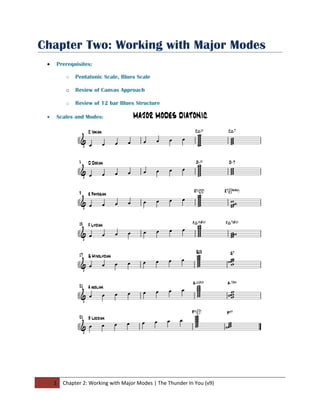
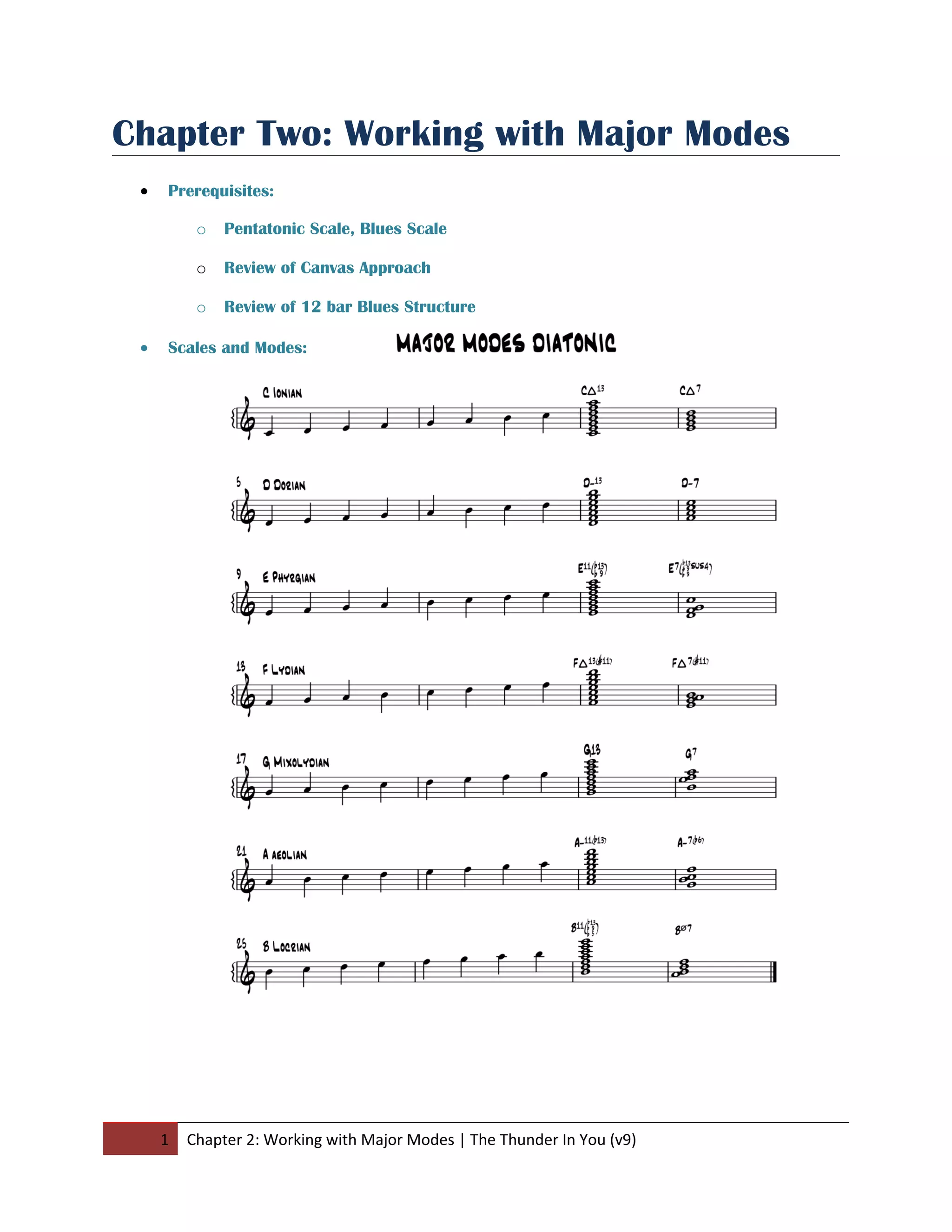
 •   Scales and Modes:


     1   Chapter 2: Working with Major Modes | The Thunder In You (v9)
•   Tools for Practice:

         o   Metronome

         o   Chromatic Tuner


    2   Chapter 2: Working with Major Modes | The Thunder In You (v9)
About Major Modes
We are going to begin our study with an examination and application of Major Modes to the blues. Each
mode is created by starting on a different note of the major scale; by starting on a different note, a new
mode is created. Each of these scales/modes can then be applied to [corresponding] chord types.

There are seven modes that can be derived from a major scale. They are:

    •   Ionian - MA7

    •   Dorian - -7

    •   Phyrigian - -7(b13, b9)

    •   Lydian - MA7(#11)

    •   Mixolydian - 7

    •   Aolean – -7(b13)

    •   Locrian – -7(b13,b9,b5)

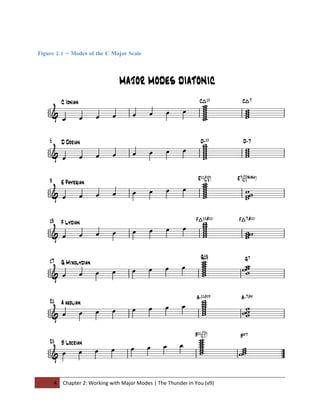
For example, C major yields seven (7) different modes.

    •   C-Ionian - MA7

    •   D - Dorian - -7

    •   E - Phyrigian - -7(b13, b9)

    •   F - Lydian - MA7(#11)

    •   G - Mixolydian - 7

    •   A - Aolean – -7(b13)

    •   B - Locrian – -7(b13,b9,b5)


        3   Chapter 2: Working with Major Modes | The Thunder In You (v9)
Figure 2.1 – Modes of the C Major Scale


      4   Chapter 2: Working with Major Modes | The Thunder In You (v9)
This method can be applied to every major scale. Twelve (12) major scales multiplied by seven (7)
modes = 84 modes; each with its own tone color and function.


Practice Tips


   1. Learn each scale slowly (quarter note = 120). Start in one key, then after getting solid
      there, move on to another key.

   2. Play all scales around the circle of 4ths and chromatically in ½ steps.

   3. Allow the sound of each scale to permeate your mind. Let each scale ‘get inside your
      head’.


Major Modes Applied to Blues Progressions
Applying major modes within the blues can give the improviser a solid base from which to create
different melodies, shapes, and patterns while maintaining consonance with each chord. This is the
basis for ‘chord/scale theory’ – a practice in which each chord has a corresponding scale or mode.

A ‘standard’ twelve (12) bar blues presents a great opportunity for the improviser to use major modes.
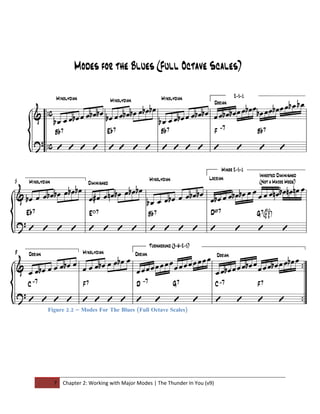
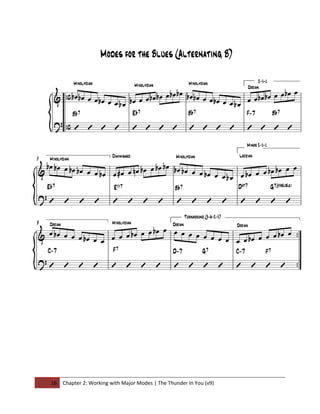
Each bar of the blues has its own tone color. In this example, we apply a major mode to each measure
of the ‘standard’ 12 bar blues. The notes will be [diatonic] to each chord/scale relationship. Another
approach would be to [match] each chord with a major mode. Here’s an example:

    •       Bb7 = Bb mixolydian

    •       Eb7 = Eb mixolydian

    •       Bb7 = Bb mixolydian

    •       F-7 – Bb7 = F dorian – Bb7 mixolydian

    •       Eb7 = Eb mixolydian

    •       E o (diminished) = E diminished (not a major mode)

    •       Bb7 = Bb mixolydian


        5     Chapter 2: Working with Major Modes | The Thunder In You (v9)
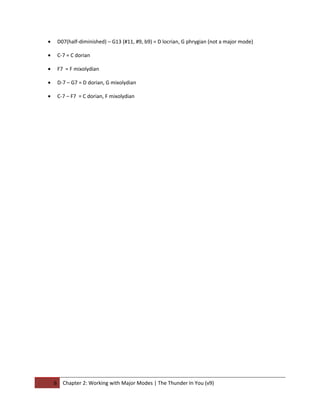
•       D07(half-diminished) – G13 (#11, #9, b9) = D locrian, G phrygian (not a major mode)

•       C-7 = C dorian

•       F7 = F mixolydian

•       D-7 – G7 = D dorian, G mixolydian

•       C-7 – F7 = C dorian, F mixolydian


    6     Chapter 2: Working with Major Modes | The Thunder In You (v9)
Figure 2.2 – Modes For The Blues (Full Octave Scales)


  7   Chapter 2: Working with Major Modes | The Thunder In You (v9)
Practice Tips


   1. Learn each blues exercise slowly (quarter note = 120).

   2. Play each blues exercise three different ways; ascending, descending, and alternating. Get
      secure in ascending, then move on to the other two patterns.

   3. Add tip # 3 here.


SUMMARY
In contemporary music chords and scale types are closely related; each chord type can be associated
with some kind of scale. In this chapter you’ve learned that seven (7) different modes, each with its
own [tonality] can be derived from a single major scale. These modes can be applied to different chord
types and used as foundation for the creation of melodies for improvisation.

Using the blues is a great way to get used to associating different chord types with different types of
scales. The ‘standard’ 12 bar blues contains ample opportunity for an improviser to apply mixolydian,
dorian, and locrian modes. These associations are diatonic to the [tonality].


       8   Chapter 2: Working with Major Modes | The Thunder In You (v9)
WRITTEN EXERCISES
  1.) What are the modes that can be derived from these major scales?

         a. Bb major

         b. E major

         c. A major

         d. Ab major

  2.) Match the appropriate scale with each chord:

         a. BbMA7

         b. Eb7

         c. D-7

         d. C-7

         e. F7

  3.) Match the appropriate scale with each chord:

         a. BbMA7

         b. Eb7

         c. D-7

         d. C-7

         e. F7

  4.) Match the appropriate scale with each chord:

         a. BbMA7

         b. Eb7

         c. D-7

         d. C-7

         e. F7


    9   Chapter 2: Working with Major Modes | The Thunder In You (v9)
5.) Match the appropriate scale with each chord:

       a. BbMA7

       b. Eb7

       c. D-7

       d. C-7

       e. F7

6.) Match the appropriate scale with each chord:

       a. BbMA7

       b. Eb7

       c. D-7

       d. C-7

       e. F7


 10   Chapter 2: Working with Major Modes | The Thunder In You (v9)
PLAYING EXERCISES


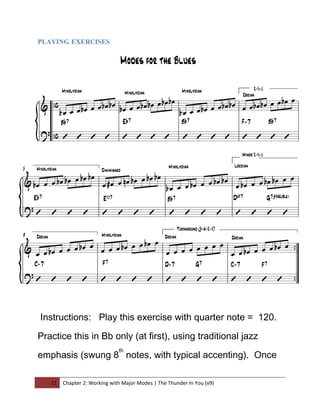
Instructions: Play this exercise with quarter note = 120.

Practice this in Bb only (at first), using traditional jazz
                              th
emphasis (swung 8 notes, with typical accenting). Once

   11   Chapter 2: Working with Major Modes | The Thunder In You (v9)
comfortable with this ascending pattern, also play the

exercise descending (reverse the pattern and play it

backwards), then alternating (ascending in one measure,

then descending the next measure).                            Be sure to

memorize this exercise so that you can do it anywhere at

anytime.


   12   Chapter 2: Working with Major Modes | The Thunder In You (v9)
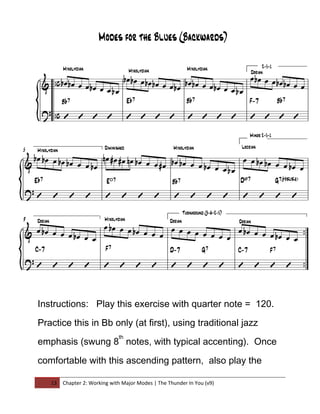
Instructions: Play this exercise with quarter note = 120.

Practice this in Bb only (at first), using traditional jazz
                              th
emphasis (swung 8 notes, with typical accenting). Once

comfortable with this ascending pattern, also play the

   13   Chapter 2: Working with Major Modes | The Thunder In You (v9)
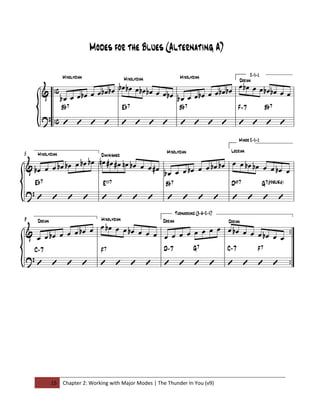
exercise descending (reverse the pattern and play it

backwards), then alternating (ascending in one measure,

then descending the next measure).                            Be sure to

memorize this exercise so that you can do it anywhere at

anytime.


   14   Chapter 2: Working with Major Modes | The Thunder In You (v9)
15   Chapter 2: Working with Major Modes | The Thunder In You (v9)
16   Chapter 2: Working with Major Modes | The Thunder In You (v9)
Insert: Unison Relationships vs. Diatonic Relationships


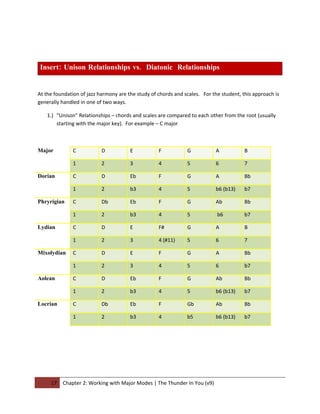
At the foundation of jazz harmony are the study of chords and scales. For the student, this approach is
generally handled in one of two ways.

    1.) “Unison” Relationships – chords and scales are compared to each other from the root (usually
        starting with the major key). For example – C major


Major          C           D           E           F           G            A           B

               1           2           3           4           5            6           7

Dorian         C           D           Eb          F           G            A           Bb

               1           2           b3          4           5            b6 (b13)    b7

Phryrigian     C           Db          Eb          F           G            Ab          Bb

               1           2           b3          4           5            b6          b7

Lydian         C           D           E           F#          G            A           B

               1           2           3           4 (#11)     5            6           7

Mixolydian     C           D           E           F           G            A           Bb

               1           2           3           4           5            6           b7

Aolean         C           D           Eb          F           G            Ab          Bb

               1           2           b3          4           5            b6 (b13)    b7

Locrian        C           Db          Eb          F           Gb           Ab          Bb

               1           2           b3          4           b5           b6 (b13)    b7


     17   Chapter 2: Working with Major Modes | The Thunder In You (v9)
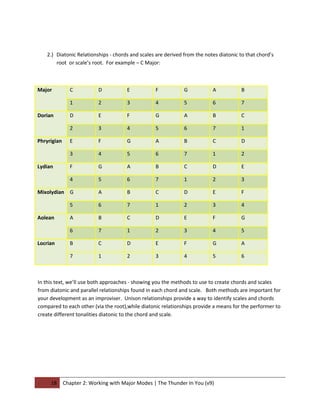
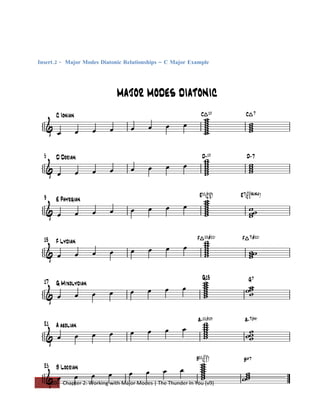
2.) Diatonic Relationships - chords and scales are derived from the notes diatonic to that chord’s
       root or scale’s root. For example – C Major:


Major          C           D          E           F           G           A            B

               1           2          3           4           5           6            7

Dorian         D           E          F           G           A           B            C

               2           3          4           5           6           7            1

Phryrigian     E           F          G           A           B           C            D

               3           4          5           6           7           1            2

Lydian         F           G          A           B           C           D            E

               4           5          6           7           1           2            3

Mixolydian G               A          B           C           D           E            F

               5           6          7           1           2           3            4

Aolean         A           B          C           D           E           F            G

               6           7          1           2           3           4            5

Locrian        B           C          D           E           F           G            A

               7           1          2           3           4           5            6


In this text, we’ll use both approaches - showing you the methods to use to create chords and scales
from diatonic and parallel relationships found in each chord and scale. Both methods are important for
your development as an improviser. Unison relationships provide a way to identify scales and chords
compared to each other (via the root),while diatonic relationships provide a means for the performer to
create different tonalities diatonic to the chord and scale.


     18      Chapter 2: Working with Major Modes | The Thunder In You (v9)
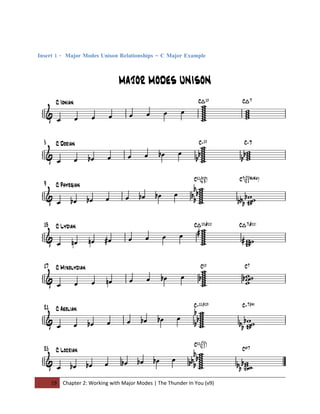
Insert 1 - Major Modes Unison Relationships – C Major Example


    19   Chapter 2: Working with Major Modes | The Thunder In You (v9)
Insert.2 - Major Modes Diatonic Relationships – C Major Example


    20   Chapter 2: Working with Major Modes | The Thunder In You (v9)
21   Chapter 2: Working with Major Modes | The Thunder In You (v9)

Chapter two(was 1) v9-oldformat

  • 1.
    Chapter Two: Workingwith Major Modes • Prerequisites: o Pentatonic Scale, Blues Scale o Review of Canvas Approach o Review of 12 bar Blues Structure • Scales and Modes: 1 Chapter 2: Working with Major Modes | The Thunder In You (v9)
  • 2.
    Tools for Practice: o Metronome o Chromatic Tuner 2 Chapter 2: Working with Major Modes | The Thunder In You (v9)
  • 3.
    About Major Modes Weare going to begin our study with an examination and application of Major Modes to the blues. Each mode is created by starting on a different note of the major scale; by starting on a different note, a new mode is created. Each of these scales/modes can then be applied to [corresponding] chord types. There are seven modes that can be derived from a major scale. They are: • Ionian - MA7 • Dorian - -7 • Phyrigian - -7(b13, b9) • Lydian - MA7(#11) • Mixolydian - 7 • Aolean – -7(b13) • Locrian – -7(b13,b9,b5) For example, C major yields seven (7) different modes. • C-Ionian - MA7 • D - Dorian - -7 • E - Phyrigian - -7(b13, b9) • F - Lydian - MA7(#11) • G - Mixolydian - 7 • A - Aolean – -7(b13) • B - Locrian – -7(b13,b9,b5) 3 Chapter 2: Working with Major Modes | The Thunder In You (v9)
  • 4.
    Figure 2.1 –Modes of the C Major Scale 4 Chapter 2: Working with Major Modes | The Thunder In You (v9)
  • 5.
    This method canbe applied to every major scale. Twelve (12) major scales multiplied by seven (7) modes = 84 modes; each with its own tone color and function. Practice Tips 1. Learn each scale slowly (quarter note = 120). Start in one key, then after getting solid there, move on to another key. 2. Play all scales around the circle of 4ths and chromatically in ½ steps. 3. Allow the sound of each scale to permeate your mind. Let each scale ‘get inside your head’. Major Modes Applied to Blues Progressions Applying major modes within the blues can give the improviser a solid base from which to create different melodies, shapes, and patterns while maintaining consonance with each chord. This is the basis for ‘chord/scale theory’ – a practice in which each chord has a corresponding scale or mode. A ‘standard’ twelve (12) bar blues presents a great opportunity for the improviser to use major modes. Each bar of the blues has its own tone color. In this example, we apply a major mode to each measure of the ‘standard’ 12 bar blues. The notes will be [diatonic] to each chord/scale relationship. Another approach would be to [match] each chord with a major mode. Here’s an example: • Bb7 = Bb mixolydian • Eb7 = Eb mixolydian • Bb7 = Bb mixolydian • F-7 – Bb7 = F dorian – Bb7 mixolydian • Eb7 = Eb mixolydian • E o (diminished) = E diminished (not a major mode) • Bb7 = Bb mixolydian 5 Chapter 2: Working with Major Modes | The Thunder In You (v9)
  • 6.
    D07(half-diminished) – G13 (#11, #9, b9) = D locrian, G phrygian (not a major mode) • C-7 = C dorian • F7 = F mixolydian • D-7 – G7 = D dorian, G mixolydian • C-7 – F7 = C dorian, F mixolydian 6 Chapter 2: Working with Major Modes | The Thunder In You (v9)
  • 7.
    Figure 2.2 –Modes For The Blues (Full Octave Scales) 7 Chapter 2: Working with Major Modes | The Thunder In You (v9)
  • 8.
    Practice Tips 1. Learn each blues exercise slowly (quarter note = 120). 2. Play each blues exercise three different ways; ascending, descending, and alternating. Get secure in ascending, then move on to the other two patterns. 3. Add tip # 3 here. SUMMARY In contemporary music chords and scale types are closely related; each chord type can be associated with some kind of scale. In this chapter you’ve learned that seven (7) different modes, each with its own [tonality] can be derived from a single major scale. These modes can be applied to different chord types and used as foundation for the creation of melodies for improvisation. Using the blues is a great way to get used to associating different chord types with different types of scales. The ‘standard’ 12 bar blues contains ample opportunity for an improviser to apply mixolydian, dorian, and locrian modes. These associations are diatonic to the [tonality]. 8 Chapter 2: Working with Major Modes | The Thunder In You (v9)
  • 9.
    WRITTEN EXERCISES 1.) What are the modes that can be derived from these major scales? a. Bb major b. E major c. A major d. Ab major 2.) Match the appropriate scale with each chord: a. BbMA7 b. Eb7 c. D-7 d. C-7 e. F7 3.) Match the appropriate scale with each chord: a. BbMA7 b. Eb7 c. D-7 d. C-7 e. F7 4.) Match the appropriate scale with each chord: a. BbMA7 b. Eb7 c. D-7 d. C-7 e. F7 9 Chapter 2: Working with Major Modes | The Thunder In You (v9)
  • 10.
    5.) Match theappropriate scale with each chord: a. BbMA7 b. Eb7 c. D-7 d. C-7 e. F7 6.) Match the appropriate scale with each chord: a. BbMA7 b. Eb7 c. D-7 d. C-7 e. F7 10 Chapter 2: Working with Major Modes | The Thunder In You (v9)
  • 11.
    PLAYING EXERCISES Instructions: Playthis exercise with quarter note = 120. Practice this in Bb only (at first), using traditional jazz th emphasis (swung 8 notes, with typical accenting). Once 11 Chapter 2: Working with Major Modes | The Thunder In You (v9)
  • 12.
    comfortable with thisascending pattern, also play the exercise descending (reverse the pattern and play it backwards), then alternating (ascending in one measure, then descending the next measure). Be sure to memorize this exercise so that you can do it anywhere at anytime. 12 Chapter 2: Working with Major Modes | The Thunder In You (v9)
  • 13.
    Instructions: Play thisexercise with quarter note = 120. Practice this in Bb only (at first), using traditional jazz th emphasis (swung 8 notes, with typical accenting). Once comfortable with this ascending pattern, also play the 13 Chapter 2: Working with Major Modes | The Thunder In You (v9)
  • 14.
    exercise descending (reversethe pattern and play it backwards), then alternating (ascending in one measure, then descending the next measure). Be sure to memorize this exercise so that you can do it anywhere at anytime. 14 Chapter 2: Working with Major Modes | The Thunder In You (v9)
  • 15.
    15 Chapter 2: Working with Major Modes | The Thunder In You (v9)
  • 16.
    16 Chapter 2: Working with Major Modes | The Thunder In You (v9)
  • 17.
    Insert: Unison Relationshipsvs. Diatonic Relationships At the foundation of jazz harmony are the study of chords and scales. For the student, this approach is generally handled in one of two ways. 1.) “Unison” Relationships – chords and scales are compared to each other from the root (usually starting with the major key). For example – C major Major C D E F G A B 1 2 3 4 5 6 7 Dorian C D Eb F G A Bb 1 2 b3 4 5 b6 (b13) b7 Phryrigian C Db Eb F G Ab Bb 1 2 b3 4 5 b6 b7 Lydian C D E F# G A B 1 2 3 4 (#11) 5 6 7 Mixolydian C D E F G A Bb 1 2 3 4 5 6 b7 Aolean C D Eb F G Ab Bb 1 2 b3 4 5 b6 (b13) b7 Locrian C Db Eb F Gb Ab Bb 1 2 b3 4 b5 b6 (b13) b7 17 Chapter 2: Working with Major Modes | The Thunder In You (v9)
  • 18.
    2.) Diatonic Relationships- chords and scales are derived from the notes diatonic to that chord’s root or scale’s root. For example – C Major: Major C D E F G A B 1 2 3 4 5 6 7 Dorian D E F G A B C 2 3 4 5 6 7 1 Phryrigian E F G A B C D 3 4 5 6 7 1 2 Lydian F G A B C D E 4 5 6 7 1 2 3 Mixolydian G A B C D E F 5 6 7 1 2 3 4 Aolean A B C D E F G 6 7 1 2 3 4 5 Locrian B C D E F G A 7 1 2 3 4 5 6 In this text, we’ll use both approaches - showing you the methods to use to create chords and scales from diatonic and parallel relationships found in each chord and scale. Both methods are important for your development as an improviser. Unison relationships provide a way to identify scales and chords compared to each other (via the root),while diatonic relationships provide a means for the performer to create different tonalities diatonic to the chord and scale. 18 Chapter 2: Working with Major Modes | The Thunder In You (v9)
  • 19.
    Insert 1 -Major Modes Unison Relationships – C Major Example 19 Chapter 2: Working with Major Modes | The Thunder In You (v9)
  • 20.
    Insert.2 - MajorModes Diatonic Relationships – C Major Example 20 Chapter 2: Working with Major Modes | The Thunder In You (v9)
  • 21.
    21 Chapter 2: Working with Major Modes | The Thunder In You (v9)