


Playing By Ear
When you hear a new song do you wish you
could just play the right chords by ear,
without the music in front of you?
In this session we go
through a simple three
step formula that will
help you work out the
right chords for any
song in any key.
              © www.musicademy.co.uk
About Musicademy
• The Musicademy team

DVDs
Guitar, Vocals, Keys
Drums, Bass, Orchestral

• Worship Backing band

                © www.musicademy.co.uk
For seminar notes, please add your
email address to the list
You’ll also get our (rather good)
weekly Worship Newsletter

+ Free prize draw!

             © www.musicademy.co.uk
Defining a Key
• Pieces of music are defined according to their “key”.
  Hosanna is in the key of G major.
• Each key is made up of a series of individual notes
  (referred to as a scale) that all “fit with” the melody,
  harmony and chords of the song without jarring on the ear.
• However, there is one note in each scale which seems to fit
  the song more than any other.
  It is often referred to as the note that sounds like the
  “home”, or most comfortable note that can be played all the
  way through the song and seems to fit all the time.
  This note is called the “Root” note.
  The root of Hosanna is G. This is why that song is in the
  key of G.
• Hosanna is in G major. Major scales or keys sound
  “happy” and minor scales sound “sad”.
                     © www.musicademy.co.uk
How to find the ‘key’ of
a song on your guitar
•   Whilst listening to a piece of music play each fret of the first string
    (high E). Start with the open E note and work your way up evenly to
    around fret 13 and then back down again. Don’t miss out any frets!
•   Find the note which seems to fit most comfortably over every chord
    change and note of the song. That note will be the ‘key’ the song is
    in.
•   Sometimes you may find two, or even three notes that work well.
    These are because you have found some notes that are contained
    within the key.
•   So in the key of G, you may have found the C, the D, and the G
    notes which all fit quite well.
•   However, if you play all those options again over the song then one
    of those notes will definitely sound more ‘home’ than the others.
    This note is also known as the ‘root’ note of the key.

•   This is the first stage of being able to work out any chord or part for
    any song you choose to. This process is known as transcribing.
                            © www.musicademy.co.uk
Step 1-The Major Scale
• The Major Scale is the backbone of music theory.
  Most other melodic and harmonic information is explained in
  terms of how it relates to the scale.
• Two distances between notes – the tone and the semitone.
  A jump of a semitone is moving one fret up or down on the
  guitar
  A jump of a tone is moving two frets up or down– the
  equivalent of two semitones.

• A major scale is recognized by the singing of the song Do,
  Ra Me ….
• Work out how many ‘steps’ between Do, (sung low) and Do,
  (sung high)
• There are always ……. notes in any major scale.
                     © www.musicademy.co.uk
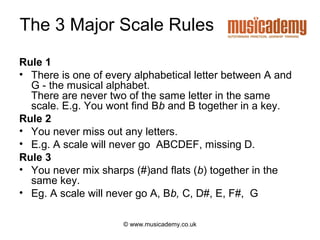
The 3 Major Scale Rules
Rule 1
• There is one of every alphabetical letter between A and
  G - the musical alphabet.
  There are never two of the same letter in the same
  scale. E.g. You wont find Bb and B together in a key.
Rule 2
• You never miss out any letters.
• E.g. A scale will never go ABCDEF, missing D.
Rule 3
• You never mix sharps (#)and flats (b) together in the
  same key.
• Eg. A scale will never go A, Bb, C, D#, E, F#, G

                     © www.musicademy.co.uk
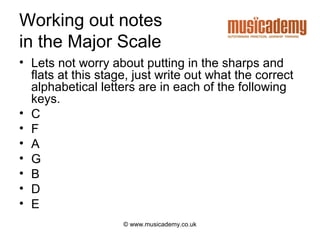
Working out notes
in the Major Scale
• Lets not worry about putting in the sharps and
  flats at this stage, just write out what the correct
  alphabetical letters are in each of the following
  keys.
• C
• F
• A
• G
• B
• D
• E
                    © www.musicademy.co.uk
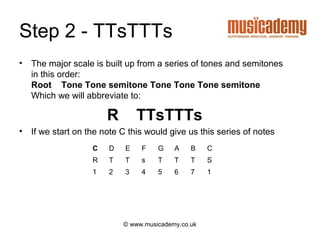
Step 2 - TTsTTTs
•   The major scale is built up from a series of tones and semitones
    in this order:
    Root Tone Tone semitone Tone Tone Tone semitone
    Which we will abbreviate to:

                        R        TTsTTTs
•   If we start on the note C this would give us this series of notes
                    C   D    E   F    G    A    B    C
                    R   T    T   s    T    T    T    S
                    1   2    3   4    5    6    7    1


                            © www.musicademy.co.uk
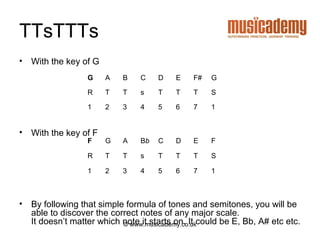
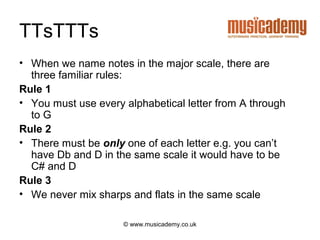
TTsTTTs
•   With the key of G
                   G    A   B    C    D    E    F#   G

                   R    T   T    s    T    T    T    S

                   1    2   3    4    5    6    7    1


•   With the key of F
                   F    G   A    Bb   C    D    E    F

                   R    T   T    s    T    T    T    S

                   1    2   3    4    5    6    7    1


•   By following that simple formula of tones and semitones, you will be
    able to discover the correct notes of any major scale.
    It doesn’t matter which note it starts on. It could be E, Bb, A# etc etc.
                            © www.musicademy.co.uk
TTsTTTs
• When we name notes in the major scale, there are
  three familiar rules:
Rule 1
• You must use every alphabetical letter from A through
  to G
Rule 2
• There must be only one of each letter e.g. you can’t
  have Db and D in the same scale it would have to be
  C# and D
Rule 3
• We never mix sharps and flats in the same scale

                     © www.musicademy.co.uk
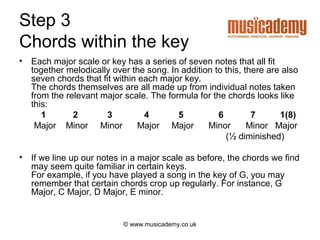
Step 3
Chords within the key
•   Each major scale or key has a series of seven notes that all fit
    together melodically over the song. In addition to this, there are also
    seven chords that fit within each major key.
    The chords themselves are all made up from individual notes taken
    from the relevant major scale. The formula for the chords looks like
    this:
       1       2       3          4       5          6         7      1(8)
     Major Minor Minor           Major Major      Minor       Minor Major
                                                       (½ diminished)

•   If we line up our notes in a major scale as before, the chords we find
    may seem quite familiar in certain keys.
    For example, if you have played a song in the key of G, you may
    remember that certain chords crop up regularly. For instance, G
    Major, C Major, D Major, E minor.


                            © www.musicademy.co.uk
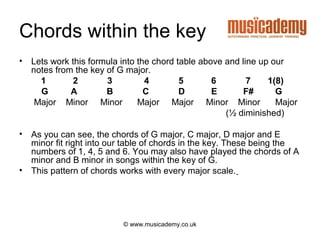
Chords within the key
•   Lets work this formula into the chord table above and line up our
    notes from the key of G major.
      1        2       3          4        5       6        7    1(8)
      G       A        B          C        D       E       F#      G
     Major Minor Minor          Major Major Minor Minor            Major
                                                      (½ diminished)

•   As you can see, the chords of G major, C major, D major and E
    minor fit right into our table of chords in the key. These being the
    numbers of 1, 4, 5 and 6. You may also have played the chords of A
    minor and B minor in songs within the key of G.
•   This pattern of chords works with every major scale.


                           © www.musicademy.co.uk
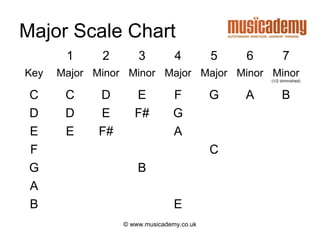
Major Scale Chart
       1     2        3          4         5   6         7
Key   Major Minor Minor Major Major Minor Minor
                                                   (1/2 diminished)


 C     C     D       E          F          G   A        B
 D     D     E       F#         G
 E     E     F#                 A
 F                                         C
 G                    B
 A
 B                               E
                  © www.musicademy.co.uk
For Further Information
• www.musicademy.co.uk
• Sign up there area for free resources and to
  receive our weekly e-newsletter packed with
  useful articles and special offers
• Sign up on our mailing list at the
  Musicademy booth to receive these teaching
  notes by email
• + a free prize draw!
                © www.musicademy.co.uk

Musicademy Playing by Ear in Worship

  • 1.
    Playing By Ear Whenyou hear a new song do you wish you could just play the right chords by ear, without the music in front of you? In this session we go through a simple three step formula that will help you work out the right chords for any song in any key. © www.musicademy.co.uk
  • 2.
    About Musicademy • TheMusicademy team DVDs Guitar, Vocals, Keys Drums, Bass, Orchestral • Worship Backing band © www.musicademy.co.uk
  • 3.
    For seminar notes,please add your email address to the list You’ll also get our (rather good) weekly Worship Newsletter + Free prize draw! © www.musicademy.co.uk
  • 4.
    Defining a Key •Pieces of music are defined according to their “key”. Hosanna is in the key of G major. • Each key is made up of a series of individual notes (referred to as a scale) that all “fit with” the melody, harmony and chords of the song without jarring on the ear. • However, there is one note in each scale which seems to fit the song more than any other. It is often referred to as the note that sounds like the “home”, or most comfortable note that can be played all the way through the song and seems to fit all the time. This note is called the “Root” note. The root of Hosanna is G. This is why that song is in the key of G. • Hosanna is in G major. Major scales or keys sound “happy” and minor scales sound “sad”. © www.musicademy.co.uk
  • 5.
    How to findthe ‘key’ of a song on your guitar • Whilst listening to a piece of music play each fret of the first string (high E). Start with the open E note and work your way up evenly to around fret 13 and then back down again. Don’t miss out any frets! • Find the note which seems to fit most comfortably over every chord change and note of the song. That note will be the ‘key’ the song is in. • Sometimes you may find two, or even three notes that work well. These are because you have found some notes that are contained within the key. • So in the key of G, you may have found the C, the D, and the G notes which all fit quite well. • However, if you play all those options again over the song then one of those notes will definitely sound more ‘home’ than the others. This note is also known as the ‘root’ note of the key. • This is the first stage of being able to work out any chord or part for any song you choose to. This process is known as transcribing. © www.musicademy.co.uk
  • 6.
    Step 1-The MajorScale • The Major Scale is the backbone of music theory. Most other melodic and harmonic information is explained in terms of how it relates to the scale. • Two distances between notes – the tone and the semitone. A jump of a semitone is moving one fret up or down on the guitar A jump of a tone is moving two frets up or down– the equivalent of two semitones. • A major scale is recognized by the singing of the song Do, Ra Me …. • Work out how many ‘steps’ between Do, (sung low) and Do, (sung high) • There are always ……. notes in any major scale. © www.musicademy.co.uk
  • 7.
    The 3 MajorScale Rules Rule 1 • There is one of every alphabetical letter between A and G - the musical alphabet. There are never two of the same letter in the same scale. E.g. You wont find Bb and B together in a key. Rule 2 • You never miss out any letters. • E.g. A scale will never go ABCDEF, missing D. Rule 3 • You never mix sharps (#)and flats (b) together in the same key. • Eg. A scale will never go A, Bb, C, D#, E, F#, G © www.musicademy.co.uk
  • 8.
    Working out notes inthe Major Scale • Lets not worry about putting in the sharps and flats at this stage, just write out what the correct alphabetical letters are in each of the following keys. • C • F • A • G • B • D • E © www.musicademy.co.uk
  • 9.
    Step 2 -TTsTTTs • The major scale is built up from a series of tones and semitones in this order: Root Tone Tone semitone Tone Tone Tone semitone Which we will abbreviate to: R TTsTTTs • If we start on the note C this would give us this series of notes C D E F G A B C R T T s T T T S 1 2 3 4 5 6 7 1 © www.musicademy.co.uk
  • 10.
    TTsTTTs • With the key of G G A B C D E F# G R T T s T T T S 1 2 3 4 5 6 7 1 • With the key of F F G A Bb C D E F R T T s T T T S 1 2 3 4 5 6 7 1 • By following that simple formula of tones and semitones, you will be able to discover the correct notes of any major scale. It doesn’t matter which note it starts on. It could be E, Bb, A# etc etc. © www.musicademy.co.uk
  • 11.
    TTsTTTs • When wename notes in the major scale, there are three familiar rules: Rule 1 • You must use every alphabetical letter from A through to G Rule 2 • There must be only one of each letter e.g. you can’t have Db and D in the same scale it would have to be C# and D Rule 3 • We never mix sharps and flats in the same scale © www.musicademy.co.uk
  • 12.
    Step 3 Chords withinthe key • Each major scale or key has a series of seven notes that all fit together melodically over the song. In addition to this, there are also seven chords that fit within each major key. The chords themselves are all made up from individual notes taken from the relevant major scale. The formula for the chords looks like this: 1 2 3 4 5 6 7 1(8) Major Minor Minor Major Major Minor Minor Major (½ diminished) • If we line up our notes in a major scale as before, the chords we find may seem quite familiar in certain keys. For example, if you have played a song in the key of G, you may remember that certain chords crop up regularly. For instance, G Major, C Major, D Major, E minor. © www.musicademy.co.uk
  • 13.
    Chords within thekey • Lets work this formula into the chord table above and line up our notes from the key of G major. 1 2 3 4 5 6 7 1(8) G A B C D E F# G Major Minor Minor Major Major Minor Minor Major (½ diminished) • As you can see, the chords of G major, C major, D major and E minor fit right into our table of chords in the key. These being the numbers of 1, 4, 5 and 6. You may also have played the chords of A minor and B minor in songs within the key of G. • This pattern of chords works with every major scale. © www.musicademy.co.uk
  • 14.
    Major Scale Chart 1 2 3 4 5 6 7 Key Major Minor Minor Major Major Minor Minor (1/2 diminished) C C D E F G A B D D E F# G E E F# A F C G B A B E © www.musicademy.co.uk
  • 15.
    For Further Information •www.musicademy.co.uk • Sign up there area for free resources and to receive our weekly e-newsletter packed with useful articles and special offers • Sign up on our mailing list at the Musicademy booth to receive these teaching notes by email • + a free prize draw! © www.musicademy.co.uk

Editor's Notes

  • #4 www.musicademy.co.uk © Musicademy 2007