The document provides an overview of cognitive behavioral therapy, focusing on influential figures like Albert Ellis, Aaron Beck, and Donald Meichenbaum. It discusses the development and principles of Rational Emotive Behavior Therapy (REBT), Beck's Cognitive Therapy, and Cognitive Behavior Therapy (CBT), while highlighting their applications, therapeutic processes, and the roles of therapists and clients. The text emphasizes how cognitive and behavioral principles are integrated to address emotional disturbances and the importance of client responsibility in therapy.

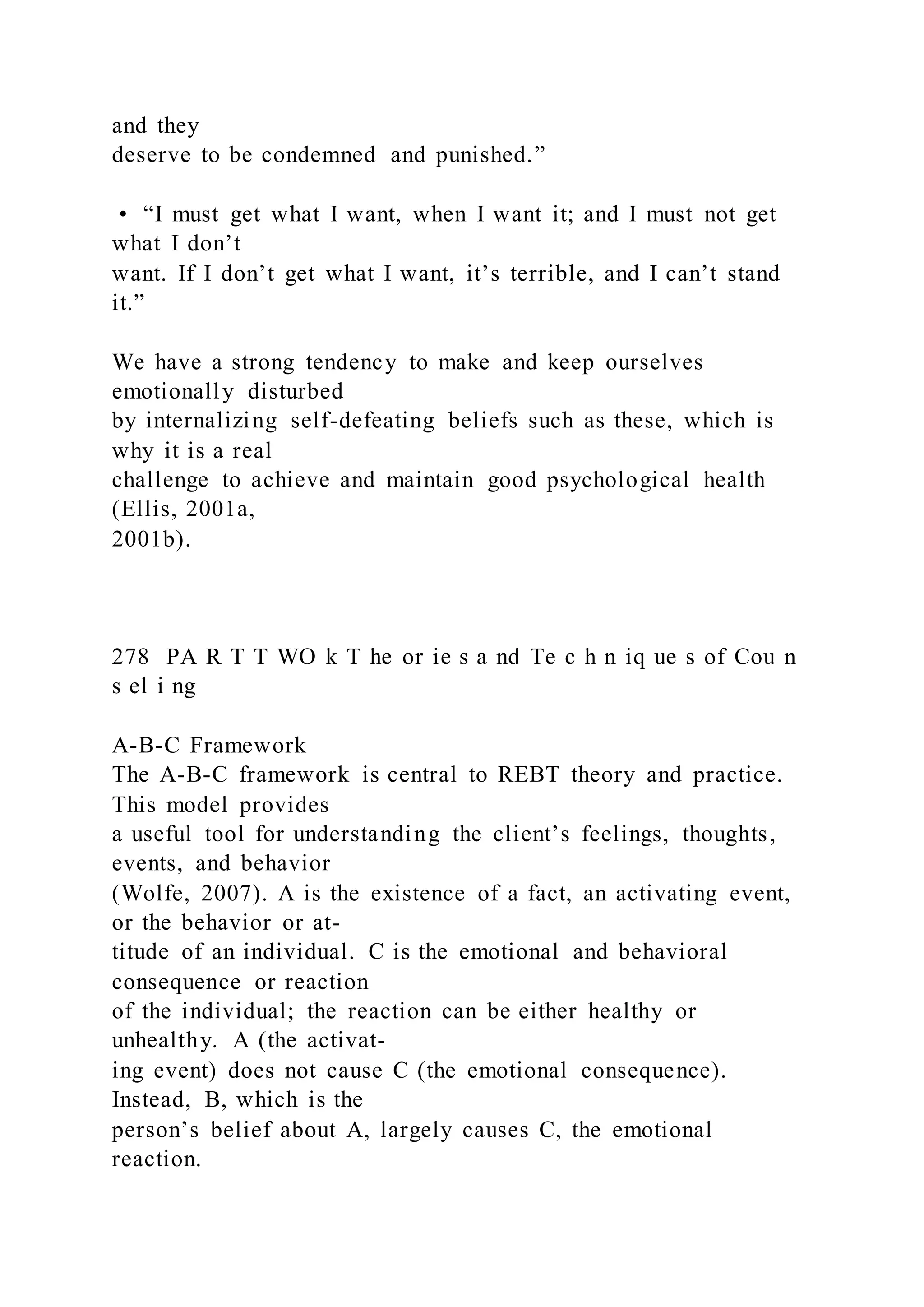
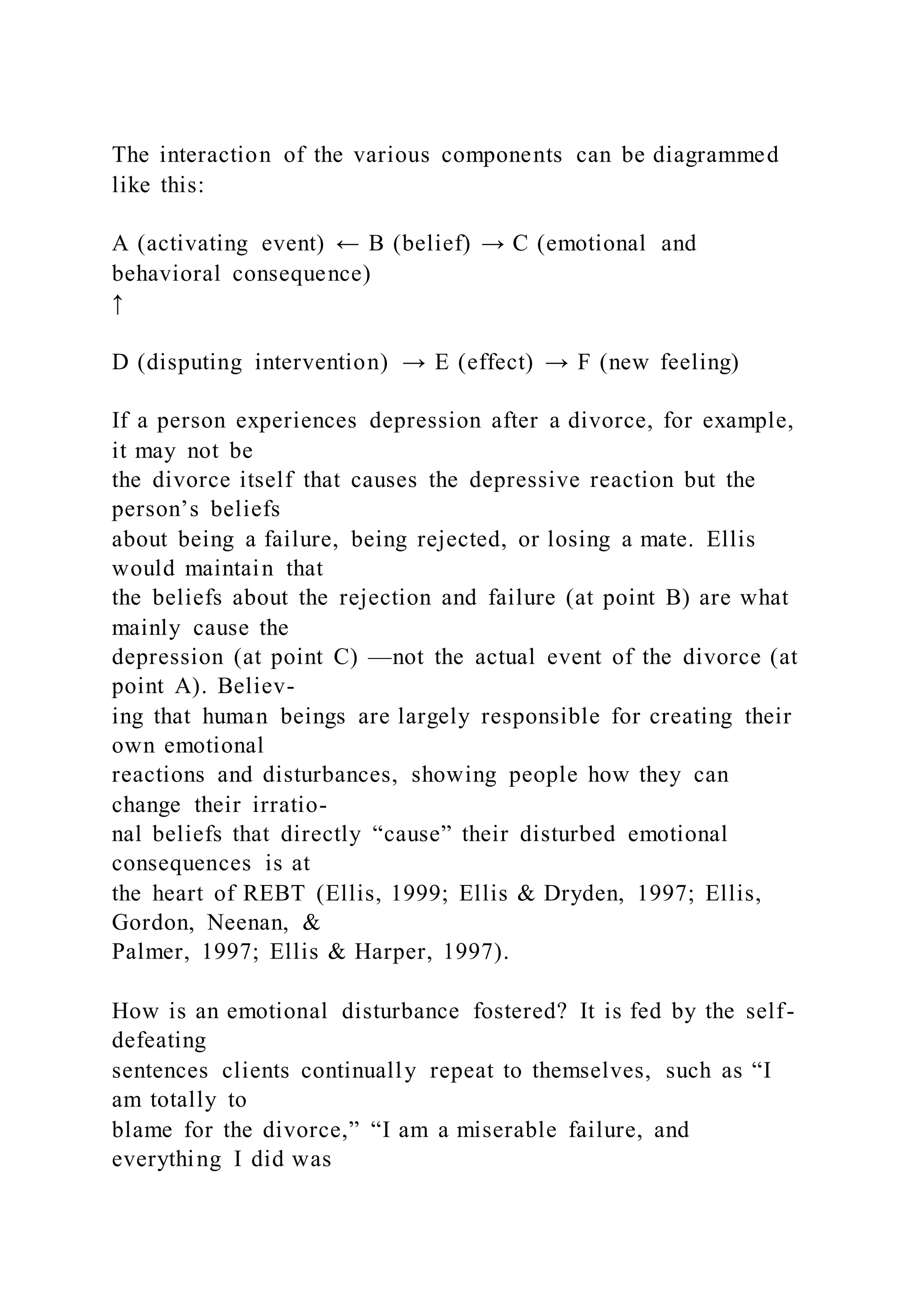
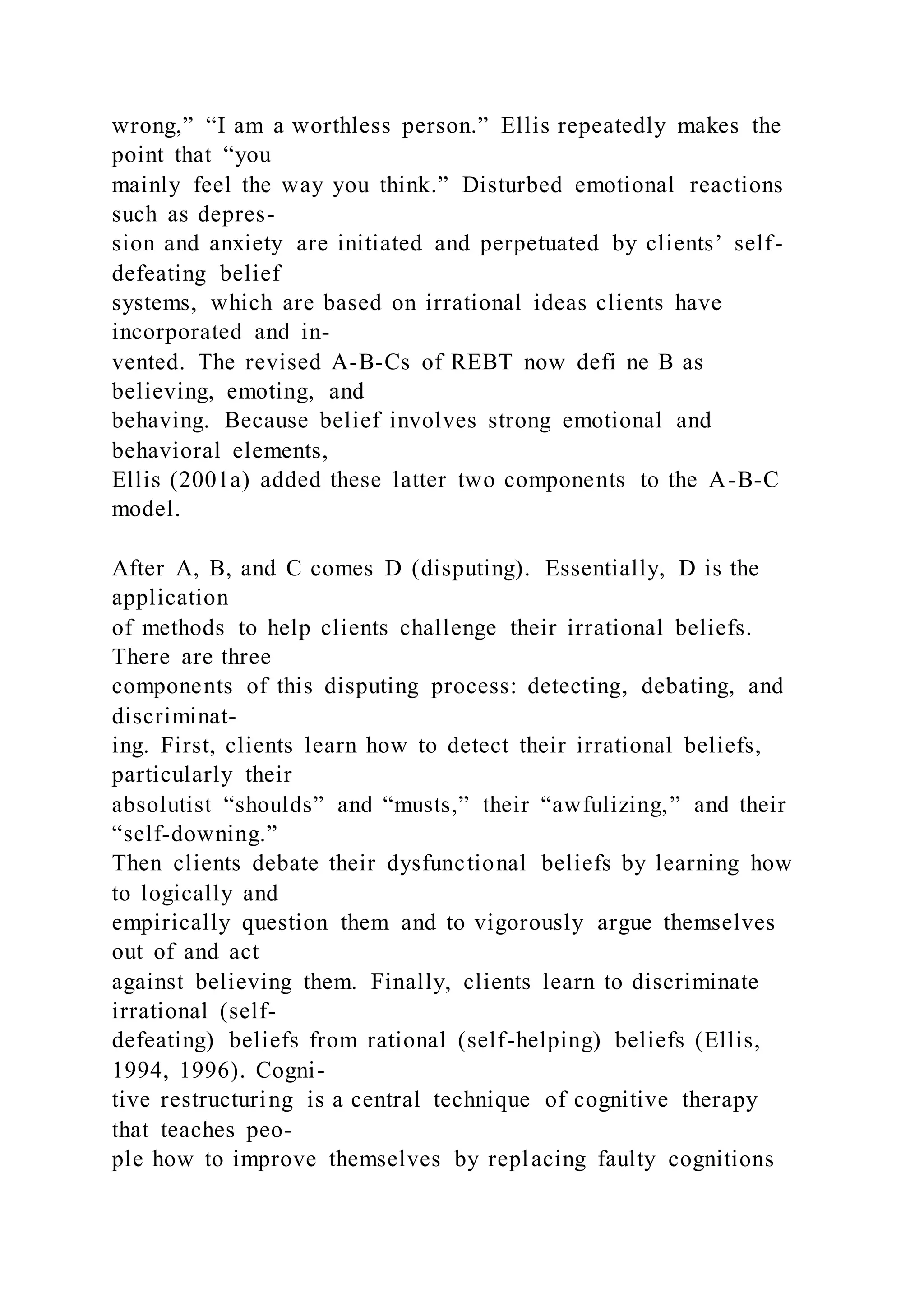
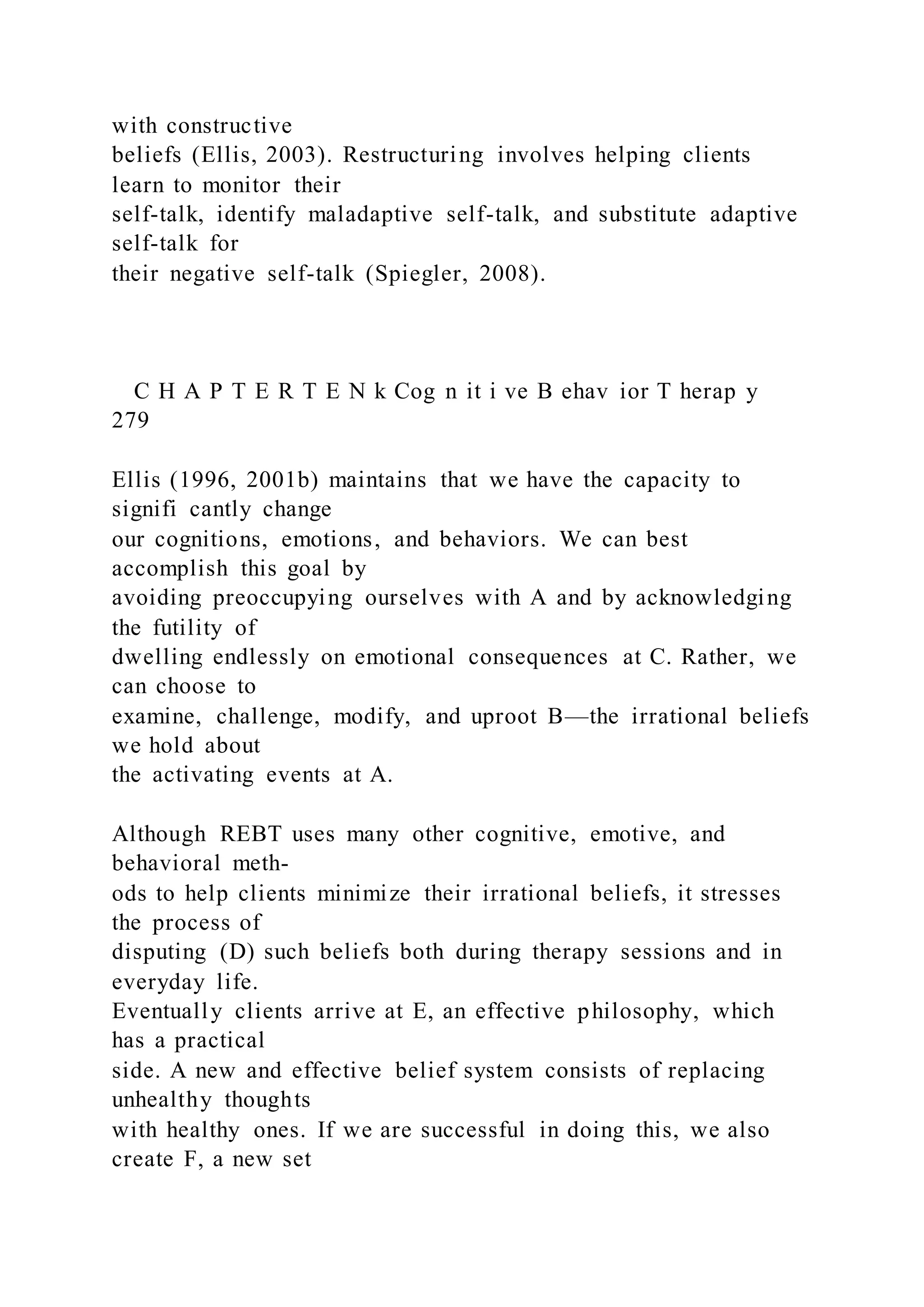
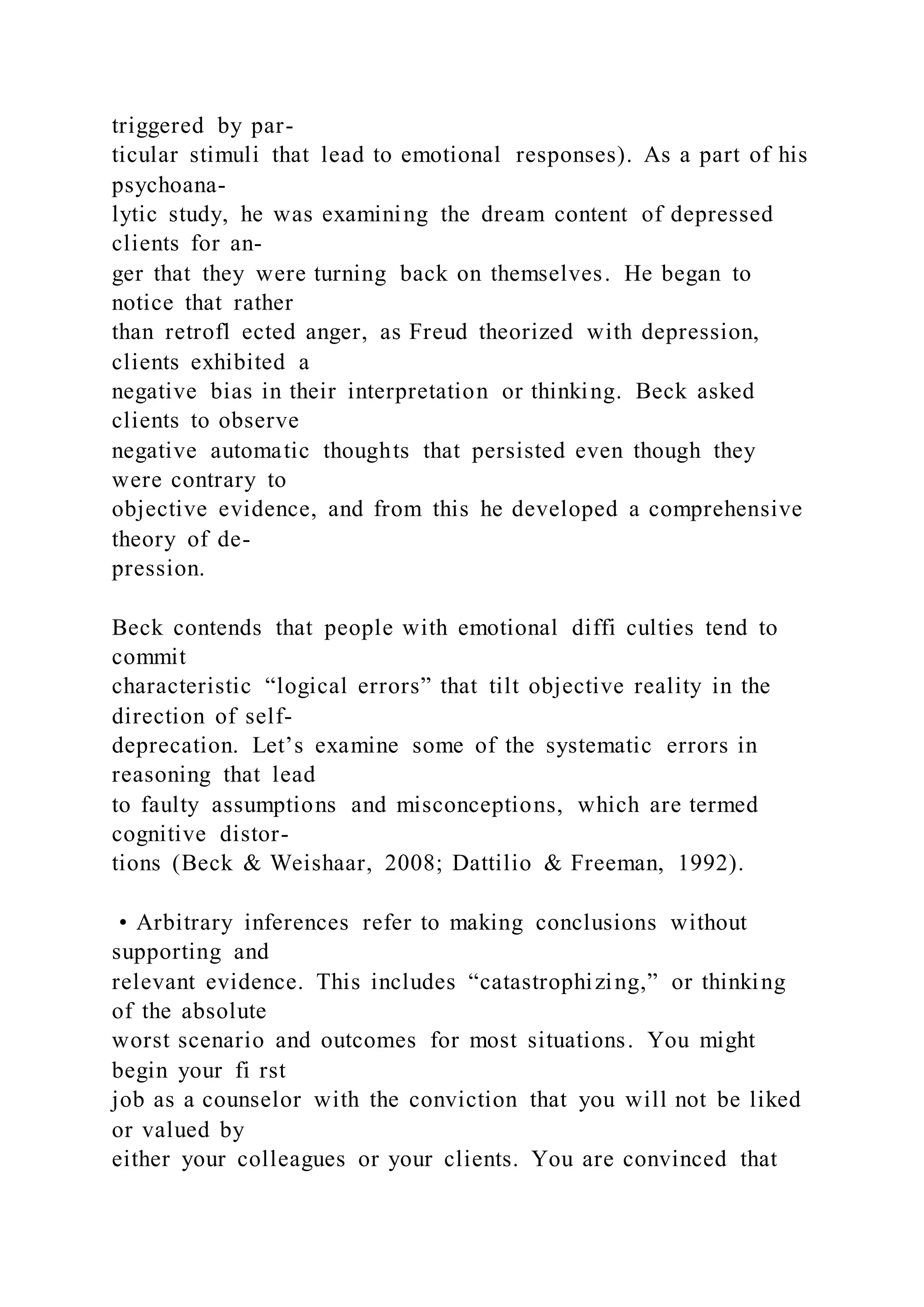
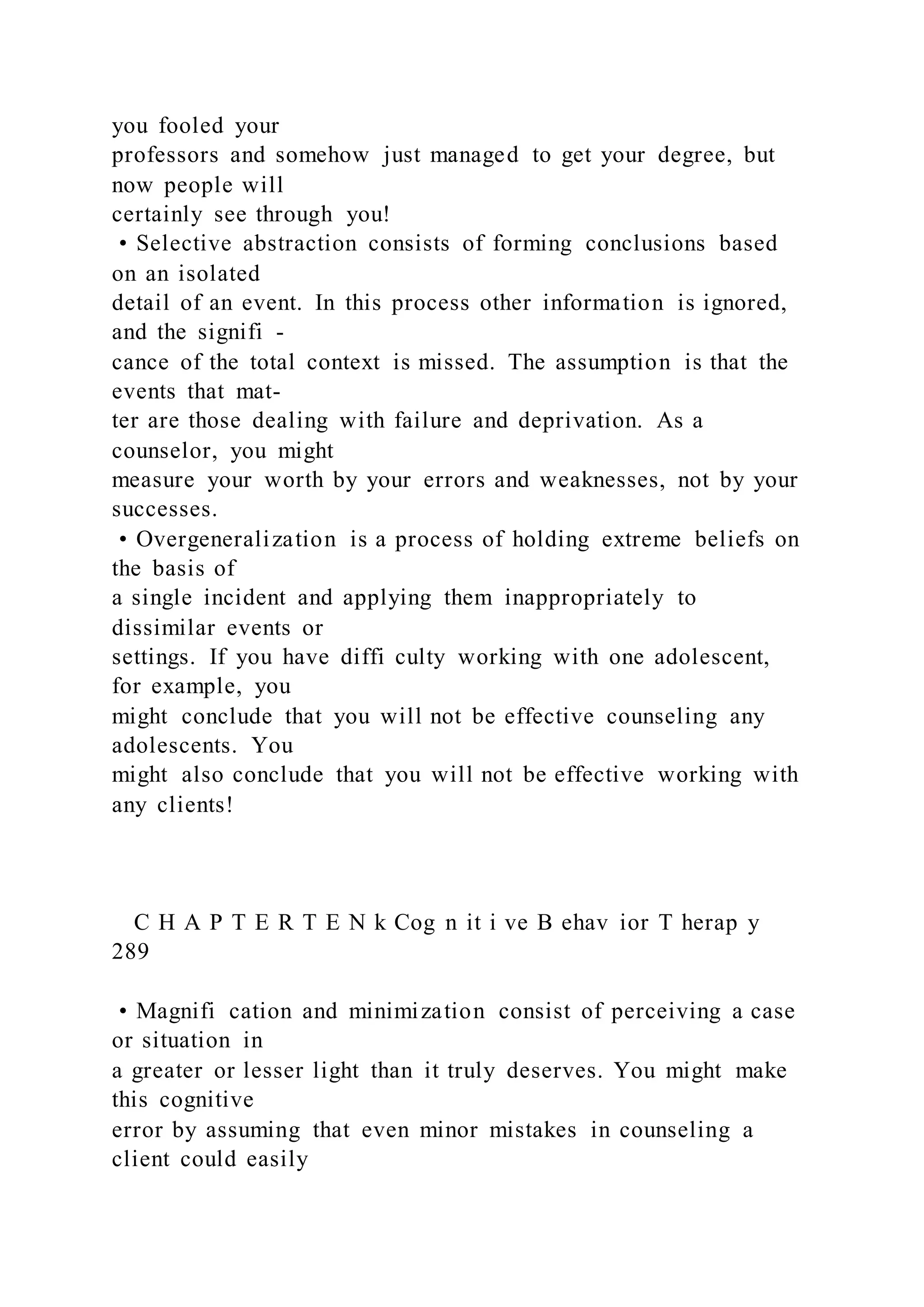
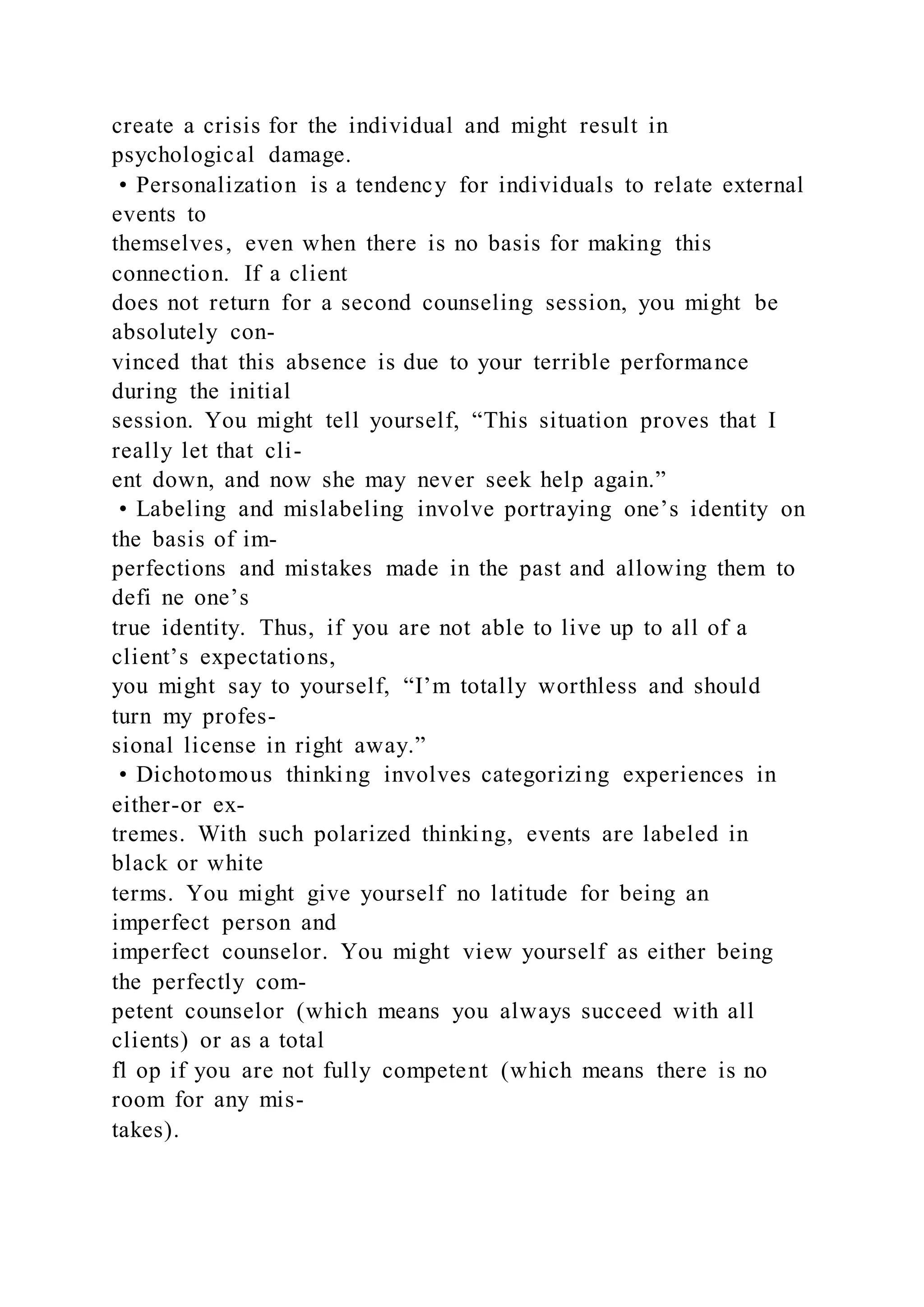
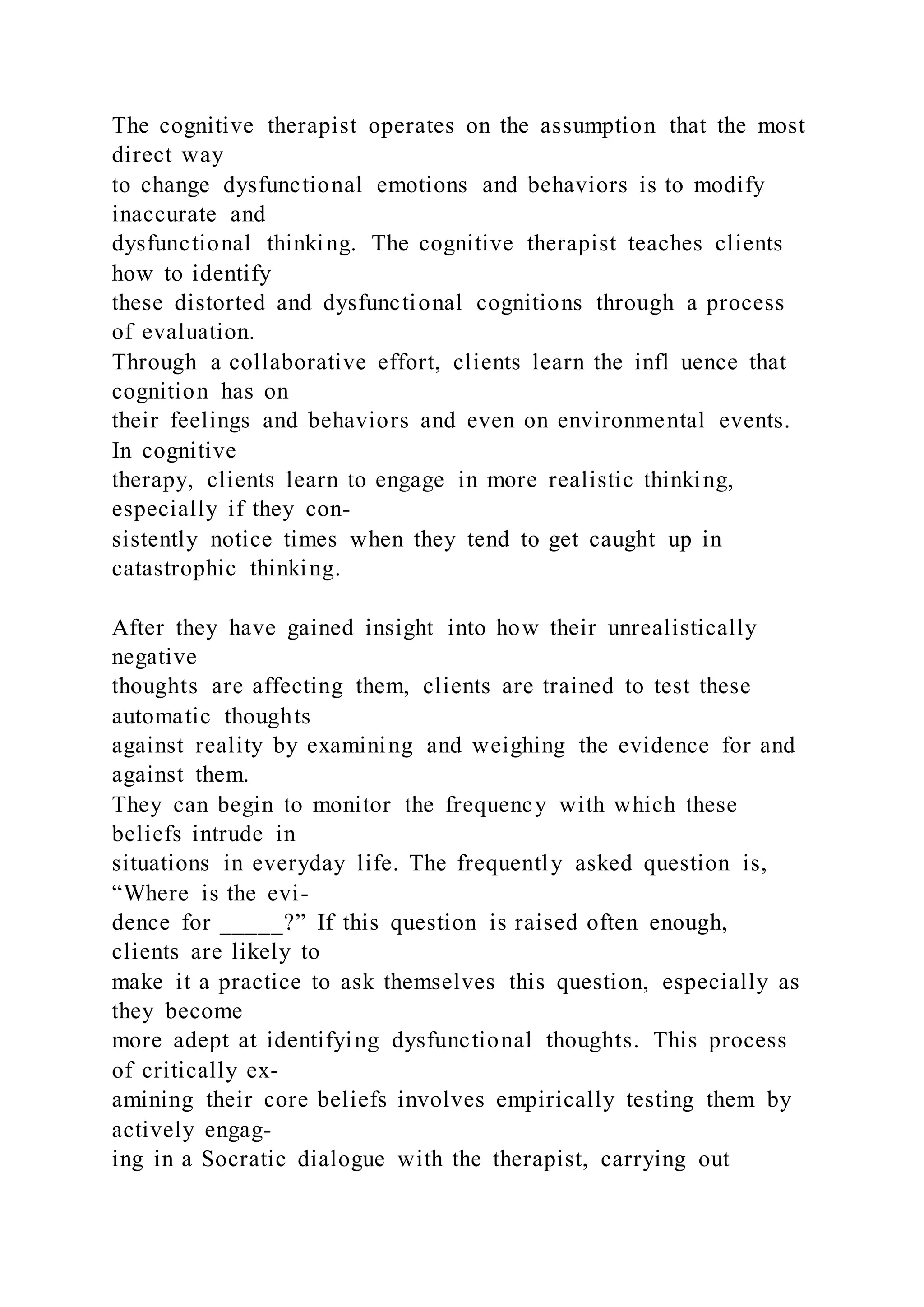


![ioral specialists.
Although Albert Ellis founded the Albert Ellis Institute in 1959,
Ellis was
not associated with this Institute for at least the last several
years of his life.
In 2006, Ellis claimed that the Albert Ellis Institute was
following a program
that in many ways was not consistent with the theory and
practice of REBT
(Ellis, 2008). For information about the work of Albert Ellis,
and current train-
ing opportunities, contact:
Dr. Debbie Joffe Ellis
Telephone: (917) 887-2006
Website: www.rebtnetwork.org/
The Journal of Cognitive Psychotherapy: An International
Quarterly, edited by John
Riskind, also provides information on theory, practice, and
research in cogni-
tive behavior therapy. Information about the journal is available
from the Inter-
national Association of Cognitive Psychotherapy or by
contacting John Riskind
directly.
Dr. John Riskind
George Mason University
Department of Psychology, MSN 3F5
Fairfax, VA 22030-4444
Telephone: (703) 993-4094
Private Practice Telephone: (703) 280-8060
Fax: (703) 993-1359
E-mail: [email protected]](https://image.slidesharecdn.com/272chaptertenkintroductionkalber-220919175150-3a7d759c/75/272-C-H-A-P-T-E-R-T-E-Nk-Introductionk-Alber-103-2048.jpg)
![Website: www.cognitivetherapyassociation.org
310 PA R T T WO k T he or ie s a nd Te c h n iq ue s of Cou n
s el i ng
The Center for Cognitive Therapy, Newport Beach, California,
maintains a
website for mental health professionals. They list cognitive
therapy books,
audio and video training tapes, current advanced training
workshops, and oth-
er cognitive therapy resources and information.
Center for Cognitive Therapy
E-mail: [email protected]
Website: http://www.padesky.com
For more information about a one-year, full-time postdoctoral
fellowship and
for shorter term clinical institutes, contact the Beck institute.
Beck Institute for Cognitive Therapy and Research
One Belmont Avenue, Suite 700
Bala Cynwyd, PA 19004-1610
Telephone: (610) 664-3020
Fax: (610) 664-4437
E-mail: [email protected]
Website: www.beckinstitute.org
For information regarding ongoing training and supervision in
cognitive ther-
apy, contact:
Department of Clinical Psychology](https://image.slidesharecdn.com/272chaptertenkintroductionkalber-220919175150-3a7d759c/75/272-C-H-A-P-T-E-R-T-E-Nk-Introductionk-Alber-104-2048.jpg)

![married for ten years. He says that he thought, “Lindsey was
initially perfect for me”, but now
Wesley is unable to see past her flaws. He reported that Lindsey
“is always working and won’t
make time for him.” Wesley reports that in order to “teach her a
lesson about what’s important,”
that he has basically stopped communicating with Lindsay.
Wesley cannot remember the last me
that he and his wife were physically or emotionally intimate.
Wesley reported that “there is
nothing he can do to fix the marriage” -- that it is up to Lindsey
to make it better.
Another reported concern is Wesley’s vocational life. The
neighborhood that Wesley
grew up in was middle-class; his mother is a middle-school
English teacher, and his father owns
a business that does contracting for housing developments.
Since Wesley is an only child, his
father would tell him, “The baby [i.e., the business] is all yours
when you become a man.”
Currently, Wesley acts as a sales manager for the company. He
says that he feels trapped in his
job and comes home frustrated every day, sometimes taking it
out on Lindsey and the kids with
angry outbursts. He also reported that he drinks a six-pack of
beer every night in order to “get
away from it all.”
Growing up, Wesley always dreamed of being an actor. He
staged plays for an audience
that consisted of his parents (who divorced when he was 15
years old) and stuffed animals. He
later starred in many high school productions but never further
pursued this once he went to](https://image.slidesharecdn.com/272chaptertenkintroductionkalber-220919175150-3a7d759c/75/272-C-H-A-P-T-E-R-T-E-Nk-Introductionk-Alber-139-2048.jpg)



![⁎ Corresponding author.E-mail addresses [email protected] (](https://cdn.slidesharecdn.com/ss_thumbnails/correspondingauthor-220919175150-d6eca781-thumbnail.jpg?width=640&height=640&fit=bounds)


