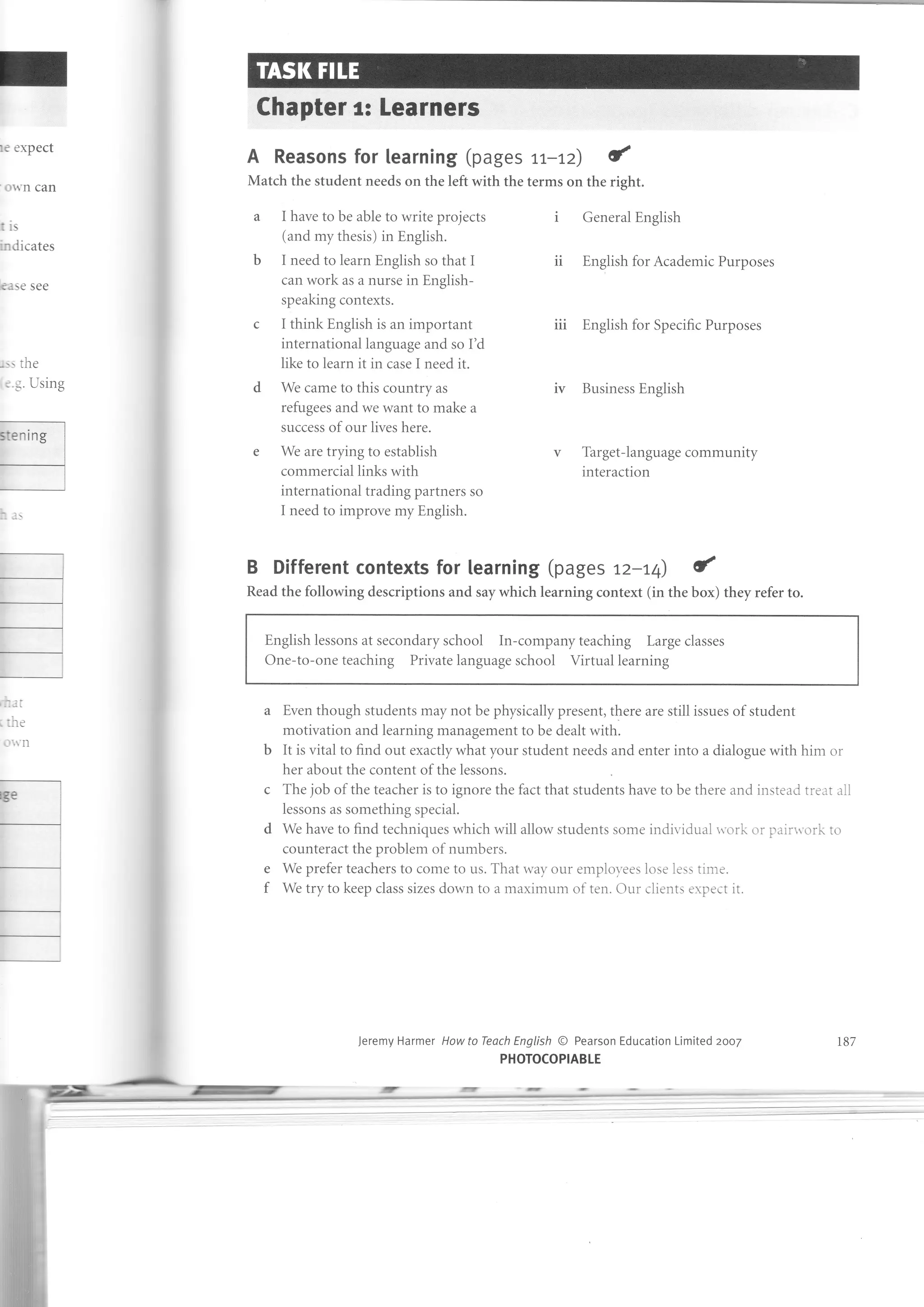
Chapter          13   Learners
re expect
                      A Reasons for learn¡ng (pages rr-r2) €
' or     n can       Match the student needs on the left with the terms on the right.

                            I have to be able to write projects                      General English
tis
                            (and my thesis) in English.
indicates
                            I need to learn English so that I                        English for Academic Purposes
Éase see                    can work as a nurse in English-
                            speaking contexts.
                            I think English is an important                   111    English for Specific Purposes
                            international language and so I'd
¡>s the                     like to learn it in case I need it.
    e   .g. Using           We came to this country as                        IV     Business English
                            refugees and we want to make a
                            success of our lives here.
rte n ing
                            We are trying to establish                               Tárget- language community
                            commercial links with                                    interaction
                            international trading partners so
                            I need to improve my English.


                      B Different contexts for learning                   (pages           n-t4) €
                      Read the following descriptions and say which learning context (in the box) they refer to.


                        English lessons at secondary school In-company teaching Large classes
                        One-to-one teaching Private language school Virtual learning

,I¿i
                        a   Even though students may not be physically present, there are still issues of student
i   thre
                            motivation and learning management to be dealt with.
    tllr-il
                            It is vital to find out exactly what your student needs and enter into a dialogue with him or
                            her about the content of the lessons
                            The job ofthe teacher is to ignore the fact that students have to be there and instead treat all
Hel                         lessons as something special.
                        d
                  I


                            We have to find techniques which   will allow students some individual rrork or pairrr-ork to
                  I
                            counteract the problem of numbers.
                        e   We prefer teachers to come to us. That way our emplo1'ees lose less time.
                  i
                        f   We try to keep class sizes down to a maximum of ten. Our clients erpect it.

                  I
                  I


                                         Jeremy Harmer How to Teoch English    O    Pearson Education Limite d zooT      r87
                                                                  PHOTOCOPIABLE
Task File


         C         Learner differences (pages               t4-zo) €
         I     Make an A & D chart (see page 186) for teaching children, adolescents and adults.

         2     Who do you think is being described in these examples? Put C = children, A = adolesients,
               Ad = adults or ? = don't know in the boxes.
               a   A small group of students come to see you and say that they're finding learning
                   English much more difficult than they had hoped. They want to stop the classes.              n
               b   After a lesson, a group of students come to see you and sa¡'we don t like the way
                   youre teaching. We want more grammar.'                                                       n
               c   One of the students' favourite activities is the chanting of rh¡hmic sentences to
                   develop good pronunciation.                                                                  n
               d   Students get really excited rvhen you offer to let them sing a song.                         n
               e   students play tricks such as hiding under desks and giving the wrong names when
                   you are taking the register.                                                                 tr
               f   When you arrive late for class, some of the students are quietly getting on with their
                   work.                                                                                        tr
               g   When you ask a student to come out to the front of the class to take part in a
                   demonstration, he is extremely reluctant to do so because he is so ,r..uorrr.                ¡
               h   You get students in groups to play a board game adapted from a general knowledge
 ,i!1
                   quiz. They'are reluctant to play the game.                                                   n
  ]li          i   You get students to rvrite poems on the subject of friendship and you are surprised
dl
i;illi             and mo'r'ed bv their rvork.                                                                  ¡
 .iili
  llir
  rii'

   ll
   i
  rlr
         3     What level are these activities appropriate for? Put B = beginner, I = intermediate or
 i!ltr

               A = advanced in the boxes. Some maybe appropriate for more than one level.
               u !      Students rvrite and assemble the front page of an imaginary newspaper with stories
                        vou have given them and others they make up.
               b LJ     Students listen to a dialogue between a railway official and a tourist asking for
                        information-
               . n      Students listen to an interview with an actor talking about how she got started.
               d n      Students practise introducing themselves with language such as'Pleased to meet
                        ,r'ou','Hello, my name's Karen'.
               . n      Students practise repeatingisaying words with the /re/ sound, e.g.'cab','sand,,,b4t',
                        'and','at', etc.
               fn       Students put together aradio commercial for a new kind of shoe.
               sn
               hn
                        Students report back on an unsimplified work of English-language fiction.
                        Students role- play choosing a dress in a clothes store.
               in       Students watch a video of a documentary about global warmirg.


         188                   Jeremy Harmer How to Teach English @ Pearson Education Limited zooT
                                                       PHOTOCOPIABLE
fask   File


         fargon buster
         Copy the chart with your own definitions for the following terms (column                                                            l)   and explain their
         relevance to teaching (column 2).

                                                                      Yo,:u,r     ,d.efi,nition                               Re leüán ie to, ita,in'$uág'e
                                                                      .','''..'f'..        ,   :'i'                                                    i
                                                                                      ,,                                      learrningltéach¡i:ng ¡ ]"',',,",
          Né,9.fü.- t.i n.¡Süi5t.it,,,...,:.             :


          Pro $,fá,m, m,i n,$,{N          L:P-)

          Mü tt|p,te , lh:t:é[,[igen,sé5
                                     I                       l:   l
         th.¿O,iy'.¡g¡)'i'.,.
     I


                                          ',,.,.,
                                                    ,'


         l-ea,rnifi,$,,by rote
=
         [éarn      i   n:$ '.S.y.,fl,6 [,6,$


         E*tii ns i c. m otivati,o:,h


                            motiváiióh
          .ntringie

n        Affget.',.


         Agefi.'¿y
.J


         teáiaer i.aütofioffit


                                         Jeremy Harmer How to Teach English                                  O   Pearson Education Limited zooT                     189
                                                                                                      PHOTOCOPIABLE

Chapter i homework

  • 1.
    Chapter 13 Learners re expect A Reasons for learn¡ng (pages rr-r2) € ' or n can Match the student needs on the left with the terms on the right. I have to be able to write projects General English tis (and my thesis) in English. indicates I need to learn English so that I English for Academic Purposes Éase see can work as a nurse in English- speaking contexts. I think English is an important 111 English for Specific Purposes international language and so I'd ¡>s the like to learn it in case I need it. e .g. Using We came to this country as IV Business English refugees and we want to make a success of our lives here. rte n ing We are trying to establish Tárget- language community commercial links with interaction international trading partners so I need to improve my English. B Different contexts for learning (pages n-t4) € Read the following descriptions and say which learning context (in the box) they refer to. English lessons at secondary school In-company teaching Large classes One-to-one teaching Private language school Virtual learning ,I¿i a Even though students may not be physically present, there are still issues of student i thre motivation and learning management to be dealt with. tllr-il It is vital to find out exactly what your student needs and enter into a dialogue with him or her about the content of the lessons The job ofthe teacher is to ignore the fact that students have to be there and instead treat all Hel lessons as something special. d I We have to find techniques which will allow students some individual rrork or pairrr-ork to I counteract the problem of numbers. e We prefer teachers to come to us. That way our emplo1'ees lose less time. i f We try to keep class sizes down to a maximum of ten. Our clients erpect it. I I Jeremy Harmer How to Teoch English O Pearson Education Limite d zooT r87 PHOTOCOPIABLE
  • 2.
    Task File C Learner differences (pages t4-zo) € I Make an A & D chart (see page 186) for teaching children, adolescents and adults. 2 Who do you think is being described in these examples? Put C = children, A = adolesients, Ad = adults or ? = don't know in the boxes. a A small group of students come to see you and say that they're finding learning English much more difficult than they had hoped. They want to stop the classes. n b After a lesson, a group of students come to see you and sa¡'we don t like the way youre teaching. We want more grammar.' n c One of the students' favourite activities is the chanting of rh¡hmic sentences to develop good pronunciation. n d Students get really excited rvhen you offer to let them sing a song. n e students play tricks such as hiding under desks and giving the wrong names when you are taking the register. tr f When you arrive late for class, some of the students are quietly getting on with their work. tr g When you ask a student to come out to the front of the class to take part in a demonstration, he is extremely reluctant to do so because he is so ,r..uorrr. ¡ h You get students in groups to play a board game adapted from a general knowledge ,i!1 quiz. They'are reluctant to play the game. n ]li i You get students to rvrite poems on the subject of friendship and you are surprised dl i;illi and mo'r'ed bv their rvork. ¡ .iili llir rii' ll i rlr 3 What level are these activities appropriate for? Put B = beginner, I = intermediate or i!ltr A = advanced in the boxes. Some maybe appropriate for more than one level. u ! Students rvrite and assemble the front page of an imaginary newspaper with stories vou have given them and others they make up. b LJ Students listen to a dialogue between a railway official and a tourist asking for information- . n Students listen to an interview with an actor talking about how she got started. d n Students practise introducing themselves with language such as'Pleased to meet ,r'ou','Hello, my name's Karen'. . n Students practise repeatingisaying words with the /re/ sound, e.g.'cab','sand,,,b4t', 'and','at', etc. fn Students put together aradio commercial for a new kind of shoe. sn hn Students report back on an unsimplified work of English-language fiction. Students role- play choosing a dress in a clothes store. in Students watch a video of a documentary about global warmirg. 188 Jeremy Harmer How to Teach English @ Pearson Education Limited zooT PHOTOCOPIABLE
  • 3.
    fask File fargon buster Copy the chart with your own definitions for the following terms (column l) and explain their relevance to teaching (column 2). Yo,:u,r ,d.efi,nition Re leüán ie to, ita,in'$uág'e .','''..'f'.. , :'i' i ,, learrningltéach¡i:ng ¡ ]"',',,", Né,9.fü.- t.i n.¡Süi5t.it,,,...,:. : Pro $,fá,m, m,i n,$,{N L:P-) Mü tt|p,te , lh:t:é[,[igen,sé5 I l: l th.¿O,iy'.¡g¡)'i'.,. I ',,.,., ,' l-ea,rnifi,$,,by rote = [éarn i n:$ '.S.y.,fl,6 [,6,$ E*tii ns i c. m otivati,o:,h motiváiióh .ntringie n Affget.',. Agefi.'¿y .J teáiaer i.aütofioffit Jeremy Harmer How to Teach English O Pearson Education Limited zooT 189 PHOTOCOPIABLE