Chapter 8:
Theories of Media Cognition
and
Information Processing
Toby Zhu
10/10/2017
 Mass Communication
 message
 medium
 producer
 receivers
 social, economic,cultural
milieu
 Pedagogy
 teaching and learning content
 curriculum
 teacher
 students
 social,economic,cultural
milieu
third parties: parents, government, churches, etc
gatekeepers:
It's more or less if not all about
getting information acrossed or processed.
Information Processing Theory
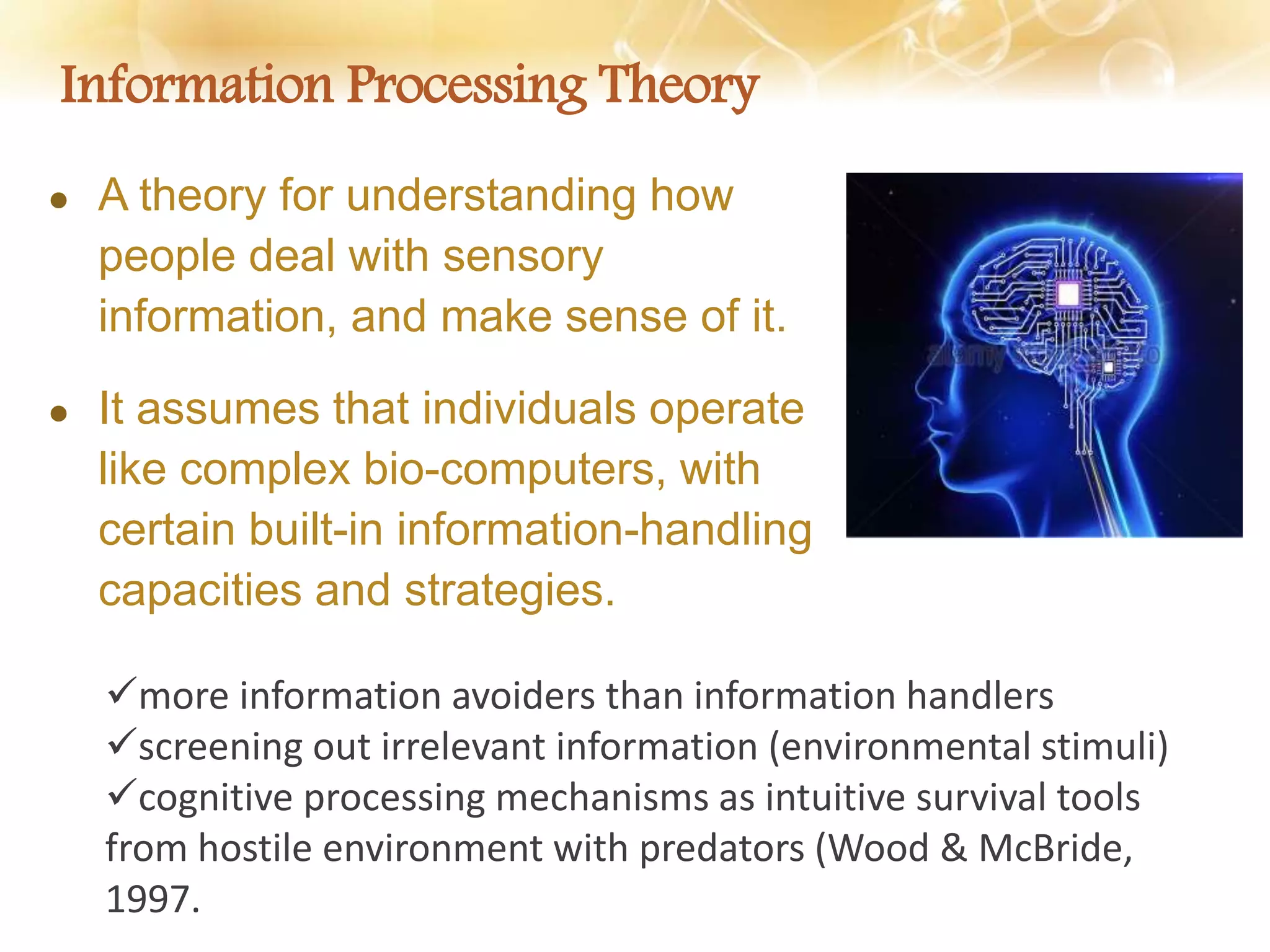
 A theory for understanding how
people deal with sensory
information, and make sense of it.
 It assumes that individuals operate
like complex bio-computers, with
certain built-in information-handling
capacities and strategies.
more information avoiders than information handlers
screening out irrelevant information (environmental stimuli)
cognitive processing mechanisms as intuitive survival tools
from hostile environment with predators (Wood & McBride,
1997.
Information Processing Theory
Research example:
Total Cell phone Use and Academic Performance
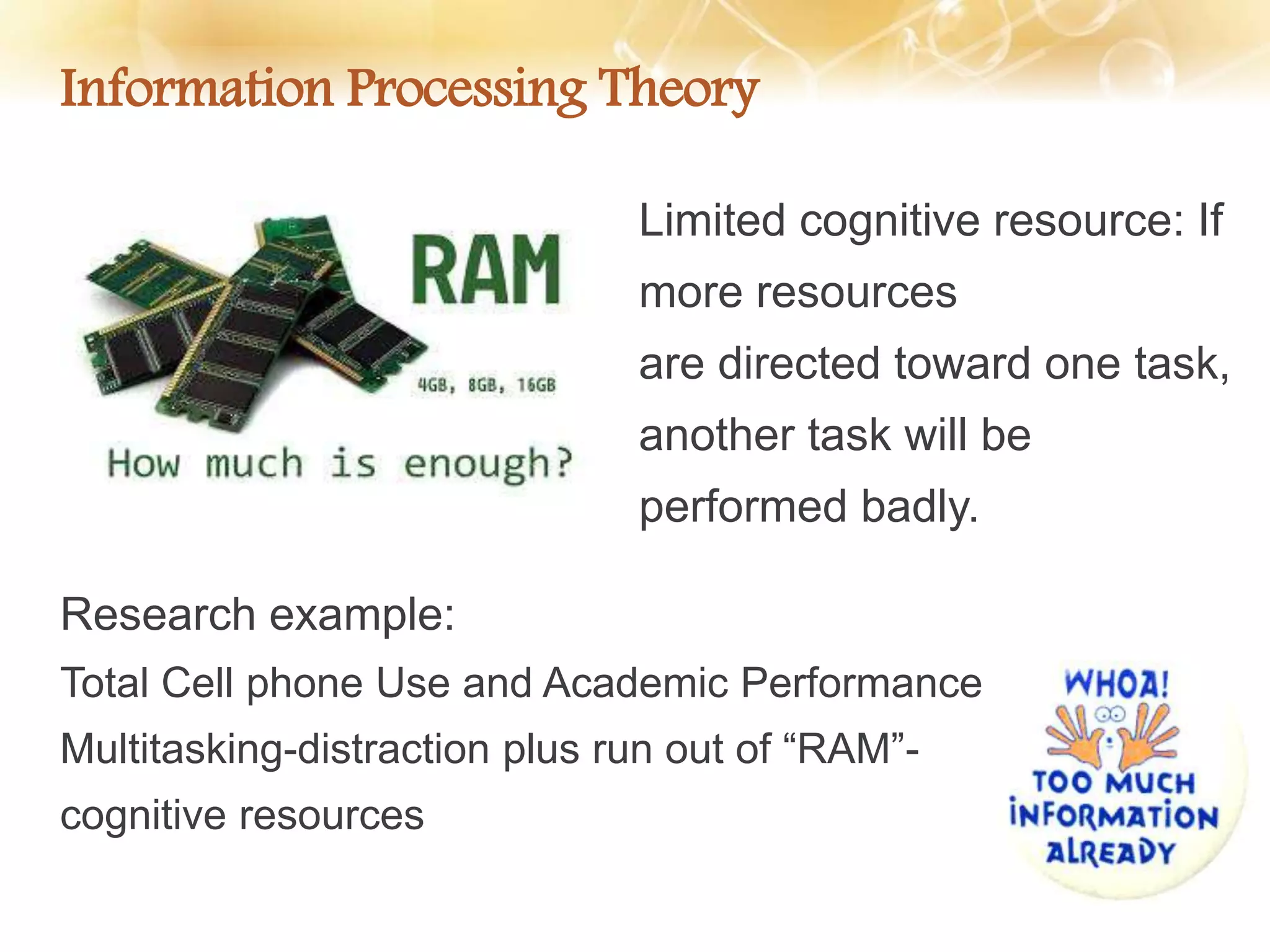
Multitasking-distraction plus run out of “RAM”-
cognitive resources
Limited cognitive resource: If
more resources
are directed toward one task,
another task will be
performed badly.
 Entertainment V.S. News
 People have developed
information processing skills
and strategies to make
sense of the entertainment
content but that interfere
with effective interpretation
and recall of news.
 Question:
 How do you understand the
above statement?
 Too many stories
 Too much information
 Too little time
 Poorly structured and less
appealing stories (narratives)
 Irrelevant information
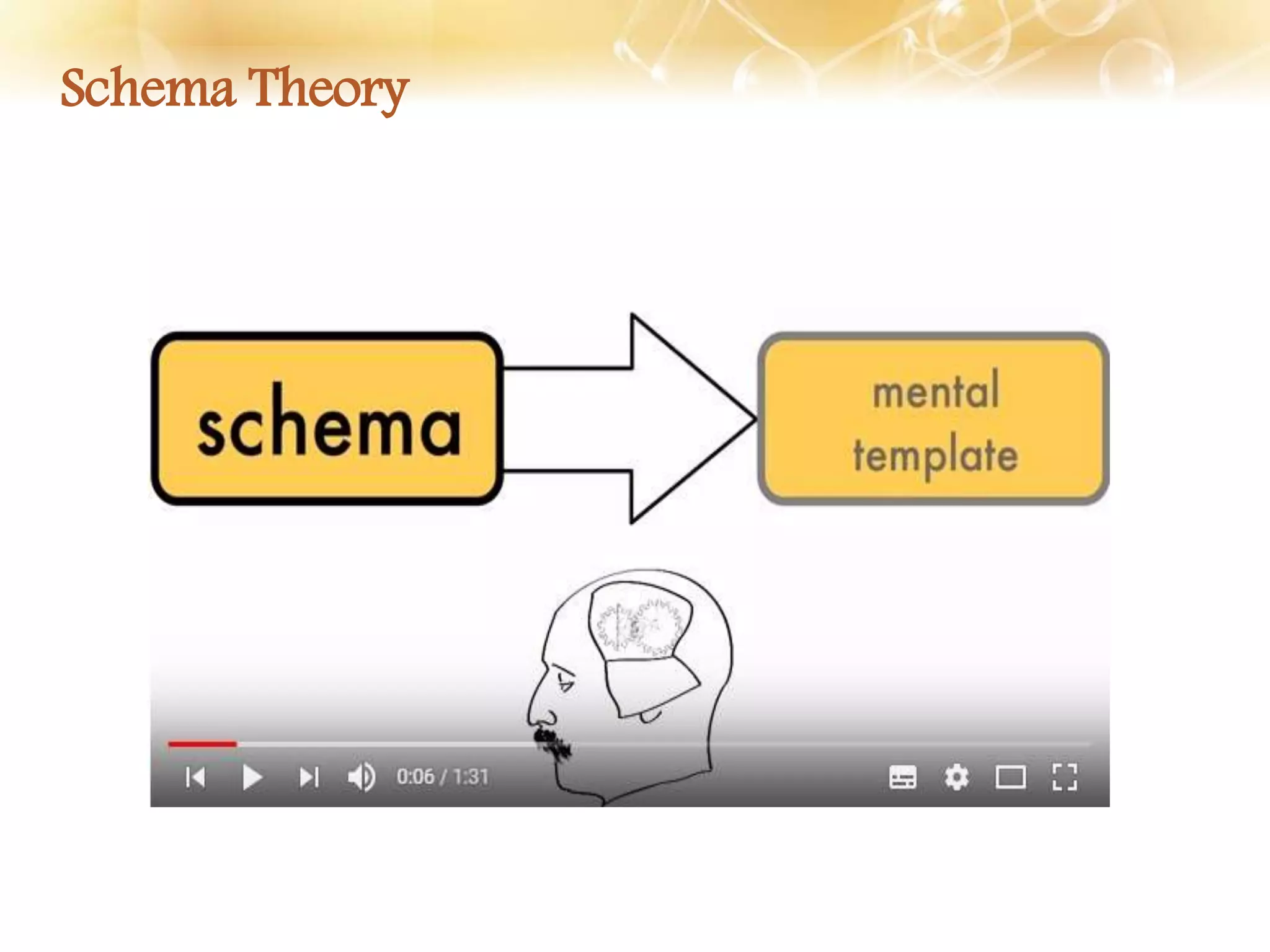
Schema Theory
Schema Theory
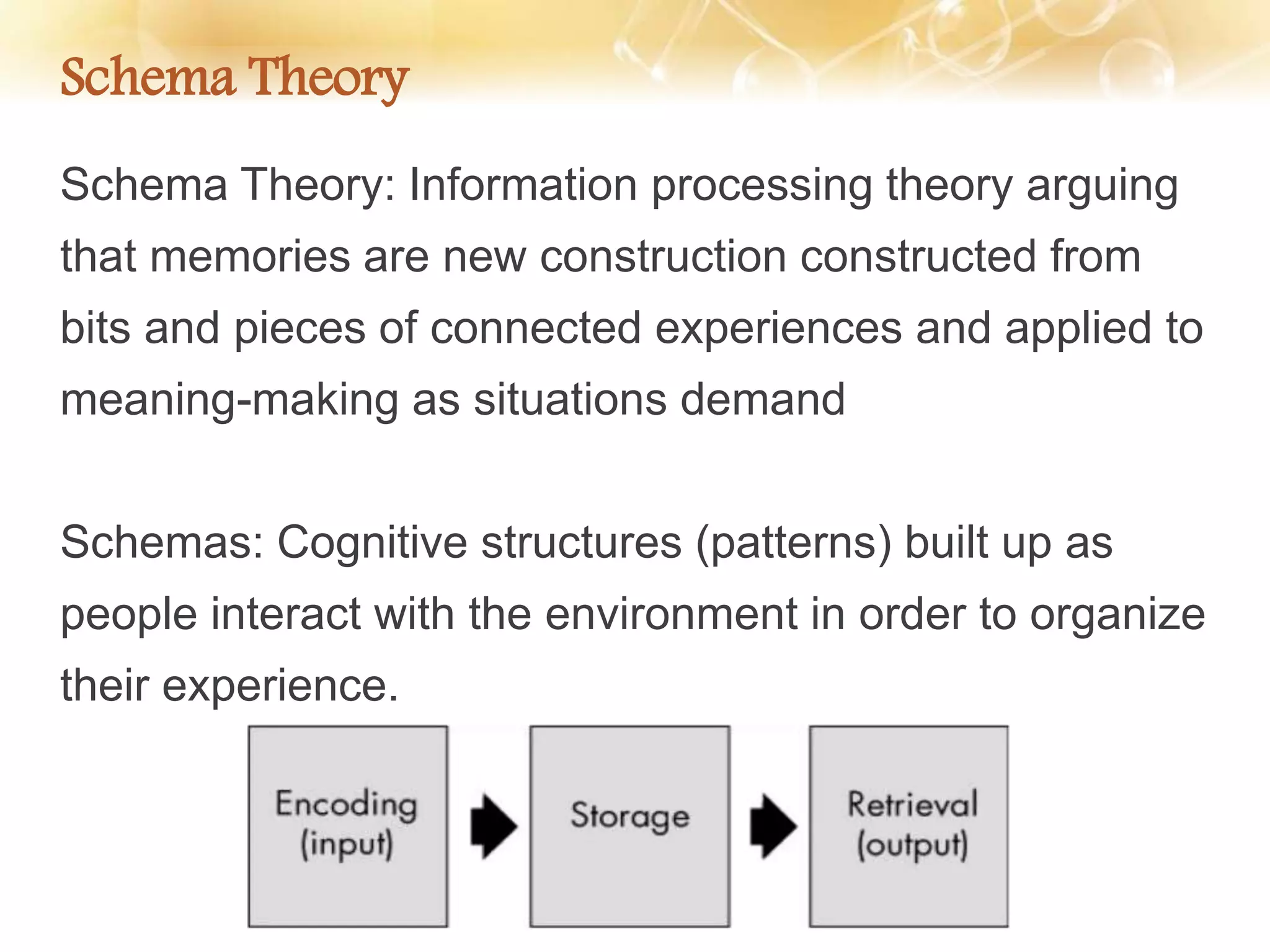
Schema Theory: Information processing theory arguing
that memories are new construction constructed from
bits and pieces of connected experiences and applied to
meaning-making as situations demand
Schemas: Cognitive structures (patterns) built up as
people interact with the environment in order to organize
their experience.
Schema Theory
 Doris Graber
 Schemas' Four functions for news consumers
1. They determine what information will be noticed,
processed, and stored so that it becomes available
for later retrieval from memory.
2. They help people organize and evaluate new
information, fitting it into their already-established
perceptions. People do not have to construct new
concepts when familiar information is presented in
the news.
Schema Theory
 Doris Graber
 Schemas' Four functions for news consumers
3. They make it possible for people to go beyond the
immediate information presented in news report,
helping them fill in missing information.
4. They help people solve problems because they
contain information about likely scenarios and ways
to cope with them; that is, they serve as scripts. This
makes them important tools in helping people decide
how to act.
 Scripts: Forms of schema, a standardized generalized
episode.
Schema Theory
 Example 1:
 Voters/news consumers making sense of news
 Paid selective attention to extract political knowledge
 Searched related information
 Brought well-formed schemas to the interpretation of
political news
1. Simple situation Sequences
2. Cause-and-Effect Sequences
3. Personal Judgement
4. Institution Judgement
5. Cultrual Norms and American Interests
Schema Theory
 Example 2:
 Schema-inconsistent advertising
 Surprise the audience with unexpected patterns
Questions:
1: Any examples from TV advertisement??
2: What techniques did those advertisements employ
to get the message into the viewers' cognition?
link
Schema Theory
Hostile Media Effect
 Idea that partisans see media as less
sympathetic to their side, more sympathetic to
the opposing side, and generally hostile to their
point of view.
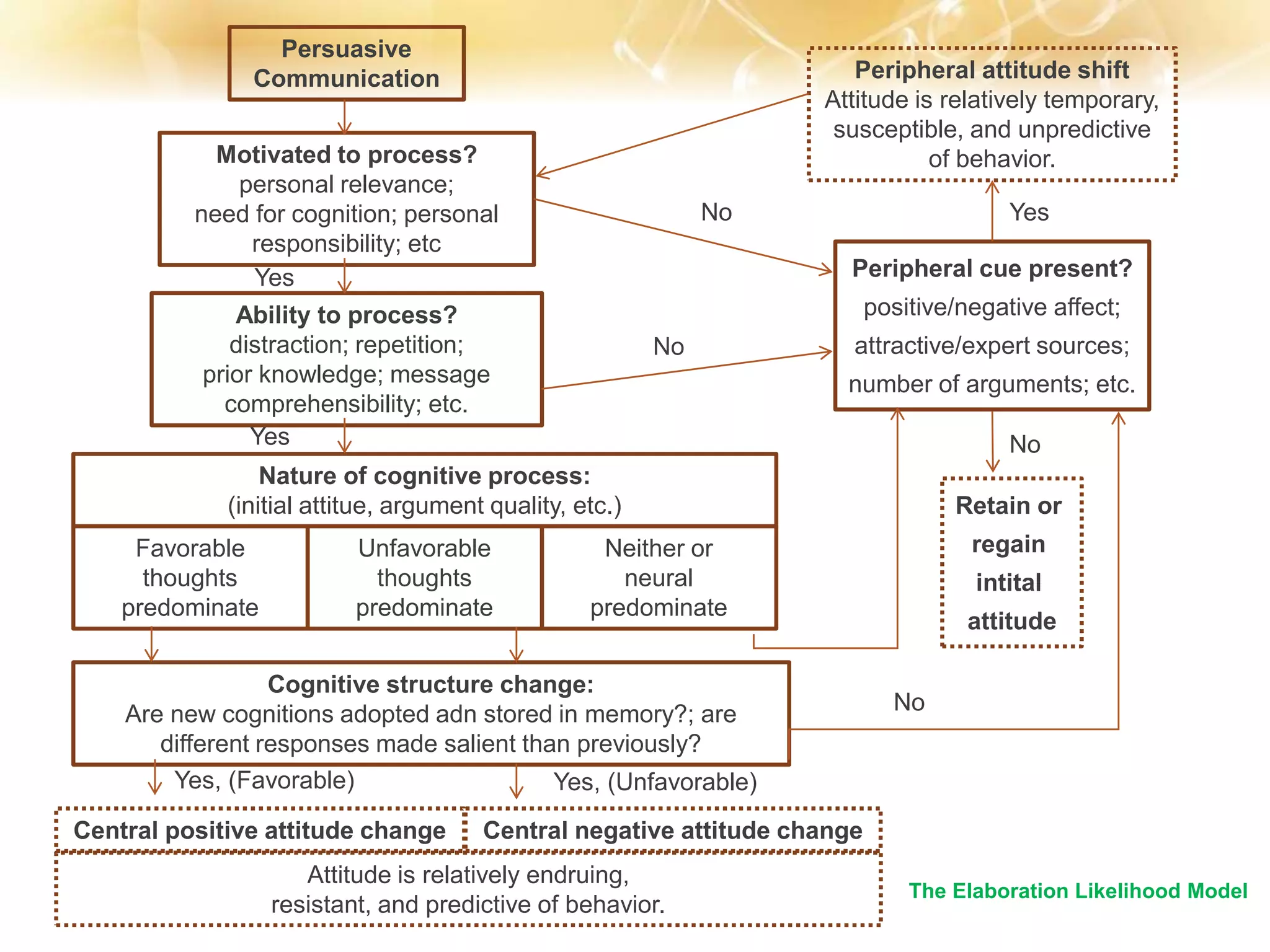
Persuasive
Communication
Motivated to process?
personal relevance;
need for cognition; personal
responsibility; etc
Ability to process?
distraction; repetition;
prior knowledge; message
comprehensibility; etc.
Nature of cognitive process:
(initial attitue, argument quality, etc.)
Favorable
thoughts
predominate
Unfavorable
thoughts
predominate
Neither or
neural
predominate
Cognitive structure change:
Are new cognitions adopted adn stored in memory?; are
different responses made salient than previously?
Central positive attitude change
Attitude is relatively endruing,
resistant, and predictive of behavior.
Central negative attitude change
Yes, (Favorable) Yes, (Unfavorable)
Yes
Yes
Peripheral attitude shift
Attitude is relatively temporary,
susceptible, and unpredictive
of behavior.
Peripheral cue present?
positive/negative affect;
attractive/expert sources;
number of arguments; etc.
Retain or
regain
intital
attitude
Yes
No
No
No
No
The Elaboration Likelihood Model
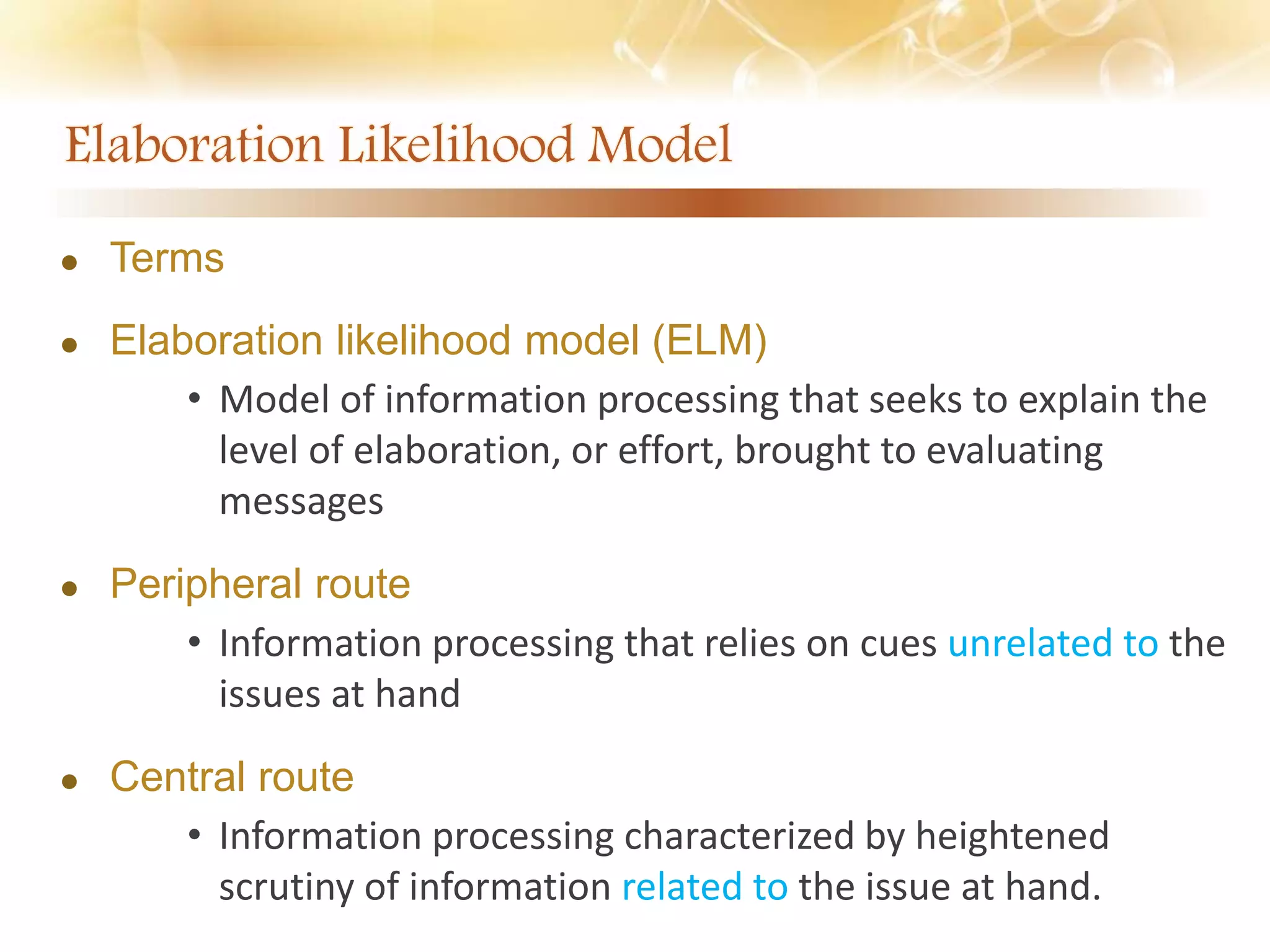
 Terms
 Elaboration likelihood model (ELM)
• Model of information processing that seeks to explain the
level of elaboration, or effort, brought to evaluating
messages
 Peripheral route
• Information processing that relies on cues unrelated to the
issues at hand
 Central route
• Information processing characterized by heightened
scrutiny of information related to the issue at hand.
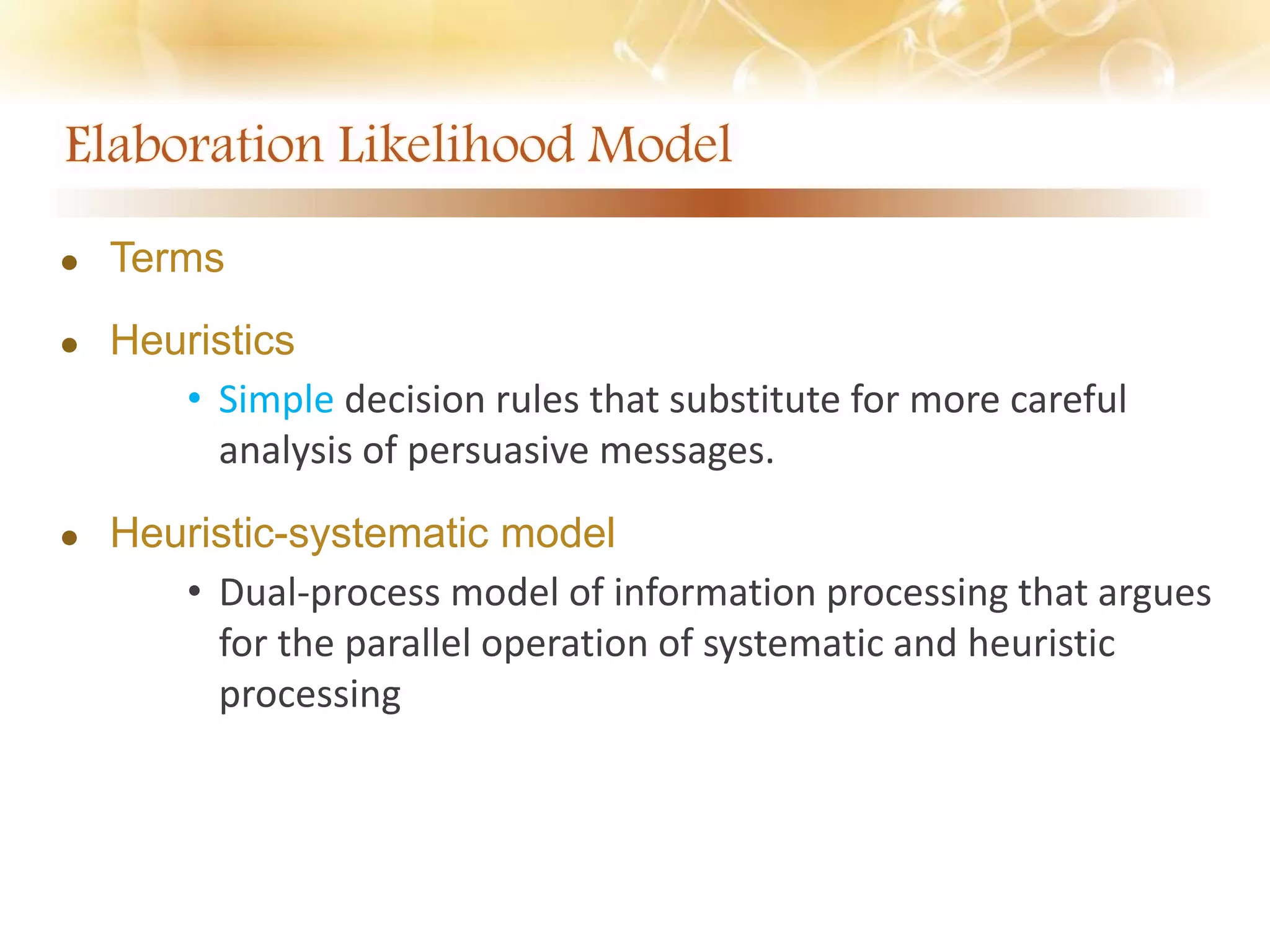
 Terms
 Heuristics
• Simple decision rules that substitute for more careful
analysis of persuasive messages.
 Heuristic-systematic model
• Dual-process model of information processing that argues
for the parallel operation of systematic and heuristic
processing
 Applications
1. Research trails in scores of settings
2. Information campaigns
 The theory that argues that being “absorbed” into
a media narrative “is a key mechanism whereby
the story can influence one's real-world beliefs
and behaviors.... Once individuals become
immersed in the story, perceive it as a realistic,
and identify with story characters, there is a
greater probability that narrative-based belief
change will occur” (Kim et al., 2012, p. 473)
 Transportation (Green & Brock, 2000)
 “a convergent process, where all the person's mental systems
and capacities become focused on the events in the narrative”
 Identification (Cohen, 2001)
 “An imaginative process through which an audience member
assumes the identity, goals, and perspectives of a character”
 Involves a cognitive response (perceived similarity) and an
emotional response (empathy).
 Sheila Murphy
1. The audience member loses awareness of his or
her surroundings and all cognitive facilities are
focused entirely on the mediated world.
2. Transported viewers feel heightened 'emotions and
motivations'...A transported viewer is so completely
immersed in the media world that his or her
responses to narrative events are strong, as though
they were actually experiencing those events.
3. When viewers emerge from the transported state,
they are often changed as a result of being so
deeply engrossed in the narrative.
Example 1:
 Smoking quitting (Hyun Suk Kim and his colleagues, 2012)
 “Smokers who read a news article in which an examplar
served as a delivery vehicle for health information about
successful smoking cessation experienced a greater degree
of engagement with the story and its characters, which in turn
was associated with elevated quit intentions, compared to
those exposed to an article with no exemplar”.
Example 2:
 Cervical cancer and the need for Pap tests (Murphy et al.,
2013)
 Comparing the effectiveness of a specifically prepared
dramatic narrative video (The Tamale Lesson) and a
nonfiction narrative featuring doctors, health experts, and
charts (It's Time) in imparting information
 Thes result indicates “both were successful in raising
awareness of cervical cancer and creating positive attitudes
toward testing”. However, “the fictional narrative was more
effective, especially as viewers' level of transportation
increased”.
Example 3:
 The effect of entertainment television on intention to become
an organ donor (Susan Morgan & colleagues, 2009)
 Employing actual episodes of prime-time network programs
CSI:NY, Numb3rs, House, and Grey's Anatomy, each of
which had organ donation as a plot line, they argued that “the
influence of the media on modeling behaviors is likely to be
depended on how emotionally involving and absorbing people
find a particular episode”.
 “emotional involvement in these programs (transportation and
identification) significantly affected intention to talk to
someone about organ donation, urging others to become
organ donors, and deciding to become an organ donor”.
Extended Elaboration Likelihood Model (E-ELM)
 Absorption in a narrative and response to its characters in a
narrative enhance persuasive effects and suppress
counterarguing if the story's implicitly persuasive content is
conterattitudinal.
Entertainment-education (EE)
 Occurs when prosocial messages are embedded in popular
media content.
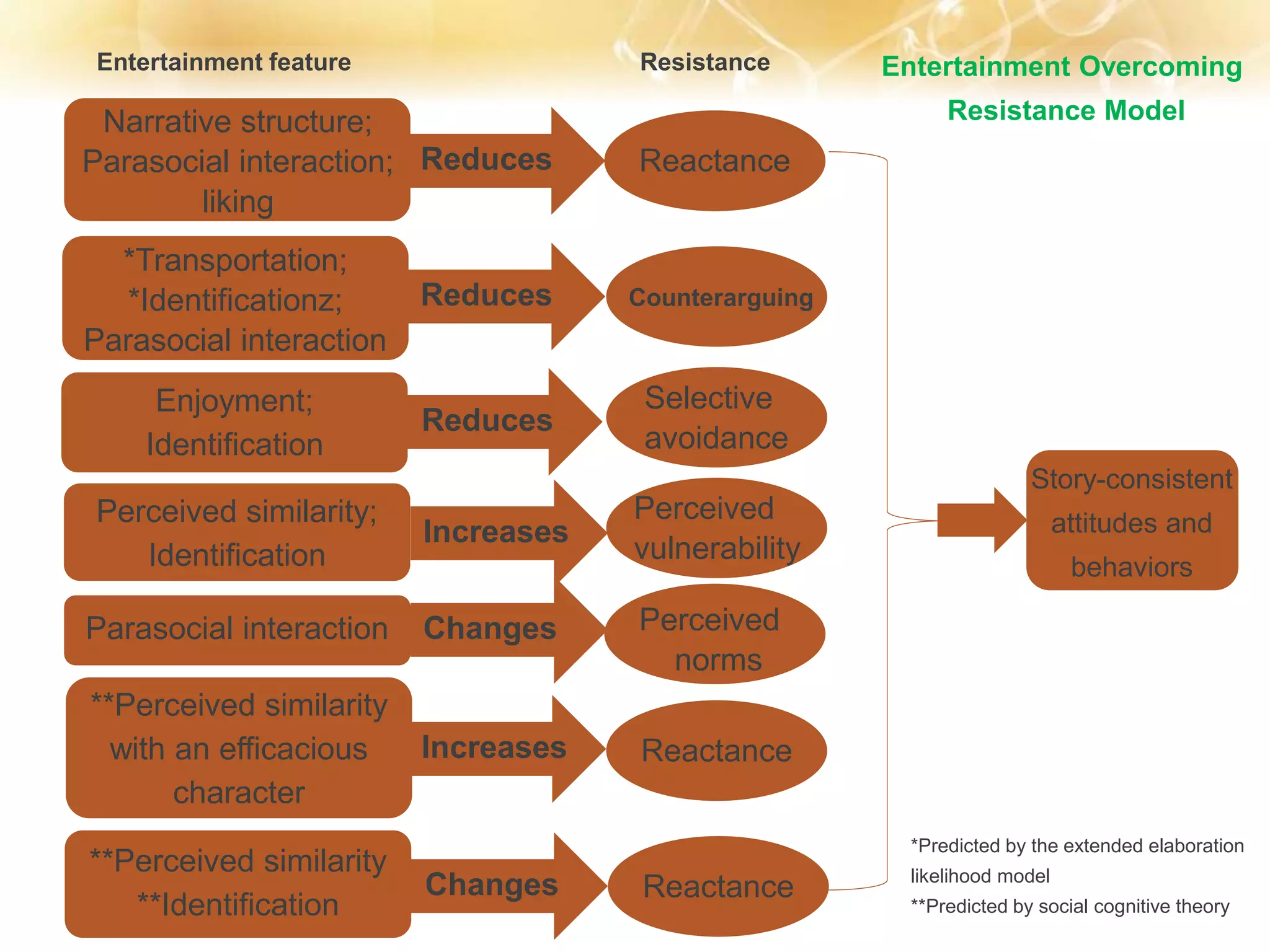
Entertainment Overcoming Resistance Model
 Entertainment media features can facilitate involvement
with characters and/ or narrative involvement leading to
story-consistent attitudes and behaviors by overcoming
various forms of resistance.
*Predicted by the extended elaboration
likelihood model
**Predicted by social cognitive theory
*Transportation;
*Identificationz;
Parasocial interaction
Enjoyment;
Identification
Narrative structure;
Parasocial interaction;
liking
Perceived similarity;
Identification
**Perceived similarity
**Identification
**Perceived similarity
with an efficacious
character
Parasocial interaction
Reduces
Reduces
Reduces
Increases
Changes
Increases
Changes
Reactance
Counterarguing
Reactance
Selective
avoidance
Perceived
norms
Perceived
vulnerability
Reactance
Story-consistent
attitudes and
behaviors
Entertainment feature Resistance Entertainment Overcoming
Resistance Model
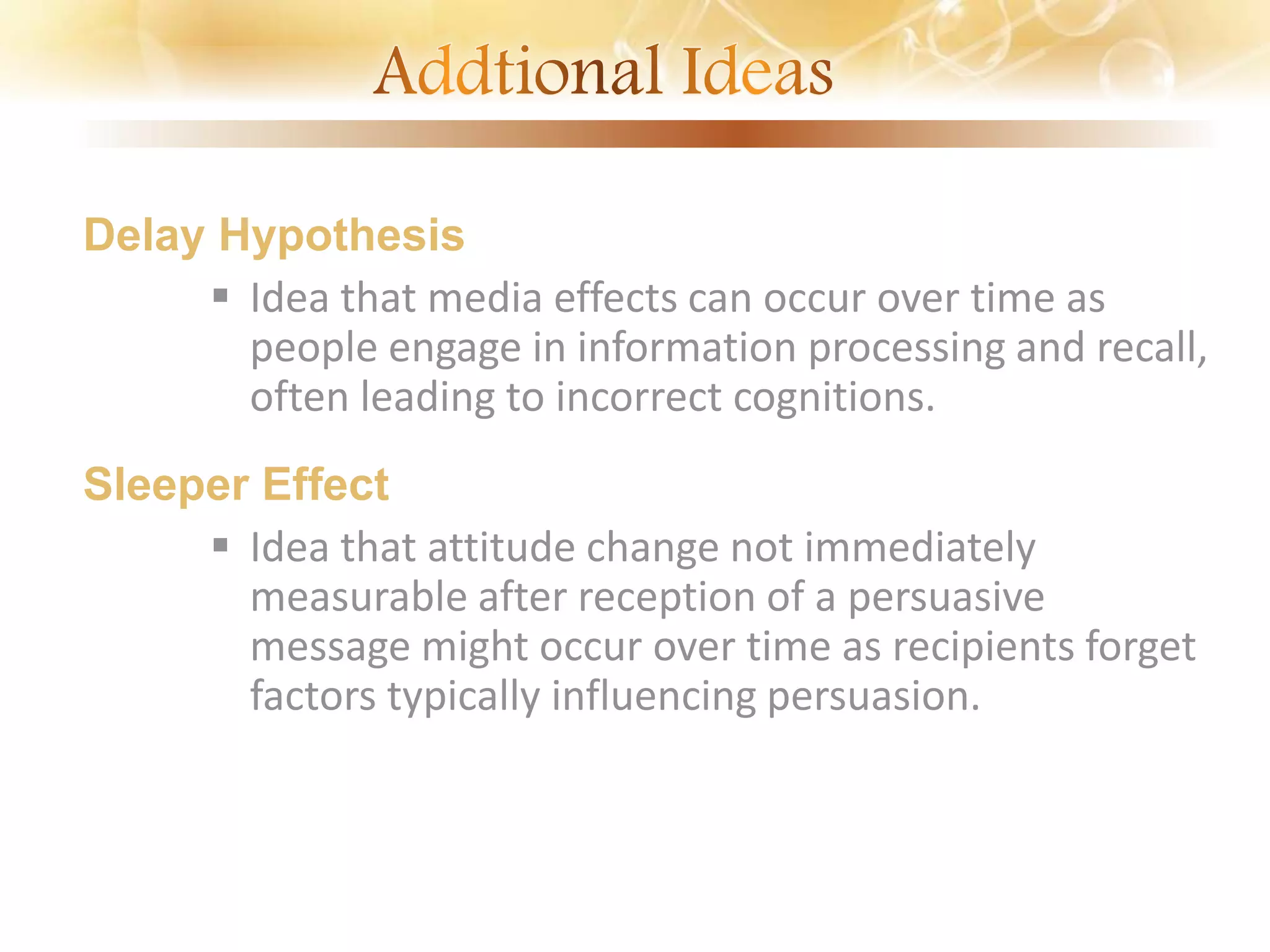
Delay Hypothesis
 Idea that media effects can occur over time as
people engage in information processing and recall,
often leading to incorrect cognitions.
Sleeper Effect
 Idea that attitude change not immediately
measurable after reception of a persuasive
message might occur over time as recipients forget
factors typically influencing persuasion.
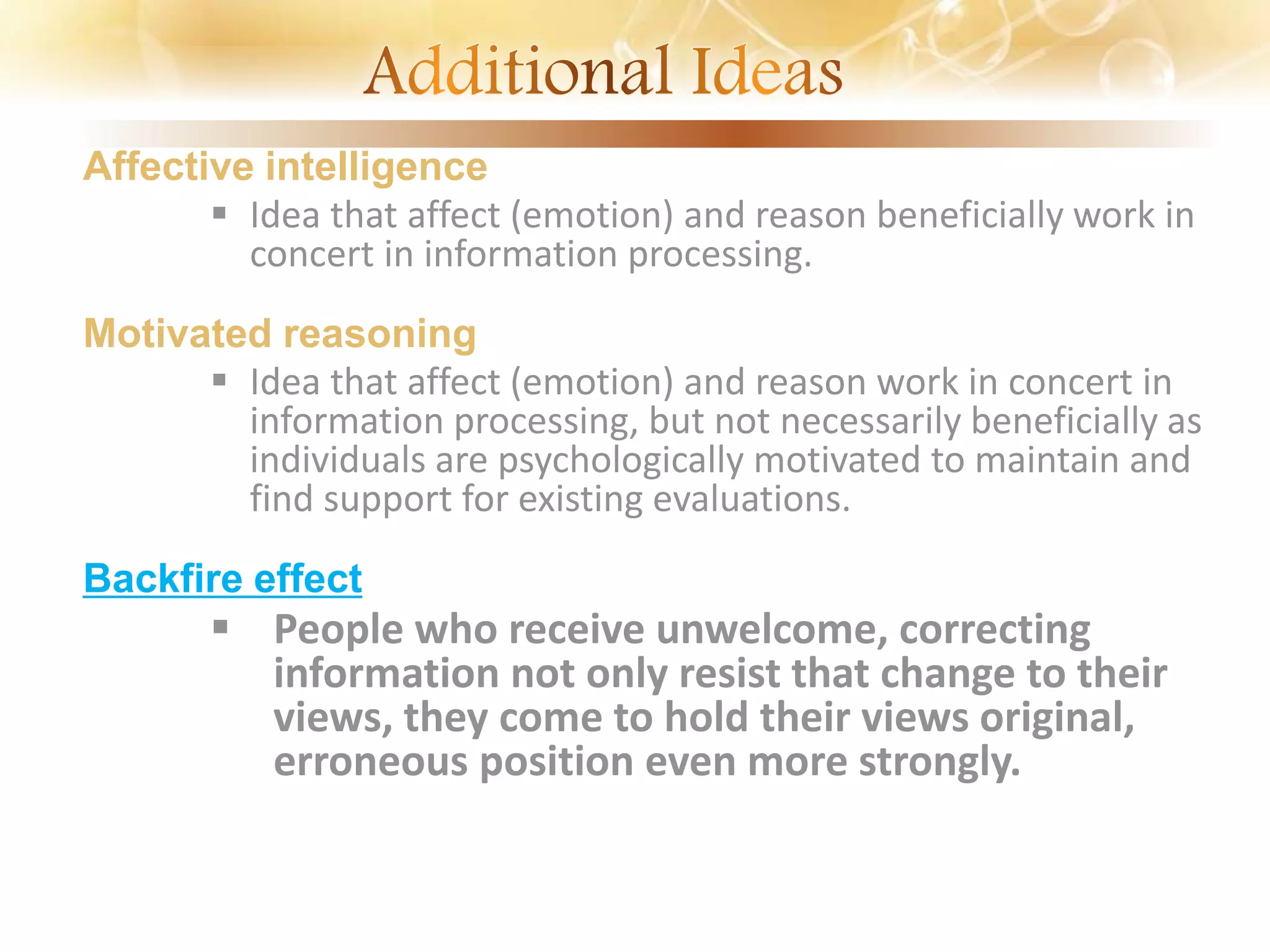
Affective intelligence
 Idea that affect (emotion) and reason beneficially work in
concert in information processing.
Motivated reasoning
 Idea that affect (emotion) and reason work in concert in
information processing, but not necessarily beneficially as
individuals are psychologically motivated to maintain and
find support for existing evaluations.
Backfire effect
 People who receive unwelcome, correcting
information not only resist that change to their
views, they come to hold their views original,
erroneous position even more strongly.
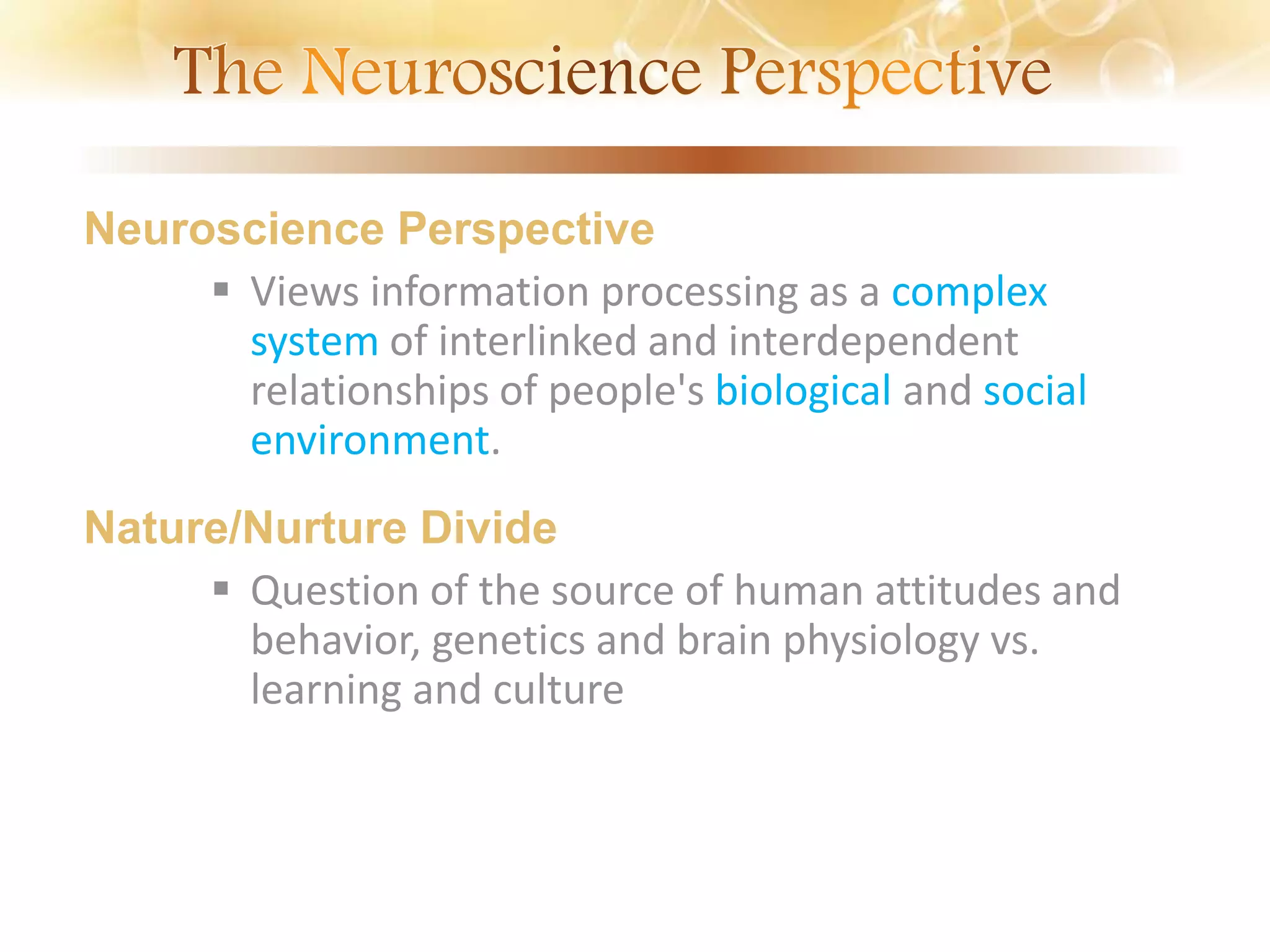
Neuroscience Perspective
 Views information processing as a complex
system of interlinked and interdependent
relationships of people's biological and social
environment.
Nature/Nurture Divide
 Question of the source of human attitudes and
behavior, genetics and brain physiology vs.
learning and culture
Neuromarketing Research
 Marketers' use of biometric measures to
find the “magic keys” to consumers
behavior.
Top-down/Bottom-up theory of political attitude
formation
 Ideological preferences are products of
environmental conditions (top-down) and
internal predispositions (bottom-up) that
motivate people to hold liberal or conservative
policy preferences.
It's more or less if not all about
getting information acrossed or processed.
1. We are humans who must interact with and
make sense of a complex world.
2. Messages from the mass media constitute
a very large part of that interaction and complexity.
3. We are actually pretty good at processing
the content we consume.

Chapter 8: Theories of Media Cognition and Information Processing (final version)-Toby Zhu

  • 1.
    Chapter 8: Theories ofMedia Cognition and Information Processing Toby Zhu 10/10/2017
  • 2.
     Mass Communication message  medium  producer  receivers  social, economic,cultural milieu  Pedagogy  teaching and learning content  curriculum  teacher  students  social,economic,cultural milieu third parties: parents, government, churches, etc gatekeepers: It's more or less if not all about getting information acrossed or processed.
  • 3.
    Information Processing Theory A theory for understanding how people deal with sensory information, and make sense of it.  It assumes that individuals operate like complex bio-computers, with certain built-in information-handling capacities and strategies. more information avoiders than information handlers screening out irrelevant information (environmental stimuli) cognitive processing mechanisms as intuitive survival tools from hostile environment with predators (Wood & McBride, 1997.
  • 4.
    Information Processing Theory Researchexample: Total Cell phone Use and Academic Performance Multitasking-distraction plus run out of “RAM”- cognitive resources Limited cognitive resource: If more resources are directed toward one task, another task will be performed badly.
  • 5.
     Entertainment V.S.News  People have developed information processing skills and strategies to make sense of the entertainment content but that interfere with effective interpretation and recall of news.  Question:  How do you understand the above statement?  Too many stories  Too much information  Too little time  Poorly structured and less appealing stories (narratives)  Irrelevant information
  • 6.
  • 7.
    Schema Theory Schema Theory:Information processing theory arguing that memories are new construction constructed from bits and pieces of connected experiences and applied to meaning-making as situations demand Schemas: Cognitive structures (patterns) built up as people interact with the environment in order to organize their experience.
  • 8.
    Schema Theory  DorisGraber  Schemas' Four functions for news consumers 1. They determine what information will be noticed, processed, and stored so that it becomes available for later retrieval from memory. 2. They help people organize and evaluate new information, fitting it into their already-established perceptions. People do not have to construct new concepts when familiar information is presented in the news.
  • 9.
    Schema Theory  DorisGraber  Schemas' Four functions for news consumers 3. They make it possible for people to go beyond the immediate information presented in news report, helping them fill in missing information. 4. They help people solve problems because they contain information about likely scenarios and ways to cope with them; that is, they serve as scripts. This makes them important tools in helping people decide how to act.  Scripts: Forms of schema, a standardized generalized episode.
  • 10.
    Schema Theory  Example1:  Voters/news consumers making sense of news  Paid selective attention to extract political knowledge  Searched related information  Brought well-formed schemas to the interpretation of political news 1. Simple situation Sequences 2. Cause-and-Effect Sequences 3. Personal Judgement 4. Institution Judgement 5. Cultrual Norms and American Interests
  • 11.
    Schema Theory  Example2:  Schema-inconsistent advertising  Surprise the audience with unexpected patterns Questions: 1: Any examples from TV advertisement?? 2: What techniques did those advertisements employ to get the message into the viewers' cognition? link
  • 12.
    Schema Theory Hostile MediaEffect  Idea that partisans see media as less sympathetic to their side, more sympathetic to the opposing side, and generally hostile to their point of view.
  • 14.
    Persuasive Communication Motivated to process? personalrelevance; need for cognition; personal responsibility; etc Ability to process? distraction; repetition; prior knowledge; message comprehensibility; etc. Nature of cognitive process: (initial attitue, argument quality, etc.) Favorable thoughts predominate Unfavorable thoughts predominate Neither or neural predominate Cognitive structure change: Are new cognitions adopted adn stored in memory?; are different responses made salient than previously? Central positive attitude change Attitude is relatively endruing, resistant, and predictive of behavior. Central negative attitude change Yes, (Favorable) Yes, (Unfavorable) Yes Yes Peripheral attitude shift Attitude is relatively temporary, susceptible, and unpredictive of behavior. Peripheral cue present? positive/negative affect; attractive/expert sources; number of arguments; etc. Retain or regain intital attitude Yes No No No No The Elaboration Likelihood Model
  • 15.
     Terms  Elaborationlikelihood model (ELM) • Model of information processing that seeks to explain the level of elaboration, or effort, brought to evaluating messages  Peripheral route • Information processing that relies on cues unrelated to the issues at hand  Central route • Information processing characterized by heightened scrutiny of information related to the issue at hand.
  • 16.
     Terms  Heuristics •Simple decision rules that substitute for more careful analysis of persuasive messages.  Heuristic-systematic model • Dual-process model of information processing that argues for the parallel operation of systematic and heuristic processing
  • 17.
     Applications 1. Researchtrails in scores of settings 2. Information campaigns
  • 18.
     The theorythat argues that being “absorbed” into a media narrative “is a key mechanism whereby the story can influence one's real-world beliefs and behaviors.... Once individuals become immersed in the story, perceive it as a realistic, and identify with story characters, there is a greater probability that narrative-based belief change will occur” (Kim et al., 2012, p. 473)
  • 19.
     Transportation (Green& Brock, 2000)  “a convergent process, where all the person's mental systems and capacities become focused on the events in the narrative”  Identification (Cohen, 2001)  “An imaginative process through which an audience member assumes the identity, goals, and perspectives of a character”  Involves a cognitive response (perceived similarity) and an emotional response (empathy).
  • 20.
     Sheila Murphy 1.The audience member loses awareness of his or her surroundings and all cognitive facilities are focused entirely on the mediated world. 2. Transported viewers feel heightened 'emotions and motivations'...A transported viewer is so completely immersed in the media world that his or her responses to narrative events are strong, as though they were actually experiencing those events. 3. When viewers emerge from the transported state, they are often changed as a result of being so deeply engrossed in the narrative.
  • 21.
    Example 1:  Smokingquitting (Hyun Suk Kim and his colleagues, 2012)  “Smokers who read a news article in which an examplar served as a delivery vehicle for health information about successful smoking cessation experienced a greater degree of engagement with the story and its characters, which in turn was associated with elevated quit intentions, compared to those exposed to an article with no exemplar”.
  • 22.
    Example 2:  Cervicalcancer and the need for Pap tests (Murphy et al., 2013)  Comparing the effectiveness of a specifically prepared dramatic narrative video (The Tamale Lesson) and a nonfiction narrative featuring doctors, health experts, and charts (It's Time) in imparting information  Thes result indicates “both were successful in raising awareness of cervical cancer and creating positive attitudes toward testing”. However, “the fictional narrative was more effective, especially as viewers' level of transportation increased”.
  • 23.
    Example 3:  Theeffect of entertainment television on intention to become an organ donor (Susan Morgan & colleagues, 2009)  Employing actual episodes of prime-time network programs CSI:NY, Numb3rs, House, and Grey's Anatomy, each of which had organ donation as a plot line, they argued that “the influence of the media on modeling behaviors is likely to be depended on how emotionally involving and absorbing people find a particular episode”.  “emotional involvement in these programs (transportation and identification) significantly affected intention to talk to someone about organ donation, urging others to become organ donors, and deciding to become an organ donor”.
  • 24.
    Extended Elaboration LikelihoodModel (E-ELM)  Absorption in a narrative and response to its characters in a narrative enhance persuasive effects and suppress counterarguing if the story's implicitly persuasive content is conterattitudinal. Entertainment-education (EE)  Occurs when prosocial messages are embedded in popular media content. Entertainment Overcoming Resistance Model  Entertainment media features can facilitate involvement with characters and/ or narrative involvement leading to story-consistent attitudes and behaviors by overcoming various forms of resistance.
  • 25.
    *Predicted by theextended elaboration likelihood model **Predicted by social cognitive theory *Transportation; *Identificationz; Parasocial interaction Enjoyment; Identification Narrative structure; Parasocial interaction; liking Perceived similarity; Identification **Perceived similarity **Identification **Perceived similarity with an efficacious character Parasocial interaction Reduces Reduces Reduces Increases Changes Increases Changes Reactance Counterarguing Reactance Selective avoidance Perceived norms Perceived vulnerability Reactance Story-consistent attitudes and behaviors Entertainment feature Resistance Entertainment Overcoming Resistance Model
  • 26.
    Delay Hypothesis  Ideathat media effects can occur over time as people engage in information processing and recall, often leading to incorrect cognitions. Sleeper Effect  Idea that attitude change not immediately measurable after reception of a persuasive message might occur over time as recipients forget factors typically influencing persuasion.
  • 27.
    Affective intelligence  Ideathat affect (emotion) and reason beneficially work in concert in information processing. Motivated reasoning  Idea that affect (emotion) and reason work in concert in information processing, but not necessarily beneficially as individuals are psychologically motivated to maintain and find support for existing evaluations. Backfire effect  People who receive unwelcome, correcting information not only resist that change to their views, they come to hold their views original, erroneous position even more strongly.
  • 28.
    Neuroscience Perspective  Viewsinformation processing as a complex system of interlinked and interdependent relationships of people's biological and social environment. Nature/Nurture Divide  Question of the source of human attitudes and behavior, genetics and brain physiology vs. learning and culture
  • 29.
    Neuromarketing Research  Marketers'use of biometric measures to find the “magic keys” to consumers behavior. Top-down/Bottom-up theory of political attitude formation  Ideological preferences are products of environmental conditions (top-down) and internal predispositions (bottom-up) that motivate people to hold liberal or conservative policy preferences.
  • 30.
    It's more orless if not all about getting information acrossed or processed. 1. We are humans who must interact with and make sense of a complex world. 2. Messages from the mass media constitute a very large part of that interaction and complexity. 3. We are actually pretty good at processing the content we consume.